Deep in the mountains of Gangwon Province, in Korea’s rugged northeast, there’s a small county that people travel a long way to reach: Jeongseon (정선). They come to coast down old railway lines on rail bikes, to wander the stalls of its famous five-day market, and to catch a few wistful notes of Jeongseon Arirang — one of Korea’s most beloved folk songs — drifting between the peaks.

⭐ Jeongseon at a glance
| 🏔️ Sights & things to do | ★★★★☆ |
| 🍚 Food | ★★★☆☆ |
| 🚆 Easy to reach | ★★☆☆☆ |
A personal take based on our own experience — the variety of things to see, the taste, and the travel time involved. Yours may well differ.
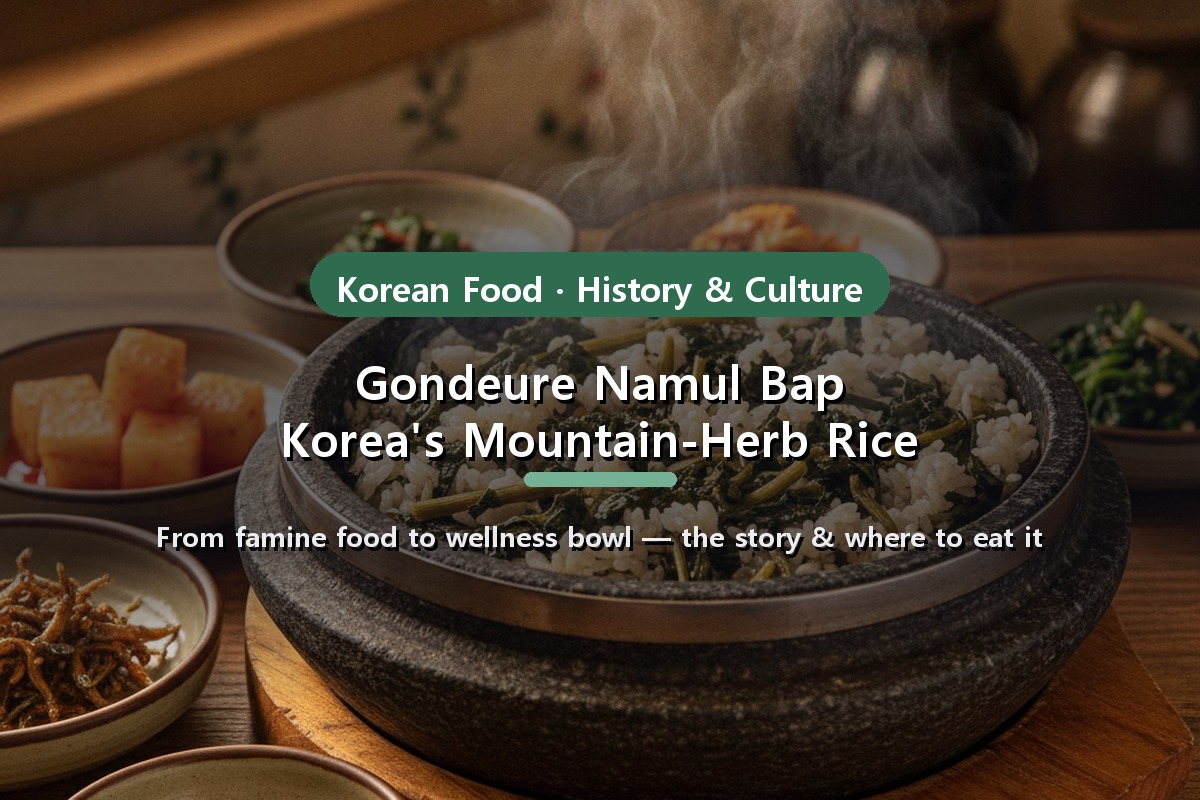
And when the mountain air leaves them hungry, there’s one dish the locals steer them toward: gondeure namul bap (곤드레나물밥). The first time a bowl landed in front of me, I almost underestimated it — plain white rice, flecked with dark green herbs, steaming in a hot stone pot. It looked like the kind of quiet, healthy thing you order to feel virtuous. What I didn’t know was that this humble bowl carries one of the heavier histories on the Korean table.

First — what is gondeure namul bap?
At its simplest, gondeure namul bap is rice steamed together with gondeure — a wild mountain green from the steep highlands of Gangwon Province, in Korea’s northeast. The plant’s proper name is Korean thistle (곤드레 is the Gangwon dialect word for it), and it’s foraged fresh around May, when the young leaves are at their most tender.
Cook it into rice, usually in a sizzling stone pot, and the greens perfume every grain — earthy, gently nutty, deeply comforting. It’s the kind of bowl that tastes like it’s doing you good, because, honestly, it is.
Why gondeure, out of all the mountain greens?

Korea has hundreds of wild mountain greens (we call them sannamul), and a lot of them are bitter, tough, or an acquired taste. Gondeure is the friendly one. It’s soft, mild, and barely bitter, which is exactly why it folds into rice so beautifully instead of fighting it.
There’s one more quality that matters more than you’d think, and we’ll come back to it: gondeure is remarkably gentle on the stomach, even when you eat a lot of it. Hold that thought.
How to eat it like a local

Like a lot of great Korean rice dishes, it arrives almost undressed, and the finishing is your job. Every table comes with a little bowl of yangnyeom-ganjang — soy sauce loosened with sesame oil, chopped scallion, a touch of chili and garlic.
You spoon that over the rice and mix, thoroughly, until every grain is glossy and seasoned. The way I see it, that’s the whole ritual.
The greens come pre-seasoned
Here’s a detail that surprised me. The gondeure is usually dressed before it ever meets the rice — cooks toss the blanched greens with perilla oil and a little guk-ganjang, a lighter, saltier soup soy sauce, then steam them right into the pot. So the bowl arrives fragrant and gently savory on its own. The sauce you stir in at the table just builds on that.
Try a splash of perilla oil
Many locals (me included) add a little deulgireum — toasted perilla oil — along with the soy sauce. It deepens that nutty, earthy note and, in my experience, is the single thing that takes the bowl from nice to genuinely craveable. Some spots also serve a thick soybean paste (gangdoenjang) on the side to stir in.
Don’t be shy with the mixing
Mix it more than feels necessary. The greens, the seasoned soy, the oil, the rice at the bottom of the stone pot slowly turning crisp — you want all of it in every spoonful.
The twist: from famine food to wellness bowl
Here’s the part that stopped me short. This dish that people now order to eat well — clean, healthy, mindful — was born out of the opposite. It was food for surviving when there was almost nothing else.
A food of the spring famine

Through the 1960s and 70s, late spring in rural Korea meant the boritgogae — the “barley hump,” a hungry stretch when last year’s grain had run out and the new harvest wasn’t in yet. In the steep valleys around Jeongseon, in Gangwon, one thing grew wild and abundant right when people needed it most: gondeure.
So families did what they had to. They gathered armfuls of the greens and stretched a little precious grain as far as it would go, mixing gondeure into every pot of rice to make it fill more mouths.
Why gondeure carried them through
Now that thought I asked you to hold. Gondeure’s mildness wasn’t just pleasant — it was the reason it worked as survival food. It was gentle enough to eat at nearly every meal without turning the stomach, so a family could lean on it day after day when little else was available.
It sank so deep into the life of the region that it even turns up in the lyrics of Jeongseon Arirang, the area’s famous, wistful folk song. A green that fed people through the hard years, sung about like an old companion.
How survival food became a delicacy

The turn came in the 1990s. As Jeongseon’s traditional five-day market began drawing visitors from the cities, those visitors got hungry — and the dish waiting for them was gondeure namul bap. What had once meant scarcity was suddenly a taste of somewhere authentic, rooted, and mountain-fresh.
Today it’s prized as a wellness food — fiber-rich, wholesome, and loved for exactly the mild, earthy flavor that once made it a lifeline. I find that reversal quietly moving: the same humble bowl, carried from a symbol of going without to a small luxury of eating well.
🗓️ Plan your visit
When: Late spring — especially around May — is the sweet spot, when fresh gondeure floods the markets and the valleys turn deep green; autumn adds mountain foliage. Try to line it up with Jeongseon’s traditional five-day market, one of Korea’s best-known — much of its fame owes to the scenic tourist train that carries city visitors up into the mountains. It runs on dates ending in 2 and 7 (the 2nd, 7th, 12th, and so on), and on a market day the stalls overflow with mountain greens, wild herbs, and steaming pots of gondeure bap.
Getting there: From Incheon Airport it’s roughly a half-day — about 4–5 hours via Seoul: take the airport railroad into the city, then an intercity bus from Dong-Seoul terminal or a train from Cheongnyangni. The scenic Jeongseon Arirang tourist train runs on weekends and market days.
Costs: Spring and autumn are peak season across Korea, so flights and rooms climb and book out early — reserve ahead. Local guesthouses stay affordable, and midweek is easiest on the wallet.
Where to try it
One spot in the dish’s mountain heartland, one an easy trip from central Seoul:
Ssarigol Sikdang (싸리골식당) — in the heartland, Jeongseon
Right by Jeongseon’s famous five-day market, this is about as close to the source as you can eat. A simple, well-loved spot doing the classic bowl the way the region intended.
- 📍 Address: 1312 Jeongseon-ro, Jeongseon-eup, Jeongseon-gun, Gangwon (강원 정선군 정선읍 정선로 1312)
- 🕒 Hours: Tue–Sun 10:00–17:00 (closed Mondays)
- 🍚 Gondeure namul bap: ₩10,000 · Parking available
Cheonggyesan Gondeure-jip (청계산곤드레집) — Seoul, at the foot of a mountain
Fittingly for a mountain green, this Seoul favorite sits right at the entrance to Cheonggyesan, a hiking mountain on the city’s southern edge. It’s been serving gondeure to hungry hikers since 2004.
- 📍 Address: 195-16 Sinwon-dong, Seocho-gu, Seoul (서울 서초구 신원동 195-16)
- 🕒 Hours: Mon–Fri 11:00–20:30, Sat–Sun 10:00–20:30 (weekend break 15:30–17:30)
- 🍚 Gondeure namul bap: ₩11,000 · Free parking (valet available)
One honest caveat: prices and hours are accurate as of July 2026, but small restaurants change both more often than you’d expect. A quick check before you go never hurts.
A few quick questions
What does gondeure taste like?
Mild, nutty, and earthy — not bitter. It’s one of the most approachable Korean wild greens, which is a big part of why it works so well in rice.
Is it healthy?
It has a genuine reputation as a wholesome dish — the greens are known for fiber, calcium, and vitamin A — and that’s a fair part of its modern appeal. It’s still a hearty bowl of rice, though — so enjoy it as the comforting, nourishing meal it is.
Is it vegetarian-friendly?
Often, yes — the rice, greens, and soy-based seasoning are plant-based. But side dishes vary and some kitchens tweak the seasoning, so if you’re strict, it’s worth a quick ask.