
Gondeure namul bap (곤드레나물밥) does not announce itself like a festival dish. It is a bowl of rice threaded with soft mountain greens, usually served with a small dish of seasoned soy sauce. That restraint is exactly why the dish explains Jeongseon so well. The green is Cirsium setidens, known in Korean as gondeure, and government food-and-travel sources repeatedly identify it with Jeongseon’s highland landscape and market culture.
The story is stronger when it is read as a chain rather than an invention legend: mountains → edible greens → drying and storage → rice cookery → market circulation → regional identity. That chain explains why a modest plant-and-rice combination can become a place-defining food without needing a royal origin story or a precise birth date.

What exactly is gondeure?
Gondeure is the Korean common name used for Cirsium setidens. It belongs to the thistle family, but the cooked leaves are much softer and gentler than the word “thistle” may suggest to an English-speaking diner. Korea.net identifies gondeure sold in Jeongseon’s market as Cirsium setidens, while VISITKOREA describes a Jeongseon restaurant specializing in rice cooked with the same plant and notes its connection to Gangwon’s alpine environment.
In the bowl, gondeure is not used like a raw salad green. The leaves are cooked until pliable, and their character is closer to other Korean namul: vegetables or wild greens prepared so that texture, aroma, seasoning, and rice can work together. Depending on the kitchen, the greens may be seasoned before cooking or folded into the rice with relatively little seasoning so that diners can adjust the final flavor at the table.
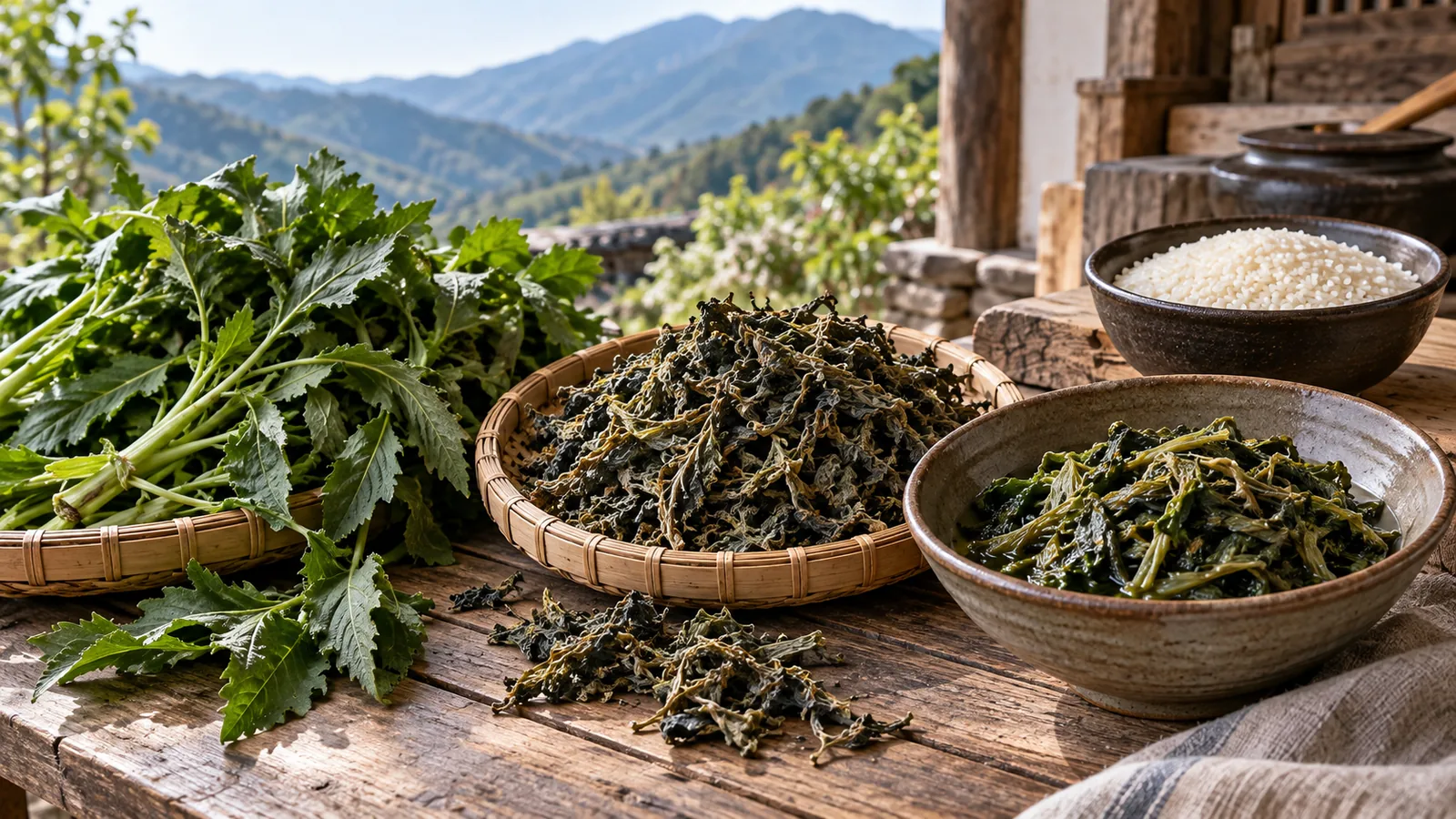
Fresh gondeure can have a greener, more immediate herbal aroma. Dried gondeure has a different advantage: it can be stored, transported, soaked, and cooked well beyond the short period when tender fresh leaves are available. That distinction matters because Jeongseon is not simply “a place where one herb grows.” It is a mountainous region where the ability to use, dry, and carry seasonal greens is part of the logic of local food.

Why Jeongseon’s landscape matters to the dish
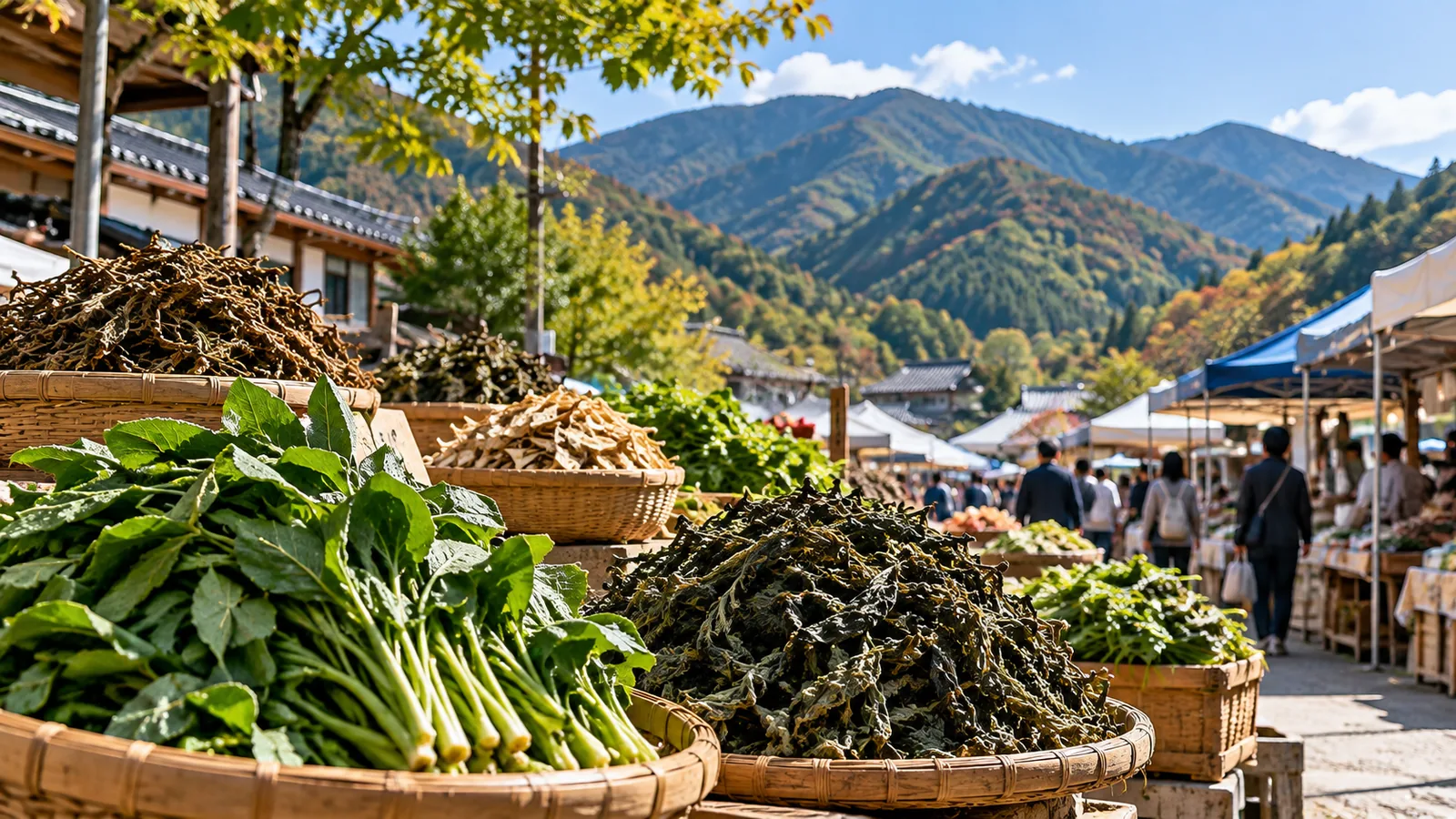
Jeongseon sits in a mountain-dominated part of Gangwon. Korea.net describes the county as surrounded by high mountains and notes that some peaks reach around 1,000 meters. The same source highlights the Jeongseon Five-Day Market as a place where visitors encounter wild greens gathered or grown in the surrounding highlands, including gondeure, chwinamul, and bracken.
That geography changes what “local food” means. In broad lowland farming districts, regional identity may be organized around rice paddies, coastal catches, orchard fruit, or livestock. In Jeongseon, mountain vegetables are unusually visible. Greens are not decorative garnish added after the main story; they are part of the story itself.
This helps explain why gondeure namul bap feels so coherent as a regional dish. Rice supplies the staple base. The mountain green supplies local character. Drying allows the ingredient to cross seasons. A savory sauce restores moisture and seasoning at the table. The result is not complicated, but every component solves a practical culinary problem.
Avoid the neat “famine food invented in the 1960s or 1970s” story
Korean food history includes the reality of boritgogae, the difficult “barley hump” period before the new grain harvest, and rural communities certainly relied on wild and cultivated greens during times of scarcity. It is therefore reasonable to discuss gondeure within a broader history of mountain foods, seasonal shortage, and household resourcefulness.
What should be treated cautiously is a much more specific claim: that modern gondeure namul bap was invented at one clearly documented moment during the 1960s or 1970s as a famine dish. The official and tourism sources used here establish Jeongseon’s highland environment, its market culture, the identity of the plant, and the modern regional prominence of the dish. They do not establish a single dated invention event.
That distinction improves the history rather than weakening it. Many everyday foods develop gradually. A region already has an ingredient, households already know how to dry and cook it, rice provides a flexible staple format, markets connect producers and customers, and restaurants later give a recognizable name and service style to the combination. A slow process can be historically more plausible than a one-line origin tale.

Fresh and dried gondeure do not behave the same way
The fresh-versus-dried distinction is one of the most useful details for understanding the dish at home. Fresh young leaves contain enough moisture that they soften quickly. Dried leaves first need to be rehydrated and then cooked until the fibers relax. That extra handling changes both texture and aroma.
The preservation logic is not just culinary common sense. A 2023 study on processing Cirsium setidens notes that the plant is commonly stored and distributed in dried form to extend shelf life, which helps explain why rehydration quality matters so much to the finished texture.
Drying also concentrates the plant’s smell and makes storage practical. When dried greens are soaked and simmered, some of that concentrated aroma reopens while the leaves regain flexibility. A cook then has to manage moisture: too little and the leaves stay tough; too much and the rice can become heavy or watery. This is why good gondeure bap is less about piling greens on rice and more about bringing the two ingredients to compatible textures.
The exact household method varies. Some cooks parboil or simmer rehydrated greens before adding them to rice. Others season the greens lightly with soy sauce, sesame oil, perilla oil, garlic, or other aromatics. The key point is structural: the greens are prepared so they can cook with the grain rather than sit on top as a separate salad.
Why cooking the greens with rice changes the dish
Gondeure namul bap is often translated simply as “rice with gondeure,” but that can make it sound similar to bibimbap. The difference becomes clearer when you look at where the main flavor is built.
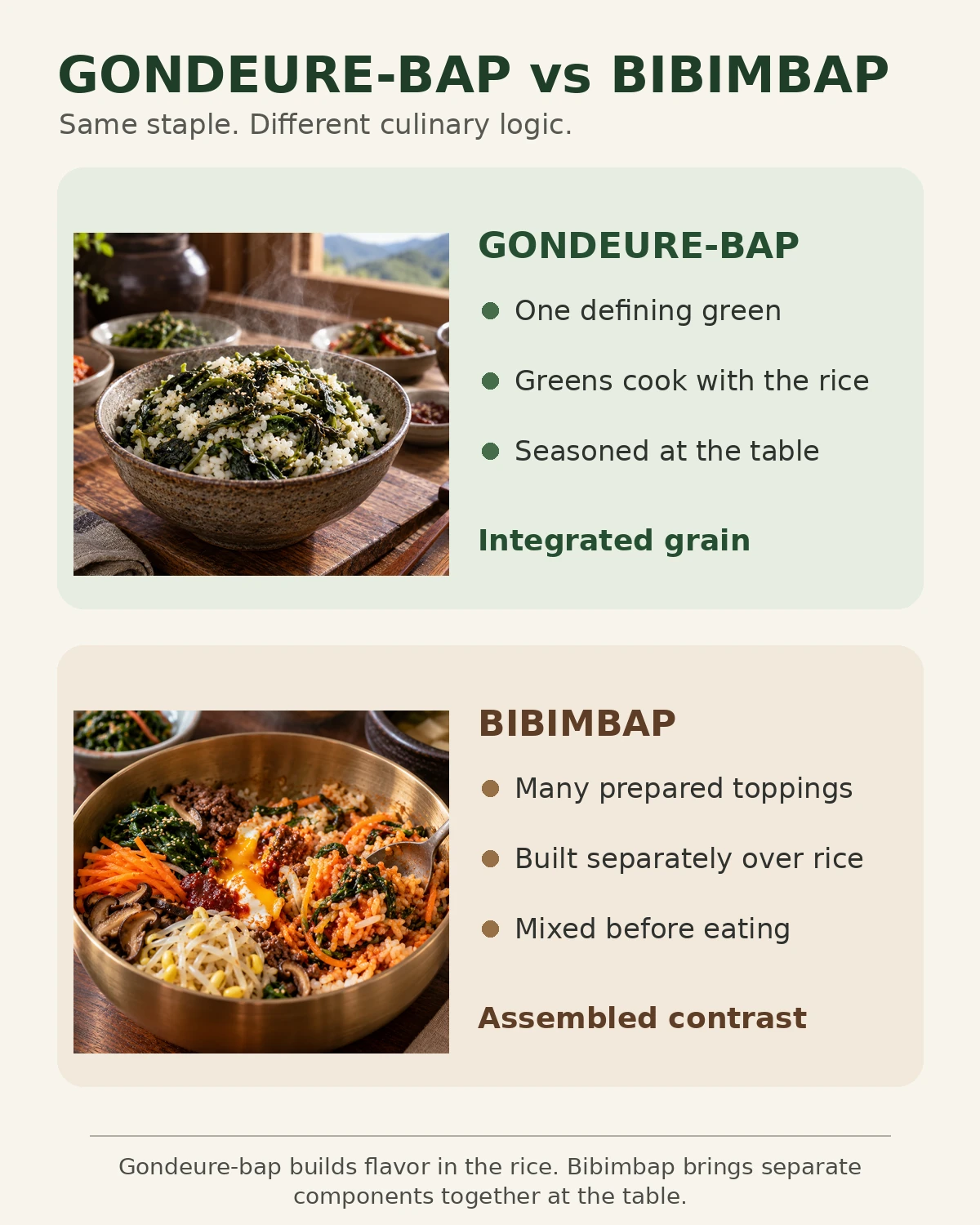
Bibimbap generally presents rice with multiple toppings that remain visually and texturally distinct until the diner mixes them. Gondeure namul bap usually gives one green a much more central role. The gondeure is cooked with or through the rice, so its aroma moves into the grain itself. The final bowl is therefore less about assembling many contrasting ingredients and more about making one staple and one regional green taste integrated.
This also changes the role of the sauce. In bibimbap, gochujang or another mixing sauce can become a dominant seasoning. With gondeure namul bap, yangnyeom-ganjang—seasoned soy sauce—is commonly added a little at a time. It sharpens a bowl that is intentionally mild rather than covering it with a single strong flavor.
What is in the seasoned soy sauce?
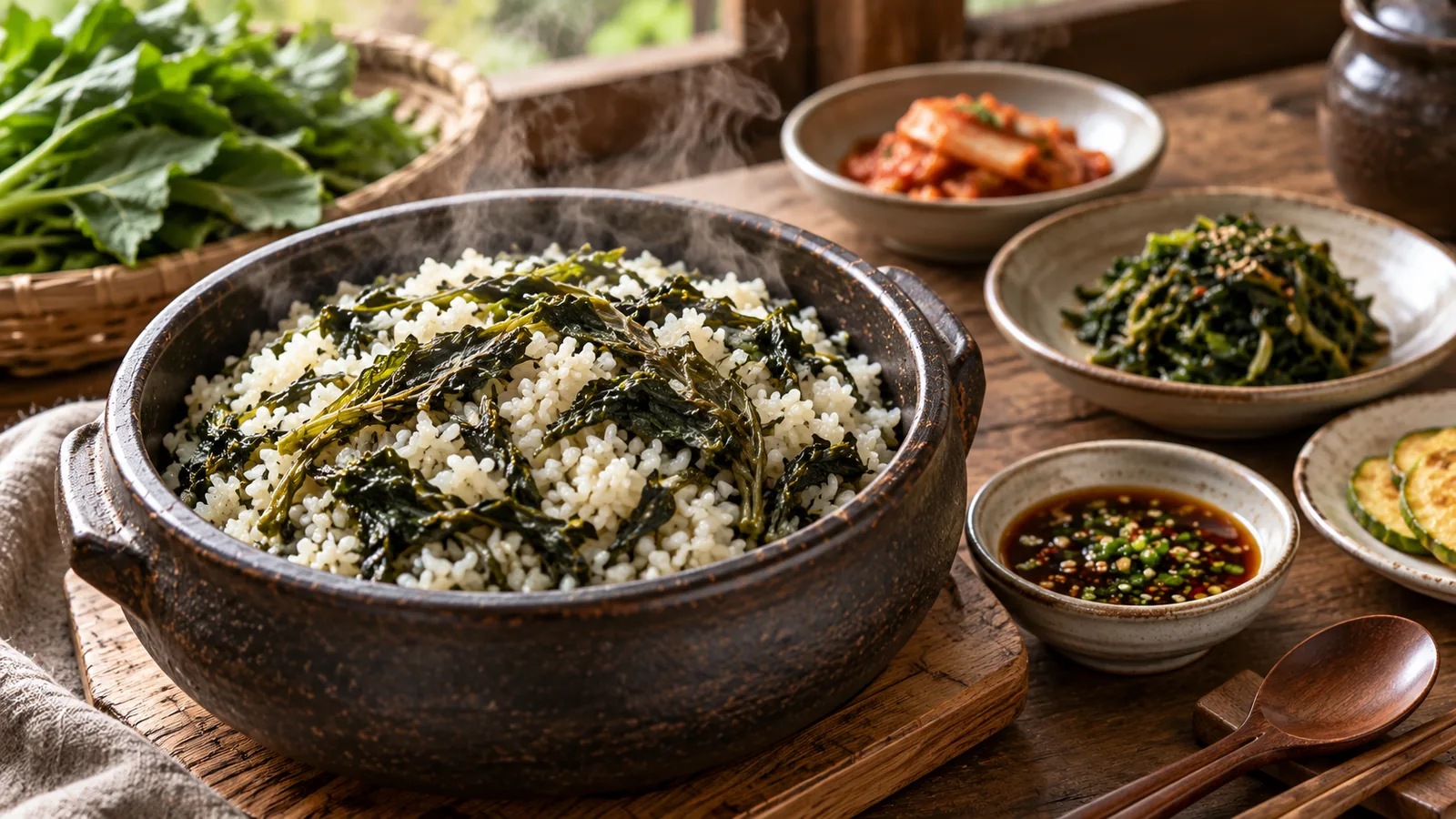
There is no single universal formula, but a typical table sauce begins with soy sauce and may include chopped scallion, garlic, sesame seeds, sesame oil or perilla oil, chili, and sometimes a small amount of sweetener. The important point is not a fixed recipe. It is the service logic: the rice arrives relatively restrained, and the diner controls the final saltiness and aroma.
That is why pouring the whole sauce dish onto the rice immediately is rarely necessary. Start with a spoonful, mix, taste, and add more if needed. The rice absorbs seasoning quickly, and side dishes will also contribute salt, acidity, spice, and fermentation.
Perilla oil is particularly compatible with mountain-green dishes because its nutty, grassy aroma can reinforce the plant character rather than bury it. Sesame oil gives a warmer roasted note. Restaurants and households may use one, the other, both, or neither.
The Jeongseon Five-Day Market helps turn ingredients into regional identity
A regional dish becomes more legible when visitors can see its ingredients circulating in public. The current VISITKOREA listing describes Jeongseon’s five-day market as a representative traditional market that becomes especially active on dates ending in 2 or 7, with local produce and regional foods drawing both residents and travelers. Korea.net likewise documents gondeure among the wild edible greens sold there.
The market therefore connects several stages of the food system. Mountain greens appear as things to buy. Prepared dishes let visitors taste them. Dried greens can travel home. Restaurants nearby turn the same ingredients into a sit-down meal. What begins as seasonal vegetation becomes a recognizable regional product.
This is a more useful way to understand “local specialty” than imagining that a tourism office simply selected one dish and declared it famous. The identity is reinforced because the ingredient, marketplace, restaurants, landscape, and traveler experience point in the same direction.
How to order gondeure namul bap in Jeongseon
The dish may appear as 곤드레나물밥, 곤드레밥, or another close variation on a menu. In a simple restaurant, it can arrive as a rice bowl or small pot accompanied by seasoned soy sauce and several banchan. Some restaurants build a fuller set meal around it with doenjang-based soup or stew, grilled items, acorn jelly, buckwheat dishes, or additional mountain vegetables.
Do not assume that every restaurant presents an identical “official Jeongseon set.” The rice dish is the anchor, while the surrounding side dishes reflect the kitchen. For travelers, that is useful: you can treat gondeure bap as the one item to identify first, then choose a restaurant according to the rest of the meal you want.
VISITKOREA currently lists Ssarigol in Jeongseon as a restaurant known for gondeure namul bap and dotorimuk muchim. Because restaurant hours, holidays, prices, and menu details can change, check the current listing or contact the restaurant close to your visit rather than relying on an old printed timetable.
How to eat it without drowning out the main ingredient
First, taste a small amount of the rice before adding sauce. This gives you a sense of how strongly the greens and oil were seasoned in the kitchen. Then add a modest amount of seasoned soy sauce and mix through part of the bowl.
If the meal includes strong fermented or spicy side dishes, alternate them with the rice rather than trying to make the rice itself very salty. Gondeure bap is satisfying partly because the base remains calm while the table around it changes from bite to bite.
If a dark, thick gangdoenjang or doenjang sauce is served, use it sparingly at first. Fermented soybean seasoning can be much more intense than the rice. The same principle applies: the bowl works best when the plant aroma still has room to register.
What does gondeure namul bap taste like?
Expect something earthy, green, and gently aromatic rather than bitter or aggressively herbal. The leaves become soft after cooking, while the rice supplies sweetness and body. Perilla or sesame oil can add a nutty top note, and seasoned soy sauce supplies salinity and allium aroma.
The exact flavor depends heavily on the greens. Fresh leaves can taste brighter. Dried-and-rehydrated leaves can have a deeper, more concentrated plant aroma. Older or insufficiently softened leaves may be more fibrous. This is another reason two restaurants can serve bowls with the same name but noticeably different texture.
Travelers who expect every famous Korean dish to be spicy sometimes misread the mildness as absence of flavor. Here, restraint is part of the design. The bowl gives the diner space to notice grain, leaf, oil, soy, and banchan separately.
Is gondeure namul bap vegetarian or vegan?
The core combination of rice and gondeure is plant-based, and a seasoned soy sauce can also be plant-based. A restaurant meal, however, should not automatically be assumed vegetarian. Kimchi may contain fish sauce or salted seafood. Doenjang soup can use anchovy or meat stock. Side dishes may contain meat, egg, seafood, or animal-based seasoning. Even a sauce that looks simple may vary by kitchen.
Vegetarian or vegan travelers should ask about the rice, sauce, soup, kimchi, and major banchan separately. A useful phrase is “고기, 생선, 멸치육수, 액젓 없이 가능해요?” (“Is it possible without meat, fish, anchovy stock, or fish sauce?”). The answer may differ from one restaurant to another.
The same caution applies to many Korean namul dishes: a vegetable main ingredient does not guarantee that every seasoning or accompanying dish is free of animal products.
What can we responsibly say about nutrition?
The most defensible nutrition statement is simple: the dish combines rice with an edible leafy green. Laboratory and animal studies have examined compounds in Cirsium setidens, but that does not justify promising that a restaurant bowl will detoxify the body, cause weight loss, treat disease, or deliver a specific therapeutic effect.
A serving can also vary widely in rice quantity, oil, soy sauce, soup and banchan. For readers, the cultural value is clearer than any generalized health claim: the dish offers a direct way to taste a mountain green strongly associated with Jeongseon.
Gondeure bap, bibimbap, and other Korean rice dishes
Comparing rice dishes by structure helps prevent them from collapsing into one broad category of “rice plus toppings.” Bibimbap is an assembled mixed-rice dish built around contrast among multiple ingredients. Gondeure bap is closer to an integrated pot rice in which one defining green perfumes and textures the grain. Other Korean rice dishes may cook beans, mushrooms, shellfish, radish, oysters, or seasonal vegetables together with rice for the same basic reason: the cooking liquid and steam allow ingredient flavor to enter the grain.
If you enjoy comparing regional staples, Jeongseon’s gondeure bap makes an interesting counterpoint to Myeongdong kalguksu. One is a mountain-green rice dish linked to Gangwon’s inland landscape; the other is a knife-cut noodle tradition associated with a dense Seoul commercial district. Both show how a basic starch becomes memorable through place, service style, and a small set of defining ingredients.
Can you make it outside Korea?
Yes, especially if you can buy dried gondeure from a Korean grocery or online retailer. The main challenge is not a complicated seasoning list; it is preparing the dried greens thoroughly enough. Soak according to the product instructions, cook until the stems and leaves are tender, squeeze out excess water without turning them dry, season lightly, and then combine with rice for cooking or reheating.
Because dried greens vary in age, cut, and toughness, a rigid universal soaking time is less useful than a texture test. The leaf should bend easily and the thicker parts should not feel woody. If the greens are still tough before they go into the rice cooker, the finished dish will probably remain tough.
For a simple table sauce, soy sauce with scallion, sesame seeds, garlic, and a small amount of sesame or perilla oil is enough to show the basic idea. Add chili only if you want it. The objective is to season the rice, not to turn the sauce into the main flavor.
Quick answers
What is gondeure?
Gondeure is the Korean common name used for Cirsium setidens, an edible mountain green associated especially strongly with Gangwon and Jeongseon.
Is gondeure namul bap the same as bibimbap?
No. Bibimbap usually assembles several toppings that are mixed with rice at the table. Gondeure namul bap gives one defining green a central role and generally cooks it with or through the rice.
Was gondeure namul bap invented as famine food?
Mountain greens have an important place in Korea’s history of seasonal scarcity and rural foodways, but a precise claim that the modern dish was invented in one documented 1960s–70s famine moment is not established by the sources used here.
How should I use the seasoned soy sauce?
Add a small amount first, mix, taste, and increase gradually. The rice is intentionally mild, and side dishes will also add seasoning.
Can vegetarians eat it?
The rice and greens can be vegetarian or vegan, but restaurant sauces, soup, kimchi, and banchan may contain anchovy stock, fish sauce, salted seafood, meat, egg, or other animal ingredients. Ask the restaurant directly.
Why this quiet bowl matters
Gondeure namul bap is useful precisely because it resists the shortcuts often used to explain regional food. It does not need a royal legend, an exact invention date, a miracle-health claim, or a dramatic “only in Korea” superlative.
The stronger story is visible in the ordinary mechanics of place. Jeongseon’s mountains support a culture of edible greens. Drying allows seasonal plants to travel across the calendar. Rice turns the green into a staple meal. Seasoned soy sauce lets diners tune a mild bowl. The market makes local ingredients legible to visitors. Restaurants then repeat that combination often enough for it to become a regional signature.
Seen this way, the dish is not just “herb rice.” It is a compact map of how landscape, preservation, cooking, commerce, and travel can converge in one bowl.
Related stories
- Jeonju Bibimbap: Korean Mixed Rice and the Making of a Regional Icon
- Myeongdong Kalguksu: Korean Knife-Cut Noodles and Seoul’s Commercial Food Culture