
The best first question at Gwangjang Market is not “Which stall is famous?” It is “Am I buying a hot snack, a small rice roll or a seated meal?” Bindaetteok, kkoma gimbap and yukhoe answer those questions differently.
A pancake is about its freshly browned edge; a tiny roll is about rice, seaweed and dip; seasoned raw beef is a separate dietary choice, not a compulsory stop. The market’s 1905 establishment and textile history explain the place, but they do not give every dish one shared birthday.
Choose the food before choosing a queue
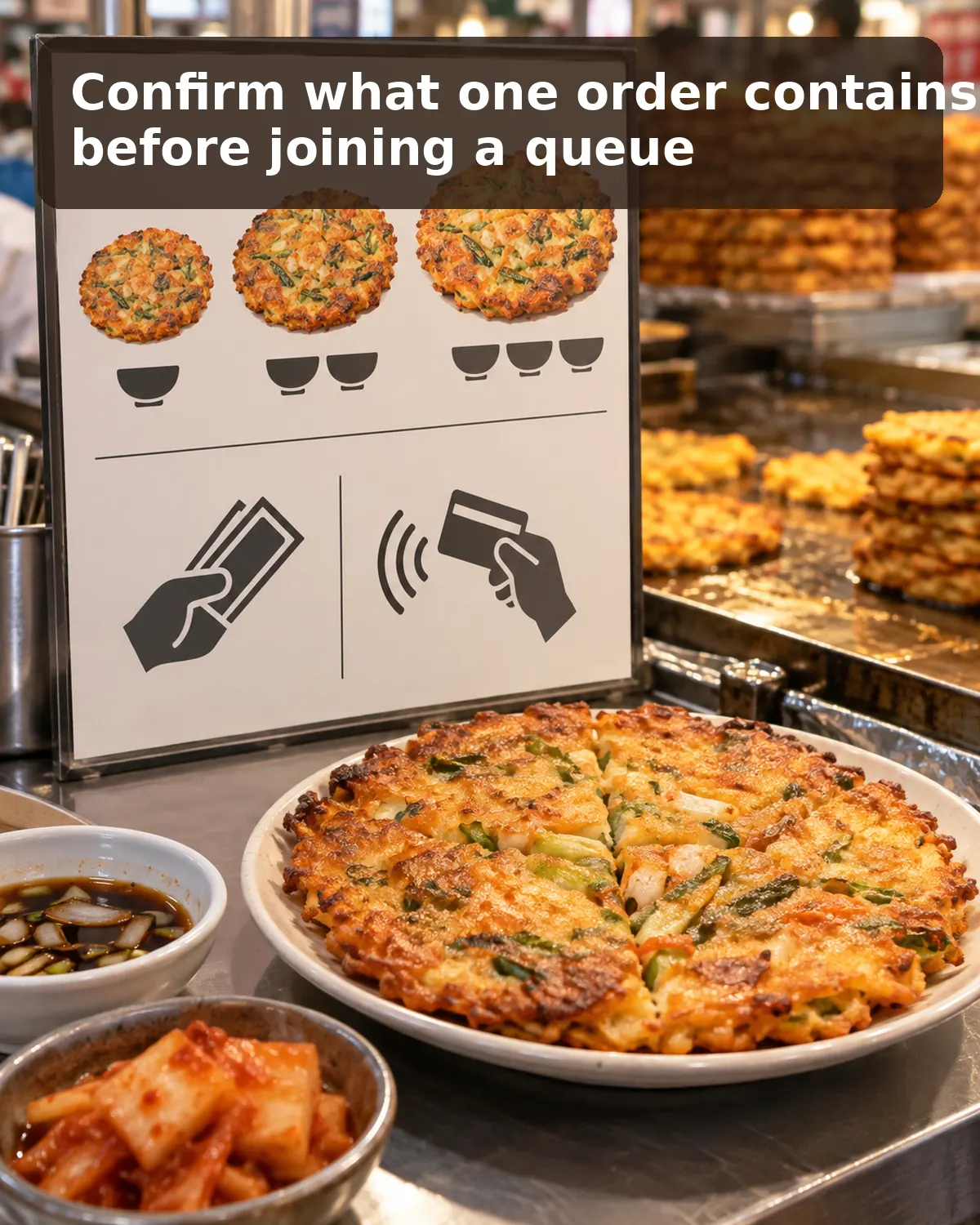
Bindaetteok (빈대떡) is a savory mung-bean pancake. At Gwangjang, soaked mung beans are ground into a thick batter and fried on broad griddles, commonly with ingredients such as bean sprouts, kimchi and pork depending on the stall. Seoul tourism sources consistently identify mung-bean pancakes as one of the market’s signature foods.
The appeal is largely structural. Ground mung beans produce a batter different from a thin wheat-flour pancake. A generous layer of oil and a hot griddle brown the outside deeply while the center remains denser and softer. Bean sprouts add moisture and crunch; kimchi can add acidity and chile; meat adds richness. A soy-and-onion dipping sauce cuts through the oil.

The best practical advice is to eat it hot. As the pancake sits, steam softens the crisp exterior. Sharing one before ordering another dish also makes sense because bindaetteok is heavier than its flat shape suggests.
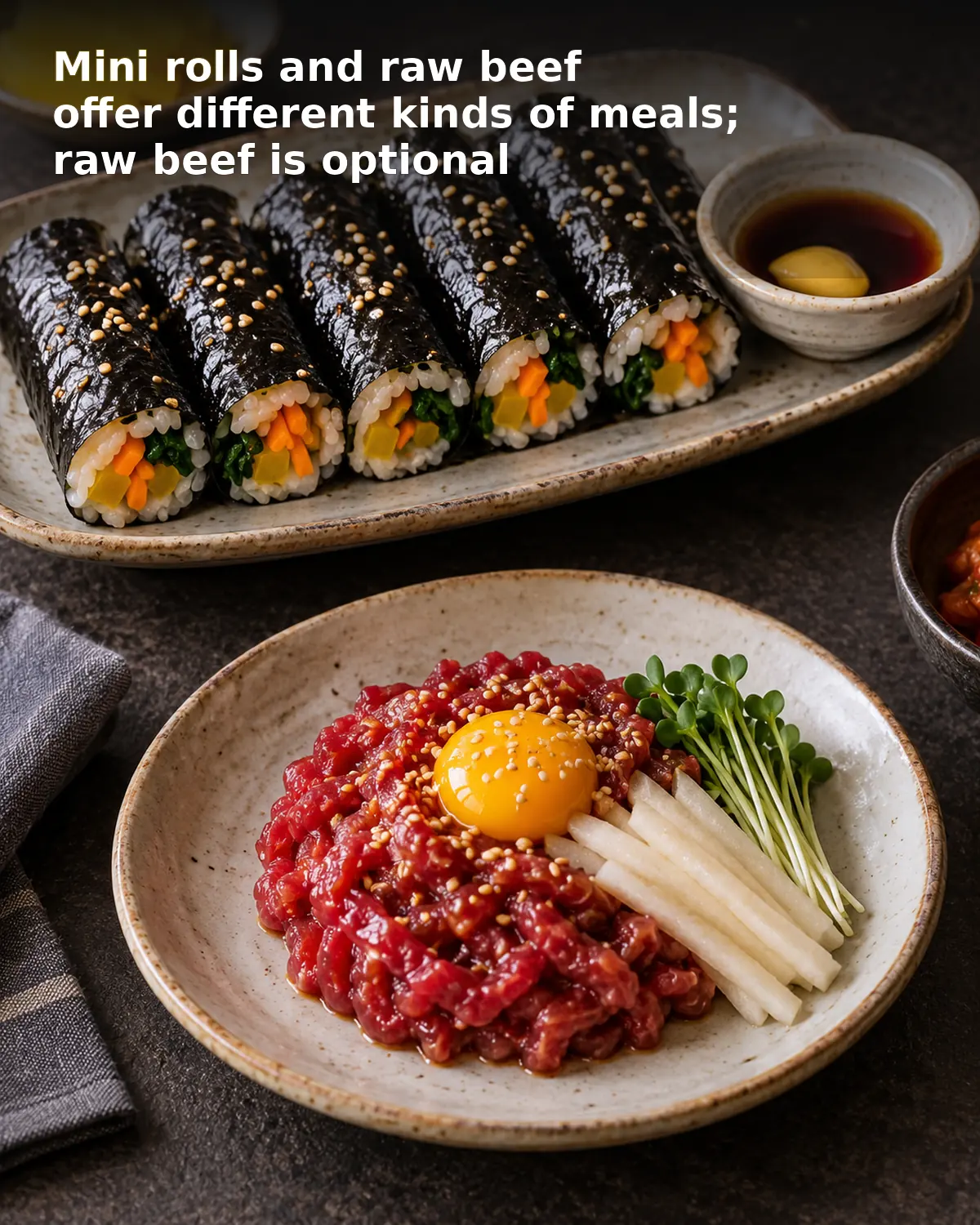
Mayak gimbap (마약김밥), often rendered in English as “addictive gimbap,” consists of small seaweed rice rolls rather than the larger, heavily filled gimbap sold as a full meal. The controversial name uses a slang metaphor for food that is hard to stop eating; it is not a literal ingredient reference and does not need to be romanticized.
The miniature format fits the market. Small rolls can be portioned quickly, shared, dipped and eaten without committing to a large plate. Fillings are typically simple compared with full-size gimbap, and a mustard-soy dipping sauce provides much of the punch. The contrast between mild rice-and-seaweed rolls and sharp sauce is more important than a long list of fillings.
Visitors sometimes assume the tiny size means the dish is a special ancient form of gimbap. The more useful interpretation is functional: a compact roll works extremely well in a high-turnover market where diners want to sample several foods in one visit.
Yukhoe (육회) is seasoned raw beef, usually cut into thin strips and dressed with ingredients such as sesame oil, garlic and sweetness; pear and egg yolk are also common in many preparations. Gwangjang has a recognizable cluster of restaurants specializing in the dish, and Seoul tourism material repeatedly lists beef tartare among the market’s signature foods.
Its texture is the opposite of bindaetteok. Instead of crisp fried edges and a soft center, yukhoe is cool, tender and slick with seasoning. Korean pear can add cold crunch and sweetness; sesame oil adds aroma; egg yolk can make the mixture richer. The dish is usually eaten seated rather than while walking, which also changes the pace of a market visit.
Yukhoe should not be framed as a “bravery challenge.” It is a normal Korean dish made with raw beef, and raw animal products carry food-safety risk. Pregnant people, immunocompromised diners and others at higher risk from foodborne illness should follow appropriate medical guidance. Anyone uncomfortable with raw beef can skip it without missing the historical point of the market.
Bindaetteok, mini gimbap and yukhoe are often presented as a checklist, but their real value is that they demonstrate three different modes of market eating. The pancake is hot griddle food built around frying and texture. The gimbap is compact, fast and portable. Yukhoe is a seated raw dish with a specialized restaurant culture.
Eating all three, if appetite and dietary preferences allow, is therefore not about collecting famous names. It is a way to experience how one market supports very different preparation systems within a few minutes’ walk: grinding and frying, rolling and dipping, slicing and seasoning.
A permanent market from 1905, not a frozen food scene
Seoul Metropolitan Government’s cultural-heritage material places Gwangjang’s creation in a period of rapid commercial and political change. Private Korean merchants sought a year-round market in Jongno as older commercial structures changed and Japanese merchants expanded their position in Seoul after gaining commercial strength around Namdaemun.
The important point is not to turn every transaction in 1905 into a heroic resistance scene. It is that the market was established by private merchants as a Korean-controlled commercial space during a period when control over urban commerce had political and economic significance. Seoul’s historical account explicitly connects the market’s establishment with efforts to compete against older monopolistic structures and, later, expanding Japanese commercial power.
The market also changed physically. Seoul’s heritage material notes that the original one-story hanok market structures were destroyed during the Korean War and that a new three-story building was constructed in 1959 as part of postwar reconstruction. In the 1960s, the name shifted from Dongdaemun Market to Gwangjang Market. That history helps explain why “a 1905 market” does not mean every corridor or building visible today survives untouched from 1905.

For much of its modern history, Gwangjang was especially famous for fabrics, hanbok and wholesale textile trade. Those businesses have not disappeared. Seoul’s current material still points visitors to the second-floor fabric market, tailor shops and hanbok-related stores.
This matters because food tourism can flatten traditional markets into eating zones. Gwangjang is more accurately understood as a commercial ecosystem in which different trades accumulated over time. Food is now the easiest entry point for visitors, but the fabric floors reveal an older economic identity that helps explain why the market became important in the first place.
A useful visit therefore has two scales: look closely at what is on the griddle, but also look upward and around the alleys to see that the food stalls are embedded in a much broader marketplace.
Seoul Metropolitan Government describes Gwangjang as established in 1905 and, in different official materials, as the first year-round private market in Seoul or the first permanent market in South Korea. Those are useful sourced descriptions.
They should not be stretched into a national “oldest” claim about Korea’s street-food markets. Street-food culture is not the same historical category as a legally or commercially established permanent market. The food alleys became famous within a market whose original purpose was much broader. Precision preserves the history better than a stronger-sounding superlative.
Migration and the mung-bean griddle
A more recent Seoul Metropolitan Government feature links the market’s famous mung-bean pancakes with people displaced from Hwanghae Province after the Korean War, describing refugees who sold the pancakes using frying fat available in the postwar period. That account is useful because it places today’s “signature street food” inside a larger story of migration and livelihood rather than treating it as an eternal market recipe.
As with many market-food histories, one article cannot prove that every bindaetteok stall descends from one origin line. What the Seoul source does establish is a credible social context: postwar displacement and market commerce helped shape the food culture that later became one of Gwangjang’s defining attractions.

New snacks join an older marketplace
A recent Seoul city feature emphasizes that Gwangjang continues to absorb new food trends. Alongside mung-bean pancakes, noodles and yukhoe, newer vendors and pop-ups sell items such as twisted doughnuts, bakery products and regional snacks from elsewhere in Korea.
That is not evidence that the market has become inauthentic. Markets survive by adapting to customers. A place founded in 1905 has already lived through colonization, war, reconstruction, changes in wholesale trade, mass tourism and social media. Expecting it to preserve one perfect historic menu would misunderstand how markets function.
The useful distinction is between historically embedded specialties and newer commercial trends. Both can be worth eating; they simply tell different stories.
No simple label fits. The market is heavily visited by domestic and international tourists, especially in the food lanes, but it remains a working commercial market with textile, clothing and food businesses. Some areas feel intensely touristic; others still function mainly around specialist trade.
That mixed identity is historically appropriate. Gwangjang has repeatedly changed with Seoul’s economy. Tourism is one more phase in a market that has already shifted from early private commerce to postwar reconstruction, fabric specialization and globally visible food culture.
Build a meal with room left over
A compact route can begin with bindaetteok, continue with mini gimbap, and add yukhoe only if raw beef fits your preferences. That sequence moves from hot and heavy to small and portable, then to a seated dish. It also avoids ordering several oily foods before deciding whether you still want a raw-beef plate.
If you do not eat meat, build a different route instead of forcing the “famous three.” Ask whether a pancake contains pork, because recipes vary. Mini gimbap may look vegetarian but fillings, seasoning or dipping sauce should still be confirmed. Noodles, pancakes and other stall foods can be adapted only when the vendor’s actual recipe allows it.
Most importantly, leave room for observation. A market is not a tasting menu designed in advance. If one stall has an unusual seasonal item, a crowd of regulars or a preparation process worth watching, that can be more informative than completing a rigid checklist.
A useful market plan starts with the meal you will eat afterwards. Before a reserved dinner, try a small cooked order and pause. When the market is lunch itself, choose one substantial dish before adding tastes of other foods. The same three famous foods need not become three full portions.
Read the selling unit before comparing prices. A plate, a serving and a combination order are not interchangeable. Ask which accompaniments are included and which are optional additions; a crowded counter and an attractive photograph do not answer those questions. Payment methods also belong to the particular stall, not to a rule about all traditional markets.
Older guides may call the little rolls mayak gimbap. A 2025 Seoul city feature uses Kkoma Gimbap and explains the naming change. The older slang nickname does not describe a narcotic ingredient. Look instead at the roll’s size, filling and separate dip. And when a raw-beef dish does not suit a diner’s dietary or safety needs, the cooked-food route is still a complete market visit.
Read the menu, portion and payment before ordering
Long lines at Gwangjang are partly a function of fame, guidebooks, television and social media. A queue can show demand, but it does not objectively prove that one stall is the “best.” Neighboring vendors may sell similar food with shorter waits.
Instead, look for operational clues. Is food being cooked continuously rather than sitting for long periods? Does the stall have clear turnover? Are raw and cooked foods handled separately? Are diners ordering the item the stall specializes in? Those observations are more useful than a viral ranking.

Old guides often say visitors “must bring cash.” That may be true at a particular stall, but payment acceptance changes. Some vendors accept cards or local digital payment, while smaller counters may still prefer cash. The safe advice is to carry a backup payment method rather than state that the entire market is cash-only.
The same freshness rule applies to individual vendor hours. A market complex can be open while one restaurant is closed, sold out or operating on a different schedule. Textile businesses and food stalls also keep different rhythms. Check the specific destination if one named shop is essential to the visit.
Street-food prices look stable until ingredient costs, rent, portion sizes or demand change. Quoting a price from an old travel article creates false precision. It can also make a normal current price look like overcharging when the only problem is that the guide is stale.
An evergreen guide should explain what each dish is, how it is served and how to compare stalls. Exact prices belong to the visit date. If budget matters, scan posted menus before ordering and confirm the price for the portion you want.
Look beyond the food lane
The most useful way to understand Gwangjang Market is to hold two histories at once. One is the institutional history: a permanent commercial market established in 1905 by private merchants, rebuilt after war and long associated with textiles and urban trade. The other is the food history: postwar migration, griddle cooking, compact snacks, raw-beef restaurants and newer trends that turned the market into a global culinary destination.
Those layers explain why the market feels both old and constantly changing. Bindaetteok does not have to be unchanged since 1905 to be historically meaningful. Mini gimbap does not have to represent all Korean gimbap. A new doughnut stand does not erase the textile market upstairs. Gwangjang’s real continuity is the market itself: a dense space where commerce adapts, specialties cluster and Seoul keeps adding new reasons to visit.