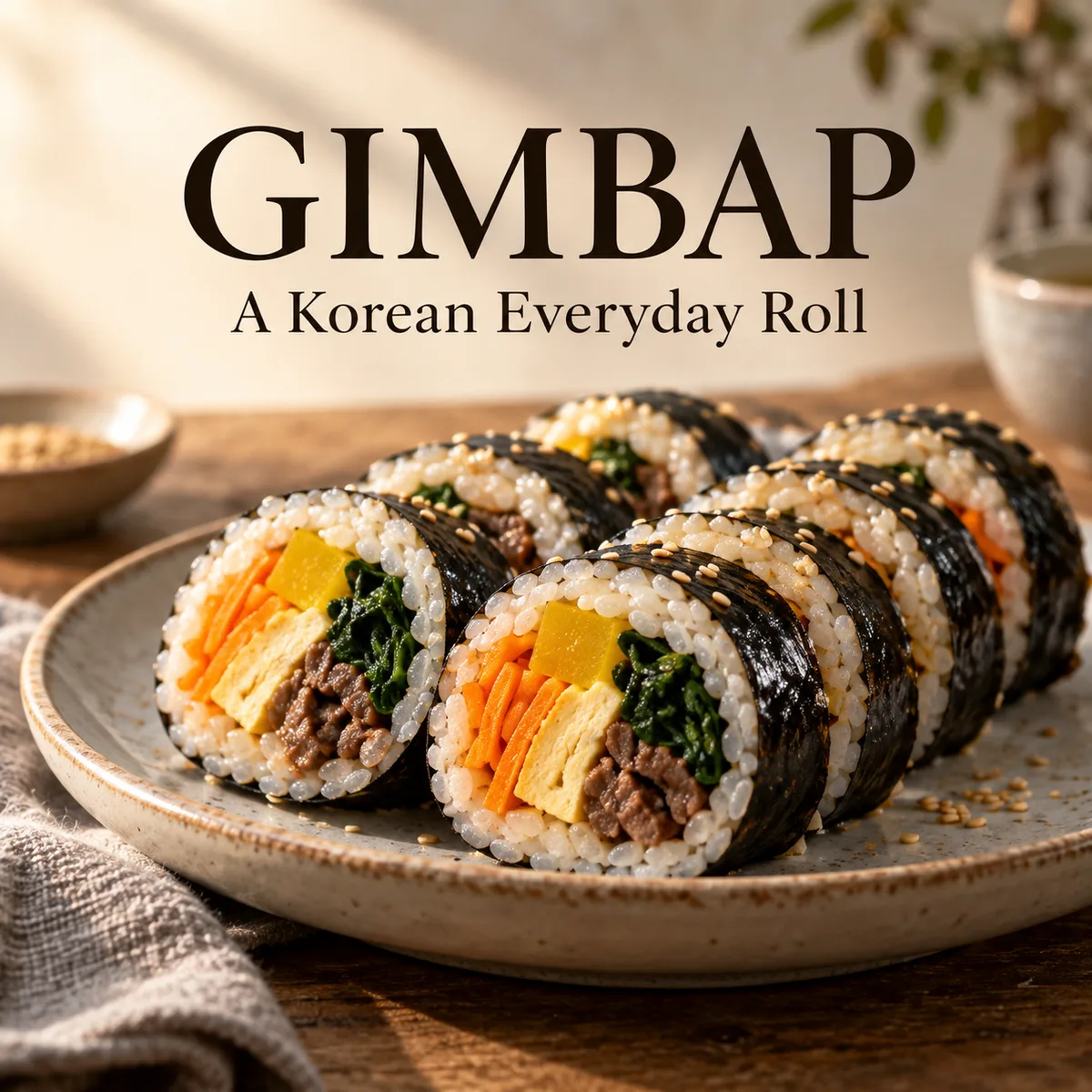
Two rolls can look similar in a photograph while doing different work at the table. Gimbap’s rice seasoning, fillings and role as a portable meal explain more than a yes-or-no argument over whether it is sushi.
Culinary influence and later localization can both be part of the history. Following the rice, the wrapping and the practical problem each version solves gives a more useful answer.
The rice is a better clue than the silhouette
A sliced cross-section makes gimbap and some forms of sushi look closely related, but the eating experience diverges quickly. Sushi rice is characteristically seasoned with vinegar. Korean gimbap rice is more commonly seasoned with salt and sesame oil, sometimes with sesame seeds or other variations depending on the cook.
That difference changes aroma and structure. Sesame oil supplies a roasted, nutty fragrance and coats the grains lightly. Vinegar supplies acidity and changes the flavor balance in a different direction. Neither description should be turned into an absolute rule—home recipes and commercial products vary—but the contrast helps explain why two visually similar rolls do not taste interchangeable.
The surface treatment matters too. A finished gimbap roll is often brushed with sesame oil before slicing, which adds shine and aroma. That final step makes the first impression come from toasted seaweed and sesame before the diner even reaches the fillings.

Influence and a distinctly Korean everyday food
Korea has a long history of eating gim, dried seaweed, and rice with seaweed. That background matters because the ingredients themselves were not foreign inventions suddenly appearing in the 20th century. But ingredient continuity does not prove that every modern form existed in the same shape before colonial-era contact.
The Academy of Korean Studies distinguishes modern rolled gimbap from the older practice of eating seaweed with rice. It traces influence from Japanese rolled sushi during Japanese rule, followed by localization. Its entry cites Hong Seon-pyo’s 1939 description of a lunchbox roll with Korean seaweed, rice, braised meat and kimchi, and a 1946 cookbook’s gimbap for excursions and hiking. Through the 1950s and 1960s, beef, shiitake, egg, spinach, pickled radish and carrot became familiar combinations; processed ham and specialty-shop fillings followed. These records document change, rather than an uncontested first invention.1
This distinction is useful far beyond one dish. Food history often becomes politically uncomfortable precisely where everyday habits show cultural exchange. Acknowledging contact does not erase what happened afterward. The identity of a food is not only the moment a shape first appeared; it is also the ingredients, techniques, institutions and social occasions that communities build around it.
Modern gimbap is not defined by one national filling list. Common components include yellow pickled radish (danmuji), egg, carrot, seasoned spinach, braised burdock, ham, fish cake, beef, tuna, kimchi, cheese and many newer combinations. What matters is the architecture: several contrasting prepared ingredients are lined up across rice, then compressed into one sliceable meal.
The result behaves almost like a compact banchan table. Sweet pickled radish provides acidity and crunch; egg softens the texture; greens bring moisture and vegetal flavor; burdock can add a sweet-savory chew; meat or tuna makes the roll heavier. The roll is not valuable because every ingredient is unique. It is valuable because the ingredients are balanced for repeated bites without utensils.
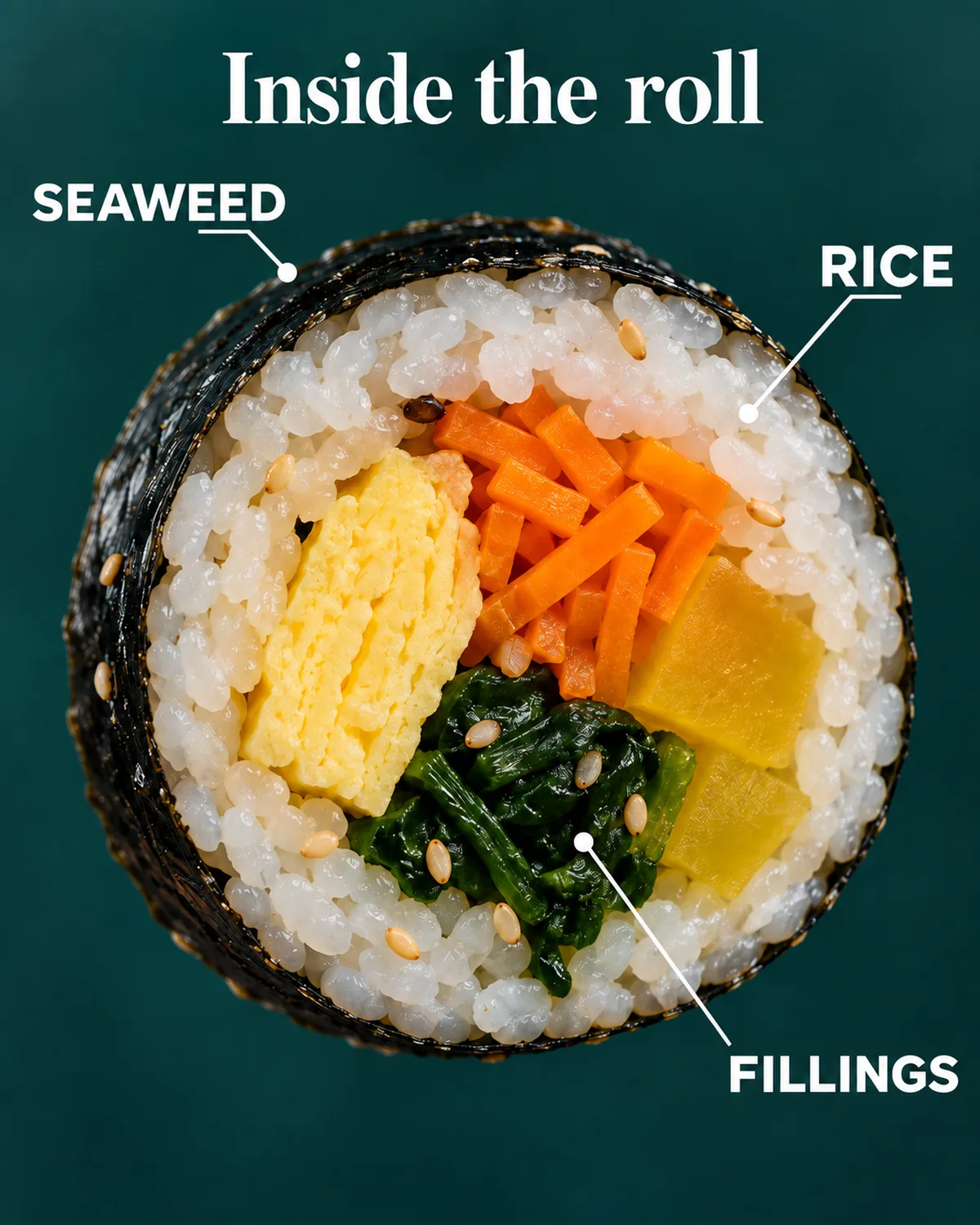
That is one reason gimbap spread so well as everyday food. It works in a school lunchbox, on a picnic, during a hike, at a train station, in a bunsik shop and as a quick take-away meal. The same portability that makes the roll appear simple is actually an engineering constraint: fillings must be cut to similar lengths, moisture must be controlled, the rice layer cannot be too thick, and the roll must hold together after slicing.
Gimbap’s strongest cultural identity is not fine dining. It is mobility. Generations of Korean families have associated the roll with outings, school excursions and travel because one roll divides naturally into individual pieces and can be eaten without bowls, broth or reheating.
That portability also explains why the social memory of gimbap is often stronger than its price or prestige. The food appears at transition moments: leaving home early, packing for a school day out, sharing food on a bus, eating on a mountain, or buying a roll before a long trip. A dish can become culturally important because it is repeatedly present when people move through daily life.

Portability should not be confused with indefinite room-temperature safety. Rice, egg, meat, tuna and vegetables are perishable. The practical lesson is to eat freshly prepared gimbap promptly, especially in warm weather, rather than treating “picnic food” as permission to hold a roll unrefrigerated all day.
The bunsik menu made the roll customizable
Gimbap’s modern ecosystem is closely connected to bunsik shops—casual businesses serving combinations of gimbap, tteokbokki, ramyeon, dumplings and other inexpensive dishes. The menu format encouraged variation because a shop could keep the same rolling method while changing one or two major fillings.
That is why tuna gimbap, cheese gimbap, kimchi gimbap, pork-cutlet gimbap and spicy-pepper versions can coexist without threatening the identity of the category. The category is flexible by design. There is a recognizable base technology—seaweed, rice, longitudinal filling, rolling, slicing—but no requirement that every shop reproduce one canonical filling set.
From a food-history perspective, this flexibility is important. It shows localization not as a one-time historical event but as a continuing process. Once a format becomes embedded in neighborhood commerce, every generation of shops can adapt it to new ingredients, dietary trends and customer expectations.
A shop menu usually signals the major filling, not every ingredient. “Tuna gimbap” may still contain egg, pickled radish, carrot and greens. “Vegetable gimbap” may include egg or processed ingredients, depending on the business. “Cheese gimbap” generally means cheese added to a broader standard filling set rather than a roll of only rice and cheese.

For allergies or strict dietary restrictions, ask about the complete filling set and seasoning. Fish cake, ham, egg, mayonnaise, tuna and shared preparation surfaces are common concerns. A visually vegetable-heavy roll is not automatically vegetarian or vegan.
Rice quantity also changes the experience. Some modern rolls use a thinner rice layer and more fillings; others remain rice-forward. Neither is automatically more “authentic.” They are different balances inside the same format.
Chungmu rolls, triangles and the seaweed problem
One of the best ways to understand gimbap is to look at a version that removes most of the familiar fillings. Chungmu gimbap, associated with present-day Tongyeong, consists of small plain rice-and-seaweed rolls served with spicy seasoned squid and radish kimchi on the side.
The Academy of Korean Studies’ separate Chungmu gimbap entry preserves more than one origin explanation, but the versions share a practical theme: separating the rice roll from moist side dishes helped the food cope with warm conditions and work around boats and travel. That makes Chungmu gimbap less like an “empty” standard roll and more like a different solution to the same portability problem.2
It also demonstrates why regional variants should not be judged by the standard Seoul snack-shop template. The fillings are absent from the roll because the side dishes carry flavor separately. The eater alternates plain roll, seasoned squid and radish rather than receiving every flavor in a single cross-section.

Samgak gimbap, the triangular convenience-store version, changes both shape and packaging. Many versions use a wrapper that keeps the seaweed separate from the rice until the package is opened. That is not cosmetic. Rice releases moisture; if seaweed sits against moist rice for hours, it loses crispness.
The familiar pull-tab packaging therefore becomes part of the food technology. It postpones contact between seaweed and rice until just before eating. Standard rolled gimbap accepts softer seaweed because it is usually made and eaten relatively soon. Triangle gimbap is designed for longer retail display and individual convenience.

Comparing the two forms shows how the same ingredients can be reorganized around distribution. One is rolled and sliced for sharing or a complete meal. The other is portioned and packaged for one person buying food quickly from a convenience store.
Freshly cut, refrigerated or frozen
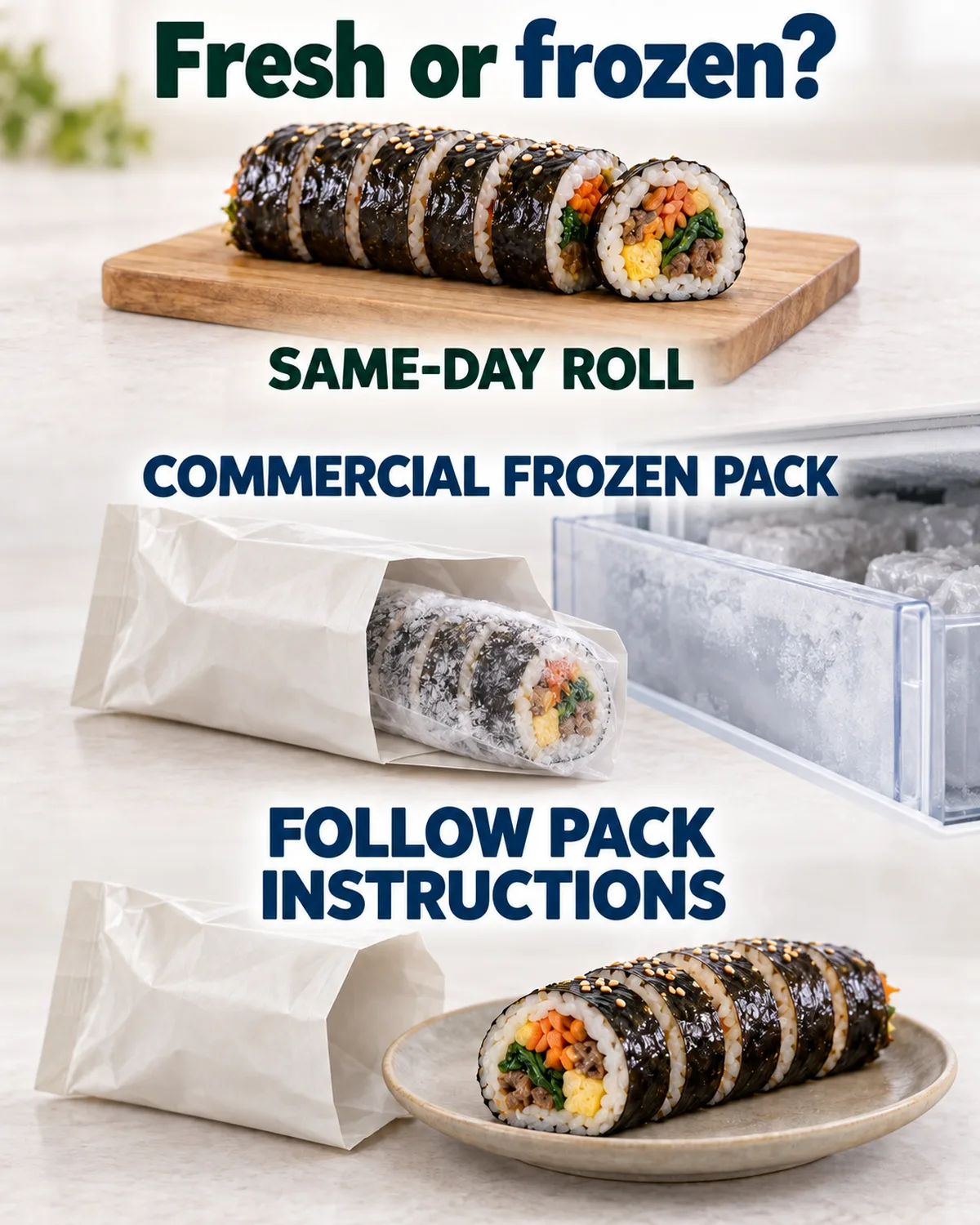
Gimbap’s more recent global chapter is frozen retail. Freezing a rice roll is technically awkward because cooked rice can become hard, dry or uneven after freezing and reheating, while vegetables and sauces respond differently to ice-crystal formation and microwave heat.
The significance of frozen gimbap is therefore not simply that a Korean food appeared in overseas supermarkets. Manufacturers had to redesign ingredients, moisture and reheating behavior so a food historically valued for same-day portability could survive a frozen supply chain. CJ Foods’ 2025 reporting on its Oceania business lists frozen gimbap among the K-food products being sold in the region, showing that the format has moved beyond one viral U.S. retail episode into a broader global frozen-food category.
This is a useful continuation of gimbap’s history. The core strength—portable rice and fillings wrapped in seaweed—remains, while the technology around portability changes. Lunchbox cloth, convenience-store wrapper and freezer are three different distribution systems built around the same basic idea.
Gimbap texture changes quickly after preparation. Rice loses moisture as it cools and sits exposed. Seaweed softens as it absorbs moisture from rice and fillings. Cut surfaces expose more rice to air. Refrigeration can slow microbial growth but also accelerates the perception of hard rice because cooked starch retrogrades as it cools.
That creates a practical paradox: gimbap is portable, but standard fresh gimbap is usually best relatively soon after it is made. Buying it hours in advance and refrigerating it aggressively may protect storage but reduce eating quality. Leaving it warm for a long time may preserve softness but creates a food-safety problem.
Frozen commercial gimbap tackles this with formulation and process control that a normal snack shop does not use. That is why “it can be frozen” should not be generalized into “any leftover gimbap freezes and reheats perfectly.”
The little market rolls and their changing nickname
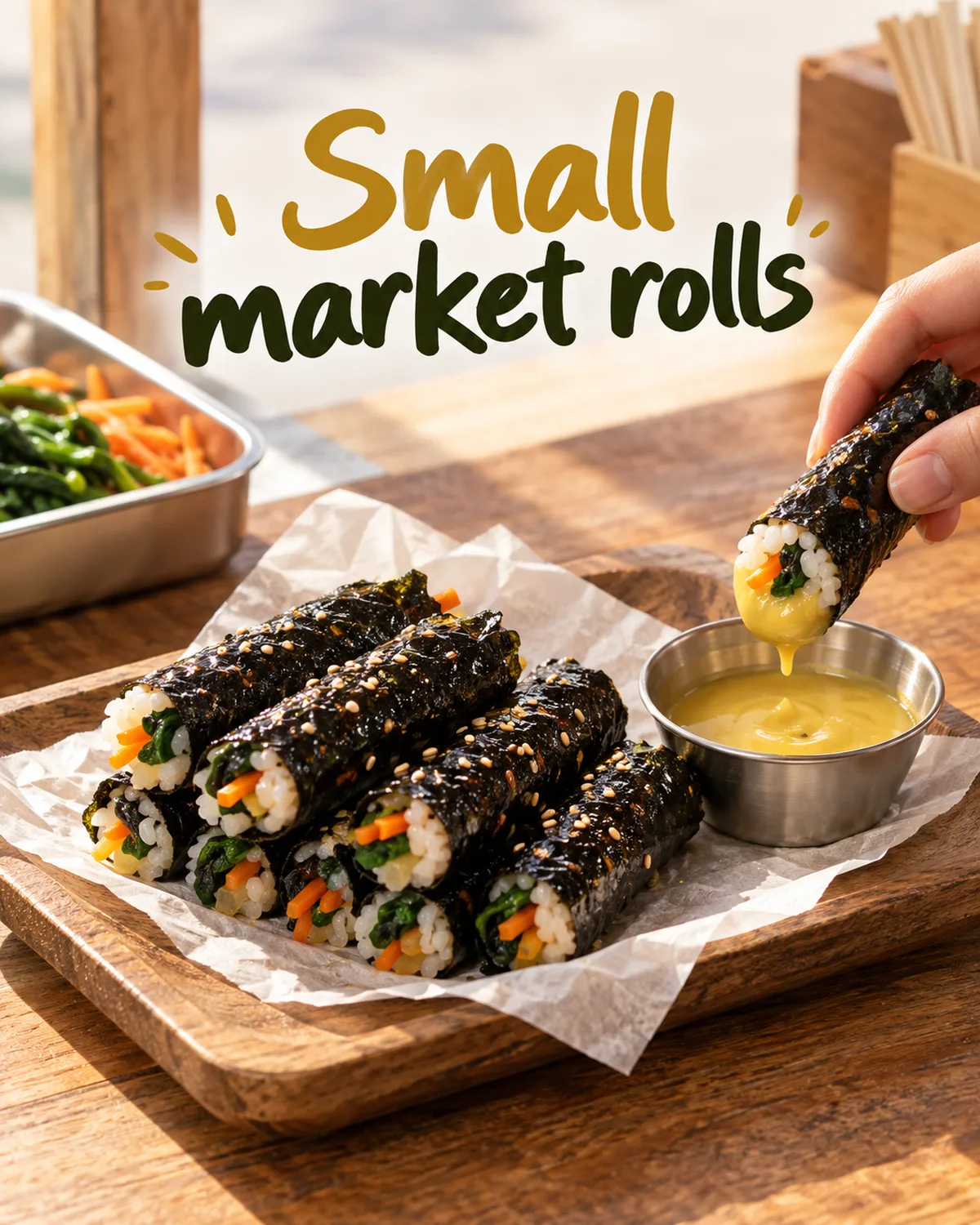
Gwangjang Market’s small rolls are widely known as mayak gimbap. The word mayak literally refers to narcotic drugs, but in informal food marketing it is hyperbole for something considered difficult to stop eating. It does not describe an ingredient.
That distinction matters in English because a literal translation can make a joking Korean marketing convention sound like a factual claim. The rolls themselves are small, simple and easy to share, often served with a mustard-based dipping sauce. Their miniature size also makes sense in a market: diners can try several foods instead of committing to one full meal.
Read the filling before deciding on a roll
Do not begin with the most overloaded premium roll. Start with a fairly standard gimbap that lets you read the basic architecture: rice, pickled radish, egg, one or two vegetables, and a savory filling. Notice the rice seasoning and how each ingredient is cut to run through the length of the roll.
Next, try a version where one major variable changes—tuna, beef, cheese, kimchi or a vegetable-heavy filling. Then, if travel allows, compare a regional form such as Chungmu gimbap or a market mini-roll. The comparison teaches more than simply ordering three visually dramatic modern rolls.
A roll is easiest to choose when you separate three questions: how is its rice seasoned, what else comes with the named filling, and when will you eat it? A freshly sliced counter roll, Chungmu rolls with separate sides and a frozen retail pack answer those questions differently. Their shared silhouette is only the beginning.