

The small packet of Korean seaweed on a supermarket shelf begins far from the snack aisle. In a January 2021 field account, researcher Kim Jun describes meeting a winter dawn on the tidal flats of Gomso Bay, where farmers were going out to harvest gim. The scene behind a nearly weightless sheet involved cold hands, changing water levels and work organized among neighboring households.
Gim is edible laver used in Korean cooking. It can become a large sheet for wrapping food, a crisp, salted piece beside rice, or a snack eaten straight from its package. The version you buy has already passed through decisions about cultivation, drying, roasting, seasoning and size.
The rectangle is made, not harvested
A natural seaweed blade does not grow as a neat snack-sized rectangle. The regular shape is a result of processing.

In Seong Seon-hae’s reported visit to a gim producer for JoongAng Ilbo’s youth section, National Institute of Fisheries Science researcher Heo Jin-seok answers questions about cultivation. The report explains that seaweed blades have different natural shapes, and that the familiar sheets are formed from smaller pieces and dried.
The same visit follows one producer’s seasoned-gim line: an initial roasting, oil and seasoning, another roasting, arranging the pieces and packaging. These are stages at the visited business, rather than a mandatory recipe for every factory.
Hold a large sheet next to a small seasoned square and their jobs become clearer. One can contain rice and fillings; the other is already portioned for a bite. Size makes the same broad ingredient easier to use in different situations.
A remembered farmer has a place in gim history
Gwangyang’s memorial complex for Kim Yeo-ik gives Korean cultivation history a named person and a physical setting. The heritage interpretation hosted by the Academy of Korean Studies describes his move to Taeindo Island in 1640 and his work cultivating gim.
It also points to a tomb inscription composed in 1714, praising him for beginning cultivation and spreading its knowledge. The later inscription records how he was remembered; it should not be confused with a surviving diary written during his first cultivation season.
The interpretation explains that the original cultivation area disappeared with the development of Gwangyang Steelworks. A ritual house established in 1919 and the associated memorial facilities preserve the story at the site.
That change gives the history an unexpected second layer. A coastal place associated with farming seaweed later became part of an industrial landscape. The memorial preserves a relationship between a person, a shoreline and a food even when the original working ground is gone.
This account concerns cultivation. It does not prove that Kim invented eating seaweed, invented every dried-sheet technique, or gave the food its name through his surname. Those are separate questions requiring separate evidence.
Winter farming includes cooperation and vulnerability
Kim Jun’s Gomso Bay account describes Mandol village’s pole-supported cultivation. Nets were tied to bamboo posts on the tidal flats, and neighboring households took turns helping with harvest work.

He also reports damage after heavy snow accumulated on exposed cultivation structures. When the tide returned, the weight and movement brought posts down. This is a dated account of one village’s experience, not a current assessment of every gim farm.
The story helps explain why a finished packet conceals so much labor. The product arrives dry, trimmed and evenly packed; the work behind it follows weather and water rather than the regular outline of the sheet.
Different cultivation systems do not automatically establish the quality of the snack in your hand. A label, the producer’s information and the finished preparation give more useful evidence than assuming that one farming image describes every package.
Roasting changes a wrapper into a rice companion
For a home example, Maangchi’s gim-gui account starts with plain sheets. She applies oil and salt, roasts them and cuts them into smaller squares to serve with rice. The toasted sesame oil in her mixture contributes a different aroma from plain roasted seaweed.
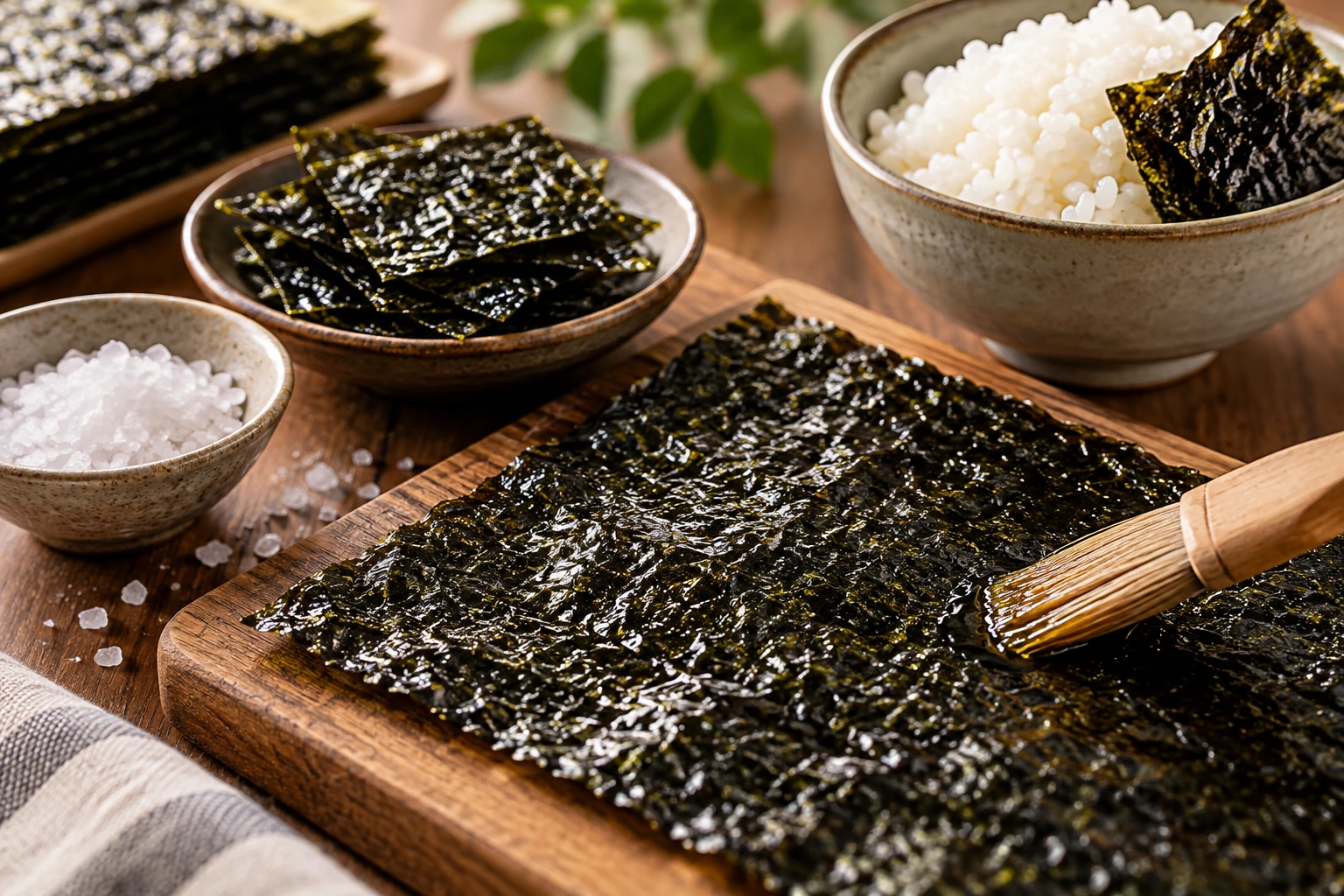
Her recollection of packing her children’s lunches adds another practical detail. She kept the crisp gim separate from the rice and other side dishes so it would not absorb their moisture. That separation helped the small pieces reach lunchtime with the texture she wanted.
A bite of seasoned gim can supply saltiness, roasted aroma and a crisp edge alongside plain rice. It does not need to become a complete rolled gimbap meal to do useful work at the table.
You can try the contrast simply: taste one small piece alone, then another with a little rice. The second mouthful changes the proportion of seasoning to food. A packet that feels intensely salty on its own may make more sense when you understand its role as a rice accompaniment.
Gim and nori need a more useful comparison than national rules
Maangchi allows plain Korean gim or Japanese nori as the starting sheets for her preparation. This is a concrete example of a cook selecting an ingredient for a particular use, rather than deciding that the national name alone determines how it must taste.
For shopping, the important question is whether the product is plain, roasted, seasoned, or portioned as a snack. Check the ingredients and the intended use. The small salty square you ate at lunch is not an automatic substitute for a large sheet needed to hold a roll.
Likewise, a large plain sheet may not give the same immediate experience as an oil-seasoned packet. You can appreciate both without deciding that one is an inferior version of the other.
Export products gave the crisp sheet another occasion
A 2014 Korea.net report featuring Dongwon’s product strategy describes the company marketing seasoned laver in different ways overseas. It presents Kimmy as a snack rather than a rice side dish and describes Sea Veggies products introduced to the United States and Canada in 2011.

These are examples of one company’s dated approach, not a claim about what all consumers in a country eat today. They show how a food can travel partly by changing the occasion attached to it.
At a Korean rice table, a piece of gim joins other foods. In a snack packet, it becomes the thing eaten on its own. The product may retain the seaweed sheet while changing seasoning, portion and the explanation on its packaging.
Welsh laver shows that a sheet is only one possibility
Laver also has a very different place in Welsh food. Museum Wales’s documented laverbread preparation involves cooking the laver until soft, draining and chopping it, and forming portions with oatmeal. The museum describes frying it in bacon fat and serving it with bacon, commonly at breakfast in south Wales.

Here, the aim is not a dry sheet to wrap or shatter. Long cooking and the oatmeal preparation take the ingredient toward a soft mass and then a cooked breakfast component.
The comparison does not establish a direct historical influence between Welsh and Korean cooking. It shows how communities can make different foods from a related sea ingredient by choosing different textures, grains and occasions.
The next time you open gim, notice the particular result you are holding: shaped seaweed, finished for a certain kind of bite. Behind that simple rectangle are the coast, the drying and roasting work, and a decision about whether it should accompany a meal or become a snack itself.