Why Koreans Eat That

Author: JWOO2016 Ch.

  • What Is Bunsik? How a Grain Policy Became a Meal with Friends

    What Is Bunsik? How a Grain Policy Became a Meal with Friends

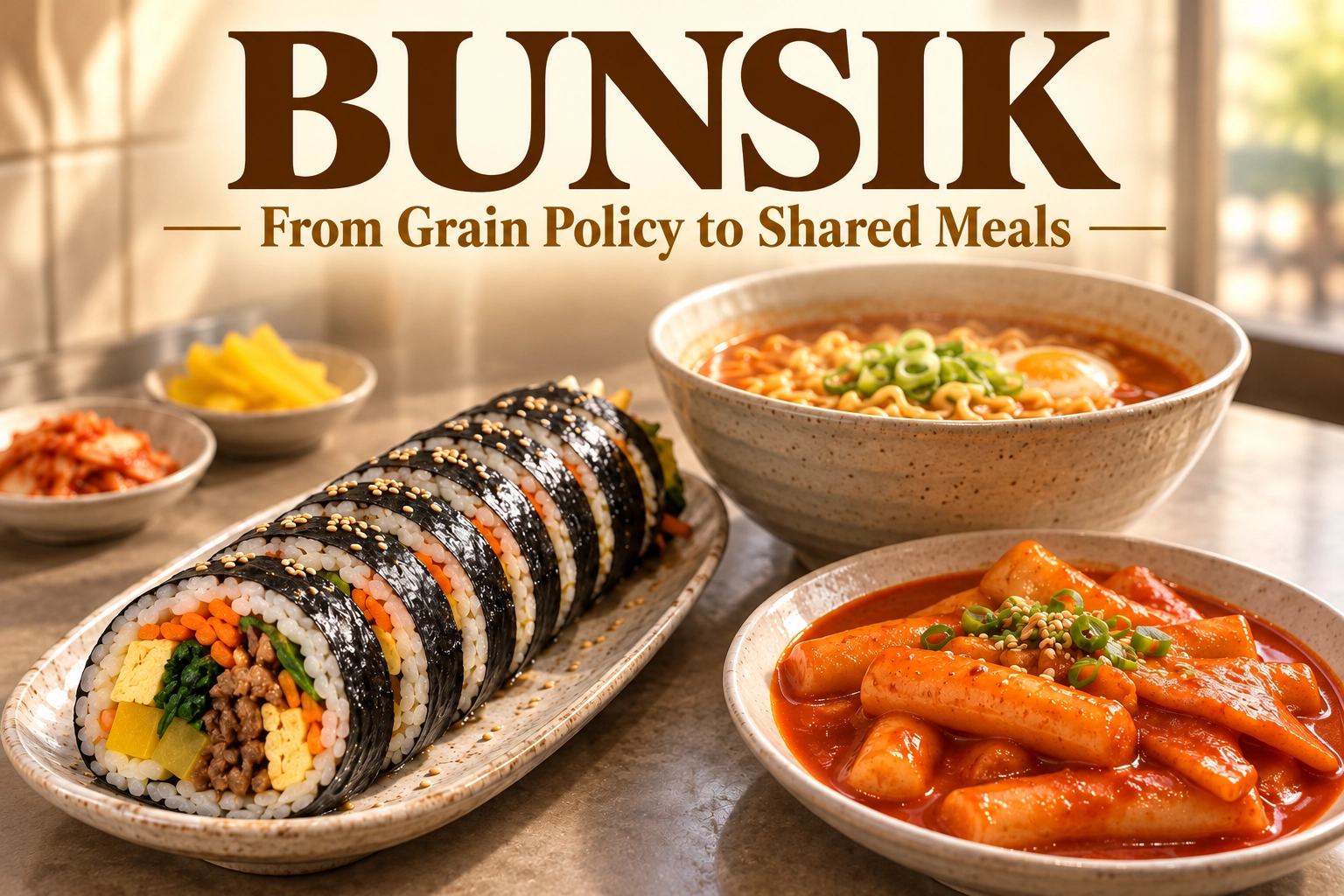
    Today’s bunsik category can bring rice rolls, rice cakes and wheat noodles together.
    Today’s bunsik category can bring rice rolls, rice cakes and wheat noodles together.

    A pork-cutlet sandwich and raw-beef gimbap might seem unexpected neighbors for a word associated with humble flour foods. Yet they appeared together at Dosan Bunsik in Seoul, where brand manager Park Do-kun explained the restaurant’s approach to The Korea Herald in 2023. Its chefs drew on their memories of eating bunsik after school, then imagined a setting where adults could return to those pleasures.

    The choice of a fashionable Apgujeong neighborhood was deliberate. The restaurant put soupy wheat-cake tteokbokki beside dishes that went beyond the familiar school-day snack counter. Park discussed design as well as flavor: remembered foods could inhabit a carefully styled contemporary space.

    That story gives bunsik an interesting double life. It can name a modest meal and also become material for a restaurant concept. Childhood familiarity does not automatically keep a food cheap, plain, or unchanged. For a visitor, the label is a starting point rather than a promise about price or atmosphere. A bunsik shop can sell a memory of ordinary eating, even when the experience has been deliberately redesigned. Kim Hae-yeon’s interview with Park Do-kun

    Why does a flour-food category include rice rolls?

    Bunsik originally refers to flour food, but its everyday dining meaning is broader. Korea.net’s account includes tteokbokki, gimbap, sundae, fried snacks, fish cakes, ramyeon, dumplings, and jjolmyeon. Rice-filled seaweed rolls therefore belong comfortably on a bunsik menu even though they are not wheat noodles or bread.

    Gimbap, noodles and rice cakes beside rice grains, wheat and Bunsik lettering.
    The everyday bunsik category includes rice dishes as well as flour-based foods.

    The same guide describes eateries near schools and markets, associated with accessible, quickly prepared meals for students and working people. The category groups an eating occasion and a kind of restaurant as much as a single ingredient. Something bought for a quick bite can also become your lunch.

    This distinction helps when you first encounter a sign reading bunsik. Translating it only as flour cuisine makes the menu look inconsistent; treating it as a recognizable assortment of informal Korean meals makes more sense. Read the actual dishes before deciding what you want. The shop name alone will not tell you which grain a rice cake contains or whether every item shares the same ingredients. The expansion of the word is part of its history, not a mistake diners need to correct. Korea.net’s introduction to bunsik

    When the government tried to change lunch

    Behind that flexible restaurant category lies a much less flexible chapter of grain policy. The National Archives distinguishes honsik, mixing other grains into rice, from bunsik, eating flour-based food. Its historical account places these efforts against rice shortages and the arrival of American wheat. Changing the supply of grain did not instantly change what people preferred to eat.
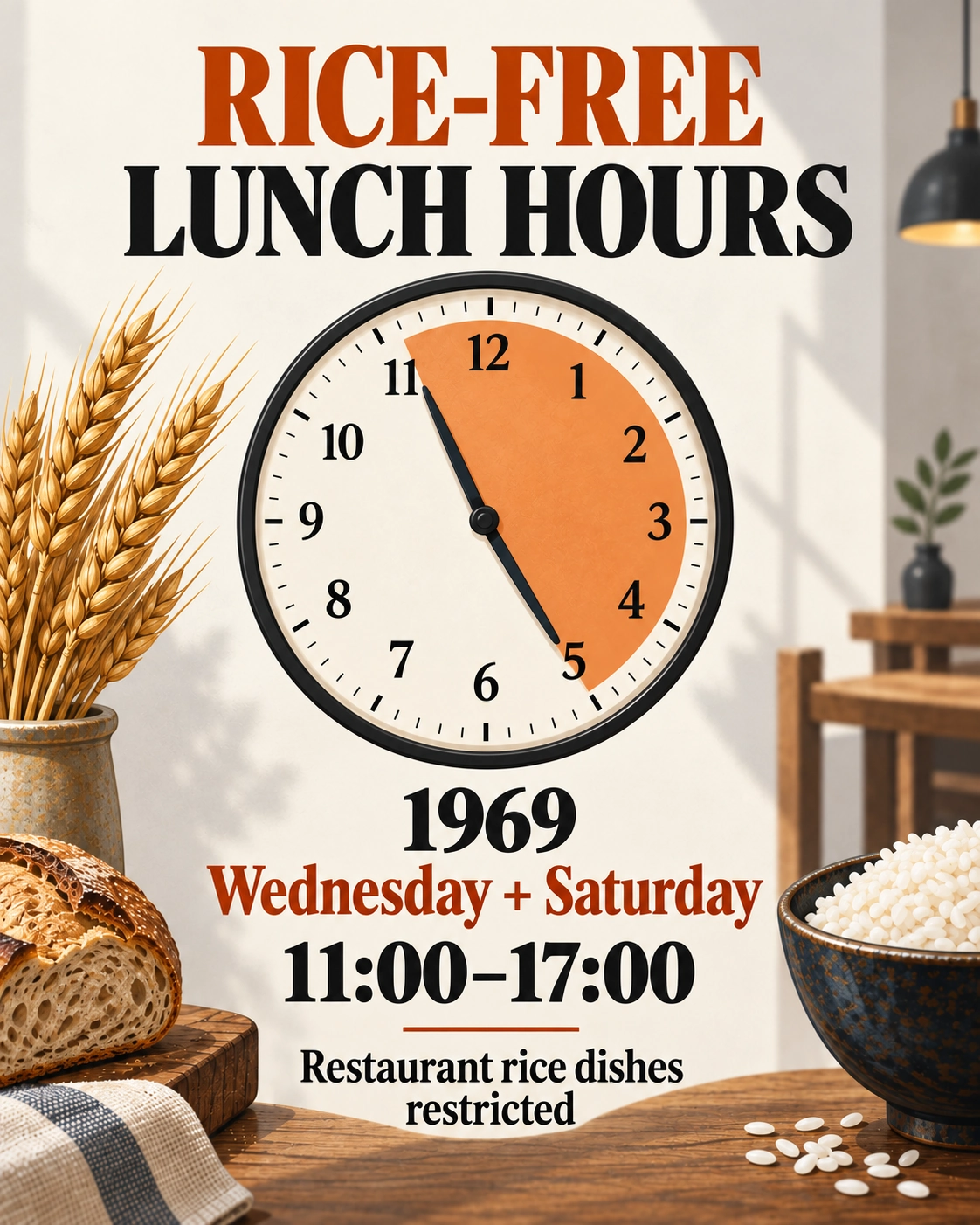
    The historical restriction applied to restaurant rice dishes on Wednesday and Saturday, 11:00–17:00.
    The historical restriction applied to restaurant rice dishes on Wednesday and Saturday, 11:00–17:00.

    A separate Archives presentation identifies January 23, 1969, as the designation of Wednesday and Saturday as bunsik days, also called rice-free days. Restaurants could not sell rice-based dishes between eleven in the morning and five in the afternoon on those days. The policy also required grain mixing in food sold by restaurants.

    The restriction makes today’s rice-filled bunsik counter especially striking. The word that now welcomes a rice roll into an informal meal was once tied to an effort to keep rice out of certain restaurant hours. That was an administrative intervention into everyday eating, not simply customers discovering a new favorite snack. Describing the campaign as encouragement without mentioning enforcement would leave out an important part of the experience. National Archives: grain policy and rice-free days

    The policy needed a persuasive language as well as rules. Advertising scholar Kim Byung-hee examined that language in a 2013 essay about a government advertisement printed in Dong-A Ilbo on January 18, 1972. The advertisement connected mixed-grain and flour consumption with patriotism, economic responsibility, and claims about health. Kim analyzed how these messages turned a dietary choice into an appeal to civic duty.

    He also noted the arrangement of government advertising alongside flour-milling and bakery advertisements. The public campaign and commercial food businesses appeared together on the newspaper page. A reader was being invited to regard a particular way of eating as desirable for the country while encountering products that could make it possible.

    The health language belongs to the advertisement’s historical rhetoric. It is not a reason to repeat its negative judgment of rice as present-day nutritional advice. For understanding bunsik, the more revealing detail is how ordinary food acquired a moral burden. Lunch was no longer only something a person wanted to eat; the campaign presented it as evidence of whether that person was cooperating. Kim Byung-hee’s analysis of the 1972 advertisement

    Nor does a simple account of government orders and foreign aid fully explain how flour reached consumers. In a 2025 study, historian Kim Dong-joo foregrounded the Korean milling industry. His published abstract describes firms burdened by earlier overinvestment, then finding opportunities amid urban population growth, an expanding food-manufacturing sector, and the droughts of 1967 and 1968.

    Wheat, a roller mill, flour and noodle preparation show a path toward food supply.
    The milling industry helps explain how a campaign for flour foods could reach everyday meals.

    Kim argues that around 1967–1969 the industry and government formed a mutually dependent relationship. State promotion of flour foods went together with an industry role in supplying the flour, enabling imports of grain and the use of previously idle milling capacity. His interpretation places companies within the story rather than treating them as passive recipients of policy.

    For the diner, this adds the missing space between a poster and a plate. Encouraging people to eat differently required ingredients to be processed and supplied at scale. A food habit can emerge through shortages, manufacturing capacity, official pressure, and consumer responses together. The argument does not make every later bunsik dish a government invention, or explain an individual restaurant’s recipe by itself. Kim Dong-joo’s study abstract

    The same grain can hold an unwelcome memory and a favorite taste

    The policy reached individual mouths as well as newspaper pages. Under a 2008 Channel Yes essay about barley rice, a reader using the name Blooming recalled lunchbox inspections during the grain-mixing campaign. The unfamiliar barley grains seemed difficult to chew. As a child, the reader picked them out, ate the rice, and returned home with barley still in the box, provoking a scolding from their mother.
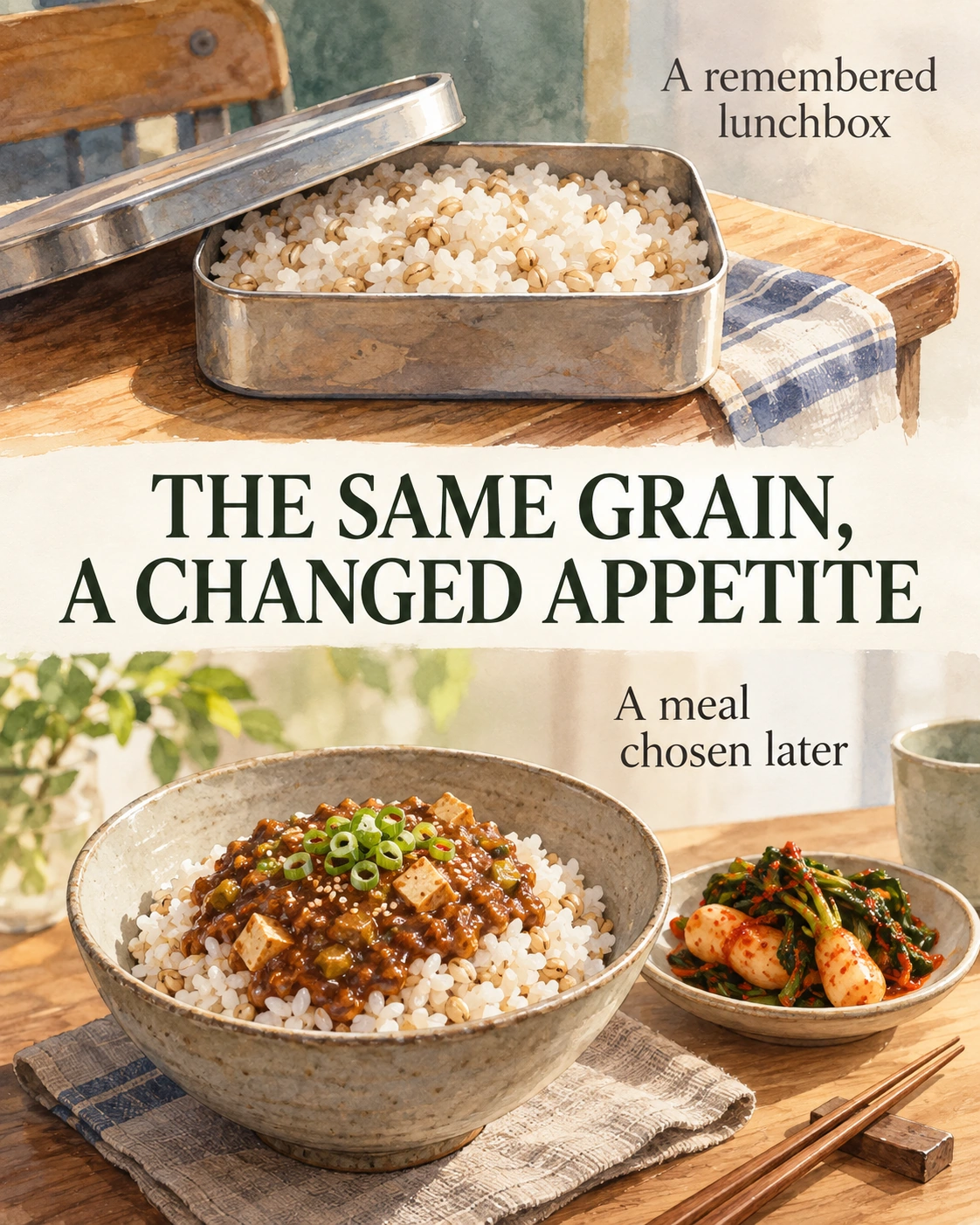
    An unwelcome childhood lunch can become a meal chosen in later life.
    An unwelcome childhood lunch can become a meal chosen in later life.

    The same comment then moved forward to a changed appetite. As an adult, Blooming enjoyed barley rice mixed with thick soybean-paste sauce and young-radish kimchi, especially as a summer meal. That small autobiographical turn is more interesting than assuming dislike lasted forever, or that everyone happily welcomed the policy.

    A single reader’s memory cannot stand for an entire generation. It does show how the circumstances of eating can outlive a campaign and then change again. The food once encountered through compulsory checking could later become something deliberately chosen. An ingredient’s social meaning and a person’s taste need not remain locked to their childhood experience. Blooming’s recollection beneath the Channel Yes essay

    Objects can make that distance between public policy and private eating easier to imagine. Reporting on the National Agricultural Museum’s 2025–2026 Carbohydrate Chronicle exhibition, Yoon Jae-yeol described a flour sack marked in English, carrying a handshake image associated with aid. Its packaging still bore an instruction against selling or exchanging the contents. A bag of an everyday ingredient preserved the conditions under which it had arrived.
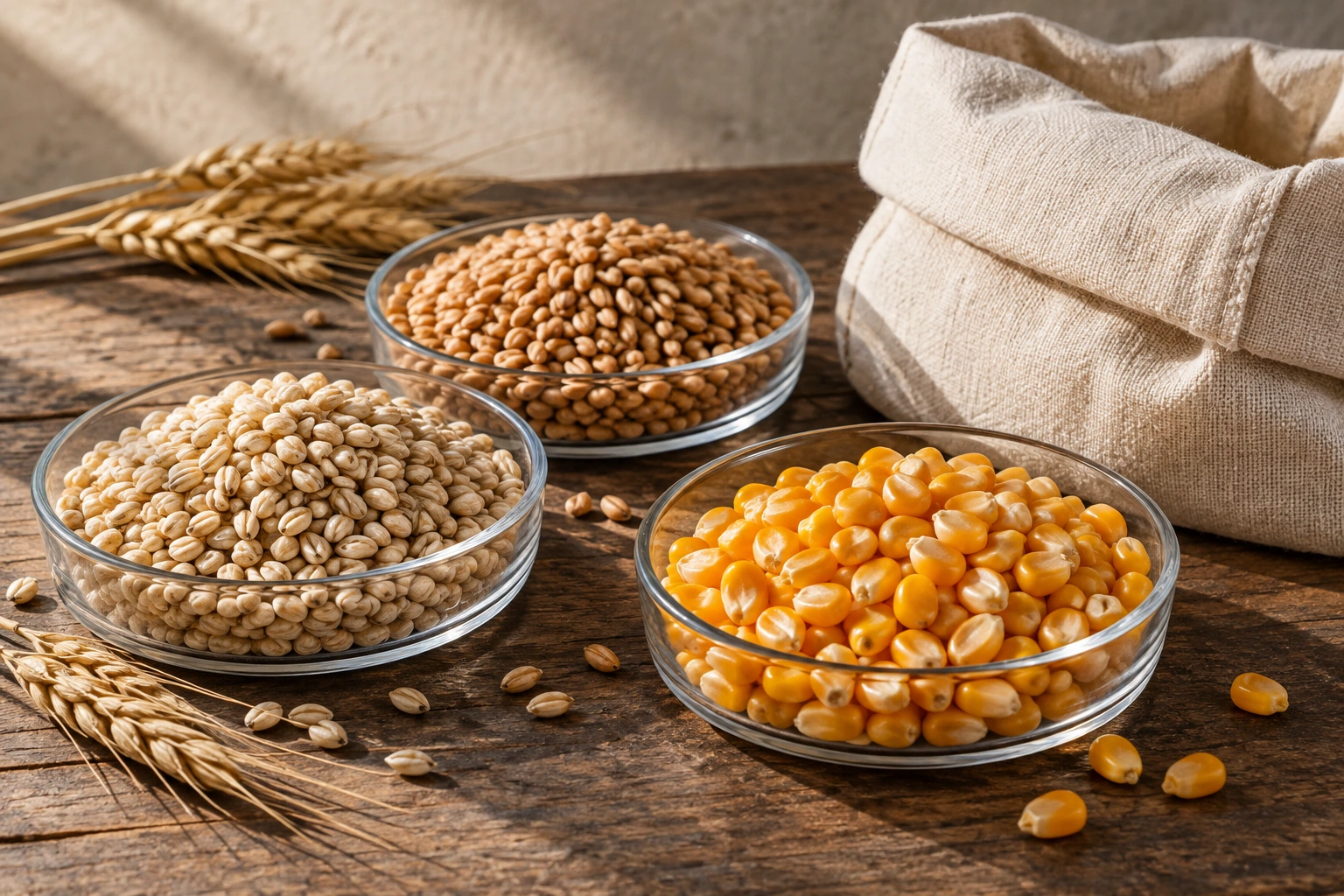
    Bowls of barley, wheat and corn beside a plain cotton sack.
    Barley, wheat, corn and a flour sack open another route into food’s material history.

    The exhibition focused on barley, wheat, and corn rather than centering rice. Curator Jang Mi-jin explained that these grains offered another way to follow changes in Korean life and food memory. The display brought a material history of meals into view alongside more familiar recollections of what people ate.

    Looking at such evidence encourages a different kind of food story. A flour sack can point toward distribution, foreign relationships, and instructions to recipients before anyone shapes dough. A menu may be the final, pleasurable encounter with an ingredient whose earlier journey was much more regulated. You can enjoy the meal and still be curious about that journey. Yoon Jae-yeol’s exhibition report

    At your next bunsik meal, the menu offers a useful way to hold these histories together without reducing the food to hardship. Choose the dishes that appeal to you, and notice how the restaurant groups them. The shared category may connect different grains, textures, and sizes of meal.

    If you are eating with someone who grew up with these foods, let their recollection be specific: a favorite shop, an unwelcome lunch, a dish they now order differently. A memory is richer when it belongs to a person rather than being assigned to everyone. Bunsik’s story accommodates policy, commerce, resistance, pleasure, and reinvention at the same table.
  • Dorumuk: The Korean Winter Fish Behind “All for Nothing”

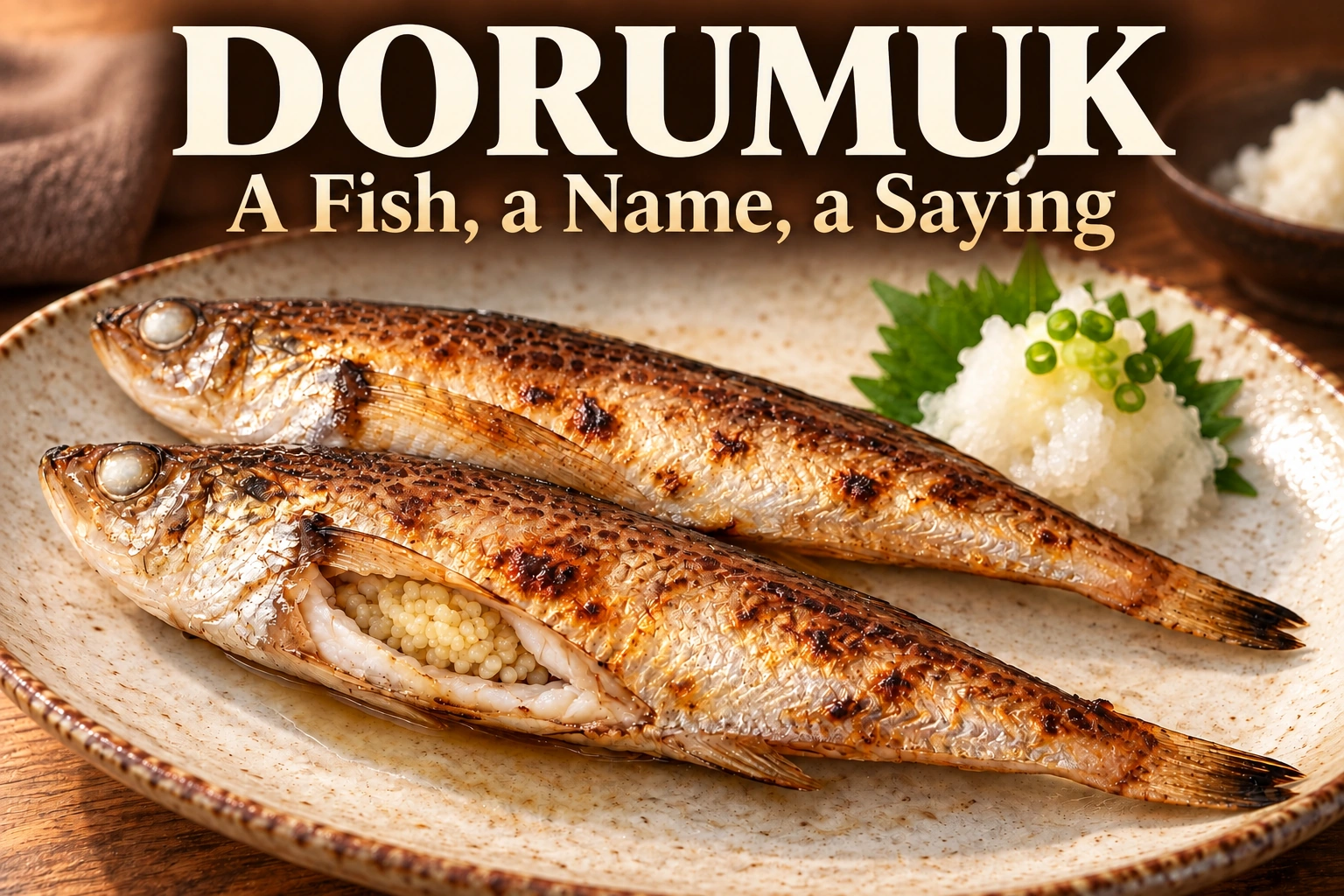
    Dorumuk: The Korean Winter Fish Behind “All for Nothing”

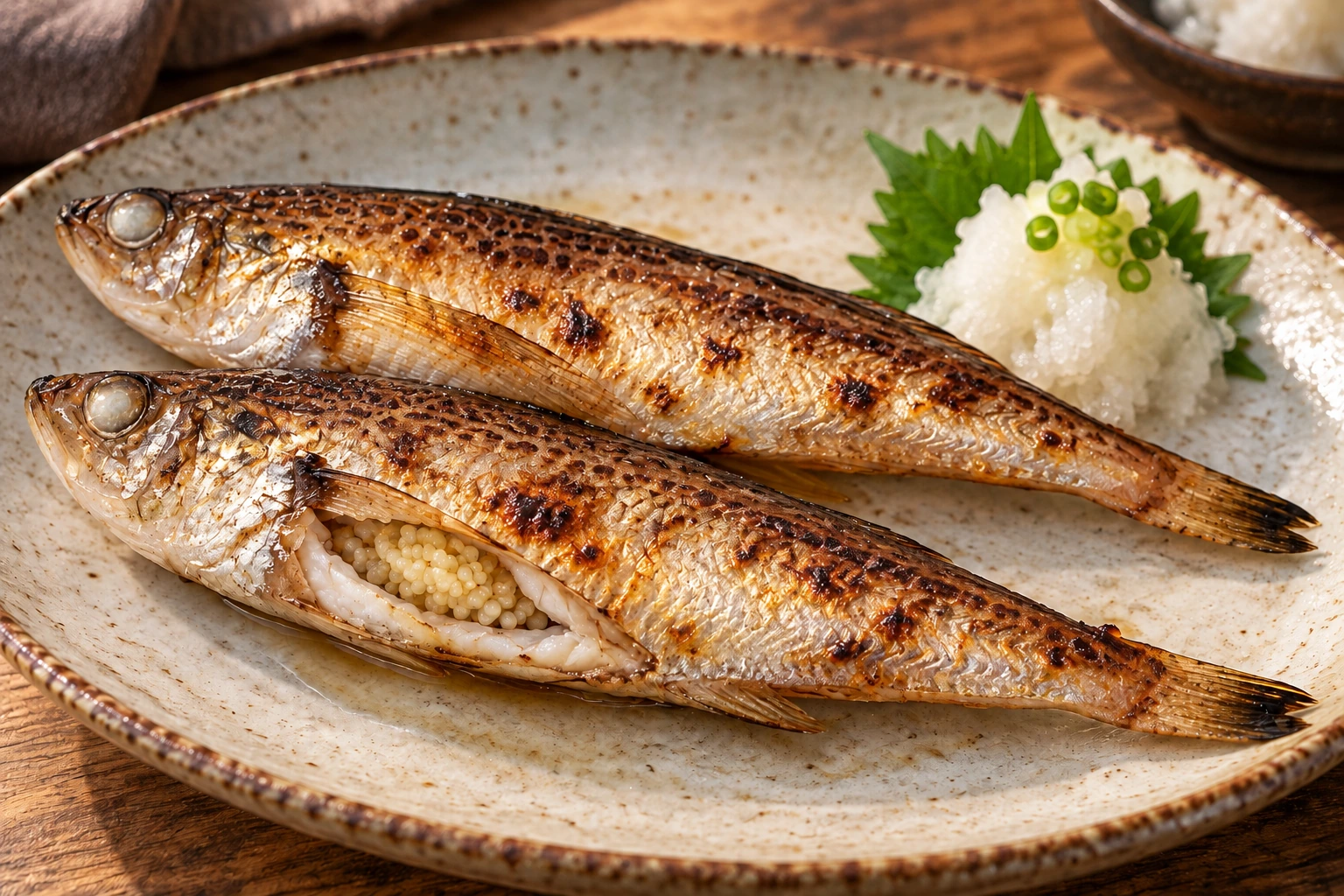
    Grilled dorumuk offers a culinary story beyond the familiar expression.
    Grilled dorumuk offers a culinary story beyond the familiar expression.

    You may meet dorumuk in two very different places: on a menu in a Korean coastal town, or in a conversation about work that has come to nothing. In the expression maljjang dorumuk, the fish becomes an image of wasted effort. Yet a winter dinner featuring its roe can be something people look forward to.

    That mismatch is the interesting part. How did an edible fish acquire such an unflattering verbal life? The familiar answer involves a king who changes his mind. The fuller story includes a linguist questioning that explanation, a cook’s family memory, and Japanese cooks giving the same fish another seasonal identity.

    Understanding those layers helps you read both a Korean expression and a restaurant menu. You can enjoy the royal tale while leaving room for the people who actually cook the fish.

    What does “maljjang dorumuk” mean?

    In a food-travel report published by the Korean Food Promotion Institute in January 2021, writer Hong Wonmun explains the expression as effort becoming useless. A loose English equivalent is “all for nothing.” It describes a disappointing result; it does not tell you how the fish on your plate tastes. Hong Wonmun’s Sokcho report.

    For an imagined everyday example, consider someone who has carefully prepared a presentation and then loses the file before saving it. The expression could convey the frustration of seeing that work disappear.

    Presentation notes beside an empty laptop document illustrate effort coming to nothing.
    The imagined lost-file example illustrates the expression’s sense of effort coming to nothing.

    There are therefore two questions to keep separate. One concerns the meaning of a phrase in conversation. The other concerns the history of the fish’s name. A memorable explanation of the first can easily be mistaken for evidence about the second.

    The king who liked the fish, then changed his mind

    A widespread version of the story features King Seonjo during wartime flight. Hungry and far from his usual table, he enjoys a fish called muk and grants it a more flattering name. Back in the palace, it disappoints him, and he orders a return to the earlier name. The phrase “back to muk” supplies the story’s verbal punch line.

    Linguist Cho Hang-beom recounts this version in a 2005 essay hosted by the National Institute of Korean Language, then rejects it as a reliable etymology. Cho’s discussion, pages 115–118.

    Read as a tale, it poses an appealing question: has the food changed, or has the eater? Hunger and comfort provide the contrast. A king’s supposedly authoritative judgment becomes unstable when his circumstances change. That makes the anecdote easy to remember and retell.

    It also makes it tempting to supply a precise king, journey and dinner. Those details need evidence of their own. The story’s neat ending does not provide that evidence.

    What the older name can tell us

    Cho instead traces dorumuk through earlier forms including dolmok and doreumok. He argues that the name can be explained through changes in pronunciation, without deriving it from a king’s command to call the fish “muk again.”

    An expression, a royal tale and a linguistic argument provide different kinds of evidence.
    An expression, a royal tale and a linguistic argument provide different kinds of evidence.

    His interpretation of the element dol connects it with lower esteem in certain animal and plant names. He also acknowledges uncertainty about the ultimate origins of the component words. This is a linguistic argument with its own limits, rather than a recovered transcript of the name’s first use. Cho Hang-beom’s etymological analysis.

    The Academy of Korean Studies records another royal version involving a Goryeo king, as well as a tradition involving King Injo. Its account also distinguishes older references to a fish called euneo from today’s fish bearing that name. These shifting rulers and labels complicate any simple identification of one legendary dinner as the origin. AKS, “Dorumuk”.

    For the reader, the useful distinction is between evidence that a story circulated and evidence that its event occurred. An old written retelling can establish the former without settling the latter.

    The name forms dolmok, doreumok and dorumuk above a winter coastline.
    Cho Hang-beom examines older name forms as an alternative to deriving the word from the royal tale.

    Why dorumuk belongs to the winter coast

    The fish itself is sailfin sandfish, Arctoscopus japonicus. The AKS account describes it living over sandy or muddy seabeds in deeper water and moving into shallow, seaweed-rich areas during its early-winter spawning period. That movement gives the seasonal food story a biological setting. AKS species account.

    The Korea Tourism Organization’s description of dorumukgui places the dish around Gangneung and Sokcho. It emphasizes winter roe, grilling over briquettes or charcoal, and eggs with a slippery surface and a popping texture. It also notes a braised preparation with radish and green onions. KTO’s grilled sailfin sandfish guide.

    These are useful expectations for a first meal. Roe brings a different experience from a simple fillet, and grilled fish differs from fish cooked with vegetables and sauce. Ask whether a particular serving includes roe instead of assuming every dorumuk dish will provide the same texture.

    A language lesson might leave you thinking of disappointment. A menu question brings you back to season, cooking method and the actual serving.

    A Sokcho mother’s food becomes a restaurant side dish

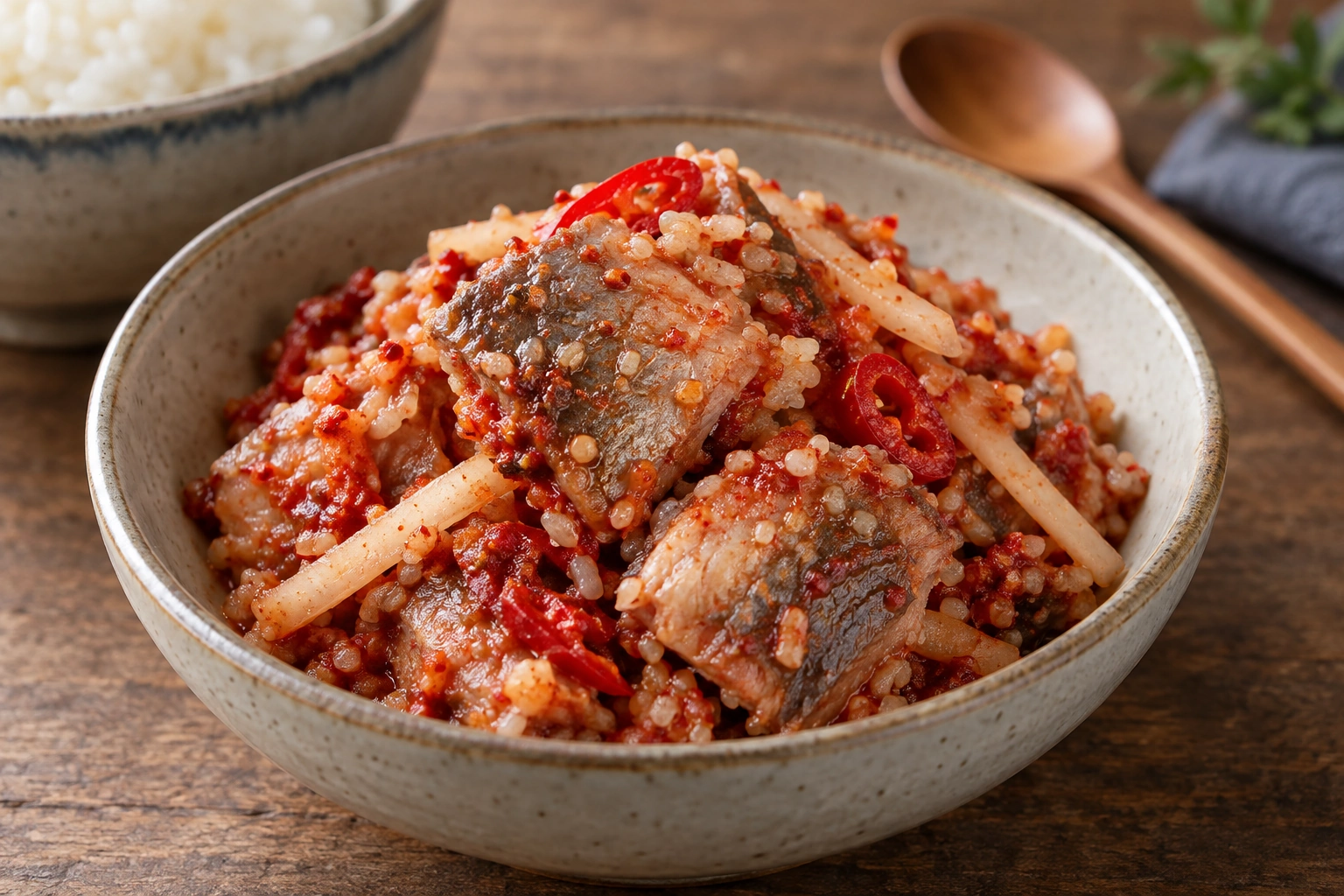
    Hong Wonmun’s 2021 report introduces Kim Hasik of Sokcho Bokjip. Kim recalled eating dorumuk sikhae as a child because his mother, originally from Hamgyeong, prepared it. He later served the fermented fish as a side dish at his restaurant.

    A small side-dish bowl of fermented fish with grains, radish and red seasoning.
    Dorumuk sikhae appears in a cook’s account as a fermented fish side dish learned through family food.

    Kim described making the side dish with the winter supply of fish, and customers enjoying it. The Korean Food Promotion Institute’s interview.

    Here, a named cook’s account offers something a king story cannot: a specific route by which knowledge moves between people. A child eats a mother’s food, remembers it, and makes it available to customers. The fish becomes recognizable through continuity of practice.

    This is a dated account of one restaurant’s cooking, rather than a promise about its present menu. It still matters as evidence of how a coastal ingredient can hold family geography inside an ordinary side dish.

    Potatoes and radish give the fish another role

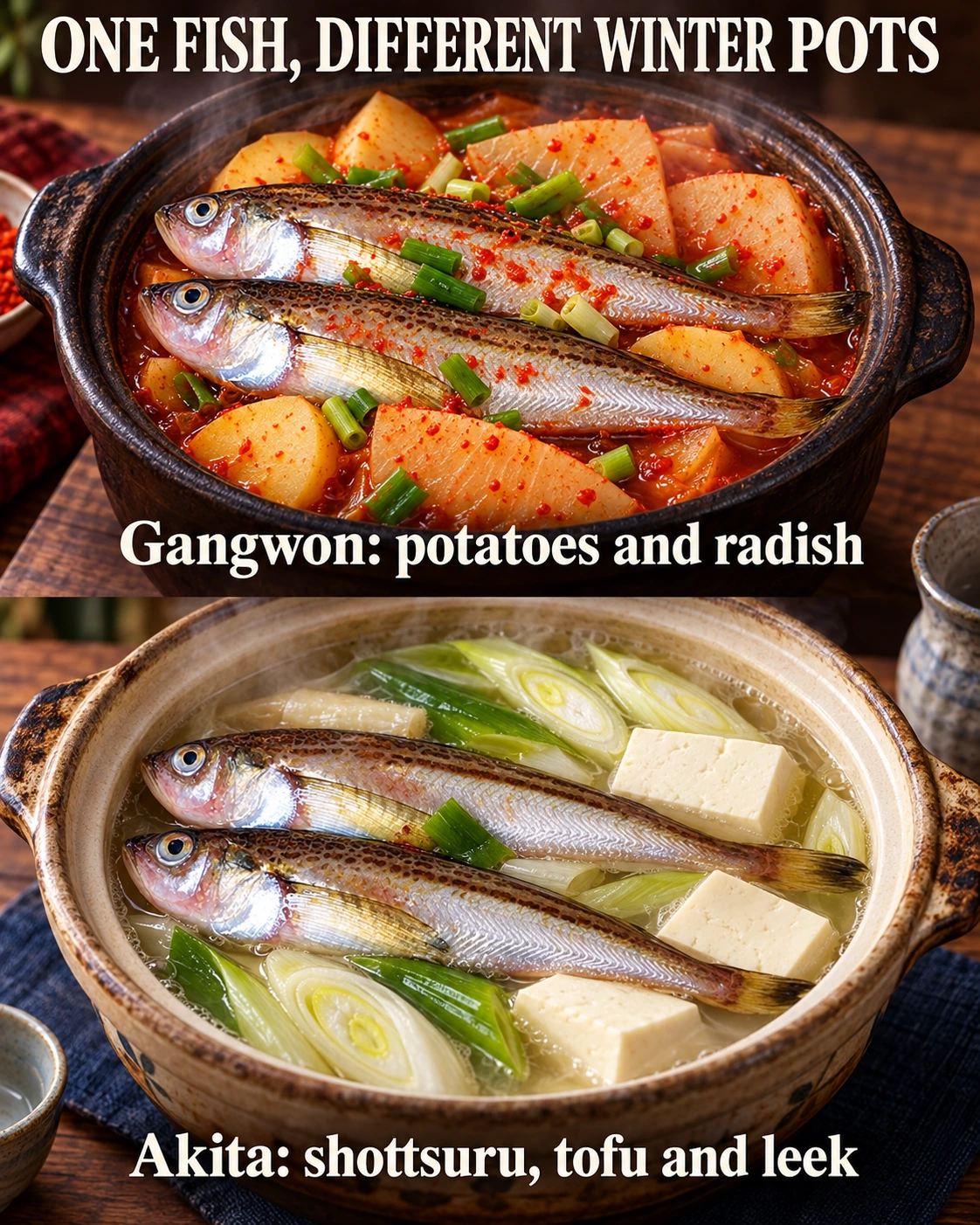
    A Gangwon recipe documented in the Korean Traditional Knowledge Portal’s 2008 regional-food collection is dorumuk gamja jjim. It combines sandfish with potatoes and radish, using seasonings that include soy sauce, garlic, chili and gochujang.

    The recorded method places the sliced vegetables underneath the fish before cooking with water and adding the seasonings. Despite the English title’s use of “steamed,” the directions describe cooking the ingredients in a pot with water. Regional recipe supplied by the Rural Development Administration.

    For someone choosing between dishes, this arrangement shifts attention from an individual grilled fish to a seasoned preparation shared with vegetables. The potatoes and radish belong to the dish’s identity, rather than functioning as an unrelated garnish.

    This one documented recipe need not stand for every Gangwon household. It shows why searching only for “grilled dorumuk” would miss part of the fish’s culinary life.

    In Akita, the same fish is hatahata

    Across the sea, Japanese cooks know this fish as hatahata. Japan’s Ministry of Agriculture, Forestry and Fisheries presents shottsuru nabe as an Akita winter specialty, associated with the November–December season.

    Sandfish arranged with potatoes and radish, or with tofu and leek, before simmering.
    Sandfish arranged with potatoes and radish, or with tofu and leek, before simmering.

    The hot pot combines the fish with shottsuru, a fermented fish sauce. The ministry describes preparations with ingredients such as tofu and leek, alongside an Oga tradition of a simpler fish soup. It also records the association of hatahata’s name with thunder. MAFF’s Akita regional cuisine account.

    The comparison changes the question from “Which country has the better version?” to “What do people make meaningful about the same ingredient?” Korean expressions invite a story about reversal and disappointment. The Akita account evokes winter weather and a regional hot pot. Neither comparison proves that one dish descended from the other.

    When you next encounter dorumuk, look beyond its verbal reputation. Check the cooking method, ask about roe, and notice whether the fish appears as a main dish or a fermented side. The king may supply the memorable anecdote; the coast, cooks and changing names supply a much richer dinner conversation.

  • Ojang-dong Hamheung Naengmyeon: A Place to Find People From Home

    Ojang-dong Hamheung Naengmyeon: A Place to Find People From Home

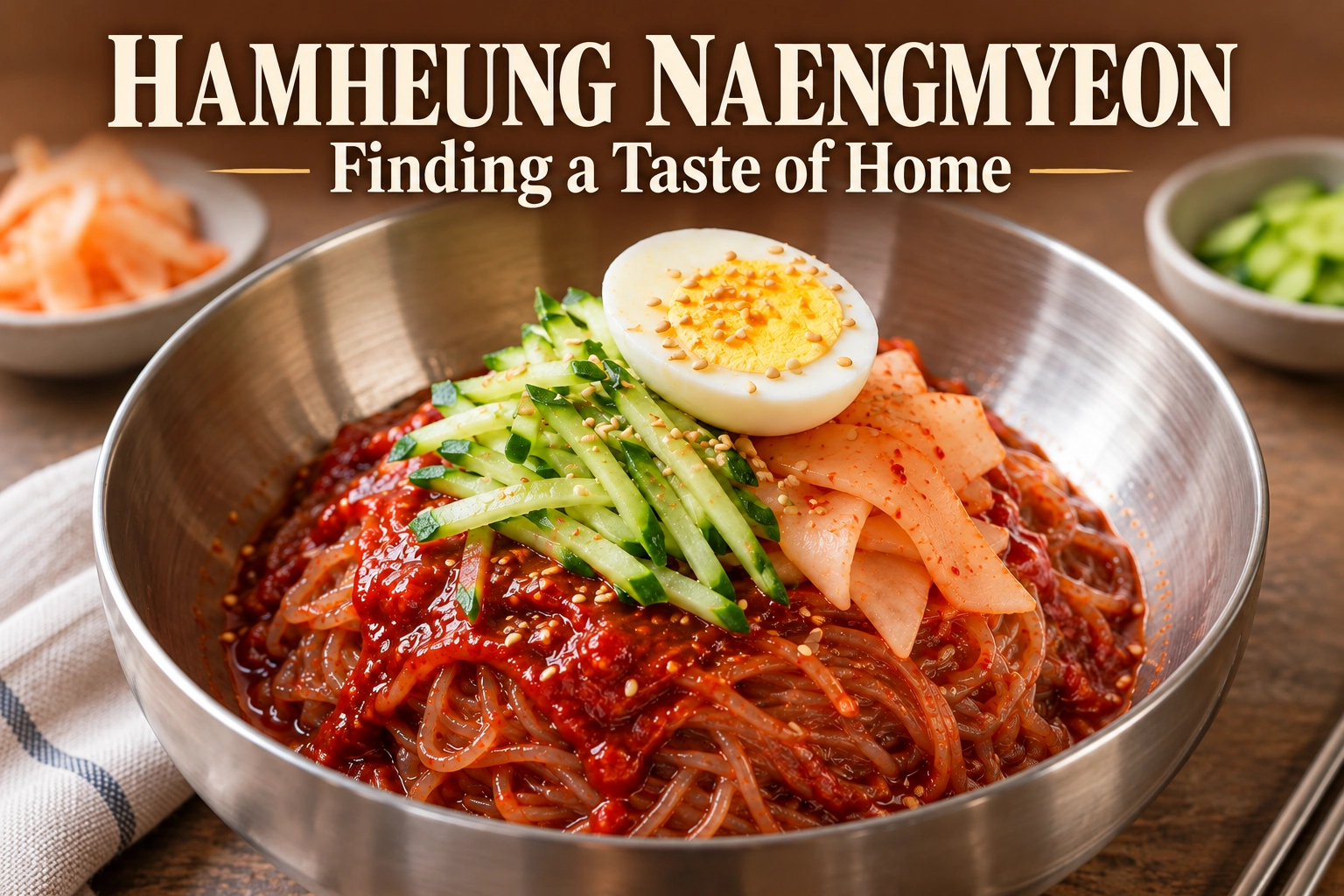
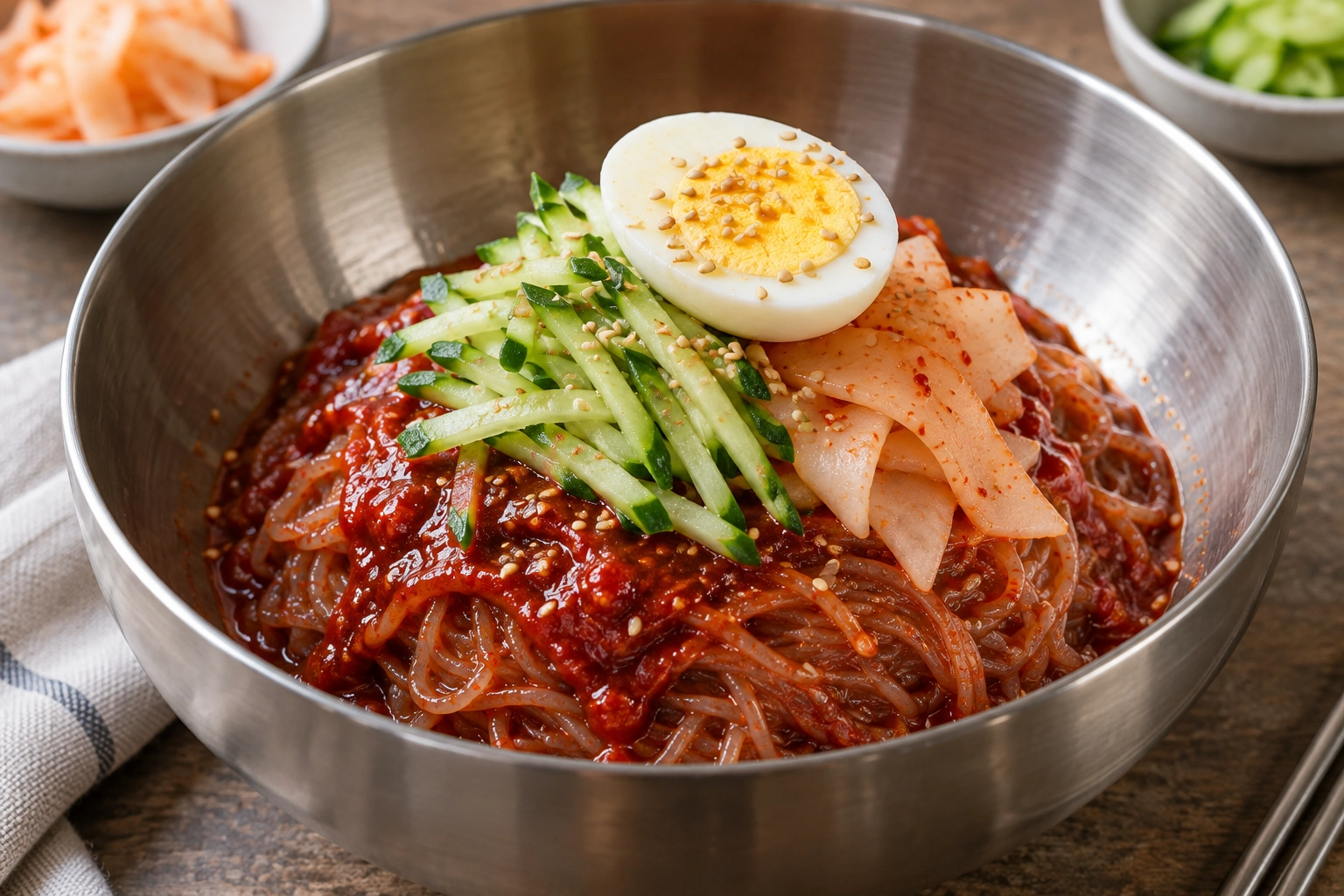
    A bibim-style bowl brings starch noodles together with mixed sauce.
    A bibim-style bowl brings starch noodles together with mixed sauce.

    Before a cold noodle bowl became a destination, it could be a way to find someone. In chef Park Chan-il’s account of Ojang-dong’s Heungnamjip, Kwon Gi-sun recalled people from the same northern region meeting at the restaurant. They came through the nearby markets, ate familiar food and asked after one another. The restaurant offered something a recipe alone could not supply: other people who remembered home.

    Kwon was describing a business founded by her mother-in-law, identified in the report as No Yong-eon. The founder had lived in Heungnam before moving south. Kwon remembered working with a baby on her back and a neighborhood where many people from Hamgyeong traded and settled. These are one family’s recollections, not a portrait of every refugee’s life.

    They nevertheless change what a visitor can recognize in Ojang-dong. The bowl did not only transport a flavor from one place to another. It helped make a meeting place amid unfamiliar surroundings. The question “Where can I eat Hamheung naengmyeon in Seoul?” has a historical answer as well as a dining answer: here, restaurants became places where displaced people could locate a community. Park Chan-il’s interview with Heungnamjip’s Kwon Gi-sun

    A northern name takes root in Seoul

    Heungnamjip is not the same establishment as the nearby restaurant named Ojang-dong Hamheung Naengmyeon. Seoul’s Future Heritage description identifies Han Hye-seon as the latter’s founder, opening the business after moving south during the Korean War. Its account dates the shop to the 1950s and explains the name through customers describing a good Hamheung noodle place in Ojang-dong.

    Two nearby establishments retain distinct founders and family histories.
    Two nearby establishments retain distinct founders and family histories.

    The same description connects Han’s food with nongma guksu, starch noodles associated with Hamheung. This makes the regional label more interesting than a claim that a restaurant copied an entire city’s cuisine unchanged. A remembered preparation gained an identity among customers in Seoul. The name referred back to the north while also acquiring a southern restaurant history.

    It is safer to understand that process than to repeat the heritage page’s sweeping statement that the food does not exist in Hamheung. That wording concerns the identity of a particular South Korean dish; it should not erase northern starch-noodle traditions. Nor should Han’s account absorb every neighboring founder into one family. Two nearby signs can share a food style and a history of displacement while representing different people, businesses and lines of succession. Seoul Future Heritage’s description of Ojang-dong Hamheung Naengmyeon

    Ines Cho’s 2005 Korea JoongAng Daily report shows the next layer of that restaurant history. At Ojang-dong Hamheung Naengmyeon, Cho shared a table with an elderly couple. The man said that he had visited after church on Sundays since before he married; later he and his wife came together.

    This memory is quieter than a dramatic escape or a founder’s opening day. Its significance is repetition. The restaurant had become a place that fitted into the couple’s life, carrying a connection through changing circumstances. A bowl could belong both to a displaced family’s livelihood and to another family’s weekly routine.

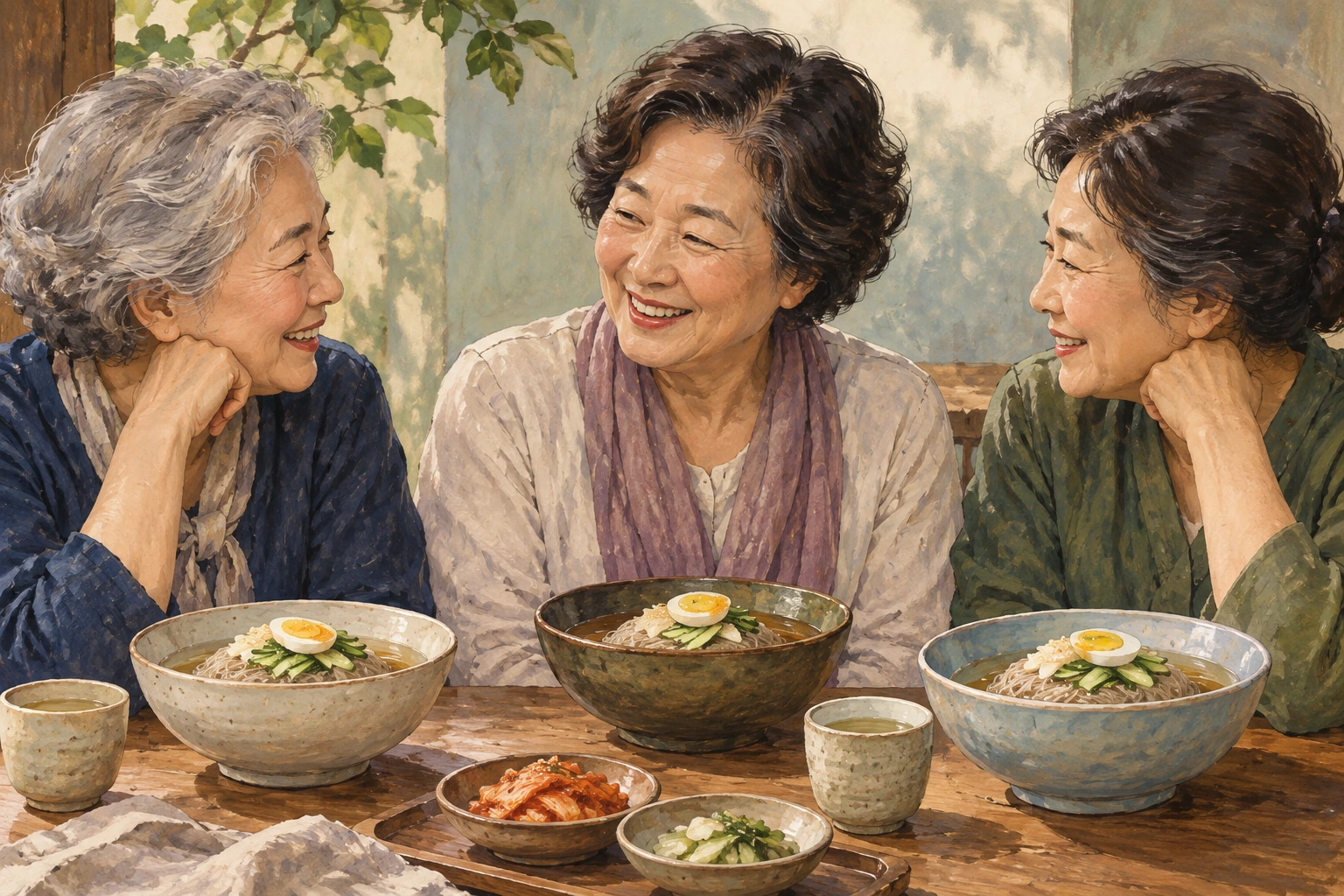
    Three older diners conversing around a table with cold noodles.
    Repeated restaurant visits can keep shared memories and relationships in circulation.

    The report also visited a Pyongyang-style restaurant and interviewed its owner about her own northern family background. Those are distinct establishments and regional associations, not interchangeable examples of one “North Korean recipe.” The shared point is that restaurant histories can preserve personal connections to places diners cannot easily revisit. Cho’s Sunday customer gives that larger history an ordinary scale: one person returned, a marriage changed the party at the table, and the meal remained part of their week. The interview records what he remembered in 2005, rather than describing the restaurant’s customers today. Ines Cho’s dated restaurant visits and interviews

    Remembering home does not mean freezing a recipe

    The movement of northern food traditions was not limited to Seoul. In the abstract of their 2023 study of fishing-village food culture, Song Ju-eun and Lee Jeong-sil describe displaced people in northern Gangwon adapting foods from Hamgyeong to the circumstances of their new homes. Hamheung naengmyeon and squid sundae are among their examples.

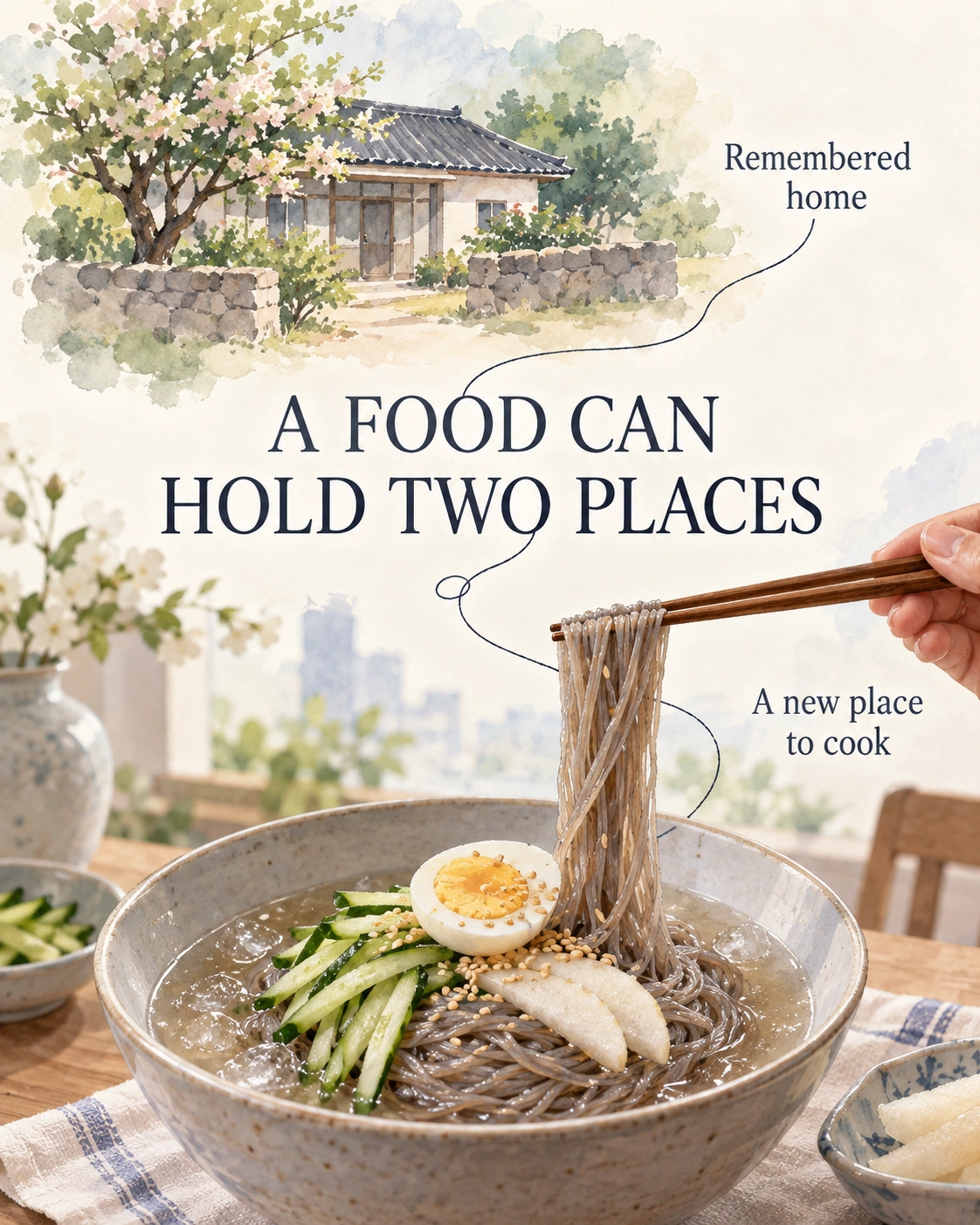
    A remembered house connected by an ink thread to a bowl of chilled gray noodles.
    The northern Gangwon study distinguishes the region remembered from the place where food is prepared again.

    The abstract’s geographic distinction is useful: the remembered region and the place of preparation are not necessarily the same. A dish can maintain a connection to home precisely through being made again somewhere else. Adapting to available conditions is part of that continuation, rather than automatic evidence that the connection has become meaningless.

    This is the authors’ framing of the coastal communities they studied. It cannot settle the opening year of an Ojang-dong restaurant, establish every historical noodle mixture or prove that all families adjusted their cooking alike. It provides a comparison for reading the Seoul testimonies: displaced cooks were creating livelihoods and meals in new circumstances. A regional name can therefore carry two places at once. One supplies memory and association; the other supplies the actual setting in which someone prepares, sells and shares the food. Song and Lee’s published research abstract

    There is also a northern comparison that remains distinct from Ojang-dong. UNESCO’s record of the Pyongyang Raengmyon custom, inscribed in 2022, describes buckwheat-forward cold noodles and social practices around them. Its account includes family and neighbor gatherings, birthday and wedding blessings, and transmission through households, restaurants and education.

    That recognition concerns the Pyongyang custom nominated by the Democratic People’s Republic of Korea. It is not an inscription for all Korean cold noodles, a certification of Ojang-dong’s restaurants or a declaration that Pyongyang and Hamheung styles are the same. The scope is part of understanding the story accurately.

    The comparison illuminates a shared question without merging the dishes: what do people pass along when they pass along a food? In the UNESCO account, the meal includes occasions, hospitality and ways of teaching. In the Ojang-dong family testimony, a restaurant allowed people from home to meet and exchange news. Different circumstances give the noodles different work to do. Food continuity can depend on a gathering and the people who sustain it as much as on the materials in the bowl. Remembering that makes the regional names more informative, rather than using them as competing authenticity badges. UNESCO’s Pyongyang Raengmyon custom record

    A useful distinction for today’s reader

    The names on menus describe more than one thing. Hyo Sun’s Korean Bapsang guide distinguishes mul naengmyeon, served in broth, from bibim naengmyeon, mixed with sauce. It also explains the broad South Korean association of Pyongyang with the former and Hamheung with the latter, alongside differences in buckwheat and starch proportions.

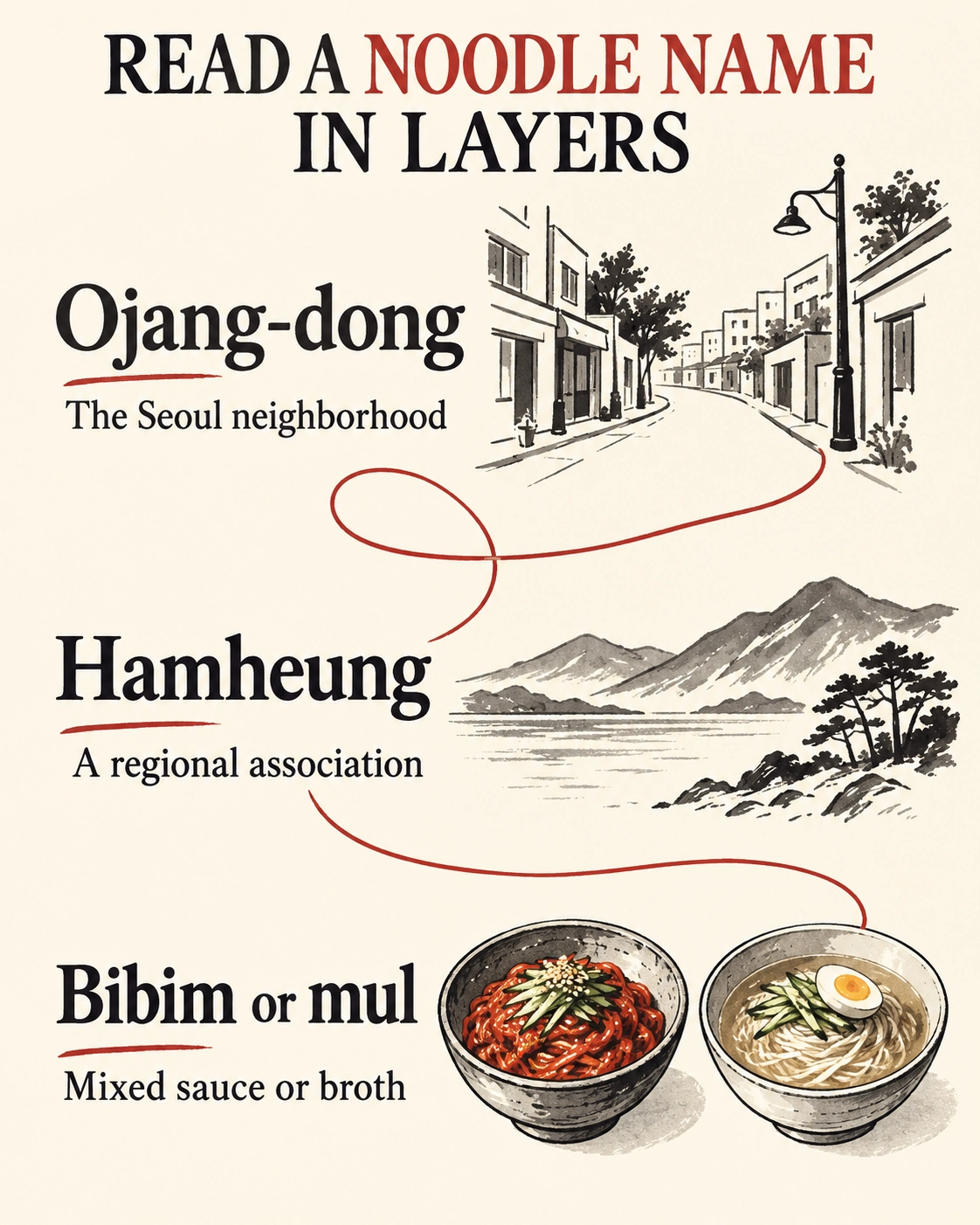
    A neighborhood, a regional association and a serving format describe different layers of a noodle name.
    A neighborhood, a regional association and a serving format describe different layers of a noodle name.

    Those associations are starting points, not two rigid boxes. Hyo’s own home preparations include choices about broth, radish garnish and commercially available noodles. Her bibim version can also receive a little broth. A serving word describes what happens to the noodles, while a place-name can carry a regional association and a restaurant history. Neither word tells you every ingredient a specific cook has used.

    For a visitor interested in the story, the useful task is to keep these descriptions separate. Notice the establishment’s name, the regional style it claims and the actual format ordered. Ojang-dong is a neighborhood; Hamheung is a northern association; broth and mixed sauce describe the bowl. This leaves room for the independent histories of neighboring restaurants and for the choices a home cook makes, instead of forcing every preparation to reproduce one imagined ancestral meal. Hyo Sun’s explanation and home versions of naengmyeon

    Explaining the food across languages brings another adjustment. On her bibim-naengmyeon page, Maangchi recalls her editor asking for sensory descriptions she had never needed when cooking and eating the food herself. Her co-writer compared the noodles’ texture to thin licorice laces. The analogy was a way to help an unfamiliar reader anticipate the chew, not a claim that the noodles contain candy or taste like it.

    The same page describes Maangchi refining her own version over time. It offers an everyday reminder that a known food can still require explanation and revision when it reaches a different audience. Knowing a name and recognizing a bite are separate stages of learning.

    Ojang-dong’s story asks for that kind of careful attention. A visitor may begin with a spicy noodle bowl and later discover the women who ran the shops, the markets through which customers arrived and the people who came looking for news of home. The historical value lies in those connections. A meal remembered only as “northern noodles” loses the very individuals who made it possible for a regional tradition to become part of another city’s ordinary life. Maangchi’s account of describing and developing bibim-naengmyeon

  • Why Koreans Eat Seaweed Soup on Birthdays: A Bowl of Family Memory

    Why Koreans Eat Seaweed Soup on Birthdays: A Bowl of Family Memory

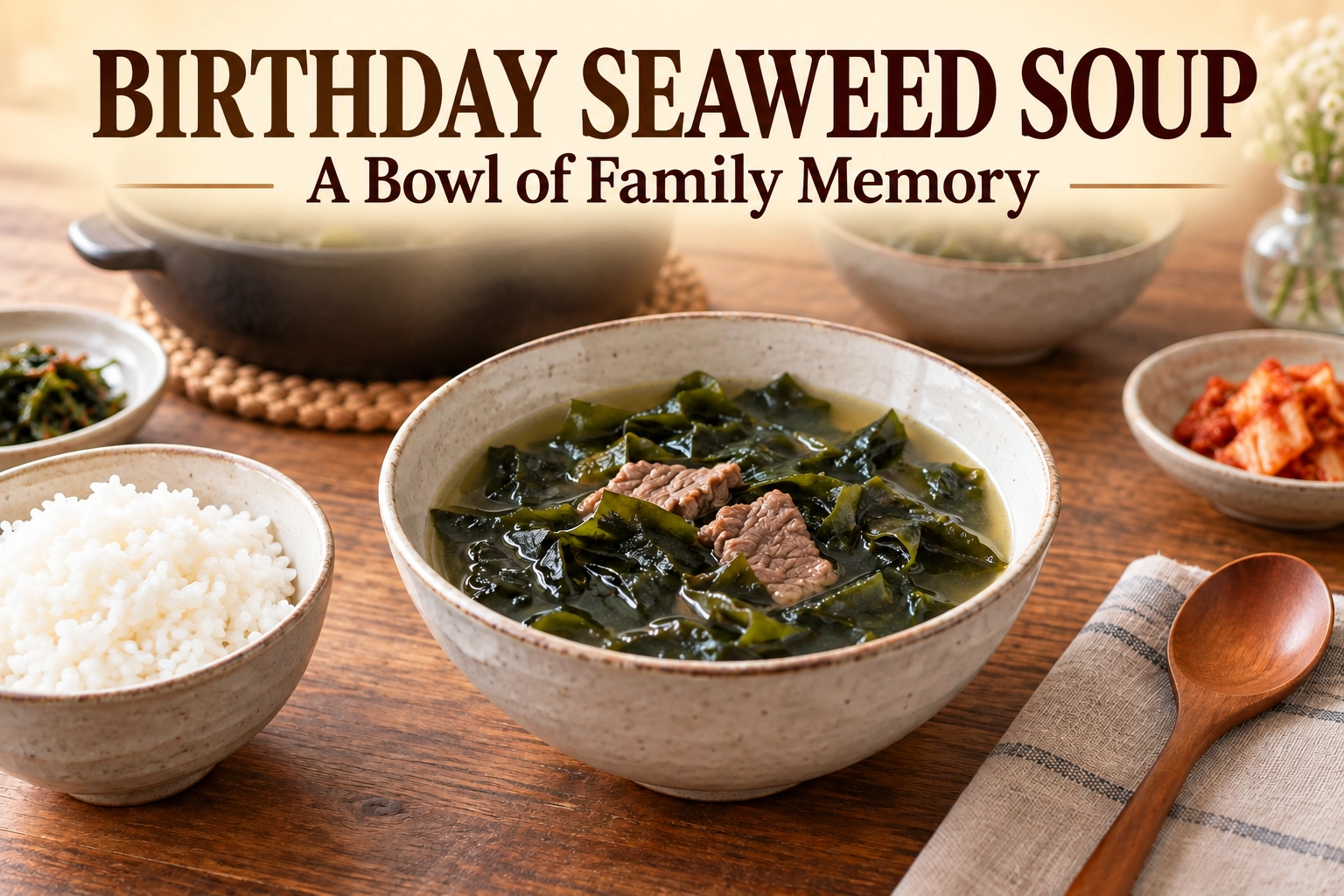
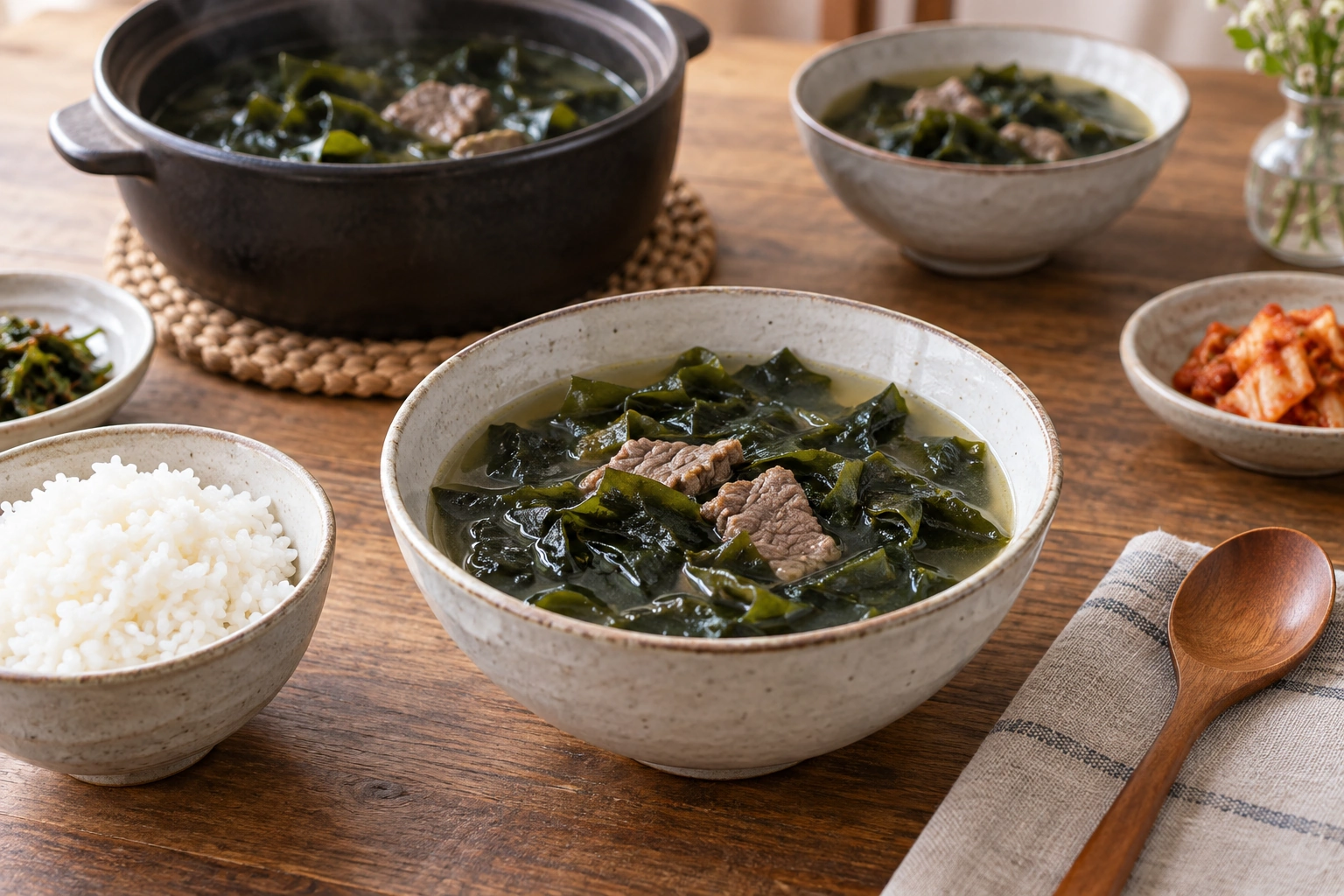
    Miyeokguk can accompany an ordinary meal as well as a birthday.
    Miyeokguk can accompany an ordinary meal as well as a birthday.

    For journalist Hannah Yang, her husband Aaron’s birthday menu includes his chosen macaroni and cheese and yellow cake with fudge frosting. She adds a small pot of miyeokguk, Korean seaweed soup. In her 2022 personal essay for MPR News, a familiar Korean custom enters a household where the birthday celebration has more than one cultural vocabulary.

    That small pot answers a question visitors often ask: why do Koreans eat seaweed soup on birthdays? Miyeokguk connects the person celebrating with childbirth and the mother who received the soup after giving birth. It can express gratitude, remembrance and care, while remaining an everyday food people also enjoy on other dates.

    The story becomes more interesting when we follow who receives the bowl—and who takes responsibility for making the next one.

    Before birthday soup, a mother’s first bowl

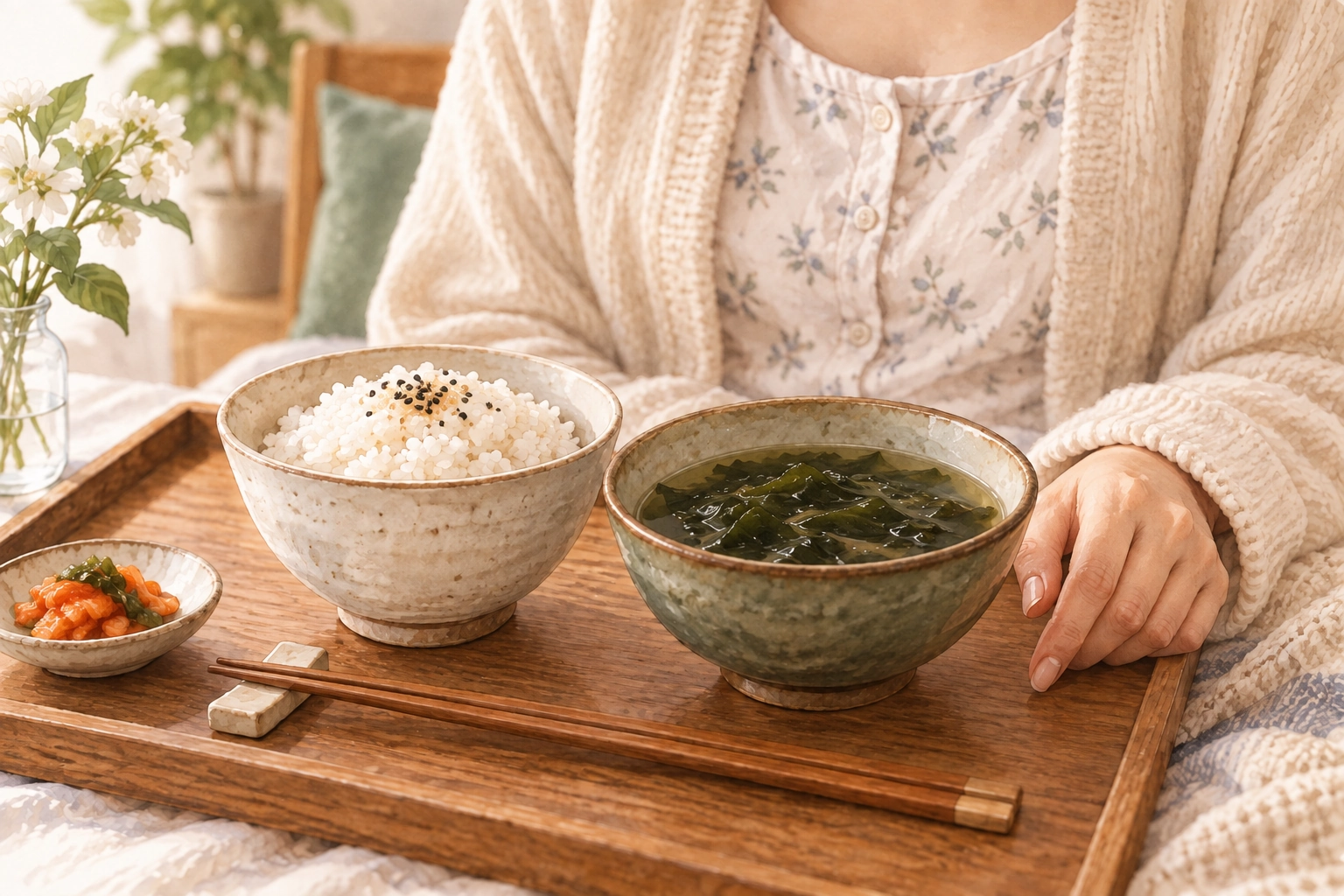
    The Korean term cheotgukbap refers to the first rice-and-soup meal offered to a woman after childbirth. Food historian Yoon Seo-seok’s encyclopedia entry on miyeokguk describes white rice with seaweed soup, and notes a first-soup preparation using soy sauce and sesame oil without beef. The same entry identifies miyeokguk as a soup customary for birthdays.

    Rice and seaweed soup without beef on a tray beside a seated woman.
    The documented first postpartum meal pairs rice with seaweed soup prepared without beef.

    That detail gives a useful perspective on the birthday meal. A visitor may first encounter a beef version in a recipe and assume that the meat defines the tradition. In this documented childbirth preparation, the central association belongs to the seaweed soup and its occasion. A modern bowl with beef is one version, rather than evidence that every earlier bowl was identical.

    The recipient also matters. The first meal described here is offered to the mother. Understanding the birthday custom through that earlier act of feeding shifts attention from the celebrated individual to the work that made the birth possible.

    This is the emotional link that makes a modest bowl feel appropriate for a celebration. Its meaning need not depend on an elaborate presentation or an expensive ingredient. Someone remembers a date and prepares food connected with it.

    Rice, seaweed and the household’s wish for a safe birth

    Food also appears in accounts of Samsin, a household deity associated with childbirth and children’s care. A chapter by Yoon Seong-jae in the National Institute of Korean History’s Korean Cultural History describes offerings of rice, seaweed and clear water, and preparations of rice and soup around childbirth. It cites the scholar Yi Neung-hwa’s account from the Japanese colonial period, in which the mother ate the rice and miyeokguk after the offering. The chapter also describes variation between places and ceremonies as a child grew.

    This is a recorded account of practice, rather than an exact date when birthday soup was invented. It helps explain how an ingredient could belong simultaneously to a household’s wishes, a mother’s meal and the recognition of a new life.

    The difference between those functions is worth keeping. The soup on a ritual table carries a stated belief; the soup handed to a person also carries the practical act of feeding them. A family meal can retain an association with birth without reproducing every element of the earlier ceremony.

    Seaweed itself was treated with care

    Yoon Seo-seok’s entry records another striking custom: haesan miyeok, seaweed intended for childbirth, was selected in broad, long pieces, purchased without bargaining and wrapped without breaking it. The explanation given is a folk belief connecting broken seaweed with a difficult delivery. The documented custom reveals attention to the ingredient before it reached the pot.

    Broad dried wakame fronds folded on a cotton wrapping cloth.
    A recorded childbirth custom attached meaning to selecting and wrapping long, unbroken seaweed.

    The belief is part of the historical story, not evidence that the shape of purchased seaweed determines an outcome. What it tells us culturally is that an ordinary shopping decision could acquire special importance when a birth was approaching.

    Compare that with selecting a birthday ingredient today. A cook may choose the brand a relative prefers or make the version someone remembers. These are different actions with different explanations, but each makes the food particular to an occasion. The ingredient is selected for a person, not just taken from a generic recipe.

    A grandmother’s care becomes a husband’s future meal

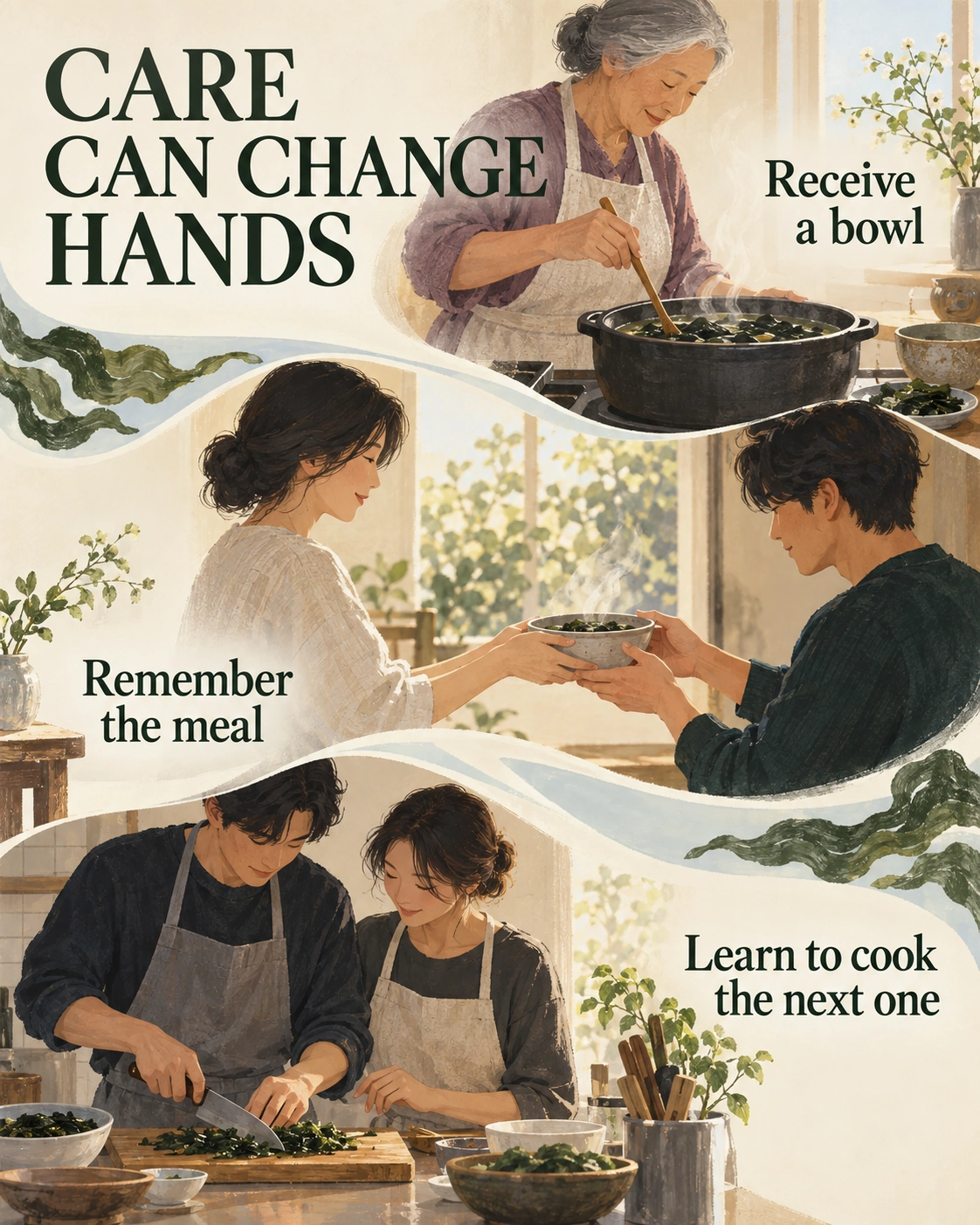
    Yang’s essay provides a specific family example. Her mother ate soup made by Yang’s grandmother after giving birth; later, she prepared it for her children and husband on their birthdays. Yang carried the practice into her own kitchen. After she cooked it for Aaron, he asked to learn the method so that he could make her birthday soup too. Yang’s account shows both inheritance and a new exchange of roles.

    Receiving a remembered meal can become learning to prepare the next one.
    Receiving a remembered meal can become learning to prepare the next one.

    That last request is particularly revealing. The person receiving the food can become the person making it. Continuity therefore does not require leaving all the work with the same family member.

    It also gives the macaroni, cake and soup at the opening a clear relationship. A birthday meal can make space for the recipient’s favorites and a family tradition together. The soup does not need to replace everything else to retain its meaning.

    Miyeokguk has a family of flavors

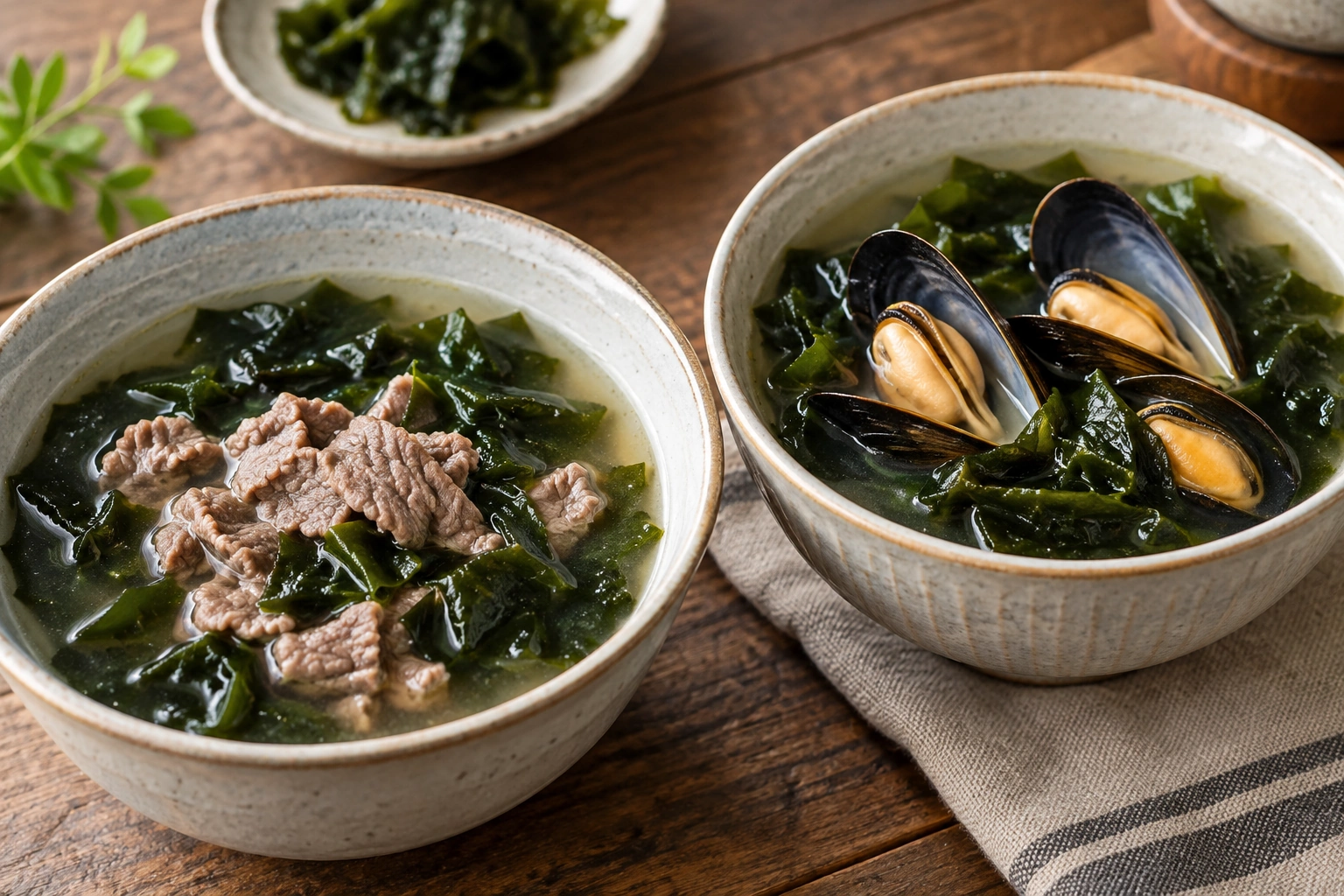
    The ingredient called miyeok is also known as wakame. Cook Hyosun’s beef miyeokguk recipe at Korean Bapsang uses dried miyeok and describes more than one way to build a beef broth: sautéing thin pieces before boiling, or simmering a larger piece and shredding it afterward. Her site also offers a mussel version.

    Beef miyeokguk and mussel miyeokguk in separate bowls.
    Beef and mussel versions share seaweed while offering different broths and flavors.

    Those examples explain why recognizing the name is different from predicting every bowl. The seaweed connects the versions, while the broth and preparation affect what the eater experiences. A family preference might include the seaweed’s tenderness, the amount of meat or the depth of the broth.

    For a first attempt, choose a complete recipe that matches the version you want. Look for miyeok or wakame on the ingredient label and follow the product’s preparation instructions. A packet sold as “seaweed” is too broad a description to select confidently for this dish.

    If you are buying the soup, asking whether it uses beef or seafood is more informative than treating a clear-looking broth as a full ingredient list. It also opens a conversation about the household or restaurant’s particular version, rather than reducing variation to a test of authenticity.

    What if the slippery texture surprises you?

    A cultural explanation cannot guarantee that everyone will enjoy the same mouthfeel. Maangchi recalls an American friend, Jeanne, a nun who had lived in Korea for more than 35 years and loved Korean food. Miyeokguk was the exception: she disliked its slippery texture. Maangchi’s account is an affectionate reminder that familiarity with a culture and liking a particular ingredient are separate things.

    For a newcomer, that is a useful permission to be curious without performing enthusiasm. Try a manageable spoonful with some broth and notice the seaweed’s texture before deciding how you feel about it. Understanding why someone prepares the soup can remain interesting even if it never becomes your favorite.

    A bowl of birthday miyeokguk can therefore hold several connections: the mother fed after childbirth, the family’s recorded beliefs, the cook’s chosen preparation and the next person learning to make it. Yang’s husband asking for the recipe brings those connections into focus. The annual reminder becomes another person’s act of care, ready for a birthday still to come.

  • Samgyetang and Poule au Pot: Two Promises in a Chicken Pot

    Samgyetang and Poule au Pot: Two Promises in a Chicken Pot

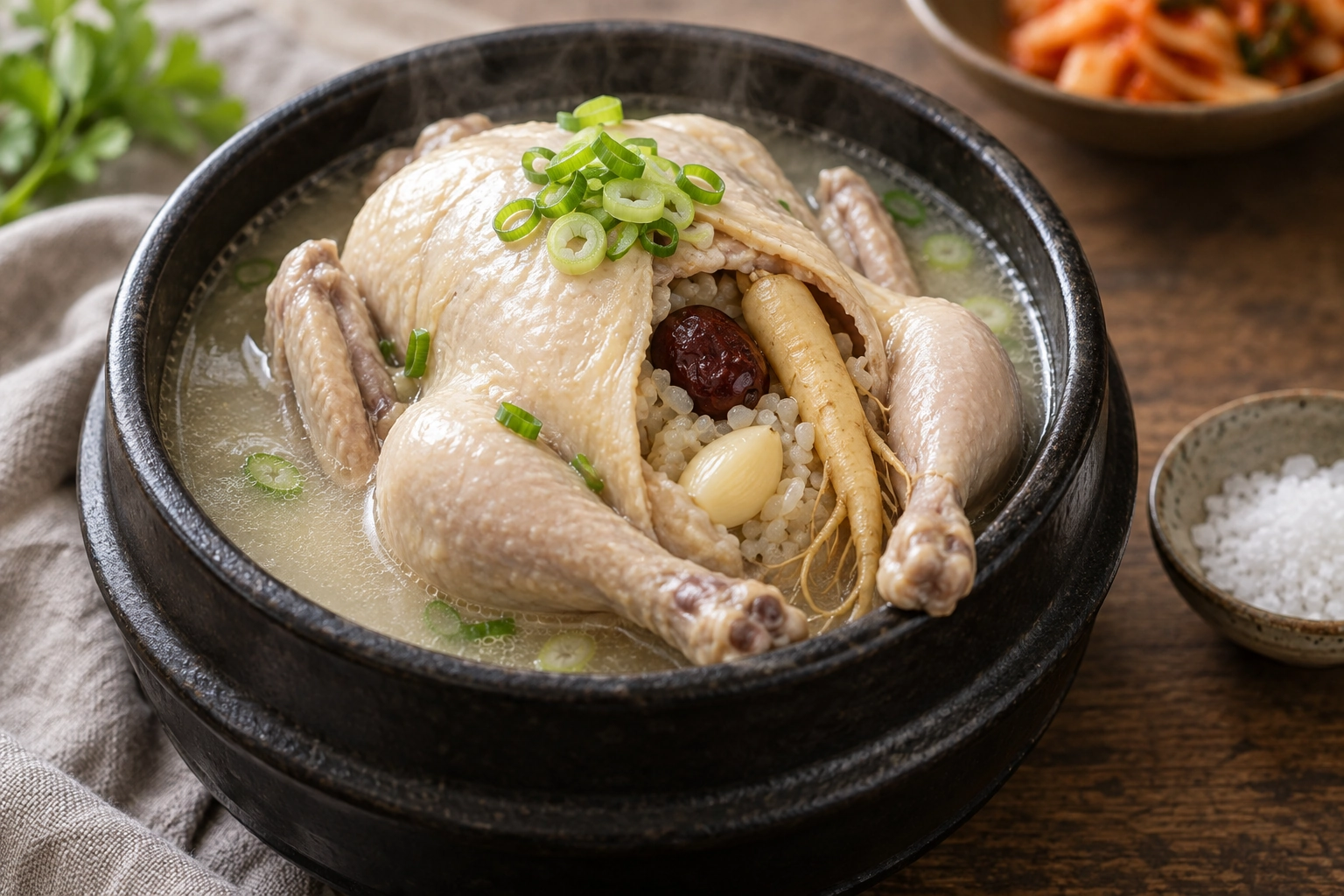
    A small chicken stuffed with rice gathers a personal meal into one bowl.
    A small chicken stuffed with rice gathers a personal meal into one bowl.

    A whole chicken in broth can look like a meal meant for everyone. With samgyetang, it may be your own lunch. Maangchi’s Korean ginseng chicken soup uses small birds filled with rice, garlic, ginseng and jujube, then divides them into individual bowls. In her introduction, she remembers meeting a reader in New York who made the dish for himself and his mother. The impressive part of his story was the cooking he did for another person, rather than the size of the chicken.

    That combination makes samgyetang a useful starting point for comparing food cultures. The bird contains part of the meal inside its own body; the broth carries the rest. Rice, meat and soup arrive together, while salt and dipping sauces let the eater adjust individual bites. A familiar English label, “chicken soup,” tells you less about this arrangement than the bowl itself. It can help to picture a small stuffed bird that becomes a complete personal meal, with company at the table even when the portions stay separate. Maangchi’s samgyetang

    A whole chicken, but a different meal

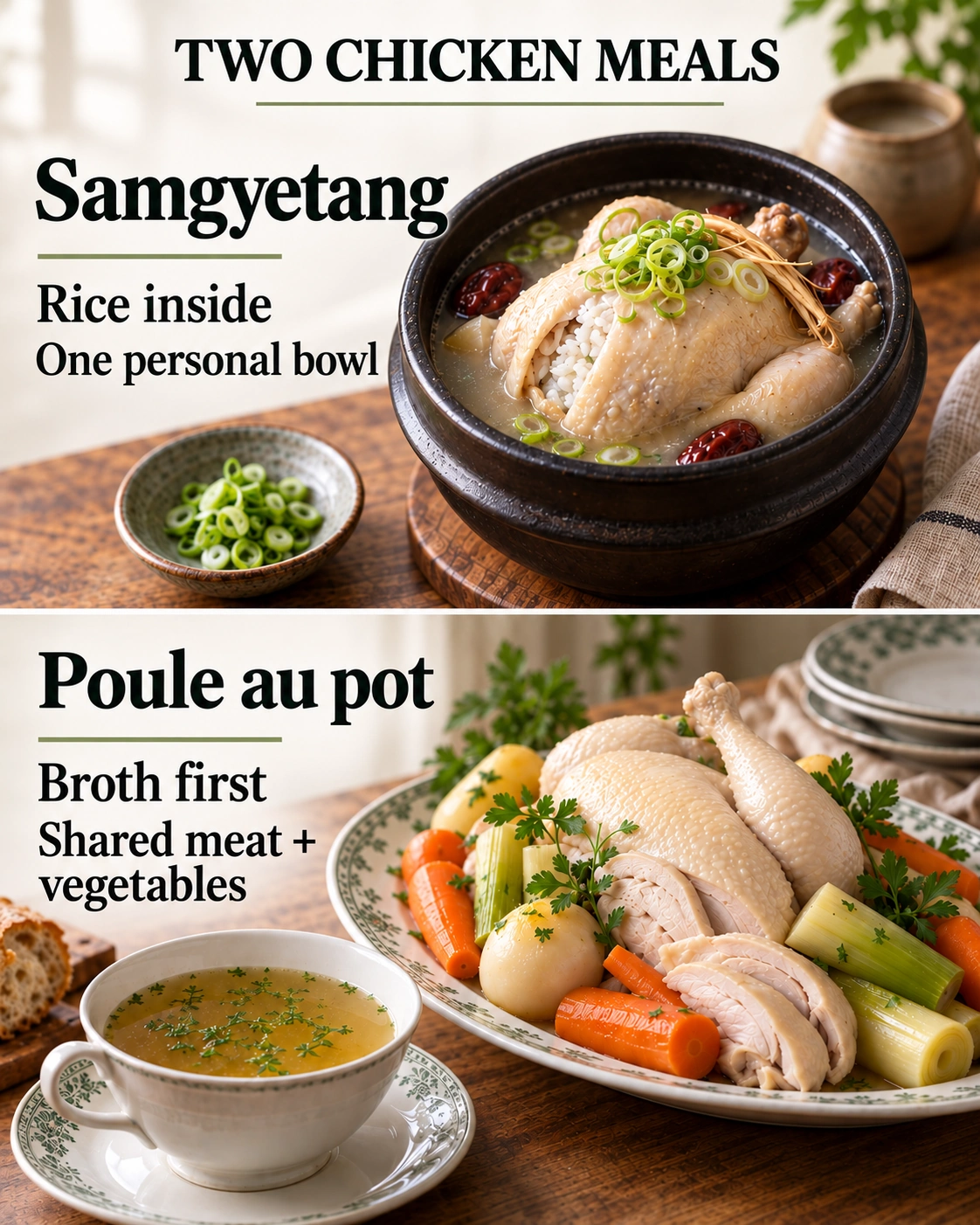
    Across the world, the Béarn tourism office describes another bird cooked slowly in liquid: poule au pot. Its account places the French dish among the comforting meals of cool late-year days. Carrots, turnips, leeks and onions accompany the hen. Broth can be served first, followed by the meat and vegetables. Some versions stuff the bird with bread, herbs, sausage meat or ham.

    These examples contrast an individual stuffed chicken bowl with broth followed by shared meat and vegetables.
    These examples contrast an individual stuffed chicken bowl with broth followed by shared meat and vegetables.

    The similarity with samgyetang is immediately useful: neither needs a roasted skin to give a whole bird importance at dinner. But the sequence changes what the cook is offering. A soup course followed by shared meat and vegetables stretches the pot across the meal. A stuffed bird in an individual bowl gathers the meal around one diner. These are arrangements in the particular descriptions, rather than rules governing every Korean or French family.

    For a reader choosing a dish, the practical distinction is worth more than calling one the French equivalent of the other. Ask what comes inside the bird, what cooks beside it, and how the contents reach the table. Shared technique leaves plenty of room for different appetites and occasions. Cœur de Béarn’s description
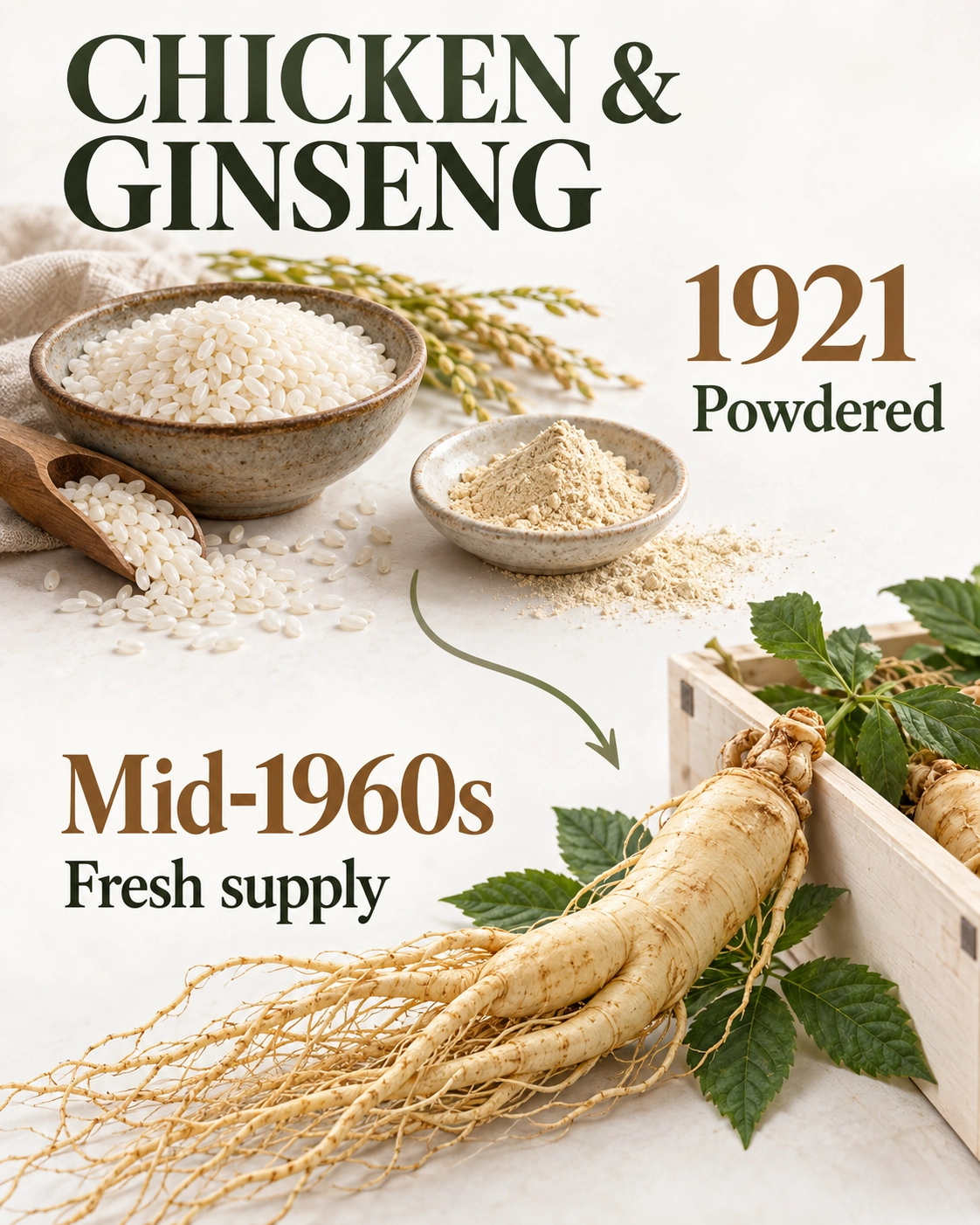
    Samgyetang’s familiar filling also has a history of changing ingredients and access. Food scholar Joo Young-ha, writing in July 2026, points to a chicken-soup recipe in the 1921 edition of Bang Sin-yeong’s Joseon yorijebeop. His reading describes glutinous rice and powdered ginseng inside the bird. He connects the later development of samgyetang restaurant menus to increased chicken production and the refrigerated distribution of fresh ginseng in the mid-1960s.

    Rice and powdered ginseng marked 1921 beside fresh ginseng supply marked Mid-1960s.
    Joo Young-ha connects an earlier powdered-ginseng recipe with later changes in fresh-ginseng distribution.

    This is a scholar’s account of the documents and supply changes; it does not establish one inventor or make the modern dish timeless. Still, the distinction between powder and a whole fresh root opens a better question than “How ancient is it?” A visible root depends on a supply chain as well as on a cook’s intention.

    Read that way, the bowl holds agricultural and commercial history alongside the chicken. Changing access can make an ingredient more prominent and a meal more widely available. The version a visitor meets in a restaurant need not look exactly like the one described in an earlier cookbook. Joo Young-ha’s historical account

    The king’s chicken was a story that changed

    Poule au pot carries an especially memorable promise: Henri IV wanted a chicken in his subjects’ pots. Gastronomic historian Jean Vitaux examines that account in a 2010 chronicle published by the Institut de France. He traces a version to Hardouin de Péréfixe’s 1661 history, written for the education of Louis XIV, and treats the saying as probably apocryphal. The familiar Sunday formulation developed later, during the Restoration.

    Vitaux also draws attention to the word laboureur. In the earlier setting it referred to a farmer prosperous enough to own a team for ploughing, not automatically every person working the land. Translating the tale as a universal weekly meal can flatten that distinction.

    The legend remains revealing without becoming a verified royal quotation. A chicken dinner offered a picture of recovered rural prosperity after destructive wars. Later retelling made that picture more inclusive and easier to repeat. The dish’s political significance lies partly in this changing image of a good ruler: people should be able to eat well. That is different evidence from a record proving that every household actually received a hen on Sunday. Jean Vitaux’s chronicle

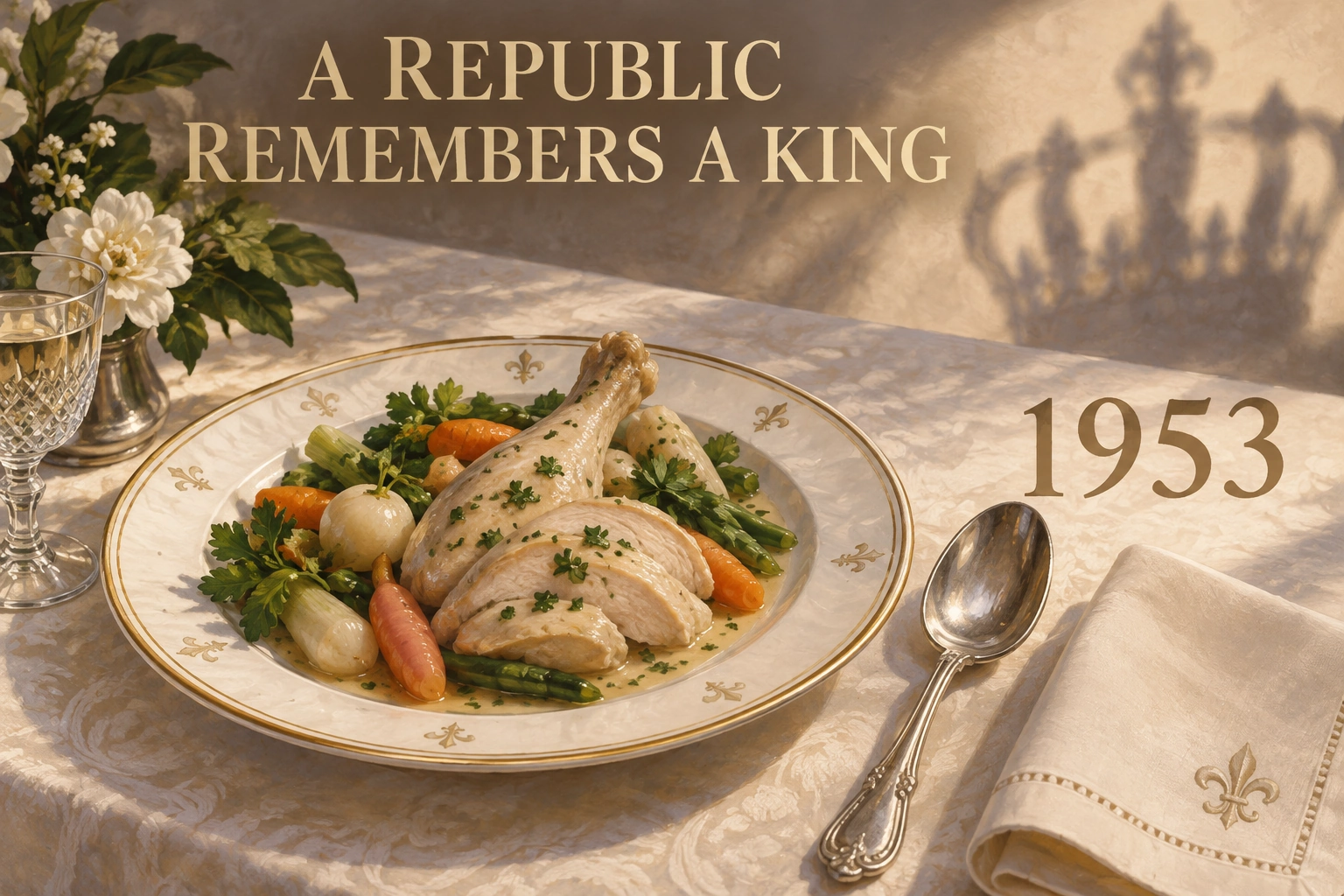
    The story also turned up on a real commemorative menu. The Château de Pau’s chronology records the 1953 celebrations marking four hundred years since Henri IV’s birth. French president Vincent Auriol attended the festivities and a banquet at the château. Poule au pot appeared among the dishes. The initiative came from Pau and its mayor, Louis Sallenave.

    Poached chicken and vegetables beside 1953 lettering and an abstract crown shadow.
    Poule au pot appeared at the 1953 banquet in Pau commemorating Henri IV’s birth.

    A twentieth-century republic serving a meal associated with a king is a more specific historical scene than a vague claim that France has always eaten this way. At that banquet, the dish helped make a figure from the past present at the table. A menu could perform some of the work of a monument, using a recognisable meal instead of stone.
    For food travellers, this changes how a famous name can be read. “Henri IV” beside poule au pot can signal regional memory and commemoration as much as a particular cooking formula. The documented banquet shows people using the association centuries later. It does not settle whether the king uttered the original saying, or prove that the banquet reproduced his own dinner. The château’s chronology

    What the broth leaves for tomorrow

    A modern chef’s version gives the French pot another role. The Académie du Goût publishes an extract from Nature Volume 2, credited to Alain Ducasse, Paule Neyrat and Christophe Saintagne. The ingredient list surrounds the hen with vegetables and aromatics, including mushrooms, thyme, bay and juniper. The chef’s introductory advice values the broth as something to keep for other recipes.

    Vegetables surround the hen, while the broth has value beyond the first serving.
    Vegetables surround the hen, while the broth has value beyond the first serving.

    Even that limited extract changes the comparison. The meal’s value is partly what remains available to another dish. A pot can feed dinner and contribute flavour to cooking afterwards. The vegetable list gives a reader concrete things to recognise when looking at this version, without suggesting that every poule au pot must contain the same combination.

    This is also why comparing soups solely by their main animal can be misleading. The cooks credited here organise a wider group of ingredients around the bird and give the liquid a future use. To understand the meal, follow the broth as well as the meat. The extract is a window into one approach, rather than a complete cooking lesson. The published recipe extract

    Rice does not belong to only one side

    The neat contrast between Korean chicken with rice and French chicken with vegetables has a problem: a French family meal may have rice too. In April 2020, France.fr featured chef Jean Imbert’s grandmother’s poule au riz. The article connected the comforting dish to cooking during confinement and reproduced his social post describing it as a favourite winter meal she made for him.

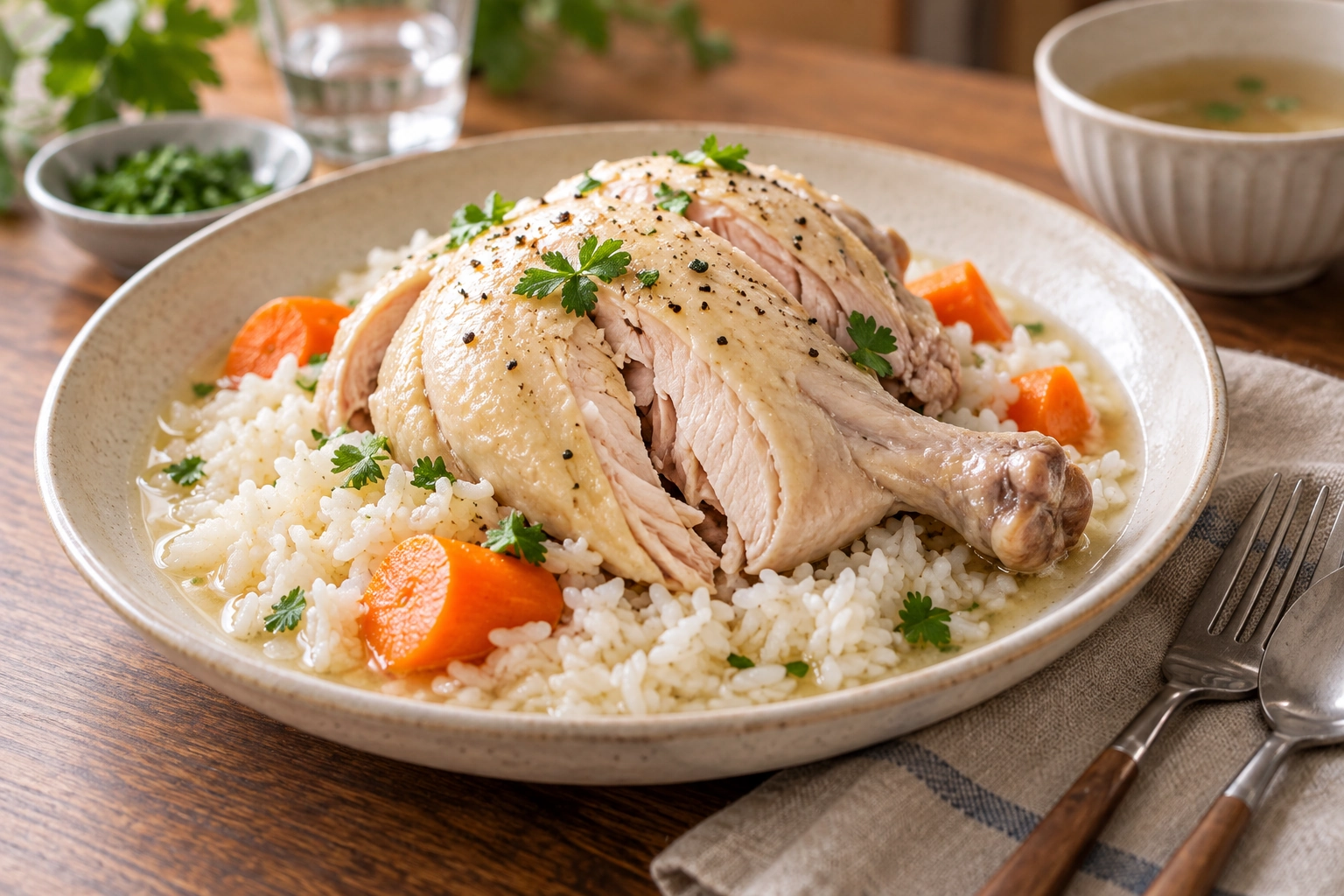
    Pale poached chicken served over white rice with a little broth and carrots.
    Poule au riz provides a French family-meal example in which chicken and rice belong together.

    Poule au riz is the dish named in that account. Treating it as an exact synonym for every poule au pot would discard a distinction the reader has just learned to notice. It is useful here as a neighbouring family example, showing why a national comparison should leave room for meals that cross our tidy categories.

    The strongest connection between these chicken pots is therefore neither an identical recipe nor a demonstrated route of influence. It is the way a modest cooking action can carry a much larger promise: a meal remembered from a grandmother, or a picture of people living well. The differences stay visible even when the feeling is recognisable. Rice in the French example makes the comparison richer, rather than making either country lose its dish. France.fr’s family-meal account

    Back at the samgyetang bowl, that promise can be as personal as cooking a small bird for your mother.

  • Ma Bok-rim’s Tteokbokki: The Secret Her Daughters-in-Law Learned

    Ma Bok-rim’s Tteokbokki: The Secret Her Daughters-in-Law Learned

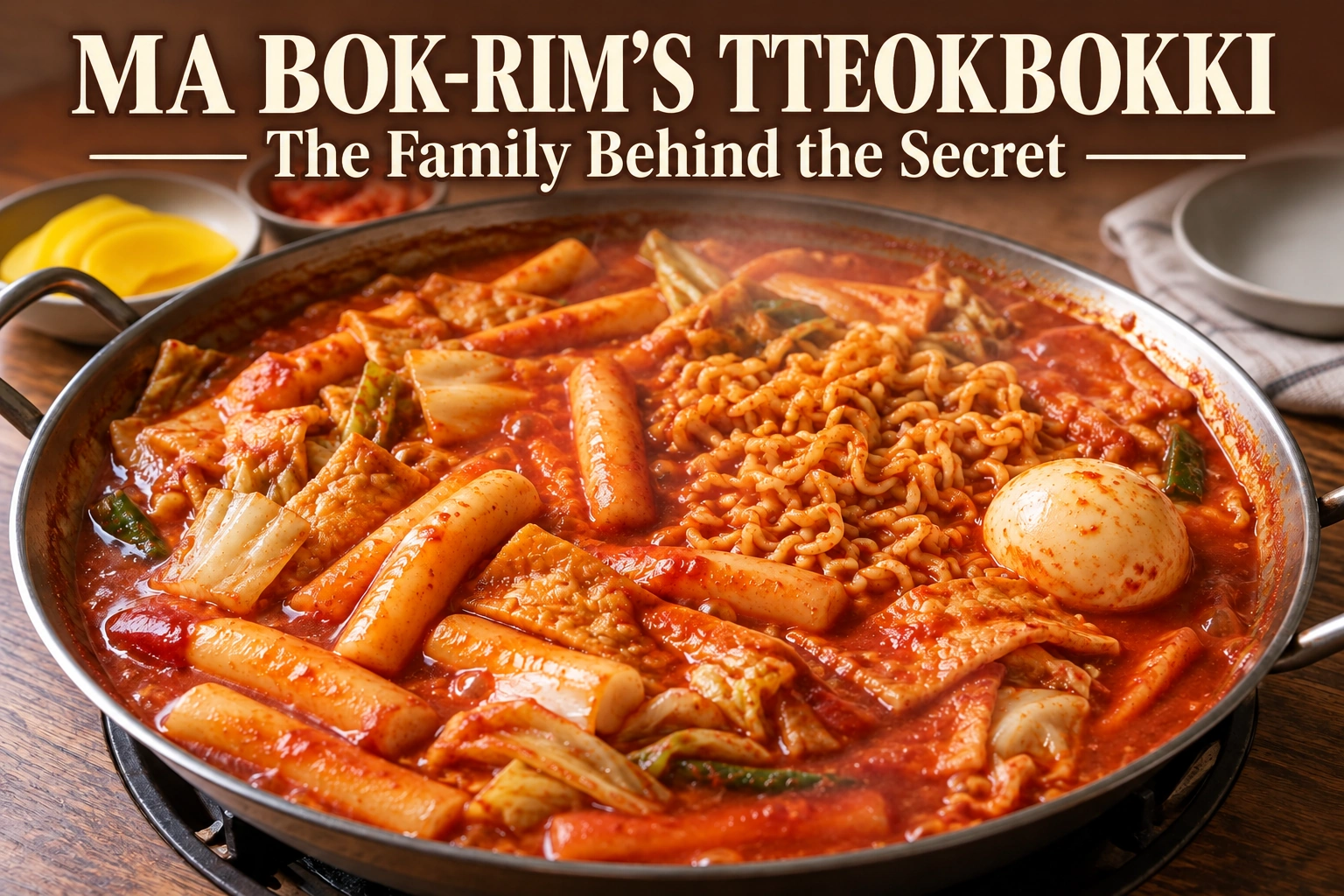
    Jeukseok tteokbokki gathers rice cakes and accompaniments in a shared cooking pot.
    Jeukseok tteokbokki gathers rice cakes and accompaniments in a shared cooking pot.

    “Even my daughters-in-law don’t know.” The joke sounds wonderfully unhelpful if you have come looking for a tteokbokki recipe. Yet that short line opens a more interesting story: who has the authority to make a family restaurant’s food, and how does that authority pass to someone else?

    Ma Bok-rim, associated with a Sindang-dong restaurant founded in 1953, became nationally recognizable through a 1996 television commercial for Haechandle’s Taeyangcho gochujang. The Korea Tourism Organization identifies the advertisement and its memorable refusal to disclose the chili paste secret. The restaurant’s seasoning also incorporates chunjang, the dark paste associated with jjajang dishes. That ingredient relationship is worth knowing; it does not reveal a complete working formula.

    For an English-speaking reader, myeoneuri means daughter-in-law. The family relationship is the point of the teasing: even women close to the founder supposedly lack access. A grandmother becomes the person everyone must ask, rather than a background figure behind the stove. The advertisement makes her refusal entertaining, but it also makes her expertise visible. To understand what followed, leave the imagined secret notebook closed and follow the women doing the work. Korea Tourism Organization’s Ma Bok-rim restaurant profile

    A secret sauce, a shared business

    In a January 2003 Korea JoongAng Daily report, the catchphrase still had a practical counterpart. Eldest daughter-in-law Chun Eun-kyung said that Ma, although retired from regular restaurant work, continued to control the paste mixture. Chun described family members running the business without possessing that recipe themselves. She hoped her mother-in-law would eventually tell her.

    The 1996 advertisement, 2003 interview and 2009 report mark changes in who knew the sauce.
    The 1996 advertisement, 2003 interview and 2009 report mark changes in who knew the sauce.

    That distinction changes the usual restaurant inheritance story. Working in the shop and knowing every component of its signature taste were separate positions. A daughter-in-law could help keep the business functioning while the founder retained authority over one central preparation. The sauce was only one part of the operation, but it gave Ma a continuing role after retirement.

    The article also described a nearby restaurant associated with Ma’s son. Her name therefore worked both as the identity of a particular establishment and as a reference point for relatives’ businesses. For visitors, a family name on a sign needs more attention than a broad claim of “the original.” For the family, the question was more intimate: how could the work continue when the person holding the most celebrated knowledge was no longer doing every other job? Kim Hae-noon’s 2003 family interview

    A later report, published in 2009, found a public answer on the restaurant’s sign: the daughters-in-law knew now. The advertisement’s punch line had acquired a sequel. A family member interviewed for the story said the recipe had remained broadly consistent, while food could be made less spicy for foreign visitors or sweeter for children.

    Those two statements belong together. Inheriting a recognizable seasoning did not mean refusing every adjustment at the table. A restaurant must preserve something customers can return to and still respond to the people sitting in front of it. The report describes that negotiation within this family business; it does not establish a rule for all Korean restaurants or promise that every request will be accommodated today.
    The changed sign is also a neat piece of storytelling. It lets returning customers recognize the old joke while acknowledging a change in the kitchen. The founder’s authority is remembered through the very sentence that announces its transfer. An inherited taste can carry the same name without requiring the founder to remain its only keeper. Here, continuity was communicated through a witty revision, rather than a claim that nothing had happened. Moon So-young’s report on Sindang’s family restaurants

    What the advertisement leaves outside the frame

    Kim Seon-ja’s recollections, reported by Park Mi-hyang in Hankyoreh in 2012, put physical work behind the cheerful slogan. Kim married into the family and began helping in 1976. She remembered the demands of briquette fires: managing fuel and dealing with smoke while keeping food moving. Later gas supplies changed how that work could be done.

    A familiar meal depends on the repeated work of preparing and serving it.
    A familiar meal depends on the repeated work of preparing and serving it.

    The meaningful contrast is between what customers remember and what workers have to repeat. A diner may remember the first delicious mouthful. Someone in the kitchen remembers the fire, the pace and the effort needed to serve another table. Kim also recalled Ma inspecting unfinished food to understand why a customer had left it. That small habit suggests a different kind of knowledge from a secret ingredient ratio: learning to read a meal after it has been served.
    The account gives a daughter-in-law a working history of her own. She was not simply handed a famous name at the end of the founder’s life. She had spent years helping make the experience that gave the name its value. The restaurant story becomes richer when the women’s labor is allowed as much space as the grandmother’s television moment. Park Mi-hyang’s Hankyoreh interview, carried by Daum

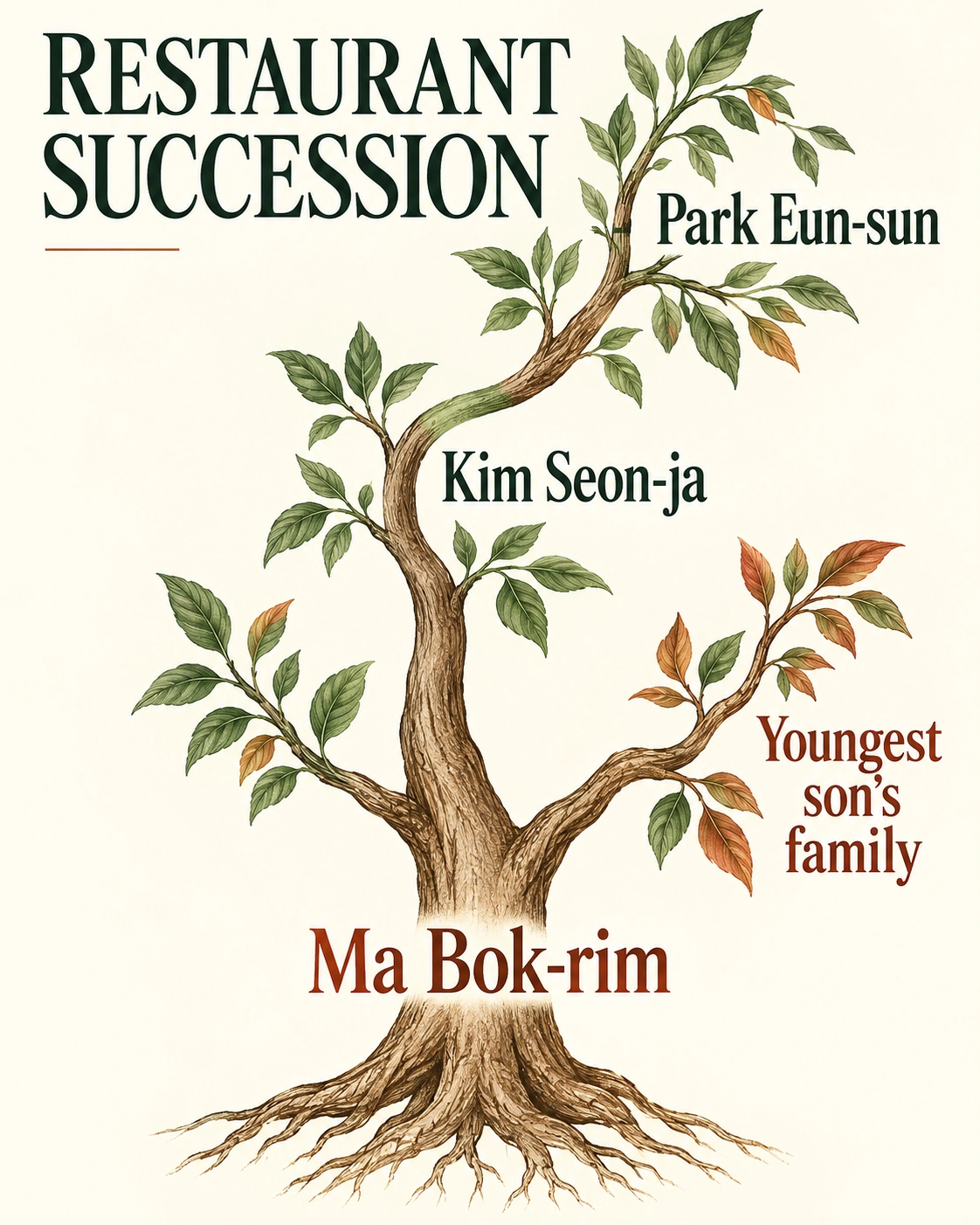
    The Seoul Museum of History’s 2022 study of the city’s eating-out culture records another step in that succession. Its account identifies daughters-in-law involved in carrying the business forward and then Park Eun-sun, Kim Seon-ja’s daughter, as the representative at the time of the study. The museum also notes the nearby establishment independently operated by Ma’s youngest son’s family.

    Ma Bok-rim, Kim Seon-ja and Park Eun-sun along a tree, with a separate youngest-son family branch.
    The 2022 museum study distinguishes family succession from a nearby independently operated family establishment.

    This makes the family tree useful without turning it into a competition between signs. A shared grandmother’s name can connect businesses with different operating histories. Meanwhile, moving from founder to daughter-in-law to granddaughter means that the public story gains people, rather than simply preserving one famous face. These are relationships recorded in a dated study, not a guarantee about present management. For someone reading a restaurant’s history before visiting, the useful question is whose work and generation the story is actually describing. Seoul Museum of History’s restaurant-life study, pages 89–90

    When a famous secret meets the internet

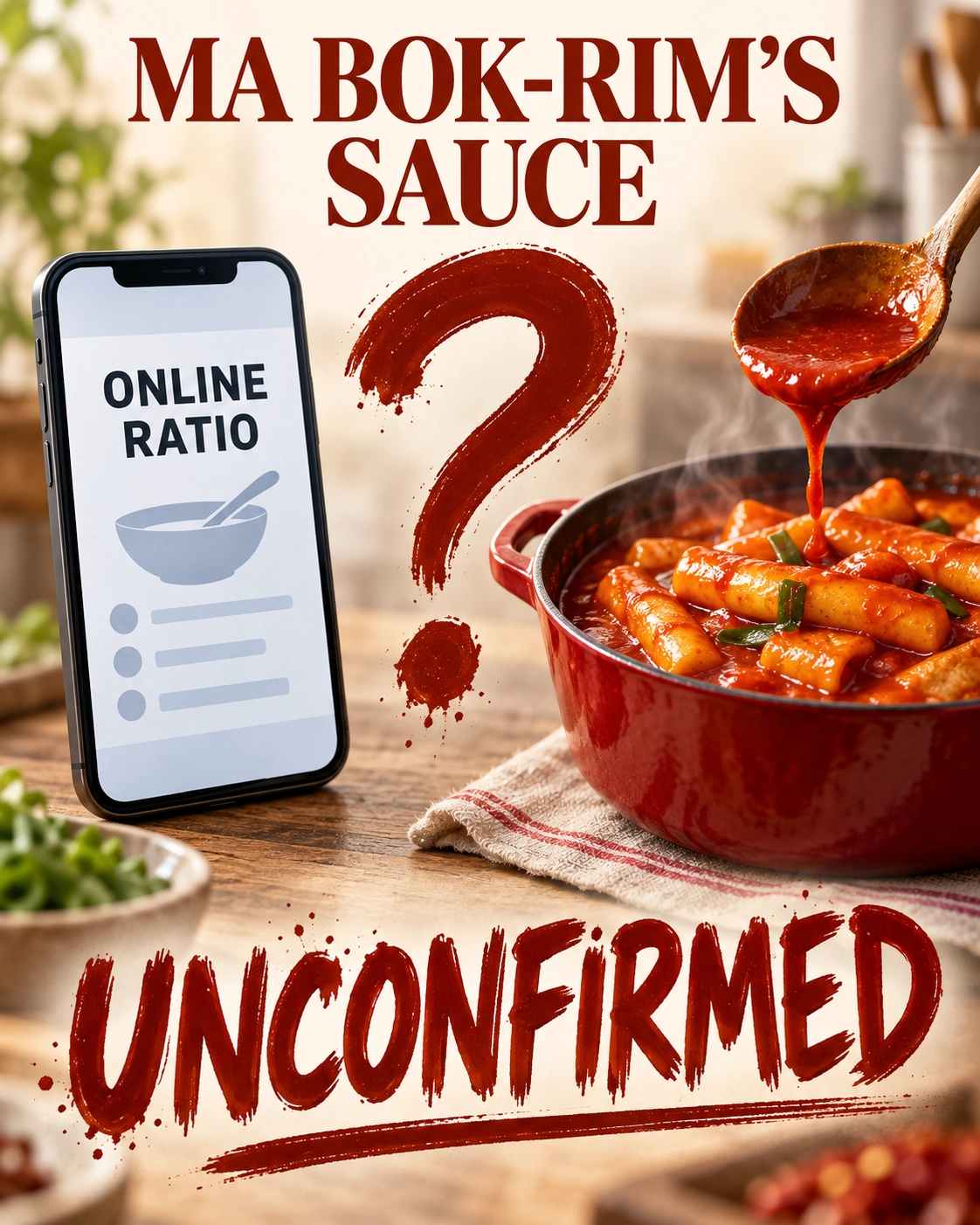
    The old slogan resurfaced during a November 2021 episode of You Quiz on the Block. Contemporary reporting described Kim Seon-ja discussing the relatives who then made the sauce. A host brought up an alleged ingredient ratio circulating online. Kim’s amused reaction was part of the exchange, but the report did not provide a clear confirmation that the internet formula was authentic. A television joke is a poor basis for labeling a home recipe “Ma Bok-rim’s secret.”

    An online-ratio screen and tteokbokki sauce beside a question mark and Unconfirmed lettering.
    The 2021 television report did not clearly confirm the ingredient ratio circulating online.

    Reporting from the same episode also recorded Park Eun-sun’s memories of fashion designer André Kim. She recalled him paying for students at neighboring tables and explained that a white apron was kept for him because he wore white, while their usual aprons were red. This is a family’s remembered customer story, rather than evidence that every celebrity visitor received the same treatment.

    Both moments make the restaurant more human. The internet wants a portable formula; a family interview offers relationships, hospitality and details that would never fit inside that formula. A specially chosen apron says something about attention to a particular guest. It belongs to the restaurant’s history even though it cannot be stirred into the sauce. Star Today’s report on the sauce discussion, Xports News’s report on family customer memories

    The inheritance customers bring back

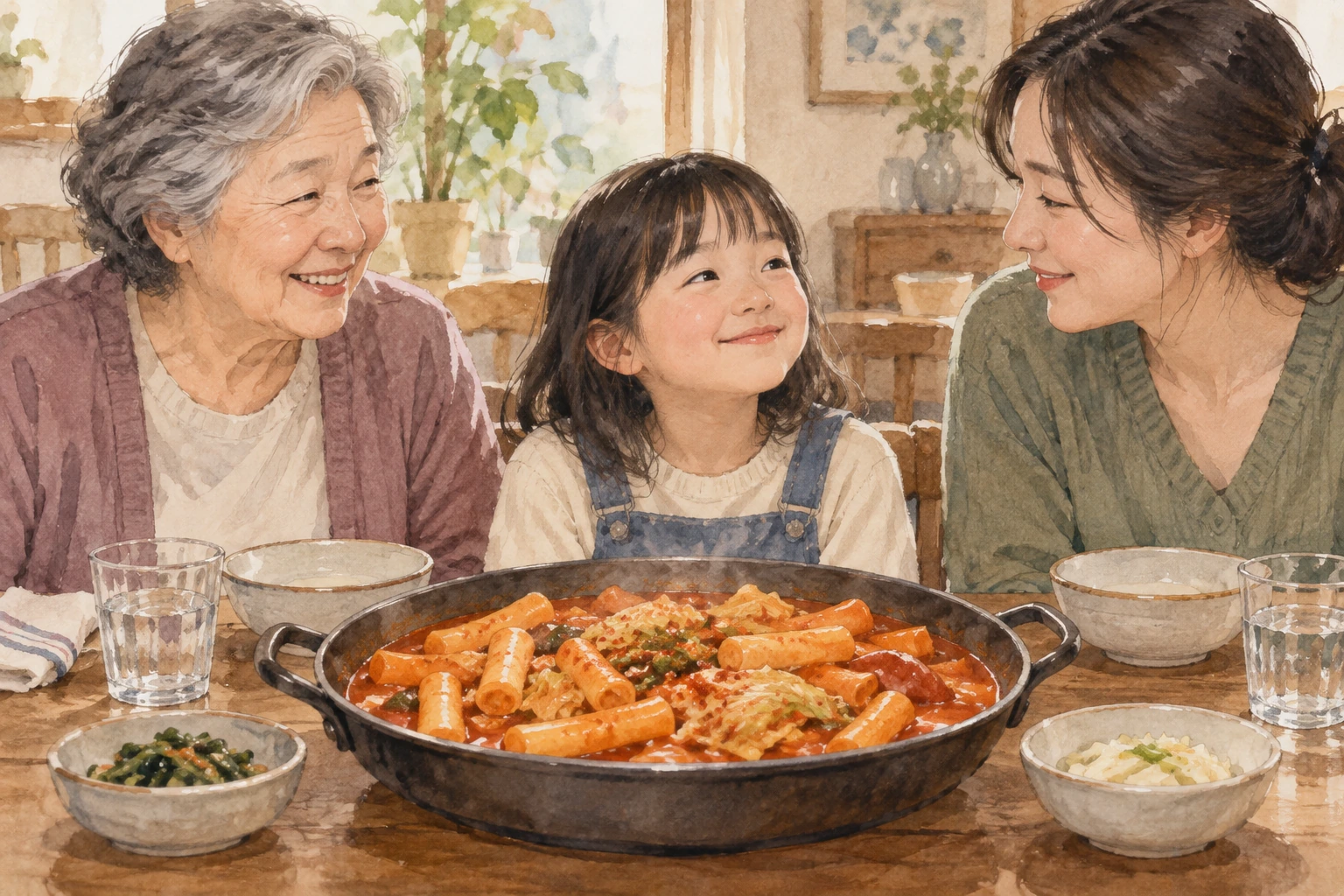
    When MBC reported Ma’s death in December 2011, its written news transcript included more than the famous advertising line. Min Young-sook described a family connection to the restaurant extending through her father and children. Another customer, Kim Gyeong-a, said she had brought her elementary-school children because she wanted to share her own memories with them.

    Returning to a familiar meal can give families an occasion to share memories.
    Returning to a familiar meal can give families an occasion to share memories.

    These customers were passing something on too. Their children could not inherit the exact circumstances of an earlier visit. What a parent could give them was the place, the food and a story told across the table. The restaurant’s successors had to maintain an experience that could support those returns; the customers supplied the connections between different generations of meals.
    That is why Ma Bok-rim’s story deserves more than an origin anecdote attached to spicy rice cakes. The grandmother’s withholding became an advertisement. The daughters-in-law’s learning made continued service possible. Customers turned that continued service into occasions for their own families. The most revealing answer to the old secret is not a ratio: it is that the meal eventually depended on several kinds of inheritance, each involving people willing to return and people prepared to keep working. Na Se-woong’s MBC report and customer interviews
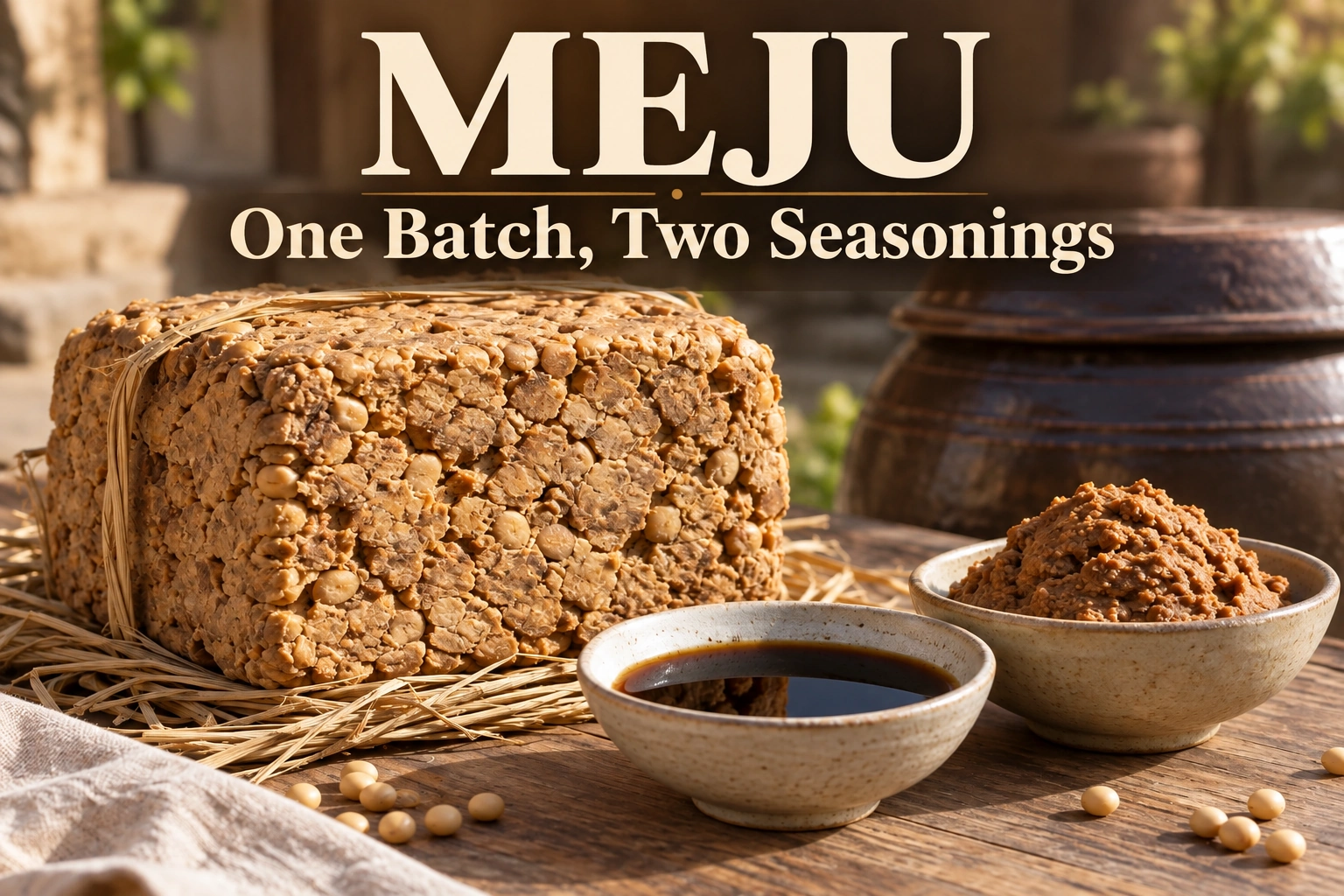
  • How Meju Becomes Doenjang and Ganjang: One Batch, Two Korean Seasonings

    How Meju Becomes Doenjang and Ganjang: One Batch, Two Korean Seasonings

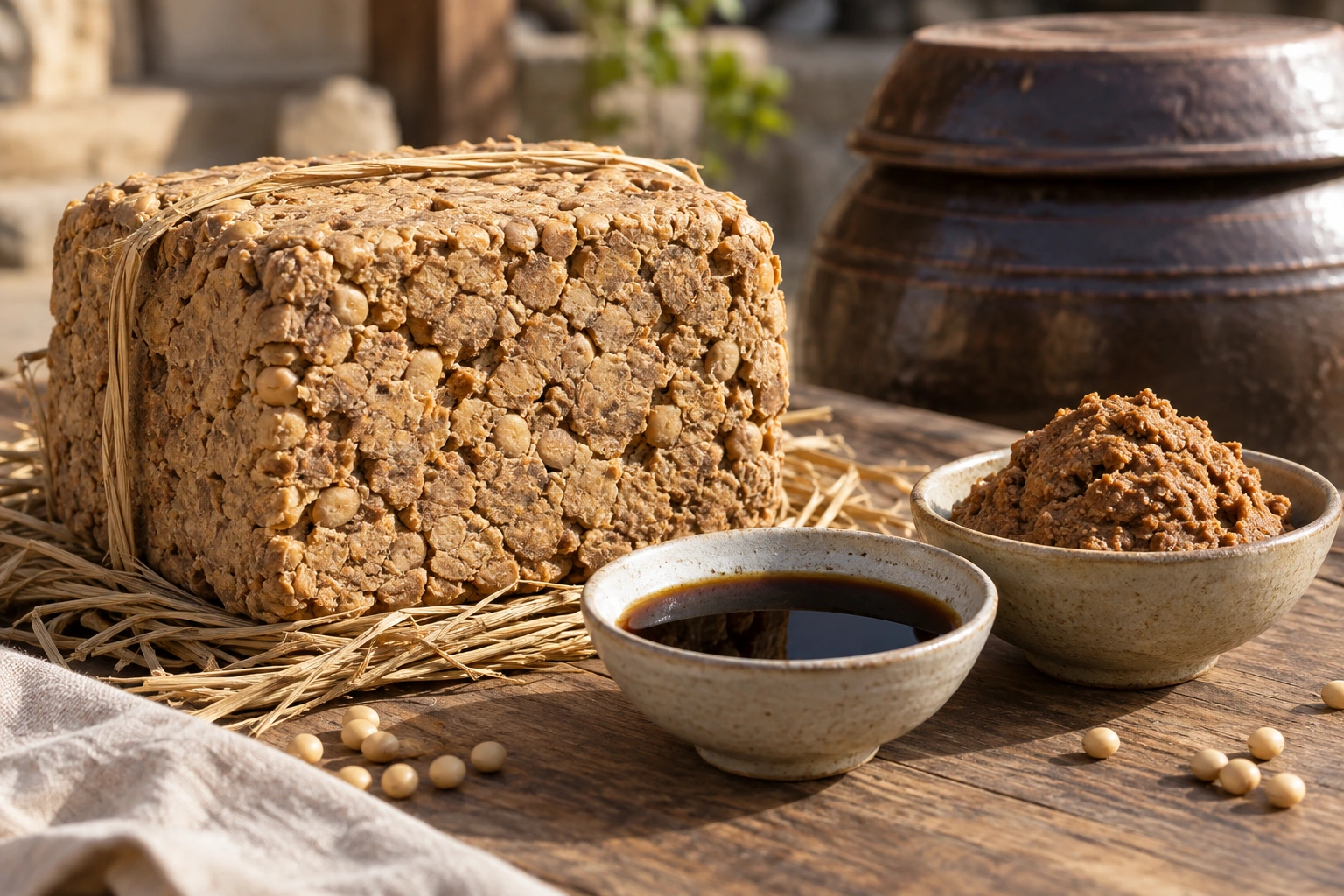
    Meju, liquid ganjang and coarse doenjang belong to connected stages of jang-making.
    Meju, liquid ganjang and coarse doenjang belong to connected stages of jang-making.

    On June 11 in a diary of her own jang-making, Maangchi separated the soybean paste from the liquid that would become soup soy sauce. Her beans had been soaked in January and placed in brine in April. The diary does not mark the paste as ready until December.
    Her diary accompanies a recipe first published in 2016 and updated in 2026. Its dates describe her example batch, rather than a universal timetable. Maangchi’s recipe and making diary

    That June separation is the turning point in this story. 된장, doenjang, and 간장, ganjang, may look like unrelated purchases—a tub of paste and a bottle of sauce. In the traditional brined-meju method, they share a beginning before taking different paths.

    Understanding that relationship makes the pantry more interesting. It also helps you ask better questions about a producer’s method without assuming that every product called doenjang was made in precisely the same way.

    A soybean block is an intermediate stage

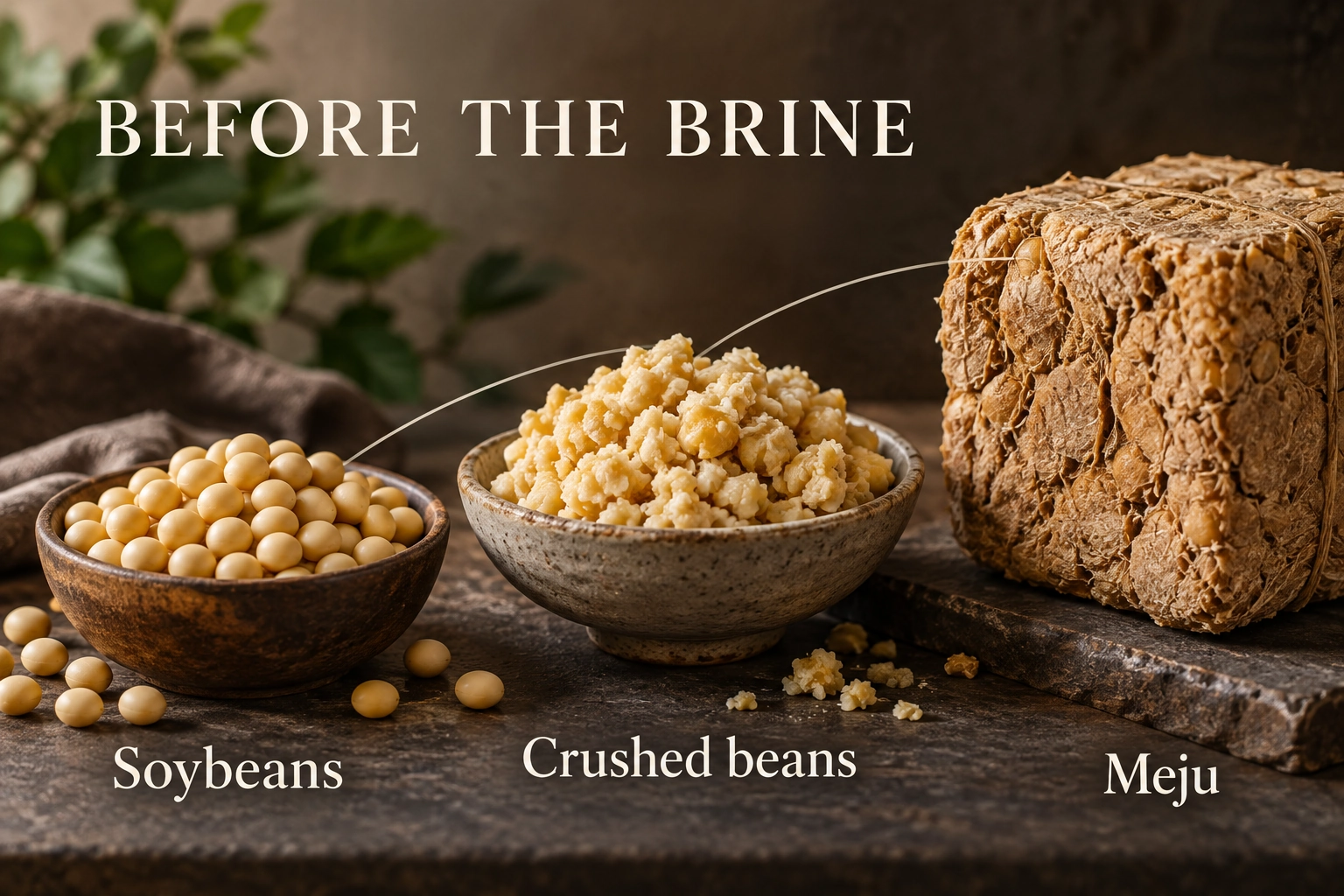
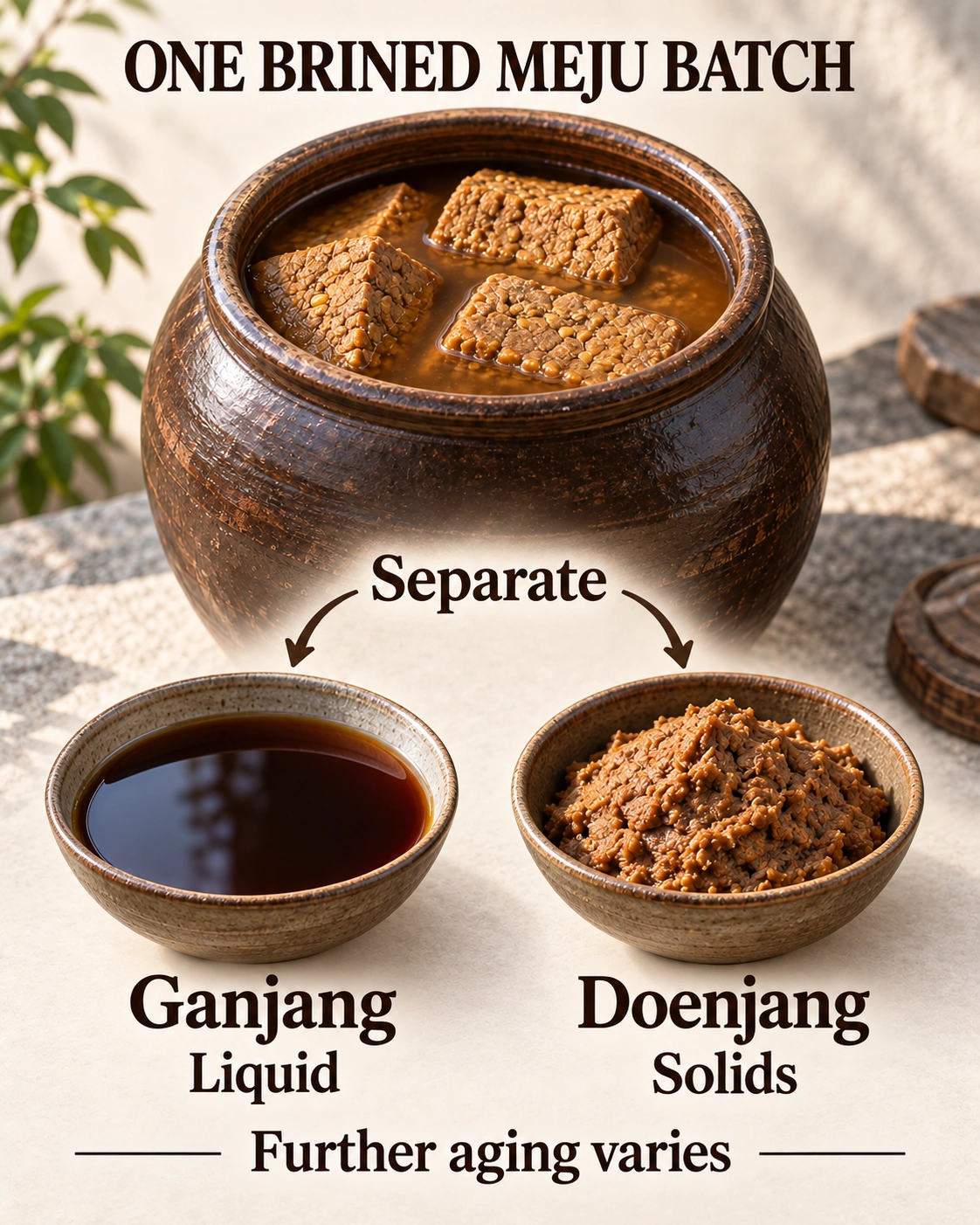
    메주, meju, is not simply the finished paste pressed into a brick. A 2018 Korea.net explanation describes boiling and crushing soybeans, forming blocks and drying them before placing them in salted water in an earthenware vessel. After fermentation, the liquid becomes ganjang and the remaining soybean material becomes doenjang. Korea.net’s account of the connected process

    Whole soybeans, crushed beans and a meju block arranged before the brining stage.
    Whole beans, crushed beans and meju mark different stages before the brined batch.

    The block is a stage in a longer production sequence. A picture of meju therefore shows work in progress: it does not show the two final seasonings already complete.

    Think about the sequence through its changing physical forms. Whole beans become crushed material, then blocks. Blocks go into liquid, and the batch is eventually separated into liquid and solid portions. The story involves handling and division alongside waiting.

    This is why a photograph of jars cannot explain the process on its own. To understand what is happening, ask which stage you are seeing. Are the blocks drying, soaking or being removed? That question turns an attractive pantry image into a readable account of work.

    Separation starts two further paths

    The action called 장 가르기, jang gareugi, divides the brined batch. Maangchi’s diary makes the distinction clear: separation and a paste ready to use are different entries.

    Separating a brined meju batch starts distinct liquid and solid paths.
    Separating a brined meju batch starts distinct liquid and solid paths.

    For a visitor meeting a maker, this suggests a more revealing question than simply asking how old a jar is: ‘How do you count the age?’ The answer might begin with the soybean preparation, the brining stage or the period after separation. Clarifying the starting point helps you understand the maker’s own description.

    The same question is useful when reading an aged-product label. Age has meaning only when the process being timed is clear. A long period does not, by itself, tell you which ingredient went through which stage or how the maker intends the seasoning to be used.

    Shared beginnings can survive inside a word

    A 2022 linguistic study by Kim Ji-suk investigates jang through written records and dialect material. Its abstract describes meanings that include ganjang, the state before ganjang and doenjang are separated, and a collective name for the two seasonings. It also follows jiryeong, a name for soy sauce found in written and regional usage. Kim’s research abstract

    That makes the production sequence relevant to language. The category can name something before separation as well as what comes after it. An English translation that chooses “paste” or “sauce” too quickly may miss what the speaker means.

    The word’s flexibility also gives you a thoughtful question for a family conversation. If a relative uses a different name for soy sauce, ask how they learned it and what they mean by it. A vocabulary difference can become a doorway into the household’s history rather than an error to correct.

    An older cookbook offers another route to paste

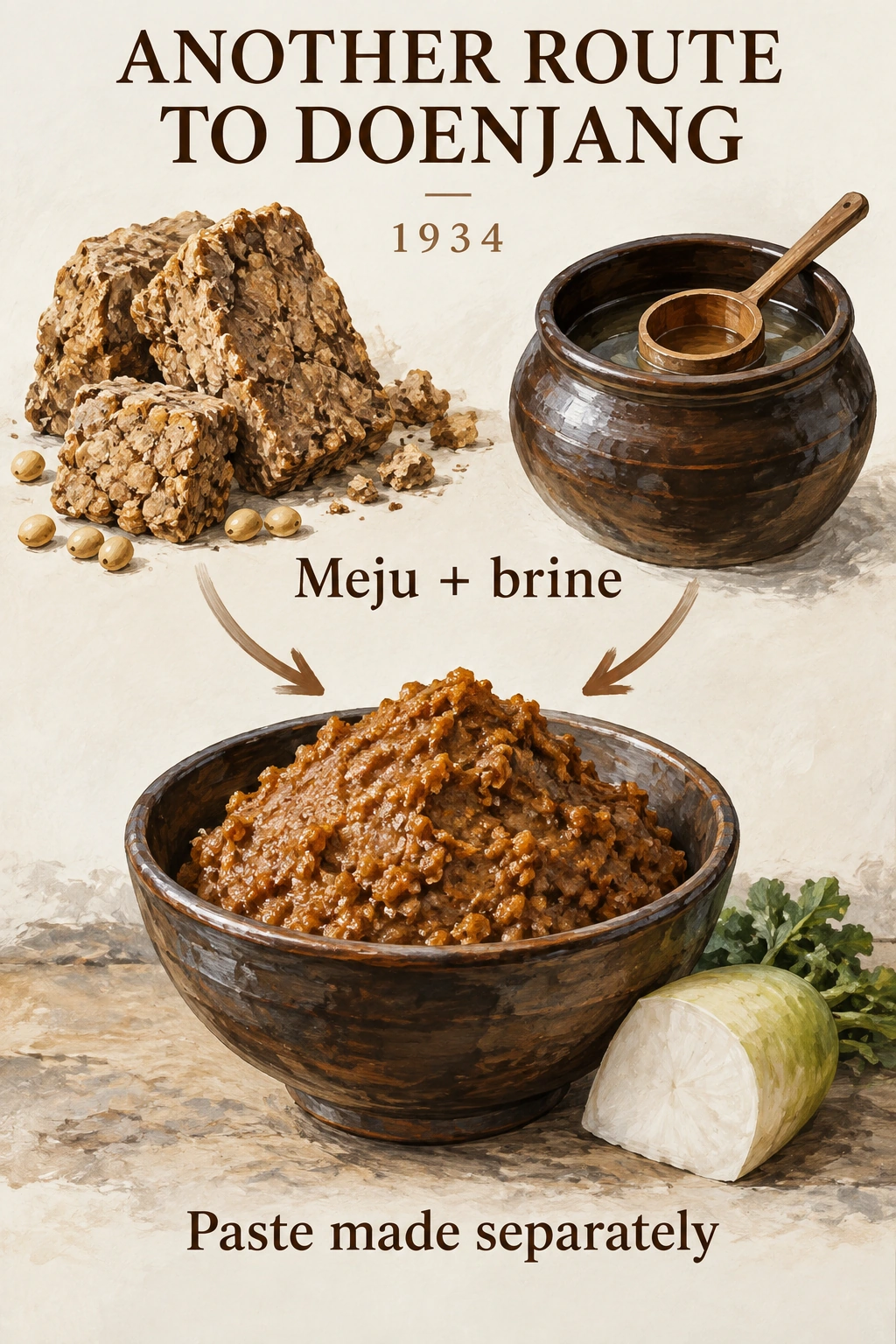
    The Korean Traditional Knowledge Portal reproduces a doenjang passage attributed to a 1934 copy of Bang Sin-yeong’s Joseon Yori Jebeop. It describes making paste separately, with meju and enough brine to cover it, rather than relying on the material left after drawing soy sauce.

    Meju and brine lead toward a separate soybean-paste bowl beneath a 1934 date.
    A passage in a 1934 cookbook copy describes making doenjang separately with meju and brine.

    The author explicitly compares that paste with the remainder of soy-sauce making. The passage also describes placing vegetables in the paste. This is a historical text presented with a transcription and translation; it is not a modern, complete home-fermentation protocol. The portal’s cookbook entry

    This evidence changes the story in a helpful way. The connected two-product method is important, but it is not a rule by which every other preparation must be judged. A cookbook can preserve alternative ways of directing the same starting material toward a desired result.

    It also shows why origin stories should leave room for choices. A household did not merely inherit a food name; it could decide what to make and how to use it. The passage’s interest in vegetables links seasoning with another practical task: preparing something to accompany a later meal.

    A temple survey records variation in practice

    Kim Su-beom and Lee Sim-yeol’s 2024 study distributed questionnaires to 117 Buddhist temples. The published abstract reports that 35.9 percent of those surveyed made their own meju. It also describes variation after separation: 40.1 percent boiled the liquid ganjang before storage, while others stored it without that step. Dongguk University’s research record

    These figures belong to the study’s surveyed temples. They should not be treated as statistics for all Korean households or as instructions to select a storage method.

    Their value here is the visible diversity. Even within a setting associated with preserving food traditions, people need not make every intermediate ingredient themselves or follow identical later steps.

    Ask a producer what they make in-house and what they obtain elsewhere. Buying meju and making jang are different parts of the supply chain; describing them clearly gives the work its proper credit. Tradition becomes easier to understand when its actual decisions are visible, including the decisions about labor and sourcing.

    Bring the history back to the pantry

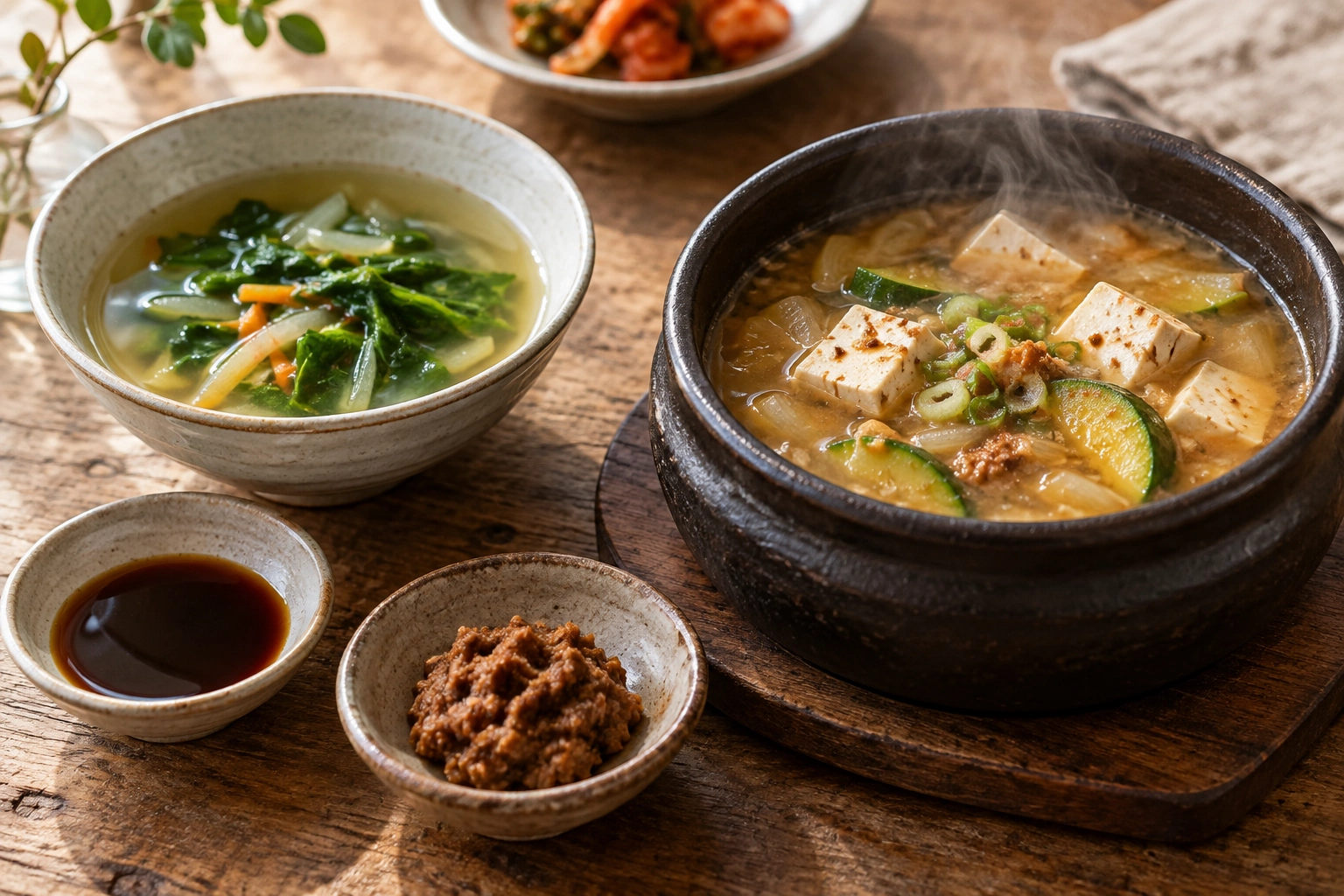
    In her Korean Bapsang pantry guide, Hyosun distinguishes traditional soup soy sauce from other common soy-sauce types. She describes soup soy sauce’s use in soups and seasoned vegetables, while noting that commercial products and ingredient lists vary. Her doenjang discussion likewise identifies products that include additional seasonings or ingredients. Hyosun’s pantry guide

    Soup soy sauce and soybean paste contribute to different dishes.
    Soup soy sauce and soybean paste contribute to different dishes.

    Use that distinction when reading a recipe. Identify the type of seasoning requested, then read the container you actually own. The shared origin of two foods does not make them interchangeable spoon for spoon, nor does one translated label explain every product. The vinegar-and-soy dip alongside mandu puts the same pantry question in a different setting: what should this seasoning contribute to the bite?

    An August 2026 ACC webzine report offers a contemporary example of learning through this pantry. Its “Asia Jang Road” course combined a lecture by Lee Jungmin with food prepared by culinary students. Participants Seo Eungyeong and Seo Seunghyeon described discovering more to say about seasonings they usually bought without much thought. ACC’s course report

    That is the invitation this story makes, too. When a bottle of ganjang sits beside a tub of doenjang, recognize their possible shared beginning. Then leave space for the maker’s particular route.

    At a meal, ask your host which seasoning they chose and what they wanted it to contribute. A question about the cook’s intention gives you more to remember than a simple judgment that one jar must be better because it looks older.

    A block of meju is the start of several decisions, and separating one batch can give a kitchen two different ways to season a meal.

  • Tangpyeongchae: The Korean Jelly Salad with a Political Name

    Tangpyeongchae: The Korean Jelly Salad with a Political Name

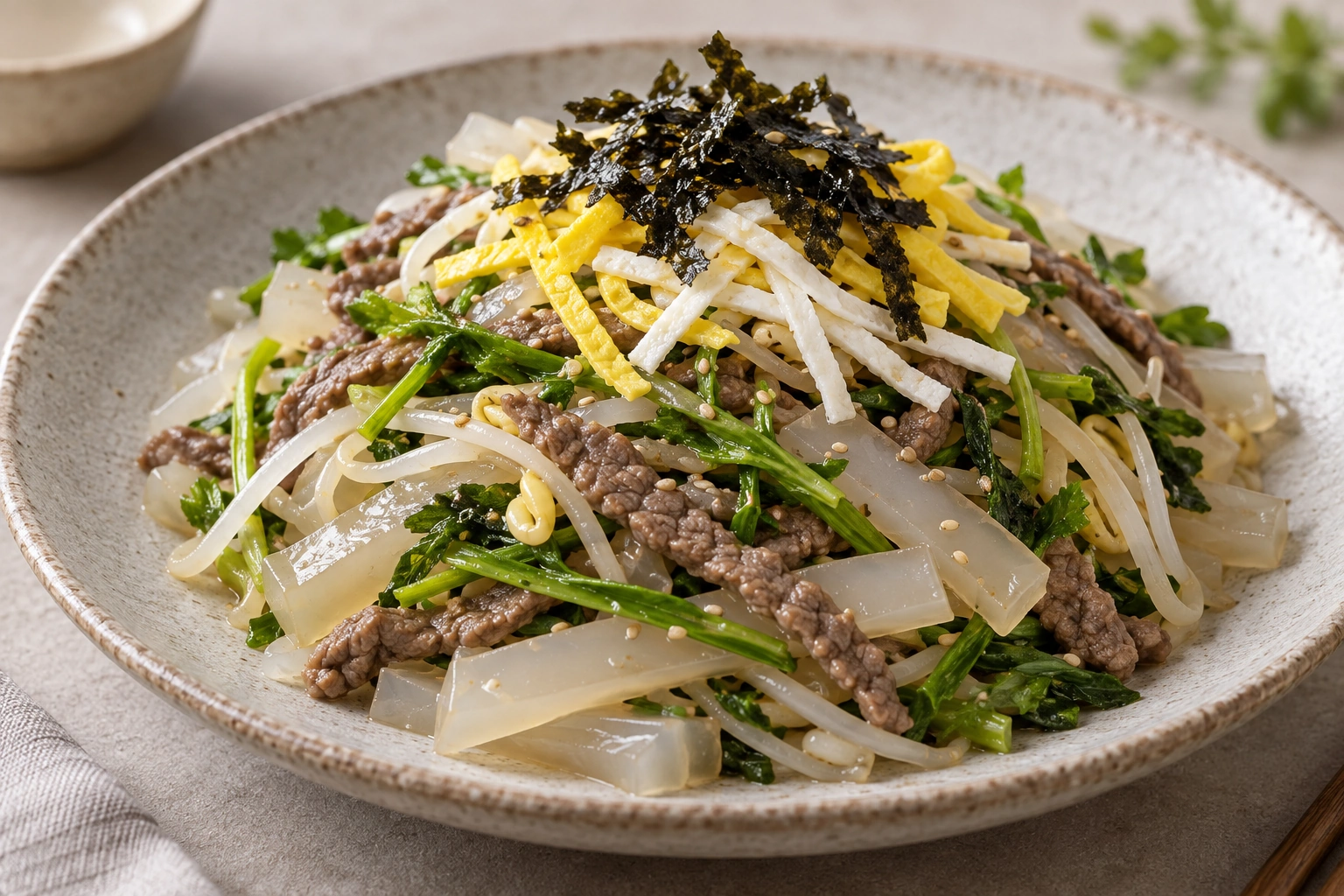
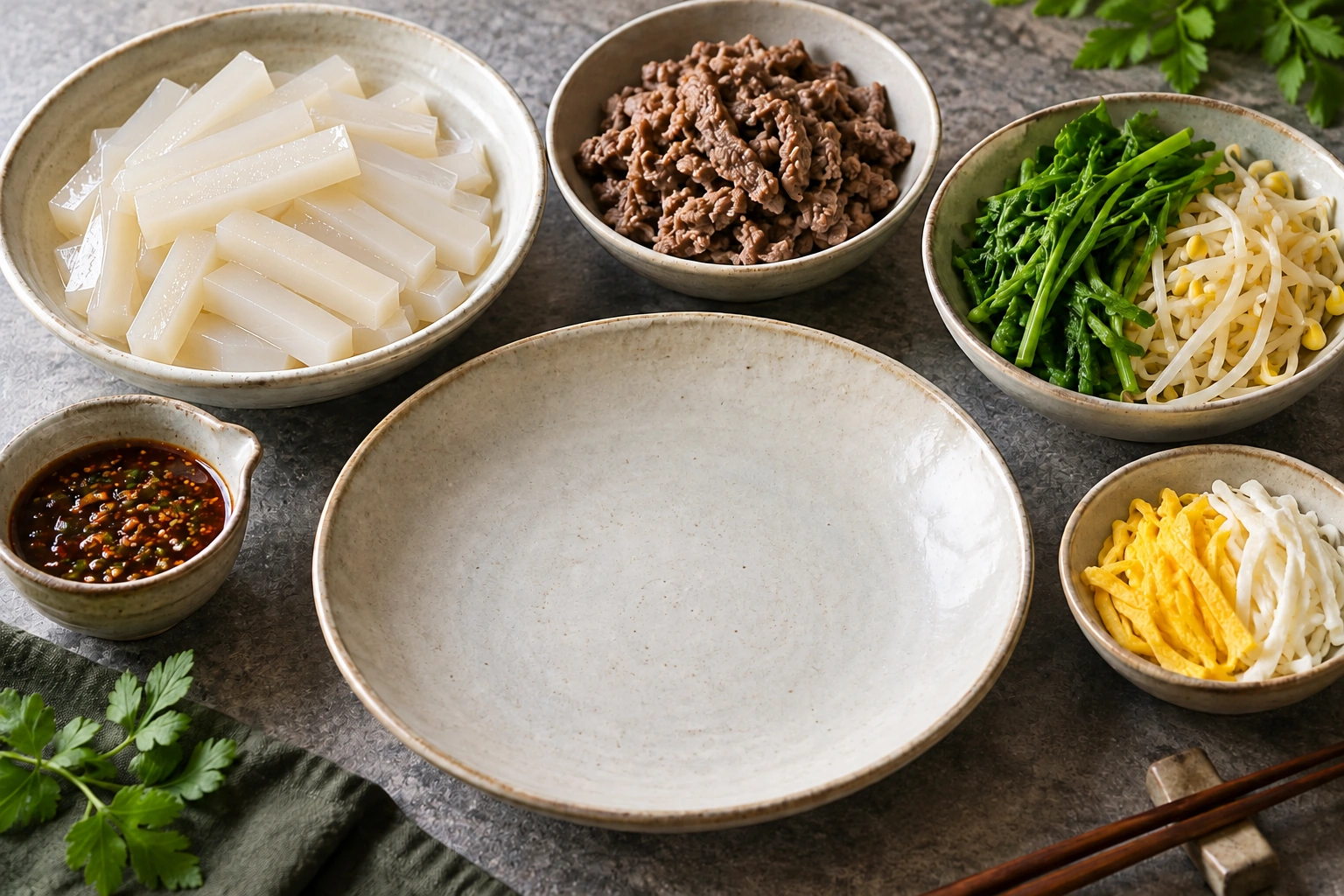
    Mung-bean jelly sits alongside separately prepared greens, beef and egg.
    Mung-bean jelly sits alongside separately prepared greens, beef and egg.

    A plate of tangpyeongchae may look like a gentle introduction to Korean food: pale strips of mung-bean jelly, greens, seaweed and meat arranged together. Its name, however, carries an argument about governing. Food scholar Yun Deok-in’s entry in the Academy of Korean Studies encyclopedia connects the name to discussions of King Yeongjo’s policy of cooperation across political factions. Tangpyeongchae — Encyclopedia of Korean Culture

    For a diner, that connection makes the salad intriguing. Why would an ideal about political fairness belong to a mixed dish? Following the name leads from a king’s public message to changing recipes, and finally to the quiet work that lets different ingredients share one mouthful.

    What does tangpyeongchae mean?

    Korea.net’s 2016 presentation explains tangpyeong through an expression about acting impartially rather than taking sides. It presents Yeongjo’s naming of the dish as a way of expressing the harmony he wanted in government. The food combines cheongpomuk, or mung-bean jelly, with ingredients including beef, sprouts, greens, seaweed and egg. Korea.net’s tangpyeongchae introduction

    The political association is a useful way to remember an unfamiliar name. Imagine looking at the components on your plate: their shapes and colors remain visible even after they are combined. That offers an accessible image of cooperation without requiring everything to become identical.

    This is also a good place to distinguish an inherited naming story from a documented conversation. We can explain the association with Yeongjo without inventing a speech, a precisely dated dinner or the reactions of everyone sitting around it.

    Yeongjo’s “harmony” involved real political work

    The history behind the metaphor was considerably more difficult than mixing a salad. Historian Lee Geun-ho’s encyclopedia entry describes the formation of a political group supporting Yeongjo’s tangpyeong policy. Its members came from both Noron and Soron backgrounds; figures including Jo Mun-myeong, Song In-myeong, Hong Chi-jung and Kim Jae-ro helped sustain the king’s approach.

    The entry also records criticism of this governing circle as its position strengthened. Cooperation across previous affiliations could produce a powerful new group with relationships and interests of its own. Lee Geun-ho on the tangpyeong faction

    That complication gives the food story depth. A king’s desired public image, the officials who carried out his policy and the results of governing are different parts of the history.

    Brush-drawn stone and an open book beneath Tangpyeong, A Public Message and 1742 lettering.
    A 1742 monument associated with Sungkyunkwan gives tangpyeong another place in cultural memory.

    A message written in stone as well as food

    There is a more tangible trace of Yeongjo’s public message: the tangpyeong monument associated with Sungkyunkwan in Seoul. The encyclopedia’s account dates its erection to 1742 and describes an inscription written by the king, adapted from a passage in the Analects.

    Its contrast concerns a broadly impartial mind and a narrowly partial one. The monument addressed students at the royal educational institution, extending the message beyond discussions among court officials. Tangpyeongbi — Encyclopedia of Korean Culture

    The stone and the salad help explain why a food name can survive as cultural memory. An inscription fixes an argument in words; a named dish gives people another occasion to recall it.

    For an overseas reader, this is a satisfying connection between food and a place. The political word on a menu belongs to a larger landscape of learning and royal communication. Recognizing the connection adds meaning without turning your meal into a reenactment of an eighteenth-century banquet.

    The recipe has a history of its own

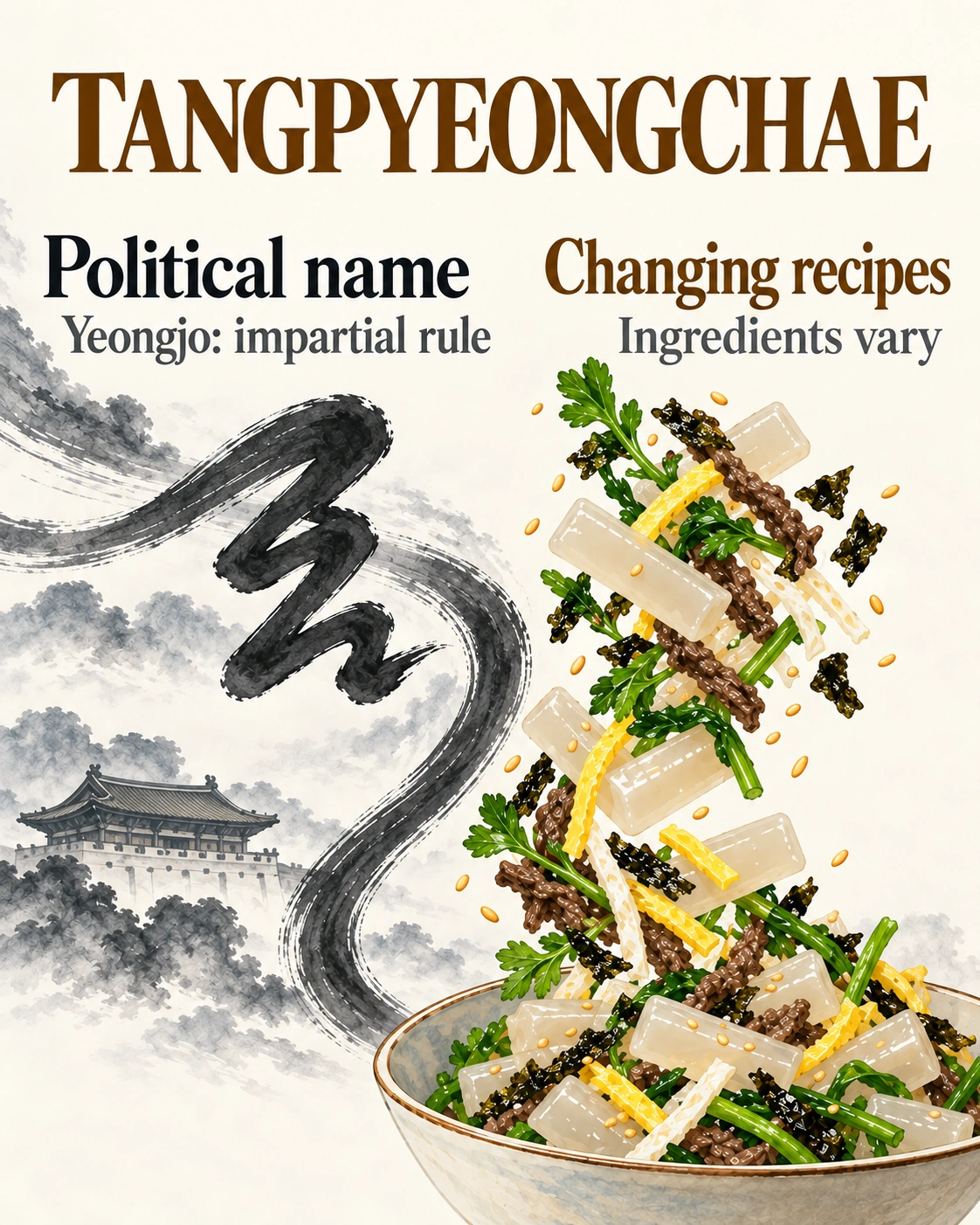
    The present-day assortment should not be projected unchanged into every earlier century. In her 2013 thesis, Bo-ram Kim reviewed recipes and food literature from the eighteenth century onward. Her Korean abstract describes many nineteenth-century preparations centered on jelly, meat and minari, with pork used as the meat.

    A political name and changing recipes preserve different parts of tangpyeongchae’s history.
    A political name and changing recipes preserve different parts of tangpyeongchae’s history.

    She also identifies later variations, including yellow daylily and wood-ear mushrooms in Joseon Yori Jebeop, and a broadly recurring modern combination of jelly, meat, greens, sprouts, egg and seaweed. The study tracks changing seasoning and assembly methods as well. Bo-ram Kim’s literature-review abstract

    These are observations about the texts she compared, rather than proof of the first day anyone ate each ingredient.

    The changes are part of the appeal. A dish can keep a recognizable name while cooks alter its composition. Looking for one eternal, compulsory platter would hide the decisions that made its later versions possible. A similar question runs through japchae’s history before glass noodles: what does a familiar food name preserve when its ingredients change?

    Color remains an active field of invention

    Tangpyeongchae also appears in modern food research. A 2014 study by Choi Ga-ram and colleagues examined contemporary recipes with the aim of standardizing preparation. It explored naturally colored mung-bean gels using ingredients including black sesame, gardenia and omija, in relation to obangsaek, the traditional five-color framework. The researchers’ published abstract

    Here, color is something cooks and researchers actively develop. That is different from assuming every historical plate used one fixed set of ingredients or that every color can be securely assigned to a particular political faction.

    For the diner, a useful question is how this particular cook has arranged the dish. Are the colored strips part of the jelly itself, or are the colors supplied by toppings? Does the presentation emphasize separate components or a mixed salad?

    Those questions bring the visual story down to the plate in front of you, where it can actually be explored.

    The jelly begins with an ingredient shoppers can confuse

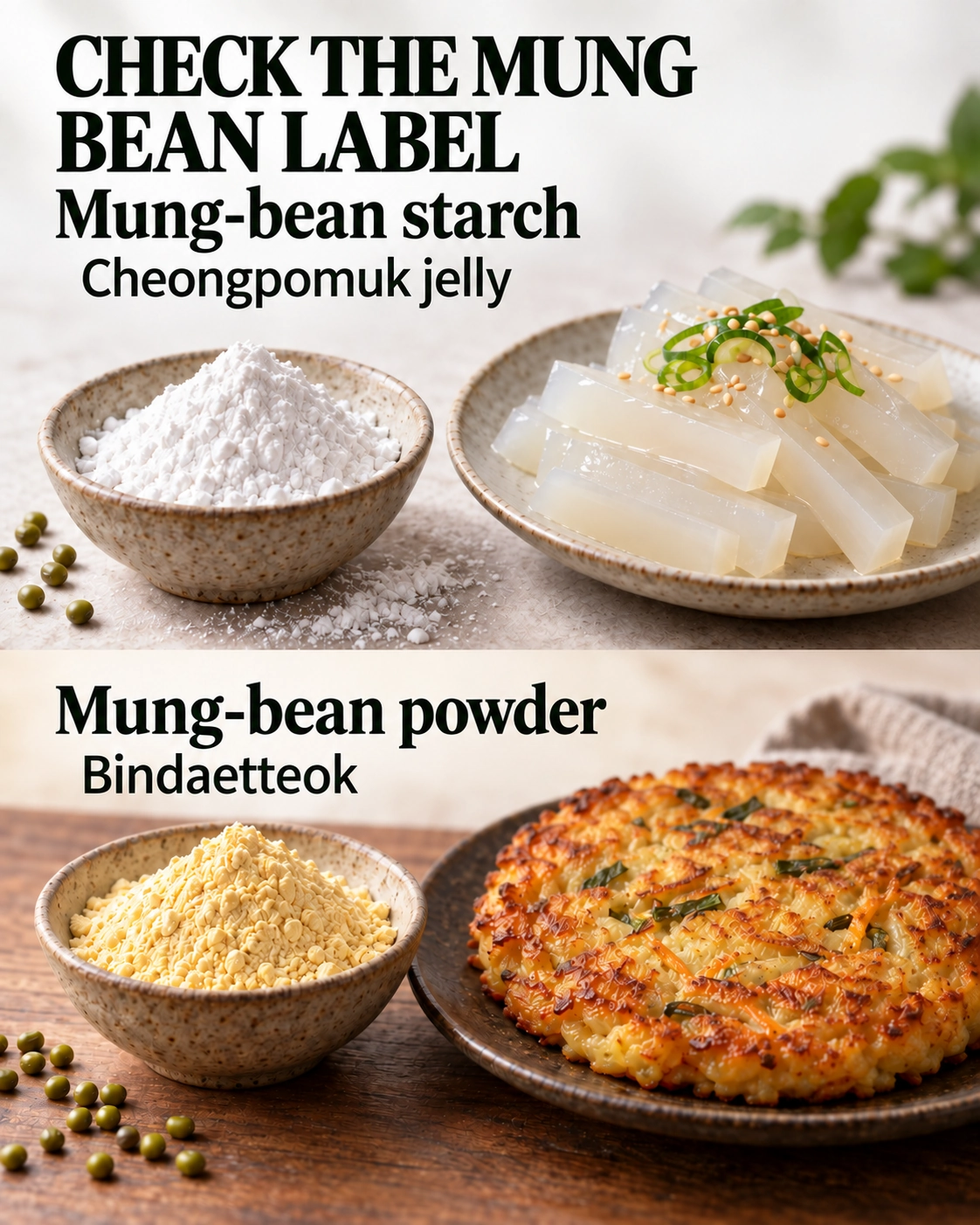
    The base creates a practical challenge for cooks outside Korea. In a reply to a reader who had bought dried mung-bean powder, Maangchi explains that making the jelly requires mung-bean starch. The other powder is used for bindaetteok, a mung-bean pancake.

    Mung-bean starch for jelly differs from the bean powder used for pancakes.
    Mung-bean starch for jelly differs from the bean powder used for pancakes.

    Her cheongpomuk-muchim recipe demonstrates several serving formats, ranging from a large party platter to small appetizer or side-dish portions. Maangchi’s recipe and ingredient clarification

    This distinction is useful when a supermarket label says only “mung bean.” Read the ingredient description and establish that the product is intended for making jelly before following a recipe.

    It also helps separate the base from the finished dish. Learning to make cheongpomuk gives you a component; tangpyeongchae is one way of arranging that component with others. For a first attempt, keeping those two tasks clear makes both the shopping and the cooking easier to follow.

    Harmony on the plate requires separate preparation

    Aeri Lee’s 2015 tangpyeongchae recipe shows the work behind an apparently simple mixture. She prepares the jelly, cooks the seasoned beef, makes egg garnish and blanches the greens before bringing them together. The sauce is held separately and added just before serving, with the amount adjusted to taste.

    Separate bowls of pale mung-bean jelly, cooked beef, greens, sprouts and egg strips.
    The jelly, beef, greens and egg garnish are prepared separately before being combined.

    She ends by considering the dish for her coming Lunar New Year meal. Aeri’s own recipe and holiday plan

    That personal plan gives the royal-associated food an ordinary destination: somebody’s anticipated celebration at home.

    The method also makes the political metaphor more interesting. Combining ingredients takes preparation; putting raw components into one bowl would be a different dish. A cook attends to each part before deciding how they will meet.

    When tasting it, try a little of the jelly with different companions, then a combined mouthful. You can judge for yourself what the arrangement contributes.

    A seasonal dish with more than one social life

    Yun Deok-in’s encyclopedia entry also places tangpyeongchae among foods associated with Samjinnal, the third day of the third lunar month. Alongside its political name, the dish therefore has a seasonal setting. The encyclopedia’s seasonal-food account

    A court association, a spring custom and Aeri’s planned holiday meal can coexist. They invite different questions: what a name remembers, when people make the food and whom they want to serve.

    If you encounter tangpyeongchae on a menu, ask what accompanies the jelly. The word “salad” alone does not tell you whether a particular version includes meat or egg. Let the restaurant explain its preparation before choosing.

    Then enjoy the story at the scale of a mouthful. The ingredients stay distinguishable, the dressing connects them, and an old political word becomes something you can discuss across a table. That continuing conversation is a richer inheritance than an invented royal quotation.

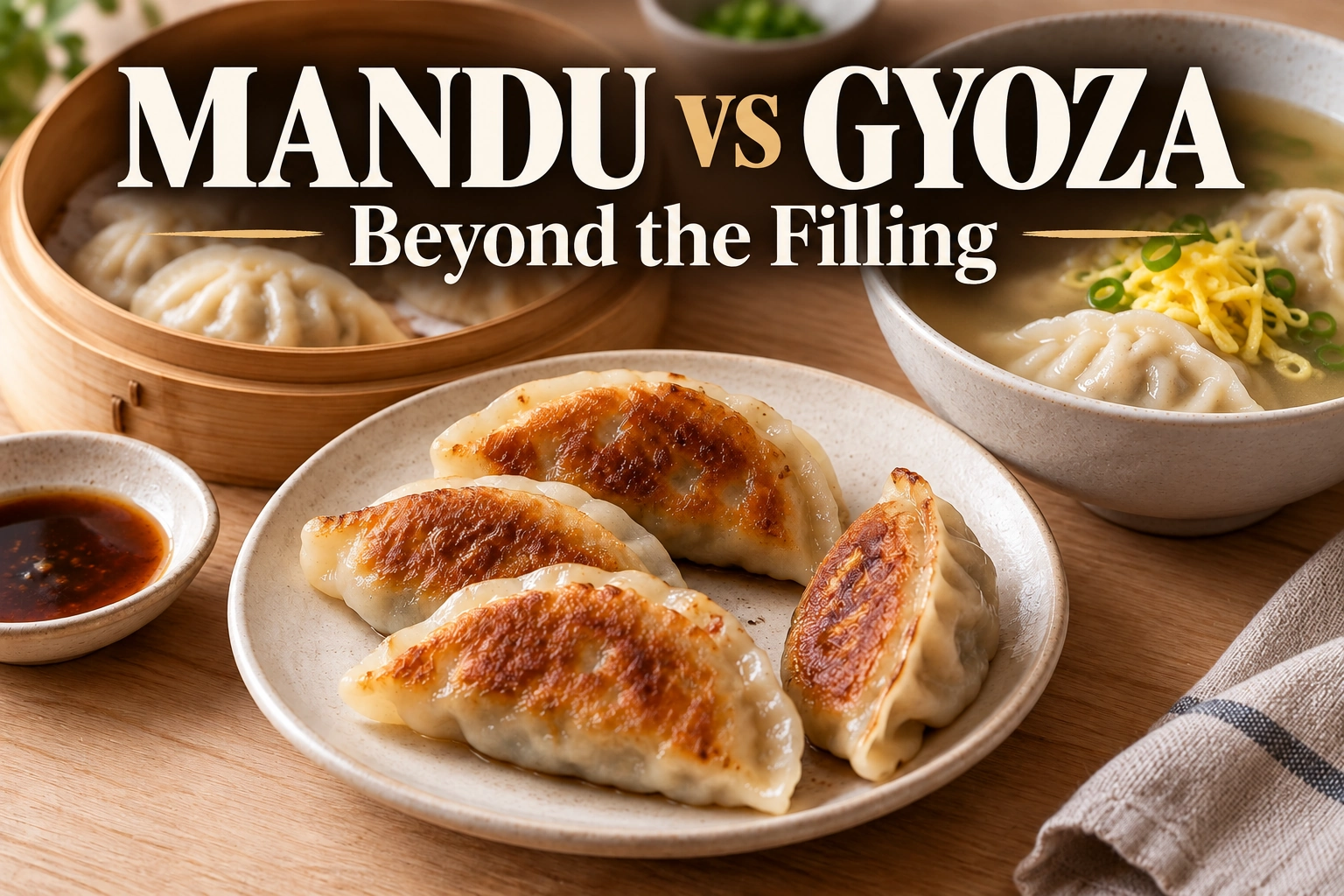
  • Mandu vs Gyoza: What Korean Dumplings Change Beyond the Filling

    Mandu vs Gyoza: What Korean Dumplings Change Beyond the Filling

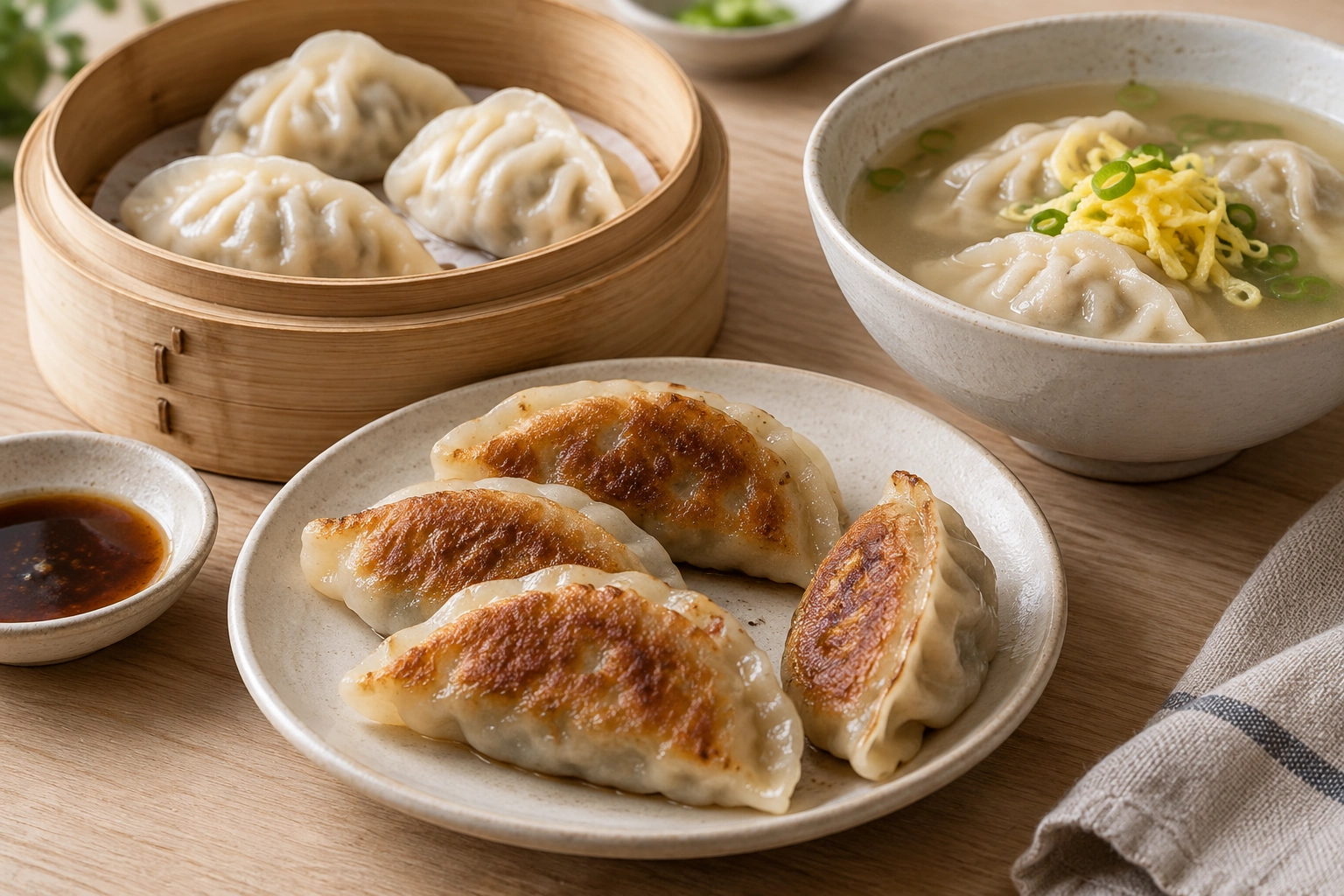
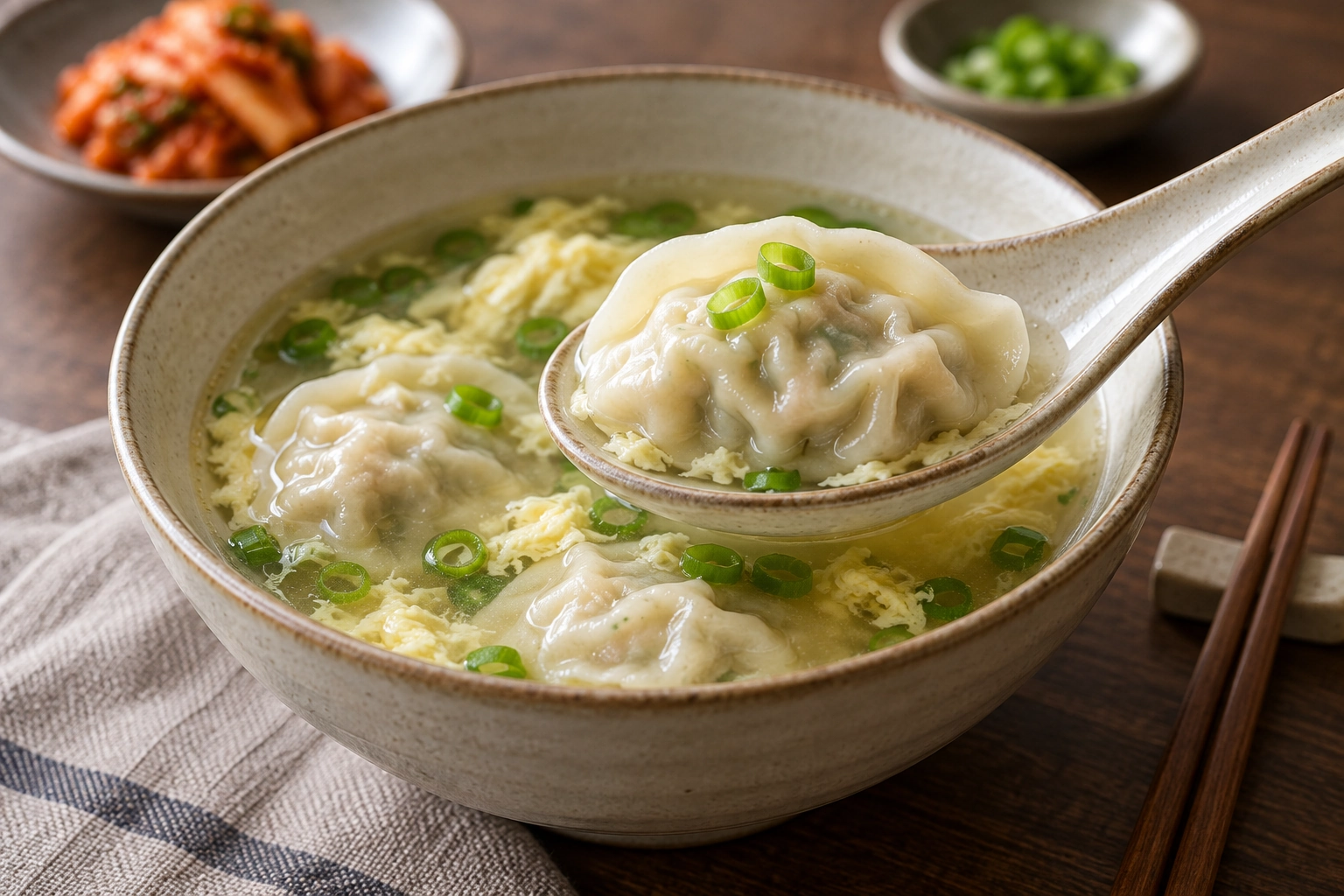
    Pan-fried, steamed and broth-served mandu offer different eating experiences.
    Pan-fried, steamed and broth-served mandu offer different eating experiences.

    A dumpling can arrive on a plate with a browned underside, sit upright in a steamer, or disappear beneath the surface of a bowl of broth. On a Korean menu, all three may belong to the same family: mandu (만두). If you search for “mandu vs gyoza,” the usual answer is a list of national differences—thicker skin, more vegetables, a larger dumpling. That list becomes much less useful when two kitchens make very different versions of the same dish.

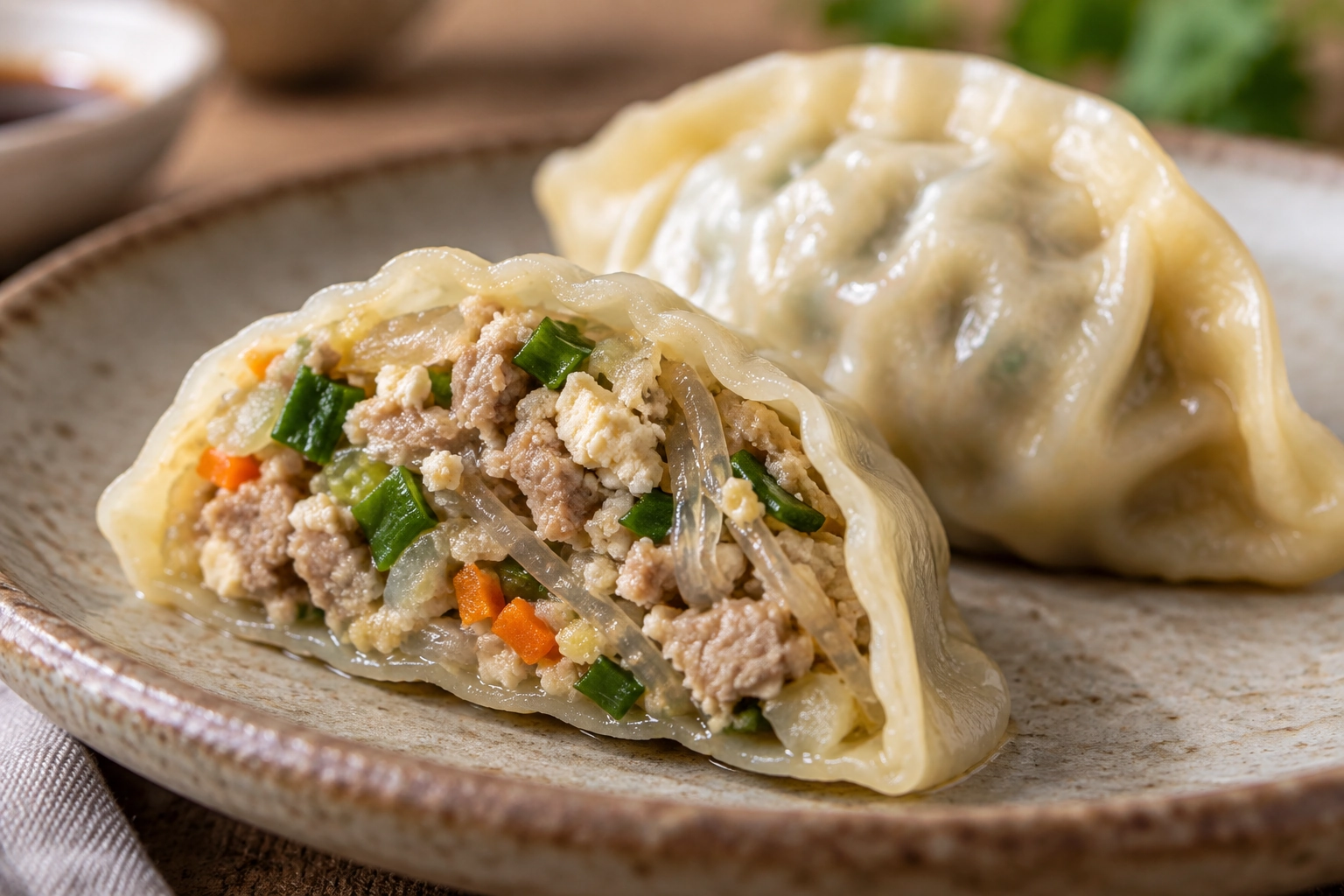
    The more revealing question is what happens to the dumpling between being folded and being eaten. Heat changes the wrapper. Broth changes the meal. A filling that works beautifully in soup may be experienced differently against a crisp, fried surface. Korea’s mandu story is a history of those possibilities, rather than a fixed specification for one national dumpling.

    An old name does not identify one unchanging dumpling

    The Academy of Korean Studies’ mandu entry points to a record in the history of Goryeo concerning a person punished for stealing dumplings from a royal kitchen. The same entry cautions that the particular form described by that record is uncertain. It establishes that dumplings were known, not the date someone invented today’s thin-skinned mandu. That distinction matters when a familiar supermarket shape is projected back across centuries. Mandu—Encyclopedia of Korean Culture.

    Names create another complication. An older word in a song or cookbook cannot always be translated directly into the dumpling on your plate. Dough may have been fermented; wrappers and fillings could differ. The surviving category is broader than a single photograph.

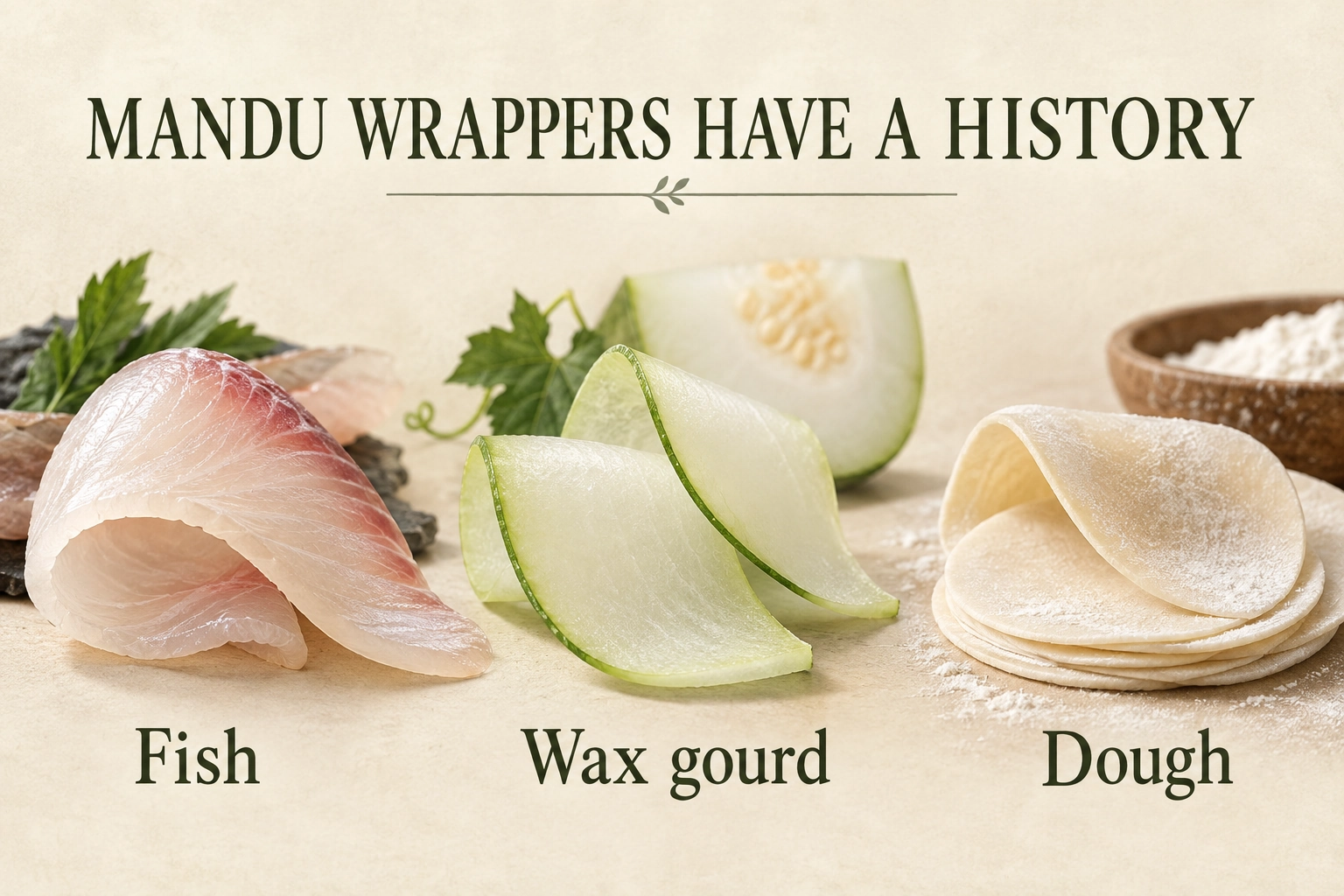
    The Korea Foundation describes historical variations that stretch that category further: eo-mandu could use fish flesh as its outer covering, while donga-mandu used sliced wax gourd. These examples make the wrapper itself part of the story. Mandu was not simply an empty flour pocket waiting for pork. It was a way to enclose ingredients, and cooks could change what did the enclosing. Korea Foundation, “Shared Tastes: Mandu and Its Cousins”.

    Fish flesh, wax-gourd slices and flour dough shown as different mandu wrapper materials.
    Historical mandu examples include fish flesh and sliced wax gourd as outer coverings.

    What changes when mandu meets a pan?

    Pan-fried mandu, often called gun-mandu, gives the wrapper a second job. It still holds the filling together, but its browned surface also supplies a crisp contrast. A bite now moves between two textures: the exterior and what is enclosed.

    Steamed mandu does not ask you to make that same contrast. Without a fried surface dominating the first bite, you can pay more attention to the wrapper’s chew and the filling’s structure. Neither method tells you how much meat, tofu, or vegetable must be inside. They tell you how that mixture will reach you.

    This is why comparing dumplings by country alone can mislead. A steamed Korean dumpling and a pan-fried Korean dumpling may differ more obviously in the mouth than two pan-fried dumplings from different countries. Start the comparison with cooking method; then consider the wrapper and filling.

    At the table, take a bite before adding much dipping sauce. A vinegar-and-soy dip can bring acidity and salt, but it can also overwhelm a lightly seasoned filling. You are deciding whether you want a sharp contrast or to keep the dumpling’s own flavor in front. There is no reason every dumpling on the plate has to receive the same amount.

    In manduguk, the broth becomes part of the dumpling

    Mandu-guk, or manduguk, is dumpling soup. Its importance is not that a cook has merely put a side dish into a bowl. The liquid changes the wrapper’s eating texture, and the dumplings help determine how substantial the bowl feels.

    A soft mandu lifted on a spoon from clear soup with egg and green onion.
    In manduguk, the broth and softened wrapper become part of the same bite.

    Maangchi’s published manduguk uses dumplings with broth and finishes the soup with egg and other additions. Her discussion places it within New Year eating while distinguishing dumpling soup from versions containing rice cakes. This is a documented home-cooking example, not a rule for every Korean household. Maangchi’s manduguk.

    For the reader choosing lunch, the soup raises questions a plate does not. What is the stock made from? Are rice cakes included? Is rice served separately? Does the menu describe one bowl or a portion to share?

    A meatless filling does not answer the stock question. A clear broth can contain animal ingredients even when no meat is visible. Ask about the whole bowl if that affects whether you can eat it.

    Soup also slows the experience. Rather than repeatedly dipping crisp dumplings, you move between spoonfuls of broth and bites of filling. The same family of food has become a different kind of meal.

    What is inside Korean mandu?

    There is no single filling that makes every mandu Korean. Pork, beef, kimchi, tofu, vegetables, seafood, and starch noodles appear in different combinations. Their presence is more informative when you ask what each contributes than when you use them as a national checklist.

    One mandu filling combines meat, tofu, vegetables and starch noodles.
    One mandu filling combines meat, tofu, vegetables and starch noodles.

    A documented example is Maangchi’s pork mandu, which combines meat with tofu, vegetables, and sweet-potato starch noodles and offers several cooking methods. It shows one cook balancing tastes and textures within a parcel. It does not establish that all mandu contain those ingredients. Maangchi’s mandu recipe.

    When you cut or bite into a dumpling, notice the filling’s structure. Is it a compact mixture, or can you distinguish pieces of vegetable? Does kimchi supply acidity as well as heat? Does the filling remain juicy against the wrapper? These observations explain more about the individual dumpling than a claim that an entire country prefers one thickness of skin.

    Kimchi mandu deserves the same care. “Kimchi” tells you something about the filling’s direction; it does not promise a fixed heat level or a meatless recipe. Tofu is similarly inconclusive. It can sit beside meat rather than replace it.

    Mandu, gyoza, and jiaozi: compare a version, not a flag

    Japanese gyoza and Chinese jiaozi are useful reference points, especially if they are the dumplings you already know. The mistake is treating each name as a rigid package of ingredients, size, and cooking method.

    Japan’s tourism organization describes Utsunomiya’s pan-fried dumplings and their thin wrappers. This is a regional example you can actually compare with a plate of fried mandu. It is stronger evidence than saying all Japanese dumplings have one texture. Japan National Tourism Organization: Utsunomiya dumplings.

    Beijing’s tourism material likewise records a range of dumpling fillings and restaurant styles, including vegetable, meat, and seafood examples. Chinese dumplings are not a single control sample against which everything else must be measured. Beijing tourism: dumpling examples.

    A fair comparison therefore needs a named form. Compare pan-fried with pan-fried, or soup dumplings in the sense of dumplings served in broth with another broth-based meal. Look at wrapper material, filling, heat, and accompaniment. You may find differences, but you will also find overlap.

    A cut dumpling with labels pointing to its wrapper, filling and browned cooking surface.
    Wrapper, filling and cooking method offer useful ways to compare particular dumplings.

    That overlap does not erase Korean food identity. Identity can live in a particular combination, regional practice, or meal context without requiring an ingredient that no other cuisine has ever used.

    Choosing mandu without guessing from the name

    If you want contrasting textures, a fried version is a sensible starting point. If you want to examine a soft wrapper and filling together, choose steamed mandu. If you want a bowl that includes liquid, garnishes, and possibly rice cakes, investigate manduguk.

    For packaged mandu, read the specific ingredients and cooking directions. A brand name or photograph is less reliable than the label in your hand. Bibigo’s European chive-and-vegetable product, for example, lists tofu and starch noodles alongside vegetables, with wheat and soy ingredients. It also provides separate preparation instructions. That is evidence about that product—not every package sold under the mandu name. Bibigo product ingredients.

    For allergies, check both ingredients and cross-contact information. Removing a visible topping cannot remove wheat from a wrapper or soy from a filling. At a restaurant, include dipping sauce and soup stock in the question.

    Mandu becomes easier to understand when you stop looking for one national fingerprint. Its long history includes changing names and wrappers; its present includes different fillings and ways of cooking. The next time you order it, choose the experience first: a browned edge, a soft parcel, or a dumpling you lift from broth. The story continues in what the kitchen does to the package, and in how you decide to eat it.

  • Korean Corn Cheese: Sweet Corn, Melted Cheese and Its Modern Serving Style

    Korean Corn Cheese: Sweet Corn, Melted Cheese and Its Modern Serving Style

    Corn cheese earns attention in the first spoonful: sweet kernels stay distinct beneath a rich, melted top. The familiar ingredients are easy to recognize, but the way they arrive together in a small hot dish gives this Korean restaurant side its particular appeal.

    The headline’s 1990s origin date needs a qualification. The sources reviewed here document published modern recipes and serving practices; they do not establish a first inventor or prove that Korea began eating the dish in one exact decade. They also do not measure its current TikTok popularity.

    There is a firmer dated record to work with. Korean Kitchen published its recipe in July 2016, while Maangchi’s recipe was posted in August 2018. Those publication dates show the dish was being explained to readers by then. They are not invention dates.[1][3]

    For a diner, the useful question is what makes the little side work. Look at the kernels, the consistency beneath the cheese and the serving role. That reveals more than a dramatic origin story or the length of a cheese pull.

    Dated recipe publications do not establish a first inventor.
    Dated recipe publications do not establish a first inventor.

    Recognize the preparation before the garnish

    My Korean Kitchen describes sweet corn with mayonnaise, sugar, butter and cheese, served as a side or drinking snack. Its recipe includes an optional bell-pepper addition. That is one cook’s documented preparation, rather than a fixed ingredient rule for every restaurant.[2]

    The dish should still be recognizable as corn. A spoonful can carry a cluster of separate kernels held together by a creamy coating and melted cheese. This is a different structure from a smooth corn soup or a battered snack with cheese hidden inside.

    A browned top and a pale melted top also offer different first bites. Browning emphasizes a surface; a softer top makes the mixture easier to scoop through. Look beneath the garnish before assuming that two attractive photographs describe the same texture.

    For a first order, ask for the basic version the venue actually serves. Extra toppings can be enjoyable, but beginning with a recognizable corn base makes later comparisons easier. The menu’s picture is a guide to that item, not a national standard.

    Corn remains distinct beneath the coating and melted top.
    Corn remains distinct beneath the coating and melted top.

    Moisture changes the spoonful

    Maangchi specifically emphasizes removing excess liquid from the corn and chopped vegetables. Her recipe warns that too much moisture leaves a wet base beneath the cheese. That supplies a concrete explanation for why the ingredients’ preparation matters.[1]

    When tasting, notice whether the spoon reaches a cohesive mixture or a pool of liquid. Neither a long cheese strand nor a browned surface answers that question. A close look at the base reveals what the top of the dish can conceal.

    The kernel texture is worth noticing on its own. A small bite lets you distinguish the corn from the surrounding richness. A heavily covered pan can look impressive while giving a quite different balance from one with a lighter cheese layer.

    At home, follow a complete tested recipe rather than copying only the final video frame. Its specified ingredients, vessel and heating method work together. A photograph of the finish does not tell you how the cook controlled the moisture underneath it.

    Excess moisture can change the mixture beneath the cheese.
    Excess moisture can change the mixture beneath the cheese.

    Melting and browning are different finishes

    My Korean Kitchen provides covered stovetop and oven options, with a broiler for browning. Maangchi likewise distinguishes stovetop melting from an oven finish. Both sources show that a browned top is a choice within a method, rather than a requirement built into the dish’s name.[1][2]

    A lid and an exposed top change what the cook is trying to achieve. When choosing a recipe, decide whether you want a soft melted surface or a more browned one, then use the method written for that result. Avoid treating every heat source as interchangeable.

    A restaurant may bring a hot pan, while a home cook may use another suitable vessel. The shape and portion affect the relationship between the surface and the corn beneath it. A shallow shared side and a deep casserole are different experiences even with familiar ingredients.

    For eating, give a hot portion time to become comfortable and follow the provider’s instructions. A photograph captures the cheese at one moment; a meal continues as it cools. The dish can be enjoyed without rushing a dramatic lift for the camera.

    A melted surface and a browned surface are different finishes.
    A melted surface and a browned surface are different finishes.

    A small side changes the rhythm of a meal

    Korean Kitchen explains anju as food usually eaten with alcohol and presents corn cheese in that role. My Korean Kitchen also describes it as an accompaniment to other meals. The serving context is documented; an obligation to drink is not part of enjoying the food.[2][3]

    Think of the pan in relation to the rest of your order. A small rich side can provide another flavor and texture between bites of the main dish. That is an eating comparison, rather than a claim that cheese cancels heat medically or improves the meal’s health effects.

    If several people share it, consider how much each person wants before adding more sides. The restaurant can explain its portion and whether it is an included accompaniment or a separate order. An old review showing a free pan does not settle the current bill.

    There is also no need to make the side carry the whole meal. Somebody may want only a few spoonfuls alongside another dish. A modest order can make the corn’s sweetness and the topping’s richness more noticeable than several similar cheese-heavy items.

    A modest corn-cheese side offers another texture beside a main dish.
    A modest corn-cheese side offers another texture beside a main dish.

    The name is not the complete ingredient list

    Corn and cheese identify the two most visible ingredients, but the cited recipes contain others. If ingredients matter to your order, ask about the actual mayonnaise, seasonings and additions used by the venue. The final photograph cannot reveal everything mixed through the base.

    Removing the visible topping after cooking does not tell you what was already incorporated. Ask before ordering when you need an ingredient-specific answer. A different restaurant’s recipe is useful for understanding the dish, but it cannot certify this restaurant’s preparation.

    Corn cheese also remains distinct from a cheese-filled corn dog or cheese-topped rice cakes. One is scooped from a pan, another is bitten through a coating, and another combines a sauce with rice cakes. A shared cheese pull does not make their histories or recipes identical.

    Enjoy the next pan through those differences: the separate kernels, the mixture beneath the top and the way it accompanies the meal. Corn cheese deserves a clear account of its modern serving style without a fictional ancient ancestor or an unproved birthday.

    A spooned corn side differs from a filled or sauce-covered snack.
    A spooned corn side differs from a filled or sauce-covered snack.

    Compare other sides and coated snacks

    Sources and reading

    1. Maangchi — corn cheese, posted August 31, 2018
    2. My Korean Kitchen — corn cheese, updated February 3, 2023
    3. Korean Kitchen — corn cheese, July 23, 2016