
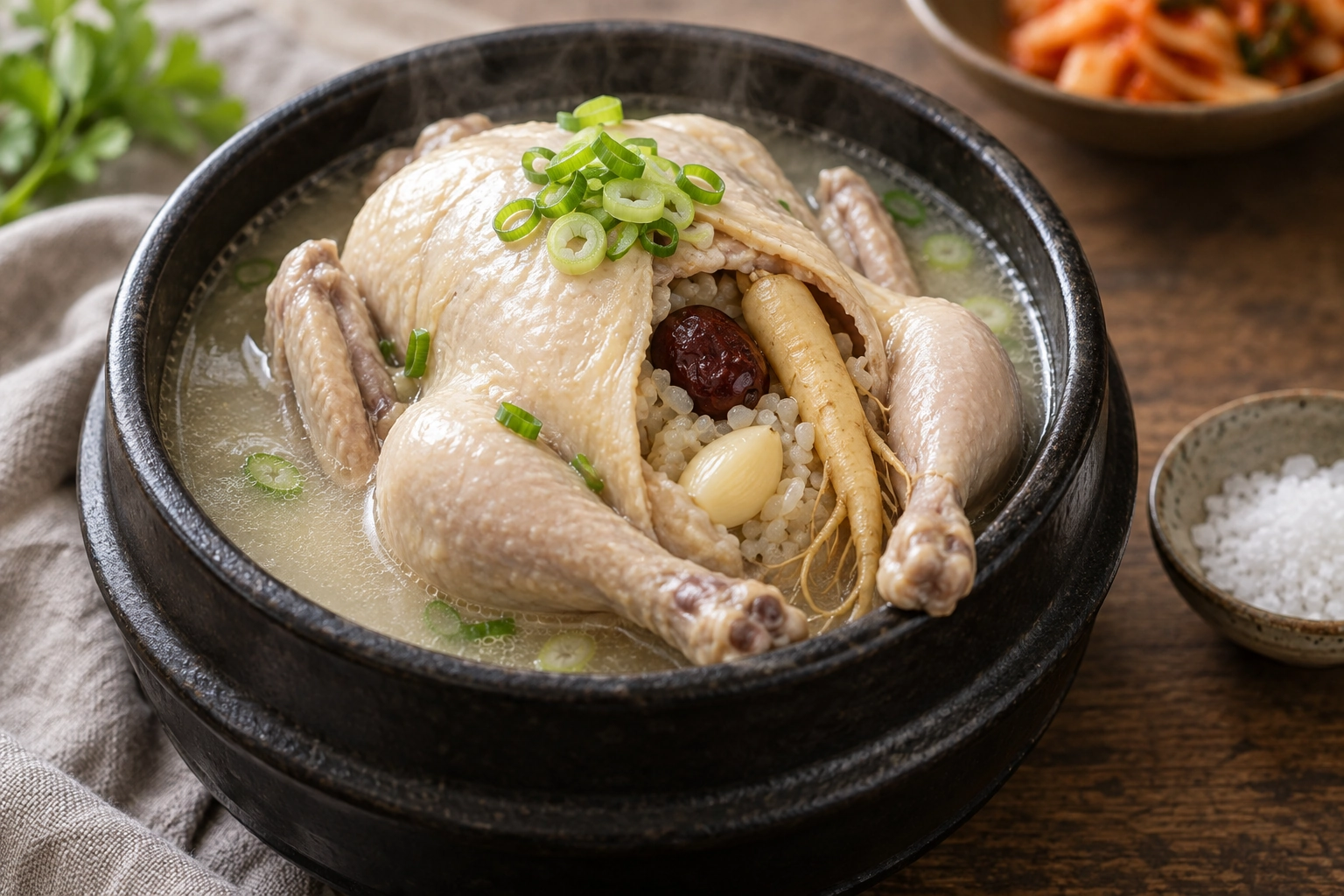
A whole chicken in broth can look like a meal meant for everyone. With samgyetang, it may be your own lunch. Maangchi’s Korean ginseng chicken soup uses small birds filled with rice, garlic, ginseng and jujube, then divides them into individual bowls. In her introduction, she remembers meeting a reader in New York who made the dish for himself and his mother. The impressive part of his story was the cooking he did for another person, rather than the size of the chicken.
That combination makes samgyetang a useful starting point for comparing food cultures. The bird contains part of the meal inside its own body; the broth carries the rest. Rice, meat and soup arrive together, while salt and dipping sauces let the eater adjust individual bites. A familiar English label, “chicken soup,” tells you less about this arrangement than the bowl itself. It can help to picture a small stuffed bird that becomes a complete personal meal, with company at the table even when the portions stay separate. Maangchi’s samgyetang
A whole chicken, but a different meal
Across the world, the Béarn tourism office describes another bird cooked slowly in liquid: poule au pot. Its account places the French dish among the comforting meals of cool late-year days. Carrots, turnips, leeks and onions accompany the hen. Broth can be served first, followed by the meat and vegetables. Some versions stuff the bird with bread, herbs, sausage meat or ham.
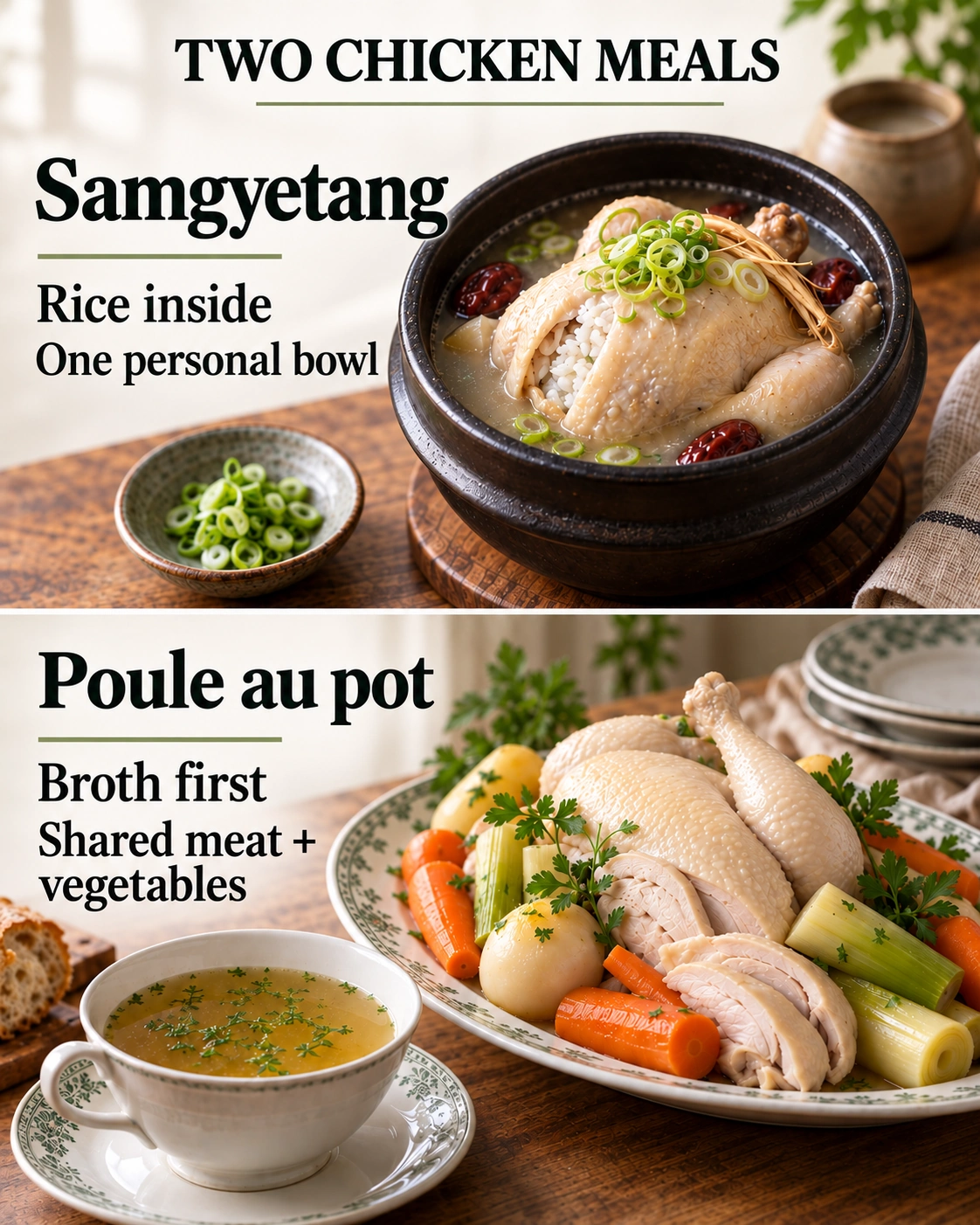
The similarity with samgyetang is immediately useful: neither needs a roasted skin to give a whole bird importance at dinner. But the sequence changes what the cook is offering. A soup course followed by shared meat and vegetables stretches the pot across the meal. A stuffed bird in an individual bowl gathers the meal around one diner. These are arrangements in the particular descriptions, rather than rules governing every Korean or French family.
For a reader choosing a dish, the practical distinction is worth more than calling one the French equivalent of the other. Ask what comes inside the bird, what cooks beside it, and how the contents reach the table. Shared technique leaves plenty of room for different appetites and occasions. Cœur de Béarn’s description
Samgyetang’s familiar filling also has a history of changing ingredients and access. Food scholar Joo Young-ha, writing in July 2026, points to a chicken-soup recipe in the 1921 edition of Bang Sin-yeong’s Joseon yorijebeop. His reading describes glutinous rice and powdered ginseng inside the bird. He connects the later development of samgyetang restaurant menus to increased chicken production and the refrigerated distribution of fresh ginseng in the mid-1960s.
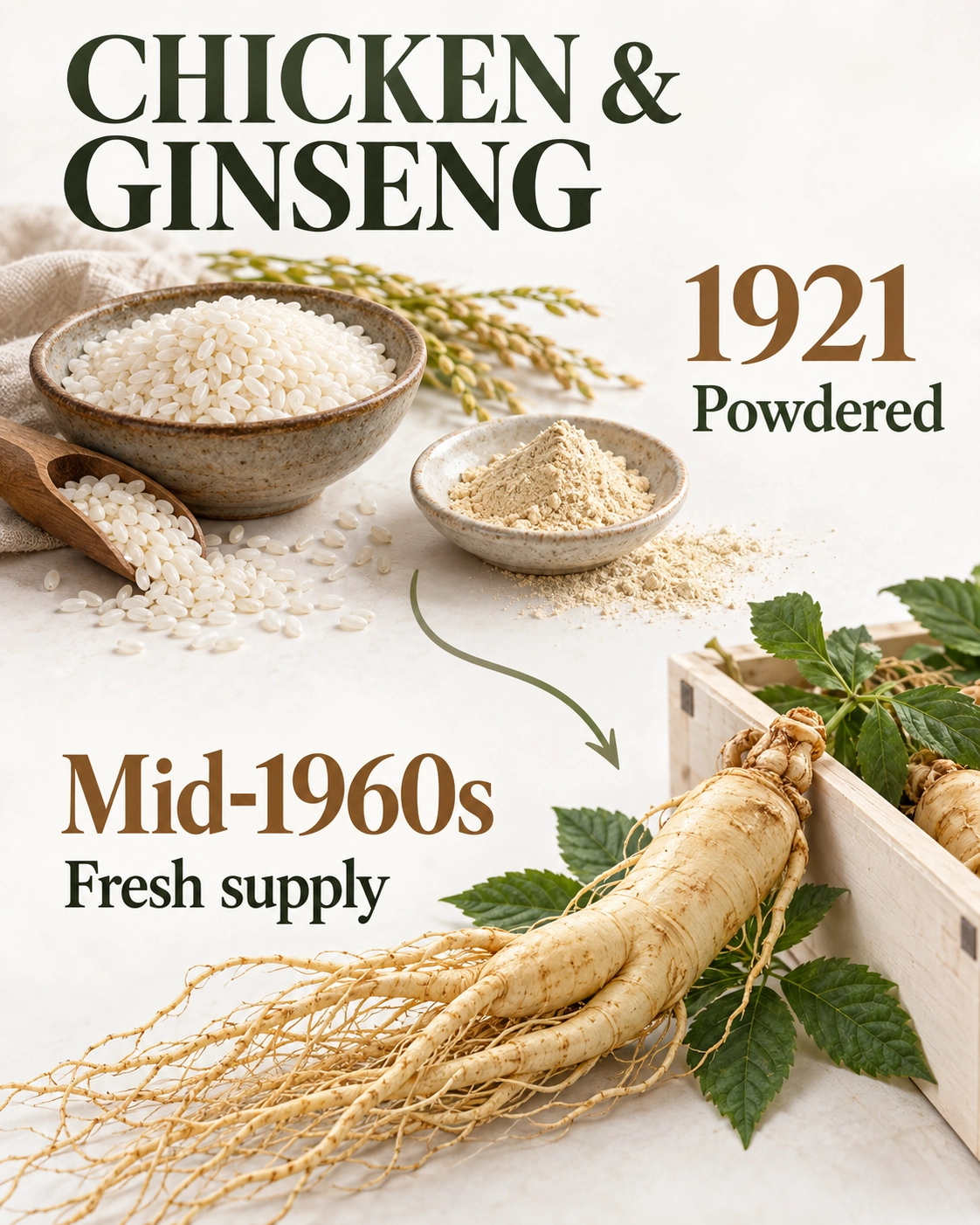
This is a scholar’s account of the documents and supply changes; it does not establish one inventor or make the modern dish timeless. Still, the distinction between powder and a whole fresh root opens a better question than “How ancient is it?” A visible root depends on a supply chain as well as on a cook’s intention.
Read that way, the bowl holds agricultural and commercial history alongside the chicken. Changing access can make an ingredient more prominent and a meal more widely available. The version a visitor meets in a restaurant need not look exactly like the one described in an earlier cookbook. Joo Young-ha’s historical account
The king’s chicken was a story that changed
Poule au pot carries an especially memorable promise: Henri IV wanted a chicken in his subjects’ pots. Gastronomic historian Jean Vitaux examines that account in a 2010 chronicle published by the Institut de France. He traces a version to Hardouin de Péréfixe’s 1661 history, written for the education of Louis XIV, and treats the saying as probably apocryphal. The familiar Sunday formulation developed later, during the Restoration.
Vitaux also draws attention to the word laboureur. In the earlier setting it referred to a farmer prosperous enough to own a team for ploughing, not automatically every person working the land. Translating the tale as a universal weekly meal can flatten that distinction.
The legend remains revealing without becoming a verified royal quotation. A chicken dinner offered a picture of recovered rural prosperity after destructive wars. Later retelling made that picture more inclusive and easier to repeat. The dish’s political significance lies partly in this changing image of a good ruler: people should be able to eat well. That is different evidence from a record proving that every household actually received a hen on Sunday. Jean Vitaux’s chronicle
The story also turned up on a real commemorative menu. The Château de Pau’s chronology records the 1953 celebrations marking four hundred years since Henri IV’s birth. French president Vincent Auriol attended the festivities and a banquet at the château. Poule au pot appeared among the dishes. The initiative came from Pau and its mayor, Louis Sallenave.
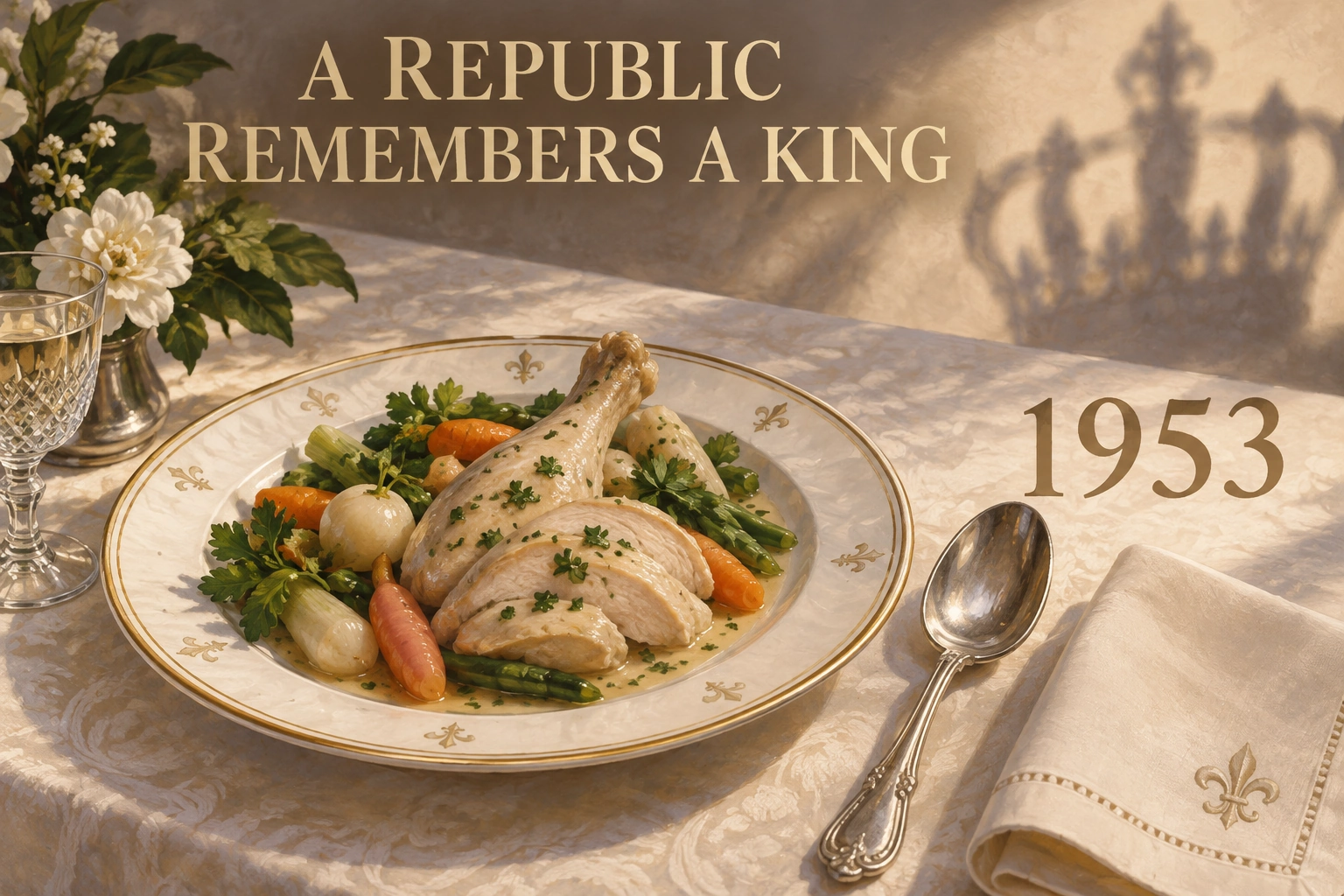
A twentieth-century republic serving a meal associated with a king is a more specific historical scene than a vague claim that France has always eaten this way. At that banquet, the dish helped make a figure from the past present at the table. A menu could perform some of the work of a monument, using a recognisable meal instead of stone.
For food travellers, this changes how a famous name can be read. “Henri IV” beside poule au pot can signal regional memory and commemoration as much as a particular cooking formula. The documented banquet shows people using the association centuries later. It does not settle whether the king uttered the original saying, or prove that the banquet reproduced his own dinner. The château’s chronology
What the broth leaves for tomorrow
A modern chef’s version gives the French pot another role. The Académie du Goût publishes an extract from Nature Volume 2, credited to Alain Ducasse, Paule Neyrat and Christophe Saintagne. The ingredient list surrounds the hen with vegetables and aromatics, including mushrooms, thyme, bay and juniper. The chef’s introductory advice values the broth as something to keep for other recipes.

Even that limited extract changes the comparison. The meal’s value is partly what remains available to another dish. A pot can feed dinner and contribute flavour to cooking afterwards. The vegetable list gives a reader concrete things to recognise when looking at this version, without suggesting that every poule au pot must contain the same combination.
This is also why comparing soups solely by their main animal can be misleading. The cooks credited here organise a wider group of ingredients around the bird and give the liquid a future use. To understand the meal, follow the broth as well as the meat. The extract is a window into one approach, rather than a complete cooking lesson. The published recipe extract
Rice does not belong to only one side
The neat contrast between Korean chicken with rice and French chicken with vegetables has a problem: a French family meal may have rice too. In April 2020, France.fr featured chef Jean Imbert’s grandmother’s poule au riz. The article connected the comforting dish to cooking during confinement and reproduced his social post describing it as a favourite winter meal she made for him.
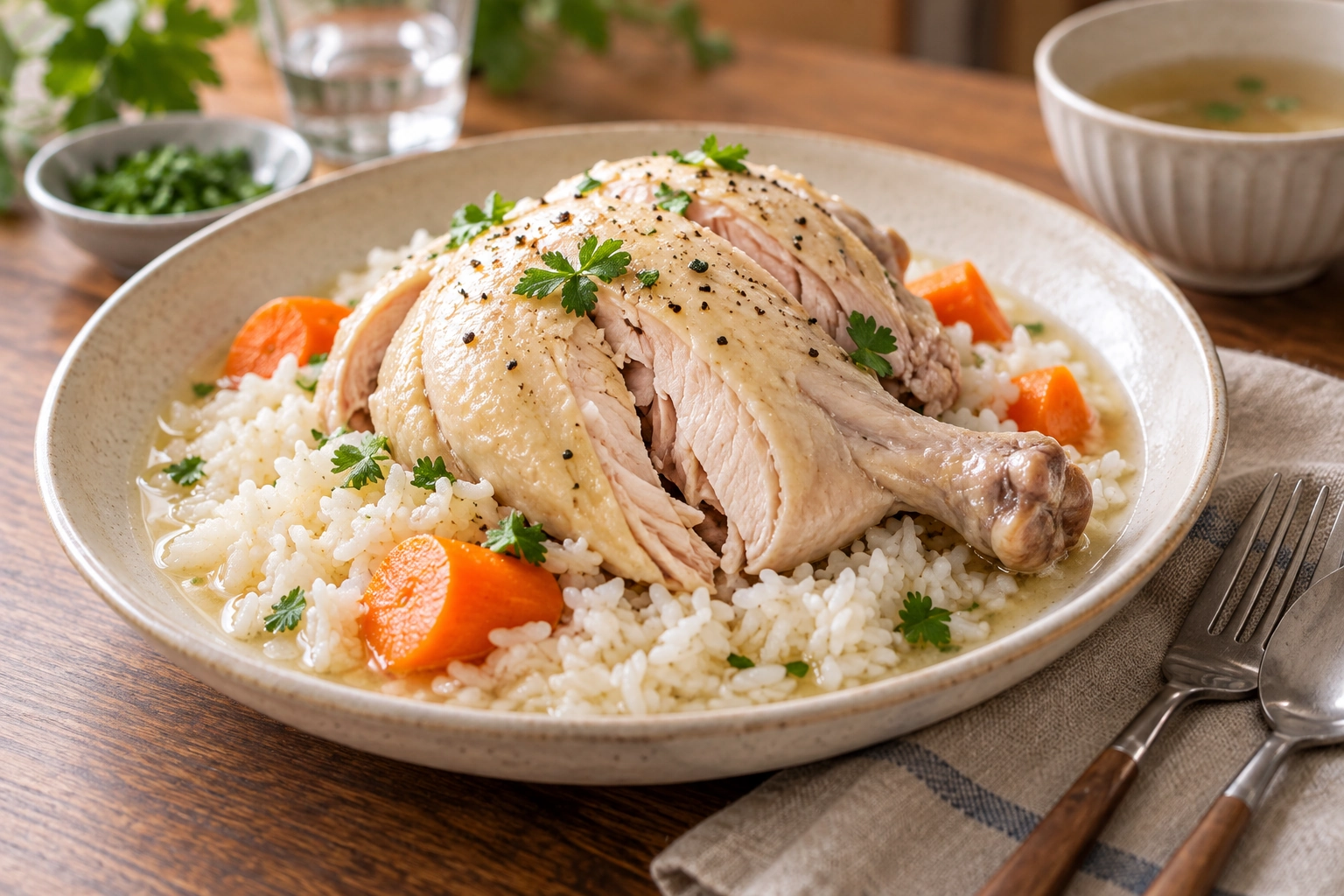
Poule au riz is the dish named in that account. Treating it as an exact synonym for every poule au pot would discard a distinction the reader has just learned to notice. It is useful here as a neighbouring family example, showing why a national comparison should leave room for meals that cross our tidy categories.
The strongest connection between these chicken pots is therefore neither an identical recipe nor a demonstrated route of influence. It is the way a modest cooking action can carry a much larger promise: a meal remembered from a grandmother, or a picture of people living well. The differences stay visible even when the feeling is recognisable. Rice in the French example makes the comparison richer, rather than making either country lose its dish. France.fr’s family-meal account
Back at the samgyetang bowl, that promise can be as personal as cooking a small bird for your mother.