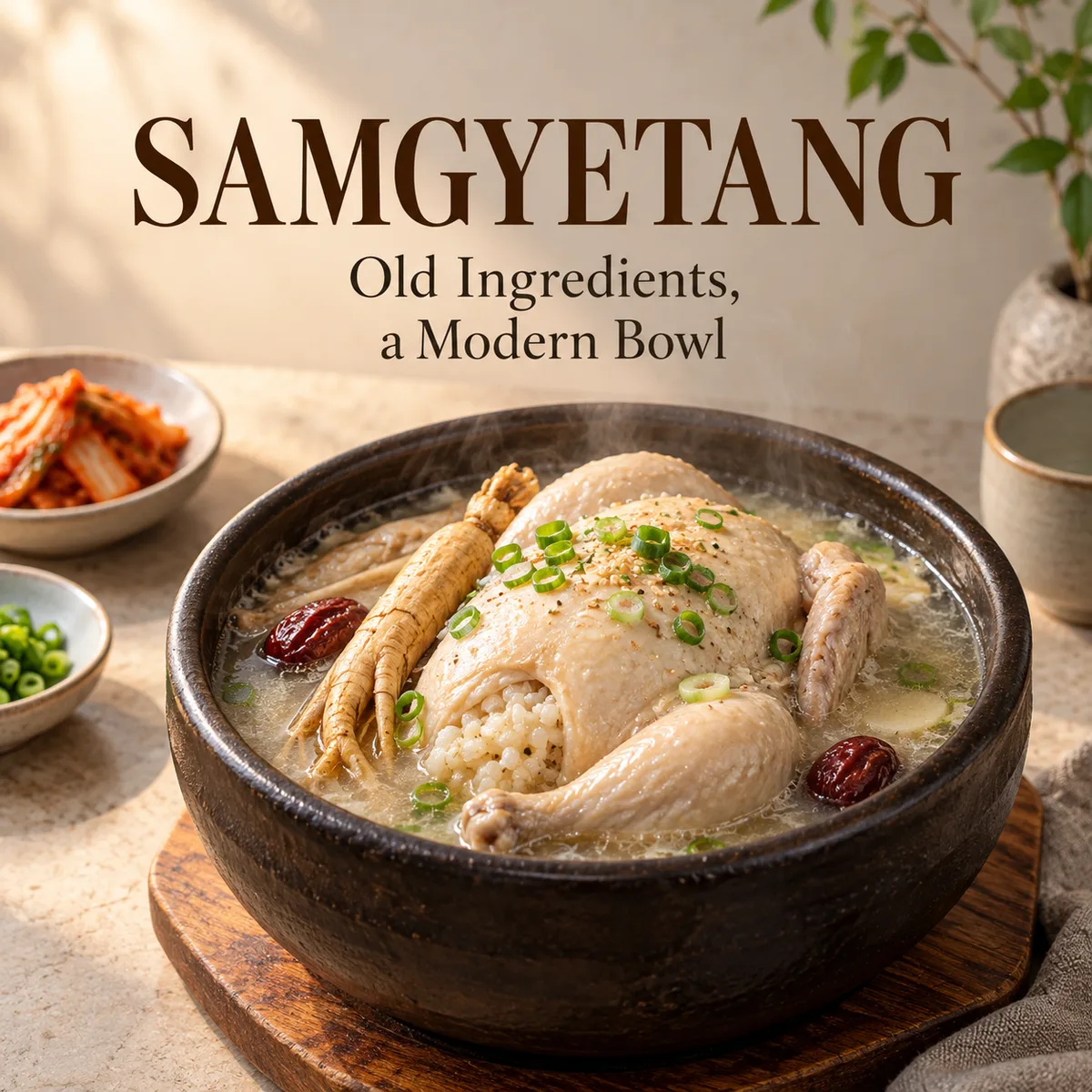
The familiar bowl looks complete: a small whole chicken, rice tucked inside, ginseng in the broth and salt waiting at the table. But those elements did not become a nationally familiar restaurant image all at once.
Samgyetang is a stronger food story when older chicken preparations, changing ingredient supply, the modern name and the much older Boknal custom are kept on separate timelines.
Chicken and ginseng before the modern name
Popular food writing often describes samgyetang as an ancient royal dish. The claim sounds plausible because ginseng was historically valuable and chicken preparations certainly existed before the 20th century. But plausibility is not documentation.
The National Folk Museum article, written by food anthropologist Joo Young-ha, makes the documentary boundary explicit: the word samgyetang is not found in Joseon-period records. That does not prove that nobody ever combined chicken and ginseng. It means that the exact modern dish, name and restaurant format should not be projected backward unchanged.1
This distinction matters throughout food history. Ingredients can be old while the recipe architecture is new. A seasonal custom can be old while the food that now represents it changes. And a dish can become deeply traditional in living culture even if its modern standardized form is only several generations old.
Chicken boiled in water is a much older Korean cooking idea than the modern samgyetang restaurant bowl. The historical obstacle was not the existence of chicken soup. It was the form and circulation of ginseng.
The National Folk Museum explains that fresh ginseng, or susam, does not keep for long after harvest. Before modern cold-chain distribution, ginseng that needed to travel or be stored was commonly processed into dried forms. That changes what a historical cook could realistically put inside a chicken. A modern visual—an intact fresh ginseng root tucked into a small bird—depends not only on culinary preference but on an agricultural and distribution system capable of delivering fresh roots widely.
This is a useful way to read food history: the supply chain is part of the recipe. Refrigeration, transportation, breeding and commercial agriculture can alter a “traditional” dish as decisively as a cook can.
One of the strongest bridges between older chicken soup and modern samgyetang appears in Bang Sin-yeong’s Joseon Yorijebeop. The National Folk Museum cites the 1921 edition, which instructs the cook to prepare a chicken, put glutinous rice and ginseng powder into the cavity, tie it closed and boil it in water.
That is strikingly close to the structural idea of modern samgyetang: a whole bird, a rice filling and ginseng cooked together. Yet the use of powdered dried ginseng also shows why it is misleading to imagine a present-day restaurant bowl already fully formed. The recipe is a historical intermediate stage.

The Museum also notes that ginseng powder was not a cheap everyday ingredient. So even when the cooking idea existed, affordability and ingredient access limited how ordinary the dish could be.

How supply and restaurants helped form the familiar bowl
Another part of the story is agricultural rather than culinary. According to the National Folk Museum, poultry raising was actively promoted in the 1920s, initially with egg production as an important goal. Improved breeds spread, and chicken supply increased.
That matters because a whole young chicken per diner is a resource-intensive format. Samgyetang is not a soup that stretches a small piece of meat through a huge pot for a family. Its modern restaurant logic often gives one small bird to one person. A more abundant, standardized poultry supply makes that format easier to commercialize.
This helps explain why “old medicinal ingredients” alone do not make an old restaurant dish. Modern samgyetang required an intersection of ingredient tradition and industrial capacity.
The National Folk Museum points to a 1937 newspaper market report that noted strong summer demand for gyesam—ginseng used with chicken. It also cites 1942 cookbooks in which chicken baeksuk could be cooked with ginseng, especially as a summer nourishing food.
Those records are valuable because they avoid a false binary. We do not have to choose between “samgyetang existed exactly as today for centuries” and “someone suddenly invented it in the 1960s.” The evidence shows a transition: chicken-and-ginseng cooking was already developing before the name samgyetang became established.
Some people used the term gyesamtang—chicken-ginseng soup—with the chicken named first. The Museum emphasizes that the term was not yet widely standardized. That unstable naming is itself evidence of a dish still taking shape.
The strongest documentary explanation for the modern form comes from the 1960s. Refrigerated distribution made fresh ginseng easier to supply nationally, while government support for poultry production increased chicken availability. The Museum reports that restaurant advertisements in Seoul’s Myeongdong and Jongno areas began using the name samgyetang in the mid-1960s.
The word order changed too. Gyesam puts chicken first; samgye puts ginseng first. It is tempting to turn that into a single clever marketing anecdote with one inventor and one date, but the evidence supports a broader interpretation: ginseng became increasingly central to the dish’s commercial identity as fresh roots became easier to distribute and restaurants promoted the soup as a distinctive summer specialty.

The seasonal place of the individual bowl
Boknal is the older seasonal setting into which this newer restaurant bowl became prominent. The separate Boknal article follows the calendar and changing summer meals; here the important question is what changed in the chicken, rice, ginseng and service format.
What is inside the chicken and around it
A standard restaurant samgyetang usually begins with a small whole chicken. Glutinous rice is placed inside the cavity, commonly with garlic, jujube and ginseng. Some recipes add chestnut, milk-vetch root or other aromatics; premium menus may add abalone, different ginseng products or black silkie chicken.
VISITKOREA’s basic dish description gives the core pattern: a young chicken stuffed with sweet rice, garlic, jujube and ginseng, then simmered in water. That is a useful baseline because it describes the category without turning one restaurant’s recipe into a national rule.
Recipes vary in broth strength, bird size, rice quantity, herb package and seasoning. Some broths are almost clear and lightly seasoned; others are richer and more concentrated. “Authentic samgyetang” is therefore better understood as a structure than as one exact formula.
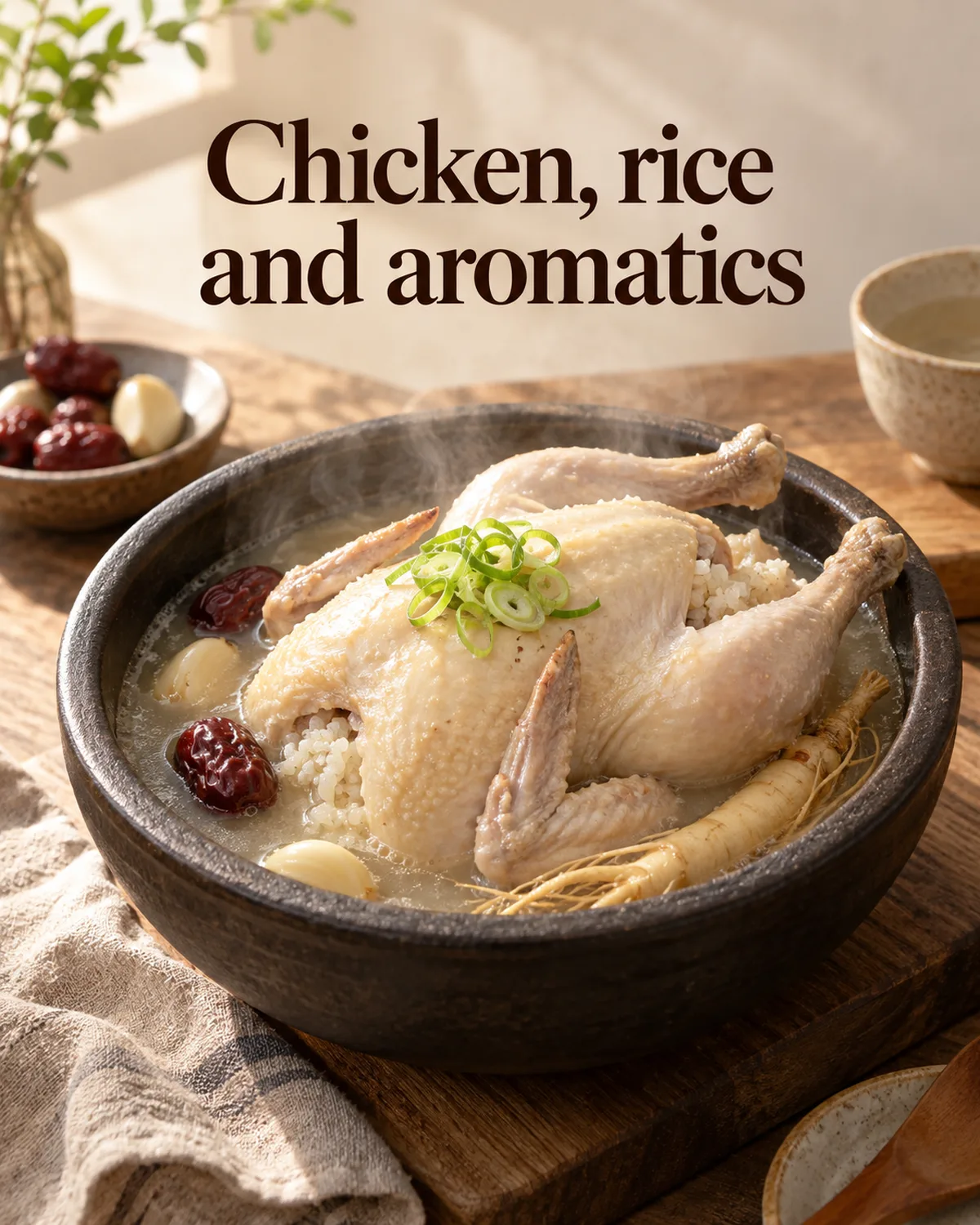
Samgyetang is different from a soup made from detached chicken pieces. A small whole bird contains skin, bone, connective tissue and meat in one compact package. As it simmers, rendered fat, gelatin-forming collagen and dissolved meat compounds move into the water.
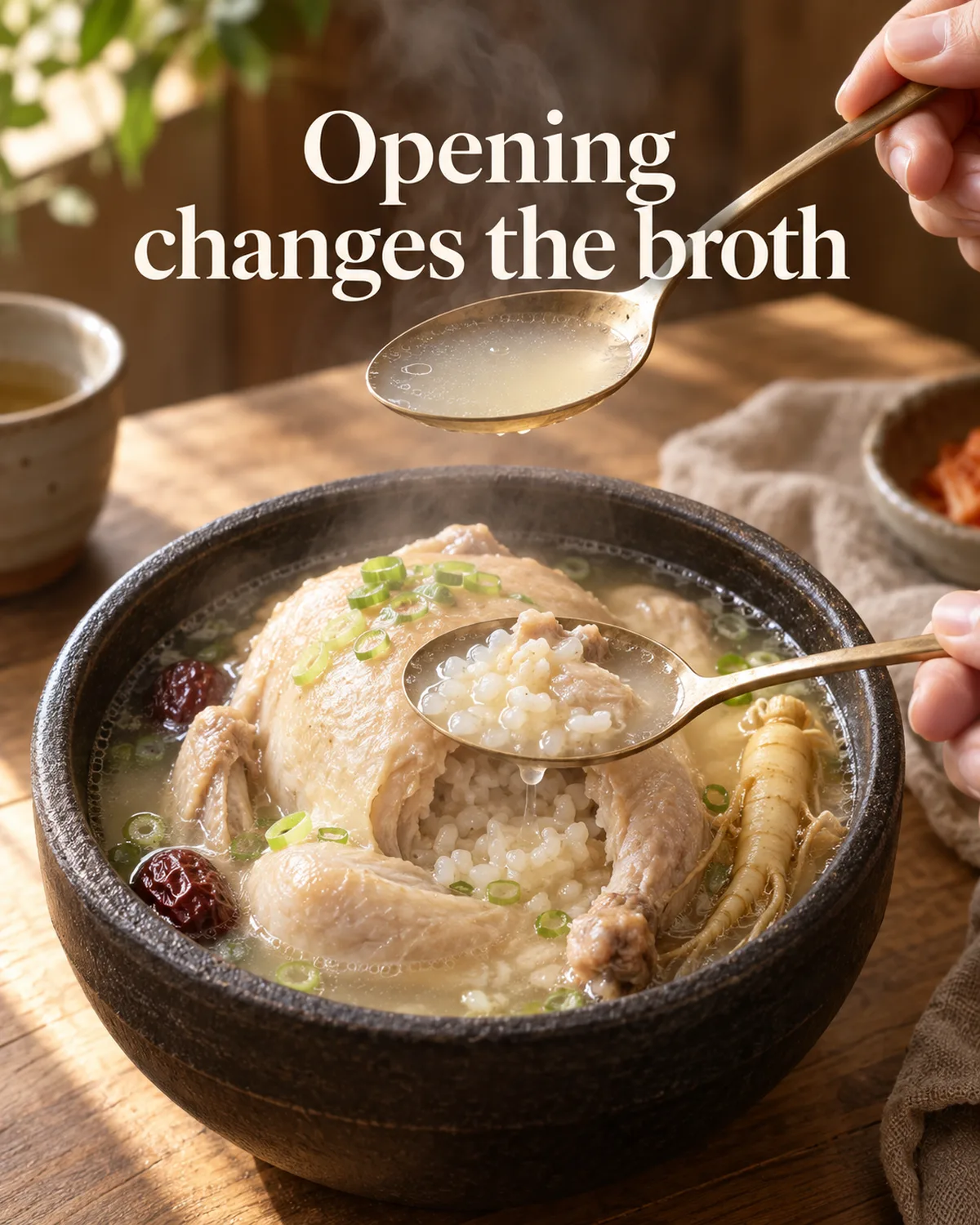
The stuffed cavity creates a second process. Glutinous rice absorbs chicken juices and broth while releasing starch. If the rice stays mostly inside the bird, it remains a dense filling. Once diners break the bird apart and release the rice, the surrounding broth can become cloudier and slightly thicker.
This is one reason the bowl changes while you eat. The first spoonful can be light and clear; the later spoonfuls may contain broken rice, shredded chicken and more fat dispersed through the broth. The meal moves gradually toward a porridge-like texture without requiring a separate pot.
The English name causes unnecessary confusion. Glutinous rice is called that because of its sticky texture, not because it contains wheat gluten. Rice itself does not naturally contain gluten.
That does not make every restaurant bowl automatically suitable for someone with celiac disease or a severe allergy. Broth seasonings, packaged herbal mixtures, side dishes and cross-contact in the kitchen can introduce other ingredients. The useful distinction is between the rice grain itself and the complete restaurant preparation.
Ginseng is the ingredient that gives the dish its name and much of its symbolic power. In the bowl, it adds an earthy, slightly bitter and medicinal aroma that can be subtle or assertive depending on the root and cooking time.
The cultural association with vigor is historically important. The clinical leap is not. A restaurant serving cannot be treated as a standardized dose of ginseng, and diners receive different amounts depending on the recipe, bird size and whether they eat the root itself.
This is why “samgyetang is healthy because it contains ginseng” is too simple. The dish can be described as culturally nourishing, substantial and rich in protein because it contains a whole chicken. It should not be advertised as a proven treatment for fatigue, disease or heat illness.
Salt, meat and rice: taste the bowl in stages
Many samgyetang restaurants serve the broth relatively mild and put salt and pepper on the table. Diners may season the broth directly, mix salt and pepper for dipping chicken, or do both. VISITKOREA’s basic eating guidance also describes adding salt and enjoying the chicken with a little salt.
This does not mean every broth is literally unsalted or that there is one “correct Korean” sequence. House recipes differ. The larger point is that samgyetang often leaves a noticeable part of final seasoning to the diner.
That makes sense structurally. A whole chicken and rice are mild, while ginseng adds bitterness rather than salt. Allowing each person to adjust the bowl preserves the clear chicken flavor while accommodating different preferences.

Let the bowl settle briefly, taste the broth, season if needed, then separate the chicken with chopsticks and a spoon. Eat meat and rice in whatever order makes sense. Breaking the stuffed rice into the broth will thicken it; keeping it inside preserves a denser filling. Neither choice is a violation.

If a ginseng root, jujube or garlic clove is present, eating it is optional. Some people enjoy the bitter root; others leave it. A small glass of ginseng liquor may be offered at certain restaurants, but it is not universal and it is not required for the dish to be “traditional.”
Samgyetang and baeksuk overlap, but portions differ
Baeksuk is a broad term for plainly boiled meat, and chicken baeksuk is a close relative of samgyetang. The boundaries are not perfectly rigid across restaurants, but the service format is useful.
Samgyetang is commonly built around a small whole chicken for one diner, with rice and ginseng integrated into the bowl. Chicken baeksuk is often made with a larger bird and served for sharing, sometimes with porridge or rice cooked separately after the meat. Local recipes can blur that distinction.
The comparison reinforces the historical point. Samgyetang did not appear from nowhere. It crystallized from older chicken-boiling practices into a more specific individual-bowl format tied to ginseng and Boknal.

Choosing a bowl during the summer rush
Korea.net documented lines outside a well-known Seoul samgyetang restaurant before Chobok in July 2026, showing that the seasonal ritual remains highly visible. That does not mean a traveler must eat the dish on one of the three Boknal dates to have an authentic experience.
On peak days, famous restaurants may be much busier precisely because people are performing the seasonal custom together. On an ordinary day, the bowl is the same category of food with less waiting. Choose based on what you want: the communal cultural moment or the easier meal.
Because opening hours, queue systems and menu prices change, an evergreen food-history guide should not freeze one restaurant timetable into the body. Check the current restaurant listing shortly before visiting.
Instead of chasing a universal winner, compare four variables.
- Broth style: clear and light, or concentrated and creamy from longer extraction and broken rice.
- Ginseng intensity: subtle aroma or a more bitter herbal profile.
- Chicken texture: just tender enough to separate cleanly, or cooked until extremely soft.
- Rice structure: compact stuffing inside the bird or rice that readily disperses into the broth.
Those variables tell you more about the meal than celebrity signatures, queue length or a stale online star score. They also let you compare restaurants without pretending that one style is the national standard.

Check the ingredients, not a promise of stamina
Standard samgyetang is not vegetarian. The broth is based on chicken, and even bowls that appear pale can contain concentrated poultry flavor. Herbal packs may contain multiple roots or botanicals beyond visible ginseng, and premium versions can add seafood such as abalone.
People avoiding alcohol should also ask rather than assume if a restaurant serves ginseng liquor alongside the meal. The drink may be separate, but service customs vary.
For allergies, ask about the complete broth, stuffing and add-ons. A visually simple soup can still contain ingredients that are not obvious once they have simmered for a long time.
Korean sources often describe samgyetang as boyang-sik, broadly a nourishing or restorative food. That language belongs to the cultural meaning of the dish. It does not tell you the calorie, sodium or nutrient content of a specific restaurant bowl.
A whole chicken provides substantial protein and fat; rice adds carbohydrate; broth seasoning changes sodium; skin, bird size and added ingredients can change the overall meal considerably. There is no single nutrition number for “one samgyetang.”
Open the bird and watch the meal change: the rice that began as stuffing can become part of the broth. That small act makes the modern bowl easier to understand than an unsupported royal origin or a promise of stamina. Old ingredients gained a distinctive restaurant form, and the diner finishes bringing its components together.