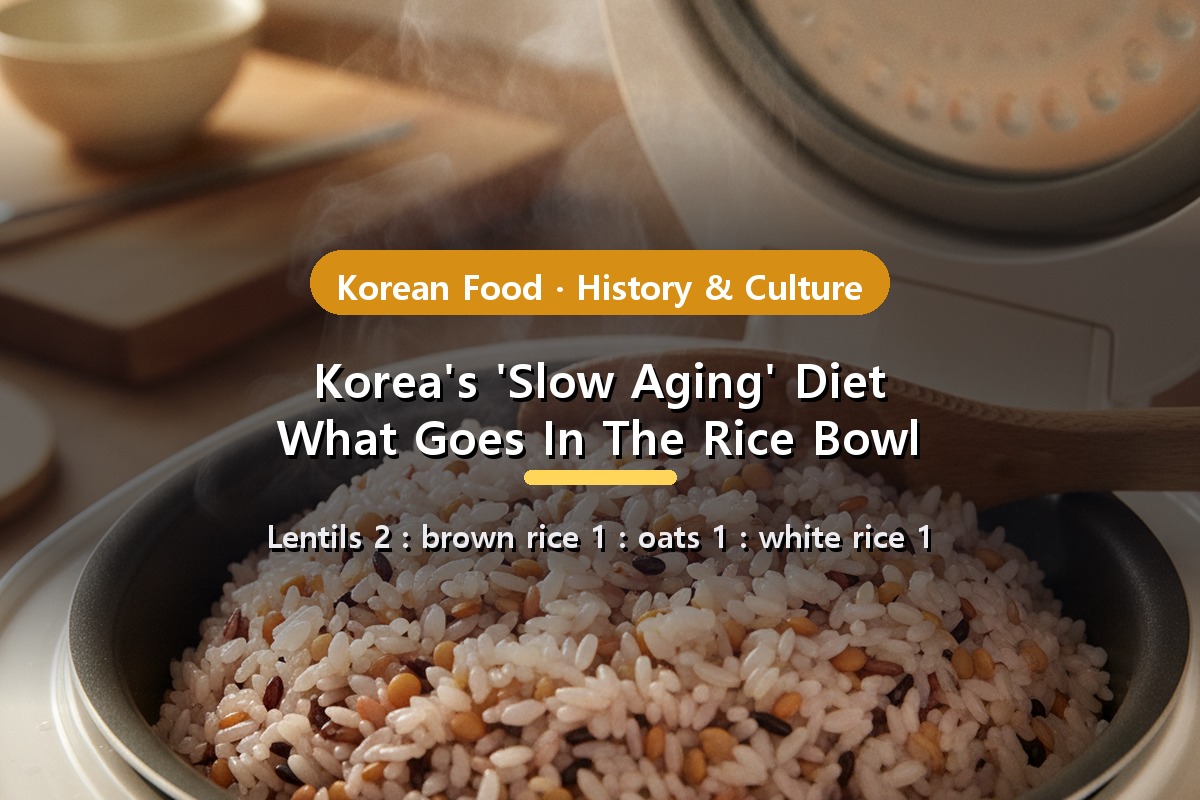
The ‘slow aging’ bowl — lentils, oats and brown rice in place of plain white rice
If you eat at a Korean friend’s home this year, look at the rice. There is a decent chance it isn’t plain white rice anymore. It might be flecked with brown, studded with something orange, a little chewier than you expected. Ask about it and you’ll probably hear the same phrase: 저속노화, jeoksok-nohwa. It means “slow aging”, and the slow aging diet is what half the country seems to be cooking right now.
The slow aging diet is the Korean food story of the moment, and it’s a strange one. It isn’t a celebrity diet. It didn’t come from a beauty brand. It came from a doctor who spent his career with elderly patients, and it spread through home cooking — one rice cooker at a time.
The short version
The slow aging diet means swapping plain white rice for a mixed bowl built around lentils. The usual ratio is lentils 2 : brown rice 1 : oats 1 : white rice 1. The idea was popularised by Jung Hee-won, then a geriatrics doctor at Asan Medical Center in Seoul, who framed it as a Korean version of the MIND diet — a way of eating built around whole grains, beans and vegetables rather than refined grains and red meat. It is an everyday-cooking trend, not a weight-loss programme.
Where the Slow Aging Diet Came From
Korean health trends usually arrive through television or celebrities. This one arrived through a book. Jung Hee-won, at the time a geriatrics doctor at Asan Medical Center in Seoul, published a book on what he calls the slow-aging way of eating, and the core idea was simple enough to repeat at a dinner table: eat the way people ate when rice was expensive.
That framing landed. He described going back to what Koreans sometimes call the poor household’s table — barley and beans stretched the rice, vegetables filled the bowls, meat showed up rarely. For a generation that grew up being told white rice and grilled beef were the reward for working hard, hearing that the older, humbler table was the better one hit differently.
What he presented is a Korean adaptation of the MIND diet — short for Mediterranean-DASH Intervention for Neurodegenerative Delay. It borrows from two established patterns: the Mediterranean diet and DASH, which was designed around blood pressure. The Korean version keeps the structure but puts it in a rice bowl instead of on a plate of bread and olive oil, which is why it travelled so easily here.
The Slow Aging Diet Grain Ratio Koreans Actually Cook

Lentils 2 : brown rice 1 : oats 1 : white rice 1 — the ratio Koreans actually cook
Here is where it gets practical. Korean recipe sites and home cooks converged on one ratio, and you’ll see it repeated almost word for word:
| Grain | Share | Why it’s in there |
|---|---|---|
| Lentils (렌틸콩) | 2 | The largest share — plant protein and fibre |
| Brown rice (현미) | 1 | Whole grain in place of refined |
| Oats (귀리) | 1 | Texture and fibre |
| White rice (백미) | 1 | Kept in — this is still a Korean rice bowl |
You’ll also see the same thing written as 4:2:2:2. Don’t let that confuse you — it’s the identical proportion, just not reduced. Lentils always carry the largest share.
The detail I find most telling is that white rice stays. Nobody is being asked to give up rice, which in Korea would be a hard sell no matter how good the argument. It just stops being the whole bowl. That single compromise is probably why the trend spread instead of fizzling out like most health fads here.
Cooking it is ordinary rice-cooker work. Lentils and oats soften faster than brown rice, so most people soak the brown rice ahead of time and add a bit more water than they would for white rice alone. Korean recipe communities are full of people trading notes on exactly this — how much water, how long to soak, whether the lentils turn to mush.
It Changes the Whole Table, Not Just the Rice

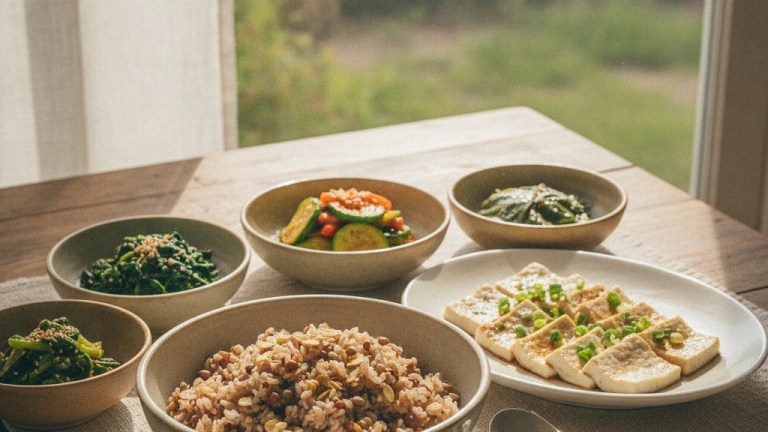
The rest of the table shifts too — more beans, tofu and greens, less red meat
The rice gets the attention, but the rest of the meal moves with it. The pattern leans on beans, tofu and vegetables for protein and calories, and pulls back on red meat, processed food and sugar. If you’ve eaten a traditional Korean home meal, you’ll notice this isn’t a foreign structure at all — it’s close to how the table already worked before grilled meat became an everyday thing.
That’s the quiet joke in all of this. In my experience most of what the slow aging diet recommends is just old Korean home cooking with a new name. Gondeure namul bap — rice steamed with mountain herbs — has been eaten for generations and fits the pattern almost perfectly. So does a bowl of kongnamul gukbap, and so does a properly loaded bibimbap, where the vegetables outnumber everything else.
Food companies noticed too. Walk through a Korean supermarket now and you’ll find zero-sugar gochujang and lower-sodium kimchi sitting next to the standard versions. Whether those taste as good is its own argument — Koreans have strong opinions — but the shelf space tells you where demand went.
Trying the Slow Aging Diet Outside Korea
The good news is that the slow aging diet needs no Korean ingredients for the rice itself. Lentils, oats, brown rice and white rice are in any supermarket, and the ratio travels. Start with a smaller share of lentils if the texture is new to you — plenty of Koreans did the same and worked up.
Where it becomes genuinely Korean is everything around the bowl. Seasoned vegetable side dishes, tofu, a soup that isn’t heavy on meat. If you’re already cooking Korean food at home, you’re most of the way there, and you probably didn’t think of it as a health project.
One honest note to close on. The slow aging diet is a food trend, and I’ve described it as one — what Koreans are cooking, where it came from, and the ratio they use. It isn’t medical advice, and nothing here should replace a conversation with your own doctor, especially if you have a condition that affects what you eat.
FAQ
What is Korea’s slow aging diet?
Jeoksok-nohwa (저속노화) literally means “slow aging”. In practice it describes eating built around whole grains, beans and vegetables instead of refined grains and red meat. The version Koreans talk about was popularised by Jung Hee-won, then a geriatrics doctor at Asan Medical Center in Seoul, who presented it as a Korean take on the MIND diet.
What is the slow aging diet grain ratio?
Lentils 2 : brown rice 1 : oats 1 : white rice 1. You’ll also see it written as 4:2:2:2 — same proportion, just not reduced. Lentils take the largest share, and white rice stays in the bowl rather than disappearing.
Is this the same as a K-pop idol diet?
No. Idol diets are usually about dropping weight fast before a comeback. This is close to the opposite in spirit — it’s about what ordinary households put in the rice bowl every day, and it came out of a hospital rather than an entertainment agency.
Can I cook it in a normal rice cooker?
Yes — that’s how most Korean households do it. Lentils and oats cook faster than brown rice, so many people soak the brown rice first and add a little more water than they would for plain white rice. Korean recipe sites are full of people comparing notes on exactly this.
Related reading