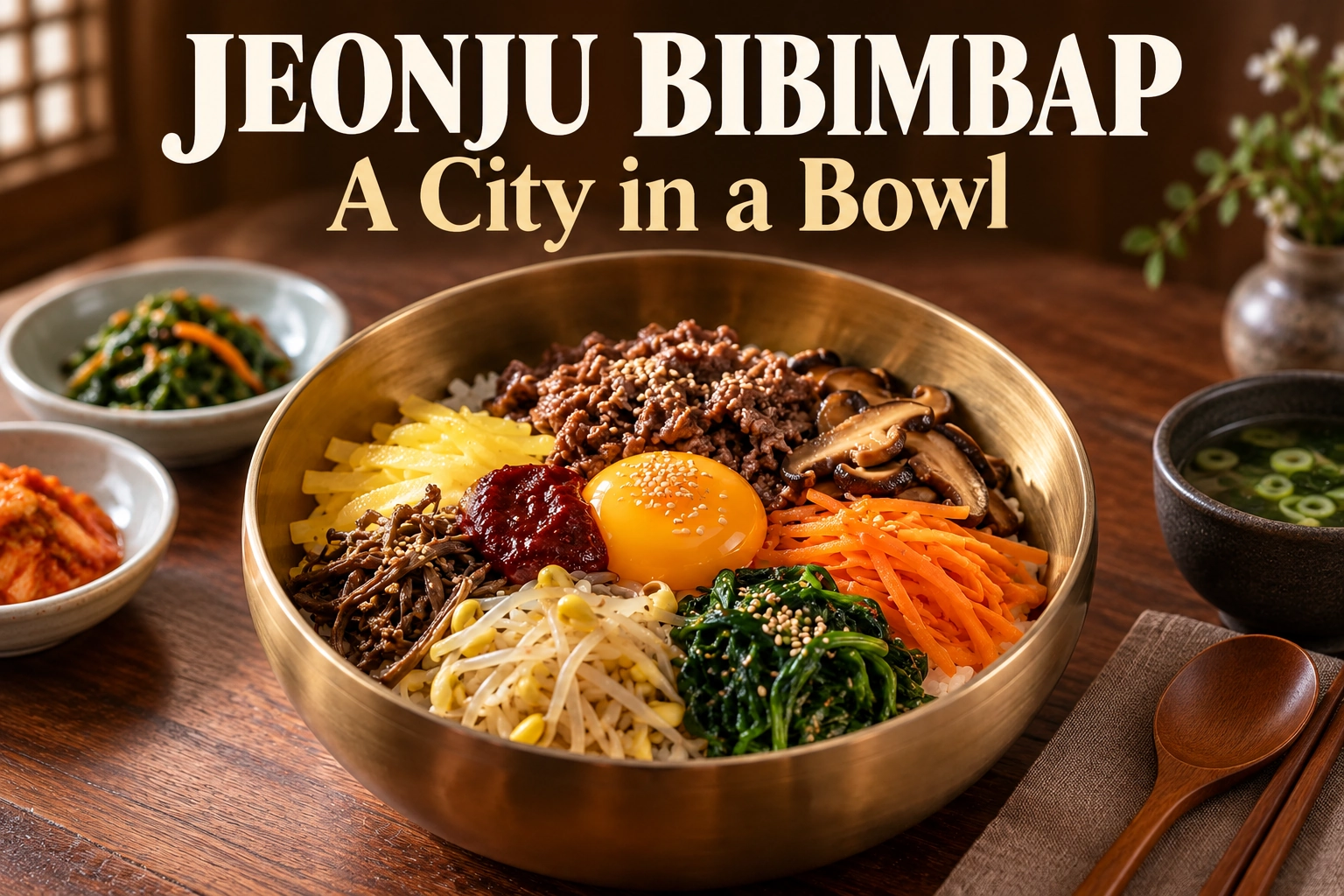
Bibimbap (비빔밥) is often introduced as the perfect summary of Korean food: rice, seasoned vegetables, meat, egg, gochujang and sesame oil mixed into one bowl. That description is useful, but it can hide the most interesting part of the story. Bibimbap is not one fixed recipe, and Jeonju’s fame does not prove that the entire category was invented there. The stronger historical picture is more nuanced: mixed-rice practices have a long written record, several origin explanations coexist, and Jeonju became the city that most successfully turned one regional style into a national culinary reference point.
That distinction changes how the bowl should be read. Instead of asking, “Who invented bibimbap?” it is more useful to ask three separate questions: when does mixed rice become visible in the documentary record, why are there several competing origin stories, and what exactly did Jeonju add to the dish’s identity? Once those questions are separated, Jeonju bibimbap becomes more than a colorful tourist meal. It becomes a case study in how a flexible household method can be formalized into a regional specialty.
Bibimbap is a method before it is a recipe
The name gives away the basic logic. Bibim refers to mixing; bap is cooked rice. The category therefore begins with an action rather than a mandatory ingredient list. A home bowl might combine rice with leftover namul, kimchi, egg and a little sauce. A restaurant version can be far more elaborate, with individually seasoned vegetables, beef, egg, mushrooms, jelly, nuts and carefully prepared condiments arranged for visual impact before the mixing begins.
This is why rigid definitions often fail. Beef is common but not universal. Egg is common but not universal. Gochujang is strongly associated with modern bibimbap, yet the history of mixed rice is older than today’s standardized red-sauce image. Stone bowls, brass bowls and ordinary ceramic bowls all appear. The shared principle is that separate components are brought together over rice and deliberately combined before eating.
That also explains a small cultural misunderstanding. The unmixed bowl is often the most photogenic moment, especially in Jeonju, where the toppings may be carefully arranged by color. But the visual arrangement is not the endpoint. The dish only becomes bibimbap in the fullest practical sense when the components are mixed so that sauce, sesame oil, vegetables and rice stop behaving as separate bites and become one composite flavor.

The written record is old enough to matter, but not simple enough to name one inventor
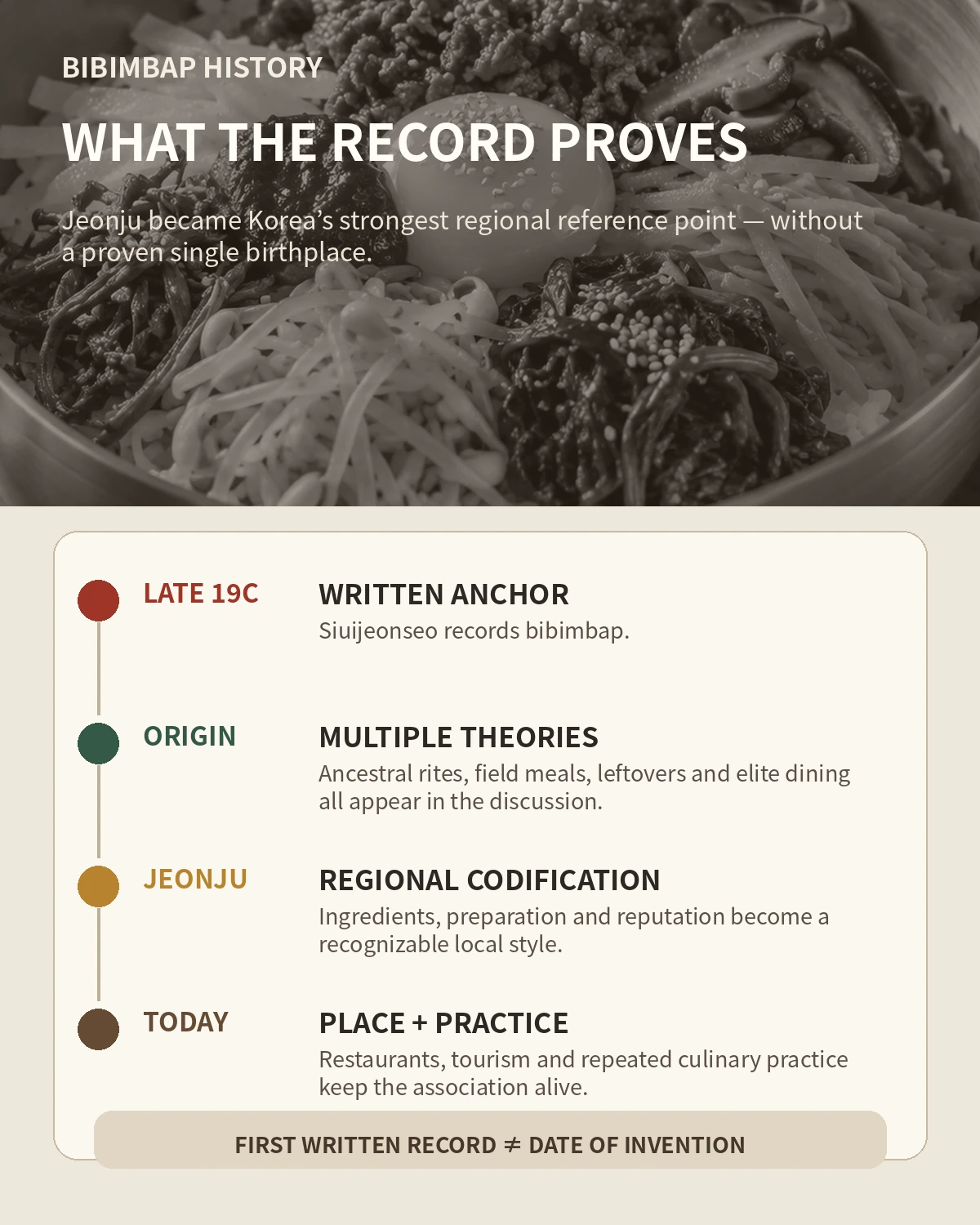
The Academy of Korean Studies notes that bibimbap appears in the late nineteenth-century cookbook Siuijeonseo. Older terminology also survives in discussions of mixed-rice traditions, including goldongban (골동반), while court usage included the shorter term bibim. This documentary evidence matters because it gives the dish historical depth without requiring a dramatic invention scene.
A late nineteenth-century written appearance does not mean people began mixing rice only at that moment. Cookbooks usually record practices after they are already familiar enough to describe. At the same time, an older mixed-rice term does not prove that every earlier bowl was identical to modern Jeonju bibimbap. The safest conclusion is that mixed-rice practices were established by the time they entered the surviving written record, while the modern regional form developed through later culinary refinement.
This is a useful place to resist a common food-history shortcut: the first written record is not automatically the date of invention. It is simply the earliest documentary anchor available in the sources used here.
Why bibimbap has several origin stories
Korean scholarship preserves multiple explanations for how bibimbap may have developed. Theories connect the dish to food from ancestral rites, to royal or upper-class dining, to farmers who needed a practical meal during busy agricultural work, to the efficient use of leftovers, and to particular regional or political events. The updated Academy of Korean Studies entry on traditional Jeonju food explicitly notes that the history and origin are difficult to determine because several theories coexist.
The theories are not mutually absurd. They describe situations in which mixing rice and prepared side dishes would make practical sense. After an ancestral rite, multiple foods might be combined for eating. During field work, a one-bowl meal could simplify serving. At home, leftovers could be reused efficiently. Elite kitchens could also produce more composed versions. A flexible method can emerge in more than one social setting without a single inventor.
That is why the most responsible history does not select one attractive theory and call it settled fact. Bibimbap’s uncertain origin is not a weakness in the story. It reflects the nature of a food built from a broadly useful technique—put rice and prepared ingredients together, season them, and mix.
Jeonju can be the most famous city for bibimbap without being the proven birthplace
Jeonju’s importance is much easier to establish than a birthplace claim. Korean reference works identify Jeonju bibimbap as a representative regional food, and Jeonju’s own tourism material treats it as a defining part of the city’s culinary identity. The city is associated with an especially elaborate form in which ingredients are prepared separately and assembled with attention to texture, color and seasoning.
This distinction matters because “home of” language in tourism is often read literally. A city can become the cultural capital of a dish by refining it, standardizing expectations, supporting specialist restaurants, preserving craft knowledge and repeatedly presenting the food as part of local identity. None of those achievements requires proof that nobody elsewhere mixed rice before Jeonju did.
Jeonju’s contribution is therefore best understood as regional codification and reputation. The city made a flexible national food legible as a distinctive local style. That is a more defensible—and more useful—claim than saying bibimbap was simply “invented in Jeonju.”
What makes Jeonju bibimbap distinctive
Jeonju bibimbap is associated with a more composed ingredient system than an improvised home bowl. The Academy of Korean Studies lists components such as soybean sprouts, hwangpomuk, gochujang, beef or yukhoe, sesame oil and egg among the ingredients that strongly shape the regional style. Jeonju tourism material likewise emphasizes rice cooked with beef-bone broth, crunchy Jeonju soybean sprouts, yellow muk, fermented gochujang and soy sauce, and a large variety of toppings.
The number of ingredients is less important than the treatment of them. Vegetables are not simply dumped into the bowl raw. Many are blanched, seasoned, sautéed or otherwise prepared separately. Beef may be cooked or served as yukhoe, depending on the version. Sauces contribute sweetness, salt, fermentation and chile heat. Sesame oil supplies aroma and helps carry flavor across the rice. The final bowl is a system of individually prepared parts designed to become coherent only after mixing.
That preparation model explains why Jeonju bibimbap can feel very different from “refrigerator bibimbap,” even though both belong to the same family. One celebrates improvisation; the other makes the ingredients themselves part of the destination experience.

The bean sprouts are not a decorative topping
Soybean sprouts, kongnamul (콩나물), are central to Jeonju’s food identity. They matter in bibimbap, but they also appear in another major Jeonju specialty, kongnamul-gukbap, bean-sprout soup with rice. Seeing the same ingredient across multiple dishes is more revealing than treating it as one more color on top of the bowl.
In bibimbap, bean sprouts contribute moisture, crunch and a clean vegetal flavor that survives mixing better than very soft greens. Their structural role becomes clearer once the bowl is stirred: they keep the rice from becoming texturally uniform. A good mixed bowl is not supposed to become paste. It should still contain contrast—soft rice, resilient sprouts, tender greens, chewy mushroom or jelly, and richer beef or egg.
This is one reason Jeonju’s version is best understood as part of a regional ingredient culture, not merely a restaurant plating style. The same city that became famous for bibimbap also built other iconic dishes around bean sprouts.
Hwangpomuk adds a specifically Jeonju clue
Hwangpomuk (황포묵) is yellow-tinted mung-bean jelly associated with Jeonju cuisine. The Academy of Korean Studies describes it as a form of cheongpomuk, mung-bean starch jelly, colored yellow with gardenia. Its mild flavor is less dramatic than gochujang or sesame oil, but its texture adds another layer to the bowl.
Reference material also connects Jeonju’s hwangpomuk tradition with local water conditions around Omokdae. That local explanation is useful as regional context, but it should not be inflated into a claim that no comparable mung-bean jelly could be made elsewhere. What matters for the diner is that hwangpomuk is one of the ingredients that makes a traditional Jeonju presentation recognizable and ties the bowl to a wider local food tradition.

Rice itself can be part of the regional style
In simple bibimbap, plain steamed rice works perfectly well. Jeonju’s more formal style may treat the rice as another prepared component rather than a neutral base. Both the Academy of Korean Studies and current Jeonju tourism material describe rice cooked with beef broth or beef-bone broth in traditional preparations.
This changes the flavor before any topping is added. The rice carries savory depth, so the bowl does not have to depend entirely on gochujang for intensity. That is important when tasting Jeonju bibimbap: if the sauce is added too aggressively at the beginning, the subtler work already built into the rice, vegetables and sesame oil can disappear under chile paste.
How to mix bibimbap so the ingredients still matter
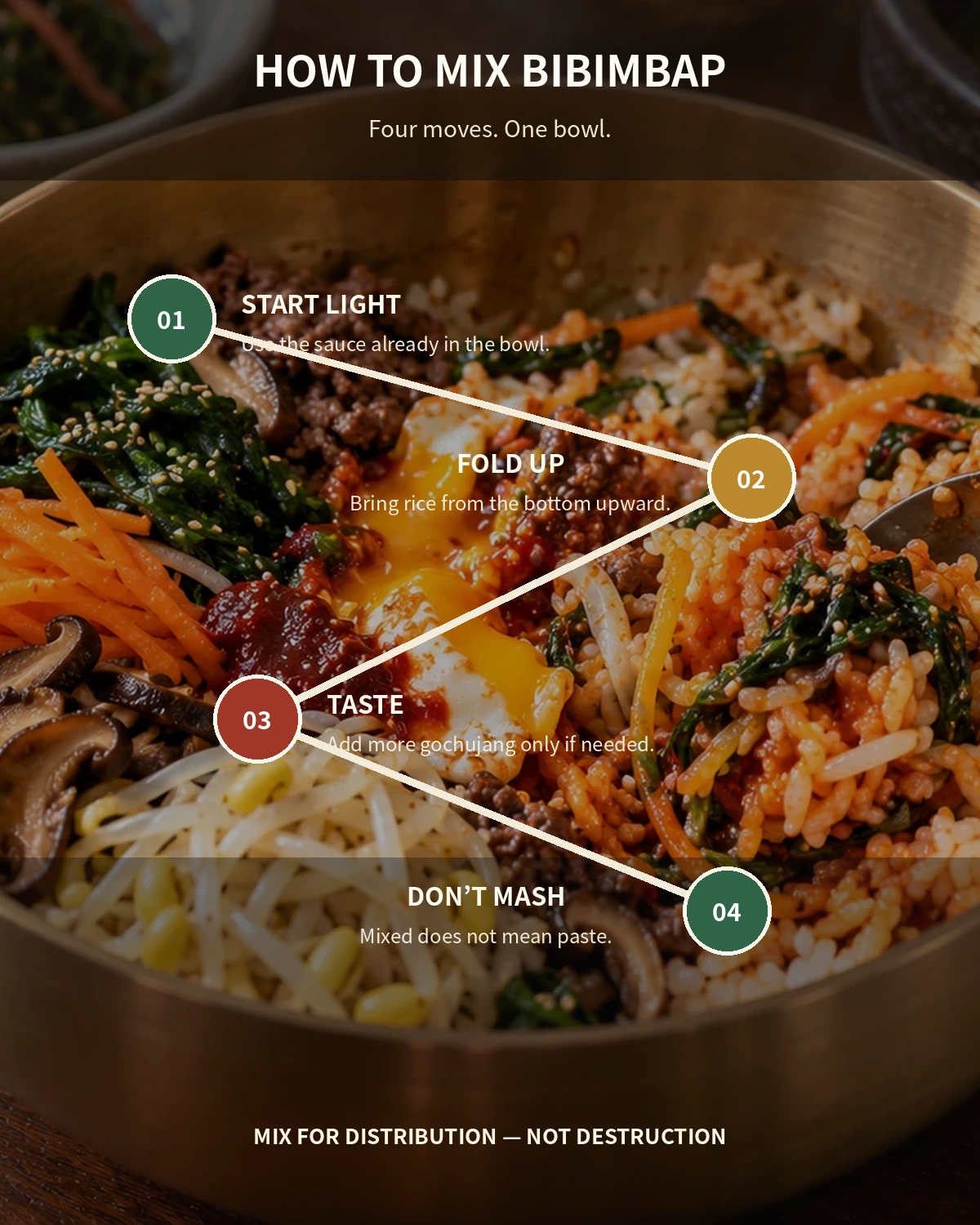
The most useful practical rule is simple: add sauce gradually. Gochujang is concentrated, salty, sweet and fermented. Too much at once can make every version of bibimbap taste like the same sauce. Start with what is already in the bowl, mix thoroughly, taste, then add more if needed.
Use the spoon to bring rice from the bottom upward and fold the toppings through it. The goal is broad distribution rather than violent mashing. Sesame oil should spread its aroma, the vegetables should season the rice, and the sauce should coat rather than pool. If a raw egg yolk or soft egg is present, it can add richness and help bind the mixture. If yukhoe is present, mixing also disperses the raw beef rather than leaving it as one concentrated bite.
The transformation is intentional. The bowl may begin as a color wheel and end looking much less orderly. That is not a failure of presentation. The visual order demonstrates the ingredients; the mixed state is the eating state.
Jeonju bibimbap and everyday bibimbap are two ends of the same idea
An everyday home version can be one of Korea’s most efficient leftover meals. Rice, two or three banchan, kimchi, egg and sauce may be enough. That flexibility is part of the dish’s enduring appeal. It adapts to what is available.
Jeonju bibimbap shows the opposite possibility: a flexible method can also become highly formalized. Instead of using whatever happens to be in the refrigerator, the cook selects ingredients for color, texture and regional identity, prepares them individually, and assembles the bowl so that the diner can see the work before mixing it away.
Both are authentic expressions of bibimbap. Treating the elaborate restaurant bowl as the only “real” version misunderstands the category, while treating the Jeonju version as merely fancy leftovers misses the craft that made the city famous for it.
Dolsot bibimbap is a vessel and cooking style, not a synonym for Jeonju bibimbap
Dolsot bibimbap is served in a heated stone bowl. The hot vessel continues cooking the rice at the table and can create a crisp layer on the bottom. That texture is the defining attraction of the style.
Jeonju bibimbap, by contrast, is a regional identity built around ingredients and preparation. A Jeonju restaurant may serve a stone-bowl version, but “dolsot” and “Jeonju” answer different questions. One tells you about the vessel and heat; the other tells you about regional culinary tradition. A brass-bowl Jeonju bibimbap can be just as representative of the city as a sizzling stone-bowl version.

Is Jeonju bibimbap vegetarian?
Not automatically. The colorful vegetables can make the dish look plant-based, but traditional or restaurant versions may include beef, yukhoe, egg, beef-broth rice, anchovy- or fish-based seasoning in side dishes, or other animal ingredients. Removing visible beef does not necessarily make the entire bowl vegan.
If you avoid animal products, ask specifically about the rice cooking liquid, meat, egg, gochujang or seasoning additions, and accompanying banchan. A vegetable-heavy appearance is not a reliable substitute for ingredient confirmation.
What if the bowl includes yukhoe?
Yukhoe is seasoned raw beef. It is a recognized component in some traditional Jeonju bibimbap preparations, but not every bowl includes it. Travelers who avoid raw meat should request a cooked-beef or meat-free version where available. People with health conditions that make raw animal foods higher-risk should follow appropriate food-safety guidance rather than treating yukhoe as a required authenticity test.
The important cultural point is that the regional style can accommodate both raw and cooked beef. The presence of one version does not invalidate the other.
Why Jeonju’s fame is more interesting than a birthplace claim
Food reputation is built through more than invention. It can come from ingredient networks, specialist cooks, markets, local institutions, tourism, heritage recognition and generations of diners who reinforce the association between a place and a dish. Jeonju’s bibimbap story fits that pattern.
The city’s fame is strengthened by a recognizable ingredient vocabulary—soybean sprouts, hwangpomuk, gochujang, sesame oil, beef and egg—plus a preparation style that makes each topping visible before it is mixed. Regional food scholarship and tourism materials then document and circulate that identity. Restaurants turn it into a repeatable visitor experience. Over time, “Jeonju” becomes almost a flavor descriptor.
This is a more useful model for understanding regional Korean food than searching for a single inventor. A dish can be nationally shared yet locally perfected, promoted and preserved in a way that gives one city special authority.
How to use Jeonju’s restaurant listings without freezing stale travel information
Jeonju’s official tourism site maintains a current bibimbap page with multiple restaurants and regional-food explanations. Use it to check live restaurant options instead of relying on months-old prices and opening hours. Restaurants change schedules, menus, prices and even operating status.
Use the official city page to build a shortlist close to your visit, then verify the restaurant’s current information before traveling. The history remains stable; the logistics do not. That distinction keeps the guidance useful without pretending that one checked price or opening time will remain valid indefinitely.
Quick answers
When was bibimbap first recorded?
The Academy of Korean Studies notes that bibimbap appears in the late nineteenth-century cookbook Siuijeonseo. That is a documentary anchor, not proof that the practice was invented in that exact year.
Did Jeonju invent bibimbap?
There is no settled evidence that the entire category was invented in Jeonju. Jeonju became the city most famously associated with an elaborate regional form, and Korean sources preserve several competing origin theories for bibimbap more broadly.
What is hwangpomuk?
Hwangpomuk is a yellow-tinted mung-bean jelly associated with Jeonju cuisine. The yellow color traditionally comes from gardenia.
Why are soybean sprouts important?
They are part of Jeonju’s broader food identity and appear prominently in both bibimbap and the city’s bean-sprout soup with rice. In the mixed bowl, they also provide moisture and crunch.
Should bibimbap be eaten unmixed?
No. The arrangement is meant to show the ingredients, but the defining action is mixing. Add sauce gradually and combine the components until the rice is evenly seasoned.
Is dolsot bibimbap the same as Jeonju bibimbap?
No. Dolsot describes a hot stone-bowl serving method. Jeonju bibimbap is a regional style. A Jeonju version can be served in different vessels.
Why this bowl tells a larger Korean food story
Bibimbap is often praised because many colors and ingredients fit into one bowl. Its history is more revealing for a different reason: it shows how Korean food can be both flexible and regional at the same time. The method is broad enough for a fast home meal, yet Jeonju turned the same principle into a carefully constructed specialty.
The documentary record gives the dish age without giving it one inventor. The competing origin theories explain why a simple “born here” story is too neat. Jeonju’s ingredient system explains how a city can make a shared national food feel unmistakably local. And the act of mixing explains why appearance and eating experience are intentionally different.
That combination—documented history, unresolved origin, regional refinement and a mixing technique that changes the dish at the table—is what makes Jeonju bibimbap more interesting than a list of toppings.
Related stories
- Gondeure Namul Bap: Jeongseon’s Mountain-Green Rice
- Myeongdong Kalguksu: Seoul’s Knife-Cut Noodle Tradition