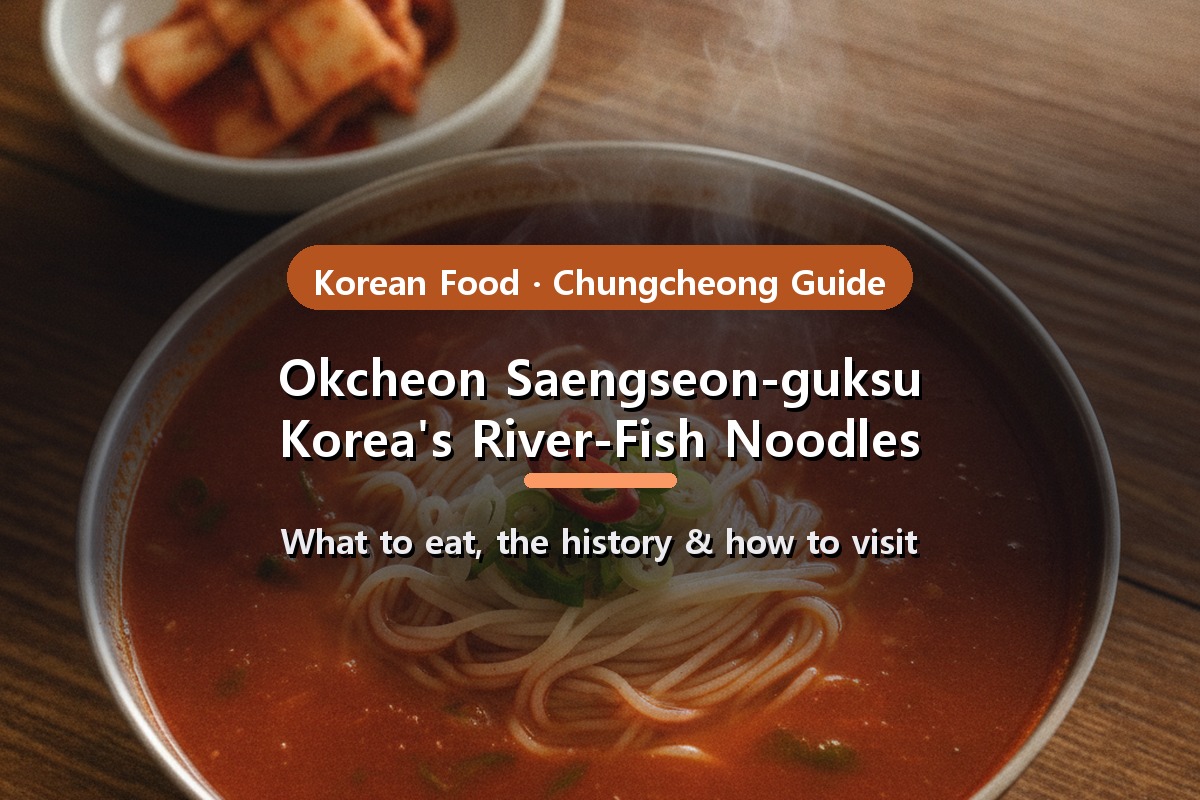
Korea’s most surprising noodle bowl might be saengseon-guksu (생선국수) — a spicy soup of river fish, cooked down to nothing and poured over soft noodles. You’ll find it two hours south of Seoul, in a small river town called Cheongsan (청산) in Okcheon County (옥천). There’s no famous palace here, no shopping district — just a quiet lane where a handful of family kitchens have spent sixty years perfecting this one strange, wonderful bowl. If you’ve only ever had Korean noodle soup made from beef or anchovy, saengseon-guksu will surprise you.

⭐ Okcheon at a glance
| 🏛️ Sights & things to do | ★★★☆☆ |
| 🍜 Food | ★★★★☆ |
| 🚆 Easy to reach | ★★★☆☆ |
A personal take based on our own experience — the range of things to see, the food, and how easy it is to get to. Okcheon is a slow, rural detour, not a headline stop; that’s rather the charm. Yours may well differ.
The short version: Saengseon-guksu is a spicy noodle soup made from freshwater river fish — crucian carp, catfish and the like — simmered for hours until the bones dissolve into a thick, savory broth, then served over thin wheat noodles. Its home is Cheongsan, a river village in Okcheon, where the original shop, Seon-gwang-jip (선광집), has been serving it since 1962. Pair it with dori-baengbaeng-i (도리뱅뱅이), a plate of crisp little fried fish. Here’s what to eat, where saengseon-guksu came from, and how to get there.
What to eat in Okcheon
Two dishes carry this town, and they’re almost always ordered together. One is a bowl, one is a plate, and both start with fish pulled from the same rivers.
Saengseon-guksu (생선국수) — the river-fish noodle soup

The name is plain. Saengseon means fish, guksu means noodles. But the making is anything but simple. Cooks take a mix of freshwater fish (crucian carp, catfish, skin carp, pale chub) and simmer them for hours until the flesh and even the bones melt down completely. The broth is then strained, so you never actually see a fish in your bowl. What’s left is a thick, ruddy, gochujang-spiced soup with a deep savory backbone and, yes, a faint muddy-river sweetness that locals swear by.
Into that goes somyeon (소면), the thin wheat noodles. There’s a reason for that. Cooks here say they tried rice, they tried sujebi dough flakes, they tried thick knife-cut noodles, and the delicate somyeon was the one that soaked up the spicy broth best without fighting it. In my experience the first spoonful reads as “spicy fish stew,” and then the noodles turn it into something you can’t stop eating.
It’s cheap, it’s filling, and it’s the kind of regional dish most Korean city-dwellers have heard of but never actually traveled out to try. That’s exactly why it’s worth the trip.
Dori-baengbaeng-i (도리뱅뱅이) — the fish you can see

If saengseon-guksu hides its fish, this dish shows them off. Small freshwater fish — pale chub, or smelt in the colder months — are laid out in a neat circle in a shallow pan, fried until crisp, then brushed with a sweet-spicy gochujang glaze. The name comes from the way they’re arranged, fanned round and round (baengbaeng) in the pan.
You eat them whole, bones and all, like a savory cracker with a chili kick. A plate of dori-baengbaeng-i next to a bowl of saengseon-guksu is the standard Cheongsan order, and honestly the crunch is the perfect foil to the soft noodles. It’s the kind of pairing that makes the long drive out feel earned.
How river fish became a bowl of noodles

From a riverbank pot to the table
Okcheon sits in river country. The Bocheong Stream (보청천) runs through Cheongsan, and the wide Daecheong Lake (대청호) and Geum River (금강) are close by, so for generations people here lived off freshwater fish. The old custom was cheollyeop (천렵). A group would head to the riverbank in warm weather, catch crucian carp, catfish and whatever else was biting, hang a pot right there over a wood fire, and boil it all into a rough, hearty stew.
At first they thickened that pot with rice, closer to a fish porridge called eojuk (어죽). The switch to noodles came later, as people tried different things to bulk the broth out — and the thin somyeon simply won. That riverside pot is the direct ancestor of the saengseon-guksu you order today.
The shop that started it all
Saengseon-guksu became a proper restaurant dish in the 1960s, when cheap wheat flour made noodles an everyday food across Korea. Around 1962, a Cheongsan shop called Seon-gwang-jip (선광집) began serving spicy river-fish soup with somyeon in it — and it stuck. Locals credit that little kitchen with turning a fisherman’s stew into the town’s signature dish, seasoned simply with gochujang and nothing fancy.
What grew up around it is a small food street. Along a lane in Cheongsan, roughly half a dozen family-run shops now cook saengseon-guksu their own slightly different ways — some richer, some spicier, a few sweeter. Fishermen with proper licenses still deliver crucian carp, carp, skin carp and pale chub to the shops every couple of days, so the fish really is local river fish, not a supermarket stand-in.
A poet’s hometown, too
There’s one more reason Okcheon holds a soft spot in the Korean imagination. It’s the hometown of Jeong Ji-yong (정지용, born 1902), one of the country’s most beloved modern poets. His most famous poem, “Nostalgia” (향수, first published in 1927), aches for a rural home village of streams and wide fields — the exact kind of countryside you’re driving through to reach the fish noodle shops. His restored birthplace and a small literary museum sit in the old town, and for many Korean visitors a bowl of saengseon-guksu and a stop at the poet’s house make one neat little day trip.
🗓️ Plan your visit
When: Saengseon-guksu is served year-round, and the hot, spicy broth is especially good in cool weather. If you can, aim for spring — Cheongsan holds a small fish-noodle-soup festival around April, when the food street is at its liveliest. The town runs on a slow, rural clock, so go earlier in the day; some shops close by mid-afternoon.
Getting there: Okcheon is in North Chungcheong, roughly two hours south of Seoul. If you’re coming straight from Incheon Airport, plan on about 3.5–4 hours all in — airport rail or bus to Seoul (or Daejeon), then a KTX down. From Seoul it’s roughly an hour by KTX to Daejeon (or straight to Okcheon town), then a local bus or taxi out to Cheongsan, a further rural stretch east. A rental car makes the whole trip far simpler — this is countryside, and buses are infrequent.
Costs: The meal itself is a bargain — a bowl of saengseon-guksu runs around 8,000 won as of 2026, with dori-baengbaeng-i a bit more. Okcheon isn’t a resort town, so there’s little seasonal price swing; the main “cost” is the travel time out and back, which is why most people fold it into a wider Daejeon or Chungcheong trip.
Where to eat it — Cheongsan’s fish-noodle street
The shops all cluster in Cheongsan-myeon (청산면), a short lane of family kitchens. Two are easy places to start.
- 📍 Seon-gwang-jip (선광집), the original: 26 Jijeon 1-gil, Cheongsan-myeon, Okcheon (충북 옥천군 청산면 지전1길 26)
- 🕒 Hours: roughly 10:30–16:00, closed Mondays (hours can change)
- 🍜 Saengseon-guksu ~8,000 won · Dori-baengbaeng-i ~10,000–20,000 won (small/large) · seasoned with gochujang only
- 📍 Jjinhan Sikdang (찐한식당): 14 Jijeon-gil, Cheongsan-myeon, Okcheon (충북 옥천군 청산면 지전길 14) — a popular alternative on the same street, open a little later in the day
One honest caveat: these are tiny rural kitchens, so hours are short and can shift, some close on their weekly rest day, and prices creep up over time. Call ahead or check before making the drive — and don’t count on a late lunch, as several shops wrap up by mid-afternoon.
🔗 More Korean food worth leaving the city for: if you like tracking regional dishes to their source, read about gondeure namul bap, Jeongseon’s mountain-herb rice, chodang sundubu, Gangneung’s seawater-set tofu, and Jeonju’s famous bibimbap.
A few quick questions
What does saengseon-guksu taste like?
Spicy, savory and surprisingly rich. The broth is river fish cooked down for hours with gochujang, so it’s thick and deeply flavored rather than fishy — the fish is strained out entirely. Soft thin noodles soak it all up. If you like Korean spicy stews, this is a gentler, noodle-friendly cousin.
Is there actual fish in the bowl?
Not visibly. The freshwater fish are simmered until they fall apart, then strained, so what you get is a smooth spicy broth over noodles. If you want to see (and eat) the fish, order dori-baengbaeng-i, the crispy fried plate, on the side.
Is saengseon-guksu worth the trip from Seoul?
It’s a genuine detour — a couple of hours each way into rural Chungcheong — so most people pair it with a Daejeon trip or a stop at Jeong Ji-yong’s birthplace nearby. For food travelers who want a dish they can’t get in the city, that quiet river town and its one-of-a-kind bowl are the reward.