
The fish in saengseon-guksu may be hardest to recognize precisely when it is doing the most work. Cooked into the broth, it gives the bowl substance rather than appearing as one neat fillet on top.
Okcheon’s river-fish noodles connect local ingredients with a changing everyday starch. Understanding that combination makes the dish more memorable than another promise of the region’s “best” bowl.
River fish came before the noodles
The geographic logic comes first. Cheongsan is crossed by Bocheongcheon, and Okcheon sits within a wider inland landscape shaped by streams, the Geum River system and Daecheong Lake. Freshwater fish were therefore a practical local resource long before a specialized noodle street existed.
Older riverside cooking centered on fish stew. People could catch small freshwater fish, clean them, cook them with chile-based seasoning and vegetables, and share the pot. Korean accounts of the region often connect this with cheollyeop (천렵), warm-weather outings in which people caught fish and cooked by the water. The precise ritual varied, but the basic ecology is clear: river access produced a cuisine in which freshwater fish was not an exotic ingredient.
What changed in the 1960s was the starch. Okcheon’s local account says noodles began to be added to the fish stew instead of relying only on rice or other ways of extending the pot. Once noodles became part of the preparation, the dish developed a distinct name and restaurant identity.
Many food stories become more dramatic when pushed backward in time, but saengseon-guksu does not need that treatment. Its modernity is part of what makes it interesting. A local fish stew encountered a period when wheat flour and thin noodles were becoming more accessible in Korean daily life. The combination was practical: noodles turned a strongly flavored broth into a complete one-bowl meal.
This is different from saying that one national flour policy “invented” saengseon-guksu. The river-fish base already existed. Nor does the 1960s date mean every household began using noodles in the same year. It is better understood as the period Okcheon’s own food history identifies as the transition from fish stew to the noodle form that became the regional specialty.
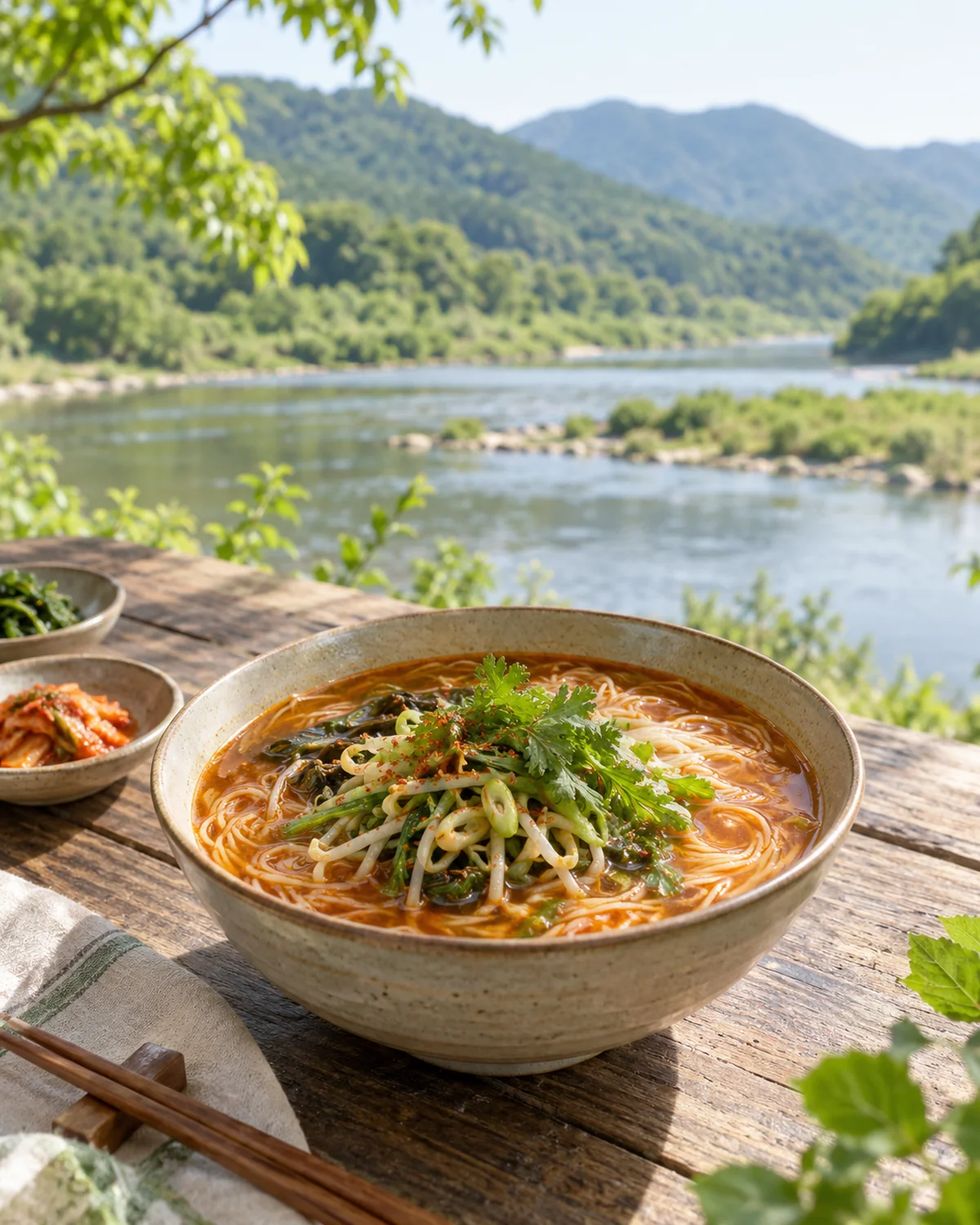
The distinction also protects the food from a weak origin myth. A dish can have a clear development period without needing a single named inventor. Local habits often change gradually before restaurants standardize and commercialize them.
Okcheon County now formally promotes a Cheongsan Saengseon-guksu Street. The tourism site lists the street as a dedicated food destination, and the county’s broader tourism site presents the Cheongsan Saengseon-guksu Festival as one of Okcheon’s signature events.
This institutional visibility matters. A food can exist in homes for decades without becoming a destination. A cluster of specialist restaurants, a named street and a recurring festival make the dish legible to outsiders and help preserve a shared regional vocabulary.
That process is different from invention. The county did not create river-fish cooking by naming a street. It formalized an existing identity and made it easier for visitors to encounter several interpretations in one place.
Cheongsan’s identity is ecological before it is commercial. The reason the dish belongs here is not that one restaurant became viral. It is that freshwater fish were available enough to support a local repertoire, and the community had cooking practices suited to them.
This is a recurring pattern in Korean regional food. Coastal towns develop around marine fish and shellfish; mountain counties build cuisines around greens, buckwheat or potatoes; river communities develop stews, porridge and fried dishes from freshwater catch. Geography does not determine every recipe, but it sets the ingredient possibilities that cooks work with.
Saengseon-guksu makes that chain unusually visible: river → fish stew → wider flour availability → noodles → restaurant cluster → named food street and festival.
The fish becomes part of the broth
Someone ordering the dish for the first time may expect a bowl with obvious fillets floating among noodles. That is not necessarily what arrives. Saengseon-guksu typically uses freshwater fish as the foundation of the broth. The fish is cooked long enough for flesh, skin and connective tissue to soften and release flavor. Depending on the restaurant, the cooked fish may be broken down, sieved, strained or otherwise incorporated so the soup becomes much more integrated than a simple fish-and-noodle assembly.

This matters for texture. A long-cooked fish broth can gain body from proteins, gelatin and suspended fine material. Gochujang, chile powder, garlic and other seasonings then build a red, savory soup around that base. The final result can feel closer to a thickened fish stew with noodles than to a clear noodle soup scented lightly with fish.
The exact fish species and processing method vary by restaurant and supply. A careful guide should not claim that every Cheongsan kitchen uses one fixed list of river fish or one identical straining method. The stable identity is the freshwater-fish broth itself.
Freshwater fish can carry aromas that diners describe as earthy, muddy or strongly aquatic. Saengseon-guksu changes that experience through long cooking and assertive seasoning. Garlic, chile, fermented paste and vegetables add their own aromas, while the fish is distributed through the broth rather than presented as a large plain fillet.
That does not mean every bowl is odorless, and “not fishy at all” is too absolute. Fish species, freshness, handling and restaurant technique all matter. But the dish’s structure explains why people who hesitate at the idea of river fish may find the bowl more approachable than expected: the fish behaves as a broth base, and the noodles give the palate something familiar to hold onto.
It is useful to taste the broth before adding extra seasoning. The first spoonful reveals whether the restaurant emphasizes chile heat, fermented depth, fish richness or a more soup-like balance.
Noodles, eojuk and a different kind of bowl
Saengseon-guksu is commonly served with relatively thin wheat noodles. That choice is structurally sensible. The broth already carries substantial body and seasoning, so a very thick, chewy noodle would compete with the soup. Thin strands absorb the red broth quickly and are easy to eat with a spoonful of liquid.

The comparison with kalguksu is useful. Kalguksu is defined strongly by the dough and cut noodle itself; regional broths surround that noodle technique. Saengseon-guksu begins from the opposite direction. Its identity is the river-fish broth, and the noodles are the later addition that turned the stew into a distinct meal.
That is why translating it simply as “fish noodles” misses the sequence. The soup is not a generic noodle broth flavored with a little fish. It is a fish-stew tradition that learned to carry noodles.
Korean river regions also have eojuk (어죽), a fish porridge in which rice or other starch cooks into a fish broth. The two dishes can overlap in ingredients and technique, and restaurants may serve both. The difference is easiest to understand at the table: saengseon-guksu foregrounds noodles as the starch, while eojuk builds toward a porridge-like rice texture.
That distinction is not a rigid national taxonomy. Local usage varies, and some preparations blur the boundary. What matters is that the same river-fish base can lead to different final structures depending on which starch is added and how long it is cooked.
This is one reason regional river cuisine deserves more than a single “fish soup” label. A community can turn the same catch into stew, porridge, noodles, fried small fish and other dishes, each emphasizing a different texture.
Dori-baengbaeng-i is a contrast, not a second soup
One bowl is enough to meet saengseon-guksu on its own terms. Begin with the broth, then lift a small portion of noodles and notice how the liquid coats them. A rich-looking soup does not mean the fish has disappeared as an ingredient, and a restaurant should answer questions about stock, seasoning and bones for the particular preparation.
Dori-baengbaeng-i makes an interesting shared companion because it keeps small fish visibly whole and arranged on a plate. The comparison is structural: fish absorbed into soup versus fish retaining an individual shape. It does not require ordering every regional specialty at once. Ask about portion size before committing to both.
The same logic distinguishes a noodle bowl from eojuk, whose eating structure can be closer to a thick rice or porridge dish depending on the version. Local names help organize a meal, but recipes and naming overlap between businesses. Describe the bowl you expect and let the server clarify it instead of using one travel photograph as a universal specification.
Dori-baengbaeng-i (도리뱅뱅이) is one of the foods most closely associated with Okcheon alongside saengseon-guksu. Small freshwater fish are arranged around a pan, cooked until crisp and coated or brushed with a sweet-spicy chile seasoning. The circular arrangement is part of the dish’s visual identity.
The pairing is excellent because the two foods treat freshwater fish in opposite ways. Saengseon-guksu hides the fish’s original shape inside a broth; dori-baengbaeng-i puts the whole small fish in front of the diner. The noodle soup is soft, wet and integrated. The pan of fish is crisp, dry at the surface and visually explicit.
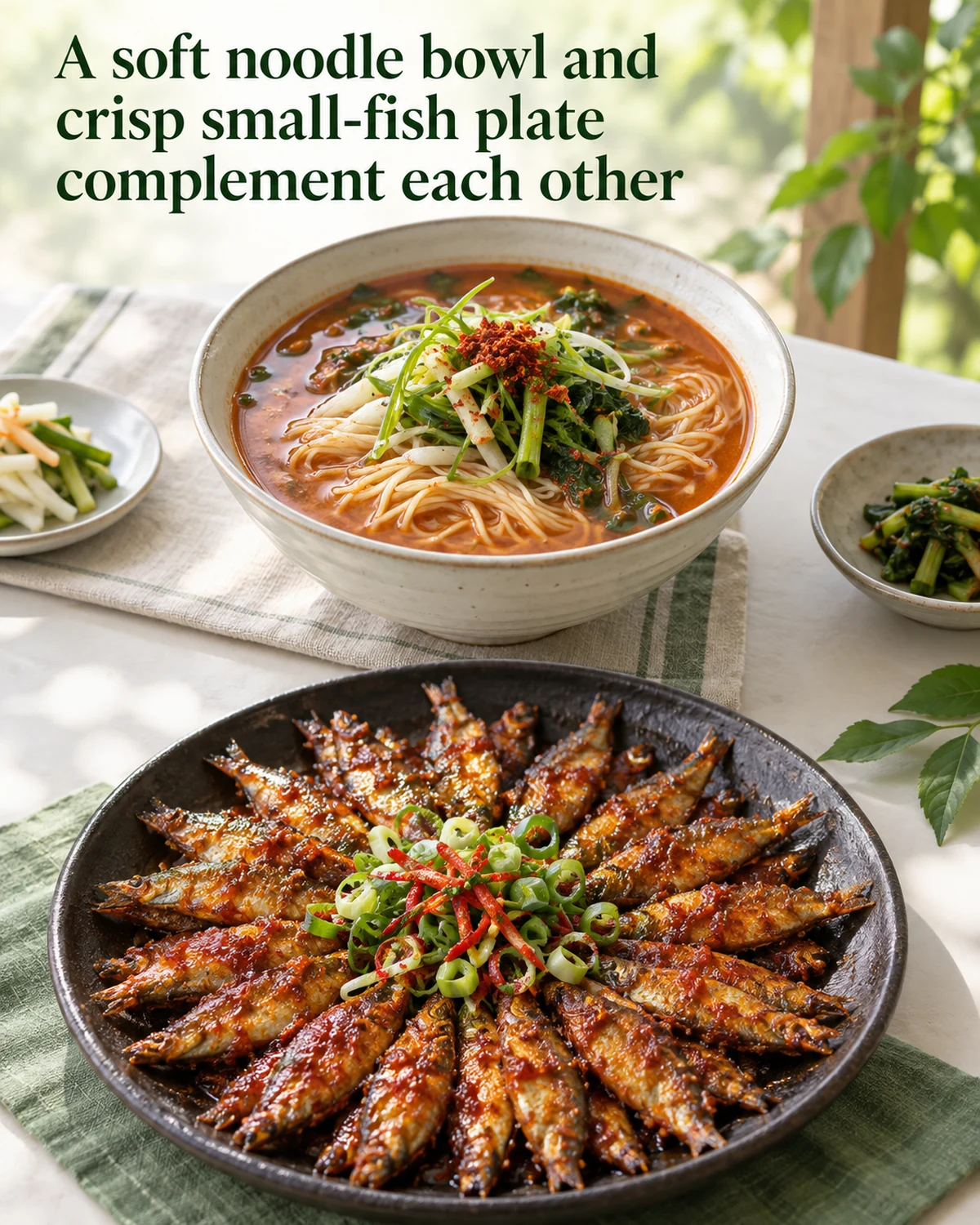
Eating them together therefore teaches more than ordering two famous local foods. It shows two techniques for the same river ecology: break fish down until it becomes broth, or preserve the fish’s shape and make it crisp.
Small freshwater fish have a high ratio of surface area to mass. When they are cooked thoroughly in oil or on a well-heated pan, moisture is driven from the exterior and the skin becomes crisp. With sufficiently small fish, the bones can also become brittle enough to eat more easily than the bones of a large fish.
Sweet-spicy seasoning is often applied after or during the crisping stage. If too much wet sauce is added too early, it can soften the exterior; when applied near the end, the sauce can glaze the surface while preserving more crunch.
Recipes vary, so diners should not assume that every version uses the same species or frying technique. The circular presentation and crisp whole-fish format are more reliable identifiers than a single fish name.
What the 1962 restaurant story establishes
Recent reporting based on Okcheon County information identifies Seon-gwang-jip (선광집) as a long-running Cheongsan restaurant that began business in 1962. That makes it an important part of the commercial history of the food street. It does not, by itself, prove that the restaurant single-handedly invented saengseon-guksu.
A restaurant can be the earliest continuously remembered specialist without being the first household ever to put noodles into fish stew. The county-level history is already sufficient: residents were adding noodles to local fish stew in the 1960s, and specialist restaurants helped turn the preparation into the regional dish known today.
For an evergreen article, this is the safer distinction: document commercial continuity without converting it into an unsupported inventor story.
Heat, bones and the ingredients to check
Usually, yes, in the sense that chile-based seasoning is a major part of the broth. But heat level varies. Gochujang can contribute sweetness and fermented depth as well as chile heat, and restaurants balance it differently with garlic, vegetables and fish broth.
If you are sensitive to spice, ask before ordering rather than relying on the color alone. A dark red broth can be rich and moderately hot rather than punishingly spicy; another kitchen may make a sharper bowl.
Preparation methods are designed to make the broth much smoother than a bowl containing intact fish pieces, but no general article should promise that every restaurant is completely bone-free. Fish may be strained or broken down to different degrees.
If bone fragments are a particular concern—for a child, an older diner or anyone with swallowing difficulty—ask the restaurant about its preparation method. Dori-baengbaeng-i, by contrast, intentionally presents small whole fish and therefore has a different texture and bone experience.

The dish is not vegetarian or vegan: freshwater fish is the foundation of the broth even when no fillet is visible. Removing a garnish does not change that. People with fish allergies should avoid it.
The noodles are typically wheat-based, so diners avoiding gluten should also ask about the noodle and seasonings. Dori-baengbaeng-i likewise contains whole fish and may use wheat-containing seasoning depending on the recipe.

There is no need to describe the bowl as a medicinal “health tonic.” It is a regional meal built from fish, seasoning and noodles. Nutritional composition changes with species, serving size, sodium level and restaurant technique.
Planning an Okcheon food stop
Cheongsan is a rural food destination, not a dense Seoul entertainment district. Specialist restaurants can have shorter operating days and hours, and schedules can change. The county’s current tourism pages are a better place to start than an old blog post with one fixed timetable.
Use the official Cheongsan Saengseon-guksu Street page to confirm the current restaurant cluster, then check the individual shop you intend to visit. Festival dates are also year-specific and should be verified from the county’s current event notice rather than treated as a permanent April weekend.
The travel time is part of the decision. Saengseon-guksu is worth seeking specifically because it is regional; that same regionality means it is better planned as part of an Okcheon or Chungcheong itinerary than squeezed into a rushed Seoul day.
Saengseon-guksu is easy to overlook because it does not have the national fame of bibimbap or Seoul kalguksu. That is exactly why it is valuable. It shows how regional Korean food develops when a local ecology meets a changing staple economy.
The fish came first. The noodles arrived later. Restaurants made the combination repeatable, and local government eventually turned the cluster into a named street and festival. Dori-baengbaeng-i preserved the visible side of the same river-food culture while the noodle bowl transformed fish into broth.
The result is not merely “a strange fish noodle soup.” It is a compact history of river access, communal fish stew, twentieth-century flour availability, restaurant specialization and regional identity—a bowl that explains Cheongsan more clearly than a generic list of attractions.
Sources and reading
- Okcheon County Tourism — Cheongsan Saengseon-guksu Street
- Okcheon County Tourism — regional tourism and Cheongsan Saengseon-guksu Festival
- Okcheon County Tourism — Cheongsan Saengseon-guksu Festival information
- Korea Tourism Organization — Okcheon travel route including Cheongsan Saengseon-guksu Street
- CDC — Safer food choices