
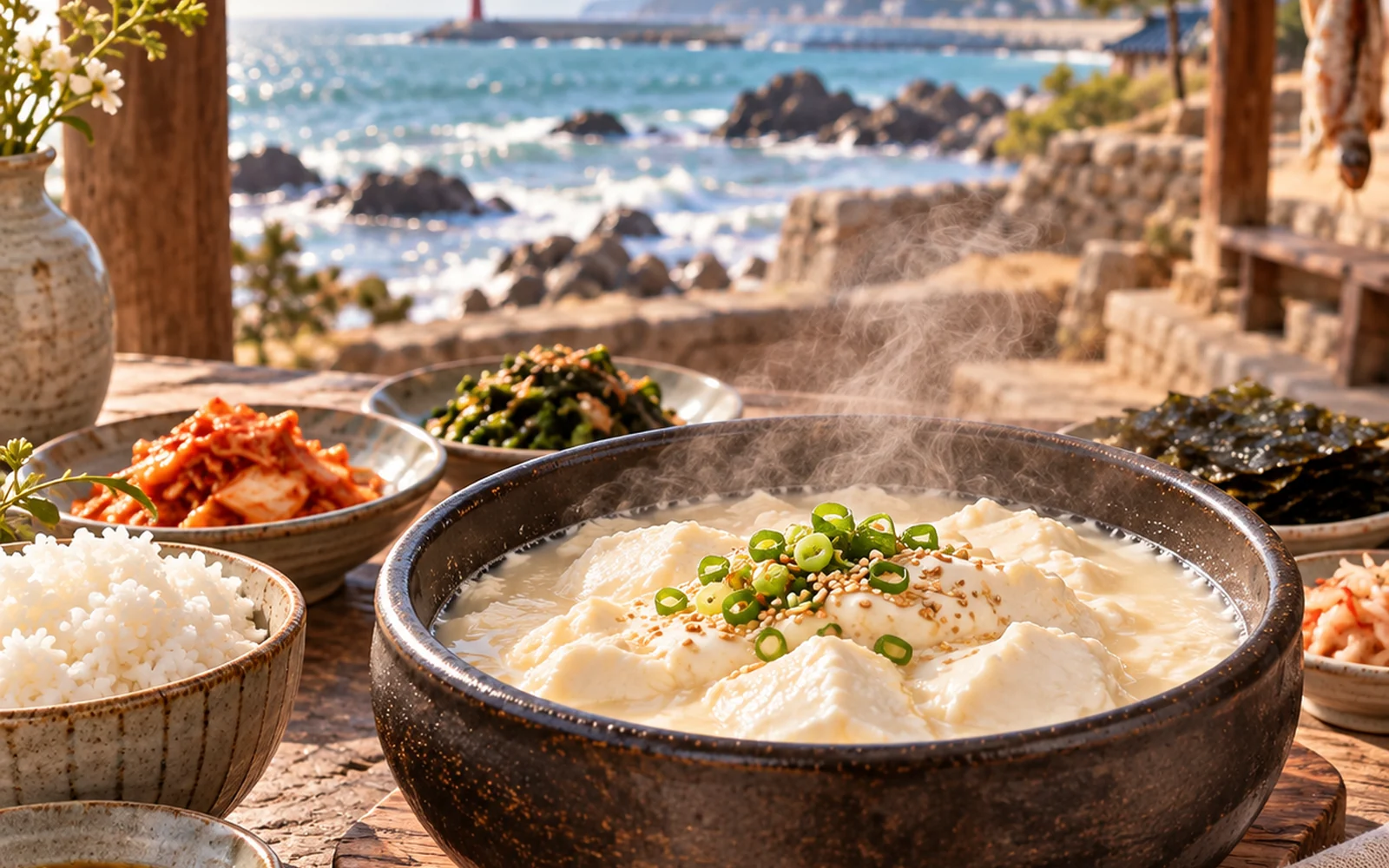
In Gangneung, tofu has a neighborhood. Chodang Dubu Village (초당두부마을), near the East Sea, is known for Chodang sundubu (초당순두부): a distinctive Korean soft tofu whose regional identity is tied to marine mineral coagulants—seawater, bittern or related seawater-derived materials—rather than to one universal industrial formula. The village also carries a famous Joseon-era origin story. The two parts of the story should be kept separate: the legend explains cultural memory, while the modern rise of the tofu village is much easier to document.
That separation makes Chodang sundubu more interesting, not less. The dish sits at the intersection of food science, local geography and regional branding. Soybeans provide the protein. A coagulant changes the behavior of that protein so curds form. Gangneung’s coastal setting supplies the marine association that distinguishes Chodang tofu. Then restaurants turn the same soft tofu into two very different experiences: a quiet, nearly plain bowl and a spicy jjamppong-style reinterpretation.
What Is Chodang Sundubu? Korean Soft Tofu From Gangneung
Sundubu is soft tofu that is eaten before the curds are pressed into a firm block. Its texture can range from loose and spoonable to softly set, but it is much more delicate than tofu meant for slicing and pan-frying. Chodang sundubu belongs to that soft-tofu family, with the regional distinction coming from the way Gangneung producers have traditionally linked coagulation to seawater or marine mineral coagulants.
Plain Chodang sundubu is often served with very little built-in seasoning. That makes sense if the tofu itself is the point. A light bowl lets diners notice soybean aroma, the gentle salinity associated with the coagulant, and the contrast between soft curds and any accompanying rice or banchan. Sauce can be added, but it does not have to dominate the first spoonful.
This is different from the red, bubbling sundubu-jjigae many visitors know from Korean restaurants abroad. Both use soft tofu, but Chodang’s regional specialty often treats the tofu as the main subject rather than as one ingredient inside a heavily seasoned stew.

Why a coagulant is necessary to make tofu
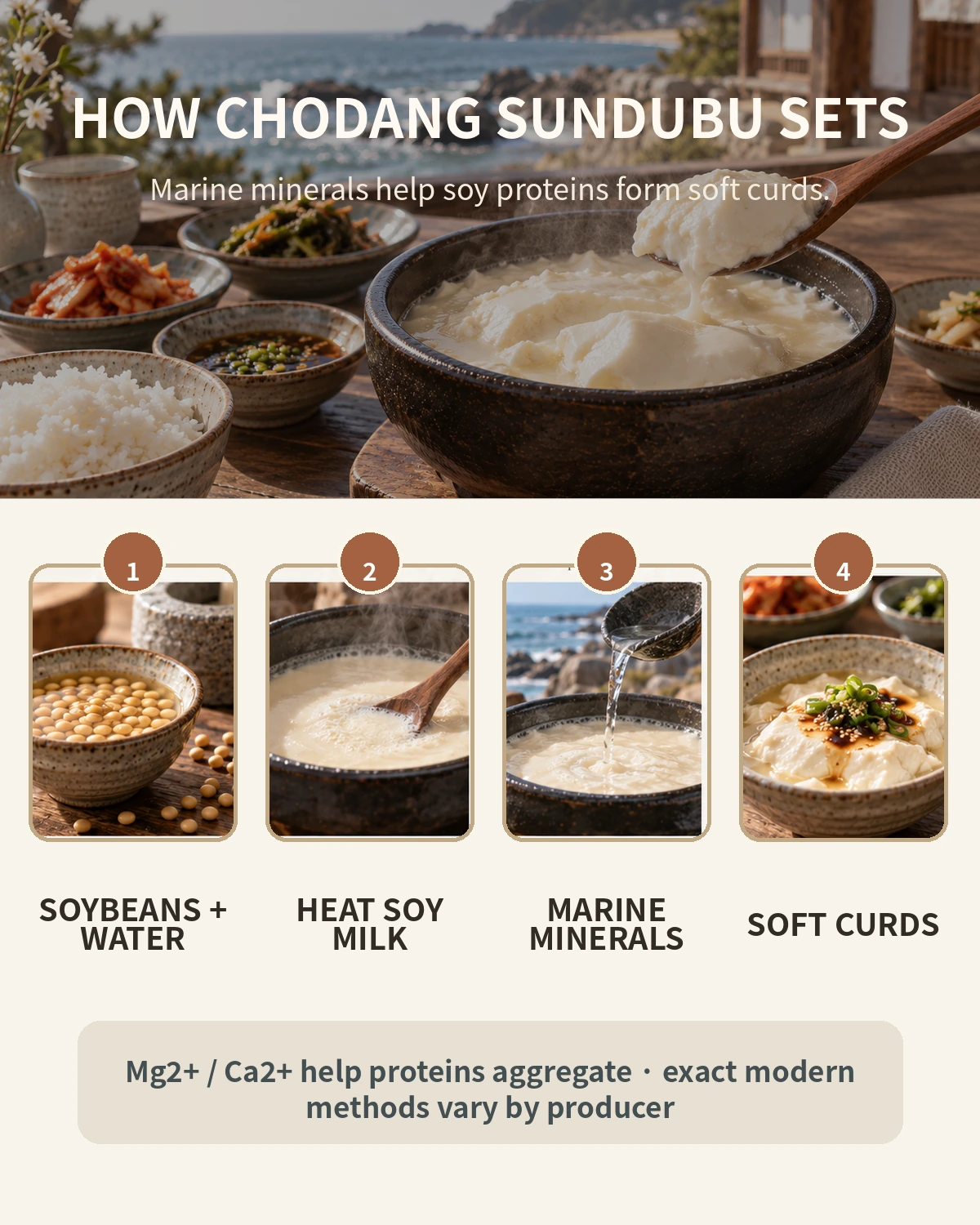
Tofu begins with soybeans that are soaked, ground with water, heated and filtered to produce soy milk. Soy milk contains proteins dispersed in water. Those proteins do not spontaneously become a tofu block just because the liquid cools. The maker needs conditions that encourage protein molecules to aggregate into a network, trapping water and forming curds.
Mineral salts can do that work. Magnesium and calcium ions reduce the electrostatic repulsion that keeps heat-denatured soy proteins dispersed, allowing the proteins to aggregate into a gel network that traps water. Food-science studies of magnesium-chloride and calcium-chloride tofu show that coagulant concentration, heating, protein concentration and coagulation temperature all affect the final gel state. Bittern—traditionally the mineral-rich liquid left after salt crystallizes—is one familiar source of those ions. Seawater or controlled seawater-derived mineral solutions can supply related salts, but the chemistry should not be confused with simply “salting” finished tofu.
The amount and handling matter. Too little coagulation can leave the soy milk weakly set; stronger or faster coagulation can change firmness, water retention and curd structure. Heating history, soy concentration, mixing and resting conditions also matter. That is why “seawater tofu” is best understood as a controlled protein-setting process with a regional marine-mineral identity, not as one fixed recipe followed identically by every producer.
Does every Chodang shop literally carry buckets of seawater from the shore?
No broad claim like that should be made for every modern producer. Official tourism material strongly connects Chodang tofu with East Sea water, bittern and deep-sea-water-based production, but exact contemporary methods can differ by shop or manufacturer. Some producers may use filtered or processed seawater; others may use bittern or a controlled mineral coagulant derived from seawater.
The safe regional point is that marine mineral coagulation is central to Chodang’s identity. The exact production method belongs to each producer. A historical method should not be mistaken for proof that every restaurant follows the same procedure unchanged.
The Heo Yeop story is local tradition, not settled documentary history
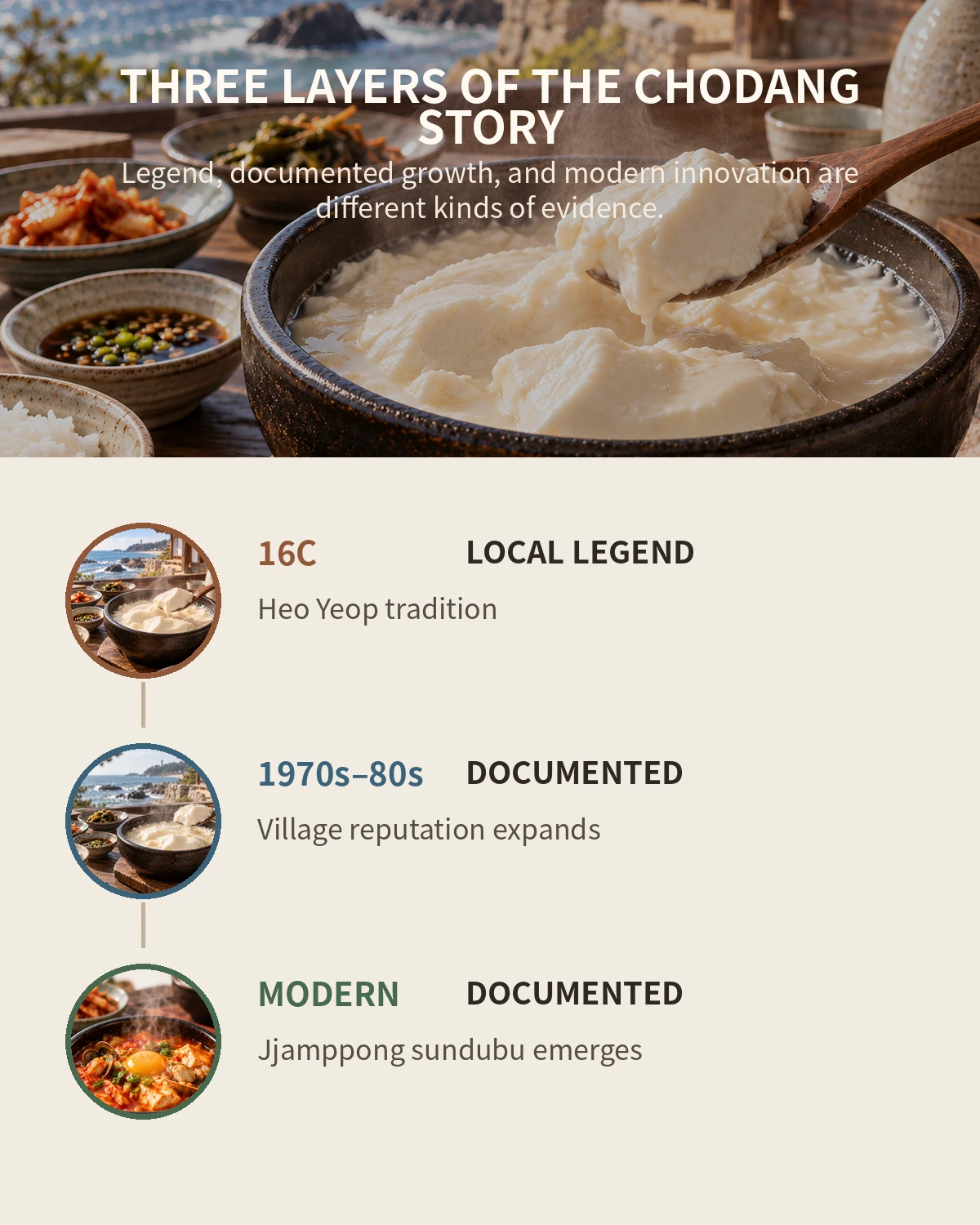
Chodang tofu is closely associated with Heo Yeop (허엽), a Joseon scholar-official whose pen name was Chodang. He is also remembered as the father of poet Heo Nanseolheon and writer Heo Gyun. Local tradition says that Heo Yeop used good local water to make soy milk and mineral-rich East Sea water or bittern to set the curds. The tofu became associated with his pen name, which in turn became attached to the neighborhood.
The story is culturally important because it connects a food, a place name and one of Gangneung’s best-known literary families. But VISITKOREA adds an important caution: it is uncertain whether Heo Yeop’s original recipe was continuously transmitted through the generations. That sentence changes how the legend should be written.
It is reasonable to say that Gangneung tradition credits Heo Yeop with the method. It is not reasonable to claim that every bowl served today is an unchanged direct descendant of one sixteenth-century recipe. Legend can explain why a community remembers a food without functioning as a complete chain of documentary proof.
How Chodang Dubu Village Grew in Gangneung
VISITKOREA provides a clearer account of the twentieth-century development of Chodang Dubu Village. It says the village’s tofu became especially well known in the 1970s and 1980s, when residents sold homemade tofu in downtown Gangneung and word of the product spread. Visitors increasingly came to the neighborhood itself, helping a cluster of tofu restaurants and shops develop.
This modern history is enough to explain the village as a food destination. A household production tradition becomes a commercial specialty; multiple shops concentrate in one area; visitors can compare different interpretations; and the neighborhood name becomes inseparable from the product.
That trajectory is common in regional food culture. A place does not need a perfectly documented ancient origin to have a genuine tradition. Repeated local production, specialist knowledge, family businesses and decades of customer recognition can create a powerful regional identity in their own right.
Plain Chodang sundubu puts the tofu itself first
If the goal is to understand Chodang tofu itself, the plain version is the clearest starting point. The curds are soft enough to break with a spoon, and the flavor is intentionally restrained. Instead of asking whether the bowl is “bland,” ask what becomes noticeable when chile, seafood and heavy seasoning are absent.
The soybean aroma is easier to detect. The mineral coagulant can contribute a subtle saline impression. The curd structure feels more delicate than firm block tofu. A soy-based dipping sauce, scallions or banchan can add intensity afterward, but the first taste establishes the baseline.
This baseline is useful because Chodang’s most famous modern reinterpretation goes in the opposite direction.

Jjamppong sundubu turns a quiet ingredient into a loud modern dish
Jjamppong sundubu (짬뽕순두부) combines soft Chodang-style tofu with a spicy broth influenced by Korean-Chinese jjamppong. The result is not simply “traditional sundubu with more chile.” The seafood-forward, smoky, spicy soup changes the role of the tofu. Instead of carrying the meal through subtle soybean flavor, the tofu becomes a soft, cooling contrast to an intense broth.
A current VISITKOREA local-food feature identifies Donghwa Garden as the first restaurant in Chodang Tofu Village to serve jjamppong sundubu. That is useful documentary evidence for a modern restaurant innovation. It also demonstrates an important point about regional tradition: a food culture can remain recognizable while developing new dishes.
The tofu village therefore offers two ends of one spectrum. Plain sundubu foregrounds the ingredient and coagulation tradition. Jjamppong sundubu shows how the same ingredient can absorb contemporary restaurant trends and become famous through a much more assertive flavor profile.
Why side-by-side tasting teaches more than choosing one “best” bowl
A plain bowl and a jjamppong-style bowl answer different questions. The plain bowl makes texture, soybean aroma and the restraint of the seasoning easy to notice. The spicy version shows how the same soft curd behaves inside a seafood-forward broth with much stronger aromatics and chile heat.
The useful comparison is not which one is “more authentic.” It is how much of Chodang identity sits in the tofu itself and how much comes from the dish built around it. That distinction is the bridge between regional ingredient tradition and modern restaurant invention.
Chodang Sundubu vs Sundubu Jjigae: What’s the Difference?
Outside Korea, “sundubu” often means spicy sundubu-jjigae by default. In Korean, however, the word can refer to the soft tofu itself. Chodang sundubu makes that distinction especially clear because the tofu may be served plainly enough that there is little confusion about what the central ingredient is.
Sundubu-jjigae is a stew category. It commonly includes chile seasoning and may contain seafood, meat, egg or other additions. Chodang sundubu is a regional tofu identity, and it can appear in a plain serving, in a set meal, in jjamppong-inspired soup or in other restaurant variations.
So the relationship is ingredient versus dish structure. Soft tofu can be the product being tasted, or it can be one component inside a stew.

What do marine minerals change — and what do they not change?
The strongest difference is not that the tofu tastes like a mouthful of ocean water. Well-made Chodang sundubu is usually described as mild, nutty and gently saline rather than aggressively salty. The mineral coagulant’s primary technical job is to set the soy proteins; flavor is a secondary consequence of the minerals and process.
That distinction matters because “made with seawater” can sound as if the tofu is simply soaked in brine. It is more accurate to think of the marine material as part of the chemistry that creates the curd. Salt concentration and mineral balance help determine how the proteins aggregate, while the producer controls texture through technique.
The texture is a production choice, not just a synonym for “silken”
English descriptions sometimes call all very soft tofu “silken tofu.” That is convenient but can flatten meaningful production differences. Chodang sundubu is fresh, softly coagulated soybean curd with a regional method and serving culture. Commercial silken tofu sold in sealed packages may use a different production process and different coagulants.
For diners, the practical distinction is texture and freshness rather than an attempt to map every Korean tofu term to one supermarket label. Chodang sundubu is meant to be spooned, not neatly cubed. Its fragility is part of the experience.
Is plain Chodang sundubu vegetarian or vegan?
The tofu itself is made from soybeans, water and a coagulant, so the core product can be plant-based. But a restaurant meal should not automatically be labeled vegan. Dipping sauces, kimchi and other banchan may contain fish sauce, salted seafood or animal-derived seasonings. Rice dishes or soups served alongside the tofu can also contain broth made from meat or seafood.
Jjamppong sundubu is an even clearer boundary case because the style is commonly built around a seafood- or meat-influenced spicy broth. Diners avoiding animal products should ask about the full set meal rather than assuming that “tofu” guarantees a vegetarian preparation.
Is Chodang sundubu a health food?
Tofu is a soy food and contributes protein, but that fact does not justify medical promises. Chodang sundubu should not be presented as a cure, detox food, digestive treatment or guaranteed low-calorie meal. Nutritional content changes with serving size and with the broth, sauces, rice and side dishes served around it.
The more interesting value is culinary: a simple protein food shows how one change in coagulation method can become the basis of a regional identity.
Visiting Chodang Dubu Village: What to Check Before You Go
Chodang Dubu Village remains a cluster rather than a single restaurant. That makes it possible to choose between traditional plain tofu, spicy adaptations and tofu-based desserts or snacks. But opening hours, closure days, menus and prices can change, especially at small independent shops.
Use current tourism listings or the restaurant’s own current information close to the day of travel instead of relying on an old price table. VISITKOREA itself warns in older Chodang Village material that shop hours vary and details can change. Treat the cultural background as stable and the restaurant logistics as current information to verify.
Gangneung’s broader coastal attractions make the area easy to combine with other stops, but exact train times, bus routes and transfer durations should also be checked when traveling rather than treated as permanent facts.
- Search: “Chodang sundubu,” “Chodang Dubu Village,” or “Gangneung soft tofu.”
- Order: start with plain sundubu if you want to taste the tofu itself; choose jjamppong sundubu if you want the spicy local variation.
- Check before going: the restaurant’s current opening day, last order, menu and whether a queue system is in use.
- For dietary needs: ask about broth, sauces, kimchi and banchan as well as the tofu itself.
Quick answers
Is Chodang sundubu made with seawater?
Its regional identity is strongly tied to seawater, bittern or other seawater-derived mineral coagulants. Exact modern methods vary by producer, so it is safer not to claim that every shop uses untreated seawater in exactly the same way.
Did Heo Yeop invent Chodang tofu?
Local tradition credits the Joseon scholar-official Heo Yeop, whose pen name was Chodang. VISITKOREA presents the story as a local legend and notes that continuous transmission of the original recipe cannot be confirmed.
When did Chodang Dubu Village become widely known?
Official tourism material says the village’s tofu reputation expanded strongly in the 1970s and 1980s as residents sold homemade tofu in downtown Gangneung and more visitors began seeking out the neighborhood.
What is jjamppong sundubu?
It is a modern spicy dish that pairs soft tofu with a jjamppong-inspired broth. VISITKOREA identifies Donghwa Garden as the first restaurant in Chodang Tofu Village to serve the style.
Does the tofu taste very salty?
Usually the marine identity is subtler than the word “seawater” suggests. The coagulant’s main job is to form curds, and well-made Chodang sundubu is generally associated with mild soybean flavor and gentle salinity rather than strong brine.
Is it the same as red sundubu-jjigae?
No. Sundubu is the soft tofu itself, while sundubu-jjigae is a stew made with soft tofu. Chodang’s specialty can be served plain, in a set meal or in newer spicy preparations.
Why Chodang is a useful way to understand regional Korean food
Chodang sundubu shows how a regional specialty can have several layers of truth at the same time. The Heo Yeop story is meaningful cultural memory but not an unbroken recipe certificate. The modern village’s growth in the 1970s and 1980s is better documented. The seawater connection is not merely folklore because mineral coagulants genuinely change soy protein into curds. And jjamppong sundubu proves that regional identity can continue evolving rather than remaining frozen in a historical pose.
Put those layers together and the dish becomes more than “soft tofu by the beach.” It is a story about coagulation chemistry, local legend, twentieth-century food clustering and modern restaurant innovation. The plain bowl and the spicy bowl are not rivals; together they show how one ingredient can carry both continuity and change.
Related stories
- Seolleongtang: Seoul’s Milky Beef Soup and Its Competing Origin Stories
- Gaegukji and Baksok Nakji-tang: Coastal Soup Traditions of Seosan and Taean
Sources
Evidence note: official tourism material is used for Chodang-specific history, place and restaurant-development claims; peer-reviewed food-science sources are used for coagulation mechanics.
- VISITKOREA — Chodang Sundubu: A Nutty and Smooth Flavor (2025)
- VISITKOREA — K-Local Food Trip: Gangneung / Chodang Sundubu
- Li et al., Journal of Food Science (2024) — Mg/Ca salt coagulation of heated soymilk
- Liu & Chang, Journal of Agricultural and Food Chemistry (2004) — coagulant requirements and tofu texture