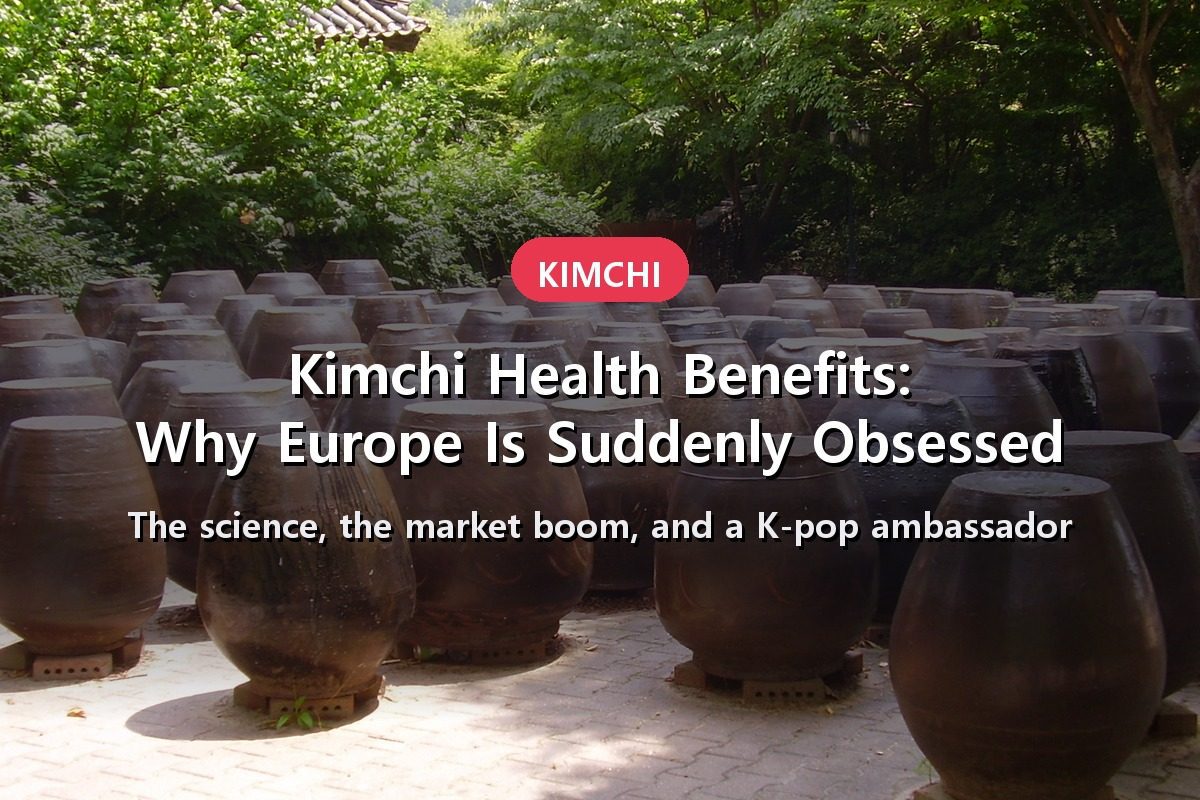
Fermentation jars at a traditional Korean yard. Photo: OlkhichaAppa, CC BY-SA 3.0, via Wikimedia Commons
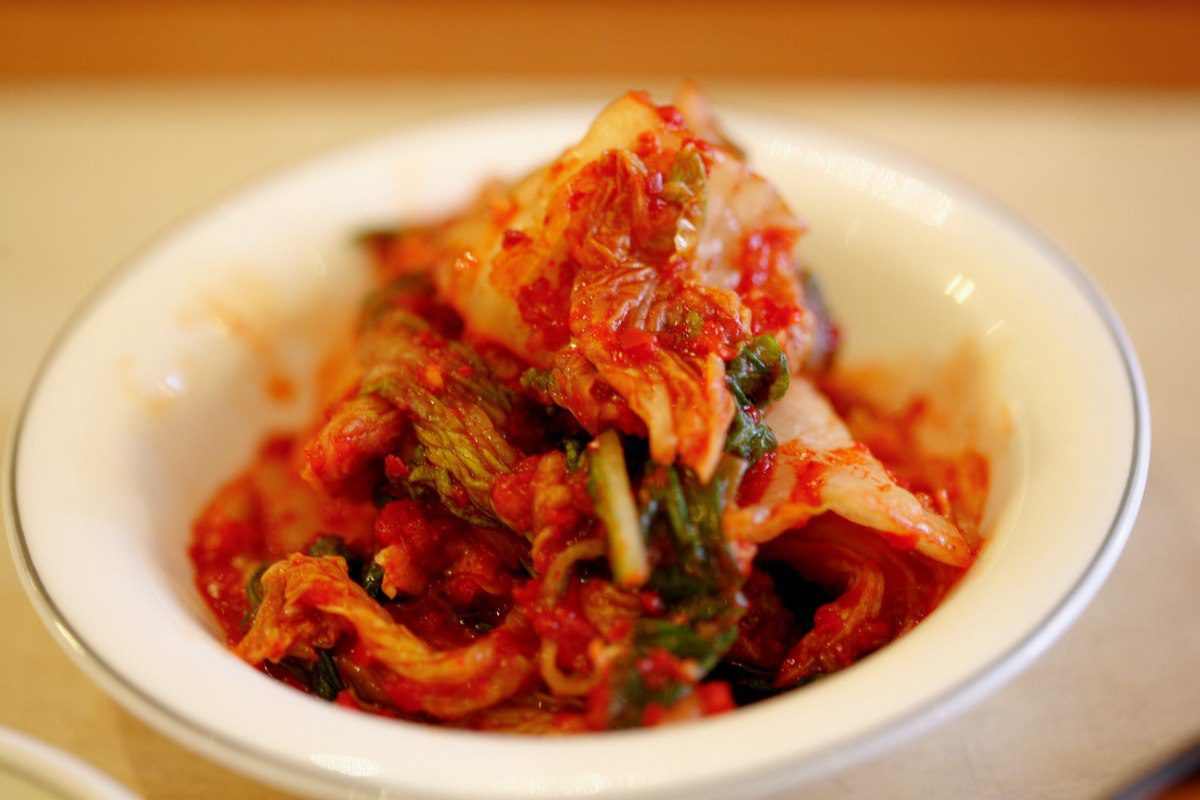
Red, spicy kimchi — the version now showing up in European gut-health headlines. Photo: Charles Haynes / Nate Beaty, CC BY-SA 2.0, via Wikimedia Commons
Kimchi (김치) has quietly become one of the fastest-talked-about foods in European wellness circles — gut-health blogs, dietitian TikTok, supermarket shelves in Berlin and Paris stocked next to kombucha. It’s being framed as a superfood, a probiotic hack, the fermented answer to a bloated, over-processed diet. Here’s the part almost nobody mentions while they’re saying that: the fiery red version everyone pictures wasn’t what Korea ate for most of its history. For centuries, it had no chili in it at all.
That contradiction — a food being sold as the newest thing in European nutrition, built on an ingredient that’s actually the newest thing in kimchi’s own history — is worth untangling. So is the other reason it keeps showing up in your feed: a K-pop idol is now its official face, and the pop-up built around him drew lines in the middle of Tokyo.
Why kimchi suddenly owns the European wellness conversation

Fermented and ready to eat — the part of the process behind the “kimchi probiotics” search boom. Photo: Nagyman, CC BY-SA 2.0, via Wikimedia Commons
Europe now accounts for roughly a fifth of the global kimchi market, and industry researchers point to the same driver over and over: demand for fermented, plant-forward foods that claim to do something for digestion. That market itself is tracked at around $5.19 billion in 2025, climbing toward $5.45 billion in 2026 and a projected $6.94 billion by 2031. Germany and France are singled out as the fastest-growing retail markets, with the fermented cabbage increasingly sitting on “clean label” or gut-health shelves rather than tucked into a niche Asian-foods aisle.
Zoom out further and the number gets bigger: Europe’s broader probiotics market — everything from yogurt drinks to supplements to fermented vegetables — is projected to grow from about $14,720 million in 2024 to $23,050 million by 2030. It’s riding a wave far bigger than itself, tucked inside a much wider shift. Industry analysts describe gut health as having moved past a niche wellness buzzword into an ordinary dinner-table topic, the kind of thing people now bring up the way they’d talk about cutting sugar or getting more fiber.
What the research actually shows — and where it doesn’t go yet

A small home serving (AI-generated) — the everyday version of the food behind a growing pile of fermentation research.
The science backing the trend is real, but it’s more layered than “kimchi is a superfood.” A 2026 study in the Journal of Food Biochemistry found that lactic acid bacteria strains isolated from it showed measurable antioxidant and anti-inflammatory activity. Around the same time, researchers reported that a fermented-cabbage-derived strain, Leuconostoc mesenteroides CBA3656, bound to polystyrene nanoplastics under simulated intestinal conditions — holding onto 57 percent of the nanoplastics tested — and roughly doubled nanoplastic excretion when given to germ-free mice — a genuinely interesting result, but it’s a mouse study under lab conditions, not proof that eating it flushes plastic out of a human gut. Treat it as an early signal, not a settled fact.
The human data is narrower but still notable. A 2025 trial found that 12 weeks of regular consumption was associated with better immune-cell responsiveness in overweight adults, and a 2024 study linked it to higher levels of Akkermansia muciniphila — a bacterium researchers generally consider beneficial — and lower levels of Proteobacteria, a group often elevated in gut inflammation. A 2022 randomized, double-blind, placebo-controlled trial went further and found that supplementation with it improved symptoms in people with irritable bowel syndrome. None of this makes kimchi a cure for anything. What it does show is that the “probiotic” claim isn’t just marketing — there’s a real and growing body of research behind why a jar of fermented cabbage keeps landing on wellness shelves next to kombucha and kefir.
The version everyone pictures isn’t the kimchi Korea started with
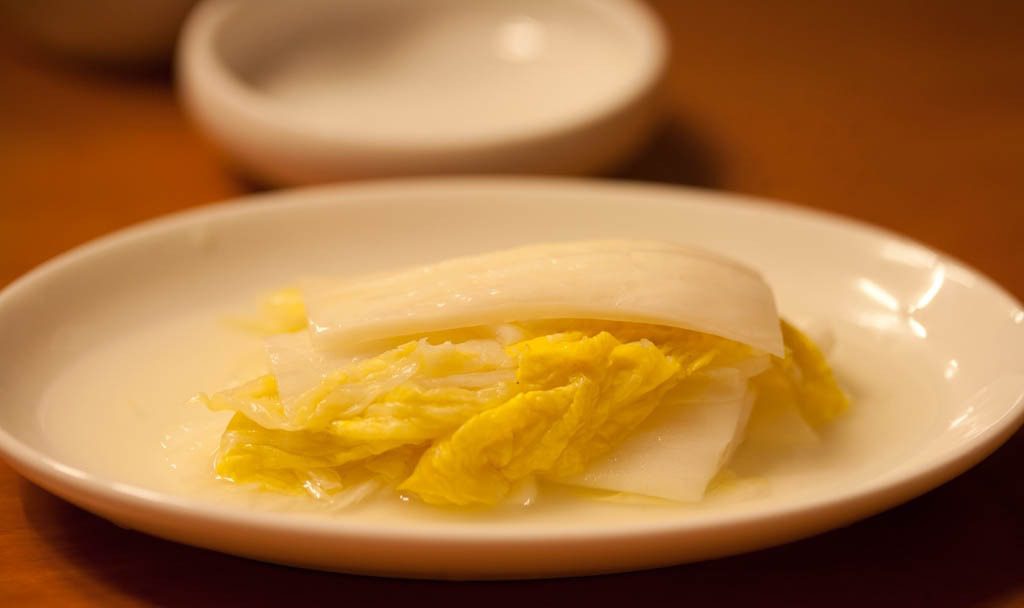
Baek-kimchi (백김치) — white and made without a trace of chili. Closer to what the dish looked like before the 17th century. Photo: Charles Haynes, CC BY-SA 2.0, via Wikimedia Commons
Here’s the detail that rarely makes it into a “kimchi is trending” headline: chili peppers are a New World crop. They didn’t exist anywhere in Asia until after the Columbian Exchange carried them across the Atlantic and Pacific in the 15th and 16th centuries. The most widely accepted account has chili reaching Korea around the time of the Imjin War (임진왜란, 1592–1598), most likely by way of Japan — though the exact route and timing are still debated among historians, and some sources describe Portuguese traders or mercenaries as part of that chain. Korea’s earliest confirmed written mention of the pepper dates to the early 1600s, and it wasn’t an instant hit — it was initially treated with suspicion as a possibly toxic plant. Chili took roughly two centuries to fully work its way into Korean cooking — the red version is actually the newer half of this dish’s story.
Before that, Korean fermented vegetables looked much closer to their original, non-spicy form — clear brine instead of red paste, seasoned instead with things like chopi (초피, a mild, Sichuan-pepper-like spice) for a gentle kick, and still served in Korea today for people who find the standard version too spicy. In other words, the “ancient superfood” headlines currently running in Europe are describing a dish that’s arguably only 200 to 300 years old in its familiar red form. We’ve gone deep on that full reversal — the white version Joseon kings actually ate, and how the red one took over — in our full history piece on baek-kimchi, if you want the longer story.
Why a K-pop idol is suddenly the face of kimchi

Hoshi of Seventeen. Photo: SEVENTEEN, CC BY 3.0, via Wikimedia Commons
The other reason it keeps surfacing outside food media has nothing to do with fermentation research and everything to do with K-pop. In September 2023, Daesang (대상)’s kimchi brand Jongga (종가) announced Hoshi (호시) — a member of the thirteen-member group Seventeen (세븐틴), and by his own fans’ running joke, a genuinely enthusiastic fan of the dish — as its brand ambassador. It wasn’t a stretch casting: his love of it had already become a running bit on his livestreams before the brand noticed and made it official.
Jongga isn’t a small player. At the time of the ambassador announcement, it was already sold in more than 40 countries, including the United States and Japan, with Taiwan and parts of Europe not far behind — reach that was already in place before the K-pop campaign even started. Pairing that kind of global distribution with a K-pop idol whose fanbase spans the same map is a straightforward move — but it also does something else. It puts the dish in front of an audience that was never going to read a fermentation study, wrapped in the language of an idol they already follow.
Inside Kimchi Blast Tokyo — the pop-up that turned a side dish into an event

Cat Street in Harajuku, Tokyo — the neighborhood, not the exact pop-up building, shown here for a sense of the setting. Photo: Joe Mabel, CC BY-SA 3.0, via Wikimedia Commons
The clearest sign that it has become a marketing event rather than just a grocery item happened in Tokyo in the spring of 2025. From April 29 to May 5, Jongga ran “Kimchi Blast Tokyo 2025” out of Cranes 6142, a glass-fronted building on Harajuku’s Cat Street, taking over more than 700㎡ across three floors. The first floor recapped the brand’s earlier pop-ups in New York and Seoul, plus an earlier stop in Busan; the second laid out Jongga’s brand identity and its reach into more than 80 countries; the third was built for Japanese fans specifically, with exclusive manga content and recipes, plus a photo booth built around Hoshi.
Hoshi showed up in person on opening day, and the first 20,000 visitors walked away with commemorative cards and event-only merchandise — a striking turnout for a pop-up built around a side dish. None of that is subtle, and it isn’t meant to be — it’s a food brand borrowing the scale of a K-pop fan event, in a city that already treats limited-run pop-ups as a form of entertainment. Whether or not that convinces anyone that a side dish belongs in their gut-health routine, it’s hard to argue this pop-up hasn’t put the word “kimchi” in front of people who’d otherwise never search for it.
The short version
- Its European growth is tied to the broader gut-health boom — Europe holds roughly a fifth of the global kimchi market, and the region’s probiotics market is projected to grow from $14,720 million (2024) to $23,050 million by 2030.
- Recent research (2022–2026) links kimchi’s lactic acid bacteria to antioxidant and anti-inflammatory effects, plus immune- and IBS-related benefits — but some of the most eye-catching findings, like nanoplastic binding, are still animal-study results, not proven human effects.
- Red, spicy versions are younger than most people assume — chili peppers only reached Korea around the late 1500s/early 1600s, and it took roughly 200 years for the fiery kind to fully replace the mild, non-spicy original.
- Seventeen’s Hoshi has been Jongga’s kimchi brand ambassador since September 2023, and headlined the “Kimchi Blast Tokyo 2025” pop-up in Harajuku (April 29–May 5, 2025).
- Jongga’s global reach — 40+ countries in 2023, 80+ by 2025 — is a big part of why an idol-fronted campaign like this can actually move the needle internationally.
A few quick questions
Q. Are the health benefits behind this trend actually backed by science, or is this mostly marketing?
Both, honestly. There’s real published research — 2022 through 2026 — linking kimchi’s lactic acid bacteria to gut, immune, and inflammation-related effects in human and animal studies. But some of the biggest claims circulating online (like plastic removal) come from mouse studies, not confirmed human results. The trend is grounded in genuine science; the headlines sometimes run ahead of it.
Q. Does how it’s fermented matter for kimchi probiotics benefits, or is any jar the same?
The research specifically points to live, actively fermenting batches — the kind still developing lactic acid bacteria — rather than pasteurized versions that have been heat-treated for shelf stability (heat kills the live cultures). Refrigerated, traditionally fermented batches are what most studies are describing.
Q. If it wasn’t spicy for most of Korean history, what changed?
Chili peppers arrived in Korea from the Americas by way of Asia sometime around the late 1500s to early 1600s, most likely connected to the Imjin War period, though historians still debate the exact route. It then took roughly 200 years for chili to move from a suspicious new plant to a kitchen staple, which is why the red, spicy version is a relatively recent chapter in a much older dish.
Q. Why did a Korean food brand pick a K-pop idol as its ambassador?
Reach. Jongga, the brand behind Hoshi’s ambassadorship, already sold in 40+ countries when it announced the partnership in 2023, and an idol’s global fanbase overlaps almost exactly with the international markets a food export brand wants to grow into. The Tokyo pop-up drawing lines of fans in 2025 is the clearest proof the strategy worked.
ONE MORE THING
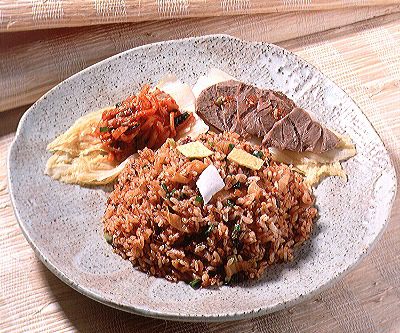
Kimchi-bokkeumbap — fried rice built around the fermented cabbage, one of the simplest ways to actually eat the stuff instead of just reading about it. Photo: Korea.net / Korean Culture and Information Service, CC BY-SA 2.0, via Wikimedia Commons
If the market data and lab studies have you curious rather than convinced, the easiest way to test the hype yourself isn’t a supplement — it’s kimchi-bokkeumbap (김치볶음밥), fried rice built around a well-fermented batch. Chop it fine (the tangier, the better), fry it with rice and a little of its own brine, and usually finish with an egg on top. It’s the dish Koreans actually reach for once a batch has fermented past the point of being a crisp, fresh side — proof that “getting more probiotics into your week” doesn’t have to mean choking down a spoonful straight from the jar.
If you’re curious how far K-pop’s food influence actually reaches, we’ve also covered what BTS actually eats in real life — and for another Korean dish riding its own healthy-food reputation, gondeure-namul-bap, Korea’s mountain-herb rice bowl, is worth a look.
Sources: Fortune Business Insights · MarkWide Research (market forecasts) · MarketsandMarkets (European probiotics market) · Journal of Food Biochemistry (2026, lactic acid bacteria study) · phys.org / ScienceDaily (2026, nanoplastic-binding probiotic strain) · Seed (2024–2025 clinical trial summaries) · PubMed (2022 IBS randomized trial) · PepperScale · laseoulite (gochugaru history) · Wikipedia (Baek-kimchi) · Aju Press · The Asia Business Daily (Hoshi x Jongga ambassador announcement, Sept 2023) · PR TIMES / TV Tokyo Plus (Tokyo pop-up event, 2025).