
If your first bulgogi arrived in broth, a flat charcoal-grilled version can look like a different dish. If you first met it as smoky beef in a lettuce wrap, the broth may seem unexpected. Both experiences belong to the story of Korean bulgogi.
The familiar English description, “marinated beef,” identifies a starting point. It leaves out what happens next: how the meat is cut and arranged, whether liquid surrounds it, and whether cooking takes place in the kitchen or at your table. Those decisions affect the entire meal, from the utensils you reach for to the way rice joins the beef.
Seoul, Eonyang and Gwangyang offer a useful comparison. Their names describe recognizable regional approaches, while individual restaurants still have their own practices. Following the equipment and the people who used it gives us a fuller story than a contest over which town has the best marinade.
Seoul-style bulgogi gives the juices somewhere to go
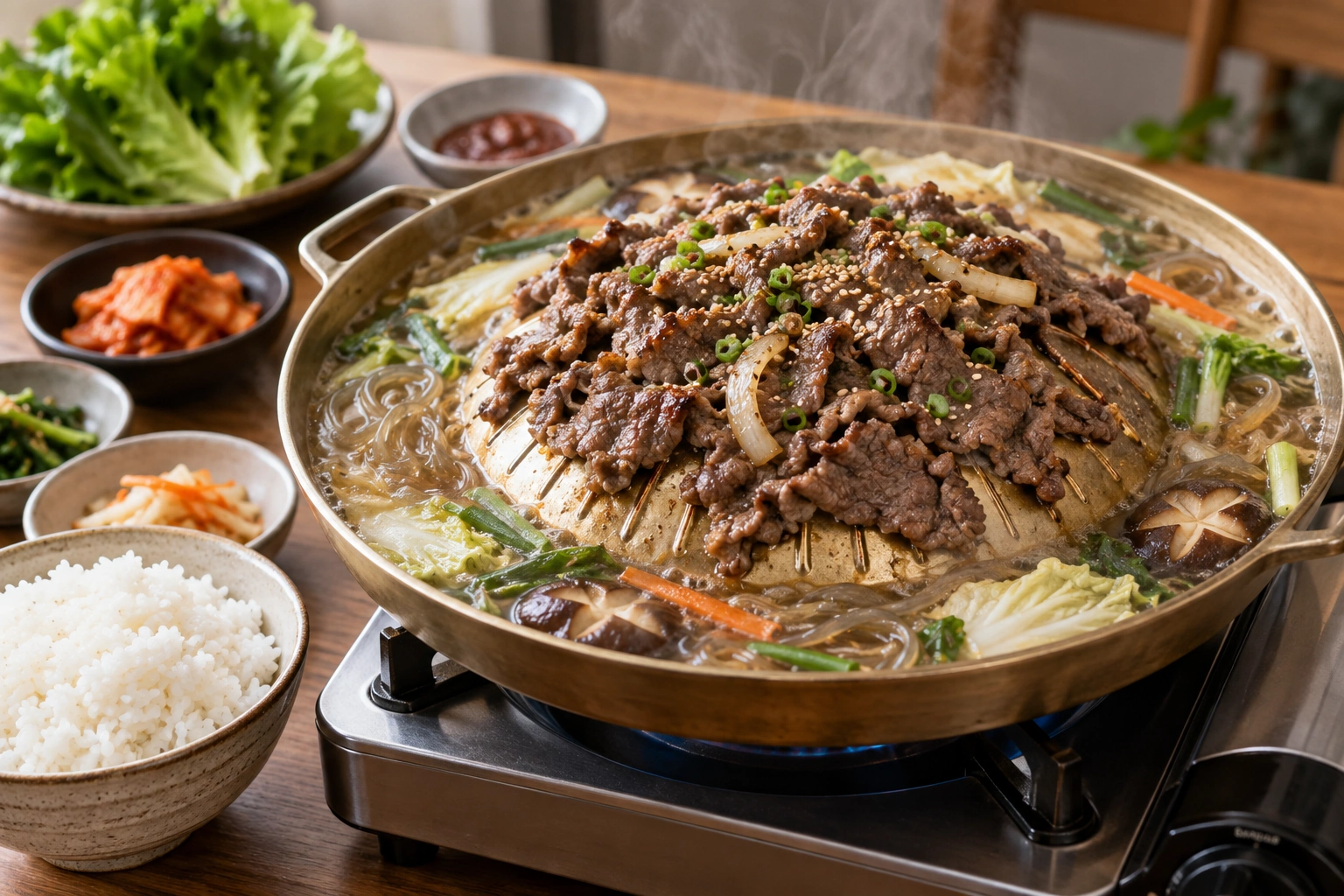
In Seoul’s broth-based approach, the pan is part of the dish. A raised center and a deeper surrounding area let meat, cooking juices, broth and accompanying ingredients share space. The meal can offer beef to pick up with chopsticks and liquid to enjoy with a spoon.
Professor Jeong Hee-seon’s 2013 explanation published by Seoul Metropolitan Government distinguishes this broth-based preparation from direct grilling. She describes vegetables and glass noodles joining the seasoned beef, and explains how the broth can be eaten with rice.
This changes what counts as a satisfying mouthful. A piece of beef is one part; a spoonful of the seasoned liquid is another. The noodles and vegetables make the cooking vessel a shared meal rather than merely a surface that holds meat above heat.
Watch where an ingredient is cooking before taking it. A noodle in the surrounding liquid has a different path to your bowl from meat on the raised surface. Ask the staff how to use the particular pan when its arrangement is unfamiliar.
The presence of broth does not mean the kitchen has abandoned bulgogi. It gives the flavor a second destination. What leaves the meat can become something to eat, instead of disappearing from the meal.
Hanilkwan’s history shows two preparations living together
Hanilkwan traces its business to 1939. Its own published history describes early grilled preparations, wartime operation in Busan, and later coexistence of grilled and broth bulgogi in Seoul. It associates both forms with its rebuilt Jongno premises from 1957.

The same company account describes portable gas burners in the 1970s and a bulging broth pan whose deeper rim could hold noodle and mandu additions. The equipment was designed around what customers could eat together.
These are dates in one restaurant’s account. They do not establish the first year any Korean cook put beef and broth in the same vessel. What they show clearly is that a long-running restaurant could change its cooking arrangements while continuing to call the meal bulgogi.
That makes an old establishment more interesting than an “unchanged since opening” slogan. A kitchen may preserve a recognizable seasoning while altering the heat source, serving vessel or menu format. Continuity can include practical adaptation.
At a modern restaurant, therefore, the founding date cannot tell you which preparation an order will bring. The menu description and the actual dish remain essential. A historic name may contain several chapters of cooking.
Eonyang connects a wide grill to a local working landscape
Eonyang is in Ulju-gun, Ulsan. The city’s tourism account places its bulgogi tradition in a landscape of cattle trading and meat businesses. It credits highway-construction workers in the 1960s with helping spread the reputation of the local beef.

Read that as the city’s account of how recognition grew, rather than the exact invention of a finished recipe. The important connection is between people coming to work, eating locally, and carrying a food’s reputation beyond its original customers.
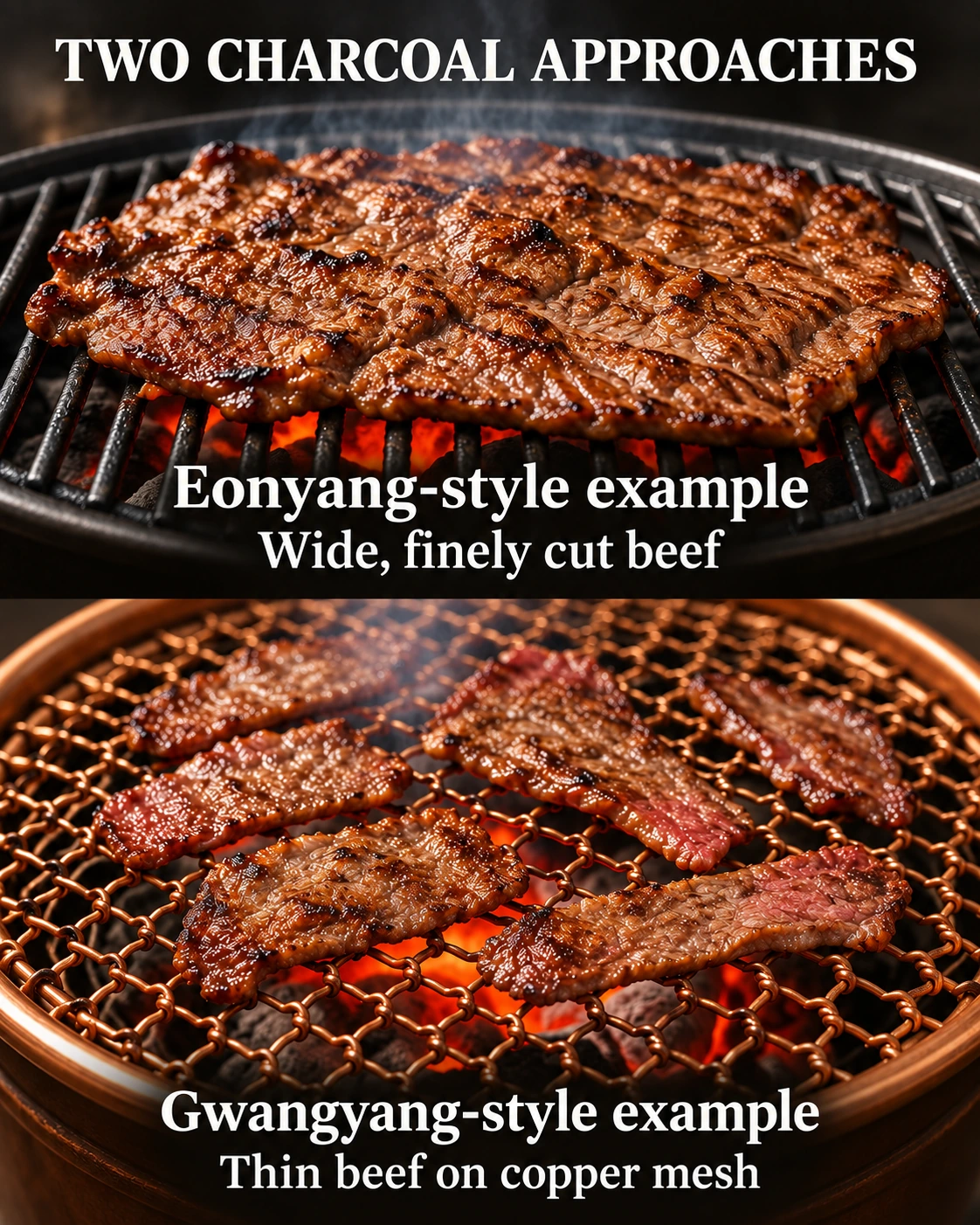
A specific restaurant example makes the cooking easier to picture. The Korea Tourism Organization describes Eonyang Giwajip Bulgogi as seasoned, finely cut beef grilled over charcoal into a wide, flat form. Its description places a gridiron, vegetables and seasoned green onions around that meal.
Instead of imagining a bowl of separate beef strips, imagine cutting or separating portions from a broader grilled form. The edges, surface and interior become useful things to notice. You can compare the beef first, then a wrap with the green-onion accompaniment.
This is one documented restaurant’s preparation, not a rule about the exact chopping or seasoning in every Eonyang-style establishment. The regional name gives you a promising question to ask: will this arrive as a broad grilled portion, and how does the kitchen serve it?
Gwangyang’s copper mesh carries a family memory
Gwangyang’s charcoal-grilled bulgogi brings attention to thin beef and a mesh grill. Its story also includes people remembering how home cooking became a restaurant trade.
On Gwangyang City’s profile of Samdae Gwangyang Bulgogijip, the establishment states that its business began in 1930. The profile reproduces writer Ju Dong-hu’s recollection of eating seasoned meat over charcoal on a copper mesh and later seeing that familiar preparation commercialized.
Ju remembered Lee Yeong-jo’s restaurant activity in the late 1960s as important to its spread. The profile also describes cooking knowledge passing within the family. That recollection is valuable precisely as a memory of a local food becoming a business; it is not conclusive proof that one person invented all Gwangyang bulgogi.
For the diner, the mesh is a clue to the experience. Thin meat can be laid over the charcoal-facing surface without a broth-filled rim becoming the center of the order. Individual pieces and the way they are turned become part of the meal’s rhythm.
You can taste the beef before adding a full wrap to notice the grilled preparation more clearly. Then compare it with rice and the accompaniments actually served. Those two bites reveal more than assuming that a geographic label determines a fixed level of sweetness.
A Seoul kitchen changed the charcoal experience again
Regional methods also travel. A restaurant in Seoul can adapt a grilling tradition without turning it into broth bulgogi.

In MICHELIN Guide’s 2024 direct interview about Yeokjeon Hoegwan, Kim Do-young recalls a change from customers grilling meat at the table to the kitchen grilling it over charcoal briquettes. Smoke and smell had made the earlier arrangement inconvenient. The resulting bassak bulgogi became a preparation customers requested.
The story connects a different texture and presentation with a change in who does the work. A diner receiving a finished plate has a different experience from someone turning thin meat over a tabletop grill.
It also keeps our three-place comparison honest. Seoul has more than one way to serve bulgogi. A city associated with broth can contain a kitchen whose signature is grilled beef.
For someone choosing a meal, “Seoul-style” is therefore more useful as a preparation description than as a guarantee based solely on the restaurant’s address. Ask how the dish is cooked, rather than letting the map answer for the kitchen.
Family dining helped broth bulgogi find its place
Food historians Lee Kyou Jin and Cho Mi Sook examined cookbooks, newspapers and restaurant interviews in The Evolution of Bulgogi over the Past 100 Years, published in 2013. Their research treats grilled and broth bulgogi as related but distinct cooking forms.
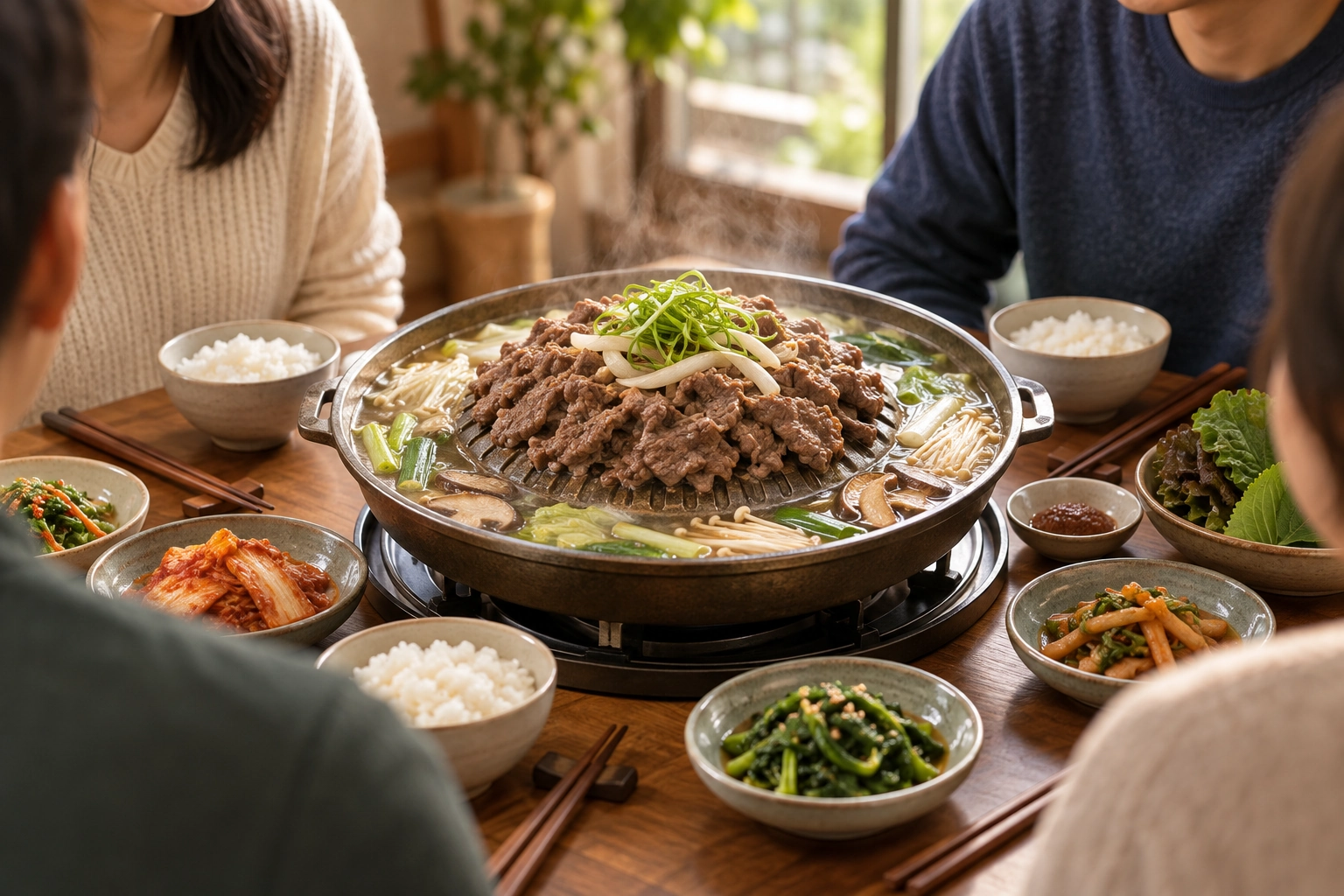
The study includes Hanilkwan owners’ recollections of a shift from large celebrations with full set menus toward smaller family gatherings ordering broth bulgogi as the main dish. It also reports an older Woolaeoak representative’s description of beef prepared without soup. Those accounts resist a simple equation of “Seoul equals broth in every restaurant.”
The historical insight is that the size and organization of a gathering can influence the food placed at its center. A shared pot with accompanying ingredients suits a different arrangement from grilled meat appearing among many courses.
This does not mean every family changed its habits at once. It means that the vessel and menu can preserve evidence of changes in restaurant life.
Choose by the experience you want to compare
For broth bulgogi, look for the relationship between beef, liquid, noodles and rice. For a wide grilled Eonyang-style portion, notice its surface and how it separates into bites. For Gwangyang-style grilling, follow the thin pieces, mesh and charcoal cooking.
Then ask one practical question: is the meal arriving cooked, or will it develop in front of you? That answer helps you understand both the serving and your part in it.
Across the three approaches, seasoned beef becomes more than one kind of meal. The pan, grill and place of cooking carry histories of local trade, family businesses and changing customers. Once you know where to look, those stories are present on the table.