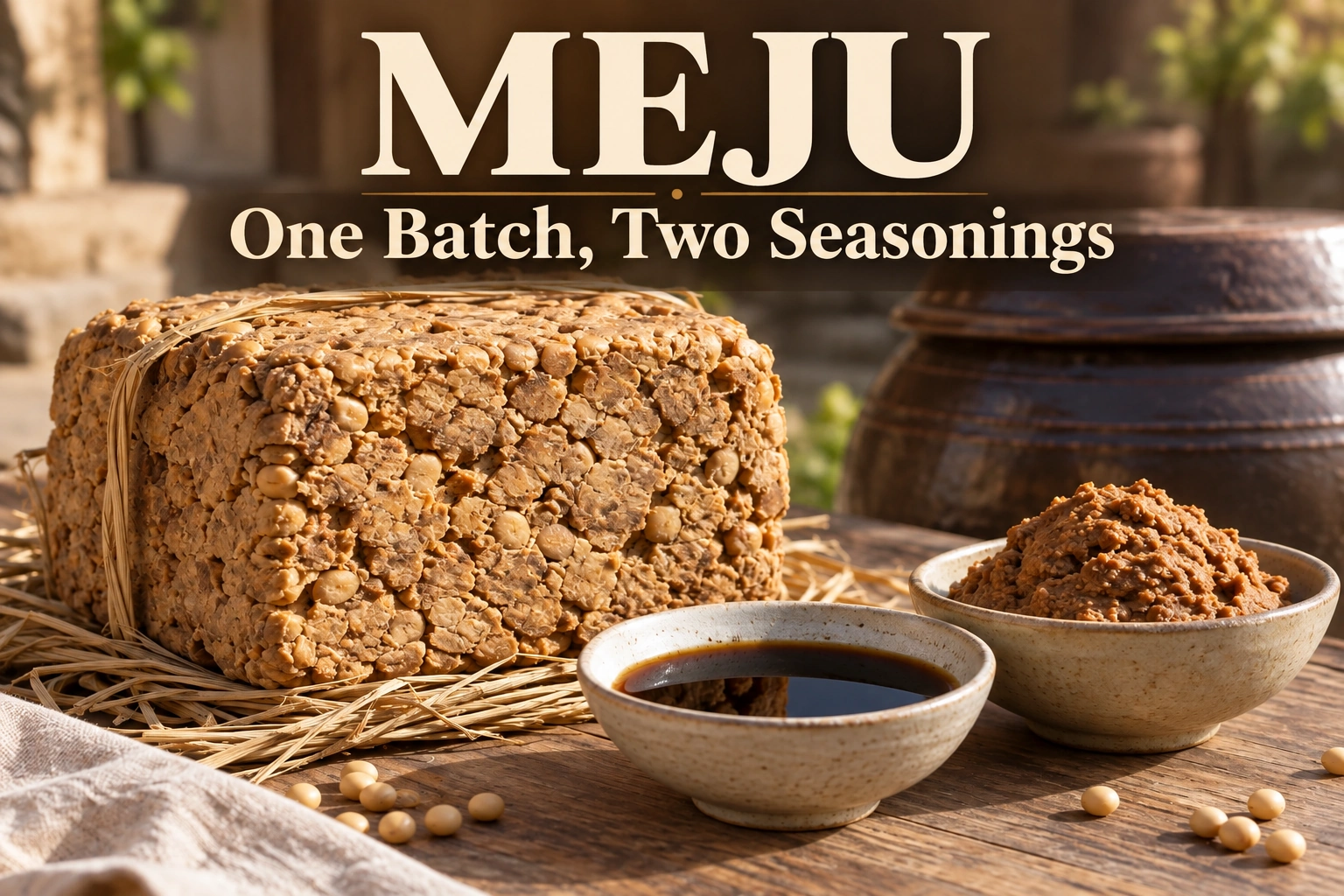
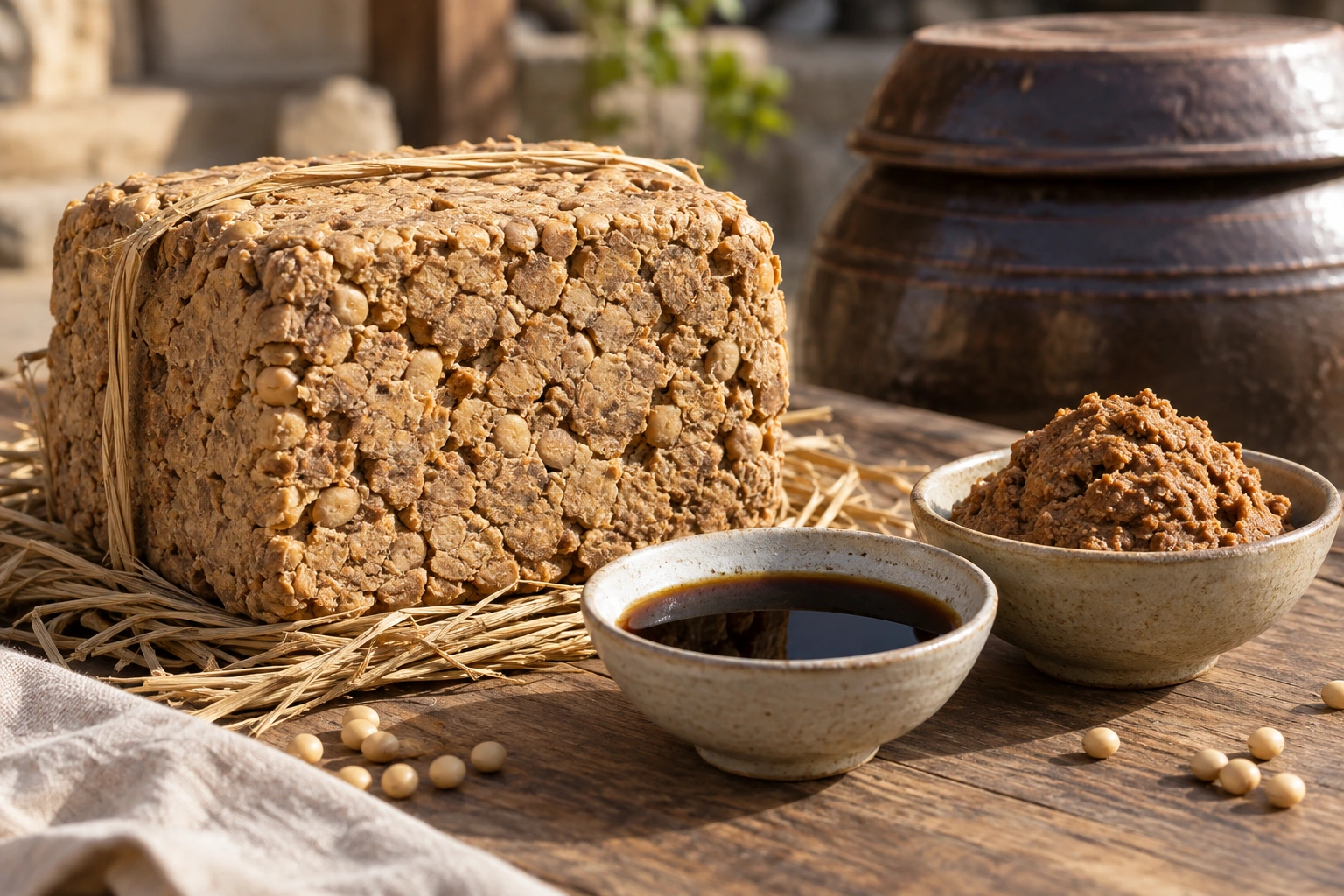
On June 11 in a diary of her own jang-making, Maangchi separated the soybean paste from the liquid that would become soup soy sauce. Her beans had been soaked in January and placed in brine in April. The diary does not mark the paste as ready until December.
Her diary accompanies a recipe first published in 2016 and updated in 2026. Its dates describe her example batch, rather than a universal timetable. Maangchi’s recipe and making diary
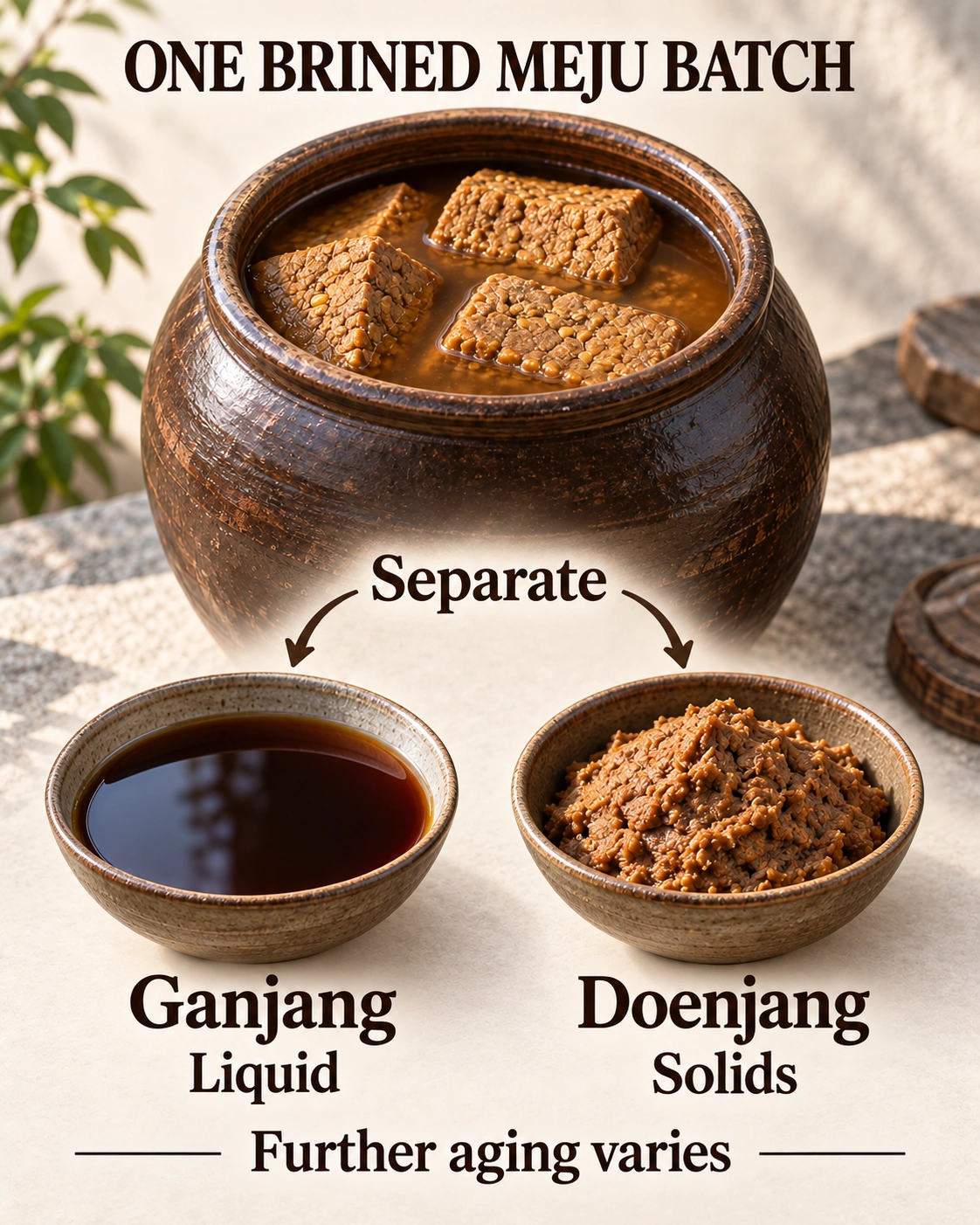
That June separation is the turning point in this story. 된장, doenjang, and 간장, ganjang, may look like unrelated purchases—a tub of paste and a bottle of sauce. In the traditional brined-meju method, they share a beginning before taking different paths.
A soybean block is an intermediate stage
메주, meju, is not simply the finished paste pressed into a brick. A 2018 Korea.net explanation describes boiling and crushing soybeans, forming blocks and drying them before placing them in salted water in an earthenware vessel. After fermentation, the liquid becomes ganjang and the remaining soybean material becomes doenjang. Korea.net’s account of the connected process
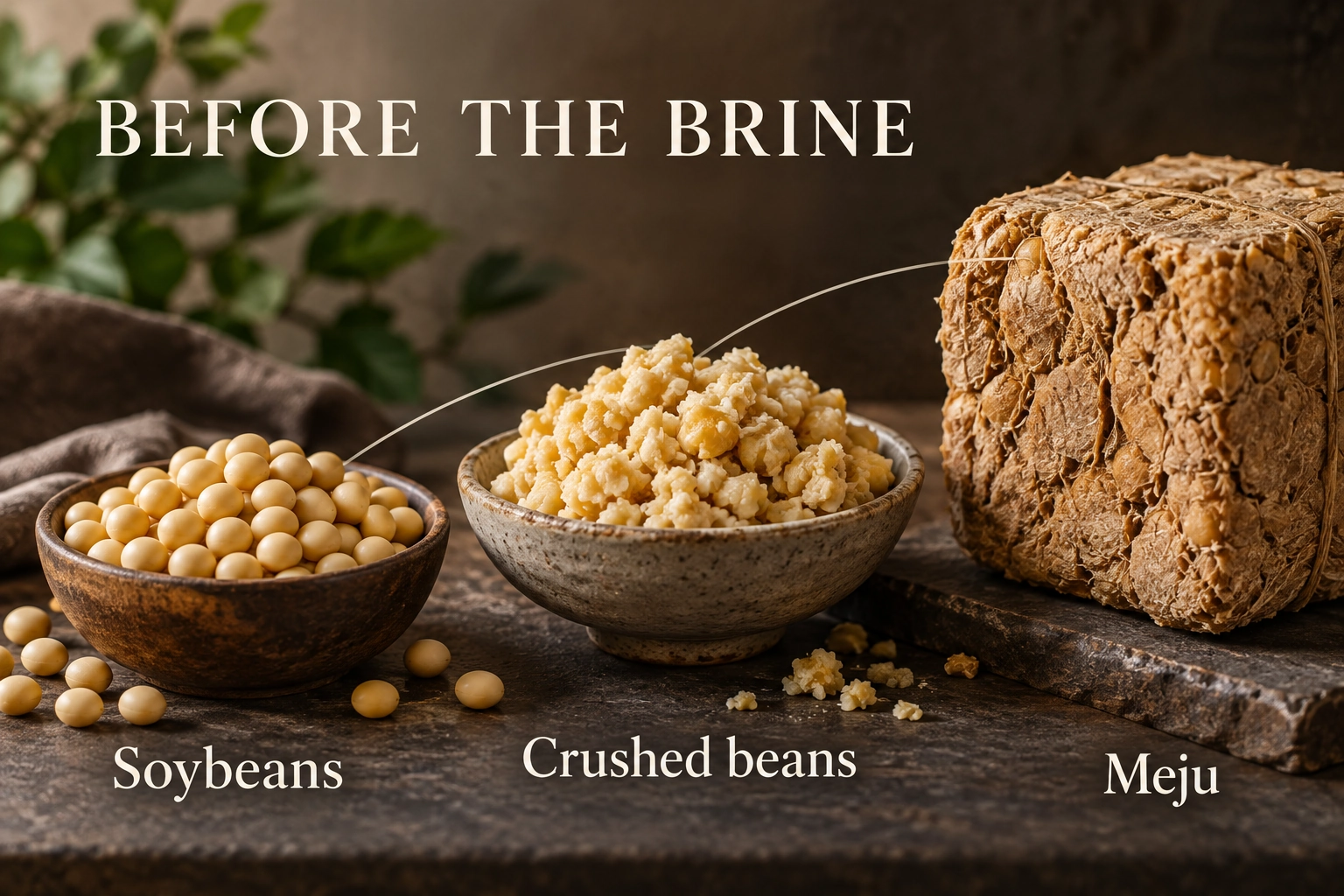
The block is a stage in a longer production sequence. A picture of meju therefore shows work in progress: it does not show the two final seasonings already complete.
Separation starts two further paths
The action called 장 가르기, jang gareugi, divides the brined batch. Maangchi’s diary makes the distinction clear: separation and a paste ready to use are different entries.
For a visitor meeting a maker, this suggests a more revealing question than simply asking how old a jar is: ‘How do you count the age?’ The answer might begin with the soybean preparation, the brining stage or the period after separation. Clarifying the starting point helps you understand the maker’s own description.
Shared beginnings can survive inside a word
A 2022 linguistic study by Kim Ji-suk investigates jang through written records and dialect material. Its abstract describes meanings that include ganjang, the state before ganjang and doenjang are separated, and a collective name for the two seasonings. It also follows jiryeong, a name for soy sauce found in written and regional usage. Kim’s research abstract
That makes the production sequence relevant to language. The category can name something before separation as well as what comes after it. An English translation that chooses “paste” or “sauce” too quickly may miss what the speaker means.
An older cookbook offers another route to paste
The Korean Traditional Knowledge Portal reproduces a doenjang passage attributed to a 1934 copy of Bang Sin-yeong’s Joseon Yori Jebeop. It describes making paste separately, with meju and enough brine to cover it, rather than relying on the material left after drawing soy sauce.
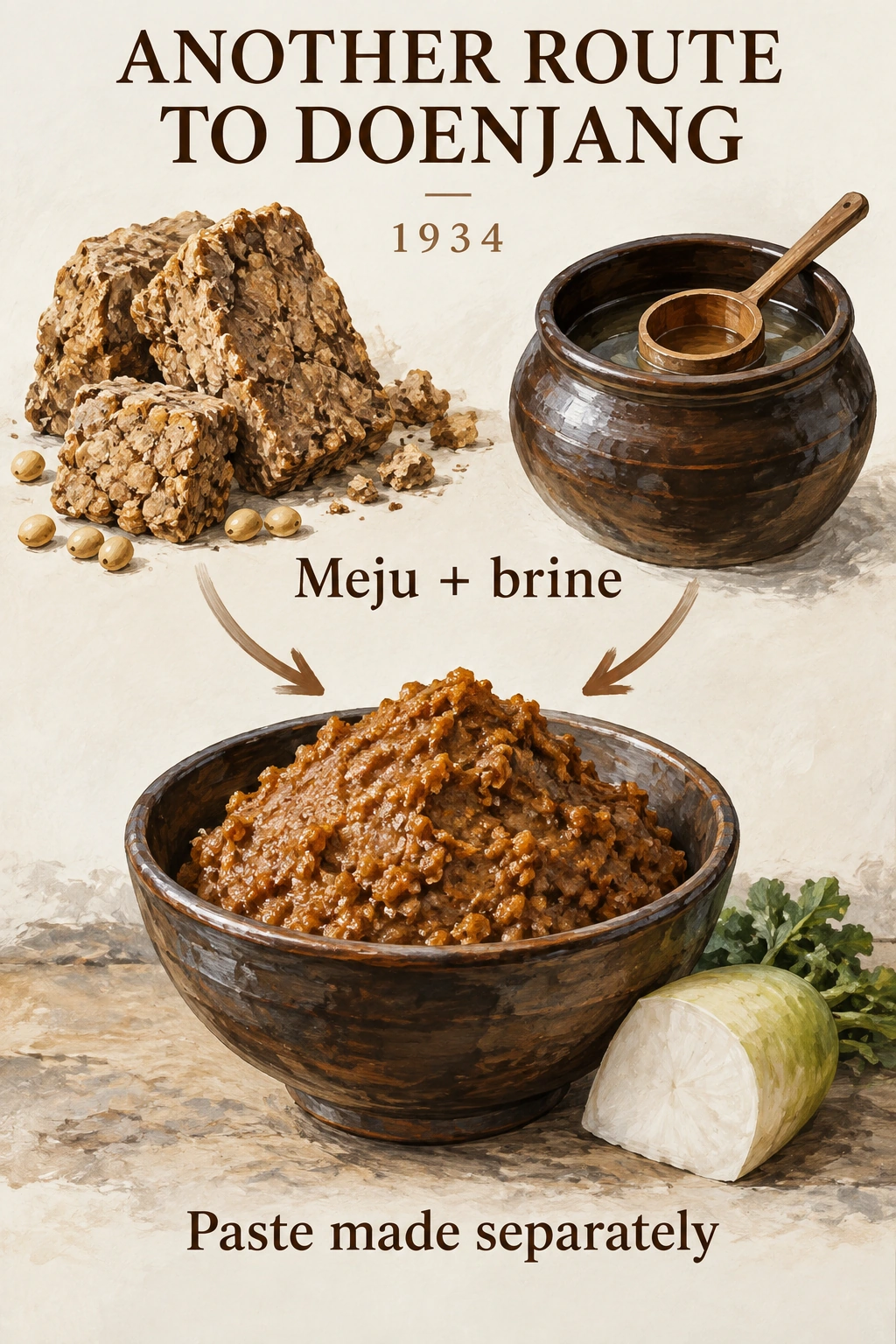
The author explicitly compares that paste with the remainder of soy-sauce making. The passage also describes placing vegetables in the paste. This is a historical text presented with a transcription and translation; it is not a modern, complete home-fermentation protocol. The portal’s cookbook entry
This evidence changes the story in a helpful way. The connected two-product method is important, but it is not a rule by which every other preparation must be judged. A cookbook can preserve alternative ways of directing the same starting material toward a desired result.
A temple survey records variation in practice
Kim Su-beom and Lee Sim-yeol’s 2024 study distributed questionnaires to 117 Buddhist temples. The published abstract reports that 35.9 percent of those surveyed made their own meju. It also describes variation after separation: 40.1 percent boiled the liquid ganjang before storage, while others stored it without that step. Dongguk University’s research record
These figures belong to the study’s surveyed temples. They should not be treated as statistics for all Korean households or as instructions to select a storage method.
Ask a producer what they make in-house and what they obtain elsewhere. Buying meju and making jang are different parts of the supply chain; describing them clearly gives the work its proper credit. Tradition becomes easier to understand when its actual decisions are visible, including the decisions about labor and sourcing. Stories from the wider jang tradition add the perspective of family learning and inheritance.
Bring the history back to the pantry
In her Korean Bapsang pantry guide, Hyosun distinguishes traditional soup soy sauce from other common soy-sauce types. She describes soup soy sauce’s use in soups and seasoned vegetables, while noting that commercial products and ingredient lists vary. Her doenjang discussion likewise identifies products that include additional seasonings or ingredients. Hyosun’s pantry guide
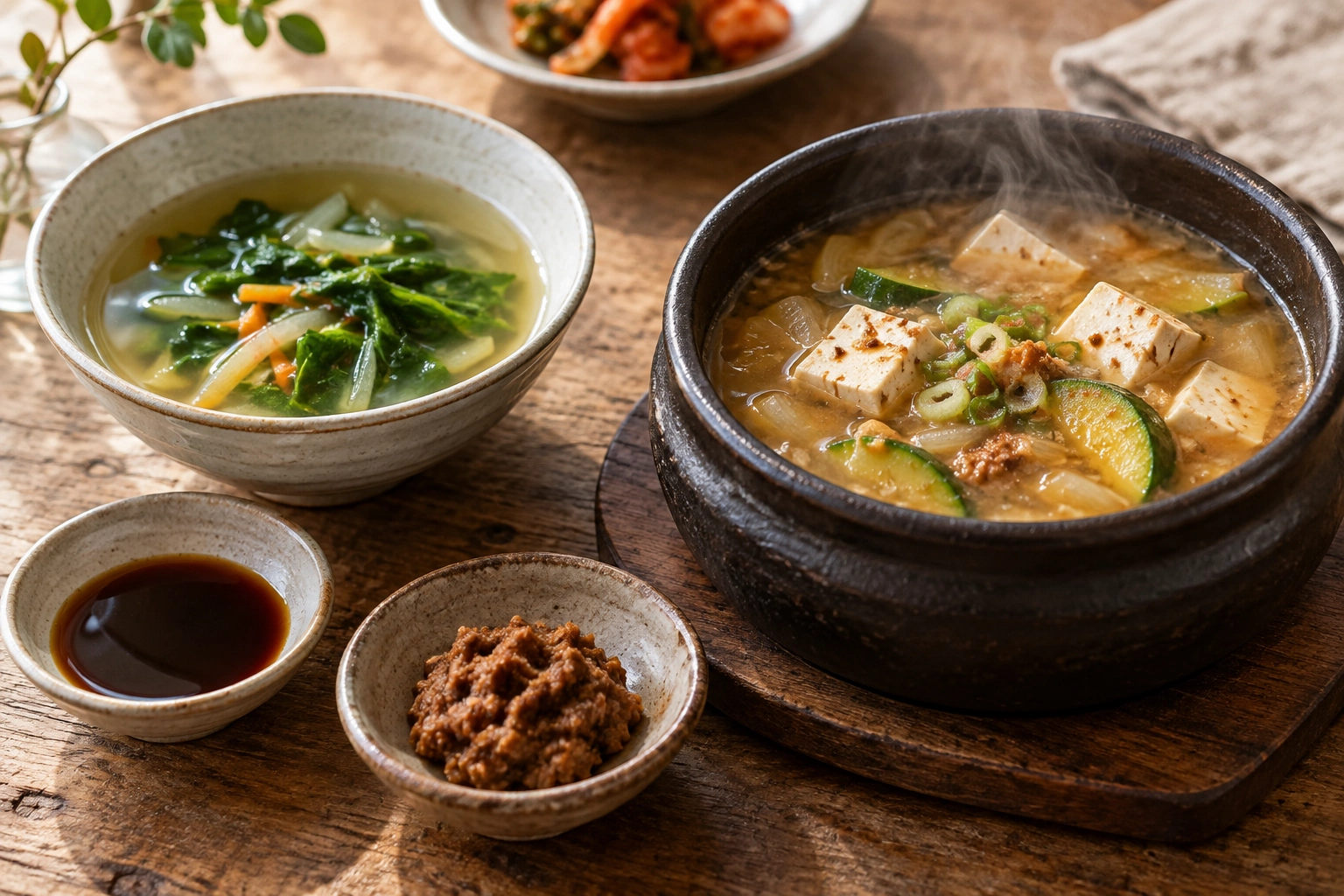
Use that distinction when reading a recipe. Identify the type of seasoning requested, then read the container you actually own. The shared origin of two foods does not make them interchangeable spoon for spoon, nor does one translated label explain every product. The vinegar-and-soy dip alongside mandu puts the same pantry question in a different setting: what should this seasoning contribute to the bite?
An August 2026 ACC webzine report offers a contemporary example of learning through this pantry. Its “Asia Jang Road” course combined a lecture by Lee Jungmin with food prepared by culinary students. Participants Seo Eungyeong and Seo Seunghyeon described discovering more to say about seasonings they usually bought without much thought. ACC’s course report
At a meal, ask your host which seasoning they chose and what they wanted it to contribute. A question about the cook’s intention gives you more to remember than a simple judgment that one jar must be better because it looks older.