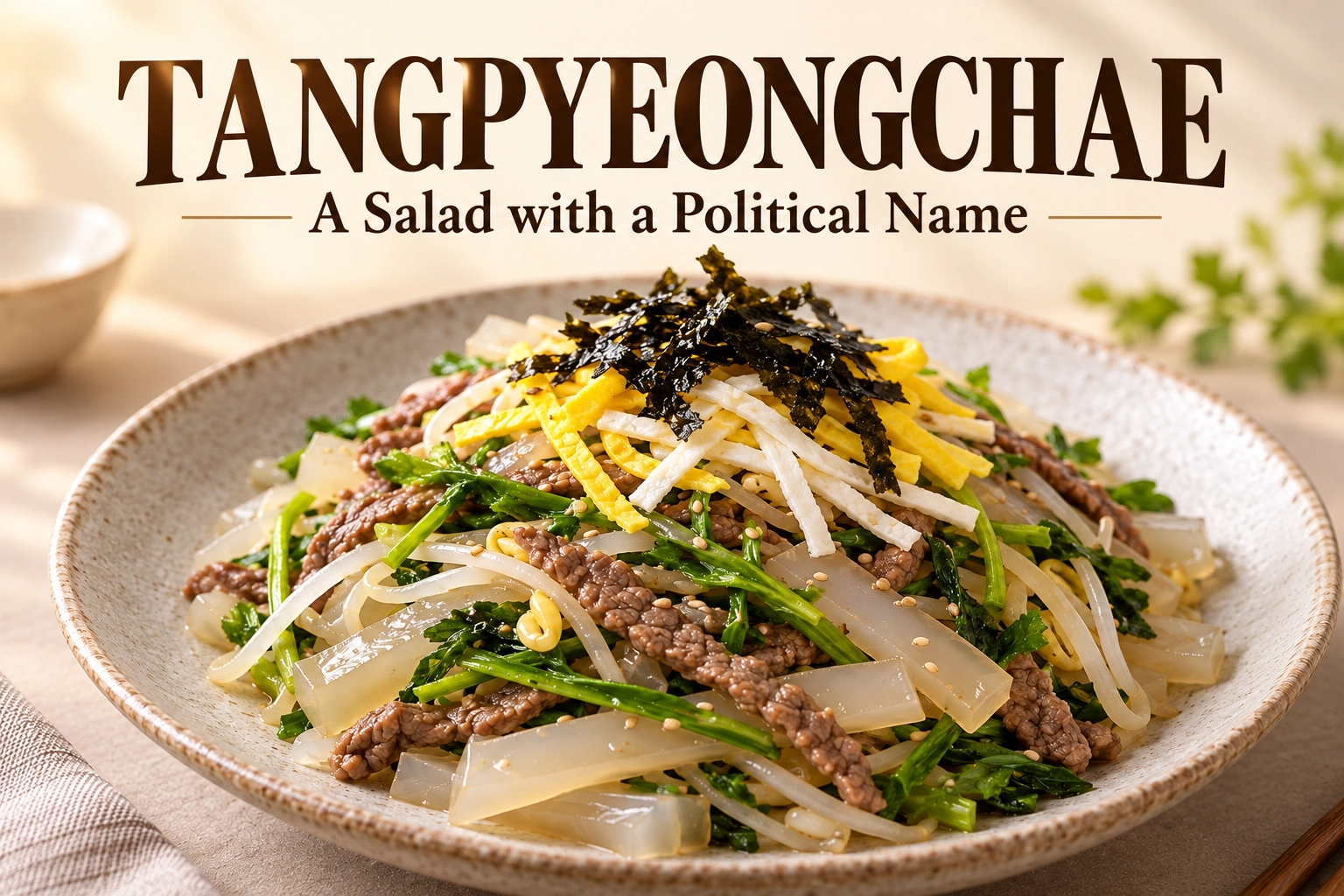
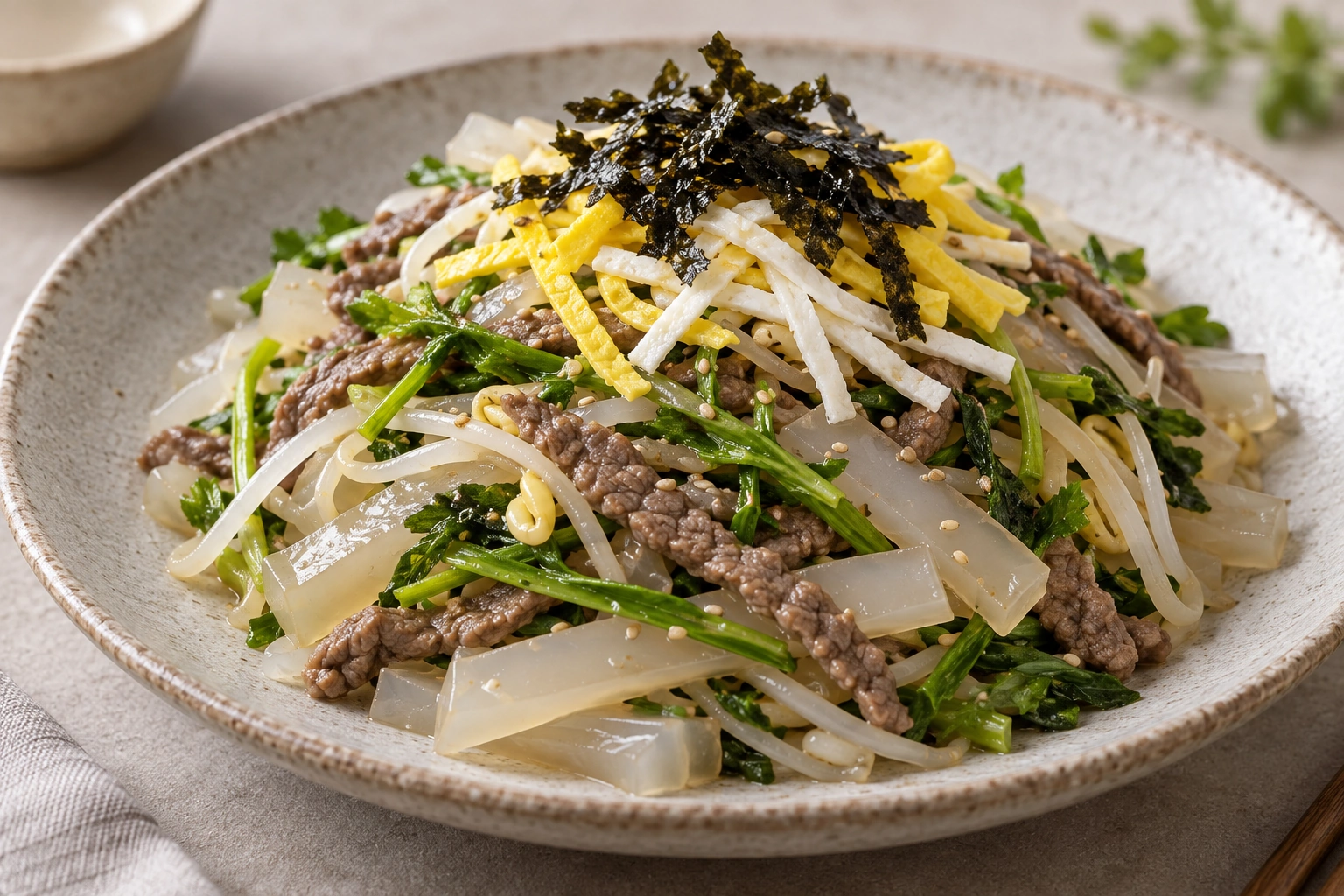
A plate of tangpyeongchae may look like a gentle introduction to Korean food: pale strips of mung-bean jelly, greens, seaweed and meat arranged together. Its name, however, carries an argument about governing. Food scholar Yun Deok-in’s entry in the Academy of Korean Studies encyclopedia connects the name to discussions of King Yeongjo’s policy of cooperation across political factions. Tangpyeongchae — Encyclopedia of Korean Culture
For a diner, that connection makes the salad intriguing. Why would an ideal about political fairness belong to a mixed dish? Following the name leads from a king’s public message to changing recipes, and finally to the quiet work that lets different ingredients share one mouthful.
What does tangpyeongchae mean?
Korea.net’s 2016 presentation explains tangpyeong through an expression about acting impartially rather than taking sides. It presents Yeongjo’s naming of the dish as a way of expressing the harmony he wanted in government. The food combines cheongpomuk, or mung-bean jelly, with ingredients including beef, sprouts, greens, seaweed and egg. Korea.net’s tangpyeongchae introduction
The political association is a useful way to remember an unfamiliar name. Imagine looking at the components on your plate: their shapes and colors remain visible even after they are combined. That offers an accessible image of cooperation without requiring everything to become identical.
This is also a good place to distinguish an inherited naming story from a documented conversation. We can explain the association with Yeongjo without inventing a speech, a precisely dated dinner or the reactions of everyone sitting around it.
Yeongjo’s “harmony” involved real political work
The history behind the metaphor was considerably more difficult than mixing a salad. Historian Lee Geun-ho’s encyclopedia entry describes the formation of a political group supporting Yeongjo’s tangpyeong policy. Its members came from both Noron and Soron backgrounds; figures including Jo Mun-myeong, Song In-myeong, Hong Chi-jung and Kim Jae-ro helped sustain the king’s approach.
The entry also records criticism of this governing circle as its position strengthened. Cooperation across previous affiliations could produce a powerful new group with relationships and interests of its own. Lee Geun-ho on the tangpyeong faction
That complication gives the food story depth. A king’s desired public image, the officials who carried out his policy and the results of governing are different parts of the history.

A message written in stone as well as food
There is a more tangible trace of Yeongjo’s public message: the tangpyeong monument associated with Sungkyunkwan in Seoul. The encyclopedia’s account dates its erection to 1742 and describes an inscription written by the king, adapted from a passage in the Analects.
Its contrast concerns a broadly impartial mind and a narrowly partial one. The monument addressed students at the royal educational institution, extending the message beyond discussions among court officials. Tangpyeongbi — Encyclopedia of Korean Culture
The stone and the salad help explain why a food name can survive as cultural memory. An inscription fixes an argument in words; a named dish gives people another occasion to recall it.
For an overseas reader, this is a satisfying connection between food and a place. The political word on a menu belongs to a larger landscape of learning and royal communication. Recognizing the connection adds meaning without turning your meal into a reenactment of an eighteenth-century banquet.
The recipe has a history of its own
The present-day assortment should not be projected unchanged into every earlier century. In her 2013 thesis, Bo-ram Kim reviewed recipes and food literature from the eighteenth century onward. Her Korean abstract describes many nineteenth-century preparations centered on jelly, meat and minari, with pork used as the meat.
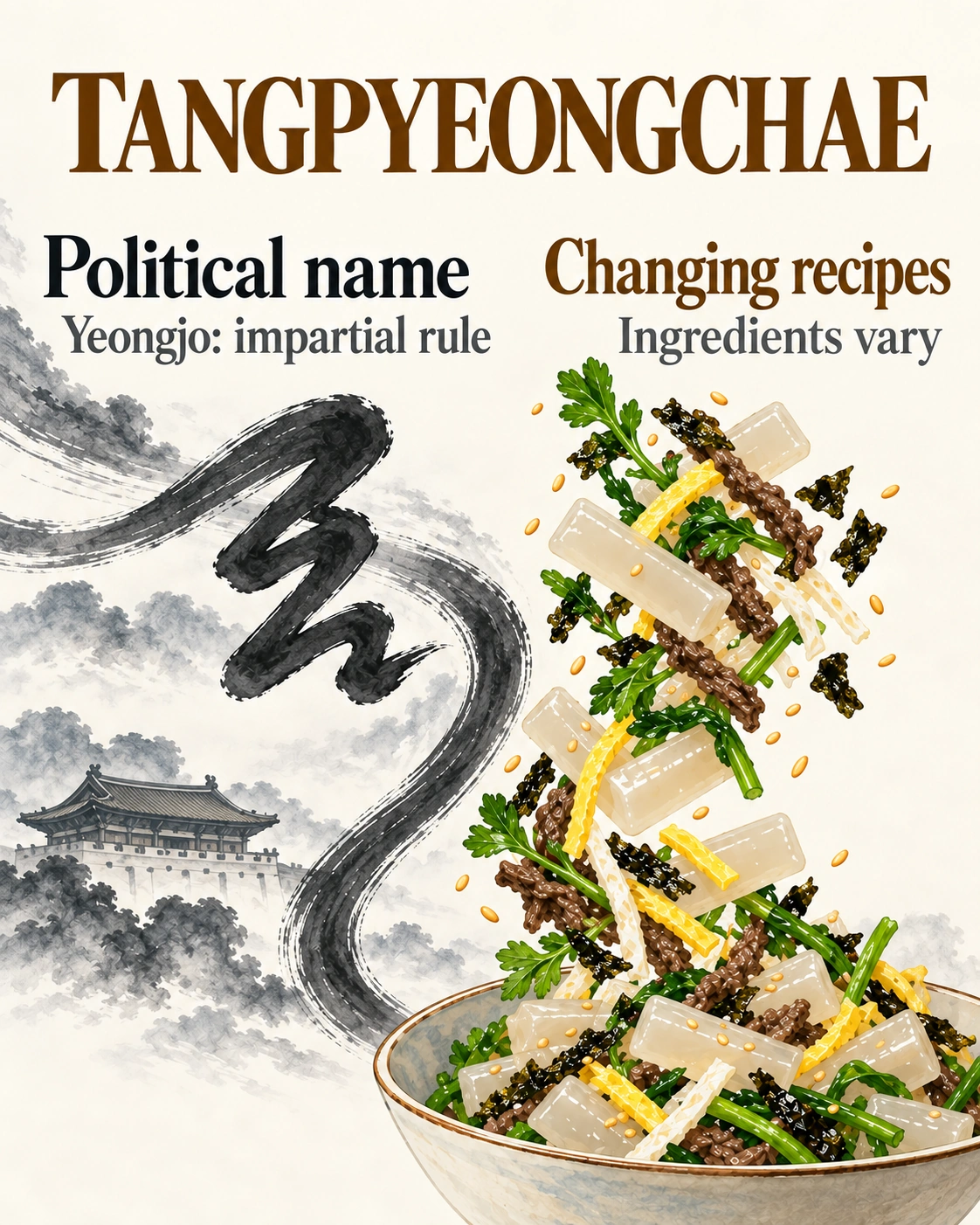
She also identifies later variations, including yellow daylily and wood-ear mushrooms in Joseon Yori Jebeop, and a broadly recurring modern combination of jelly, meat, greens, sprouts, egg and seaweed. The study tracks changing seasoning and assembly methods as well. Bo-ram Kim’s literature-review abstract
These are observations about the texts she compared, rather than proof of the first day anyone ate each ingredient.
The changes are part of the appeal. A dish can keep a recognizable name while cooks alter its composition. Looking for one eternal, compulsory platter would hide the decisions that made its later versions possible.
Color remains an active field of invention
Tangpyeongchae also appears in modern food research. A 2014 study by Choi Ga-ram and colleagues examined contemporary recipes with the aim of standardizing preparation. It explored naturally colored mung-bean gels using ingredients including black sesame, gardenia and omija, in relation to obangsaek, the traditional five-color framework. The researchers’ published abstract
Here, color is something cooks and researchers actively develop. That is different from assuming every historical plate used one fixed set of ingredients or that every color can be securely assigned to a particular political faction.
For the diner, a useful question is how this particular cook has arranged the dish. Are the colored strips part of the jelly itself, or are the colors supplied by toppings? Does the presentation emphasize separate components or a mixed salad?
Those questions bring the visual story down to the plate in front of you, where it can actually be explored.
The jelly begins with an ingredient shoppers can confuse
The base creates a practical challenge for cooks outside Korea. In a reply to a reader who had bought dried mung-bean powder, Maangchi explains that making the jelly requires mung-bean starch. The other powder is used for bindaetteok, a mung-bean pancake.
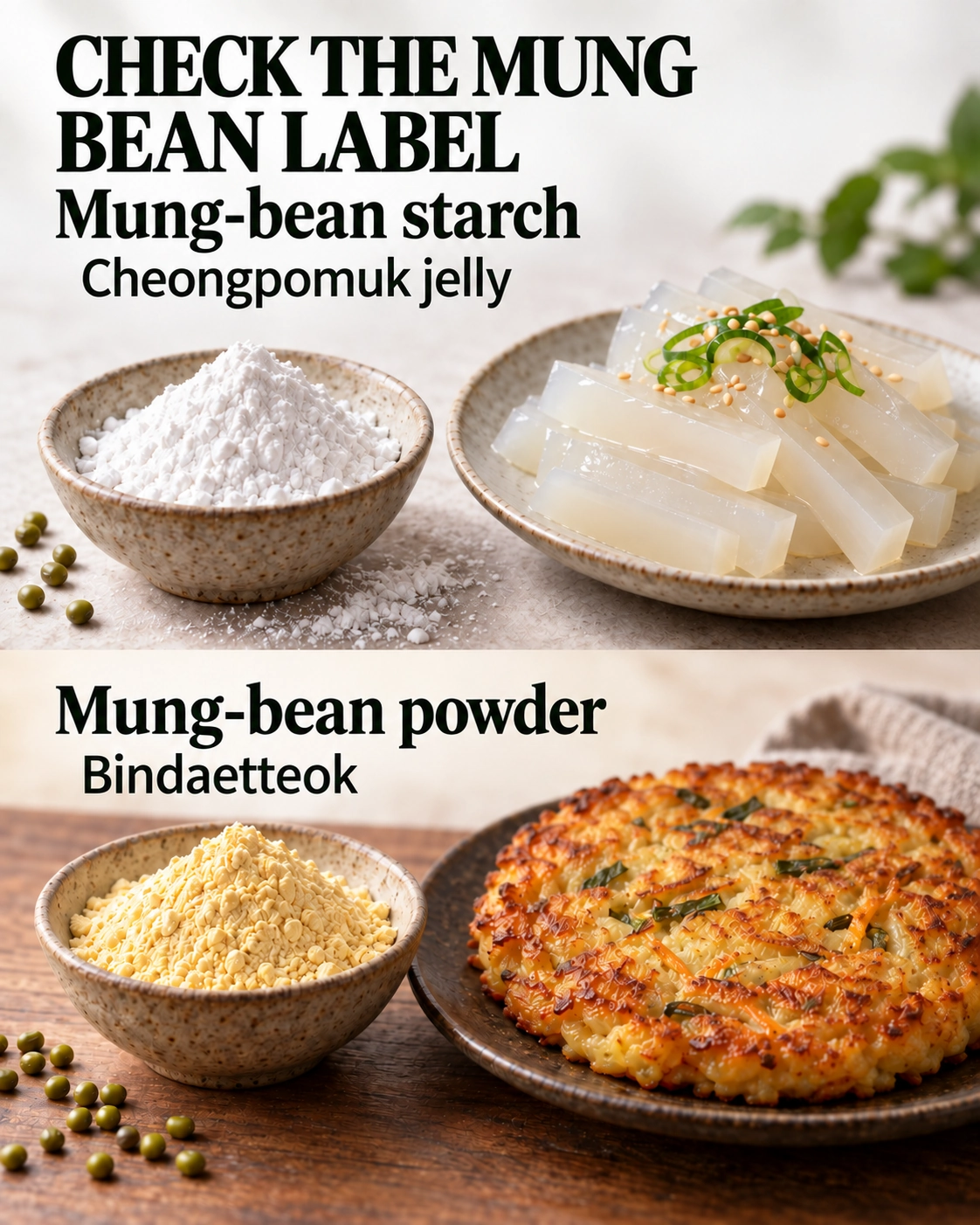
Her cheongpomuk-muchim recipe demonstrates several serving formats, ranging from a large party platter to small appetizer or side-dish portions. Maangchi’s recipe and ingredient clarification
This distinction is useful when a supermarket label says only “mung bean.” Read the ingredient description and establish that the product is intended for making jelly before following a recipe.
It also helps separate the base from the finished dish. Learning to make cheongpomuk gives you a component; tangpyeongchae is one way of arranging that component with others. For a first attempt, keeping those two tasks clear makes both the shopping and the cooking easier to follow.
Harmony on the plate requires separate preparation
Aeri Lee’s 2015 tangpyeongchae recipe shows the work behind an apparently simple mixture. She prepares the jelly, cooks the seasoned beef, makes egg garnish and blanches the greens before bringing them together. The sauce is held separately and added just before serving, with the amount adjusted to taste.
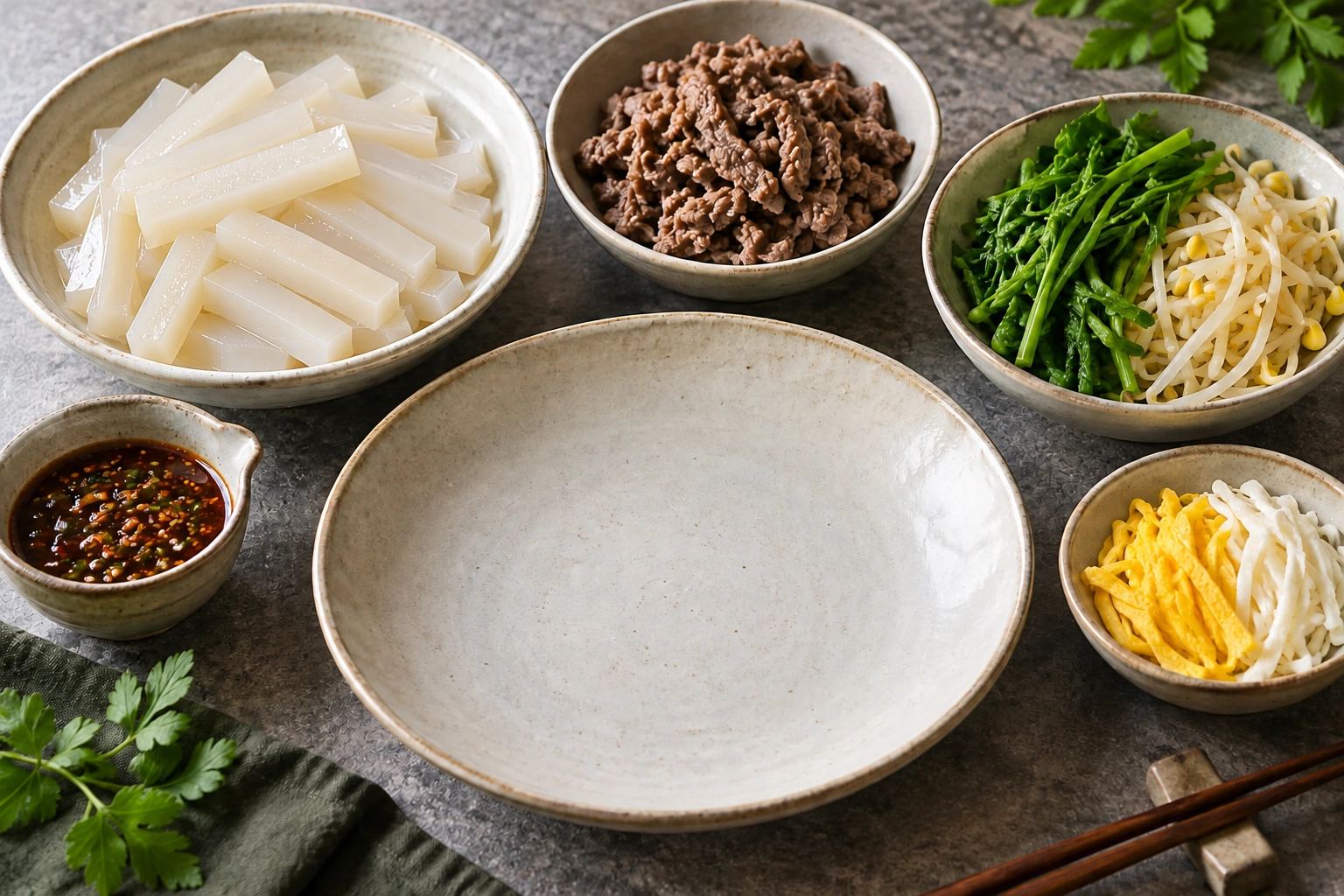
She ends by considering the dish for her coming Lunar New Year meal. Aeri’s own recipe and holiday plan
That personal plan gives the royal-associated food an ordinary destination: somebody’s anticipated celebration at home.
The method also makes the political metaphor more interesting. Combining ingredients takes preparation; putting raw components into one bowl would be a different dish. A cook attends to each part before deciding how they will meet.
When tasting it, try a little of the jelly with different companions, then a combined mouthful. You can judge for yourself what the arrangement contributes.
A seasonal dish with more than one social life
Yun Deok-in’s encyclopedia entry also places tangpyeongchae among foods associated with Samjinnal, the third day of the third lunar month. Alongside its political name, the dish therefore has a seasonal setting. The encyclopedia’s seasonal-food account
A court association, a spring custom and Aeri’s planned holiday meal can coexist. They invite different questions: what a name remembers, when people make the food and whom they want to serve.
If you encounter tangpyeongchae on a menu, ask what accompanies the jelly. The word “salad” alone does not tell you whether a particular version includes meat or egg. Let the restaurant explain its preparation before choosing.
Then enjoy the story at the scale of a mouthful. The ingredients stay distinguishable, the dressing connects them, and an old political word becomes something you can discuss across a table. That continuing conversation is a richer inheritance than an invented royal quotation.