
About an hour south of Seoul, in the city of Cheonan (천안), there’s a little riverside town called Byeongcheon (병천). Its old Korean name is Aunae (아우내), “where the streams meet,” and for most Koreans that name carries real weight: this is where a 16-year-old named Yu Gwan-sun helped lead a huge independence protest in 1919. Come here today, though, and the street is lined with something warmer — steaming cauldrons of Byeongcheon sundae (병천순대), Korea’s most famous blood sausage, ladled into bowls of hot soup at shops that have been at it for half a century.
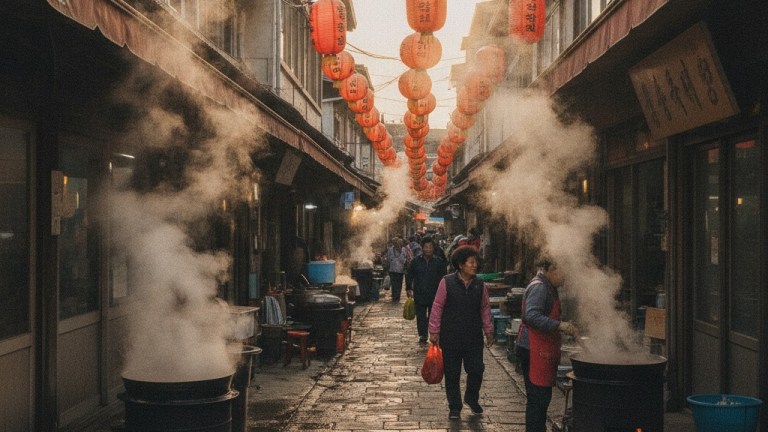
⭐ Byeongcheon (Cheonan) at a glance
| 🏛️ Sights & things to do | ★★★☆☆ |
| 🍜 Food | ★★★★★ |
| 🚆 Easy to reach | ★★★☆☆ |
A personal take from our own visits — how much there is to see nearby, how good the eating is, and how easy it is to get to. Cheonan is a quick train ride from Seoul, but Byeongcheon itself is a small town out east, so you’ll finish the trip by local bus or taxi. The eating is the reason to come; the independence-history sites are a moving bonus. Your own mileage may vary.
New to Korean food? Start with our complete guide to what to eat in Korea.
The short version: Byeongcheon sundae is a Korean blood sausage stuffed into soft pork small-intestine casing, packed with glutinous rice, blood, ground perilla and a lot of vegetables — and going lighter on the glass noodles than the sundae you find in most cities. You eat it two ways: steamed on a plate, or dropped into a hot pork-bone soup with rice, called sundae-gukbap (순대국밥). It grew up at the historic Aunae market and got famous in the 1960s. Here’s what makes it special, and where to eat it.
What to eat in Byeongcheon — sundae, two ways
First, what is sundae? At its simplest it’s a Korean sausage: a casing of cleaned pig intestine, stuffed with a filling and steamed. The cheap version sold at street stalls all over Korea is mostly dangmyeon (당면), springy sweet-potato glass noodles, bound with a little blood. It’s fine, filling, a bit one-note. Byeongcheon sundae is a different animal.
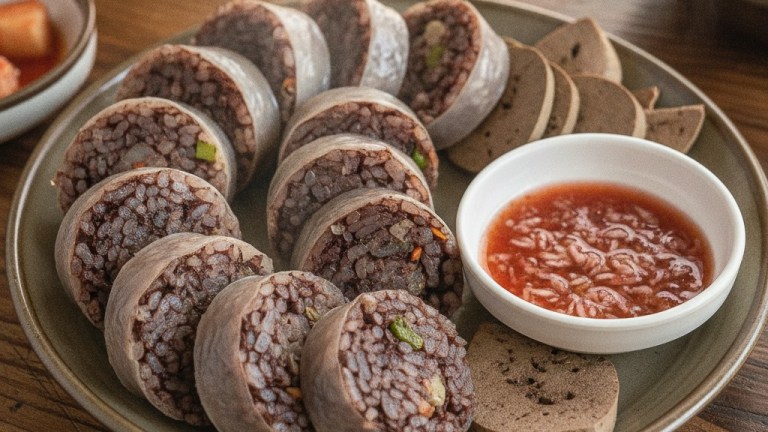
The Byeongcheon style is a proper blood sausage (피순대, pi-sundae). Two things set it apart. The casing is so-chang (소창), the small intestine, the thinnest and softest part, where a lot of places use the chewier large intestine. And the filling is generous and real: pig’s blood (선지, seonji), glutinous rice, ground perilla seed (들깨), onion, scallion, cabbage and other vegetables, with the glass noodles cut way back or left out entirely. Garlic, chives and ginger go in to knock out any off smell. The result is soft rather than rubbery, and the taste is what Koreans call dambaek (담백) — clean, savory, not greasy. It’s the kind of thing that sounds intense on paper and eats surprisingly gently.
On a plate, or in the soup
You’ve got two orders to choose from, and honestly you might want both. A modeum sundae (모듬순대) plate brings the sausage sliced and steamed, usually alongside a few busok (부속) — pieces of boiled liver and other pork offal. You eat it dipped in a little salt, or in a saeu-jeot (salted shrimp) and chili mix. Simple, and it lets the sundae itself do the talking.
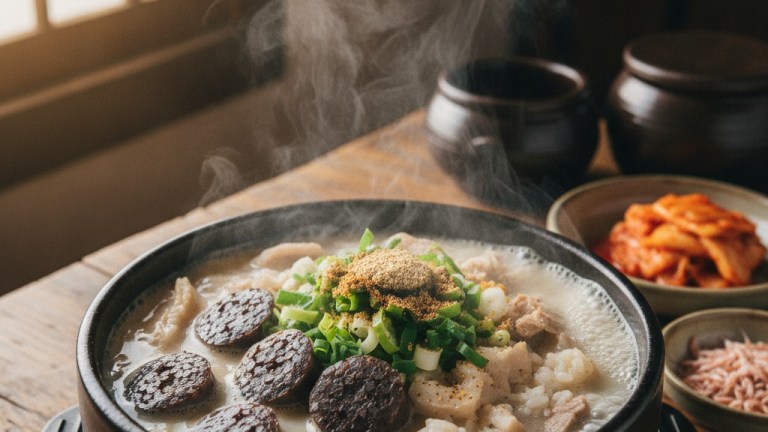
The other order, and the one most people come for, is sundae-gukbap: sundae and rice in a deep, cloudy pork-bone broth simmered for hours. It arrives plain, and you season it yourself at the table with salted shrimp, chili paste, chopped scallion and a spoon of ground perilla, tuning it to whatever you’re in the mood for. On a cold day, in a drafty old shop, it’s about as comforting as Korean food gets. In my experience the move is to split a plate of sundae to start, then have a bowl of gukbap each. You’ll walk out warm.
How a market town’s cheap meal became a national dish
The five-day market at Aunae
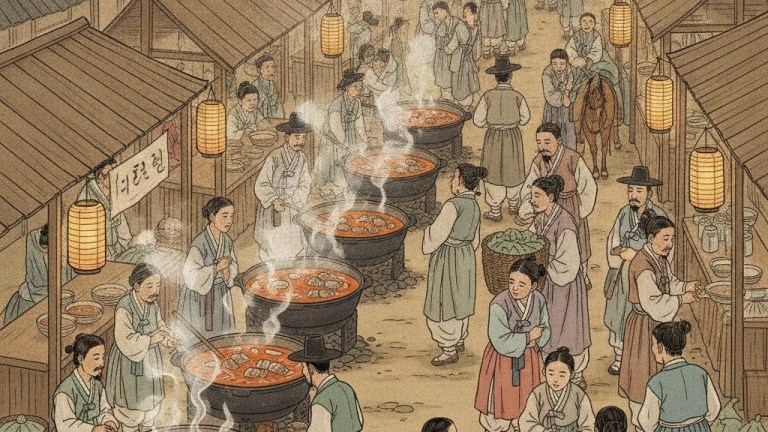
Sundae itself is old. The first Korean recipe shows up in Eumsik dimibang (음식디미방), a cookbook written around 1670. But Byeongcheon’s version is a market story, and the market is the key. Aunae holds a traditional five-day market (오일장) on dates ending in 1 and 6 — a rhythm recorded as far back as a 1779 county gazetteer, and still running today. Byeongcheon sat on the road toward the old Cheonan crossroads, so traders and travelers passed through constantly, and market-day crowds needed cheap, filling, fast food. Few things fit that bill like a hot bowl of sundae soup.
The dish as we know it took off in the 1960s. A pork-processing plant opened in Byeongcheon around then, which meant a steady, cheap supply of fresh intestines and blood, exactly what sundae is built from. Shops that had only sold gukbap on market days started opening more often. One of them, Cheonghwajip (청화집), hung its first proper signboard in 1968, and it’s still going. Word spread, the reputation grew, and by the late 1990s “Byeongcheon sundae” was recognized as a local specialty of Cheonan in its own right.
The name Aunae carries
You can’t really eat here without brushing up against history, and it’s worth knowing why. On April 1, 1919, this same market square was the site of the Aunae independence demonstration led by the teenage patriot Yu Gwan-sun, part of Korea’s nationwide March First Movement against Japanese colonial rule. Thousands gathered; the crackdown was brutal, and around nineteen people died on the spot, Yu Gwan-sun’s own parents among them. She was arrested, imprisoned, and died the next year at seventeen. Today her memorial and birthplace sit just outside town, and the Independence Hall of Korea (독립기념관), the country’s big national history museum, is a short drive away in the same district. So the town you visit for a bowl of soup happens to be one of the more sacred spots on Korea’s map. Locals feel both, and after a plate of sundae, a stop at the memorial makes for a quietly meaningful afternoon.
🗓️ Plan your visit
When: Sundae soup is a year-round comfort, but it hits hardest in the cold months, roughly late autumn through winter. If you like a bit of theater with your trip, time it to a market day — dates ending in 1 and 6 — when Aunae’s five-day market fills the surrounding streets. Late February brings the Aunae torchlight festival (아우내봉화제), which honors the 1919 martyrs.
Getting there: Take a train from Seoul down to Cheonan — the KTX or SRT reaches Cheonan-Asan Station in roughly the better part of an hour, and Line 1 trains also run there more slowly and cheaply. From Cheonan, Byeongcheon is about another 20–30 minutes east by city bus or taxi. From Incheon Airport, plan on a half-day by public transit, so many visitors pick it up as a side trip while touring central Korea.
Costs: This is famously good-value eating — a bowl of sundae-gukbap runs around ten thousand won, and a sharing plate of sundae not much more, which is part of the dish’s whole character. Prices creep up over time, so treat any figure as a guide, and note many shops take cash more happily than cards.
Where to eat Byeongcheon sundae
Byeongcheon’s sundae shops cluster along Chungjeol-ro (충절로) in the old market center, close enough that you can eyeball the crowds and take your pick. Two long-running names to anchor on, and they sit almost directly across the street from each other:
- 📍 Cheonghwajip (청화집): 1749 Chungjeol-ro, Byeongcheon-myeon, Dongnam-gu, Cheonan, Chungcheongnam-do (충남 천안시 동남구 병천면 충절로 1749)
- 🕒 Hours: about 09:00–17:00 on weekdays (opens ~08:30 on weekends), closed Mondays
- 🍲 Sundae-gukbap around 10,000 won, a modeum sundae plate around 15,000 won · in business since 1968 and recognized as a “100-year shop,” it’s the town’s best-known original · a few parking spots out front
- 📍 Chungnamjip Sundae (충남집순대): 1748 Chungjeol-ro, Byeongcheon-myeon, Dongnam-gu, Cheonan (충남 천안시 동남구 병천면 충절로 1748) — roughly 08:00–19:00 daily until sold out; another long-time favorite facing Cheonghwajip, with sundae-gukbap around 10,000 won and a sundae plate around 16,000 won
One honest note: most Byeongcheon shops close in the late afternoon and take a day off during the week, and the popular ones can sell out, so this is a lunch trip, not a late dinner. Hours, closing days and prices shift over time, and there are many good shops on the street beyond these two — a quick check before you go saves a wasted drive.
🔗 More Korean meals worth the trip: graze blood sausage and street food at Seoul’s Gwangjang Market, warm up with a bowl of milky ox-bone soup, seolleongtang, or head east for Gangneung’s seawater-set soft tofu.
A few quick questions
What exactly is Byeongcheon sundae?
It’s a Korean blood sausage from Byeongcheon (Aunae) in Cheonan, made by stuffing soft pork small-intestine casing with pig’s blood, glutinous rice, ground perilla and lots of vegetables, then steaming it. Compared with the common street-stall sundae, it uses far less glass noodle and much more real filling, so it tastes cleaner and less heavy.
How is it different from ordinary sundae?
Two ways. It uses the thin, tender small intestine (소창) rather than the chewier large intestine, and its filling is a proper mix of blood, rice, perilla and vegetables instead of mostly glass noodles. That’s why people describe Byeongcheon sundae as softer and more dambaek, or clean-tasting.
Do I eat it as a soup or on a plate?
Both are classic. A modeum sundae plate is steamed and sliced, often with a little boiled liver, eaten with a salt or salted-shrimp dip. Sundae-gukbap drops the sundae into a hot pork-bone broth with rice, which you season yourself at the table. Many people order a plate to share and a bowl of soup each.
Is Byeongcheon worth the trip from Seoul?
If you’re already touring central Korea, yes. Cheonan is a fast train from Seoul, the sundae is cheap and genuinely distinctive, and the town’s independence-history sites — Yu Gwan-sun’s memorial and the nearby Independence Hall of Korea, make it more than just a food run. For a quick sundae fix alone, Seoul has plenty; the reason to come here is the original, in the place that made it famous.