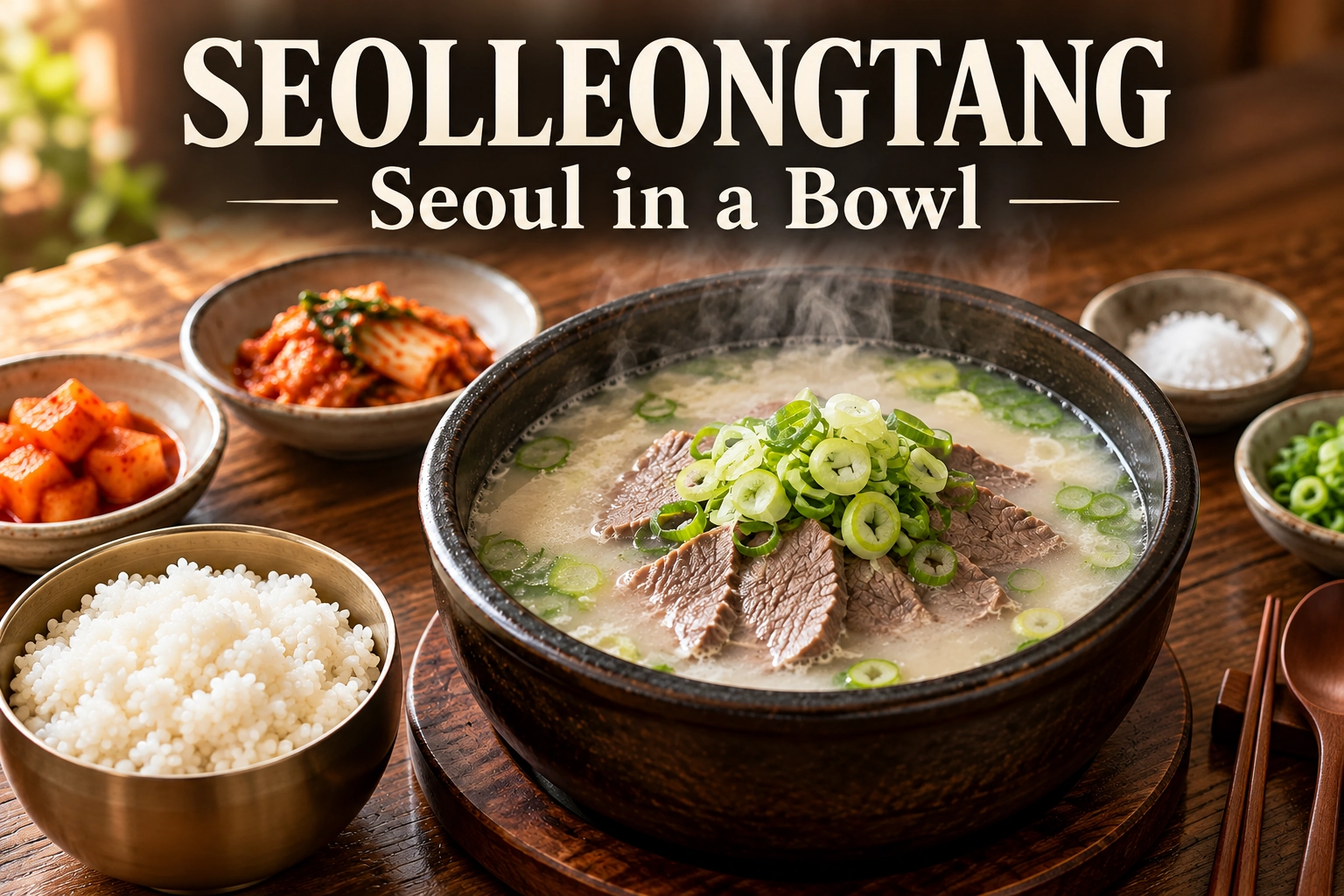
Seolleongtang (설렁탕) is one of Seoul’s most recognizable beef soups: a pale, opaque broth served with beef, rice, green onion, salt, pepper, and usually kimchi or kkakdugi. The bowl often arrives deliberately mild. That is not a flaw in the cooking. It is part of the service design: the diner finishes the seasoning at the table.
The history is less tidy than the bowl. Seoul’s own official material preserves two different theories for the name. One connects seolleongtang to Seonnongdan, the royal agricultural altar in eastern Seoul. Another links the word to shullu, described by Seoul as a Yuan-dynasty term for meat soup. Rather than forcing one theory into a settled origin story, the more interesting history begins with what can actually be documented: an early twentieth-century restaurant tradition, a famous 1924 literary appearance, and a 1929 description of seolleongtang as remarkably fast urban food.
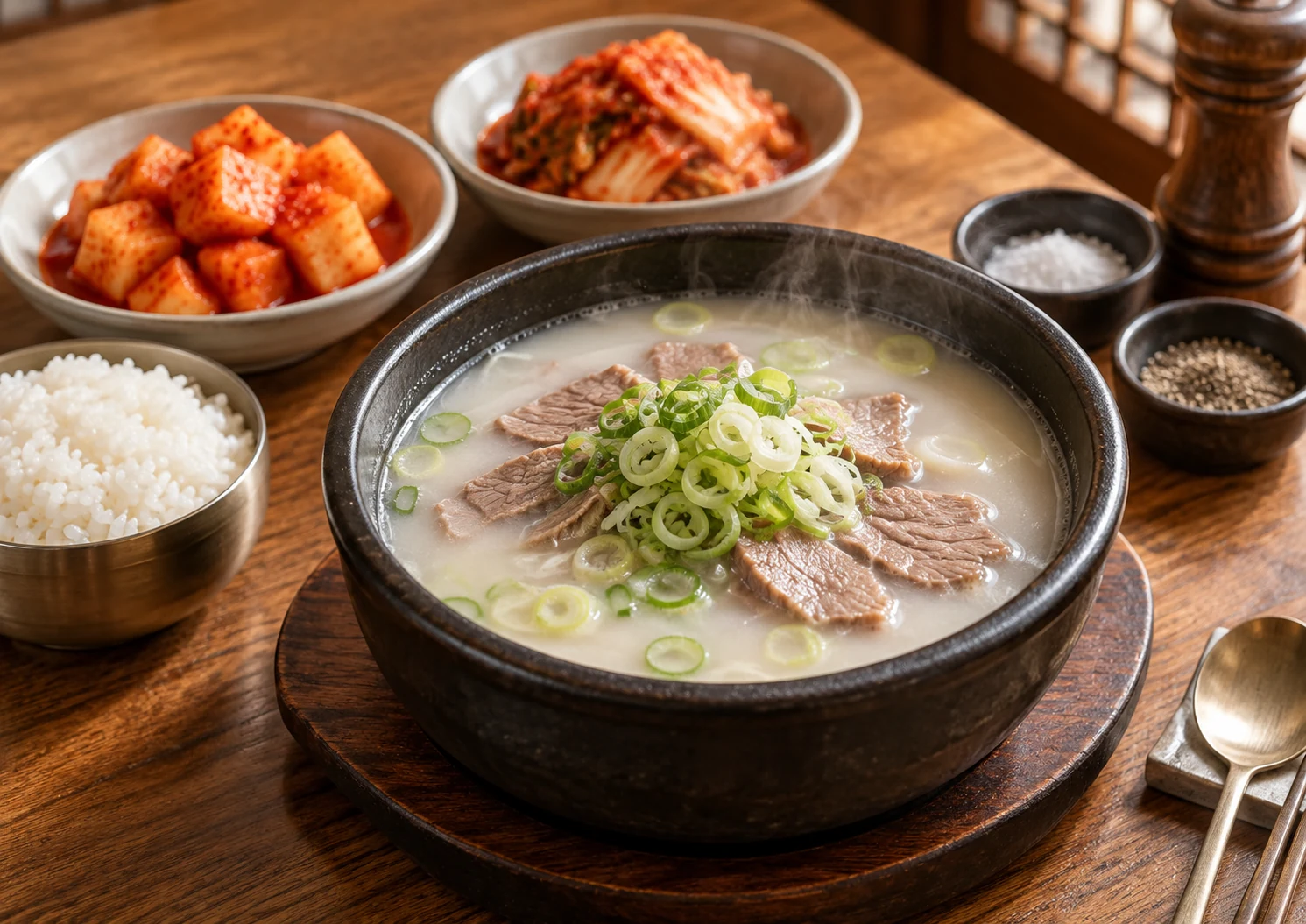
A milky broth with no milk
The white color does not come from dairy. Long boiling extracts fat, protein, collagen-derived material, and tiny particles from bones and meat. When heat and movement keep those components dispersed through the liquid, the broth scatters light and looks cloudy or milky instead of clear.
This is why “seolleongtang is boiled for exactly twelve hours” is too rigid. Long extraction is characteristic, but kitchens vary in equipment, batch size, bone-to-meat ratio, temperature, replenishment, and how vigorously the stock moves. A clear stock and an opaque seolleongtang-style broth are not separated by a magic number of hours. They are separated by cooking conditions as well as time.

Two origin theories, neither of which should be treated as proven
The best-known explanation links the soup to Seonnongdan (선농단), where Joseon kings conducted agricultural rites. A Seoul Metropolitan Government feature from 2013 says there are several theories about the name and presents the Seonnongdan explanation as the most plausible among them. In this tradition, food associated with the rite and shared afterward eventually gave rise to the modern name.
Seoul’s newer “Signature Food” material keeps another theory in view. It says the word may be connected to shullu, a Yuan-dynasty term meaning a delicious meat soup, which gradually changed in Korean usage. The important fact is not that one explanation must defeat the other. The important fact is that official Seoul sources themselves preserve multiple etymologies.
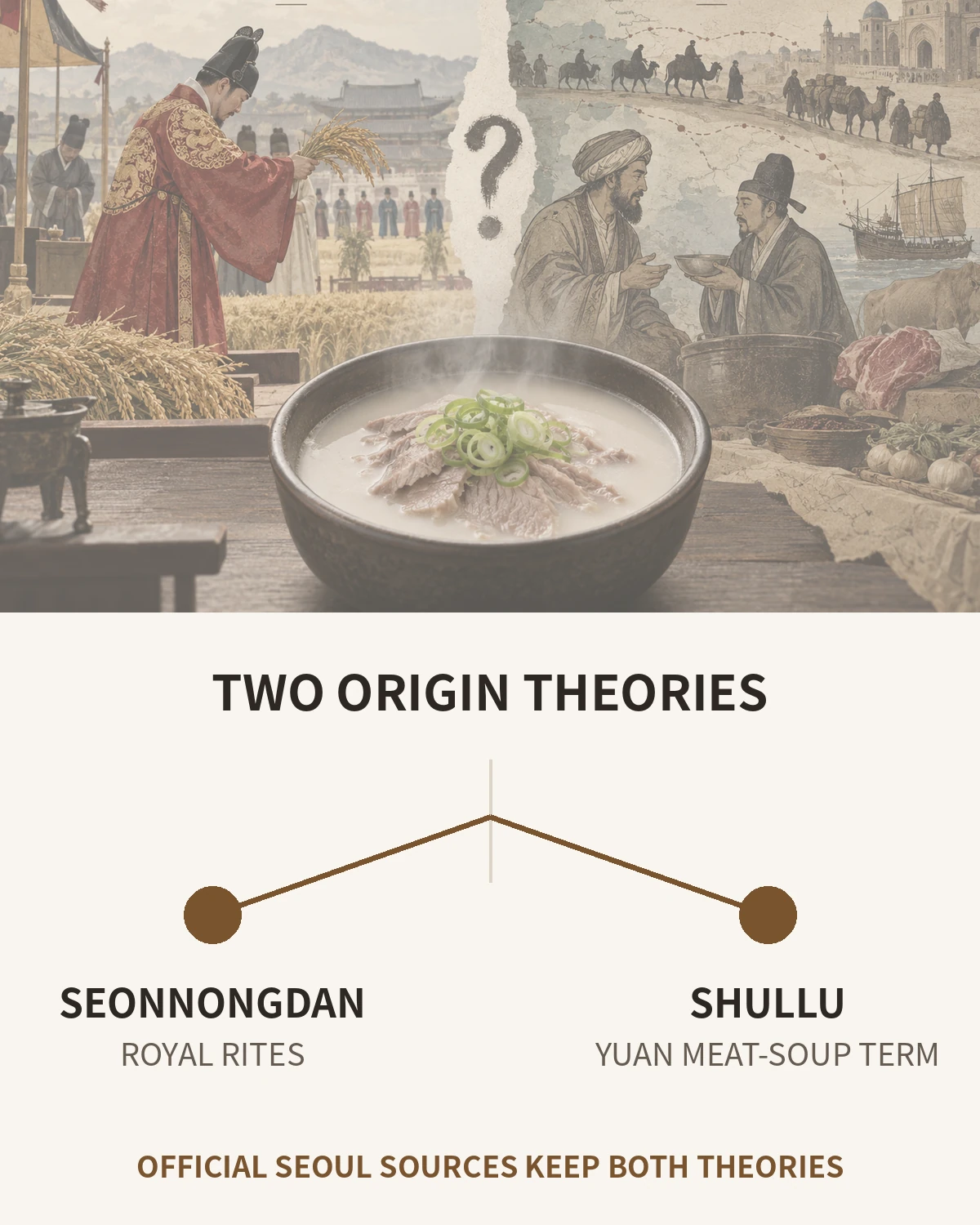
That makes a single-sentence “seolleongtang was invented at Seonnongdan” origin claim too confident. Food names often accumulate stories faster than they accumulate documentary proof.
The stronger history begins in modern Seoul
Once the search for a single origin legend is set aside, the soup’s urban history becomes clearer. Seoul’s official material cites Hyun Jin-geon’s 1924 short story One Lucky Day, where seolleongtang appears without needing explanation. The food already works as something the reader is expected to recognize.
A 1929 account quoted by Seoul is even more revealing. It describes a diner entering, ordering, sitting down, and receiving a steaming pot and rice in under a minute. Seoul explicitly frames this as an old Korean form of “fast food.” That phrase is modern, but the underlying point is historically useful: seolleongtang was not only ceremonial or special-occasion food. It was built for the rhythm of city life.

Why old restaurants matter more than origin legends
Restaurant continuity gives the history a physical address. Seoul Metropolitan Government says Imun Seolnongtang has specialized in the dish since 1904. Visit Seoul currently describes it as one of Seoul’s oldest seolleongtang restaurants and notes that the family has passed the business down from generation to generation since the early 1900s.
That continuity does not mean the kitchen is frozen in time. Seoul’s own 2013 feature notes that the old wooden building and iron cauldron were replaced by a modern concrete building and pressure cooker. This is a useful reminder: culinary continuity does not require identical equipment.
Mapo-ok offers a second long-running Seoul example. Visit Seoul documents it as operating since 1949 for three generations. The point is not to rank the two restaurants. It is to show that “old Seoul seolleongtang” is not one universal recipe. Long-lived houses can differ in broth density, beef cuts, offal, kimchi, noodles, and serving style.
Why the soup arrives under-seasoned
The table completes the bowl. Salt usually does the most important work, followed by scallion and pepper. The right method is simple: taste first, season gradually, and remember that kimchi and radish kimchi add their own salt, acidity, fermentation, and chili.
Rice can stay separate or go into the soup. Keeping it separate preserves the contrast between grain and broth. Adding it creates a softer, starchier bowl. Neither approach needs to be treated as the one authentic method.

Kkakdugi is part of the architecture of the meal
Radish kimchi is not just decoration. Seolleongtang is soft, pale, and restrained; kkakdugi is crisp, sour, salty, and spicy. The pairing works because each provides what the other lacks. That contrast is one reason a visually simple seolleongtang table can still feel complete.
The soup, rice, seasoning dishes, and kimchi should therefore be read as a system rather than as isolated side components. The meal’s pleasure comes from moving among textures and levels of intensity.
Seolleongtang and gomtang overlap more than neat charts suggest
A common beginner rule says seolleongtang is always white bone broth while gomtang is always clear meat broth. That is useful as a first orientation, but it becomes misleading when treated as a strict national standard. Restaurant names and techniques overlap.

What a first-time diner should expect
The first surprise is usually the restraint. A visitor expecting a heavily salted beef soup may think the first spoonful tastes unfinished. That is exactly when the table seasoning matters.
The second surprise can be the meat. Depending on the house, a standard or special bowl may include brisket, head meat, tongue, tripe, spleen, or other beef cuts. The third is temperature: soup served in a hot earthenware bowl stays hot for a long time.
For travelers, the useful rule is to separate culinary history from fast-changing restaurant details. If you want a historic house, official Seoul listings for Imun Seollongtang and Mapo-ok are a good starting point. Check current opening hours, holidays, and prices close to your visit instead of relying on an old blog post.
Why seolleongtang is really a story about urban logistics
The 1929 description changes the way the bowl looks. A city meal has to solve practical problems: it must be repeatable, hot, filling, quick to portion, and easy to customize. Seolleongtang fits that logic unusually well. Broth can be produced in volume. Beef can be portioned. Rice and kimchi are ready. The diner completes the salt and scallion balance.
That does not make the soup industrial or impersonal. It explains why it became durable. The bowl could move through a busy restaurant quickly without giving up the feeling of a complete meal.
In that sense, seolleongtang does not need one perfect origin legend. Its stronger story is visible in the documented life of Seoul: a debated name, a century-old restaurant tradition, a literary reference that assumes familiarity, a 1929 account of extraordinary speed, and a serving style that still lets the diner finish the bowl.
Related stories
- Chodang Sundubu: Gangneung’s Soft Tofu and Its Local Brining Tradition
- Seosan-Taean Gaegukji and Baksok Nakji-tang: Two Regional Soup Traditions