
A slice of sundae and a spoonful of sundae-gukbap can contain related ingredients but offer quite different experiences. On the plate, the casing and filling stay in focus. In soup, broth, rice and condiments reshape the whole meal.
Byeongcheon’s reputation is rooted in a recognizable food-street cluster. That regional identity is more useful than treating one recipe, one restaurant or one personal ranking as a rule for everyone.
The filling and casing tell you what you ordered
Sundae (순대) is Korea’s family of stuffed sausages. The familiar modern street-food version often uses a pork casing filled with sweet-potato glass noodles, blood and seasonings, but the category is much broader than one recipe. Fillings can include rice, vegetables, perilla, noodles, blood and other ingredients in different proportions. Casings also vary, as do steaming methods and the way the sausage is held after cooking.
Byeongcheon-style sundae is generally associated with a fuller, softer filling and a strong restaurant culture built around pork sausage and soup. Older guides sometimes reduce the distinction to a rigid formula—small intestine, no noodles, one exact list of vegetables—but that overstates uniformity. The street is a cluster of independent businesses, not one standardized factory recipe.
For a first-time diner, the most useful comparison is not “authentic versus ordinary.” It is plate versus bowl. Sliced sundae lets you focus on casing, filling and seasoning. Sundae-gukbap places the same sausage inside a pork-based broth with rice and often other cuts of meat or offal, turning texture into only one part of a larger soup system.

The first sensation of sundae is often the casing before the filling. Pork intestine has its own collagen-rich structure, and cleaning, thickness and cooking time all affect whether the bite feels delicate, elastic or tough.
Once steamed, the casing should be cooked through but still hold the filling. Too firm and it dominates the bite; too fragile and the slices collapse. Shops can differ because they use different intestine sections, stuffing densities and steaming times. This is one reason it is risky to claim that every Byeongcheon sausage uses one exact casing specification.

The filling then determines the second texture. Rice gives density and softness; glass noodles add spring; chopped vegetables add moisture; ground seeds can change aroma and graininess. Blood contributes color, flavor and binding but does not have to dominate every recipe equally.
A market town becomes a sundae destination
Cheonan’s municipal data distinguishes Byeongcheon Market from Byeongcheon Sundae Street. The market is listed as a traditional market, while the sundae street is separately identified as a specialized commercial street around Aunae Sundae-gil. That distinction is useful because it shows how a general market environment can generate a narrower food district.
On the city page last updated on January 26, 2026, Byeongcheon Sundae Street is listed with 18 businesses. Restaurant counts can change, so that number should be treated as a current municipal snapshot rather than an eternal fact. What is stable is the density: enough sundae specialists operate in a compact area that visitors can reasonably think of the town itself as a destination for the food.

This kind of cluster has economic advantages. Several restaurants selling related dishes create comparison and competition, but they also reinforce the destination. A traveler who would not drive for one unknown shop may travel for a whole street where another option is nearby if the first shop is full. Individual businesses compete for the same customer while collectively strengthening the place name.
Korea Tourism Organization lists Cheonghwajip (청화집) on Byeongcheon Sundae Street and says the restaurant is regarded as the street’s oldest, having opened in 1968. Its menu is notably focused: sundae-gukbap and modeum sundae, or assorted sliced sundae and pork parts.
This gives the local story a useful documentary anchor. A restaurant operating from 1968 is evidence that a recognizable commercial sundae tradition existed in Byeongcheon by that period. It does not automatically prove that all Byeongcheon sundae was invented in 1968, that no earlier market seller existed, or that one shop created every later recipe.
Market food has to solve practical problems. It should be satisfying, reasonably quick to portion, robust enough for repeated service and flexible enough to use ingredients efficiently. Sundae and gukbap fit that environment well.
A sausage can be made in batches, steamed, held and sliced to order. Pork bones and meat trimmings can contribute to a broth. Rice turns the soup into a complete bowl. Kimchi and kkakdugi add acidity, salt and crunch. Diners can adjust seasoning at the table rather than requiring the kitchen to make a separate broth for every preference.
That structure matters more than a romantic claim that the dish was “born because market workers needed energy.” Market workers, traders, residents and visitors all eat. The evidence-backed point is simpler: the format is highly compatible with a market restaurant because it transforms a prepared sausage into either a quick plate or a filling soup meal.
Sliced sundae, soup and Sokcho’s squid version
Order a plate of modeum sundae and the sausage is the center of attention. You can compare casing resistance, the grain or noodle content of the filling, blood flavor, vegetable aroma and how much moisture remains after steaming. Assorted plates may also include boiled pork offal, which adds liver, lung or other textures depending on the restaurant.
In sundae-gukbap, those distinctions are softened by broth. The casing absorbs hot liquid. Fat and seasoning from the soup coat the filling. Rice adds starch and changes the viscosity around each spoonful. Offal becomes part of a mixed bowl rather than a separate bite.
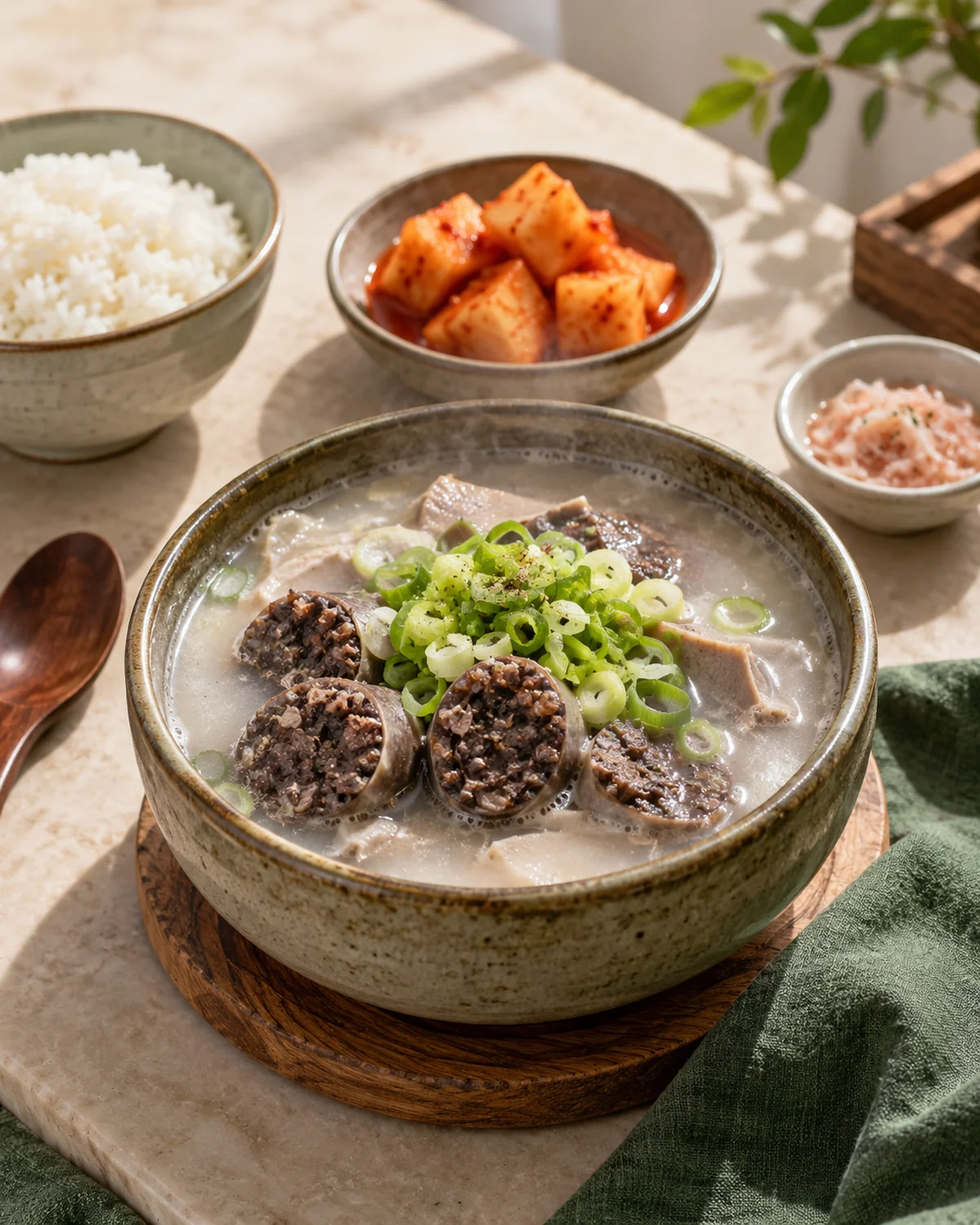
This is why a traveler interested in understanding the style benefits from trying both formats. One isolates the sausage. The other shows the restaurant’s broth, seasoning system and idea of a complete meal.
The word sundae refers to the stuffed-food idea more broadly than one pork sausage. That becomes clear when Byeongcheon is compared with Sokcho’s ojingeo sundae. In Sokcho, a cleaned squid body acts as the casing around a savory filling. In Byeongcheon, pork intestine and pork-based soup culture are central.
The comparison is useful because it prevents the English translation “blood sausage” from becoming too narrow. Many common pork sundae versions do contain blood, but Korean stuffed-food traditions include variations where the casing, filling and regional story change dramatically.
For travelers, this also changes expectation. Ojingeo sundae has a seafood casing and is often sliced as a side or specialty plate. Byeongcheon sundae is deeply integrated with pork gukbap culture.
The broth, salted shrimp and radish kimchi
Korea Tourism Organization describes Cheonghwajip’s sundae-gukbap as a milky soup. A pale or cloudy pork broth does not require dairy. As bones, meat and connective tissues cook, fat droplets, proteins and fine particles disperse into the liquid. Stronger boiling and agitation can keep more of that material suspended, making the broth look opaque.
Not every Byeongcheon shop produces exactly the same color or density. Some broths are heavier and pork-rich; others are cleaner or clearer. A cloudy bowl should therefore be understood as one common restaurant style rather than a rule that defines whether a soup is “real Byeongcheon sundae.”
The broth also arrives less complete than its color may suggest. Many gukbap restaurants expect diners to finish seasoning with salted shrimp, chili seasoning, chopped scallion or perilla powder. That table customization is part of the format.
Saeujeot (새우젓), salted fermented shrimp, is a common pork condiment in Korea. In a sundae-gukbap bowl it provides salinity in a very concentrated form, plus fermented seafood aroma. Because it is powerful, a small amount can shift an entire bowl.
Its role is practical. The base broth can remain relatively restrained, while each diner adjusts salt. Chili seasoning changes heat and color. Ground perilla adds nutty aroma and a slightly thicker mouthfeel. Chopped green onion brings freshness. The result is a soup whose final balance is partly transferred from kitchen to diner.
There is no need to invent a mandatory “local eating order.” Add seasonings gradually, taste after each change and stop when the broth is balanced for you.
Kkakdugi, cubed radish kimchi, is particularly effective with rich pork broth. The radish gives crisp texture against soft sausage and rice, while fermentation brings acidity and chile heat. Cabbage kimchi can play the same balancing role.
Fresh green chili, raw onion or garlic may also appear depending on the restaurant. These should be treated as optional condiments rather than compulsory proof of eating “like a local.” The strongest meal is the one in which the broth, sausage and side dishes remain distinct enough that you can notice each component.
Ordering when offal is unfamiliar
A practical first order for two diners is a sliced sundae plate plus one or two bowls of gukbap. Start with the sausage by itself. That tells you whether you like the casing and filling before the flavor is blended into soup.
If liver or other offal textures are unfamiliar, ask what comes in the assorted plate or soup. Some restaurants may be able to reduce certain pieces, but service policies vary. A clear request is better than assuming “sundae soup” contains only sliced sausage.
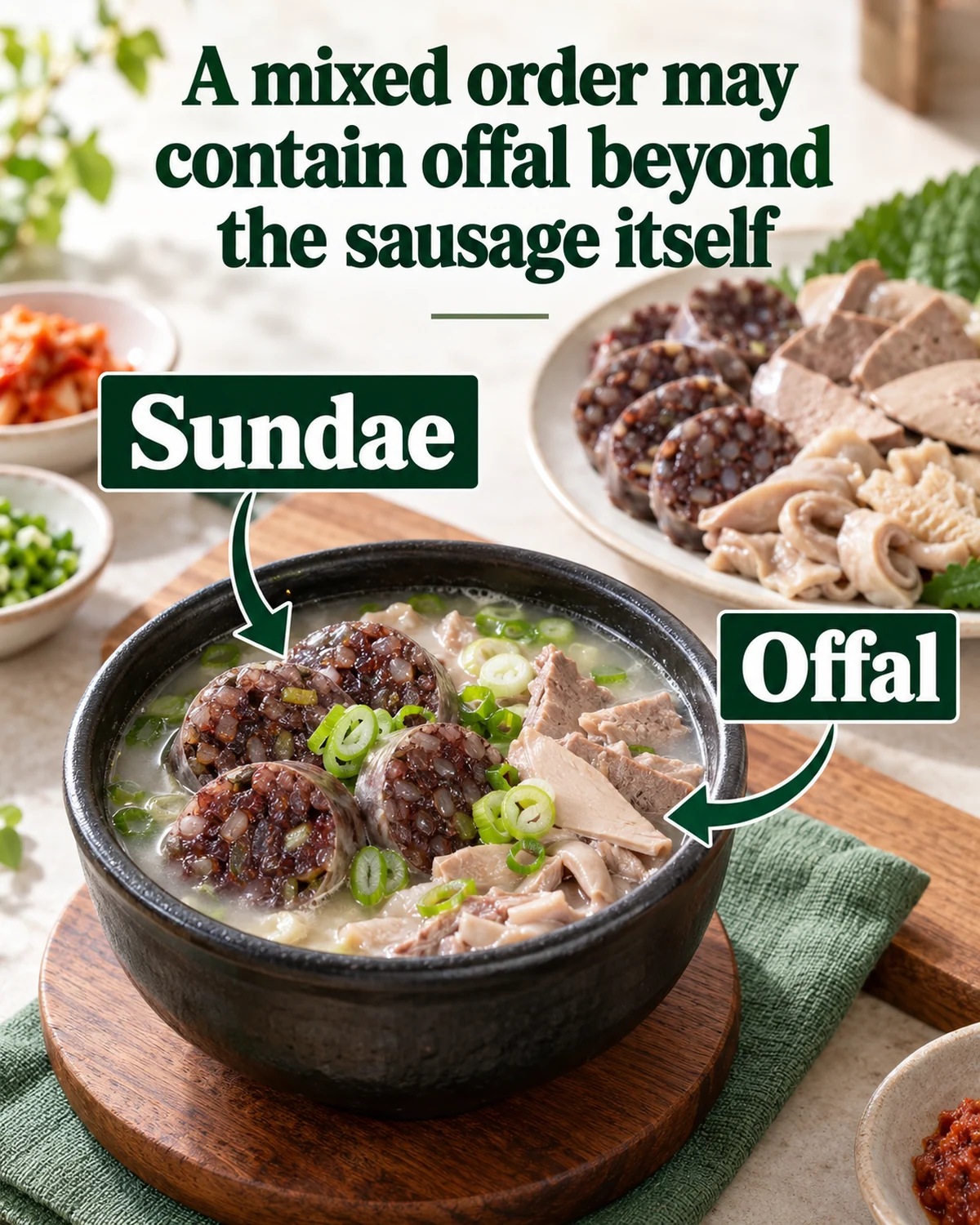
Once the soup arrives, taste the broth before adding salted shrimp or chili paste. The bowl may already be more seasoned than expected. Add condiments in small amounts because both salt and fermented shrimp are difficult to reverse.

Aunae’s history is not a recipe origin date
Byeongcheon is also known by the older local name Aunae and is an important site in Korea’s March First independence-movement history. The 1919 Aunae demonstration associated with Yu Gwan-sun gives the market area national historical significance independent of food.
It is tempting to fuse the two stories too tightly—market history, independence history and sundae history—into one dramatic causal narrative. That should be avoided unless sources actually connect them. The market can be historically important for one reason and later become famous for food for another.
For a visitor, however, the proximity is meaningful at the itinerary level. A food trip can include both a market meal and local historical sites without implying that one caused the other.
Plan the visit and check the ingredients
Restaurant hours, weekly closure days and menu prices can change. The official KTO listing for an individual restaurant is useful close to a trip, but an evergreen history article should not promise that a shop will always open at the same hour years later.
The stable geography is Byeongcheon-myeon in eastern Cheonan, around Byeongcheon Market and Aunae Sundae-gil. Cheonan’s municipal page lists the market and specialty street separately, which makes them easy to identify in current map services. Use current transit and restaurant information on the travel date.
A market day can add atmosphere, but do not build a long-distance itinerary around an old schedule without verifying it. The food street itself operates independently of whether the traditional market is at peak activity that day.
Sundae and sundae-gukbap are pork-based foods and are unsuitable for people avoiding pork for religious, ethical or dietary reasons. Blood is commonly used in many pork sundae fillings, but recipes vary; diners who avoid blood should ask rather than infer from color.
Saeujeot contains shellfish. Broth can contain pork bones, meat, offal and seasonings not visible in the final bowl. People with allergies should ask about broth and condiments, not only the sausage.
These details matter because “sausage” is only one component of the meal. A modeum plate, broth, dipping condiment and kimchi can each introduce separate ingredients.
Taste before seasoning the bowl
Start with what is in the order: sausage alone, sausage with other pork cuts, or a soup containing a particular mixture. A dish name does not settle a diner’s comfort with offal, and a meat-free-looking section of filling is not a vegetarian guarantee. It is easier to make that choice before the bowl arrives than to try to sort out an unwanted ingredient afterwards.
Taste the broth before adding salted shrimp or other strong condiments. Saeujeot changes the salt and aroma; it also remains a shellfish ingredient. Radish kimchi creates another contrast through acidity and crunch. Those roles are worth noticing separately rather than tipping everything into the soup at once.
Two people sharing can compare a suitable platter with soup, but a solo diner does not need both to understand the specialty. In either format, take a bite that includes the casing and center. Comparing Byeongcheon sundae with Sokcho’s squid-filled version then becomes a question about structure and regional context, not a contest over which town owns the entire word sundae.