The History and Culture of Korean Food

Tag: trip to korea

  • What to Eat in Korea: Jeju’s Galchi-jorim (갈치조림) & Galchi-guk (갈치국), Silver Cutlassfish Two Ways

    What to Eat in Korea: Jeju’s Galchi-jorim (갈치조림) & Galchi-guk (갈치국), Silver Cutlassfish Two Ways

    On Jeju Island (제주), the fish that shows up on nearly every dinner table is galchi (갈치) — a long, ribbon-thin, mirror-bright sea fish that English menus call cutlassfish or hairtail. Down in Seogwipo (서귀포), the harbor city on Jeju’s south coast, the line-caught kind glints like polished chrome, and locals turn it into two dishes that couldn’t be more different: galchi-jorim (갈치조림), a fiery red braise, and galchi-guk (갈치국), a clear, gentle soup. Eating them here, a stone’s throw from where the boats land, is the whole point. Galchi doesn’t travel well, and Jeju knows it.

    Seogwipo harbor and blue coastal waters of Jeju Island Korea with volcanic rock and fishing boats
    Seogwipo on Jeju’s south coast — where the silver cutlassfish comes off the boats and straight into the pot.

    ⭐ Seogwipo & Jeju at a glance

    🏛️ Sights & things to do ★★★★★
    🍜 Food ★★★★★
    ✈️ Easy to reach ★★★☆☆

    A personal take from our own trips — how much there is to see, how good the eating is, and how easy the getting there feels. Jeju scores high on almost everything, but it’s an island, so you’re flying in. Your own mileage may vary.

    The short version: Galchi is Jeju’s beloved silver cutlassfish, and the island’s two signature ways with it are galchi-jorim, a spicy braise of thick fish steaks with radish and potato, and galchi-guk, a clean soup simmered with ripe pumpkin and cabbage. The best comes from line-caught eun-galchi (은갈치), the “silver galchi” that keeps its shine. Seogwipo, on the south coast, is the place to eat it. Here’s what to order, why Jeju’s fish is prized, and how to plan the trip.

    What to eat in Seogwipo — galchi two ways

    Most galchi restaurants on Jeju serve the same short lineup, and the two dishes worth crossing the island for sit at opposite ends of the flavor scale. One is loud and red. The other is quiet and clear. Order both if you can.

    Galchi-jorim (갈치조림) — the fiery braise

    Korean galchi-jorim braised cutlassfish in spicy red gochujang sauce with radish and potato in a pan
    Galchi-jorim — thick cutlassfish steaks braised down in a red, spicy sauce with radish and potato.

    This is the one people photograph. Thick cross-cut steaks of galchi are laid over a bed of radish and potato and braised in a sauce built on gochujang (고추장, chili paste), gochugaru (고춧가루, chili flakes), garlic, soy and a little sugar until everything glows a deep brick red. The fish stays silky, the radish drinks up the sauce and turns almost translucent, and the whole pot arrives bubbling.

    Here’s a small history hiding in the flavor: old-style galchi-jorim was a milder, soy-and-radish affair, not the fire-engine red you see today. The chili-heavy version is the modern one, and it’s now what most people mean by the name. In my experience the radish and potato underneath are half the reason to order it — spoon them over rice and you’ve got the best bite on the table.

    One honest note on price: because good galchi is premium fish, jorim usually comes as a shared pot priced for two to four people, not a single serving. It’s a dish you split, ideally over a bowl of the soup below.

    Galchi-guk (갈치국) — the clear soup

    Jeju galchi-guk clear cutlassfish soup with ripe pumpkin and cabbage and green chili in a bowl
    Galchi-guk — a clean, clear soup of fresh cutlassfish with ripe pumpkin, cabbage and green chili.

    If the braise is a shout, the soup is a whisper. To a lot of Jeju people it’s the truer galchi dish. Galchi-guk is startlingly plain: fresh fish steaks dropped into a light broth with neulgeun-hobak (늙은호박, ripe golden pumpkin) and cabbage, a few slices of green chili, seasoned with barely more than salt and soy. No chili paste, no red. What you taste is the fish itself, sweet and clean, with the pumpkin turning the broth faintly golden and soft.

    The pumpkin-and-cabbage version is often called galchi-hobak-guk (갈치호박국, cutlassfish-and-pumpkin soup). In summer cooks lean on cabbage; after the autumn harvest, when ripe pumpkin comes in, they switch to that — and Jeju folk will tell you that autumn galchi with autumn pumpkin is the pairing to beat. Jeju even has a dialect word for the mellow, rounded richness of a good broth like this: bejigeun (베지근하다). It sounds odd to first-timers — a clear fish soup with squash in it — but one spoonful usually converts them.

    Prefer nothing spicy at all? Almost every galchi house also grills the fish as galchi-gui (갈치구이) — a whole silver fillet, salted and crisped, no sauce needed. Between the braise, the soup and the grill, there’s a galchi dish for every kind of eater.

    Why Jeju’s silver galchi is the good stuff

    Illustration of Jeju fishing boats at night with bright lamps line-fishing for silver cutlassfish
    Small boats jigging by lamplight through the night — how Jeju’s prized silver galchi is caught.

    Silver galchi vs. dark galchi

    Not all galchi is equal, and Koreans split it into two grades by how it’s caught. Fish taken by net rub against each other and the mesh, scraping off their scales until the skin looks dark. That’s meok-galchi (먹갈치, “ink galchi”), landed mostly around Mokpo and Yeosu on the mainland. Fish hooked one by one on a line barely get marked, so they keep their bright mirror scales. That’s eun-galchi (은갈치, “silver galchi”), and Jeju is its home. Both eat well, but the intact, gleaming silver of Jeju’s line-caught fish makes it the top grade.

    The catching itself is a sight. Small boats motor out and work through the night, jigging by the glare of bright lamps that draw the fish up — from a distance the fishing grounds off Jeju light up like a floating city. This chae-nakgi (채낚기, hook-and-line) method lands fresher fish than long-line boats, which is exactly why the good galchi houses advertise “line-caught fresh Jeju silver galchi” and charge accordingly.

    A fish worthy of honored guests

    Jeju has a deep soup culture, and galchi-guk sits near the heart of it. On an island where fresh sea fish was everyday food but a truly good galchi still counted as a treat, a clear pot of galchi-guk was the thing you cooked when an important guest came to the house. That “for honored guests” role is why the clean soup, not the flashy braise, is the dish older Jeju cooks talk about with the most pride.

    Season matters, too. Galchi is fished hard from roughly July through October, with the peak landing from late September into mid-October, when the fish are fattest. That autumn timing is no accident in the kitchen — it lines up with the ripe pumpkin harvest, and that is how galchi-hobak-guk became a thing in the first place. Eat it in the autumn and you’re tasting both ingredients at their best, exactly as generations of Jeju households intended.

    🗓️ Plan your visit

    When: Galchi is on menus year-round, but the freshest, fattest fish lands in autumn — roughly late September to mid-October is peak. That’s also ripe-pumpkin season, so it’s the ideal window for galchi-hobak-guk. Jeju is lovely in spring and autumn and busiest in summer.

    Getting there: Jeju is an island, so you fly. From Seoul it’s about a one-hour hop from Gimpo Airport to Jeju International Airport (one of the world’s busiest routes, so flights are frequent). Coming from Incheon Airport, you’ll usually transfer via Gimpo or take a direct Jeju flight where available. From Jeju Airport, Seogwipo is on the far south coast — roughly an hour across the island by car or bus. A rental car makes Jeju far easier, as sights are spread all over.

    Costs: Jeju is a resort destination, so flights and hotels swing a lot with the season — summer and holiday weekends are the priciest, spring and late autumn far gentler. Book ahead in peak season. And budget a little more for galchi itself: it’s premium fish, so a shared pot of galchi-jorim for two to four people runs well above a normal single-bowl meal.

    Where to eat galchi on Jeju

    Galchi houses cluster around Seogwipo and near the big draws on the island’s east side. Two solid, well-known places to start:

    • 📍 Negeori Sikdang (네거리식당), Seogwipo: 20 Seomun-ro 29beon-gil, Seogwipo (제주 서귀포시 서문로29번길 20), by the Seogwipo Maeil Olle Market
    • 🕒 Hours: roughly 07:00–21:40, last order about 20:40 (can change)
    • 🍲 Galchi-jorim (shared pot) ~55,000 won for two, ~65,000 for three · galchi-guk also on the menu · known for line-caught fresh Jeju silver galchi
    • 📍 Buttumak Sikdang (부뚜막식당), Seongsan: 11 Goseong-ojo-ro, Seongsan-eup, Seogwipo (서귀포시 성산읍 고성오조로 11) — near Seongsan Ilchulbong (Sunrise Peak); galchi-jorim ~35,000 (two) / ~55,000 (four), roughly 07:00–20:00

    One honest caveat: galchi is premium seafood, so prices are higher than most Korean comfort food and do drift upward over time — the figures above are a guide, not a promise. Popular houses fill up and hours can shift, so it’s worth calling ahead or checking before you go, especially in peak season.

    🔗 More regional Korean dishes worth the trip: if you like chasing a dish to its home turf, read about chodang sundubu, Gangneung’s seawater-set tofu, the street-food feast at Seoul’s Gwangjang Market, and seolleongtang, Seoul’s milky ox-bone soup.

    A few quick questions

    What does galchi taste like?
    Mild, sweet and clean, with soft white flesh — much gentler than oily fish like mackerel. That’s why it works both ways: it can carry a fiery braise without turning muddy, and it can stand alone in a clear soup where there’s nothing to hide behind.

    Galchi-jorim or galchi-guk — which should I get?
    If you love Korean spice, galchi-jorim is the showstopper. If you want to taste the fish itself, order galchi-guk, the clear pumpkin soup — it’s the dish many Jeju locals rate highest. Best of all, split a jorim pot and add a bowl of the soup to share.

    Why eat galchi on Jeju specifically?
    Galchi doesn’t keep well, so freshness is everything, and Jeju is where the prized line-caught silver galchi (eun-galchi) comes ashore. Eating it near the south-coast harbors of Seogwipo means the fish is about as fresh as it gets — hard to match back on the mainland.
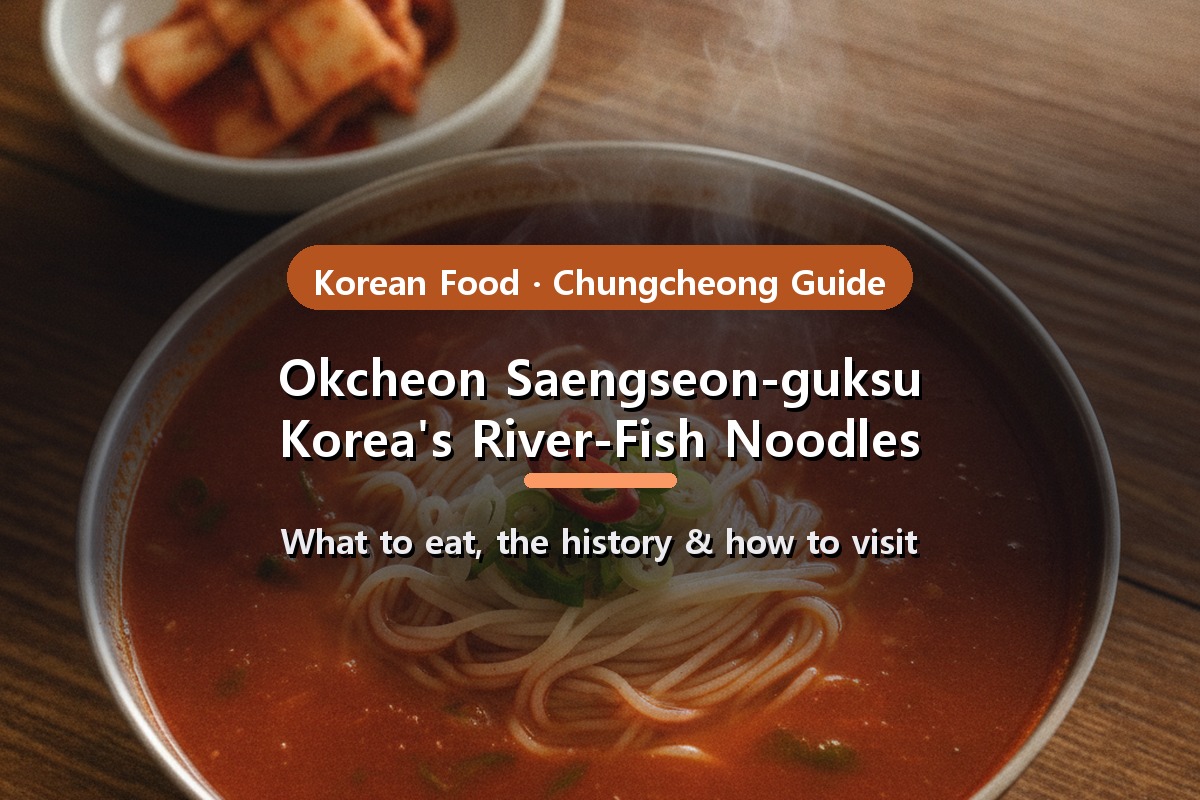
  • What to Eat in Korea: Okcheon’s Saengseon-guksu (생선국수), a Spicy River-Fish Noodle Soup

    What to Eat in Korea: Okcheon’s Saengseon-guksu (생선국수), a Spicy River-Fish Noodle Soup

    Korea’s most surprising noodle bowl might be saengseon-guksu (생선국수) — a spicy soup of river fish, cooked down to nothing and poured over soft noodles. You’ll find it two hours south of Seoul, in a small river town called Cheongsan (청산) in Okcheon County (옥천). There’s no famous palace here, no shopping district — just a quiet lane where a handful of family kitchens have spent sixty years perfecting this one strange, wonderful bowl. If you’ve only ever had Korean noodle soup made from beef or anchovy, saengseon-guksu will surprise you.

    Quiet riverside town of Cheongsan in Okcheon county North Chungcheong Korea with hills and stream
    Cheongsan, a sleepy river town in Okcheon — the unlikely home of Korea’s freshwater fish noodle soup.

    ⭐ Okcheon at a glance

    🏛️ Sights & things to do ★★★☆☆
    🍜 Food ★★★★☆
    🚆 Easy to reach ★★★☆☆

    A personal take based on our own experience — the range of things to see, the food, and how easy it is to get to. Okcheon is a slow, rural detour, not a headline stop; that’s rather the charm. Yours may well differ.

    The short version: Saengseon-guksu is a spicy noodle soup made from freshwater river fish — crucian carp, catfish and the like — simmered for hours until the bones dissolve into a thick, savory broth, then served over thin wheat noodles. Its home is Cheongsan, a river village in Okcheon, where the original shop, Seon-gwang-jip (선광집), has been serving it since 1962. Pair it with dori-baengbaeng-i (도리뱅뱅이), a plate of crisp little fried fish. Here’s what to eat, where saengseon-guksu came from, and how to get there.

    What to eat in Okcheon

    Two dishes carry this town, and they’re almost always ordered together. One is a bowl, one is a plate, and both start with fish pulled from the same rivers.

    Saengseon-guksu (생선국수) — the river-fish noodle soup

    Bowl of Korean saengseon-guksu spicy freshwater fish noodle soup with red broth and thin wheat noodles
    Saengseon-guksu — thin noodles in a deep, brick-red broth cooked entirely from river fish.

    The name is plain. Saengseon means fish, guksu means noodles. But the making is anything but simple. Cooks take a mix of freshwater fish (crucian carp, catfish, skin carp, pale chub) and simmer them for hours until the flesh and even the bones melt down completely. The broth is then strained, so you never actually see a fish in your bowl. What’s left is a thick, ruddy, gochujang-spiced soup with a deep savory backbone and, yes, a faint muddy-river sweetness that locals swear by.

    Into that goes somyeon (소면), the thin wheat noodles. There’s a reason for that. Cooks here say they tried rice, they tried sujebi dough flakes, they tried thick knife-cut noodles, and the delicate somyeon was the one that soaked up the spicy broth best without fighting it. In my experience the first spoonful reads as “spicy fish stew,” and then the noodles turn it into something you can’t stop eating.

    It’s cheap, it’s filling, and it’s the kind of regional dish most Korean city-dwellers have heard of but never actually traveled out to try. That’s exactly why it’s worth the trip.

    Dori-baengbaeng-i (도리뱅뱅이) — the fish you can see

    Dori-baengbaeng-i small freshwater fish fried and arranged in a circle glazed with red gochujang sauce in a pan
    Dori-baengbaeng-i — small river fish fried crisp, fanned into a ring and glazed with sweet-spicy sauce.

    If saengseon-guksu hides its fish, this dish shows them off. Small freshwater fish — pale chub, or smelt in the colder months — are laid out in a neat circle in a shallow pan, fried until crisp, then brushed with a sweet-spicy gochujang glaze. The name comes from the way they’re arranged, fanned round and round (baengbaeng) in the pan.

    You eat them whole, bones and all, like a savory cracker with a chili kick. A plate of dori-baengbaeng-i next to a bowl of saengseon-guksu is the standard Cheongsan order, and honestly the crunch is the perfect foil to the soft noodles. It’s the kind of pairing that makes the long drive out feel earned.

    How river fish became a bowl of noodles

    Illustration of villagers cooking freshwater fish in a large pot by a Korean river in old times
    The dish began as riverside fishing feasts — a pot, a fire, and whatever the stream gave up that day.

    From a riverbank pot to the table

    Okcheon sits in river country. The Bocheong Stream (보청천) runs through Cheongsan, and the wide Daecheong Lake (대청호) and Geum River (금강) are close by, so for generations people here lived off freshwater fish. The old custom was cheollyeop (천렵). A group would head to the riverbank in warm weather, catch crucian carp, catfish and whatever else was biting, hang a pot right there over a wood fire, and boil it all into a rough, hearty stew.

    At first they thickened that pot with rice, closer to a fish porridge called eojuk (어죽). The switch to noodles came later, as people tried different things to bulk the broth out — and the thin somyeon simply won. That riverside pot is the direct ancestor of the saengseon-guksu you order today.

    The shop that started it all

    Saengseon-guksu became a proper restaurant dish in the 1960s, when cheap wheat flour made noodles an everyday food across Korea. Around 1962, a Cheongsan shop called Seon-gwang-jip (선광집) began serving spicy river-fish soup with somyeon in it — and it stuck. Locals credit that little kitchen with turning a fisherman’s stew into the town’s signature dish, seasoned simply with gochujang and nothing fancy.

    What grew up around it is a small food street. Along a lane in Cheongsan, roughly half a dozen family-run shops now cook saengseon-guksu their own slightly different ways — some richer, some spicier, a few sweeter. Fishermen with proper licenses still deliver crucian carp, carp, skin carp and pale chub to the shops every couple of days, so the fish really is local river fish, not a supermarket stand-in.

    A poet’s hometown, too

    There’s one more reason Okcheon holds a soft spot in the Korean imagination. It’s the hometown of Jeong Ji-yong (정지용, born 1902), one of the country’s most beloved modern poets. His most famous poem, “Nostalgia” (향수, first published in 1927), aches for a rural home village of streams and wide fields — the exact kind of countryside you’re driving through to reach the fish noodle shops. His restored birthplace and a small literary museum sit in the old town, and for many Korean visitors a bowl of saengseon-guksu and a stop at the poet’s house make one neat little day trip.

    🗓️ Plan your visit

    When: Saengseon-guksu is served year-round, and the hot, spicy broth is especially good in cool weather. If you can, aim for spring — Cheongsan holds a small fish-noodle-soup festival around April, when the food street is at its liveliest. The town runs on a slow, rural clock, so go earlier in the day; some shops close by mid-afternoon.

    Getting there: Okcheon is in North Chungcheong, roughly two hours south of Seoul. If you’re coming straight from Incheon Airport, plan on about 3.5–4 hours all in — airport rail or bus to Seoul (or Daejeon), then a KTX down. From Seoul it’s roughly an hour by KTX to Daejeon (or straight to Okcheon town), then a local bus or taxi out to Cheongsan, a further rural stretch east. A rental car makes the whole trip far simpler — this is countryside, and buses are infrequent.

    Costs: The meal itself is a bargain — a bowl of saengseon-guksu runs around 8,000 won as of 2026, with dori-baengbaeng-i a bit more. Okcheon isn’t a resort town, so there’s little seasonal price swing; the main “cost” is the travel time out and back, which is why most people fold it into a wider Daejeon or Chungcheong trip.

    Where to eat it — Cheongsan’s fish-noodle street

    The shops all cluster in Cheongsan-myeon (청산면), a short lane of family kitchens. Two are easy places to start.

    • 📍 Seon-gwang-jip (선광집), the original: 26 Jijeon 1-gil, Cheongsan-myeon, Okcheon (충북 옥천군 청산면 지전1길 26)
    • 🕒 Hours: roughly 10:30–16:00, closed Mondays (hours can change)
    • 🍜 Saengseon-guksu ~8,000 won · Dori-baengbaeng-i ~10,000–20,000 won (small/large) · seasoned with gochujang only
    • 📍 Jjinhan Sikdang (찐한식당): 14 Jijeon-gil, Cheongsan-myeon, Okcheon (충북 옥천군 청산면 지전길 14) — a popular alternative on the same street, open a little later in the day

    One honest caveat: these are tiny rural kitchens, so hours are short and can shift, some close on their weekly rest day, and prices creep up over time. Call ahead or check before making the drive — and don’t count on a late lunch, as several shops wrap up by mid-afternoon.

    🔗 More Korean food worth leaving the city for: if you like tracking regional dishes to their source, read about gondeure namul bap, Jeongseon’s mountain-herb rice, chodang sundubu, Gangneung’s seawater-set tofu, and Jeonju’s famous bibimbap.

    A few quick questions

    What does saengseon-guksu taste like?
    Spicy, savory and surprisingly rich. The broth is river fish cooked down for hours with gochujang, so it’s thick and deeply flavored rather than fishy — the fish is strained out entirely. Soft thin noodles soak it all up. If you like Korean spicy stews, this is a gentler, noodle-friendly cousin.

    Is there actual fish in the bowl?
    Not visibly. The freshwater fish are simmered until they fall apart, then strained, so what you get is a smooth spicy broth over noodles. If you want to see (and eat) the fish, order dori-baengbaeng-i, the crispy fried plate, on the side.

    Is saengseon-guksu worth the trip from Seoul?
    It’s a genuine detour — a couple of hours each way into rural Chungcheong — so most people pair it with a Daejeon trip or a stop at Jeong Ji-yong’s birthplace nearby. For food travelers who want a dish they can’t get in the city, that quiet river town and its one-of-a-kind bowl are the reward.