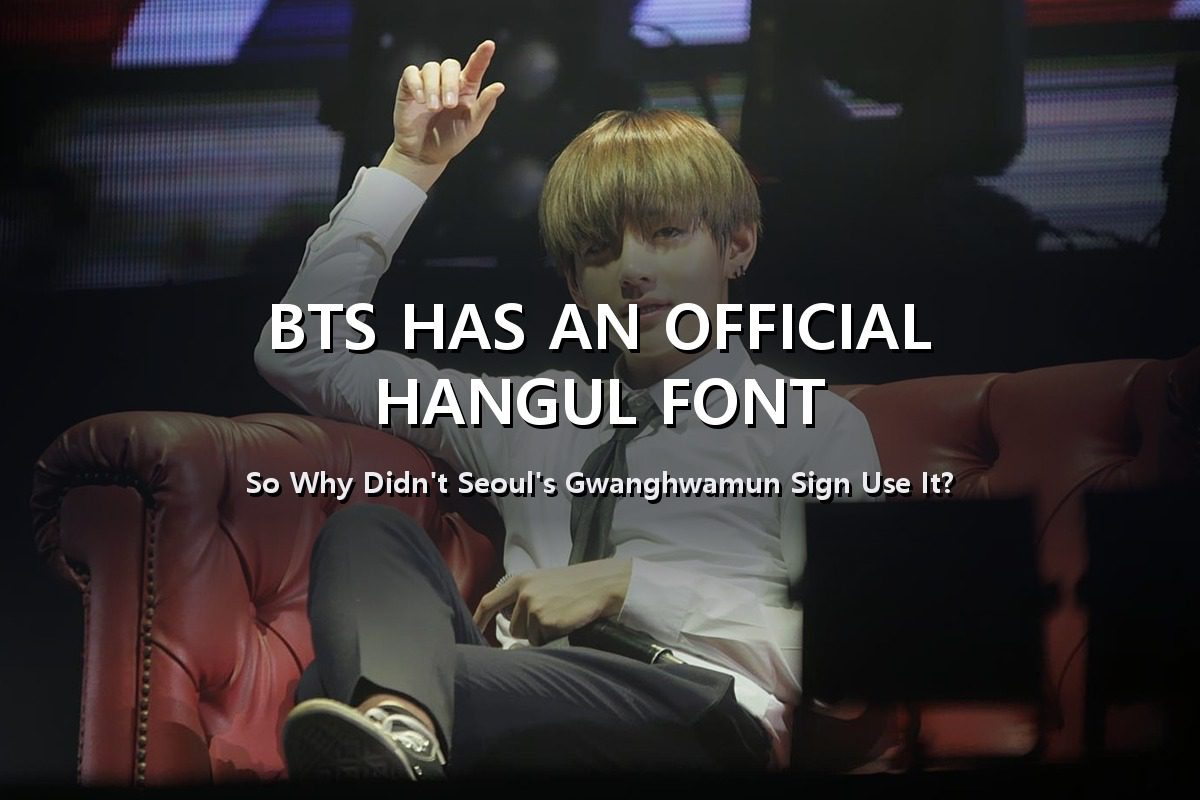

Gwanghwamun Square at night. The quote board sits on the Kyobo building facing this exact boulevard. Photo: Seoul Tourism Organization, KOGL Type 1
In March 2026, a nine-story building on Gwanghwamun Square went purple for five days, wrapped floor to roof in BTS’s colors. Half the tourists photographing it assumed they already knew what they were looking at: the same font that had shown up on this exact building before.
They were half right. BTS really has appeared on this sign three separate times since 2020, and there really is something people call “that font.” What almost nobody photographing that wall in March actually knew is that the two things aren’t the same. Three collaborations, three different pieces of typography, and the one everyone assumes got reused a third time is the one that wasn’t there this time.
What this sign actually is
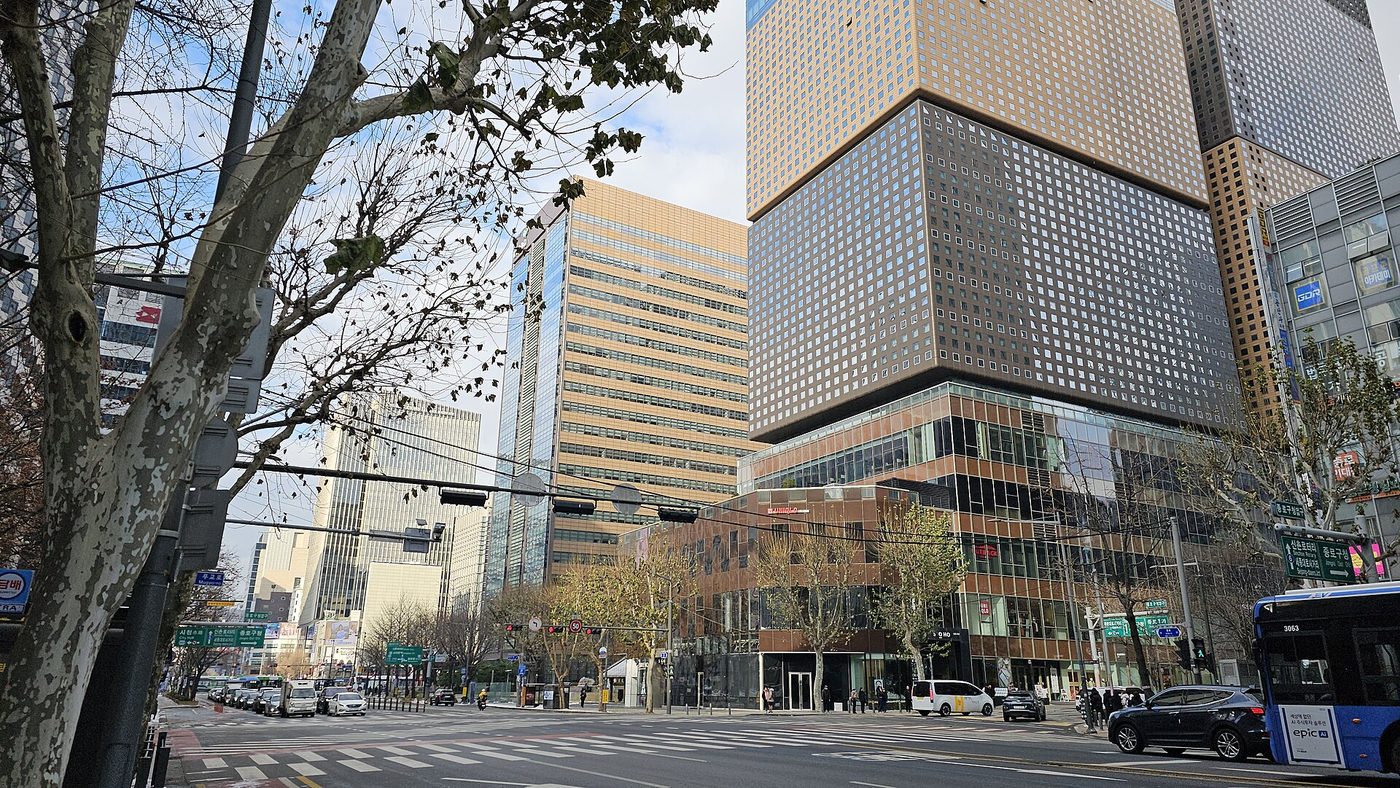
Jongno, the district around Gwanghwamun Station. The insurance company Kyobo Life has its headquarters facing the square from here. Photo: DtSeoul (public domain)
The building belongs to Kyobo Life (교보생명), one of Korea’s largest insurers, and the sign is called the Gwanghwamun Geulpan (광화문 글판) — literally, “the writing board.” It started in January 1991, and the first message was about economic recovery, not poetry. That changed after the 1997 Asian financial crisis, when the company’s founder decided the country needed comfort more than slogans, and the board shifted permanently toward literary quotations: poets, novelists, the occasional line from Hermann Hesse.
Since 2001 it has changed four times a year, once a season, and it has run quotes from roughly fifty writers. It’s less a billboard than a piece of civic furniture at this point — the closest comparison for someone who has never stood in Seoul is a giant digital ad screen in a place like Times Square, except every rotation is unpaid, none of it is selling anything, and the “ad” is a stanza of poetry picked to match how the country is feeling that season.
For Koreans, checking what’s up on the Geulpan each season is a small, recurring habit rather than a tourist stop. The sign has run for over three decades now, and its most-loved lines were collected into a 25th-anniversary anthology in 2015. Nobody lines up to photograph it on an ordinary week — it’s just expected to be there, and to have something worth reading on it.
The first time, during the worst of the pandemic
BTS first appeared on the Geulpan in August 2020, and it wasn’t a poet’s line — it was the group’s own lyrics, put up twice that month as part of the board’s 30th-anniversary special editions. One panel used a line from “Run”: people falling down and getting back up is allowed. The other, in purple lettering laid over a sky full of tiny stars, used a line from “A Supplementary Story: You Never Walk Alone” — that it’s fine to be tired, because you’re not walking through it alone.
Korea was deep into COVID restrictions at that point, and putting a K-pop group’s lyrics on a sign that had spent two decades running literary quotations was itself a small departure. It read less like a marketing tie-in and more like the company deciding that, in the middle of a pandemic, a boy band’s lyric about getting back up qualified as literature too.
The second time, BTS wrote the line themselves
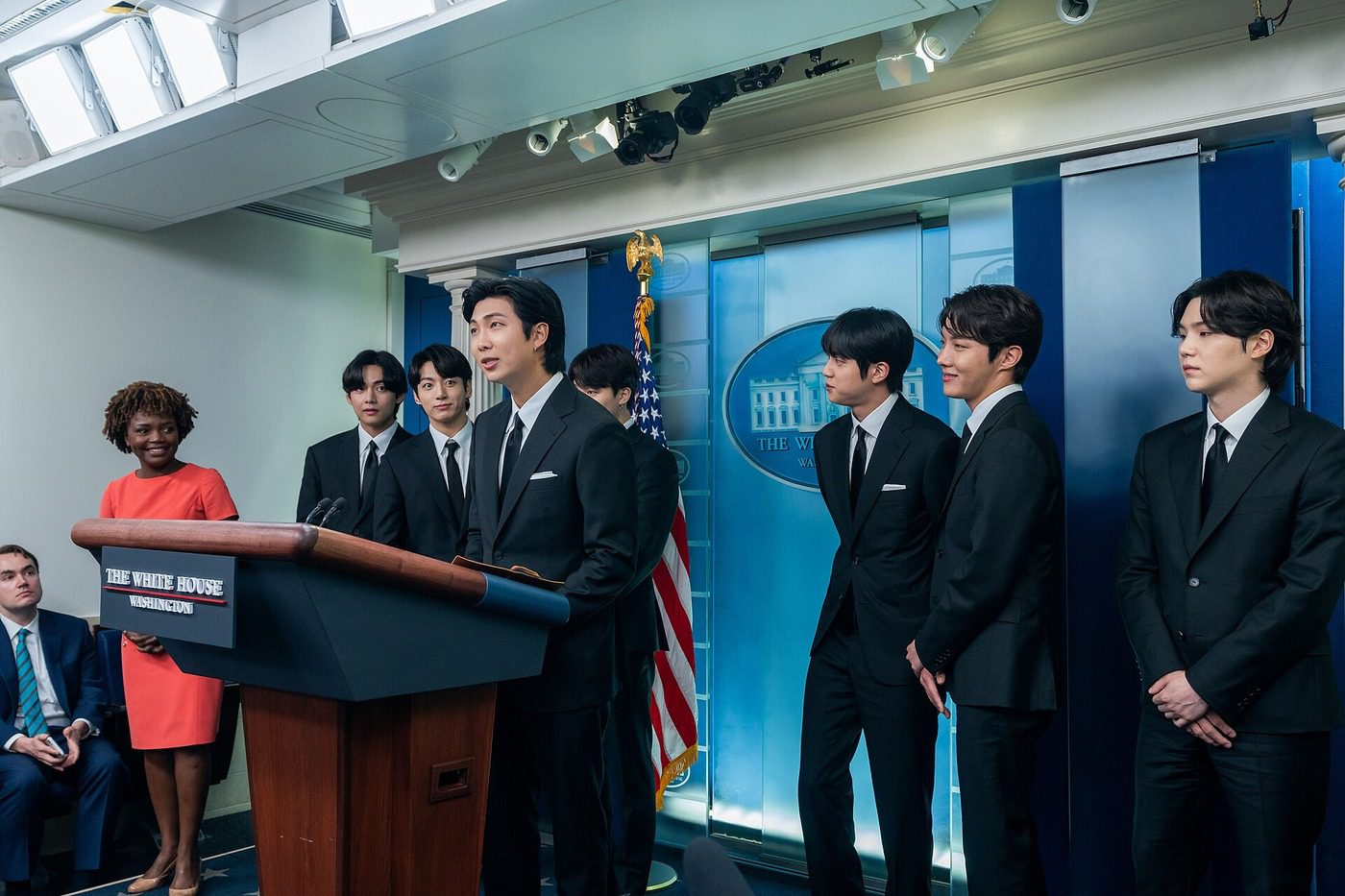
The group at a White House press briefing, May 2022 — a different event, included here to show how far outside music the group’s cultural reach had already extendedby the time of the second Geulpan collaboration. Photo: The White House (public domain)
The second appearance, in November 2021, is the one worth slowing down on, because of how it was made. It landed on the Geulpan’s 100th installation — a milestone edition — and instead of an editor pulling a line from a poem, the text came directly from the group: “[Dance] however your heart moves you, no permission needed.”
Every other quote in the Geulpan’s history, including their own August 2020 appearance, was a line lifted from something already written — a song, a poem, an essay. This one wasn’t lifted from anywhere. It was composed for the sign, by the group, for a milestone edition of a 30-year-old institution built entirely on other people’s sentences. That’s a different kind of honor than “your lyric got picked” — it’s closer to being asked to write the quote itself.
So does BTS actually have an official Hangul font?
Yes — just not the one most people think. In October 2021, around Hangul Day, HYBE released a Hangul lettering design built off the BTS logo, sold through Weverse Shop as board games, statues, and message chocolates. Korean outlets covering that release also mentioned, in passing, that the same lettering had already shown up on the group’s 2020 Geulpan panels and on McDonald’s merchandise from the 2021 “BTS Meal” collaboration — the one where crew uniforms worldwide were printed with the Hangul consonants for the band and McDonald’s side by side.
That’s a real, named lettering design, reused across more than one campaign. Treat the “same font on McDonald’s merch” detail as reported by Korean press rather than confirmed by a design credit — nobody has published a side-by-side comparing the font files. But the core fact holds: HYBE built one specific Hangul design tied to the group’s logo, and it circulated for about a year.
The third time was a completely different design
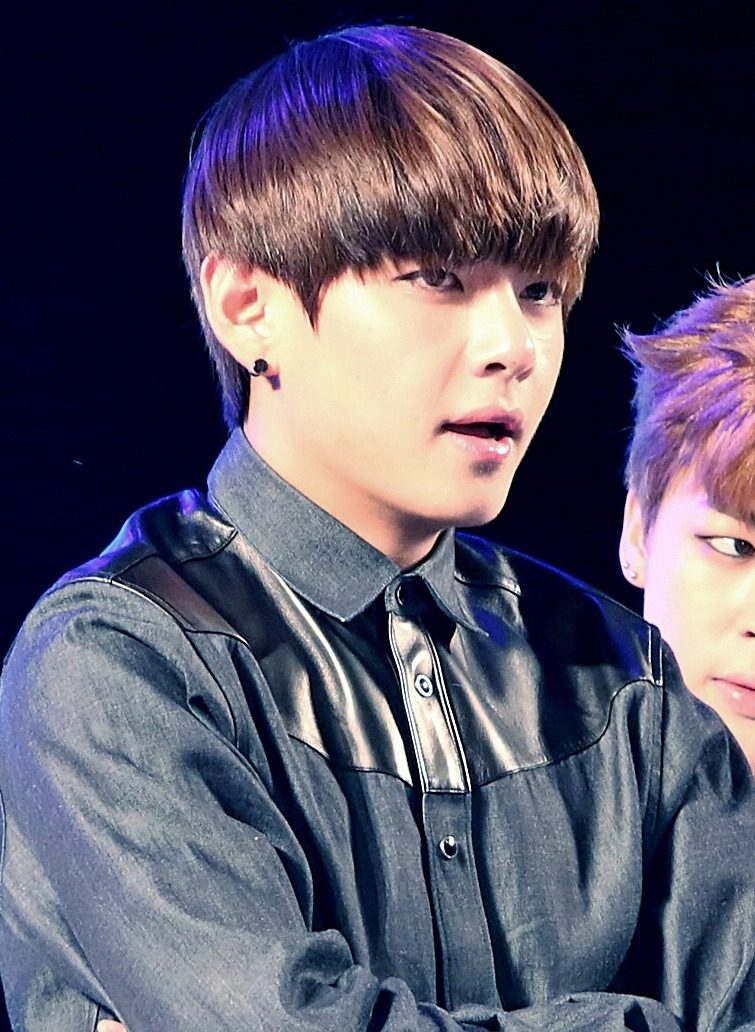
V performing during a tour stop in Taipei. Photo: Taehyung’s Moment, CC BY 4.0
Here’s the part that gets missed. The March 2026 wrap — the one that started this article — was tied to BTS’s comeback album ARIRANG and a free outdoor concert on Gwanghwamun Plaza that streamed globally on Netflix. Kyobo itself called it “the third meeting” between the Geulpan and the group. But the typography on that building wasn’t the 2021 Hangul Day font. It was built around the ARIRANG album’s own logo — designed by member Jungkook, structured around the Hangul consonants that spell out the folk song’s name and organized using the four trigrams from the Korean flag — combined with a Taegeuk-based visual motif across a wrap roughly 90m wide and 21m tall, about 1,890 m² of building. The lines displayed included “The story that started with me, until it echoes across the whole world” and “Born in Korea, Play for the World.”
So the honest version is: the group has one named Hangul lettering design (2021, Hangul Day, HYBE), and it appeared once, maybe twice, in a two-year window around its release. The Geulpan’s three collaborations with them used three different pieces of typography — 2020’s own song lyrics, 2021’s self-written line in the Geulpan’s house style, and 2026’s bespoke album branding. Nothing about a font got “reused a third time.” Each visit made something new.
Three visits, three different looks
| Aug 2020 | BTS’s own song lyrics (“Run” / “A Supplementary Story”) |
| Nov 2021 | A brand-new line, written by the group for the Geulpan’s 100th edition |
| Mar 2026 | ARIRANG album branding, designed by Jungkook, plus Taegeuk-trigram motifs |
Why V keeps getting called Korea’s “Hangul evangelist”
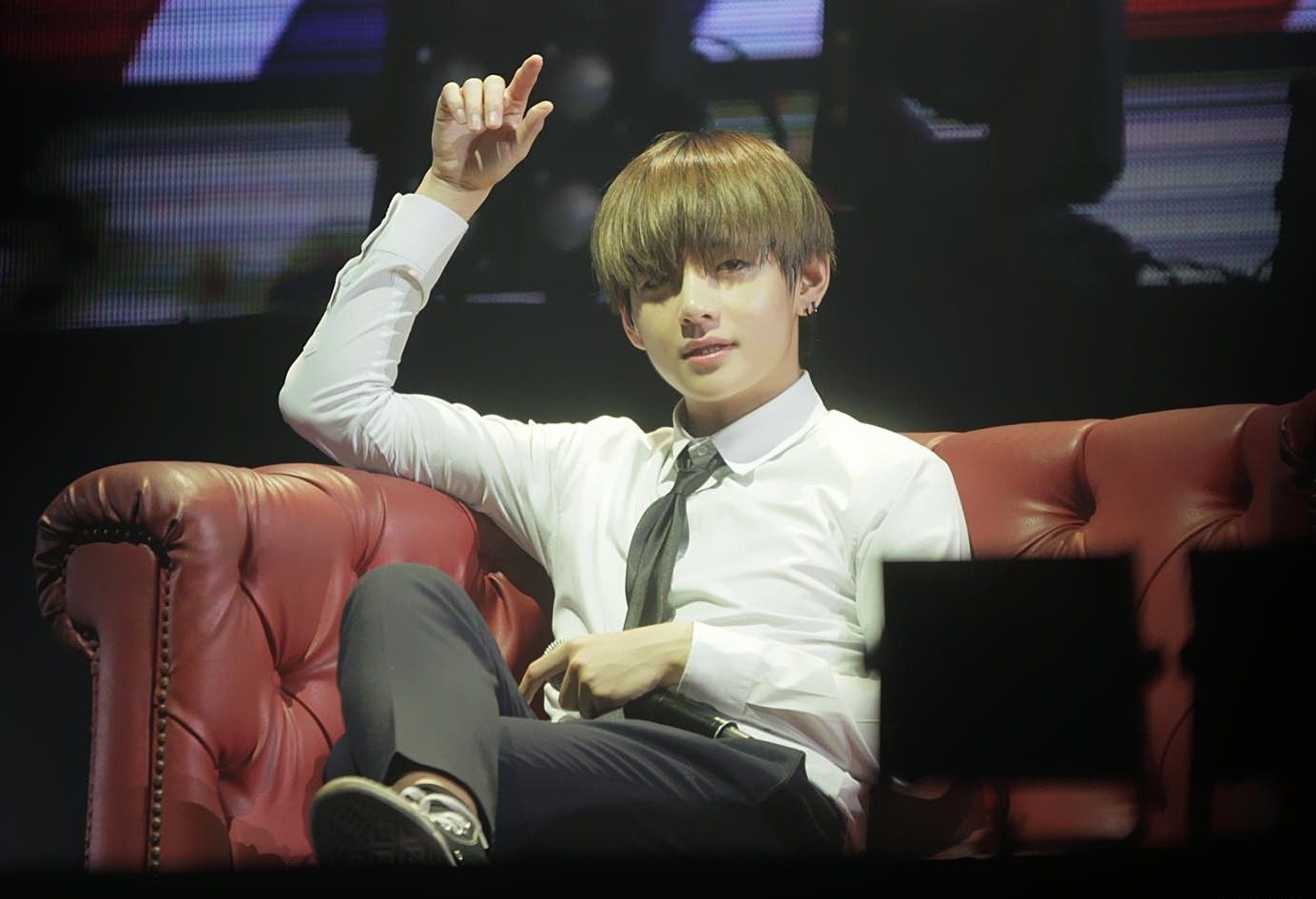
V at the Billboard Music Awards, May 2019. Photo: Dispatch, CC BY 3.0
The typography story fits a wider pattern in how this group treats Hangul, and one member gets singled out for it. Member V, Kim Tae-hyung (김태형), has a real, repeated nickname in Korean entertainment coverage: roughly translated, the “Hangul evangelist.” It’s not an official title, but the label shows up most visibly around Hangul Day 2021, when Korean coverage credited him with regularly working Korean vocabulary into interviews and fan content — enough that overseas ARMY started looking words up on their own.
HYBE eventually built an actual product around that fan habit: Learn! Korean with BTS, now a full workbook-and-flashcard package sold internationally through HYBE EDU. Picking up Korean phonetically from BTS content stopped being a side effect and became something the company plans for.
Can you still see it if you go to Gwanghwamun now?
Almost certainly not the BTS panel specifically. The Geulpan changes every season — spring, summer, fall, winter — so any given quote has a shelf life of about three months before Kyobo swaps it for the next writer. The March 2026 wrap was also a special event tied to a five-day concert window, not a standard seasonal rotation, which means it came down faster than an ordinary quote would.
What’s permanent is the location and the habit: the sign faces Gwanghwamun Square from the Kyobo building, it always changes on schedule, and Kyobo posts each new quote through its own newsroom and social accounts when it goes up. If you’re planning a Seoul trip around a specific celebrity sighting, that’s the wrong plan — the board itself, and the chance that some season lines up with something you care about, is the actual draw.
The short version
- BTS has appeared on Kyobo’s Gwanghwamun Geulpan three times: August 2020, November 2021, and March 2026.
- HYBE does have one officially named Hangul lettering design, released for Hangul Day in 2021 — but it’s not the same design used in each Geulpan appearance.
- The 2021 appearance is the one BTS wrote themselves, for the board’s 100th edition — every other quote in the Geulpan’s history was borrowed from an existing text.
- The 2026 wrap used bespoke typography from the ARIRANG album, designed by Jungkook, not the 2021 Hangul Day font.
- The Geulpan changes every season, so there’s no fixed “come see the BTS sign” — the location and the habit are permanent, the panel isn’t.
A few questions people keep asking
Q. Is there really an official BTS font?
Yes — a Hangul lettering design HYBE released for Hangul Day in October 2021, built off the BTS logo and sold as Weverse merchandise. It’s a real, named design, not a rumor.
Q. Did the 2026 Gwanghwamun wrap use that same font?
No. The March 2026 collaboration used typography built for the ARIRANG album, designed by member Jungkook, along with a Taegeuk-trigram pattern — a separate design made for that specific comeback.
Q. How many times has BTS been on the Gwanghwamun Geulpan?
Three: August 2020, November 2021 (the board’s 100th edition, with a line BTS wrote themselves), and March 2026, tied to the ARIRANG comeback concert.
Q. Is McDonald’s really connected to this?
Partly. The May 2021 “BTS Meal” collaboration confirmed had crew uniforms printed with Hangul consonants for both brand names. Korean press also reported the 2021 HYBE font showing up on some of that merchandise, though that specific detail hasn’t been independently confirmed the way the uniform design has.
Q. Where exactly is the Gwanghwamun Geulpan, and can I see it as a tourist?
It’s mounted on the Kyobo Life headquarters building on Gwanghwamun Square, a short walk from Gwanghwamun Station on Seoul’s Line 5. No ticket, tour, or advance planning required — anyone walking through the square can look up and read whatever quote is running that season.
ONE MORE THING
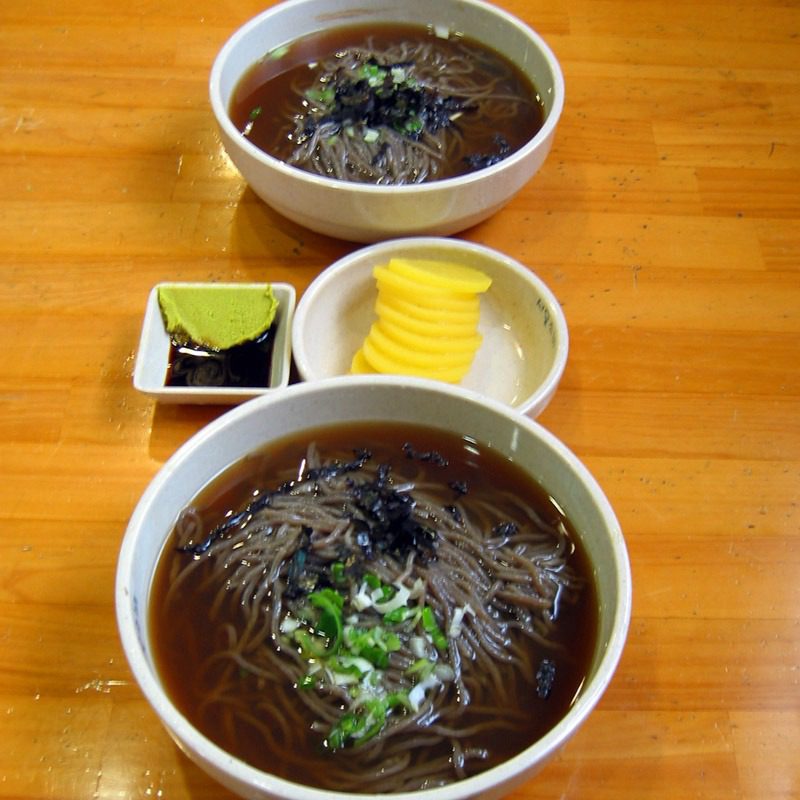
Memil guksu, cold buckwheat noodles — the specialty at Mijin, a Michelin Bib Gourmand spot with its own Kyobo history. Photo: cube300, CC BY-SA
The restaurant that once sat right outside Kyobo’s back door for a decade wasn’t selling anything K-pop-related — it was selling cold buckwheat noodles. Mijin, a Michelin Bib Gourmand pick since at least 2018, used to operate directly in front of the Kyobo Building’s rear entrance before relocating nearby in 2008. If you want a food landmark with an actual, verifiable connection to this building rather than a guessed one, that’s it. We’ve also covered what BTS actually eats in real life, if you want the fuller picture.
If you’re following the ARIRANG era for other reasons, we also looked at why BTS skipped the Grammys and sang Arirang to a sold-out stadium in Boston instead — the same comeback era that brought the group back to this sign for a third time. And if you’re curious what a stadium-scale K-pop event actually does to the streets around it once the crowds show up, here’s what happened to one Seoul neighborhood when BTS came through.
Sources: Kyobo Life Newsroom · Newsis (Mar 17, 2026) · Korean Wikipedia (Gwanghwamun Geulpan) · Hankyung · Newsis/Hankyung (Oct 2021, Hangul Day) · Nate News (Oct 2021) · Forbes (Mar 13, 2026, ARIRANG album design) · Korea Herald · Hankook Ilbo (BTS Meal, 2021) · Forbes (Mar 2020, Learn Korean with BTS) · Korea Times (HYBE EDU) · Michelin Guide Seoul (Mijin).