
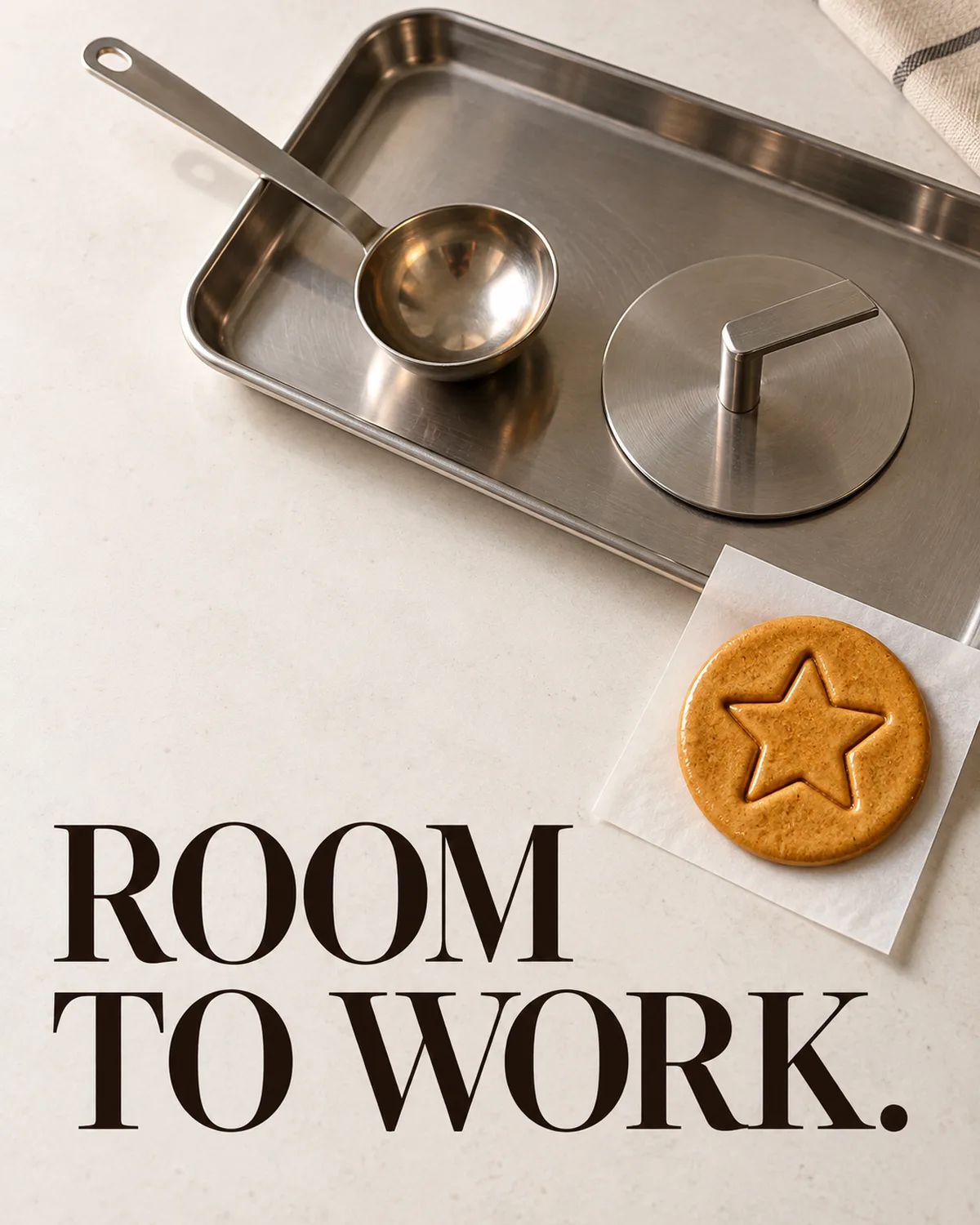
A finished dalgona disc carries two kinds of work: the candy has been made, and a shape has been pressed into it. The stamped star or circle is what a viewer recognizes first. At a stall, the surface has to be ready before anyone can try the game.
The headline’s number belongs to October 2021. Reuters reported that Seoul seller An Yong-hui was selling more than 500 pieces a day, up from fewer than 200 before Squid Game premiered. It was a report about that seller during that surge, not a current sales figure.[1]
The same report described him remaining at work without going home for a week to meet demand. That gives the surge a human scale. It does not establish his present location, later income or the experience of every vendor in Seoul.[1]
The enduring food question is what happens between one customer and the next. A candy disc begins as a hot mixture and ends as a fragile stamped object. A larger audience can arrive quickly; that physical transformation still needs the maker’s attention.

The sales number has a limited job
The Reuters account documents attention reaching a particular small business. It also distinguishes the person making candy from customers trying a game. Those are useful observations without treating one day’s output as a complete financial account.
Pieces sold are not the same measure as profit. To calculate earnings, you would also need costs and other business details. A visible line or a large sales number alone cannot supply them.
Likewise, the phrase street vendor covers people working with different spaces, equipment and customers. One reported case can illuminate the work, but it cannot represent every person selling a similar sweet.
For a visitor today, use current information from the seller you actually find. Ask what is being offered and whether a game is included. A dated news photograph cannot promise today’s stall location, price or opening time.

Watch how the surface is formed
Maangchi’s ppopgi recipe begins with sugar and baking soda. She describes heating and stirring the sugar, expanding the mixture with baking soda, then pressing and stamping it. Her account connects a short ingredient list with technique and timing.[2]
Watching the sequence is different from seeing only the finished shape. Stirring, placing the mixture and pressing it each change the object in front of you. Leave the work area clear so the maker can continue without someone reaching across it.
The foamed interior helps explain the candy’s light, brittle texture. Maangchi describes it as sweet with smoky, nutty and bitter notes. A bite is therefore a different experience from chewing a dense, sticky sweet.[2]
This is a description of skilled work rather than a complete home recipe. If you want to cook it, use a reliable method and suitable supervision for hot sugar. Watching the stall does not require handling the burner or the hot mixture.

The stamp makes an edible game boundary
A stamped line marks where the central shape meets the surrounding candy. It has to be an impression in the disc, rather than a separate decoration placed on top. That small difference is essential to understanding the challenge.
The maker’s pressure affects the impression. Maangchi explains that a stronger or lighter stamp can change how easily a shape comes out. This makes the line part of the food’s making process, as well as the later game.[2]
Look at the line and the thickness of the piece before deciding whether to try. A handmade candy is an actual object with edges and small irregularities. Its shape may be familiar from television while its brittleness is still surprising in the hand.
Ask the seller what rules apply. A prize, tool or handling arrangement shown elsewhere may not be offered at this stall. You can also choose to eat the sweet without turning it into a test.

A queue includes more than cooking
Serving the next person also involves explaining choices, receiving payment and handing over something that can break. Those small actions compete for attention around the same work surface. Watching them makes the trade easier to understand.
Choose your order before stepping into the maker’s working space. If you want a photograph or close video, ask first and follow the answer. A clear surface and an uninterrupted moment can matter more than another angle of the candy.
Keep your hands away from active tools and let the seller pass the finished piece to you. The stamped surface can be admired after the handover. Reaching toward a piece while it is being shaped interrupts the very process you came to see.
If the wait does not fit your day, choose another stop or return when suitable. A recognizable food is still sold by a business with its own pace. Enjoying Korean street food does not depend on joining every visible line.
Carry the candy as food, not just an image
Support the finished disc rather than squeezing its rim. If it comes in packaging, follow the seller’s handling advice and keep it from being crushed against heavier purchases. A clean photograph is easier after the candy has reached a stable surface.
Confirm ingredients in the actual version when needed. A familiar basic recipe cannot identify every modern variation or what other foods are handled nearby. The seller’s own preparation details are the relevant information for your purchase.
The 2021 report and the recipe answer different questions: one records a surge in demand, while the other explains how a stamped candy takes shape. Together they let you see both the public image and the small repeated actions behind it.
Start by looking at the disc, its bubbles and the pressed outline. Then watch the maker begin the next piece, if the stall permits it. The most useful memory may be how much attention a small candy requires before it reaches your hand.
