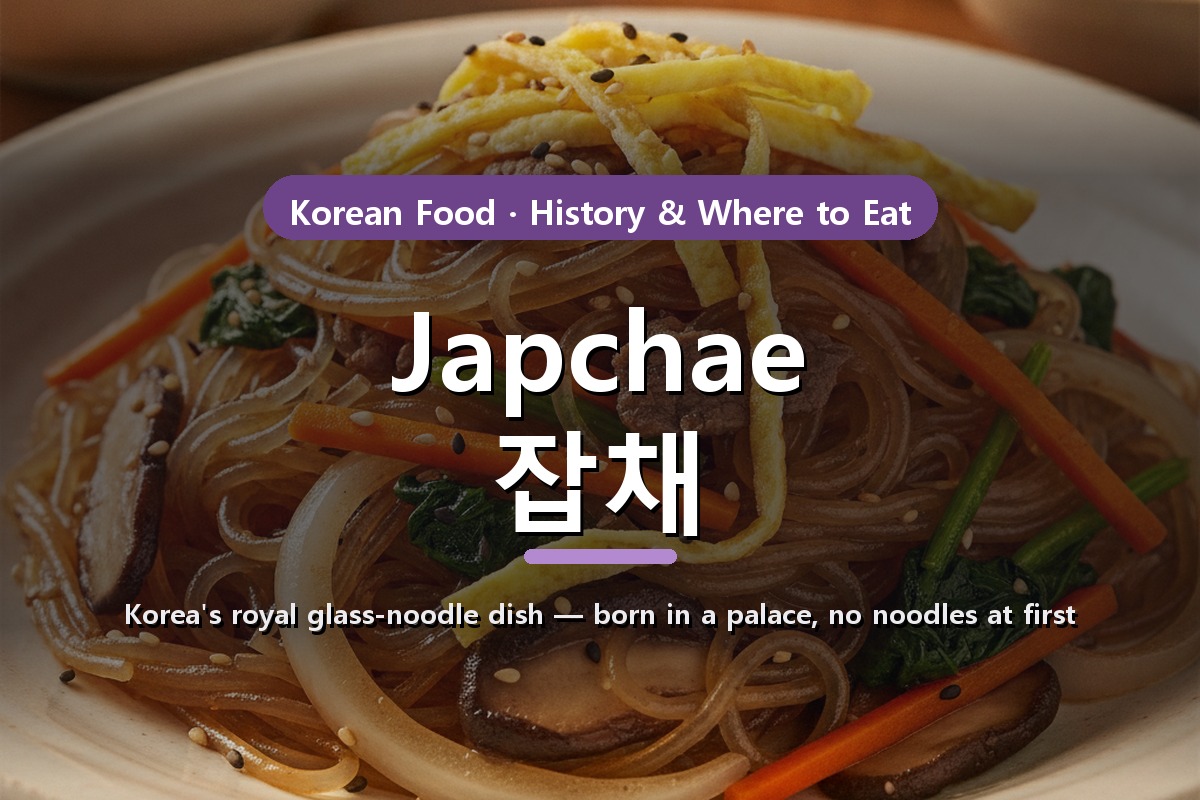
Walk into any Korean birthday party, wedding lunch, or holiday gathering and one dish shows up almost every time: a glossy, faintly sweet tangle of glass noodles called japchae (잡채). Koreans don’t treat japchae as everyday food — it’s the dish a grandmother makes for Chuseok (추석, the autumn harvest holiday), the platter that empties first at a potluck. Here’s the part almost nobody at that table knows: japchae was invented four hundred years ago in a royal palace, and back then it had no noodles at all.
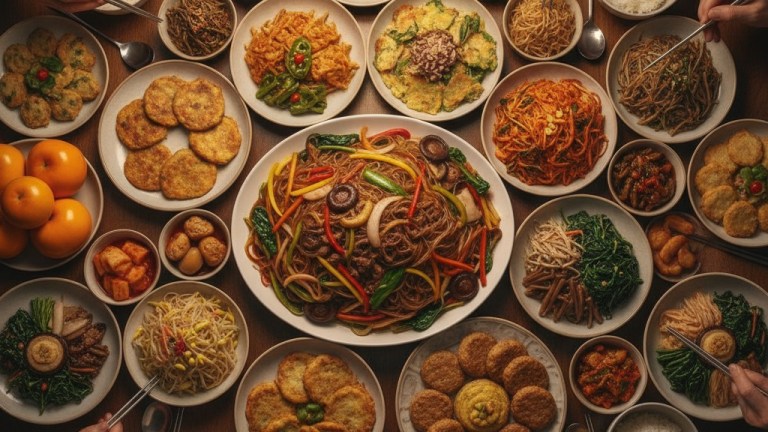
Japchae is Korea’s celebration dish — the platter at the heart of holiday and party tables.
⭐ Japchae at a glance
🌶️ Spice level (very mild) — ★☆☆☆☆
🥢 First-timer friendly — ★★★★★
🎉 Shows up at celebrations — ★★★★★
New to Korean food? Start with our complete guide to what to eat in Korea.
These stars are our own subjective take from eating around Korea — how spicy japchae is, how easy it is for a first-timer, and how often you’ll run into it. Your mileage may vary.
The short version: japchae is a Korean stir-toss of chewy sweet-potato glass noodles (dangmyeon, 당면) with strips of beef, spinach, carrot, onion, and mushrooms in a soy–sesame dressing that lands gently sweet and savory. It’s served warm or at room temperature, it’s barely spicy at all, and it’s one of the friendliest first dishes in Korean food. The name literally means “mixed vegetables” — and that’s no accident. When it was created for a 17th-century king, japchae contained not a single noodle. Below: the full story, how to eat it like a local, and where in Seoul you can taste the royal version.
So what exactly is japchae?
At its heart, japchae is a noodle dish that eats like a salad. The noodles are dangmyeon — long, translucent strands pressed from sweet-potato starch that turn springy and slightly bouncy when boiled. They get tossed with marinated ribbons of beef and a pile of vegetables — usually spinach, julienned carrot, onion, and earthy shiitake or wood-ear mushrooms — then dressed in a glossy mix of soy sauce, sugar, and sesame oil, and finished with toasted sesame seeds.
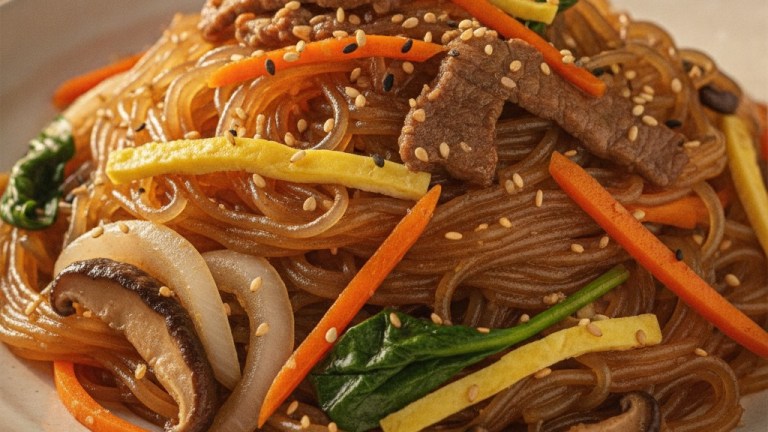
The close-up: translucent sweet-potato noodles, beef, and vegetables, all catching the sesame-oil sheen.
The secret is cooking everything separately
What separates great japchae from a gluey pile is patience. Careful cooks fry the carrots alone, blanch the spinach alone, brown the mushrooms and beef in their own turns, season the noodles by themselves — and only combine everything at the very end. It’s more work than it looks. Honestly, that’s exactly why japchae sits in the “special occasion” column rather than the weeknight one. Each vegetable keeps its own color and bite, so a well-made platter looks like a small festival.
How to eat japchae like a local
Don’t overthink it. Japchae is relaxed food, and Koreans eat it several ways depending on the setting. On a holiday or party table, it appears as one shared dish among many — you pick off a chopstick-load onto your own plate next to rice, jeon pancakes, and namul. It’s usually served warm or at room temperature rather than piping hot, which is one reason it works so well on buffet spreads that sit out a while.
You’ll also see japchae moonlighting as a light main. Order japchae-bap (잡채밥) at a Korean-Chinese restaurant and you get a generous heap of the noodles over a bowl of rice — cheap, filling, and a popular quick lunch. Wherever you meet it, there’s nothing to assemble and no dipping sauce to manage; the dish comes fully seasoned. In my experience it’s the single easiest recommendation for someone nervous about Korean food, because there’s no chili heat to brace for.
From royal court to family table
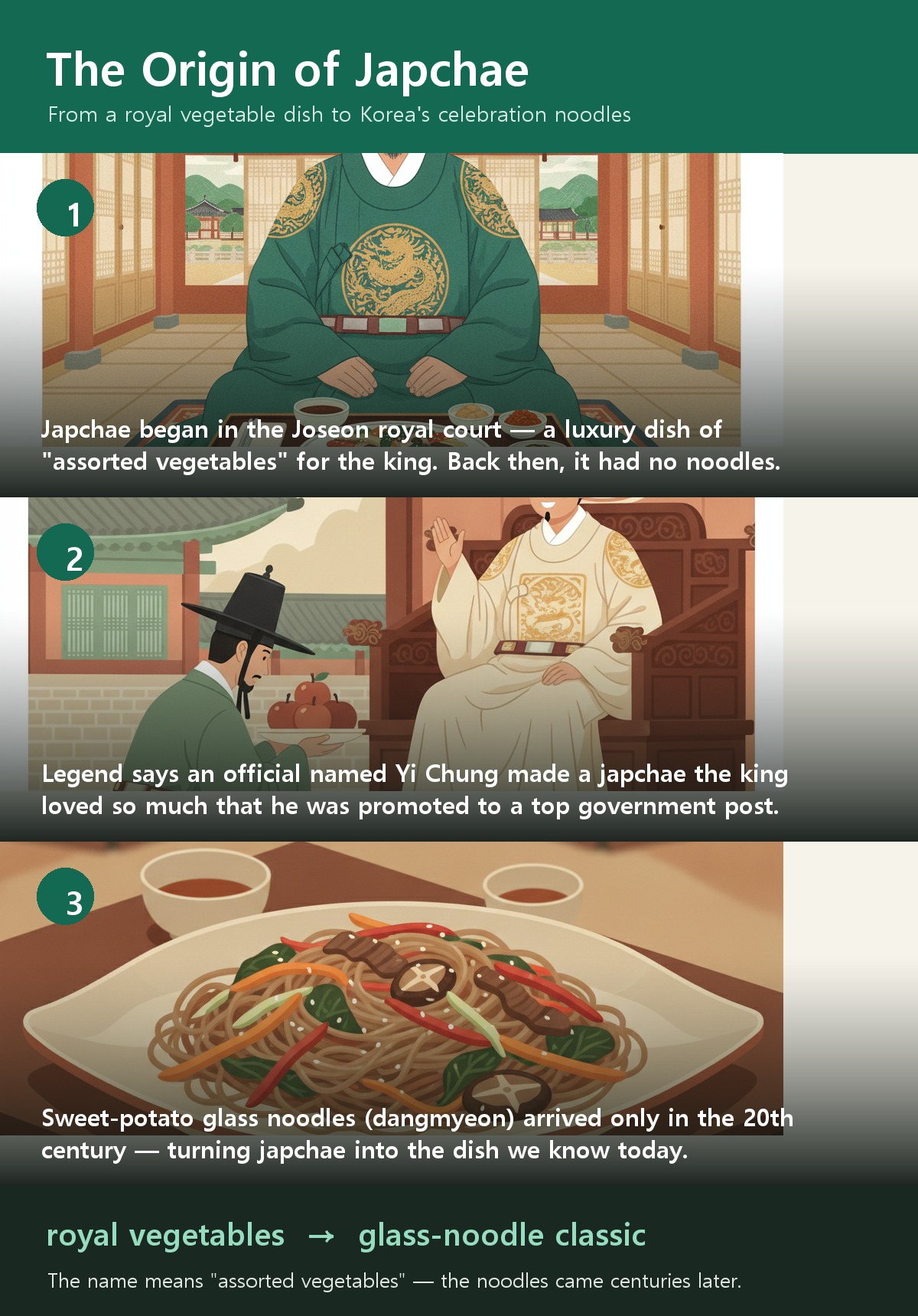

Japchae began in the Joseon royal court — a luxury vegetable dish set before the king.
The minister who cooked his way up
The name gives the game away. Jap (잡, 雜) means “mixed,” and chae (채, 菜) means “vegetables” — so japchae is literally “assorted vegetables.” And that’s exactly what it was. According to records from the Joseon dynasty, the dish was devised in the early 1600s for King Gwanghaegun (광해군, r. 1608–1623) by a court official named Yi Chung (이충). No glass noodles, no meat — just finely prepared stir-fried vegetables and mushrooms, elegantly seasoned and presented as a delicacy fit for the throne.
As the story goes, the king loved Yi Chung’s japchae so much that he showered the official with favor and promoted him to one of the highest posts in the government — roughly the equivalent of a finance minister. A dish good enough to earn a cabinet seat: that anecdote stuck, and it’s a big part of why japchae still carries a faint aura of luxury. This was palace food, part of the Korean royal court cuisine tradition, and for a long time it stayed a refined upper-class dish rather than something ordinary families ate.
How the noodles took over
So where did the noodles come from? Not the palace. Dangmyeon, the sweet-potato starch noodle that defines modern japchae, only arrived in the 20th century. The noodle-making technique came to Korea from China, and in 1919 a large dangmyeon factory opened in Sariwon (사리원, in today’s North Korea). Suddenly cheap, shelf-stable glass noodles were everywhere, and within a decade or so cooks had folded them into japchae.
The noodles changed everything. They stretched a little expensive beef and a pile of vegetables into a big, satisfying platter; they held their looks at room temperature; and that bouncy chew gave the dish a texture people fell for. The noodle version proved so popular that it worked its way into early modern Korean cookbooks and gradually elbowed out the noodle-less original. By the second half of the 20th century, “japchae” simply meant the noodle dish — and because it was festive, colorful, and easy to share, it became the natural pick for holidays and family milestones. A royal vegetable plate had quietly turned into the glass-noodle dish every Korean grandmother makes for Chuseok.
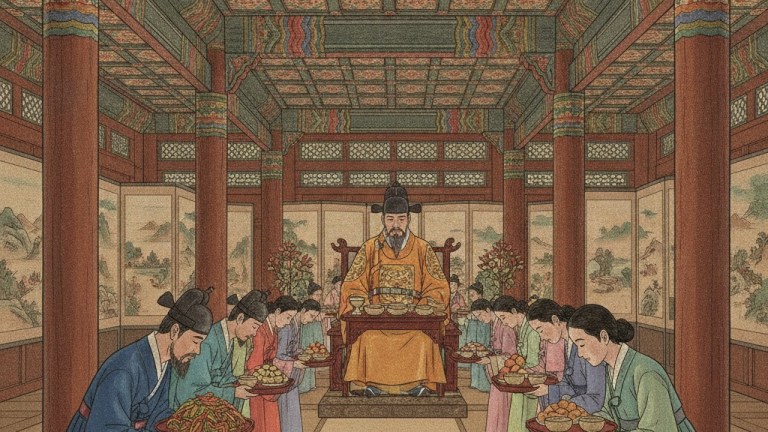
The old way — a dish presented to the king, centuries before the noodles arrived.
🗓️ Plan your japchae hunt
When: japchae is available year-round, but it shines at celebrations — Seollal (Lunar New Year), Chuseok (the autumn harvest holiday), first-birthday parties (dol, 돌), and 60th-birthday feasts (hwangap, 환갑). Visit a Korean home around a major holiday and japchae will almost certainly be on the table.
Where: you won’t have to hunt hard. Everyday japchae turns up nationwide — Korean restaurants, banchan delis, markets, and Korean-Chinese places (as japchae-bap over rice). For the historic, refined take, look for royal court cuisine restaurants in Seoul (서울), where japchae appears among a parade of delicate palace-style dishes.
Cost: as an everyday side dish or a bowl of japchae-bap, it’s one of the cheaper things you can eat in Korea. A full royal-cuisine course, on the other hand, is a proper splurge and usually needs a reservation — think special-night-out, not casual drop-in.
Where to taste royal-style japchae in Seoul
Good everyday japchae is everywhere, so this section covers the other side of the story — the palace version. A few Seoul restaurants specialize in gungjung eumsik (궁중음식), Korean royal court cuisine, and serve japchae much as it might have appeared at a Joseon banquet. Two well-known starting points:
📍 Korea House (한국의집): 10 Toegye-ro 36-gil, Jung-gu, Seoul (서울 중구 퇴계로36길 10)
🕒 Hours: roughly 11:30–15:30 (lunch) and 17:00–21:00 (dinner), closed Mondays · reservations recommended · 02-2266-9101
🍜 Traditional royal-course menus plus nightly traditional performances · opened in 1981 on the historic site of a Joseon scholar’s residence · a short walk from Chungmuro Station (Lines 3 & 4) · parking available
📍 Jihwaja (지화자): B1, 125 Jahamun-ro, Jongno-gu, Seoul (서울 종로구 자하문로 125 지하 1층) — Korea’s first dedicated royal-cuisine restaurant, founded in 1991 by the late master Hwang Hye-seong (황혜성). Course-style royal menus, close to Gyeongbokgung Palace. Lunch roughly 11:30–15:00, dinner 17:30–21:30, closed Tuesdays · 02-2269-5834
One honest note: a royal-cuisine meal isn’t a quick plate of japchae — it’s a full multi-course experience, priced accordingly. Think of it as dinner plus a history lesson rather than a cheap eat. Hours, closing days, and menus shift over time (details above are current as of 2026), and both houses run on reservations, so call before you build an evening around either one.
🔗 More Korean classics worth your time: for another dish with deep roots, try Seoul’s milky ox-bone soup, seolleongtang, or the famous mixed-rice bowl Jeonju bibimbap. Prefer to graze? Wander the stalls of Gwangjang Market in Seoul.
Frequently asked questions
What is japchae made of?
Japchae is built on dangmyeon — chewy glass noodles made from sweet-potato starch — tossed with sliced beef and vegetables (commonly spinach, carrot, onion, and mushrooms) in a soy–sugar–sesame-oil dressing, finished with toasted sesame seeds. The ingredients are usually cooked separately and combined at the end, so each keeps its color and texture.
Is japchae spicy?
No. Japchae is one of the mildest dishes in Korean food — sweet and savory rather than hot, with no chili in the classic version. That makes it a great starting point if you’re new to Korean cooking or eating with kids.
Why is japchae served at celebrations?
It’s colorful, easy to share, holds up beautifully at room temperature on a crowded table, and carries an old whiff of luxury from its palace origins. Those traits made it a natural for holidays like Seollal and Chuseok and for milestone birthdays like dol and hwangap.
Did japchae always have noodles?
No — and this surprises most people. When it was created for King Gwanghaegun in the early 1600s, japchae was a noodle-free dish of stir-fried mixed vegetables, exactly as its name suggests. Sweet-potato glass noodles only entered the dish in the 20th century, after a dangmyeon factory opened in Sariwon in 1919 — and eventually they became its signature ingredient.
Is japchae vegetarian?
It can be. Most modern versions include a little beef, but the original court dish was meat-free, and vegetable-only japchae is common and easy to make. If you don’t eat meat, ask for it without beef, or look for a vegetarian version at royal-cuisine restaurants.