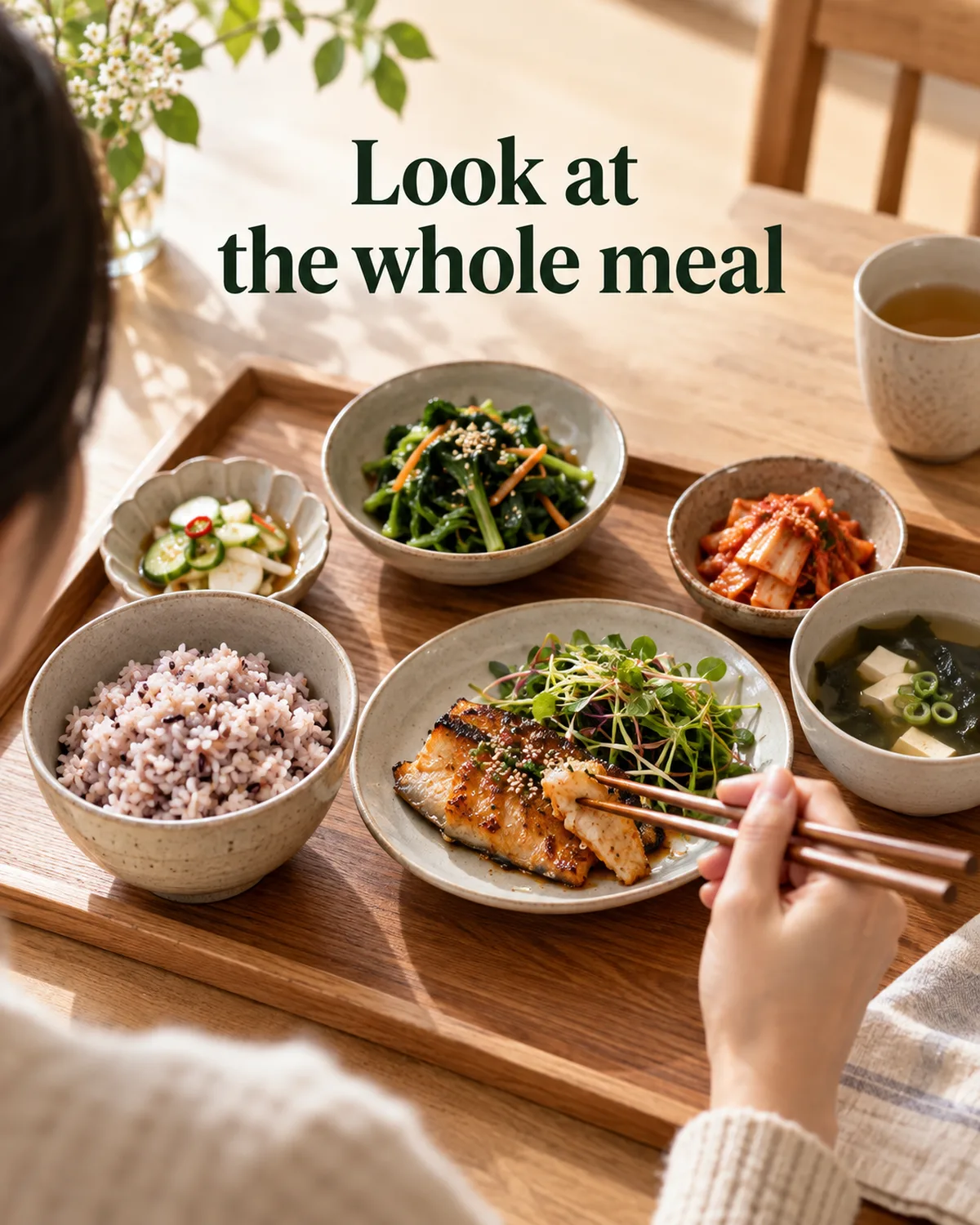
The most useful question for a solo meal in Korea is often not “Will eating alone look strange?” It is “Can this dish be ordered as a complete portion for one?” A bowl of soup and rice and a large shared grill have different operating requirements.
Honbap becomes easier to understand when the household, the individual meal and the restaurant’s service format are separated. None can stand in for the other two.
Living alone and eating alone are different things
A one-person household and a solo diner are related categories, not synonyms. Someone who lives alone can eat with coworkers every day. Someone who lives with family can eat lunch alone because schedules do not match. A student can choose a quiet meal between classes; an office worker can eat alone because colleagues are in meetings; an older adult can live alone but regularly share meals with friends.
This distinction prevents two common exaggerations. The first is that Korea suddenly became “individualistic” because more people eat alone. The second is that demographic growth automatically proves every solo meal is voluntary or enjoyable. Honbap is better understood as infrastructure catching up with more varied household and schedule patterns.
The Statistics Korea figures also show why age stereotypes fail. In 2024, one-person households were not only a young-adult phenomenon: people aged 29 or younger, people in their 30s, and people in their 60s each formed substantial shares. The single-person economy therefore serves students, workers, divorced adults, widowed seniors and many other groups with different food needs.
Older Korean meal culture placed enormous value on eating together. Family meals, school meals, company lunches, hoesik work dinners, barbecue grills and communal stews all reinforced the idea that eating is social. Korean table settings also combine individual rice and soup with shared side dishes, so the meal physically expresses both the individual and the group.
But saying “Koreans never ate alone until the 2010s” turns a strong social norm into a false historical absolute. Travelers, workers, market vendors, students and people living apart from family obviously ate alone at times. Many traditional commercial foods—noodle bowls, rice soups, bibimbap—were already structurally possible for one diner.
What changed was visibility, language and commercial accommodation. A behavior that could once feel like an exception gained a name, media attention, dedicated seating formats and menus designed around one person. The transition was from possible but sometimes conspicuous to ordinary in many contexts.
By the middle of the 2010s, Korean and international reporting was treating honbap as a recognizable social trend. Restaurants experimented with counter seats, partitions and smaller portions. Media discussed honbap, honsul (drinking alone) and the broader language of doing leisure activities alone.
A 2015 study compared university students in Korea and Japan using data collected in 2011–2013. The Korean students in that convenience sample associated solo eating more strongly with negative feelings than the Japanese comparison group. It records a particular cohort and period, rather than today’s national attitude.4
A 2018 study used Korean health-survey data from 2013–2015 to examine patterns of eating alone. Associations differed by meal pattern and sex, and the design did not establish that eating alone caused a health outcome. Company at the table and the composition of a meal remain separate questions.
Menus made room for one person
Think of solo dining as a transaction-cost problem. A group-oriented restaurant can impose several costs on one diner: a two-serving minimum, a large grill table, a pot designed for sharing, slow ordering for one portion, or the social discomfort of occupying a four-person table during a busy period.
Honbap-friendly formats reduce those costs. Counter seating uses less floor space. Individual burners allow one-person hot pots. Kiosks make ordering less dependent on conversation. Convenience stores package complete meals in one-person units. Delivery platforms allow a single household to assemble dinner without coordinating with anyone else.
The cultural shift and the business shift reinforce each other. More solo customers make single-person formats profitable; more single-person formats make solo dining feel routine.

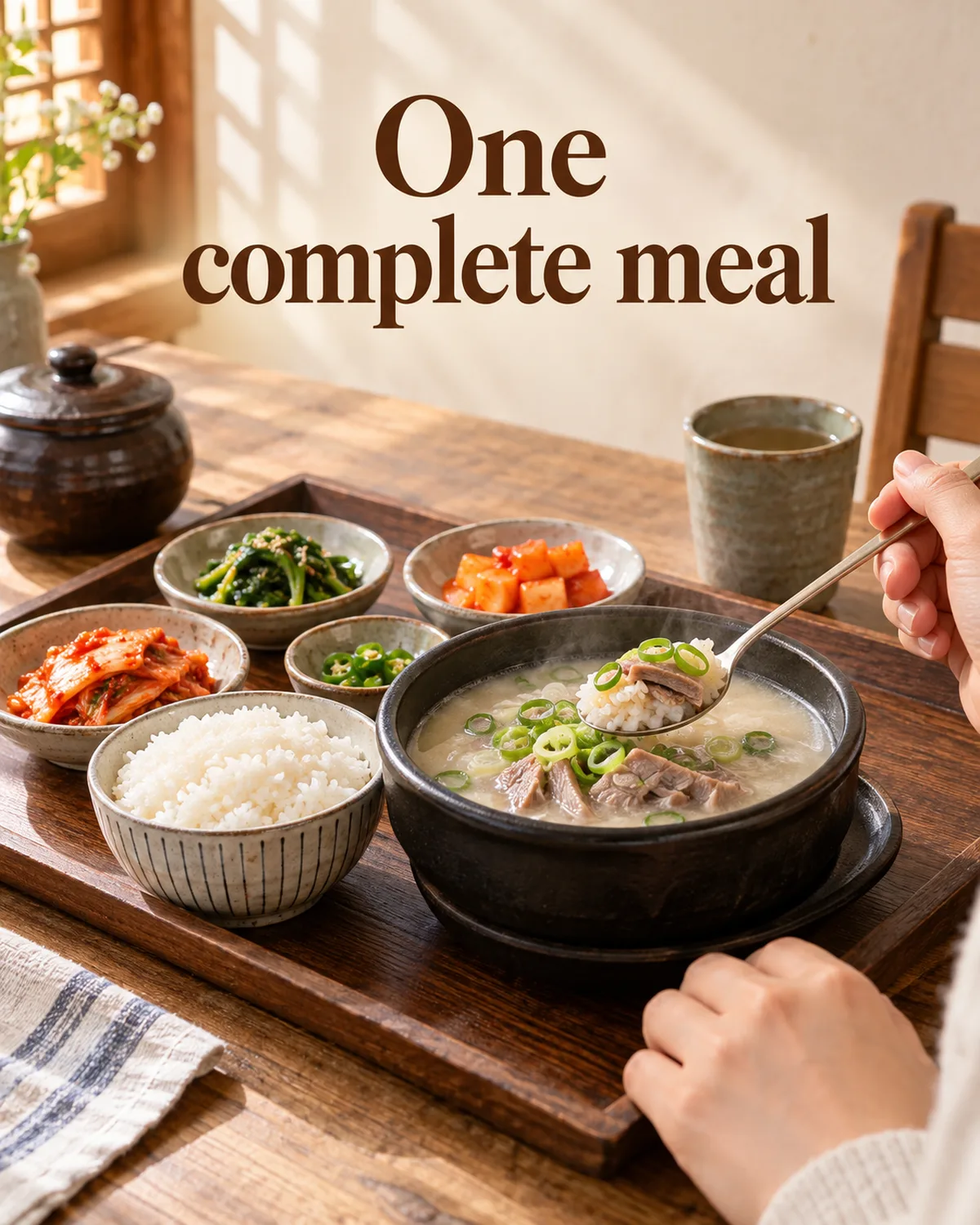
Gukbap literally combines soup and rice, but its great advantage for solo diners is not the name. It is the service unit. A bowl or earthenware pot can be cooked and priced for one person without changing the kitchen’s fundamental workflow.
A grill restaurant has to decide how to handle one customer ordering meat normally sold in multiple portions. A large hot pot may have a minimum size. Gukbap simply arrives as one bowl with rice, broth, protein or sprouts, and side dishes.
Jeonju kongnamul-gukbap is a clear example. Its market history, hot broth, rice and soybean sprouts make sense as an individual meal even before anyone labels the act “honbap.” The dish did not adapt to solo culture; solo culture discovered that the format was already compatible.
Travelers do not need a list of “approved honbap foods.” They need to read the menu architecture. Foods that naturally arrive in one person’s vessel are usually simplest:
- Gukbap and soup bowls: rice soup, seolleongtang, galbitang and similar individual servings.
- Noodles: kalguksu, naengmyeon, ramyeon and many noodle soups are ordered one bowl at a time.
- Bibimbap and rice bowls: the serving unit is one bowl even when side dishes are shared in a group.
- Gimbap and bunsik: small dishes can be combined without a group minimum.
- Individual jjigae: many casual restaurants serve one-person earthenware stews, although house rules vary.
The common feature is not cuisine type but portion independence. One person can order without forcing the restaurant to redesign the dish.

A shared grill is a portion question, not a social verdict
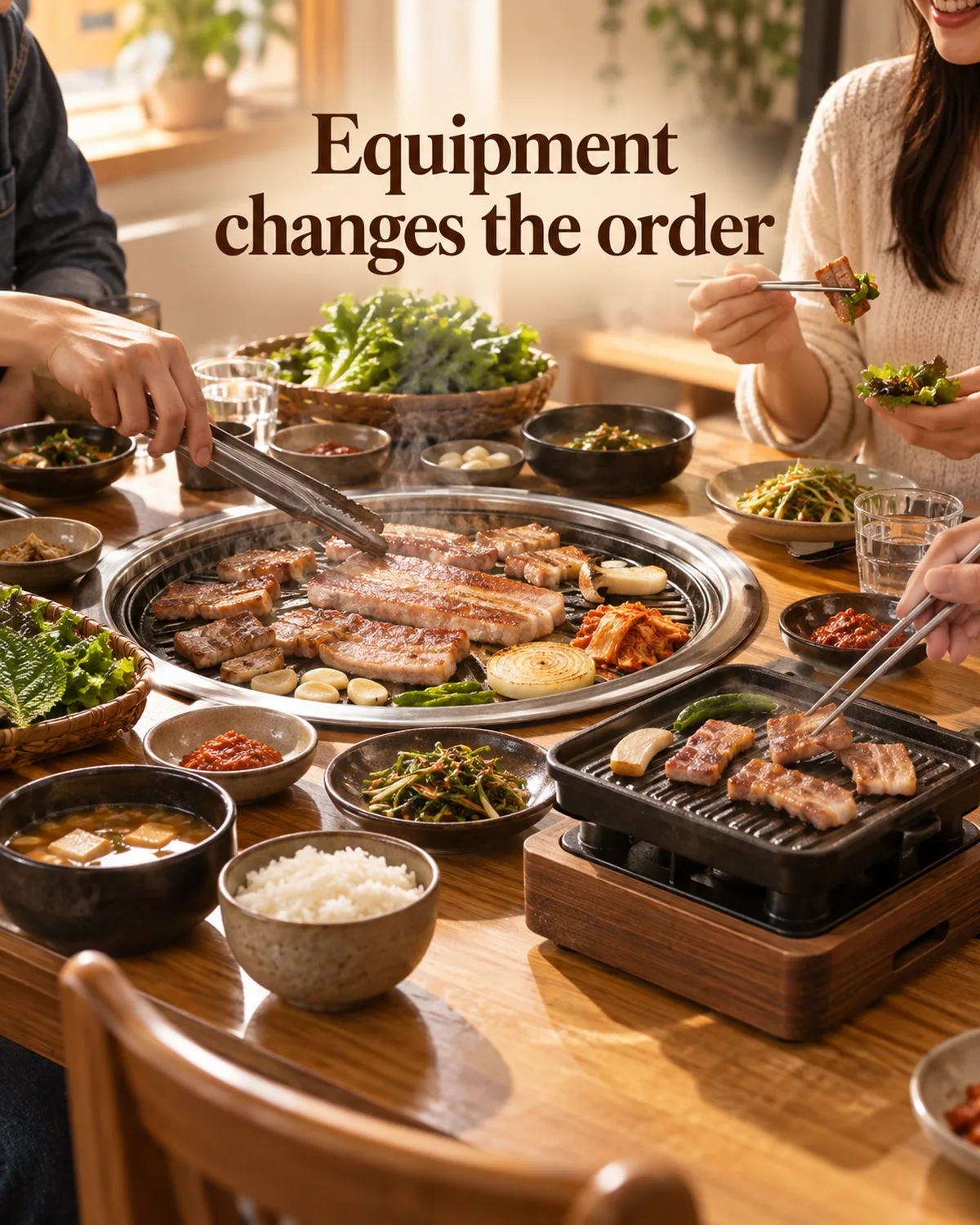
Korean barbecue is the classic example. Meat may be sold by multiple portions, the grill consumes a full table, side dishes must be set for one customer, and staff may spend similar labor on a lower total bill. A restaurant can welcome solo diners yet still require a two-portion minimum.
Large hot pots and shared platters create the same issue. This is why “Is it rude to eat alone in Korea?” is the wrong question. The more useful question is “Can this restaurant economically serve this menu to one person?”
That distinction prevents needless anxiety. A minimum order is not necessarily a judgment on loneliness. It can simply be a portion and equipment rule. Conversely, a restaurant with single grills or half-size portions may actively court solo customers.
Traditional Korean barbecue creates a difficult one-person cost structure: a shared grill, several banchan dishes, ventilation capacity and meat portions often designed for groups. Solo-barbecue concepts solve the problem by changing physical design rather than asking the diner to change.
Individual grills, counter layouts, smaller meat sets and partitioned seating let a restaurant allocate equipment to one customer efficiently. The food may be familiar; the innovation is the table.
That makes solo barbecue a particularly clear example of demography becoming architecture. One-person households do not merely buy different quantities. They can change how restaurants use square meters, heat sources and labor.
Three menu signals to read before sitting down
For practical travel, three signals predict solo-friendliness better than any cultural stereotype.
- Portion notation: Does the menu say “2 servings minimum,” list a pot by size, or price a dish per person?
- Equipment: Does each seat have an individual burner or grill, or is the cooking setup built around a group table?
- Seat geometry: Counters, two-tops and bar seating usually absorb one diner more easily than restaurants dominated by large grill tables.
If those signals are unclear, asking whether an item can be ordered for one person is normal. Restaurant rules change, so a current menu or staff answer is more reliable than a years-old blog that labels an entire cuisine “solo-friendly” or “not solo-friendly.”
The convenience store is another eating format
One-person households do not only reshape restaurants. They change retail food. Convenience stores and supermarkets sell smaller rice portions, lunch boxes, ready meals, cut fruit, single desserts, frozen foods and microwaveable soups. A person can assemble a meal without buying family-size ingredients or creating leftovers for several days.
This matters because the biggest challenge for a one-person household is often not cooking skill but scale. Perishable vegetables, large meat packs and multi-serving sauces create waste when only one person is eating. Convenience food solves that problem by charging more per unit but lowering the risk of spoilage and reducing preparation time.

The trade-off is not “home cooking good, convenience store bad.” It is cost, nutrition, waste and time. Different one-person households optimize those variables differently.
A study published in 2025 examined 2022 food-consumption survey data from 949 one-person households, grouped into ages 20–39, 40–59 and 60–74. The younger two groups spent more on eating out than the oldest group in that dataset. This is a dated comparison of food spending, not a description of every solo diner.
A 25-year-old living near a university, a 45-year-old divorced office worker and a 72-year-old widow may all be counted as one-person households, but their mobility, income, cooking habits, health priorities and preferred restaurants can be completely different. Good food culture writing should preserve that diversity.
Company, choice and the communal table
Solo meals serve different purposes. Someone may value control over time, menu and pace, or may eat alone because schedules and circumstances leave no alternative. Satisfaction cannot be read from the number of chairs at the table.
This is why romanticizing honbap as pure liberation is as simplistic as describing it as sad. The same behavior can mean efficient lunch, restorative solitude, work pressure or social isolation depending on the person and day.

The food-history angle is narrower and more useful: Korean commercial eating has become flexible enough that many more of those situations can now be served without friction.
Normalization of honbap did not erase Korean group dining. Barbecue, shared stews, fried-chicken gatherings, family meals and work dinners remain important. Banchan are still placed in the center of many tables. Celebrations still use food to build relationships.
What changed is that the group meal lost its monopoly over what counts as a socially acceptable meal. A person can enjoy barbecue with friends on Friday and eat kalguksu alone on Saturday without treating the two acts as competing identities.
That coexistence is the real cultural shift. Korea did not move from “collectivist eating” to “individualist eating.” It added more valid table configurations.

Ordering a solo meal without a special “honbap” label
Gukbap restaurants are often straightforward, but practices vary. Check the menu for the type of soup, portion size and add-ons. Sit where staff direct you. The rice may arrive inside the soup or separately. Salt, pepper, chopped scallion or salted shrimp may be available for adjustment depending on the regional style.
If the broth is served very hot in a ttukbaegi, the vessel can remain dangerously hot after the bubbling stops. Handle the bowl through the table, not by grabbing the sides.
A first-time visitor can waste time searching for restaurants explicitly branded for solo dining. In most urban neighborhoods, the easier strategy is to choose naturally single-serving food. Noodle shops, gukbap houses, gimbap restaurants, food courts and many casual rice-bowl shops already solve the problem.
Then treat group-format food as a separate category requiring a menu check. This is more durable than maintaining a list of “solo-friendly” businesses whose seating policies, hours and ownership can change.
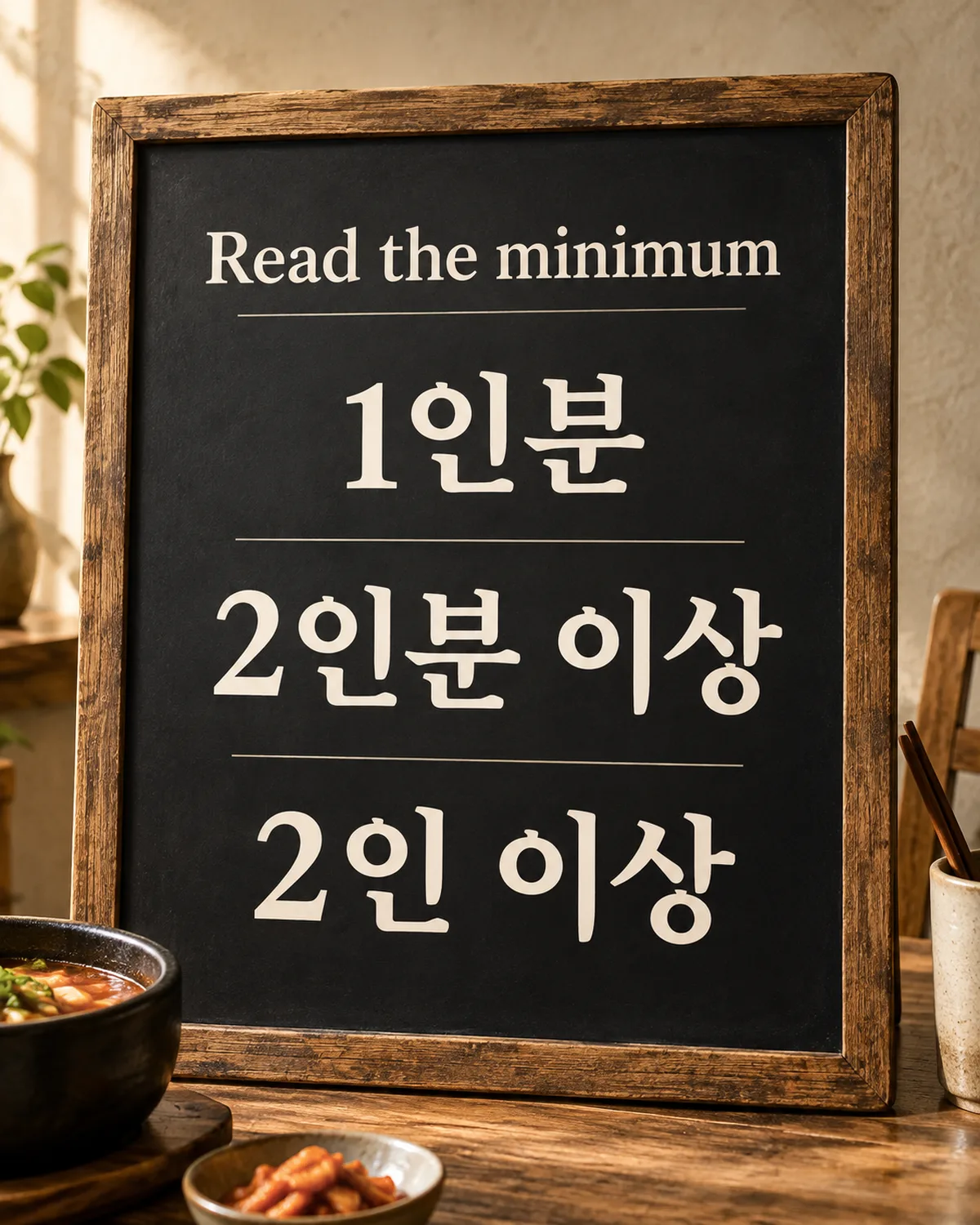
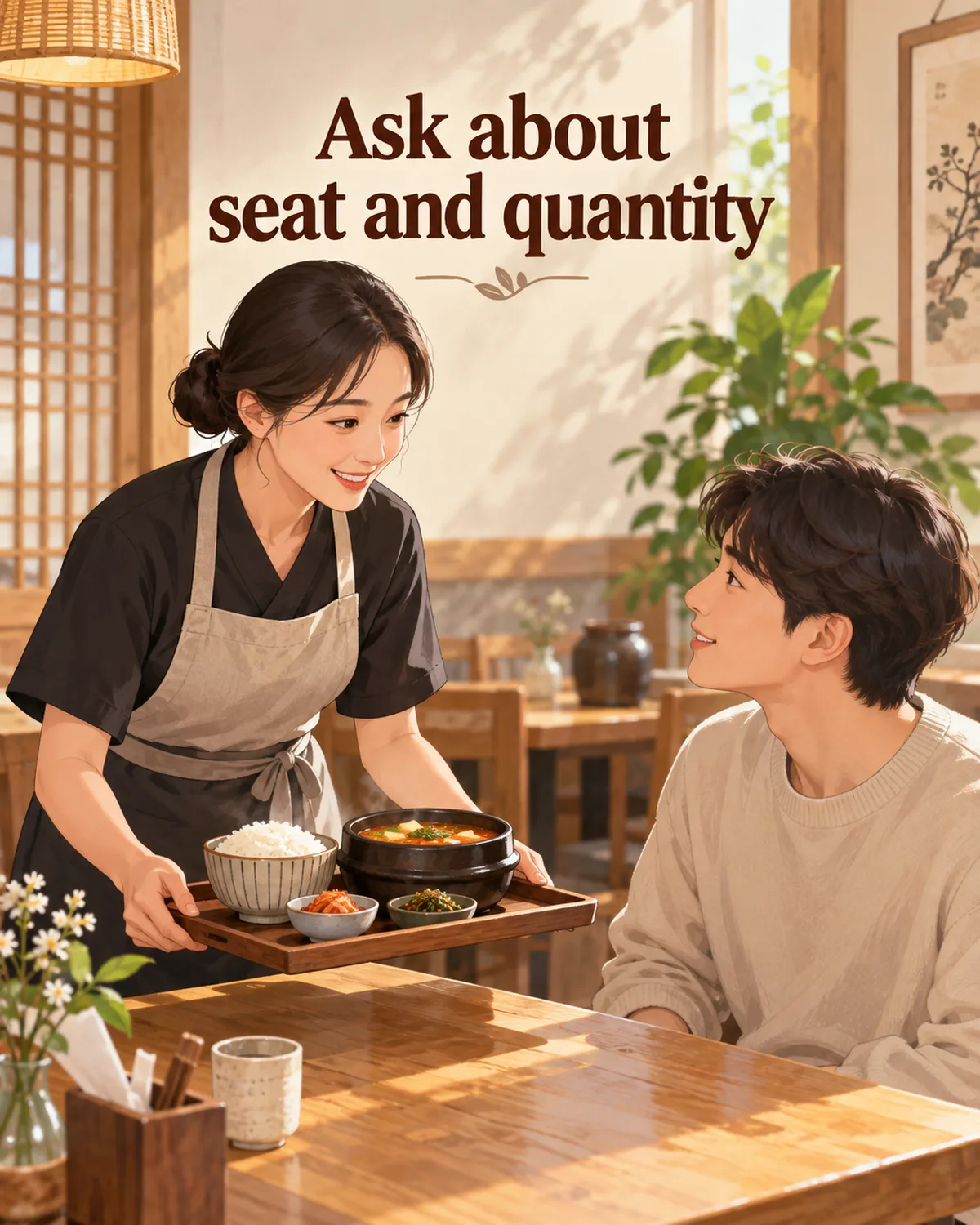
Read the minimum as carefully as the price. 1인분 is one serving; 1인 세트 is a set for one person. 2인분 이상 requires at least two servings, while 2인 이상 refers to at least two people. Those are different conditions. Ask both whether one diner can be seated and whether the required quantity suits your appetite.
Convenience stores, take-away packaging and individual meal sets expand the available formats, but they do not tell us why any particular person is eating alone. A chosen quiet lunch and unwanted isolation can look identical from another table. Choose the meal that suits the occasion rather than turning solitude into a test of independence, loneliness or health.
A meal for one still has several components
Studies of eating alone sometimes report associations with diet quality or health outcomes, but those relationships are entangled with age, income, living arrangement, meal frequency and social conditions. One bowl eaten alone does not cause a health outcome.
The practical issue is repetition. If honbap means instant noodles every night because they are convenient, the nutritional pattern matters. If it means a balanced rice-soup meal with vegetables and adequate protein, the pattern is different. The social setting cannot substitute for what is actually on the plate.
For a regular solo meal, look beyond the number of seats: what is the main starch, what supplies protein, and are vegetables part of the meal or only a small garnish? Repeating a narrow convenience-food pattern is a different question from whether you happened to eat it alone.