
Eating together does not require identical bowls. A useful, directly reported detail about tripleS is its members’ individual food orders. It offers a more practical way into everyday Korean eating than an inference about somebody’s private habits from a short clip.
The smoking headline needs a precise answer first. NEWSIS reported on August 12, 2026 that TWICE’s Chaeyoung said she was drinking a beverage, rather than smoking, in the circulated footage. This is her stated response, not a claim that we independently inspected every original frame.[1]
Xportsnews’s July 24 report describes fromis_9’s Lee Chae-young denying smoking on a July 23 talk-show episode, and tripleS’s Kim Yoo-yeon making a denial in May. The accounts concern a background object and an earlier variety-show exchange. A televised lie-detector segment should not be treated as independent proof of a person’s private history.[2]
For food, the evidence is more straightforward. At a May 2024 showcase reported by Korea JoongAng Daily, tripleS’s Kim Yoo-yeon explained that the members did not force one another to choose the same menu. That is a reported group practice, rather than a rule for all idols or all Korean restaurants.[3]

Choose the unit of the order first
A Korean group meal can combine individual mains with shared accompaniments. The important first question is what the restaurant is selling: one bowl, one plate to divide, or a pan ordered in portions. Sitting at the same table does not answer that question.
Look for the unit beside the price. Inbun, written 인분, means a portion or serving. A restaurant can require a minimum order for a shared preparation; another can sell complete individual meals. Ask about that restaurant’s system before multiplying the price by your group size.
A small, medium or large pot is also a restaurant-defined size. Those words do not specify one fixed number of diners across Korea. The rest of the order matters: a pot serving as the whole dinner has a different role from one of several shared dishes.
Rice and extras deserve their own question. A bowl may include its starch; a shared pan may have rice, noodles or other additions charged separately. The menu and staff can clarify what is included before the table orders several overlapping items.

Bowls and shared pans create different meals
Individual bowls give each diner a clear portion and a place to adjust the meal. A person can choose a different main while still sharing the conversation. Small common accompaniments, where supplied, do not erase the individuality of those bowls.
A shared pan makes division part of the experience. People serve from the same preparation, and an addition affects the whole dish. That can be enjoyable when the group wants the same flavor, but it needs another plan when somebody prefers a different main.
Consider a table with two people sharing a spicy pan and two choosing individual bowls. The group needs to check whether the venue offers that combination and whether the shared order meets its minimum. A specialist with one set menu may work differently.
There is no need to make this a test of Korean etiquette. Ask what the business serves, agree which items belong to whom and choose a workable combination. The useful distinction is the order’s structure, rather than an assumption that everybody must share everything.

Let cooking determine the pace
A finished rice bowl and a dish cooking at the table keep different time. If both are ordered, the group may not begin every mouthful together. Ask how the venue handles mixed orders when timing matters to your visit.
For a shared pot or stir-fry, follow the staff’s explanation about when to eat and when to add ingredients. A hot vessel is not a complete instruction. The venue may manage the preparation or may expect diners to perform a particular step.
Ready-to-eat food can change while it waits. Noodles absorb liquid; the crisp edge of a pancake can soften. Enjoying a finished dish when it arrives can make more sense than waiting for an unrelated shared preparation to reach the same stage.
This also affects quantity. An extra ordered early joins a meal already in progress; a finishing rice comes later. Understanding that sequence helps the table leave room for the part it actually wants instead of ordering every possible addition at once.

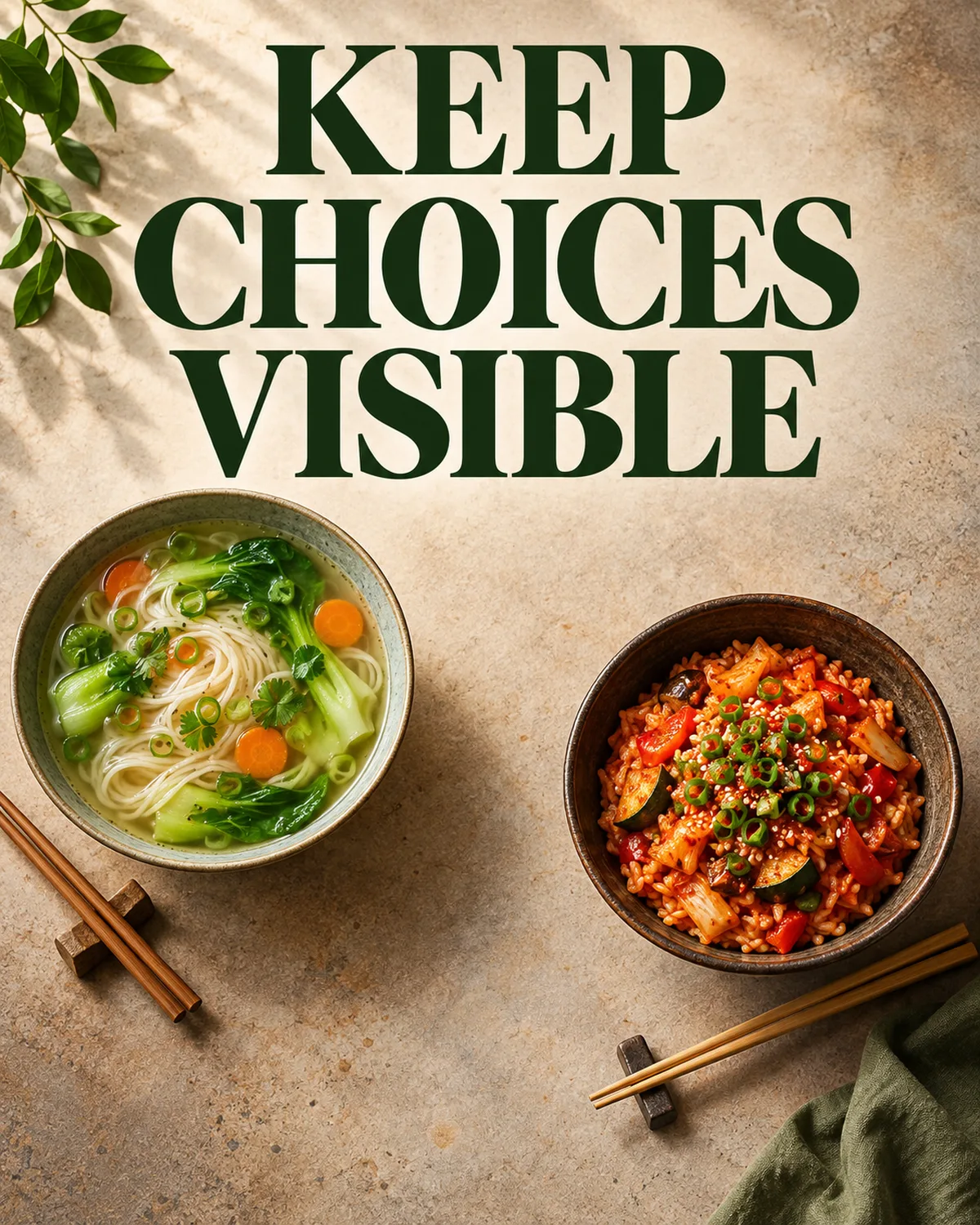
Keep individual choices visible
Before settling on one communal dish, ask whether everybody wants its basic flavor. A mild preference, a dislike of one ingredient and a need for confirmed ingredients are different questions. They are easier to discuss before ordering than after the food is mixed.
For ingredient questions, ask the provider about the complete preparation, including sauce and broth. Moving a visible item out of a finished dish does not tell you what was used in the rest of it. The menu’s picture is not an ingredient list.
An individual main can be the simplest way to preserve different preferences where the venue offers it. The group still shares a table and occasion. Nobody needs to explain a personal choice as a judgment on the whole cuisine.
Be specific when discussing alternatives. “I would like a mild bowl” gives the staff and friends something useful to work with. A clear description is easier to accommodate than a vague assumption that all Korean dishes have the same heat or fermented flavor.
Leave room for the finishing dish
Some shared-pan meals offer a later noodle or fried-rice addition. Where available, this is another stage of the meal, not an automatic free component. Confirm the price, portion and timing with the restaurant.
Ask whether the finishing addition can be ordered after the main dish. If it can, the group has a chance to judge its appetite. The appeal of the final rice is easier to enjoy when it is wanted rather than treated as an obligation.
Small side dishes also belong to the venue’s own service. What is included and what can be refilled varies. Request what the table will eat and let the staff explain the arrangement instead of deriving a refill promise from another restaurant’s photograph.
Finally, agree how the group will divide shared items and individual orders before adding extras. The restaurant has its own payment arrangements, but the table can still make its intentions clear. A good group meal leaves people knowing what they ordered and enjoying the food in front of them.
