Why Koreans Eat That

Tag: Korean dessert

  • Songpyeon vs Mochi vs Mooncake: Why Korea’s Chuseok Rice Cake Is a Half Moon

    Songpyeon vs Mochi vs Mooncake: Why Korea’s Chuseok Rice Cake Is a Half Moon

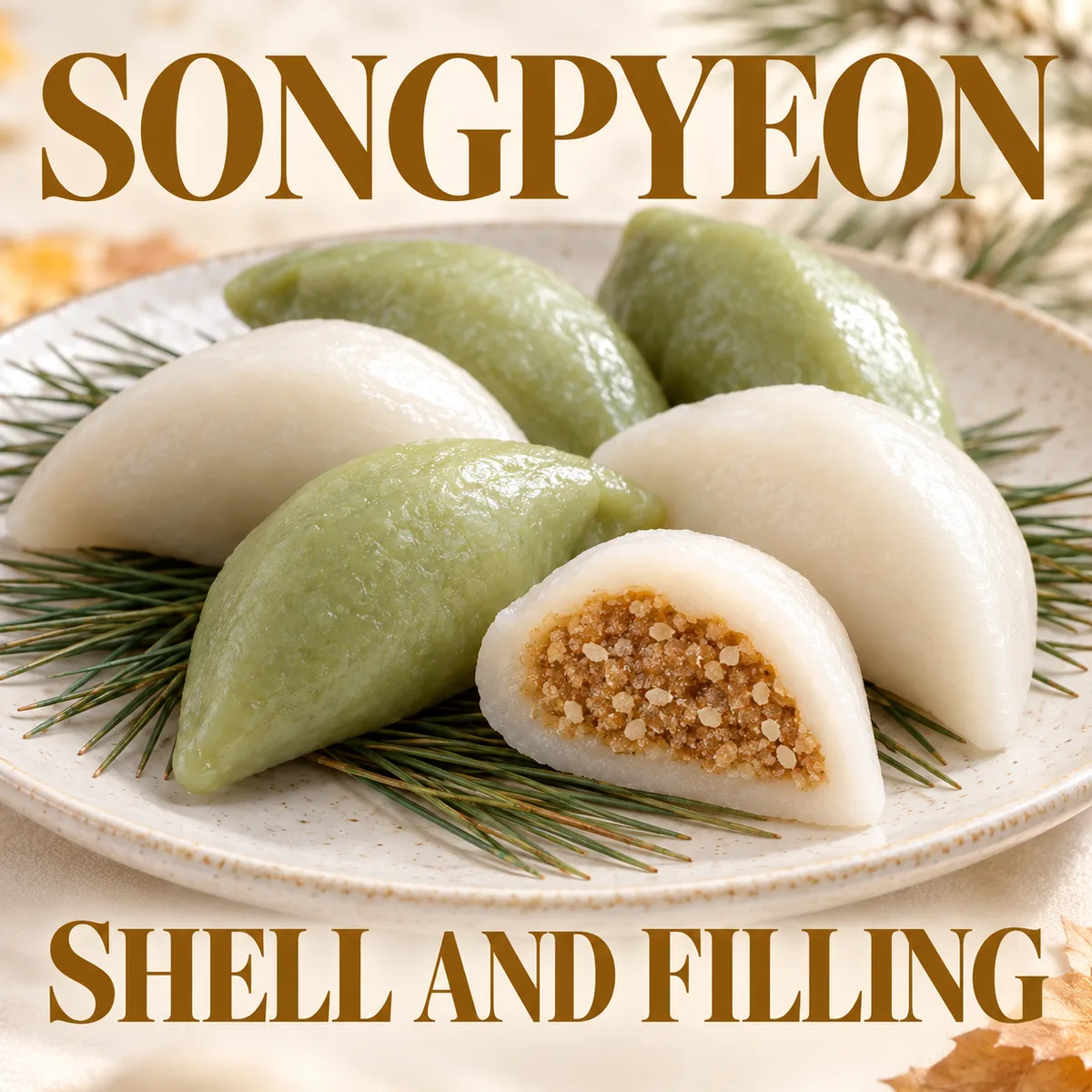
    Songpyeon gives the first bite two layers: a rice-dough shell and a filling enclosed inside it. A curved edge and a pinched seam make the familiar half-moon form easy to recognize. Comparing it with mochi and mooncakes works best when you look beyond the outline to how each food is made.

    Why a half moon? The practical answer begins with shaping filled dough and sealing it into a crescent. A Korean cultural feature also retells a legend that associates a crescent with growth and a full moon with decline. That is a traditional explanation of the symbolism, not evidence that the legend established the recipe or its invention date.[2]

    The shape is familiar rather than universal. The same feature describes a flat, round Jeju version. A round rice cake therefore does not automatically stop being songpyeon, and a crescent alone cannot tell you the flour, filling or regional preparation.[2]

    The most useful comparison has three questions: what forms the outside, how is it cooked and what is inside? Those questions keep Korea’s steamed rice cake, Japan’s many mochi preparations and the varied mooncakes of Mid-Autumn from becoming three interchangeable festival sweets.
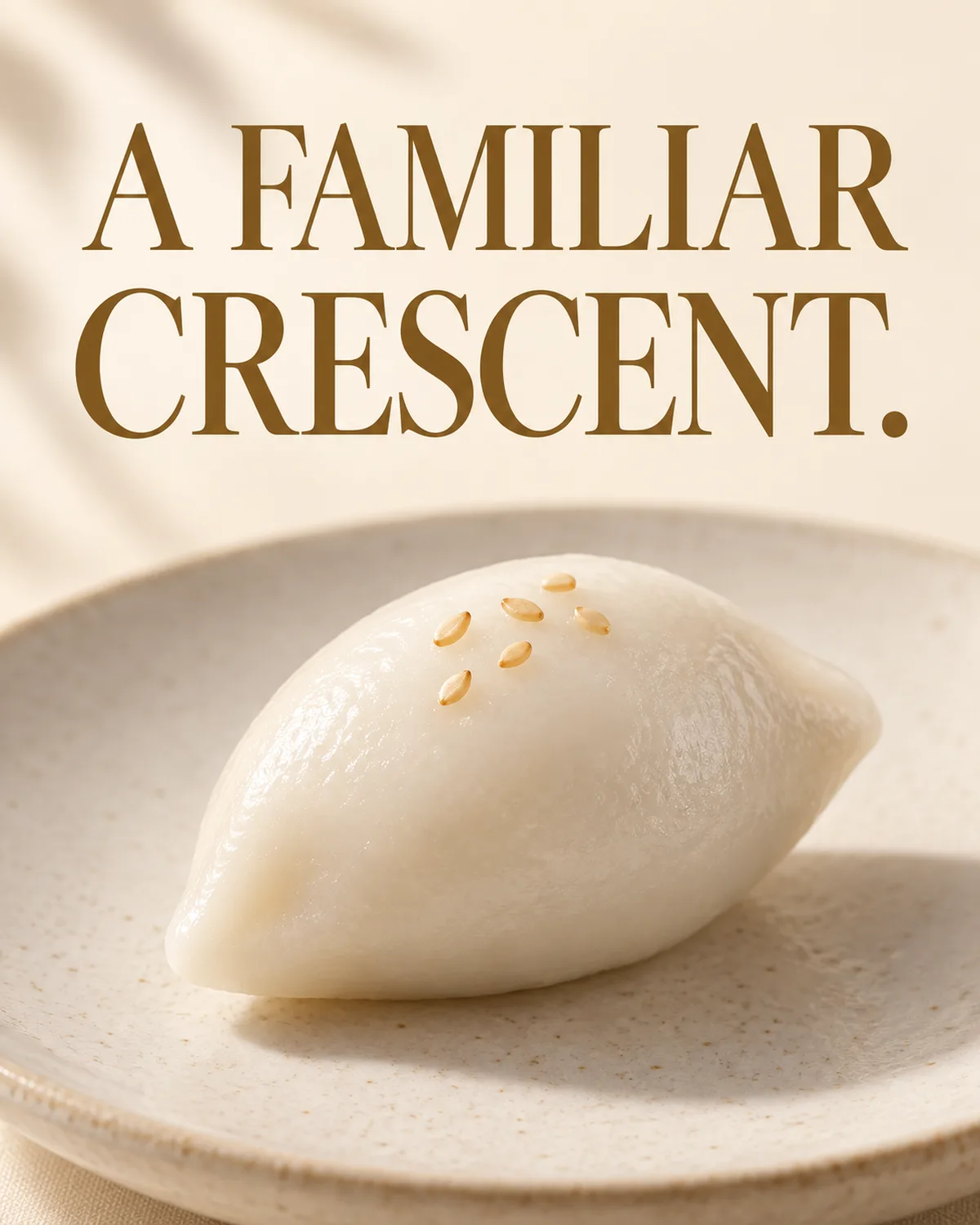
    The crescent is familiar, while regional forms can differ.
    The crescent is familiar, while regional forms can differ.

    Songpyeon: a sealed rice shell

    The Academy of Korean Studies describes a standard method using non-glutinous rice flour kneaded with hot water, shaped around a filling and steamed. Its account lists fillings such as beans, sesame and pine nuts. The rice shell is part of the finished bite, rather than a wrapper that disappears behind the center.[1]

    To read a cut piece, look for the distinct boundary between dough and filling. A fine filling can seem more integrated with the shell than a filling with visible pieces. Color on the outside, however, is a separate clue; it does not reliably identify every ingredient in the middle.

    The curve is made during shaping rather than supplied by a mold that all households must use. The seam has a concrete job: keeping the filling enclosed. A neat crescent and a more rounded piece can both invite the same question about the center, even when their silhouettes differ.

    Pine needles belong to the customary steaming association and aroma described in the cultural feature. They should not be confused with pine nuts used as a possible filling. A needle beside a cake and a nut inside it have different culinary roles.[2]
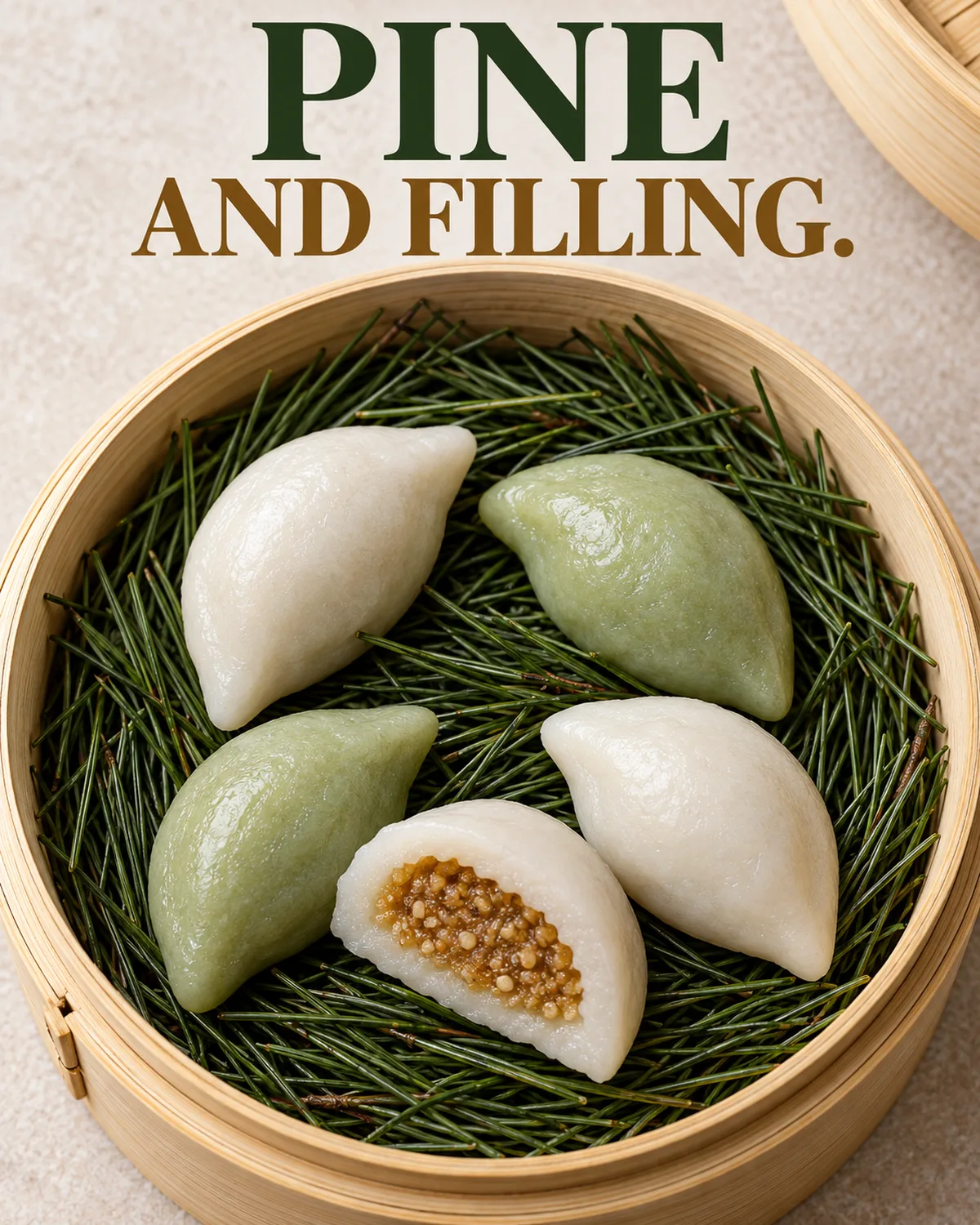
    Pine needles used in steaming and a filling inside the cake have different roles.
    Pine needles used in steaming and a filling inside the cake have different roles.

    Mochi: preparation matters more than the label

    JNTO describes the classic mochi process as cooking glutinous rice and pounding it into a cohesive mass. That is a useful contrast with the flour dough used for the standard songpyeon method. It also discusses savory as well as sweet regional traditions, so mochi should not be reduced to a single filled dessert.[3]

    Kyoto examples documented by Japan’s agriculture ministry combine glutinous rice with ingredients such as millet or other grains, then steam and pound it. Their serving methods include preparations beyond a plain sweet bite. One ingredient or topping cannot represent the entire mochi category.[4]

    A plain piece makes the rice texture the main event. A filled sweet adds another layer, while a savory serving changes the surrounding flavors. When a shop uses mochi in an English product name, read the actual item rather than assuming it matches every traditional preparation.

    For a tasting comparison, pay attention to how the surface and center behave together. A sealed songpyeon has a dough boundary around its filling. A mochi item may be plain, filled or served with other ingredients. Comparing those particular pieces is more informative than ranking two broad names.

    Classic pounded mochi and a filled songpyeon illustrate different rice preparations.
    Classic pounded mochi and a filled songpyeon illustrate different rice preparations.

    Mooncakes: a varied pastry family

    The Hong Kong Tourism Board presents mooncakes as part of Mid-Autumn sharing and describes both traditional fillings and modern variations. Lotus-seed paste and salted egg yolk are examples, not compulsory contents. The occasion and the many available versions matter as much as a round outline.[5]

    A maker’s dated example makes that variety concrete. The Peninsula’s July 2026 announcement describes Spring Moon egg-custard mooncakes with flaky pastry and includes both round and heart-shaped offerings. The announcement documents that seasonal collection; it does not establish present stock or a universal shape rule.[6]

    In a baked pastry example, cutting exposes an outer crust around a denser filling. That structure differs from a steamed rice-dough shell. A modern chilled or other variation may change the comparison again, so check which kind of mooncake is actually on the plate.

    Sharing a cut mooncake also changes the tasting experience. A small wedge exposes the layers and makes the relationship between crust and filling easy to see. Compare the portion in front of you without assuming that one whole cake is the appropriate serving for every person.

    A baked mooncake example has a crust surrounding its filling.
    A baked mooncake example has a crust surrounding its filling.

    The harvest connection is broader than one story

    The Academy’s account connects new-rice songpyeon with the eighth lunar month, but also records a second-month custom involving cakes for servants. Songpyeon therefore has a documented seasonal life beyond a claim that Koreans eat it only on Chuseok.[1]

    A festival association gives a food social meaning without prescribing every family’s plate. Different fillings, colors and regional forms can coexist within that association. A contemporary shop display is an example of what that seller offers, not a complete map of Korean household practice.

    Likewise, mochi belongs to several Japanese occasions and regional settings. Mooncakes have their own Mid-Autumn sharing context. Their calendars can overlap in an autumn comparison while their techniques and meanings remain distinct.

    Treat the crescent legend as a story to discuss alongside the food. It can explain why growth is associated with the shape in that telling. It cannot replace evidence about the dough, steaming method or the many forms people actually make.

    The crescent legend explains symbolism rather than establishing a recipe’s invention.
    The crescent legend explains symbolism rather than establishing a recipe’s invention.

    Compare the pieces on the table

    Start with a cut songpyeon and identify its seam, shell and filling. Then inspect the particular mochi item: is it plain, filled or dressed? Finally, look at the mooncake’s crust and center. This order makes the comparison visible before you decide which texture you prefer.

    For a fair comparison, keep the pieces modest and taste them separately. A strong filling or topping can dominate the first impression. Notice what the outer layer contributes rather than treating all the flavor as a property of the rice or pastry alone.

    Ingredient questions belong to the particular product. A general category name cannot establish whether nuts, sesame, dairy or another ingredient is present. Ask the maker about the item being served when those details matter.

    The three foods are rewarding for different reasons: a steamed shell enclosing filling, a rice preparation that can take many forms, and a diverse pastry tradition shared around Mid-Autumn. Their familiar shapes open the conversation; the actual layers and methods make it worth continuing.
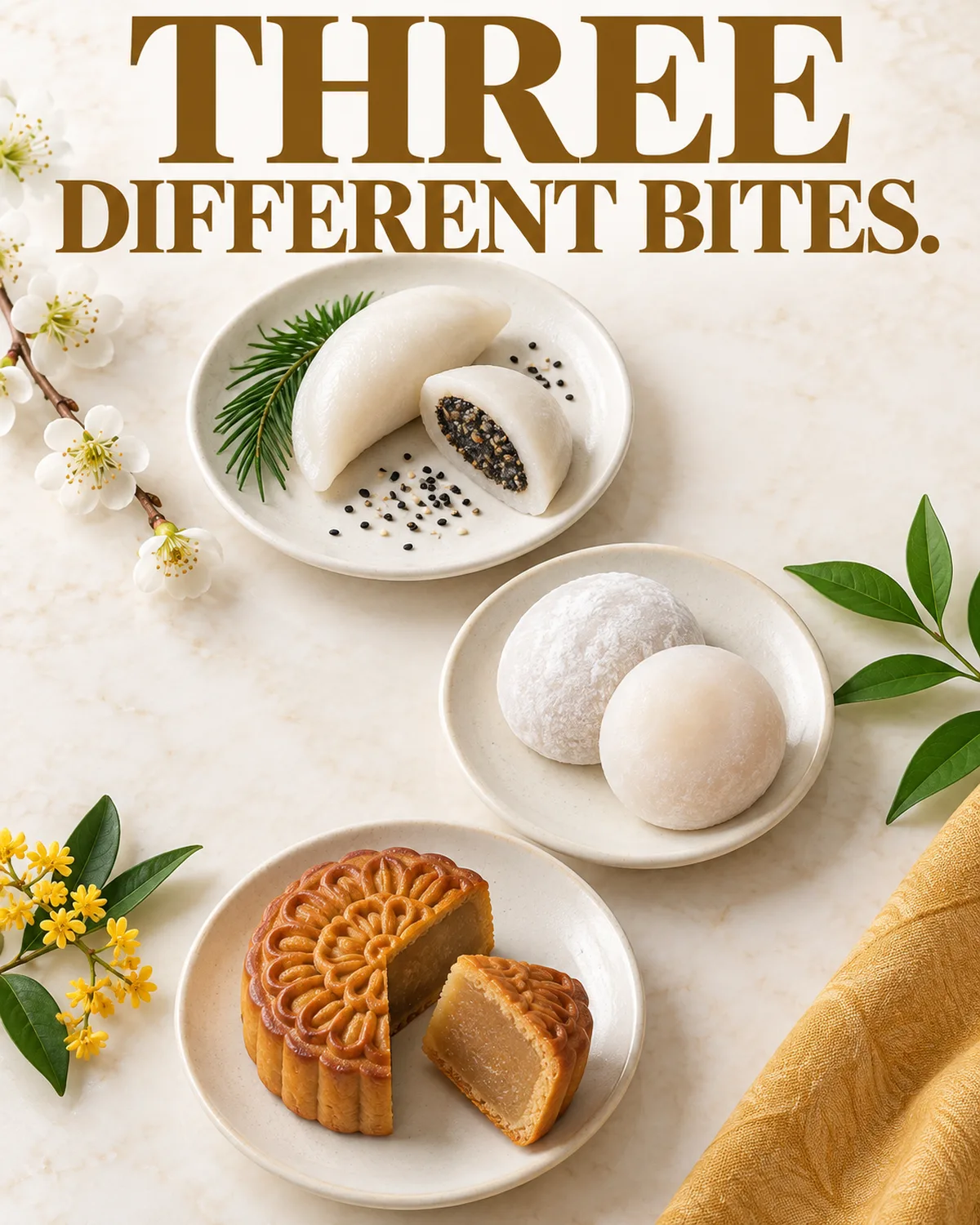
    The shell, preparation and filling make the comparison concrete.
    The shell, preparation and filling make the comparison concrete.

    Continue the Korean rice and sweets story

    Sources and reading

    1. Academy of Korean Studies — songpyeon
    2. Ministry of Culture, Sports and Tourism — songpyeon feature, September 9, 2024
    3. Japan National Tourism Organization — mochi and regional traditions
    4. Japan Ministry of Agriculture — Kyoto rice cakes
    5. Hong Kong Tourism Board — Mid-Autumn food traditions
    6. The Peninsula — Spring Moon seasonal announcement, July 28, 2026
  • The Man Who Sold 500 Dalgona a Day: What Squid Game Did to Seoul’s Street Vendors

    The Man Who Sold 500 Dalgona a Day: What Squid Game Did to Seoul’s Street Vendors

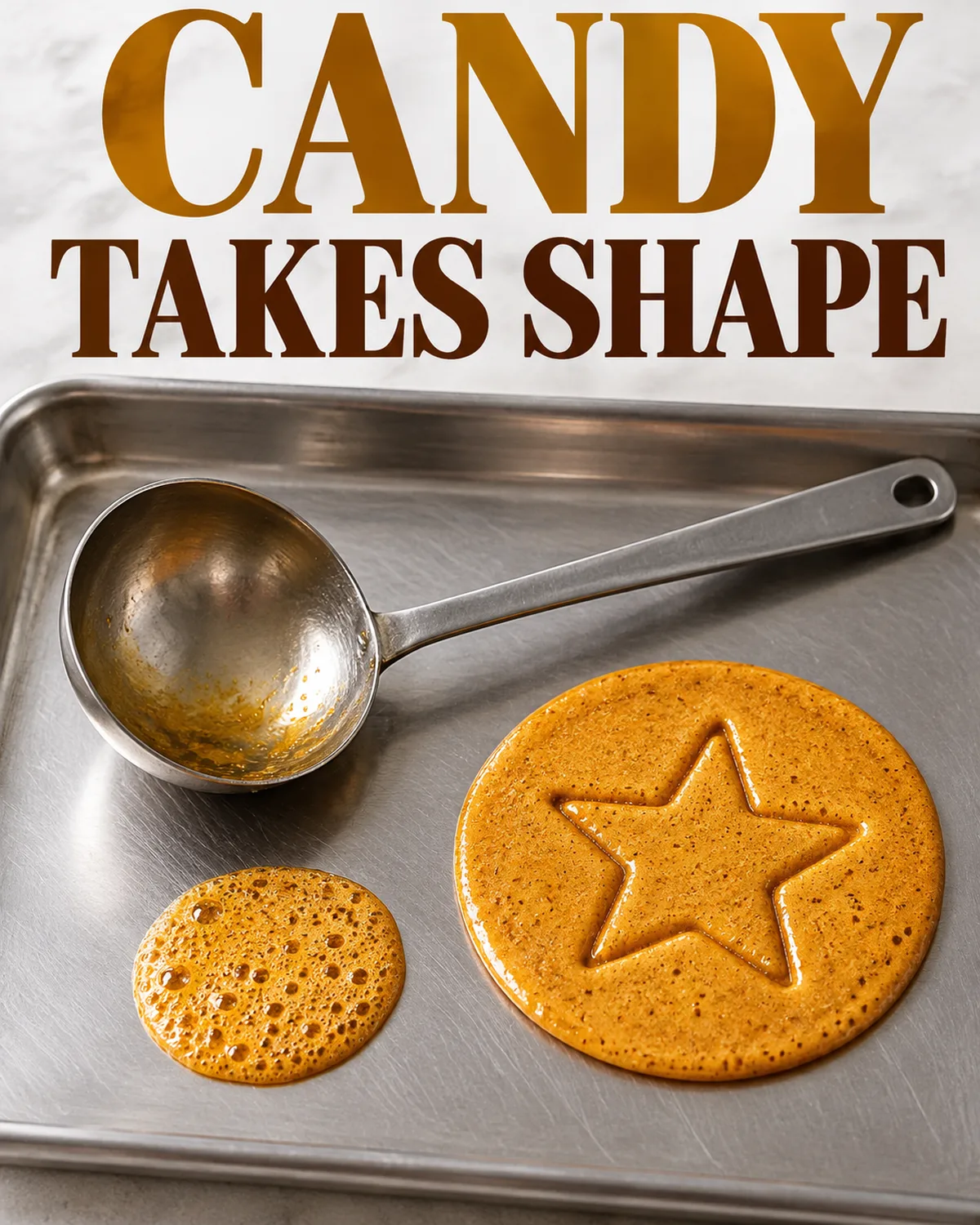
    A finished dalgona disc carries two kinds of work: the candy has been made, and a shape has been pressed into it. The stamped star or circle is what a viewer recognizes first. At a stall, the surface has to be ready before anyone can try the game.

    The headline’s number belongs to October 2021. Reuters reported that Seoul seller An Yong-hui was selling more than 500 pieces a day, up from fewer than 200 before Squid Game premiered. It was a report about that seller during that surge, not a current sales figure.[1]

    The same report described him remaining at work without going home for a week to meet demand. That gives the surge a human scale. It does not establish his present location, later income or the experience of every vendor in Seoul.[1]

    The enduring food question is what happens between one customer and the next. A candy disc begins as a hot mixture and ends as a fragile stamped object. A larger audience can arrive quickly; that physical transformation still needs the maker’s attention.

    The sales figures describe a vendor during the reported 2021 surge.
    The sales figures describe a vendor during the reported 2021 surge.

    The sales number has a limited job

    The Reuters account documents attention reaching a particular small business. It also distinguishes the person making candy from customers trying a game. Those are useful observations without treating one day’s output as a complete financial account.

    Pieces sold are not the same measure as profit. To calculate earnings, you would also need costs and other business details. A visible line or a large sales number alone cannot supply them.

    Likewise, the phrase street vendor covers people working with different spaces, equipment and customers. One reported case can illuminate the work, but it cannot represent every person selling a similar sweet.

    For a visitor today, use current information from the seller you actually find. Ask what is being offered and whether a game is included. A dated news photograph cannot promise today’s stall location, price or opening time.

    A piece count alone cannot establish a vendor’s profit.
    A piece count alone cannot establish a vendor’s profit.

    Watch how the surface is formed

    Maangchi’s ppopgi recipe begins with sugar and baking soda. She describes heating and stirring the sugar, expanding the mixture with baking soda, then pressing and stamping it. Her account connects a short ingredient list with technique and timing.[2]

    Watching the sequence is different from seeing only the finished shape. Stirring, placing the mixture and pressing it each change the object in front of you. Leave the work area clear so the maker can continue without someone reaching across it.

    The foamed interior helps explain the candy’s light, brittle texture. Maangchi describes it as sweet with smoky, nutty and bitter notes. A bite is therefore a different experience from chewing a dense, sticky sweet.[2]

    This is a description of skilled work rather than a complete home recipe. If you want to cook it, use a reliable method and suitable supervision for hot sugar. Watching the stall does not require handling the burner or the hot mixture.

    The foamed candy is pressed into a disc before the outline becomes a game.
    The foamed candy is pressed into a disc before the outline becomes a game.

    The stamp makes an edible game boundary

    A stamped line marks where the central shape meets the surrounding candy. It has to be an impression in the disc, rather than a separate decoration placed on top. That small difference is essential to understanding the challenge.

    The maker’s pressure affects the impression. Maangchi explains that a stronger or lighter stamp can change how easily a shape comes out. This makes the line part of the food’s making process, as well as the later game.[2]

    Look at the line and the thickness of the piece before deciding whether to try. A handmade candy is an actual object with edges and small irregularities. Its shape may be familiar from television while its brittleness is still surprising in the hand.

    Ask the seller what rules apply. A prize, tool or handling arrangement shown elsewhere may not be offered at this stall. You can also choose to eat the sweet without turning it into a test.

    The stamp leaves a line within the same candy disc.
    The stamp leaves a line within the same candy disc.

    A queue includes more than cooking

    Serving the next person also involves explaining choices, receiving payment and handing over something that can break. Those small actions compete for attention around the same work surface. Watching them makes the trade easier to understand.

    Choose your order before stepping into the maker’s working space. If you want a photograph or close video, ask first and follow the answer. A clear surface and an uninterrupted moment can matter more than another angle of the candy.

    Keep your hands away from active tools and let the seller pass the finished piece to you. The stamped surface can be admired after the handover. Reaching toward a piece while it is being shaped interrupts the very process you came to see.

    If the wait does not fit your day, choose another stop or return when suitable. A recognizable food is still sold by a business with its own pace. Enjoying Korean street food does not depend on joining every visible line.

    A clear work surface helps the maker finish and hand over the candy.
    A clear work surface helps the maker finish and hand over the candy.

    Carry the candy as food, not just an image

    Support the finished disc rather than squeezing its rim. If it comes in packaging, follow the seller’s handling advice and keep it from being crushed against heavier purchases. A clean photograph is easier after the candy has reached a stable surface.

    Confirm ingredients in the actual version when needed. A familiar basic recipe cannot identify every modern variation or what other foods are handled nearby. The seller’s own preparation details are the relevant information for your purchase.

    The 2021 report and the recipe answer different questions: one records a surge in demand, while the other explains how a stamped candy takes shape. Together they let you see both the public image and the small repeated actions behind it.

    Start by looking at the disc, its bubbles and the pressed outline. Then watch the maker begin the next piece, if the stall permits it. The most useful memory may be how much attention a small candy requires before it reaches your hand.

    The brittle candy needs support when it is carried.
    The brittle candy needs support when it is carried.

    The candy and the wider street-food table

    Sources and reading

    1. Reuters — October 1, 2021 vendor report, reproduced by Our Today
    2. Maangchi — Ppopgi, published November 26, 2013; updated September 14, 2026
  • Yakgwa: Fried Dough, Syrup and the History of Korean Oil-and-Honey Sweets

    Yakgwa: Fried Dough, Syrup and the History of Korean Oil-and-Honey Sweets

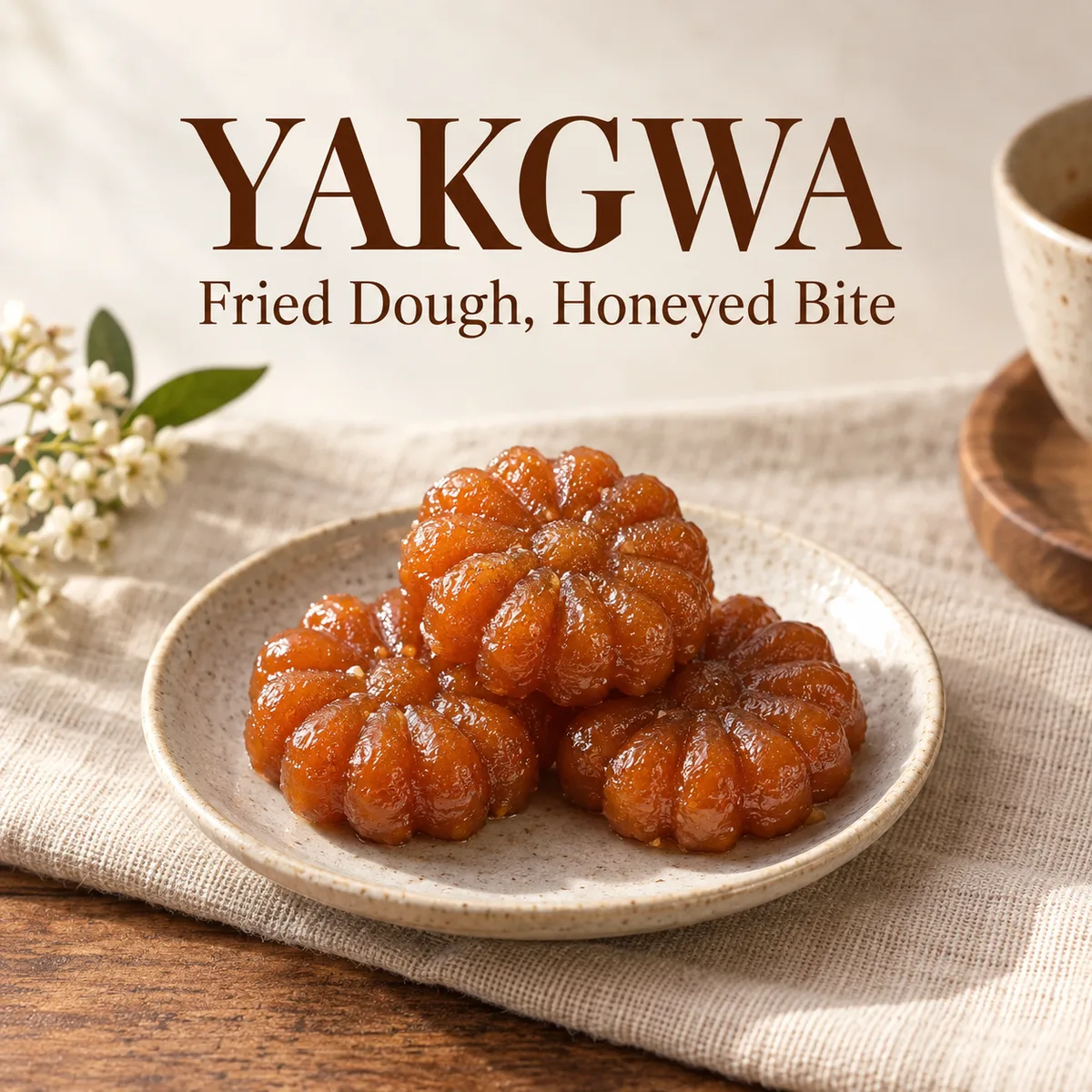
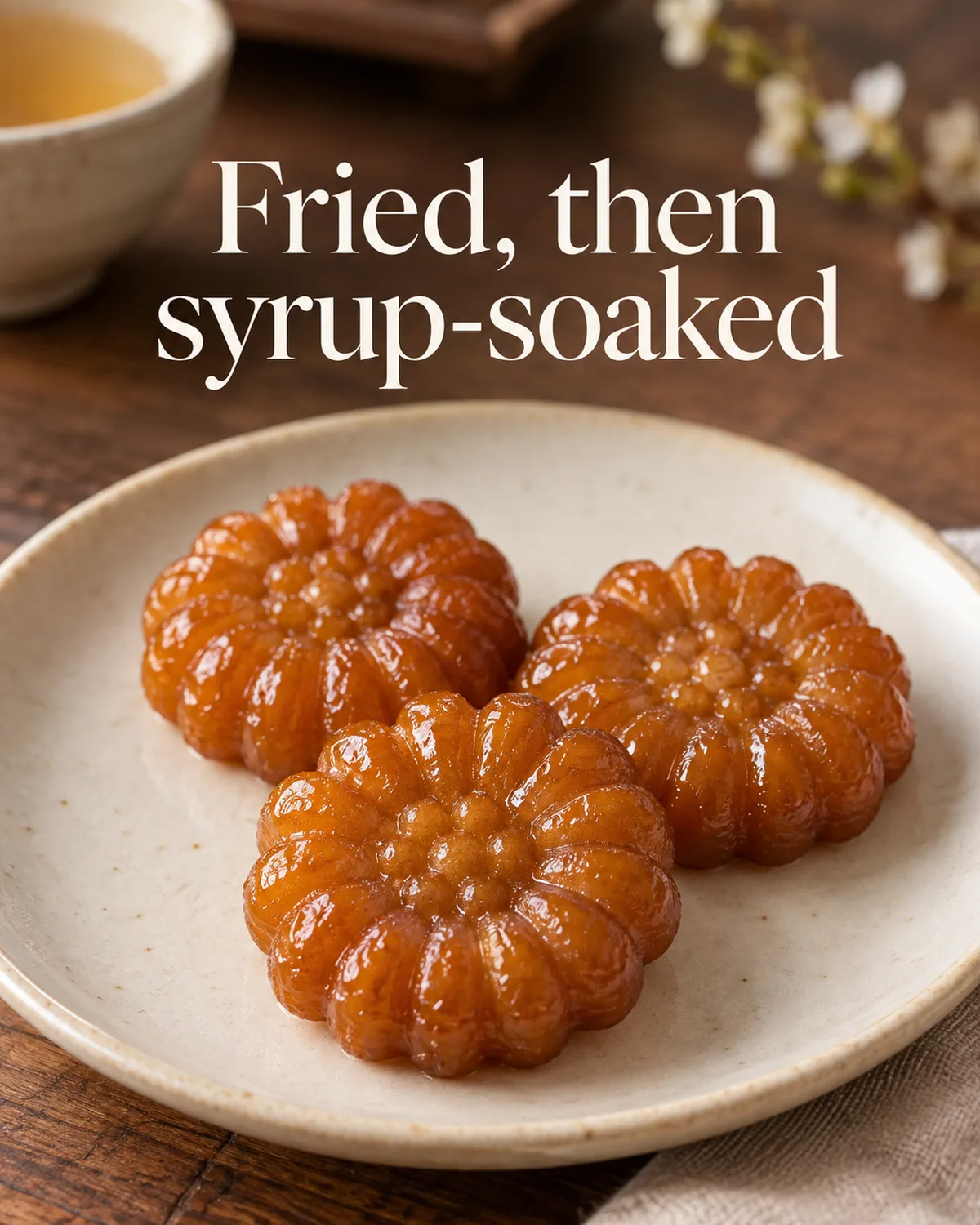
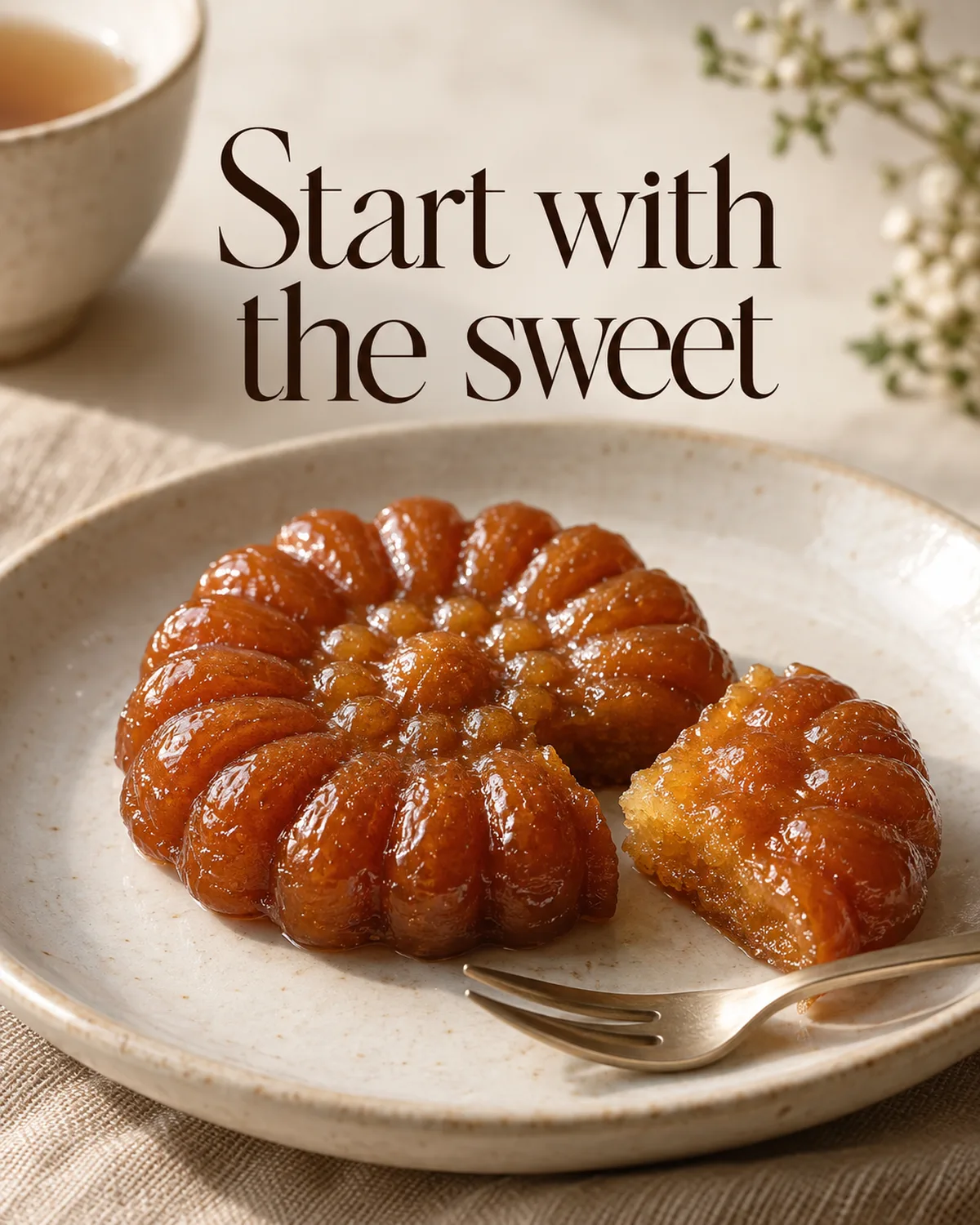
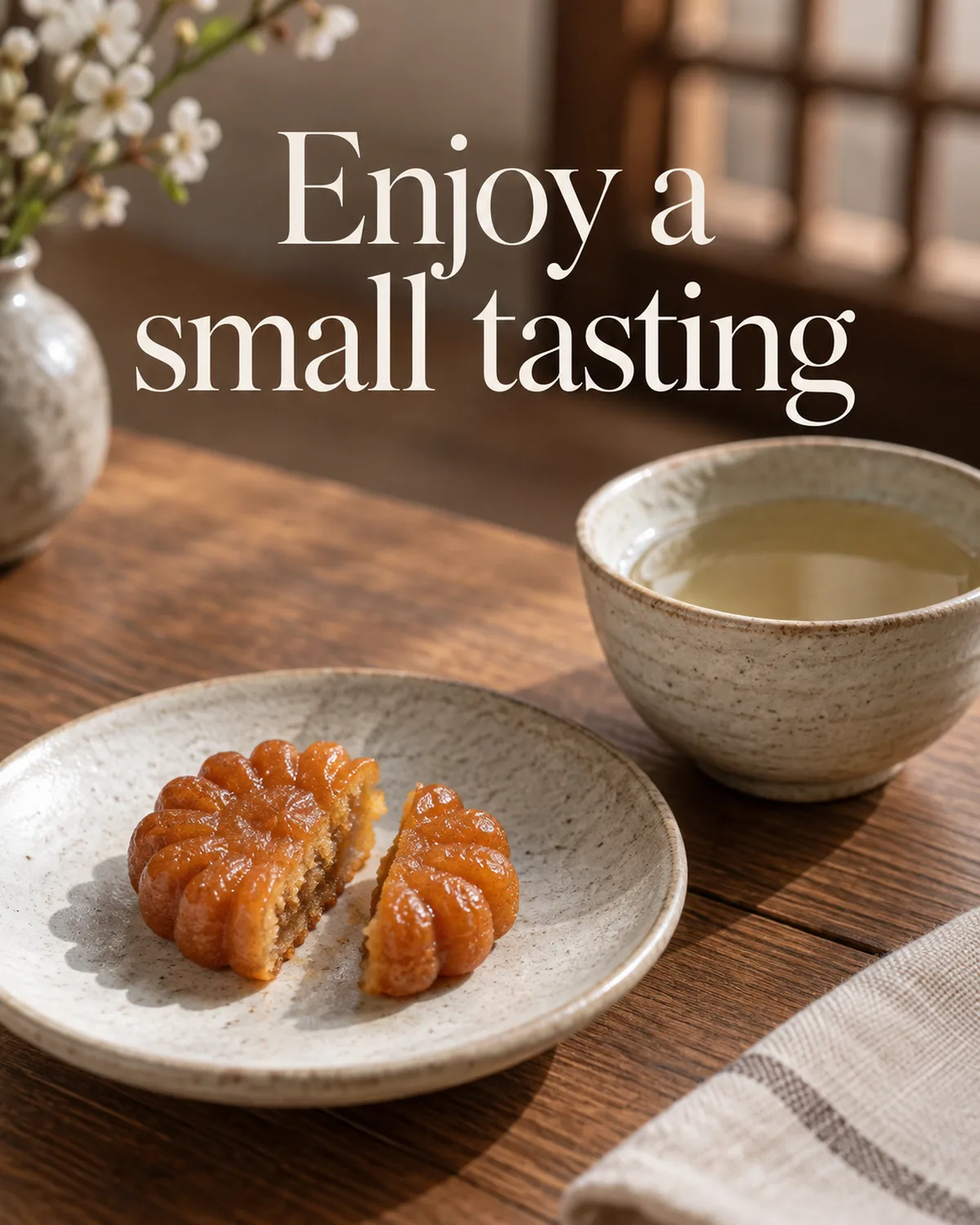
    A small flower-shaped yakgwa can look like a molded biscuit until you pick it up. Its glossy surface and substantial bite belong to a different kind of sweet: dough is fried, then soaked in syrup. Start with a small piece and notice how the edge and center behave.

    Its older history is best understood through yumilgwa, the wider family of oil-and-honey confections. A royal association and a long tradition do not mean that every modern flower-shaped cookie follows one unchanged, thousand-year-old recipe.[2]

    Two stages shape the sweet.
    Two stages shape the sweet.

    Frying and syrup create the distinctive bite

    The Academy of Korean Studies defines yakgwa as wheat-flour dough made with honey and sesame oil, pressed into a mold and cooked in vegetable oil. It then goes into honey or grain syrup.[1]

    That sequence helps explain why the word “cookie” only gets you part of the way. Look at a cut or broken piece: the inside is a cooked dough structure carrying sweetness, rather than a crisp biscuit with a thin icing on top.

    Taste an edge first, then a piece from the center. Compare resistance, softness and the way syrup coats the mouth. Different makers can deliver a firmer, more crumbly piece or a softer, denser one; a flower outline alone cannot predict the result.

    The encyclopedia’s recipe includes ginger juice and clear rice wine in the dough, with cinnamon in the soaking syrup. Those details describe a documented preparation, not an ingredient guarantee for every packaged or handmade product.[1]

    Look beyond the glossy surface.
    Look beyond the glossy surface.

    Choose the product, not just the photograph

    A molded flower is the familiar image, but shape and size vary. The same reference distinguishes small and large yakgwa and a large angular form called moyakgwa.[1]

    Ask the seller what the piece is like before buying a large box. Is the center soft, is the surface particularly sticky, and is the portion intended as one serving or for sharing? A small sample tells you more about your preference than a glossy display.

    Read the actual ingredients when they matter to you. Wheat flour, sesame oil, honey, syrup, spices and toppings need checking on the product you choose. A traditional description cannot settle substitutions, shared equipment or the composition of a cream-filled adaptation.

    For taking it home, follow the maker’s packaging and storage directions. Plain yakgwa and a dessert assembled with cream or ice cream are different products. Keep the box supported and do not assume one universal shelf life from the name.

    Ask about texture and ingredients.
    Ask about texture and ingredients.

    An old confection family, not a precise invention date

    The encyclopedia’s yumilgwa entry explicitly says its beginning is unknown. It describes the family as flourishing in Goryeo, used at rites, banquets and weddings. Its 1296 account concerns confections brought to a royal wedding in Yuan territory.[2]

    It also records restrictions in 1192 and 1353, linking extensive use to demand for grain, honey and oil. The history concerns costly ingredients and public resources as well as ceremonial prestige.[2]

    These dates establish medieval documentation of the broader family. They do not identify the first baker of today’s flower-shaped yakgwa or certify that a modern shop reproduces a medieval formula.

    The wider family includes molded, angular and dumpling-shaped forms with different names and uses. Reading yakgwa within that family leaves room for changes in shape, occasion and preparation.[2]

    Shapes and occasions have varied.
    Shapes and occasions have varied.

    Suwon adds a local story to the royal connection

    The Academy’s Suwon entry describes yakgwa as made across Joseon, with Suwon especially renowned. It discusses Yongjusa’s confections being supplied for rites at Hyeollyungwon, the tomb associated with Crown Prince Sado.[3]

    The entry also retells an account from Jeong Yak-yong’s Mokminsimseo in which King Injo requests Suwon yakgwa. That is an attributed historical anecdote in a later text, rather than a surviving order that proves one original royal recipe.[3]

    The royal connection is therefore richer than a label saying “food only kings could eat.” Local reputation, temple provisioning and ceremonial use offer more specific questions to ask about a regional sweet.

    When a shop advertises a regional style, ask what distinguishes its actual preparation. A place name can guide curiosity, but it does not replace tasting the product or checking the maker’s explanation.

    Ask what distinguishes the preparation.
    Ask what distinguishes the preparation.

    The modern revival has a date

    A Korea Tourism Organization article published on February 2, 2024 described young consumers queuing for yakgwa and competing to secure sought-after products, using the term “yaketing.” It also described yakgwa cookies, financiers and ice cream.[4]

    That dated account helps explain the sweet’s modern visibility. It is evidence of a reported revival, not a live ranking of Korea’s most popular dessert or a promise that a particular shop still has the same queues.

    Notice what the dessert adds.
    Notice what the dessert adds.

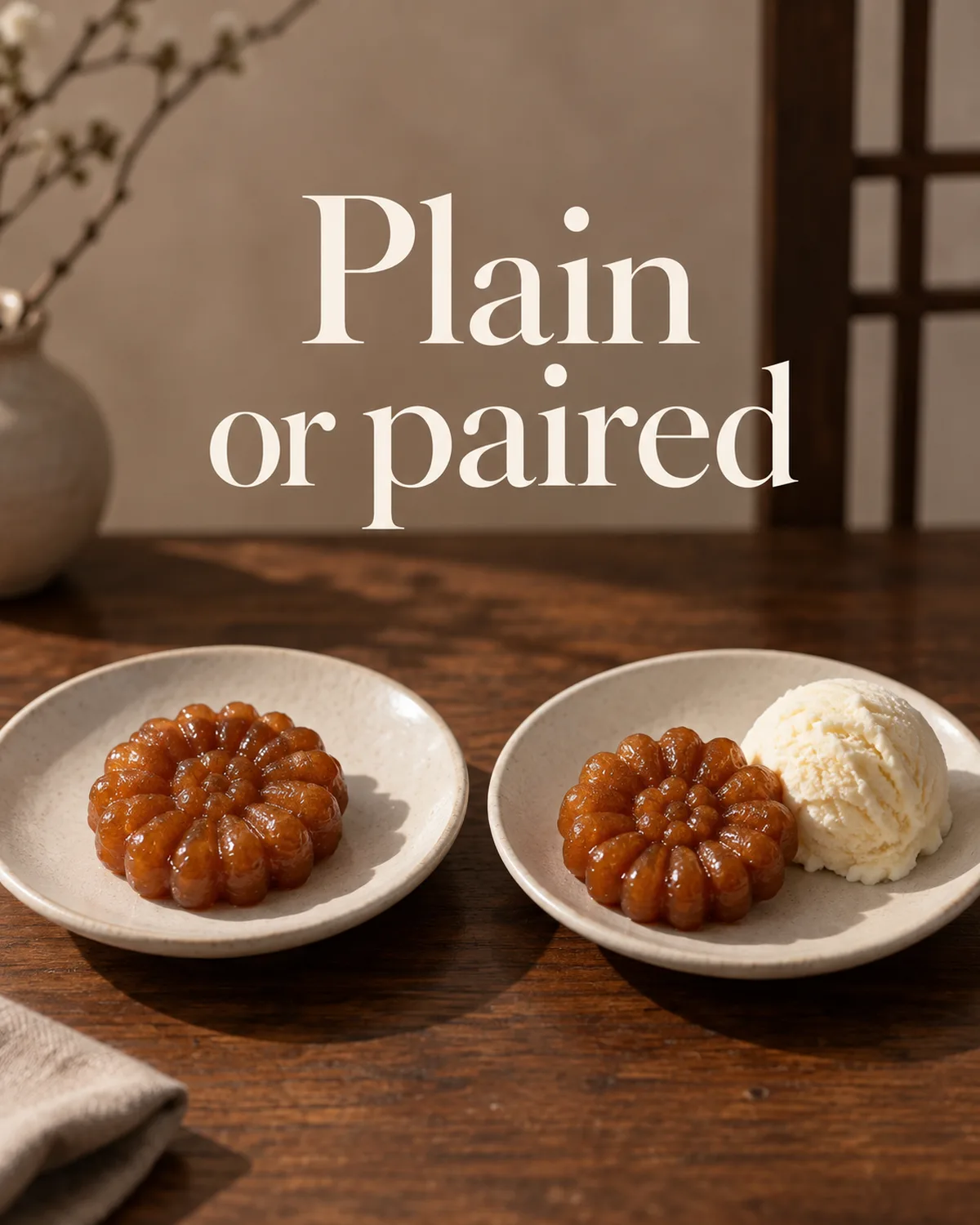
    A plain piece lets you concentrate on the fried dough and syrup. In a composed dessert, ask whether yakgwa is an intact topping, broken pieces or part of the filling; cream and frozen elements change the balance and the eating method.

    If comparing versions, begin with a small plain piece before a richer adaptation. You can then distinguish the sweet itself from the dessert built around it, rather than judging both by the same expectation.

    Compare a small plain bite first.
    Compare a small plain bite first.

    A small tasting is enough to start

    Set one piece on a plate and divide it if the portion feels substantial. Try a bite by itself, then take a sip of an unsweetened drink you enjoy. Notice whether the pairing changes how strongly you perceive the syrup, spice or toasted notes.

    The name’s connection with honey belongs to its food history; it is not a reason to treat the confection as medicine. Enjoy yakgwa as a sweet whose technique, regional stories and modern variations reward attention.[1]

    Texture, aroma and a drink you like.
    Texture, aroma and a drink you like.

    Explore other Korean sweets

    Sources and reading

    1. 한국민족문화대백과사전 — 약과 (Yakgwa)
    2. 한국민족문화대백과사전 — 유밀과 (Yumilgwa)
    3. 한국민족문화대백과사전 — 수원약과 (Suwon Yakgwa)
    4. Korea Tourism Organization — Gen Z’s Choice of Traditional Desserts, February 2, 2024
  • Squid Game Dalgona: The Candy Korean Kids Were Cheating At for Decades

    Squid Game Dalgona: The Candy Korean Kids Were Cheating At for Decades

    The stamped shape makes dalgona more than a piece of caramelized sugar. It tells the eater where to look, where the brittle candy might break and what counts as succeeding at the game.

    That is why Squid Game could make an old street snack instantly legible to viewers who had never tasted it. The drama amplified an existing object and activity; it did not invent either one.

    Sugar becomes a fragile, foamed disc

    The basic modern street-candy version is remarkably simple. Sugar is melted until liquid, a very small amount of baking soda is stirred in, and the mixture foams. It is then flattened and stamped with a shape before it fully hardens.

    Baking soda helps produce carbon dioxide bubbles in hot sugar. As the candy cools, its sugar structure sets around the bubbles, giving the finished piece a light, porous bite. The American Chemical Society’s explanation of honeycomb candy describes this aeration mechanism; its honey-and-water recipe is a different preparation, not a dalgona formula.6

    The vendor therefore works with seconds, not with a forgiving cake batter. Sugar can burn, foam can collapse, the press can stick and the stamp can cut too deeply. The visual simplicity hides a skilled repetitive motion.

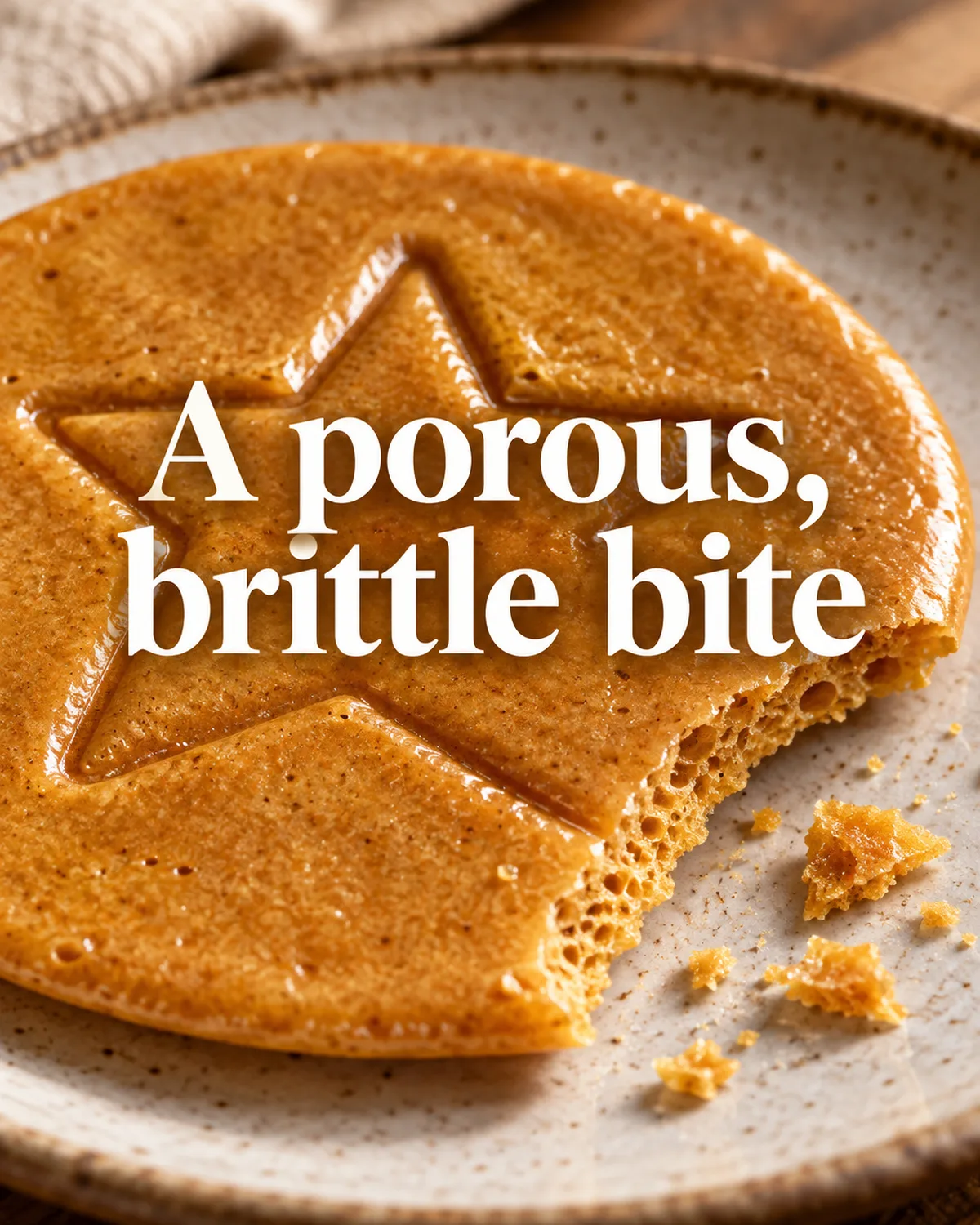
    Break off a small corner of a cooled piece and look at its edge. Fine pores distinguish it from a solid boiled sweet. The first bite snaps; the thin sugar walls then dissolve, leaving a caramel-like sweetness. A badly scorched piece can taste bitter rather than pleasantly toasted.

    A broken edge reveals the fine pores inside cooled dalgona.
    A broken edge reveals the fine pores inside cooled dalgona.

    Pressing makes the foam into a disc, while stamping gives it a guide line. Neither stage should remove the whole figure: the challenge depends on leaving the shape connected to the surrounding candy.

    The stamped challenge is half the object

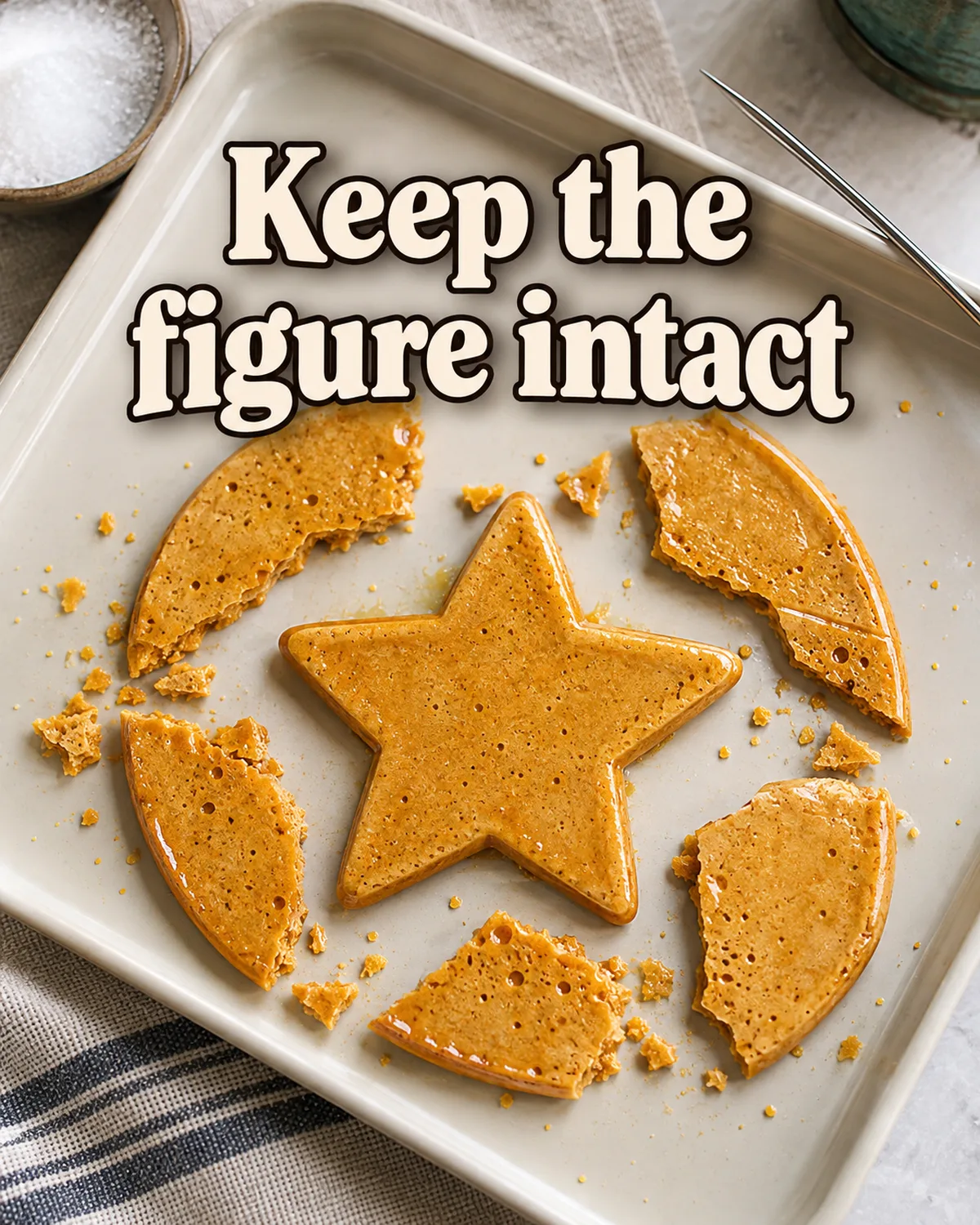
    The player tries to remove the surrounding candy while keeping the stamped figure intact. The outer scraps can break; a crack across the intended figure ends the attempt. Ask the seller what counts as success before assuming a free second candy is offered.

    The outer candy can break; the stamped center should stay whole.
    The outer candy can break; the stamped center should stay whole.

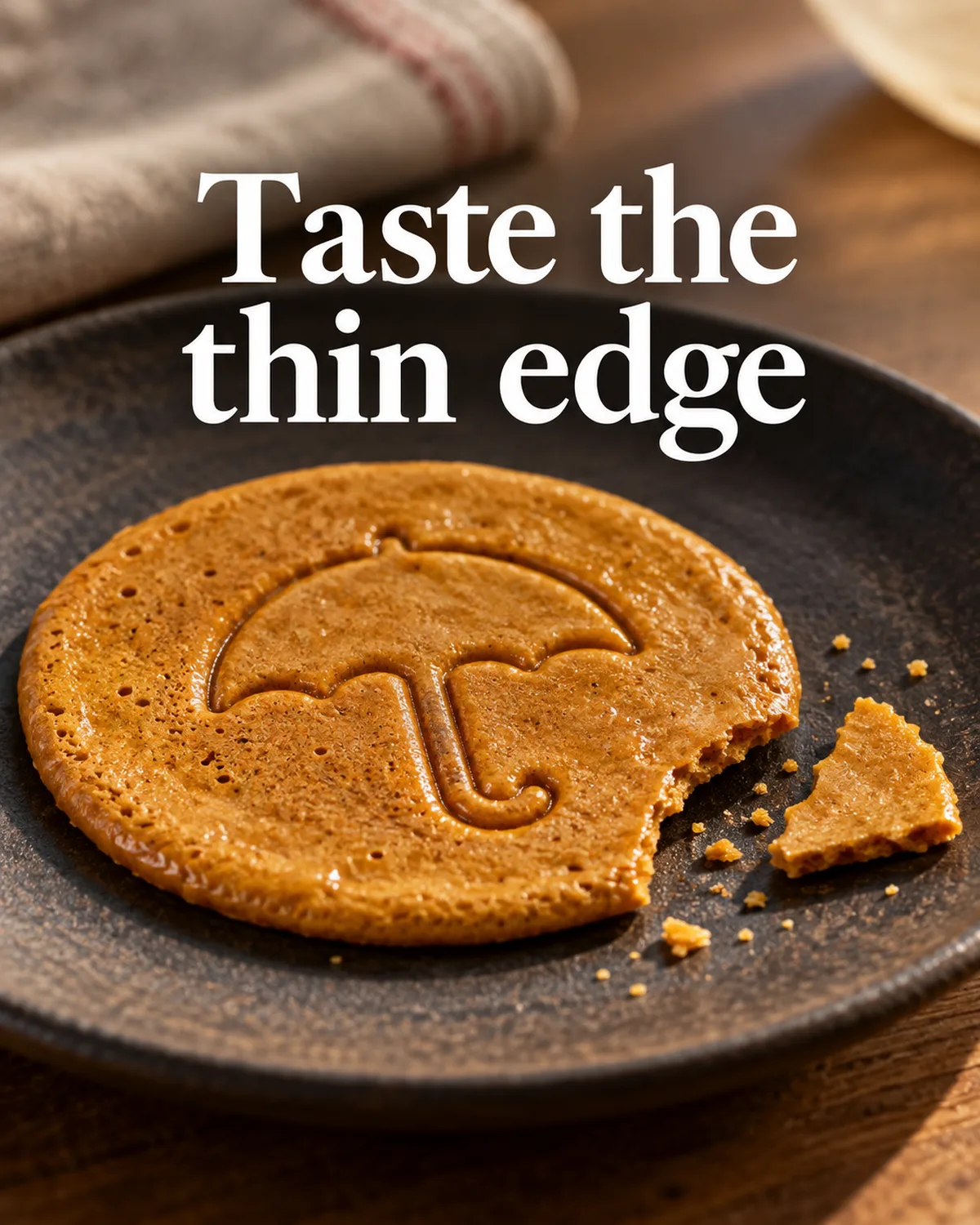
    This changes the value of the snack. The buyer is paying for sugar and for suspense. A circle with a broad edge is usually easier than a shape with thin projections and tight curves. An umbrella, especially one with a narrow handle, can be harder because it creates more places where stress concentrates.

    That is why the game travels so well visually. No translation is necessary to understand the problem. A viewer sees a brittle disc, a needle and a fragile line. The stakes in real childhood play were tiny; the mechanics were instantly legible.

    The game works because hard sugar is brittle. It tolerates limited deformation before cracking. When a player pushes a needle against the candy, force concentrates around the tip. Corners, narrow necks and thin sections create more vulnerable places where a crack can jump across the intended line.

    A broad triangle can therefore be easier than a detailed umbrella even if both contain the same amount of sugar. Difficulty comes from geometry, thickness, stamping depth, bubble distribution and how evenly the candy cooled.

    There is no universal scientific ranking for every vendor’s molds. The famous Squid Game shapes created a memorable hierarchy, but a poorly stamped circle can be harder than a thick, forgiving star from another batch.

    Narrow points, thickness and stamp depth affect the attempt.
    Narrow points, thickness and stamp depth affect the attempt.

    The 2021 Reuters report identifies the series’ four shapes as a triangle, circle, star and umbrella. It also notes that vendors sell other designs. Those four motifs are familiar screen references, rather than the complete range of dalgona stamps.1

    Dalgona, ppopgi and the school-front stall

    The names dalgona (달고나) and ppopgi (뽑기) are often used for the same sugar candy today, especially after global media standardized “dalgona.” Older regional and generational usage can be less tidy.

    When ordering, the object matters more than a rigid naming rule: look for a flat, foamed sugar disc with an impressed outline. The museum’s 2017 festival notice uses both names in its nostalgic snack programming, without establishing one universal historical definition.4

    The useful distinction is functional: the candy is one thing; the shape-extraction challenge is a way of playing with it. In modern conversation, the terms can overlap.

    Many short articles assign dalgona one clean origin year or claim it was invented during one specific crisis. The available mainstream documentation is stronger on its status as a long-established street and school-front snack than on a patent-like moment of invention.

    A Reuters report published in October 2021 describes dalgona sellers outside Korean schools until the early 2000s. Separately, the National Folk Museum’s April 2017 Children’s Day notice lists dalgona and ppopgi among nostalgic snacks—four years before the television series. These are dated records of familiarity, not an exact invention date.1,4

    The museum documented nostalgic dalgona programming in 2017.
    The museum documented nostalgic dalgona programming in 2017.

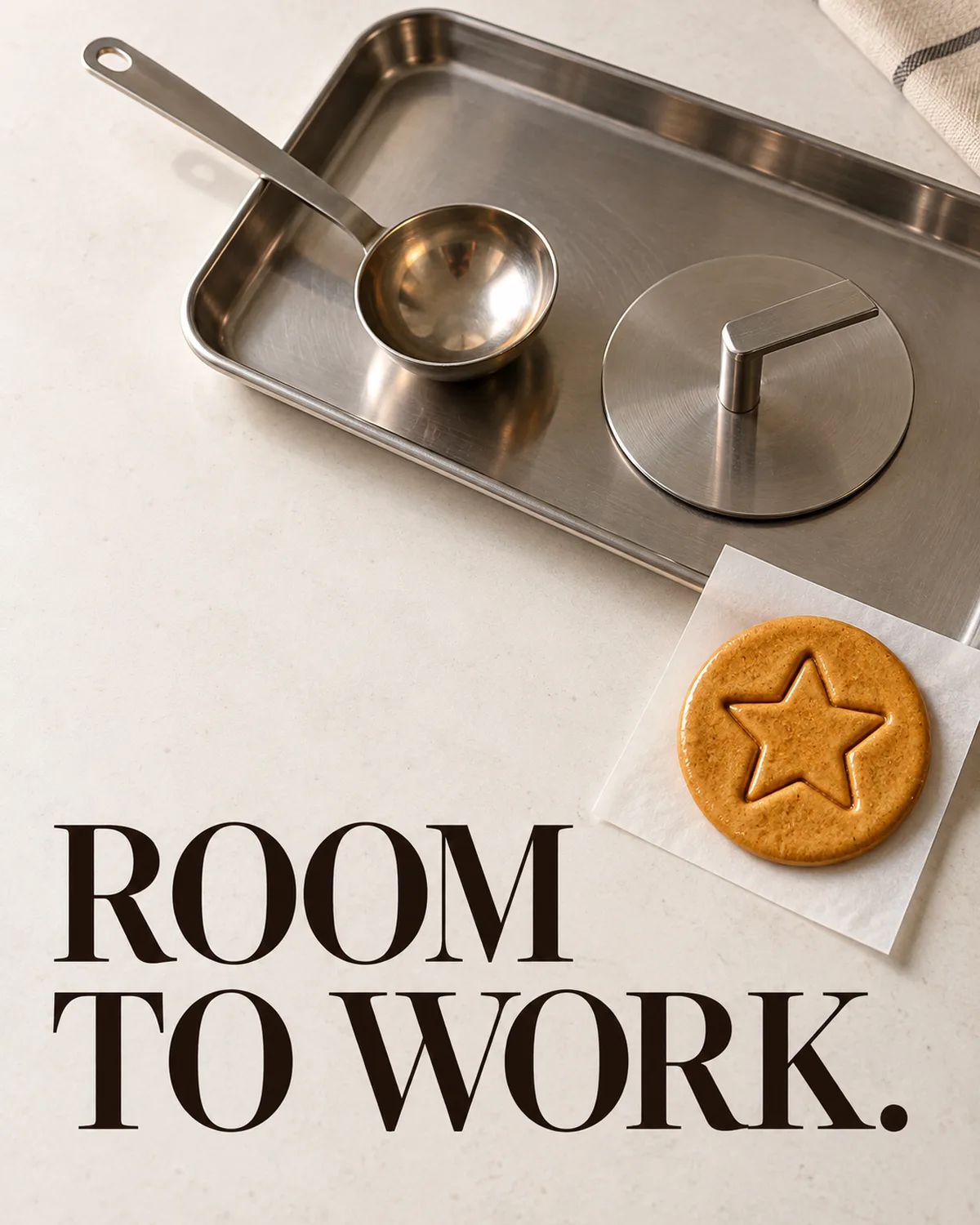
    A simple workstation makes the transformation easy to watch: sugar in a ladle, a heat source, a stirring tool, a flat pressing surface and a small shape stamp. Watch how the foamed mixture becomes a thin disc; the shape is pressed into the surface rather than drawn on afterward.

    The shape is impressed while the candy is still workable.
    The shape is impressed while the candy is still workable.

    If a stall offers a challenge, check its own rules. A reward, time limit or provided tool belongs to that seller’s arrangement. Buying the candy does not require playing, and an attractive stamped piece is still food if you choose to eat it immediately.

    What Squid Game changed in 2021

    Netflix lists Season 1 Episode 3 as “The Man with the Umbrella.” The episode puts the shape-removal challenge inside its lethal competition. Netflix’s September 2021 production account explains that Hwang Dong-hyuk deliberately selected childhood games that were simple to understand.2,3

    For international viewers, the candy could function immediately even without cultural memory. For Korean viewers who remembered similar snacks or games, it carried another layer: an ordinary childhood object made frightening.

    The Korea Times reported in January 2025 that the Oxford English Dictionary’s December 2024 update added both dalgona and dalgona coffee. The report describes the candy as melted sugar with baking soda, flattened and marked with a shape.5

    The separate entries are a useful naming distinction. Recognizing the word does not tell a reader which preparation is being served: a brittle candy disc and a foamy coffee drink require different ingredients and techniques.

    Candy and dalgona coffee are different recipes

    Dalgona coffee is whipped instant coffee, sugar and water served over milk. Liberty Mendez’s Good Food recipe uses that method. The candy instead relies on heated sugar and baking soda; the coffee foam is not made by melting the candy.7

    The two foods share a tawny appearance, but their textures are opposite: the candy snaps, while whipped coffee forms a soft topping. A picture of beige foam alone can be misleading, so check whether the subject is a stamped disc or a glass of milk and coffee.

    Brittle sugar candy and whipped coffee are different preparations.
    Brittle sugar candy and whipped coffee are different preparations.

    That distinction is worth preserving because global search often merges the two. One is a pre-existing street candy and game; the other is a modern whipped-coffee trend whose name references the candy.

    The snack becomes something visitors can take part in

    Choose whether you want a snack or a challenge before opening the packaging. For eating, a small broken corner is useful. For play, keep the disc supported on a flat surface and inspect the stamped line before attempting it.

    Look at the narrowest part of the design. A star point or umbrella handle can be much thinner than the surrounding disc. A clear outline helps you see the intended boundary; it cannot guarantee that the sugar will break along it.

    A dramatic prop or costume does not improve the candy. Focus on the cooled disc, the impression and the texture rather than judging a stall by how closely its decorations resemble the series.

    A useful stall visit starts with the food: is the candy fully cooled, is the stamp visible, and can it be carried without snapping? Check actual opening information for a planned visit rather than treating a dated news report as a current directory.

    If carrying it, support the disc flat and follow the seller’s packaging advice. A delicate handle or star point can break before the game even starts. For ingredient restrictions, confirm the actual recipe and preparation; a short traditional ingredient list does not describe every variation.

    Respect the heat, then taste the texture

    Dalgona recipes look childlike because the finished candy is associated with children. The cooking stage is not child-safe. Molten sugar is extremely hot, sticky and capable of causing serious burns because it adheres to skin.

    For a first encounter, buy a cooled piece or watch a maker from outside the work area. Keep children away from hot sugar. If making it at home, use a reliable recipe and let an experienced adult perform the heating and pouring; an online clip is not a complete cooking guide.6

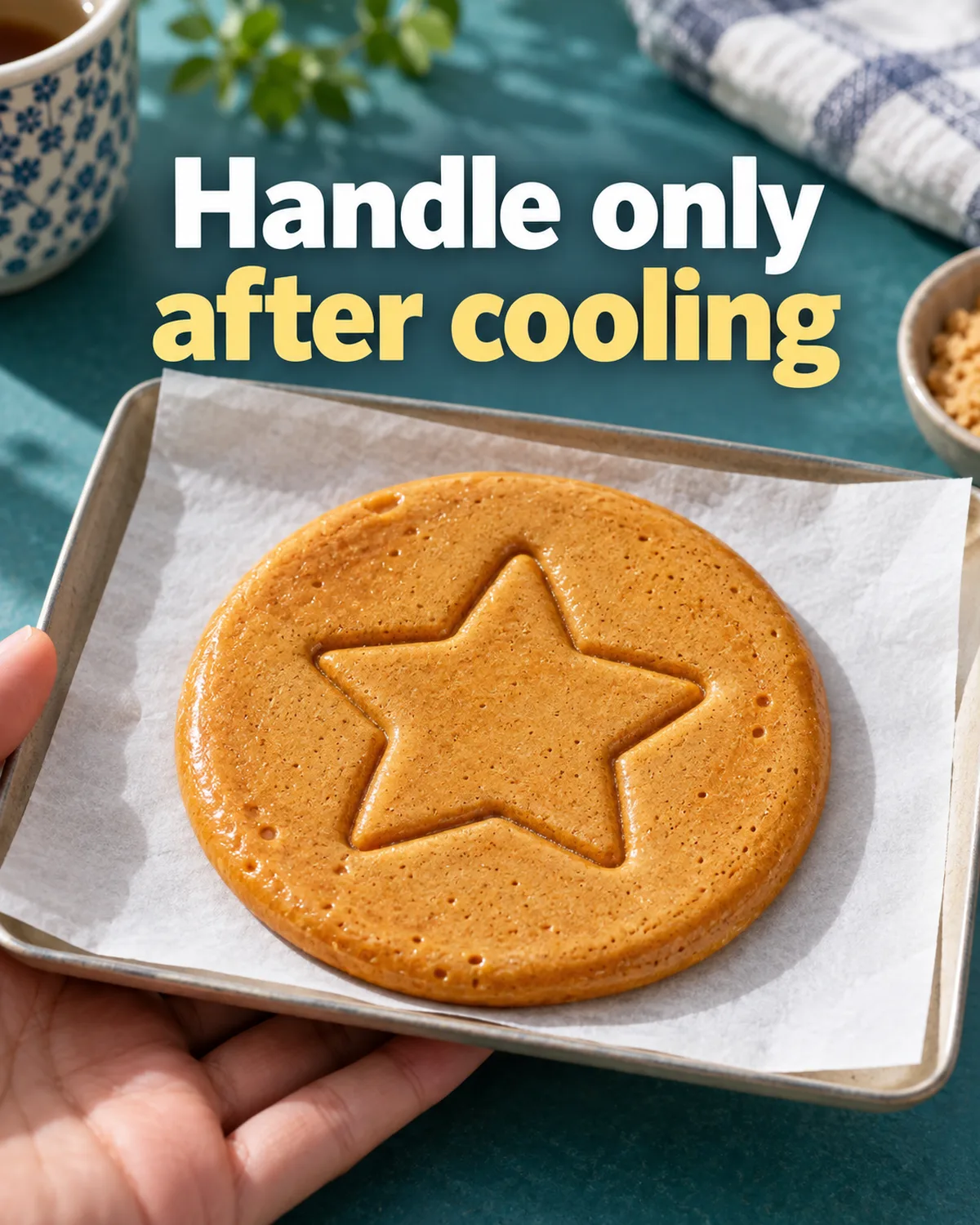
    Wait until the candy and its tools have cooled before handling them. The cooled shape game and the hot caramel work are separate activities.

    The cooled candy game is separate from hot sugar work.
    The cooled candy game is separate from hot sugar work.

    Dalgona is inexpensive street candy, not a pastry competition. Still, several details separate a pleasant piece from a frustrating one:

    • Color: deep enough for caramel flavor but not burned and acrid.
    • Foam: enough aeration to lighten the candy without making it collapse into giant holes.
    • Thickness: thin enough to break cleanly but not so thin that ordinary handling destroys it.
    • Stamp depth: visible enough to guide the game without cutting the figure out before play begins.
    • Freshness and humidity: dry sugar candy is crisp; humidity makes the surface sticky and changes fracture behavior.

    The best piece for eating and the best piece for a difficult challenge may not be identical.

    Eat it, play with it, or simply watch

    You can eat the outer scraps and save the stamped center, or skip the challenge entirely. Try the edge first to notice the thin, porous crunch. The shape gives the snack a game, but its caramel flavor and fragile texture explain why it remains worth tasting.

    A small corner shows the caramel flavor and airy crunch.
    A small corner shows the caramel flavor and airy crunch.

    Sources and reading

    1. Reuters via The Korea Times — October 2, 2021 dalgona report
    2. Netflix — Squid Game episode listing
    3. Netflix — Production background, September 30, 2021
    4. National Folk Museum of Korea — 2017 Children’s Day festival
    5. The Korea Times — Dictionary update report, January 2025
    6. American Chemical Society, Chicago Section — Honeycomb Candy: Cooking with CO2, May 2014, page 3
    7. Liberty Mendez, Good Food — Dalgona coffee recipe
  • Korean Salt Bread: Its Japanese Roots, Butter-Browned Base and Seongsu Café Culture

    Korean Salt Bread: Its Japanese Roots, Butter-Browned Base and Seongsu Café Culture

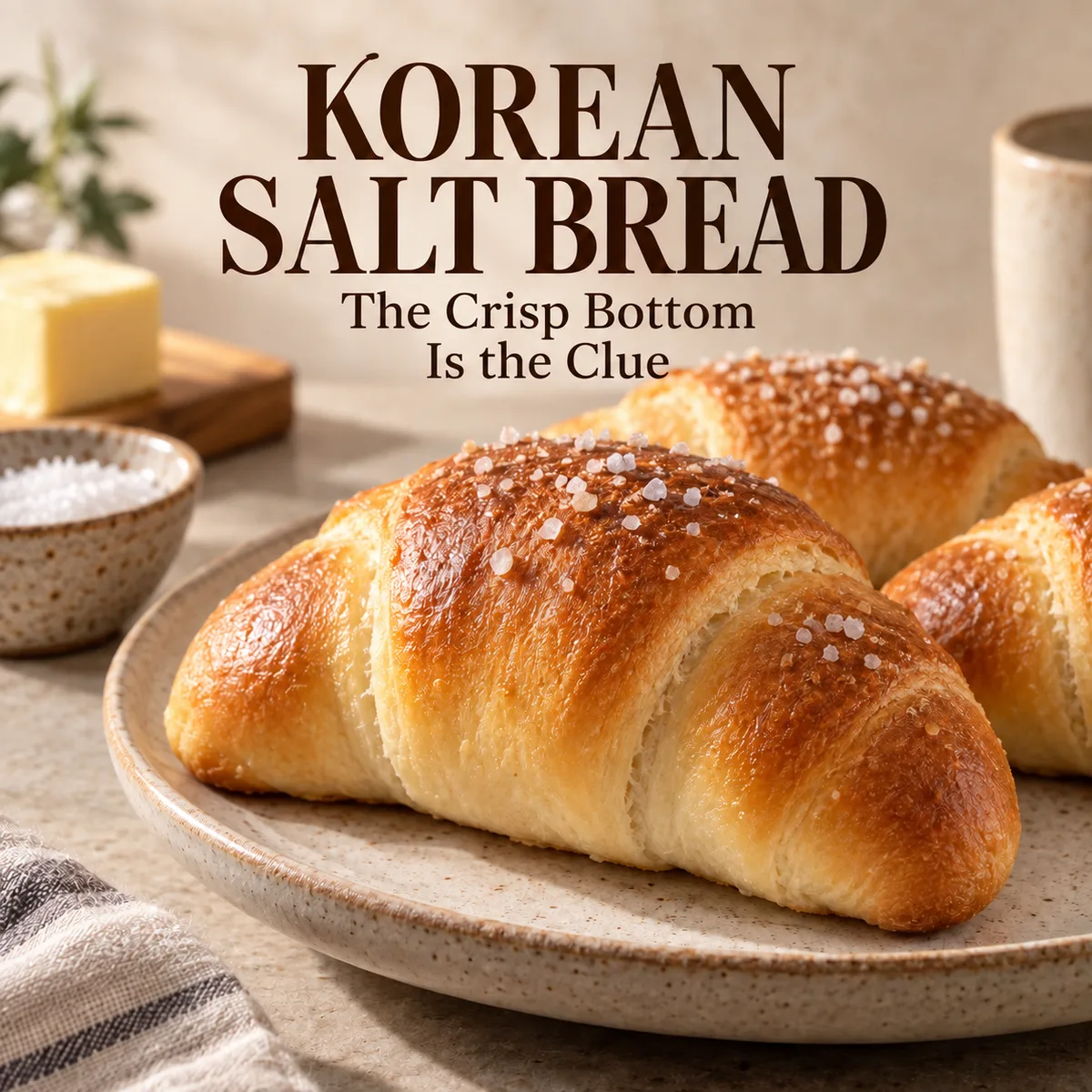
    The crescent shape can distract from the most revealing part of salt bread: its underside. Melted butter, dough and the baking surface create a contrast that a photograph of the top may not show.

    Its Korean popularity is a story of adoption and reinterpretation, not evidence that the bread first originated in Korea. A plain roll is a useful starting point because it makes the structure easier to taste.

    A Japanese starting point and a Korean bakery life

    A 2019 interview in Yonden’s regional magazine follows Pain Maison owner Hirata Mitoshi’s trials in Yawatahama, Ehime. He was looking for a bread customers would want in summer. The account describes trials around 2003, followed by commercialization the next year, using bread dough wrapped around butter and finished with salt.

    The interview also names fish-market workers and students as early tasters. Hirata tried salts that would leave visible grains after baking; baking more rolls together then let melted butter collect on the tray and crisp their undersides. It is a shop’s documented development story, rather than a date to assign to every butter-and-salt bread.

    That account connects the name to something you can taste: the salt on top and the butter-browned bottom. Korean bakeries later gave the format new recipes and retail settings, but Seongsu’s popularity does not make the neighborhood the bread’s birthplace.

    The browned underside is a separate texture from the softer interior of a salt-bread roll.
    The browned underside is a separate texture from the softer interior of a salt-bread roll.

    Once salt bread entered Korean bakery culture, it encountered a market already comfortable with rapid pastry cycles. Korean cafes routinely rotate signature croissants, bagels, cream breads, twisted doughnuts, cakes and limited seasonal products. A visually simple roll that could be served warm, photographed easily and compared shop by shop fit naturally into that system.

    The category also leaves room for variation without losing its identity. One bakery emphasizes a blistered thin shell. Another pushes a chewy crumb. Some use a very crisp butter-fried base, others a softer bottom. Shops vary the salt crystal size, dough sweetness, butter quantity, fermentation, shape and fillings.

    This is localization without requiring a dramatic flavor change. Korean bakeries can make the bread feel distinctive through texture, bake timing, presentation and retail experience rather than covering it with an entirely new sauce.

    The difference from a croissant is in the dough

    One of the most persistent descriptions of sogeum-ppang is that it is “croissant-like.” The comparison helps a first-time eater imagine butter and a curved shape, but it becomes technically misleading when people claim the dough must be repeatedly laminated like a croissant.

    A classic croissant creates many alternating sheets of dough and butter through repeated folding and rolling. Many salt-bread formulas instead use a yeasted bread dough rolled around a distinct piece or strip of butter. The butter melts during baking, leaving a cavity, soaking parts of the crumb and pooling against the hot tray.

    This is why two breads that look vaguely related can behave differently. A croissant depends on laminated layers separating through steam. Salt bread can achieve its signature contrast with a softer bread crumb and a concentrated butter pocket. The category is broad, so individual Korean bakeries may hybridize techniques, but lamination is not the universal definition.

    A piece of butter is wrapped inside the dough before baking.
    A piece of butter is wrapped inside the dough before baking.

    The crisp bottom and the hollow inside

    The top gets the photograph because the coarse salt is visible. The bottom often explains the obsession better.

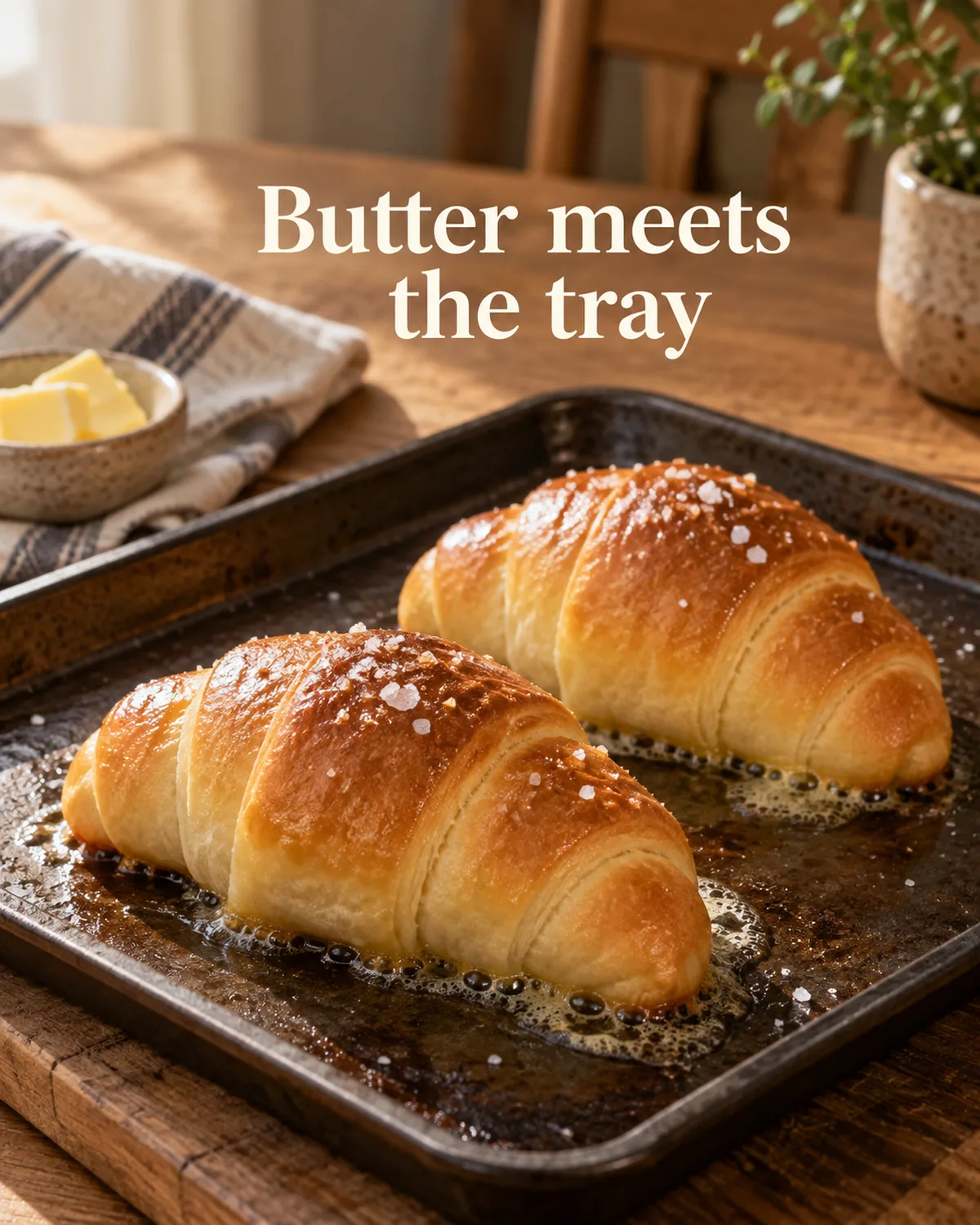
    As the butter enclosed in the dough melts, some of it escapes and collects where the roll meets the baking surface. The base is therefore exposed to hot fat as well as dry oven heat. That encourages stronger browning and a crisp, almost shallow-fried texture. Meanwhile, steam from the butter and dough can create the characteristic hollow pocket inside.

    Butter released during baking can brown the base where the roll meets the baking surface.
    Butter released during baking can brown the base where the roll meets the baking surface.

    A good salt bread gives you several textures in a bite: a thin browned exterior, a soft or slightly chewy interior, a buttery cavity and a deeply crisp base. The salt crystal then arrives as a high-intensity accent. What looks like a plain roll is really a controlled contrast machine.

    A cut roll can reveal space left as the enclosed butter melts during baking.
    A cut roll can reveal space left as the enclosed butter melts during baking.

    Salt does not merely make the bread salty. It changes how the butter is perceived. A small amount on the surface can make dairy richness taste more vivid and can sharpen whatever mild sweetness is present in the dough.

    The placement matters too. Salt dissolved evenly through dough produces a different sensation from a few coarse crystals on the surface. Large crystals create short bursts of salinity, so the baker can keep the overall bread balanced while still delivering an unmistakable “salt bread” moment.

    This is also why “more salt” is not automatically better. If every bite is aggressively salty, the contrast disappears. The goal is usually butter-first richness punctuated by salinity, not the flavor profile of a salted snack cracker.

    What changes as the roll cools

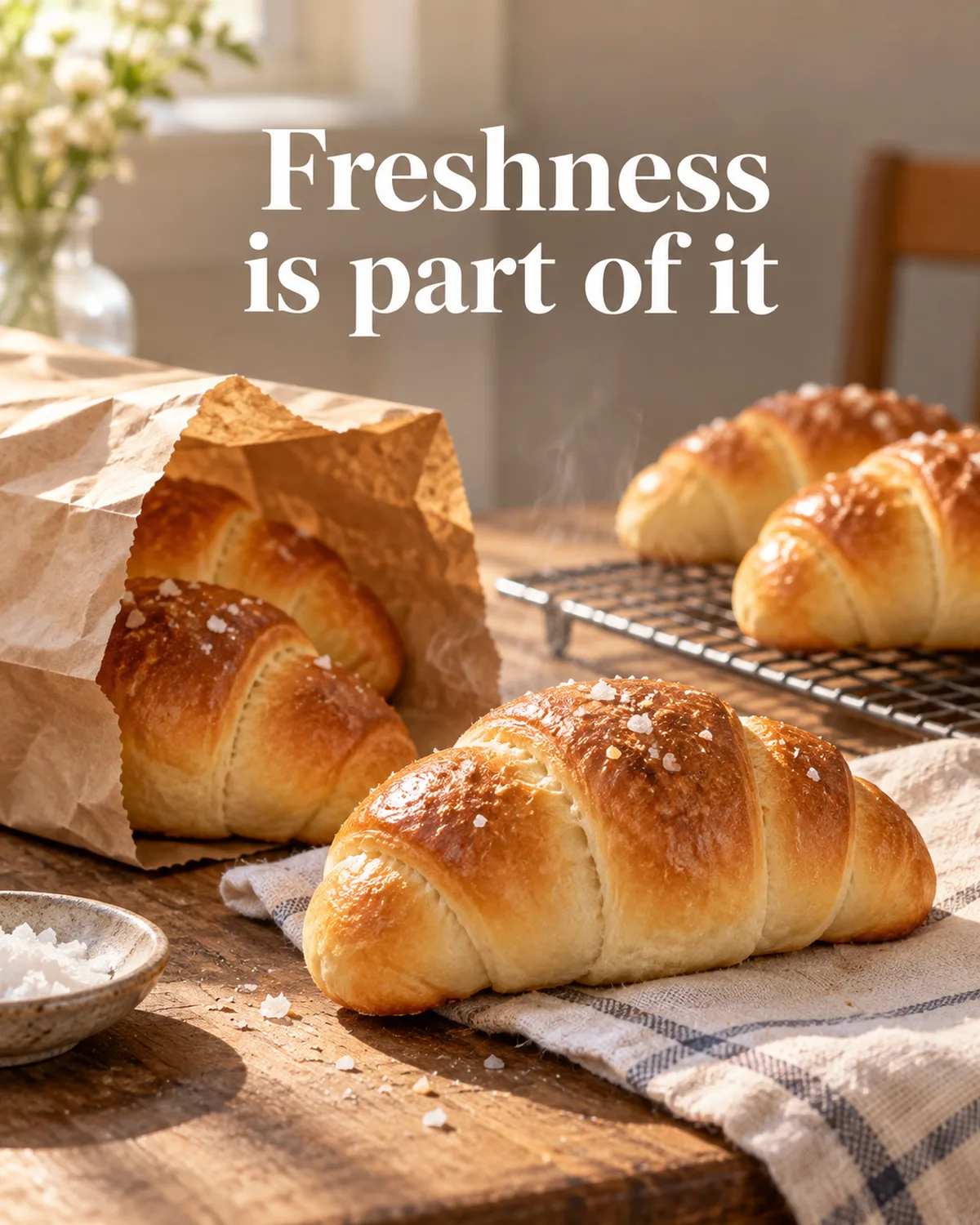
    Salt bread is unusually sensitive to the moment between oven and mouth. The crisp base is strongest before trapped steam and ambient humidity soften it. Warm butter is aromatic and fluid; as the bread cools, butter firms and the crumb changes. The interior may still be pleasant hours later, but the textural contrast narrows.

    Visit Seoul’s listing, updated in August 2026, describes Jayeondo Salt Bread in Seongsu as a takeout specialist with several daily bakes and frequent waits. Bake times and queues can change; the useful culinary point is that batch timing is part of the product.

    A fresh batch illustrates why the time since baking can affect the bread experience.
    A fresh batch illustrates why the time since baking can affect the bread experience.

    A line at a salt-bread shop therefore contains two different signals. It can be social proof—people want what other people want—but it can also be a freshness queue, clustering customers around the next oven release.

    A bread optimized for immediate consumption can push the buttery bottom to an extreme because the customer eats it while hot. A bread designed for takeaway may need a slightly sturdier crust and crumb so it survives a train ride or several hours in a bag.

    This creates a hidden trade-off in online recommendations. A reviewer who eats a roll thirty seconds after baking and a traveler who eats the same roll at a hotel two hours later are not experiencing the same texture.

    If a shop is famous for timed batches, that is a clue to eat at least one piece soon after purchase. Save the second roll for later only if you want to learn how the product changes.

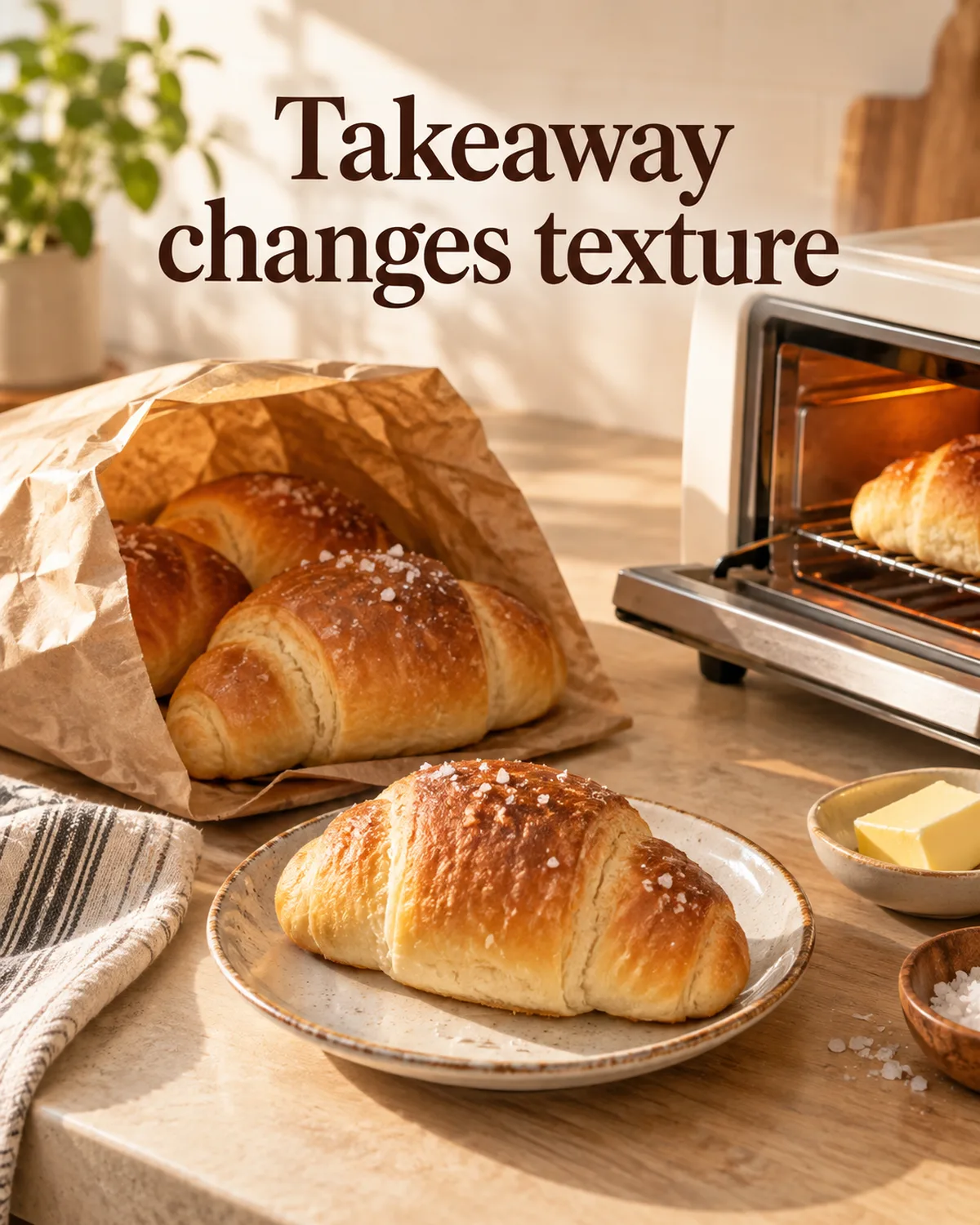
    Once salt bread cools, a short dry reheat can help the crust and base become crisp again. A microwave alone tends to emphasize softness because it heats water quickly and can make the crumb steamy.

    An oven or toaster is better suited to restoring surface dryness, but excessive heat can melt out more fat and overbrown the already crisp base. If the bread contains cream, cheese or another filling, reheating rules change again.

    The practical lesson is modest: plain salt bread is best treated like a butter-rich roll whose defining asset is fresh texture. Buy only as many as you can enjoy well, rather than assuming a large viral haul will taste identical tomorrow.

    An opened takeaway bag illustrates how storage and transport can affect the crust.
    An opened takeaway bag illustrates how storage and transport can affect the crust.

    Why Seongsu is a good setting for a small bread trend

    Salt bread could have become popular in any Seoul district. Seongsu gives it something extra: a neighborhood built around the expectation that visitors will discover a new shop, pop-up or product.

    Seoul Metropolitan Government describes Seongsu as a former factory-and-warehouse district that changed through urban regeneration in the 2010s as arts, culture and cafes occupied old industrial spaces. Visit Seoul’s current Yeonmujang-gil guide still presents the area as a place where traces of shoe factories mix with cafes, galleries, boutiques and brand pop-ups.

    That urban form is unusually compatible with trend food. People arrive intending to walk. They expect to stop repeatedly. A small bread that can be carried in a paper bag requires little commitment compared with a full restaurant meal. The product and the neighborhood reinforce each other.

    A conventional neighborhood bakery needs a wide assortment because customers arrive with different needs. A destination bakery can invert that logic. If people travel specifically for one product, specialization becomes part of the attraction.

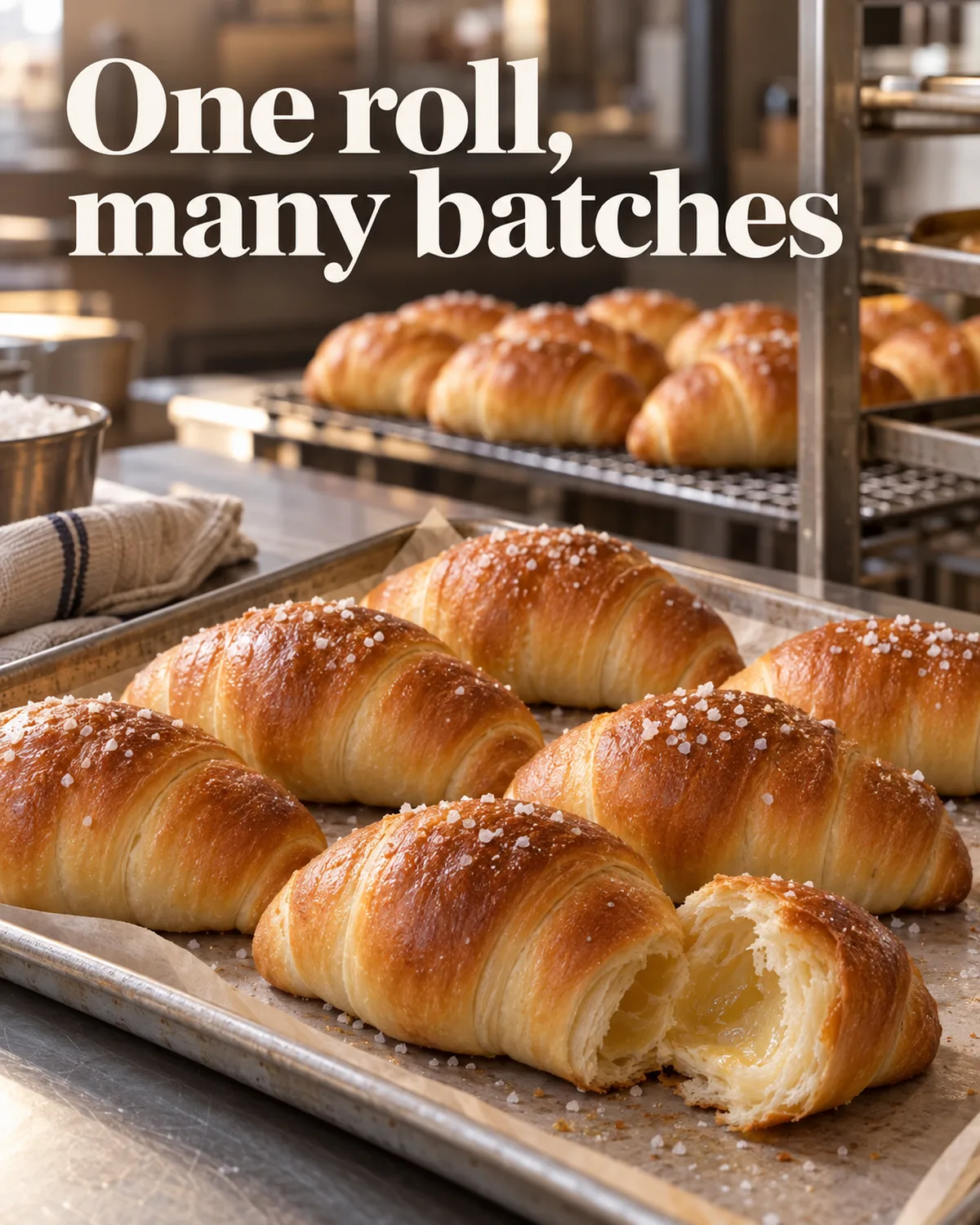
    A takeout specialist selling repeated batches of one signature roll offers a different encounter from an assorted neighborhood bakery. The customer is comparing fresh versions of a known product, rather than choosing from a broad bread cabinet.

    A generic counter illustrates a specialist bakery selling repeated batches of one signature roll.
    A generic counter illustrates a specialist bakery selling repeated batches of one signature roll.

    Specialization also simplifies comparison. Visitors do not ask which of forty breads is the signature. The question becomes “Is this salt bread worth the queue?” That clarity is extremely useful in a social-media environment, where one item must communicate the shop in a few seconds.

    Salt bread also benefits from Korea’s dense cafe ecosystem. A small salty-buttery bread pairs naturally with coffee, and cafes already provide the seating, takeaway cups and weekend leisure routines that turn a baked item into an outing.

    For a visitor, the bread can be one stop within a day of walking, coffee and shops. That is an interpretation of how a portable product fits the district, rather than a claim about why every customer came.

    Salt bread is part of a café visit in a neighborhood such as Seongsu.
    Salt bread is part of a café visit in a neighborhood such as Seongsu.

    Plain first, then fillings

    A more useful tasting framework has five variables:

    • Base: Is the bottom deeply crisp from butter contact, or mostly soft?
    • Crumb: Is the interior fluffy, chewy, layered or dense?
    • Butter pocket: Does the cavity feel aromatic and rich without becoming greasy?
    • Salt placement: Do crystals create occasional sharp accents or blanket the whole roll?
    • Freshness curve: Does the bread remain balanced after cooling, or is it compelling only straight from the oven?

    These questions let you compare different Korean interpretations without pretending there is one legally fixed recipe for sogeum-ppang.

    Once a bread category becomes familiar, variation can accelerate. Korean bakeries use salt-bread dough as a base for sweet creams, savory fillings, garlic, cheese, corn, red-bean butter, seasonal flavors and sandwich formats. Some are close to the simple Japanese-style ancestor; others are effectively new filled breads that borrow the salt-butter architecture.

    This expansion is not evidence that Korea “improved” or “corrupted” the original. It is what commercial baking does when a format becomes legible to customers. The name becomes a platform.

    Start with a plain roll before comparing flavored or filled variations.
    Start with a plain roll before comparing flavored or filled variations.

    Buying bread without planning around an old queue report

    Start with the neighborhood, not the line. Seongsu Station, Yeonmujang-gil and the wider cafe district offer enough food, design and retail that a sold-out batch should not ruin the visit.

    If you want one famous specialist, check its current official or tourism listing shortly before going. Baking schedules, purchase limits, branch arrangements and operating hours can change. A 2026 schedule should not be treated as permanent advice for a later trip.
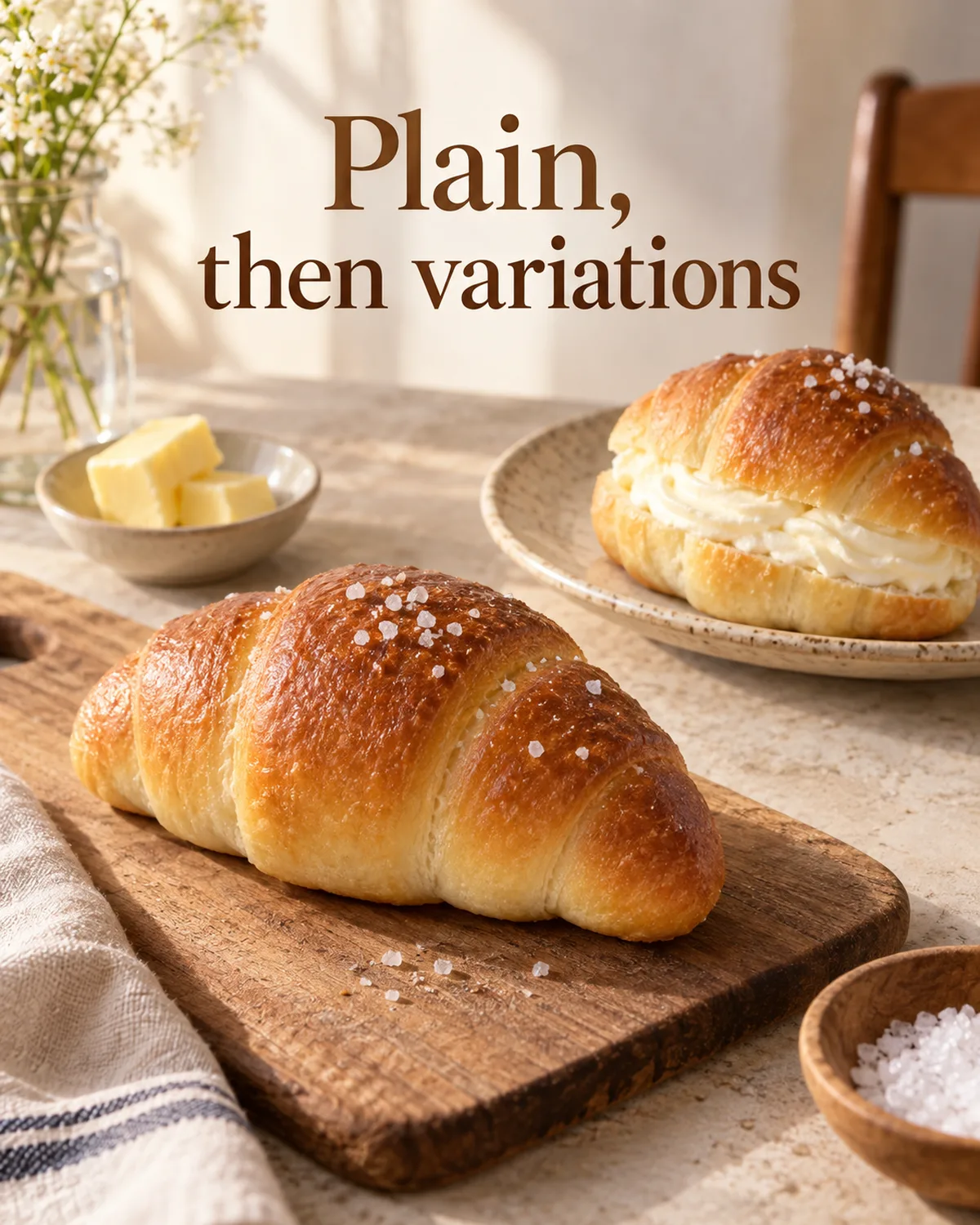
    Keep a second bakery in mind so that a sold-out batch does not decide the whole visit. Comparing two plain rolls can make differences in crumb and butter-browned base easier to notice.

    Some shops sell only sets. Others sell singles. Some bake at announced times. Others replenish continuously. Some versions are plain; others are filled. Those are business decisions, not culinary rules.

    This distinction matters because travel guides often turn a famous shop’s method into a statement about the whole category. “Korean salt bread comes in packs of four” is not a food fact. It is a current shop policy. “Salt bread is a butter-rich salted roll whose texture depends strongly on baking and fresh service” is much more durable.

    Wheat and dairy are common in salt bread; check the specific recipe and fillings rather than judging ingredients from appearance.
    Wheat and dairy are common in salt bread; check the specific recipe and fillings rather than judging ingredients from appearance.

    A plain-looking roll normally contains wheat and dairy, and may include milk, egg or other enrichments depending on the recipe. Butter is central to many classic versions, so standard sogeum-ppang is not vegan.

    Filled versions add more variables: cheese, cream, nuts, eggs, processed meats, sauces or bean pastes. Cross-contact is also possible in bakeries producing many products in the same kitchen.

    “Only bread and salt” is therefore not a safe allergy assumption. Ask about the specific bakery recipe, especially if the product is sold from a shop whose marketing emphasizes simplicity but whose production space handles a broad menu.

    Sources and reading

    1. Visit Seoul: Jayeondo, listing updated August 2026
    2. Seoul Metropolitan Government: Seongsu cafe street
    3. Visit Seoul: Yeonmujang-gil’s industrial traces
    4. Yonden, 2019: interview with Pain Maison’s Hirata
  • Daejeon Food: Sungsimdang Bread and Dubu-duruchigi

    Daejeon Food: Sungsimdang Bread and Dubu-duruchigi

    A pastry carried home and a pan of tofu eaten on the spot can both become signatures of one city. In Daejeon, Sungsimdang and dubu-duruchigi show two different ways that happens: a bakery builds a recognizable product, while restaurant cooking gives a local dish its setting.

    Treating the city as nothing but a bread stop misses the contrast. The more revealing visit leaves room for a savory meal and a separately planned bakery purchase.

    A bakery beside Daejeon Station

    Sungsimdang’s own history provides a clear anchor. The company dates its founding to October 1956, when founders Im Gil-sun and Han Sun-deok opened a small steamed-bun shop in front of Daejeon Station. The company later moved within central Daejeon, reaching the Eunhaeng-dong area that remains central to the brand’s identity.

    Sungsimdang’s account begins with a station-area steamed-bread business
    Sungsimdang’s account begins with a station-area steamed-bread business

    The station origin is more than a charming detail. A railway station is a boundary between resident and visitor. A neighborhood bakery usually depends on people who live nearby, but a food business beside a major station can become familiar to people who are merely passing through. Daejeon’s national rail importance gave Sungsimdang a natural audience beyond its immediate neighborhood long before “food tourism” became a common marketing phrase.

    It would be an overstatement to say one bakery transformed Daejeon single-handedly from a transfer city into a tourism city. That would require economic evidence far beyond queues and publicity. A more defensible claim is that Sungsimdang became one of the strongest reasons many visitors associate Daejeon with food, while the city increasingly incorporated bread into its own public identity. The relationship runs both directions: Daejeon gave the bakery its place, customers and transport network; the bakery gave Daejeon a portable symbol that travelers could taste and carry home.

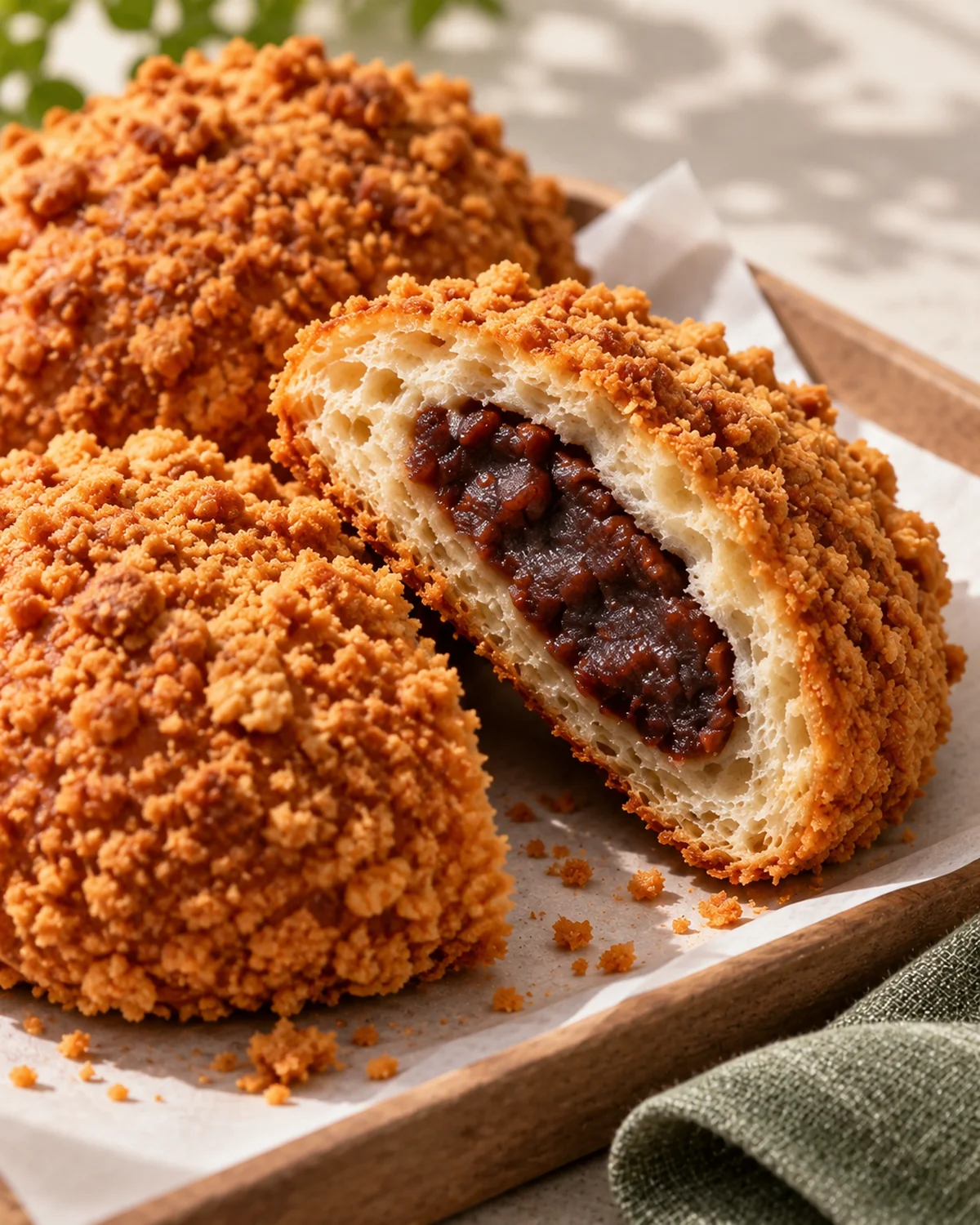
    Sungsimdang’s best-known signature, tuigim-soboro (튀김소보로), is not an ancient Korean sweet reconstructed from a royal cookbook. The bakery dates its development to 1980. Its own product description presents it as a three-part combination: soboro bread, a red-bean bun and a doughnut-like fried preparation.

    A bakery signature can become a portable memory of Daejeon
    A bakery signature can become a portable memory of Daejeon

    That modernity makes the product more interesting, not less. Korean bakery culture is itself a history of adaptation: wheat-flour breads, sweet bean fillings, streusel-like toppings, dairy creams and frying techniques entered local food culture through different channels and were repeatedly recombined. Tuigim-soboro is a compact example of that process. Instead of choosing between “Korean” and “Western,” the product joins a familiar Korean bakery filling with a crumbly soboro surface and deep frying.

    Frying changes the experience structurally. A baked bun develops a dry crust mainly through oven heat. A fried bun encounters hot oil across the surface, producing a different crispness and richer aroma. The red-bean filling stays soft inside while the crumb topping and outer dough take on more contrast. This helps explain why the product works well as a souvenir but is especially distinctive when fresh: texture is a major part of the design.

    Sungsimdang’s current official site still presents tuigim-soboro as its number-one signature and explicitly dates its birth to 1980. That is stronger evidence than repeating a vague story that the bun has “always” represented Daejeon. Its status was built over decades, not inherited from antiquity.

    How bread became part of Daejeon’s identity

    In April 2026, Daejeon Metropolitan City announced a major reset of its representative-food system. After twenty-six years, the city designated bread, kalguksu and dubu-duruchigi as the new “Three Tastes of Daejeon.” The city said 4,314 people participated in online and offline preference surveys before the final selection.

    That decision matters because it separates two different kinds of evidence. Travelers may already have associated Daejeon with bakery queues and spicy tofu, but a current city document shows that the municipality itself now treats those foods as part of Daejeon’s public culinary identity. The official designation does not prove where every recipe began. It proves something more contemporary: these are foods Daejeon has chosen to represent itself with now.

    The three-food list is also revealing. Bread is a broad category tied strongly to modern bakery culture. Kalguksu is a noodle tradition with many Korean regional forms. Dubu-duruchigi is a local restaurant dish. Daejeon’s food identity is therefore not built around one ancient court recipe or one protected geographical product. It is a layered urban identity assembled from businesses, everyday restaurants, transport history and repeated local preference.

    Food tourism often blurs the line between a city and a successful business. Sungsimdang illustrates why the distinction matters. The bakery is a commercial company with its own product development, expansion decisions and brand strategy. Daejeon is a city with a much larger economy and cultural history. Saying the bakery “saved” the city or created its entire tourism economy would turn correlation into a heroic business myth.

    What can be observed is a powerful place-brand relationship. Sungsimdang’s own slogan has long framed the company as part of Daejeon’s culture. Daejeon, meanwhile, has made bread one of its three representative foods. Travelers often use bakery purchases as proof that they have physically been in the city, much as local sweets or station bento can function as edible souvenirs elsewhere.

    This is different from a franchise model in which the same shop is designed to become interchangeable across cities. Even without making a risky claim that no Sungsimdang product can ever be found outside Daejeon, the brand’s documented history, flagship stores and public identity remain unusually place-bound. For an evergreen travel guide, that stable relationship matters more than a branch-count claim that can change.

    Dubu-duruchigi: the meal before the bread bag

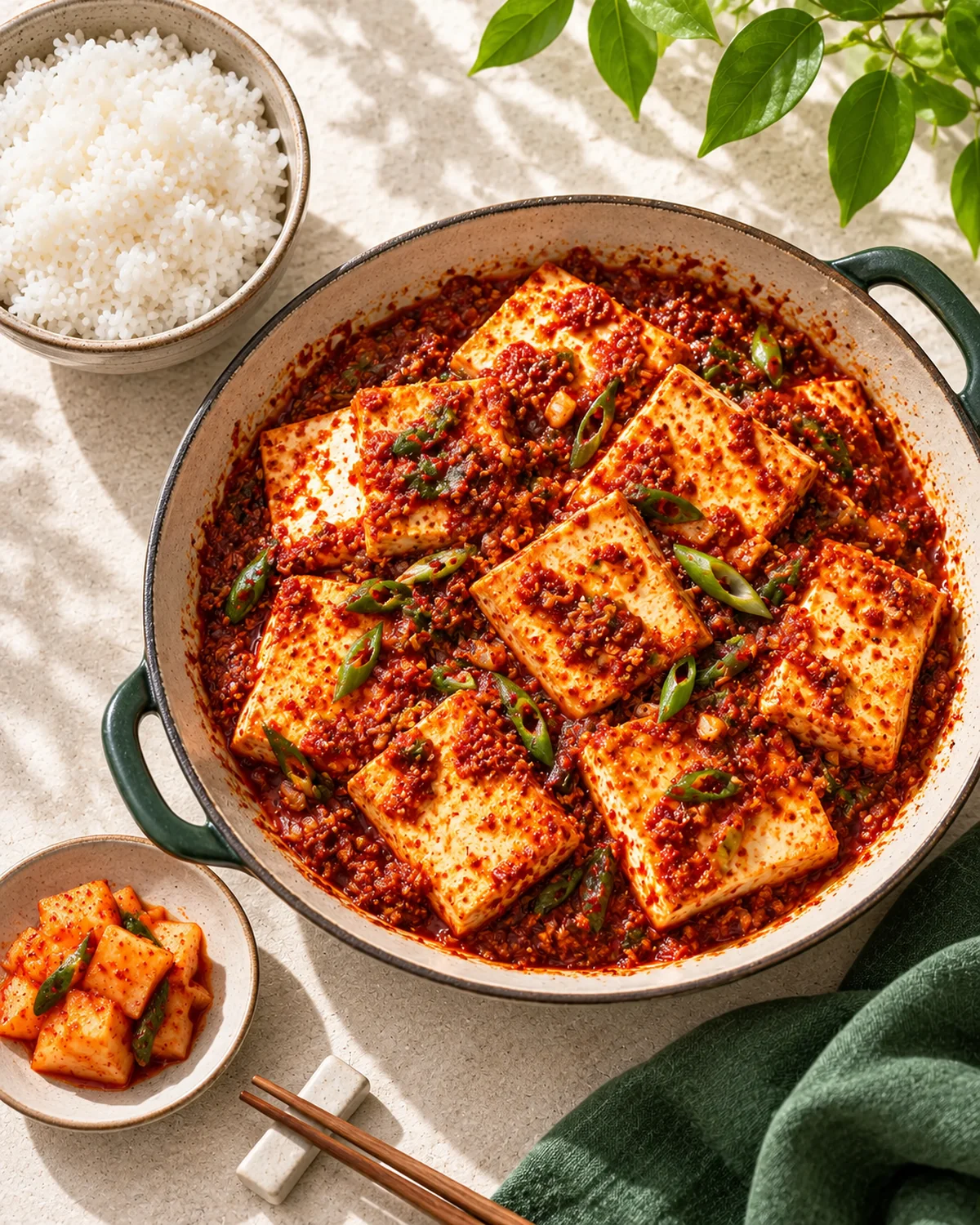
    If Sungsimdang is portable, boxed and branded, dubu-duruchigi is table food. The dish centers on tofu cooked in a strongly seasoned red sauce, usually hot enough and concentrated enough to function as a main dish rather than a mild banchan. Garlic, chile seasoning, scallion and other aromatics are common, but recipes vary. Some restaurants add seafood, pork or vegetables; others keep the focus more squarely on tofu and sauce.

    Dubu-duruchigi supplies the sit-down meal rather than a bread-shop side
    Dubu-duruchigi supplies the sit-down meal rather than a bread-shop side

    The name can be confusing because duruchigi elsewhere in Korea often refers to meat cooked quickly with vegetables and a spicy sauce. In Daejeon’s tofu version, the important feature is not whether the dish fits one rigid national definition. It is the combination of tofu and a reduced, assertive sauce served as a substantial shared dish.

    Good dubu-duruchigi relies on contrast. Tofu itself is mild and water-rich. The sauce is salty, spicy, aromatic and concentrated. As the tofu heats, its surface takes on seasoning while the interior stays soft. That difference between a flavored exterior and a gentler center is what prevents the dish from tasting like one uniform paste.

    Tofu is often described casually as if it “soaks up” unlimited sauce like a sponge. The reality is more useful. Tofu is a gel network formed from soy proteins and water. A dense block contains a great deal of moisture already, so seasoning does not simply race to its center. Much of the immediate flavor comes from sauce clinging to the surface, entering small pores and fissures, and mixing with each bite as the tofu breaks apart.

    That is why cutting thickness and simmering style matter. Thin pieces give sauce more surface area. Thicker slabs preserve more plain soy flavor in the center. Vigorous reduction concentrates the sauce around the tofu, while a looser preparation behaves more like stew. Restaurants can therefore produce noticeably different dubu-duruchigi while using the same basic name.

    This also explains the appeal of eating it with rice or noodles. A concentrated sauce that would be too strong by itself becomes balanced when diluted across a neutral starch. The starch is not just an accompaniment; it changes the seasoning ratio of the meal.

    Why noodles enter the remaining sauce

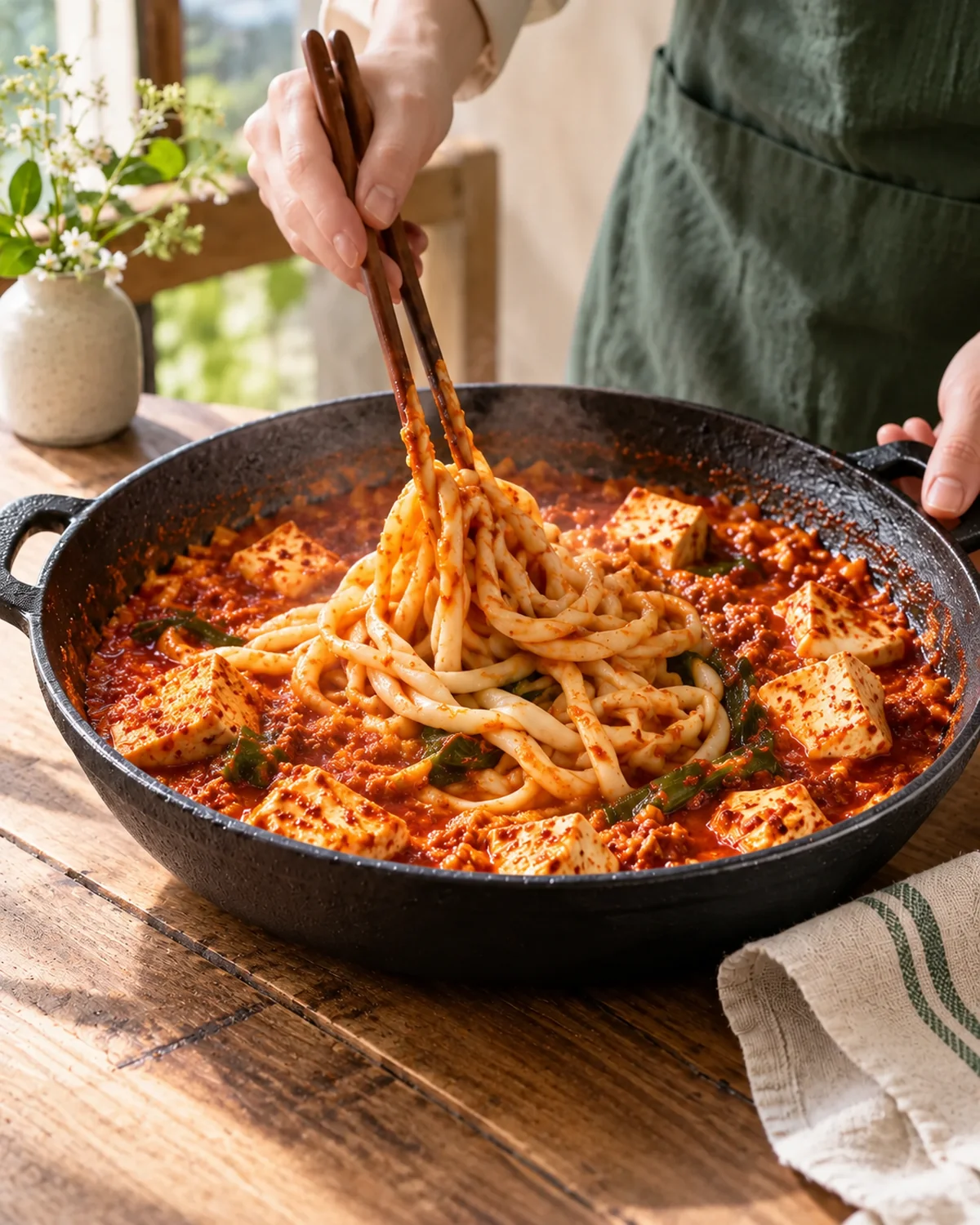
    Daejeon’s 2026 representative-food list places kalguksu beside bread and dubu-duruchigi. In practice, the noodle and tofu traditions also meet at the table. Many diners pair dubu-duruchigi with knife-cut noodles, using the remaining sauce as a coating or seasoning base.

    Noodles turn the sauce into a second stage of the meal
    Noodles turn the sauce into a second stage of the meal

    The exact serving sequence varies by restaurant, so it should not be turned into a claim that every Daejeon resident follows one ritual. But the pairing makes culinary sense. Wheat noodles bring chew and starch to a sauce already flavored by tofu, garlic and chile. The sauce becomes less concentrated as it spreads over the noodles, while the noodles pick up a flavor profile more intense than a plain broth would provide.

    For a traveler, this is a better insight than memorizing a fixed restaurant order. If a dubu-duruchigi restaurant offers kalguksu as an add-on or companion, it is worth understanding that the noodles are not a random second course. They connect two foods Daejeon now officially places within the same representative-food system.

    What to notice at the bakery and the tofu table

    Start with tuigim-soboro because it has the clearest documented role in the bakery’s product history. The company dates it to 1980, making it a useful example of a modern product becoming a regional icon. Then choose something that shows a different side of the bakery rather than buying several versions of the same sweet profile.

    Sungsimdang’s product line changes over time, and seasonal cakes or special releases can draw intense attention. For food-history purposes, however, the most useful comparison is between a long-running signature such as tuigim-soboro and newer products. It shows how a heritage brand stays recognizable while continuing to invent.

    Do not assume that the longest queue automatically identifies the historically most important product. Popularity, social-media visibility, seasonality and production capacity all shape queues. The official company history is a better guide to chronology than crowd size.

    First, taste a piece of tofu before mixing everything with rice or noodles. Notice how much of the flavor sits on the outside and how mild the center remains. Then try the sauce with rice. Finally, if noodles are available, compare how the same sauce changes when spread over a chewy wheat starch.

    This three-step comparison turns a “spicy tofu” description into something more precise. Tofu shows concentration contrast. Rice softens and disperses the sauce. Kalguksu gives the sauce a clingy, noodle-coating role. The dish is therefore less about one secret recipe than about how a concentrated seasoning system behaves with different textures.

    Heat level is also not standardized. A red sauce can look extremely spicy without producing the same chile intensity in every restaurant. If you are sensitive to heat, ask before ordering rather than assuming the color tells the whole story.

    Plan the sit-down meal separately from the takeaway

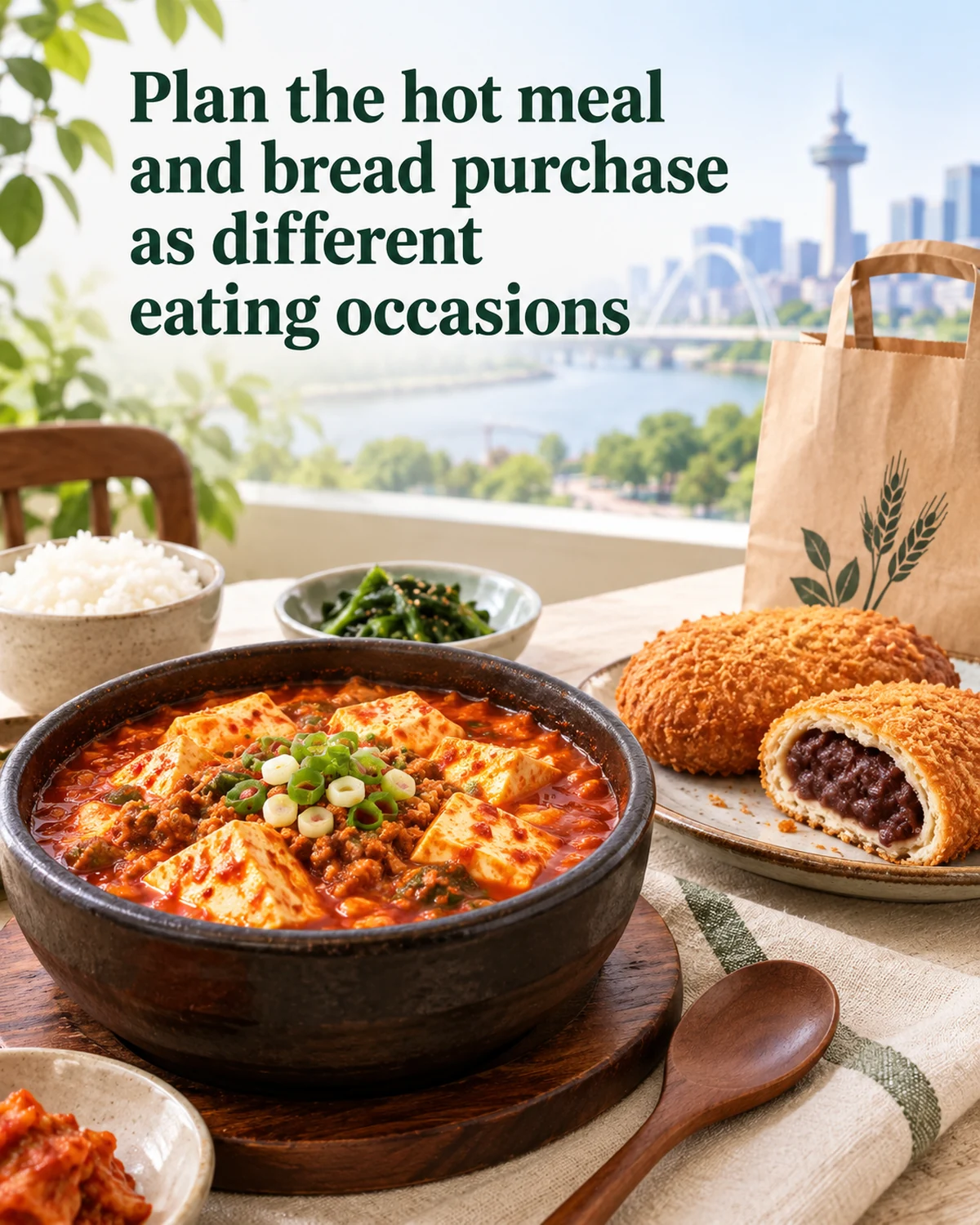
    Decide which food is lunch and which is a later snack before joining a bakery queue. A bag of pastries is easy to count as souvenirs while eating enough of it to replace the meal. Conversely, buying something to take away is not an obligation to eat it immediately. Ask for product-specific storage guidance rather than assuming all bread keeps in the same conditions.

    Plan the hot meal and bread purchase as different eating occasions
    Plan the hot meal and bread purchase as different eating occasions

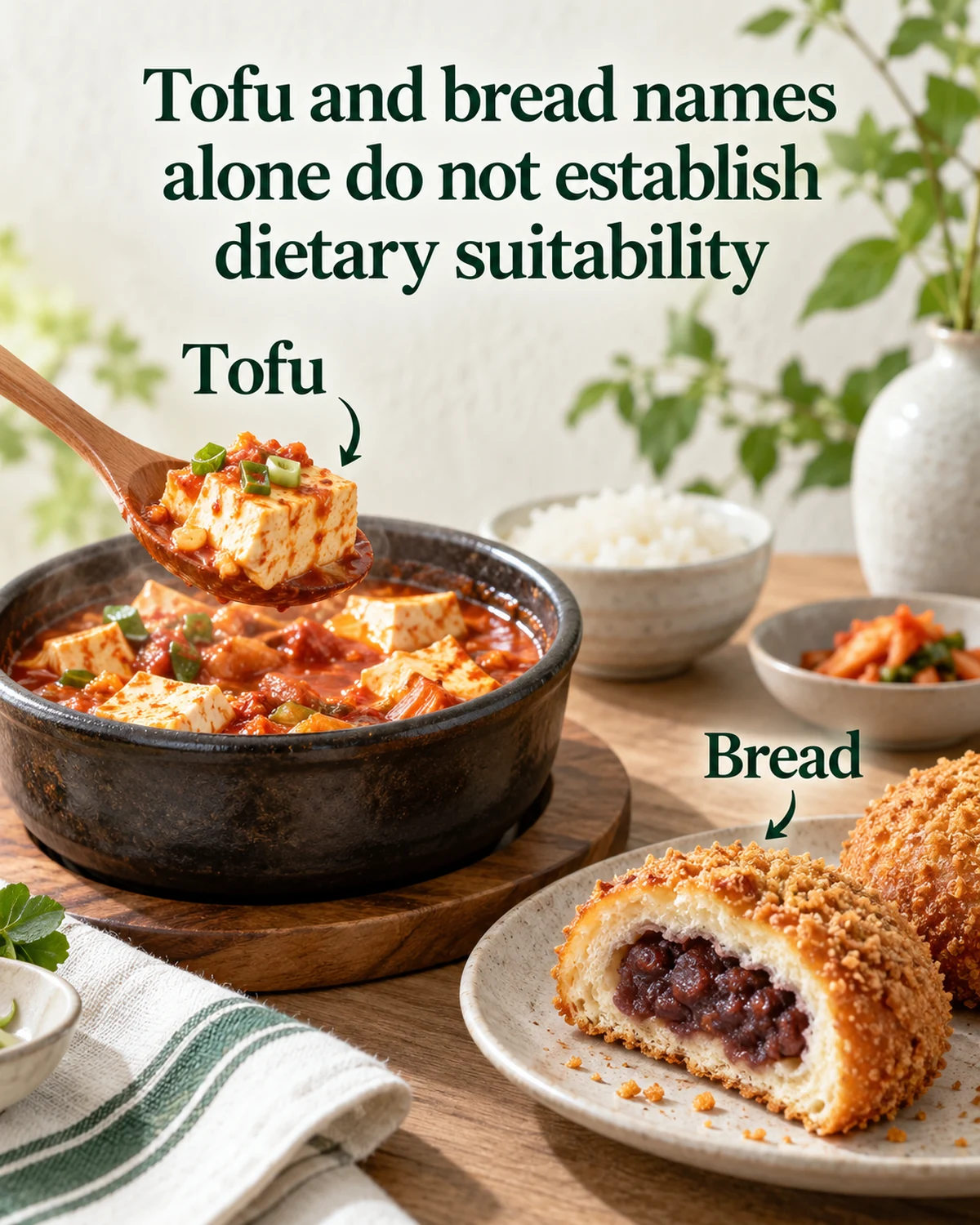
    At a dubu-duruchigi restaurant, check whether tofu is the principal ingredient in the dish you are ordering, how portions are sold and whether rice or noodles are included. Duruchigi is not a guarantee of one ingredient everywhere. Tofu also does not by itself establish that the stock, sauce and accompaniments are vegetarian.

    Tofu and bread names alone do not establish dietary suitability
    Tofu and bread names alone do not establish dietary suitability

    A useful tasting comparison is the sauce against three surfaces: a piece of tofu, a little rice and, when offered and wanted, noodles added later. Each carries the sauce differently. The interest is not simply how hot the dish is, but how the same seasoning becomes a meal through several textures. That makes a better partner to the bakery story than an invented rivalry between two kinds of city food.

    What “tofu” and “bread” do not tell you about ingredients

    Tofu itself is plant-based, but dubu-duruchigi should not automatically be treated as vegetarian or vegan. Restaurant sauces can include seafood-based stock, fish sauce, meat seasoning or actual pieces of squid or pork. Side dishes may also contain animal ingredients. Ask about the sauce base and additions, not only whether the visible tofu contains meat.

    At the bakery, common allergens can include wheat, milk, eggs, soy, nuts or other ingredients depending on the product. Deep-fried items can also raise cross-contact questions for people with severe allergies. Current ingredient and allergen information from the bakery is more reliable than assuming a pastry is safe from appearance alone.

    Sources and reading

    1. Sungsimdang official website — company introduction and current signature-product description
    2. Sungsimdang official history — 1956 founding and 1980 tuigim-soboro development
    3. Daejeon Metropolitan City — 2026 designation of bread, kalguksu and dubu-duruchigi as representative foods