
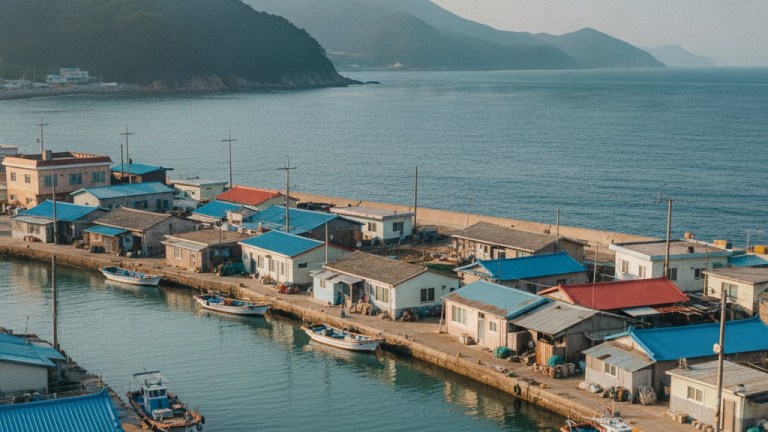
On the far northeast corner of South Korea, right where the Seoraksan mountains tumble into the East Sea, sits a small port city called Sokcho (속초). Cross a tiny hand-pulled ferry there and you land in Abai Village (아바이마을), a low huddle of houses built by war refugees from the North. This is home to one of Korea’s most inventive dishes: ojingeo sundae (오징어순대), a whole squid stuffed like a sausage and steamed. It’s comfort food born out of homesickness, and once you know the story, it tastes different.
⭐ Sokcho at a glance
| 🏛️ Sights & things to do | ★★★★★ |
| 🍜 Food | ★★★★☆ |
| 🚌 Easy to reach | ★★★★☆ |
A personal take based on our own experience — the range of things to see, the food, and the travel time from Seoul. Yours may well differ.
The short version: ojingeo sundae is a squid stuffed with a savory filling of vegetables, glass noodles and a little meat, then steamed and sliced into rounds. It was created in Sokcho by refugees who fled the North during the Korean War and rebuilt their hometown cooking with what the East Sea gave them. Here’s what it is, why the squid, and where to eat it.
First — what exactly is ojingeo sundae?
Start with the word. Sundae (순대) is Korea’s classic stuffed sausage, usually a pork casing packed with glass noodles, rice and seasoned blood, then steamed. It’s a beloved street food, sold by the plate at markets all over the country. Now swap the pork intestine for a whole squid, and you’ve got ojingeo sundae — ojingeo just means squid.
How it’s actually made
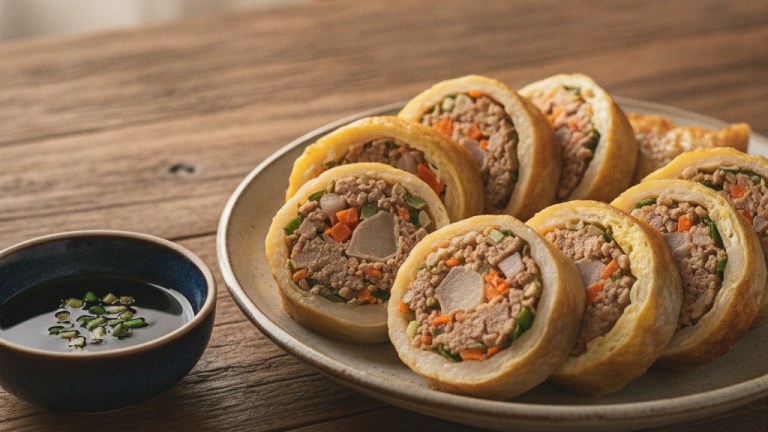
The cook cleans out a squid body so it becomes a hollow tube, then dries the inside and dusts it with a little flour so the filling grips. The stuffing does the heavy lifting: finely chopped vegetables — carrot, onion, chili, scallion — plus glass noodles, tofu, a bit of minced meat, and seasonings like garlic and sesame oil. The squid gets packed full but not tight (it shrinks as it cooks), sealed, and steamed for around twenty minutes. Some shops then slice it, give the rounds an egg coating and lightly pan-fry them. That’s the version I like best — a soft, springy bite with a golden edge.
How to eat it
It arrives already sliced, so you don’t have to do anything clever. Dip a round in the soy-and-vinegar sauce on the table and go. The squid is chewy in that satisfying way; the filling is savory and a little sweet. Locals often eat it alongside a bowl of sundae-guk (순대 soup) or the sharp, cold myeongtae-hoe naengmyeon — pollock in chilly noodles. My honest advice? Order it as part of a spread rather than a single plate. It shines next to other Hamgyeong-style dishes.
The story behind the dish
This is where ojingeo sundae stops being just a clever snack. It’s a piece of the Korean War, still on the plate.
A village built by refugees

During the war, in the great retreat of early 1951, thousands of people from Hamgyeong Province (함경도), a region now in North Korea, fled south with the retreating troops. Many got as far as Sokcho and stopped on a spit of sand at Cheongho-dong (청호동), certain the fighting would end soon and they’d cross back home in a few months. The war ended in a stalemate. The border froze. And they stayed.
The settlement they built became known as Abai Village. Abai (아바이) is a Hamgyeong dialect word for “father” or, more broadly, an older man, the way these northerners addressed one another. So the name itself is a fragment of a lost dialect, kept alive on a signboard. Walk the lanes today and you’ll still hear it in the shop names.
Why squid? Because home was gone
Back in Hamgyeong, a prized local dish was myeongtae sundae, fresh pollock stuffed with a seasoned filling and steamed. When the refugees tried to recreate it in Sokcho, two things had changed. Pollock wasn’t always easy to come by, and neither were the pork casings for ordinary sundae. But squid? The East Sea off Sokcho was full of it. So they used what the new sea offered, stuffing the squid the way they’d once stuffed the fish back home.
That’s the quiet genius of it. Ojingeo sundae isn’t a chef’s invention or a marketing idea. It’s a memory of the North, rebuilt with the ingredients of the South. A hometown recipe adapted so it wouldn’t be lost. I find that quietly moving. You’ll find its cousin, Abai sundae (아바이순대), the heartier pork-casing version, in the same village, but the squid one is Sokcho’s own signature.
The village that a TV drama made famous

To reach Abai Village the fun way, you ride the galbae (갯배), a flat little ferry with no motor. Passengers grab a hooked pole and haul the boat across the narrow channel on a steel cable, hand over hand. It costs only a few hundred won and takes about a minute, and honestly, it’s half the reason people come.
If the crossing looks familiar, there’s a reason. The galbae featured in Autumn in My Heart (가을동화), the hit 2000 Korean drama that aired across Asia, and fans have been making the pilgrimage ever since. There’s a little photo spot by the dock. So you get a bowl of refugee history and a K-drama backdrop in the same fifteen minutes.
🗓️ Plan your visit
When: Sokcho is a year-round base for Seoraksan National Park, and each season has its pull. Autumn (roughly October) is the showstopper, when the mountain turns red and gold, though it’s also the busiest. Summer brings beach crowds; late spring and early winter are quieter and mild. The squid, happily, is good in any weather.
Getting there: From Incheon Airport, plan on roughly 3–4 hours. The simplest route is an express bus from Seoul straight to Sokcho (about 2.5 hours over the mountains); intercity buses also run from other cities. From Sokcho’s bus terminal, Abai Village is a short taxi ride, then the galbae ferry across.
Costs: A plate of ojingeo sundae runs roughly ₩15,000–17,000, and a bowl of sundae soup a bit less. Solid value for a regional specialty. For the trip, autumn foliage season and summer weekends are the priciest and most crowded times for east-coast rooms, so book ahead or aim for the shoulder months.
Where to eat it
Both of these sit right inside Abai Village, a short walk from the ferry dock:
Dancheon Sikdang (단천식당) — the village classic
This is usually the shop with a line out front, and for good reason. The name is a homesick nod to Dancheon, a city up in Hamgyeong that the founding family left behind. Order the ojingeo sundae, and add a bowl of the Abai-style sundae soup if you’re hungry. The pairing is the whole point.
- 📍 Address: 17 Abai-maeul-gil, Sokcho, Gangwon (강원 속초시 아바이마을길 17)
- 🕒 Hours: 08:30–19:00 (last order 18:30)
- 🦑 Ojingeo sundae: from around ₩15,000 · Abai sundae-guk around ₩10,000 · pollock naengmyeon around ₩10,000 · parking near the beach lot
2-dae Songnim Sundae-jip (2대송림순대집) — two generations in
The “2-dae” in the name means “second generation,” and that’s the draw: a family shop passing the recipe down. They do both the squid version and the classic pork-casing Abai sundae, plus a mixed plate if you can’t choose — which, the first time, you probably can’t.
- 📍 Address: 12 Abai-maeul-gil, Sokcho, Gangwon (강원 속초시 아바이마을길 12)
- 🕒 Hours: weekdays 10:00–19:00 · weekends 08:00–20:00
- 🦑 Ojingeo sundae: from around ₩17,000 (small/medium/large) · mixed sundae plate available · public parking nearby (limited)
One honest caveat: prices and hours are accurate as of July 2026, but small family restaurants change both more often than you’d expect, and busy ones sometimes close early when they run out. A quick check before you go never hurts.
🔗 More Korean food to explore: New to Korean food? Start with our complete guide to what to eat in Korea. stay on the east coast for Gangneung’s seawater tofu, chodang sundubu, head into the Gangwon mountains for gondeure namul bap in Jeongseon, or go back to Seoul for the street food of Gwangjang Market. · More on Wikipedia
A few quick questions
Is ojingeo sundae the same as regular sundae?
No. Regular sundae is a pork casing stuffed with glass noodles, rice and blood. Ojingeo sundae uses a whole squid as the casing and a milder vegetable-and-noodle filling, with no blood. Different texture, different flavor, same idea of stuffing and steaming.
Does it taste very fishy?
Not really. The squid is clean and springy rather than strong, and the savory filling balances it out. If you like calamari, you’ll be fine here. The dipping sauce adds a little tang.
What’s the difference between ojingeo sundae and Abai sundae?
Both come from the same refugee community in Sokcho. Abai sundae is the hearty pork-casing sausage; ojingeo sundae is the squid version. Many Abai Village shops serve both, so you can compare them side by side.