A royal food display can look like one table for everybody. Joseon’s court was more particular: the king and crown prince belonged to different ranks and households. A dragon badge offers one visible clue to that distinction before you ask who prepared the meal.
For the gonryongpo robe described by the Academy of Korean Studies, the king’s dragon insignia has five claws and the crown prince’s has four. The crown prince’s son has a three-clawed square badge. These are distinctions in a specified court garment, not a rule for every dragon in Korean art.[1]
Gonryongpo insignia distinguish five claws for the king, four for the crown prince and three for the crown prince’s son.
Count the claws, then identify the garment
Gonryongpo was the robe worn for the king’s official duties. Dragon badges were attached at the chest, back and shoulders; the encyclopedia associates the king with five-clawed round insignia and the crown prince with four-clawed round insignia.[1]
The same account describes Joseon’s royal robe as red, the crown prince’s robe as black, and the emperor’s robe as yellow after Gojong assumed imperial status in 1897. Color therefore needs a period and status, not a timeless “king versus prince” shortcut.[1]
When looking at a museum label, identify the wearer, garment and date before counting. An imperial-period object should not silently become proof of every earlier Joseon costume convention.
A scene can use these distinctions to make rank legible. It still needs separate evidence before you can say the production reproduces one particular historical robe, person or occasion.
A garment’s period and wearer give the insignia its context.
The East Palace was a real household
Netflix’s official page identifies The East Palace as a 2026 horror limited series. Its supernatural premise is storytelling; that listing does not authenticate the costumes or identify a real crown prince behind every character.[5]
The historical term Donggung is another name for sejagung, the crown prince’s residence and activity area. AKS explains the eastern placement and the alternative name Chungung, or Spring Palace, through the heir’s future role.[2]
That was not one unchanged building for the entire dynasty. The reference traces different arrangements at Gyeongbokgung, Changdeokgung, Changgyeonggung and other palace settings.[2]
A label saying “crown prince’s quarters” identifies a function. For a particular site, follow the named buildings and their dates rather than treating all eastern palace spaces as one address.
The crown prince’s residence and activity area changed across palace settings.
A food officer is a stronger clue than an imagined menu
AKS records sachan as an office established during the 1430 reorganization of the Donggung household. The official presented the meal, tasted it first and supervised food and medical offices. The Gyeongguk Daejeon later codified the renamed jangchan at junior seventh rank.[3]
This is evidence about responsibility and rank. It does not name the ingredients in a particular prince’s breakfast or prove that every table followed a single arrangement.
The sejagung account also lists a structured household with education, protection and female palace offices, including food-related positions. Feeding the heir belonged to an organized setting rather than an isolated private kitchen.[2]
If a display includes an office title, read it alongside the vessels. Who supervised a meal and who received it can tell you something a decorative plate cannot.
The sachan and later jangchan office connect meal service with household rank.
Cooking, arranging and storing were different tasks
The National Palace Museum’s royal-cuisine exhibition describes kitchens near the quarters of the king, queen, queen dowager and crown prince. Sojubang handled cooking; suragan included arranging finished food; saenggwabang prepared lighter foods and refreshments.[4]
The museum also identifies sauce and salt stores and temporary kitchens for large events. It describes a wider palace workforce of roughly four hundred food workers across royal kitchens, not four hundred assigned to one prince.[4]
The distinction becomes tangible at a contemporary Korean meal: cooking a dish, portioning it and bringing it to the right diner are separate actions. Watching those actions helps you understand the work without claiming the modern dishes reproduce a prince’s supper.
A bowl’s journey depends on more than the cook. A place to hold it, a suitable serving vessel and a clear recipient all matter when a household serves several people.
Preparation and serving are separate kinds of work.
Why a beautiful table is not a universal daily menu
The museum cautions that records of ordinary royal meals are thinner than those for rites and banquets. The familiar twelve-dish table was transmitted through memories of the late Joseon and imperial court; it is not a universal crown-prince menu.[4]
A dated ceremonial table and an ordinary daily meal answer different questions. An impressive banquet arrangement should not become evidence for what one person ate every morning.
When you encounter a royal-style restaurant menu today, ask which dishes are actually offered, how they are served and what period the presentation references. Judge the meal by its cooking and the explanation it provides.
Rice, soup, sweets and shared dishes can help you notice different types of service. Their presence together does not establish one historically exact setting.
Read the display from wearer to household to meal
Start with the person identified: king, crown prince, another household member or banquet guest. The robe badge is one clue to rank; a label and date give it context.
Next establish the place and occasion. Is the display about a named palace quarter, a specific ceremony or a broader culinary tradition? Keep those answers together as you move from clothing to the food objects.
Then look for the practical evidence: an office title, a kitchen name, a store or a documented meal record. Each reveals part of the preparation and service system.
The dragon’s claws make rank visible. The food offices make its daily work visible. Reading both gives the East Palace a more concrete history than a guessed menu or a costume treated as a complete legal document.
A label, occasion and food-service record answer different questions.
A salt storehouse is a surprisingly useful doorway into Korean food history. The royal meal needed seasonings long before a finished tray appeared. A jar, a storage room and the work of receiving supplies can explain more about everyday cooking than a spectacular banquet alone.
The East Palace offers a fictional doorway to that subject: Netflix’s description of its second episode mentions a salt-storehouse ghost. Its official page lists a 2026 horror limited series starring Nam Joo-hyuk, Roh Yoon-seo and Cho Seung-woo, with Choi Jung-kyu, Kwon So-ra and Seo Jea-won credited as creators.[1]
Read the horror premise before the popularity claim
Netflix’s synopsis pairs a man who can enter the spirit world with a court lady who hears the dead, summoned into the palace by the king. That combination gives the story a supernatural mystery within a royal setting. The official page lists eight episodes.[1]
Those descriptions help a reader decide whether the premise appeals to them. A claim that the series is trending globally needs something else: a named chart, reporting week and measure. The series page establishes the program and premise, rather than a dated worldwide popularity ranking.
The fictional salt-storehouse episode opens a separate question about palace food storage.
The historical storehouse has a food job
The National Palace Museum’s 2024–2025 royal-cuisine exhibition identifies jang-go and yeom-go among palace storage spaces for jang, salt and jeotgal. It places these seasonings within a wider system of kitchens, tools and service.[2]
The exhibition describes Saongwon as the office receiving and supplying royal-food ingredients. Cooking had specialized workers, including people making rice, grilling fish and meat, producing tofu and preparing rice cakes.[2]
Its kitchen account distinguishes sojubang cooking spaces, suragan preparation and arrangement, and saenggwabang lighter foods and refreshments. This vocabulary identifies work, rather than a single room in which every palace meal was made.[2]
The exhibition also explains that seafood could be dried or made into jeotgal for transport, and that ice was sometimes used. Arriving ingredients underwent inspection. The record does not identify one universal preservation method for every food.[2]
The museum identifies storage for jang, salt and jeotgal within palace food work.
Follow the seasoning rather than the ghost
A fictional storage room can carry suspense because it is removed from the visible ceremonial table. For a food reader, its historical interest lies in what had to be ready before cooking began: ingredients, containers, tools and people who could connect them.
Ask three questions about a finished dish. Which ingredient supplies its main flavor? At what stage is it added? What work had to happen before it was ready to use? These questions move attention from the decorative table to the preparation.
A soup seasoned with soy sauce offers an accessible example. The liquid seasoning can disappear into the broth, leaving no visible portion to count on the plate. Its absence from the photograph does not make its contribution small.
This is a way of reading food, not a reconstruction of a palace recipe. A storehouse label alone cannot identify the quantities, aging times or sequence used for an undocumented royal dish.
A seasoning can shape a soup while remaining hard to see in a photograph.
Jang is a practice before it is a condiment
UNESCO’s 2024 jang-making inscription describes a process encompassing ingredient preparation, fermentation, aging, storage and consumption. It includes soybean paste, soy sauce and red-chili paste, and notes that household sauces can differ.[3]
The same description connects transmission with families and community teaching. This living practice adds a useful perspective to storage: keeping a sauce is part of maintaining a taste and a body of knowledge. It does not establish an unchanged palace recipe stretching into the present.[3]
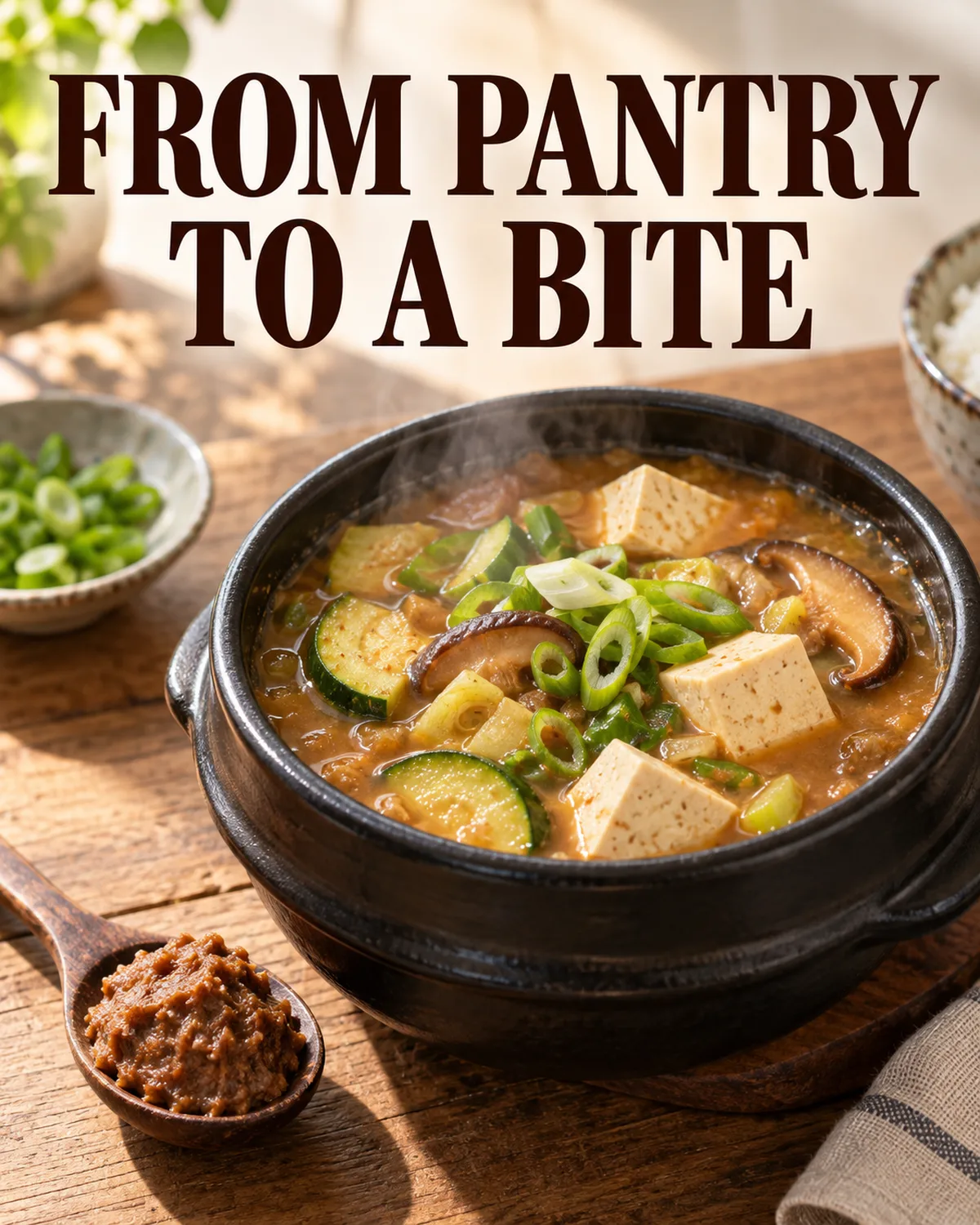
At a modern meal, notice what a sauce does. Doenjang can supply depth to a soup, while soy sauce can season vegetables or form part of a dip. The dish, recipe and product determine how each is used.
Do not assume that two products with the same broad name will taste identical. Read the ingredient list, follow the storage instructions and use the quantity required by the recipe you are cooking. Historical interest is a reason to pay closer attention to those differences.
Making, fermenting, aging and storing belong to the jang-making tradition.
Try the pantry question at an ordinary table
Start with one dish rather than assembling an imagined royal spread. With a vegetable jeon, for example, compare a small bite on its own with a bite lightly dipped in the sauce served beside it. The crisp edge and the seasoning become separate things to notice.
For a soup, taste the broth before adjusting it. If the recipe already contains a salty paste or sauce, that ingredient belongs to the seasoning decision even when you cannot see it. Additional salt should respond to the actual dish.
When ordering, ask what goes into the broth or dip if an ingredient matters to you. A soy-based seasoning may also contain wheat, and a sauce can contain other additions. The name of a dish cannot replace information about its preparation.
These are contemporary eating suggestions. They offer a small experience of how stored seasonings become part of a meal without pretending to reproduce the food eaten by a particular king.
Taste the food and its seasoning as separate parts of the bite.
Keep the exhibition and the episode in their own time
The museum page records an exhibition held from November 20, 2024 to February 2, 2025; it is an archive to read, rather than a promise that the same display is open today. Netflix’s episode description belongs to the series. Neither can stand in for the other’s evidence.[2]
The food detail survives that separation. Fiction makes the storehouse a place to fear; food history makes it a place to investigate. Follow the seasoning from storage to preparation to a bite at the table, and the quieter palace story comes into view.
The quieter food story runs from storage through preparation to the meal.
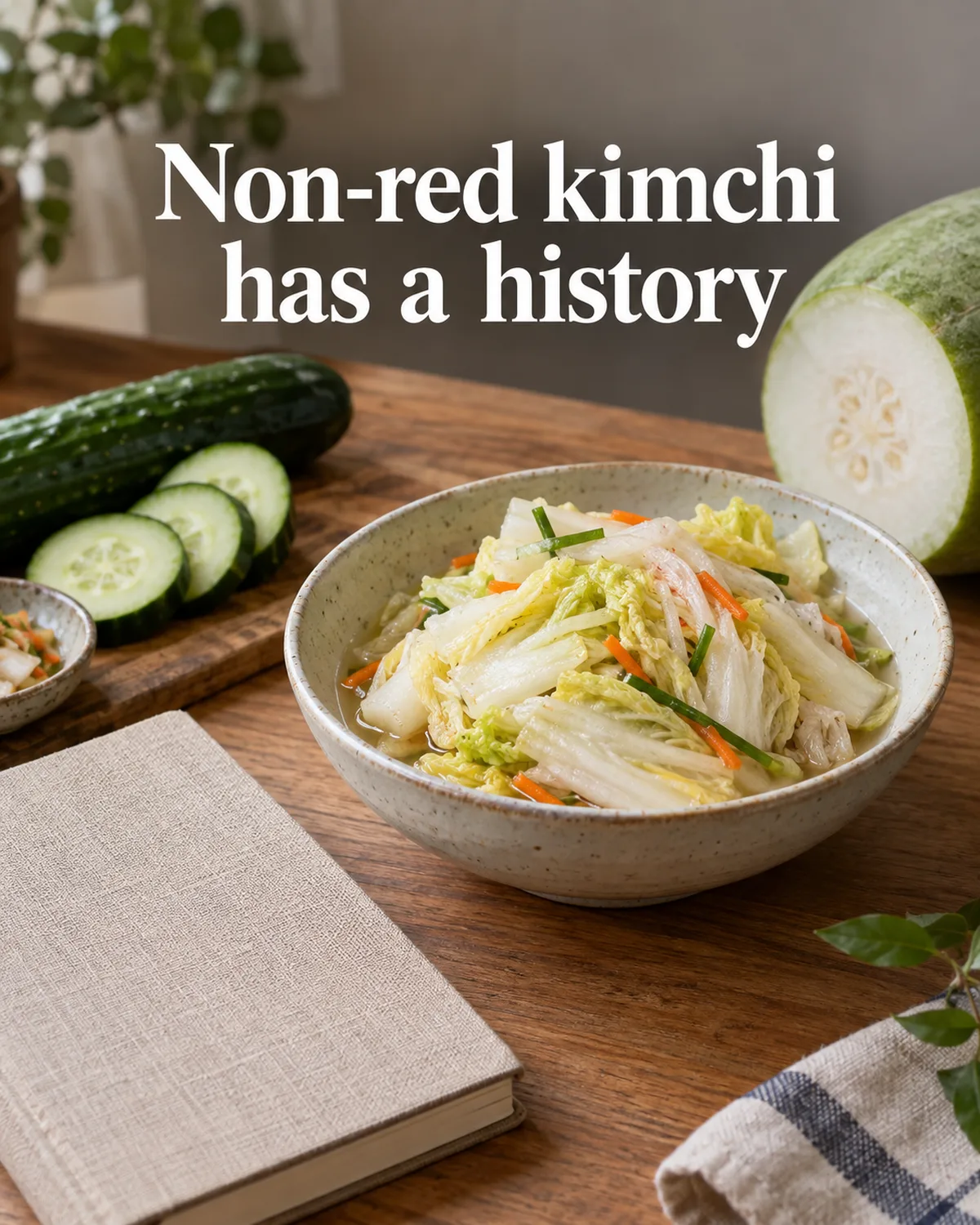
Take away the red color and other parts of kimchi become easier to notice: the cabbage, radish, pear, aromatics and brine. White kimchi is not simply an incomplete version waiting for chili; it offers its own relationship between vegetables and liquid.
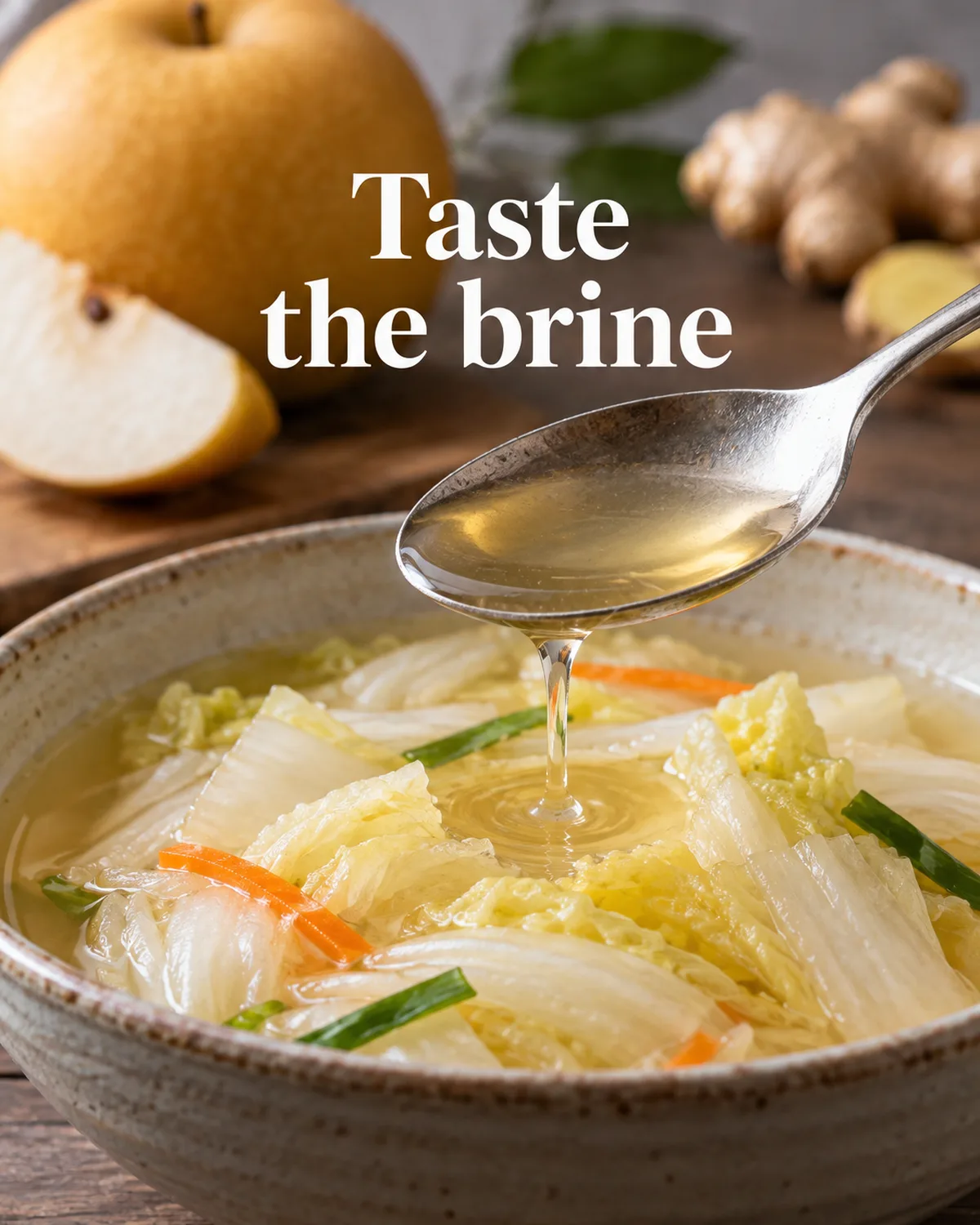
At the table, the useful distinction is between the cabbage and its liquid: one gives a crisp bite, the other carries salt, fruit and acidity. The history explains why kimchi need not be red, but the modern dish deserves attention on its own terms.
A cabbage filling and a brine worth tasting
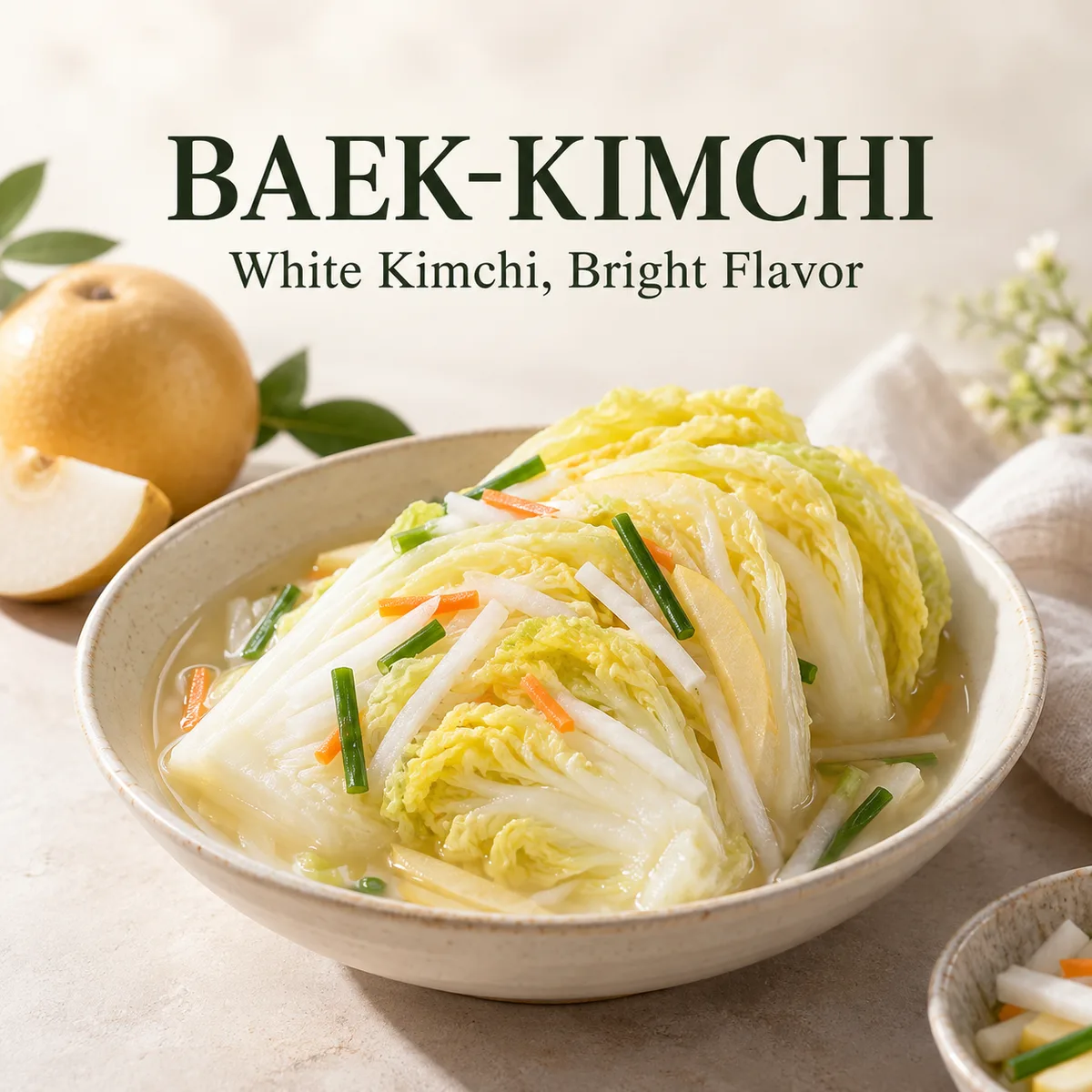
Baek-kimchi literally means white kimchi. VISITKOREA describes salted cabbage filled with shredded radish, pear and scallions, then surrounded by broth or fruit juice. Without a red-chili-powder coating, the pale cabbage and its filling stay visible. This is a distinct preparation rather than a plate of red kimchi with its seasoning washed off.[3]
Pale napa cabbage encloses radish, pear and scallion filling.
The Academy of Korean Studies describes a Pyeongan-style preparation using pear, chestnut, garlic, scallion, ginger and wood-ear mushroom in the filling. Thin red-pepper threads can appear even though red chili powder is absent. Its described liquid also uses salted fish: a pale appearance does not establish that the recipe is vegetarian.[4]
For a first taste, notice the cabbage stem and leaf separately. The stem usually gives the firmer bite; the leaf holds more filling and liquid. A piece that looks almost unseasoned can still carry garlic, ginger and a pronounced salty-sour brine.
Taste the cabbage stem and leaf separately.
The Academy of Korean Studies defines kimchi broadly as vegetables such as radish, cabbage and cucumber that are salted, seasoned and fermented. Its historical overview traces Korean preserved-vegetable traditions through terms such as ji, jeo and later dimchae, long before the modern global image of red napa-cabbage kimchi.1
What the older records actually establish
The Academy of Korean Studies’ kimchi history discusses Eumsik Dimibang, a cookbook from around 1670, and preparations without chili, including winter melon and a pheasant-and-cucumber combination. These examples support a history of non-red preserved vegetables. They do not establish that a modern stuffed napa-cabbage baek-kimchi reproduces that cookbook’s recipe.[1]
Chili’s arrival and its adoption in kimchi were separate developments. The same encyclopedia notes older non-chili preparations in early-eighteenth-century Sallim Gyeongje and chili-using preparations in Jeungbo Sallim Gyeongje in 1766. The record points to change over time rather than a single birthday for red kimchi.[1]
That history also leaves room for both dishes today. White kimchi highlights a filling and brine; red kimchi develops another seasoning balance around chili powder. One is not automatically more authentic, and a modern restaurant’s white kimchi is not evidence of what a particular Joseon king ate.
Older non-chili preparations do not certify a modern royal recipe.
Pear, radish and the brine do the flavor work
Appearance: white kimchi shows pale cabbage and light brine; common red cabbage kimchi carries a red seasoning coating.
Heat: white kimchi usually has little chili heat; red kimchi is often chili-forward, though either recipe can vary.
Aroma: white kimchi makes cabbage, radish, fruit, garlic and ginger easier to notice. Red kimchi adds the prominence of chili seasoning.
Liquid: white kimchi often comes with brine served as part of the dish; red cabbage kimchi usually makes its seasoning paste more prominent.
These comparisons describe tendencies. Korean households make many hybrids. A baek-kimchi can contain a few threads of red pepper without becoming a red-chili kimchi, while a red kimchi can be mild despite its color.
Taste a little cabbage before taking the liquid. Then try a spoonful of the brine when it is served for drinking. Pear can lend sweetness and aroma, radish brings a firmer crunch, and garlic or ginger may stand out without chili powder. What seems mild in heat can still taste lively and strongly seasoned.
The liquid carries salt, fruit aroma and acidity.
The interesting question is how the elements balance. Is the fruit a faint aroma or a clear sweetness? Does the brine taste sharper than the cabbage? Is the stem crisp while the leaf is softer? These observations make it easier to choose the version you enjoy without using chili heat as the only measure of flavor.
Many baek-kimchi versions are served with a generous amount of chilled liquid. That changes the eating experience. A bite delivers both fermented vegetable and broth-like acidity, making the dish feel lighter than a dense red seasoning paste.
The liquid also lets the kimchi work as a contrast food. Rich grilled meat, fried food or fatty dishes can feel less heavy after a cold, acidic bite. That does not mean baek-kimchi “detoxes” the body or medically neutralizes fat. It is a sensory contrast: cool against hot, crisp against soft, sour against rich.
White kimchi provides a sensory contrast beside richer food.
White cabbage kimchi and dongchimi are not identical
Dongchimi is a useful comparison because radish and a generous clear brine organize it differently from stuffed cabbage white kimchi. The Academy of Korean Studies compares baek-kimchi’s use with dongchimi, but similarity in table function does not make them the same preparation. Look at the main vegetable and the filling before grouping them by color.[4]
Baek-kimchi and dongchimi organize their vegetables differently.
When ordering, ask whether the white kimchi is served with its brine and how much is included with the meal. A supermarket package and a restaurant side dish may offer different proportions of cabbage and liquid. Neither the white color nor the name promises a particular sweetness, fermentation stage or portion size.
Taste the vegetable and the liquid separately
A first tasting is more informative when the goal is not “is it as good as red kimchi?” but “what is the recipe trying to balance?”
Taste the cabbage first. Notice whether it remains crisp or has softened with fermentation.
Try some brine separately. Check the balance of salt, sweetness, fruit aroma and acidity.
Notice the aromatics. Garlic, ginger, scallion and pear can be easier to identify without heavy chili.
Pair it with a rich bite. The contrast with grilled or braised meat makes the kimchi’s cool acidity clearer.
Compare fermentation stages if possible. A younger batch can taste sweeter and greener; a more mature batch tends to become more acidic.
No stage is universally “correct.” Restaurants and households serve baek-kimchi at different points depending on the texture and acidity they prefer.
Recipes and fermentation stages create different tasting balances.
Check the actual house recipe for dietary needs. The encyclopedia’s Pyeongan-style example includes chestnut and salted-fish liquid; VISITKOREA describes a different filling and broth. Those are concrete reasons to ask about nuts, seafood seasoning and stock rather than guessing from the cabbage’s color.[4], [3]
Vegetarian or vegan diners can ask whether the brine contains fish sauce, jeotgal or animal stock. For an allergy, name the ingredient you need to avoid and ask about both the filling and liquid. Removing chili powder does not answer those questions.
Check the filling, seafood seasoning and stock for your dietary needs.
A good final comparison is one small cabbage bite, one spoonful of its brine and a bite alongside rice or a richer main dish. The changes in temperature, crunch and acidity explain the dish’s appeal more clearly than treating it as a historical prop or a health supplement.
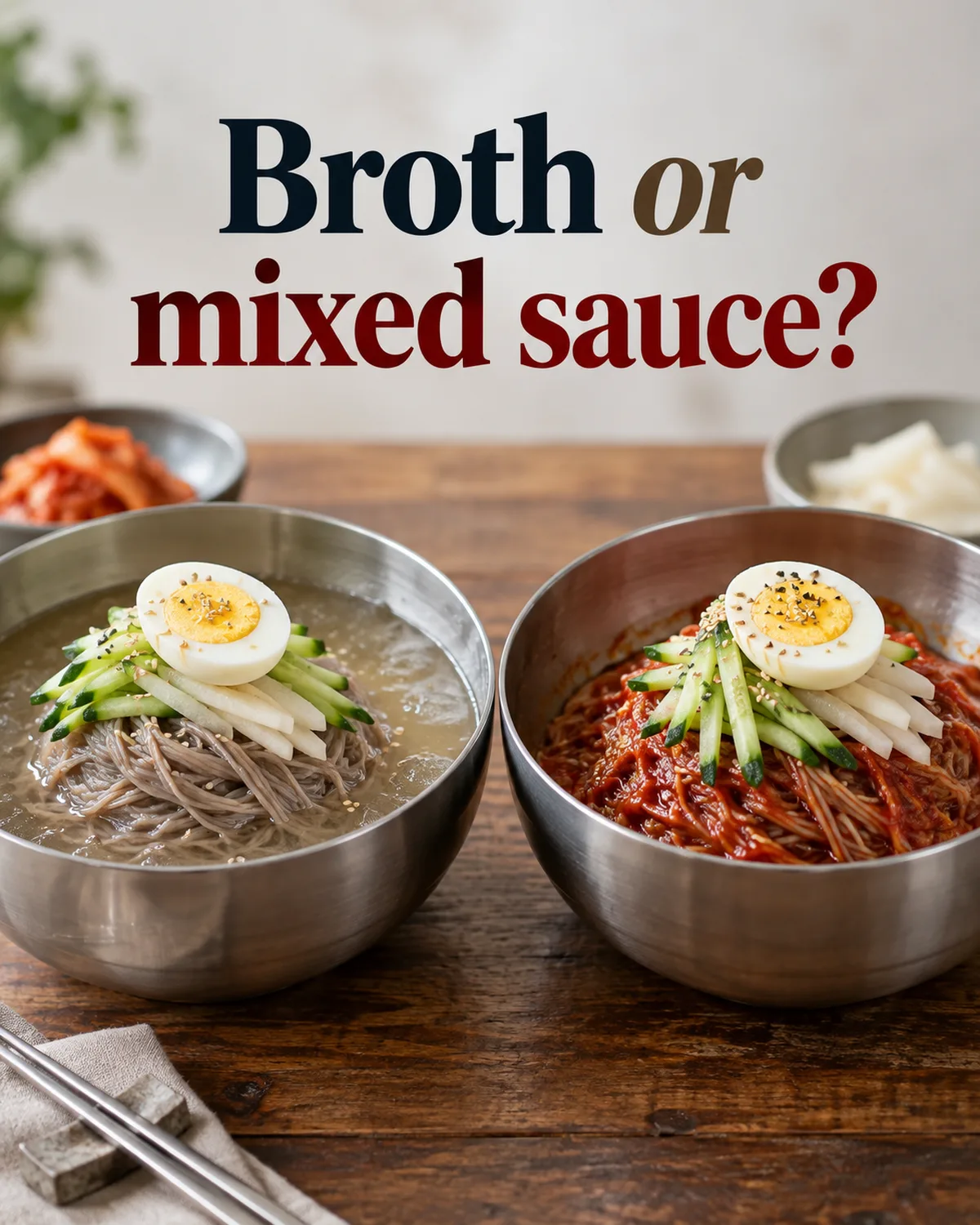
Choose the liquid before choosing the regional label. A bowl of cold broth makes temperature and the first spoonful central; spicy mixed noodles put sauce directly around the strands. Both are naengmyeon, but they ask you to taste different things.
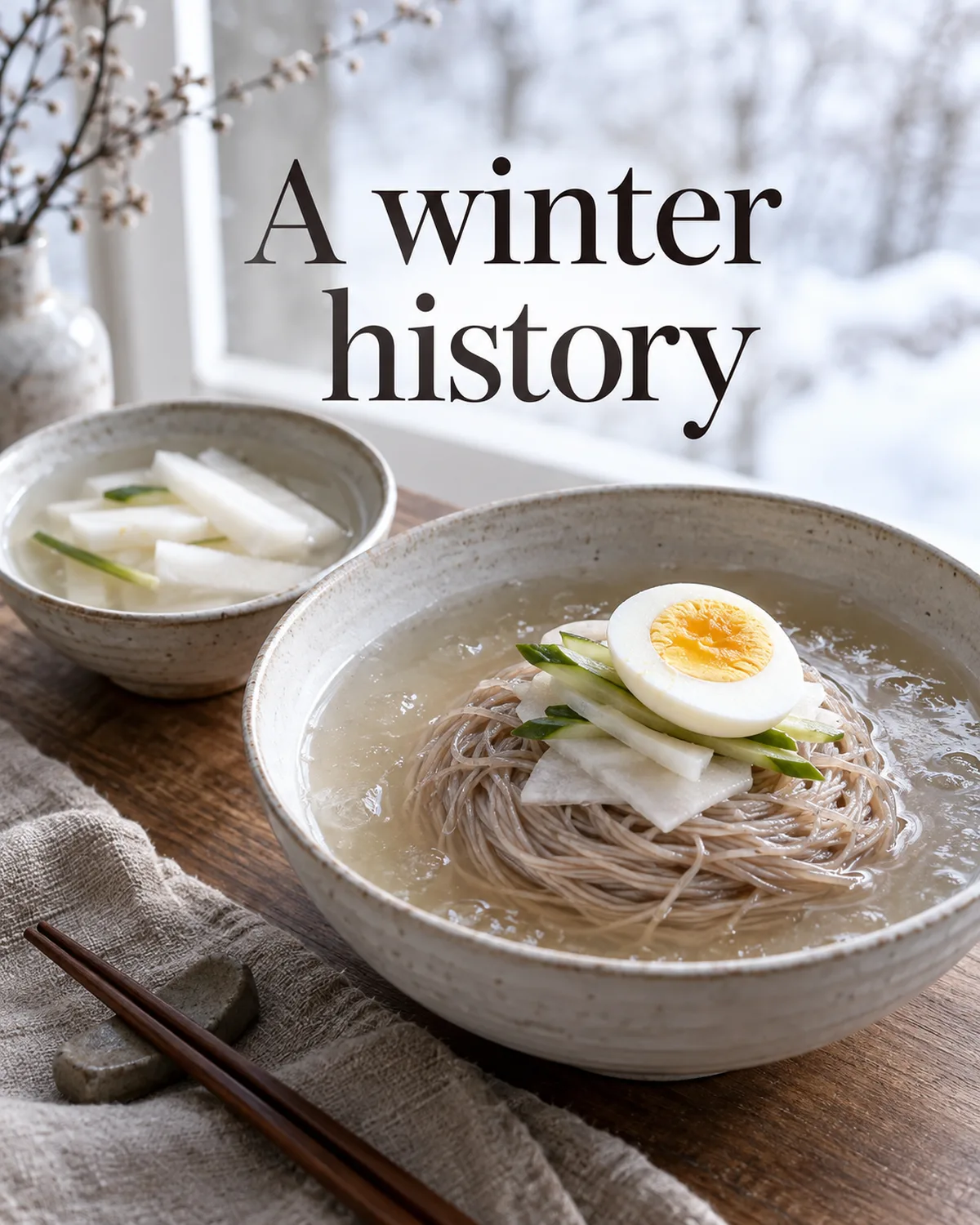
The winter history makes the chilled bowl more interesting. Radish brine and northern noodle traditions belong to the story, while the modern ordering decision is still practical: broth or mixed sauce, a gentler bite or a springier chew, a main meal or a smaller finish after barbecue.
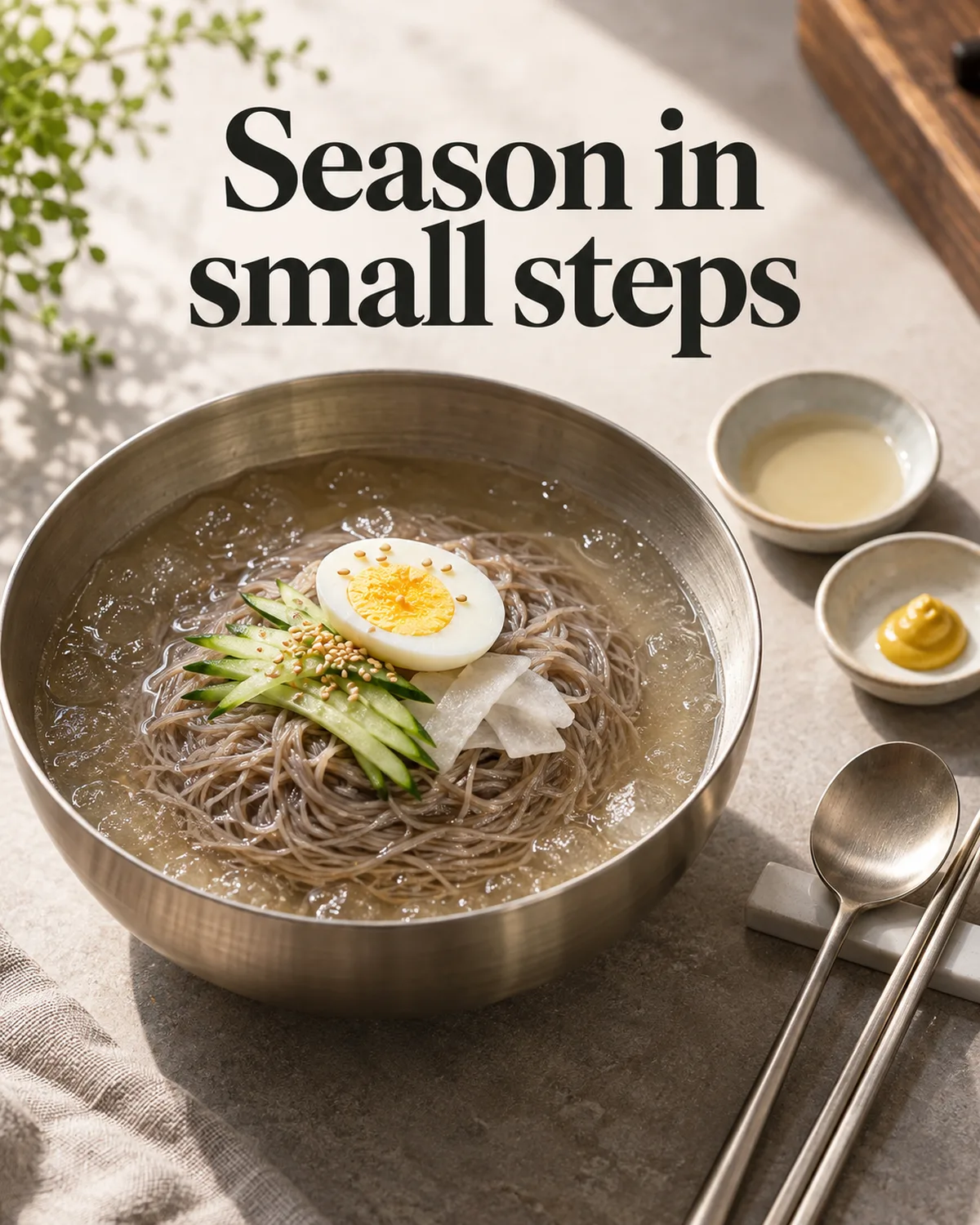
Mul and bibim describe different serving formats.
A winter history behind a cold bowl
The Academy of Korean Studies describes naengmyeon as noodles in chilled liquid and discusses Pyongyang, Hamhung and Jinju regional forms. Its entry records buckwheat-and-starch noodles, several meat or kimchi-based broth options and garnishes that can include meat, vegetables and egg.[1]
Mul naengmyeon means the broth format; bibim naengmyeon means the mixed-sauce format. Pyongyang and Hamhung refer to regional associations. These are two different ways to describe a bowl: a menu offering mul and bibim does not automatically promise two exact historical city recipes.
The same encyclopedia identifies naengmyeon as a historical winter specialty and cites Dongguk Sesigi among the records. Korea.net’s 2017 recipe feature connects the winter custom with dongchimi radish brine and the winter-solstice period. These accounts support winter associations, not an exact date when cold noodles were invented.[1], [3]
Winter radish brine belongs to the documented story.
The encyclopedia’s Pyongyang entry describes a relatively mild food tradition, buckwheat noodles mixed with starch, and a broth blending meat stock and dongchimi. It mentions older pheasant stock and later beef and bone stock. Its recipe is one documented preparation, not a universal ratio every restaurant must use.[2]
Taste a spoonful before reaching for condiments. A restrained broth lets you compare grain aroma, the savory stock and the radish-brine note. If you expect every cold bowl to be sharply sweet and sour, that quieter starting point may be the most useful discovery.
Notice the stock and radish-brine note before adding condiments.
Ask about the noodle as well as the city
Noodle composition changes the bite. Ask how the shop describes its buckwheat and starch mixture rather than guessing from the city name. A softer strand and a very elastic strand can require different amounts of chewing and different handling with chopsticks.
There is no single buckwheat percentage for this guide to prescribe. If grain flavor matters to you, ask about the noodles; if ease of eating matters, ask about their texture and whether scissors are available.
The encyclopedia associates Hamhung noodles with potato starch, pronounced chew, spicy mixing and a fish garnish such as flatfish or skate. That is a useful regional description; a particular South Korean restaurant may offer different toppings or both broth and mixed versions.[1]
Read the fish topping separately from the sauce choice. A red bowl may contain fish, beef, egg or another garnish, and its color cannot tell you whether the fish is raw, seasoned or otherwise prepared. Ask the restaurant about the actual order rather than assuming every bibim bowl contains the same thing.
The menu should explain the actual topping.
Migration and a changing season
The Pyongyang encyclopedia entry says people moving south after the Korean War helped spread the dish nationwide. Migration belongs to the history of where these noodles were served; it does not require every later restaurant to have the same stock, noodle ratio or garnish.[2]
Winter history and summer appetite can coexist. The cold serving temperature is appealing in warm weather, but the bowl’s ingredients and regional memories have a longer story. You do not need an invented year when a winter food officially became a summer food.
Mul and bibim are useful first decisions
Noodles: ask about buckwheat and starch, rather than assuming a fixed ratio.
Texture: compare a softer bite with a more elastic chew.
Liquid: check meat stock, kimchi brine and seasoning.
Topping: read the actual garnish and its preparation.
Treat these comparisons as starting questions. Ask whether the noodles are buckwheat-forward or starch-forward, whether the broth is meat-based or mixed with kimchi brine, and what garnish the menu includes. A regional label alone does not answer all three.
Cold broth: start with mul naengmyeon.
Sauce around the strands: choose bibim naengmyeon.
Grain aroma: ask about buckwheat-forward noodles.
After barbecue: check finishing portions and whether to share.
A restaurant may use the same noodles for its mul and bibim orders, or different recipes. The broth-versus-sauce decision is the quickest first choice; noodle composition is the next question when you want to compare texture.
Ask about grain and starch as well as the serving style.
After barbecue, cold noodles create a distinct change from the hot grilled meat. Decide whether you want a shared contrast or another full meal. Check whether the restaurant offers a smaller finishing portion instead of assuming every bowl is designed to be eaten after a meat order.
At a specialist noodle restaurant, the bowl can be the main event. In that setting, give the broth and strands your attention before adding other food or condiments. The same dish can play a different role in another restaurant.
Choose a portion that fits the meal.
Broth, vinegar, mustard and scissors
Try a spoonful of broth, then a manageable portion of noodles. Add a small amount of vinegar or mustard if you want it, and taste again. This keeps the house’s starting flavor available for comparison while leaving the final seasoning to your preference.
For bibim noodles, mix the sauce through the strands as the restaurant recommends. Taste before adding more condiments: the bowl may already have a strong balance of sweetness, acidity and heat. A little extra seasoning can change that balance quickly.
If the long strands are difficult to manage, ask for scissors or help cutting them. Take a short portion with the chopsticks instead of lifting a large tangle. The goal is to enjoy the noodle texture comfortably.
Taste first, then adjust vinegar or mustard if you want it.
If warm broth arrives separately, ask how the house serves it. It may be intended for sipping alongside the meal. Do not pour it into the cold bowl without checking, especially if you want to preserve the original broth concentration and temperature.
Check the actual noodle, broth, sauce and toppings when ingredients matter. A bowl with vegetables on top can still contain meat stock, seafood seasoning, egg, buckwheat or wheat. The menu name and the clear appearance of the broth are not a full ingredient list.
Check ingredients, then choose a portion
For a vegetarian order or a particular allergy requirement, ask about the liquid as carefully as the noodles. Request the restaurant’s ingredient information and explain the requirement before ordering; removing a visible meat garnish does not change what is already in the broth or sauce.
For the first tasting, choose mul if you want to notice the cold broth, and bibim if you want a sauce-coated bowl. Within either format, ask about the noodles and topping. That gives you a clearer comparison than choosing a city label without knowing the serving style.
Winter associations, migration and modern summer demand all help explain naengmyeon. In the bowl, the enduring choices are more immediate: grain aroma, chew, broth, sauce and the way you season the next bite.
Start with the house’s serving, taste before adjusting it and choose a portion that fits the meal. The cold bowl becomes easier to understand once the noodles and liquid have each had a chance to speak.
A restaurant queue on Boknal tells you something about a calendar and a custom, not necessarily the thermometer. The three summer days belong to a traditional timing system; they are not guaranteed to be the three highest-temperature readings of the year.
That distinction leaves room for a better question: why did an older seasonal meal custom become so closely associated with a comparatively modern samgyetang restaurant bowl?
Three calendar days, not three weather predictions
The first Boknal is Chobok, the second is Jungbok, and the third is Malbok. The Chinese character bok (伏) carries meanings such as lying down, crouching or hiding. That literal meaning has encouraged many poetic explanations about people or nature bowing before the heat. The safe historical point is simpler: the character is part of the long-established name of this seasonal period, while later storytelling often adds imagery around it.
Boknal uses gyeong days in the traditional sexagenary cycle. Chobok is the third gyeong day after the summer solstice, Jungbok the fourth, and Malbok the first after Ipchu, the beginning-of-autumn solar term. They usually fall ten days apart; in some years Jungbok and Malbok are twenty days apart, an interval called wolbok (월복/越伏).1
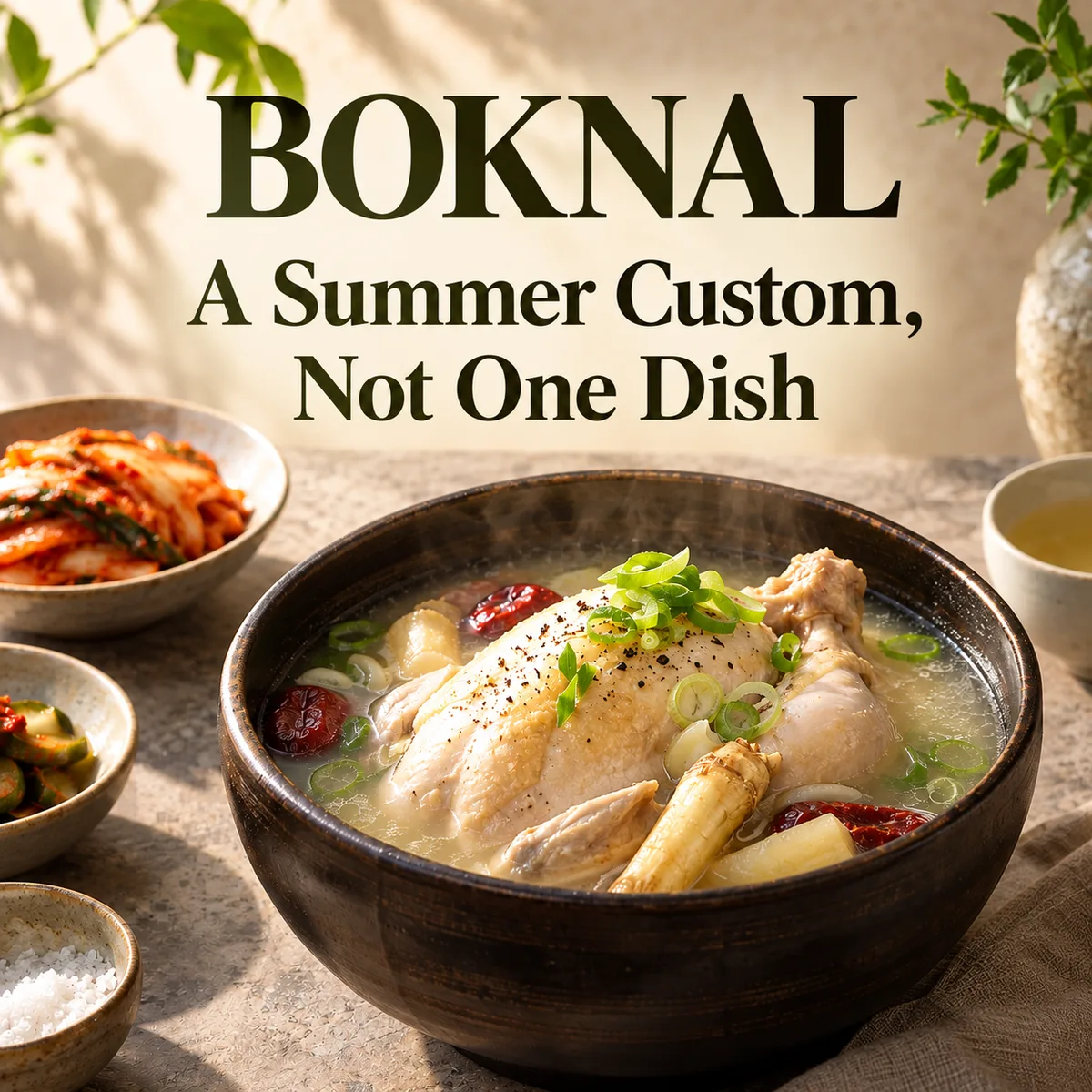
Chobok, Jungbok and Malbok label calendar stages. The pictured dishes are alternatives, not one prescribed food for each date.
This is why an evergreen guide should not permanently bake one year’s three dates into the main explanation. The useful information is the rule. If you are actually traveling during July or August, check the current year’s dates shortly before the trip.
Korean and tourism sources commonly describe Sambok as the hottest part of summer, and the phrase sambok-deowi (삼복더위) itself evokes oppressive peak heat. But a modern weather station can easily record the year’s highest temperature on some other date. Climate does not obey a ritual calendar.
That does not make the phrase wrong. Seasonal calendars work by marking a period when a community expects certain conditions and organizes behavior around them. Boknal says, in effect, “we are in the hardest stretch of summer now.” The precise daily maximum temperature is secondary to that cultural function.
This distinction is useful for visitors because it prevents a strange question: “What if Chobok is cloudy—does Boknal get canceled?” No. The date is calendrical, not chosen after the weather report.
Summer work and the older idea of replenishment
The 2026 National Folk Museum of Korea essay on samgyetang history connects Sambok to the demanding agricultural calendar. Before mechanized farming and air-conditioned work, the period around Sambok coincided with some of the most exhausting summer field labor. The article describes farmers completing repeated rounds of weeding before the mid-summer seasonal cycle and using animal foods to rebuild strength after heavy work.2
This context matters because modern articles often reverse the history. They begin with samgyetang, then assume Boknal must have been invented to celebrate that soup. The chronology works the other way around: the seasonal need and the custom are older than samgyetang’s modern named form.
The Academy of Korean Studies’ Boknal entry also records a broader world of older summer customs: special foods, resting in mountain valleys, eating fruit, folk beliefs about bathing, and agricultural sayings tied to rice and jujube crops. Boknal was part of a seasonal system, not merely a menu promotion.
Summer agricultural work and seasonal rest help explain the background of Boknal.
This is one of the most important corrections to the modern image. Today, a television camera filming Boknal will almost inevitably find a line outside a samgyetang restaurant. Yet the National Folk Museum notes that before the 1970s, other animal foods—most notably dog meat in historical Boknal custom—held a much more prominent place.
The Academy of Korean Studies documents older gaejang-guk meals and other foods believed to support the body through summer. Those descriptions record past practices and beliefs; the menu a diner chooses today can be quite different.
Boknal’s continuity lies in the seasonal slot, not in one permanently fixed dish. A seasonal slot can remain stable while the representative food changes. Boknal survives because people continue to mark peak summer through eating; the food chosen to perform that ritual can shift with agriculture, ethics, supply chains, public taste and restaurant culture.
Samgyetang became a modern seasonal icon
Samgyetang now looks inseparable from Boknal: a small whole chicken stuffed with glutinous rice, garlic, jujube and ginseng, simmered in broth and served steaming. But the dish’s modern name is not an ancient Joseon label.
The National Folk Museum traces the modern samgyetang name and restaurant bowl through 20th-century cooking and supply changes. The samgyetang article follows those developments in detail. For Boknal, the crucial point is the order: the seasonal occasion came first, and its best-known modern menu came later.
That makes samgyetang an ideal modern Boknal food, but not proof that today’s exact bowl was eaten for centuries. Old ingredients, an older seasonal need and a newer restaurant format converged. The result became traditional through repetition.
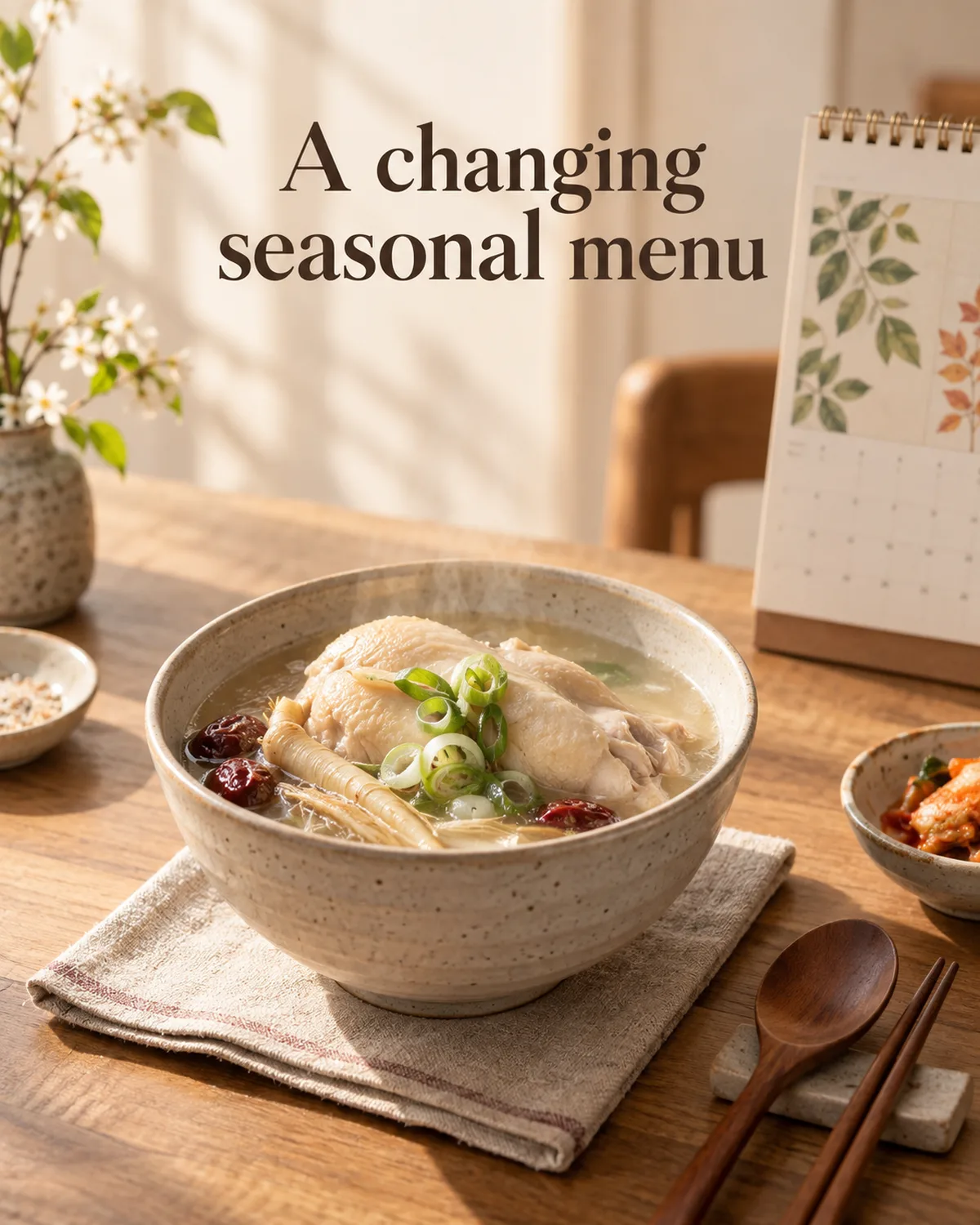
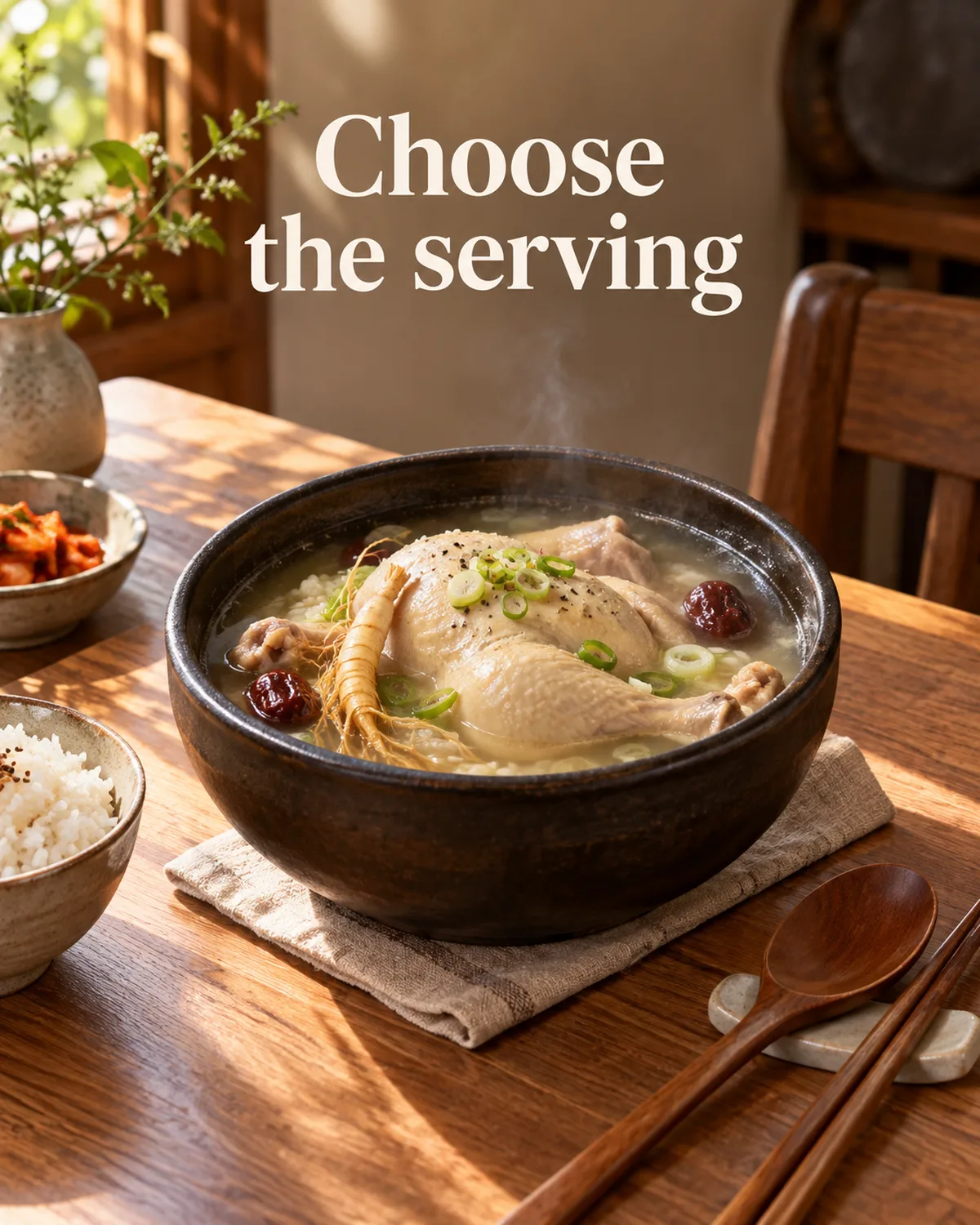
A modern chicken-soup serving illustrates one form of a seasonal menu that has changed over time.
A tradition is not a museum label assigned once. It is a behavior repeated by communities and passed on with meaning. Samgyetang became powerful precisely because it fit an existing summer category: substantial animal food eaten when heat and labor were thought to drain strength. Poultry production and cold-chain distribution made the bowl scalable; restaurant culture made it visible; families and media repeated the association until it became expected.
What “fight heat with heat” means—and does not mean
The phrase most associated with Boknal is iyeol-chiyeol (이열치열), usually translated as “fight heat with heat” or “treat heat with heat.” It makes the visual paradox memorable: people eat a bubbling chicken soup while the outdoor air is already oppressive.
Official tourism writing uses this phrase to explain the summer custom. It does not establish that every hot restaurant meal lowers body temperature or makes dangerous heat exposure safe.
Korean writing often groups Boknal dishes under terms such as boyangsik (보양식), meaning nourishing or restorative food. The category makes sense historically: a high-effort work season encouraged people to value calorie-dense animal foods, protein-rich soups and ingredients associated with strength.
So this guide keeps two statements separate. “Koreans historically regarded these foods as restorative” is a cultural fact. “This dish will cure fatigue, prevent heat illness or boost immunity” is a medical claim that requires evidence far beyond tradition.
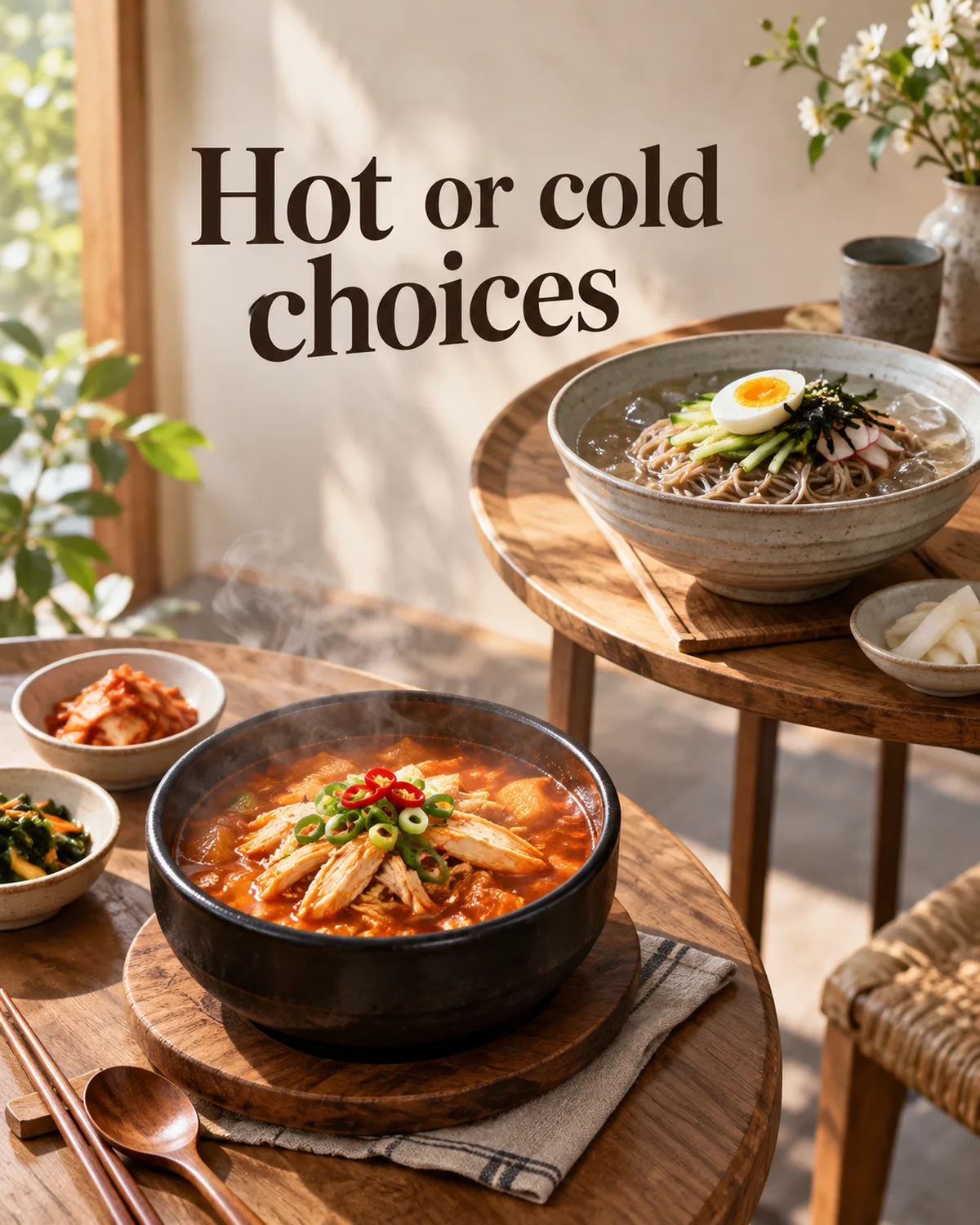
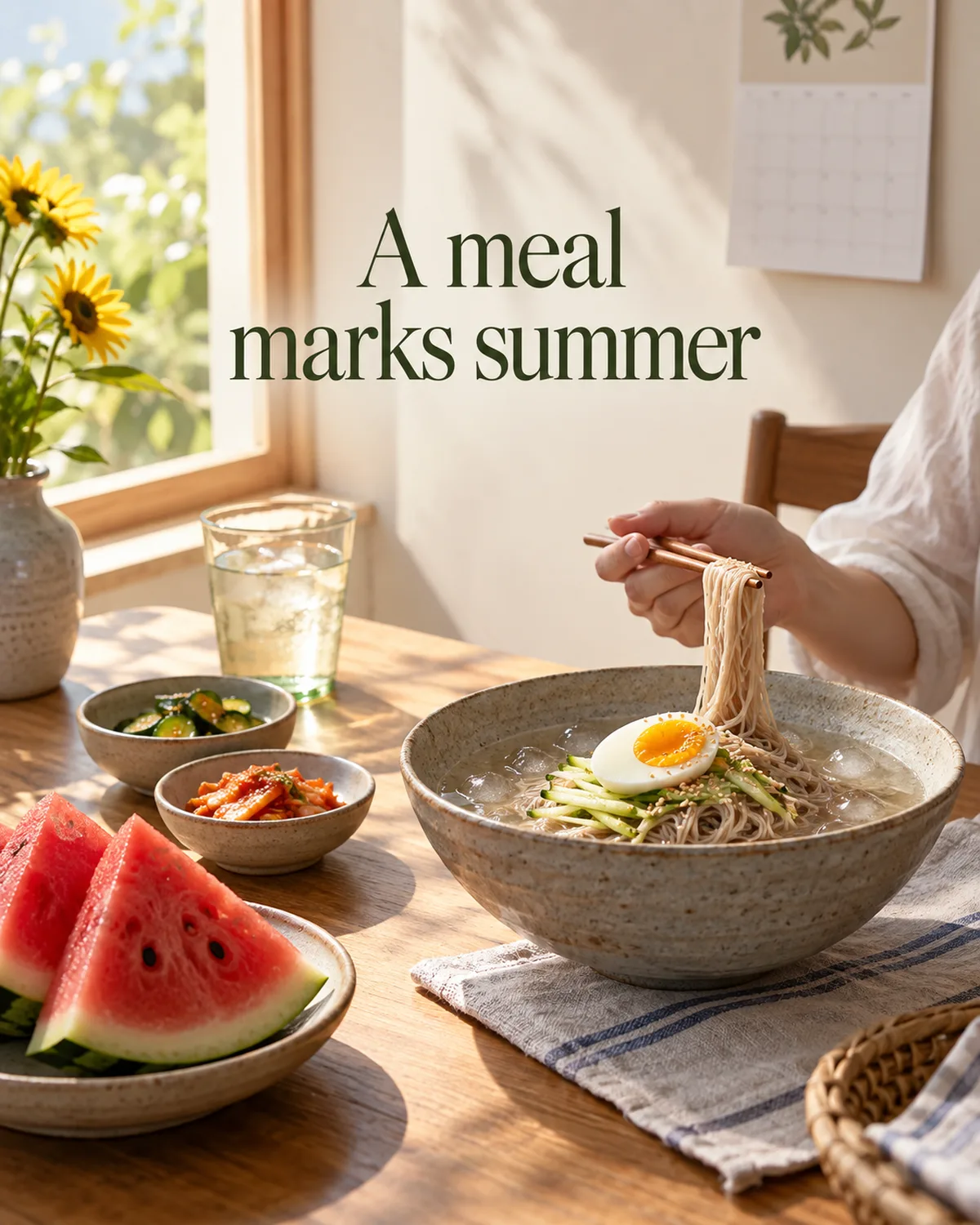
Hot chicken soup and cold noodles are different summer meal choices; neither is a promised medical treatment.
More than one food can mark the season
Modern tourism guides list several substantial summer foods alongside samgyetang. Grilled eel appears frequently because it is rich and energy-dense. Chueotang, a loach soup, represents another long-standing nourishing-food tradition. Duck baeksuk and richer chicken soups can fill the same cultural role. Households and regions make different choices.
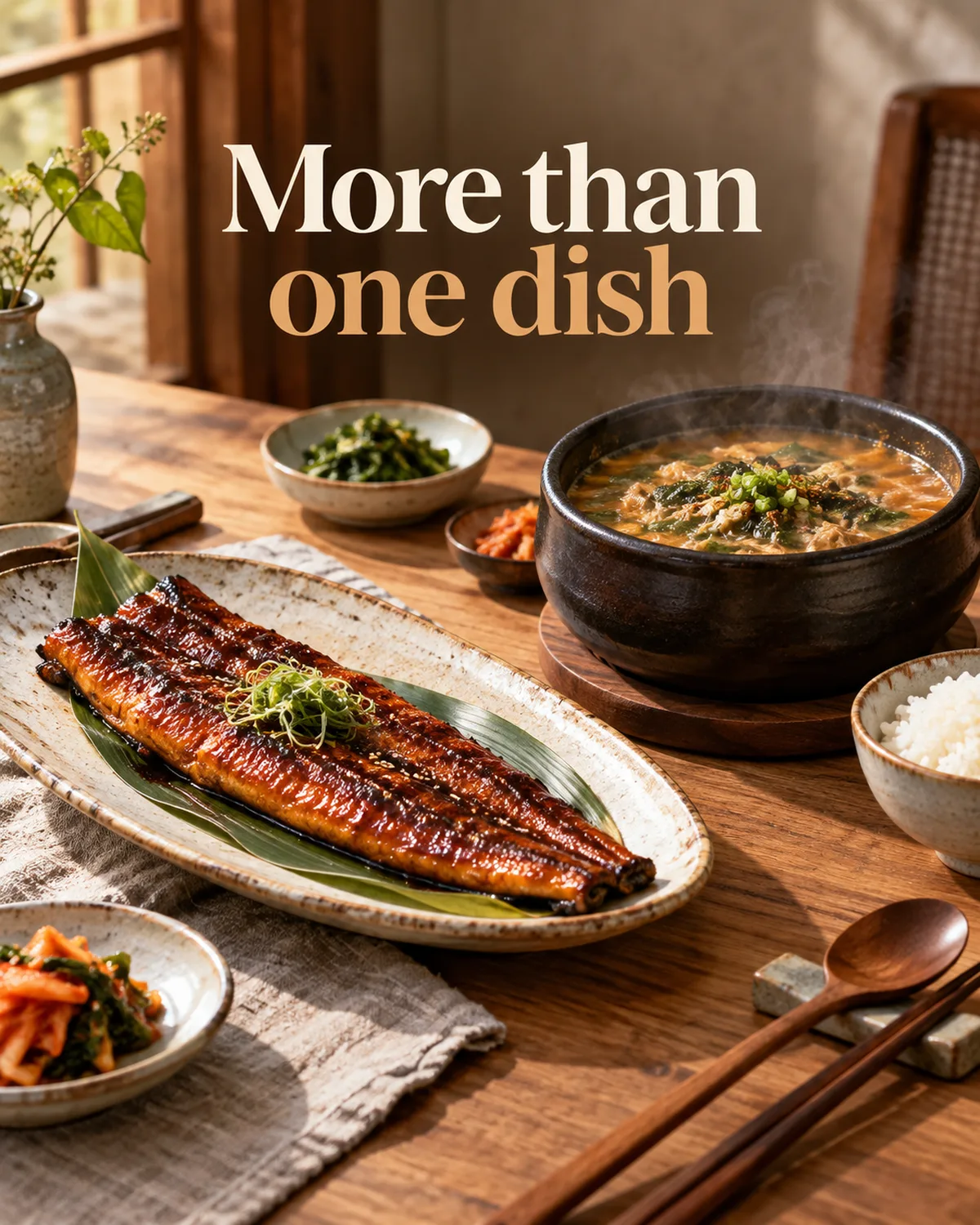
Eel and chueotang illustrate alternative dishes within a broader seasonal food repertoire.
Cold foods also remain part of Korean summer. Kongguksu, naengmyeon, chilled fruit, bingsu and cold drinks do not disappear because iyeol-chiyeol exists. Real food culture is not a philosophical purity test. People can eat samgyetang on Chobok and cold noodles the next day.
This is why the best definition of Boknal is not “the day Koreans eat hot soup.” It is a peak-summer marker around which nourishing-food customs become especially visible.
If you happen to be in Korea on a Boknal date, there is no single required meal. A simple way to experience the custom is to choose one food with a clear summer-nourishing connection, understand why it belongs to the season, and notice how other diners and media are marking the date.
Samgyetang is the most legible option because the seasonal association is so strong. But grilled eel, chueotang, baeksuk or another substantial local dish can make sense too. If hot soup sounds miserable in humid weather, there is no cultural penalty for choosing a cold summer meal instead.
The tradition is not an exam in Korean authenticity. It is an invitation to notice how the calendar, weather and food economy interact.
A custom also changes the restaurant day
Seasonal rituals become easiest to see when they change ordinary consumer behavior. On Boknal, famous samgyetang restaurants can attract substantial queues, lunch demand rises, news coverage returns to summer foods, supermarkets promote chicken and ginseng ingredients, and ready-meal brands foreground packaged versions.
The food has not changed because the calendar arrived, but the concentration of demand has. That makes Boknal a useful case study in how culture affects restaurant economics. One seasonal expectation can push thousands of customers toward the same category at nearly the same time.
For a traveler, this creates a choice. Eating at a famous shop on Chobok offers the social atmosphere of the ritual—crowds included. Eating the same category of food a day earlier or later may offer a calmer meal. Neither is more historically “authentic.” They are different experiences of the same tradition.
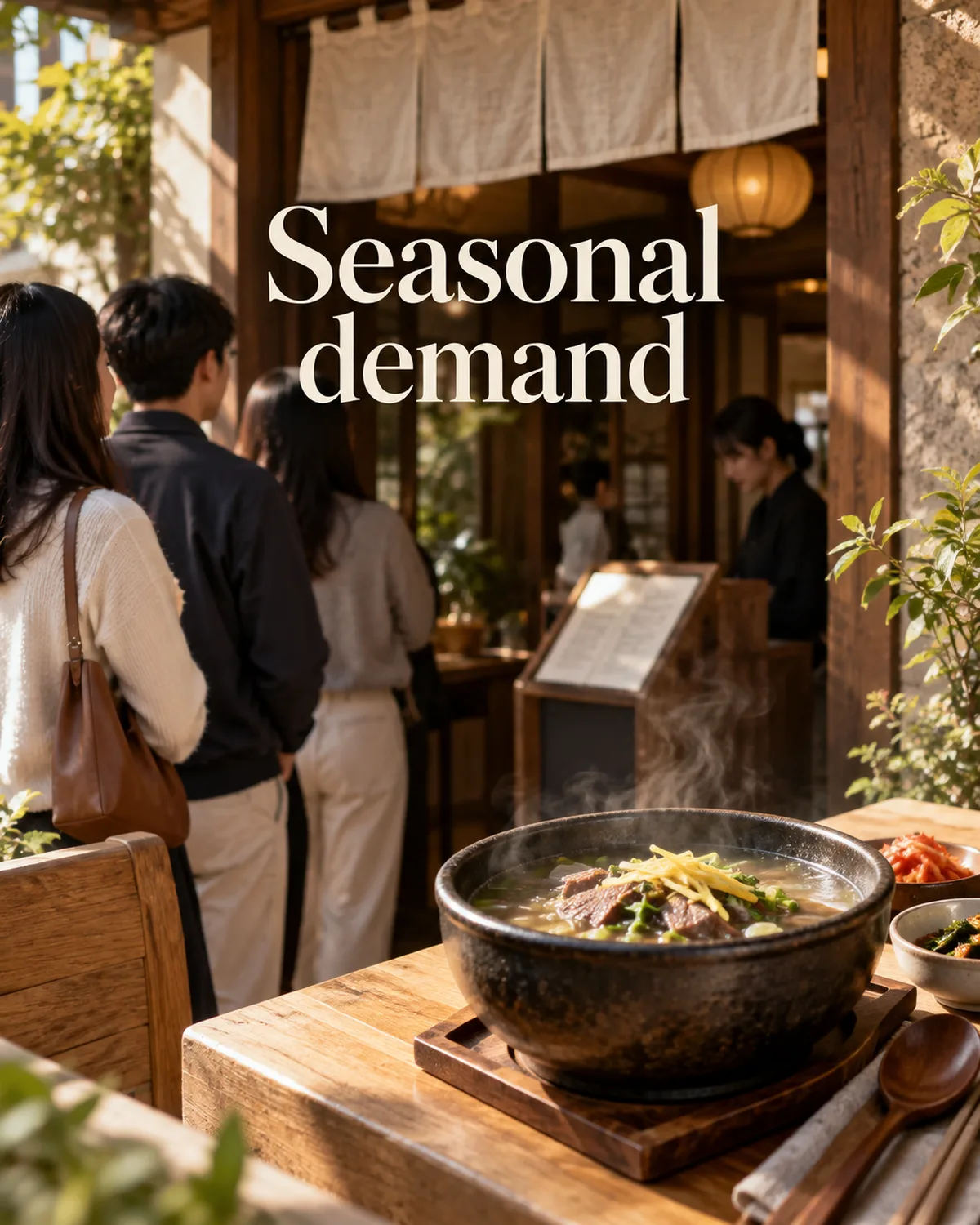
Summer demand can make restaurants serving Boknal meals busy.
If Boknal existed only as a practical response to outdoor agricultural labor, modern cooling should have weakened it dramatically. Instead, the ritual persists. That tells us what seasonal food does beyond nutrition.
Seasonal foods mark time. Songpyeon can signal Chuseok; tteokguk can mark the New Year; samgyetang can signal that the deepest part of summer has arrived. Once a dish becomes a calendar cue, its social value no longer depends on reproducing the exact conditions that created the custom.
This is also why Songpyeon at Chuseok is a useful comparison. Both foods help make an abstract point in the calendar tangible. You can taste the season.
A meal can mark the season without being treated as a remedy.
Choose the meal without treating it as a health ritual
A standard samgyetang is usually an individual whole chicken with rice and aromatics. Broth styles vary from clear and mild to rich and cloudy. Some restaurants leave much of the final seasoning to the diner with salt and pepper; others season more aggressively in the kitchen.
Premium bowls may add abalone, black chicken, extra ginseng or herb packages. Those additions can change flavor and price, but “more medicinal-looking ingredients” does not automatically mean more historically authentic or medically effective.
On a peak Boknal day, the most practical questions are ordinary ones: how long is the wait, is one bowl enough for your appetite, do you have dietary restrictions, and is the restaurant’s current service format convenient for your group?
Check the ingredients, portion and serving format of the bowl you order.
Traditional Boknal foods are often meat- or fish-centered, and standard samgyetang is based on chicken. A bowl with visible vegetables is not vegetarian if the broth is poultry-based. Chueotang contains fish; eel is fish; many baeksuk dishes use chicken or duck.
Plant-based diners can still participate in the seasonal idea without pretending that the traditional meat dishes are vegetarian. A substantial bean dish, kongguksu or another summer meal can mark the day personally.
For allergies, ask about complete preparation rather than only the headline ingredient. Herbal packs can contain multiple roots. Premium samgyetang may include shellfish such as abalone. Prepared sauces and shared kitchens create additional variables.
Begin with the occasion and the food, not a promised effect. A chicken soup, another substantial cooked dish or a cold noodle meal can occupy different places in a Korean summer. They do not need to be ranked as the one correct response to the season.
Iyeol-chiyeol, often rendered as fighting heat with heat, is useful cultural language. It should not become advice to ignore cooling, hydration or signs of heat illness. Likewise, a celebrity eating a seasonal dish can introduce the custom to new viewers without explaining its origin or proving a medical outcome. Keeping those claims apart makes the food story clearer, not less enjoyable.
The seasonal story becomes more concrete when compared with individual dishes and regional meals.
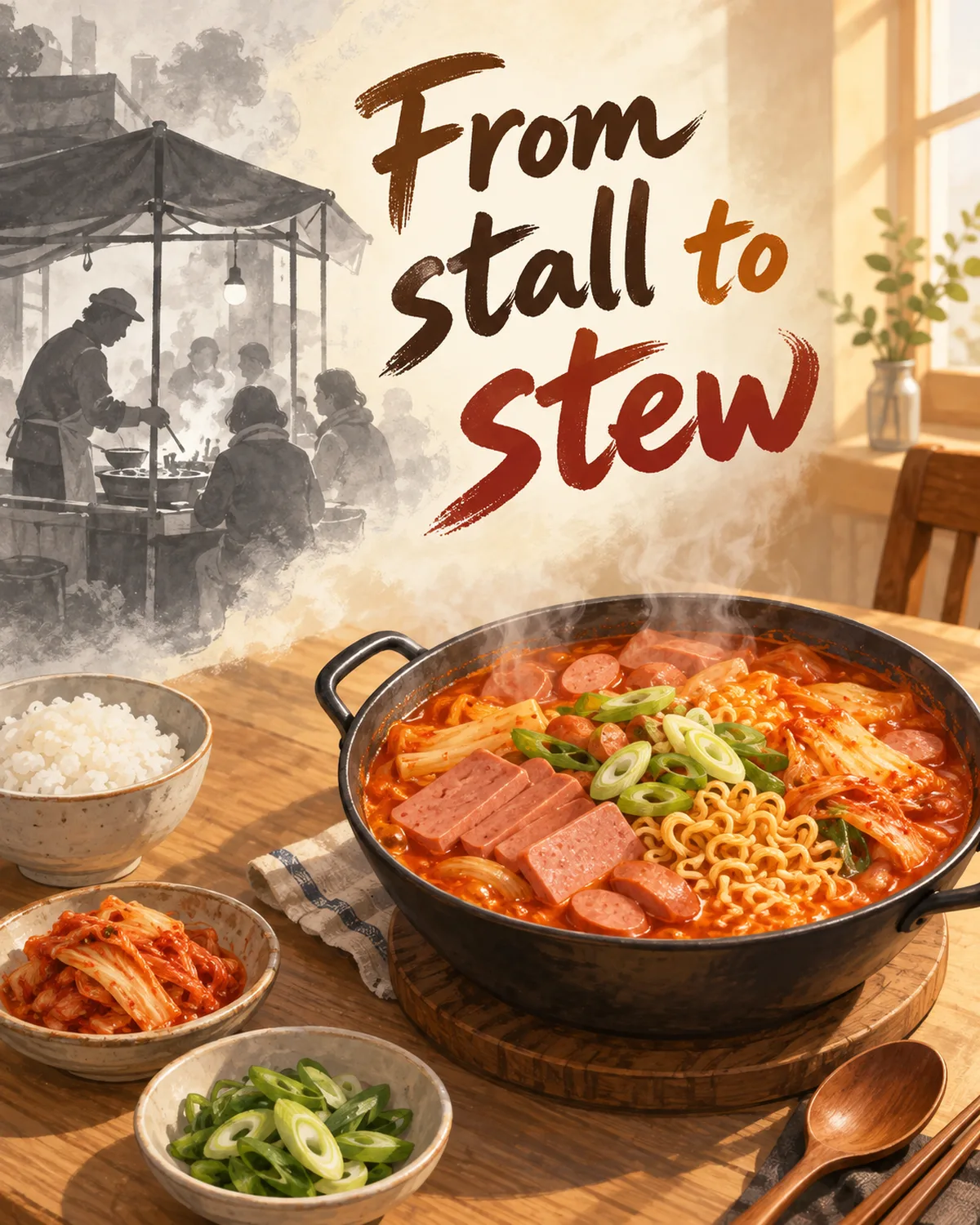
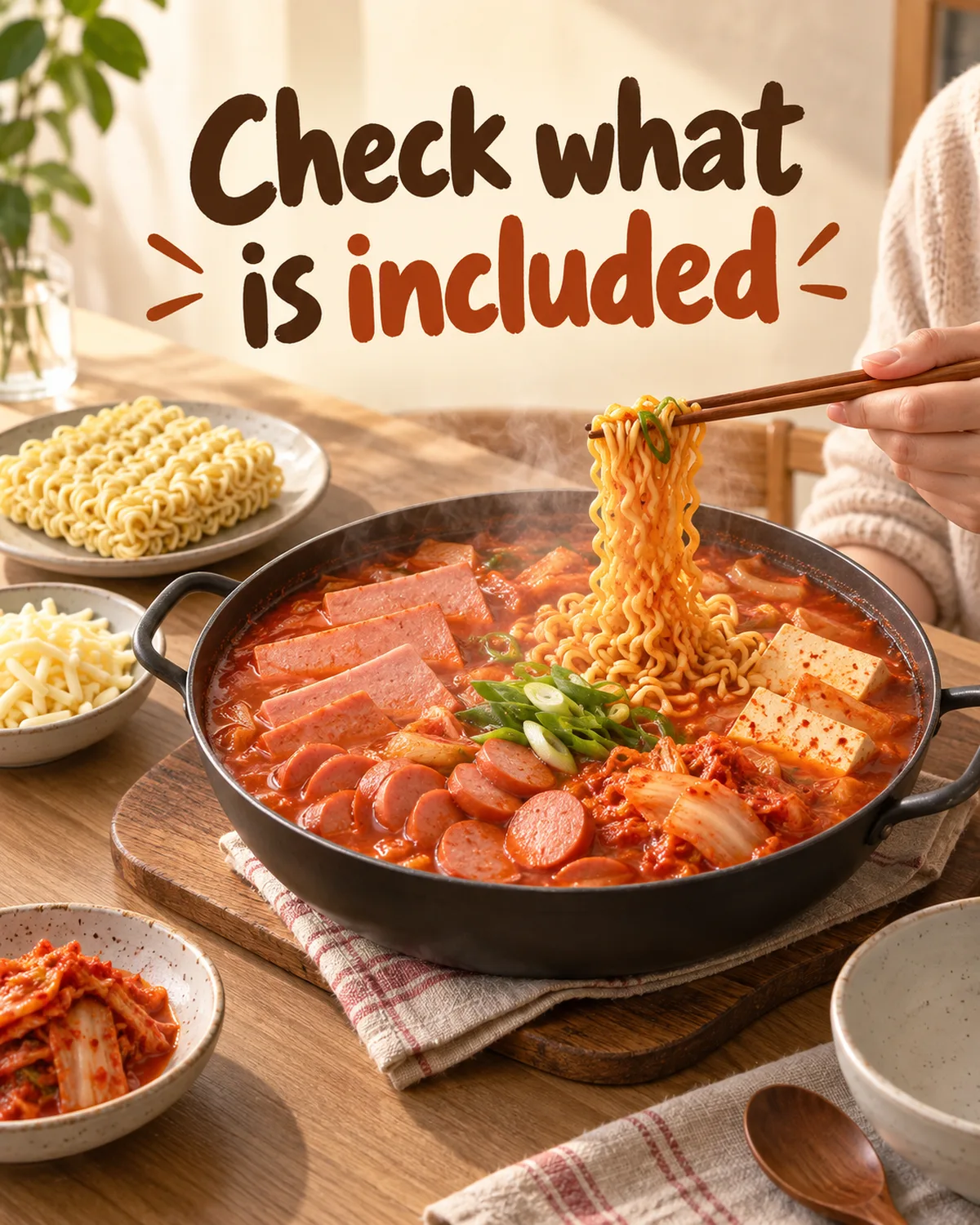
The sausage, kimchi, noodles and cheese in a modern budae jjigae pan do not all need to have arrived together. Reading them as layers added over time tells a more accurate story than imagining one complete modern restaurant recipe emerging in a single postwar moment.
The Korean identity of the meal also lies in its cooking system: ingredients simmer together, seasoning moves into the broth and rice gives the shared pot a place on the table.
The ingredient list is not one frozen 1950s recipe
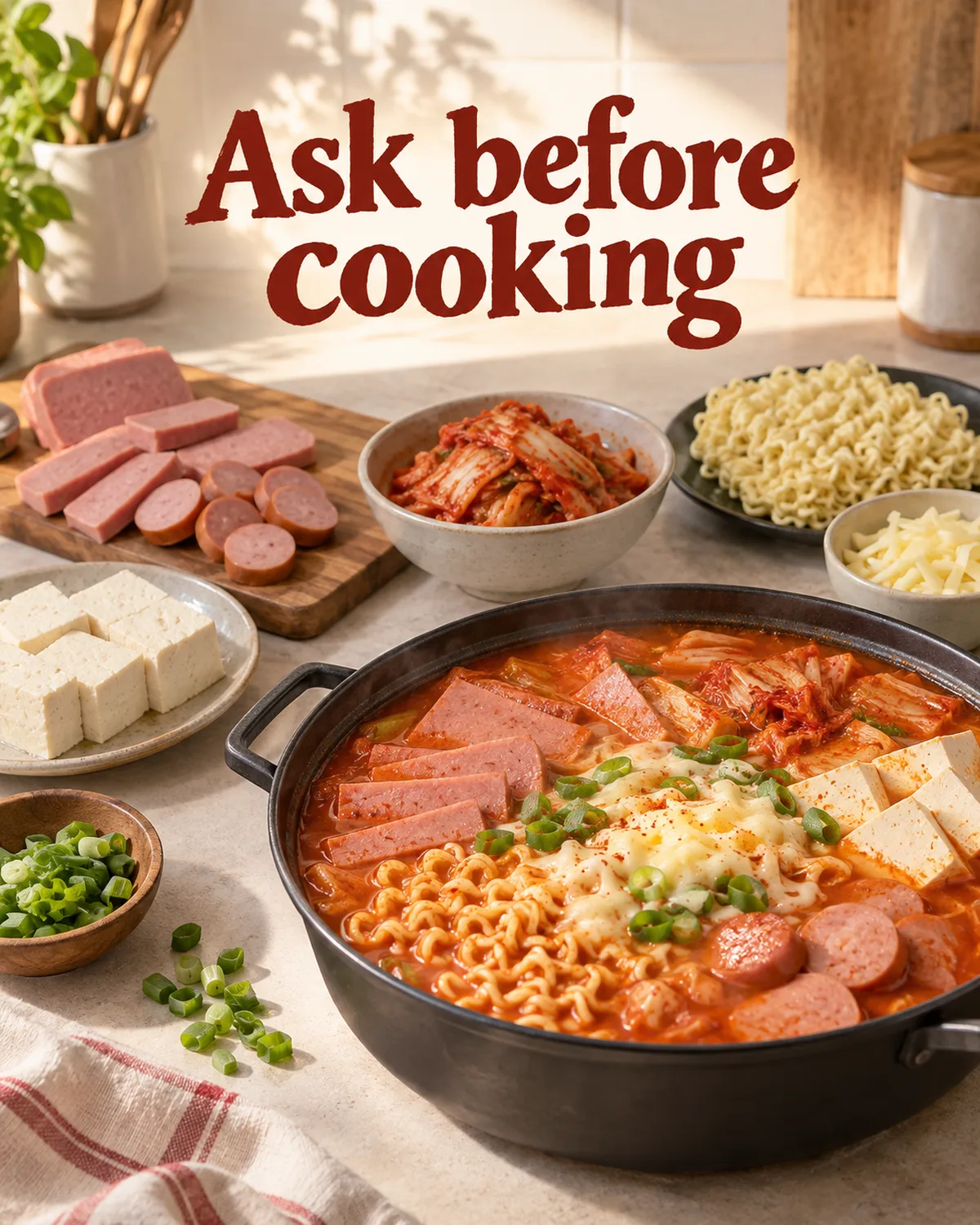
A modern restaurant pot can contain sliced luncheon meat, frankfurter-style sausage, kimchi, tofu, scallion, onion, chili paste or chili powder, baked beans, rice cake, mushrooms, instant ramyeon and a slice of processed cheese. Seeing all of those ingredients together can make it seem as though the finished modern recipe appeared at once in the 1950s.
It did not. The pot contains ingredients from different moments. U.S.-base-associated processed meats belong to the immediate postwar story. Kimchi, garlic and chili seasoning connect the foreign meats to Korean stew practice. Instant ramyeon could only become a normal addition after commercial Korean instant noodles arrived: Samyang Foods dates Korea’s first domestic ramyeon to September 1963. Cheese and the wider range of modern add-ons belong to later restaurant and home-cooking layers.
This matters because food history becomes misleading when today’s photograph is projected backward. A cheese-topped pot with ramyeon, rice cake and multiple branded sausages is a contemporary version of a dish whose earliest forms were necessarily simpler. The current bowl is better read as several decades of Korean food history compressed into one pan.
After the Korean War ended in 1953, the peninsula faced severe material destruction and food shortages. U.S. military installations remained in a number of Korean cities, including Uijeongbu north of Seoul. Around those bases circulated foods that were scarce in ordinary Korean markets: canned luncheon meat, sausages, ham, bacon, cheese and other processed products.
Some of that circulation was legal, some informal and some illegal. Older reporting from Uijeongbu includes testimony about meat being carried out of bases and resold. The precise path of any one sausage is impossible to reconstruct decades later, so an accurate article should avoid turning one dramatic anecdote into a universal supply chain. What is well supported is the broader environment: base-adjacent communities gained access to Western processed meats at a time when meat was otherwise difficult for many people to obtain.
The 2012 interview records Heo Gi-suk’s recollection of taking meat out of the base and selling it. That account explains one business’s circumstances; it does not establish a single supply route for every early pot. A present-day restaurant stew should be described through its current ingredients, without presenting an old scarcity story as a current kitchen practice.
Separate ingredients illustrate the different histories that meet in a contemporary pot.
The ethical point is equally important. Postwar ingenuity is worth recognizing, but the poverty itself should not be romanticized. Base economies reflected military power, scarcity and unequal access. A cheerful “people made something delicious out of trash” narrative turns a painful historical situation into lifestyle content. Budae jjigae is more interesting when the hardship is left visible rather than converted into a cute origin myth.
Uijeongbu and the restaurant histories
Several Korean cities had U.S. military bases, so why is Uijeongbu so closely associated with budae jjigae? The answer is concentration. The city north of Seoul developed a cluster of restaurants specializing in the stew, and that cluster became a recognized food street with its own local tourism identity.
Korea Tourism Organization presents Uijeongbu Budae Jjigae Street as a specialty district associated with postwar U.S.-base foods and their adaptation with Korean seasonings. The city’s restaurant cluster helped make that history visible as a local food identity.
VISITKOREA’s Odeng Sikdang listing traces the business from a humble food stall to a specialist restaurant run by the third generation.
That official restaurant history supports Odeng Sikdang’s importance within Uijeongbu’s tradition. It does not prove the first-ever pot in Korea: informal cooking around several base communities rarely leaves such an exact record.
Odeng Sikdang’s founder, Heo Gi-suk, gave interviews describing a progression from selling fish cake at a street stand to cooking processed meat associated with the nearby U.S. base, first as a stir-fry and later as a stew after customers wanted something better suited to eating with rice. That testimony is historically valuable because it records how one important Uijeongbu business remembers the transformation.
A food stall and a pot of budae jjigae connect the dish with everyday restaurant culture.
The Korean cooking system holds the ingredients together
Processed meat is the most visually striking ingredient, but a pile of sliced sausage is not budae jjigae. The decisive transformation happens when those meats enter the architecture of Korean jjigae.
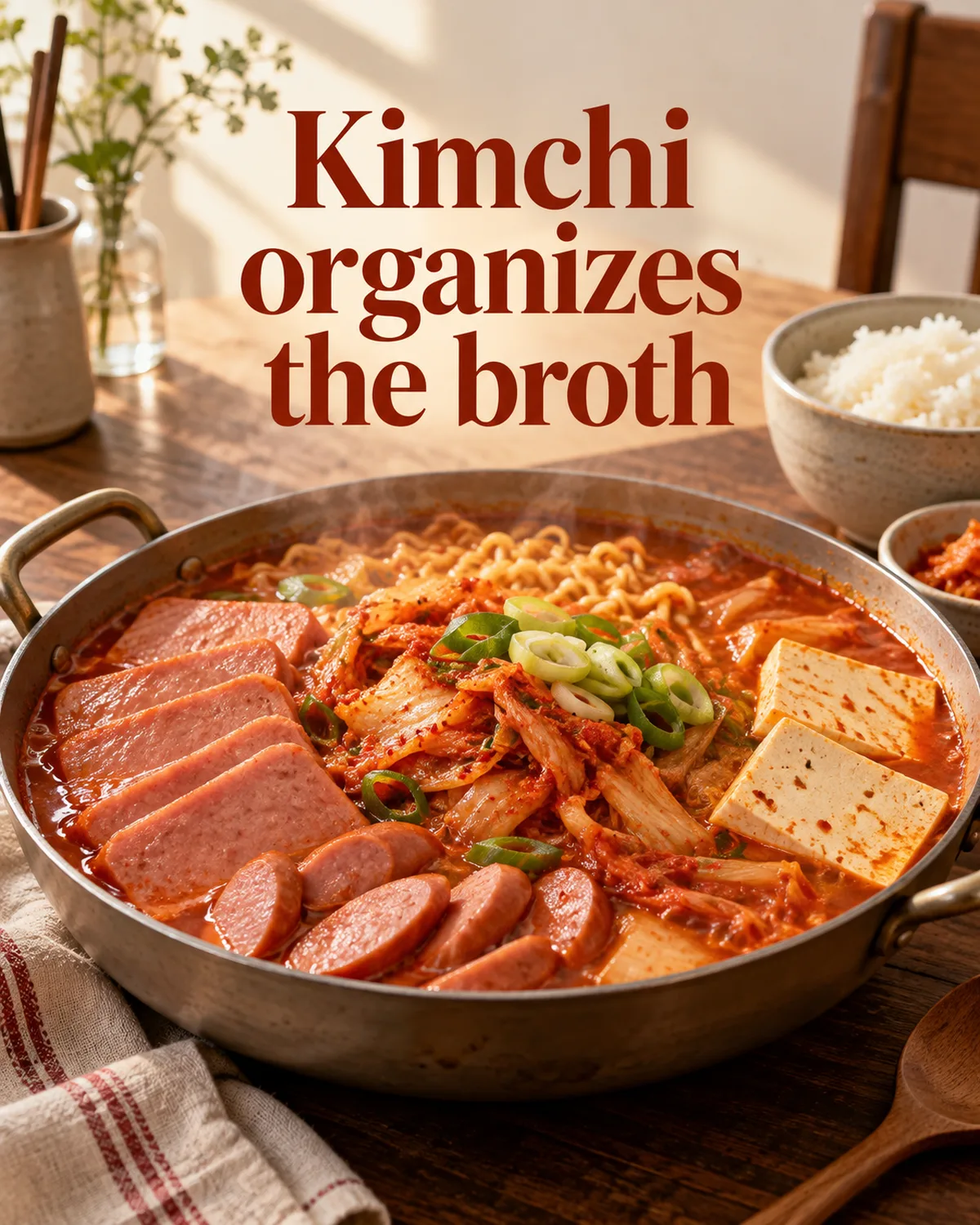
Kimchi contributes acidity, fermented aroma and salinity. Garlic and scallion supply fresh sulfurous notes. Gochujang or chili powder provides heat and body, though recipes vary and some restaurants lean more heavily on one than the other. Broth turns the ingredients into a shared spoonable meal. Tofu, mushrooms, onion or rice cake can extend texture and volume. The pot then cooks at the table or immediately before serving, allowing fat, starch and seasoning to move into the liquid.
This is why describing the dish as “American leftovers” misses the actual culinary work. The imported or base-associated foods were ingredients; the organizing grammar was Korean. The same logic appears throughout food history when migrant ingredients enter an existing cooking system: what matters is not only where an ingredient came from but what local cooks made it do.
Kimchi is often reduced to cultural symbolism in descriptions of budae jjigae, but it also changes the chemistry of the pot. Fermentation produces acidity and a complex savory profile that cuts through fatty processed meat. Chili and garlic add aromatic intensity. The vegetable material contributes moisture and soluble compounds to the broth.
That balance is especially useful because luncheon meat and sausage are concentrated, salty products. If the pot relied only on meat and cheese, it would become heavy very quickly. Kimchi gives the broth tension: sour against fatty, fermented against processed, vegetable against meat.
Fermented cabbage contributes sourness and seasoning to the chili broth.
Restaurants differ in how mature their kimchi is and how much they rely on it. Some Uijeongbu-style pots are described locally as relatively clean and kimchi-forward rather than extremely thick. That should not be turned into a rigid regional law, but it is a useful tasting question. When comparing two pots, ask whether the base flavor comes mainly from fermented kimchi, chili paste, a prepared stock or the processed meats themselves.
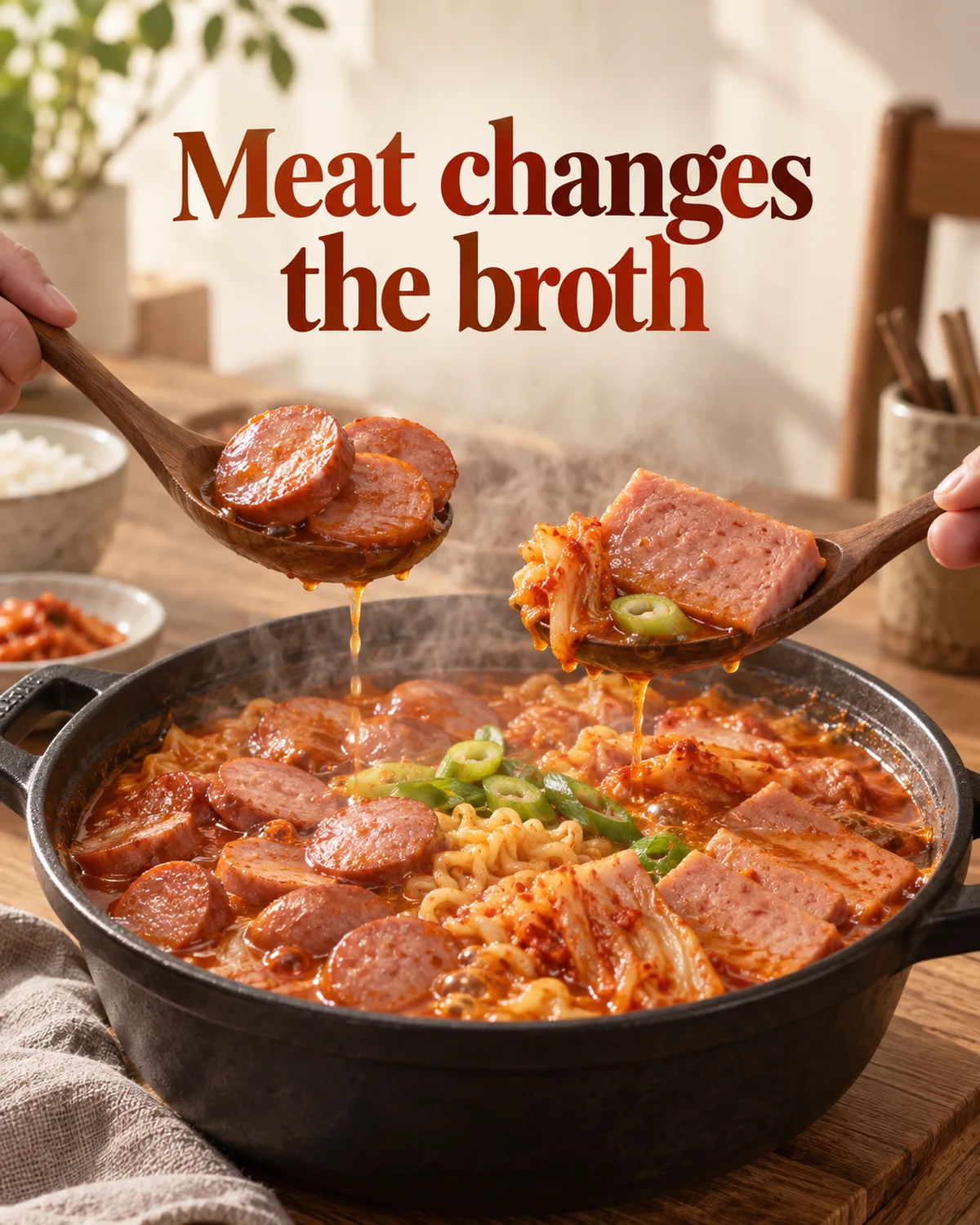
Processed meats contribute more than protein. They carry salt, fat, spices and emulsified meat juices. As slices heat in the broth, some fat disperses and some seasoning dissolves into the liquid. This can make the stew taste deeper even before additional seasoning is added.
Different products behave differently. A firm frankfurter keeps a springy bite. Luncheon meat softens around the edges and can release more fat. Smoked sausage brings a different aroma from plain ham. A heavily seasoned product can make the final broth much saltier than expected.
That is why a good pot is not improved simply by adding more meat. Too many salty processed ingredients can flatten the contrast between kimchi, broth and chili. The most satisfying versions use processed meat as one powerful layer inside the stew rather than as the only flavor source.
Luncheon meat and sausage contribute different textures and concentrated seasoning as they simmer.
Noodles and cheese belong to later layers
Instant noodles are so familiar in budae jjigae today that they can look historically inseparable from the stew. The chronology says otherwise. Samyang Foods and the Academy of Korean Studies both identify 1963 as the year Korea began producing domestic instant ramyeon. That means the noodle layer belongs to a later stage than the immediate postwar circulation of U.S.-base meats.6
Once ramyeon became common, however, it was an almost perfect addition. The noodles are cheap, quick-cooking and designed to absorb strongly seasoned broth. Their surface starch also thickens the pot slightly as they cook. One block can turn a meat-and-kimchi stew into a heavier shared meal without requiring another pan.
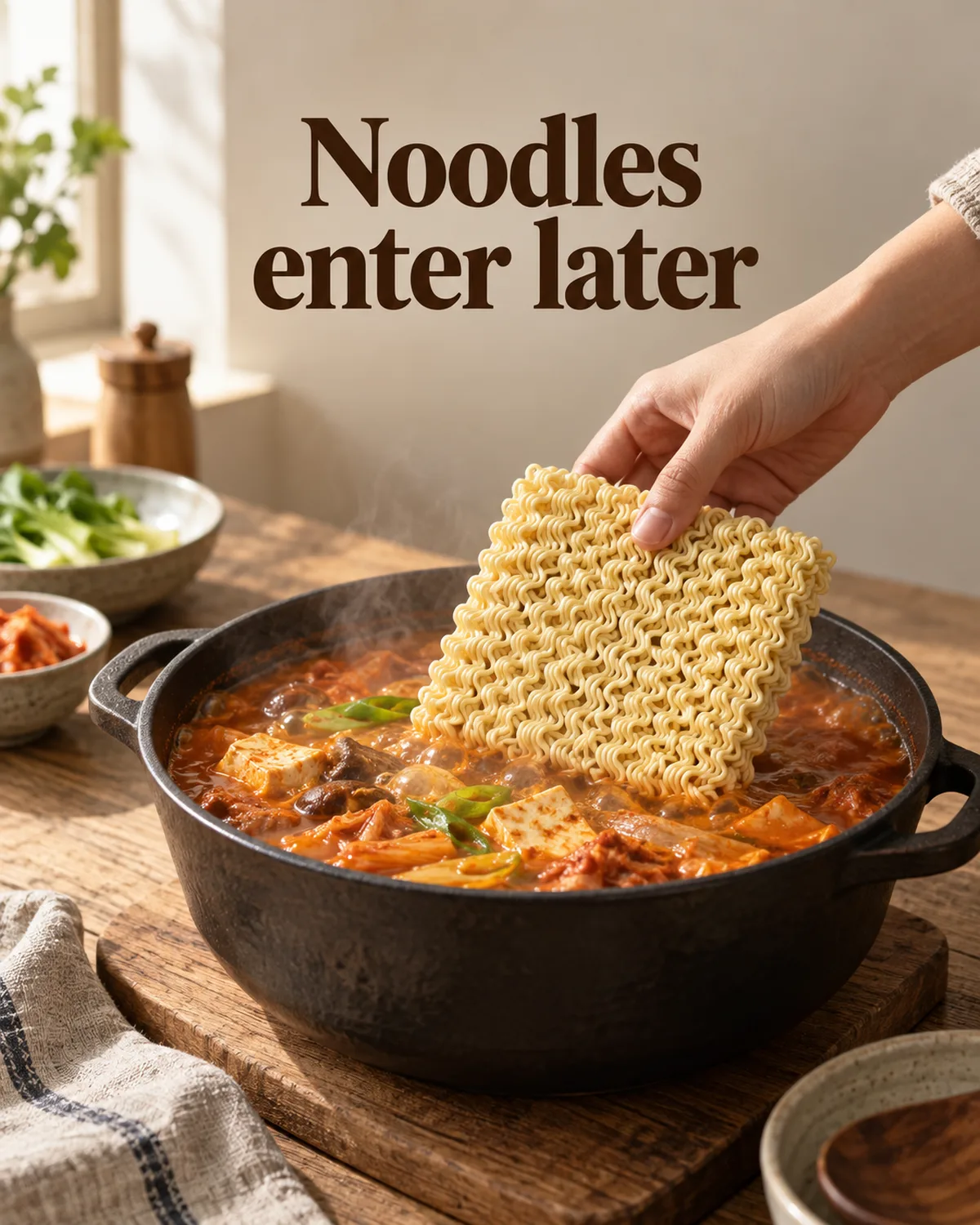
Timing matters. Add the noodles too early and they continue absorbing liquid until soft and swollen. Add them after the broth has developed and they take on concentrated flavor while retaining more bounce. For diners, this is one reason a table-cooked pot changes from first spoonful to last: the broth gets saltier, starchier and more integrated over time.
Ramyeon added after the broth develops can retain more bite before it absorbs the liquid.
A square of processed cheese melting over the center is now one of the most photographed budae-jjigae images. It fits the dish visually and chemically. The cheese softens chili heat, adds dairy fat and salt, and can make the surface of the broth feel richer.
But cheese should not be used as evidence for what an early postwar pot looked like. It is better understood as part of the dish’s later restaurant evolution, when abundance replaced scarcity and diners began treating the stew as a format open to additions.
The same applies to macaroni, dumplings, extra rice cake, premium sausages, mushrooms and branded meat assortments. Budae jjigae did not become less “authentic” each time the ingredient list grew. Its identity has always depended on adaptation. The historical discipline is simply to keep the timeline visible rather than pretending every modern topping was present at the beginning.
Cheese is an optional addition that changes the broth’s richness.
How scarcity food became a shared comfort meal
The first generation associated with base-area processed meat experienced a food system marked by shortage. A later generation could encounter the same ingredients as inexpensive restaurant comfort food. Younger diners may know budae jjigae primarily as a group meal ordered because it is salty, spicy, filling and fun to cook at the table.
That change in meaning is not a betrayal of the history. It is the history continuing. Foods often lose, soften or reverse the stigma attached to their origins. Ingredients that once signaled dependence or scarcity can later signal nostalgia, convenience or indulgence.
Uijeongbu’s food street shows that transition especially clearly. What began in a base-adjacent economy became an officially promoted local specialty with restaurants, tourism material and a recurring festival. The city’s relationship with the stew is now civic as well as culinary.
If you want a mental model that survives conflicting origin stories, use four stages.
Stage 1 — postwar access: U.S.-base systems put processed meats and unfamiliar packaged foods into circulation near Korean communities during severe scarcity.
Stage 2 — Korean adaptation: those ingredients entered kimchi-and-chili stew logic and became a hot shared meal suited to rice.
Stage 3 — restaurant standardization: places such as Uijeongbu developed specialist businesses and a recognizable local style, while instant ramyeon and later toppings expanded the format.
Stage 4 — mainstream comfort food: the stew spread nationally into franchises, home cooking, meal kits and pop-culture imagery, where diners may know the flavor before they know the history.
Let the table pot cook in stages
Restaurant service varies, but the shared-pot logic is consistent enough to explain. Meat, kimchi, tofu, vegetables and seasoning can begin heating together. Once the broth reaches a strong simmer and the flavors have started combining, quick-cooking additions such as ramyeon are better added later.
Watch the liquid level after noodles enter. Instant noodles absorb broth rapidly, and rice cake adds additional starch. If the pot reduces too far, the seasoning that tasted balanced at the beginning can become sharply salty. Restaurants may provide extra broth; if they do, add it before the bottom begins catching.
Check the broth level as noodles absorb liquid during the meal.
Cheese should be treated as a flavor adjustment, not an obligatory topping. Letting it melt over one section gives diners a choice between a cleaner spicy broth and a creamier spoonful. Mixing it completely through the pot changes the entire balance.
There is no universal “correct” eating order, but a practical sequence is to taste the broth once it has developed, eat the noodles while they still have texture, then work through meat, tofu and vegetables. Rice can accompany the stew rather than serving as a mandatory finale. House style matters more than internet etiquette.
A shared stew pan can be accompanied by individual bowls of rice.
Start by checking whether the menu is priced by person, by pot size or by set. Famous budae-jjigae restaurants often expect a minimum number of servings for a shared table, but details vary and should be checked at the restaurant rather than assumed from an old guide.
Then decide which additions actually improve the meal. Extra sausage increases salt, fat and meat intensity. Extra ramyeon increases starch and turns the broth thicker. Rice cake increases chew and can make the pot more filling. Cheese rounds the spice and adds dairy richness. Dumplings add another heavy component. Ordering every add-on at once can obscure the base you came to taste.
For a first visit to Uijeongbu, the most informative choice is usually a relatively standard pot first. Taste what the restaurant considers its core balance, then add one variable if the group is still hungry.
Confirm the serving unit and included additions before ordering.
Read the broth, processed meat and seasonings
Budae jjigae is fundamentally a meat-centered dish. Even if visible sausage is removed, the broth or seasoning may have been cooked with processed meat, anchovy stock or other animal ingredients. Tofu and mushrooms do not make the standard pot vegetarian.
Allergy questions also need specificity. Processed meats can contain multiple seasonings and additives. Cheese introduces dairy. Fish cake may appear in some versions. Baked beans or prepared sauces can contain ingredients not obvious from the table. Shared kitchen and pot handling also matter for severe allergies.
If a restaurant offers a meatless “budae-jjigae-style” pot, treat it as a separate adaptation rather than assuming the standard dish can be made safe by picking out the sausage.
The deep red color suggests intense heat, but budae jjigae often tastes more salty, sour and savory than explosively spicy. Kimchi maturity, chili paste, chili powder, broth concentration and cheese all change the perceived heat.
Processed meat can also soften the immediate chili impression through fat while increasing overall saltiness. As the pot reduces, however, both salt and spice concentrate. A broth that tastes moderate at the beginning can feel much more aggressive near the end.
If spice tolerance is low, ask whether the restaurant can reduce the chili base before cooking rather than trying to dilute an already concentrated pot at the table. Avoid assuming that the red color alone predicts a universal heat level.
Processed meat, prepared stock, kimchi and optional cheese can make the pot salty and rich. Choose the portion and additions that suit your table, and ask about specific ingredients when needed. The dish needs no medical promise: its value here is the transformation of ingredients into a shared meal.
Ask about stock, processed meat and optional additions when an ingredient matters to your meal.
Visiting the food street without chasing a perfect origin
The strongest reason to eat budae jjigae in Uijeongbu is comparison. A specialty street gives you multiple restaurants working within the same local expectation. Sausage choice, kimchi maturity, broth strength, bean use and add-ons can vary even when the dish name is identical.
The food street provides a district to explore rather than a single compulsory stop. Check a current official listing for access and opening details; if a shop is closed or its queue is impractical, another bowl can still make the district’s variation tangible.
Odeng Sikdang remains historically important, and VISITKOREA maintains a current listing for it. But hours, menu prices, queue systems and branch details can change. An evergreen article should therefore link the current listing rather than freeze a price and timetable that may be wrong by the time a traveler arrives.
The pot becomes clearer when compared with dishes that share the table format but not the history. Samgyetang is usually a one-bird-per-person soup tied to summer boknal customs, even though the modern form is more recent than many travelers assume. Budae jjigae is deliberately communal and built around processed ingredients whose meaning comes from the postwar base economy.
Kimchi jjigae shares fermented cabbage and chili-seasoned broth, but budae jjigae makes processed meat part of its identity rather than an optional protein. Ramyeon becomes structurally important in many modern budae-jjigae pots, while it is not required for kimchi jjigae.
This comparison helps avoid the lazy definition “kimchi stew with Spam.” The two can overlap in ingredients, but budae jjigae carries a specific historical relationship to U.S.-base food circulation and a restaurant tradition built around that memory.
Other shared pans and chicken soups show how ingredients and dining formats can change together.