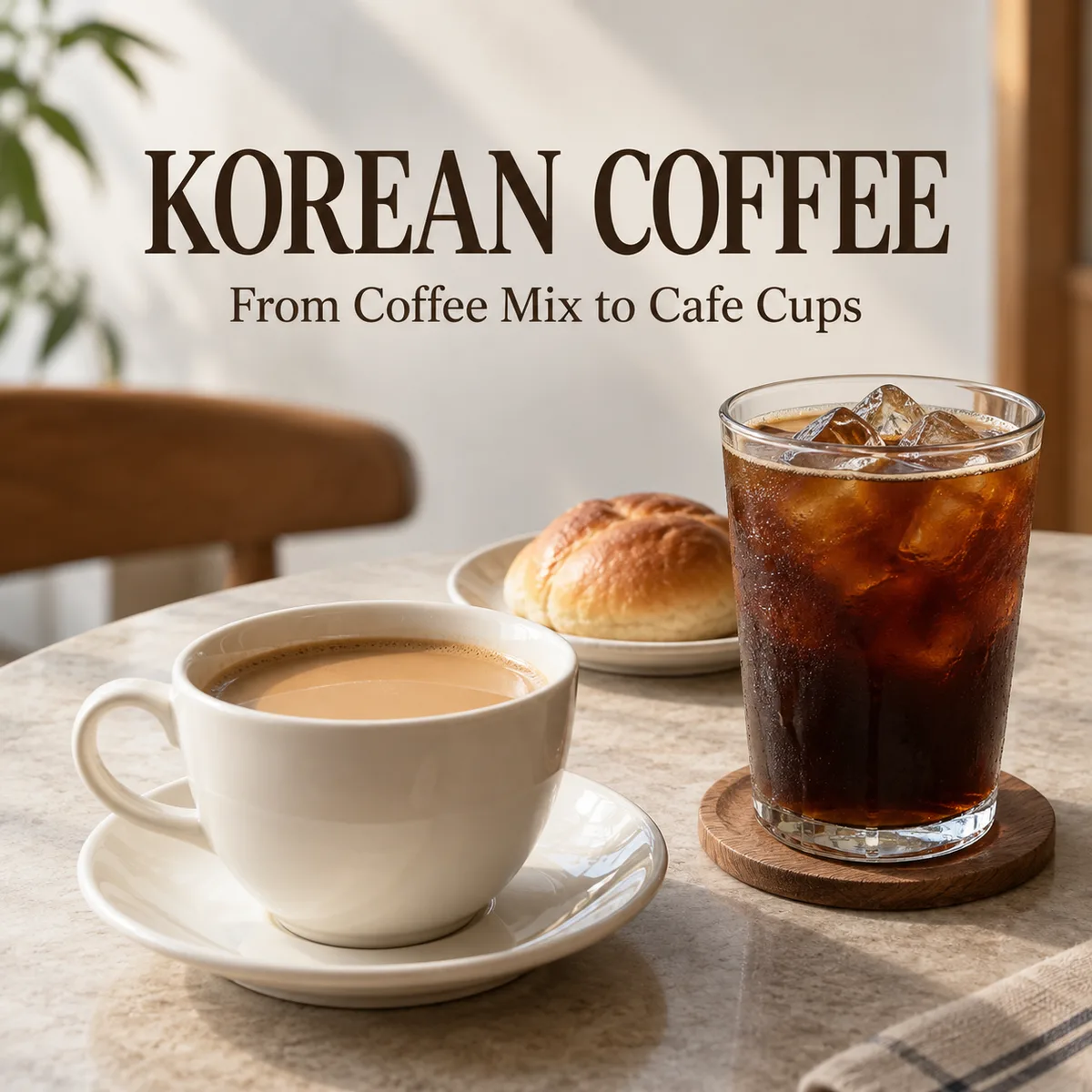
Start with two cups: a small, sweet coffee mix and a black iced americano. One dissolves instant coffee with sugar and powdered creamer; the other combines espresso, water and ice. The contrast makes Korea’s coffee culture tangible before a royal anecdote or a cafe count enters the story.
Choose the drink and the setting separately. A quick takeaway, a bean-focused tasting and an afternoon in a bakery cafe can all involve coffee while offering different tastes, portions and ways to spend time.

Gojong’s cup and a later coffeehouse
Korea.net’s 2015 account associates Gojong’s coffee drinking with his refuge at the Russian legation in 1896–1897 and describes his continued enjoyment after returning to the palace. This is an early royal episode, rather than proof that one person created every later Korean coffee habit.[1]
The court episode, the commercial coffeehouse, the instant packet and the modern espresso bar are different developments. A royal cup helps explain an early encounter with the drink; it cannot by itself explain a later national cafe market.

A room as well as a drink
Seoul Metropolitan Government’s 2016 account links Antoinette Sontag with Gojong’s coffee enthusiasm and identifies her 1902 hotel restaurant and cafe as a landmark in the city’s coffee history. Its description of a first cafe concerns a commercial venue, not a claim that nobody had previously tasted coffee.[2]
The useful distinction is between serving a drink privately and building a place where people buy the drink and spend time. The latter makes the room part of the experience, a question visitors still face when choosing between a small counter and a spacious cafe.
Dabang and different reasons to visit
Korea.net describes early twentieth-century dabang coffeehouses and the later spread of instant coffee associated with U.S. military rations. These are separate stages of access and preparation, not one unchanged recipe passed from the palace to a paper cup.[1]
A dabang, an espresso counter and a roastery should not be ranked as if they were successive steps from bad coffee to good coffee. Ask what each place emphasizes: a familiar sweet drink, a meeting room, quick service or the flavor of particular beans.

What coffee mix puts in the cup
The practical shift with instant coffee is preparation. A hot-water supply and a packet can produce a repeatable drink without an espresso machine or a filter setup. That makes the format easy to serve wherever the equipment and ingredients are available.
Korea.net describes coffee mix as instant coffee with sugar and powdered creamer. Expect a sweet, creamy cup rather than the flavor profile of unsweetened black coffee. Check the actual packet for its ingredients and water instructions; products do not all have the same composition.[1]
Compare coffee mix with black coffee on its own terms. The dissolved ingredients make sweetness and creaminess part of every sip. An americano leaves those additions optional, and its strength changes with the espresso-to-water ratio and melting ice.

Black coffee, filter coffee and the cafe setting
An iced americano gives you a straightforward comparison with coffee mix: black coffee, cold water and ice, without the packet’s built-in sugar and creamer. Ask about size and the number of espresso shots when deciding what to order; the same menu name does not guarantee the same concentration.
Taste the drink before adding syrup. Cold temperature, the beans and the cafe’s recipe can make one americano seem brighter, more bitter or more diluted than another. If you want milk, order a milk-based drink rather than expecting an americano to contain it.

The “17,000 cafes” in the headline should not be read as a verified current national total. Cafe counts depend on date, geography and business category. This guide makes no present-day nationwide count claim; its useful comparison is between coffee formats and the settings that serve them.
For a bean-focused visit, ask which coffee is available as filter coffee and how the shop describes its roast or flavor. For a longer conversation, look at seating and the house’s policies first. A beautiful room and a carefully prepared drink are two things to assess separately.

A tiny takeaway counter, a roastery with a short menu and a bakery with many tables may all be called cafes. Their layout tells you something useful: whether the visit is organized around speed, tasting, food or spending time in the room.
Seoul’s 2016 cafe-culture account describes renovated homes in Yeonnam-dong, cafes in remodeled hanok near Gyeongbokgung and book cafes in Samcheong-dong. These are dated examples of different cafe settings, not a verified current list of shops or operating hours.[3]
Use that variety to decide what you want from a visit. A courtyard can make the surroundings part of the afternoon; a compact roastery can put the cup first; a bakery counter can make food the reason to stay. Check the current menu and access details for the specific business.

Korea.net’s 2015 article describes after-meal coffee as part of the social routine for many people. A cafe can therefore be a second stop after lunch or dinner, rather than a replacement for the meal. Choose a drink and portion that suit what you have already eaten.[1]
Read the drink description
A coffee menu may also borrow a familiar food name. Do not assume that a drink named after a candy contains that candy: read the description or ask the staff. The actual dalgona sugar candy has its own ingredients, brittle texture and story, covered in the separate candy guide below.
Choose your first cup
- Sweet and creamy: check the coffee-mix ingredients and preparation.
- Black and cold: choose an iced americano; check size and shots.
- Bean-focused: ask about the filter-coffee selection.
- Food and surroundings: compare the bakery menu, seating and house policies.
Choose the format before comparing prices. A small sweet mix, an espresso-based cup and a filter coffee can differ in ingredients, preparation and serving size. The menu is more useful than an undated claim about the country’s average coffee price.
Check one-order-per-person requirements, laptop restrictions, seating limits and outside-food rules at the actual cafe. These are house policies. Ask before taking a table for a long stay, particularly when seats are scarce.
If pastries are the reason for visiting, check whether coffee and food are ordered at the same counter and whether the seating area has a minimum purchase. Return trays where requested and keep calls at a volume that suits the room.
A small coffee mix and an iced americano offer an easy first comparison: sweetness, creaminess, temperature and dilution are arranged differently. A filter coffee adds another question—what the beans and brewing style contribute when the drink is served without built-in sweeteners.
For a dessert pairing, taste a sip before and after the food. A buttery bread or syrup-soaked yakgwa changes the sweetness and richness surrounding the coffee. That simple comparison tells you more about your preference than a rule that every Korean cafe drink must be paired the same way.

Begin with the cup you want, then choose the room and food around it. Gojong’s early coffee episode remains an interesting historical stop; the everyday pleasure is discovering which drink, portion and setting make your own visit work.