Why Koreans Eat That

Category: Rice & Noodles

  • Korean Cold Noodles (Naengmyeon): Why Korea’s Icy Summer Dish Was Once a Winter Food

    Korean Cold Noodles (Naengmyeon): Why Korea’s Icy Summer Dish Was Once a Winter Food

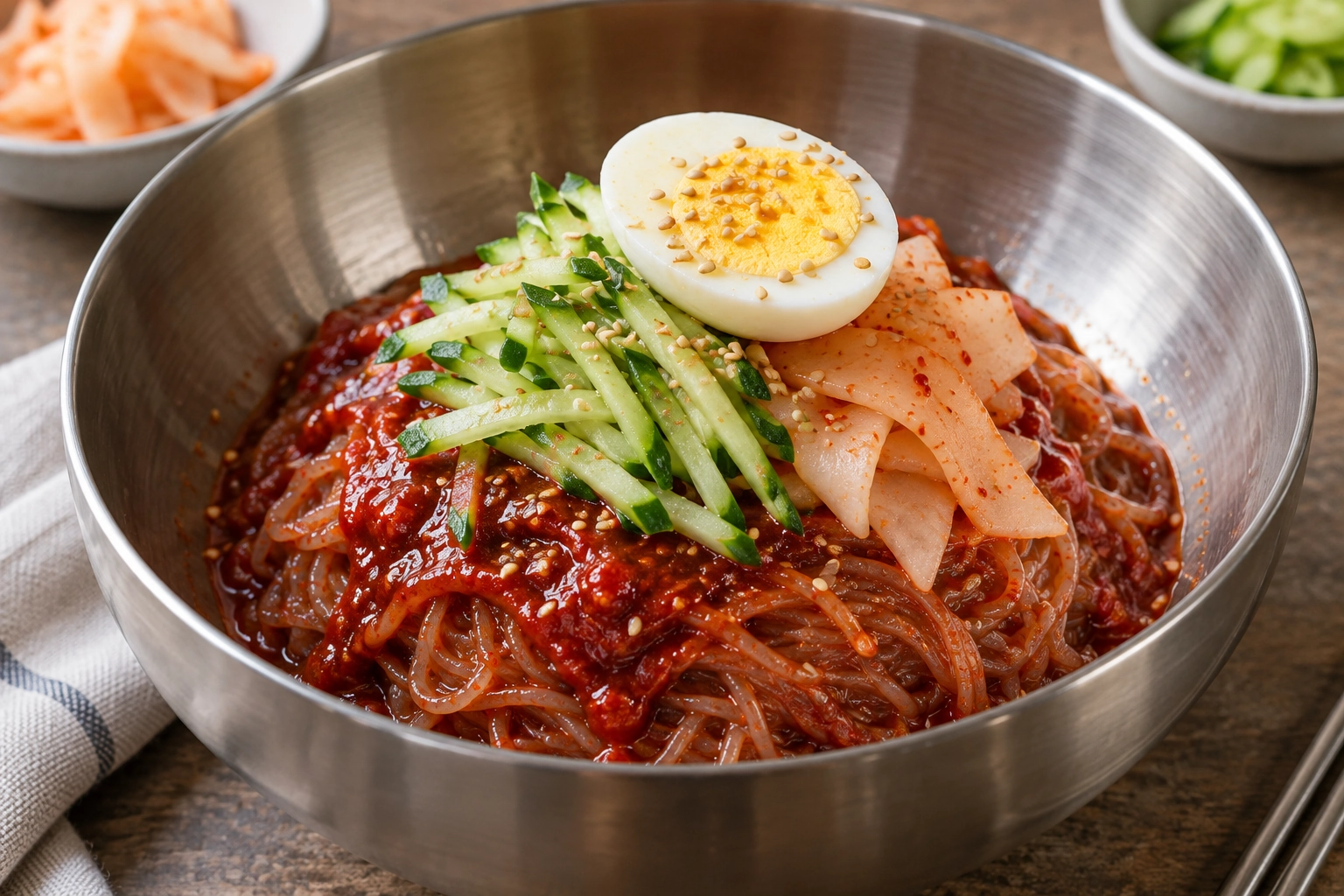
    A bowl of mul naengmyeon, Korean cold buckwheat noodles in icy broth — naengmyeon winter origin

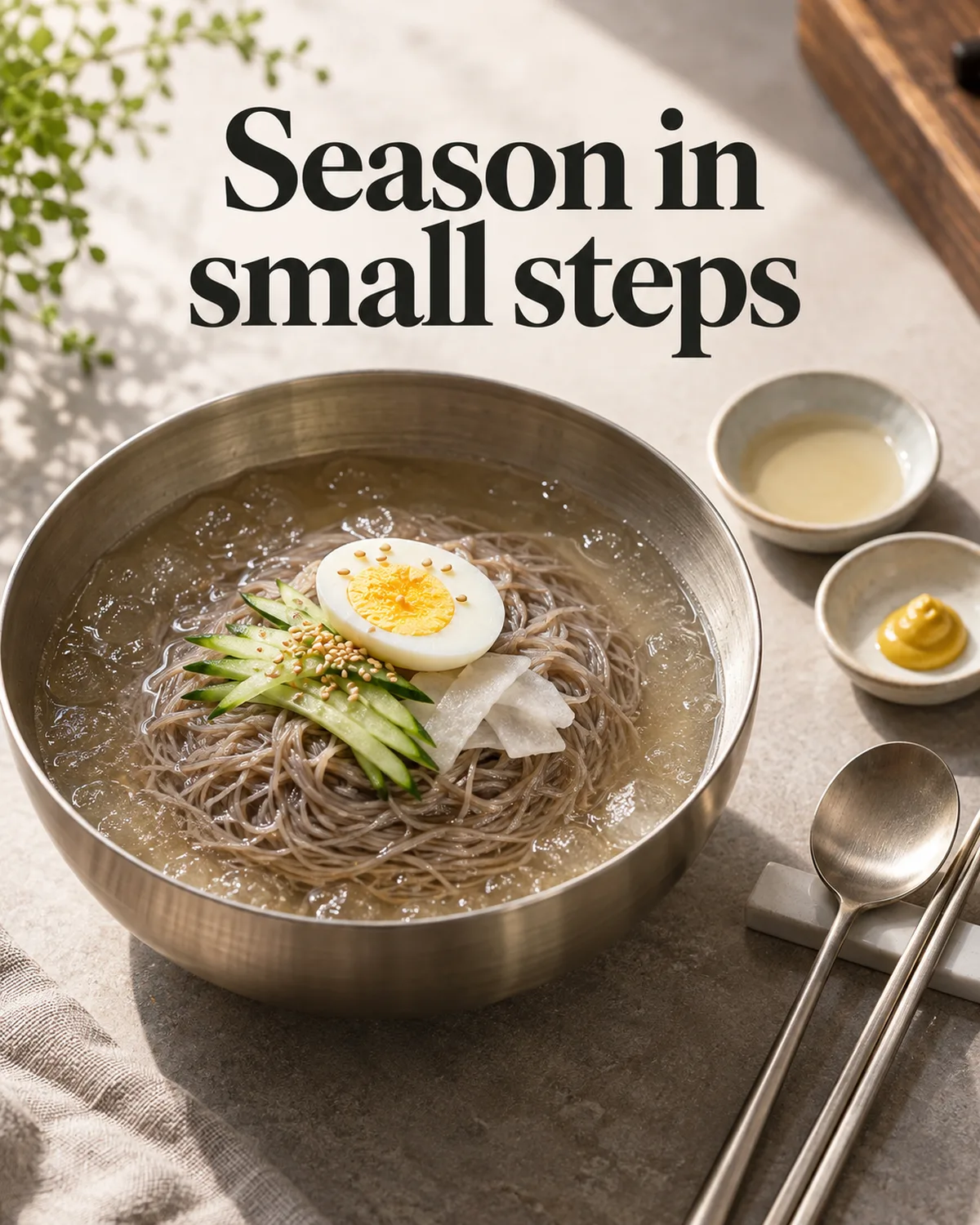
    Mul naengmyeon — chewy noodles in an icy, tangy broth, Korea’s answer to summer. Photo: Jinho Jung, CC BY 2.0

    When a Korean summer turns brutal, the whole country reaches for one thing: a freezing metal bowl of naengmyeon (냉면), Korea’s famous cold noodles. Nutty buckwheat noodles with a toothsome, easy-snap bite, a tart icy broth sometimes topped with actual slush, a boiled egg, a few slices of pear — it’s the sound of ice cubes clinking that says “we survived another heat wave.” There’s even a national summer debate about it, serious enough that Netflix made a documentary. But here’s the twist nobody expects.

    Naengmyeon wasn’t invented for summer at all. For most of its history, it was a winter food — eaten on heated floors while snow piled up outside, and beloved by Joseon kings, one of whom reached for it precisely because he couldn’t handle spicy food. To understand Korea’s coldest noodle, you have to picture it in the dead of winter.

    “Korea’s ultimate summer dish was born in the middle of winter.”

    The summer noodle Koreans argue about every year

    Bibim naengmyeon, spicy Korean cold noodles mixed with red gochujang sauce — naengmyeon winter origin

    Bibim naengmyeon — thespicy, sauced sibling. Mul or bibim? Koreans pick sides. Photo: lazy fri13th, CC BY 2.0
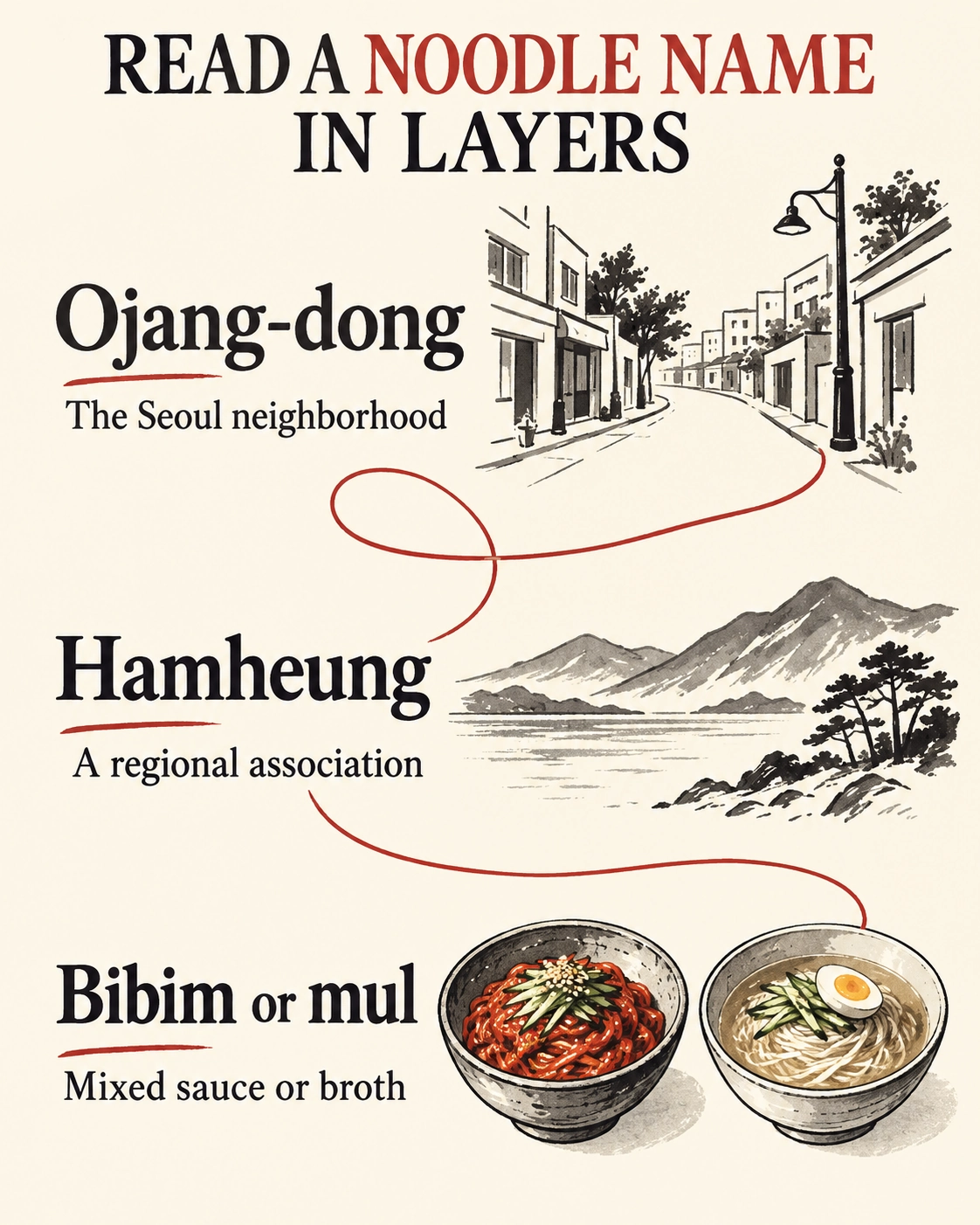
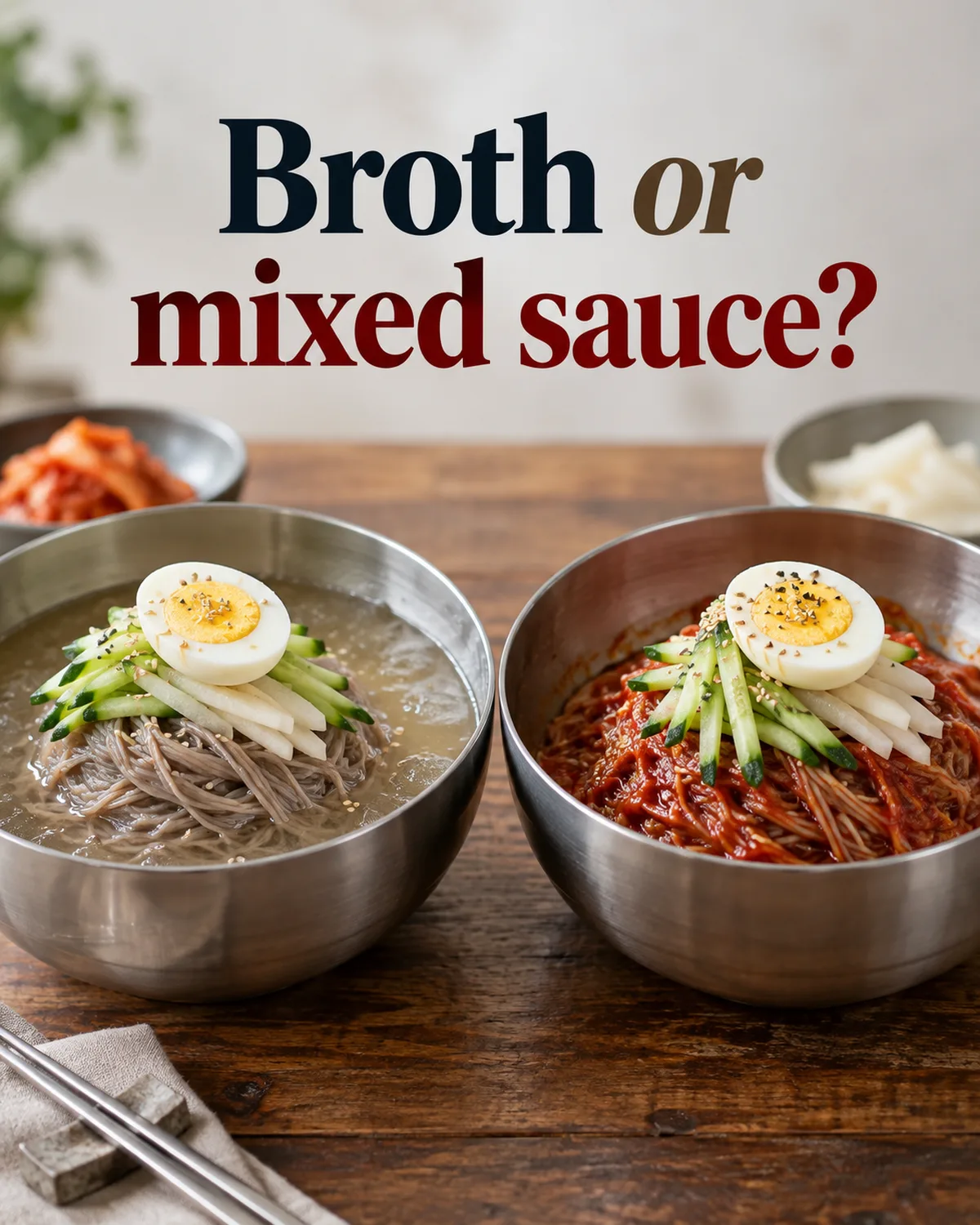
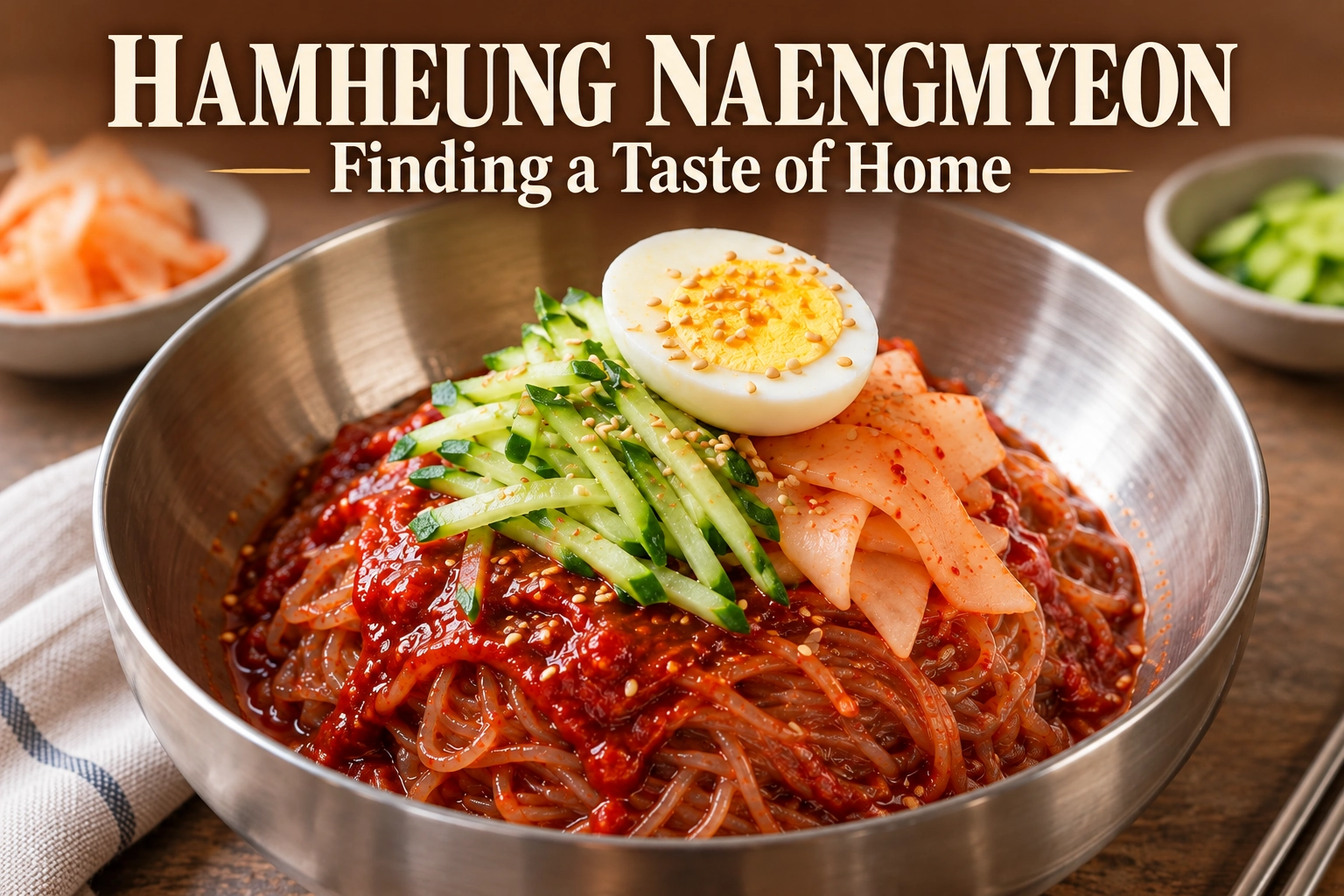
    Today, naengmyeon is peak-summer comfort, and Koreans take it seriously enough to split into camps. First question: mul (물) or bibim (비빔)? Mul naengmyeon is the cold-broth version, clean and refreshing; bibim naengmyeon ditches the broth for a fiery gochujang sauce you mix yourself. Second question: Pyongyang or Hamhung style? Both cities are in what is now North Korea, and the dish came south with refugees. Pyongyang naengmyeon uses buckwheat for a mild, almost austere broth that first-timers sometimes find “too plain” — until they’re hooked. Hamhung naengmyeon uses chewy sweet-potato or potato starch noodles, usually served bibim-style with raw skate. The debate is so woven into Korean summer that Netflix released Korean Cold Noodle Rhapsody, a whole documentary chasing the dish across the country. All of this, for a bowl that started out as a way to survive winter.
    A winter dish, eaten on a heated floor

    Joseon king winter naengmyeon on ondol floor — cold noodles history playful illustration — naengmyeon winter origin

    Icy noodles on a hot floor in midwinter — the original Joseon indulgence (playful illustration).

    Dongchimi, Korean radish water kimchi used for cold noodle broth — naengmyeon winter origin

    Dongchimi — the winter radish-water kimchi whose icy brine once made the broth. Photo: 경빈마마, CC BY 4.0

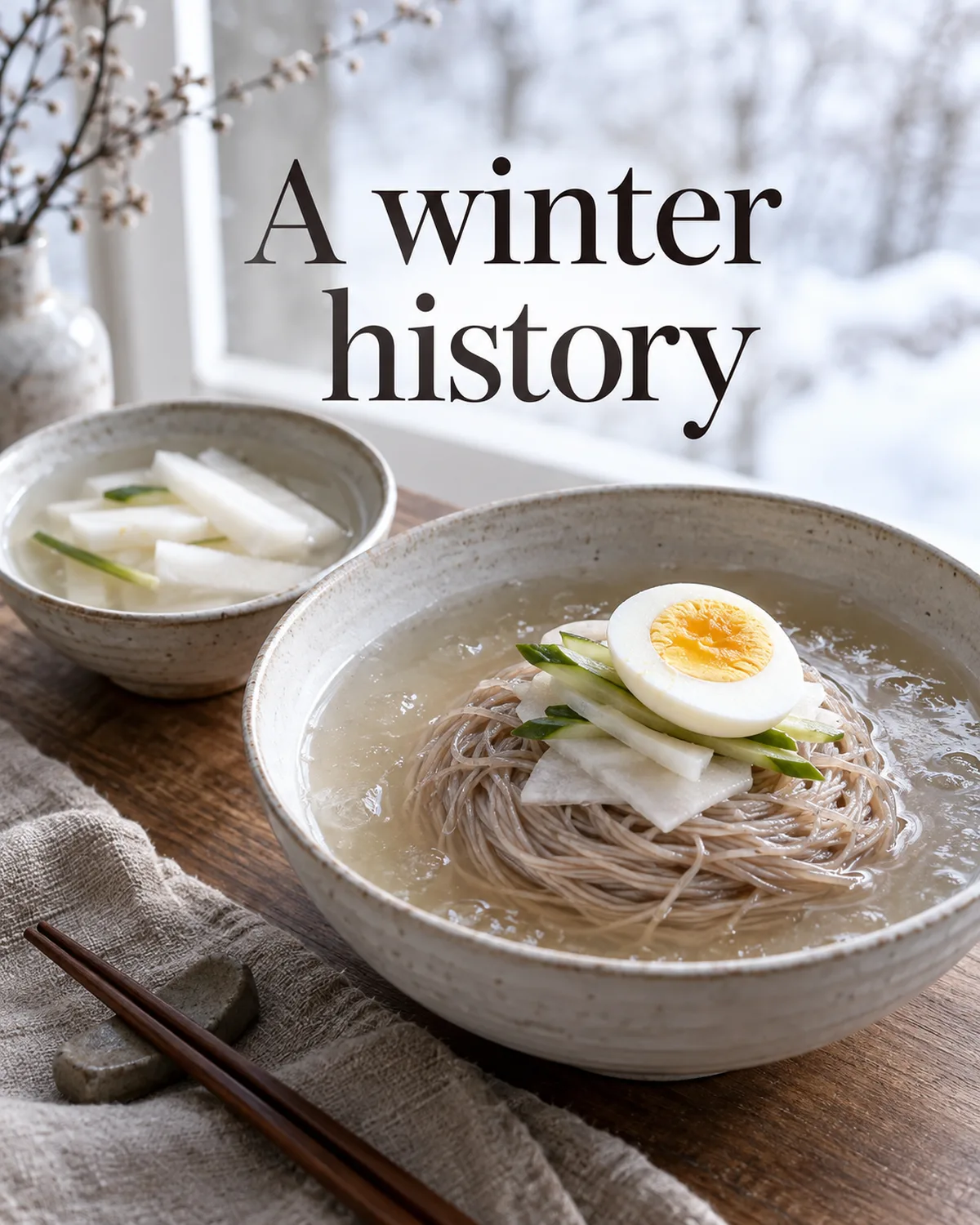
    Go back a few centuries and the whole picture flips. Naengmyeon began in the cold northern regions of the peninsula, where deep winter did the refrigerating for free. People made the broth from dongchimi — a radish-water kimchi fermenting in a jar half-buried in the frozen ground — and ate the icy noodles while sitting on a warm ondol floor, blankets over their laps. The logic sounds backwards until you feel it: a cold shock in a warm room, the body responding with its own heat. The Joseon scholar Dasan Jeong Yak-yong even wrote of hand-pulled cold noodles with crisp cabbage kimchi when the October snow lay a foot deep.

    It was also, for a long time, a luxury and a celebration food. The earliest naengmyeon mention shows up in a 1643 collection of writings, and by the 1700s Seoul nobles were already ordering it in — some of the first food delivery in Korean history. On New Year’s, the long noodles stood for a long life. So why do we now eat it in July? Because only the wealthy once had ice in summer, kept in private ice caves; when ice became available to everyone, this cold winter delicacy slid naturally into the hottest months. The dish didn’t change. The season did.

    The kings who couldn’t get enough of it

    A Joseon-era Korean royal palace, home to kings who loved naengmyeon — naengmyeon winter origin

    Several Joseon kings were devoted naengmyeon fans. Photo: Basile Morin, CC BY-SA 4.0

    Naengmyeon didn’t just feed northern villagers — it reached the throne. Several Joseon kings, including Sunjo, Heonjong, and Cheoljong, were known to love cold noodles. But the most famous royal fan was Emperor Gojong, and there’s a very human reason: Gojong reportedly couldn’t handle spicy food. In a cuisine that leans hard on chili, the mild, clean, faintly sweet broth of Pyongyang-style naengmyeon was his kind of comfort. Picture the emperor of Korea, skipping the fiery stuff, quietly happy over a bowl of cold buckwheat noodles. Sometimes the most powerful person in the country just wants the gentle option.

    The main types of naengmyeon

    Pyongyang naengmyeon, buckwheat cold noodles in a clear mild broth — naengmyeon winter origin

    Pyongyang naengmyeon — buckwheat noodles in a pale, clean broth. Deceptively plain, quietly addictive. Photo: Mobius6, CC BY-SA

    Before you order, here’s the cheat sheet:

    • Mul naengmyeon (물냉면) — noodles in a cold, tangy broth. Refreshing and mild; the classic summer cooldown.
    • Bibim naengmyeon (비빔냉면) — no broth, tossed in a spicy-sweet gochujang sauce. Bold and addictive.
    • Pyongyang naengmyeon (평양냉면) — buckwheat noodles, subtle clear broth. An acquired taste that becomes an obsession.
    • Hamhung naengmyeon (함흥냉면) — chewy starch noodles, usually bibim-style, often with raw skate. Springy and fierce.

    Hamhung naengmyeon, spicy Korean cold noodles with chewy starch noodles and vegetables — naengmyeon winter origin

    Hamhung-style naengmyeon — springy starch noodlesunder a fiery sauce, the bold counterpart to Pyongyang’s calm. Photo: Mobius6, CC BY-SA

    How to eat naengmyeon like a local

    A person eating Korean cold noodles (naengmyeon) with chopsticks at a restaurant — naengmyeon winter origin

    Long noodles, big bowl — there’s a small ritual to a proper bowl of naengmyeon. Photo: Hard Seat Sleeper, CC BY 2.0

    Your first bowl of Korean cold noodles comes with a few local rules:

    • To cut, or not to cut? Traditionalists say the long noodles symbolize long life and shouldn’t be cut. But the server will always offer scissors — one snip (a single cross-cut) is perfectly acceptable if those slippery, chewy noodles are hard to manage.
    • Season it yourself. Taste the broth first — Pyongyang-style is meant to be subtle. If you want more punch, add vinegar to the broth and a dab of mustard (gyeoja) to the noodles, not the other way around.
    • Sip the warm broth first. Many Hamhung-style spots bring a small pot of hot beef broth (yuksu) before the cold noodles arrive — sip it to settle your stomach before the icy hit.

    Questions people ask about naengmyeon

    What is naengmyeon? Korean cold noodles — long, chewy noodles (buckwheat or starch) served either in an icy broth (mul) or tossed in spicy sauce (bibim). It’s a beloved summer dish, though it began as a winter one.

    What does naengmyeon taste like? Mul naengmyeon is cold, clean, and tart-refreshing, with nutty, chewy buckwheat noodles and a lightly sweet-sour broth. Bibim naengmyeon is spicy-sweet and bold from its gochujang sauce. Both are famous for that springy, almost bouncy noodle texture.

    Why is naengmyeon eaten cold? Originally, northern Koreans ate cold noodles in winter, using naturally frozen broths, over heated ondol floors — the cold bowl felt refreshing in a warm room. Once summer ice became widely available, the dish drifted into the hot season, where it’s now a staple.

    What’s the difference between mul and bibim naengmyeon? Mul naengmyeon comes in cold broth and is mild and refreshing; bibim naengmyeon has no broth and is mixed with a spicy gochujang sauce. Many restaurants serve both.

    Did Korean kings really eat naengmyeon? Yes. Several Joseon kings loved it, and Emperor Gojong was famously fond of mild Pyongyang-style cold noodles — partly because he couldn’t tolerate spicy food.

    One cold bowl, four seasons of history

    So the next time you’re wiping sweat off your face over an icy bowl of naengmyeon, know that you’re eating a winter dish in disguise — one that warmed northern villagers on frozen nights, traveled by delivery to noble homes, and soothed an emperor who couldn’t take the heat. Korea just moved it to summer and never looked back.

    Craving more of Korea’s summer survival menu? Fight fire with fire in our samgyetang guide, build a cool vegetable bowl with Jeonju bibimbap, or slurp your way through Gwangjang Market.

    Naengmyeon’s winter origins, dongchimi broth, ondol-floor tradition, and northern (Pyongyang and Hamhung) roots are drawn from Korean culinary histories and reporting (The Korea Herald, The Korea Times, NamuWiki). Early records include the 1643 Gyegokjip and the writings of Dasan Jeong Yak-yong (1762–1836). The royal fondness of kings Sunjo, Heonjong, Cheoljong, and Emperor Gojong for cold noodles is noted in Korean historical accounts.

  • Saengseon-guksu (생선국수): A Spicy Korean River-Fish Noodle Soup

    Saengseon-guksu (생선국수): A Spicy Korean River-Fish Noodle Soup

    Korea’s most surprising noodle bowl might be saengseon-guksu (생선국수) — a spicy soup of river fish, cooked down to nothing and poured over soft noodles. You’ll find it two hours south of Seoul, in a small river town called Cheongsan (청산) in Okcheon County (옥천). There’s no famous palace here, no shopping district — just a quiet lane where a handful of family kitchens have spent sixty years perfecting this one strange, wonderful bowl. If you’ve only ever had Korean noodle soup made from beef or anchovy, saengseon-guksu will surprise you.

    Quiet riverside town of Cheongsan in Okcheon county North Chungcheong Korea with hills and stream — okcheon saengseon guksu
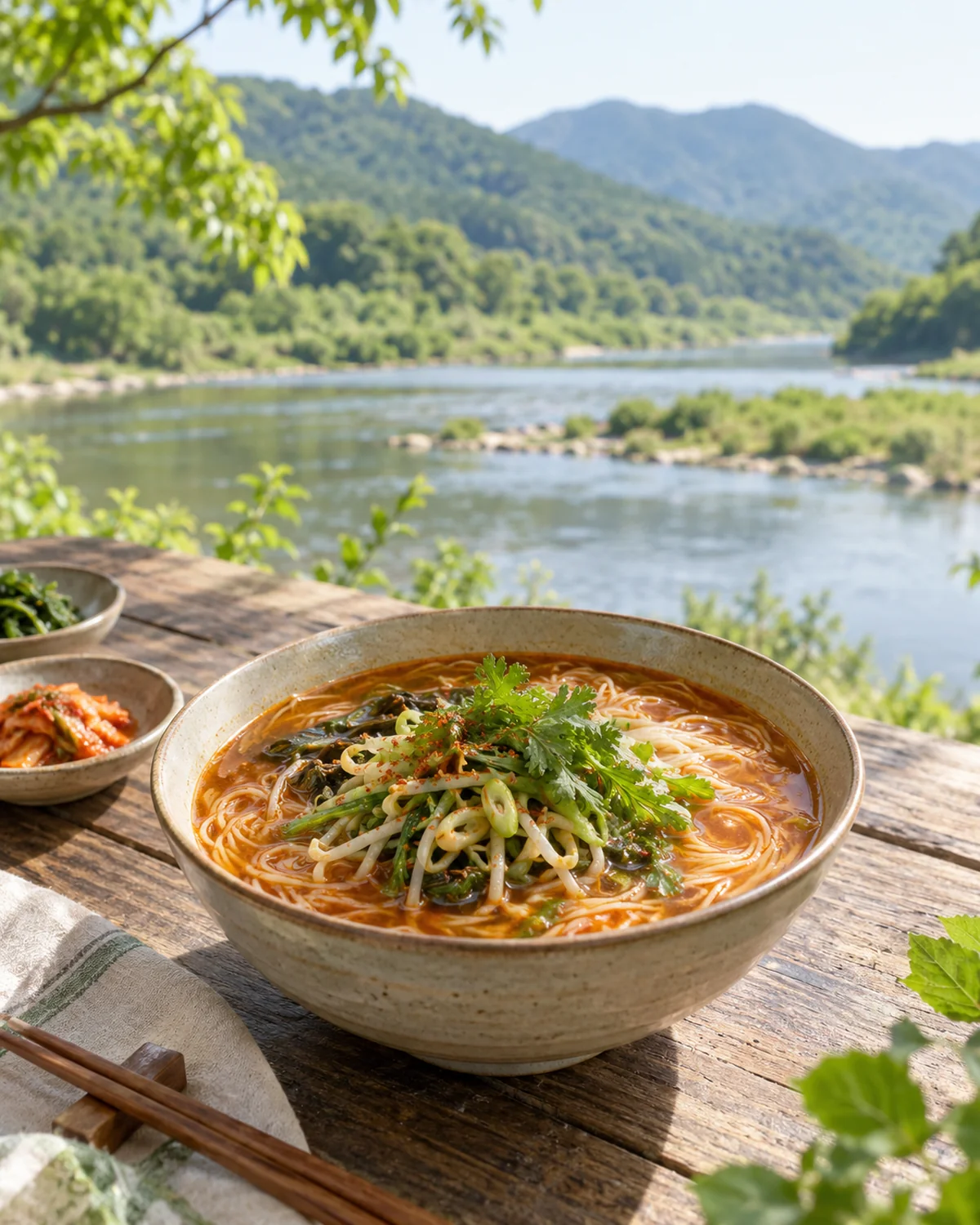
    Cheongsan, a sleepy river town in Okcheon — the unlikely home of Korea’s freshwater fish noodle soup.

    ⭐ Okcheon at a glance

    🏛️ Sights & things to do ★★★☆☆
    🍜 Food ★★★★☆
    🚆 Easy to reach ★★★☆☆

    A personal take based on our own experience — the range of things to see, the food, and how easy it is to get to. Okcheon is a slow, rural detour, not a headline stop; that’s rather the charm. Yours may well differ.

    The short version: Saengseon-guksu is a spicy noodle soup made from freshwater river fish — crucian carp, catfish and the like — simmered for hours until the bones dissolve into a thick, savory broth, then served over thin wheat noodles. Its home is Cheongsan, a river village in Okcheon, where the original shop, Seon-gwang-jip (선광집), has been serving it since 1962. Pair it with dori-baengbaeng-i (도리뱅뱅이), a plate of crisp little fried fish. Here’s what to eat, where saengseon-guksu came from, and how to get there.

    What to eat in Okcheon

    Two dishes carry this town, and they’re almost always ordered together. One is a bowl, one is a plate, and both start with fish pulled from the same rivers.

    Saengseon-guksu (생선국수) — the river-fish noodle soup

    Bowl of Korean saengseon-guksu spicy freshwater fish noodle soup with red broth and thin wheat noodles — okcheon saengseon guksu
    Saengseon-guksu — thin noodles in a deep, brick-red broth cooked entirely from river fish.

    The name is plain. Saengseon means fish, guksu means noodles. But the making is anything but simple. Cooks take a mix of freshwater fish (crucian carp, catfish, skin carp, pale chub) and simmer them for hours until the flesh and even the bones melt down completely. The broth is then strained, so you never actually see a fish in your bowl. What’s left is a thick, ruddy, gochujang-spiced soup with a deep savory backbone and, yes, a faint muddy-river sweetness that locals swear by.

    Into that goes somyeon (소면), the thin wheat noodles. There’s a reason for that. Cooks here say they tried rice, they tried sujebi dough flakes, they tried thick knife-cut noodles, and the delicate somyeon was the one that soaked up the spicy broth best without fighting it. In my experience the first spoonful reads as “spicy fish stew,” and then the noodles turn it into something you can’t stop eating.

    It’s cheap, it’s filling, and it’s the kind of regional dish most Korean city-dwellers have heard of but never actually traveled out to try. That’s exactly why it’s worth the trip.

    Dori-baengbaeng-i (도리뱅뱅이) — the fish you can see

    Dori-baengbaeng-i small freshwater fish fried and arranged in a circle glazed with red gochujang sauce in a pan — okcheon saengseon guksu
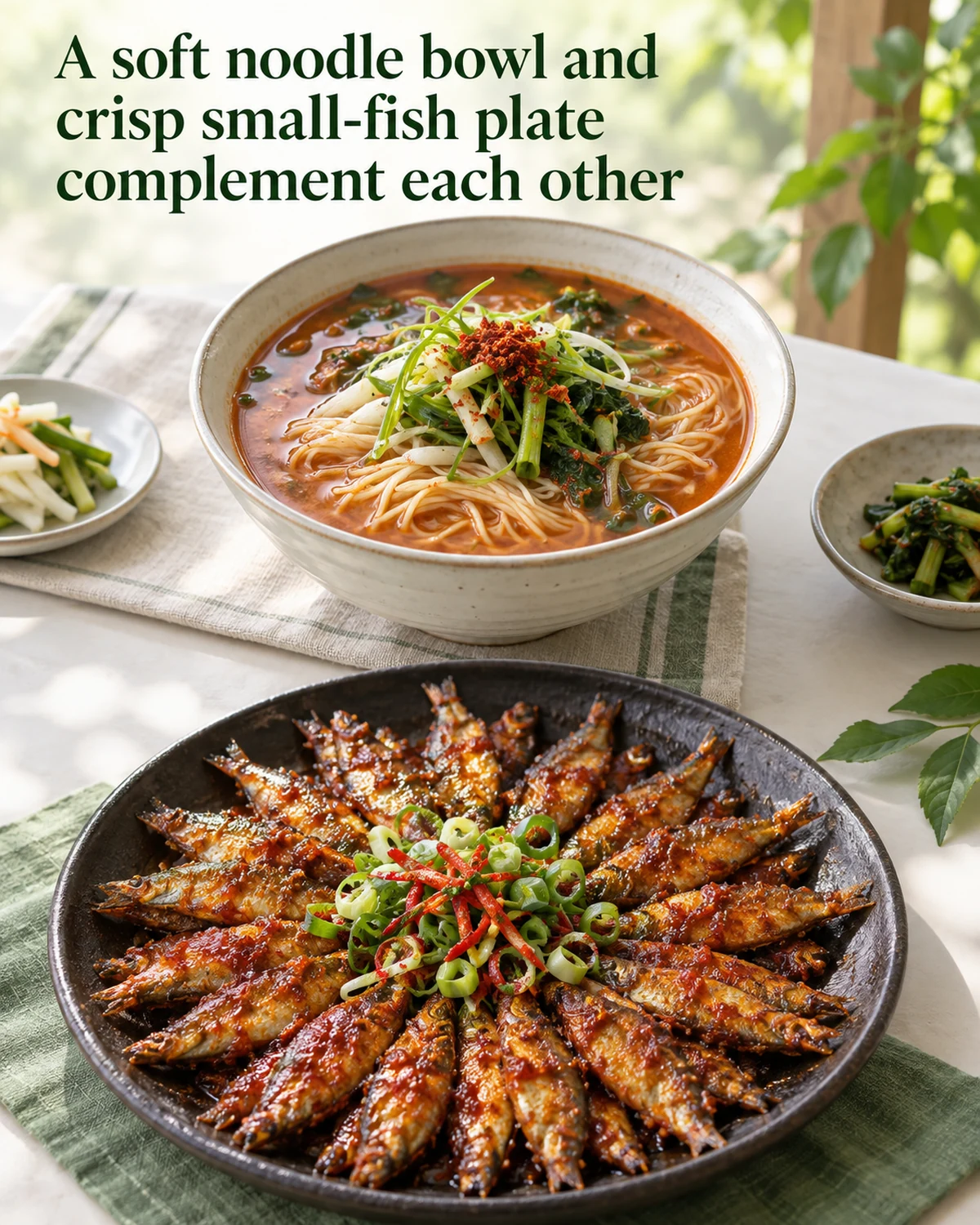
    Dori-baengbaeng-i — small river fish fried crisp, fanned into a ring and glazed with sweet-spicy sauce.

    If saengseon-guksu hides its fish, this dish shows them off. Small freshwater fish — pale chub, or smelt in the colder months — are laid out in a neat circle in a shallow pan, fried until crisp, then brushed with a sweet-spicy gochujang glaze. The name comes from the way they’re arranged, fanned round and round (baengbaeng) in the pan.

    You eat them whole, bones and all, like a savory cracker with a chili kick. A plate of dori-baengbaeng-i next to a bowl of saengseon-guksu is the standard Cheongsan order, and honestly the crunch is the perfect foil to the soft noodles. It’s the kind of pairing that makes the long drive out feel earned.

    How river fish became a bowl of noodles

    Illustration of villagers cooking freshwater fish in a large pot by a Korean river in old times — okcheon saengseon guksu
    The dish began as riverside fishing feasts — a pot, a fire, and whatever the stream gave up that day.

    From a riverbank pot to the table

    Okcheon sits in river country. The Bocheong Stream (보청천) runs through Cheongsan, and the wide Daecheong Lake (대청호) and Geum River (금강) are close by, so for generations people here lived off freshwater fish. The old custom was cheollyeop (천렵). A group would head to the riverbank in warm weather, catch crucian carp, catfish and whatever else was biting, hang a pot right there over a wood fire, and boil it all into a rough, hearty stew.

    At first they thickened that pot with rice, closer to a fish porridge called eojuk (어죽). The switch to noodles came later, as people tried different things to bulk the broth out — and the thin somyeon simply won. That riverside pot is the direct ancestor of the saengseon-guksu you order today.

    The shop that started it all

    Saengseon-guksu became a proper restaurant dish in the 1960s, when cheap wheat flour made noodles an everyday food across Korea. Around 1962, a Cheongsan shop called Seon-gwang-jip (선광집) began serving spicy river-fish soup with somyeon in it — and it stuck. Locals credit that little kitchen with turning a fisherman’s stew into the town’s signature dish, seasoned simply with gochujang and nothing fancy.

    What grew up around it is a small food street. Along a lane in Cheongsan, roughly half a dozen family-run shops now cook saengseon-guksu their own slightly different ways — some richer, some spicier, a few sweeter. Fishermen with proper licenses still deliver crucian carp, carp, skin carp and pale chub to the shops every couple of days, so the fish really is local river fish, not a supermarket stand-in.

    A poet’s hometown, too

    There’s one more reason Okcheon holds a soft spot in the Korean imagination. It’s the hometown of Jeong Ji-yong (정지용, born 1902), one of the country’s most beloved modern poets. His most famous poem, “Nostalgia” (향수, first published in 1927), aches for a rural home village of streams and wide fields — the exact kind of countryside you’re driving through to reach the fish noodle shops. His restored birthplace and a small literary museum sit in the old town, and for many Korean visitors a bowl of saengseon-guksu and a stop at the poet’s house make one neat little day trip.

    🗓️ Plan your visit

    When: Saengseon-guksu is served year-round, and the hot, spicy broth is especially good in cool weather. If you can, aim for spring — Cheongsan holds a small fish-noodle-soup festival around April, when the food street is at its liveliest. The town runs on a slow, rural clock, so go earlier in the day; some shops close by mid-afternoon.

    Getting there: Okcheon is in North Chungcheong, roughly two hours south of Seoul. If you’re coming straight from Incheon Airport, plan on about 3.5–4 hours all in — airport rail or bus to Seoul (or Daejeon), then a KTX down. From Seoul it’s roughly an hour by KTX to Daejeon (or straight to Okcheon town), then a local bus or taxi out to Cheongsan, a further rural stretch east. A rental car makes the whole trip far simpler — this is countryside, and buses are infrequent.

    Costs: The meal itself is a bargain — a bowl of saengseon-guksu runs around 8,000 won as of 2026, with dori-baengbaeng-i a bit more. Okcheon isn’t a resort town, so there’s little seasonal price swing; the main “cost” is the travel time out and back, which is why most people fold it into a wider Daejeon or Chungcheong trip.

    Where to eat it — Cheongsan’s fish-noodle street

    The shops all cluster in Cheongsan-myeon (청산면), a short lane of family kitchens. Two are easy places to start.

    • 📍 Seon-gwang-jip (선광집), the original: 26 Jijeon 1-gil, Cheongsan-myeon, Okcheon (충북 옥천군 청산면 지전1길 26)
    • 🕒 Hours: roughly 10:30–16:00, closed Mondays (hours can change)
    • 🍜 Saengseon-guksu ~8,000 won · Dori-baengbaeng-i ~10,000–20,000 won (small/large) · seasoned with gochujang only
    • 📍 Jjinhan Sikdang (찐한식당): 14 Jijeon-gil, Cheongsan-myeon, Okcheon (충북 옥천군 청산면 지전길 14) — a popular alternative on the same street, open a little later in the day

    One honest caveat: these are tiny rural kitchens, so hours are short and can shift, some close on their weekly rest day, and prices creep up over time. Call ahead or check before making the drive — and don’t count on a late lunch, as several shops wrap up by mid-afternoon.

    🔗 More Korean food worth leaving the city for: New to Korean food? Start with our complete guide to what to eat in Korea. if you like tracking regional dishes to their source, read about gondeure namul bap, Jeongseon’s mountain-herb rice, chodang sundubu, Gangneung’s seawater-set tofu, and Jeonju’s famous bibimbap. · More on Wikipedia

    A few quick questions

    What does saengseon-guksu taste like?
    Spicy, savory and surprisingly rich. The broth is river fish cooked down for hours with gochujang, so it’s thick and deeply flavored rather than fishy — the fish is strained out entirely. Soft thin noodles soak it all up. If you like Korean spicy stews, this is a gentler, noodle-friendly cousin.

    Is there actual fish in the bowl?
    Not visibly. The freshwater fish are simmered until they fall apart, then strained, so what you get is a smooth spicy broth over noodles. If you want to see (and eat) the fish, order dori-baengbaeng-i, the crispy fried plate, on the side.

    Is saengseon-guksu worth the trip from Seoul?
    It’s a genuine detour — a couple of hours each way into rural Chungcheong — so most people pair it with a Daejeon trip or a stop at Jeong Ji-yong’s birthplace nearby. For food travelers who want a dish they can’t get in the city, that quiet river town and its one-of-a-kind bowl are the reward.

  • Kalguksu (칼국수): Korea’s Knife-Cut Noodle Soup in Myeongdong

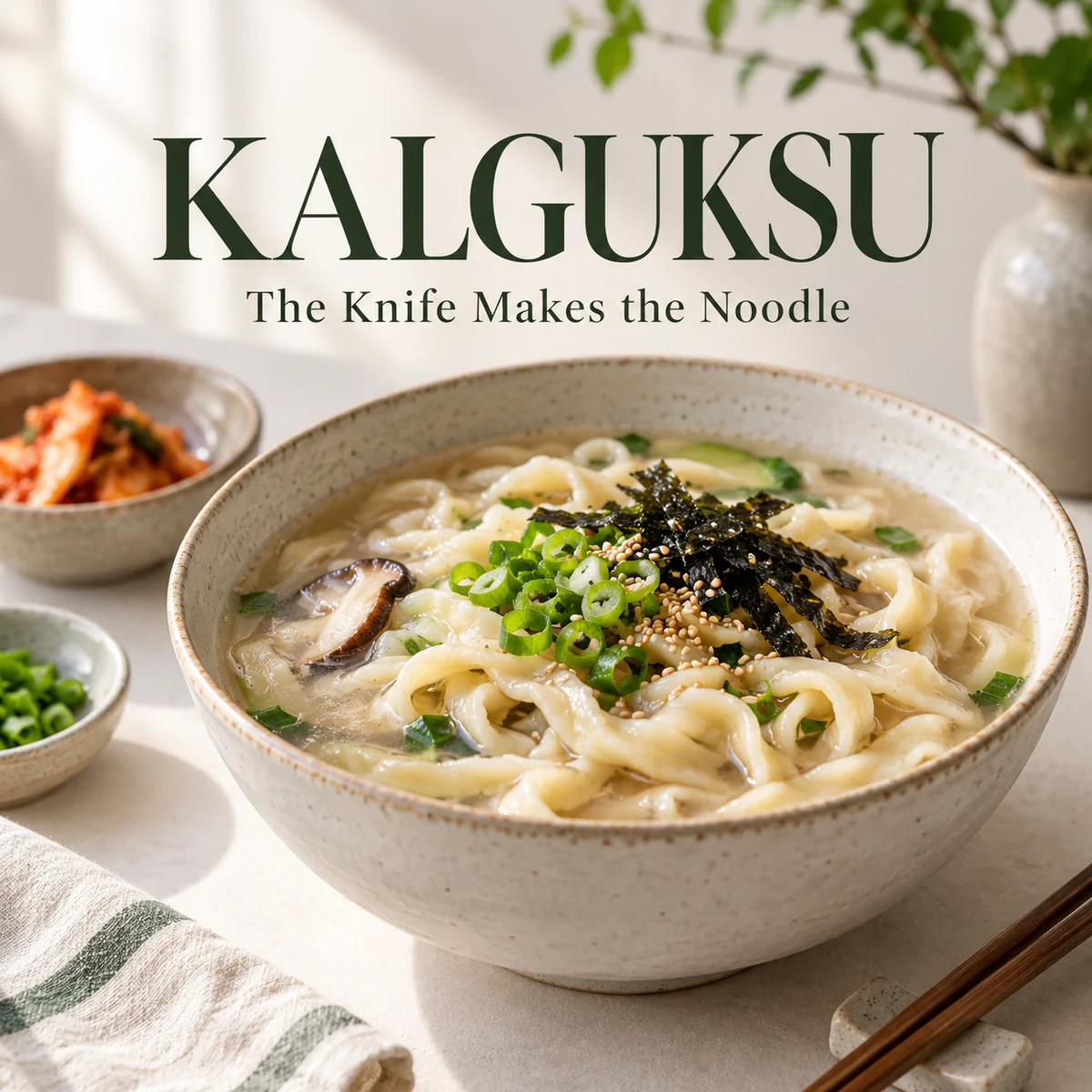
    Kalguksu (칼국수): Korea’s Knife-Cut Noodle Soup in Myeongdong

    Most people come to Myeongdong (명동) for the shopping — the cosmetics shops stacked three deep, the street-food carts, the neon. But when the crowds thin and the weather turns cool, locals slip into a plain, packed noodle house on a side lane and order a steaming bowl of kalguksu (칼국수), Korea’s hand-cut knife noodle soup. This is one of those meals that looks humble and hits like comfort itself.

    Busy Myeongdong shopping street in central Seoul at dusk with neon signs and crowds — myeongdong kalguksu
    Myeongdong at dusk — Seoul’s busiest shopping district, and home to its most famous bowl of kalguksu.

    ⭐ Myeongdong at a glance

    🏛️ Sights & things to do ★★★★★
    🍜 Food ★★★★★
    🚇 Easy to reach ★★★★★

    A personal take based on our own experience — the range of things to see, the food, and how easy it is to get to. Yours may well differ.

    New to Korean food? Start with our complete guide to what to eat in Korea.

    The short version: Kalguksu is Korea’s hand-cut wheat noodle soup, served in a warm, savory broth. Myeongdong’s most famous version comes from Myeongdong Kyoja (명동교자), a Michelin Bib Gourmand shop that has done basically four dishes since the 1960s and perfected all of them. Order the kalguksu, add a plate of mandu, come hungry. Here’s what to eat, the noodle’s long history, and how to visit.

    What to eat in Myeongdong

    The star here is a single bowl, but the supporting cast matters. Here’s what to order.

    Kalguksu (칼국수) — the hand-cut noodle soup

    Bowl of Korean kalguksu knife-cut wheat noodles in a warm savory broth topped with minced meat and zucchini — myeongdong kalguksu
    Kalguksu — soft, hand-cut wheat noodles in a rich, slightly cloudy broth.

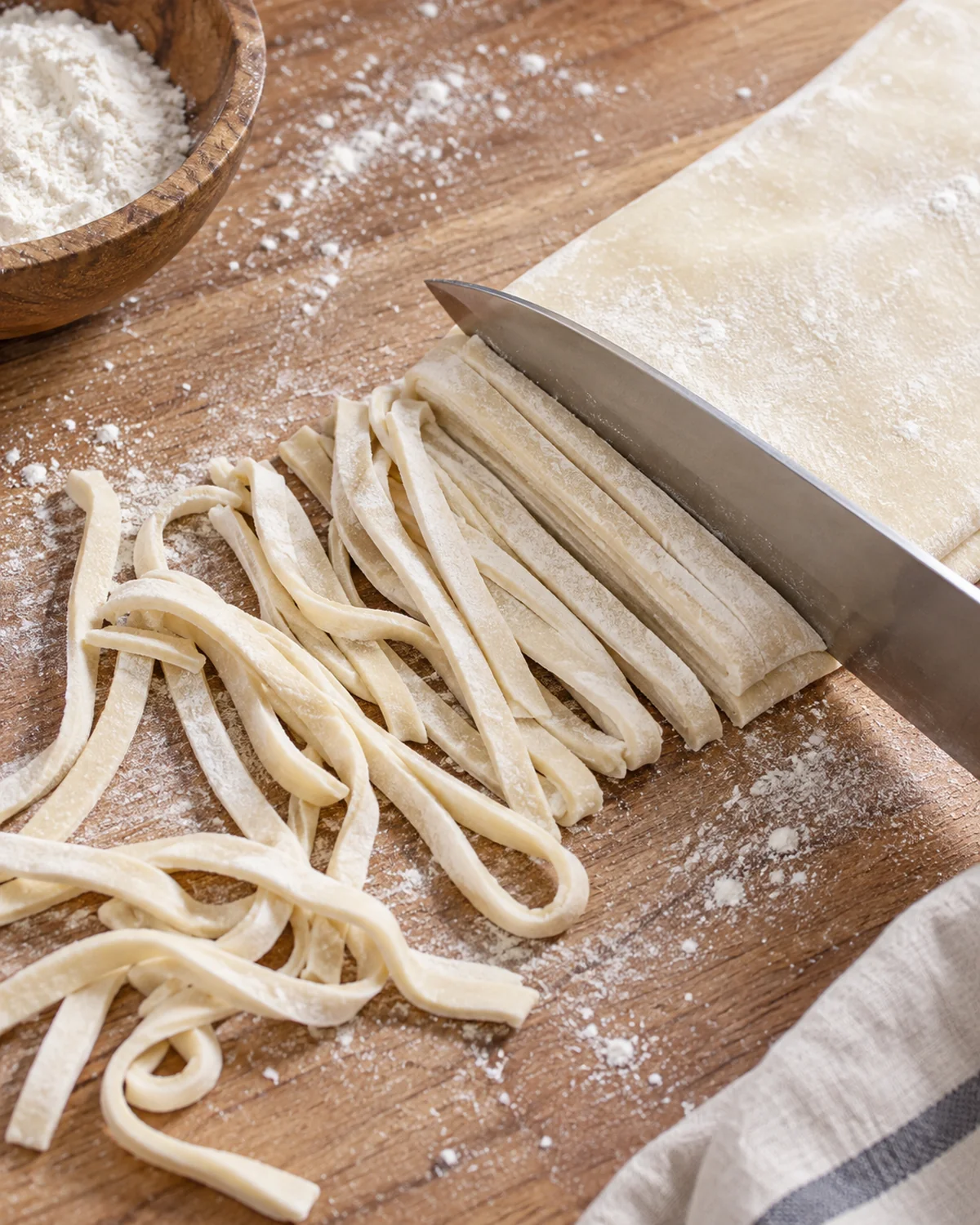
    The name is literal: kal means knife, guksu means noodles. The dough is rolled flat and sliced by hand, so no two strands are quite identical — a little thick, a little chewy, nothing like the machine-perfect noodles you get elsewhere. That texture is the whole point.

    At Myeongdong Kyoja the broth is the thing people talk about: rich, savory, and a touch cloudy, cooked down from chicken and bone rather than the lighter, clearer stocks you’ll find at other shops. It comes topped with a spoonful of seasoned minced meat and a little zucchini, and each table gets a bowl of the shop’s fiery, garlicky kimchi on the side. In my experience that kimchi is dangerously good — I’ve watched first-timers ask for a second helping before they’ve touched the noodles.

    One nice habit here: order a bowl and you can usually get a noodle refill to finish off every last drop of broth. Nobody leaves hungry.

    Mandu (만두) — the dumplings that named the place

    Plate of steamed Korean mandu dumplings filled with pork and vegetables at a Myeongdong restaurant — myeongdong kalguksu
    Mandu — plump pork-and-vegetable dumplings, the shop’s other calling card.

    The word kyoja (교자) in the restaurant’s name literally means dumpling, so it would be a mistake to skip these. They’re plump, hand-folded, and filled with a mix of pork and vegetables — bigger and meatier than you might expect. A plate of them alongside your noodles is the classic move, and it’s how most regulars order.

    In summer the menu adds one seasonal item: kongguksu (콩국수), cold wheat noodles in a chilled, nutty soybean broth. If you’re visiting in the heat, it’s worth asking whether it’s on that day.

    How a simple noodle got its history

    Illustration of a traditional Korean noodle shop with hand-cut wheat noodles in an old hanok — myeongdong kalguksu
    For centuries, wheat noodles were a rare treat — served only on special days.

    When noodles were a luxury

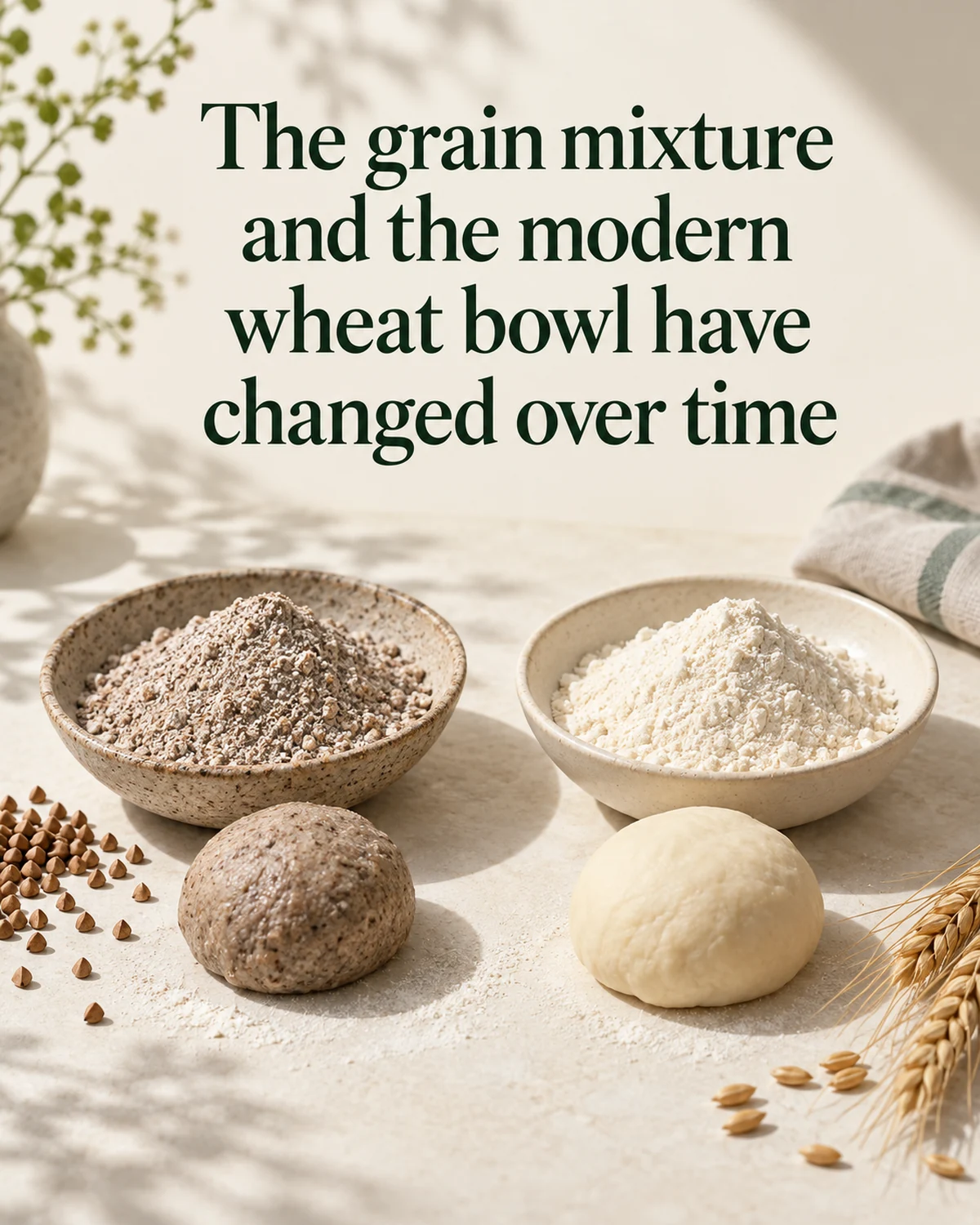
    Here’s what surprises most visitors: for most of Korean history, a bowl of wheat noodles was a rare treat, not everyday food. Wheat didn’t grow well on the peninsula, so flour had to be imported from China and was expensive. Under the Goryeo and early Joseon dynasties it was rare enough that noodles showed up mainly at weddings, harvest feasts, and a baby’s first birthday — where long noodles stood for a long life, a symbolism Koreans still keep.

    The knife-cut technique itself is old. The first written recipe resembling kalguksu appears in Eumsik Dimibang (음식디미방), a cookbook written around 1670 by a Joseon-era noblewoman, Lady Jang Gye-hyang. So the idea of rolling dough flat and slicing it into noodles has been passed down in Korea for well over three centuries.

    How kalguksu reached everyone’s table

    Kalguksu only became an everyday dish fairly recently. After the Korean War ended in 1953, large amounts of wheat flour arrived from overseas aid, and for the first time flour was cheap and plentiful. Through the 1960s and 70s the government actively encouraged people to eat wheat-based meals to stretch the country’s short rice supply. Noodle shops multiplied — and kalguksu went from special-occasion food to a bowl anyone could afford.

    The Myeongdong Kyoja story

    That’s exactly the moment Myeongdong Kyoja was born. The shop traces back to 1966, and its hand-cut noodles in a chicken-and-bone broth became so well known that people started calling this style “Myeongdong-style kalguksu.” Copycats with similar names soon popped up all over, so in 1978 the family renamed the place Myeongdong Kyoja — leaning on that dumpling word — to protect a name no one could imitate.

    It clearly worked. Since the Michelin Guide first came to Seoul in 2017, Myeongdong Kyoja has held a Bib Gourmand — Michelin’s nod to great food at a modest price — pretty much every year since. Not bad for a shop that only really makes four things.

    🗓️ Plan your visit

    When: Kalguksu is a year-round dish, but it hits hardest on a cold day — autumn and winter are prime bowl-of-broth season. The shop is busiest at lunch and around dinner, so an off-peak hour (mid-afternoon) means a shorter wait. In summer, look for the seasonal kongguksu.

    Getting there: Myeongdong sits right in central Seoul. From Incheon Airport it’s about an hour on the airport railroad into the city, then a short subway hop to Myeongdong Station (Line 4), Exit 8, or Euljiro 1-ga Station (Line 2). Everything below is a few minutes’ walk from there.

    Costs: The meal is a bargain — a bowl of kalguksu runs around 12,000 won as of 2026, with mandu a little more. For the trip itself, spring (blossoms) and autumn (foliage) are peak season in Seoul, so flights and hotels climb and book out early; winter outside the holidays is gentler on the wallet.

    Where to eat it — Myeongdong Kyoja

    The name to know is Myeongdong Kyoja (명동교자). There’s the original main branch on a Myeongdong side lane, plus a second location by Myeongdong Station that’s handy if the first has a line — same menu, same kitchen standards.

    • 📍 Myeongdong Kyoja, Main Branch (명동교자 본점): 29 Myeongdong 10-gil, Jung-gu, Seoul (서울 중구 명동10길 29)
    • 🕒 Hours: roughly 10:30–21:00, open daily (hours can change)
    • 🍜 Kalguksu ~12,000 won · Mandu ~13,000 won · you order and pay at the counter first (prepaid)
    • 📍 Annex, Myeongdong Station branch (신관·명동역점): 129 Toegye-ro, Jung-gu, Seoul (서울 중구 퇴계로 129) — steps from Myeongdong Station, Exit 8

    One honest caveat: this place is popular, and lines form fast at peak meal times. Prices and hours also shift now and then, so it’s worth a quick check before you go — and note that you order at the counter before you sit.

    🔗 More warming bowls in Seoul: if you love a good broth, read about seolleongtang, Seoul’s original ox-bone soup, and chodang sundubu, a silky seawater-set tofu stew. Nearby, don’t miss Gwangjang Market, Seoul’s oldest street-food market. · More on Wikipedia

    A few quick questions

    What does kalguksu taste like?
    Comforting and savory rather than spicy. Soft, chewy hand-cut wheat noodles sit in a warm, slightly rich broth — at Myeongdong Kyoja it’s a hearty chicken-and-bone stock. Think of it as Korea’s answer to a good bowl of homemade noodle soup.

    Is Myeongdong Kyoja worth the wait?
    For most people, yes — it’s a Michelin Bib Gourmand shop that keeps its menu tiny and does each dish extremely well, all at a very fair price. If the line looks long, the annex near Myeongdong Station serves the same food.

    Is kalguksu vegetarian?
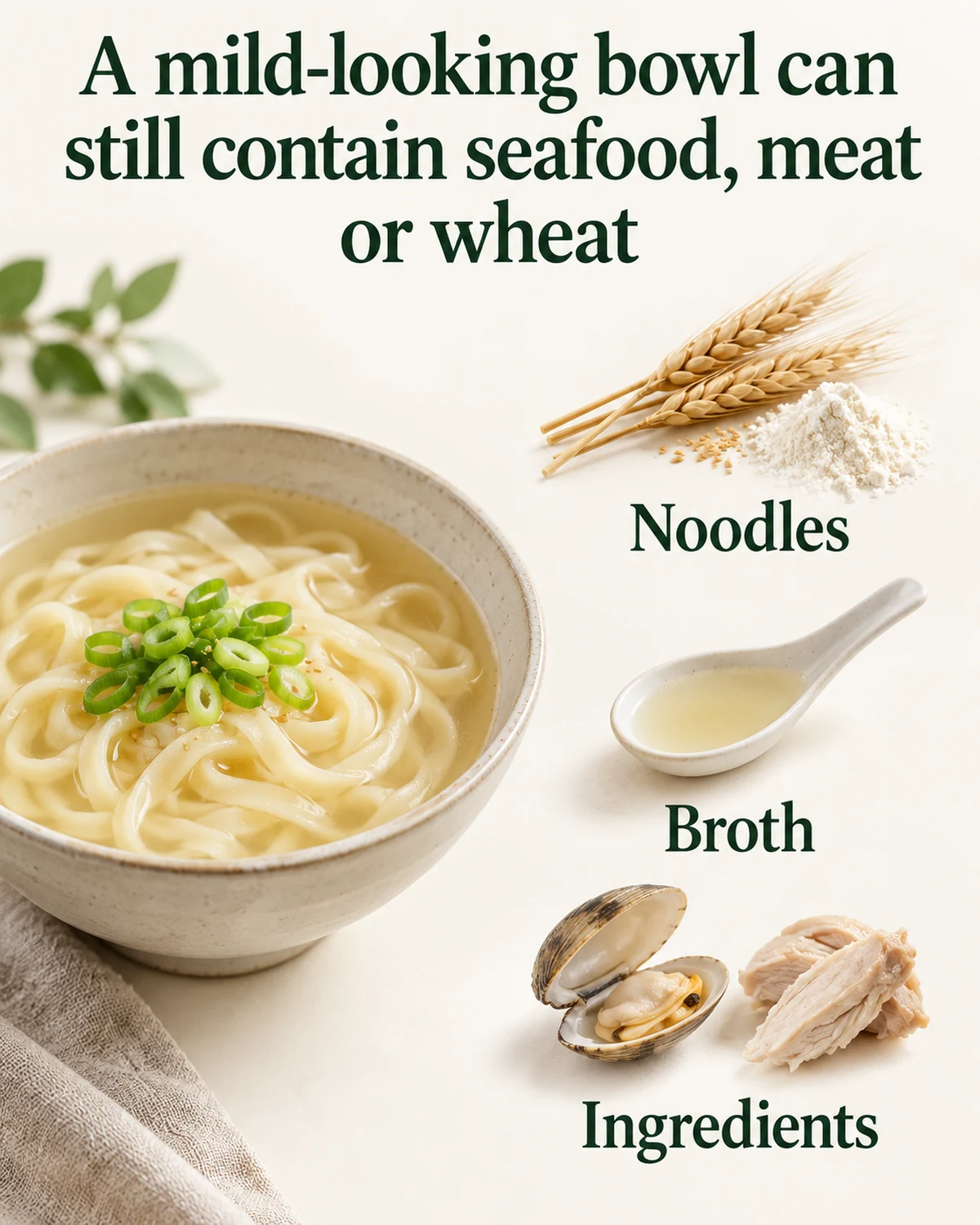
    Usually not. The classic version is built on a meat or seafood broth and often topped with minced meat. Recipes vary by shop, so it’s always worth asking before you order.

  • Bibimbap (비빔밥): Korea’s Famous Mixed Rice, and Why Jeonju Does It Best

    Bibimbap (비빔밥): Korea’s Famous Mixed Rice, and Why Jeonju Does It Best

    There’s a city about two hours south of Seoul that Koreans travel to specifically to eat. It’s called Jeonju (전주), and it’s a place of curved-tile hanok roofs, old shrine walls, and — since 2012 — a UNESCO-designated City of Gastronomy. People come to wander the Hanok Village, but the dish they really come for is one you’ve almost certainly seen: bibimbap (비빔밥).

    Traditional hanok village rooftops in Jeonju Korea, home of Jeonju bibimbap
    Jeonju’s Hanok Village — the home of Korea’s most famous bibimbap.

    ⭐ Jeonju at a glance

    🏛️ Sights & things to do ★★★★★
    🍜 Food ★★★★★
    🚄 Easy to reach ★★★☆☆

    A personal take based on our own experience — the variety of things to see, the taste, and the travel time involved. Yours may well differ.

    The short version: Bibimbap is Korea’s famous “mixed rice” — a bowl of rice topped with seasoned vegetables, beef, and a spoon of chili paste, all stirred together before you eat. Jeonju does the most celebrated version, and the city is the place to try it. Here’s what it is, the story behind it, and where to eat it.

    First — what exactly is bibimbap?

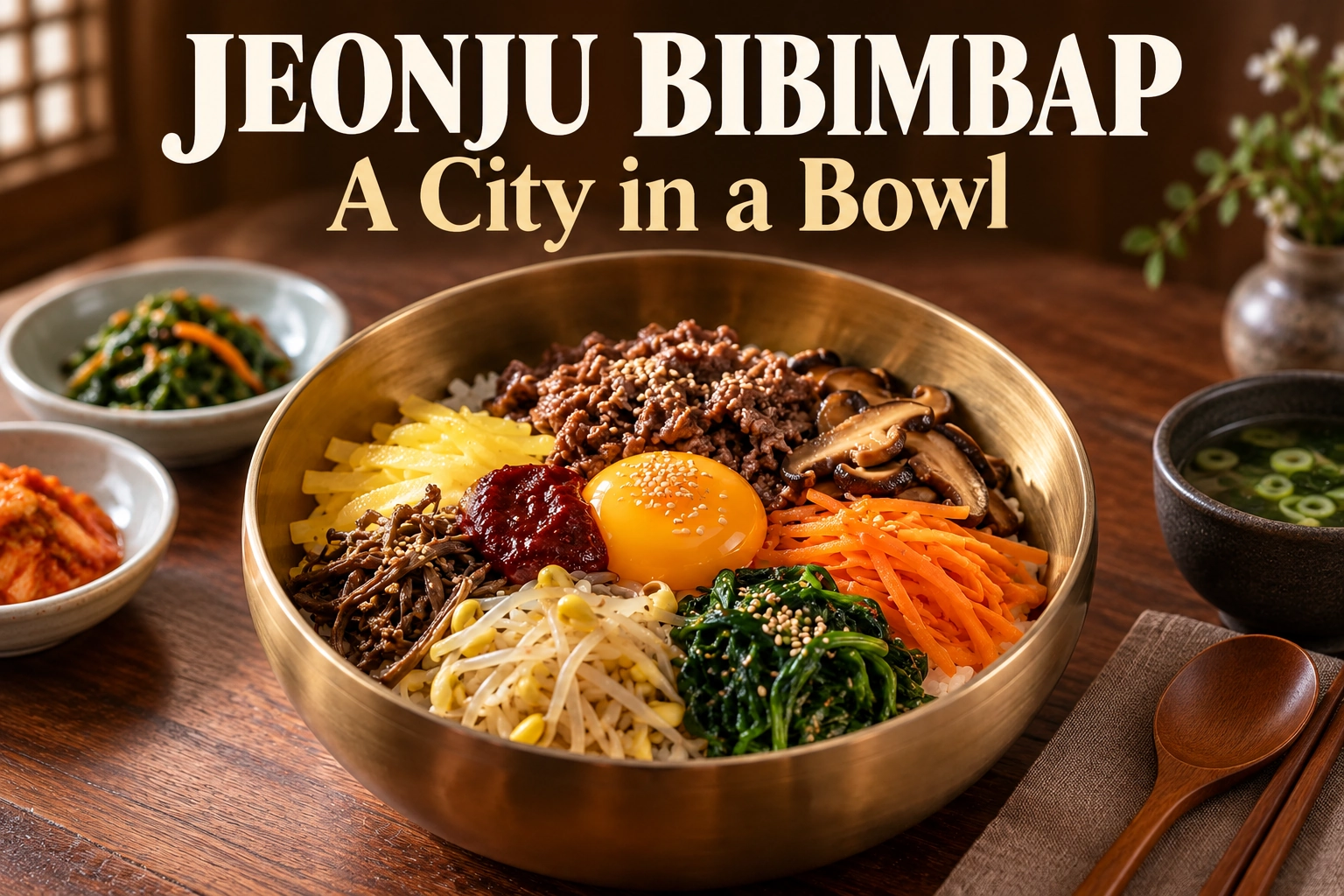
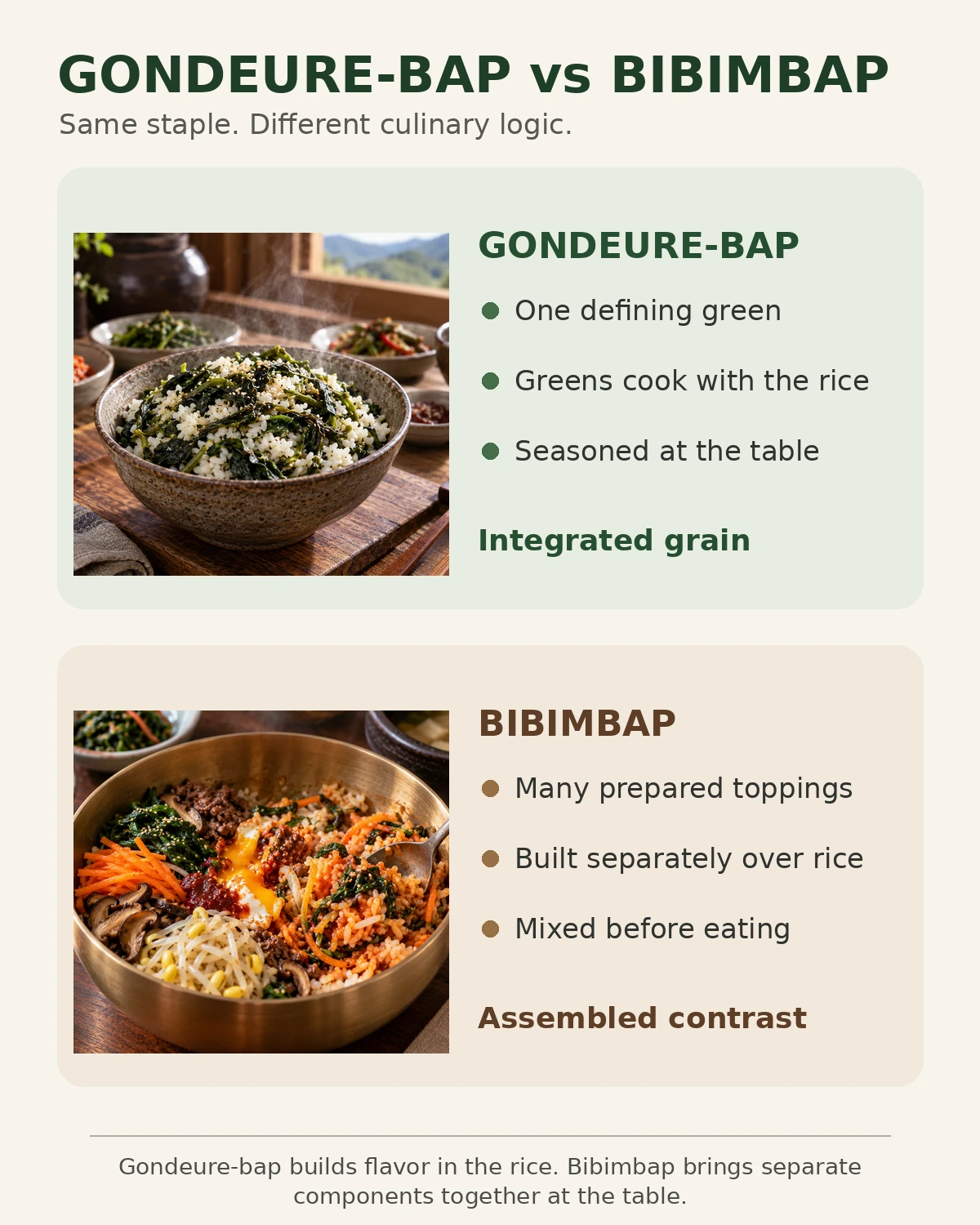
    The name says it plainly: bibim means “mixed,” bap means “rice.” At its heart it’s a bowl of warm rice crowned with an array of namul (seasoned vegetables), often some beef, a raw or fried egg, and a spoonful of gochujang (red chili paste). You mix all of it together, thoroughly, right before eating.

    Colorful Jeonju bibimbap in a brass bowl with seasoned vegetables beef egg and gochujang before mixing
    Before the mix — Jeonju bibimbap arrives almost too pretty to stir.

    Why Jeonju’s version is special

    Jeonju bibimbap is the deluxe one. It’s traditionally served in a gleaming brass bowl, piled with a small mountain of toppings — sometimes thirty-odd of them, from mountain greens to yukhoe (raw beef) to a delicate egg. Old records even call bibimbap hwaban (화반), “flower rice,” and one look at a proper Jeonju bowl tells you why. It’s genuinely beautiful.

    How to eat it like a local

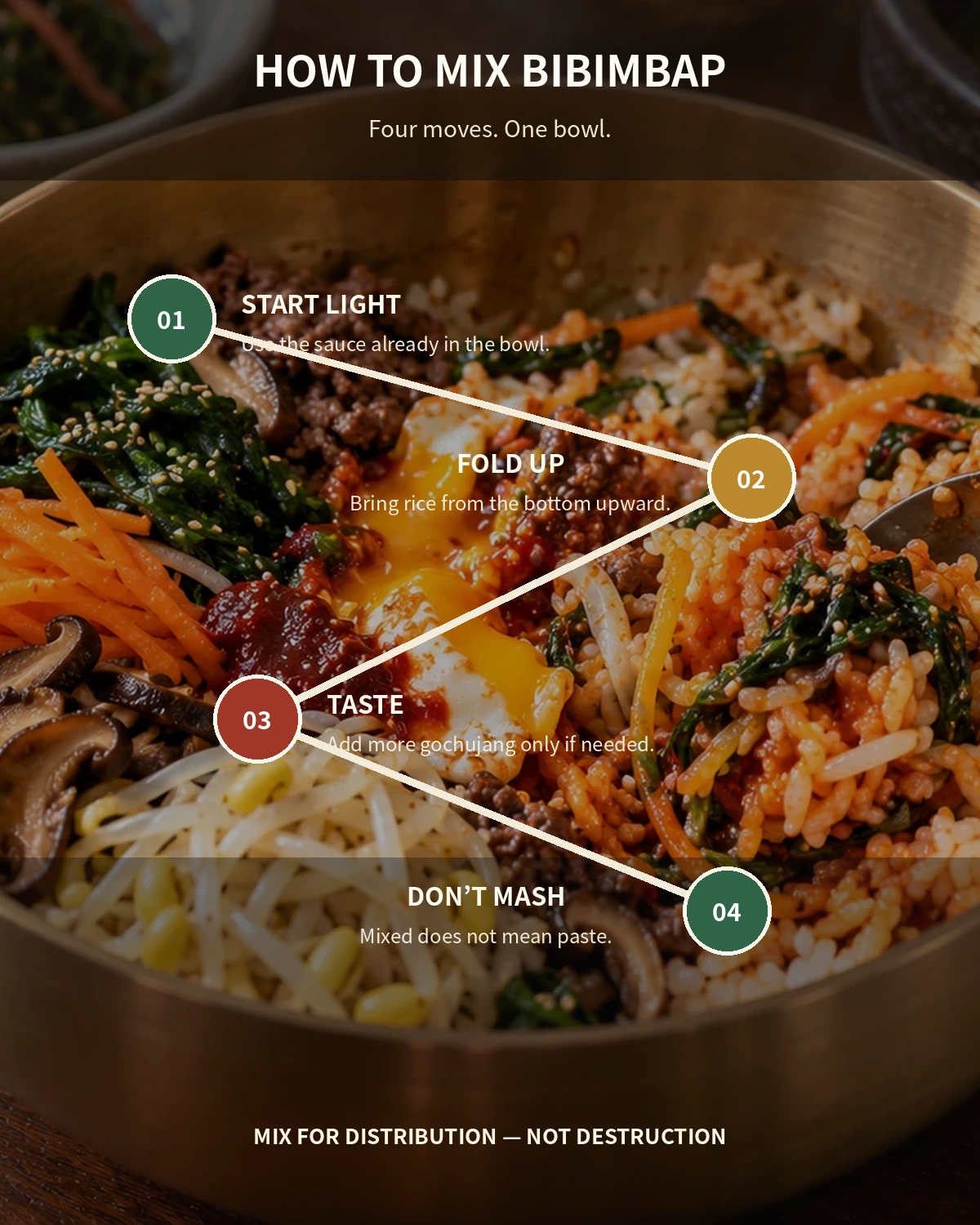
    Add as much gochujang as your spice tolerance allows — you can always add more — then mix, and I mean mix. Turn it over and over until every grain of rice is coated and the colors blur into one. The way I see it, that unruly-looking mixed bowl is the whole point: bibimbap isn’t meant to be admired, it’s meant to be stirred into something greater than its parts.

    The story behind the bowl

    Here’s something that surprised me: for a dish this iconic, nobody is entirely sure where it came from. And honestly, I find that kind of charming.

    A dish with many origin stories

    Illustration of Joseon era Korean family mixing bibimbap together, one origin story of the dish — jeonju bibimbap
    One theory: bibimbap began as a practical way to feed many from one big bowl.

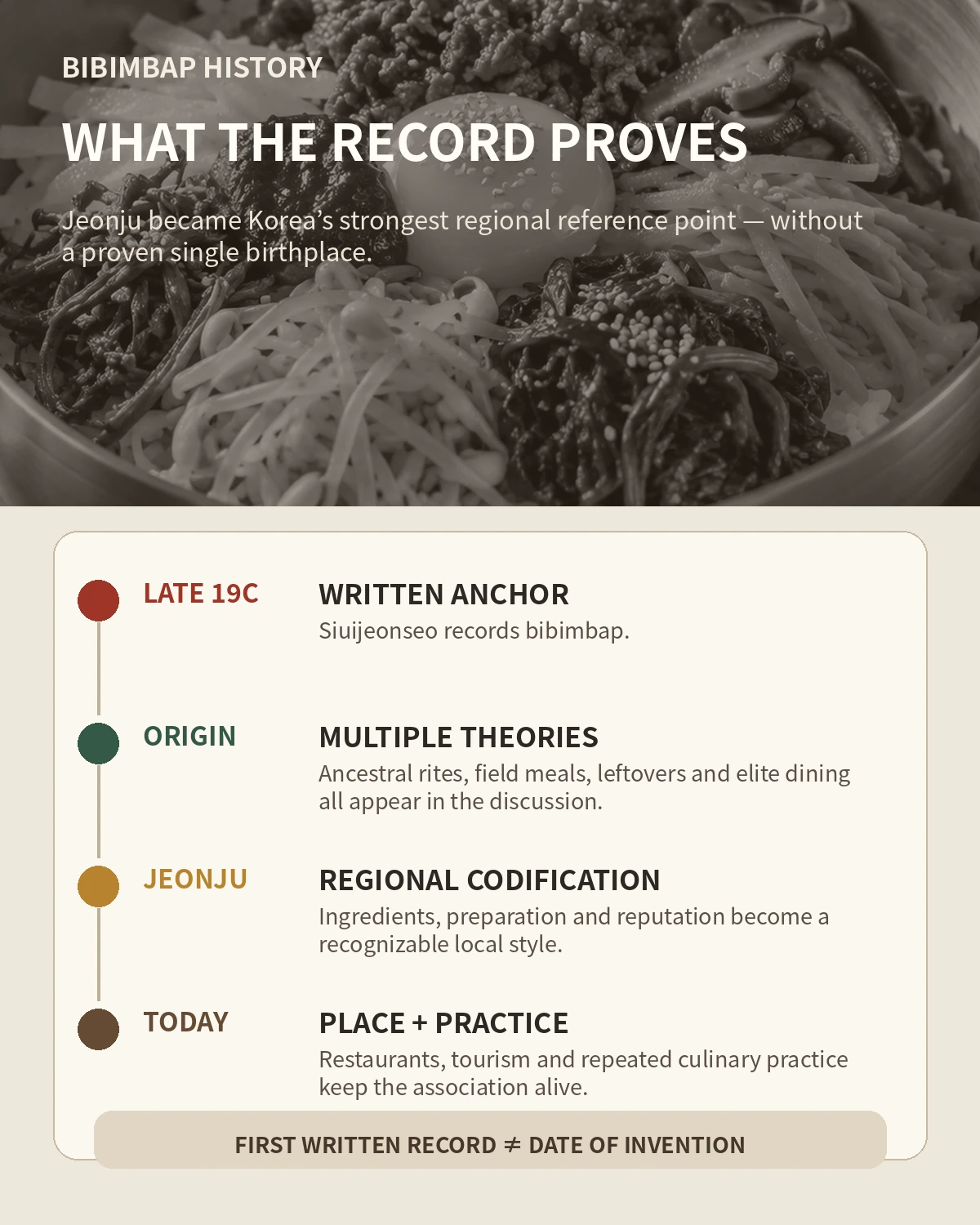
    Historians float several theories, and none has a smoking gun. Some trace it to eumbok — the tradition of eating the food offered at ancestral rites, mixed together. Others point to royal court kitchens, or to farmers mixing rice and vegetables in the fields at harvest, or even to feeding crowds during the Donghak Peasant uprising. What we do have is the name: a cookbook from the late 1800s, the Siuijeonseo, records it, and the old Chinese term goldongban (골동반) simply means “rice with many things stirred in.”

    How Jeonju became the home of bibimbap

    Whatever its murky beginnings, Jeonju is where bibimbap became a legend. Sitting in Korea’s rice-and-vegetable heartland, the city had the ingredients and the culinary pride. Through the 1900s, cheap, hearty bibimbap thrived around Jeonju’s Nambu Market, and by the 1960s and 70s a whole “bibimbap alley” had grown up near the old provincial office. That’s the lineage the city’s famous restaurants still carry today.

    🗓️ Plan your visit

    When: Jeonju is a year-round destination, but the Hanok Village is loveliest in spring and autumn, when the tiled roofs and courtyards look their best. It gets busy on weekends, so a weekday visit is calmer.

    Getting there: From Incheon Airport, plan on roughly 3–4 hours via Seoul — take the airport railroad into the city, then a KTX high-speed train from Yongsan to Jeonju (about two hours), or an intercity express bus. Jeonju itself is walkable once you’re there.

    Costs: A bowl of Jeonju bibimbap runs around ₩14,000–17,000. For the trip, spring and autumn are peak season nationwide, so flights and rooms climb and book out early — reserve ahead; winter outside the holidays is gentler on the budget.

    Where to eat it

    One in the heartland, one for when you’re staying in Seoul:

    Gajok Hoegwan (가족회관) — Jeonju

    One of Jeonju’s celebrated “big three” bibimbap houses, Gajok Hoegwan has been at it since 1973, now into a third generation. Its founder is recognized as a master of traditional food and an official holder of Jeonju bibimbap’s intangible-heritage craft — which is a long way of saying this is the real thing, a short walk from the Hanok Village.

    • 📍 Address: 17 Jeollagamyeong 5-gil, Wansan-gu, Jeonju (전북 전주시 완산구 전라감영5길 17)
    • 🕒 Hours: 10:30–20:00 (last order 19:50)
    • 🍲 Bibimbap: ₩14,000 (yukhoe bibimbap ₩17,000) · No lot; nearby paid lots give 1 hr free with validation

    Jeonju Jungang Hoegwan (전주중앙회관) — Myeongdong, Seoul

    Can’t make it to Jeonju? This Myeongdong institution has been serving Jeonju-style bibimbap since the 1960s, when its founder moved the family restaurant from Jeonju to Seoul. It’s an easy, central stop if you’re sightseeing around Myeongdong.

    • 📍 Address: 21 Myeongdong 8na-gil, Jung-gu, Seoul (서울 중구 명동8나길 21)
    • 🕒 Hours: 09:30–22:30 (last order 22:00), open year-round
    • 🍲 Bibimbap: a Jeonju-style bowl in central Seoul · nearest to Myeongdong Station

    One honest caveat: prices and hours are accurate as of July 2026, but restaurants change both more often than you’d expect. A quick check before you go never hurts.

    🔗 More Korean food to explore: New to Korean food? Start with our complete guide to what to eat in Korea. in Seoul, don’t miss Gwangjang Market’s street food and a bowl of seolleongtang, the city’s ox-bone soup. Or head to the mountains for gondeure namul bap in Jeongseon. · More on Wikipedia

    A few quick questions

    Is bibimbap spicy?
    Only as spicy as you make it. The heat comes from the gochujang you stir in yourself, so you’re fully in control — add a little, taste, add more.

    Is bibimbap vegetarian?
    It can be. The base of rice and seasoned vegetables is plant-based, but many versions add beef, egg, or yukhoe — and some seasonings aren’t strictly vegetarian, so it’s worth asking.

    What’s the difference with dolsot bibimbap?
    Dolsot bibimbap is served in a scorching-hot stone bowl, so the rice at the bottom crisps into a golden crust as you eat. Same idea, extra texture — and be careful, the bowl is very hot.

  • Gondeure Namul Bap (곤드레나물밥): Korea’s Healthy Mountain-Herb Rice Bowl

    Gondeure Namul Bap (곤드레나물밥): Korea’s Healthy Mountain-Herb Rice Bowl

    Deep in the mountains of Gangwon Province, in Korea’s rugged northeast, there’s a small county that people travel a long way to reach: Jeongseon (정선). They come to coast down old railway lines on rail bikes, to wander the stalls of its famous five-day market, and to catch a few wistful notes of Jeongseon Arirang — one of Korea’s most beloved folk songs — drifting between the peaks.

    Scenic mountain view of Jeongseon in Gangwon Province Korea, a travel destination and home of gondeure namul bap
    Jeongseon, deep in the mountains of Gangwon — the home of gondeure namul bap.

    ⭐ Jeongseon at a glance

    🏔️ Sights & things to do ★★★★☆
    🍚 Food ★★★☆☆
    🚆 Easy to reach ★★☆☆☆

    A personal take based on our own experience — the variety of things to see, the taste, and the travel time involved. Yours may well differ.

    New to Korean food? Start with our complete guide to what to eat in Korea.

    And when the mountain air leaves them hungry, there’s one dish the locals steer them toward: gondeure namul bap (곤드레나물밥). The first time a bowl landed in front of me, I almost underestimated it — plain white rice, flecked with dark green herbs, steaming in a hot stone pot. It looked like the kind of quiet, healthy thing you order to feel virtuous. What I didn’t know was that this humble bowl carries one of the heavier histories on the Korean table.

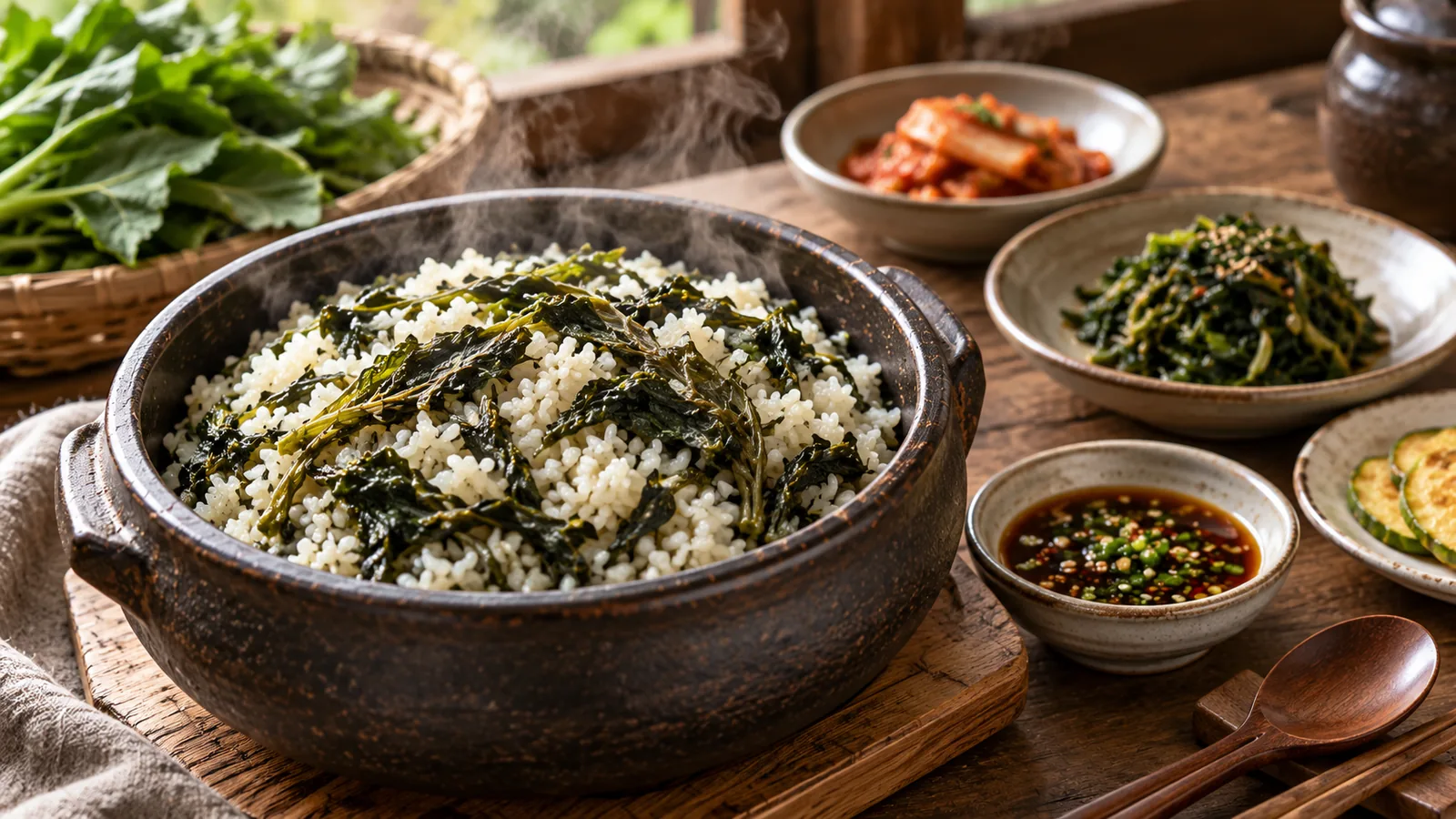
    Korean gondeure namul bap mountain herb rice in a hot stone pot with dark green thistle greens
    Gondeure namul bap — rice steamed with mild mountain-thistle greens.

    First — what is gondeure namul bap?

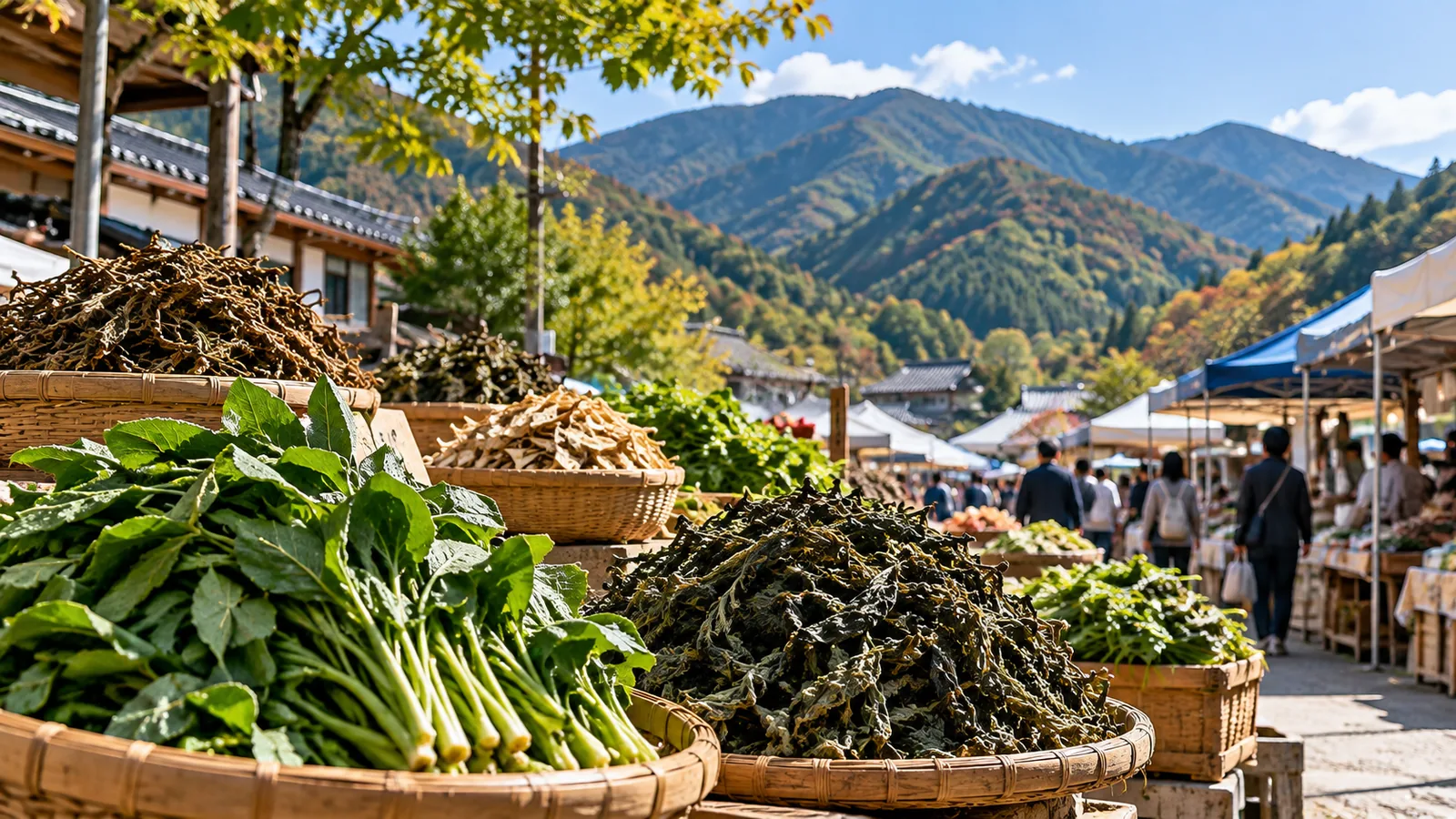
    At its simplest, gondeure namul bap is rice steamed together with gondeure — a wild mountain green from the steep highlands of Gangwon Province, in Korea’s northeast. The plant’s proper name is Korean thistle (곤드레 is the Gangwon dialect word for it), and it’s foraged fresh around May, when the young leaves are at their most tender.

    Cook it into rice, usually in a sizzling stone pot, and the greens perfume every grain — earthy, gently nutty, deeply comforting. It’s the kind of bowl that tastes like it’s doing you good, because, honestly, it is.

    Why gondeure, out of all the mountain greens?

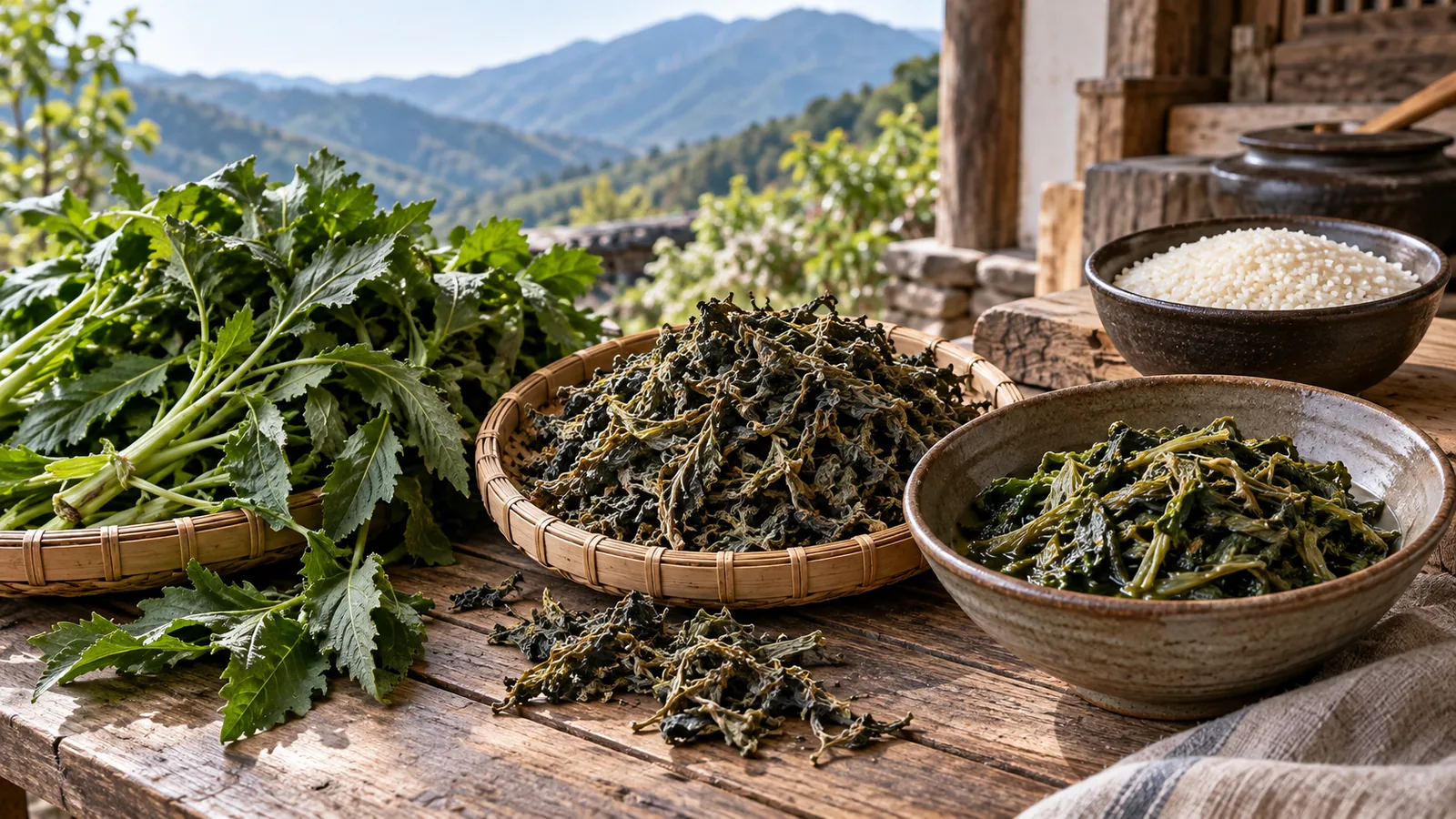
    Fresh gondeure Korean thistle mountain greens namul from Gangwon Province — gondeure namul bap
    Gondeure (Korean thistle) — mild and tender, unlike most wild greens.

    Korea has hundreds of wild mountain greens (we call them sannamul), and a lot of them are bitter, tough, or an acquired taste. Gondeure is the friendly one. It’s soft, mild, and barely bitter, which is exactly why it folds into rice so beautifully instead of fighting it.

    There’s one more quality that matters more than you’d think, and we’ll come back to it: gondeure is remarkably gentle on the stomach, even when you eat a lot of it. Hold that thought.

    How to eat it like a local

    Seasoned soy sauce yangnyeom ganjang being drizzled over gondeure namul bap before mixing
    The seasoned soy sauce goes on top — then you mix it all in.

    Like a lot of great Korean rice dishes, it arrives almost undressed, and the finishing is your job. Every table comes with a little bowl of yangnyeom-ganjang — soy sauce loosened with sesame oil, chopped scallion, a touch of chili and garlic.

    You spoon that over the rice and mix, thoroughly, until every grain is glossy and seasoned. The way I see it, that’s the whole ritual.

    The greens come pre-seasoned

    Here’s a detail that surprised me. The gondeure is usually dressed before it ever meets the rice — cooks toss the blanched greens with perilla oil and a little guk-ganjang, a lighter, saltier soup soy sauce, then steam them right into the pot. So the bowl arrives fragrant and gently savory on its own. The sauce you stir in at the table just builds on that.

    Try a splash of perilla oil

    Many locals (me included) add a little deulgireum — toasted perilla oil — along with the soy sauce. It deepens that nutty, earthy note and, in my experience, is the single thing that takes the bowl from nice to genuinely craveable. Some spots also serve a thick soybean paste (gangdoenjang) on the side to stir in.

    Don’t be shy with the mixing

    Mix it more than feels necessary. The greens, the seasoned soy, the oil, the rice at the bottom of the stone pot slowly turning crisp — you want all of it in every spoonful.

    The twist: from famine food to wellness bowl

    Here’s the part that stopped me short. This dish that people now order to eat well — clean, healthy, mindful — was born out of the opposite. It was food for surviving when there was almost nothing else.

    A food of the spring famine

    Illustration of a Korean mountain family in Gangwon gathering gondeure greens during the spring famine — gondeure namul bap
    In the lean spring months, gondeure was what the mountains offered.

    Through the 1960s and 70s, late spring in rural Korea meant the boritgogae — the “barley hump,” a hungry stretch when last year’s grain had run out and the new harvest wasn’t in yet. In the steep valleys around Jeongseon, in Gangwon, one thing grew wild and abundant right when people needed it most: gondeure.

    So families did what they had to. They gathered armfuls of the greens and stretched a little precious grain as far as it would go, mixing gondeure into every pot of rice to make it fill more mouths.

    Why gondeure carried them through

    Now that thought I asked you to hold. Gondeure’s mildness wasn’t just pleasant — it was the reason it worked as survival food. It was gentle enough to eat at nearly every meal without turning the stomach, so a family could lean on it day after day when little else was available.

    It sank so deep into the life of the region that it even turns up in the lyrics of Jeongseon Arirang, the area’s famous, wistful folk song. A green that fed people through the hard years, sung about like an old companion.

    How survival food became a delicacy

    Illustration of the Jeongseon five-day market with visitors enjoying gondeure namul bap
    At Jeongseon’s five-day market, the old survival food found new fans.

    The turn came in the 1990s. As Jeongseon’s traditional five-day market began drawing visitors from the cities, those visitors got hungry — and the dish waiting for them was gondeure namul bap. What had once meant scarcity was suddenly a taste of somewhere authentic, rooted, and mountain-fresh.

    Today it’s prized as a wellness food — fiber-rich, wholesome, and loved for exactly the mild, earthy flavor that once made it a lifeline. I find that reversal quietly moving: the same humble bowl, carried from a symbol of going without to a small luxury of eating well.

    🗓️ Plan your visit

    When: Late spring — especially around May — is the sweet spot, when fresh gondeure floods the markets and the valleys turn deep green; autumn adds mountain foliage. Try to line it up with Jeongseon’s traditional five-day market, one of Korea’s best-known — much of its fame owes to the scenic tourist train that carries city visitors up into the mountains. It runs on dates ending in 2 and 7 (the 2nd, 7th, 12th, and so on), and on a market day the stalls overflow with mountain greens, wild herbs, and steaming pots of gondeure bap.

    Getting there: From Incheon Airport it’s roughly a half-day — about 4–5 hours via Seoul: take the airport railroad into the city, then an intercity bus from Dong-Seoul terminal or a train from Cheongnyangni. The scenic Jeongseon Arirang tourist train runs on weekends and market days.

    Costs: Spring and autumn are peak season across Korea, so flights and rooms climb and book out early — reserve ahead. Local guesthouses stay affordable, and midweek is easiest on the wallet.

    Where to try it

    One spot in the dish’s mountain heartland, one an easy trip from central Seoul:

    Ssarigol Sikdang (싸리골식당) — in the heartland, Jeongseon

    Right by Jeongseon’s famous five-day market, this is about as close to the source as you can eat. A simple, well-loved spot doing the classic bowl the way the region intended.

    • 📍 Address: 1312 Jeongseon-ro, Jeongseon-eup, Jeongseon-gun, Gangwon (강원 정선군 정선읍 정선로 1312)
    • 🕒 Hours: Tue–Sun 10:00–17:00 (closed Mondays)
    • 🍚 Gondeure namul bap: ₩10,000 · Parking available

    Cheonggyesan Gondeure-jip (청계산곤드레집) — Seoul, at the foot of a mountain

    Fittingly for a mountain green, this Seoul favorite sits right at the entrance to Cheonggyesan, a hiking mountain on the city’s southern edge. It’s been serving gondeure to hungry hikers since 2004.

    • 📍 Address: 195-16 Sinwon-dong, Seocho-gu, Seoul (서울 서초구 신원동 195-16)
    • 🕒 Hours: Mon–Fri 11:00–20:30, Sat–Sun 10:00–20:30 (weekend break 15:30–17:30)
    • 🍚 Gondeure namul bap: ₩11,000 · Free parking (valet available)

    One honest caveat: prices and hours are accurate as of July 2026, but small restaurants change both more often than you’d expect. A quick check before you go never hurts.

    🔗 More Korean comfort food to explore: warm up with Gangneung’s seawater tofu, chodang sundubu, mix a bowl of Jeonju’s famous bibimbap, or slurp the humble river-fish noodle soup of Okcheon. · More on Wikipedia

    A few quick questions

    What does gondeure taste like?
    Mild, nutty, and earthy — not bitter. It’s one of the most approachable Korean wild greens, which is a big part of why it works so well in rice.

    Is it healthy?
    It has a genuine reputation as a wholesome dish — the greens are known for fiber, calcium, and vitamin A — and that’s a fair part of its modern appeal. It’s still a hearty bowl of rice, though — so enjoy it as the comforting, nourishing meal it is.

    Is it vegetarian-friendly?
    Often, yes — the rice, greens, and soy-based seasoning are plant-based. But side dishes vary and some kitchens tweak the seasoning, so if you’re strict, it’s worth a quick ask.