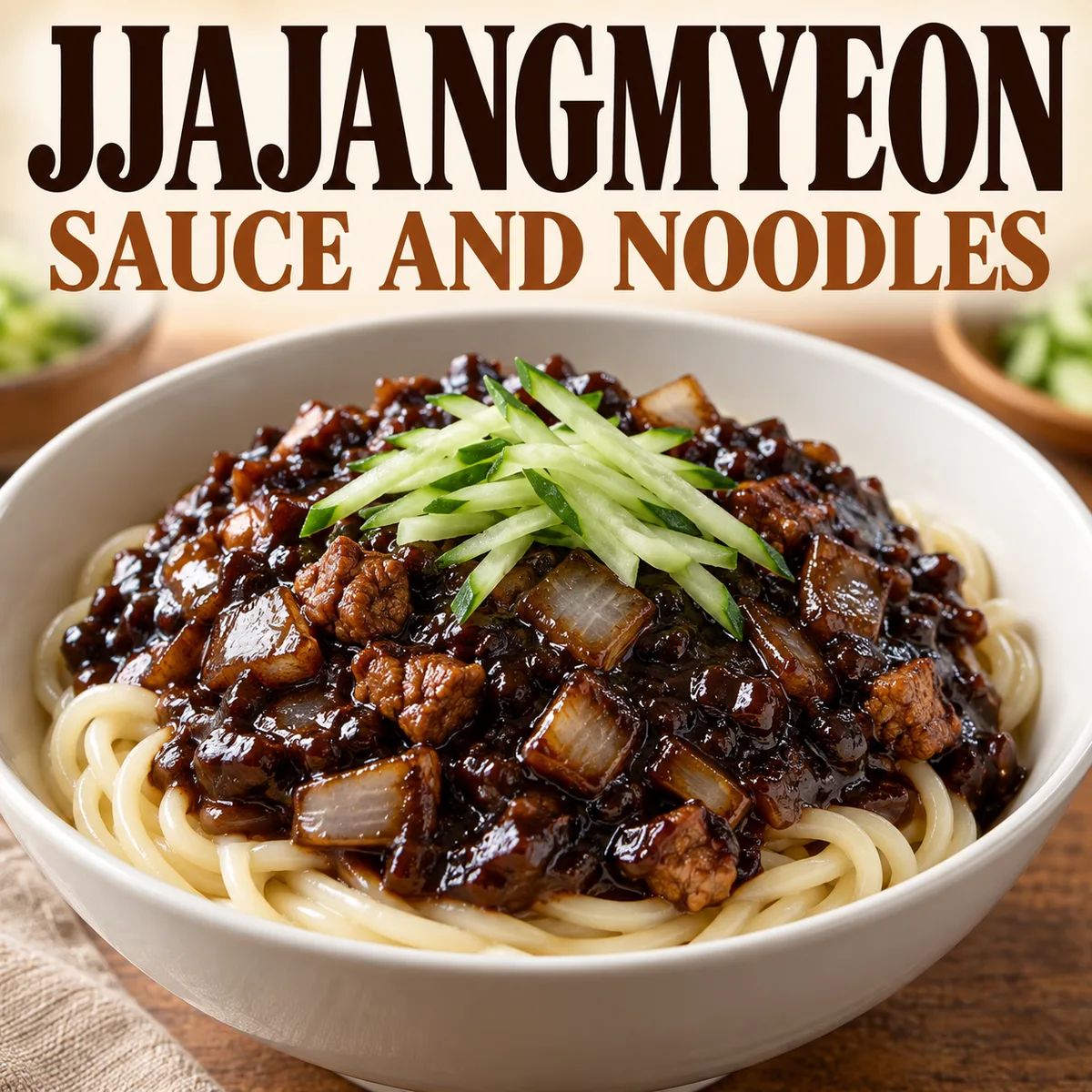
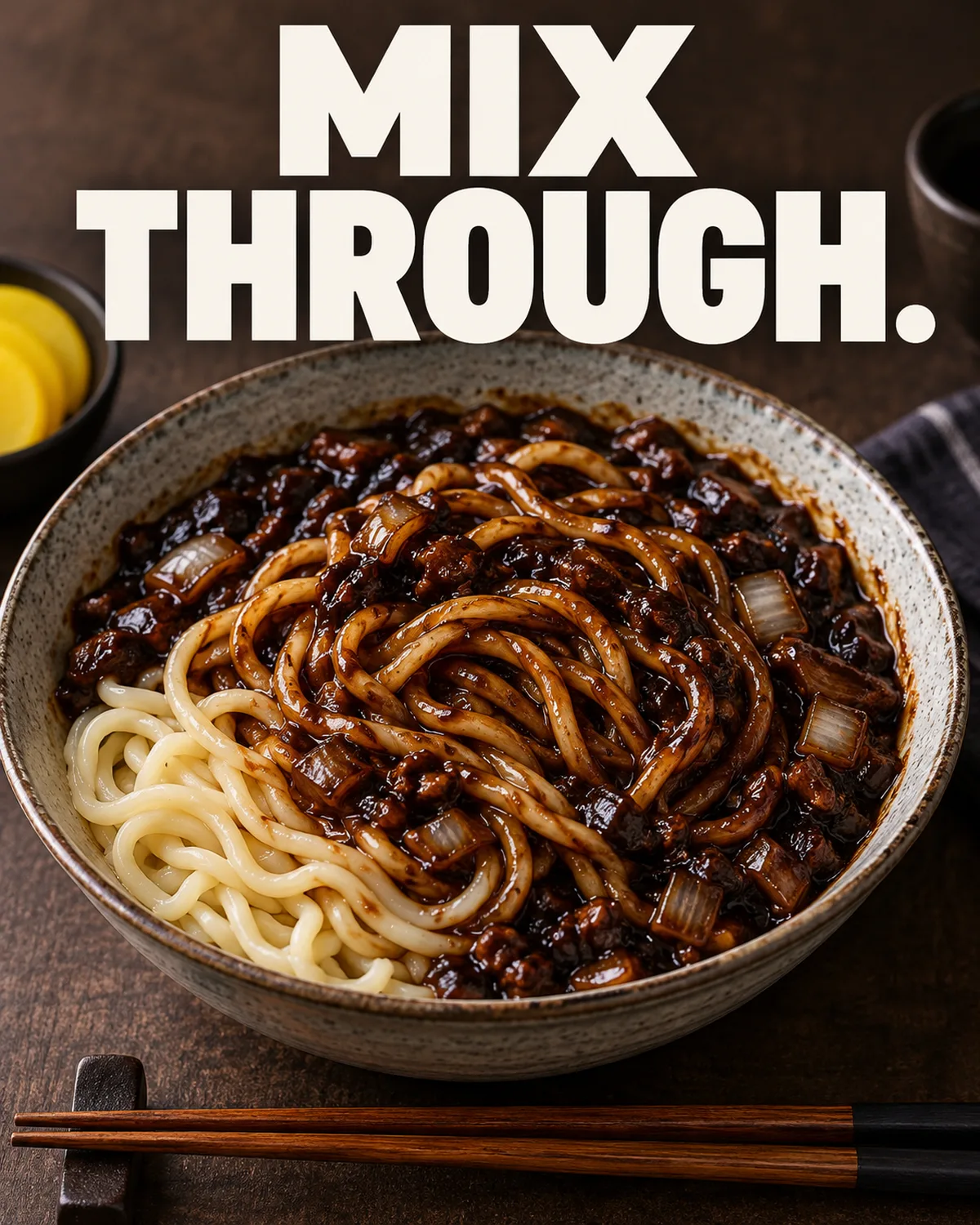
Jjajangmyeon is easiest to understand while mixing it: pale wheat noodles become coated in a dark, glossy sauce, and pieces of onion or other ingredients come into view. The sauce needs to reach the noodles below the first visible layer. Its flavor and texture are part of the bowl, not simply a color poured over it.
The headline needs a qualification. Korean jjajangmyeon developed through Chinese migration and adaptation in Korea; Korean-Chinese is a useful description of that history. The Academy of Korean Studies traces its ancestry to Shandong and connects its Korean development with the opening of Incheon’s port in 1883 and the restaurants that followed.[1]
Hwasa’s dated television scene is a different category of evidence. iMBC reported on February 23, 2019 that she had prepared jjajang-flavored instant noodles with truffle oil in the preceding broadcast of I Live Alone. That documents a home preparation, rather than an invention of restaurant jjajangmyeon.[2]
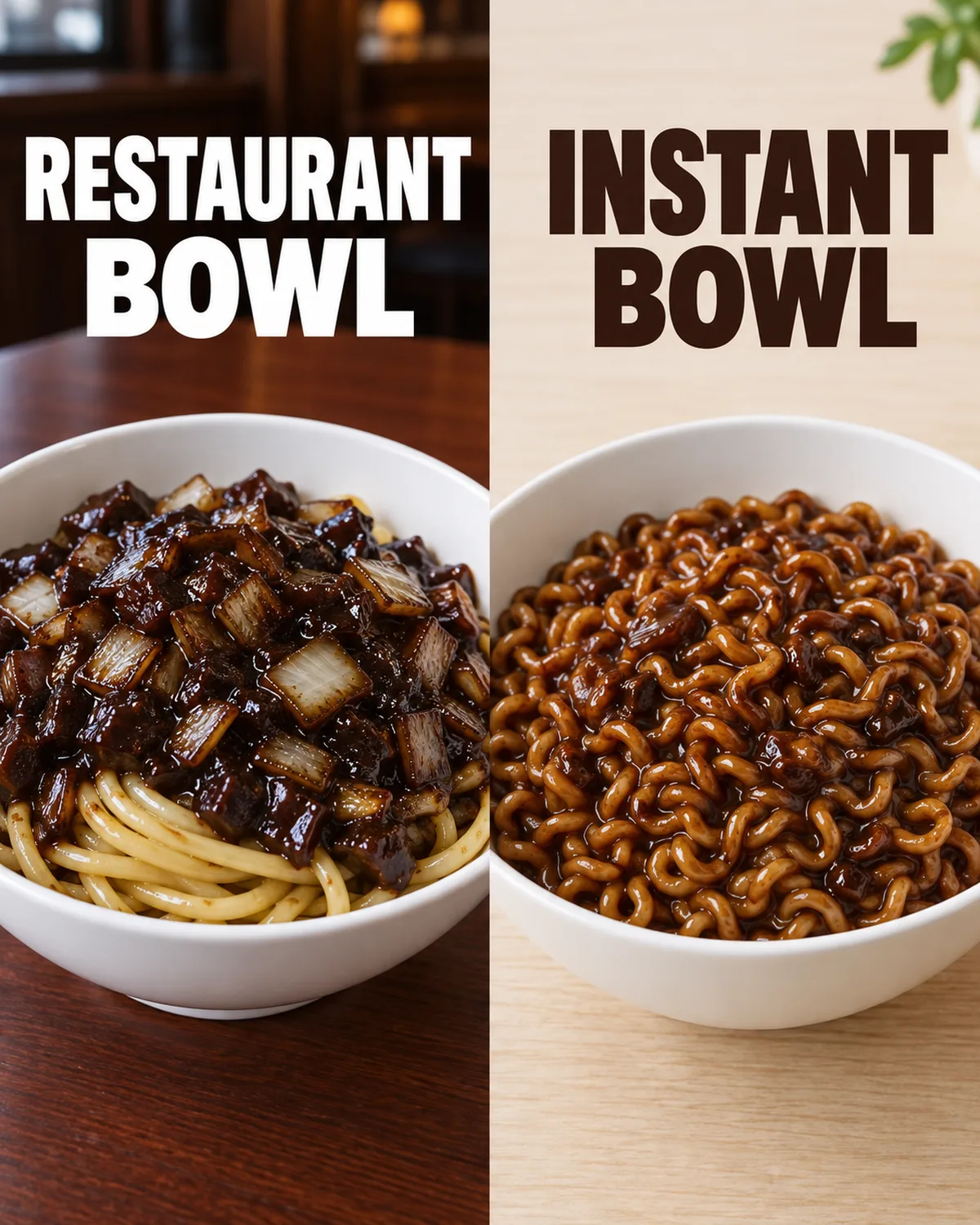
You can follow either food story while keeping the two bowls distinct. A restaurant sauce made with its own ingredients and an instant packet have different preparations. A famous finishing choice may attract attention, but the sauce, noodles and mixing explain the meal more directly.
A restaurant sauce and an instant noodle preparation belong to different food stories.
Incheon explains a meeting of food traditions
The tourism organization’s 2025 account places the dish in Incheon’s Chinese immigrant community. It describes a business opened as Sandong Hoegwan in 1905 and renamed Gonghwachun in 1912. The former Gonghwachun building now houses the Jajangmyeon Museum, giving the story a physical setting rather than a single unnamed cook.[3]
Those dates should be read as milestones in a business and a developing food culture. A port opens, people settle, restaurants serve customers and dishes change. One date cannot show that every ingredient and cooking method of a modern delivery bowl already existed together.
Calling the dish Korean-Chinese preserves both parts of that history. It recognizes the Chinese contribution and the Korean setting in which a distinctive everyday bowl developed. Reducing the story to a competition over national ownership makes the history less informative.
For a museum visit or a restaurant stop, check the venue’s current information before setting out. A historical building and a present business are different destinations. The history can guide your interest without fixing today’s opening hours, prices or available menu.
The port and immigrant community provide a setting for adaptation.
Read the sauce before adding anything
The Academy describes chunjang-based seasoning prepared with meat, vegetables or seafood and served over boiled wheat noodles. Its method includes starch thickening. These elements explain the relation between a paste used in cooking and a finished sauce ready to coat a bowl.[1]
A spoonful taken from the top may contain mostly sauce. After mixing, a mouthful brings noodles and sauce into the same proportion. This is why the first unmixed taste and the later noodle bite can feel different without the food itself having changed ingredients.
Work from the bottom of the bowl and fold the noodles through the sauce instead of leaving a pale clump underneath. Take a manageable bite once the coating looks more even. The goal is a consistent taste, rather than a performance with one very long strand.
Garnishes change the first impression too. A crisp topping stays more distinct if tasted before it disappears into the sauce. Choose whether to preserve that contrast or mix it through; the actual bowl gives you a better guide than a rule about every restaurant.
Mixing brings sauce to the noodles beneath the surface.
Menu names point to useful differences
The tourism feature distinguishes ganjjajang by its cooked-to-order sauce, yuni-jjajang by finely minced ingredients and samseon-jjajang by seafood. These names give a starting point for an order. Ask the restaurant how it prepares the specific item when texture or ingredients matter.[3]
In a separate-sauce order, notice what is in the sauce dish before combining it with the noodles. More visible onion pieces and a finer mince create different mouthfuls. Adding some sauce first can make that contrast easier to notice than emptying everything immediately.
A shared platter changes the dining format as well as the amount. Ask how many people the listed portion is intended for and what else is included. A platter photographed from above does not reveal the edible quantity in each person’s bowl.
Seafood in a name is useful information, but an ordinary dark sauce is not evidence of a vegetarian dish. Likewise, removing a visible piece cannot identify the stock or paste. The kitchen serving the actual order is the source for its ingredient details.
A larger onion piece and a fine mince create different mouthfuls.
Hwasa’s instant bowl has its own context
The iMBC account describes reducing the noodles during cooking, using truffle oil and adding egg yolk near the end; meatballs accompanied the meal. That is a dated report of her preparation, not a required method for every instant noodle product.[2]
For an instant version at home, begin with the directions on the particular packet. Noodle thickness, seasoning format and intended cooking liquid vary. The package’s instructions remain relevant even when another person’s finishing choice makes an appealing television moment.
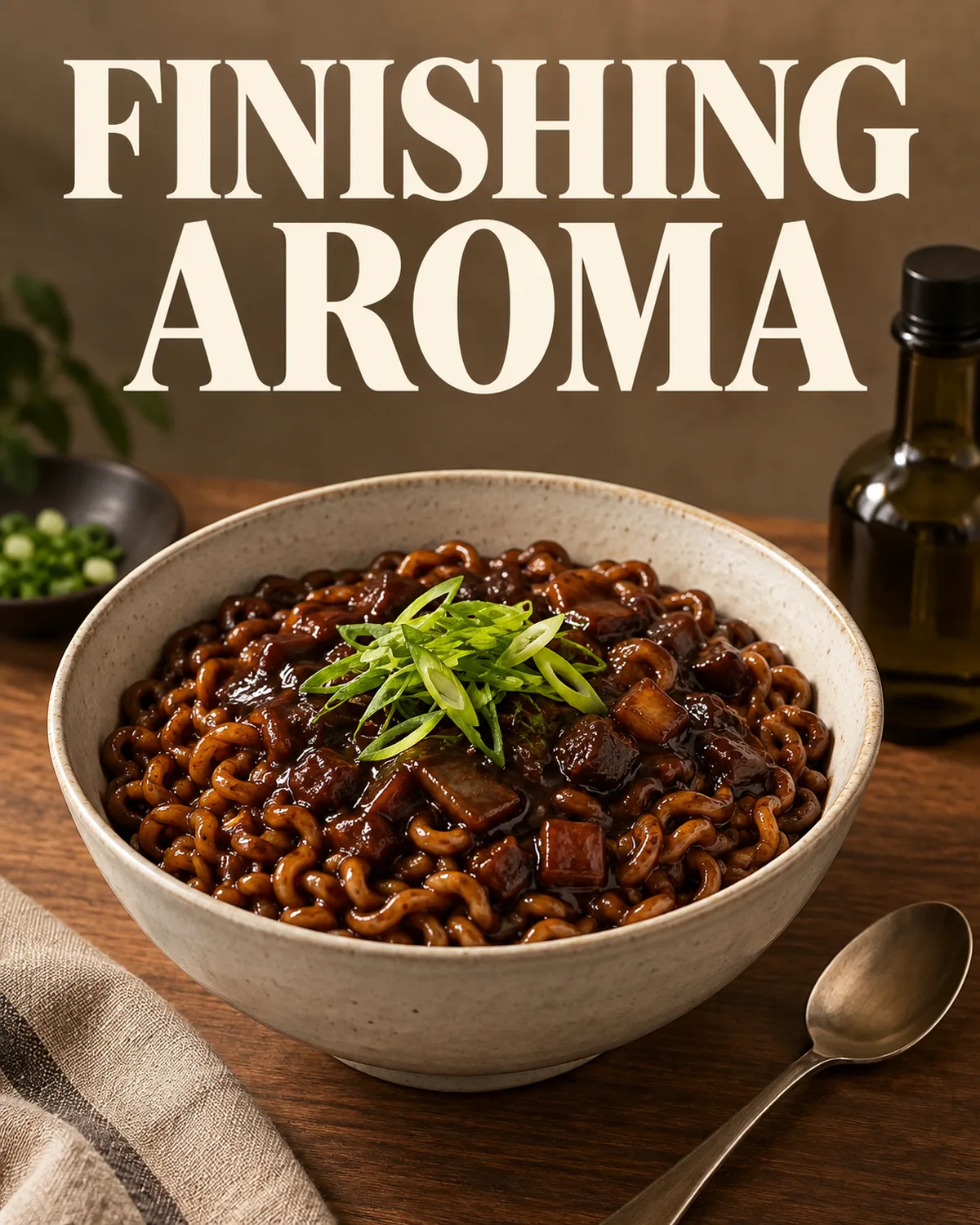
An aromatic oil affects the aroma arriving before a bite. It cannot turn an instant seasoning into the same ingredient-by-ingredient preparation as a restaurant sauce. Taste the bowl as the food it is, rather than using the celebrity connection as a guarantee of equivalence.
There is also no reason to reproduce a raw topping merely because it appeared on television. Choose ingredients and preparation suited to the people eating. The useful lesson from the clip is that a finishing ingredient can change a familiar instant bowl’s character.
A finishing ingredient can change an instant bowl’s aroma.
Make the next order a concrete comparison
Try to name the feature you want to compare: a sauce with larger pieces, a finer mince, seafood or a packet prepared at home. Those choices produce clearer observations than asking whether a whole cuisine is sweeter or saltier than another.
For the restaurant bowl, notice three things after mixing: how the sauce coats the noodles, how the onion or other pieces feel and which flavor remains after swallowing. A very dark appearance alone cannot measure sweetness or identify the recipe.
The instant bowl offers another comparison in convenience, noodle texture and aroma. It belongs in the food’s modern everyday story, while the Incheon history explains a longer path of migration and adaptation. Both are interesting without collapsing them into one origin tale.
Start with the actual menu and the bowl in front of you. Mix the sauce through the noodles, leave room to notice the pieces and ask about the variation you are ordering. That is enough to turn a headline or a television scene into a useful understanding of jjajangmyeon.
Coating, ingredient pieces and noodle texture make the comparison useful.
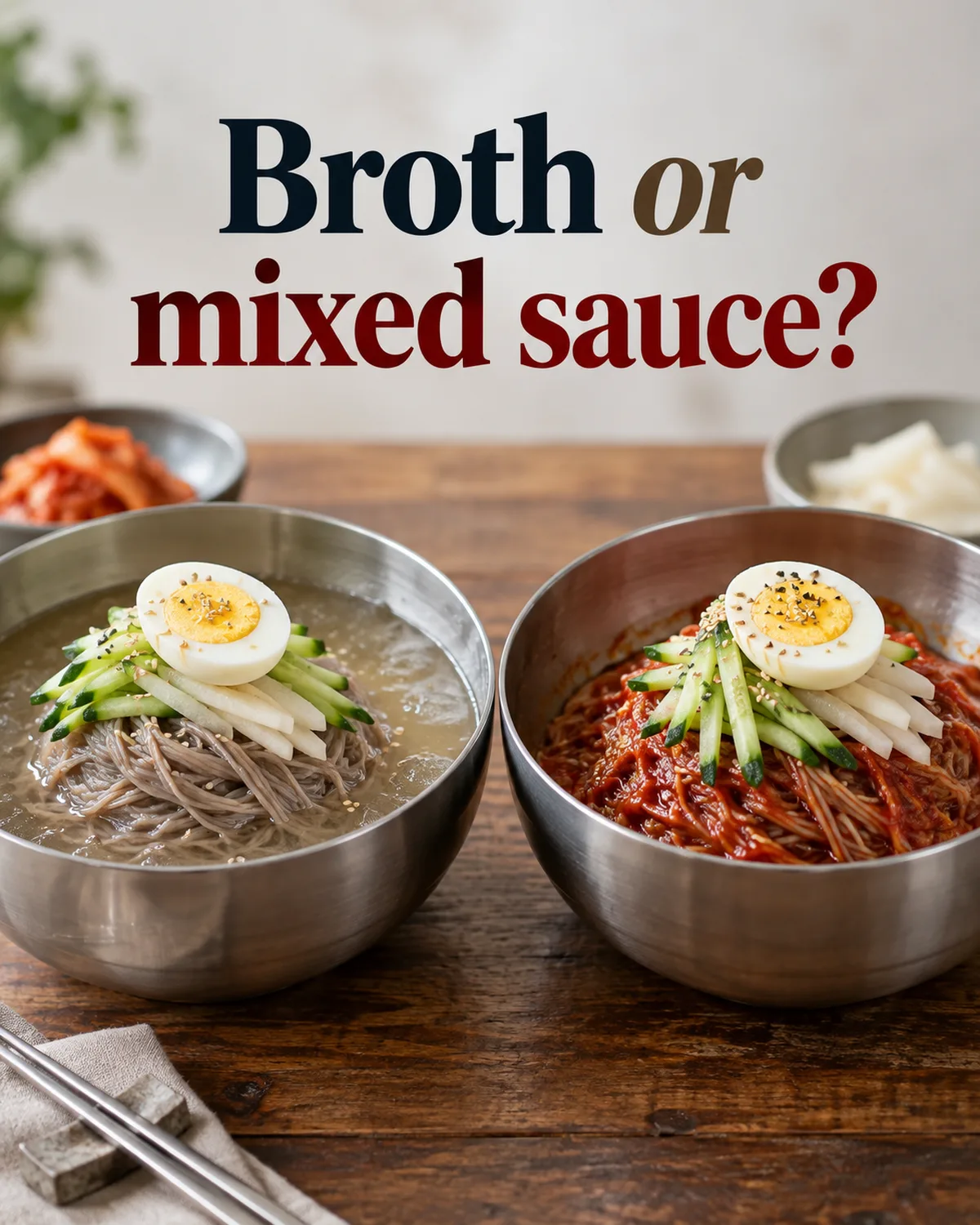
Choose the liquid before choosing the regional label. A bowl of cold broth makes temperature and the first spoonful central; spicy mixed noodles put sauce directly around the strands. Both are naengmyeon, but they ask you to taste different things.
The winter history makes the chilled bowl more interesting. Radish brine and northern noodle traditions belong to the story, while the modern ordering decision is still practical: broth or mixed sauce, a gentler bite or a springier chew, a main meal or a smaller finish after barbecue.
Mul and bibim describe different serving formats.
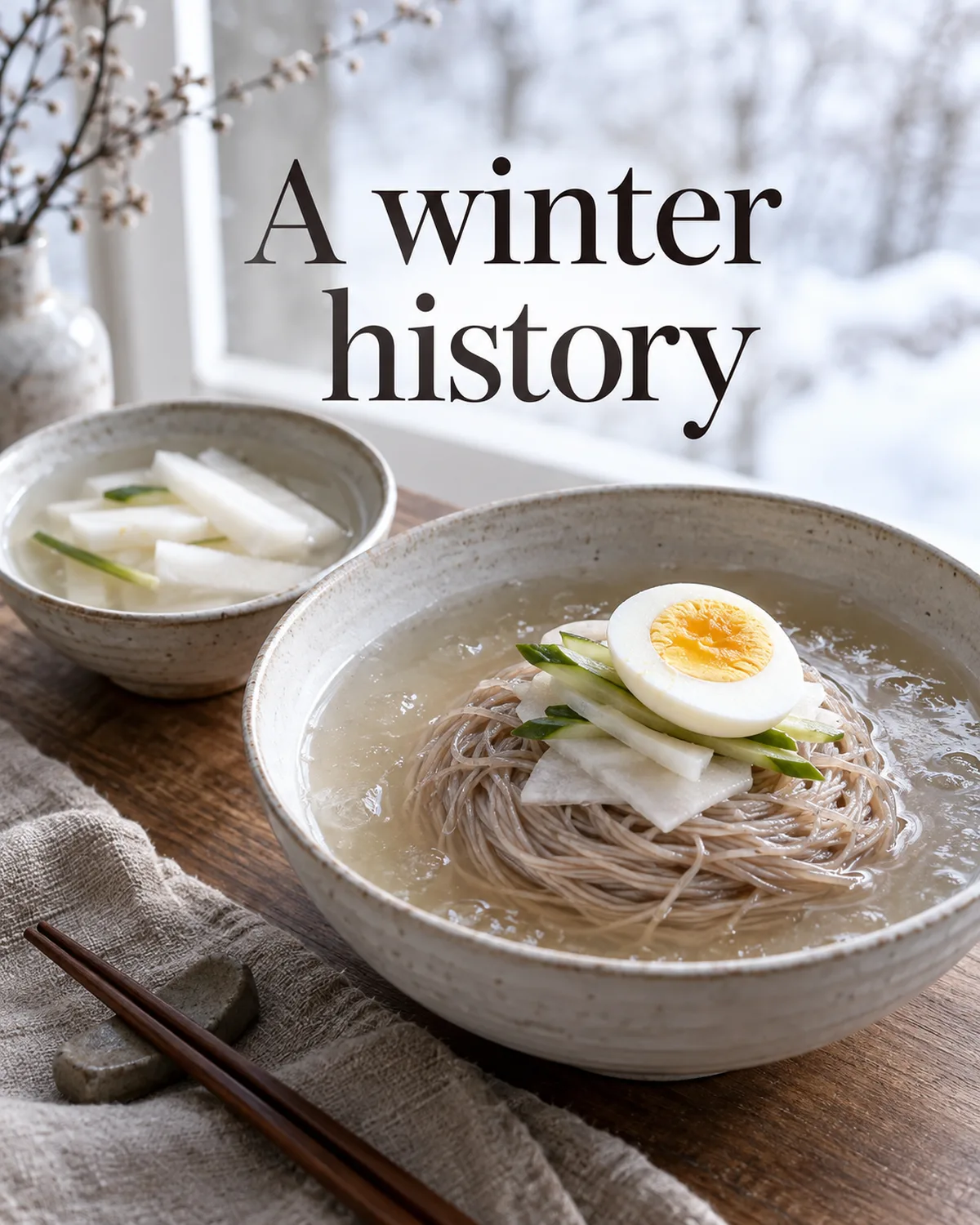
A winter history behind a cold bowl
The Academy of Korean Studies describes naengmyeon as noodles in chilled liquid and discusses Pyongyang, Hamhung and Jinju regional forms. Its entry records buckwheat-and-starch noodles, several meat or kimchi-based broth options and garnishes that can include meat, vegetables and egg.[1]
Mul naengmyeon means the broth format; bibim naengmyeon means the mixed-sauce format. Pyongyang and Hamhung refer to regional associations. These are two different ways to describe a bowl: a menu offering mul and bibim does not automatically promise two exact historical city recipes.
The same encyclopedia identifies naengmyeon as a historical winter specialty and cites Dongguk Sesigi among the records. Korea.net’s 2017 recipe feature connects the winter custom with dongchimi radish brine and the winter-solstice period. These accounts support winter associations, not an exact date when cold noodles were invented.[1], [3]
Winter radish brine belongs to the documented story.
The encyclopedia’s Pyongyang entry describes a relatively mild food tradition, buckwheat noodles mixed with starch, and a broth blending meat stock and dongchimi. It mentions older pheasant stock and later beef and bone stock. Its recipe is one documented preparation, not a universal ratio every restaurant must use.[2]
Taste a spoonful before reaching for condiments. A restrained broth lets you compare grain aroma, the savory stock and the radish-brine note. If you expect every cold bowl to be sharply sweet and sour, that quieter starting point may be the most useful discovery.
Notice the stock and radish-brine note before adding condiments.
Ask about the noodle as well as the city
Noodle composition changes the bite. Ask how the shop describes its buckwheat and starch mixture rather than guessing from the city name. A softer strand and a very elastic strand can require different amounts of chewing and different handling with chopsticks.
There is no single buckwheat percentage for this guide to prescribe. If grain flavor matters to you, ask about the noodles; if ease of eating matters, ask about their texture and whether scissors are available.
The encyclopedia associates Hamhung noodles with potato starch, pronounced chew, spicy mixing and a fish garnish such as flatfish or skate. That is a useful regional description; a particular South Korean restaurant may offer different toppings or both broth and mixed versions.[1]
Read the fish topping separately from the sauce choice. A red bowl may contain fish, beef, egg or another garnish, and its color cannot tell you whether the fish is raw, seasoned or otherwise prepared. Ask the restaurant about the actual order rather than assuming every bibim bowl contains the same thing.
The menu should explain the actual topping.
Migration and a changing season
The Pyongyang encyclopedia entry says people moving south after the Korean War helped spread the dish nationwide. Migration belongs to the history of where these noodles were served; it does not require every later restaurant to have the same stock, noodle ratio or garnish.[2]
Winter history and summer appetite can coexist. The cold serving temperature is appealing in warm weather, but the bowl’s ingredients and regional memories have a longer story. You do not need an invented year when a winter food officially became a summer food.
Mul and bibim are useful first decisions
Noodles: ask about buckwheat and starch, rather than assuming a fixed ratio.
Texture: compare a softer bite with a more elastic chew.
Liquid: check meat stock, kimchi brine and seasoning.
Topping: read the actual garnish and its preparation.
Treat these comparisons as starting questions. Ask whether the noodles are buckwheat-forward or starch-forward, whether the broth is meat-based or mixed with kimchi brine, and what garnish the menu includes. A regional label alone does not answer all three.
Cold broth: start with mul naengmyeon.
Sauce around the strands: choose bibim naengmyeon.
Grain aroma: ask about buckwheat-forward noodles.
After barbecue: check finishing portions and whether to share.
A restaurant may use the same noodles for its mul and bibim orders, or different recipes. The broth-versus-sauce decision is the quickest first choice; noodle composition is the next question when you want to compare texture.
Ask about grain and starch as well as the serving style.
After barbecue, cold noodles create a distinct change from the hot grilled meat. Decide whether you want a shared contrast or another full meal. Check whether the restaurant offers a smaller finishing portion instead of assuming every bowl is designed to be eaten after a meat order.
At a specialist noodle restaurant, the bowl can be the main event. In that setting, give the broth and strands your attention before adding other food or condiments. The same dish can play a different role in another restaurant.
Choose a portion that fits the meal.
Broth, vinegar, mustard and scissors
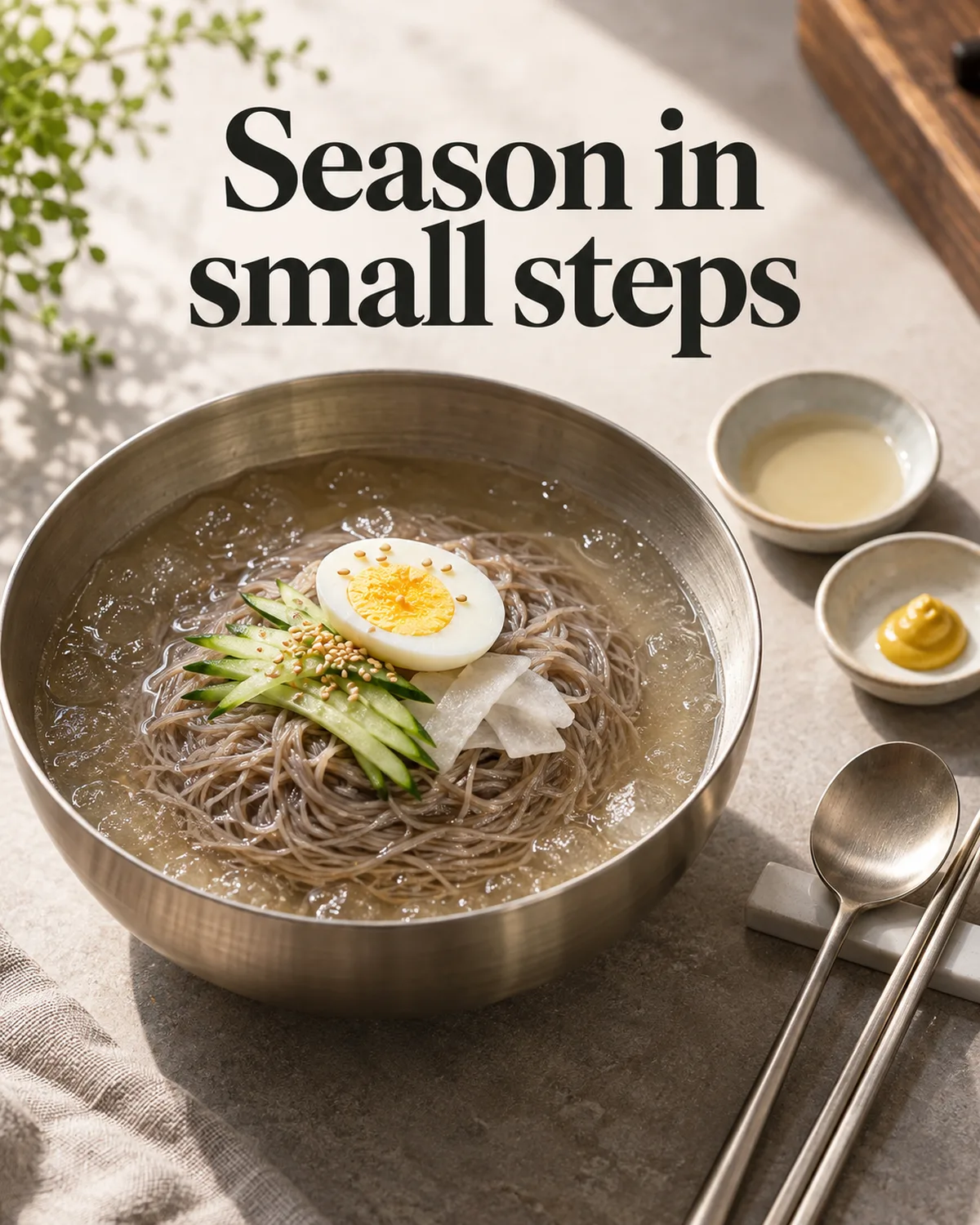
Try a spoonful of broth, then a manageable portion of noodles. Add a small amount of vinegar or mustard if you want it, and taste again. This keeps the house’s starting flavor available for comparison while leaving the final seasoning to your preference.
For bibim noodles, mix the sauce through the strands as the restaurant recommends. Taste before adding more condiments: the bowl may already have a strong balance of sweetness, acidity and heat. A little extra seasoning can change that balance quickly.
If the long strands are difficult to manage, ask for scissors or help cutting them. Take a short portion with the chopsticks instead of lifting a large tangle. The goal is to enjoy the noodle texture comfortably.
Taste first, then adjust vinegar or mustard if you want it.
If warm broth arrives separately, ask how the house serves it. It may be intended for sipping alongside the meal. Do not pour it into the cold bowl without checking, especially if you want to preserve the original broth concentration and temperature.
Check the actual noodle, broth, sauce and toppings when ingredients matter. A bowl with vegetables on top can still contain meat stock, seafood seasoning, egg, buckwheat or wheat. The menu name and the clear appearance of the broth are not a full ingredient list.
Check ingredients, then choose a portion
For a vegetarian order or a particular allergy requirement, ask about the liquid as carefully as the noodles. Request the restaurant’s ingredient information and explain the requirement before ordering; removing a visible meat garnish does not change what is already in the broth or sauce.
For the first tasting, choose mul if you want to notice the cold broth, and bibim if you want a sauce-coated bowl. Within either format, ask about the noodles and topping. That gives you a clearer comparison than choosing a city label without knowing the serving style.
Winter associations, migration and modern summer demand all help explain naengmyeon. In the bowl, the enduring choices are more immediate: grain aroma, chew, broth, sauce and the way you season the next bite.
Start with the house’s serving, taste before adjusting it and choose a portion that fits the meal. The cold bowl becomes easier to understand once the noodles and liquid have each had a chance to speak.
The modern plate seems to announce its main ingredient immediately: glossy glass noodles, with vegetables and sometimes meat woven through them. But the older history of japchae does not begin with that same noodle-centered picture.
The change makes the dish useful twice over. It explains how a court-associated name became familiar celebration food, and it helps a cook understand why the ingredients should not all be handled as one wet stir-fry.
A court nickname before a noodle-centered dish
The most useful evidence is the primary text itself. The National Institute of Korean History’s online Gwanghaegun Ilgi records Yi Chung’s death in 1619 and describes him as a man who made unusual delicacies and privately sent them to the palace. It says the king would wait for food from Yi Chung’s house before beginning to eat.
The entry then quotes a mocking verse. One line calls Yi Chung a japchae sangseo—roughly, “japchae minister.” A note explains that Yi Chung mixed vegetables with other flavors and that the taste was unusual. This is strong evidence that japchae was associated with his household and royal favor.
What the record does not say is equally important. It does not say “Yi Chung invented japchae.” It does not provide a recipe with sweet-potato glass noodles. It does not prove that royal promotion happened because one brand-new dish was created from nothing. The court document is a political obituary containing criticism and satire, not a patent certificate for a recipe.
Popular retellings often turn the Yi Chung story into a charming anecdote: a talented cook makes delicious japchae, the king loves it, and the cook rises in government. The actual record is darker and more political. Yi Chung is portrayed negatively, accused of building influence through palace connections and extravagant service. The mocking phrase about “japchae minister” is part of that criticism.
This context changes how the story should be used. The food mattered because it symbolized access and favoritism. The satirists were not writing a restaurant review. They were criticizing the relationship between court pleasure and political power.
That makes the story more useful for food history, not less. It shows that prepared food could carry social meaning inside the palace: taste, access, status and patronage could become entangled.
The name itself points toward mixture. Jap carries the sense of assorted or mixed, and chae refers to vegetables. The 1619 court note fits that logic: vegetables were combined with other flavoring elements.
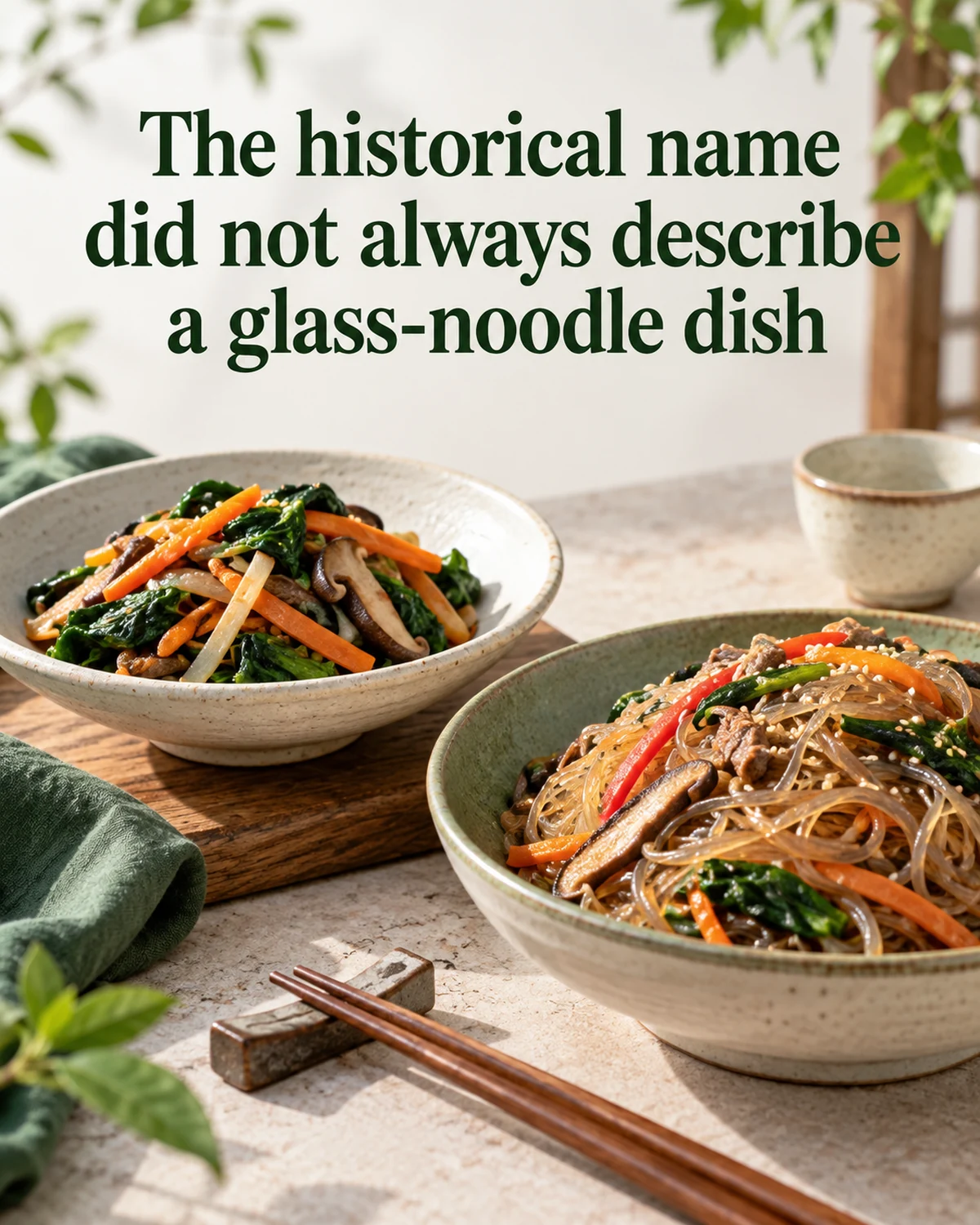
That does not mean every premodern japchae recipe was identical. Historical Korean cookery contains multiple ingredient combinations under names that shift over time. The safe conclusion is narrower: the defining feature of early japchae was not a mound of dangmyeon.
This is the crucial correction to the familiar visual image. If we picture Gwanghaegun eating the exact modern brown, translucent noodle dish, we are projecting a later ingredient system backward into the 17th century.
When dangmyeon changed the center of japchae
Modern japchae usually begins with dangmyeon (당면), translucent noodles commonly made from sweet-potato starch. Korea Tourism Organization material describes today’s dish as glass noodles combined with sautéed vegetables and meat and notes its role at festive occasions.
The historical name did not always describe a glass-noodle dish
The addition of noodles did more than add one ingredient. It changed the physical balance of the plate. Vegetables became distributed through a chewy starch matrix. Soy sauce and sesame oil could coat a much larger surface area. The dish became easier to serve in generous communal portions and could hold well enough for banquet-style eating.
That transformation is why “old japchae versus new japchae” is not simply a recipe swap. The modern version has a different center of gravity. The name persisted while the noodle became the structural base.
A historical mention is not proof of the modern recipe’s invention date
Dangmyeon do not behave like wheat noodles used in kalguksu or ramen. Their texture comes mainly from starch rather than a gluten network. When properly hydrated and cooked, they become translucent, elastic and slippery. They can absorb seasoning while retaining a distinctive chew.
Dangmyeon brings the modern dish its recognizable chew
That makes them unusually compatible with a mixed dish. Wheat noodles can become soft or clump as they sit in sauce. Sweet-potato starch noodles remain springy for longer, although they can still become too soft if overcooked or left in excess liquid.
The comparison with kalguksu is useful. Kalguksu depends on wheat dough, gluten development and a broth or sauce surrounding freshly cut noodles. Japchae depends on glass-noodle elasticity and a relatively dry coating of seasoning. They are both Korean noodle foods today, but the cooking physics are very different.
Assembly is more important than one dramatic stir-fry
A pan full of raw onion, carrot, spinach, mushrooms, beef and soaked noodles looks efficient, but it creates a control problem. Each ingredient releases water at a different rate and requires a different cooking time. If everything goes in together, spinach can collapse before carrot softens, mushrooms can steam instead of brown, and noodles can absorb diluted sauce unevenly.
Traditional and modern recipes often solve this by preparing components separately or in controlled stages. Vegetables are cut to similar dimensions, cooked until just tender, and combined after excess moisture is managed. Meat, when used, is seasoned and cooked according to its own timing. The noodles are boiled or softened, seasoned, then mixed with the prepared ingredients.
This labor is not pointless ceremony. It is texture management. Japchae is successful when the ingredients remain distinguishable even though they are served as one mixture.
Vegetables contain water. Spinach holds water after blanching. Mushrooms release moisture when heated. Onions and peppers soften and give off liquid. Noodles themselves carry water after boiling.
If all of that moisture is transferred into the final bowl, the soy seasoning becomes diluted and the noodles sit in liquid. The surface loses gloss and the dish becomes heavy. Good technique therefore includes draining, squeezing where appropriate, cooking off moisture and letting hot components cool slightly before prolonged storage.
The lesson is simple: japchae is not improved by more sauce if the real problem is excess water. Concentrated seasoning on properly drained ingredients tastes clearer than a larger amount of diluted seasoning.
Seasoning, sesame and color
Dangmyeon have relatively mild flavor on their own. That makes surface seasoning important. Soy sauce provides salt and fermented savoriness; sugar or another sweetener rounds the salt and creates the familiar sweet-savory profile; sesame oil adds aroma and helps the noodles feel glossy.
Because the noodles have so much surface area, small changes in the seasoning ratio are noticeable. Too little seasoning and the noodles taste blank. Too much soy sauce can make them salty before the vegetables have a chance to contribute flavor. Too much sugar can flatten the savory contrast.
There is no single historic royal ratio that every modern household must follow. The modern dish is a family of recipes, not a frozen palace formula.
Toasted sesame oil is one of japchae’s signature smells, but it is usually most effective when treated as a finishing or seasoning oil. Its aroma is volatile and can be lost or become harsh with prolonged high heat.
Neutral cooking oil is often better for sautéing vegetables, while sesame oil can be mixed in later with the soy seasoning. This distinction helps explain why japchae can smell strongly of sesame without tasting greasy.
The exact technique varies by household, but the principle is broadly useful: use high heat to cook ingredients efficiently, then protect aromatic ingredients that do not need long frying.
Modern japchae is often built from contrasting colors—dark mushrooms, green spinach, orange carrot, pale onion, brown seasoned noodles, yellow egg garnish or red pepper. That visual arrangement is not merely decorative. Separate preparation preserves both color and texture.
Separate preparation helps preserve different ingredient textures
If spinach, carrot and mushroom are all boiled together, the colors dull and the textures converge. If each component is handled separately, the final mixture looks abundant and varied, matching the very idea of japchae as an assortment.
This also explains why japchae remains common at celebrations. It scales into a large platter, looks generous on a communal table and contains enough contrasting ingredients to feel festive even when served at room temperature.
From court association to celebration table
Korea Tourism Organization food material describes japchae as a classic festive dish served at birthdays, weddings and other celebrations. That modern social role is far removed from the political world of Yi Chung and Gwanghaegun.
The change matters. Calling japchae “royal cuisine” without qualification can make it sound as though Koreans today are reproducing a fixed palace recipe. In reality, the dish became domesticated and democratized. Its current identity comes from home cooking, banquet halls, holiday tables, restaurants and prepared-food counters as much as from court history.
That is a more interesting continuity: not one unchanged recipe moving intact through four centuries, but a prestigious name adapting until it became ordinary enough for family celebrations.
In a large Korean feast, japchae may arrive as one shared platter among many dishes. In a home meal, a smaller portion may function like a banchan. In a Korean-Chinese restaurant, japchae-bap can become a more substantial rice-based meal.
Japchae can be part of a table rather than the entire main meal
These formats change portion expectations. A traveler who orders japchae as if it were always a Western-style main noodle entrée may receive a dish intended for sharing. Conversely, a rice combination can be filling enough to stand alone.
The name therefore identifies the preparation more reliably than it identifies meal position.
Ingredients and reheating deserve separate checks
The glossy noodles and vegetables make japchae look plant-based, but beef is common in many versions. Some recipes use egg garnish. Seasoning can vary, and restaurant kitchens may use shared equipment.
A vegetarian diner should ask whether the particular dish contains meat, egg or meat-based seasoning. A vegan diner should ask separately about animal ingredients and cross-contact. Japchae can be made vegetarian very easily, but the standard name does not guarantee that version.
For soy or wheat allergies, the seasoning matters as much as the noodle. Sweet-potato starch dangmyeon may be gluten-free in principle, but soy sauce can contain wheat and noodle formulations vary by manufacturer. The package or restaurant ingredients, not the visual appearance, determine suitability.
Check the actual noodle and seasoning ingredients, not only the dish’s appearance
Overcooked noodles are the obvious problem, but vegetables can also collapse. Spinach should be tender without becoming a wet puree. Carrot should soften enough to integrate but retain shape. Mushrooms benefit from enough heat to develop flavor rather than merely steaming in accumulated water.
Meat, if used, should be sliced thinly enough to cook quickly and distribute through the noodles. Large chunks change the dish into something closer to a meat stir-fry with noodles.
The best texture comes from keeping every component close to its ideal state before the final mix. That is why japchae can be time-consuming even though none of its individual steps is technically difficult.
Cold japchae can become firm because starch-based noodles change texture as they cool. Reheating restores softness, but too much water can make the noodles swollen and mushy. Too much dry heat can make the seasoning scorch.
A small amount of oil or moisture and short, controlled reheating usually works better than prolonged cooking. If the dish already contains a lot of liquid from vegetables, extra water may not be necessary.
This practical behavior helps explain why japchae works for gatherings: it can be prepared in advance, but its final quality still depends on moisture management.
Ordering and tasting japchae
On a general Korean menu, japchae usually means the sweet-savory glass-noodle dish with vegetables and possibly beef. It is generally mild rather than chili-hot. If you want a meat-free version, ask before ordering rather than assuming.
If you see japchae-bap, expect japchae served with rice or in a rice-meal format, often in Korean-Chinese restaurants. Regional or restaurant-specific dishes can use the word japchae differently, so the ingredient list matters more than the English translation alone.
Prices and portion size vary widely by restaurant and context, so an evergreen article should not lock one national price to the dish.
Take a bite containing a noodle, a vegetable and a little of the seasoning, then compare those components separately. The point is not to hunt for the largest number of ingredients. It is to notice whether each retains enough texture to contribute to the finished mixture.
Water management explains much of that result. Vegetables release different amounts of moisture, and noodles absorb liquid differently from wheat noodles. Combining properly prepared parts near the end can preserve contrast better than forcing everything through one cooking time. Soy seasoning, sweetness and sesame aroma also have separate jobs; more of one does not necessarily correct an imbalance in another.
When ordering, ask what role the portion plays. A small side dish, a shared platter and japchae served with rice are not equivalent quantities. Meat and egg can be present even when the name emphasizes mixed vegetables, so a vegetarian request needs an ingredient check. The historical lesson and the practical one meet here: the same name can survive while the center and the function of the dish change.
The next question is how separately prepared ingredients become one everyday rice dish.
The fish in saengseon-guksu may be hardest to recognize precisely when it is doing the most work. Cooked into the broth, it gives the bowl substance rather than appearing as one neat fillet on top.
Okcheon’s river-fish noodles connect local ingredients with a changing everyday starch. Understanding that combination makes the dish more memorable than another promise of the region’s “best” bowl.
River fish came before the noodles
The geographic logic comes first. Cheongsan is crossed by Bocheongcheon, and Okcheon sits within a wider inland landscape shaped by streams, the Geum River system and Daecheong Lake. Freshwater fish were therefore a practical local resource long before a specialized noodle street existed.
Older riverside cooking centered on fish stew. People could catch small freshwater fish, clean them, cook them with chile-based seasoning and vegetables, and share the pot. Korean accounts of the region often connect this with cheollyeop (천렵), warm-weather outings in which people caught fish and cooked by the water. The precise ritual varied, but the basic ecology is clear: river access produced a cuisine in which freshwater fish was not an exotic ingredient.
What changed in the 1960s was the starch. Okcheon’s local account says noodles began to be added to the fish stew instead of relying only on rice or other ways of extending the pot. Once noodles became part of the preparation, the dish developed a distinct name and restaurant identity.
Many food stories become more dramatic when pushed backward in time, but saengseon-guksu does not need that treatment. Its modernity is part of what makes it interesting. A local fish stew encountered a period when wheat flour and thin noodles were becoming more accessible in Korean daily life. The combination was practical: noodles turned a strongly flavored broth into a complete one-bowl meal.
This is different from saying that one national flour policy “invented” saengseon-guksu. The river-fish base already existed. Nor does the 1960s date mean every household began using noodles in the same year. It is better understood as the period Okcheon’s own food history identifies as the transition from fish stew to the noodle form that became the regional specialty.
This is an inland freshwater-fish food, not a coastal seafood soup
The distinction also protects the food from a weak origin myth. A dish can have a clear development period without needing a single named inventor. Local habits often change gradually before restaurants standardize and commercialize them.
Okcheon County now formally promotes a Cheongsan Saengseon-guksu Street. The tourism site lists the street as a dedicated food destination, and the county’s broader tourism site presents the Cheongsan Saengseon-guksu Festival as one of Okcheon’s signature events.
This institutional visibility matters. A food can exist in homes for decades without becoming a destination. A cluster of specialist restaurants, a named street and a recurring festival make the dish legible to outsiders and help preserve a shared regional vocabulary.
That process is different from invention. The county did not create river-fish cooking by naming a street. It formalized an existing identity and made it easier for visitors to encounter several interpretations in one place.
Cheongsan’s identity is ecological before it is commercial. The reason the dish belongs here is not that one restaurant became viral. It is that freshwater fish were available enough to support a local repertoire, and the community had cooking practices suited to them.
This is a recurring pattern in Korean regional food. Coastal towns develop around marine fish and shellfish; mountain counties build cuisines around greens, buckwheat or potatoes; river communities develop stews, porridge and fried dishes from freshwater catch. Geography does not determine every recipe, but it sets the ingredient possibilities that cooks work with.
Saengseon-guksu makes that chain unusually visible: river → fish stew → wider flour availability → noodles → restaurant cluster → named food street and festival.
The fish becomes part of the broth
Someone ordering the dish for the first time may expect a bowl with obvious fillets floating among noodles. That is not necessarily what arrives. Saengseon-guksu typically uses freshwater fish as the foundation of the broth. The fish is cooked long enough for flesh, skin and connective tissue to soften and release flavor. Depending on the restaurant, the cooked fish may be broken down, sieved, strained or otherwise incorporated so the soup becomes much more integrated than a simple fish-and-noodle assembly.
The fish is incorporated into the broth rather than displayed as a fillet
This matters for texture. A long-cooked fish broth can gain body from proteins, gelatin and suspended fine material. Gochujang, chile powder, garlic and other seasonings then build a red, savory soup around that base. The final result can feel closer to a thickened fish stew with noodles than to a clear noodle soup scented lightly with fish.
The exact fish species and processing method vary by restaurant and supply. A careful guide should not claim that every Cheongsan kitchen uses one fixed list of river fish or one identical straining method. The stable identity is the freshwater-fish broth itself.
Freshwater fish can carry aromas that diners describe as earthy, muddy or strongly aquatic. Saengseon-guksu changes that experience through long cooking and assertive seasoning. Garlic, chile, fermented paste and vegetables add their own aromas, while the fish is distributed through the broth rather than presented as a large plain fillet.
That does not mean every bowl is odorless, and “not fishy at all” is too absolute. Fish species, freshness, handling and restaurant technique all matter. But the dish’s structure explains why people who hesitate at the idea of river fish may find the bowl more approachable than expected: the fish behaves as a broth base, and the noodles give the palate something familiar to hold onto.
It is useful to taste the broth before adding extra seasoning. The first spoonful reveals whether the restaurant emphasizes chile heat, fermented depth, fish richness or a more soup-like balance.
Noodles, eojuk and a different kind of bowl
Saengseon-guksu is commonly served with relatively thin wheat noodles. That choice is structurally sensible. The broth already carries substantial body and seasoning, so a very thick, chewy noodle would compete with the soup. Thin strands absorb the red broth quickly and are easy to eat with a spoonful of liquid.
The noodle and broth carry different textures in the same spoonful
The comparison with kalguksu is useful. Kalguksu is defined strongly by the dough and cut noodle itself; regional broths surround that noodle technique. Saengseon-guksu begins from the opposite direction. Its identity is the river-fish broth, and the noodles are the later addition that turned the stew into a distinct meal.
That is why translating it simply as “fish noodles” misses the sequence. The soup is not a generic noodle broth flavored with a little fish. It is a fish-stew tradition that learned to carry noodles.
Korean river regions also have eojuk (어죽), a fish porridge in which rice or other starch cooks into a fish broth. The two dishes can overlap in ingredients and technique, and restaurants may serve both. The difference is easiest to understand at the table: saengseon-guksu foregrounds noodles as the starch, while eojuk builds toward a porridge-like rice texture.
That distinction is not a rigid national taxonomy. Local usage varies, and some preparations blur the boundary. What matters is that the same river-fish base can lead to different final structures depending on which starch is added and how long it is cooked.
This is one reason regional river cuisine deserves more than a single “fish soup” label. A community can turn the same catch into stew, porridge, noodles, fried small fish and other dishes, each emphasizing a different texture.
Dori-baengbaeng-i is a contrast, not a second soup
One bowl is enough to meet saengseon-guksu on its own terms. Begin with the broth, then lift a small portion of noodles and notice how the liquid coats them. A rich-looking soup does not mean the fish has disappeared as an ingredient, and a restaurant should answer questions about stock, seasoning and bones for the particular preparation.
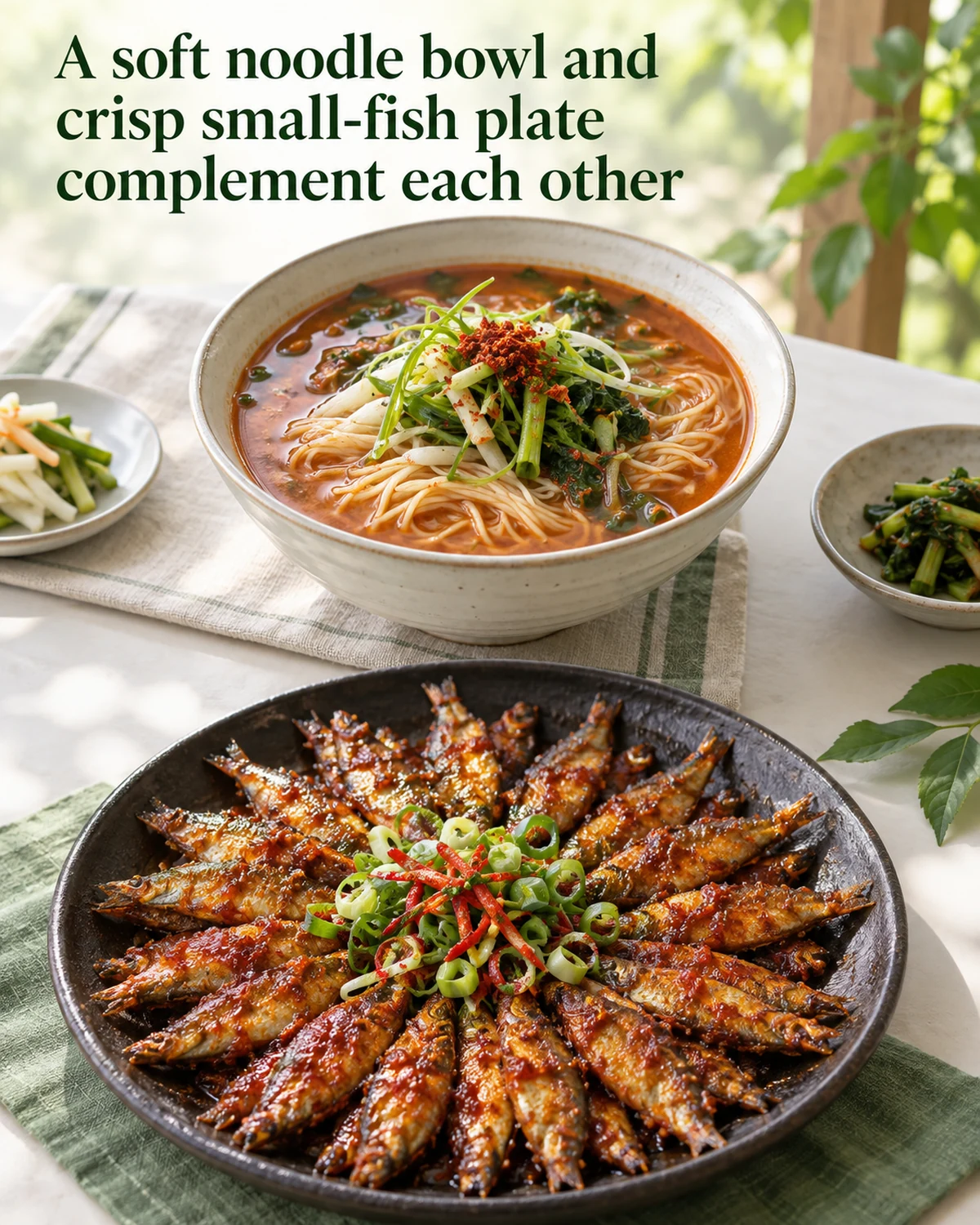
Dori-baengbaeng-i makes an interesting shared companion because it keeps small fish visibly whole and arranged on a plate. The comparison is structural: fish absorbed into soup versus fish retaining an individual shape. It does not require ordering every regional specialty at once. Ask about portion size before committing to both.
The same logic distinguishes a noodle bowl from eojuk, whose eating structure can be closer to a thick rice or porridge dish depending on the version. Local names help organize a meal, but recipes and naming overlap between businesses. Describe the bowl you expect and let the server clarify it instead of using one travel photograph as a universal specification.
Dori-baengbaeng-i (도리뱅뱅이) is one of the foods most closely associated with Okcheon alongside saengseon-guksu. Small freshwater fish are arranged around a pan, cooked until crisp and coated or brushed with a sweet-spicy chile seasoning. The circular arrangement is part of the dish’s visual identity.
The pairing is excellent because the two foods treat freshwater fish in opposite ways. Saengseon-guksu hides the fish’s original shape inside a broth; dori-baengbaeng-i puts the whole small fish in front of the diner. The noodle soup is soft, wet and integrated. The pan of fish is crisp, dry at the surface and visually explicit.
A soft noodle bowl and crisp small-fish plate complement each other
Eating them together therefore teaches more than ordering two famous local foods. It shows two techniques for the same river ecology: break fish down until it becomes broth, or preserve the fish’s shape and make it crisp.
Small freshwater fish have a high ratio of surface area to mass. When they are cooked thoroughly in oil or on a well-heated pan, moisture is driven from the exterior and the skin becomes crisp. With sufficiently small fish, the bones can also become brittle enough to eat more easily than the bones of a large fish.
Sweet-spicy seasoning is often applied after or during the crisping stage. If too much wet sauce is added too early, it can soften the exterior; when applied near the end, the sauce can glaze the surface while preserving more crunch.
Recipes vary, so diners should not assume that every version uses the same species or frying technique. The circular presentation and crisp whole-fish format are more reliable identifiers than a single fish name.
What the 1962 restaurant story establishes
Recent reporting based on Okcheon County information identifies Seon-gwang-jip (선광집) as a long-running Cheongsan restaurant that began business in 1962. That makes it an important part of the commercial history of the food street. It does not, by itself, prove that the restaurant single-handedly invented saengseon-guksu.
A restaurant can be the earliest continuously remembered specialist without being the first household ever to put noodles into fish stew. The county-level history is already sufficient: residents were adding noodles to local fish stew in the 1960s, and specialist restaurants helped turn the preparation into the regional dish known today.
For an evergreen article, this is the safer distinction: document commercial continuity without converting it into an unsupported inventor story.
Heat, bones and the ingredients to check
Usually, yes, in the sense that chile-based seasoning is a major part of the broth. But heat level varies. Gochujang can contribute sweetness and fermented depth as well as chile heat, and restaurants balance it differently with garlic, vegetables and fish broth.
If you are sensitive to spice, ask before ordering rather than relying on the color alone. A dark red broth can be rich and moderately hot rather than punishingly spicy; another kitchen may make a sharper bowl.
Preparation methods are designed to make the broth much smoother than a bowl containing intact fish pieces, but no general article should promise that every restaurant is completely bone-free. Fish may be strained or broken down to different degrees.
If bone fragments are a particular concern—for a child, an older diner or anyone with swallowing difficulty—ask the restaurant about its preparation method. Dori-baengbaeng-i, by contrast, intentionally presents small whole fish and therefore has a different texture and bone experience.
The companion dish uses a different cooking method, not another noodle recipe
The dish is not vegetarian or vegan: freshwater fish is the foundation of the broth even when no fillet is visible. Removing a garnish does not change that. People with fish allergies should avoid it.
The noodles are typically wheat-based, so diners avoiding gluten should also ask about the noodle and seasonings. Dori-baengbaeng-i likewise contains whole fish and may use wheat-containing seasoning depending on the recipe.
Recognize the dish names and ask about bones rather than assuming they vanish
There is no need to describe the bowl as a medicinal “health tonic.” It is a regional meal built from fish, seasoning and noodles. Nutritional composition changes with species, serving size, sodium level and restaurant technique.
Planning an Okcheon food stop
Cheongsan is a rural food destination, not a dense Seoul entertainment district. Specialist restaurants can have shorter operating days and hours, and schedules can change. The county’s current tourism pages are a better place to start than an old blog post with one fixed timetable.
Use the official Cheongsan Saengseon-guksu Street page to confirm the current restaurant cluster, then check the individual shop you intend to visit. Festival dates are also year-specific and should be verified from the county’s current event notice rather than treated as a permanent April weekend.
The travel time is part of the decision. Saengseon-guksu is worth seeking specifically because it is regional; that same regionality means it is better planned as part of an Okcheon or Chungcheong itinerary than squeezed into a rushed Seoul day.
Saengseon-guksu is easy to overlook because it does not have the national fame of bibimbap or Seoul kalguksu. That is exactly why it is valuable. It shows how regional Korean food develops when a local ecology meets a changing staple economy.
The fish came first. The noodles arrived later. Restaurants made the combination repeatable, and local government eventually turned the cluster into a named street and festival. Dori-baengbaeng-i preserved the visible side of the same river-food culture while the noodle bowl transformed fish into broth.
The result is not merely “a strange fish noodle soup.” It is a compact history of river access, communal fish stew, twentieth-century flour availability, restaurant specialization and regional identity—a bowl that explains Cheongsan more clearly than a generic list of attractions.
Compare the use of the fish, the noodle technique and another regional seafood pantry.
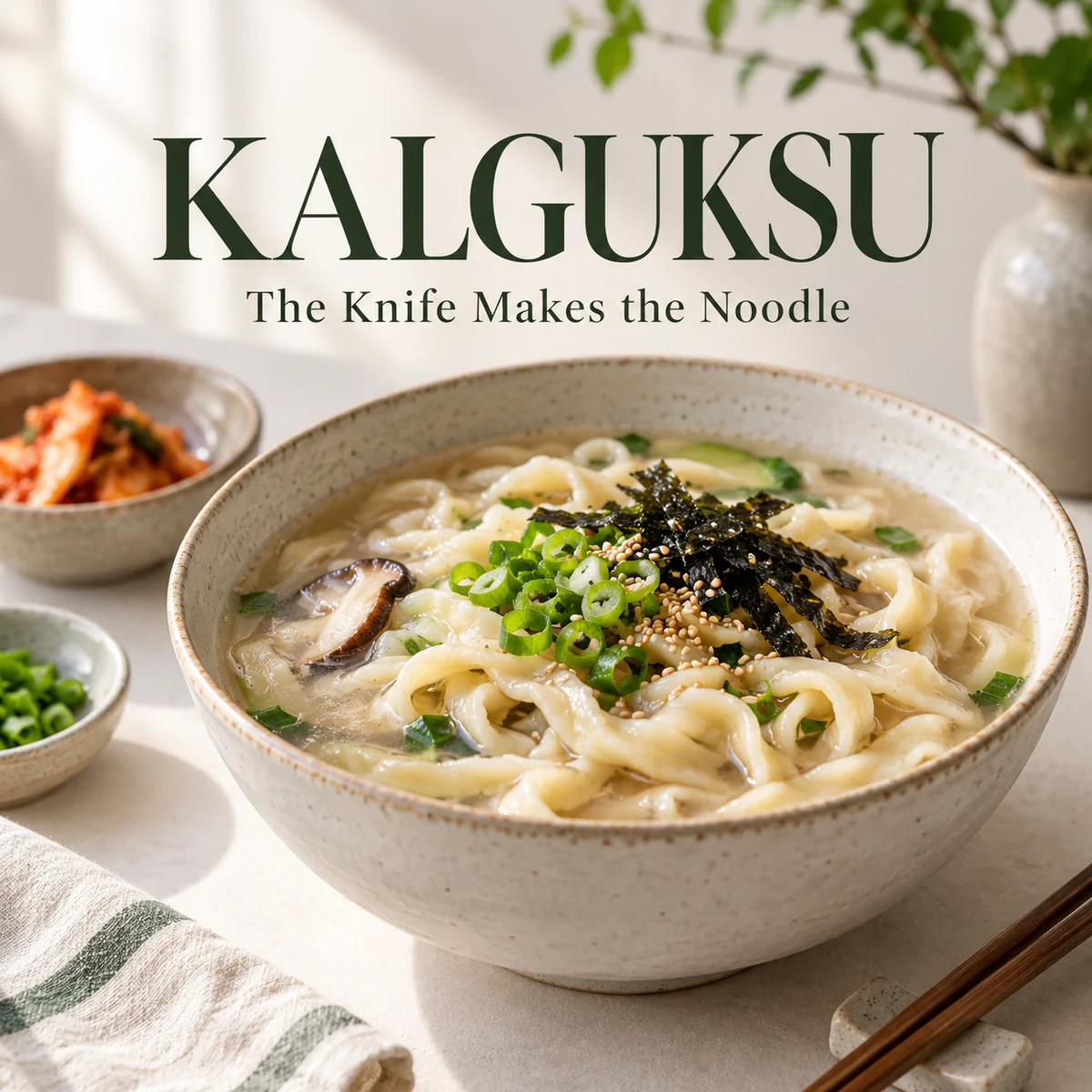
A bowl of kalguksu can be chicken-rich, clam-scented or thickened with perilla. What connects those bowls is not one broth but a name built around cutting dough into noodles.
That small distinction changes how you read the menu. Myeongdong’s famous restaurant style is one branch of a much larger family. Older Korean recipes also do not always describe the white wheat noodles that many visitors now expect.
The knife in the name
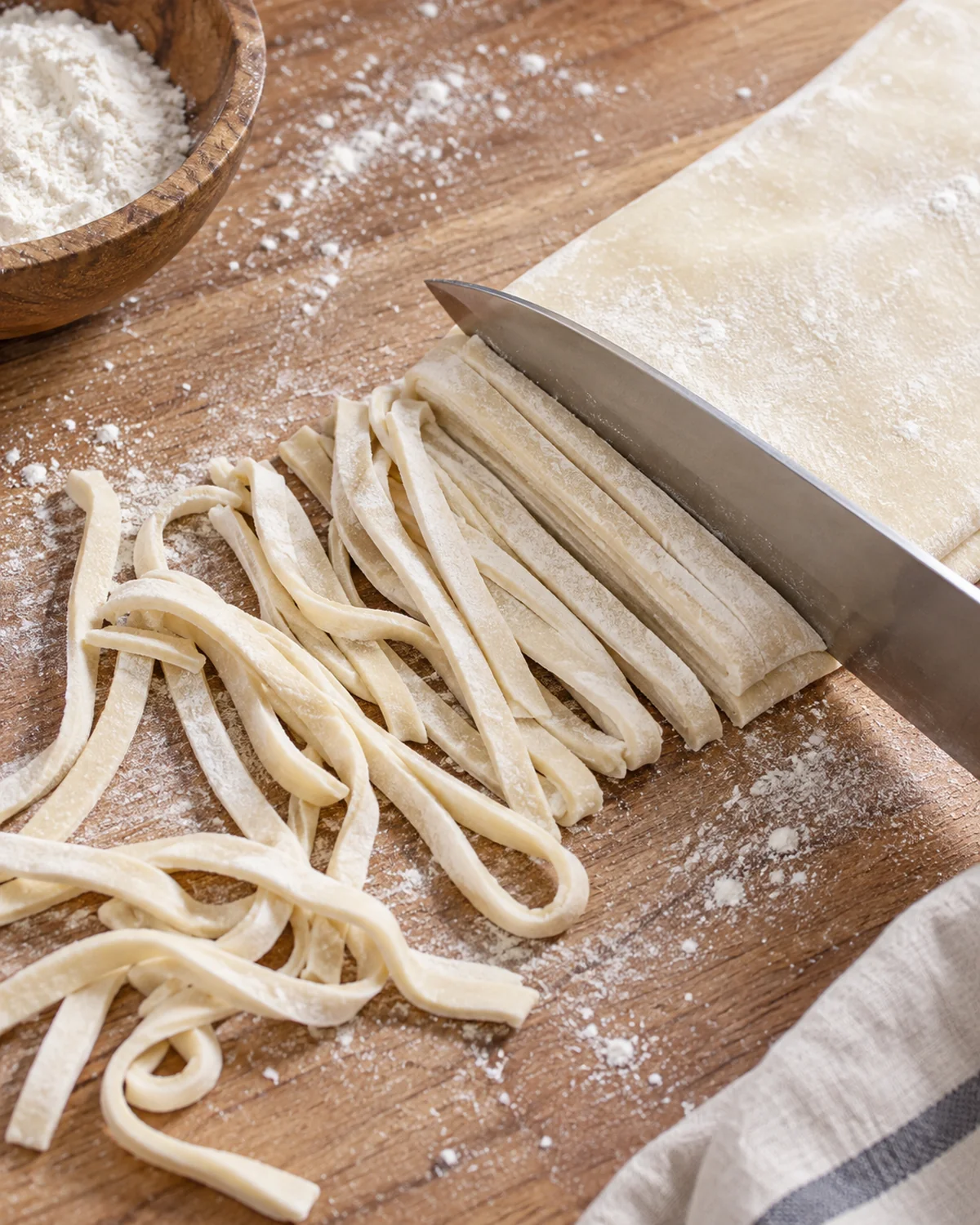
Kal means knife and guksu means noodles. In the simplest method, dough is kneaded, rested, rolled thin, folded or layered, and cut into strands. The cut noodles are then cooked in or served with broth. That knife-cut identity is the common thread.
Knife-cut describes the noodle technique rather than a single broth
Everything around the noodles can change. Broth may be based on chicken, anchovy, clam, seafood, beef or vegetables. Some versions include zucchini and potato; others emphasize shellfish, perilla seed or minced meat. The dough can differ in thickness and hydration. A restaurant can make very soft noodles while another serves a chewier strand. Kalguksu is therefore better understood as a noodle family than as one standardized soup.
Knife cutting is not only a visual tradition. Rolling and cutting dough lets a cook control thickness and width directly. Thicker noodles retain more chew and take longer to cook through. Thin noodles soften quickly and release starch faster. Slight variation in hand-cut strands means some pieces can feel softer while others keep more bite.
Dough hydration and resting matter as well. Water lets gluten-forming proteins interact; kneading develops structure; resting relaxes the dough so it can be rolled without springing back too aggressively. Flour dusted between folded layers prevents the cut strands from sticking before they enter the pot.
Once the noodles cook directly in broth, loose starch thickens the liquid. That is one reason kalguksu broth can feel more substantial than a clear soup poured over separately rinsed noodles.
The cultural name describes the noodle tradition. Modern restaurants may use dough sheeters, cutting machines or partially standardized production while still serving a dish recognized as kalguksu. Some shops visibly hand-roll and hand-cut; others prioritize consistency and volume.
This matters because authenticity claims can become theatrical. A slightly irregular strand can be evidence of hand cutting, but perfect uniformity does not automatically make a bowl culturally illegitimate. The defining family resemblance is the flat cut-noodle form and how it works in broth, not a certification system for each noodle.
Buckwheat, wheat and the changing noodle dough
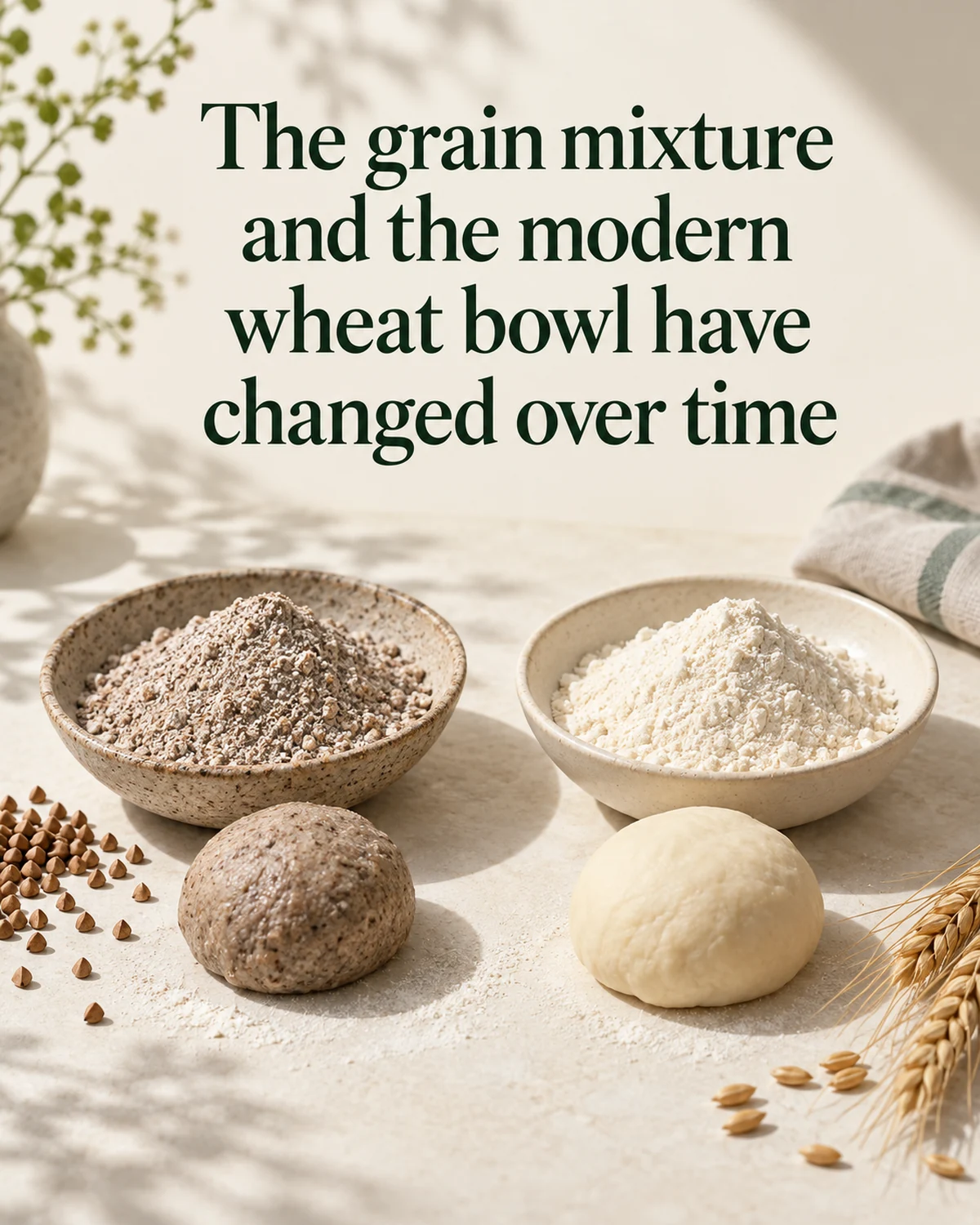
The Academy of Korean Studies traces an early knife-cut noodle preparation to the Joseon cookbook Gyugonsiuibang, where the dish appears under the name jeolmyeon (절면), literally “cut noodles.” The significant detail is the flour composition: the older recipe used buckwheat as the main flour and mixed in wheat flour as a binder.1
Another historical recipe cited by the Academy also relies on buckwheat, using water from cooked glutinous rice in the dough. Those examples show that the knife-cut method is older than the modern expectation that kalguksu must begin with a bag of white wheat flour.
The grain mixture and the modern wheat bowl have changed over time
This is an important correction because visual continuity can be deceptive. A bowl of modern kalguksu looks “traditional,” but the availability and relative price of grain changed across centuries. Technique can persist even as the ingredient ratio changes.
The Academy of Korean Studies cites the medieval text Goryeodogyeong to explain that wheat was scarce enough in Korea to be imported and expensive. That does not mean no Korean ate wheat noodles. It means wheat flour occupied a different economic position than it does in a modern urban restaurant.
If an ingredient is relatively scarce, cooks stretch it, reserve it, combine it with other grains or use it in contexts where its value makes sense. Buckwheat, which grows well in conditions that are difficult for some other grains, was an important noodle grain in many Korean regions. Mixing wheat into buckwheat dough could improve binding while still reflecting the relative scarcity of wheat.
That historical reality is more informative than repeating unsourced claims that kalguksu belonged to one exact ceremony or one social class. The evidence securely supports scarcity and older buckwheat-heavy formulations; more specific claims about weddings, birthdays or harvest feasts require their own documentation.
The Academy of Korean Studies also cites twentieth-century cookbooks in which kalguksu is made much more like the noodles recognized today: wheat flour mixed with water and salt, kneaded firmly, rolled thin and cut. Some older modern recipes boiled the noodles separately, rinsed them in cold water and then added clear broth.
Contemporary kalguksu is often cooked directly in the broth. That cooking method releases some surface starch into the soup, making the liquid slightly cloudy and giving it a thicker, more integrated texture. The noodles and broth become part of the same cooking system rather than two components assembled at the end.
This difference shows why “traditional” is not one frozen point. Even within the wheat-flour era, technique shifts between boiling separately and cooking directly in broth.
Modern kalguksu depends on a condition that earlier cooks could not take for granted: wheat flour that is widely available and affordable enough to form the main body of the meal. The twentieth century transformed the place of wheat in Korean diets, but that broad change should not be reduced to one unsupported sentence such as “U.S. food aid invented modern kalguksu” or “government flour policy created the dish.”
Those policies and postwar grain flows are important subjects in Korean food history, but they need dedicated sources. For this dish, the safer conclusion is narrower: as wheat became more available, a noodle technique that had previously accommodated expensive wheat and buckwheat could become a routine wheat-flour restaurant food.
That is enough to explain why the same name can connect historically different bowls without pretending that one policy created a centuries-old technique.
Myeongdong is a style, not the starting point
MICHELIN documents Myeongdong Kyoja as a family-run restaurant operating since 1966. That date is important because it anchors a famous modern Seoul expression of kalguksu. It does not place the restaurant at the beginning of the dish’s history; Joseon-era written evidence is much older.
The restaurant became influential because its bowl is distinctive. Myeongdong Kyoja is associated with a richer chicken-based broth, soft noodles, minced-meat topping and intensely garlicky kimchi, along with mandu as another signature item. The combination is different from the lighter anchovy or seafood broths many diners encounter elsewhere.
Myeongdong is a branch of kalguksu, not the whole noodle family
Its historical role is therefore best described as modern urban institution, not inventor. It made one Seoul style famous enough that international visitors sometimes mistake the Myeongdong bowl for the national definition of kalguksu.
Travel around Korea and kalguksu changes with local ingredients. Coastal areas may use clams or mixed seafood. Inland bowls may use chicken or anchovy broth. Perilla-seed versions become nutty and opaque. Some soups are clear and light; others are thick with starch or ground seeds.
The common noodle technique allows the broth to express place. This makes kalguksu structurally different from a dish defined by one sauce or one topping. The noodles create a canvas, and the local broth supplies much of the regional identity.
A useful comparison is with Okcheon saengseon-guksu, where river-fish broth gives a noodle dish a completely different regional logic. The existence of such variations is why no famous Seoul shop should be treated as the sole authentic template.
Broth is the other half of the bowl
When fresh flour-dusted noodles are cooked directly in soup, starch leaves the noodle surface and disperses into the broth. That starch increases viscosity and reduces clarity. The cloudiness is therefore not necessarily a sign of heavy fat or dairy; it can be a natural consequence of cooking fresh noodles in the serving broth.
Starch can cloud a noodle broth without making it a bone soup
The effect varies with how heavily the noodles are floured, how much they are agitated, how concentrated the broth is and whether the cook boils them separately. A very clear kalguksu and a cloudy one can both belong to the category.
Think of a kalguksu menu in two layers: the cut noodle and the liquid around it. Words for clams, chicken or perilla tell you about the second layer. A photograph of pale broth cannot reliably tell you whether it contains seafood, meat or a seed-based addition. Dietary questions should address the stock and seasonings as well as visible toppings.
At the table, taste a little broth before adding strong kimchi or condiments. Then compare a strand near the surface with the broth it carries. Thickness, surface starch and cooking time all affect the experience, so “knife-cut” is more useful as a technique description than as a promise that every strand was sliced moments before your order.
Restaurant age and dish age also need separate labels. A restaurant can have an important modern history without inventing the whole category. Use a named shop to understand one version, then use the broth modifiers to explore another; that is a more revealing comparison than trying to crown one bowl the only authentic kalguksu.
Taste the noodles before the kimchi
Start with the noodles and broth before eating much kimchi. This establishes the baseline: noodle softness, chicken depth, starch level and seasoning. Then eat the kimchi in small bites alongside the soup.
Taste the broth and noodle first; add contrasting kimchi afterward
Myeongdong Kyoja is famous for very garlicky kimchi. That pungency is part of the restaurant’s identity, but garlic and chile can overwhelm subtle broth if added or eaten in large quantities immediately. Alternating bites preserves the contrast better than treating the kimchi as a compulsory flavor booster.
Mandu pairs naturally with kalguksu because the dumpling provides a firmer wrapper, meat filling and different texture. It is a classic companion at the restaurant, not a requirement for understanding the noodle dish itself.
Many versions are not chile-hot, especially clear anchovy, clam or chicken broths. But “mild” does not mean flavorless. Garlic, black pepper, fermented kimchi, seafood salinity and concentrated stock can all create strong flavor without red chile broth.
Restaurants may also serve spicy versions. The broth style, not the word kalguksu itself, determines heat level.
Kalguksu is strongly associated with warmth and comfort, but there is no rule that it belongs only to winter. Hot noodle shops operate through Seoul summers, and restaurants can pair them with seasonal cold noodles or other menus. The appeal is partly practical: a bowl combines starch, broth and toppings in one filling format.
Weather changes how the dish feels, not whether the dish remains culturally appropriate.
Check the stock, then the restaurant details
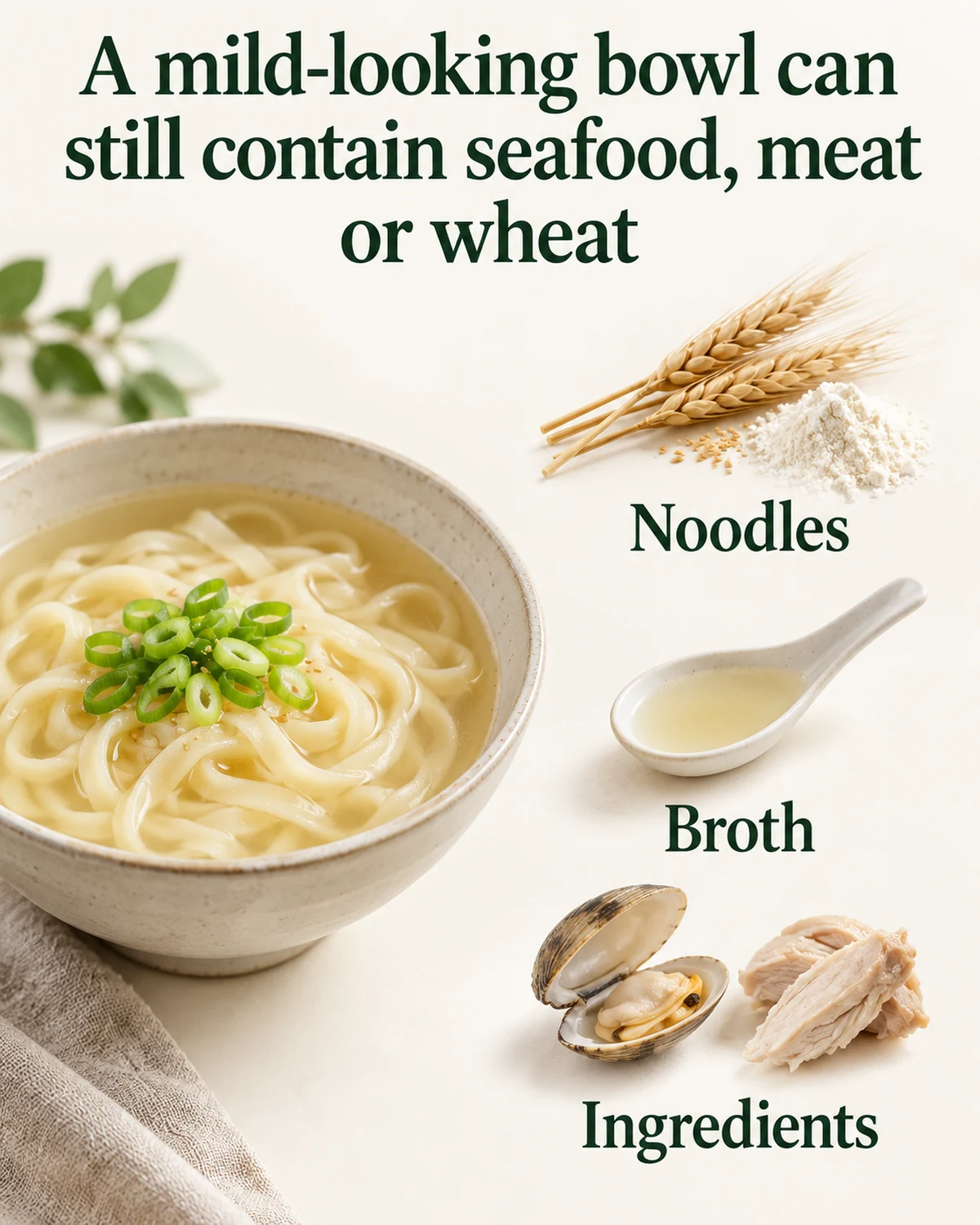
Kalguksu is not vegetarian by default. Wheat noodles themselves can be simple flour-and-water dough, but the broth may contain anchovies, clams, chicken, beef or other animal ingredients. Toppings and kimchi can also contain animal-derived seasonings.
A mild-looking bowl can still contain seafood, meat or wheat
If you need a vegetarian or vegan meal, ask about the broth first. Removing visible meat from the top does not change an anchovy, seafood or chicken stock underneath.
For a planned visit, verify the restaurant’s current information close to the day you go. The history of the noodle does not expire; practical logistics do.
Kalguksu looks like a simple continuity story: Koreans cut noodles with a knife long ago and still do it today. The documentary record reveals something more useful. Older recipes relied heavily on buckwheat because wheat had a different economic value. Later wheat-flour recipes moved closer to the modern noodle. Contemporary restaurants then developed highly recognizable regional and urban broths.
The continuity is the technique; the change is the ingredient economy and the restaurant culture around it. Myeongdong Kyoja belongs near the end of that timeline as a 1966 Seoul institution, not at the beginning as an inventor.
That sequence—scarce wheat, buckwheat-heavy cut noodles, increasingly wheat-based modern dough, then diverse regional broths and urban specialists—explains far more than calling kalguksu an “ancient comfort food.”
The next comparison can stay with noodles or move to the food city around the bowl.
Bibimbap (비빔밥) is often introduced as the perfect summary of Korean food: rice, seasoned vegetables, meat, egg, gochujang and sesame oil mixed into one bowl. That description is useful, but it can hide the most interesting part of the story. Bibimbap is not one fixed recipe, and Jeonju’s fame does not prove that the entire category was invented there. The stronger historical picture is more nuanced: mixed-rice practices have a long written record, several origin explanations coexist, and Jeonju became the city that most successfully turned one regional style into a national culinary reference point.
That distinction changes how the bowl should be read. Instead of asking, “Who invented bibimbap?” it is more useful to ask three separate questions: when does mixed rice become visible in the documentary record, why are there several competing origin stories, and what exactly did Jeonju add to the dish’s identity? Once those questions are separated, Jeonju bibimbap becomes more than a colorful tourist meal. It becomes a case study in how a flexible household method can be formalized into a regional specialty.
Bibimbap is a method before it is a recipe
The name gives away the basic logic. Bibim refers to mixing; bap is cooked rice. The category therefore begins with an action rather than a mandatory ingredient list. A home bowl might combine rice with leftover namul, kimchi, egg and a little sauce. A restaurant version can be far more elaborate, with individually seasoned vegetables, beef, egg, mushrooms, jelly, nuts and carefully prepared condiments arranged for visual impact before the mixing begins.
This is why rigid definitions often fail. Beef is common but not universal. Egg is common but not universal. Gochujang is strongly associated with modern bibimbap, yet the history of mixed rice is older than today’s standardized red-sauce image. Stone bowls, brass bowls and ordinary ceramic bowls all appear. The shared principle is that separate components are brought together over rice and deliberately combined before eating.
That also explains a small cultural misunderstanding. The unmixed bowl is often the most photogenic moment, especially in Jeonju, where the toppings may be carefully arranged by color. But the visual arrangement is not the endpoint. The dish only becomes bibimbap in the fullest practical sense when the components are mixed so that sauce, sesame oil, vegetables and rice stop behaving as separate bites and become one composite flavor.
The arranged bowl is only the starting point. Mixing is the defining action.
The written record is old enough to matter, but not simple enough to name one inventor
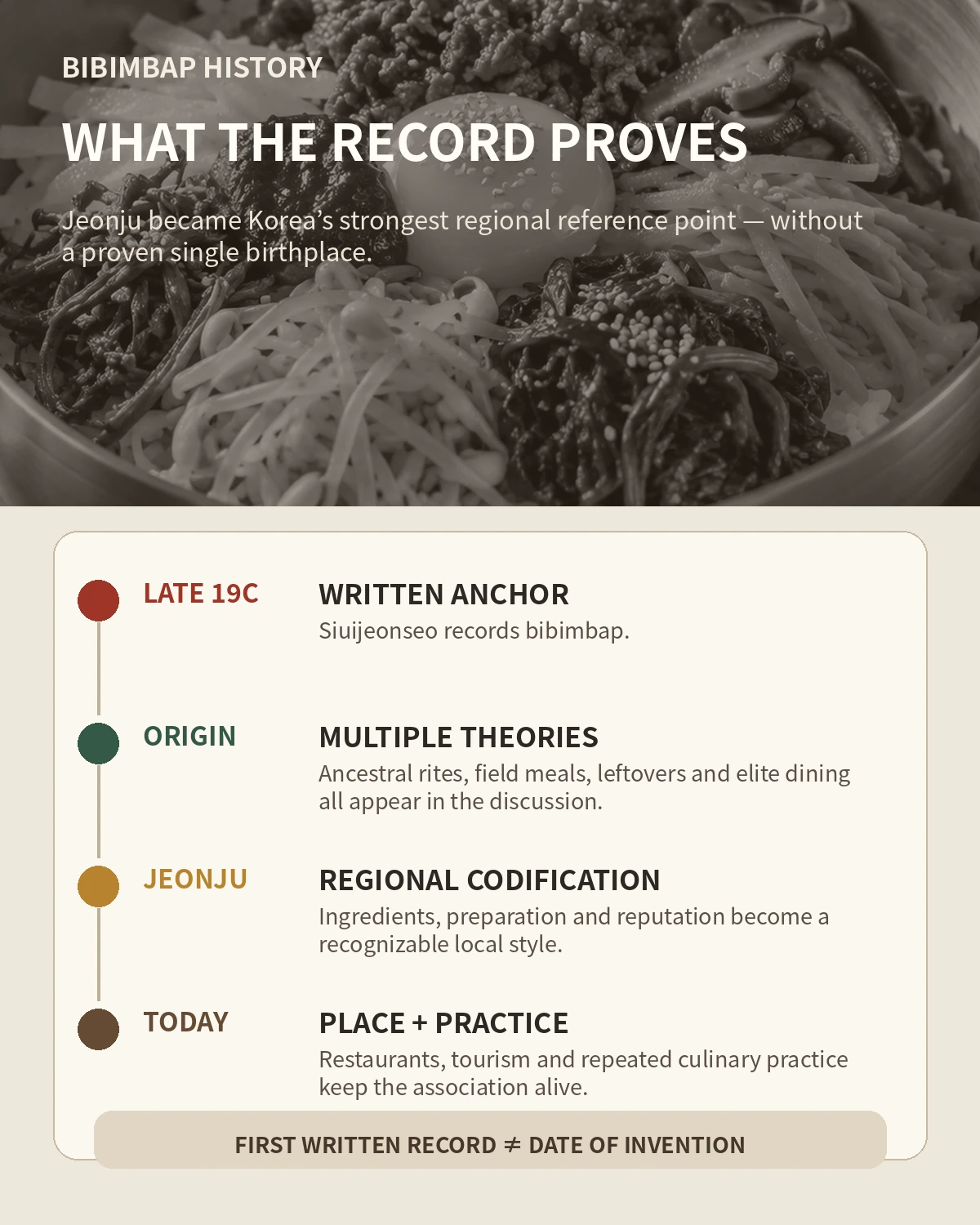
The Academy of Korean Studies notes that bibimbap appears in the late nineteenth-century cookbook Siuijeonseo. Older terminology also survives in discussions of mixed-rice traditions, including goldongban (골동반), while court usage included the shorter term bibim. This documentary evidence matters because it gives the dish historical depth without requiring a dramatic invention scene.
A late nineteenth-century written appearance does not mean people began mixing rice only at that moment. Cookbooks usually record practices after they are already familiar enough to describe. At the same time, an older mixed-rice term does not prove that every earlier bowl was identical to modern Jeonju bibimbap. The safest conclusion is that mixed-rice practices were established by the time they entered the surviving written record, while the modern regional form developed through later culinary refinement.
This is a useful place to resist a common food-history shortcut: the first written record is not automatically the date of invention. It is simply the earliest documentary anchor available in the sources used here.
The written record gives bibimbap history, but it does not identify one uncontested birthplace.
Why bibimbap has several origin stories
Korean scholarship preserves multiple explanations for how bibimbap may have developed. Theories connect the dish to food from ancestral rites, to royal or upper-class dining, to farmers who needed a practical meal during busy agricultural work, to the efficient use of leftovers, and to particular regional or political events. The updated Academy of Korean Studies entry on traditional Jeonju food explicitly notes that the history and origin are difficult to determine because several theories coexist.
The theories are not mutually absurd. They describe situations in which mixing rice and prepared side dishes would make practical sense. After an ancestral rite, multiple foods might be combined for eating. During field work, a one-bowl meal could simplify serving. At home, leftovers could be reused efficiently. Elite kitchens could also produce more composed versions. A flexible method can emerge in more than one social setting without a single inventor.
That is why the most responsible history does not select one attractive theory and call it settled fact. Bibimbap’s uncertain origin is not a weakness in the story. It reflects the nature of a food built from a broadly useful technique—put rice and prepared ingredients together, season them, and mix.
Jeonju can be the most famous city for bibimbap without being the proven birthplace
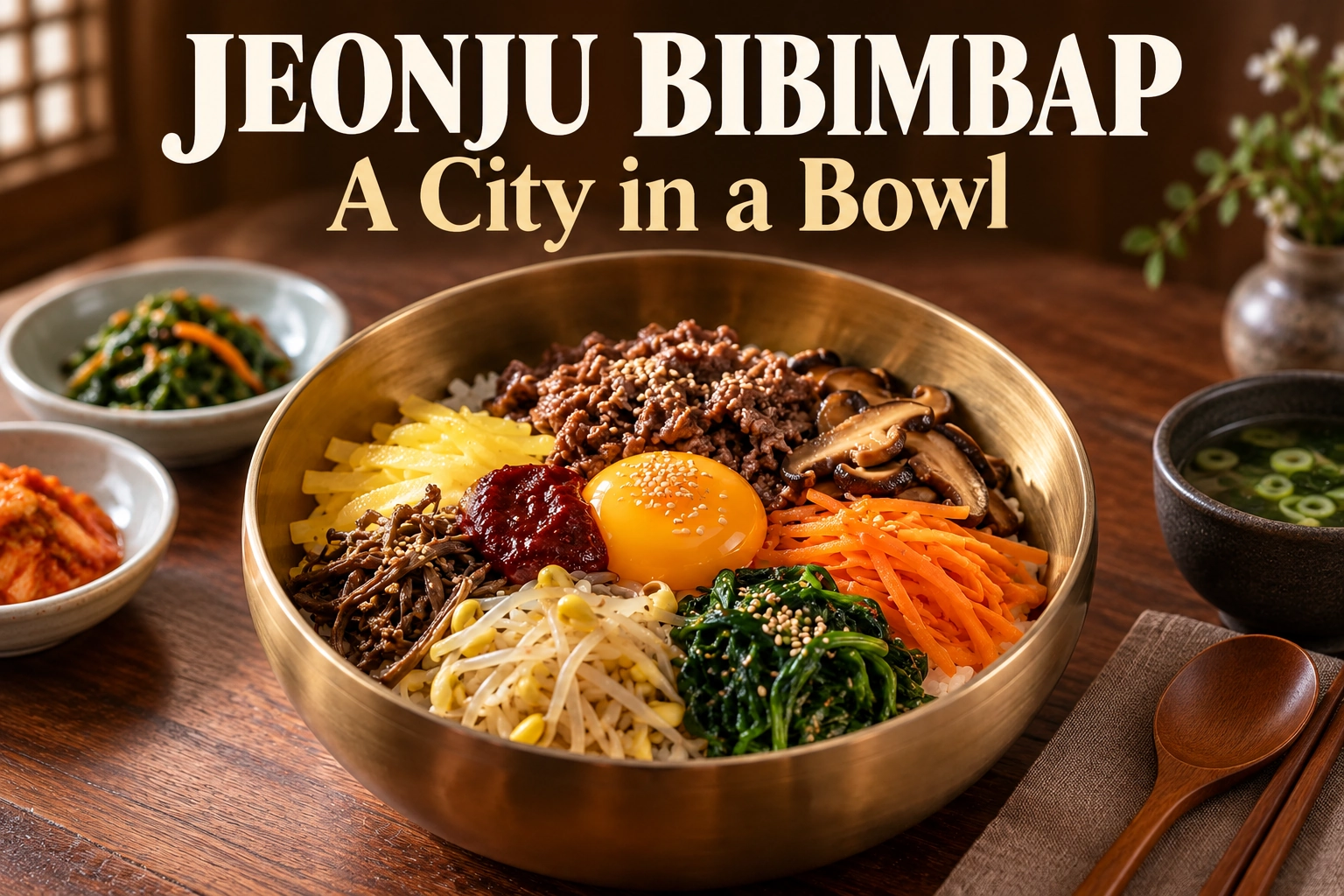
Jeonju’s importance is much easier to establish than a birthplace claim. Korean reference works identify Jeonju bibimbap as a representative regional food, and Jeonju’s own tourism material treats it as a defining part of the city’s culinary identity. The city is associated with an especially elaborate form in which ingredients are prepared separately and assembled with attention to texture, color and seasoning.
This distinction matters because “home of” language in tourism is often read literally. A city can become the cultural capital of a dish by refining it, standardizing expectations, supporting specialist restaurants, preserving craft knowledge and repeatedly presenting the food as part of local identity. None of those achievements requires proof that nobody elsewhere mixed rice before Jeonju did.
Jeonju’s contribution is therefore best understood as regional codification and reputation. The city made a flexible national food legible as a distinctive local style. That is a more defensible—and more useful—claim than saying bibimbap was simply “invented in Jeonju.”
What makes Jeonju bibimbap distinctive
Jeonju bibimbap is associated with a more composed ingredient system than an improvised home bowl. The Academy of Korean Studies lists components such as soybean sprouts, hwangpomuk, gochujang, beef or yukhoe, sesame oil and egg among the ingredients that strongly shape the regional style. Jeonju tourism material likewise emphasizes rice cooked with beef-bone broth, crunchy Jeonju soybean sprouts, yellow muk, fermented gochujang and soy sauce, and a large variety of toppings.
The number of ingredients is less important than the treatment of them. Vegetables are not simply dumped into the bowl raw. Many are blanched, seasoned, sautéed or otherwise prepared separately. Beef may be cooked or served as yukhoe, depending on the version. Sauces contribute sweetness, salt, fermentation and chile heat. Sesame oil supplies aroma and helps carry flavor across the rice. The final bowl is a system of individually prepared parts designed to become coherent only after mixing.
That preparation model explains why Jeonju bibimbap can feel very different from “refrigerator bibimbap,” even though both belong to the same family. One celebrates improvisation; the other makes the ingredients themselves part of the destination experience.
Jeonju bibimbap is distinguished less by a fixed topping count than by how individual ingredients are prepared and balanced.
The bean sprouts are not a decorative topping
Soybean sprouts, kongnamul (콩나물), are central to Jeonju’s food identity. They matter in bibimbap, but they also appear in another major Jeonju specialty, kongnamul-gukbap, bean-sprout soup with rice. Seeing the same ingredient across multiple dishes is more revealing than treating it as one more color on top of the bowl.
In bibimbap, bean sprouts contribute moisture, crunch and a clean vegetal flavor that survives mixing better than very soft greens. Their structural role becomes clearer once the bowl is stirred: they keep the rice from becoming texturally uniform. A good mixed bowl is not supposed to become paste. It should still contain contrast—soft rice, resilient sprouts, tender greens, chewy mushroom or jelly, and richer beef or egg.
This is one reason Jeonju’s version is best understood as part of a regional ingredient culture, not merely a restaurant plating style. The same city that became famous for bibimbap also built other iconic dishes around bean sprouts.
Hwangpomuk adds a specifically Jeonju clue
Hwangpomuk (황포묵) is yellow-tinted mung-bean jelly associated with Jeonju cuisine. The Academy of Korean Studies describes it as a form of cheongpomuk, mung-bean starch jelly, colored yellow with gardenia. Its mild flavor is less dramatic than gochujang or sesame oil, but its texture adds another layer to the bowl.
Reference material also connects Jeonju’s hwangpomuk tradition with local water conditions around Omokdae. That local explanation is useful as regional context, but it should not be inflated into a claim that no comparable mung-bean jelly could be made elsewhere. What matters for the diner is that hwangpomuk is one of the ingredients that makes a traditional Jeonju presentation recognizable and ties the bowl to a wider local food tradition.
Soybean sprouts and hwangpomuk are especially useful clues to Jeonju’s regional food identity.
Rice itself can be part of the regional style
In simple bibimbap, plain steamed rice works perfectly well. Jeonju’s more formal style may treat the rice as another prepared component rather than a neutral base. Both the Academy of Korean Studies and current Jeonju tourism material describe rice cooked with beef broth or beef-bone broth in traditional preparations.
This changes the flavor before any topping is added. The rice carries savory depth, so the bowl does not have to depend entirely on gochujang for intensity. That is important when tasting Jeonju bibimbap: if the sauce is added too aggressively at the beginning, the subtler work already built into the rice, vegetables and sesame oil can disappear under chile paste.
How to mix bibimbap so the ingredients still matter
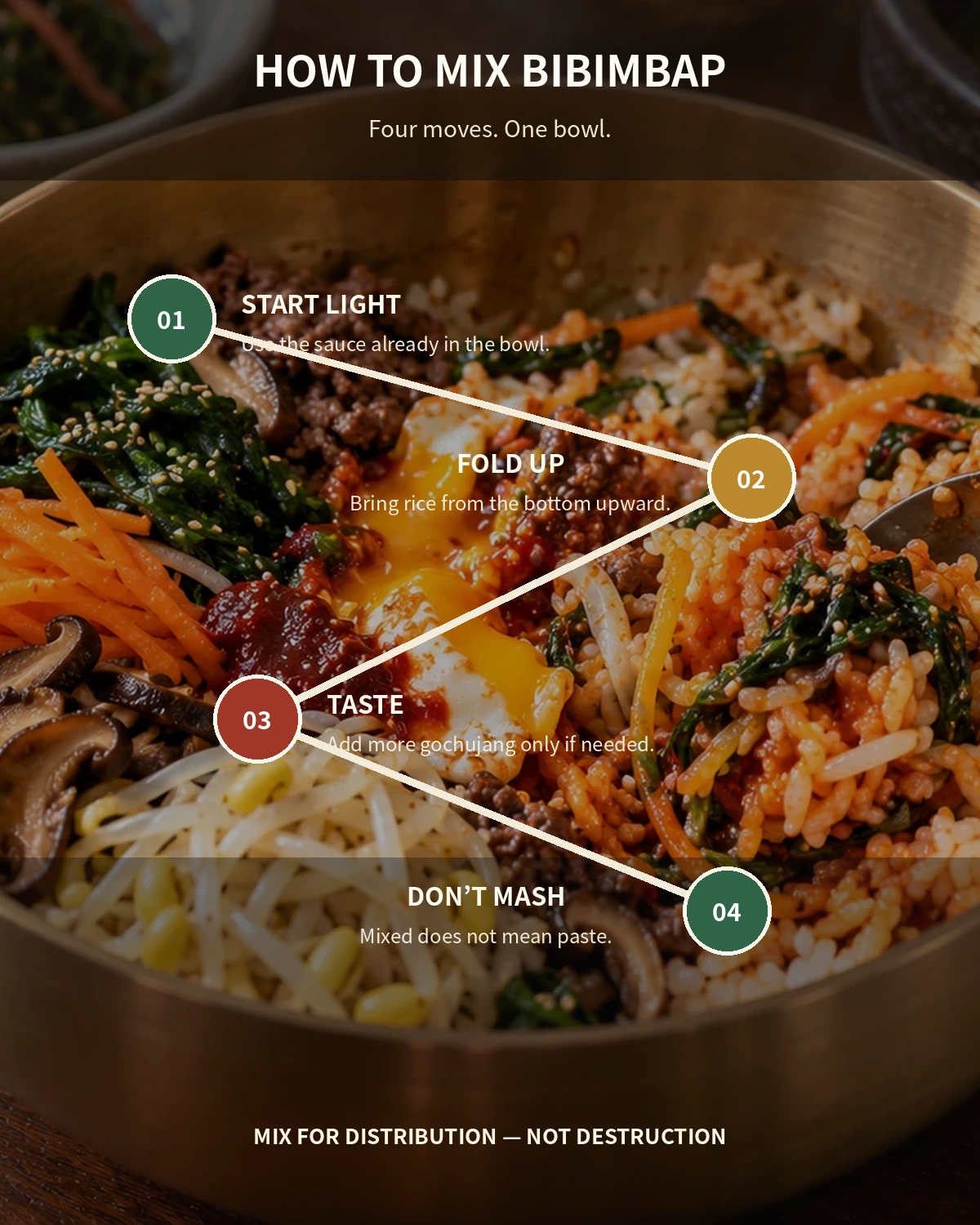
The most useful practical rule is simple: add sauce gradually. Gochujang is concentrated, salty, sweet and fermented. Too much at once can make every version of bibimbap taste like the same sauce. Start with what is already in the bowl, mix thoroughly, taste, then add more if needed.
Use the spoon to bring rice from the bottom upward and fold the toppings through it. The goal is broad distribution rather than violent mashing. Sesame oil should spread its aroma, the vegetables should season the rice, and the sauce should coat rather than pool. If a raw egg yolk or soft egg is present, it can add richness and help bind the mixture. If yukhoe is present, mixing also disperses the raw beef rather than leaving it as one concentrated bite.
The transformation is intentional. The bowl may begin as a color wheel and end looking much less orderly. That is not a failure of presentation. The visual order demonstrates the ingredients; the mixed state is the eating state.
Start with less sauce, fold from the bottom, taste, then add more only if needed.
Jeonju bibimbap and everyday bibimbap are two ends of the same idea
An everyday home version can be one of Korea’s most efficient leftover meals. Rice, two or three banchan, kimchi, egg and sauce may be enough. That flexibility is part of the dish’s enduring appeal. It adapts to what is available.
Jeonju bibimbap shows the opposite possibility: a flexible method can also become highly formalized. Instead of using whatever happens to be in the refrigerator, the cook selects ingredients for color, texture and regional identity, prepares them individually, and assembles the bowl so that the diner can see the work before mixing it away.
Both are authentic expressions of bibimbap. Treating the elaborate restaurant bowl as the only “real” version misunderstands the category, while treating the Jeonju version as merely fancy leftovers misses the craft that made the city famous for it.
Dolsot bibimbap is a vessel and cooking style, not a synonym for Jeonju bibimbap
Dolsot bibimbap is served in a heated stone bowl. The hot vessel continues cooking the rice at the table and can create a crisp layer on the bottom. That texture is the defining attraction of the style.
Jeonju bibimbap, by contrast, is a regional identity built around ingredients and preparation. A Jeonju restaurant may serve a stone-bowl version, but “dolsot” and “Jeonju” answer different questions. One tells you about the vessel and heat; the other tells you about regional culinary tradition. A brass-bowl Jeonju bibimbap can be just as representative of the city as a sizzling stone-bowl version.
Jeonju describes a regional identity; dolsot describes a heated-stone-bowl serving method.
Is Jeonju bibimbap vegetarian?
Not automatically. The colorful vegetables can make the dish look plant-based, but traditional or restaurant versions may include beef, yukhoe, egg, beef-broth rice, anchovy- or fish-based seasoning in side dishes, or other animal ingredients. Removing visible beef does not necessarily make the entire bowl vegan.
If you avoid animal products, ask specifically about the rice cooking liquid, meat, egg, gochujang or seasoning additions, and accompanying banchan. A vegetable-heavy appearance is not a reliable substitute for ingredient confirmation.
What if the bowl includes yukhoe?
Yukhoe is seasoned raw beef. It is a recognized component in some traditional Jeonju bibimbap preparations, but not every bowl includes it. Travelers who avoid raw meat should request a cooked-beef or meat-free version where available. People with health conditions that make raw animal foods higher-risk should follow appropriate food-safety guidance rather than treating yukhoe as a required authenticity test.
The important cultural point is that the regional style can accommodate both raw and cooked beef. The presence of one version does not invalidate the other.
Why Jeonju’s fame is more interesting than a birthplace claim
Food reputation is built through more than invention. It can come from ingredient networks, specialist cooks, markets, local institutions, tourism, heritage recognition and generations of diners who reinforce the association between a place and a dish. Jeonju’s bibimbap story fits that pattern.
The city’s fame is strengthened by a recognizable ingredient vocabulary—soybean sprouts, hwangpomuk, gochujang, sesame oil, beef and egg—plus a preparation style that makes each topping visible before it is mixed. Regional food scholarship and tourism materials then document and circulate that identity. Restaurants turn it into a repeatable visitor experience. Over time, “Jeonju” becomes almost a flavor descriptor.
This is a more useful model for understanding regional Korean food than searching for a single inventor. A dish can be nationally shared yet locally perfected, promoted and preserved in a way that gives one city special authority.
How to use Jeonju’s restaurant listings without freezing stale travel information
Jeonju’s official tourism site maintains a current bibimbap page with multiple restaurants and regional-food explanations. Use it to check live restaurant options instead of relying on months-old prices and opening hours. Restaurants change schedules, menus, prices and even operating status.
Use the official city page to build a shortlist close to your visit, then verify the restaurant’s current information before traveling. The history remains stable; the logistics do not. That distinction keeps the guidance useful without pretending that one checked price or opening time will remain valid indefinitely.
Quick answers
When was bibimbap first recorded?
The Academy of Korean Studies notes that bibimbap appears in the late nineteenth-century cookbook Siuijeonseo. That is a documentary anchor, not proof that the practice was invented in that exact year.
Did Jeonju invent bibimbap?
There is no settled evidence that the entire category was invented in Jeonju. Jeonju became the city most famously associated with an elaborate regional form, and Korean sources preserve several competing origin theories for bibimbap more broadly.
What is hwangpomuk?
Hwangpomuk is a yellow-tinted mung-bean jelly associated with Jeonju cuisine. The yellow color traditionally comes from gardenia.
Why are soybean sprouts important?
They are part of Jeonju’s broader food identity and appear prominently in both bibimbap and the city’s bean-sprout soup with rice. In the mixed bowl, they also provide moisture and crunch.
Should bibimbap be eaten unmixed?
No. The arrangement is meant to show the ingredients, but the defining action is mixing. Add sauce gradually and combine the components until the rice is evenly seasoned.
Is dolsot bibimbap the same as Jeonju bibimbap?
No. Dolsot describes a hot stone-bowl serving method. Jeonju bibimbap is a regional style. A Jeonju version can be served in different vessels.
Why this bowl tells a larger Korean food story
Bibimbap is often praised because many colors and ingredients fit into one bowl. Its history is more revealing for a different reason: it shows how Korean food can be both flexible and regional at the same time. The method is broad enough for a fast home meal, yet Jeonju turned the same principle into a carefully constructed specialty.
The documentary record gives the dish age without giving it one inventor. The competing origin theories explain why a simple “born here” story is too neat. Jeonju’s ingredient system explains how a city can make a shared national food feel unmistakably local. And the act of mixing explains why appearance and eating experience are intentionally different.
That combination—documented history, unresolved origin, regional refinement and a mixing technique that changes the dish at the table—is what makes Jeonju bibimbap more interesting than a list of toppings.
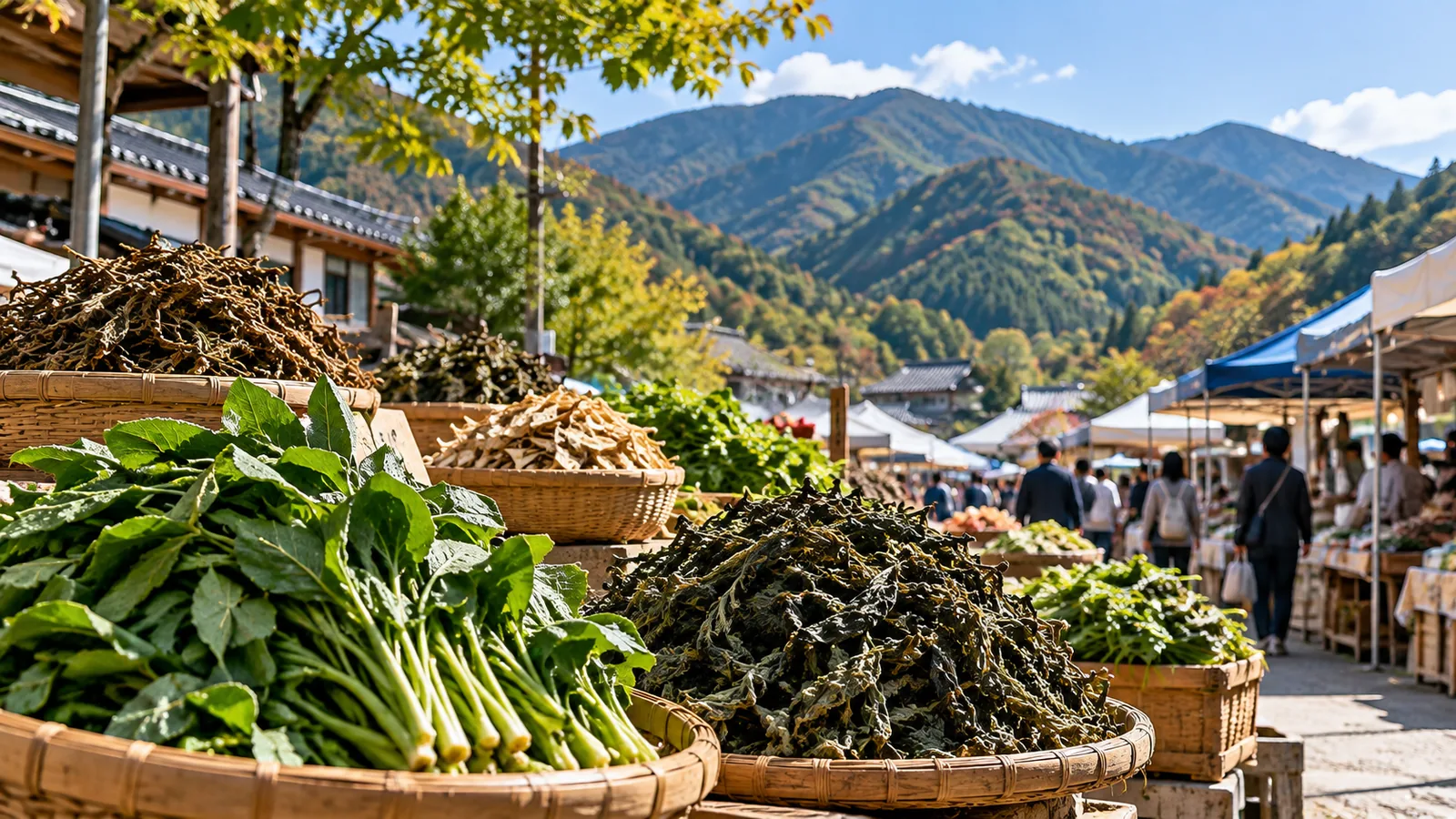
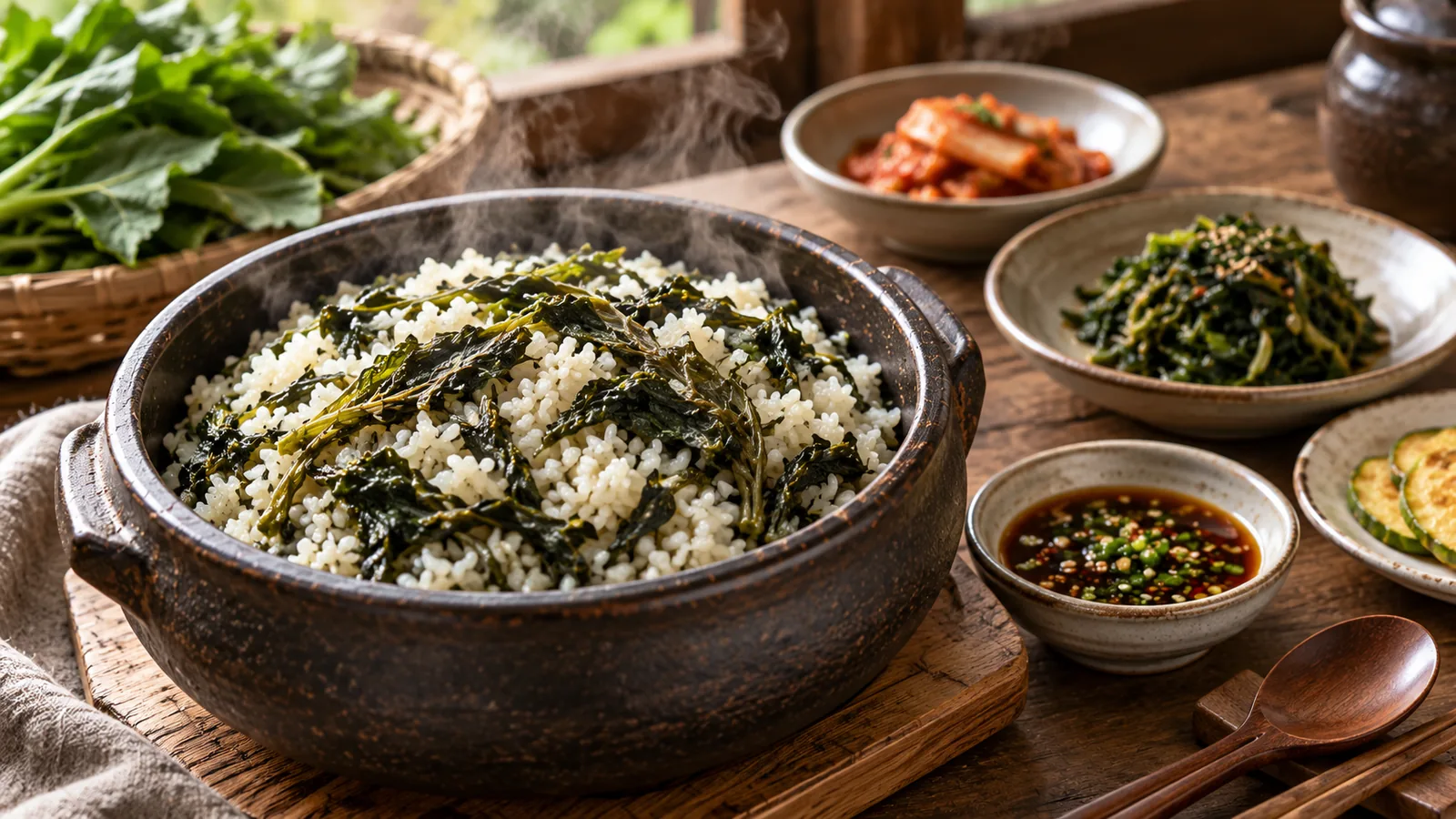
Gondeure namul bap (곤드레나물밥) does not announce itself like a festival dish. It is a bowl of rice threaded with soft mountain greens, usually served with a small dish of seasoned soy sauce. That restraint is exactly why the dish explains Jeongseon so well. The green is Cirsium setidens, known in Korean as gondeure, and government food-and-travel sources repeatedly identify it with Jeongseon’s highland landscape and market culture.
The story is stronger when it is read as a chain rather than an invention legend: mountains → edible greens → drying and storage → rice cookery → market circulation → regional identity. That chain explains why a modest plant-and-rice combination can become a place-defining food without needing a royal origin story or a precise birth date.
Gondeure namul bap hero
What exactly is gondeure?
Gondeure is the Korean common name used for Cirsium setidens. It belongs to the thistle family, but the cooked leaves are much softer and gentler than the word “thistle” may suggest to an English-speaking diner. Korea.net identifies gondeure sold in Jeongseon’s market as Cirsium setidens, while VISITKOREA describes a Jeongseon restaurant specializing in rice cooked with the same plant and notes its connection to Gangwon’s alpine environment.
In the bowl, gondeure is not used like a raw salad green. The leaves are cooked until pliable, and their character is closer to other Korean namul: vegetables or wild greens prepared so that texture, aroma, seasoning, and rice can work together. Depending on the kitchen, the greens may be seasoned before cooking or folded into the rice with relatively little seasoning so that diners can adjust the final flavor at the table.
Fresh gondeure can have a greener, more immediate herbal aroma. Dried gondeure has a different advantage: it can be stored, transported, soaked, and cooked well beyond the short period when tender fresh leaves are available. That distinction matters because Jeongseon is not simply “a place where one herb grows.” It is a mountainous region where the ability to use, dry, and carry seasonal greens is part of the logic of local food.
Fresh, dried and rehydrated gondeure
Why Jeongseon’s landscape matters to the dish
Jeongseon sits in a mountain-dominated part of Gangwon. Korea.net describes the county as surrounded by high mountains and notes that some peaks reach around 1,000 meters. The same source highlights the Jeongseon Five-Day Market as a place where visitors encounter wild greens gathered or grown in the surrounding highlands, including gondeure, chwinamul, and bracken.
That geography changes what “local food” means. In broad lowland farming districts, regional identity may be organized around rice paddies, coastal catches, orchard fruit, or livestock. In Jeongseon, mountain vegetables are unusually visible. Greens are not decorative garnish added after the main story; they are part of the story itself.
This helps explain why gondeure namul bap feels so coherent as a regional dish. Rice supplies the staple base. The mountain green supplies local character. Drying allows the ingredient to cross seasons. A savory sauce restores moisture and seasoning at the table. The result is not complicated, but every component solves a practical culinary problem.
Avoid the neat “famine food invented in the 1960s or 1970s” story
Korean food history includes the reality of boritgogae, the difficult “barley hump” period before the new grain harvest, and rural communities certainly relied on wild and cultivated greens during times of scarcity. It is therefore reasonable to discuss gondeure within a broader history of mountain foods, seasonal shortage, and household resourcefulness.
What should be treated cautiously is a much more specific claim: that modern gondeure namul bap was invented at one clearly documented moment during the 1960s or 1970s as a famine dish. The official and tourism sources used here establish Jeongseon’s highland environment, its market culture, the identity of the plant, and the modern regional prominence of the dish. They do not establish a single dated invention event.
That distinction improves the history rather than weakening it. Many everyday foods develop gradually. A region already has an ingredient, households already know how to dry and cook it, rice provides a flexible staple format, markets connect producers and customers, and restaurants later give a recognizable name and service style to the combination. A slow process can be historically more plausible than a one-line origin tale.
Rice cooked together with mountain greens
Fresh and dried gondeure do not behave the same way
The fresh-versus-dried distinction is one of the most useful details for understanding the dish at home. Fresh young leaves contain enough moisture that they soften quickly. Dried leaves first need to be rehydrated and then cooked until the fibers relax. That extra handling changes both texture and aroma.
The preservation logic is not just culinary common sense. A 2023 study on processing Cirsium setidens notes that the plant is commonly stored and distributed in dried form to extend shelf life, which helps explain why rehydration quality matters so much to the finished texture.
Drying also concentrates the plant’s smell and makes storage practical. When dried greens are soaked and simmered, some of that concentrated aroma reopens while the leaves regain flexibility. A cook then has to manage moisture: too little and the leaves stay tough; too much and the rice can become heavy or watery. This is why good gondeure bap is less about piling greens on rice and more about bringing the two ingredients to compatible textures.
The exact household method varies. Some cooks parboil or simmer rehydrated greens before adding them to rice. Others season the greens lightly with soy sauce, sesame oil, perilla oil, garlic, or other aromatics. The key point is structural: the greens are prepared so they can cook with the grain rather than sit on top as a separate salad.
Why cooking the greens with rice changes the dish
Gondeure namul bap is often translated simply as “rice with gondeure,” but that can make it sound similar to bibimbap. The difference becomes clearer when you look at where the main flavor is built.
Bibimbap generally presents rice with multiple toppings that remain visually and texturally distinct until the diner mixes them. Gondeure namul bap usually gives one green a much more central role. The gondeure is cooked with or through the rice, so its aroma moves into the grain itself. The final bowl is therefore less about assembling many contrasting ingredients and more about making one staple and one regional green taste integrated.
This also changes the role of the sauce. In bibimbap, gochujang or another mixing sauce can become a dominant seasoning. With gondeure namul bap, yangnyeom-ganjang—seasoned soy sauce—is commonly added a little at a time. It sharpens a bowl that is intentionally mild rather than covering it with a single strong flavor.
Mountain landscape and market setting associated with gondeure.
What is in the seasoned soy sauce?
There is no single universal formula, but a typical table sauce begins with soy sauce and may include chopped scallion, garlic, sesame seeds, sesame oil or perilla oil, chili, and sometimes a small amount of sweetener. The important point is not a fixed recipe. It is the service logic: the rice arrives relatively restrained, and the diner controls the final saltiness and aroma.
That is why pouring the whole sauce dish onto the rice immediately is rarely necessary. Start with a spoonful, mix, taste, and add more if needed. The rice absorbs seasoning quickly, and side dishes will also contribute salt, acidity, spice, and fermentation.
Perilla oil is particularly compatible with mountain-green dishes because its nutty, grassy aroma can reinforce the plant character rather than bury it. Sesame oil gives a warmer roasted note. Restaurants and households may use one, the other, both, or neither.
The Jeongseon Five-Day Market helps turn ingredients into regional identity
A regional dish becomes more legible when visitors can see its ingredients circulating in public. The current VISITKOREA listing describes Jeongseon’s five-day market as a representative traditional market that becomes especially active on dates ending in 2 or 7, with local produce and regional foods drawing both residents and travelers. Korea.net likewise documents gondeure among the wild edible greens sold there.
The market therefore connects several stages of the food system. Mountain greens appear as things to buy. Prepared dishes let visitors taste them. Dried greens can travel home. Restaurants nearby turn the same ingredients into a sit-down meal. What begins as seasonal vegetation becomes a recognizable regional product.
This is a more useful way to understand “local specialty” than imagining that a tourism office simply selected one dish and declared it famous. The identity is reinforced because the ingredient, marketplace, restaurants, landscape, and traveler experience point in the same direction.
Gondeure namul bap served with Korean side dishes
How to order gondeure namul bap in Jeongseon
The dish may appear as 곤드레나물밥, 곤드레밥, or another close variation on a menu. In a simple restaurant, it can arrive as a rice bowl or small pot accompanied by seasoned soy sauce and several banchan. Some restaurants build a fuller set meal around it with doenjang-based soup or stew, grilled items, acorn jelly, buckwheat dishes, or additional mountain vegetables.
Do not assume that every restaurant presents an identical “official Jeongseon set.” The rice dish is the anchor, while the surrounding side dishes reflect the kitchen. For travelers, that is useful: you can treat gondeure bap as the one item to identify first, then choose a restaurant according to the rest of the meal you want.
VISITKOREA currently lists Ssarigol in Jeongseon as a restaurant known for gondeure namul bap and dotorimuk muchim. Because restaurant hours, holidays, prices, and menu details can change, check the current listing or contact the restaurant close to your visit rather than relying on an old printed timetable.
How to eat it without drowning out the main ingredient
First, taste a small amount of the rice before adding sauce. This gives you a sense of how strongly the greens and oil were seasoned in the kitchen. Then add a modest amount of seasoned soy sauce and mix through part of the bowl.
If the meal includes strong fermented or spicy side dishes, alternate them with the rice rather than trying to make the rice itself very salty. Gondeure bap is satisfying partly because the base remains calm while the table around it changes from bite to bite.
If a dark, thick gangdoenjang or doenjang sauce is served, use it sparingly at first. Fermented soybean seasoning can be much more intense than the rice. The same principle applies: the bowl works best when the plant aroma still has room to register.
Gondeure-bap and bibimbap structural comparison
What does gondeure namul bap taste like?
Expect something earthy, green, and gently aromatic rather than bitter or aggressively herbal. The leaves become soft after cooking, while the rice supplies sweetness and body. Perilla or sesame oil can add a nutty top note, and seasoned soy sauce supplies salinity and allium aroma.
The exact flavor depends heavily on the greens. Fresh leaves can taste brighter. Dried-and-rehydrated leaves can have a deeper, more concentrated plant aroma. Older or insufficiently softened leaves may be more fibrous. This is another reason two restaurants can serve bowls with the same name but noticeably different texture.
Travelers who expect every famous Korean dish to be spicy sometimes misread the mildness as absence of flavor. Here, restraint is part of the design. The bowl gives the diner space to notice grain, leaf, oil, soy, and banchan separately.
Is gondeure namul bap vegetarian or vegan?
The core combination of rice and gondeure is plant-based, and a seasoned soy sauce can also be plant-based. A restaurant meal, however, should not automatically be assumed vegetarian. Kimchi may contain fish sauce or salted seafood. Doenjang soup can use anchovy or meat stock. Side dishes may contain meat, egg, seafood, or animal-based seasoning. Even a sauce that looks simple may vary by kitchen.
Vegetarian or vegan travelers should ask about the rice, sauce, soup, kimchi, and major banchan separately. A useful phrase is “고기, 생선, 멸치육수, 액젓 없이 가능해요?” (“Is it possible without meat, fish, anchovy stock, or fish sauce?”). The answer may differ from one restaurant to another.
The same caution applies to many Korean namul dishes: a vegetable main ingredient does not guarantee that every seasoning or accompanying dish is free of animal products.
Ingredient and preservation close for regional identity
What can we responsibly say about nutrition?
The most defensible nutrition statement is simple: the dish combines rice with an edible leafy green. Laboratory and animal studies have examined compounds in Cirsium setidens, but that does not justify promising that a restaurant bowl will detoxify the body, cause weight loss, treat disease, or deliver a specific therapeutic effect.
A serving can also vary widely in rice quantity, oil, soy sauce, soup and banchan. For readers, the cultural value is clearer than any generalized health claim: the dish offers a direct way to taste a mountain green strongly associated with Jeongseon.
Gondeure bap, bibimbap, and other Korean rice dishes
Comparing rice dishes by structure helps prevent them from collapsing into one broad category of “rice plus toppings.” Bibimbap is an assembled mixed-rice dish built around contrast among multiple ingredients. Gondeure bap is closer to an integrated pot rice in which one defining green perfumes and textures the grain. Other Korean rice dishes may cook beans, mushrooms, shellfish, radish, oysters, or seasonal vegetables together with rice for the same basic reason: the cooking liquid and steam allow ingredient flavor to enter the grain.
If you enjoy comparing regional staples, Jeongseon’s gondeure bap makes an interesting counterpoint to Myeongdong kalguksu. One is a mountain-green rice dish linked to Gangwon’s inland landscape; the other is a knife-cut noodle tradition associated with a dense Seoul commercial district. Both show how a basic starch becomes memorable through place, service style, and a small set of defining ingredients.
Can you make it outside Korea?
Yes, especially if you can buy dried gondeure from a Korean grocery or online retailer. The main challenge is not a complicated seasoning list; it is preparing the dried greens thoroughly enough. Soak according to the product instructions, cook until the stems and leaves are tender, squeeze out excess water without turning them dry, season lightly, and then combine with rice for cooking or reheating.
Because dried greens vary in age, cut, and toughness, a rigid universal soaking time is less useful than a texture test. The leaf should bend easily and the thicker parts should not feel woody. If the greens are still tough before they go into the rice cooker, the finished dish will probably remain tough.
For a simple table sauce, soy sauce with scallion, sesame seeds, garlic, and a small amount of sesame or perilla oil is enough to show the basic idea. Add chili only if you want it. The objective is to season the rice, not to turn the sauce into the main flavor.
Quick answers
What is gondeure?
Gondeure is the Korean common name used for Cirsium setidens, an edible mountain green associated especially strongly with Gangwon and Jeongseon.
Is gondeure namul bap the same as bibimbap?
No. Bibimbap usually assembles several toppings that are mixed with rice at the table. Gondeure namul bap gives one defining green a central role and generally cooks it with or through the rice.
Was gondeure namul bap invented as famine food?
Mountain greens have an important place in Korea’s history of seasonal scarcity and rural foodways, but a precise claim that the modern dish was invented in one documented 1960s–70s famine moment is not established by the sources used here.
How should I use the seasoned soy sauce?
Add a small amount first, mix, taste, and increase gradually. The rice is intentionally mild, and side dishes will also add seasoning.
Can vegetarians eat it?
The rice and greens can be vegetarian or vegan, but restaurant sauces, soup, kimchi, and banchan may contain anchovy stock, fish sauce, salted seafood, meat, egg, or other animal ingredients. Ask the restaurant directly.
Why this quiet bowl matters
Gondeure namul bap is useful precisely because it resists the shortcuts often used to explain regional food. It does not need a royal legend, an exact invention date, a miracle-health claim, or a dramatic “only in Korea” superlative.
The stronger story is visible in the ordinary mechanics of place. Jeongseon’s mountains support a culture of edible greens. Drying allows seasonal plants to travel across the calendar. Rice turns the green into a staple meal. Seasoned soy sauce lets diners tune a mild bowl. The market makes local ingredients legible to visitors. Restaurants then repeat that combination often enough for it to become a regional signature.
Seen this way, the dish is not just “herb rice.” It is a compact map of how landscape, preservation, cooking, commerce, and travel can converge in one bowl.