
What should you eat in Seoul when the day only has room for a few meals? A market, a noodle institution, barbecue, tteokbokki and a bakery can all be appealing. Put them on one itinerary without looking at portion size, and five stops become five meals.

Choose the meal you most want to experience, then use its neighborhood to shape the day. A working market lets you sample; a tabletop pan asks you to sit and share; a cafe can be a later pause. These differences make the map useful without turning every district into another compulsory stop.
Jongno and Myeong-dong: market counters and noodle bowls
Jongno is useful as a first food district because it contains several layers of Seoul at once: palace-era street geography, long commercial corridors, markets and restaurants with unusually deep local histories.
Gwangjang Market is the most obvious entry point. The official Seoul travel guide lists foods such as bindaetteok, assorted jeon, small gimbap rolls, sundae and yukhoe among the market’s familiar foods. The point is not that every stall is ancient. The point is that a dense traditional market lets you see multiple cooking systems within one block: grinding mung beans, frying pancakes, rolling rice, slicing raw beef and serving noodles at counters.
This makes Gwangjang best used as a sampling stop, not as a place where every person orders a full portion from the first vendor. A small group can share one pancake, one plate of mini gimbap and another dish, then move on. The market becomes more informative when you compare methods rather than simply pursue one viral stall.
Jongno also preserves older eating geographies beyond the market. Pimatgol, for example, is remembered as a network of alleys beside the main road that developed pubs and gukbap shops for commoners moving through central Seoul. Much of the old alley fabric has changed, but the story helps explain why inexpensive soups and drinking food belong so naturally in the old downtown.
For a focused market route, use the Gwangjang Market guide. For an older soup institution, the seolleongtang history adds another layer to central Seoul eating.

Myeong-dong is internationally associated with shopping and fast-changing street snacks, but one of the district’s most durable food stories is a bowl of noodles.
The Michelin Guide’s current profile of Myeongdong Kyoja states that the family-run restaurant has operated since 1966 and specializes in dumplings and noodle soup. That date matters because it prevents an easy mistake: presenting the restaurant’s kalguksu as an ancient Seoul origin story. What it represents is modern urban restaurant continuity.
The restaurant is known for its noodle soup, dumplings and assertive garlic kimchi. The Michelin profile describes a narrow menu and food made in-house. Its significance is the continuity of a recognizable restaurant meal in a changing commercial district, rather than a claim that every Seoul noodle bowl follows the same recipe.
That is a different kind of heritage from palace cuisine or a centuries-old market. Seoul food history is full of 20th-century institutions that became “classic” because generations of customers kept returning. Myeong-dong kalguksu belongs in that category.
The dedicated Myeong-dong kalguksu guide explains the noodle mechanics and restaurant context in more detail.
Sindang and Jangchung: two meals designed for company
Sindang-dong is one of Seoul’s most important centers for modern spicy tteokbokki culture. The district is often reduced to a single invention legend about Ma Bok-rim, but the more useful story is how a style, a restaurant cluster and a youth culture formed around the dish.
Seoul Metropolitan Government material retells the Ma Bok-rim story and links the neighborhood’s growth to the spread of spicy tteokbokki and later transport access. The anecdote is part of the district’s cultural memory, but it should not be used to claim that all tteokbokki began there. Rice-cake dishes existed before the modern red version, including soy-seasoned forms.
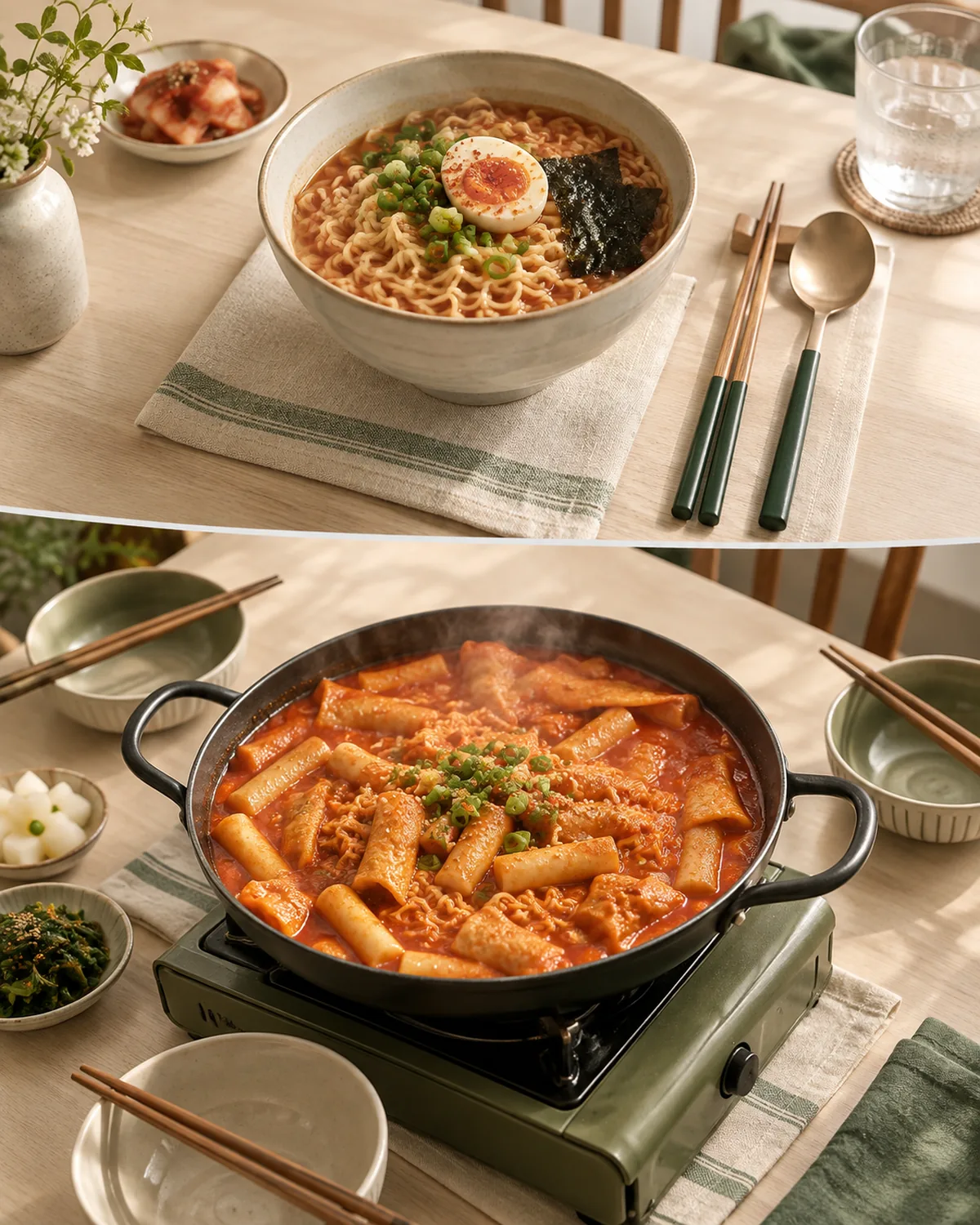
What makes Sindang different today is the jeukseok format: a larger pan can arrive at the table with rice cakes, fish cake, noodles and additions that cook together while diners eat. The starch thickens the sauce as the meal progresses. That is a fundamentally different experience from buying a small ready-cooked portion at a street stall.
The neighborhood also developed an entertainment identity around tteokbokki restaurants. Korea Tourism Organization describes theaters, students and the remembered DJs of the late 1970s and 1980s: a cheap meal became part of an afternoon of music and meeting friends. That helps explain why a shared pan carries a different social memory from a quick street-stall portion. The Sindang-dong tteokbokki guide separates the documented neighborhood story from the popular invention legend.
Jangchung-dong’s jokbal story is a lesson in urban foot traffic. The official Visit Seoul page, edited in 2026, connects the growth of Jokbal Alley with crowds attending events at nearby Jangchung Arena. Spectators leaving sports events and concerts created demand, nearby jokbal restaurants benefited, and the cluster became a destination in its own right.
That is more precise than saying Jangchung-dong “invented jokbal.” Braised pig’s feet are not owned by one Seoul alley. The neighborhood’s significance lies in the restaurant concentration and the way a large public venue helped produce a recognizable after-event food district.
Jokbal itself is suited to group dining. The meat is braised, sliced and served in a large shared portion, often with greens, garlic, fermented shrimp condiment and other accompaniments. The texture comes from both meat and collagen-rich skin, so good preparation balances tenderness with enough chew to remain satisfying.
For a deeper treatment of the dish and the alley’s development, see the Jangchung-dong jokbal guide.

Mapo and Euljiro: read the cut and the occasion
“Where is Seoul’s best Korean BBQ?” is usually the wrong first question. Seoul has too many grill traditions and restaurant clusters for one neighborhood to represent the whole category.
Start with the cut and the dining style. Samgyeopsal gives you fatty pork belly and a casual, high-heat table-grill experience. Dwaeji galbi brings sweet-savory marinated pork ribs. Sogalbi moves toward beef ribs and a different price point. Some restaurants specialize in aged pork, some in charcoal, some in specific cattle breeds, and some in large group dining.
Mapo has long been associated with meat restaurants and after-work dining, but a useful plan is not “go to Mapo because all good barbecue is there.” It is “decide whether you want pork belly, marinated ribs, beef, charcoal or a late-night social meal, then choose a district and restaurant that specializes in that format.”
A celebrated beef-rib restaurant may be the wrong choice for someone looking for pork belly. Choose the cut and serving style first, then check which restaurant actually specializes in them.
Seoul dining often extends beyond a single restaurant. A group can eat dinner, move for drinks and snacks, then finish somewhere else. Central districts such as Euljiro are useful for understanding this layered evening rather than one iconic dish.
Foods such as golbaengi-muchim, dried fish, grilled meats, pancakes or simple noodle dishes can function as anju—food eaten with alcohol. The meal logic is different from a Western appetizer-main-dessert sequence. Dishes arrive for sharing, the group controls the pace, and the “second round” may be as socially important as dinner.
This is where translation such as “bar food” is useful but incomplete. Anju is not one recipe category; it is a relationship between food and drinking occasion.
Seongsu: leave room for a bakery stop
Seongsu is valuable for almost the opposite reason from Jangchung or Myeong-dong. Seoul Metropolitan Government material describes how former factory and warehouse spaces were transformed into cafes, galleries and cultural venues, creating one of the city’s strongest contemporary trend districts.
The neighborhood is therefore ideal for observing format innovation: industrial spaces converted into cafes, bakeries using social-media-friendly display systems, pop-up collaborations, branded desserts and fast-moving bread trends. Salt bread is one example of a product that moved through this ecosystem, but it would be a mistake to freeze Seongsu into one permanent “salt bread street.”
In a trend district, the durable object is the neighborhood’s role as a testing ground. Individual shops, queues and signature items are the unstable layer. Check current opening status and reservation systems close to the visit rather than relying on a months-old viral list.
If you want the specific salt-bread story, see the Seongsu salt bread guide.
A food district is not a fixed restaurant ranking
A traditional market rewards broad sampling. The physical concentration of many vendors makes it efficient to compare pancake, noodles, rice rolls, meat and sweets. A trend district rewards selective research because individual cafes can have long queues, timed entry, limited releases or rapid menu changes.
That means the planning logic is almost reversed:
- Market: verify the market’s current operating pattern, arrive hungry, then decide stall by stall.
- Historic food alley: choose the dish first, then compare a few established businesses.
- Long-running institution: verify the current restaurant status and accept that the menu may be intentionally narrow.
- Trend district: check current shops shortly before the visit and keep a backup because pop-ups, sell-outs and queues are normal.
Seoul offers almost every major Korean food, but availability is not the same as origin or regional identity. Bibimbap is everywhere in Seoul, yet Jeonju has a stronger regional claim to a particular bibimbap tradition. Dakgalbi can be excellent in the capital, but Chuncheon is central to its modern regional story. Chodang sundubu points toward Gangneung. Idong galbi points toward Pocheon.
This distinction helps when a trip extends beyond Seoul. Eat foods in the capital when they fit the day, but save some dishes for the region where landscape, local industry or neighborhood history adds another layer.
The companion Korea food guide by region is designed for that decision.
A queue can tell you that demand is high. It cannot tell you whether the food will match your taste, whether the line is inflated by social media, or whether a nearby specialist is worse.
For old institutions, a queue may reflect limited seating and a narrow menu. For trend cafes, it may reflect a product launch or photo-friendly space. For market stalls, it may simply be that one vendor was featured in a show.
Set a personal waiting threshold before the day starts. If a food is central to the trip, a long wait may be rational. If it is one of six planned snacks, spending an hour in line destroys the rest of the route.
Build a day around one anchor meal
The biggest failure in food itineraries is not choosing the wrong restaurant. It is scheduling too many heavy dishes too close together.
A practical Seoul food day works better when each stop has a different weight. For example:
- Morning: a light soup, simple rice meal or bakery stop.
- Lunch: a focused restaurant institution such as kalguksu.
- Afternoon: shared market snacks rather than another full meal.
- Dinner: the group meal—jokbal, barbecue, jeukseok tteokbokki or another dish that benefits from sharing.
- Late evening: only if appetite remains, a smaller anju or dessert stop.
The exact neighborhoods can change, but the principle is stable: alternate meal weight, cooking style and setting. Three bowls of noodles in three districts may be historically interesting and physically miserable.
Late morning — Jongno: begin with old-downtown context rather than immediately chasing a viral cafe. If you choose Gwangjang, sample rather than feast.
Lunch — Myeong-dong: use a long-running noodle institution or another established downtown restaurant to contrast with the market format.
Afternoon — walk, museum or coffee: leave a real gap before another substantial meal. A food itinerary can include time when you are looking at the city rather than ordering something else.

Dinner — Sindang or Jangchung: choose one. Sindang is stronger if the interest is table-cooked tteokbokki and youth-food history; Jangchung is stronger for a meat-centered group meal and the arena-linked alley story.
Alternative evening — Seongsu: if historical food is not the priority, use Seongsu for current cafe and bakery culture instead. This sacrifices some historical continuity in exchange for seeing what is changing now.
For a more snack-focused version of the day, the Korean street food guide organizes foods by market, stall and seasonal eating format.
Choose the meal that matters most and organize the surrounding stops around its quantity and timing. A shared barbecue or tabletop tteokbokki meal needs a different appetite from a brief bakery visit. A nearby snack is not necessarily a small portion: walking distance and meal size are separate decisions.
Use a neighborhood’s food identity as orientation rather than a promise that every business serves one thing. In Jongno, food stalls sit within broader market commerce. In Seongsu, a cafe’s current queue, menu and ordering system are live information, not permanent features of the district. Confirm the specific shop rather than building a day around an old screenshot.
The most informative comparison may be between two food systems instead of two rankings: a finished jokbal platter and a tteokbokki pan still changing at the table, for example. Leave room to take that comparison seriously. Seoul can introduce foods associated with other regions, but serving them in the capital does not relocate their entire history.
Reservations, portions and current opening information
Do not assume every restaurant uses the same system. Some modern restaurants take reservations through Korean booking platforms, some manage bookings directly, some use remote waitlists, and some long-running casual restaurants operate primarily with walk-in queues. Traditional market stalls may have no booking concept at all.
This is why “Do I need reservations in Seoul?” has no citywide answer. The correct question is “What reservation or queue system does this specific business use now?” Check close to the visit, especially for tasting menus, famous barbecue restaurants, small trend cafes and peak weekend periods.
Menus, ingredient costs, rent, labor and tourism demand change. So do opening hours, branch arrangements and holiday closures. A useful evergreen guide should preserve the reason to go while treating prices and business hours as dynamic.
For named restaurants, verify the business’s current official or major-platform listing before leaving. For markets, check the market-level hours but remember that individual vendors can differ. For trend districts, verify the exact shop because closures and relocations are part of the environment.
This is more reliable than memorizing a price copied from a blog several years ago.