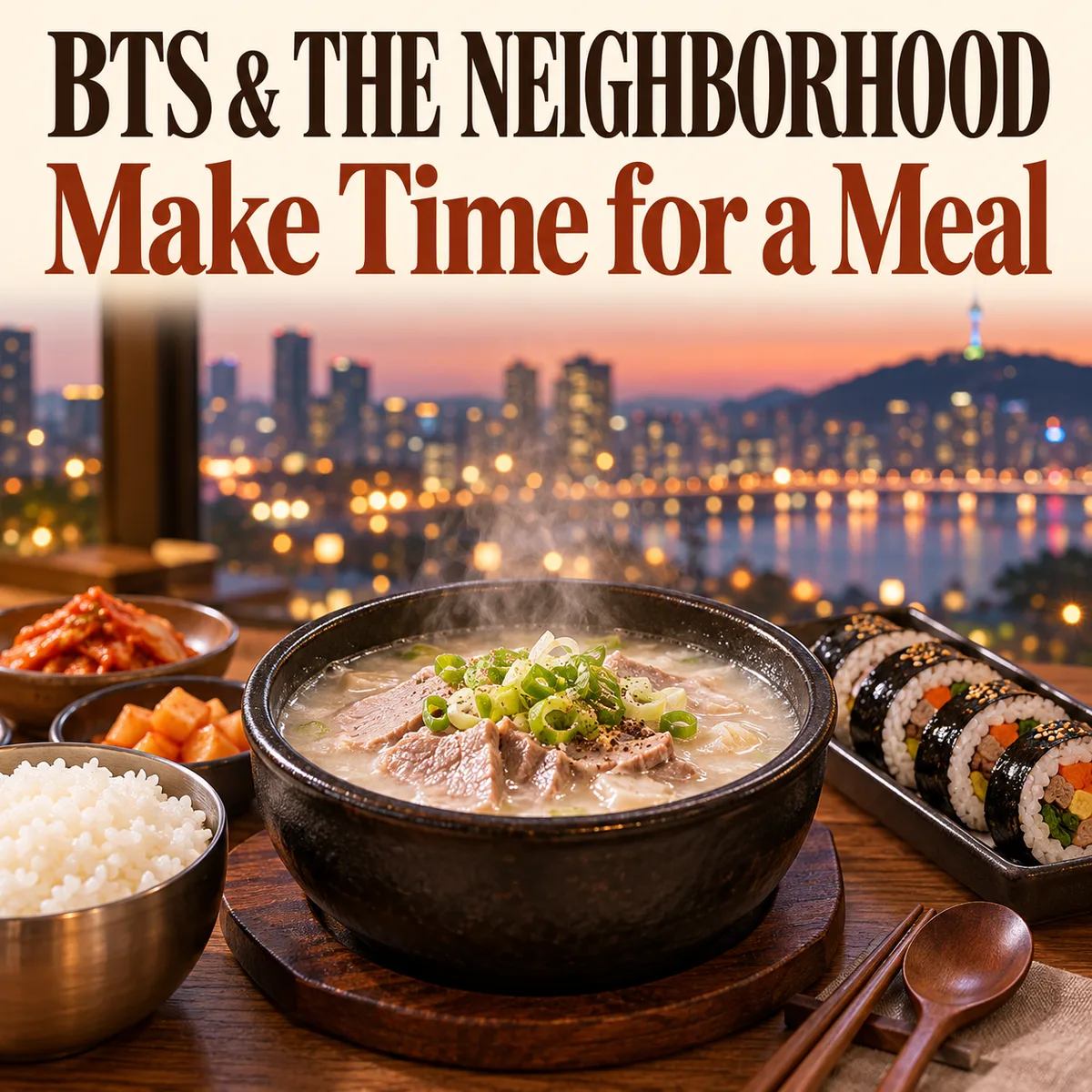
A concert neighborhood has to feed people whose clocks are suddenly synchronized. For a visitor, the practical question is whether to sit down to a bowl, carry a rice roll or make a shared dinner part of the evening. The serving format matters as much as the name on the restaurant sign.
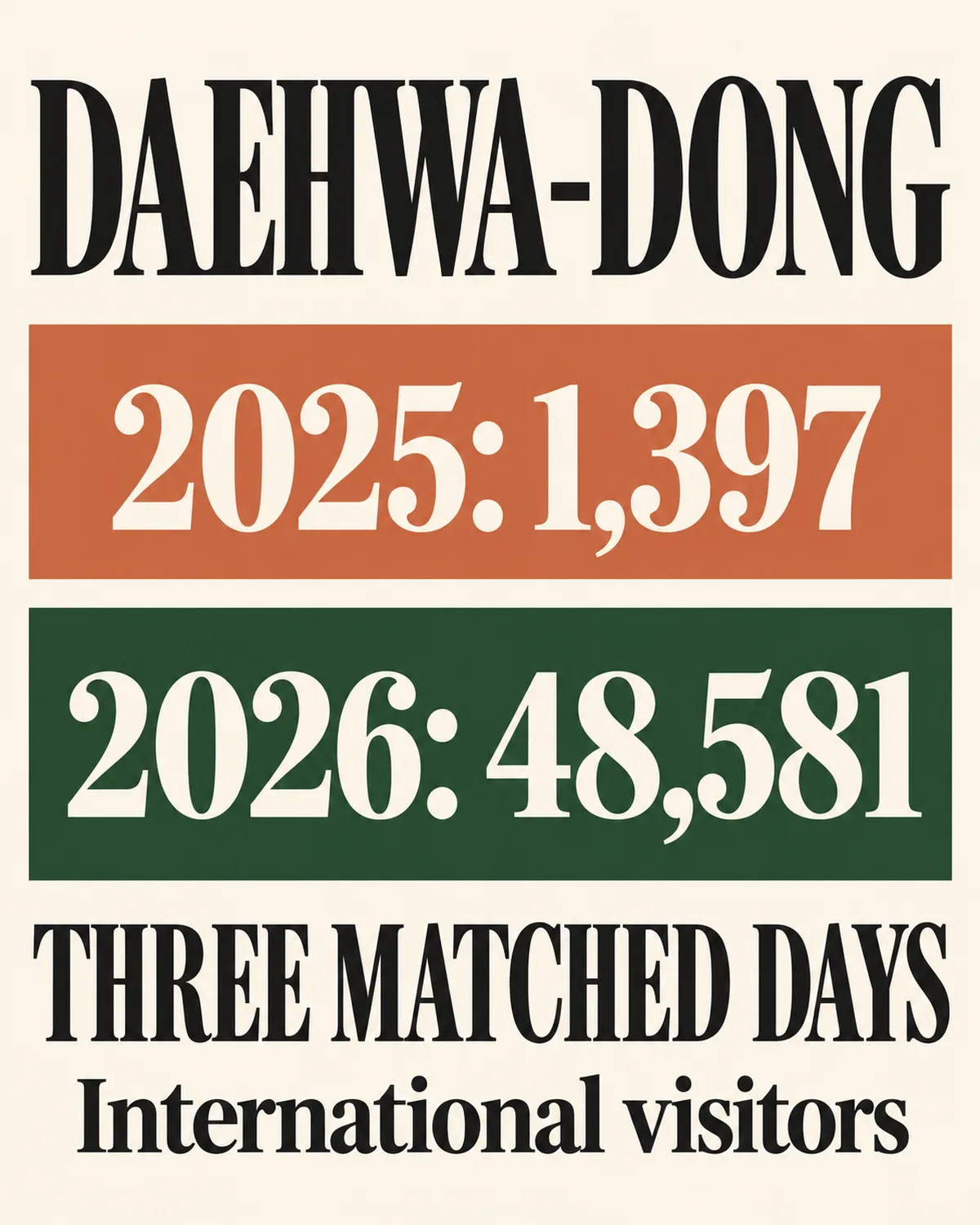
The BTS neighborhood effect has a measured example. MCST’s April 30, 2026 release reported 48,581 international visitors in Daehwa-dong across the April 9, 11 and 12 Goyang concert days, against 1,397 across three comparable days in 2025. It was a year-on-year comparison, not a count of permanent residents or a typical weekend.[1]
What the neighborhood figures actually compare
For the same comparison, international visitor card spending rose from KRW 8.9 million to KRW 337.8 million. The release identifies mobile-network and card data as the basis. These totals describe the measured district and dates; they do not tell you the turnover of every restaurant.[1]
A separate on-site audience survey found average stays of 8.7 days for international visitors at Gwanghwamun and 7.4 days at Goyang. That helps explain why a concert trip can include meals well beyond the stadium neighborhood.[1]
Neither dataset proves that a specific gimbap shop sold out or that a particular cafe raised prices. Those questions need their own business records. For planning dinner, treat the concentration of visitors as a reason to leave room for queues, rather than a precise forecast for one counter.
The food plan can have two places: a dependable meal where you are already spending the day, and a smaller fallback along the actual journey to the event. This avoids making the closest restaurant responsible for the whole evening.
Daehwa-dong international visitor figures compare concert days with matched days a year earlier.
A bowl makes the serving decision visible
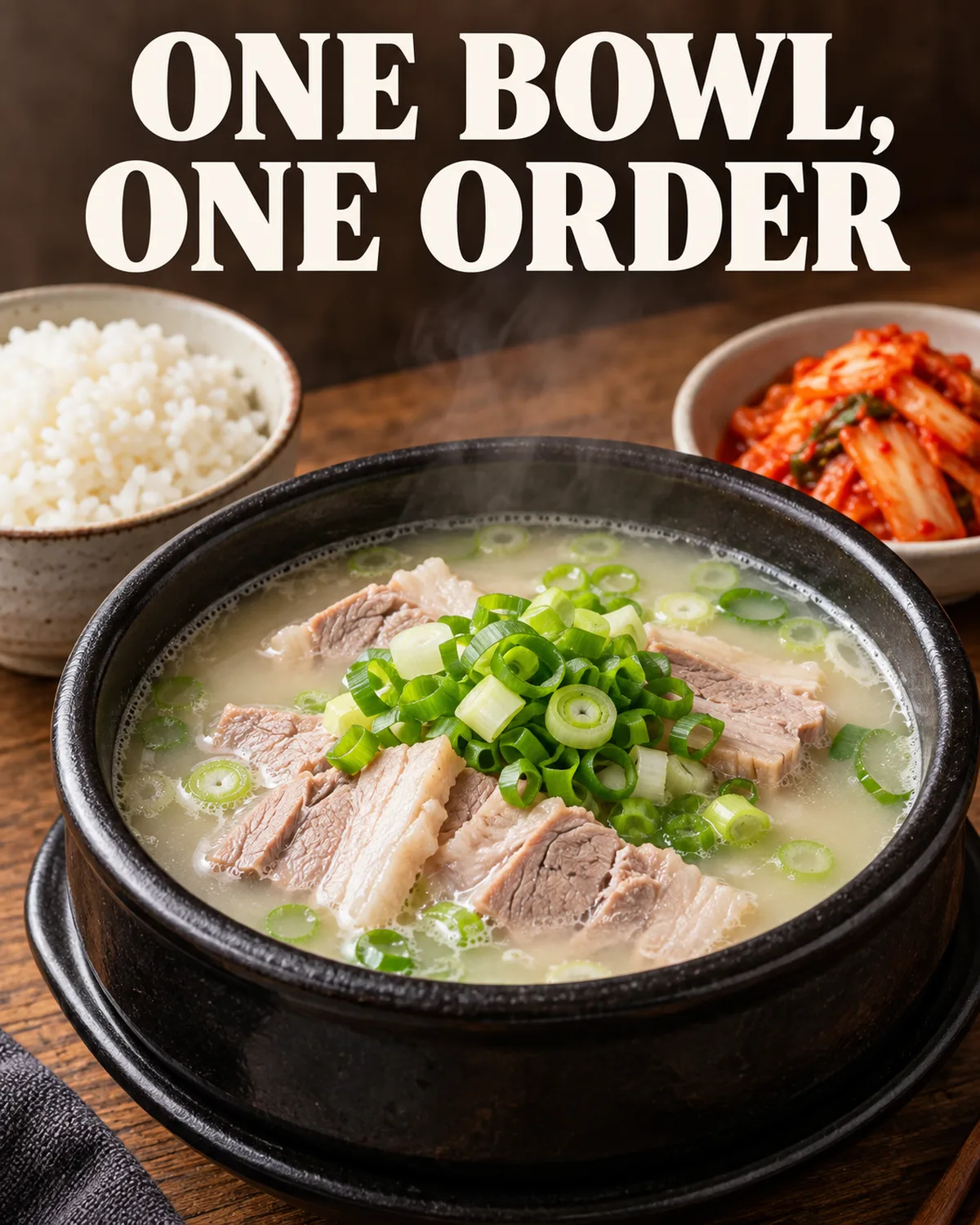
An individual gukbap order gives each diner a recognizable main dish: soup and rice, with the exact combination determined by the menu. It can make ordering easier for a group whose members want different portions or need to leave at different times.
Read beyond the word gukbap. A pork-based bowl, a bean-sprout soup and a beef soup have different ingredients. Rice can be served separately or already added, and the broth may come with condiments for the diner to adjust.
Taste the soup before adding more seasoning. Notice the broth, the rice and the main ingredients as separate parts of the meal. A pale broth does not identify every ingredient, and a red one does not measure its heat for you.
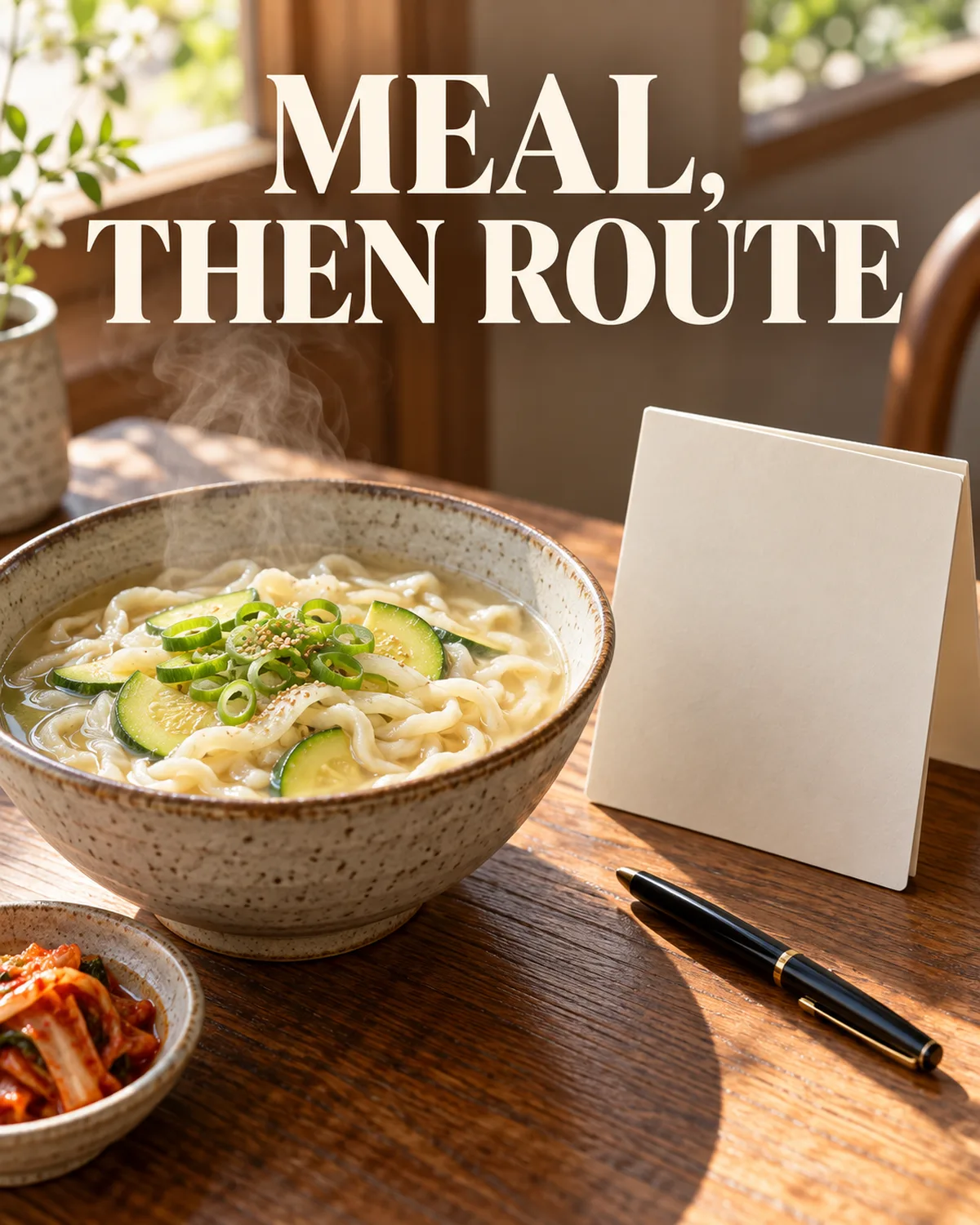
Kalguksu offers another individual serving format, with noodles in a prepared bowl. Choose it because you want that meal and have time for the restaurant’s actual service, rather than assuming that noodles guarantee a quick turnaround.
An individual soup-and-rice meal makes the serving unit clear.
Gimbap is portable food with a storage decision
Sliced gimbap can be divided without setting up a communal pan. Its seaweed wrapper holds rice and fillings together, which is useful when a sit-down meal is difficult. It does not show all of those fillings from the outside.
Check the ingredients and storage directions on a packaged order. At a shop, ask what is inside before paying. Egg, fish cake, meat, sauces or shared preparation may matter even when the name emphasizes vegetables.
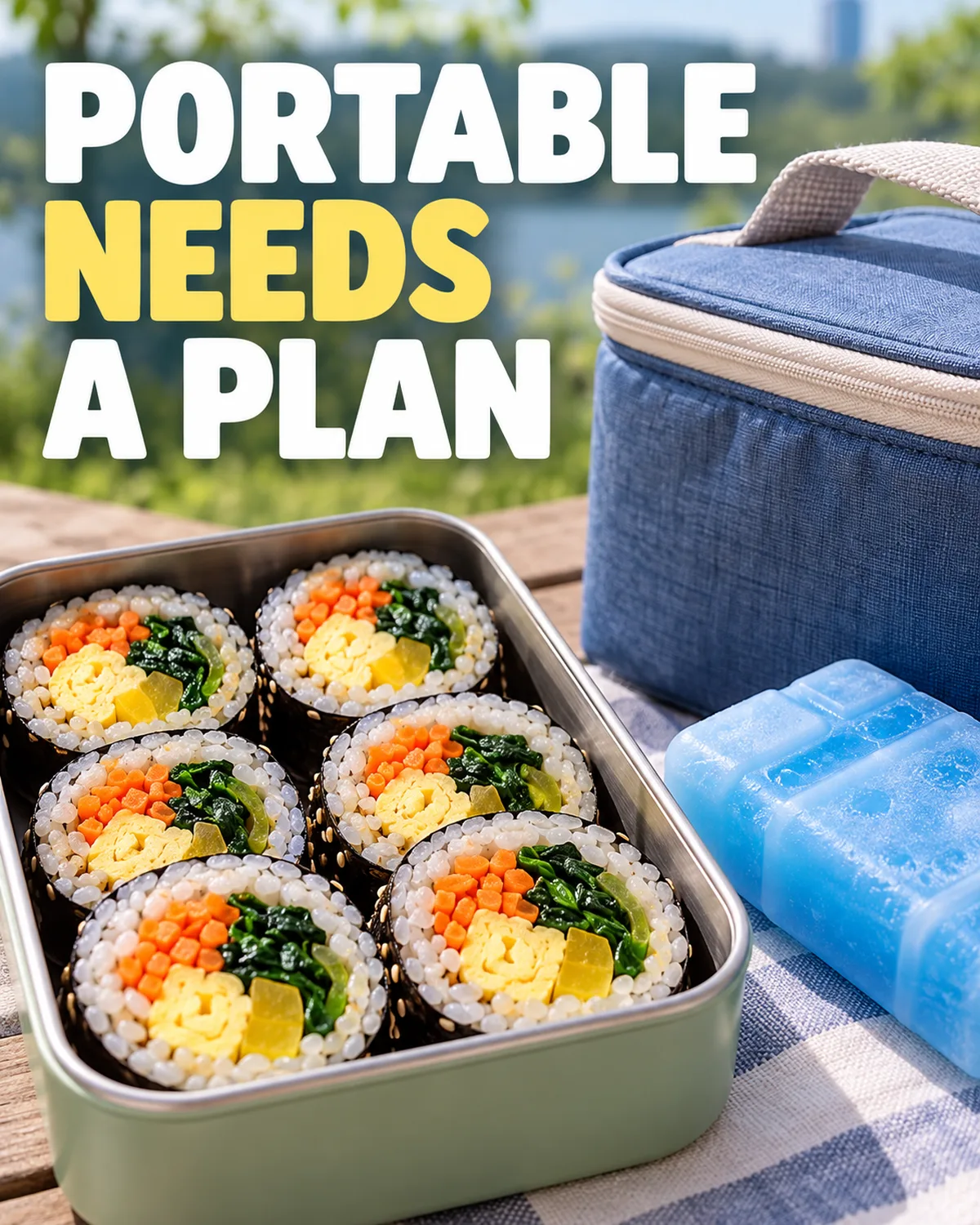
USDA guidance for outdoor food handling says to keep cold perishable food at 40°F or below and hot food at 140°F or above. Perishable food should not remain between those temperatures for more than two hours, reduced to one hour above 90°F outdoors. A concert bag supplies none of that temperature control.[2]
Choose something you can eat and store as directed. Carrying freshly prepared gimbap through a long afternoon is a different decision from buying it shortly before eating. A packaged fallback still needs its own ingredient and storage check.
Gimbap needs appropriate storage as well as convenient packaging.
A shared pan asks for a shared evening
Korean barbecue keeps part of the meal at the table. Meat cooks, pieces are divided and wraps are assembled while the group continues eating. It is enjoyable when that activity fits the evening, but awkward when one person is watching the door time.
Ask how the menu counts an order: price per portion, minimum number of portions and what accompanies the meat. Rice and soup may be separate. A photograph of a full table cannot explain the bill for your group.
Dakgalbi has another sequence, with chicken and vegetables cooking in a shared pan. Optional additions and a fried-rice finish can extend the meal. Decide together which stages you actually want before ordering everything pictured.
After the concert, a shared pan can become the gathering itself. Confirm that everyone has time for it and that the restaurant is still accepting food orders. The cooking format should be a choice the table enjoys.
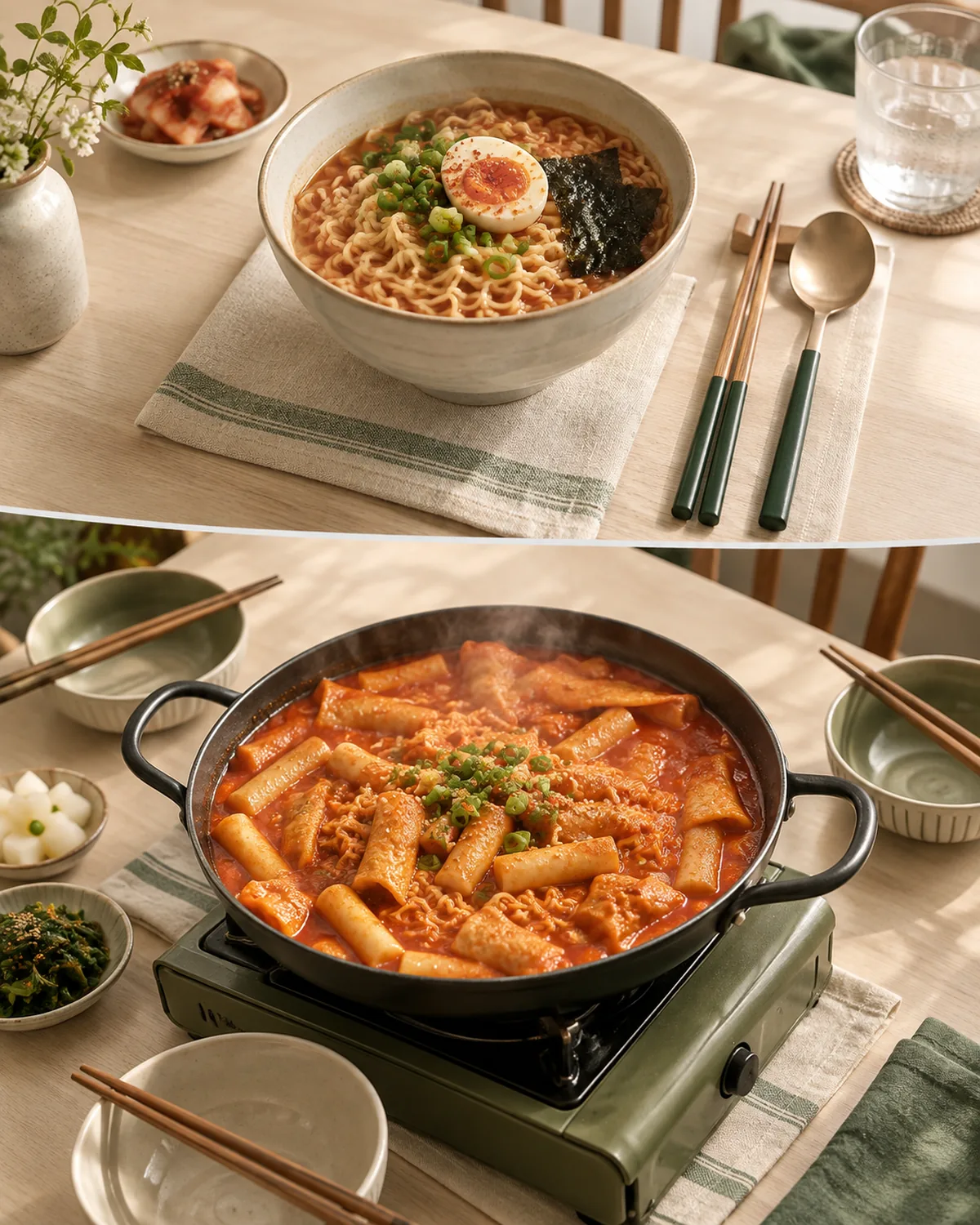
Dakgalbi and its finishing stages suit a meal the group has time to share.
Place the meal on the route you will take
A restaurant’s position on a map is only the start. The official entrance, the path to it and the return journey determine whether a stop fits. A nearby street can still require an inconvenient detour.
Check the current event’s arrival instructions and outside-food policy. A rice roll being easy to carry does not establish permission to take it inside, and rules from another venue do not answer that question.
Confirm restaurant service and last-order information directly. If the queue changes the plan, switch the serving format as well as the address: an available individual bowl may work when both shared-dinner choices are busy.
For a late meal, include the return journey in the decision before sitting down. Coffee and a small bite, a complete bowl and a long shared dinner serve different needs. Let the group choose the one that fits its appetite and available time.
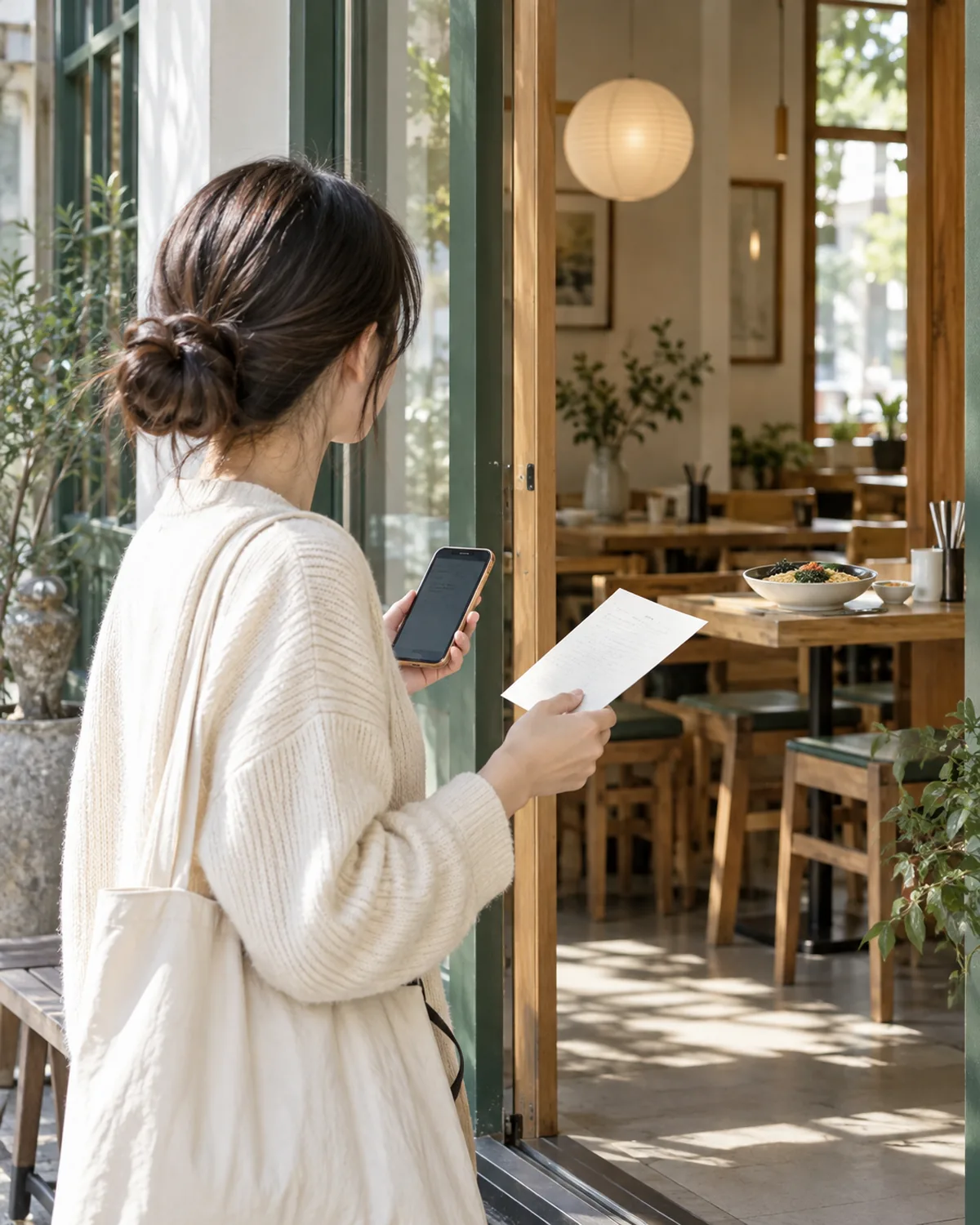
The event entrance, food stop and return journey belong in the same decision.
Let ingredient questions come before cooking
Ask early about broth, sauces and preparation when an ingredient matters to you. Removing a visible topping cannot remove an ingredient that has entered the soup or seasoning. For a serious allergy, obtain preparation information from the provider.
The neighborhood figures show a concentrated event with a wider travel footprint. Your own meal can stay simpler: choose a serving format, identify one realistic fallback and leave enough room to enjoy the food before the first song or after the last.
A dependable meal and a realistic fallback help the evening stay flexible.
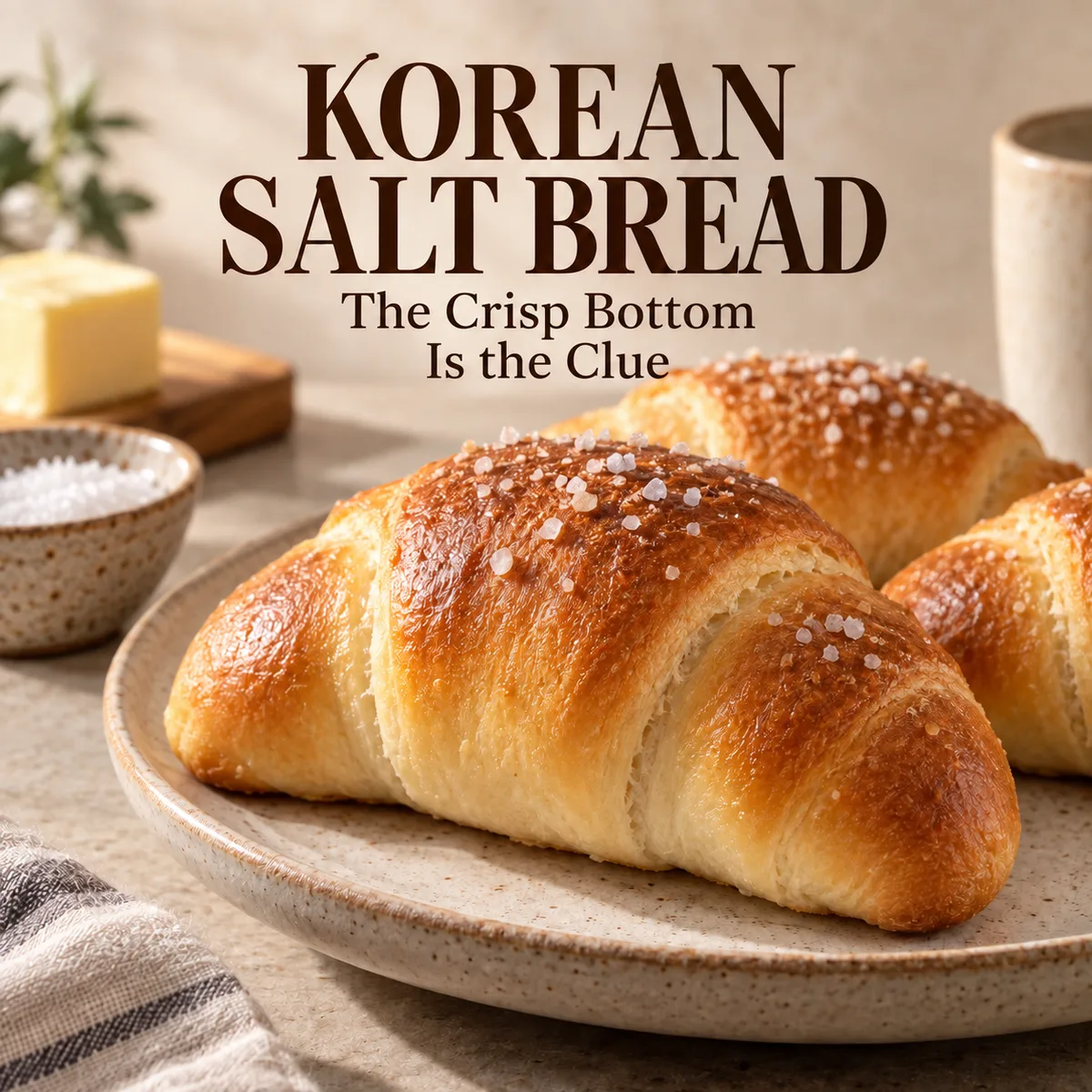
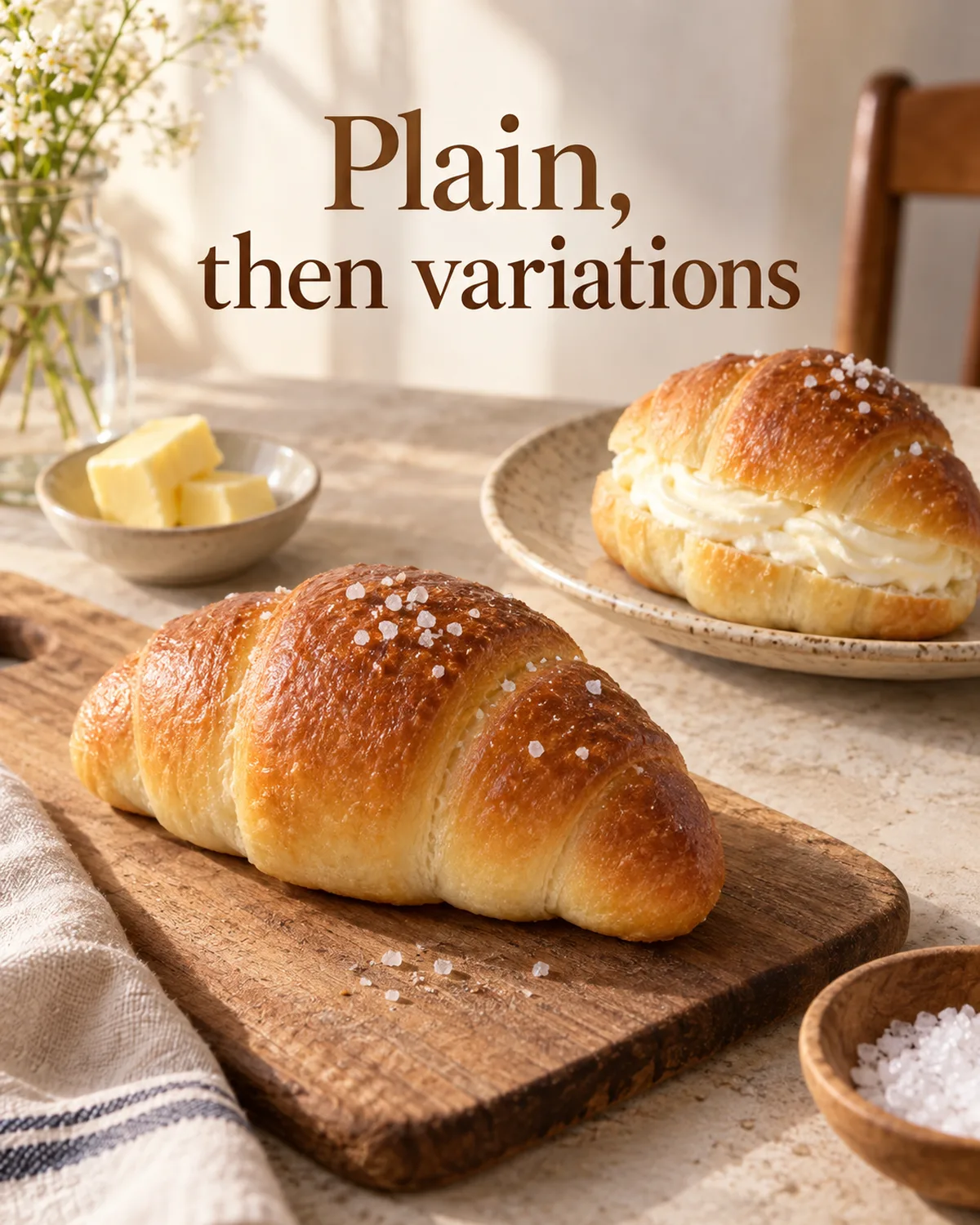
The crescent shape can distract from the most revealing part of salt bread: its underside. Melted butter, dough and the baking surface create a contrast that a photograph of the top may not show.
Its Korean popularity is a story of adoption and reinterpretation, not evidence that the bread first originated in Korea. A plain roll is a useful starting point because it makes the structure easier to taste.
A Japanese starting point and a Korean bakery life
A 2019 interview in Yonden’s regional magazine follows Pain Maison owner Hirata Mitoshi’s trials in Yawatahama, Ehime. He was looking for a bread customers would want in summer. The account describes trials around 2003, followed by commercialization the next year, using bread dough wrapped around butter and finished with salt.
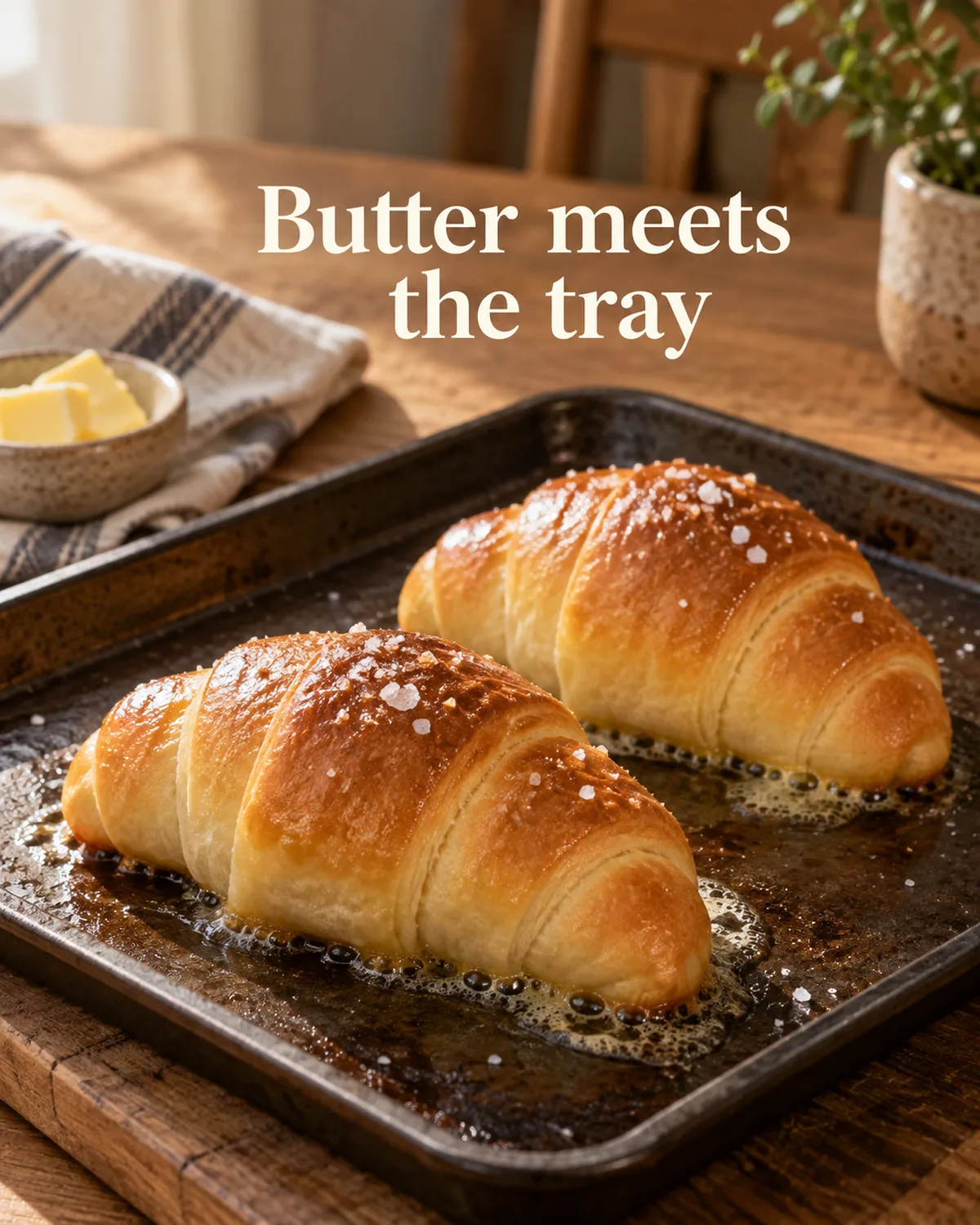
The interview also names fish-market workers and students as early tasters. Hirata tried salts that would leave visible grains after baking; baking more rolls together then let melted butter collect on the tray and crisp their undersides. It is a shop’s documented development story, rather than a date to assign to every butter-and-salt bread.
That account connects the name to something you can taste: the salt on top and the butter-browned bottom. Korean bakeries later gave the format new recipes and retail settings, but Seongsu’s popularity does not make the neighborhood the bread’s birthplace.
The browned underside is a separate texture from the softer interior of a salt-bread roll.
Once salt bread entered Korean bakery culture, it encountered a market already comfortable with rapid pastry cycles. Korean cafes routinely rotate signature croissants, bagels, cream breads, twisted doughnuts, cakes and limited seasonal products. A visually simple roll that could be served warm, photographed easily and compared shop by shop fit naturally into that system.
The category also leaves room for variation without losing its identity. One bakery emphasizes a blistered thin shell. Another pushes a chewy crumb. Some use a very crisp butter-fried base, others a softer bottom. Shops vary the salt crystal size, dough sweetness, butter quantity, fermentation, shape and fillings.
This is localization without requiring a dramatic flavor change. Korean bakeries can make the bread feel distinctive through texture, bake timing, presentation and retail experience rather than covering it with an entirely new sauce.
The difference from a croissant is in the dough
One of the most persistent descriptions of sogeum-ppang is that it is “croissant-like.” The comparison helps a first-time eater imagine butter and a curved shape, but it becomes technically misleading when people claim the dough must be repeatedly laminated like a croissant.
A classic croissant creates many alternating sheets of dough and butter through repeated folding and rolling. Many salt-bread formulas instead use a yeasted bread dough rolled around a distinct piece or strip of butter. The butter melts during baking, leaving a cavity, soaking parts of the crumb and pooling against the hot tray.
This is why two breads that look vaguely related can behave differently. A croissant depends on laminated layers separating through steam. Salt bread can achieve its signature contrast with a softer bread crumb and a concentrated butter pocket. The category is broad, so individual Korean bakeries may hybridize techniques, but lamination is not the universal definition.
A piece of butter is wrapped inside the dough before baking.
The crisp bottom and the hollow inside
The top gets the photograph because the coarse salt is visible. The bottom often explains the obsession better.
As the butter enclosed in the dough melts, some of it escapes and collects where the roll meets the baking surface. The base is therefore exposed to hot fat as well as dry oven heat. That encourages stronger browning and a crisp, almost shallow-fried texture. Meanwhile, steam from the butter and dough can create the characteristic hollow pocket inside.
Butter released during baking can brown the base where the roll meets the baking surface.
A good salt bread gives you several textures in a bite: a thin browned exterior, a soft or slightly chewy interior, a buttery cavity and a deeply crisp base. The salt crystal then arrives as a high-intensity accent. What looks like a plain roll is really a controlled contrast machine.
A cut roll can reveal space left as the enclosed butter melts during baking.
Salt does not merely make the bread salty. It changes how the butter is perceived. A small amount on the surface can make dairy richness taste more vivid and can sharpen whatever mild sweetness is present in the dough.
The placement matters too. Salt dissolved evenly through dough produces a different sensation from a few coarse crystals on the surface. Large crystals create short bursts of salinity, so the baker can keep the overall bread balanced while still delivering an unmistakable “salt bread” moment.
This is also why “more salt” is not automatically better. If every bite is aggressively salty, the contrast disappears. The goal is usually butter-first richness punctuated by salinity, not the flavor profile of a salted snack cracker.
What changes as the roll cools
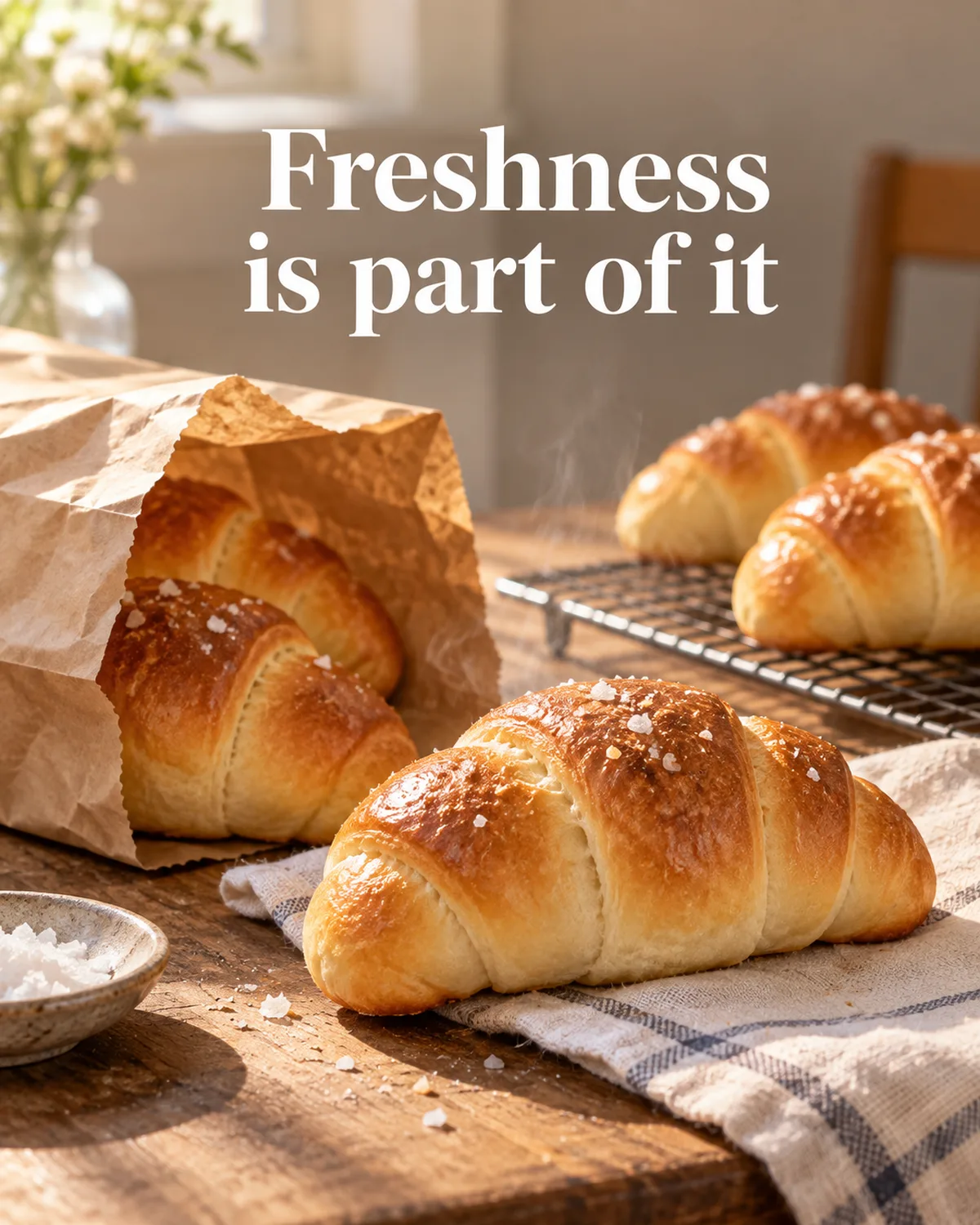
Salt bread is unusually sensitive to the moment between oven and mouth. The crisp base is strongest before trapped steam and ambient humidity soften it. Warm butter is aromatic and fluid; as the bread cools, butter firms and the crumb changes. The interior may still be pleasant hours later, but the textural contrast narrows.
Visit Seoul’s listing, updated in August 2026, describes Jayeondo Salt Bread in Seongsu as a takeout specialist with several daily bakes and frequent waits. Bake times and queues can change; the useful culinary point is that batch timing is part of the product.
A fresh batch illustrates why the time since baking can affect the bread experience.
A line at a salt-bread shop therefore contains two different signals. It can be social proof—people want what other people want—but it can also be a freshness queue, clustering customers around the next oven release.
A bread optimized for immediate consumption can push the buttery bottom to an extreme because the customer eats it while hot. A bread designed for takeaway may need a slightly sturdier crust and crumb so it survives a train ride or several hours in a bag.
This creates a hidden trade-off in online recommendations. A reviewer who eats a roll thirty seconds after baking and a traveler who eats the same roll at a hotel two hours later are not experiencing the same texture.
If a shop is famous for timed batches, that is a clue to eat at least one piece soon after purchase. Save the second roll for later only if you want to learn how the product changes.
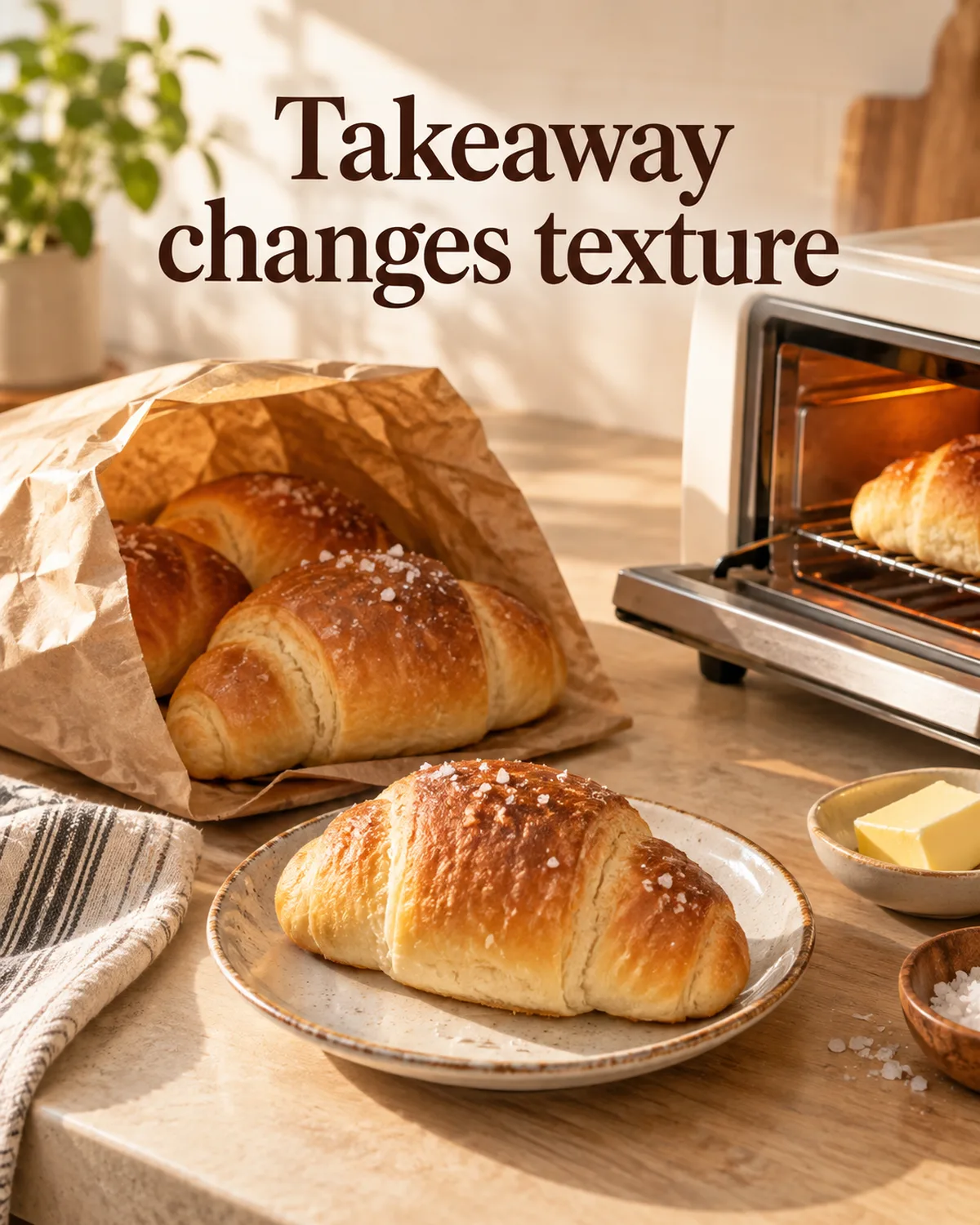
Once salt bread cools, a short dry reheat can help the crust and base become crisp again. A microwave alone tends to emphasize softness because it heats water quickly and can make the crumb steamy.
An oven or toaster is better suited to restoring surface dryness, but excessive heat can melt out more fat and overbrown the already crisp base. If the bread contains cream, cheese or another filling, reheating rules change again.
The practical lesson is modest: plain salt bread is best treated like a butter-rich roll whose defining asset is fresh texture. Buy only as many as you can enjoy well, rather than assuming a large viral haul will taste identical tomorrow.
An opened takeaway bag illustrates how storage and transport can affect the crust.
Why Seongsu is a good setting for a small bread trend
Salt bread could have become popular in any Seoul district. Seongsu gives it something extra: a neighborhood built around the expectation that visitors will discover a new shop, pop-up or product.
Seoul Metropolitan Government describes Seongsu as a former factory-and-warehouse district that changed through urban regeneration in the 2010s as arts, culture and cafes occupied old industrial spaces. Visit Seoul’s current Yeonmujang-gil guide still presents the area as a place where traces of shoe factories mix with cafes, galleries, boutiques and brand pop-ups.
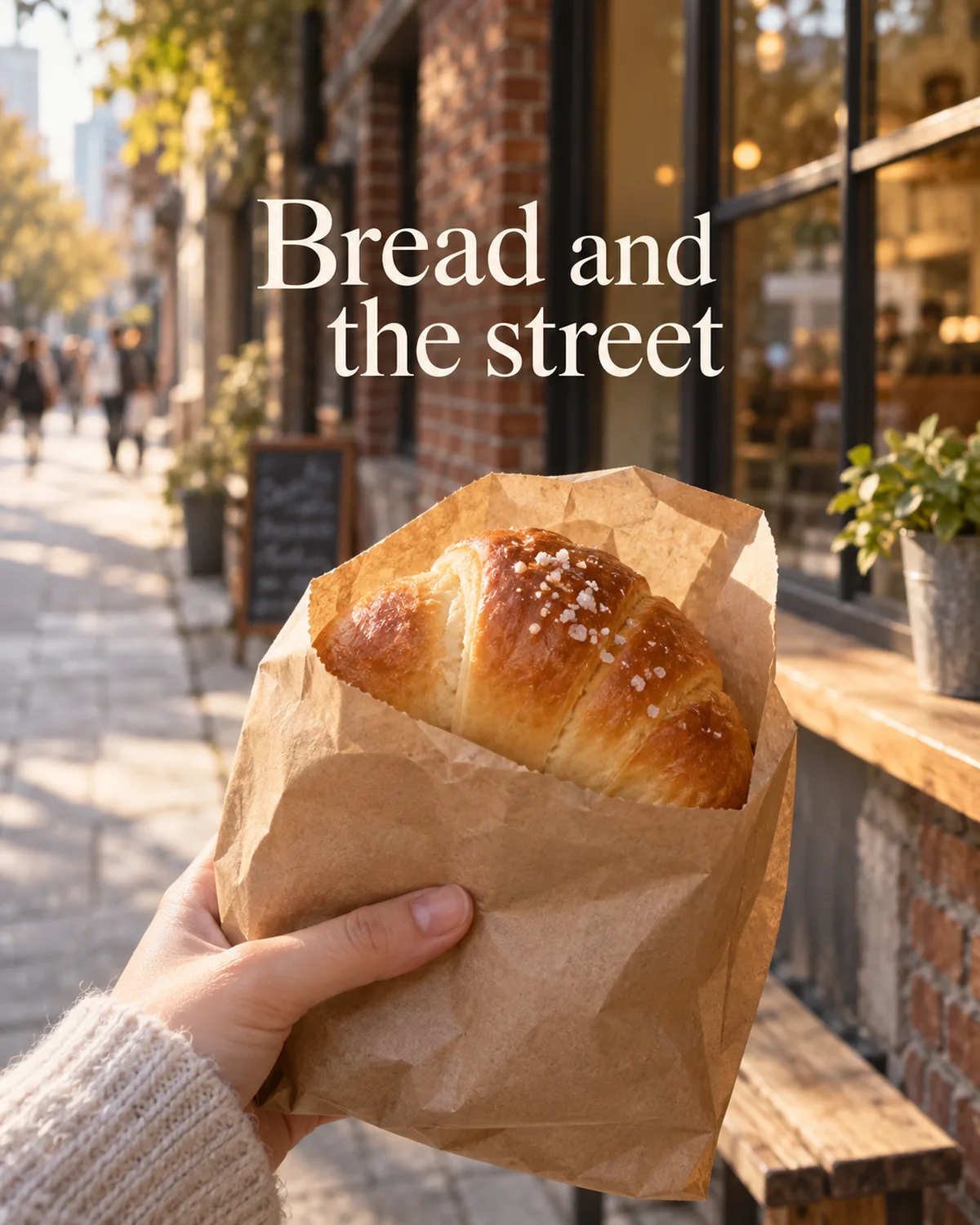
That urban form is unusually compatible with trend food. People arrive intending to walk. They expect to stop repeatedly. A small bread that can be carried in a paper bag requires little commitment compared with a full restaurant meal. The product and the neighborhood reinforce each other.
A conventional neighborhood bakery needs a wide assortment because customers arrive with different needs. A destination bakery can invert that logic. If people travel specifically for one product, specialization becomes part of the attraction.
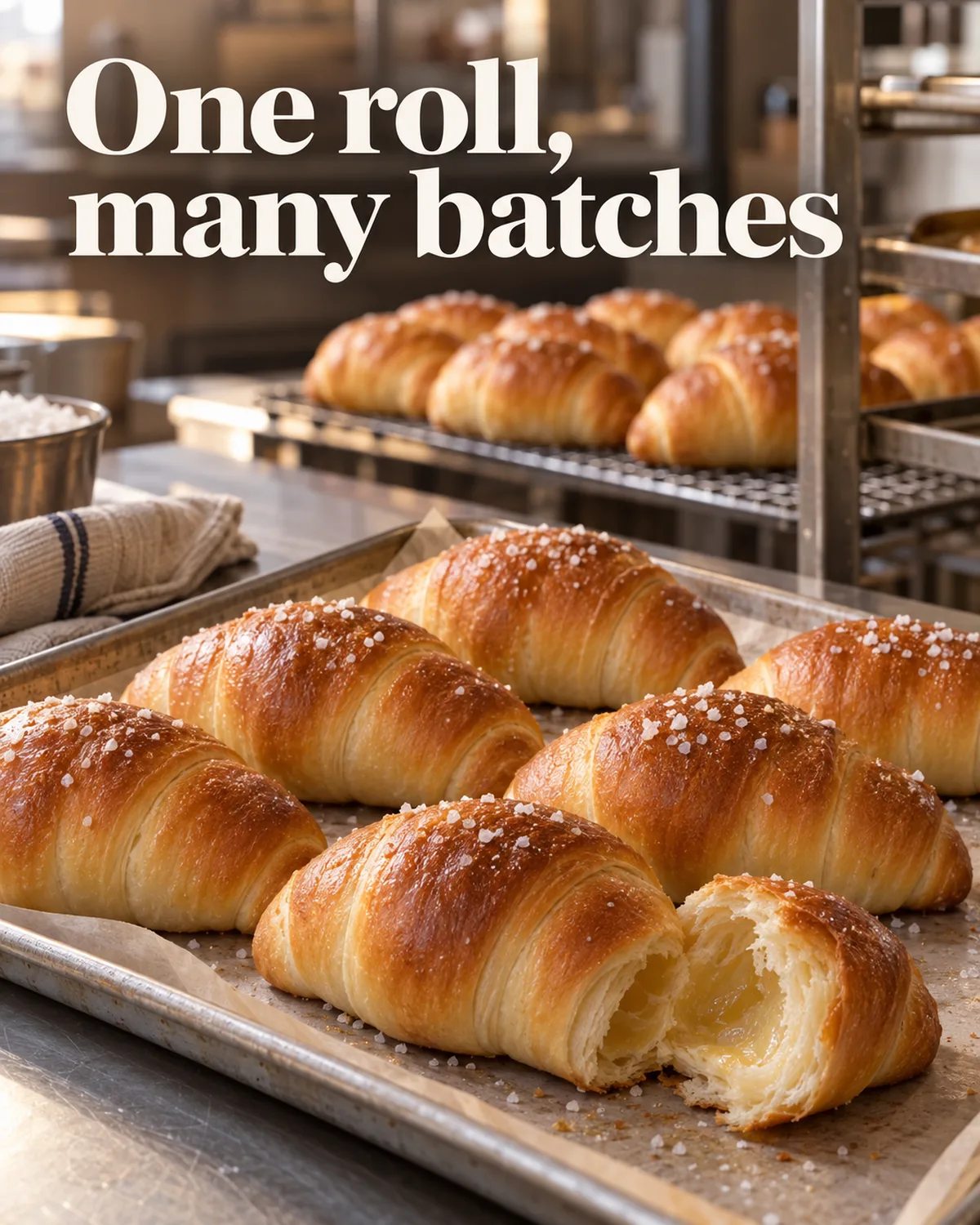
A takeout specialist selling repeated batches of one signature roll offers a different encounter from an assorted neighborhood bakery. The customer is comparing fresh versions of a known product, rather than choosing from a broad bread cabinet.
A generic counter illustrates a specialist bakery selling repeated batches of one signature roll.
Specialization also simplifies comparison. Visitors do not ask which of forty breads is the signature. The question becomes “Is this salt bread worth the queue?” That clarity is extremely useful in a social-media environment, where one item must communicate the shop in a few seconds.
Salt bread also benefits from Korea’s dense cafe ecosystem. A small salty-buttery bread pairs naturally with coffee, and cafes already provide the seating, takeaway cups and weekend leisure routines that turn a baked item into an outing.
For a visitor, the bread can be one stop within a day of walking, coffee and shops. That is an interpretation of how a portable product fits the district, rather than a claim about why every customer came.
Salt bread is part of a café visit in a neighborhood such as Seongsu.
Plain first, then fillings
A more useful tasting framework has five variables:
Base: Is the bottom deeply crisp from butter contact, or mostly soft?
Crumb: Is the interior fluffy, chewy, layered or dense?
Butter pocket: Does the cavity feel aromatic and rich without becoming greasy?
Salt placement: Do crystals create occasional sharp accents or blanket the whole roll?
Freshness curve: Does the bread remain balanced after cooling, or is it compelling only straight from the oven?
These questions let you compare different Korean interpretations without pretending there is one legally fixed recipe for sogeum-ppang.
Once a bread category becomes familiar, variation can accelerate. Korean bakeries use salt-bread dough as a base for sweet creams, savory fillings, garlic, cheese, corn, red-bean butter, seasonal flavors and sandwich formats. Some are close to the simple Japanese-style ancestor; others are effectively new filled breads that borrow the salt-butter architecture.
This expansion is not evidence that Korea “improved” or “corrupted” the original. It is what commercial baking does when a format becomes legible to customers. The name becomes a platform.
Start with a plain roll before comparing flavored or filled variations.
Buying bread without planning around an old queue report
Start with the neighborhood, not the line. Seongsu Station, Yeonmujang-gil and the wider cafe district offer enough food, design and retail that a sold-out batch should not ruin the visit.
If you want one famous specialist, check its current official or tourism listing shortly before going. Baking schedules, purchase limits, branch arrangements and operating hours can change. A 2026 schedule should not be treated as permanent advice for a later trip.
Keep a second bakery in mind so that a sold-out batch does not decide the whole visit. Comparing two plain rolls can make differences in crumb and butter-browned base easier to notice.
Some shops sell only sets. Others sell singles. Some bake at announced times. Others replenish continuously. Some versions are plain; others are filled. Those are business decisions, not culinary rules.
This distinction matters because travel guides often turn a famous shop’s method into a statement about the whole category. “Korean salt bread comes in packs of four” is not a food fact. It is a current shop policy. “Salt bread is a butter-rich salted roll whose texture depends strongly on baking and fresh service” is much more durable.
Wheat and dairy are common in salt bread; check the specific recipe and fillings rather than judging ingredients from appearance.
A plain-looking roll normally contains wheat and dairy, and may include milk, egg or other enrichments depending on the recipe. Butter is central to many classic versions, so standard sogeum-ppang is not vegan.
Filled versions add more variables: cheese, cream, nuts, eggs, processed meats, sauces or bean pastes. Cross-contact is also possible in bakeries producing many products in the same kitchen.
“Only bread and salt” is therefore not a safe allergy assumption. Ask about the specific bakery recipe, especially if the product is sold from a shop whose marketing emphasizes simplicity but whose production space handles a broad menu.
Compare another city’s bakery culture or the eating route around a Seoul bread stop.
What should you eat in Seoul when the day only has room for a few meals? A market, a noodle institution, barbecue, tteokbokki and a bakery can all be appealing. Put them on one itinerary without looking at portion size, and five stops become five meals.
Group meals around the area already in your day
Choose the meal you most want to experience, then use its neighborhood to shape the day. A working market lets you sample; a tabletop pan asks you to sit and share; a cafe can be a later pause. These differences make the map useful without turning every district into another compulsory stop.
Jongno and Myeong-dong: market counters and noodle bowls
Jongno is useful as a first food district because it contains several layers of Seoul at once: palace-era street geography, long commercial corridors, markets and restaurants with unusually deep local histories.
Gwangjang Market is the most obvious entry point. The official Seoul travel guide lists foods such as bindaetteok, assorted jeon, small gimbap rolls, sundae and yukhoe among the market’s familiar foods. The point is not that every stall is ancient. The point is that a dense traditional market lets you see multiple cooking systems within one block: grinding mung beans, frying pancakes, rolling rice, slicing raw beef and serving noodles at counters.
This makes Gwangjang best used as a sampling stop, not as a place where every person orders a full portion from the first vendor. A small group can share one pancake, one plate of mini gimbap and another dish, then move on. The market becomes more informative when you compare methods rather than simply pursue one viral stall.
Jongno also preserves older eating geographies beyond the market. Pimatgol, for example, is remembered as a network of alleys beside the main road that developed pubs and gukbap shops for commoners moving through central Seoul. Much of the old alley fabric has changed, but the story helps explain why inexpensive soups and drinking food belong so naturally in the old downtown.
For a focused market route, use the Gwangjang Market guide. For an older soup institution, the seolleongtang history adds another layer to central Seoul eating.
A soup meal fits a different occasion from an evening shared platter
Myeong-dong is internationally associated with shopping and fast-changing street snacks, but one of the district’s most durable food stories is a bowl of noodles.
The Michelin Guide’s current profile of Myeongdong Kyoja states that the family-run restaurant has operated since 1966 and specializes in dumplings and noodle soup. That date matters because it prevents an easy mistake: presenting the restaurant’s kalguksu as an ancient Seoul origin story. What it represents is modern urban restaurant continuity.
The restaurant is known for its noodle soup, dumplings and assertive garlic kimchi. The Michelin profile describes a narrow menu and food made in-house. Its significance is the continuity of a recognizable restaurant meal in a changing commercial district, rather than a claim that every Seoul noodle bowl follows the same recipe.
That is a different kind of heritage from palace cuisine or a centuries-old market. Seoul food history is full of 20th-century institutions that became “classic” because generations of customers kept returning. Myeong-dong kalguksu belongs in that category.
The dedicated Myeong-dong kalguksu guide explains the noodle mechanics and restaurant context in more detail.
Sindang and Jangchung: two meals designed for company
Sindang-dong is one of Seoul’s most important centers for modern spicy tteokbokki culture. The district is often reduced to a single invention legend about Ma Bok-rim, but the more useful story is how a style, a restaurant cluster and a youth culture formed around the dish.
Seoul Metropolitan Government material retells the Ma Bok-rim story and links the neighborhood’s growth to the spread of spicy tteokbokki and later transport access. The anecdote is part of the district’s cultural memory, but it should not be used to claim that all tteokbokki began there. Rice-cake dishes existed before the modern red version, including soy-seasoned forms.
What makes Sindang different today is the jeukseok format: a larger pan can arrive at the table with rice cakes, fish cake, noodles and additions that cook together while diners eat. The starch thickens the sauce as the meal progresses. That is a fundamentally different experience from buying a small ready-cooked portion at a street stall.
The neighborhood also developed an entertainment identity around tteokbokki restaurants. Korea Tourism Organization describes theaters, students and the remembered DJs of the late 1970s and 1980s: a cheap meal became part of an afternoon of music and meeting friends. That helps explain why a shared pan carries a different social memory from a quick street-stall portion. The Sindang-dong tteokbokki guide separates the documented neighborhood story from the popular invention legend.
Jangchung-dong’s jokbal story is a lesson in urban foot traffic. The official Visit Seoul page, edited in 2026, connects the growth of Jokbal Alley with crowds attending events at nearby Jangchung Arena. Spectators leaving sports events and concerts created demand, nearby jokbal restaurants benefited, and the cluster became a destination in its own right.
That is more precise than saying Jangchung-dong “invented jokbal.” Braised pig’s feet are not owned by one Seoul alley. The neighborhood’s significance lies in the restaurant concentration and the way a large public venue helped produce a recognizable after-event food district.
Jokbal itself is suited to group dining. The meat is braised, sliced and served in a large shared portion, often with greens, garlic, fermented shrimp condiment and other accompaniments. The texture comes from both meat and collagen-rich skin, so good preparation balances tenderness with enough chew to remain satisfying.
For a deeper treatment of the dish and the alley’s development, see the Jangchung-dong jokbal guide.
Market tasting and a seated group dinner require different plans
Mapo and Euljiro: read the cut and the occasion
“Where is Seoul’s best Korean BBQ?” is usually the wrong first question. Seoul has too many grill traditions and restaurant clusters for one neighborhood to represent the whole category.
Start with the cut and the dining style. Samgyeopsal gives you fatty pork belly and a casual, high-heat table-grill experience. Dwaeji galbi brings sweet-savory marinated pork ribs. Sogalbi moves toward beef ribs and a different price point. Some restaurants specialize in aged pork, some in charcoal, some in specific cattle breeds, and some in large group dining.
Mapo has long been associated with meat restaurants and after-work dining, but a useful plan is not “go to Mapo because all good barbecue is there.” It is “decide whether you want pork belly, marinated ribs, beef, charcoal or a late-night social meal, then choose a district and restaurant that specializes in that format.”
A celebrated beef-rib restaurant may be the wrong choice for someone looking for pork belly. Choose the cut and serving style first, then check which restaurant actually specializes in them.
Serving format matters as much as neighborhood reputation
Seoul dining often extends beyond a single restaurant. A group can eat dinner, move for drinks and snacks, then finish somewhere else. Central districts such as Euljiro are useful for understanding this layered evening rather than one iconic dish.
Foods such as golbaengi-muchim, dried fish, grilled meats, pancakes or simple noodle dishes can function as anju—food eaten with alcohol. The meal logic is different from a Western appetizer-main-dessert sequence. Dishes arrive for sharing, the group controls the pace, and the “second round” may be as socially important as dinner.
This is where translation such as “bar food” is useful but incomplete. Anju is not one recipe category; it is a relationship between food and drinking occasion.
Seongsu: leave room for a bakery stop
Seongsu is valuable for almost the opposite reason from Jangchung or Myeong-dong. Seoul Metropolitan Government material describes how former factory and warehouse spaces were transformed into cafes, galleries and cultural venues, creating one of the city’s strongest contemporary trend districts.
The neighborhood is therefore ideal for observing format innovation: industrial spaces converted into cafes, bakeries using social-media-friendly display systems, pop-up collaborations, branded desserts and fast-moving bread trends. Salt bread is one example of a product that moved through this ecosystem, but it would be a mistake to freeze Seongsu into one permanent “salt bread street.”
In a trend district, the durable object is the neighborhood’s role as a testing ground. Individual shops, queues and signature items are the unstable layer. Check current opening status and reservation systems close to the visit rather than relying on a months-old viral list.
If you want the specific salt-bread story, see the Seongsu salt bread guide.
A food district is not a fixed restaurant ranking
A traditional market rewards broad sampling. The physical concentration of many vendors makes it efficient to compare pancake, noodles, rice rolls, meat and sweets. A trend district rewards selective research because individual cafes can have long queues, timed entry, limited releases or rapid menu changes.
That means the planning logic is almost reversed:
Market: verify the market’s current operating pattern, arrive hungry, then decide stall by stall.
Historic food alley: choose the dish first, then compare a few established businesses.
Long-running institution: verify the current restaurant status and accept that the menu may be intentionally narrow.
Trend district: check current shops shortly before the visit and keep a backup because pop-ups, sell-outs and queues are normal.
Seoul offers almost every major Korean food, but availability is not the same as origin or regional identity. Bibimbap is everywhere in Seoul, yet Jeonju has a stronger regional claim to a particular bibimbap tradition. Dakgalbi can be excellent in the capital, but Chuncheon is central to its modern regional story. Chodang sundubu points toward Gangneung. Idong galbi points toward Pocheon.
This distinction helps when a trip extends beyond Seoul. Eat foods in the capital when they fit the day, but save some dishes for the region where landscape, local industry or neighborhood history adds another layer.
The companion Korea food guide by region is designed for that decision.
A queue can tell you that demand is high. It cannot tell you whether the food will match your taste, whether the line is inflated by social media, or whether a nearby specialist is worse.
For old institutions, a queue may reflect limited seating and a narrow menu. For trend cafes, it may reflect a product launch or photo-friendly space. For market stalls, it may simply be that one vendor was featured in a show.
Set a personal waiting threshold before the day starts. If a food is central to the trip, a long wait may be rational. If it is one of six planned snacks, spending an hour in line destroys the rest of the route.
Build a day around one anchor meal
The biggest failure in food itineraries is not choosing the wrong restaurant. It is scheduling too many heavy dishes too close together.
A practical Seoul food day works better when each stop has a different weight. For example:
Morning: a light soup, simple rice meal or bakery stop.
Lunch: a focused restaurant institution such as kalguksu.
Afternoon: shared market snacks rather than another full meal.
Dinner: the group meal—jokbal, barbecue, jeukseok tteokbokki or another dish that benefits from sharing.
Late evening: only if appetite remains, a smaller anju or dessert stop.
The exact neighborhoods can change, but the principle is stable: alternate meal weight, cooking style and setting. Three bowls of noodles in three districts may be historically interesting and physically miserable.
Late morning — Jongno: begin with old-downtown context rather than immediately chasing a viral cafe. If you choose Gwangjang, sample rather than feast.
Lunch — Myeong-dong: use a long-running noodle institution or another established downtown restaurant to contrast with the market format.
Afternoon — walk, museum or coffee: leave a real gap before another substantial meal. A food itinerary can include time when you are looking at the city rather than ordering something else.
Leave practical space between sightseeing, dining and a cafe stop
Dinner — Sindang or Jangchung: choose one. Sindang is stronger if the interest is table-cooked tteokbokki and youth-food history; Jangchung is stronger for a meat-centered group meal and the arena-linked alley story.
Alternative evening — Seongsu: if historical food is not the priority, use Seongsu for current cafe and bakery culture instead. This sacrifices some historical continuity in exchange for seeing what is changing now.
For a more snack-focused version of the day, the Korean street food guide organizes foods by market, stall and seasonal eating format.
Choose the meal that matters most and organize the surrounding stops around its quantity and timing. A shared barbecue or tabletop tteokbokki meal needs a different appetite from a brief bakery visit. A nearby snack is not necessarily a small portion: walking distance and meal size are separate decisions.
Use a neighborhood’s food identity as orientation rather than a promise that every business serves one thing. In Jongno, food stalls sit within broader market commerce. In Seongsu, a cafe’s current queue, menu and ordering system are live information, not permanent features of the district. Confirm the specific shop rather than building a day around an old screenshot.
The most informative comparison may be between two food systems instead of two rankings: a finished jokbal platter and a tteokbokki pan still changing at the table, for example. Leave room to take that comparison seriously. Seoul can introduce foods associated with other regions, but serving them in the capital does not relocate their entire history.
Reservations, portions and current opening information
Do not assume every restaurant uses the same system. Some modern restaurants take reservations through Korean booking platforms, some manage bookings directly, some use remote waitlists, and some long-running casual restaurants operate primarily with walk-in queues. Traditional market stalls may have no booking concept at all.
This is why “Do I need reservations in Seoul?” has no citywide answer. The correct question is “What reservation or queue system does this specific business use now?” Check close to the visit, especially for tasting menus, famous barbecue restaurants, small trend cafes and peak weekend periods.
Menus, ingredient costs, rent, labor and tourism demand change. So do opening hours, branch arrangements and holiday closures. A useful evergreen guide should preserve the reason to go while treating prices and business hours as dynamic.
For named restaurants, verify the business’s current official or major-platform listing before leaving. For markets, check the market-level hours but remember that individual vendors can differ. For trend districts, verify the exact shop because closures and relocations are part of the environment.
Search the dish and verify the exact branch, not just a familiar district name
This is more reliable than memorizing a price copied from a blog several years ago.
Follow the meal that best fits the next part of your day.
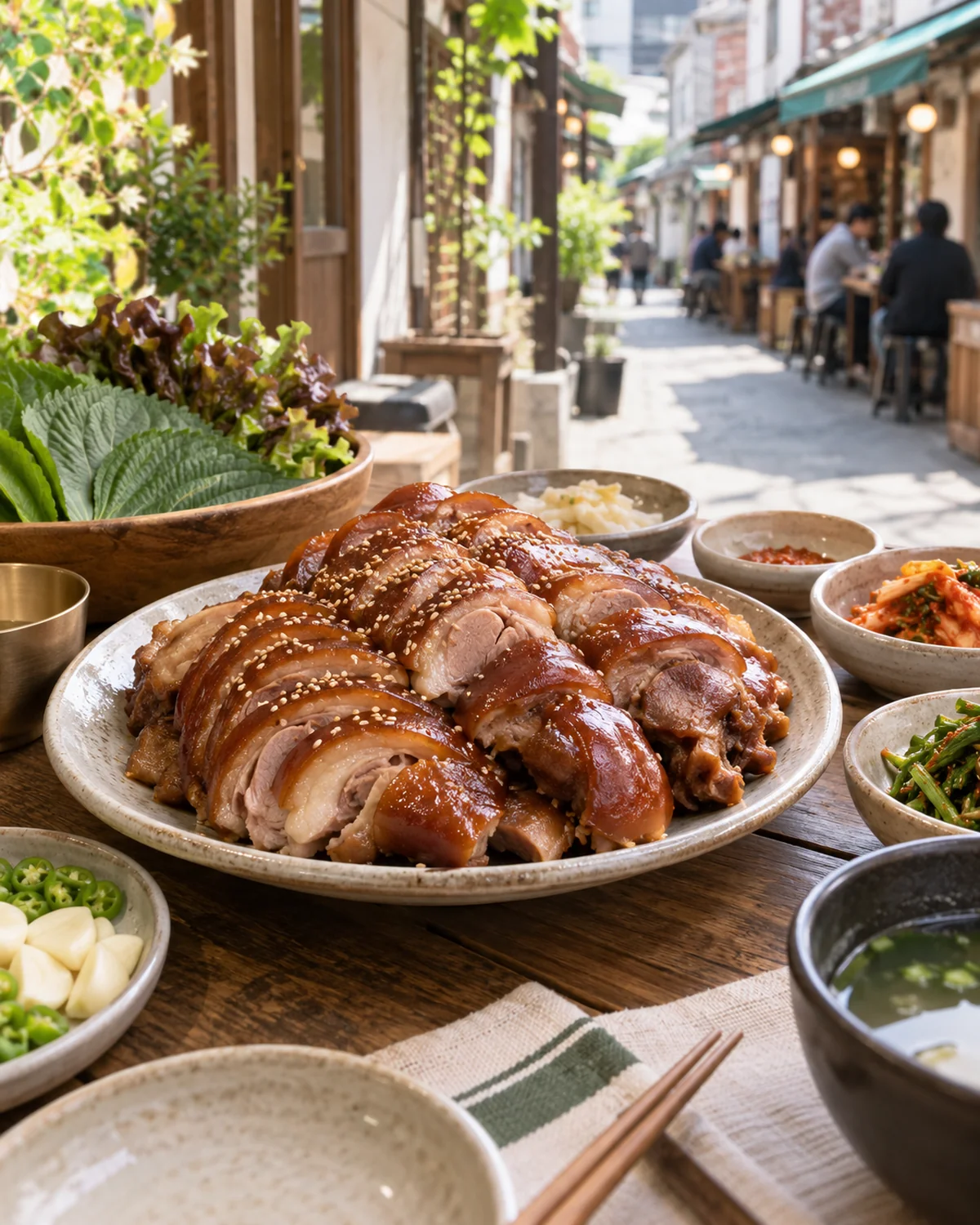
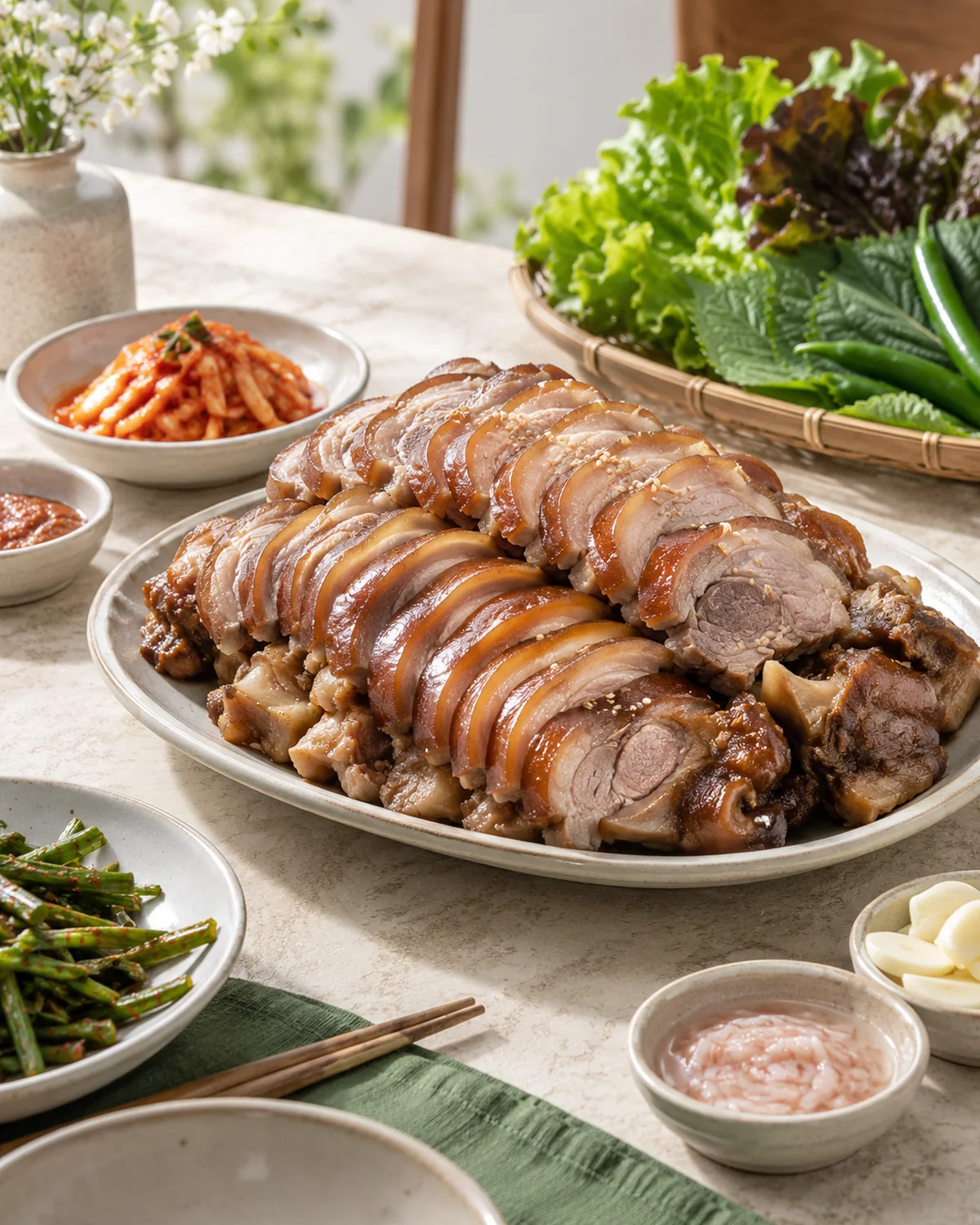
Jokbal is as much about how a plate is shared as how a pork foot is cooked. Skin, meat and connective tissue are transformed by slow braising, sliced together and brought to the table ready to eat.
Jokbal is seasoned braised trotter, not grilled pork belly
Jangchung-dong’s restaurant cluster explains one important Seoul setting for that meal. Its local history is worth knowing without turning every long-running house into the proven inventor of all jokbal.
Braising, not barbecuing: what makes jokbal
Jokbal uses the lower leg and foot of the pig, a cut that behaves very differently from pork belly or loin. It contains bone, skin, tendons and connective tissues surrounding smaller muscles. If cooked quickly, those tissues remain firm and resistant. Slow moist heat changes the structure: collagen-rich connective tissue gradually softens, while the skin becomes tender and springy rather than leathery.
The seasoning varies by house. Soy sauce is common, along with garlic, ginger and sweet aromatics. Some braises use rice wine, onion, scallion, pepper, spices or other ingredients. The point is not one secret national formula. The stable technique is prolonged braising until the meat can be sliced cleanly while the skin retains enough structure to feel pleasantly chewy.
After cooking, the trotter is commonly rested and sliced off the bone. Cooling even briefly helps the gelatin-rich exterior firm enough for cleaner slices. Rewarming or serving the slices while still warm then restores softness without turning the platter into shredded meat.
The texture that defines jokbal comes from connective tissue. Tendons and skin contain large amounts of collagen, a structural protein that is tough in raw or undercooked meat. Under sustained heat in a moist environment, collagen gradually breaks down and forms gelatin. That gelatin holds water and gives the surface of the meat its sticky, glossy, almost bouncy quality.
This is different from simply cooking fat until it melts. Jokbal certainly contains fat, but its distinctive texture depends heavily on collagen conversion. That is why the skin and tendon can feel soft yet resilient instead of behaving like the lean fibers of a pork chop.
The process also explains why aggressive high heat alone is not enough. Boiling hard can cook the outside quickly, but time is still needed for connective tissue to soften. Restaurants can vary temperature, braising strength and resting method, yet the underlying transformation is the same: a tough working cut becomes sliceable because long moist cooking changes its connective structure.
The glossy brown surface can make jokbal look similar to glazed grilled meat, but the cooking process is different. The trotter spends most of its transformation in moist heat. Soy sauce contributes salt and color; aromatics add fragrance; sugars or sweet ingredients can round the braise and deepen surface browning and gloss.
Because the meat is cooked in liquid, flavor enters the outer tissues while gelatin and rendered fat enrich the braising environment. The final slices can therefore taste deeply seasoned even without a separate glaze applied over open flame.
Some modern restaurants offer spicy jokbal or torch-seared variations. Those are legitimate variations, but they should not redefine the basic dish. Standard jokbal is generally remembered as soy-braised, savory and mildly sweet rather than chile-hot.
How Jangchung-dong became a food alley
Seoul’s own heritage material identifies Jangchung-dong Jokbal Alley as one of the city’s specialized food streets and lists its formation date as 1970. That is a much more precise and useful claim than saying the neighborhood invented every modern form of jokbal.
Jangchung’s restaurant concentration is distinct from the age of pork-trotter eating
The distinction matters because pig’s feet were eaten in different ways before one Seoul restaurant district became famous. Regional pork traditions, northern-style food memories and individual restaurant histories all predate or overlap with the alley. A city can become the most famous center for a dish through clustering, specialization and repeated public recognition without being the place where the underlying cooking idea first appeared.
Jangchung-dong’s importance is therefore urban and commercial. A recognizable group of specialist restaurants formed in one walkable area, customers learned to associate the neighborhood name with jokbal, and that association became strong enough for the alley itself to enter Seoul’s heritage and tourism narratives.
One frequently repeated account connects the early Jangchung-dong restaurants with women from northern Korea who settled in Seoul after war and displacement. Individual long-running shops preserve family stories about northern food traditions and founders who built businesses in the neighborhood. Those memories are part of the alley’s social history.
The problem begins when one family narrative is expanded into the claim that a single woman invented modern jokbal for all of Korea. The official city sources used here do not establish that level of certainty. They support the existence and growth of the restaurant cluster; they do not provide documentary proof for one universally accepted inventor.
A careful history can therefore hold both ideas at once. Refugee and northern regional food memory may be important to particular Jangchung-dong shops, while the broader dish cannot be reduced to one heroic origin story. That is not a weaker narrative. It is a more accurate description of how restaurant districts often form: several businesses, families and customer groups reinforce one another until a place name becomes attached to a food.
Visit Seoul explicitly connects the fame of Jangchung-dong jokbal with Jangchung Arena. Before Seoul developed many large sports and concert venues, the arena drew crowds for major matches and performances. According to the city’s tourism guide, spectators would stop at nearby jokbal restaurants after events, helping the restaurant area grow into the alley recognized today.
That link makes sense at the level of eating format. Jokbal is not a fragile dish that must be consumed within seconds of coming off a grill. It can be braised in advance, sliced for a table and served in large platters. A group leaving a sports match can sit down, order one main plate, add noodles or pancakes and share drinks without each person needing a separate entrée.
The platter gives diners choices in building a bite
The second paragraph is interpretation rather than documentary proof of a single economic cause. The official source establishes the arena-crowd connection. The food’s group-friendly service format helps explain why that customer flow could work so well for jokbal restaurants.
A platter built for sharing
A typical order is a platter rather than a personal bowl. That serving style changes the social rhythm of the meal. Diners take individual slices, combine them with condiments or wraps, pause for side dishes, and continue over a longer conversation. The same plate can support different preferences because one person may eat the meat plain while another builds a full ssam.
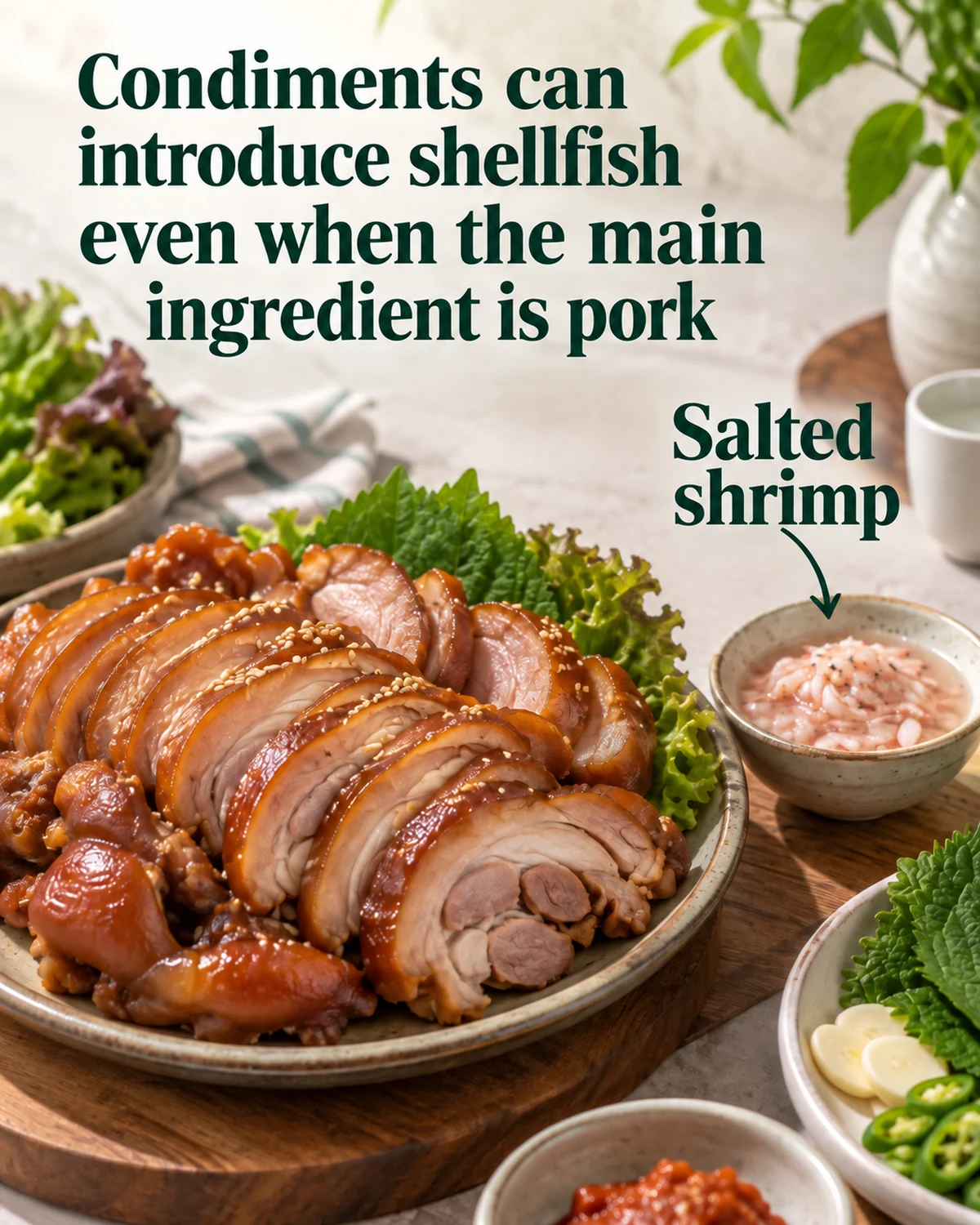
Lettuce or perilla leaves are common wrapping greens. Raw garlic, green chile, ssamjang and saeujeot—salted fermented shrimp—often appear as condiments. These are common accompaniments, not a mandatory national ritual. Restaurants vary, and diners do not need to assemble every slice in exactly the same way.
Saeujeot is particularly useful because its salty fermented flavor cuts through rich pork. Raw garlic adds heat and sharpness. A leaf adds freshness and changes the meat-to-vegetable ratio. The table therefore lets diners adjust intensity bite by bite without changing the braise itself.
Taste the pork before building the wrap
Try a small slice as it arrives, taking skin and meat together. Next, add a little condiment. Only then try a wrap with the leaves and accompaniments supplied. This separates the pork’s own texture from the salt, heat and crunch you choose to add. A large wrap containing everything at once can make those differences disappear.
Taste the pork first and keep the wrap manageable
Ask whether a plate’s serving estimate suits the people at the table. The size label may describe a shared platter rather than a personal portion, and bones or other components can make visual comparisons misleading. Cold noodles or a pancake can provide a contrast, but they remain additional food, not an obligatory proof that you ordered properly.
For a comparison with bossam, look at cut, skin, bones and cooking method rather than assuming all sliced pork serves the same role. Both can support a wrap, but the experience of the pork itself differs. That is also why glossy jokbal should not be described as barbecue simply because its seasoning looks sweet and dark.
Jangchung-dong restaurant tables often include or offer side dishes such as cold mixed noodles, mung-bean pancakes or green-onion pancakes. Visit Seoul specifically notes bindaetteok and pajeon among the side menus found in the alley.
The pairing is structurally useful. Warm gelatin-rich pork is dense and savory. A cold, tangy noodle dish brings acidity, chile and temperature contrast. A crisp pancake brings browned edges and starch. The meal becomes easier to keep eating because the side dishes interrupt the repetition of rich pork.
That does not mean every local orders the same combination. It explains why these side menus thrive in a restaurant cluster centered on a large shared meat platter.
Jokbal, bossam and suyuk are not the same order
Three Korean pork terms are often collapsed in translation: jokbal, bossam and suyuk. All can arrive sliced on a shared platter, but the cut and cooking logic differ.
Jokbal is defined primarily by pig’s trotter and a seasoned braising process. The skin, tendons and connective tissue are central to its texture. Bossam usually refers to boiled pork—often belly or shoulder—served in slices and commonly wrapped with cabbage, greens and condiments. Suyuk is the broader term: meat cooked in water or broth and served sliced, and it can refer to pork or beef depending on context.
This means a plate of plain boiled pork is not automatically jokbal just because it is sliced for sharing. Conversely, jokbal does not become bossam simply because diners wrap it in lettuce. The cut and cooking method matter more than the presence of a leaf.
Cut and cooking method separate jokbal from other boiled-pork dishes
Finding the alley and reading the menu
Seoul also has a well-known jokbal cluster inside Gongdeok Market. Visit Seoul describes that alley as a later concentration of jokbal and sundae-guk shops. The existence of another cluster is useful because it separates the dish from one neighborhood while showing how the “food alley” model repeats across the city.
Jangchung-dong’s distinction is its older heritage identity and strong association with Jangchung Arena. Gongdeok’s cluster belongs to a market environment with its own customer flow and neighboring jeon alley. The two places show how the same dish can anchor different commercial ecosystems.
For travelers, that means the choice does not have to be framed as “authentic versus fake.” The better question is which neighborhood history and surrounding itinerary you want to experience.
Jangchung-dong Jokbal Alley remains close to Dongguk University Station and Jangchung Arena, but individual restaurant hours, closure days, prices and sell-out patterns change. Current Visit Seoul listings are useful close to a trip, yet even a page edited in 2026 can become outdated later.
Because platter sizes vary, asking how many people a size is intended for is more useful than relying on an old fixed price. The menu in front of you is the authority for that meal.
Pork, salted shrimp and other ingredients to check
Jokbal is pork, so it is unsuitable for diners avoiding pork for religious, ethical or personal reasons. Soy sauce commonly contains soy and may contain wheat depending on the product. Ssamjang can contain soy and wheat, while saeujeot contains shellfish. Restaurant recipes vary, so people with allergies should ask about the braising liquid and condiments rather than assuming the sliced meat is the only ingredient that matters.
Condiments can introduce shellfish even when the main ingredient is pork
The dish is sometimes marketed with claims about collagen and skin health. A food-history guide should not turn the collagen content of connective tissue into a promise that eating jokbal improves skin, joints or other medical outcomes. The cooking science is interesting enough without making therapeutic claims.
From this shared pork platter, compare a rib meal or the practical choices of dining alone.
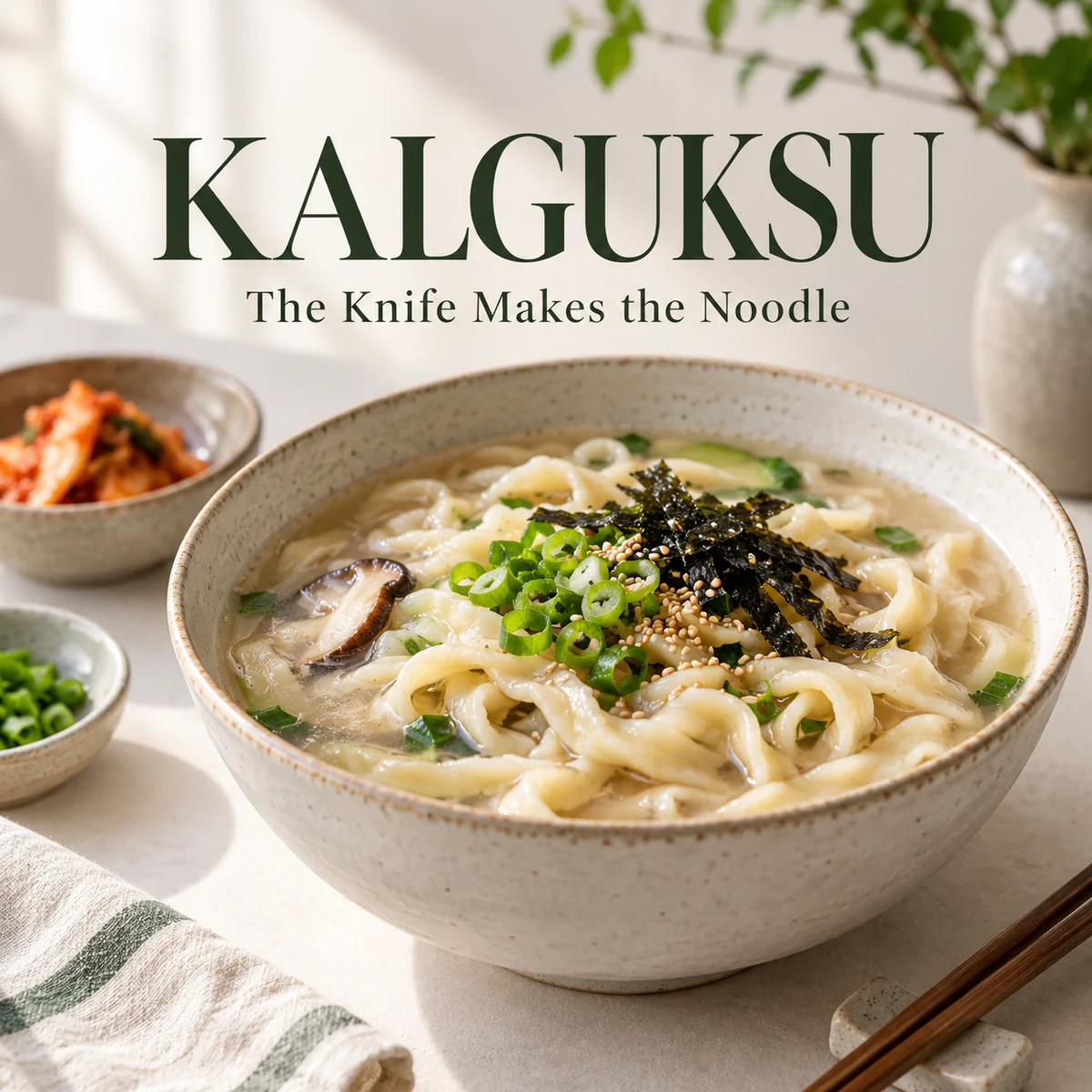
A bowl of kalguksu can be chicken-rich, clam-scented or thickened with perilla. What connects those bowls is not one broth but a name built around cutting dough into noodles.
That small distinction changes how you read the menu. Myeongdong’s famous restaurant style is one branch of a much larger family. Older Korean recipes also do not always describe the white wheat noodles that many visitors now expect.
The knife in the name
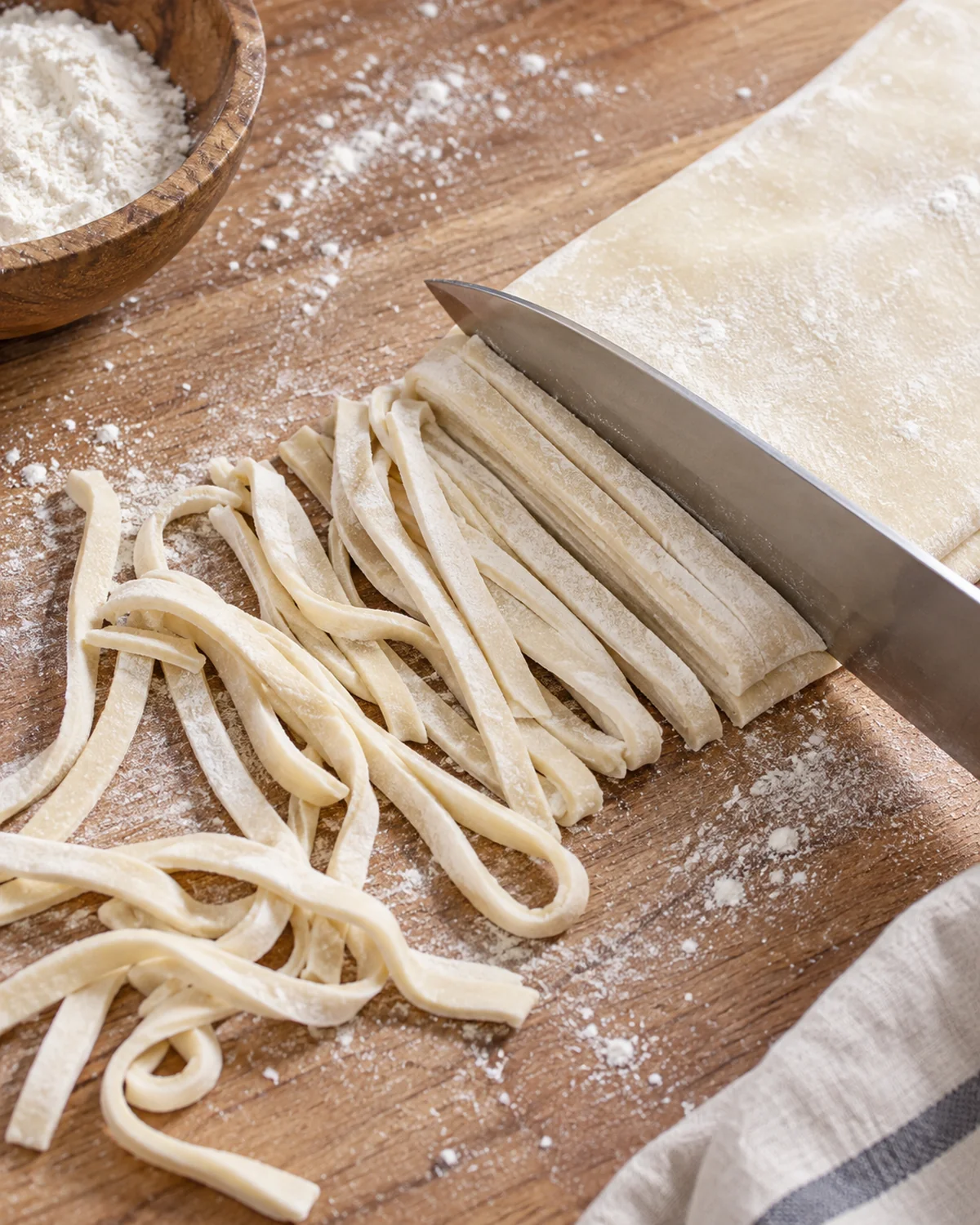
Kal means knife and guksu means noodles. In the simplest method, dough is kneaded, rested, rolled thin, folded or layered, and cut into strands. The cut noodles are then cooked in or served with broth. That knife-cut identity is the common thread.
Knife-cut describes the noodle technique rather than a single broth
Everything around the noodles can change. Broth may be based on chicken, anchovy, clam, seafood, beef or vegetables. Some versions include zucchini and potato; others emphasize shellfish, perilla seed or minced meat. The dough can differ in thickness and hydration. A restaurant can make very soft noodles while another serves a chewier strand. Kalguksu is therefore better understood as a noodle family than as one standardized soup.
Knife cutting is not only a visual tradition. Rolling and cutting dough lets a cook control thickness and width directly. Thicker noodles retain more chew and take longer to cook through. Thin noodles soften quickly and release starch faster. Slight variation in hand-cut strands means some pieces can feel softer while others keep more bite.
Dough hydration and resting matter as well. Water lets gluten-forming proteins interact; kneading develops structure; resting relaxes the dough so it can be rolled without springing back too aggressively. Flour dusted between folded layers prevents the cut strands from sticking before they enter the pot.
Once the noodles cook directly in broth, loose starch thickens the liquid. That is one reason kalguksu broth can feel more substantial than a clear soup poured over separately rinsed noodles.
The cultural name describes the noodle tradition. Modern restaurants may use dough sheeters, cutting machines or partially standardized production while still serving a dish recognized as kalguksu. Some shops visibly hand-roll and hand-cut; others prioritize consistency and volume.
This matters because authenticity claims can become theatrical. A slightly irregular strand can be evidence of hand cutting, but perfect uniformity does not automatically make a bowl culturally illegitimate. The defining family resemblance is the flat cut-noodle form and how it works in broth, not a certification system for each noodle.
Buckwheat, wheat and the changing noodle dough
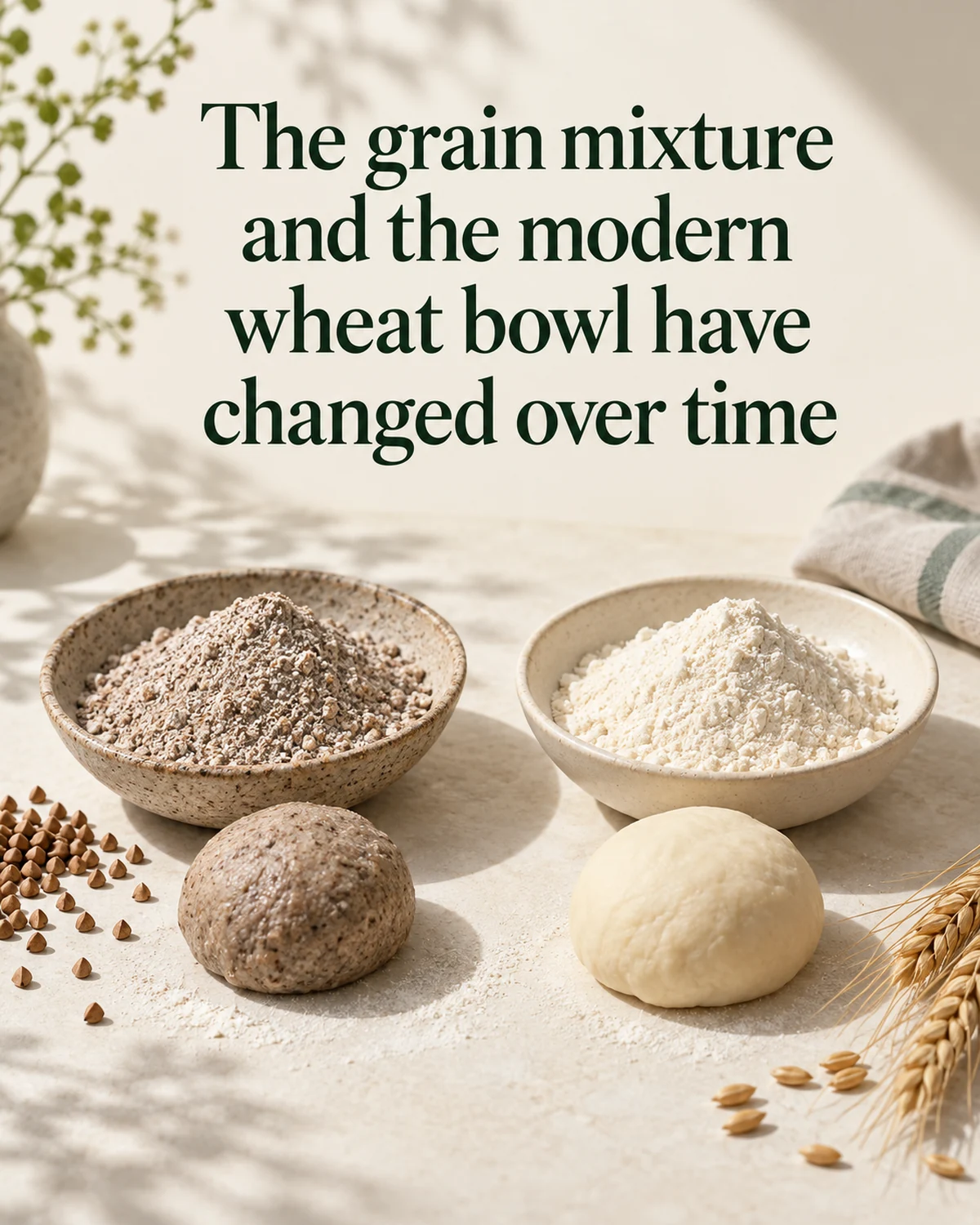
The Academy of Korean Studies traces an early knife-cut noodle preparation to the Joseon cookbook Gyugonsiuibang, where the dish appears under the name jeolmyeon (절면), literally “cut noodles.” The significant detail is the flour composition: the older recipe used buckwheat as the main flour and mixed in wheat flour as a binder.1
Another historical recipe cited by the Academy also relies on buckwheat, using water from cooked glutinous rice in the dough. Those examples show that the knife-cut method is older than the modern expectation that kalguksu must begin with a bag of white wheat flour.
The grain mixture and the modern wheat bowl have changed over time
This is an important correction because visual continuity can be deceptive. A bowl of modern kalguksu looks “traditional,” but the availability and relative price of grain changed across centuries. Technique can persist even as the ingredient ratio changes.
The Academy of Korean Studies cites the medieval text Goryeodogyeong to explain that wheat was scarce enough in Korea to be imported and expensive. That does not mean no Korean ate wheat noodles. It means wheat flour occupied a different economic position than it does in a modern urban restaurant.
If an ingredient is relatively scarce, cooks stretch it, reserve it, combine it with other grains or use it in contexts where its value makes sense. Buckwheat, which grows well in conditions that are difficult for some other grains, was an important noodle grain in many Korean regions. Mixing wheat into buckwheat dough could improve binding while still reflecting the relative scarcity of wheat.
That historical reality is more informative than repeating unsourced claims that kalguksu belonged to one exact ceremony or one social class. The evidence securely supports scarcity and older buckwheat-heavy formulations; more specific claims about weddings, birthdays or harvest feasts require their own documentation.
The Academy of Korean Studies also cites twentieth-century cookbooks in which kalguksu is made much more like the noodles recognized today: wheat flour mixed with water and salt, kneaded firmly, rolled thin and cut. Some older modern recipes boiled the noodles separately, rinsed them in cold water and then added clear broth.
Contemporary kalguksu is often cooked directly in the broth. That cooking method releases some surface starch into the soup, making the liquid slightly cloudy and giving it a thicker, more integrated texture. The noodles and broth become part of the same cooking system rather than two components assembled at the end.
This difference shows why “traditional” is not one frozen point. Even within the wheat-flour era, technique shifts between boiling separately and cooking directly in broth.
Modern kalguksu depends on a condition that earlier cooks could not take for granted: wheat flour that is widely available and affordable enough to form the main body of the meal. The twentieth century transformed the place of wheat in Korean diets, but that broad change should not be reduced to one unsupported sentence such as “U.S. food aid invented modern kalguksu” or “government flour policy created the dish.”
Those policies and postwar grain flows are important subjects in Korean food history, but they need dedicated sources. For this dish, the safer conclusion is narrower: as wheat became more available, a noodle technique that had previously accommodated expensive wheat and buckwheat could become a routine wheat-flour restaurant food.
That is enough to explain why the same name can connect historically different bowls without pretending that one policy created a centuries-old technique.
Myeongdong is a style, not the starting point
MICHELIN documents Myeongdong Kyoja as a family-run restaurant operating since 1966. That date is important because it anchors a famous modern Seoul expression of kalguksu. It does not place the restaurant at the beginning of the dish’s history; Joseon-era written evidence is much older.
The restaurant became influential because its bowl is distinctive. Myeongdong Kyoja is associated with a richer chicken-based broth, soft noodles, minced-meat topping and intensely garlicky kimchi, along with mandu as another signature item. The combination is different from the lighter anchovy or seafood broths many diners encounter elsewhere.
Myeongdong is a branch of kalguksu, not the whole noodle family
Its historical role is therefore best described as modern urban institution, not inventor. It made one Seoul style famous enough that international visitors sometimes mistake the Myeongdong bowl for the national definition of kalguksu.
Travel around Korea and kalguksu changes with local ingredients. Coastal areas may use clams or mixed seafood. Inland bowls may use chicken or anchovy broth. Perilla-seed versions become nutty and opaque. Some soups are clear and light; others are thick with starch or ground seeds.
The common noodle technique allows the broth to express place. This makes kalguksu structurally different from a dish defined by one sauce or one topping. The noodles create a canvas, and the local broth supplies much of the regional identity.
A useful comparison is with Okcheon saengseon-guksu, where river-fish broth gives a noodle dish a completely different regional logic. The existence of such variations is why no famous Seoul shop should be treated as the sole authentic template.
Broth is the other half of the bowl
When fresh flour-dusted noodles are cooked directly in soup, starch leaves the noodle surface and disperses into the broth. That starch increases viscosity and reduces clarity. The cloudiness is therefore not necessarily a sign of heavy fat or dairy; it can be a natural consequence of cooking fresh noodles in the serving broth.
Starch can cloud a noodle broth without making it a bone soup
The effect varies with how heavily the noodles are floured, how much they are agitated, how concentrated the broth is and whether the cook boils them separately. A very clear kalguksu and a cloudy one can both belong to the category.
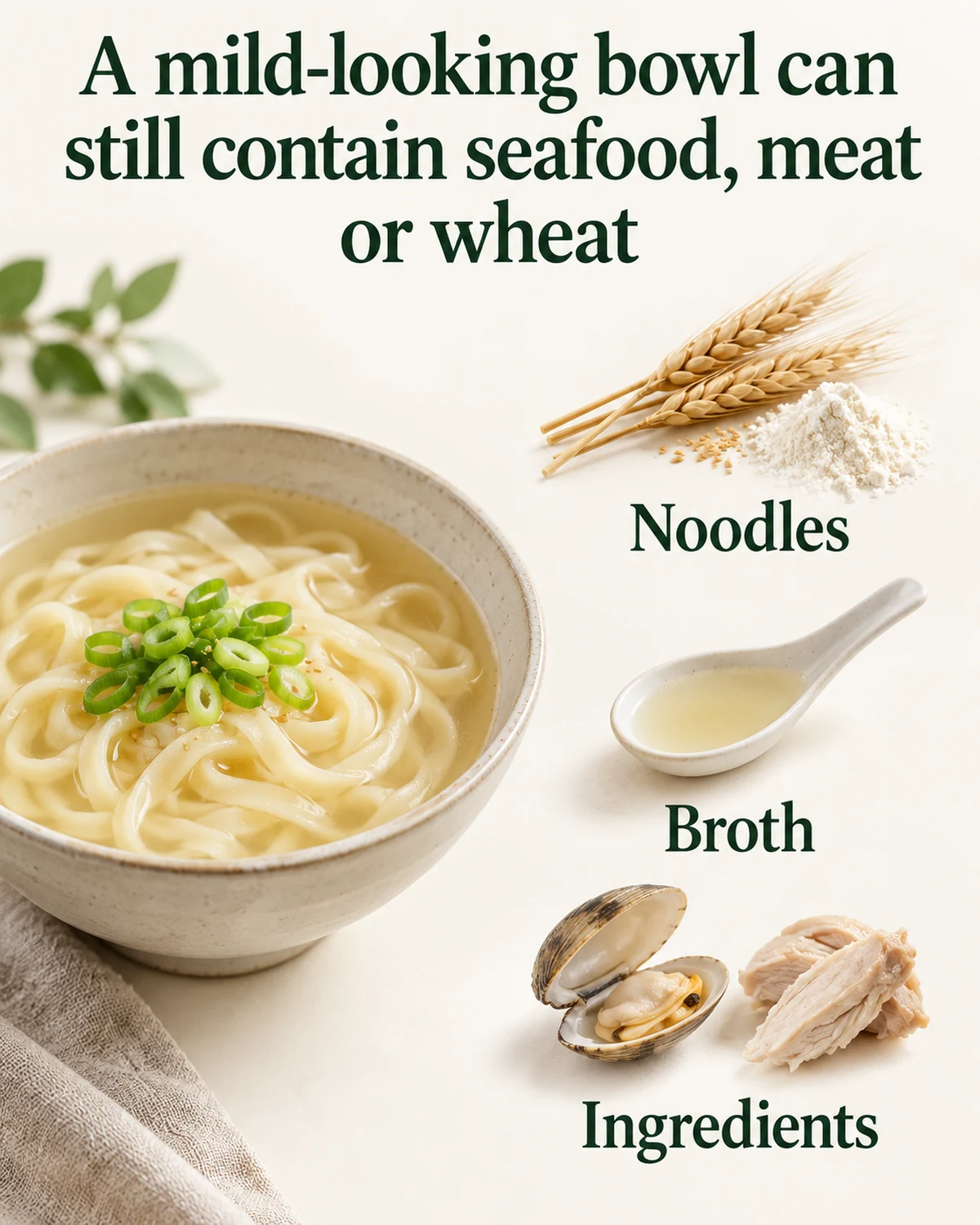
Think of a kalguksu menu in two layers: the cut noodle and the liquid around it. Words for clams, chicken or perilla tell you about the second layer. A photograph of pale broth cannot reliably tell you whether it contains seafood, meat or a seed-based addition. Dietary questions should address the stock and seasonings as well as visible toppings.
At the table, taste a little broth before adding strong kimchi or condiments. Then compare a strand near the surface with the broth it carries. Thickness, surface starch and cooking time all affect the experience, so “knife-cut” is more useful as a technique description than as a promise that every strand was sliced moments before your order.
Restaurant age and dish age also need separate labels. A restaurant can have an important modern history without inventing the whole category. Use a named shop to understand one version, then use the broth modifiers to explore another; that is a more revealing comparison than trying to crown one bowl the only authentic kalguksu.
Taste the noodles before the kimchi
Start with the noodles and broth before eating much kimchi. This establishes the baseline: noodle softness, chicken depth, starch level and seasoning. Then eat the kimchi in small bites alongside the soup.
Taste the broth and noodle first; add contrasting kimchi afterward
Myeongdong Kyoja is famous for very garlicky kimchi. That pungency is part of the restaurant’s identity, but garlic and chile can overwhelm subtle broth if added or eaten in large quantities immediately. Alternating bites preserves the contrast better than treating the kimchi as a compulsory flavor booster.
Mandu pairs naturally with kalguksu because the dumpling provides a firmer wrapper, meat filling and different texture. It is a classic companion at the restaurant, not a requirement for understanding the noodle dish itself.
Many versions are not chile-hot, especially clear anchovy, clam or chicken broths. But “mild” does not mean flavorless. Garlic, black pepper, fermented kimchi, seafood salinity and concentrated stock can all create strong flavor without red chile broth.
Restaurants may also serve spicy versions. The broth style, not the word kalguksu itself, determines heat level.
Kalguksu is strongly associated with warmth and comfort, but there is no rule that it belongs only to winter. Hot noodle shops operate through Seoul summers, and restaurants can pair them with seasonal cold noodles or other menus. The appeal is partly practical: a bowl combines starch, broth and toppings in one filling format.
Weather changes how the dish feels, not whether the dish remains culturally appropriate.
Check the stock, then the restaurant details
Kalguksu is not vegetarian by default. Wheat noodles themselves can be simple flour-and-water dough, but the broth may contain anchovies, clams, chicken, beef or other animal ingredients. Toppings and kimchi can also contain animal-derived seasonings.
A mild-looking bowl can still contain seafood, meat or wheat
If you need a vegetarian or vegan meal, ask about the broth first. Removing visible meat from the top does not change an anchovy, seafood or chicken stock underneath.
For a planned visit, verify the restaurant’s current information close to the day you go. The history of the noodle does not expire; practical logistics do.
Kalguksu looks like a simple continuity story: Koreans cut noodles with a knife long ago and still do it today. The documentary record reveals something more useful. Older recipes relied heavily on buckwheat because wheat had a different economic value. Later wheat-flour recipes moved closer to the modern noodle. Contemporary restaurants then developed highly recognizable regional and urban broths.
The continuity is the technique; the change is the ingredient economy and the restaurant culture around it. Myeongdong Kyoja belongs near the end of that timeline as a 1966 Seoul institution, not at the beginning as an inventor.
That sequence—scarce wheat, buckwheat-heavy cut noodles, increasingly wheat-based modern dough, then diverse regional broths and urban specialists—explains far more than calling kalguksu an “ancient comfort food.”
The next comparison can stay with noodles or move to the food city around the bowl.
The best first question at Gwangjang Market is not “Which stall is famous?” It is “Am I buying a hot snack, a small rice roll or a seated meal?” Bindaetteok, kkoma gimbap and yukhoe answer those questions differently.
A pancake is about its freshly browned edge; a tiny roll is about rice, seaweed and dip; seasoned raw beef is a separate dietary choice, not a compulsory stop. The market’s 1905 establishment and textile history explain the place, but they do not give every dish one shared birthday.
Choose the food before choosing a queue
Bindaetteok (빈대떡) is a savory mung-bean pancake. At Gwangjang, soaked mung beans are ground into a thick batter and fried on broad griddles, commonly with ingredients such as bean sprouts, kimchi and pork depending on the stall. Seoul tourism sources consistently identify mung-bean pancakes as one of the market’s signature foods.
The appeal is largely structural. Ground mung beans produce a batter different from a thin wheat-flour pancake. A generous layer of oil and a hot griddle brown the outside deeply while the center remains denser and softer. Bean sprouts add moisture and crunch; kimchi can add acidity and chile; meat adds richness. A soy-and-onion dipping sauce cuts through the oil.
The mung-bean pancake is best understood through its crust and filling
The best practical advice is to eat it hot. As the pancake sits, steam softens the crisp exterior. Sharing one before ordering another dish also makes sense because bindaetteok is heavier than its flat shape suggests.
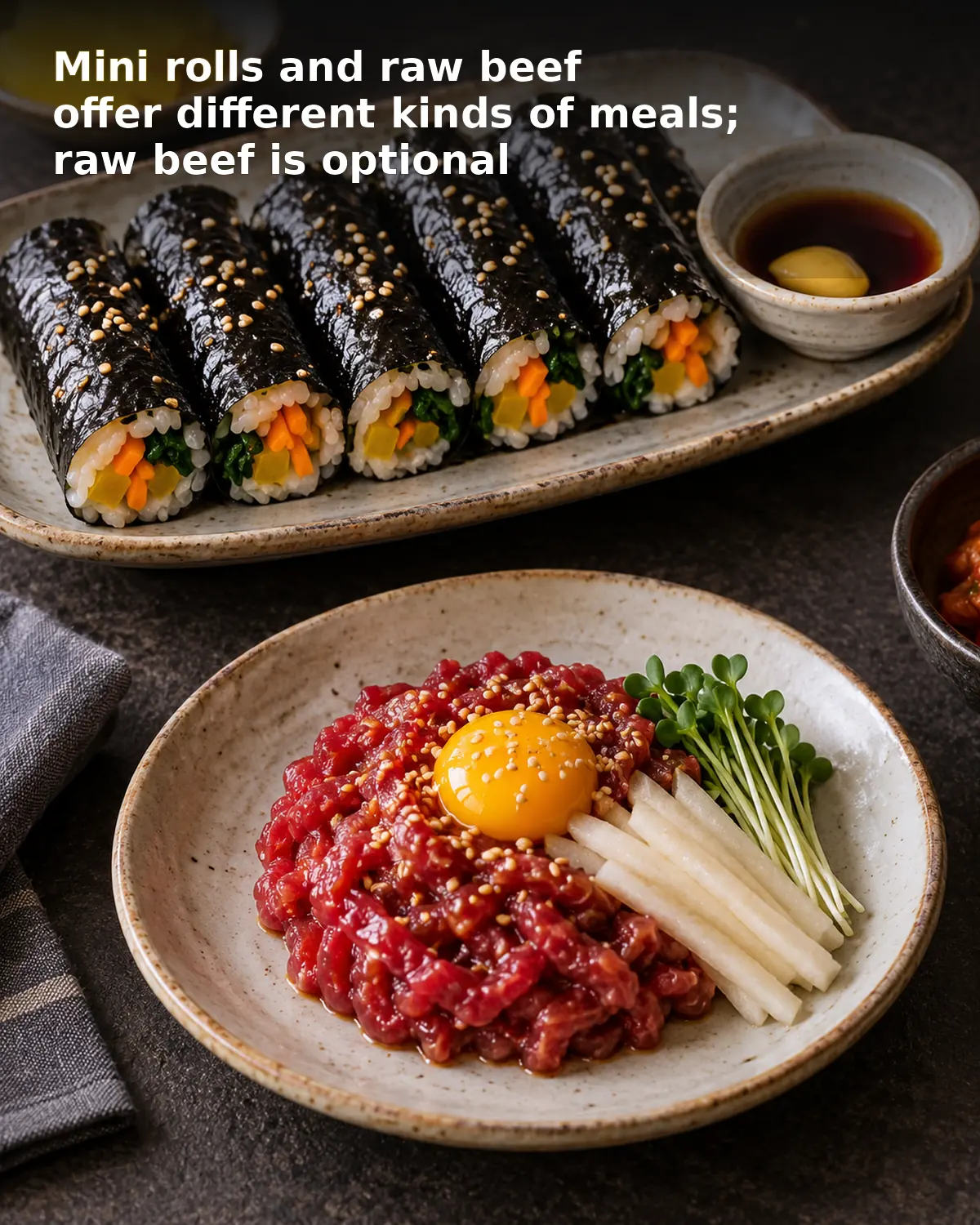
Mayak gimbap (마약김밥), often rendered in English as “addictive gimbap,” consists of small seaweed rice rolls rather than the larger, heavily filled gimbap sold as a full meal. The controversial name uses a slang metaphor for food that is hard to stop eating; it is not a literal ingredient reference and does not need to be romanticized.
The miniature format fits the market. Small rolls can be portioned quickly, shared, dipped and eaten without committing to a large plate. Fillings are typically simple compared with full-size gimbap, and a mustard-soy dipping sauce provides much of the punch. The contrast between mild rice-and-seaweed rolls and sharp sauce is more important than a long list of fillings.
Visitors sometimes assume the tiny size means the dish is a special ancient form of gimbap. The more useful interpretation is functional: a compact roll works extremely well in a high-turnover market where diners want to sample several foods in one visit.
Yukhoe (육회) is seasoned raw beef, usually cut into thin strips and dressed with ingredients such as sesame oil, garlic and sweetness; pear and egg yolk are also common in many preparations. Gwangjang has a recognizable cluster of restaurants specializing in the dish, and Seoul tourism material repeatedly lists beef tartare among the market’s signature foods.
Its texture is the opposite of bindaetteok. Instead of crisp fried edges and a soft center, yukhoe is cool, tender and slick with seasoning. Korean pear can add cold crunch and sweetness; sesame oil adds aroma; egg yolk can make the mixture richer. The dish is usually eaten seated rather than while walking, which also changes the pace of a market visit.
Yukhoe should not be framed as a “bravery challenge.” It is a normal Korean dish made with raw beef, and raw animal products carry food-safety risk. Pregnant people, immunocompromised diners and others at higher risk from foodborne illness should follow appropriate medical guidance. Anyone uncomfortable with raw beef can skip it without missing the historical point of the market.
Bindaetteok, mini gimbap and yukhoe are often presented as a checklist, but their real value is that they demonstrate three different modes of market eating. The pancake is hot griddle food built around frying and texture. The gimbap is compact, fast and portable. Yukhoe is a seated raw dish with a specialized restaurant culture.
Eating all three, if appetite and dietary preferences allow, is therefore not about collecting famous names. It is a way to experience how one market supports very different preparation systems within a few minutes’ walk: grinding and frying, rolling and dipping, slicing and seasoning.
A permanent market from 1905, not a frozen food scene
Seoul Metropolitan Government’s cultural-heritage material places Gwangjang’s creation in a period of rapid commercial and political change. Private Korean merchants sought a year-round market in Jongno as older commercial structures changed and Japanese merchants expanded their position in Seoul after gaining commercial strength around Namdaemun.
The important point is not to turn every transaction in 1905 into a heroic resistance scene. It is that the market was established by private merchants as a Korean-controlled commercial space during a period when control over urban commerce had political and economic significance. Seoul’s historical account explicitly connects the market’s establishment with efforts to compete against older monopolistic structures and, later, expanding Japanese commercial power.
The market also changed physically. Seoul’s heritage material notes that the original one-story hanok market structures were destroyed during the Korean War and that a new three-story building was constructed in 1959 as part of postwar reconstruction. In the 1960s, the name shifted from Dongdaemun Market to Gwangjang Market. That history helps explain why “a 1905 market” does not mean every corridor or building visible today survives untouched from 1905.
The food lane is one layer of a larger market, not its entire 1905 identity
For much of its modern history, Gwangjang was especially famous for fabrics, hanbok and wholesale textile trade. Those businesses have not disappeared. Seoul’s current material still points visitors to the second-floor fabric market, tailor shops and hanbok-related stores.
This matters because food tourism can flatten traditional markets into eating zones. Gwangjang is more accurately understood as a commercial ecosystem in which different trades accumulated over time. Food is now the easiest entry point for visitors, but the fabric floors reveal an older economic identity that helps explain why the market became important in the first place.
A useful visit therefore has two scales: look closely at what is on the griddle, but also look upward and around the alleys to see that the food stalls are embedded in a much broader marketplace.
Seoul Metropolitan Government describes Gwangjang as established in 1905 and, in different official materials, as the first year-round private market in Seoul or the first permanent market in South Korea. Those are useful sourced descriptions.
They should not be stretched into a national “oldest” claim about Korea’s street-food markets. Street-food culture is not the same historical category as a legally or commercially established permanent market. The food alleys became famous within a market whose original purpose was much broader. Precision preserves the history better than a stronger-sounding superlative.
Migration and the mung-bean griddle
A more recent Seoul Metropolitan Government feature links the market’s famous mung-bean pancakes with people displaced from Hwanghae Province after the Korean War, describing refugees who sold the pancakes using frying fat available in the postwar period. That account is useful because it places today’s “signature street food” inside a larger story of migration and livelihood rather than treating it as an eternal market recipe.
As with many market-food histories, one article cannot prove that every bindaetteok stall descends from one origin line. What the Seoul source does establish is a credible social context: postwar displacement and market commerce helped shape the food culture that later became one of Gwangjang’s defining attractions.
Grinding and shallow frying create the pancake’s contrasting textures
New snacks join an older marketplace
A recent Seoul city feature emphasizes that Gwangjang continues to absorb new food trends. Alongside mung-bean pancakes, noodles and yukhoe, newer vendors and pop-ups sell items such as twisted doughnuts, bakery products and regional snacks from elsewhere in Korea.
That is not evidence that the market has become inauthentic. Markets survive by adapting to customers. A place founded in 1905 has already lived through colonization, war, reconstruction, changes in wholesale trade, mass tourism and social media. Expecting it to preserve one perfect historic menu would misunderstand how markets function.
The useful distinction is between historically embedded specialties and newer commercial trends. Both can be worth eating; they simply tell different stories.
No simple label fits. The market is heavily visited by domestic and international tourists, especially in the food lanes, but it remains a working commercial market with textile, clothing and food businesses. Some areas feel intensely touristic; others still function mainly around specialist trade.
That mixed identity is historically appropriate. Gwangjang has repeatedly changed with Seoul’s economy. Tourism is one more phase in a market that has already shifted from early private commerce to postwar reconstruction, fabric specialization and globally visible food culture.
Build a meal with room left over
A compact route can begin with bindaetteok, continue with mini gimbap, and add yukhoe only if raw beef fits your preferences. That sequence moves from hot and heavy to small and portable, then to a seated dish. It also avoids ordering several oily foods before deciding whether you still want a raw-beef plate.
Mini rolls and raw beef offer different kinds of meals; raw beef is optional
If you do not eat meat, build a different route instead of forcing the “famous three.” Ask whether a pancake contains pork, because recipes vary. Mini gimbap may look vegetarian but fillings, seasoning or dipping sauce should still be confirmed. Noodles, pancakes and other stall foods can be adapted only when the vendor’s actual recipe allows it.
Most importantly, leave room for observation. A market is not a tasting menu designed in advance. If one stall has an unusual seasonal item, a crowd of regulars or a preparation process worth watching, that can be more informative than completing a rigid checklist.
A useful market plan starts with the meal you will eat afterwards. Before a reserved dinner, try a small cooked order and pause. When the market is lunch itself, choose one substantial dish before adding tastes of other foods. The same three famous foods need not become three full portions.
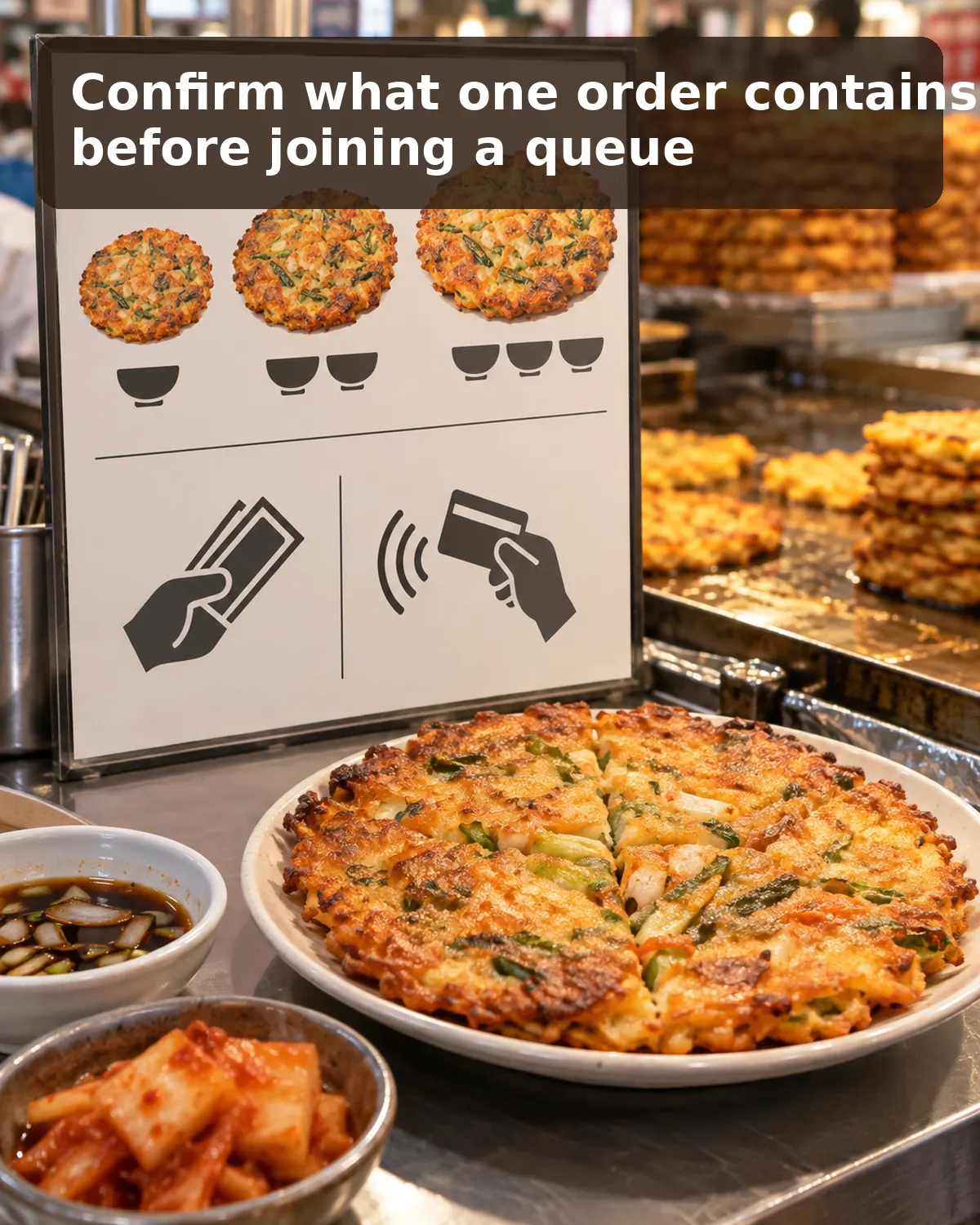
Read the selling unit before comparing prices. A plate, a serving and a combination order are not interchangeable. Ask which accompaniments are included and which are optional additions; a crowded counter and an attractive photograph do not answer those questions. Payment methods also belong to the particular stall, not to a rule about all traditional markets.
Confirm what one order contains before joining a queue
Older guides may call the little rolls mayak gimbap. A 2025 Seoul city feature uses Kkoma Gimbap and explains the naming change. The older slang nickname does not describe a narcotic ingredient. Look instead at the roll’s size, filling and separate dip. And when a raw-beef dish does not suit a diner’s dietary or safety needs, the cooked-food route is still a complete market visit.
Read the menu, portion and payment before ordering
Long lines at Gwangjang are partly a function of fame, guidebooks, television and social media. A queue can show demand, but it does not objectively prove that one stall is the “best.” Neighboring vendors may sell similar food with shorter waits.
Instead, look for operational clues. Is food being cooked continuously rather than sitting for long periods? Does the stall have clear turnover? Are raw and cooked foods handled separately? Are diners ordering the item the stall specializes in? Those observations are more useful than a viral ranking.
Leave room for the next dish rather than ordering every famous food at once
Old guides often say visitors “must bring cash.” That may be true at a particular stall, but payment acceptance changes. Some vendors accept cards or local digital payment, while smaller counters may still prefer cash. The safe advice is to carry a backup payment method rather than state that the entire market is cash-only.
The same freshness rule applies to individual vendor hours. A market complex can be open while one restaurant is closed, sold out or operating on a different schedule. Textile businesses and food stalls also keep different rhythms. Check the specific destination if one named shop is essential to the visit.
Street-food prices look stable until ingredient costs, rent, portion sizes or demand change. Quoting a price from an old travel article creates false precision. It can also make a normal current price look like overcharging when the only problem is that the guide is stale.
An evergreen guide should explain what each dish is, how it is served and how to compare stalls. Exact prices belong to the visit date. If budget matters, scan posted menus before ordering and confirm the price for the portion you want.
Look beyond the food lane
The most useful way to understand Gwangjang Market is to hold two histories at once. One is the institutional history: a permanent commercial market established in 1905 by private merchants, rebuilt after war and long associated with textiles and urban trade. The other is the food history: postwar migration, griddle cooking, compact snacks, raw-beef restaurants and newer trends that turned the market into a global culinary destination.
Those layers explain why the market feels both old and constantly changing. Bindaetteok does not have to be unchanged since 1905 to be historically meaningful. Mini gimbap does not have to represent all Korean gimbap. A new doughnut stand does not erase the textile market upstairs. Gwangjang’s real continuity is the market itself: a dense space where commerce adapts, specialties cluster and Seoul keeps adding new reasons to visit.
The market gives you several starting points: follow the noodle, the little rice roll or the wider street-food setting.