Why Koreans Eat That

Tag: gwangjang market

  • Gimbap (김밥): Korea’s Everyday Seaweed Rice Roll — and Why It Isn’t Sushi

    Gimbap (김밥): Korea’s Everyday Seaweed Rice Roll — and Why It Isn’t Sushi


    Walk into any Korean neighborhood and you’re never far from gimbap (김밥) — the seaweed-wrapped rice roll sold at every corner bunsik (snack) shop, packed into school lunchboxes, and grabbed by the piece at the market. In one line: gimbap is cooked rice and fillings rolled in dried seaweed and seasoned with sesame oil rather than vinegar — Korea’s cheap, portable, everyday meal. And in 2023 it did something very un-everyday: a frozen version landed at Trader Joe’s in the US and sold out nationwide after a single TikTok video. So what is this humble roll, really — and why do Koreans get a little touchy when you call it “Korean sushi”?

    Colorful cross-sections of Korean gimbap seaweed rice rolls on a plate with sesame seeds — gimbap korean seaweed
    Gimbap — rice and fillings rolled in seaweed, brushed with sesame oil, sliced into bites.

    ⭐ Gimbap at a glance

    🍙 Everyday-ness (you’ll see it everywhere) ★★★★★
    🎒 Portable / picnic-friendly ★★★★★
    💸 Easy on the wallet ★★★★★
    🌶️ Spice level ★☆☆☆☆

    A personal take — how often you’ll meet it, how travel-friendly it is, and the price. Yours may differ.

    The short version: Gimbap is cooked rice and a row of fillings — egg, vegetables, often ham or fish — rolled tight in a sheet of gim (dried seaweed), brushed with sesame oil, and sliced into rounds. It’s cheap, portable, and endlessly customizable. Here’s how it’s different from sushi, where it came from, the varieties worth knowing, and where to eat it.

    It looks like sushi. It really isn’t.

    The comparison is understandable — rice, seaweed, a roll sliced into circles. But bite in and the difference is immediate. The giveaway is the rice: sushi rice is seasoned with rice vinegar, giving it that clean tang. Gimbap rice is dressed with sesame oil and a little salt — nutty, savory, and served at room temperature rather than chilled.

    Close-up of a gimbap roll being sliced showing rice egg spinach carrot and pickled radish fillings — gimbap korean seaweed
    The tell is the rice — sesame oil, not vinegar — and hearty, cooked fillings.

    The fillings tell the rest of the story. Instead of raw fish, gimbap leans on fully cooked, homey ingredients: strips of egg omelette, seasoned spinach, carrot, danmuji (yellow pickled radish), and often bulgogi, ham, tuna, or fish cake. The seaweed is brushed with sesame oil so it glistens, then scattered with sesame seeds. Where sushi is often restaurant food, gimbap is the opposite — it’s what a Korean parent rolls at dawn before a family outing.

    The story: a roll Korea made its own

    Here’s where it gets interesting — and a little contested. Koreans have wrapped rice in seaweed for a very long time; gim was already being farmed in the southern Gyeongsang and Jeolla provinces by the 1400s, and old Joseon-era dishes like bokssam involved bundling rice into seaweed. So the raw idea is deeply Korean.

    Rows of freshly rolled gimbap at a Korean market stall with a vendor preparing more — gimbap korean seaweed
    From market stalls to lunchboxes — gimbap became Korea’s go-to portable meal.

    The rolled-and-sliced form we know today, though, took shape in the early 1900s, when the Japanese makizushi arrived during the occupation (1910–1945) — and the word for it was the Japanese loanword norimaki. The first known printed use of “gimbap” comes from a 1935 newspaper. After liberation, as part of a push to purify the language, Koreans deliberately swapped norimaki for the homegrown gimbap, and the dish kept evolving down a distinctly Korean path — sesame oil, Korean fillings, no raw fish. By the postwar decades it was the nation’s default packed lunch, the thing you ate on a school field trip with your name practically written on it.

    One roll, many moods

    “Gimbap” is really a whole family. A few worth knowing:

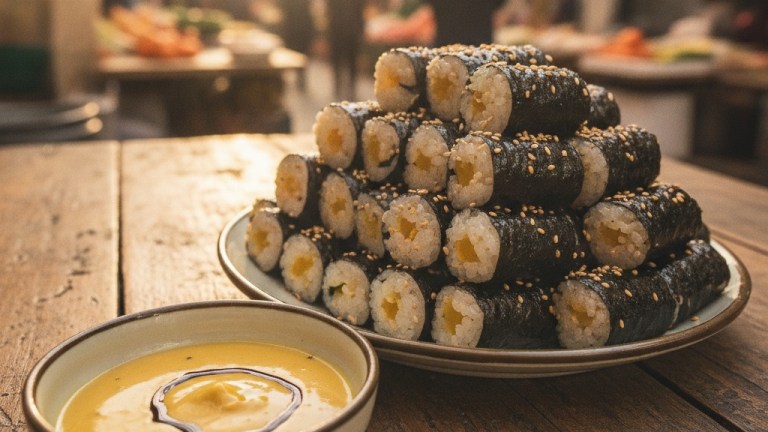
    • Mayak gimbap (마약김밥) — “drug gimbap,” the addictive mini rolls of Seoul’s Gwangjang Market: just carrot, spinach, and pickled radish, dipped in a mustard-soy sauce. The name is a joke about not being able to stop.
    • Chungmu gimbap (충무김밥) — from the seaside town of Chungmu (now Tongyeong): plain rice rolls with nothing inside, served alongside spicy seasoned squid and radish kimchi. Born as a food that wouldn’t spoil in the heat.
    • Samgak gimbap (삼각김밥) — the triangle convenience-store version, wrapped so the seaweed stays crisp until you open it.
    • Everyday fillings — tuna (chamchi), kimchi, bulgogi beef, cheese, fried pork cutlet. Every bunsik shop has its own lineup.

    The little roll that went global

    For decades gimbap was too everyday to be exciting. Then, in August 2023, a small Korean company called Allgot put frozen gimbap on Trader Joe’s shelves in the US — a strange idea, since freezing usually wrecks the texture. A Korean-American creator posted a TikTok of her mother heating it up; the clip passed 11 million views, and the product sold out across the country within weeks, with some stores capping it at one per customer. A humble packed lunch had quietly become a global craving — proof that the most ordinary food can travel the farthest. It’s a strange thing to watch a roll that costs a few thousand won at a Seoul convenience store turn into a rationed, one-per-customer item on another continent.

    🗓️ Plan your visit

    Where it’s easiest: everywhere. Any bunsik shop or convenience store in Korea sells gimbap, usually for around ₩3,000–4,500 a roll. For the famous market version, head to Seoul’s Gwangjang Market.

    Getting there: From Incheon Airport, take the airport railroad into Seoul; Gwangjang Market is a short walk from Jongno 5-ga station (Line 1). It’s central and easy to fold into a day of sightseeing.

    Costs: This is budget food at its best — a plate of ten mayak gimbap runs about ₩3,500. Bring a little cash for market stalls.

    Where to try it

    Gwangjang Market (광장시장) — Seoul

    Korea’s oldest continuously running market, open since 1905, and the spiritual home of mayak gimbap. Follow the crowds to the gimbap alley, grab a plate of the little rolls with their mustard-soy dip, and pair it with a mung-bean pancake. It’s messy, loud, and exactly the point.

    • 📍 Address: 88 Changgyeonggung-ro, Jongno-gu, Seoul (서울 종로구 창경궁로 88)
    • 🚇 Getting there: Jongno 5-ga Station (Line 1) or Euljiro 4-ga Station
    • 🍙 Mayak gimbap: about ₩3,500 for a plate of ten · cash is handy at stalls

    Down south, the port town of Tongyeong is the place for Chungmu gimbap — plain little rolls with spicy squid on the side, a regional specialty you’ll find all over the waterfront.

    One honest caveat: prices and hours shift, and market stalls come and go. The details here are accurate as of July 2026 — a quick check before you go never hurts.

    🔗 More Korean food to explore: gimbap is the calm cousin of Korea’s louder snacks — try tteokbokki, the spicy rice cakes, and browse the stalls of Gwangjang Market. For the bigger picture, see our Korean street food guide or the regional what to eat in Korea guide. · More on Wikipedia

    A few quick questions

    Is gimbap the same as sushi?
    No. Gimbap’s rice is seasoned with sesame oil and salt (not rice vinegar), it’s served at room temperature, and the fillings are cooked — egg, vegetables, meat or tuna — rather than raw fish.

    Is gimbap vegetarian?
    It can be — mayak gimbap and plain vegetable rolls are meat-free — but many everyday versions include ham, tuna, fish cake, or bulgogi, and some rice is brushed with fish-based seasonings. Ask or check the fillings.

    Why is it called “mayak” (drug) gimbap?
    It’s a playful nickname for the mini rolls at Gwangjang Market — they’re so moreish, dipped in that mustard-soy sauce, that people joke you can’t stop eating them.

    Does gimbap keep well for travel?
    That’s its whole appeal — it’s designed to be portable and eaten at room temperature, which is why it’s Korea’s classic picnic and field-trip food. Eat it the same day, though; it’s best fresh.

  • Seoul Food Guide: The Best Dishes in Each Neighborhood

    Seoul Food Guide: The Best Dishes in Each Neighborhood

    Seoul doesn’t have one food scene — it has dozens, and each neighborhood does something better than the rest. The trick to eating well here is knowing where: milky ox-bone soup in the old-town lanes of Jongno, hand-cut noodles in Myeongdong, a whole alley of rice cakes in Sindang-dong. This Seoul food guide covers what to eat in Seoul, organized by neighborhood, with links to full guides for each dish and where the locals really line up.

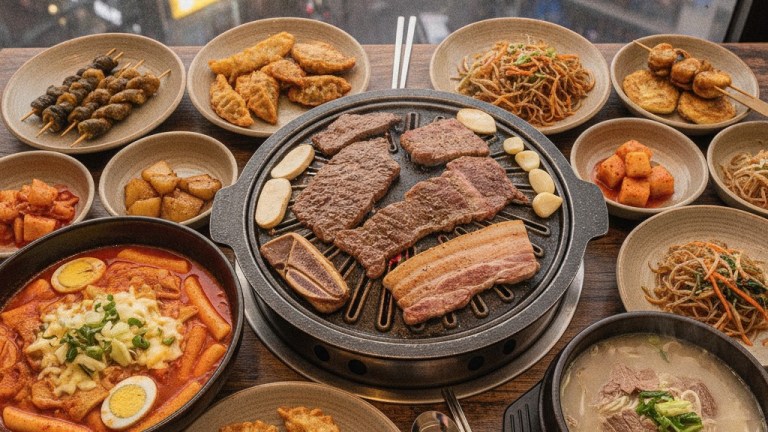
    A spread of must-eat Seoul food dishes, a guide to what to eat in Seoul
    Seoul’s best eating happens neighborhood by neighborhood — this is your map.

    ⭐ Eating in Seoul at a glance

    💸 Value ★★★★★
    🌶️ Spice range ★★★☆☆
    🚇 Easy to get around ★★★★★

    A personal take from eating across Seoul — value, spice range, and how easy it is to hop between neighborhoods by subway. Yours may differ.

    First time in Korea? This is the Seoul chapter of our bigger guide to what to eat in Korea — start there for the national picture, then use this to eat your way across the capital.

    Jongno & the old city — where Seoul eats history

    Gwangjang Market street food stalls in Jongno Seoul, where to eat in Seoul — eat seoul
    Jongno’s Gwangjang Market — a century of Seoul street food in one loop.

    Jongno (종로) is old Seoul, and it eats like it. Start at a century-old shop for seolleongtang, the milky ox-bone soup you season yourself and slurp on a cold morning. A few minutes away, Gwangjang Market is the city’s oldest street-food market — one loop for bindaetteok (mung-bean pancakes), mayak gimbap and raw beef, and you’ve had the crash course in Seoul snacking.

    Myeongdong & downtown — noodles and neon snacks

    Myeongdong (명동) is Seoul’s most famous food street, packed with stalls that come alive around 6–7 pm — corn dogs, tteokbokki, grilled cheese, and whatever’s trending this month. Duck off the main drag for a bowl of kalguksu, the comforting hand-cut noodle soup the district is quietly famous for.

    Sindang-dong & Jangchung-dong — one dish, done to death (in a good way)

    Some Seoul neighborhoods are built around a single dish. Sindang-dong is the birthplace of tteokbokki — a whole alley cooking the spicy rice cakes table-side. Jangchung-dong is the go-to for soy-braised jokbal (pig’s trotters), tender and just sweet enough. Pick a neighborhood, and dinner picks itself.

    Korean BBQ & fried chicken — the Seoul night out

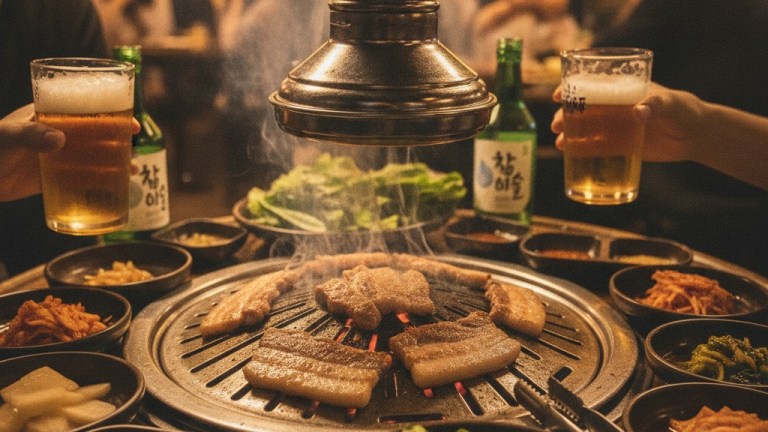
    Korean BBQ grilling meat at a table in Seoul, what to eat in Seoul at night — eat seoul
    Korean BBQ and chimaek — the classic Seoul evening.

    No Seoul trip is complete without a proper Korean BBQ, grilling samgyeopsal (pork belly) or galbi at your own table — the Mapo area near Gongdeok is thick with smoke and good options. And when the grill’s done, there’s chimaek (치맥): Korean fried chicken and beer, the country’s favorite late-night ritual. Seoul reportedly has more chicken shops than the whole world has McDonald’s.

    Seoul food guide: the dishes every trip needs

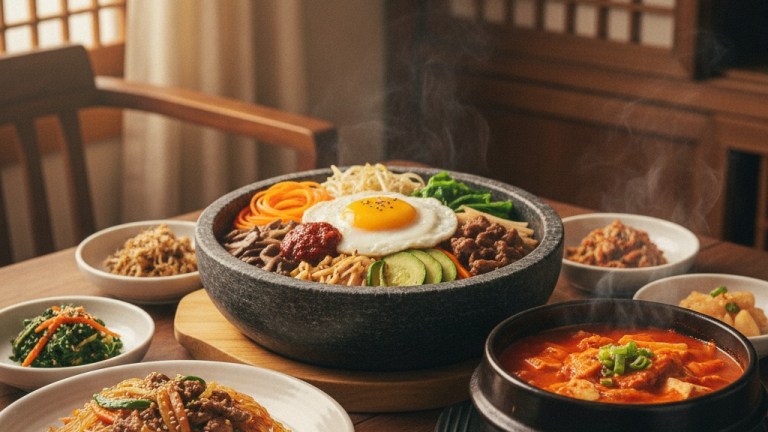
    Korean bibimbap, kimchi jjigae and japchae, must-eat dishes on a Seoul food trip — eat seoul
    A few icons belong on every Seoul itinerary — bibimbap, kimchi jjigae, japchae.

    Beyond the neighborhoods, a few icons belong on every itinerary: a colorful bowl of bibimbap (see our guide to Jeonju’s famous version), a bubbling kimchi jjigae stew, and the barely-spicy japchae glass noodles for anyone easing into Korean flavors. Wash it down with the market’s makgeolli and you’ve eaten Seoul properly. I’d start with Jongno and Gwangjang Market on day one — everything else on this list is an easy subway hop from there.

    Tips for eating your way across Seoul

    Get around: the subway connects every neighborhood here in minutes — grab a T-money card and hop between them. When: markets and street stalls peak from 6–7 pm; BBQ and chimaek run late. How to pick: follow the queues of local office workers, not the English menus. Spice: plenty is mild — seolleongtang, kalguksu, japchae and BBQ — so there’s always a gentle option.

    A few quick questions

    What food is Seoul famous for?
    Street food and late-night eating. Seoul is famous for Gwangjang Market snacks, tteokbokki, Korean BBQ, and chimaek (fried chicken and beer), plus comfort classics like seolleongtang.

    Where do locals eat in Seoul?
    In the neighborhoods, not the tourist traps: Jongno’s old shops and Gwangjang Market, Sindang-dong for tteokbokki, Jangchung-dong for jokbal, and Mapo for BBQ. Look for the stall with a line of Korean office workers.

    What should a first-timer eat in Seoul?
    Start with Korean BBQ and a Gwangjang Market crawl, then add a mild bowl of kalguksu or seolleongtang. Finish with chimaek. That’s a perfect first day of eating.

    🔗 Keep exploring: the full guide to what to eat in Korea, or the Korean street food guide. · More on Korean cuisine (Wikipedia)

  • Gwangjang Market (광장시장): The Ultimate Seoul Street-Food Guide

    Gwangjang Market (광장시장): The Ultimate Seoul Street-Food Guide

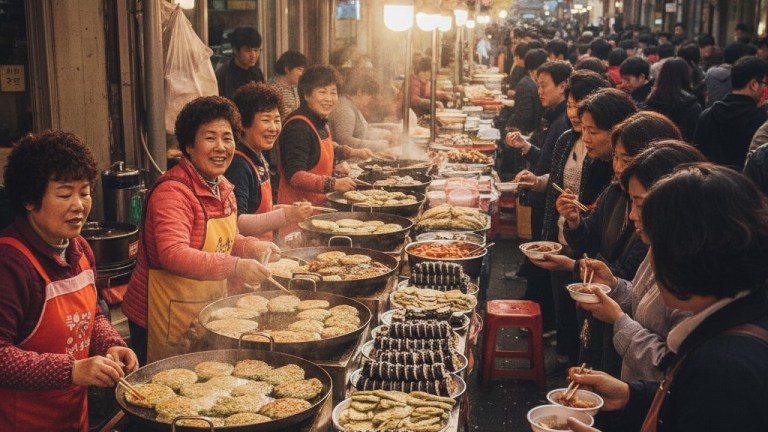
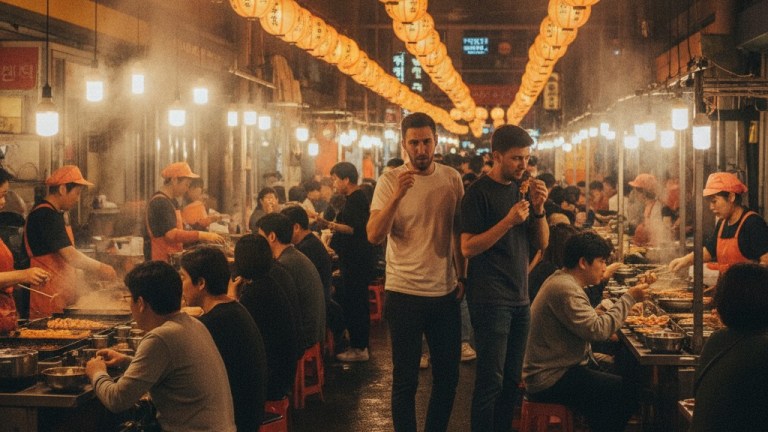
    If you only have time for one food stop in Seoul, a lot of locals — me included — would point you straight to Gwangjang Market (광장시장). It sits in the old downtown district of Jongno, a short walk from Insadong and the palaces, and it’s the kind of place where you eat elbow-to-elbow with strangers on plastic stools, grease on your fingers, completely happy. It’s also the oldest market of its kind in the country — but we’ll get to that.

    Busy food alley at Gwangjang Market in Jongno Seoul with street food stalls and diners on stools
    Gwangjang Market — Seoul’s most famous street-food alley, in the heart of Jongno.

    ⭐ Gwangjang Market at a glance

    🏛️ Sights & things to do ★★★★☆
    🍜 Food ★★★★★
    🚇 Easy to reach ★★★★★

    A personal take based on our own experience — the variety of things to see, the taste, and the travel time involved. Yours may well differ.

    New to Korean food? Start with our complete guide to what to eat in Korea.

    The short version: Gwangjang Market is Seoul’s oldest and most beloved street-food market, born in 1905 out of a quiet act of resistance. Come hungry, bring cash, and go for three things above all: bindaetteok, mayak gimbap, and yukhoe. Here’s what to eat, the story behind the market, and how to visit.

    What to eat at Gwangjang Market

    You could graze here for hours, but three dishes are the ones people cross the city for. Start with these.

    Bindaetteok (빈대떡) — the sizzling mung-bean pancake

    Golden bindaetteok mung bean pancakes frying on a griddle at Gwangjang Market
    Bindaetteok, ground fresh from mung beans and fried to a crisp — the market’s signature.

    If Gwangjang has a signature dish, this is it. Bindaetteok is a savory pancake made from mung beans that are soaked, stone-ground on the spot, then mixed with pork, bean sprouts, and kimchi and fried in a generous slick of oil until the edges go lacy and crisp.

    You eat it hot off the griddle, dipped in a little soy-and-onion sauce. The way I see it, watching the batter hit the pan is half the experience — the whole alley smells like it. Grab a seat at Sunhui-ne Bindaetteok, the market’s most famous pancake stall, and you’ll understand the hype in one bite.

    Mayak gimbap (마약김밥) — the “addictive” mini rolls

    Mayak gimbap tiny sesame oil rice rolls with mustard soy dipping sauce at Gwangjang Market
    Mayak gimbap — bite-sized rolls you dip in a sharp mustard-soy sauce.

    The name literally translates to “drug gimbap” — a cheeky nod to how hard they are to stop eating. These are tiny seaweed-and-rice rolls, no bigger than your thumb, brushed with sesame oil and served with a punchy mustard-soy dipping sauce.

    They’re plain-looking and dangerously moreish. In my experience, you order one plate thinking it’s a snack and somehow end up flagging down a second. The stalls around Monyeo Gimbap are the classic spot for them.

    Yukhoe (육회) — Korean raw beef, done right

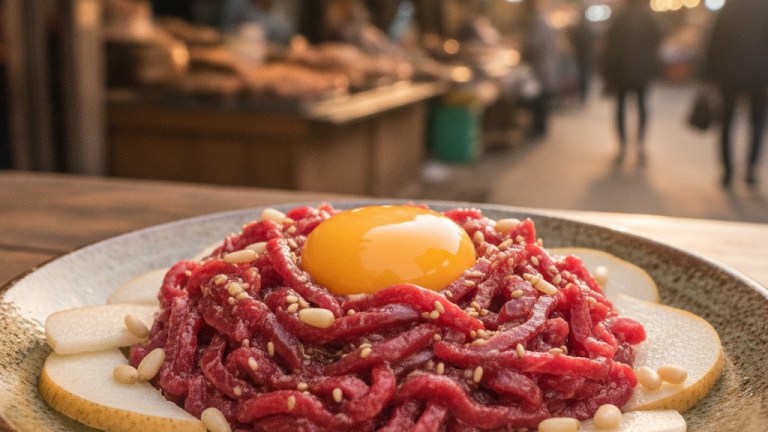
    Yukhoe Korean raw beef tartare with sesame oil and egg yolk on a plate at Gwangjang Market
    Yukhoe — fresh raw beef, sesame oil, and a glossy egg yolk on top.

    For the more adventurous, Gwangjang is famous for yukhoe — Korean-style beef tartare. Fresh raw beef is cut into fine strips, seasoned with sesame oil, garlic, and a touch of sweetness, then crowned with a raw egg yolk you stir through just before eating.

    There’s a whole lane of the market known as Yukhoe Alley, where side-by-side restaurants have been serving it for decades. It’s silky, rich, and nothing like you’re expecting. If you eat one “brave” thing in Seoul, I’d make it this.

    The market’s surprising history

    Illustration of Gwangjang Market founding in 1905 with Korean merchants in a traditional Seoul market
    Founded in 1905 by Korean merchants — a market built as quiet resistance.

    Here’s the part most visitors never hear while they’re slurping their noodles. Gwangjang isn’t just old — it was born out of defiance.

    In the early 1900s, as Japan tightened its grip on Korea, control of the country’s biggest market, Namdaemun, slipped into Japanese hands. In response, a group of Korean merchants and investors pooled their own money and, in 1905, founded a new market that would stay under Korean control. That market was Gwangjang.

    It’s been running continuously ever since, which makes it the oldest permanent market in Korea — well over a century of the same trade, now layered with fabric shops upstairs and that legendary food alley below. I find it quietly moving that a place this joyful started as an act of holding on to something.

    🗓️ Plan your visit

    When: The food alley runs all year and is at its liveliest in the evening, though many stalls open late morning (around 10–11 a.m.). Come genuinely hungry, and bring some cash — a lot of stalls prefer it. Upstairs fabric shops keep daytime hours and close on Sundays.

    Getting there: It couldn’t be easier — Gwangjang is right in central Seoul. From Incheon Airport it’s about an hour on the airport railroad into the city, then a short subway hop to Jongno 5-ga Station (Line 1), Exit 8, or Euljiro 4-ga Station (Lines 2 & 5), Exit 4 — both a 3-minute walk.

    Costs: The food is wonderfully cheap — most dishes are a few thousand won each. For the trip itself, spring (blossoms) and autumn (foliage) are peak season in Seoul, so flights and hotels climb and book out early; winter outside the holidays is easier on the wallet.

    Where to eat it — the market & its famous stalls

    Everything is inside one market, so the address below gets you to all of it. A few names worth seeking out:

    • 📍 Gwangjang Market: 88 Changgyeonggung-ro, Jongno-gu, Seoul (서울 종로구 창경궁로 88)
    • 🕒 Food stalls: roughly 09:00–23:00 (varies by stall; many open late morning)
    • 🥞 Sunhui-ne Bindaetteok (순희네빈대떡): mung-bean pancakes · ~09:00–23:00
    • 🍙 Monyeo Gimbap (모녀김밥): mayak gimbap · ~09:00–20:30
    • 🥩 Yukhoe Alley (육회골목): raw beef restaurants, clustered together

    One honest caveat: stall hours and prices shift more than you’d expect, and some spots take cash only. It’s worth a quick check — and an ATM stop — before you go.

    🔗 Nearby in Jongno: the same neighborhood is home to seolleongtang, Seoul’s original ox-bone soup — including the oldest restaurant in the country. Heading out of the city? Read about gondeure namul bap, a mountain-herb rice from Jeongseon Planning an actual visit? Our travel guide to Gwangjang Market covers stall-by-stall pricing and ordering tips.. · More on Wikipedia

    A few quick questions

    What should I eat first at Gwangjang Market?
    Start with bindaetteok (the mung-bean pancake) — it’s the market’s signature. Then chase it with mayak gimbap, and, if you’re game, a plate of yukhoe.

    Is Gwangjang Market good for vegetarians?
    Partly. Bindaetteok often contains a little pork, and mayak gimbap is usually veggie-friendly, but recipes vary by stall — it’s always worth asking before you order.

    Do I need cash?
    Yes, bring some. Many stalls take cards now, but plenty still prefer cash, and it keeps things quick during the busy hours.