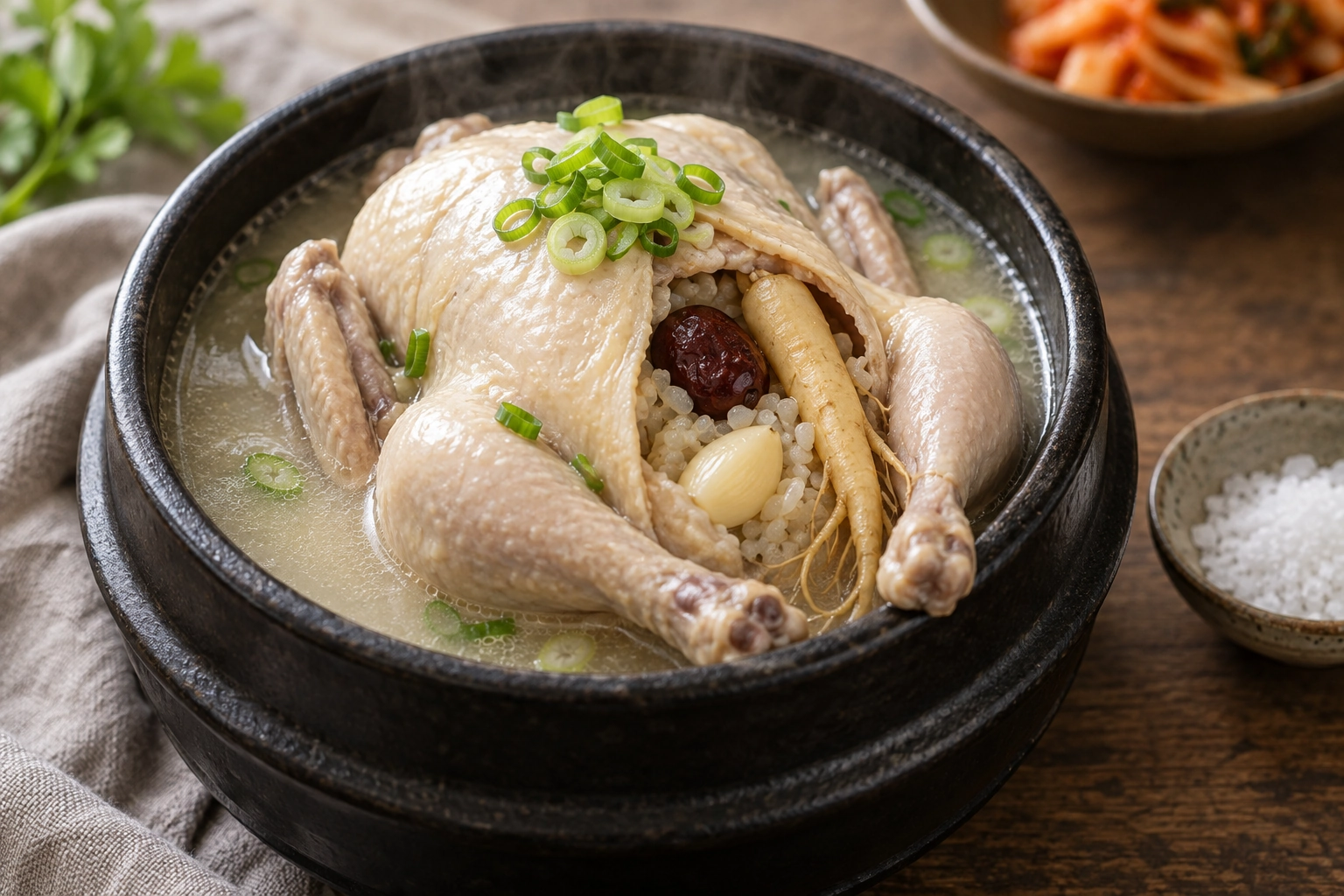
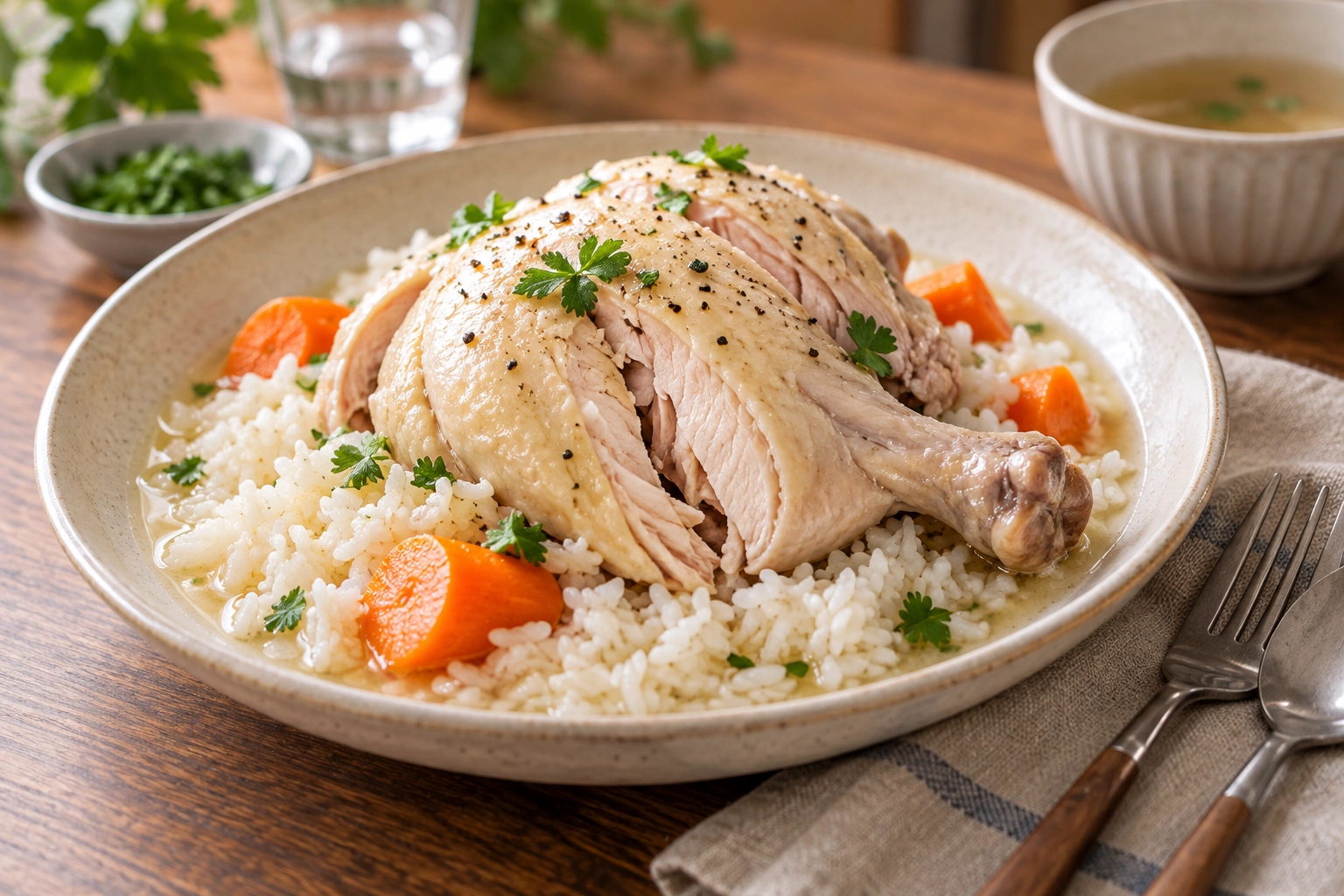
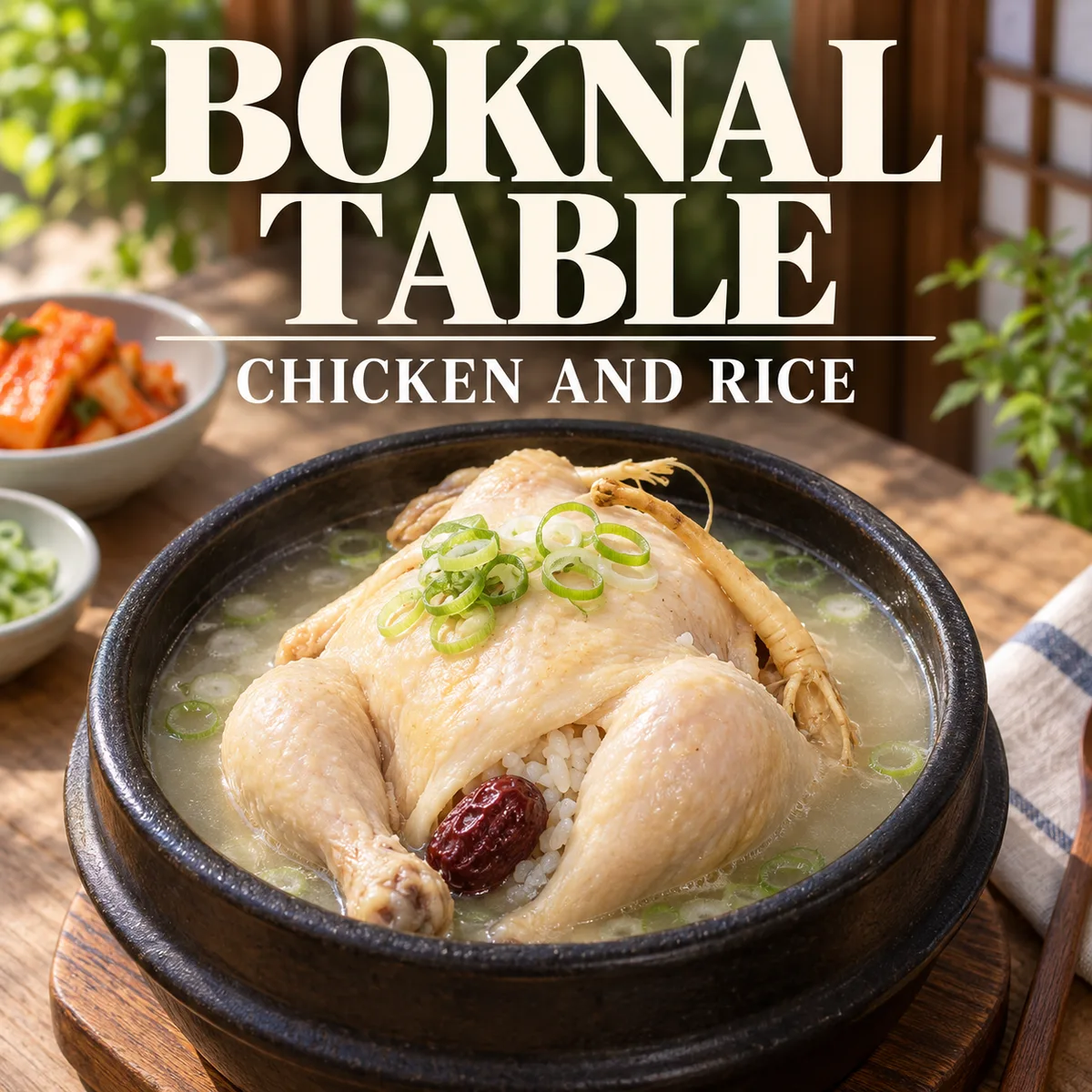
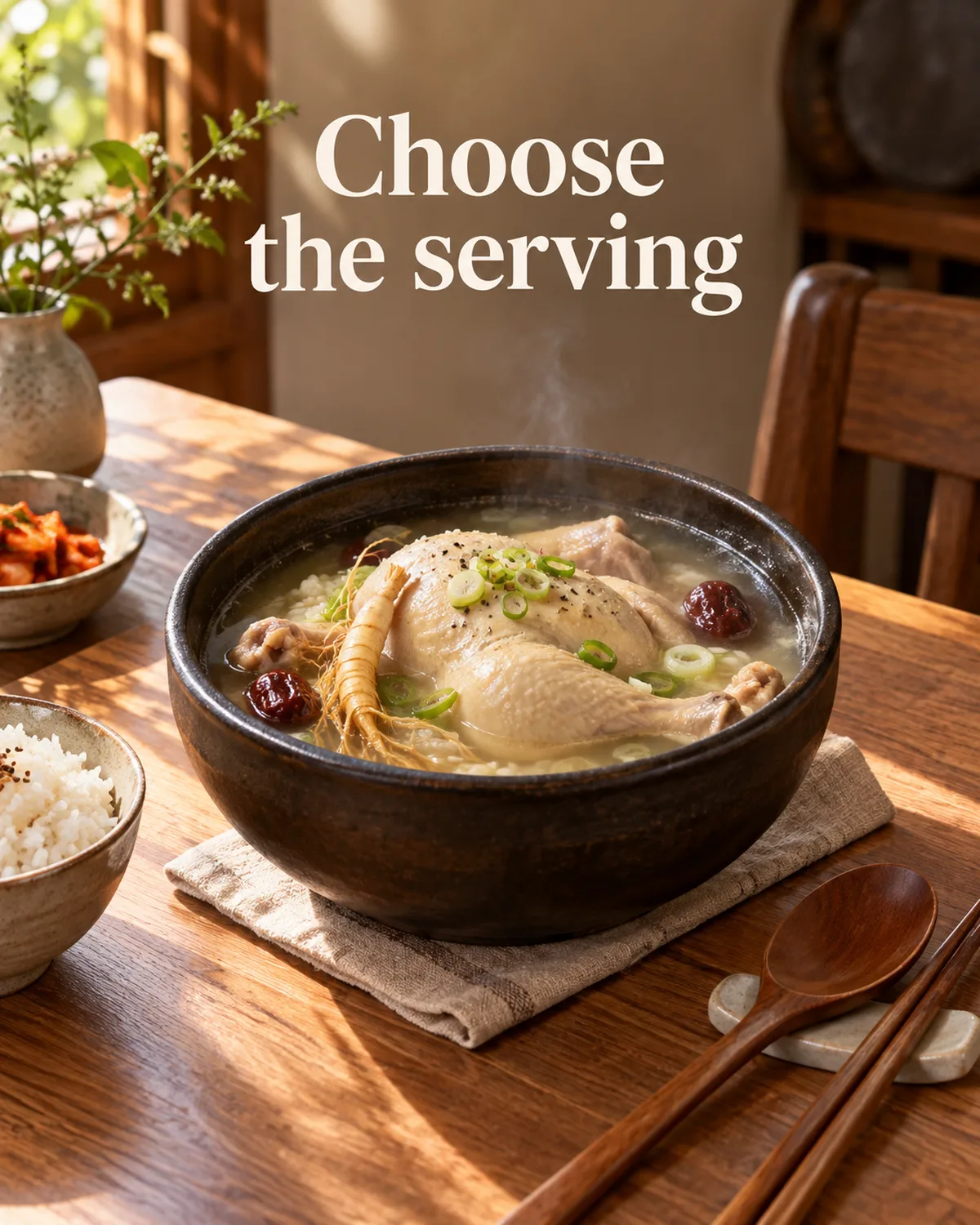
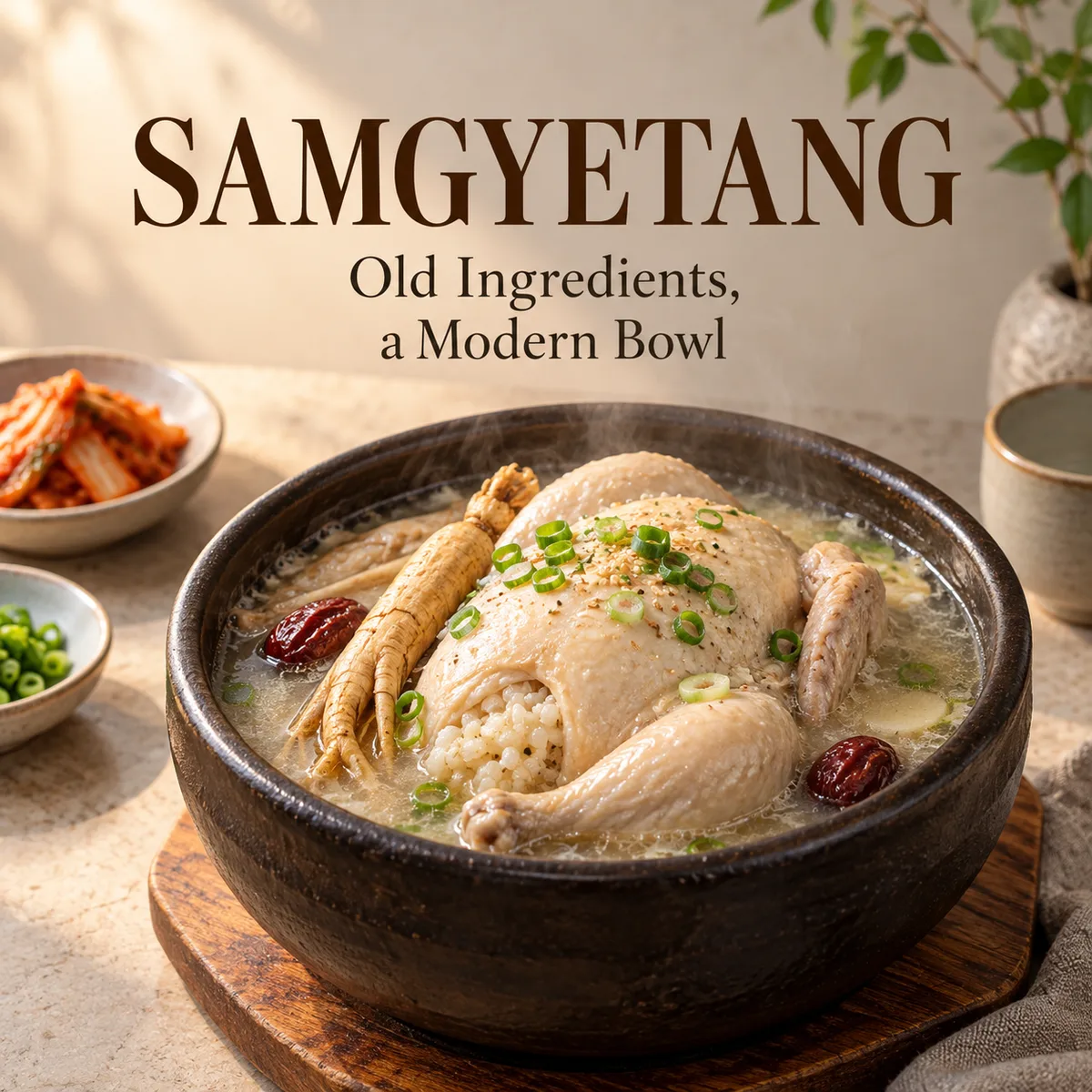
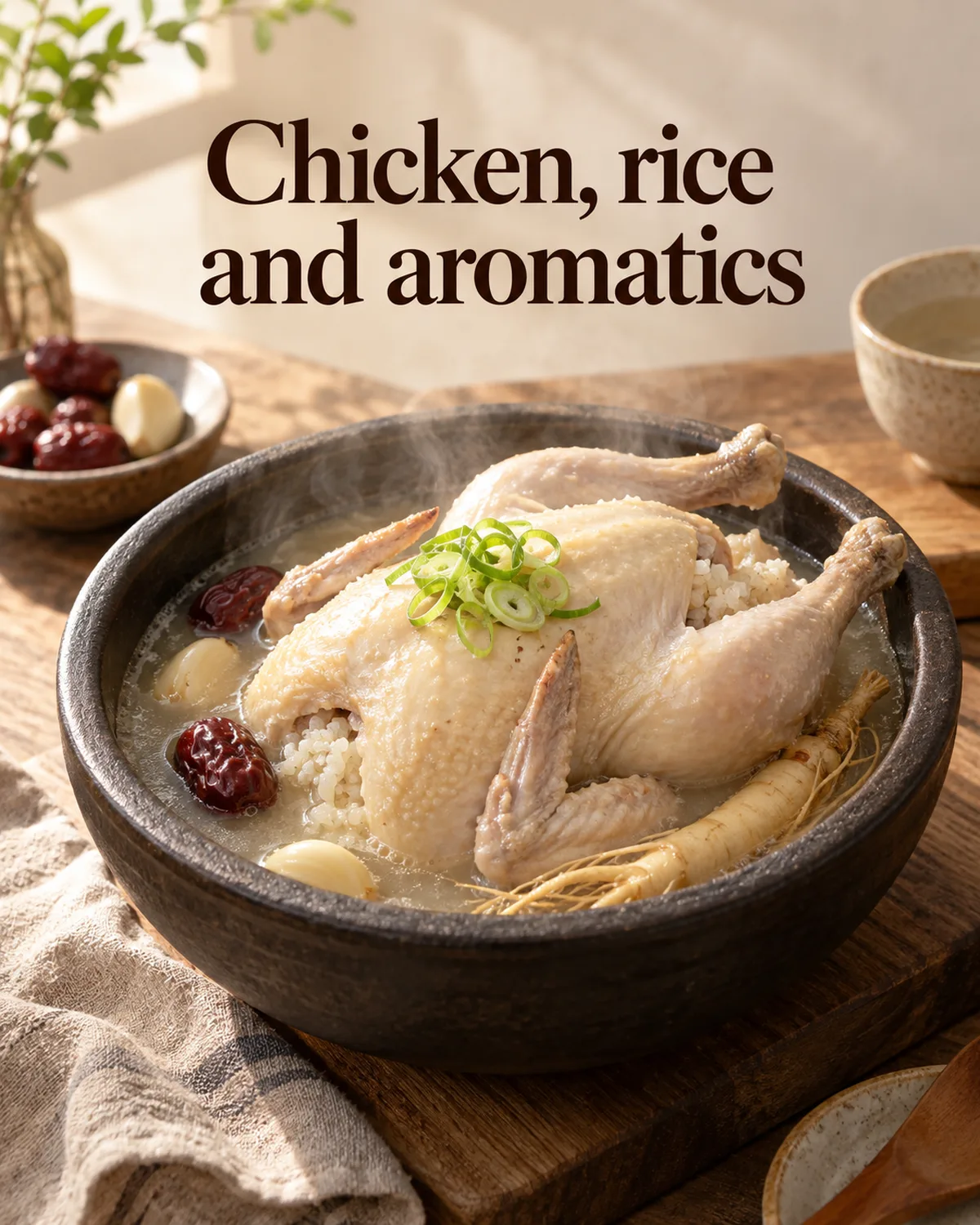
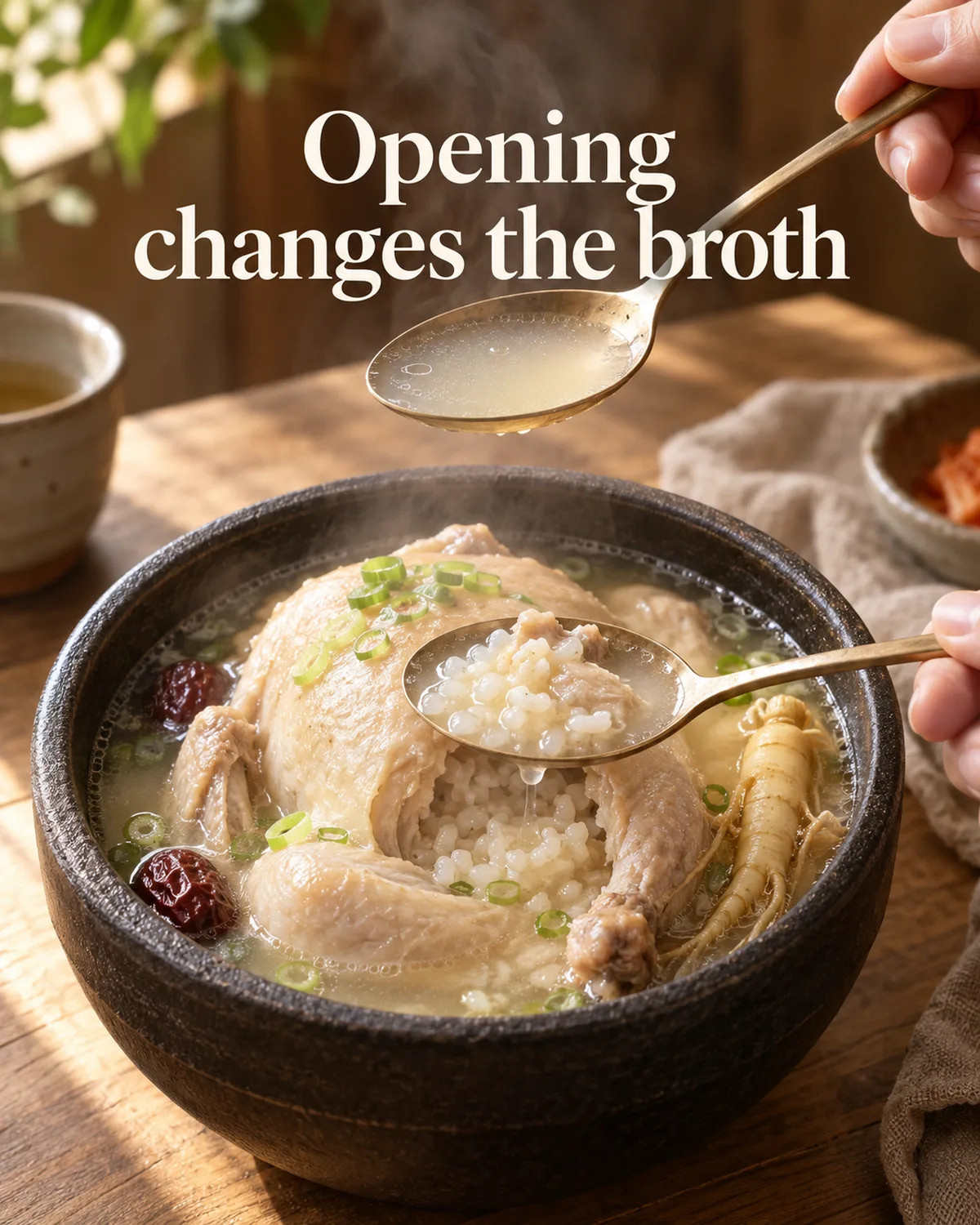
A small chicken stuffed with rice gathers a personal meal into one bowl.
A whole chicken in broth can look like a meal meant for everyone. With samgyetang, it may be your own lunch. Maangchi’s Korean ginseng chicken soup uses small birds filled with rice, garlic, ginseng and jujube, then divides them into individual bowls. In her introduction, she remembers meeting a reader in New York who made the dish for himself and his mother. The impressive part of his story was the cooking he did for another person, rather than the size of the chicken.
That combination makes samgyetang a useful starting point for comparing food cultures. The bird contains part of the meal inside its own body; the broth carries the rest. Rice, meat and soup arrive together, while salt and dipping sauces let the eater adjust individual bites. A familiar English label, “chicken soup,” tells you less about this arrangement than the bowl itself. It can help to picture a small stuffed bird that becomes a complete personal meal, with company at the table even when the portions stay separate. Maangchi’s samgyetang
A whole chicken, but a different meal
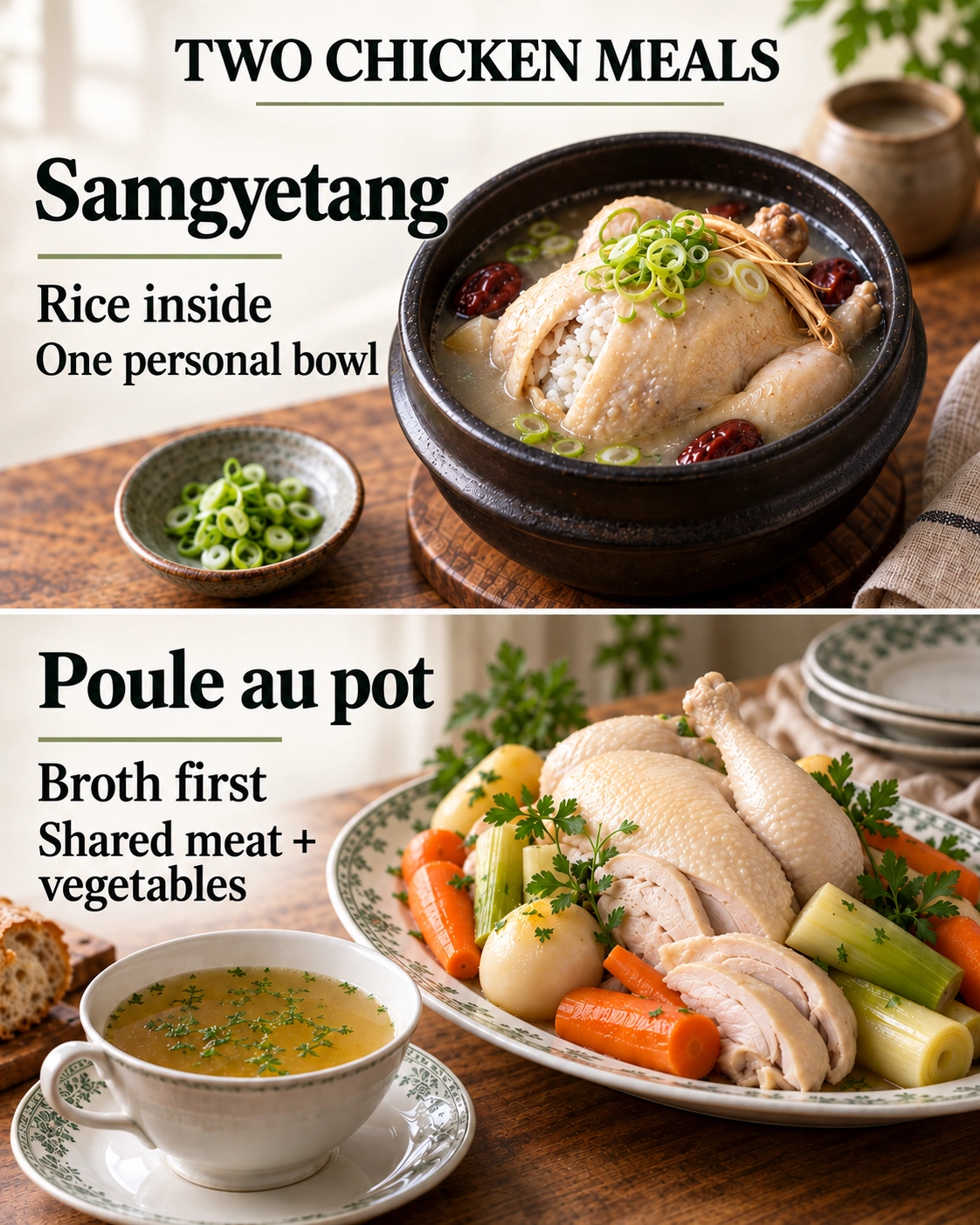
Across the world, the Béarn tourism office describes another bird cooked slowly in liquid: poule au pot. Its account places the French dish among the comforting meals of cool late-year days. Carrots, turnips, leeks and onions accompany the hen. Broth can be served first, followed by the meat and vegetables. Some versions stuff the bird with bread, herbs, sausage meat or ham.
These examples contrast an individual stuffed chicken bowl with broth followed by shared meat and vegetables.
The similarity with samgyetang is immediately useful: neither needs a roasted skin to give a whole bird importance at dinner. But the sequence changes what the cook is offering. A soup course followed by shared meat and vegetables stretches the pot across the meal. A stuffed bird in an individual bowl gathers the meal around one diner. These are arrangements in the particular descriptions, rather than rules governing every Korean or French family.
For a reader choosing a dish, the practical distinction is worth more than calling one the French equivalent of the other. Ask what comes inside the bird, what cooks beside it, and how the contents reach the table. Shared technique leaves plenty of room for different appetites and occasions. Cœur de Béarn’s description
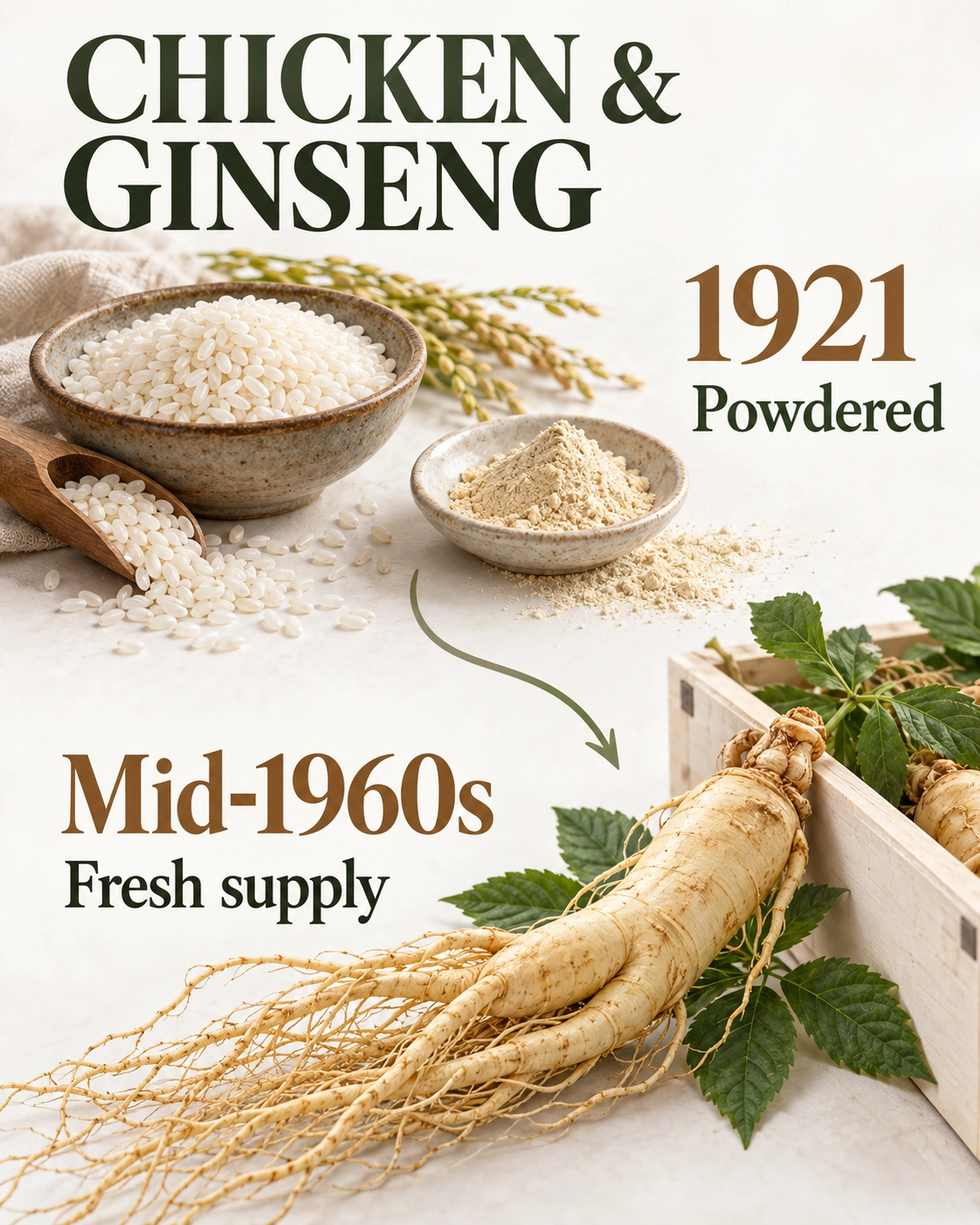
Samgyetang’s familiar filling also has a history of changing ingredients and access. Food scholar Joo Young-ha, writing in July 2026, points to a chicken-soup recipe in the 1921 edition of Bang Sin-yeong’s Joseon yorijebeop. His reading describes glutinous rice and powdered ginseng inside the bird. He connects the later development of samgyetang restaurant menus to increased chicken production and the refrigerated distribution of fresh ginseng in the mid-1960s.
Joo Young-ha connects an earlier powdered-ginseng recipe with later changes in fresh-ginseng distribution.
This is a scholar’s account of the documents and supply changes; it does not establish one inventor or make the modern dish timeless. Still, the distinction between powder and a whole fresh root opens a better question than “How ancient is it?” A visible root depends on a supply chain as well as on a cook’s intention.
Read that way, the bowl holds agricultural and commercial history alongside the chicken. Changing access can make an ingredient more prominent and a meal more widely available. The version a visitor meets in a restaurant need not look exactly like the one described in an earlier cookbook. Joo Young-ha’s historical account
The king’s chicken was a story that changed
Poule au pot carries an especially memorable promise: Henri IV wanted a chicken in his subjects’ pots. Gastronomic historian Jean Vitaux examines that account in a 2010 chronicle published by the Institut de France. He traces a version to Hardouin de Péréfixe’s 1661 history, written for the education of Louis XIV, and treats the saying as probably apocryphal. The familiar Sunday formulation developed later, during the Restoration.
Vitaux also draws attention to the word laboureur. In the earlier setting it referred to a farmer prosperous enough to own a team for ploughing, not automatically every person working the land. Translating the tale as a universal weekly meal can flatten that distinction.
The legend remains revealing without becoming a verified royal quotation. A chicken dinner offered a picture of recovered rural prosperity after destructive wars. Later retelling made that picture more inclusive and easier to repeat. The dish’s political significance lies partly in this changing image of a good ruler: people should be able to eat well. That is different evidence from a record proving that every household actually received a hen on Sunday. Jean Vitaux’s chronicle
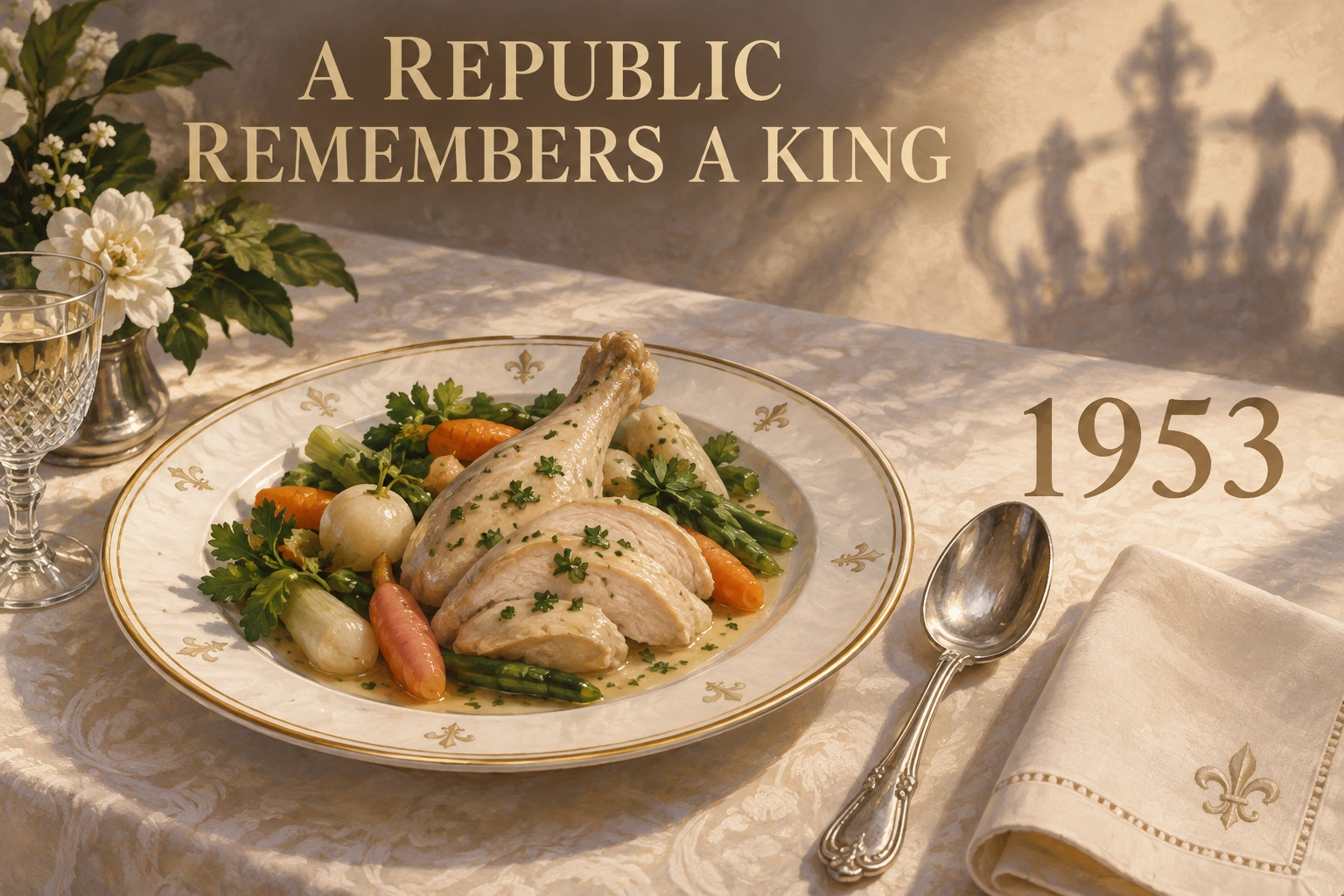
The story also turned up on a real commemorative menu. The Château de Pau’s chronology records the 1953 celebrations marking four hundred years since Henri IV’s birth. French president Vincent Auriol attended the festivities and a banquet at the château. Poule au pot appeared among the dishes. The initiative came from Pau and its mayor, Louis Sallenave.
Poule au pot appeared at the 1953 banquet in Pau commemorating Henri IV’s birth.
A twentieth-century republic serving a meal associated with a king is a more specific historical scene than a vague claim that France has always eaten this way. At that banquet, the dish helped make a figure from the past present at the table. A menu could perform some of the work of a monument, using a recognisable meal instead of stone.
For food travellers, this changes how a famous name can be read. “Henri IV” beside poule au pot can signal regional memory and commemoration as much as a particular cooking formula. The documented banquet shows people using the association centuries later. It does not settle whether the king uttered the original saying, or prove that the banquet reproduced his own dinner. The château’s chronology
What the broth leaves for tomorrow
A modern chef’s version gives the French pot another role. The Académie du Goût publishes an extract from Nature Volume 2, credited to Alain Ducasse, Paule Neyrat and Christophe Saintagne. The ingredient list surrounds the hen with vegetables and aromatics, including mushrooms, thyme, bay and juniper. The chef’s introductory advice values the broth as something to keep for other recipes.
Vegetables surround the hen, while the broth has value beyond the first serving.
Even that limited extract changes the comparison. The meal’s value is partly what remains available to another dish. A pot can feed dinner and contribute flavour to cooking afterwards. The vegetable list gives a reader concrete things to recognise when looking at this version, without suggesting that every poule au pot must contain the same combination.
This is also why comparing soups solely by their main animal can be misleading. The cooks credited here organise a wider group of ingredients around the bird and give the liquid a future use. To understand the meal, follow the broth as well as the meat. The extract is a window into one approach, rather than a complete cooking lesson. The published recipe extract
Rice does not belong to only one side
The neat contrast between Korean chicken with rice and French chicken with vegetables has a problem: a French family meal may have rice too. In April 2020, France.fr featured chef Jean Imbert’s grandmother’s poule au riz. The article connected the comforting dish to cooking during confinement and reproduced his social post describing it as a favourite winter meal she made for him.
Poule au riz provides a French family-meal example in which chicken and rice belong together.
Poule au riz is the dish named in that account. Treating it as an exact synonym for every poule au pot would discard a distinction the reader has just learned to notice. It is useful here as a neighbouring family example, showing why a national comparison should leave room for meals that cross our tidy categories.
The strongest connection between these chicken pots is therefore neither an identical recipe nor a demonstrated route of influence. It is the way a modest cooking action can carry a much larger promise: a meal remembered from a grandmother, or a picture of people living well. The differences stay visible even when the feeling is recognisable. Rice in the French example makes the comparison richer, rather than making either country lose its dish. France.fr’s family-meal account
Back at the samgyetang bowl, that promise can be as personal as cooking a small bird for your mother.
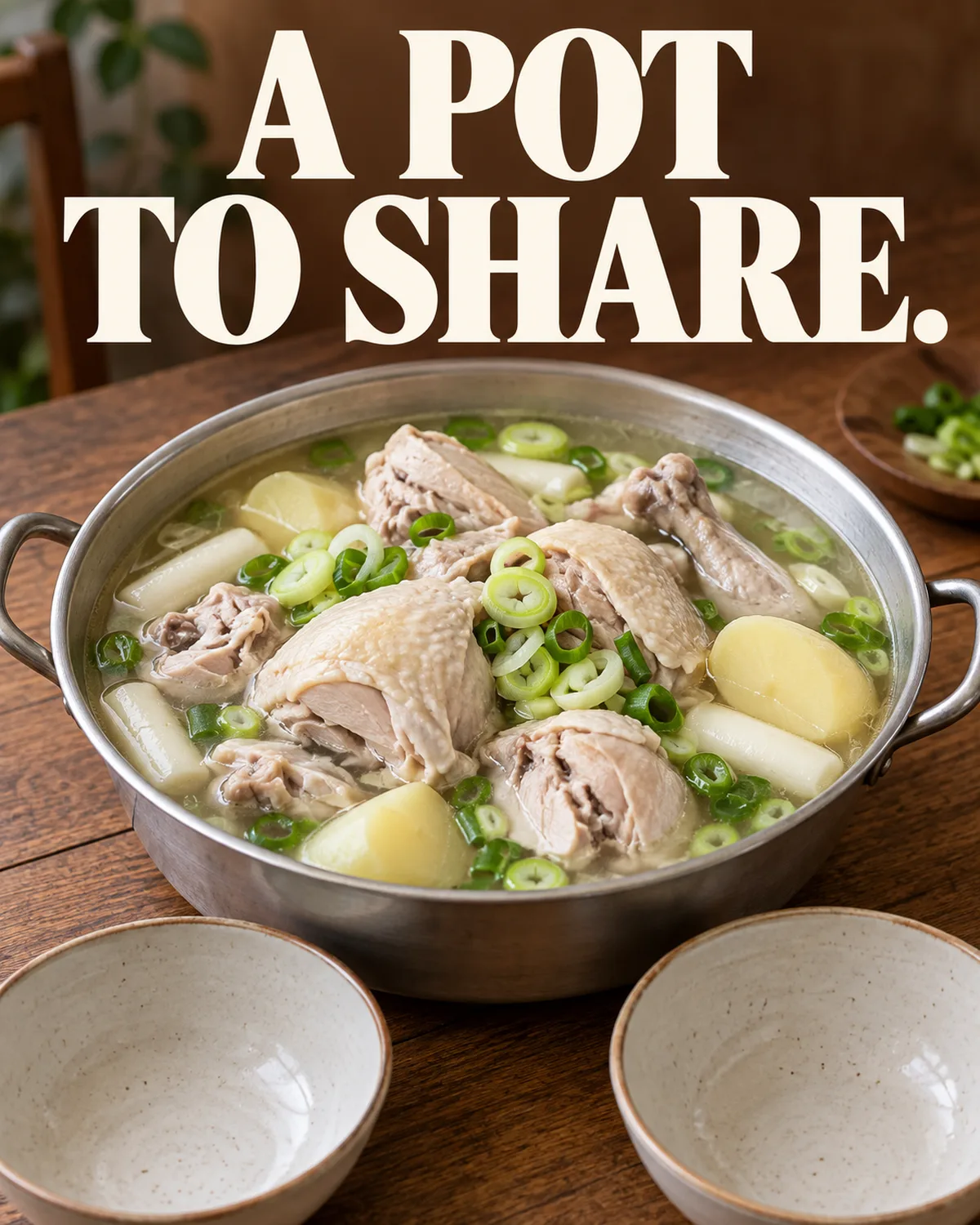
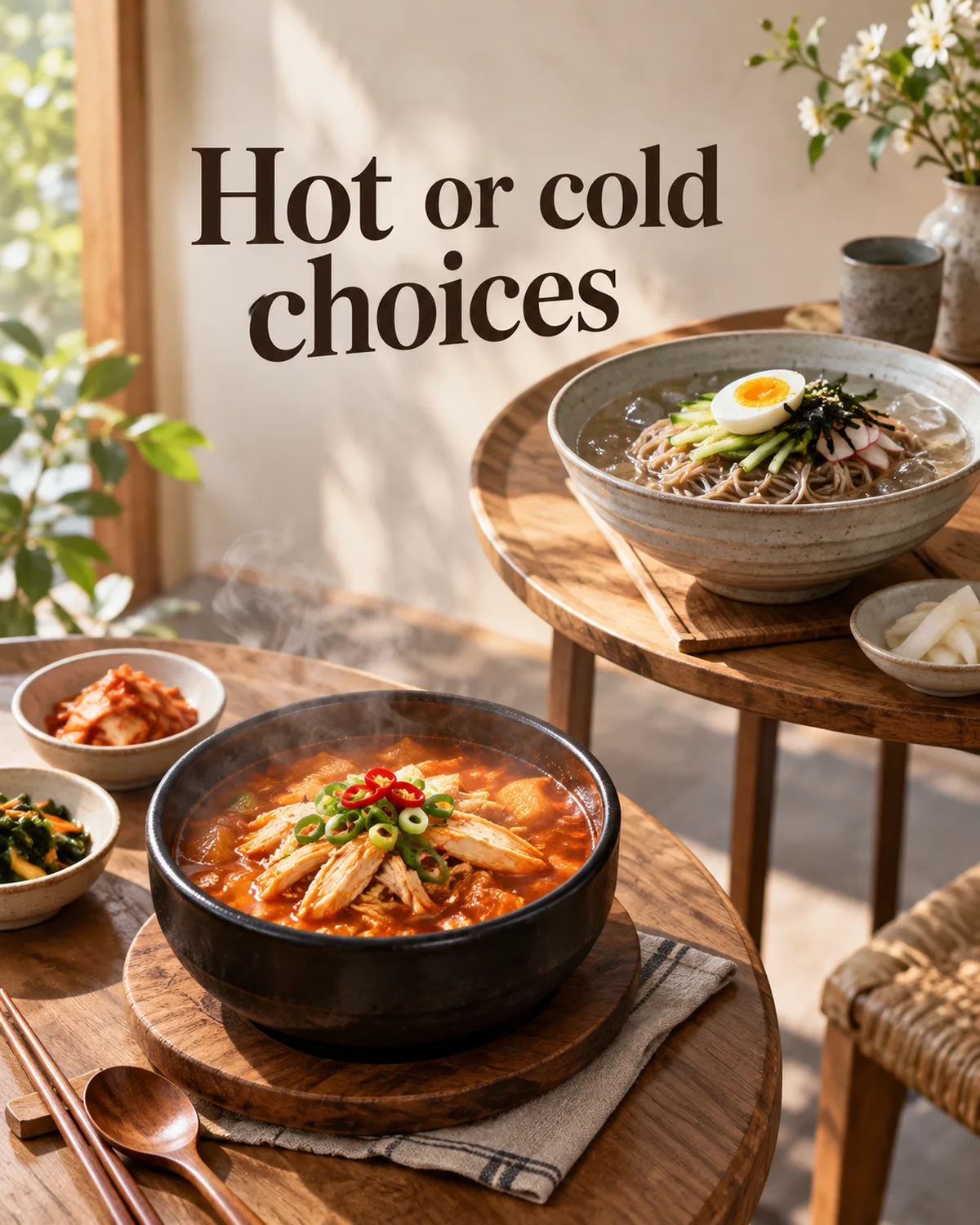
A whole small chicken in hot broth and a bowl of chilled noodles can both make sense on a Korean summer menu. The choice begins with the kind of meal you want: chicken and rice in one bowl, a pot to share, or noodles whose temperature and chew lead the experience.
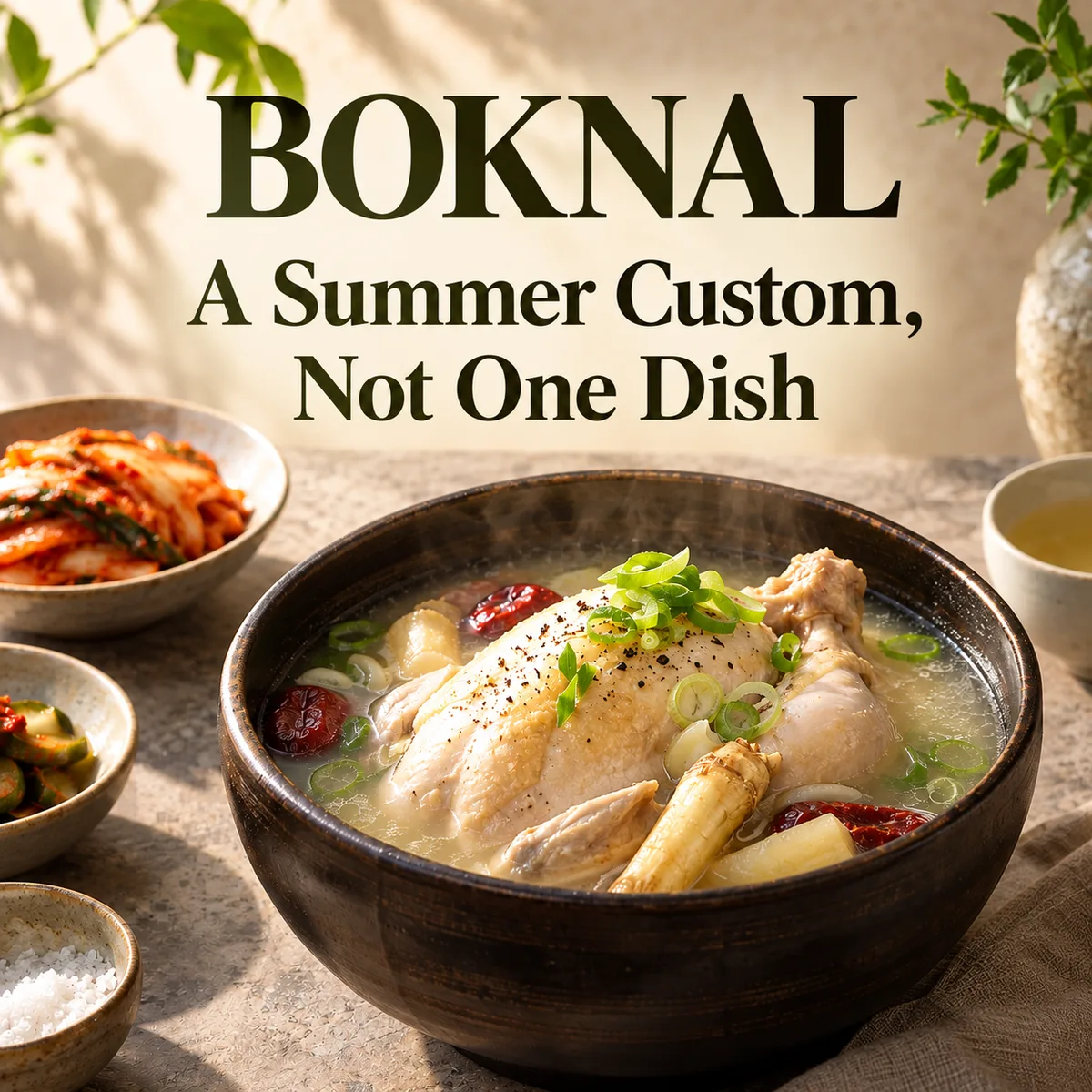
Boknal names three traditional summer observances: chobok, jungbok and malbok. The Academy of Korean Studies explains their calculation through the seasonal calendar. They mark the hot season; they are not selected afterward by finding the three highest readings on a thermometer.[1]
The BTS framing in the headline is an invitation to learn about the foods, rather than a verified menu for the members. The food sources here describe the seasonal custom and dishes. They do not establish a current member-by-member boknal routine, so those private eating claims should not guide your order.
For a concrete date reference, the tourism organization’s July 2026 guide lists July 15, July 25 and August 14 as that year’s three sambok dates. Those dates are now past. The dishes still provide useful choices beyond a single calendar occasion.[3]
Chobok, jungbok and malbok belong to the seasonal calendar.
Open the chicken to find the rice
VISITKOREA describes samgyetang as a young chicken stuffed with sweet rice, garlic, jujube and ginseng, then simmered. This gives the bowl more structure than a plain cup of broth: a bird sits in the liquid, and part of the meal is inside it.[2]
Before you pull the chicken apart, notice where the cavity opens. Separating a little meat makes the rice easier to see. Move a manageable portion toward the edge of your bowl instead of trying to lift the entire bird at once.
Try broth, meat and filling separately for the first few bites. The rice is softer than a separate bowl of steamed rice, and a piece of chicken brings a different texture. Keeping them distinct briefly helps you understand what the bowl contains.
Table salt or other condiments may be offered for adjustment. Begin by tasting what is served, then add a little if you want it. The presence of a condiment dish does not mean the whole amount belongs in the soup.
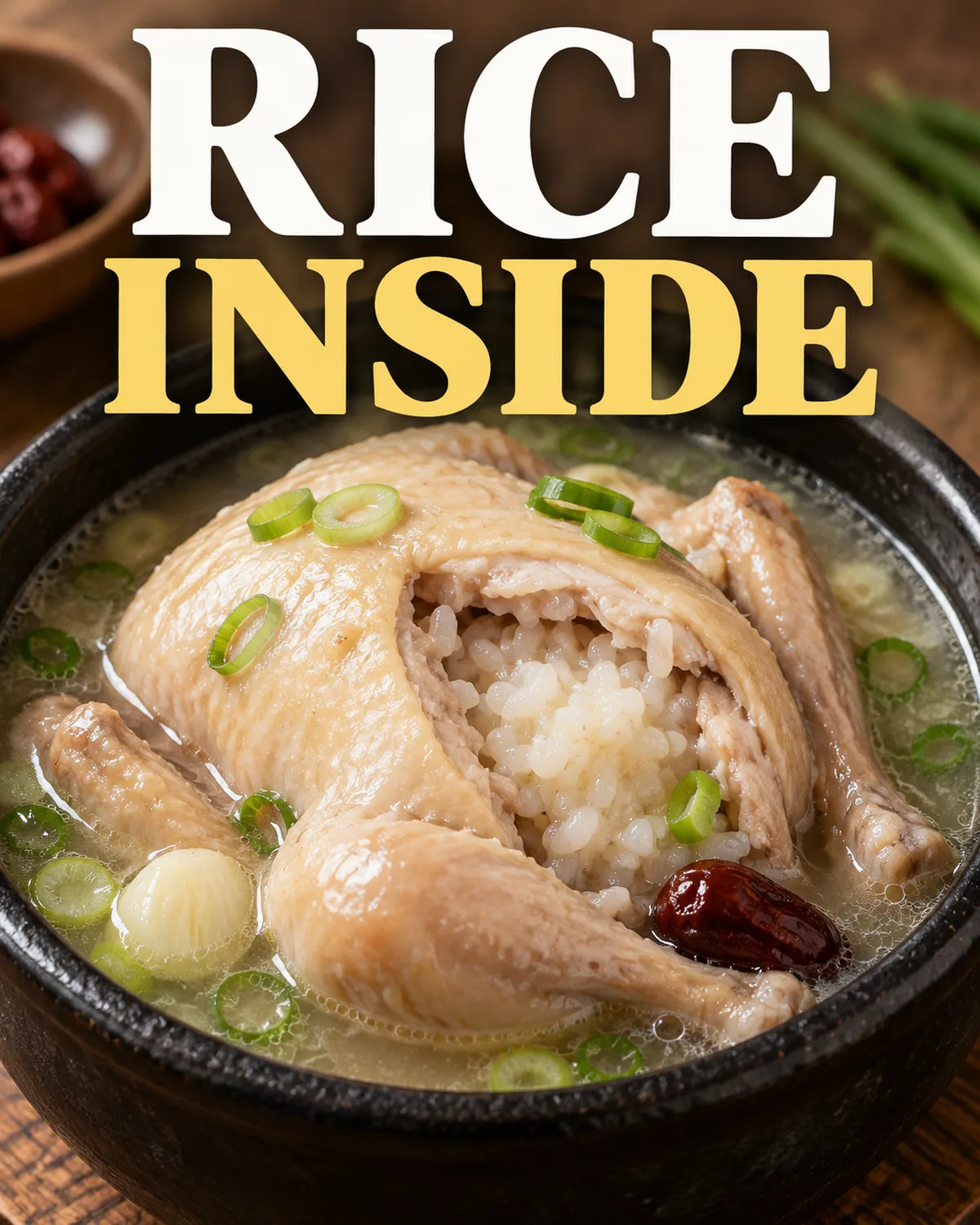
Opening the small chicken reveals the rice filling.
A shared chicken pot changes the occasion
The tourism guide describes dakhanmari as a whole-chicken hot pot with ingredients such as green onion, potato and rice cakes. Its dipping sauce and later noodle or rice additions create a different format from an individual stuffed-chicken bowl.[3]
Start the order by asking how many people the listed pot serves. A whole bird can appear in both preparations, but the size, accompaniments and way the restaurant serves it matter. The name alone cannot settle the portion for your table.
With a shared pot, take pieces into a personal bowl and use the serving utensils provided. This gives everyone access to the broth and chicken without each diner working on the same piece. Ask the staff about the sequence if the pot arrives in stages.
Discuss additions before the liquid has nearly disappeared. If the restaurant offers a later finish, ask when it should be ordered and what it includes. A noodle or rice stage is part of a particular menu, rather than an automatic entitlement everywhere.
A shared chicken pot creates a different meal format from an individual bowl.
Cold noodles offer a different texture
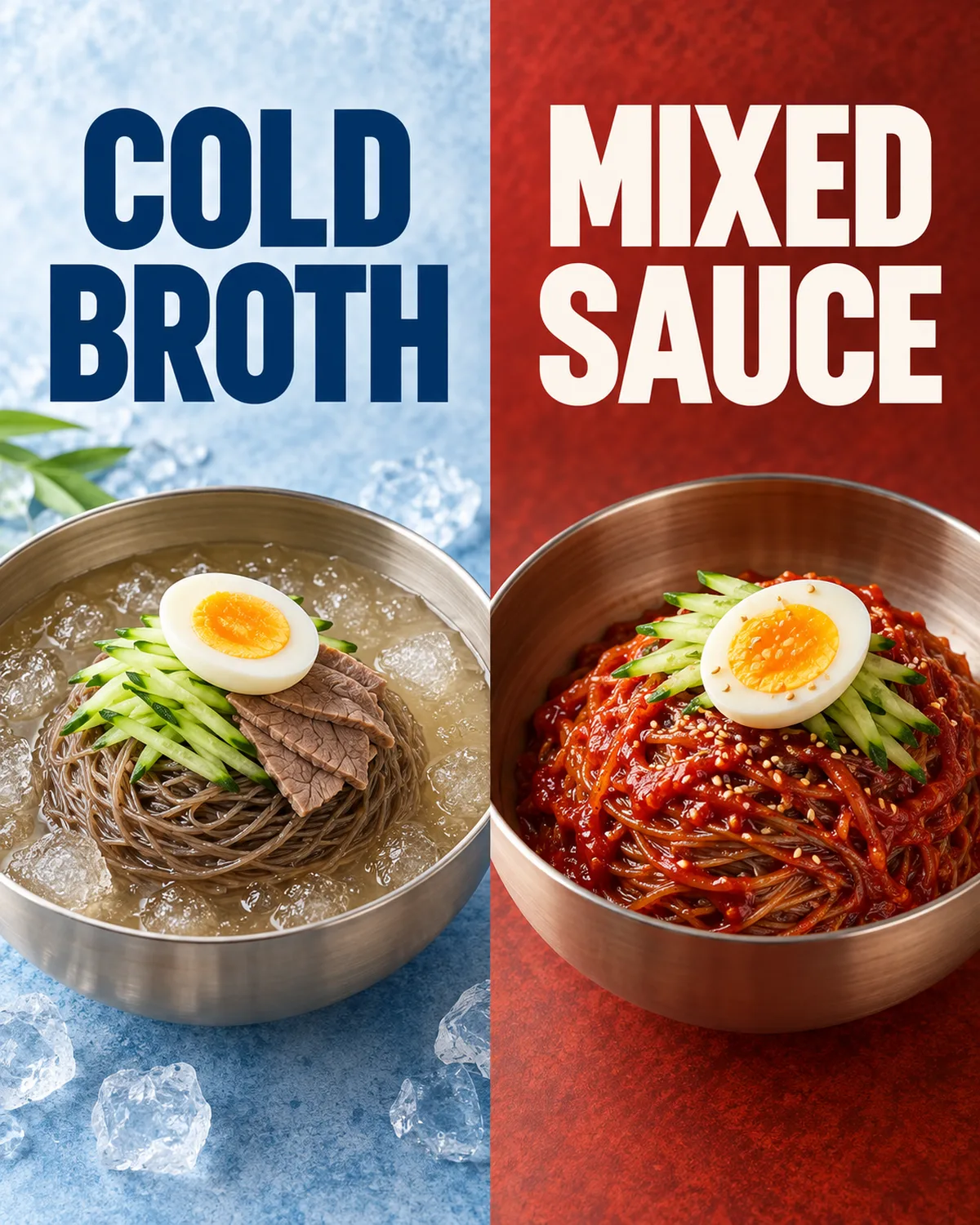
Naengmyeon is another summer choice in the tourism guide, with broth-based and spicy-sauce styles. The useful distinction is between a chilled liquid surrounding the noodles and a sauce mixed through them. Read which version the menu actually offers.[3]
For a broth bowl, taste the liquid before adding anything from the table. Lift a small portion of noodles and notice how the chew contrasts with the cold broth. A bowl can be chilled without all of its ingredients tasting mild.
For a sauce version, mix enough to coat the noodles evenly before deciding whether you want more seasoning. The top of an unmixed mound is a poor sample of the whole bowl. Garnishes can offer a separate bite before they are folded through.
Choose manageable mouthfuls. If you want the noodles cut, ask the restaurant for help or the utensils it uses. Enjoying the texture does not require struggling with an oversized tangle.
Cold broth and mixed sauce lead to different naengmyeon mouthfuls.
The seasonal story holds more than one dish
The Academy’s account includes chicken preparations, red-bean porridge and seasonal fruit in the wider custom. That variety matters: boknal is a seasonal occasion with a history, rather than a rule that every Korean eats an identical modern restaurant bowl.[1]
The expression iyeol-chiyeol, often rendered as fighting heat with heat, belongs to the cultural explanation of hot summer food. Treat it as a food custom, not as evidence that a bowl has a measurable stamina score or guarantees recovery.
Temperature is one part of preference. Some diners want a substantial hot soup; others want the chill and chew of noodles. A group can share the occasion without every person choosing the same food.
The food can also be the reason to visit on a quieter day. You do not have to reproduce a particular calendar date or a performer’s presumed routine to understand a chicken bowl. The meal’s ingredients and serving format remain available to notice.
Hot chicken soup and chilled noodles can suit different appetites.
Choose a meal that fits the table
For one person, an individual chicken-and-rice bowl makes the portion easy to discuss. For friends who want to linger, a shared pot may make more sense. For someone seeking chilled noodles, the broth or sauce choice becomes the first question.
Ask what comes with the main order before adding another starch. Rice inside a chicken, noodles after a shared pot and dumplings beside cold noodles produce different amounts of food. Count the people and their appetites instead of ordering by the photograph alone.
Check the actual broth, noodle ingredients and garnishes when restrictions matter. A cold bowl can contain meat stock, and a chicken preparation can include additions beyond the familiar short description. The kitchen’s information is more useful than removing one visible topping.
Choose the restaurant for the format you want, then check its current menu and ordering arrangements. Once the food arrives, start with a small taste, find the rice or separate the noodles, and let the bowl explain the season through its temperature, texture and portion.
An individual bowl and a shared pot call for different ordering decisions.
A restaurant queue on Boknal tells you something about a calendar and a custom, not necessarily the thermometer. The three summer days belong to a traditional timing system; they are not guaranteed to be the three highest-temperature readings of the year.
That distinction leaves room for a better question: why did an older seasonal meal custom become so closely associated with a comparatively modern samgyetang restaurant bowl?
Three calendar days, not three weather predictions
The first Boknal is Chobok, the second is Jungbok, and the third is Malbok. The Chinese character bok (伏) carries meanings such as lying down, crouching or hiding. That literal meaning has encouraged many poetic explanations about people or nature bowing before the heat. The safe historical point is simpler: the character is part of the long-established name of this seasonal period, while later storytelling often adds imagery around it.
Boknal uses gyeong days in the traditional sexagenary cycle. Chobok is the third gyeong day after the summer solstice, Jungbok the fourth, and Malbok the first after Ipchu, the beginning-of-autumn solar term. They usually fall ten days apart; in some years Jungbok and Malbok are twenty days apart, an interval called wolbok (월복/越伏).1
Chobok, Jungbok and Malbok label calendar stages. The pictured dishes are alternatives, not one prescribed food for each date.
This is why an evergreen guide should not permanently bake one year’s three dates into the main explanation. The useful information is the rule. If you are actually traveling during July or August, check the current year’s dates shortly before the trip.
Korean and tourism sources commonly describe Sambok as the hottest part of summer, and the phrase sambok-deowi (삼복더위) itself evokes oppressive peak heat. But a modern weather station can easily record the year’s highest temperature on some other date. Climate does not obey a ritual calendar.
That does not make the phrase wrong. Seasonal calendars work by marking a period when a community expects certain conditions and organizes behavior around them. Boknal says, in effect, “we are in the hardest stretch of summer now.” The precise daily maximum temperature is secondary to that cultural function.
This distinction is useful for visitors because it prevents a strange question: “What if Chobok is cloudy—does Boknal get canceled?” No. The date is calendrical, not chosen after the weather report.
Summer work and the older idea of replenishment
The 2026 National Folk Museum of Korea essay on samgyetang history connects Sambok to the demanding agricultural calendar. Before mechanized farming and air-conditioned work, the period around Sambok coincided with some of the most exhausting summer field labor. The article describes farmers completing repeated rounds of weeding before the mid-summer seasonal cycle and using animal foods to rebuild strength after heavy work.2
This context matters because modern articles often reverse the history. They begin with samgyetang, then assume Boknal must have been invented to celebrate that soup. The chronology works the other way around: the seasonal need and the custom are older than samgyetang’s modern named form.
The Academy of Korean Studies’ Boknal entry also records a broader world of older summer customs: special foods, resting in mountain valleys, eating fruit, folk beliefs about bathing, and agricultural sayings tied to rice and jujube crops. Boknal was part of a seasonal system, not merely a menu promotion.
Summer agricultural work and seasonal rest help explain the background of Boknal.
This is one of the most important corrections to the modern image. Today, a television camera filming Boknal will almost inevitably find a line outside a samgyetang restaurant. Yet the National Folk Museum notes that before the 1970s, other animal foods—most notably dog meat in historical Boknal custom—held a much more prominent place.
The Academy of Korean Studies documents older gaejang-guk meals and other foods believed to support the body through summer. Those descriptions record past practices and beliefs; the menu a diner chooses today can be quite different.
Boknal’s continuity lies in the seasonal slot, not in one permanently fixed dish. A seasonal slot can remain stable while the representative food changes. Boknal survives because people continue to mark peak summer through eating; the food chosen to perform that ritual can shift with agriculture, ethics, supply chains, public taste and restaurant culture.
Samgyetang became a modern seasonal icon
Samgyetang now looks inseparable from Boknal: a small whole chicken stuffed with glutinous rice, garlic, jujube and ginseng, simmered in broth and served steaming. But the dish’s modern name is not an ancient Joseon label.
The National Folk Museum traces the modern samgyetang name and restaurant bowl through 20th-century cooking and supply changes. The samgyetang article follows those developments in detail. For Boknal, the crucial point is the order: the seasonal occasion came first, and its best-known modern menu came later.
That makes samgyetang an ideal modern Boknal food, but not proof that today’s exact bowl was eaten for centuries. Old ingredients, an older seasonal need and a newer restaurant format converged. The result became traditional through repetition.
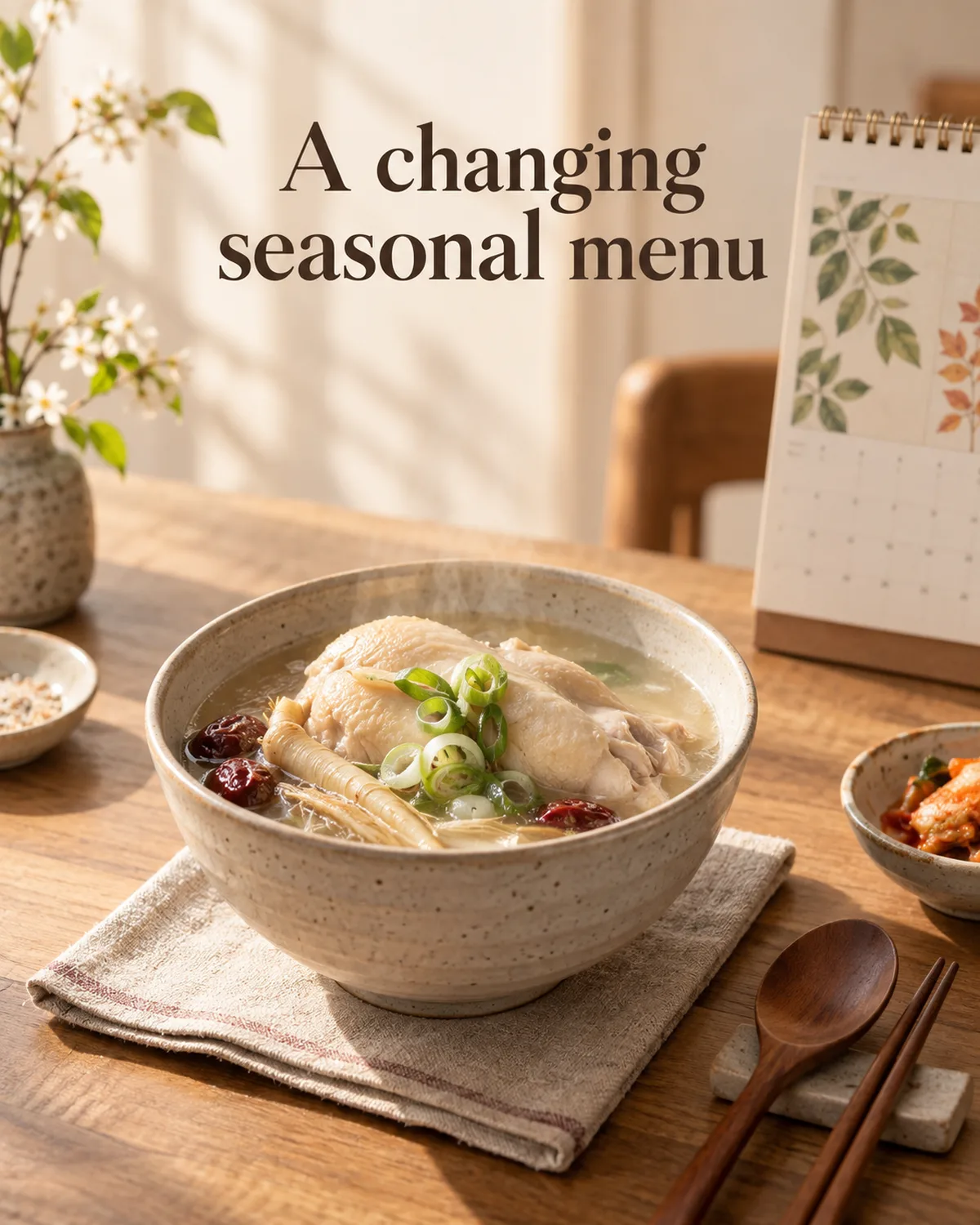
A modern chicken-soup serving illustrates one form of a seasonal menu that has changed over time.
A tradition is not a museum label assigned once. It is a behavior repeated by communities and passed on with meaning. Samgyetang became powerful precisely because it fit an existing summer category: substantial animal food eaten when heat and labor were thought to drain strength. Poultry production and cold-chain distribution made the bowl scalable; restaurant culture made it visible; families and media repeated the association until it became expected.
What “fight heat with heat” means—and does not mean
The phrase most associated with Boknal is iyeol-chiyeol (이열치열), usually translated as “fight heat with heat” or “treat heat with heat.” It makes the visual paradox memorable: people eat a bubbling chicken soup while the outdoor air is already oppressive.
Official tourism writing uses this phrase to explain the summer custom. It does not establish that every hot restaurant meal lowers body temperature or makes dangerous heat exposure safe.
Korean writing often groups Boknal dishes under terms such as boyangsik (보양식), meaning nourishing or restorative food. The category makes sense historically: a high-effort work season encouraged people to value calorie-dense animal foods, protein-rich soups and ingredients associated with strength.
So this guide keeps two statements separate. “Koreans historically regarded these foods as restorative” is a cultural fact. “This dish will cure fatigue, prevent heat illness or boost immunity” is a medical claim that requires evidence far beyond tradition.
Hot chicken soup and cold noodles are different summer meal choices; neither is a promised medical treatment.
More than one food can mark the season
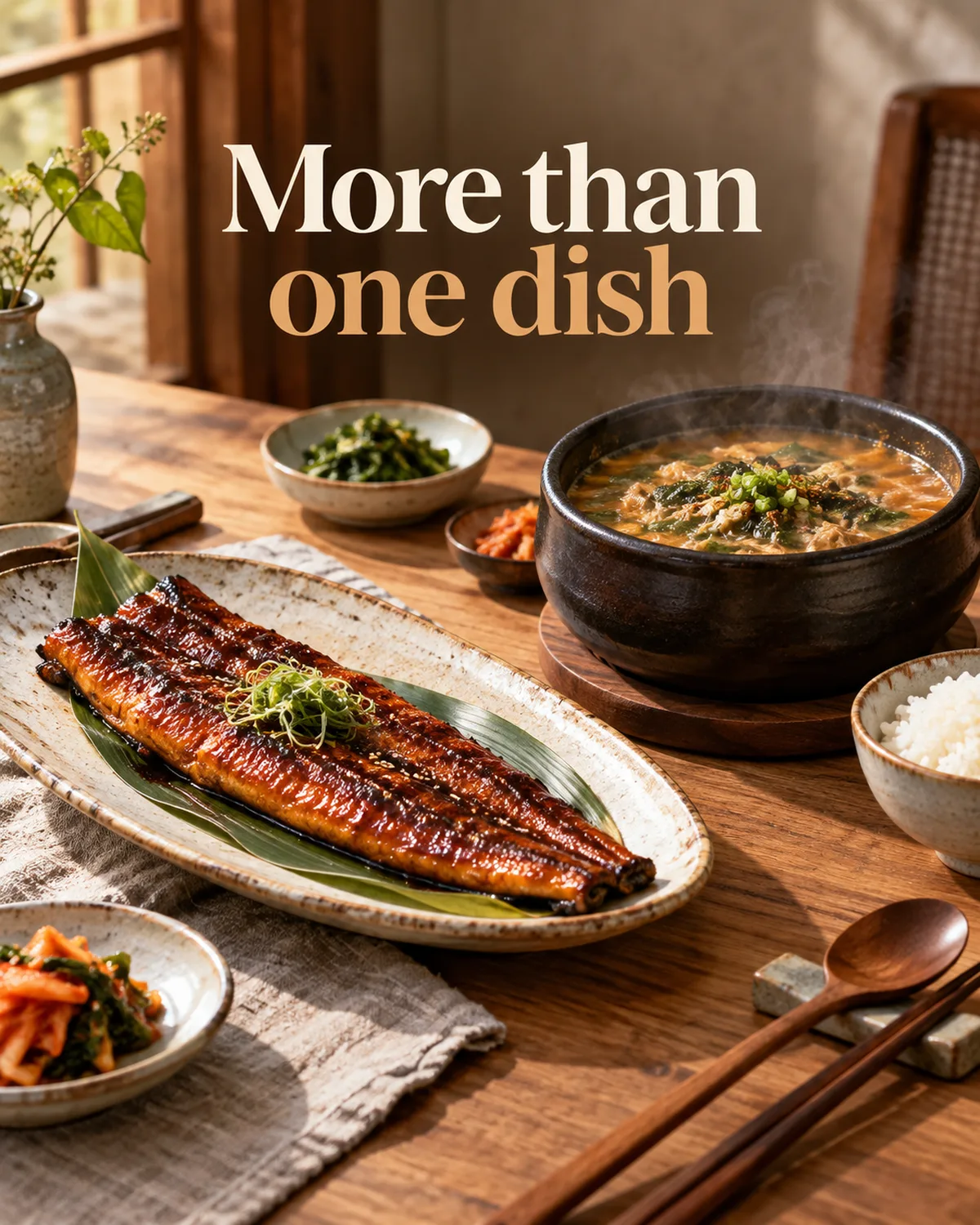
Modern tourism guides list several substantial summer foods alongside samgyetang. Grilled eel appears frequently because it is rich and energy-dense. Chueotang, a loach soup, represents another long-standing nourishing-food tradition. Duck baeksuk and richer chicken soups can fill the same cultural role. Households and regions make different choices.
Eel and chueotang illustrate alternative dishes within a broader seasonal food repertoire.
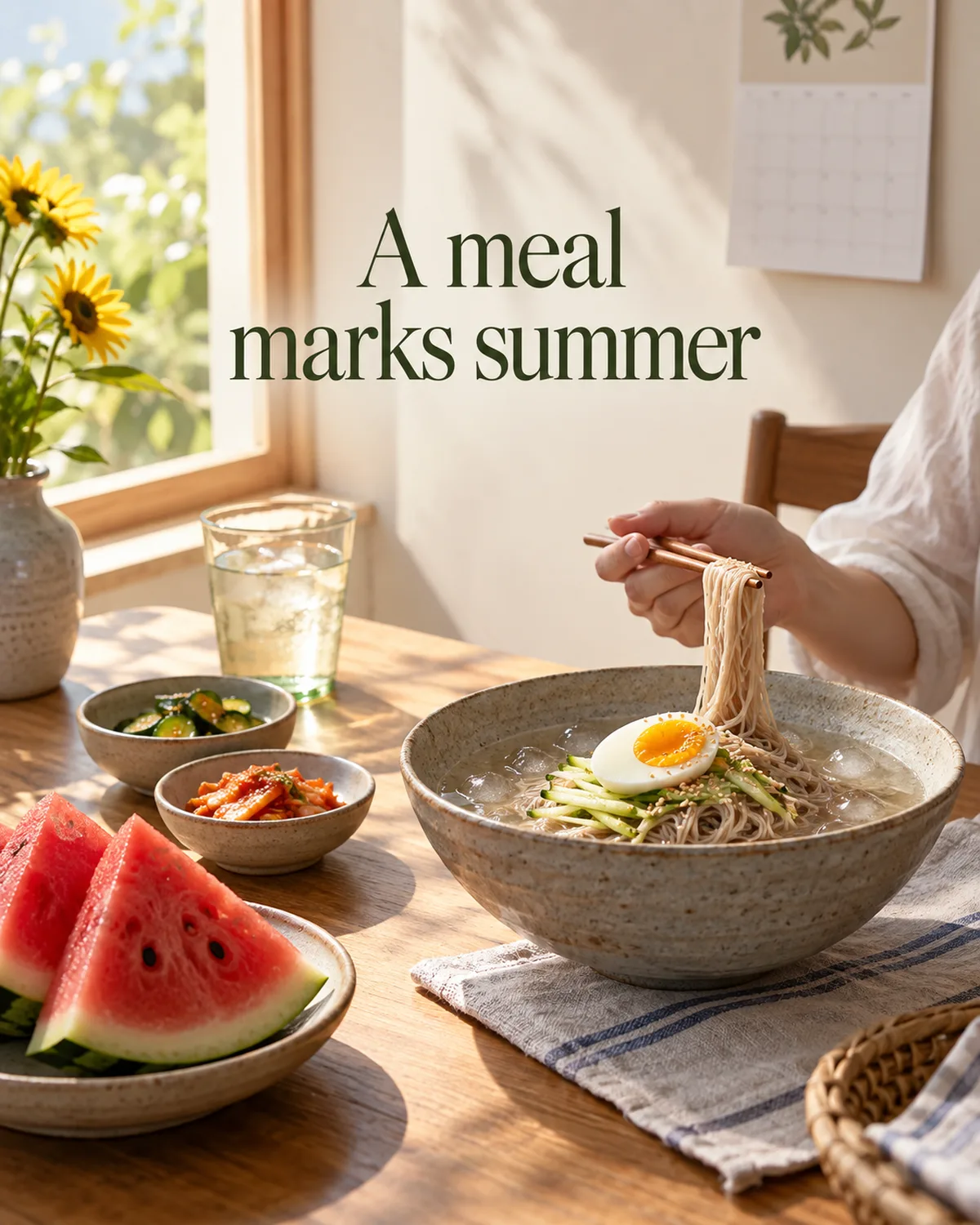
Cold foods also remain part of Korean summer. Kongguksu, naengmyeon, chilled fruit, bingsu and cold drinks do not disappear because iyeol-chiyeol exists. Real food culture is not a philosophical purity test. People can eat samgyetang on Chobok and cold noodles the next day.
This is why the best definition of Boknal is not “the day Koreans eat hot soup.” It is a peak-summer marker around which nourishing-food customs become especially visible.
If you happen to be in Korea on a Boknal date, there is no single required meal. A simple way to experience the custom is to choose one food with a clear summer-nourishing connection, understand why it belongs to the season, and notice how other diners and media are marking the date.
Samgyetang is the most legible option because the seasonal association is so strong. But grilled eel, chueotang, baeksuk or another substantial local dish can make sense too. If hot soup sounds miserable in humid weather, there is no cultural penalty for choosing a cold summer meal instead.
The tradition is not an exam in Korean authenticity. It is an invitation to notice how the calendar, weather and food economy interact.
A custom also changes the restaurant day
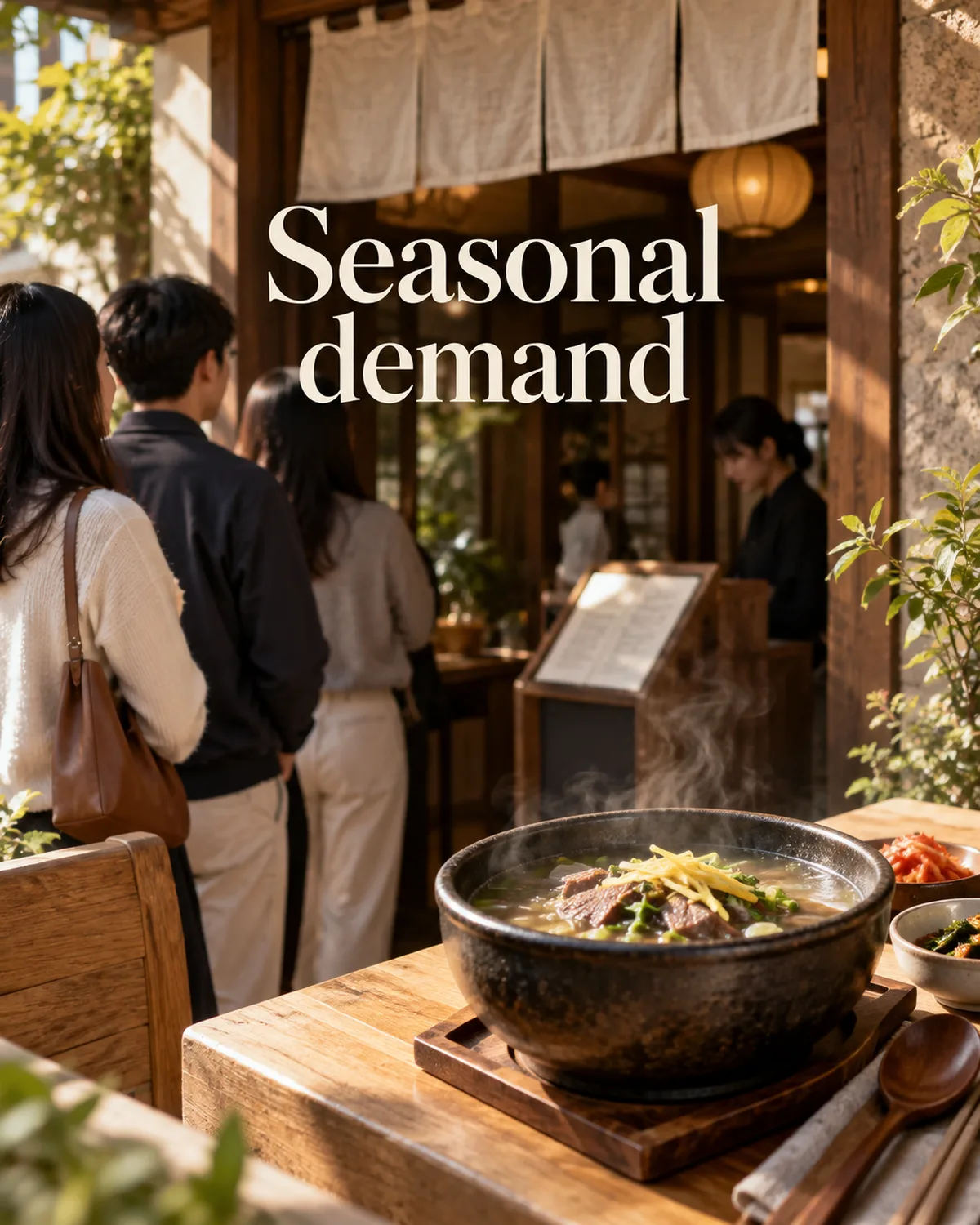
Seasonal rituals become easiest to see when they change ordinary consumer behavior. On Boknal, famous samgyetang restaurants can attract substantial queues, lunch demand rises, news coverage returns to summer foods, supermarkets promote chicken and ginseng ingredients, and ready-meal brands foreground packaged versions.
The food has not changed because the calendar arrived, but the concentration of demand has. That makes Boknal a useful case study in how culture affects restaurant economics. One seasonal expectation can push thousands of customers toward the same category at nearly the same time.
For a traveler, this creates a choice. Eating at a famous shop on Chobok offers the social atmosphere of the ritual—crowds included. Eating the same category of food a day earlier or later may offer a calmer meal. Neither is more historically “authentic.” They are different experiences of the same tradition.
Summer demand can make restaurants serving Boknal meals busy.
If Boknal existed only as a practical response to outdoor agricultural labor, modern cooling should have weakened it dramatically. Instead, the ritual persists. That tells us what seasonal food does beyond nutrition.
Seasonal foods mark time. Songpyeon can signal Chuseok; tteokguk can mark the New Year; samgyetang can signal that the deepest part of summer has arrived. Once a dish becomes a calendar cue, its social value no longer depends on reproducing the exact conditions that created the custom.
This is also why Songpyeon at Chuseok is a useful comparison. Both foods help make an abstract point in the calendar tangible. You can taste the season.
A meal can mark the season without being treated as a remedy.
Choose the meal without treating it as a health ritual
A standard samgyetang is usually an individual whole chicken with rice and aromatics. Broth styles vary from clear and mild to rich and cloudy. Some restaurants leave much of the final seasoning to the diner with salt and pepper; others season more aggressively in the kitchen.
Premium bowls may add abalone, black chicken, extra ginseng or herb packages. Those additions can change flavor and price, but “more medicinal-looking ingredients” does not automatically mean more historically authentic or medically effective.
On a peak Boknal day, the most practical questions are ordinary ones: how long is the wait, is one bowl enough for your appetite, do you have dietary restrictions, and is the restaurant’s current service format convenient for your group?
Check the ingredients, portion and serving format of the bowl you order.
Traditional Boknal foods are often meat- or fish-centered, and standard samgyetang is based on chicken. A bowl with visible vegetables is not vegetarian if the broth is poultry-based. Chueotang contains fish; eel is fish; many baeksuk dishes use chicken or duck.
Plant-based diners can still participate in the seasonal idea without pretending that the traditional meat dishes are vegetarian. A substantial bean dish, kongguksu or another summer meal can mark the day personally.
For allergies, ask about complete preparation rather than only the headline ingredient. Herbal packs can contain multiple roots. Premium samgyetang may include shellfish such as abalone. Prepared sauces and shared kitchens create additional variables.
Begin with the occasion and the food, not a promised effect. A chicken soup, another substantial cooked dish or a cold noodle meal can occupy different places in a Korean summer. They do not need to be ranked as the one correct response to the season.
Iyeol-chiyeol, often rendered as fighting heat with heat, is useful cultural language. It should not become advice to ignore cooling, hydration or signs of heat illness. Likewise, a celebrity eating a seasonal dish can introduce the custom to new viewers without explaining its origin or proving a medical outcome. Keeping those claims apart makes the food story clearer, not less enjoyable.
The seasonal story becomes more concrete when compared with individual dishes and regional meals.
The familiar bowl looks complete: a small whole chicken, rice tucked inside, ginseng in the broth and salt waiting at the table. But those elements did not become a nationally familiar restaurant image all at once.
Samgyetang is a stronger food story when older chicken preparations, changing ingredient supply, the modern name and the much older Boknal custom are kept on separate timelines.
Chicken and ginseng before the modern name
Popular food writing often describes samgyetang as an ancient royal dish. The claim sounds plausible because ginseng was historically valuable and chicken preparations certainly existed before the 20th century. But plausibility is not documentation.
The National Folk Museum article, written by food anthropologist Joo Young-ha, makes the documentary boundary explicit: the word samgyetang is not found in Joseon-period records. That does not prove that nobody ever combined chicken and ginseng. It means that the exact modern dish, name and restaurant format should not be projected backward unchanged.1
This distinction matters throughout food history. Ingredients can be old while the recipe architecture is new. A seasonal custom can be old while the food that now represents it changes. And a dish can become deeply traditional in living culture even if its modern standardized form is only several generations old.
Chicken boiled in water is a much older Korean cooking idea than the modern samgyetang restaurant bowl. The historical obstacle was not the existence of chicken soup. It was the form and circulation of ginseng.
The National Folk Museum explains that fresh ginseng, or susam, does not keep for long after harvest. Before modern cold-chain distribution, ginseng that needed to travel or be stored was commonly processed into dried forms. That changes what a historical cook could realistically put inside a chicken. A modern visual—an intact fresh ginseng root tucked into a small bird—depends not only on culinary preference but on an agricultural and distribution system capable of delivering fresh roots widely.
This is a useful way to read food history: the supply chain is part of the recipe. Refrigeration, transportation, breeding and commercial agriculture can alter a “traditional” dish as decisively as a cook can.
One of the strongest bridges between older chicken soup and modern samgyetang appears in Bang Sin-yeong’s Joseon Yorijebeop. The National Folk Museum cites the 1921 edition, which instructs the cook to prepare a chicken, put glutinous rice and ginseng powder into the cavity, tie it closed and boil it in water.
That is strikingly close to the structural idea of modern samgyetang: a whole bird, a rice filling and ginseng cooked together. Yet the use of powdered dried ginseng also shows why it is misleading to imagine a present-day restaurant bowl already fully formed. The recipe is a historical intermediate stage.
Sticky rice is stuffed inside a small whole chicken and cooks with the broth.
The Museum also notes that ginseng powder was not a cheap everyday ingredient. So even when the cooking idea existed, affordability and ingredient access limited how ordinary the dish could be.
Chicken, rice and powdered ginseng are ingredients discussed in early chicken-soup recipes.
How supply and restaurants helped form the familiar bowl
Another part of the story is agricultural rather than culinary. According to the National Folk Museum, poultry raising was actively promoted in the 1920s, initially with egg production as an important goal. Improved breeds spread, and chicken supply increased.
That matters because a whole young chicken per diner is a resource-intensive format. Samgyetang is not a soup that stretches a small piece of meat through a huge pot for a family. Its modern restaurant logic often gives one small bird to one person. A more abundant, standardized poultry supply makes that format easier to commercialize.
This helps explain why “old medicinal ingredients” alone do not make an old restaurant dish. Modern samgyetang required an intersection of ingredient tradition and industrial capacity.
The National Folk Museum points to a 1937 newspaper market report that noted strong summer demand for gyesam—ginseng used with chicken. It also cites 1942 cookbooks in which chicken baeksuk could be cooked with ginseng, especially as a summer nourishing food.
Those records are valuable because they avoid a false binary. We do not have to choose between “samgyetang existed exactly as today for centuries” and “someone suddenly invented it in the 1960s.” The evidence shows a transition: chicken-and-ginseng cooking was already developing before the name samgyetang became established.
Some people used the term gyesamtang—chicken-ginseng soup—with the chicken named first. The Museum emphasizes that the term was not yet widely standardized. That unstable naming is itself evidence of a dish still taking shape.
The strongest documentary explanation for the modern form comes from the 1960s. Refrigerated distribution made fresh ginseng easier to supply nationally, while government support for poultry production increased chicken availability. The Museum reports that restaurant advertisements in Seoul’s Myeongdong and Jongno areas began using the name samgyetang in the mid-1960s.
The word order changed too. Gyesam puts chicken first; samgye puts ginseng first. It is tempting to turn that into a single clever marketing anecdote with one inventor and one date, but the evidence supports a broader interpretation: ginseng became increasingly central to the dish’s commercial identity as fresh roots became easier to distribute and restaurants promoted the soup as a distinctive summer specialty.
Access to poultry and ginseng helped shape the modern chicken-soup bowl.
The seasonal place of the individual bowl
Boknal is the older seasonal setting into which this newer restaurant bowl became prominent. The separate Boknal article follows the calendar and changing summer meals; here the important question is what changed in the chicken, rice, ginseng and service format.
What is inside the chicken and around it
A standard restaurant samgyetang usually begins with a small whole chicken. Glutinous rice is placed inside the cavity, commonly with garlic, jujube and ginseng. Some recipes add chestnut, milk-vetch root or other aromatics; premium menus may add abalone, different ginseng products or black silkie chicken.
VISITKOREA’s basic dish description gives the core pattern: a young chicken stuffed with sweet rice, garlic, jujube and ginseng, then simmered in water. That is a useful baseline because it describes the category without turning one restaurant’s recipe into a national rule.
Recipes vary in broth strength, bird size, rice quantity, herb package and seasoning. Some broths are almost clear and lightly seasoned; others are richer and more concentrated. “Authentic samgyetang” is therefore better understood as a structure than as one exact formula.
Chicken, glutinous rice, garlic, jujube and ginseng form a common combination; recipes vary.
Samgyetang is different from a soup made from detached chicken pieces. A small whole bird contains skin, bone, connective tissue and meat in one compact package. As it simmers, rendered fat, gelatin-forming collagen and dissolved meat compounds move into the water.
The stuffed cavity creates a second process. Glutinous rice absorbs chicken juices and broth while releasing starch. If the rice stays mostly inside the bird, it remains a dense filling. Once diners break the bird apart and release the rice, the surrounding broth can become cloudier and slightly thicker.
This is one reason the bowl changes while you eat. The first spoonful can be light and clear; the later spoonfuls may contain broken rice, shredded chicken and more fat dispersed through the broth. The meal moves gradually toward a porridge-like texture without requiring a separate pot.
Rice released from the cavity can make later spoonfuls thicker than the first broth.
The English name causes unnecessary confusion. Glutinous rice is called that because of its sticky texture, not because it contains wheat gluten. Rice itself does not naturally contain gluten.
That does not make every restaurant bowl automatically suitable for someone with celiac disease or a severe allergy. Broth seasonings, packaged herbal mixtures, side dishes and cross-contact in the kitchen can introduce other ingredients. The useful distinction is between the rice grain itself and the complete restaurant preparation.
Ginseng is the ingredient that gives the dish its name and much of its symbolic power. In the bowl, it adds an earthy, slightly bitter and medicinal aroma that can be subtle or assertive depending on the root and cooking time.
The cultural association with vigor is historically important. The clinical leap is not. A restaurant serving cannot be treated as a standardized dose of ginseng, and diners receive different amounts depending on the recipe, bird size and whether they eat the root itself.
This is why “samgyetang is healthy because it contains ginseng” is too simple. The dish can be described as culturally nourishing, substantial and rich in protein because it contains a whole chicken. It should not be advertised as a proven treatment for fatigue, disease or heat illness.
Salt, meat and rice: taste the bowl in stages
Many samgyetang restaurants serve the broth relatively mild and put salt and pepper on the table. Diners may season the broth directly, mix salt and pepper for dipping chicken, or do both. VISITKOREA’s basic eating guidance also describes adding salt and enjoying the chicken with a little salt.
This does not mean every broth is literally unsalted or that there is one “correct Korean” sequence. House recipes differ. The larger point is that samgyetang often leaves a noticeable part of final seasoning to the diner.
That makes sense structurally. A whole chicken and rice are mild, while ginseng adds bitterness rather than salt. Allowing each person to adjust the bowl preserves the clear chicken flavor while accommodating different preferences.
Taste the soup before adjusting salt and pepper to the actual bowl.
Let the bowl settle briefly, taste the broth, season if needed, then separate the chicken with chopsticks and a spoon. Eat meat and rice in whatever order makes sense. Breaking the stuffed rice into the broth will thicken it; keeping it inside preserves a denser filling. Neither choice is a violation.
Separate tender meat from small bones while eating with a spoon and chopsticks.
If a ginseng root, jujube or garlic clove is present, eating it is optional. Some people enjoy the bitter root; others leave it. A small glass of ginseng liquor may be offered at certain restaurants, but it is not universal and it is not required for the dish to be “traditional.”
Samgyetang and baeksuk overlap, but portions differ
Baeksuk is a broad term for plainly boiled meat, and chicken baeksuk is a close relative of samgyetang. The boundaries are not perfectly rigid across restaurants, but the service format is useful.
Samgyetang is commonly built around a small whole chicken for one diner, with rice and ginseng integrated into the bowl. Chicken baeksuk is often made with a larger bird and served for sharing, sometimes with porridge or rice cooked separately after the meat. Local recipes can blur that distinction.
The comparison reinforces the historical point. Samgyetang did not appear from nowhere. It crystallized from older chicken-boiling practices into a more specific individual-bowl format tied to ginseng and Boknal.
An individual samgyetang bowl and a shared chicken pot illustrate different serving formats.
Choosing a bowl during the summer rush
Korea.net documented lines outside a well-known Seoul samgyetang restaurant before Chobok in July 2026, showing that the seasonal ritual remains highly visible. That does not mean a traveler must eat the dish on one of the three Boknal dates to have an authentic experience.
On peak days, famous restaurants may be much busier precisely because people are performing the seasonal custom together. On an ordinary day, the bowl is the same category of food with less waiting. Choose based on what you want: the communal cultural moment or the easier meal.
Because opening hours, queue systems and menu prices change, an evergreen food-history guide should not freeze one restaurant timetable into the body. Check the current restaurant listing shortly before visiting.
Instead of chasing a universal winner, compare four variables.
Broth style: clear and light, or concentrated and creamy from longer extraction and broken rice.
Ginseng intensity: subtle aroma or a more bitter herbal profile.
Chicken texture: just tender enough to separate cleanly, or cooked until extremely soft.
Rice structure: compact stuffing inside the bird or rice that readily disperses into the broth.
Those variables tell you more about the meal than celebrity signatures, queue length or a stale online star score. They also let you compare restaurants without pretending that one style is the national standard.
Samgyetang is one of the meals associated with Boknal.
Check the ingredients, not a promise of stamina
Standard samgyetang is not vegetarian. The broth is based on chicken, and even bowls that appear pale can contain concentrated poultry flavor. Herbal packs may contain multiple roots or botanicals beyond visible ginseng, and premium versions can add seafood such as abalone.
People avoiding alcohol should also ask rather than assume if a restaurant serves ginseng liquor alongside the meal. The drink may be separate, but service customs vary.
For allergies, ask about the complete broth, stuffing and add-ons. A visually simple soup can still contain ingredients that are not obvious once they have simmered for a long time.
Korean sources often describe samgyetang as boyang-sik, broadly a nourishing or restorative food. That language belongs to the cultural meaning of the dish. It does not tell you the calorie, sodium or nutrient content of a specific restaurant bowl.
A whole chicken provides substantial protein and fat; rice adds carbohydrate; broth seasoning changes sodium; skin, bird size and added ingredients can change the overall meal considerably. There is no single nutrition number for “one samgyetang.”
Open the bird and watch the meal change: the rice that began as stuffing can become part of the broth. That small act makes the modern bowl easier to understand than an unsupported royal origin or a promise of stamina. Old ingredients gained a distinctive restaurant form, and the diner finishes bringing its components together.
The seasonal custom and other soup meals help place this chicken bowl in a wider table.
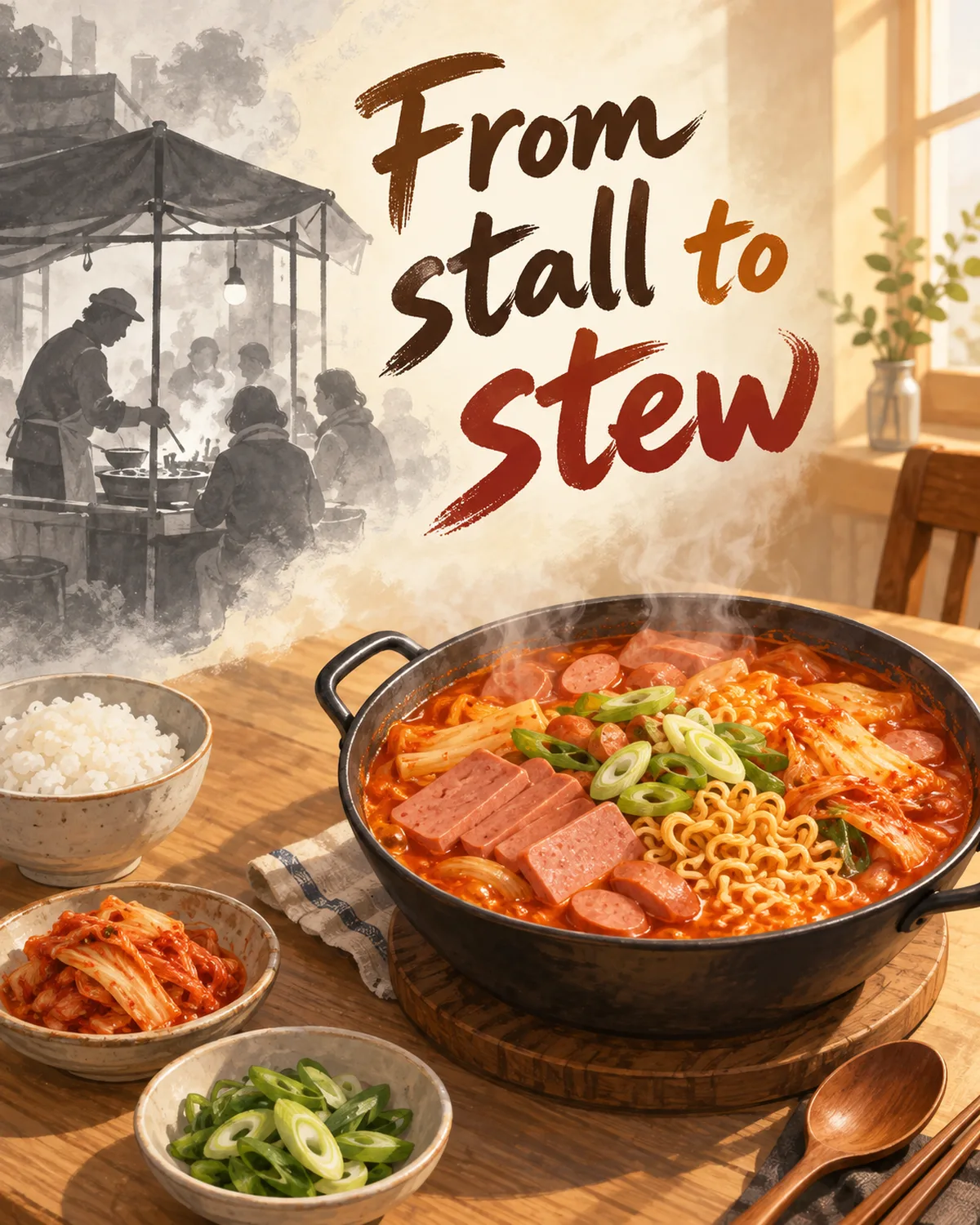
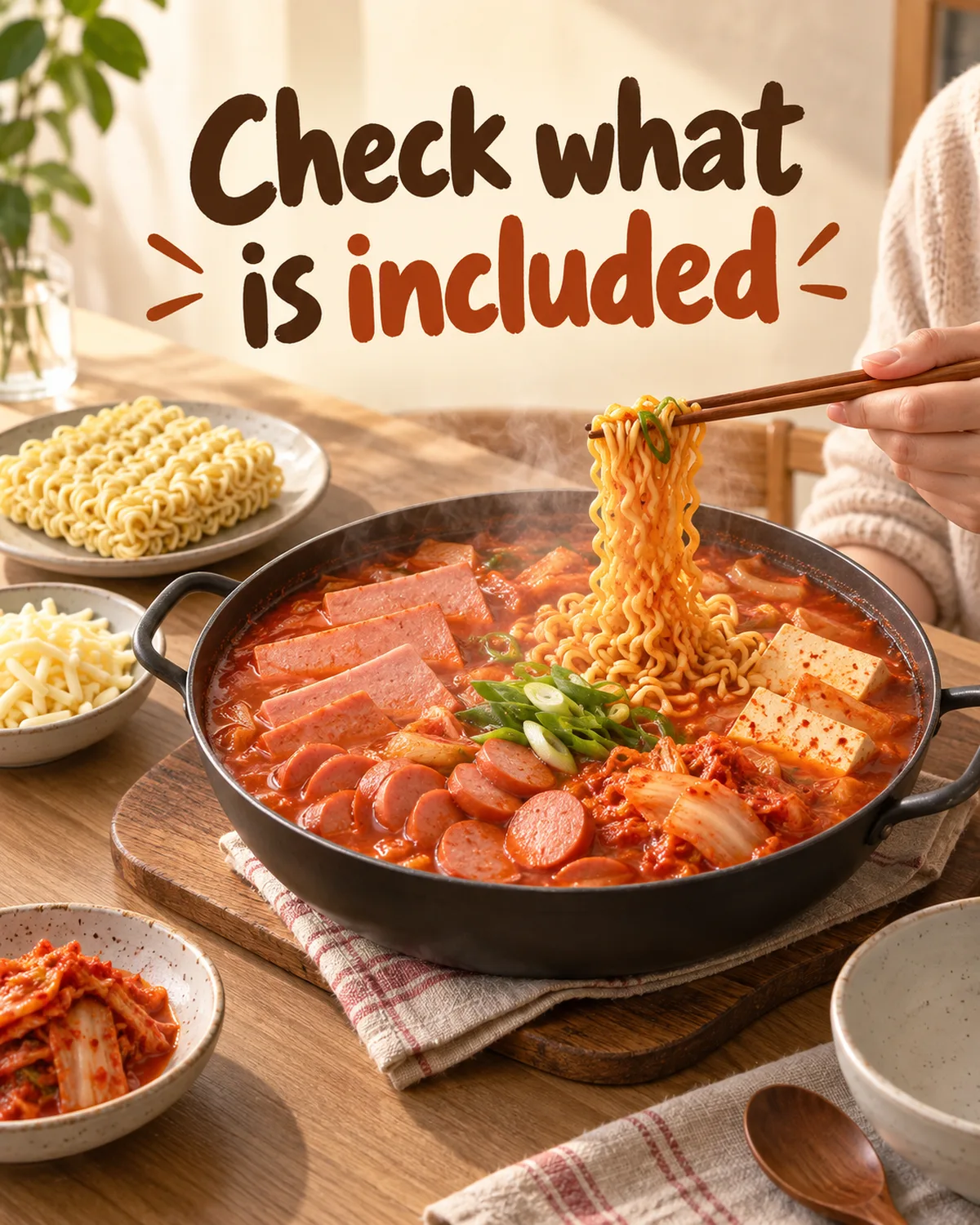
The sausage, kimchi, noodles and cheese in a modern budae jjigae pan do not all need to have arrived together. Reading them as layers added over time tells a more accurate story than imagining one complete modern restaurant recipe emerging in a single postwar moment.
The Korean identity of the meal also lies in its cooking system: ingredients simmer together, seasoning moves into the broth and rice gives the shared pot a place on the table.
The ingredient list is not one frozen 1950s recipe
A modern restaurant pot can contain sliced luncheon meat, frankfurter-style sausage, kimchi, tofu, scallion, onion, chili paste or chili powder, baked beans, rice cake, mushrooms, instant ramyeon and a slice of processed cheese. Seeing all of those ingredients together can make it seem as though the finished modern recipe appeared at once in the 1950s.
It did not. The pot contains ingredients from different moments. U.S.-base-associated processed meats belong to the immediate postwar story. Kimchi, garlic and chili seasoning connect the foreign meats to Korean stew practice. Instant ramyeon could only become a normal addition after commercial Korean instant noodles arrived: Samyang Foods dates Korea’s first domestic ramyeon to September 1963. Cheese and the wider range of modern add-ons belong to later restaurant and home-cooking layers.
This matters because food history becomes misleading when today’s photograph is projected backward. A cheese-topped pot with ramyeon, rice cake and multiple branded sausages is a contemporary version of a dish whose earliest forms were necessarily simpler. The current bowl is better read as several decades of Korean food history compressed into one pan.
After the Korean War ended in 1953, the peninsula faced severe material destruction and food shortages. U.S. military installations remained in a number of Korean cities, including Uijeongbu north of Seoul. Around those bases circulated foods that were scarce in ordinary Korean markets: canned luncheon meat, sausages, ham, bacon, cheese and other processed products.
Some of that circulation was legal, some informal and some illegal. Older reporting from Uijeongbu includes testimony about meat being carried out of bases and resold. The precise path of any one sausage is impossible to reconstruct decades later, so an accurate article should avoid turning one dramatic anecdote into a universal supply chain. What is well supported is the broader environment: base-adjacent communities gained access to Western processed meats at a time when meat was otherwise difficult for many people to obtain.
The 2012 interview records Heo Gi-suk’s recollection of taking meat out of the base and selling it. That account explains one business’s circumstances; it does not establish a single supply route for every early pot. A present-day restaurant stew should be described through its current ingredients, without presenting an old scarcity story as a current kitchen practice.
Separate ingredients illustrate the different histories that meet in a contemporary pot.
The ethical point is equally important. Postwar ingenuity is worth recognizing, but the poverty itself should not be romanticized. Base economies reflected military power, scarcity and unequal access. A cheerful “people made something delicious out of trash” narrative turns a painful historical situation into lifestyle content. Budae jjigae is more interesting when the hardship is left visible rather than converted into a cute origin myth.
Uijeongbu and the restaurant histories
Several Korean cities had U.S. military bases, so why is Uijeongbu so closely associated with budae jjigae? The answer is concentration. The city north of Seoul developed a cluster of restaurants specializing in the stew, and that cluster became a recognized food street with its own local tourism identity.
Korea Tourism Organization presents Uijeongbu Budae Jjigae Street as a specialty district associated with postwar U.S.-base foods and their adaptation with Korean seasonings. The city’s restaurant cluster helped make that history visible as a local food identity.
VISITKOREA’s Odeng Sikdang listing traces the business from a humble food stall to a specialist restaurant run by the third generation.
That official restaurant history supports Odeng Sikdang’s importance within Uijeongbu’s tradition. It does not prove the first-ever pot in Korea: informal cooking around several base communities rarely leaves such an exact record.
Odeng Sikdang’s founder, Heo Gi-suk, gave interviews describing a progression from selling fish cake at a street stand to cooking processed meat associated with the nearby U.S. base, first as a stir-fry and later as a stew after customers wanted something better suited to eating with rice. That testimony is historically valuable because it records how one important Uijeongbu business remembers the transformation.
A food stall and a pot of budae jjigae connect the dish with everyday restaurant culture.
The Korean cooking system holds the ingredients together
Processed meat is the most visually striking ingredient, but a pile of sliced sausage is not budae jjigae. The decisive transformation happens when those meats enter the architecture of Korean jjigae.
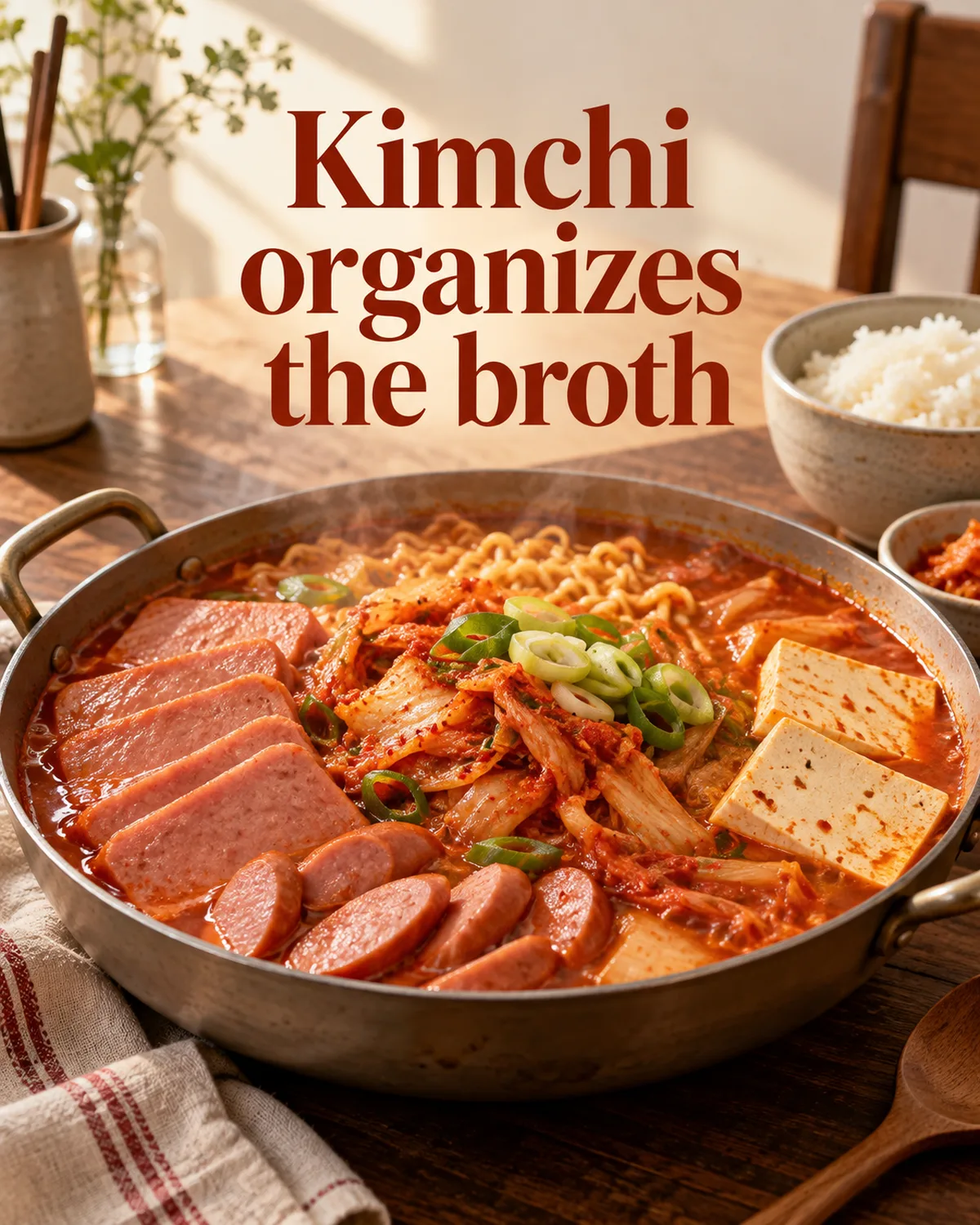
Kimchi contributes acidity, fermented aroma and salinity. Garlic and scallion supply fresh sulfurous notes. Gochujang or chili powder provides heat and body, though recipes vary and some restaurants lean more heavily on one than the other. Broth turns the ingredients into a shared spoonable meal. Tofu, mushrooms, onion or rice cake can extend texture and volume. The pot then cooks at the table or immediately before serving, allowing fat, starch and seasoning to move into the liquid.
This is why describing the dish as “American leftovers” misses the actual culinary work. The imported or base-associated foods were ingredients; the organizing grammar was Korean. The same logic appears throughout food history when migrant ingredients enter an existing cooking system: what matters is not only where an ingredient came from but what local cooks made it do.
Kimchi is often reduced to cultural symbolism in descriptions of budae jjigae, but it also changes the chemistry of the pot. Fermentation produces acidity and a complex savory profile that cuts through fatty processed meat. Chili and garlic add aromatic intensity. The vegetable material contributes moisture and soluble compounds to the broth.
That balance is especially useful because luncheon meat and sausage are concentrated, salty products. If the pot relied only on meat and cheese, it would become heavy very quickly. Kimchi gives the broth tension: sour against fatty, fermented against processed, vegetable against meat.
Fermented cabbage contributes sourness and seasoning to the chili broth.
Restaurants differ in how mature their kimchi is and how much they rely on it. Some Uijeongbu-style pots are described locally as relatively clean and kimchi-forward rather than extremely thick. That should not be turned into a rigid regional law, but it is a useful tasting question. When comparing two pots, ask whether the base flavor comes mainly from fermented kimchi, chili paste, a prepared stock or the processed meats themselves.
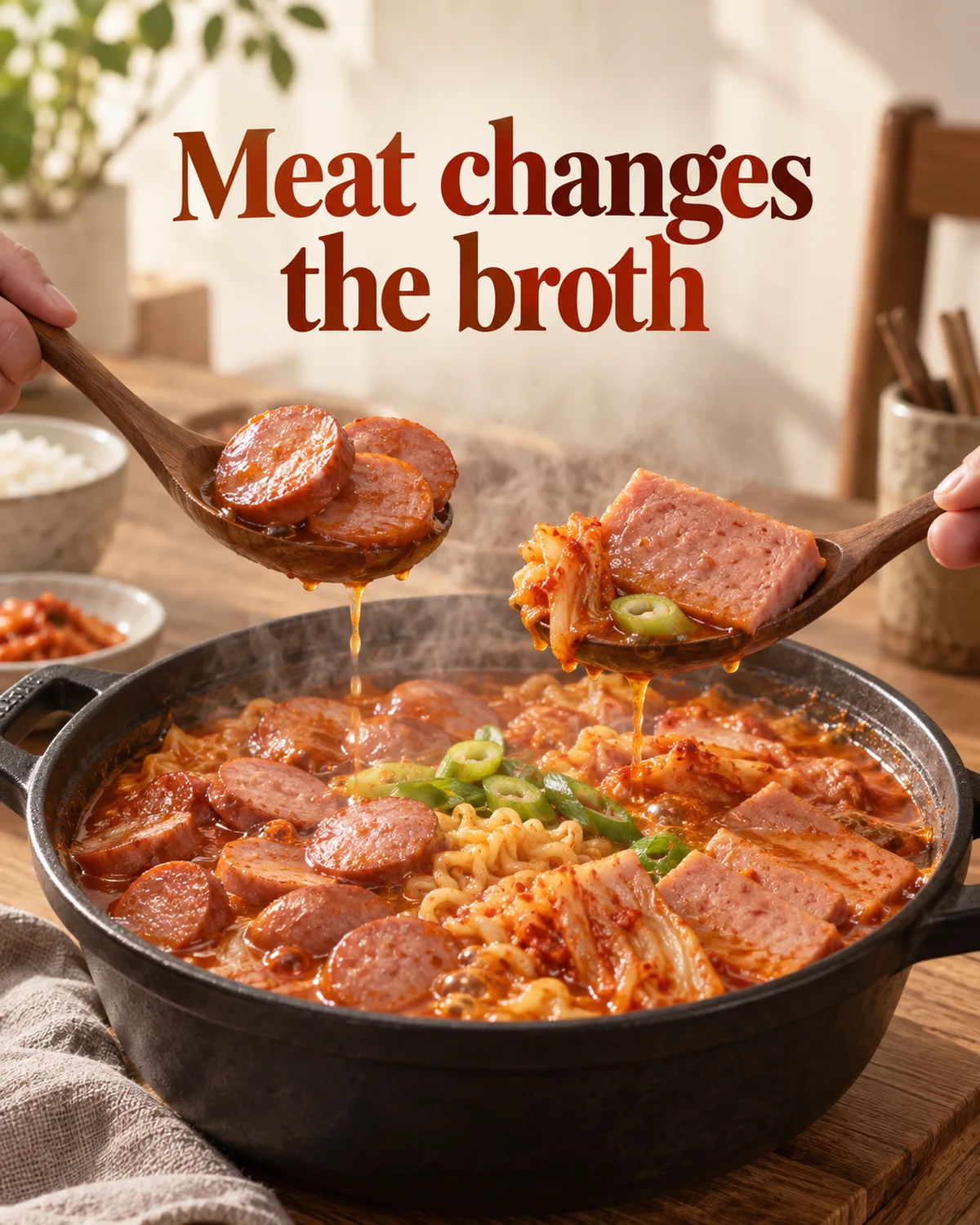
Processed meats contribute more than protein. They carry salt, fat, spices and emulsified meat juices. As slices heat in the broth, some fat disperses and some seasoning dissolves into the liquid. This can make the stew taste deeper even before additional seasoning is added.
Different products behave differently. A firm frankfurter keeps a springy bite. Luncheon meat softens around the edges and can release more fat. Smoked sausage brings a different aroma from plain ham. A heavily seasoned product can make the final broth much saltier than expected.
That is why a good pot is not improved simply by adding more meat. Too many salty processed ingredients can flatten the contrast between kimchi, broth and chili. The most satisfying versions use processed meat as one powerful layer inside the stew rather than as the only flavor source.
Luncheon meat and sausage contribute different textures and concentrated seasoning as they simmer.
Noodles and cheese belong to later layers
Instant noodles are so familiar in budae jjigae today that they can look historically inseparable from the stew. The chronology says otherwise. Samyang Foods and the Academy of Korean Studies both identify 1963 as the year Korea began producing domestic instant ramyeon. That means the noodle layer belongs to a later stage than the immediate postwar circulation of U.S.-base meats.6
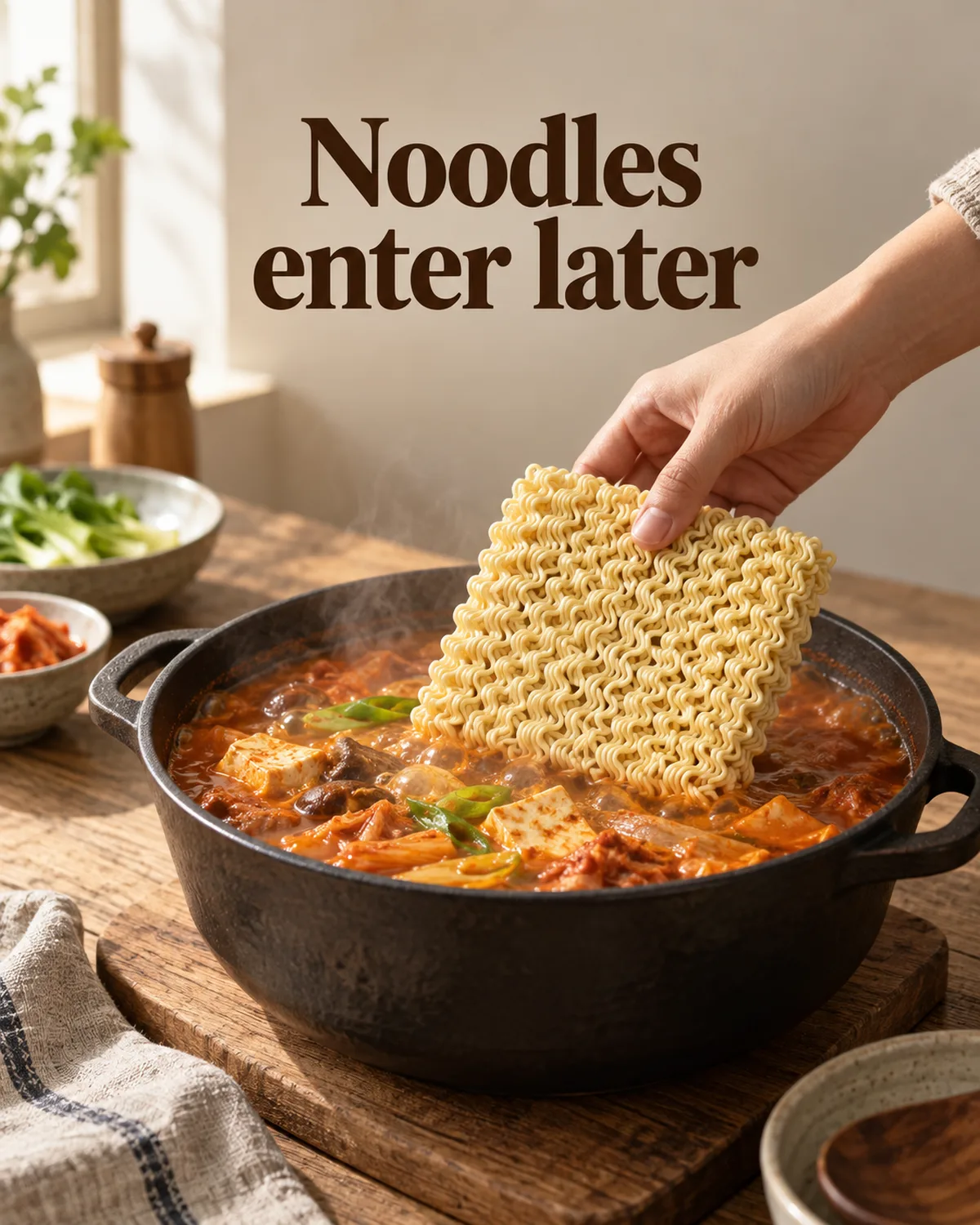
Once ramyeon became common, however, it was an almost perfect addition. The noodles are cheap, quick-cooking and designed to absorb strongly seasoned broth. Their surface starch also thickens the pot slightly as they cook. One block can turn a meat-and-kimchi stew into a heavier shared meal without requiring another pan.
Timing matters. Add the noodles too early and they continue absorbing liquid until soft and swollen. Add them after the broth has developed and they take on concentrated flavor while retaining more bounce. For diners, this is one reason a table-cooked pot changes from first spoonful to last: the broth gets saltier, starchier and more integrated over time.
Ramyeon added after the broth develops can retain more bite before it absorbs the liquid.
A square of processed cheese melting over the center is now one of the most photographed budae-jjigae images. It fits the dish visually and chemically. The cheese softens chili heat, adds dairy fat and salt, and can make the surface of the broth feel richer.
But cheese should not be used as evidence for what an early postwar pot looked like. It is better understood as part of the dish’s later restaurant evolution, when abundance replaced scarcity and diners began treating the stew as a format open to additions.
The same applies to macaroni, dumplings, extra rice cake, premium sausages, mushrooms and branded meat assortments. Budae jjigae did not become less “authentic” each time the ingredient list grew. Its identity has always depended on adaptation. The historical discipline is simply to keep the timeline visible rather than pretending every modern topping was present at the beginning.
Cheese is an optional addition that changes the broth’s richness.
How scarcity food became a shared comfort meal
The first generation associated with base-area processed meat experienced a food system marked by shortage. A later generation could encounter the same ingredients as inexpensive restaurant comfort food. Younger diners may know budae jjigae primarily as a group meal ordered because it is salty, spicy, filling and fun to cook at the table.
That change in meaning is not a betrayal of the history. It is the history continuing. Foods often lose, soften or reverse the stigma attached to their origins. Ingredients that once signaled dependence or scarcity can later signal nostalgia, convenience or indulgence.
Uijeongbu’s food street shows that transition especially clearly. What began in a base-adjacent economy became an officially promoted local specialty with restaurants, tourism material and a recurring festival. The city’s relationship with the stew is now civic as well as culinary.
If you want a mental model that survives conflicting origin stories, use four stages.
Stage 1 — postwar access: U.S.-base systems put processed meats and unfamiliar packaged foods into circulation near Korean communities during severe scarcity.
Stage 2 — Korean adaptation: those ingredients entered kimchi-and-chili stew logic and became a hot shared meal suited to rice.
Stage 3 — restaurant standardization: places such as Uijeongbu developed specialist businesses and a recognizable local style, while instant ramyeon and later toppings expanded the format.
Stage 4 — mainstream comfort food: the stew spread nationally into franchises, home cooking, meal kits and pop-culture imagery, where diners may know the flavor before they know the history.
Let the table pot cook in stages
Restaurant service varies, but the shared-pot logic is consistent enough to explain. Meat, kimchi, tofu, vegetables and seasoning can begin heating together. Once the broth reaches a strong simmer and the flavors have started combining, quick-cooking additions such as ramyeon are better added later.
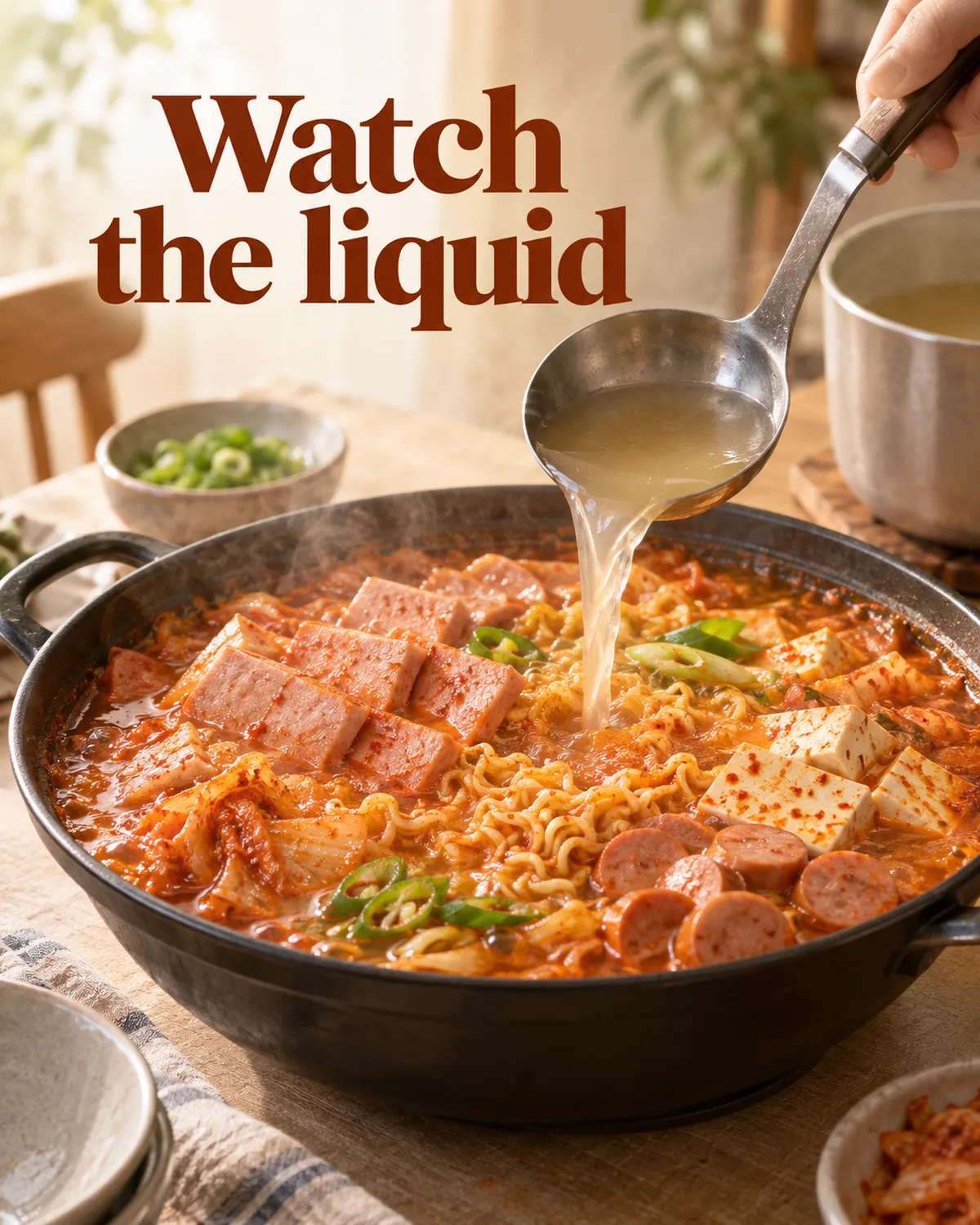
Watch the liquid level after noodles enter. Instant noodles absorb broth rapidly, and rice cake adds additional starch. If the pot reduces too far, the seasoning that tasted balanced at the beginning can become sharply salty. Restaurants may provide extra broth; if they do, add it before the bottom begins catching.
Check the broth level as noodles absorb liquid during the meal.
Cheese should be treated as a flavor adjustment, not an obligatory topping. Letting it melt over one section gives diners a choice between a cleaner spicy broth and a creamier spoonful. Mixing it completely through the pot changes the entire balance.
There is no universal “correct” eating order, but a practical sequence is to taste the broth once it has developed, eat the noodles while they still have texture, then work through meat, tofu and vegetables. Rice can accompany the stew rather than serving as a mandatory finale. House style matters more than internet etiquette.
A shared stew pan can be accompanied by individual bowls of rice.
Start by checking whether the menu is priced by person, by pot size or by set. Famous budae-jjigae restaurants often expect a minimum number of servings for a shared table, but details vary and should be checked at the restaurant rather than assumed from an old guide.
Then decide which additions actually improve the meal. Extra sausage increases salt, fat and meat intensity. Extra ramyeon increases starch and turns the broth thicker. Rice cake increases chew and can make the pot more filling. Cheese rounds the spice and adds dairy richness. Dumplings add another heavy component. Ordering every add-on at once can obscure the base you came to taste.
For a first visit to Uijeongbu, the most informative choice is usually a relatively standard pot first. Taste what the restaurant considers its core balance, then add one variable if the group is still hungry.
Confirm the serving unit and included additions before ordering.
Read the broth, processed meat and seasonings
Budae jjigae is fundamentally a meat-centered dish. Even if visible sausage is removed, the broth or seasoning may have been cooked with processed meat, anchovy stock or other animal ingredients. Tofu and mushrooms do not make the standard pot vegetarian.
Allergy questions also need specificity. Processed meats can contain multiple seasonings and additives. Cheese introduces dairy. Fish cake may appear in some versions. Baked beans or prepared sauces can contain ingredients not obvious from the table. Shared kitchen and pot handling also matter for severe allergies.
If a restaurant offers a meatless “budae-jjigae-style” pot, treat it as a separate adaptation rather than assuming the standard dish can be made safe by picking out the sausage.
The deep red color suggests intense heat, but budae jjigae often tastes more salty, sour and savory than explosively spicy. Kimchi maturity, chili paste, chili powder, broth concentration and cheese all change the perceived heat.
Processed meat can also soften the immediate chili impression through fat while increasing overall saltiness. As the pot reduces, however, both salt and spice concentrate. A broth that tastes moderate at the beginning can feel much more aggressive near the end.
If spice tolerance is low, ask whether the restaurant can reduce the chili base before cooking rather than trying to dilute an already concentrated pot at the table. Avoid assuming that the red color alone predicts a universal heat level.
Processed meat, prepared stock, kimchi and optional cheese can make the pot salty and rich. Choose the portion and additions that suit your table, and ask about specific ingredients when needed. The dish needs no medical promise: its value here is the transformation of ingredients into a shared meal.
Ask about stock, processed meat and optional additions when an ingredient matters to your meal.
Visiting the food street without chasing a perfect origin
The strongest reason to eat budae jjigae in Uijeongbu is comparison. A specialty street gives you multiple restaurants working within the same local expectation. Sausage choice, kimchi maturity, broth strength, bean use and add-ons can vary even when the dish name is identical.
The food street provides a district to explore rather than a single compulsory stop. Check a current official listing for access and opening details; if a shop is closed or its queue is impractical, another bowl can still make the district’s variation tangible.
Odeng Sikdang remains historically important, and VISITKOREA maintains a current listing for it. But hours, menu prices, queue systems and branch details can change. An evergreen article should therefore link the current listing rather than freeze a price and timetable that may be wrong by the time a traveler arrives.
The pot becomes clearer when compared with dishes that share the table format but not the history. Samgyetang is usually a one-bird-per-person soup tied to summer boknal customs, even though the modern form is more recent than many travelers assume. Budae jjigae is deliberately communal and built around processed ingredients whose meaning comes from the postwar base economy.
Kimchi jjigae shares fermented cabbage and chili-seasoned broth, but budae jjigae makes processed meat part of its identity rather than an optional protein. Ramyeon becomes structurally important in many modern budae-jjigae pots, while it is not required for kimchi jjigae.
This comparison helps avoid the lazy definition “kimchi stew with Spam.” The two can overlap in ingredients, but budae jjigae carries a specific historical relationship to U.S.-base food circulation and a restaurant tradition built around that memory.
Other shared pans and chicken soups show how ingredients and dining formats can change together.
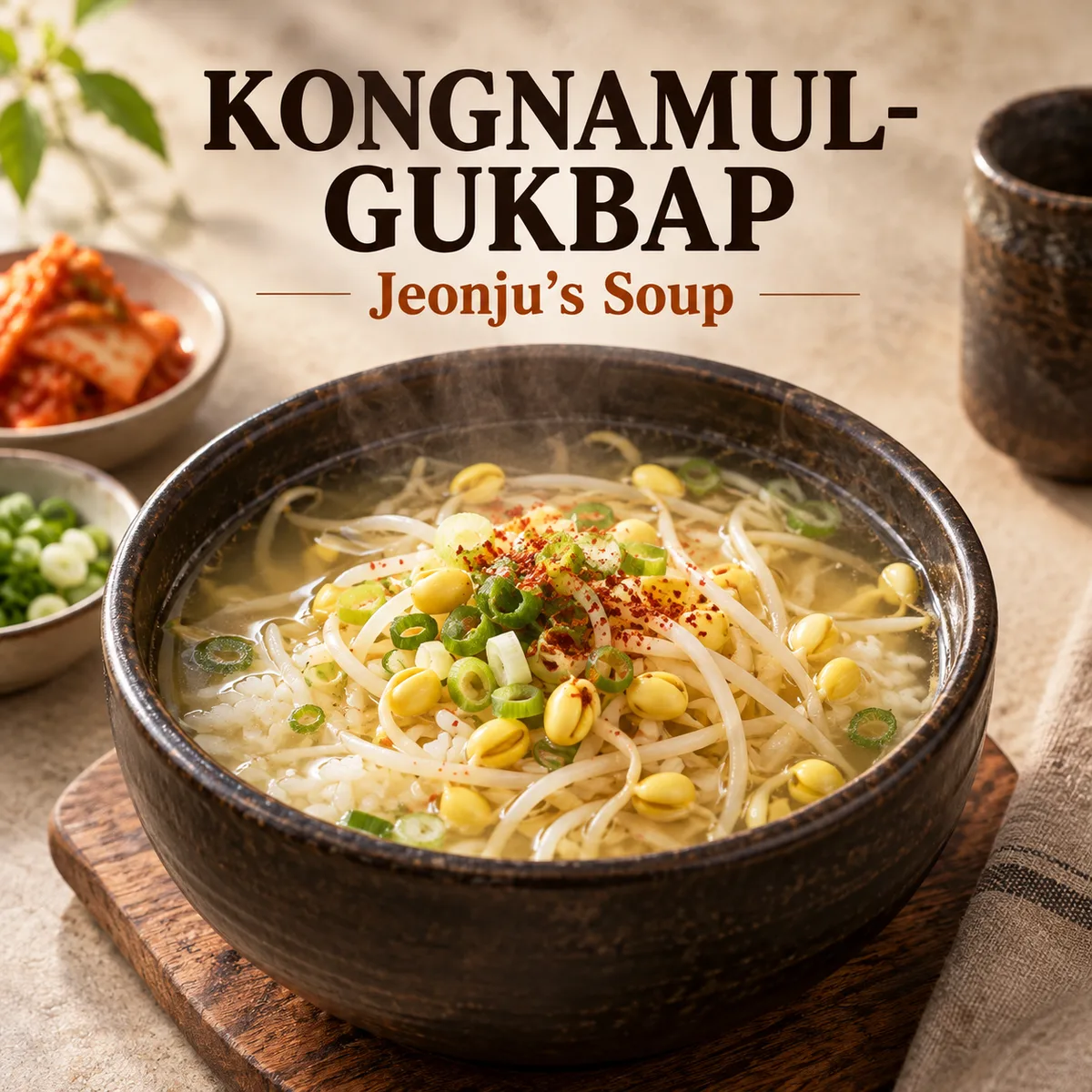
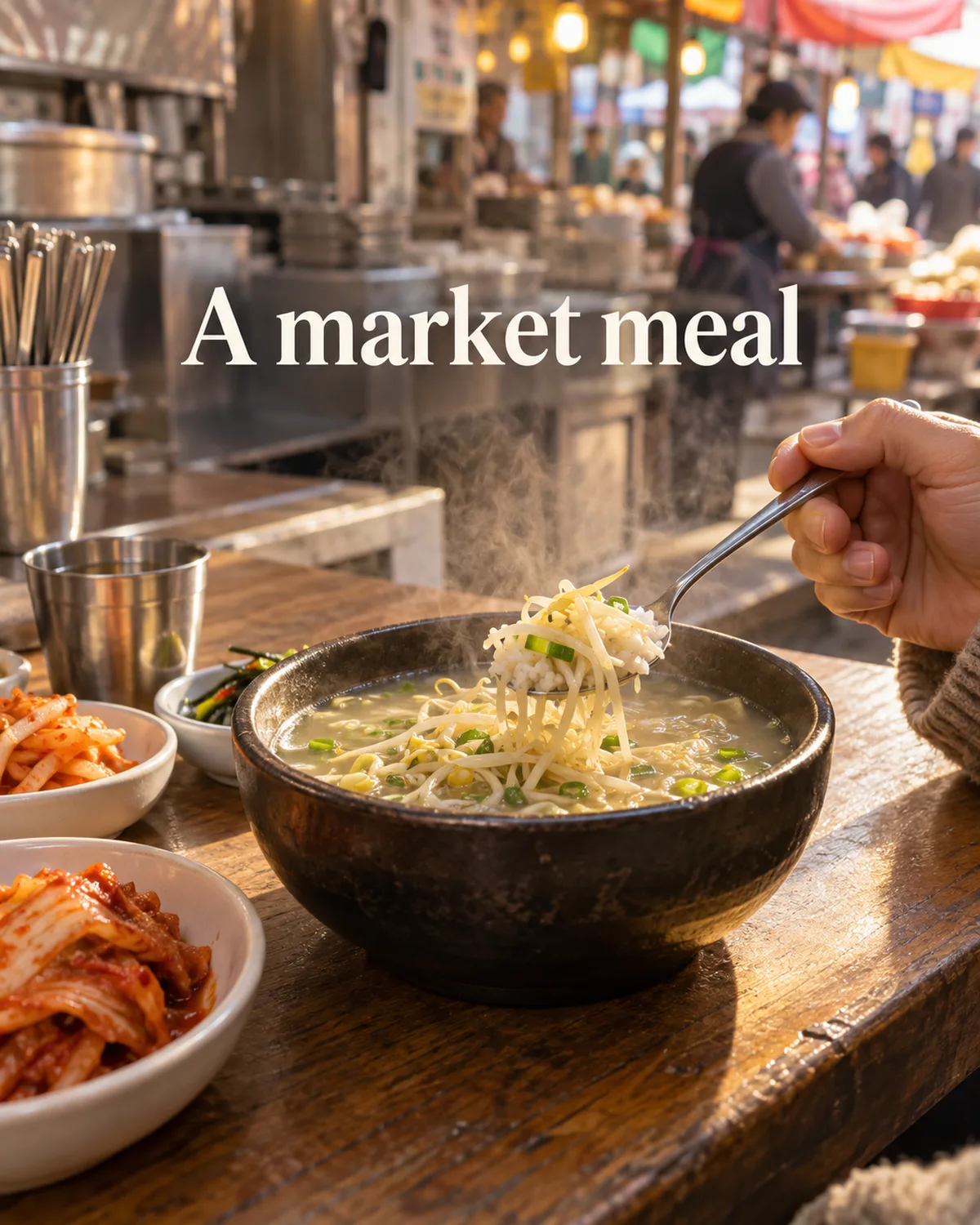
A soup does not have to arrive violently bubbling to have been carefully heated. In Jeonju’s kongnamul-gukbap, the repeated pouring of hot broth can bring rice and other components to an eating temperature in a different way from boiling everything together in a stone bowl.
That difference—and the egg sometimes served separately—makes this bean-sprout rice soup more interesting than the familiar label of hangover cure.
Why a bean-sprout bowl belongs to Jeonju
Jeonju is famous internationally for bibimbap, but official city food materials give soybean sprouts their own prominent place. Jeonju publications describe local sprout cultivation, the long use of kongnamul in many dishes and the special place of kongnamul-gukbap in the city’s everyday food culture.
That matters because the dish is not simply a generic national soup that happens to have a famous branch in Jeonju. The city built a dense relationship among ingredient supply, markets, breakfast trade and specialist restaurants. Jeonju’s Nambu Market became especially associated with a style designed for people who needed a hot meal quickly.
This is a useful contrast with Jeonju bibimbap. Bibimbap displays ingredients separately and asks the diner to mix them. Kongnamul-gukbap begins as a unified hot bowl. One represents composition and visual abundance; the other represents speed, warmth and repetition. Together they explain more about Jeonju than either dish alone.
Kongnamul means soybean sprouts, guk means soup and bap means rice. That literal name can create the impression that every restaurant serves the same thing. In practice, broth strength, seasoning, chili, seafood additions, egg treatment, seaweed and heating method vary.
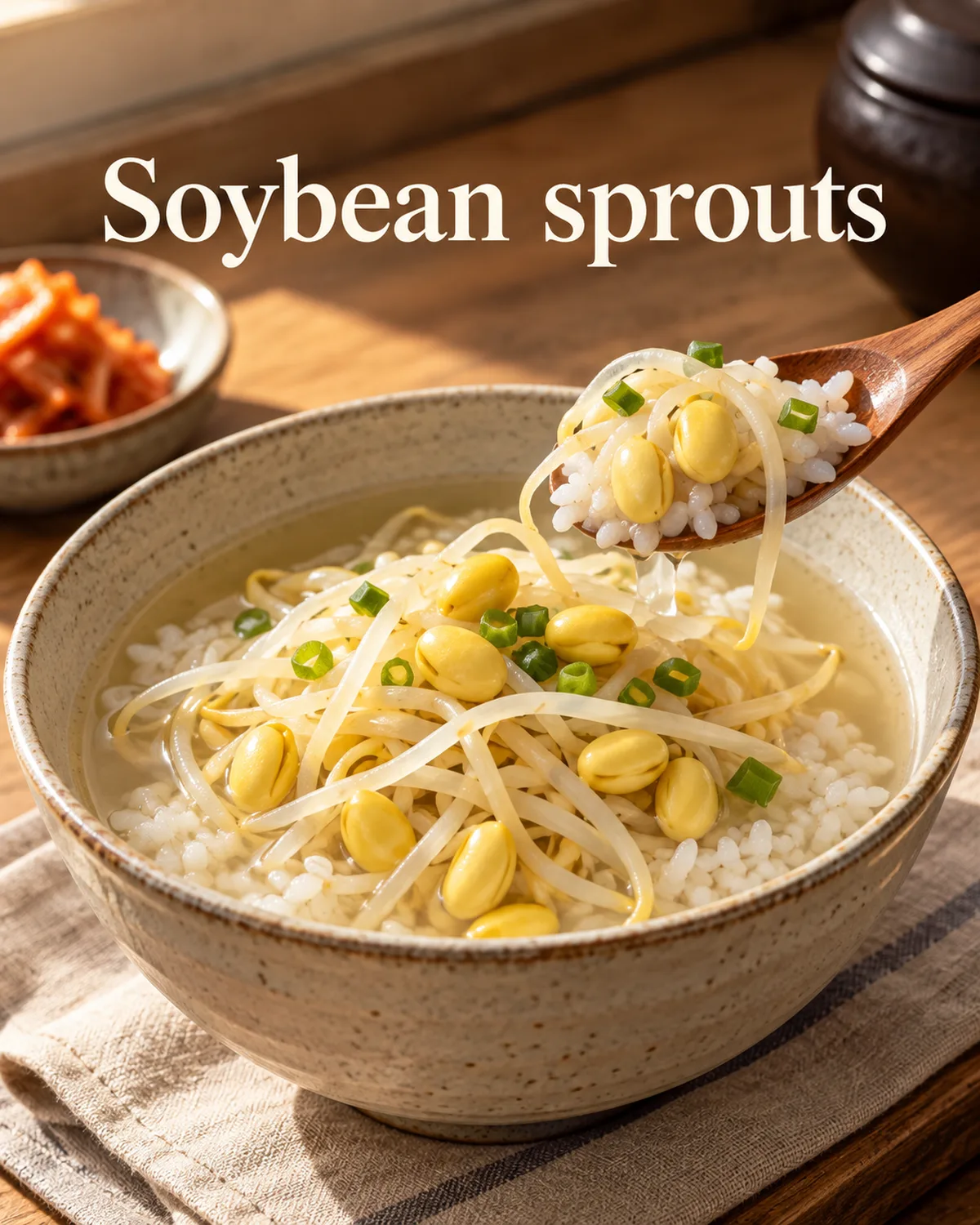
The core texture is built around contrast. Rice softens in broth. Soybean sprouts should retain enough snap to keep the bowl from becoming mushy. Dried seaweed adds roasted aroma and dissolves into the broth as it sits. Scallion and chili can add freshness and heat. Salted shrimp or other seasonings may be offered for diners to tune salinity.
Because the ingredient list is modest, cooking method becomes unusually visible. In a heavily sauced stew, small differences in rice warming may disappear. In a clear bowl of sprouts and broth, overcooked rice and limp sprouts change the entire experience.
Large yellow soybean heads and long stems give kongnamul its recognizable texture above the rice.
Traditional markets are not only tourist attractions. They are workplaces. Jeonju city material on the Nambu Market style explicitly links toryeom to merchants and porters who needed to eat quickly while working. That detail is more informative than a generic claim that the soup is “traditional.”
It tells you what the dish had to accomplish: inexpensive ingredients, fast service, enough substance to support physical work, and a method that could produce bowl after bowl without waiting for each portion to boil from cold.
When travelers eat the soup in or around Nambu Market, that functional history is part of the experience. The market context also explains why breakfast and early-day eating remain culturally important even though many modern restaurants serve the dish much later.
Toryeom and the bubbling earthenware pot
The Nambu Market style is strongly associated with toryeom. The basic idea is to heat rice or ingredients by repeatedly ladling hot broth over them, draining or returning the liquid, and repeating the process rather than boiling the assembled bowl aggressively for a long time.
Jeonju city material describes this market method as a practical response to speed: merchants and porters moving through the market needed food that could be served quickly. The method warms the rice while avoiding the same degree of continued boiling that can turn rice swollen and sprouts soft.
From a food-science perspective, the logic is straightforward. Heat moves from broth into the rice and sprouts, but exposure is controlled. Repeated contact raises temperature without subjecting every component to a long rolling boil. That helps explain why a toryeom bowl can feel cleaner and more texturally separated even though it is still served hot.
Toryeom is not a mystical Jeonju-only principle. Similar repeated-pouring logic can appear in other Korean soup-and-rice traditions. What makes it important here is the way Nambu Market restaurants turned the technique into part of a recognizable local service style.
Pouring broth over rice and sprouts illustrates toryeom, which warms the ingredients through repeated broth contact.
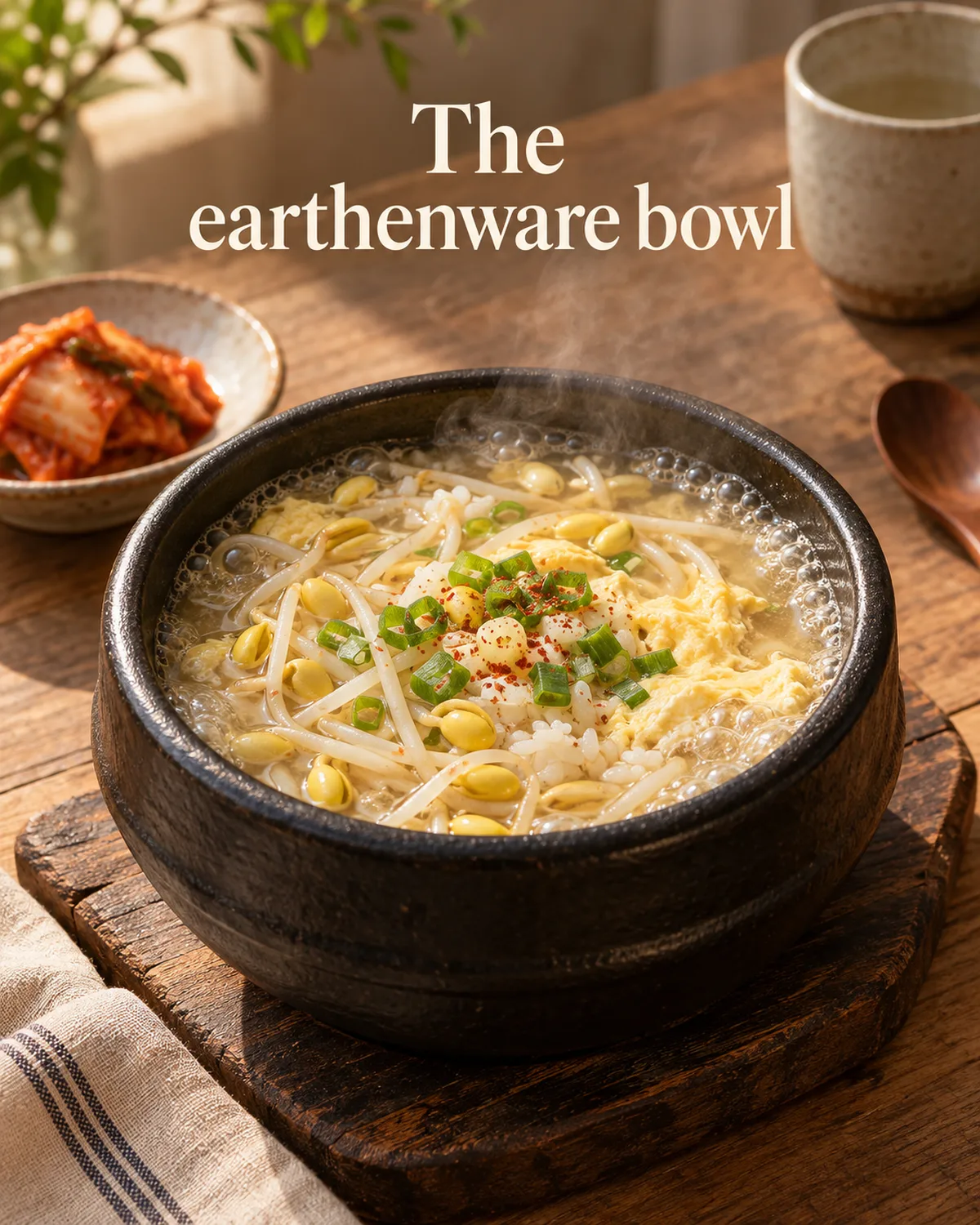
Not every Jeonju kongnamul-gukbap shop relies on the Nambu Market toryeom format. Another familiar style heats the bowl more aggressively and may bring it to the table in a hot earthenware vessel, with egg incorporated directly into the soup.
The result emphasizes heat retention and integration. A ttukbaegi keeps boiling or near-boiling food hot at the table, so the diner experiences a bowl that changes while eating. Egg thickens slightly, rice continues to soften and aromatics keep releasing into the broth.
It is tempting to turn these differences into a rigid “two schools of Jeonju soup” taxonomy. That goes too far. Restaurant practices overlap, individual houses adapt, and the details can change. It is more accurate to say that Jeonju preserves multiple service styles, with toryeom and separately served egg especially associated with the Nambu Market tradition.
The heated earthenware bowl keeps rice, sprouts and incorporated egg cooking together.
The separate egg has a role of its own
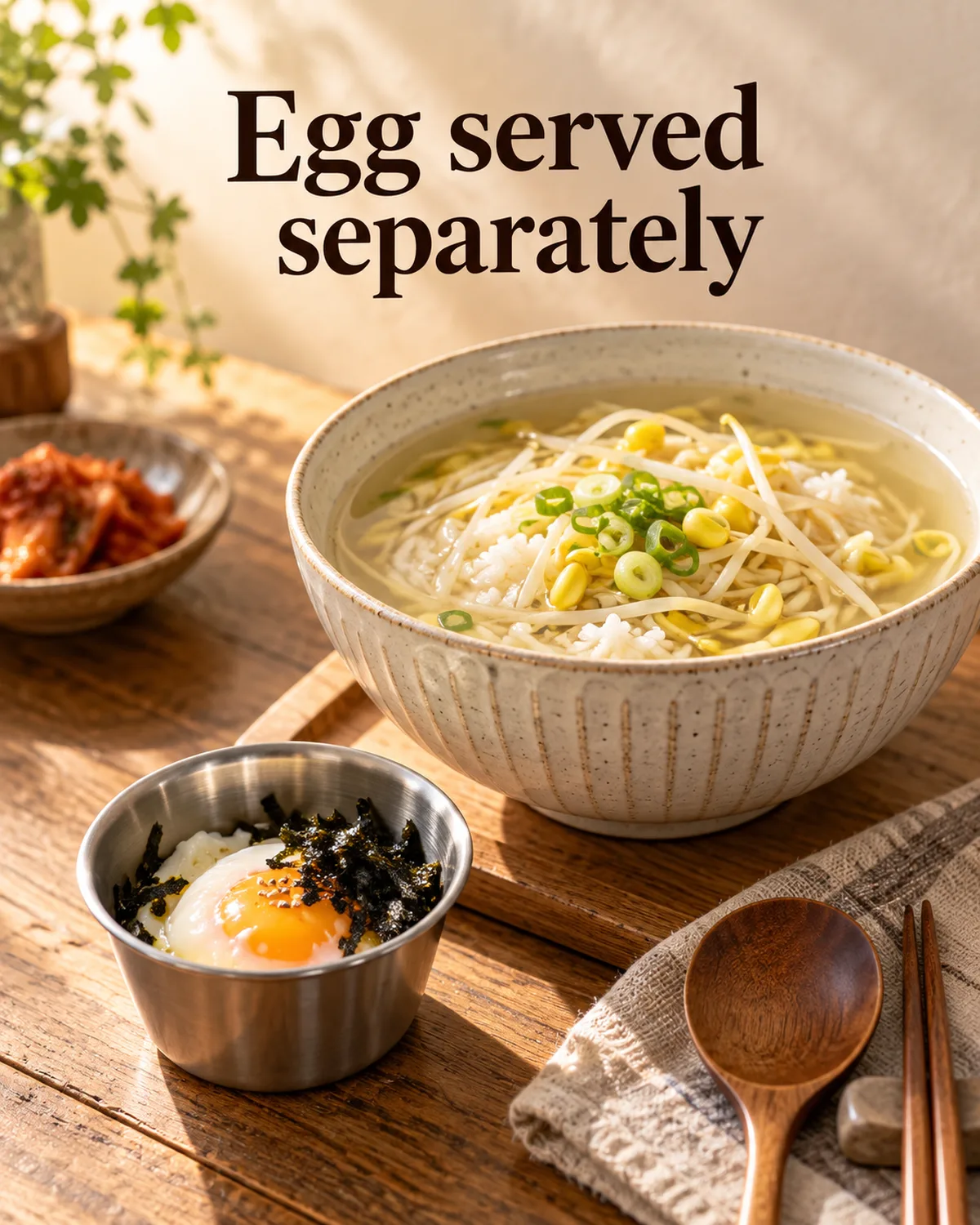
Some Jeonju shops serve a soft or partially cooked egg separately, often with crumbled seaweed. Diners may add a little hot broth, season it, eat it between spoonfuls of soup or combine it gradually.
Keeping the egg outside the main bowl changes two things. First, the clear broth stays clearer because yolk does not immediately disperse through it. Second, the diner controls richness. A spoonful of egg can soften the salty, hot soup without turning the entire bowl creamy.
Restaurants differ, so there is no universal etiquette. If an egg arrives separately, follow the house setup rather than assuming it must be poured into the soup. If it is already cooked in the bowl, there is no need to imitate the market style. The variation is part of the regional culture, not a test of correct behavior.
A small egg cup alongside the soup lets the diner taste and combine the two separately.
Broth, sprouts and the timing of the seaweed
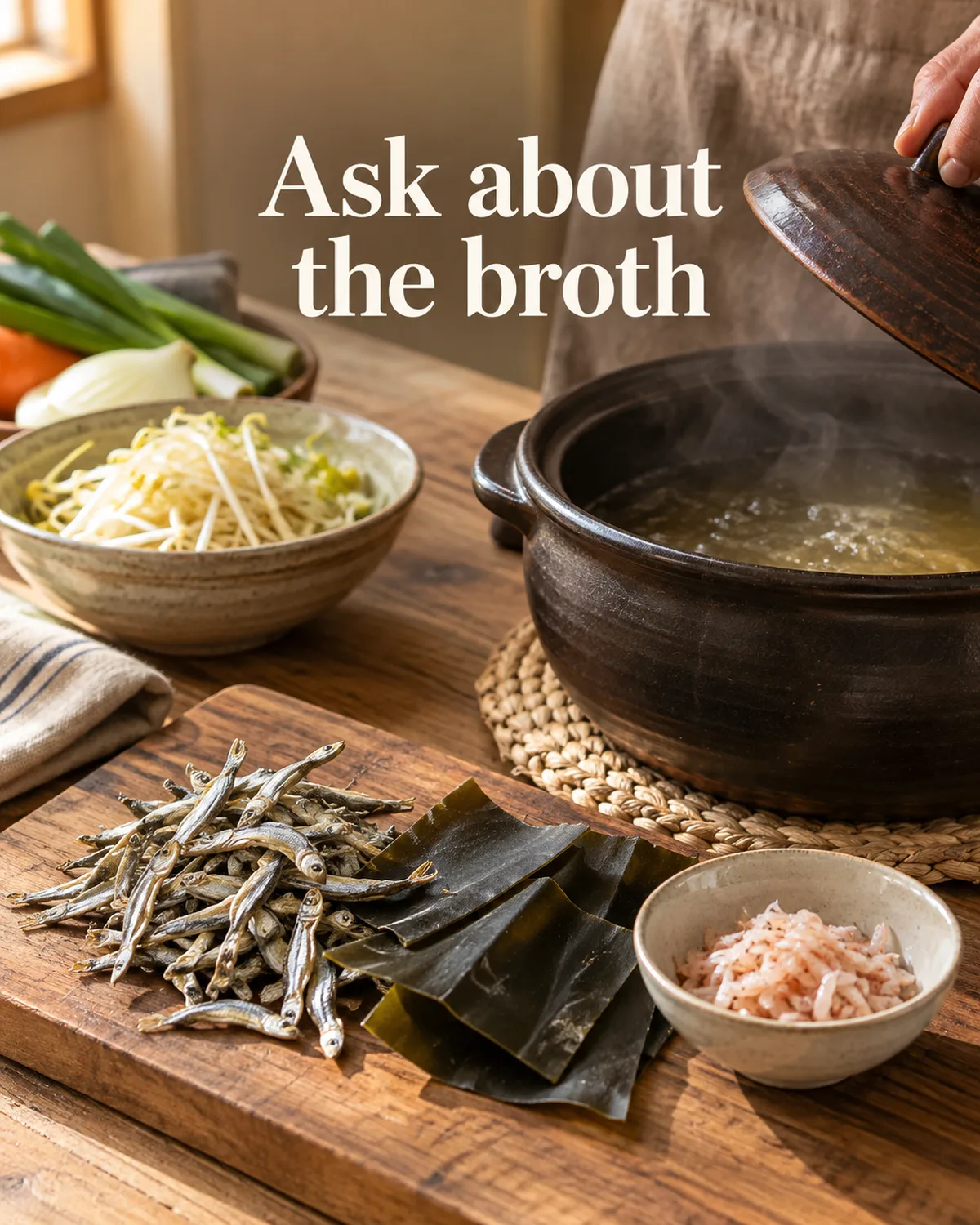
Travel descriptions sometimes define kongnamul-gukbap entirely by the sprouts, but the broth changes the bowl just as much. Different restaurants may use anchovy, kelp, seafood, dried ingredients or house-specific seasoning combinations. Some bowls are almost transparent and restrained; others are deeper, saltier or spicier.
That creates an important dietary boundary. A bowl that appears vegetable-based is not automatically vegetarian. Anchovy or seafood stock is common in Korean soup traditions, and salted shrimp may be used for seasoning. Travelers avoiding animal products should ask about the broth rather than judging from visible toppings.
The same rule applies to allergies. Seafood-derived broth or condiments may be present even when no obvious fish or shellfish sits on top of the rice.
Anchovies, kelp and salted shrimp illustrate possible broth or seasoning ingredients; ask the shop about its recipe.
Soybean sprouts are mostly water, but their stems and roots retain a crisp structure when cooked appropriately. Long boiling softens that structure, while insufficient cooking can leave a raw bean aroma. Kongnamul-gukbap depends on finding a useful middle point.
The sprout also creates volume without making the bowl extremely heavy. Rice supplies starch and satiety; broth supplies heat and fluid; sprouts create chew and freshness. That balance explains why the dish can function as breakfast even when many Korean soups are meat-heavy.
Restaurants that emphasize toryeom often make texture part of their identity because repeated broth contact allows the cook to warm the rice without turning every sprout limp. The technique and the ingredient therefore reinforce one another.
Roasted gim can arrive crumbled on the soup or separately. At first it contributes a dry, crisp texture and toasted aroma. Once it contacts broth, it collapses and disperses, increasing savory marine character.
This gives the diner control over timing. Adding all the seaweed immediately produces a more integrated bowl. Adding it gradually preserves some crispness and aroma. Neither is more authentic; the choice simply changes texture over the course of the meal.
Dry roasted seaweed adds aroma and texture, which change as it absorbs soup.
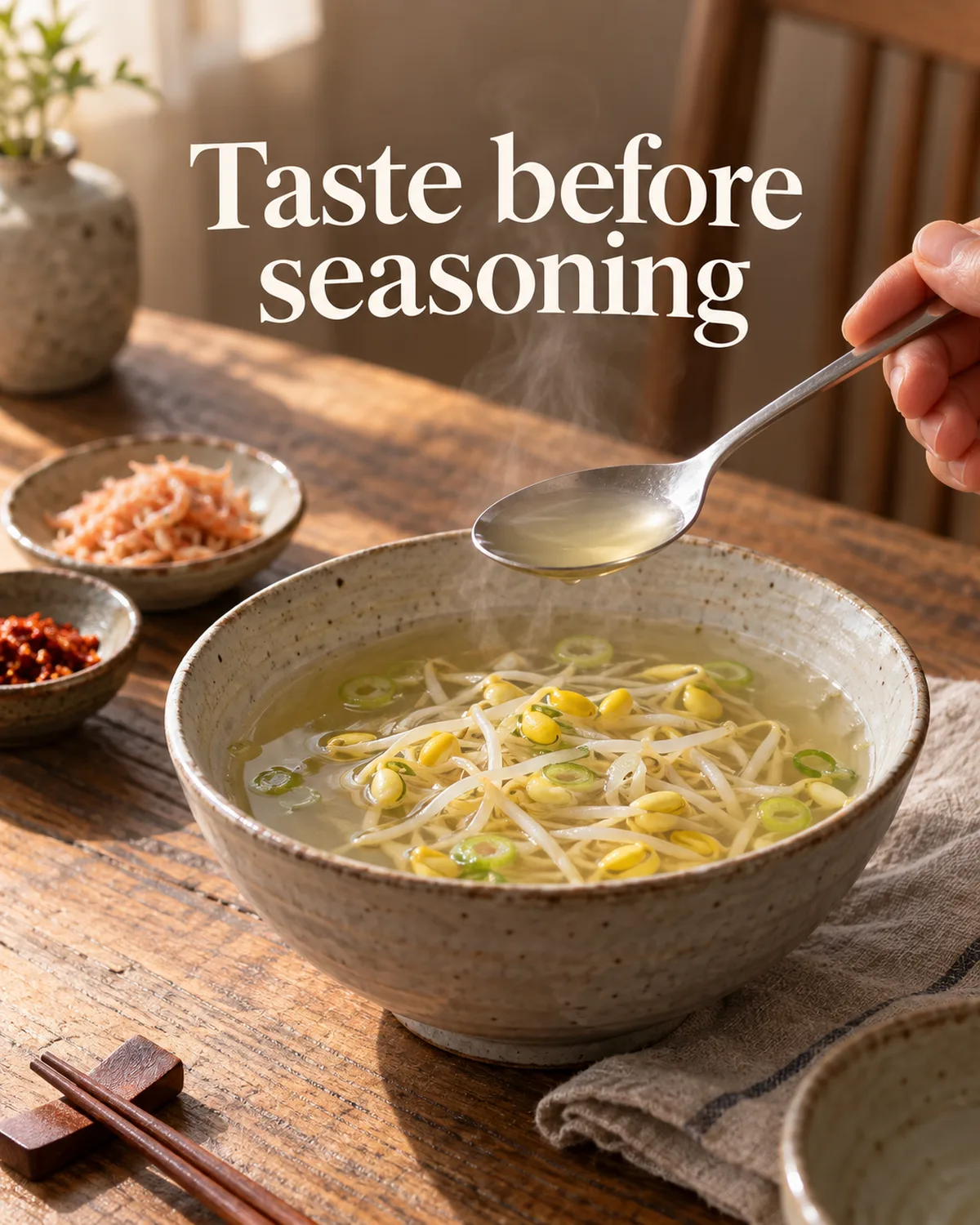
The same principle applies to chili and salted seasonings. Taste the broth before adjusting. A bowl designed for customer seasoning can seem mild or under-salted if you expect the kitchen to make every decision in advance.
Taste the original broth before adding shrimp seasoning or chili.
Comfort after a late night is not a cure
Korea has a broad category of haejangguk and morning-after foods associated with drinking. Kongnamul-gukbap fits that cultural logic extremely well: it is hot, salty, easy to eat, contains fluid and carbohydrate, and can be served quickly in the morning.
Those properties explain the ritual without requiring a medical promise. After drinking, people may be thirsty, tired, nauseated or have low appetite. A warm soup-and-rice meal can feel comforting and familiar. Social repetition then strengthens the reputation: people drink at night, meet again over soup in the morning, and the dish becomes part of the expected sequence.
So the accurate formulation is simple: kongnamul-gukbap is one of Korea’s classic hangover foods, not a proven hangover cure.
Taste two styles without turning it into a rivalry
If you have time to try more than one kongnamul-gukbap in Jeonju, compare mechanisms instead of brand prestige. Look at four variables:
Heating: toryeom-style warming or more direct boiling.
Egg: separate, gently cooked in the bowl or fully incorporated.
Broth: light and clear versus deeper, spicier or more seafood-forward.
Texture: how firm the sprouts and rice remain when the bowl reaches the table.
This framework survives restaurant changes better than a permanent “best shop” ranking. Businesses can move, close, franchise or alter service, but the cooking choices remain understandable.
Start with the broth before adding extra seasoning. This tells you how the kitchen intended the base to taste. Then eat a spoonful containing rice and sprouts together so you can judge the textural balance.
If seaweed arrives separately, add some rather than all. If salted shrimp or chili seasoning is provided, adjust gradually; both can change the bowl quickly. If a separate egg is part of the service, use it as a rich side element or combine it in small amounts rather than assuming the whole egg must disappear into the soup immediately.
Most importantly, eat while the temperature and sprout texture are still working together. This is not a soup improved by a long photo session while the rice continues absorbing broth.
A separate egg and a gently warmed bowl invite a different sequence from a bubbling earthenware pot. Taste the broth, notice the sprouts, then decide how much seaweed or egg to combine. That sequence lets the service method show itself instead of disappearing under extra seasoning.
A market counter and a bowl of bean-sprout soup show the dish as a practical meal.
Finding the meal beside Jeonju’s better-known rice dish
International tourism often gives Jeonju one headline dish: bibimbap. Kongnamul-gukbap complicates the picture in a useful way.
Bibimbap is often described through ingredients, color and arrangement. Kongnamul-gukbap is described through temperature, speed and repetition. Bibimbap can carry ceremonial or restaurant prestige; gukbap carries market and morning associations. One is mixed by the diner at the table; the other is assembled as a hot bowl before it arrives.
The market sits near Jeonju’s central heritage area, making the soup easy to combine with a walk rather than a separate cross-city food expedition. A morning bowl followed by the Hanok Village area also solves a practical itinerary problem: you begin with a substantial but relatively light meal before a heavier lunch or dinner.
Jeonju’s other rice dish and Seoul’s milky soup make useful comparisons with this clear bowl.
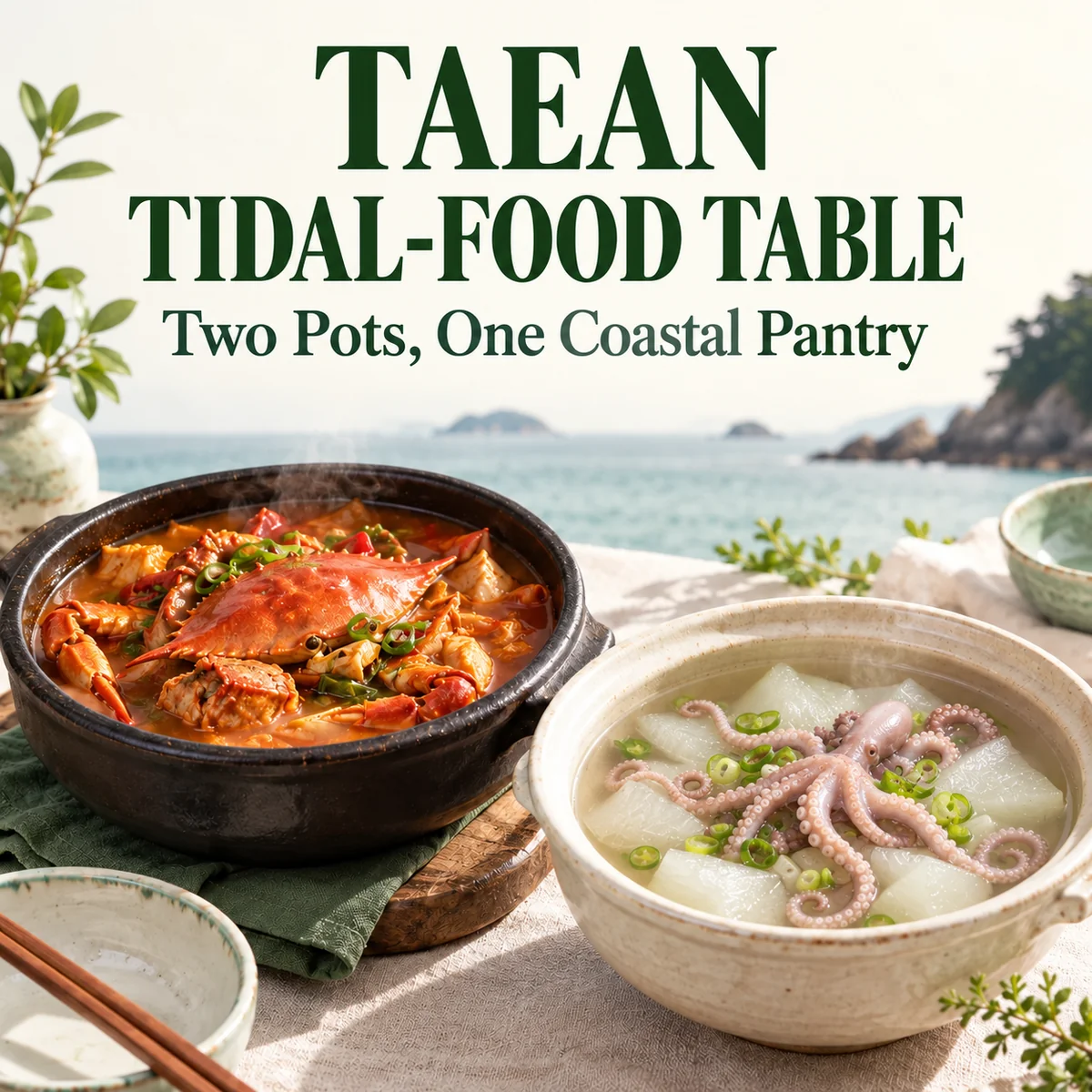
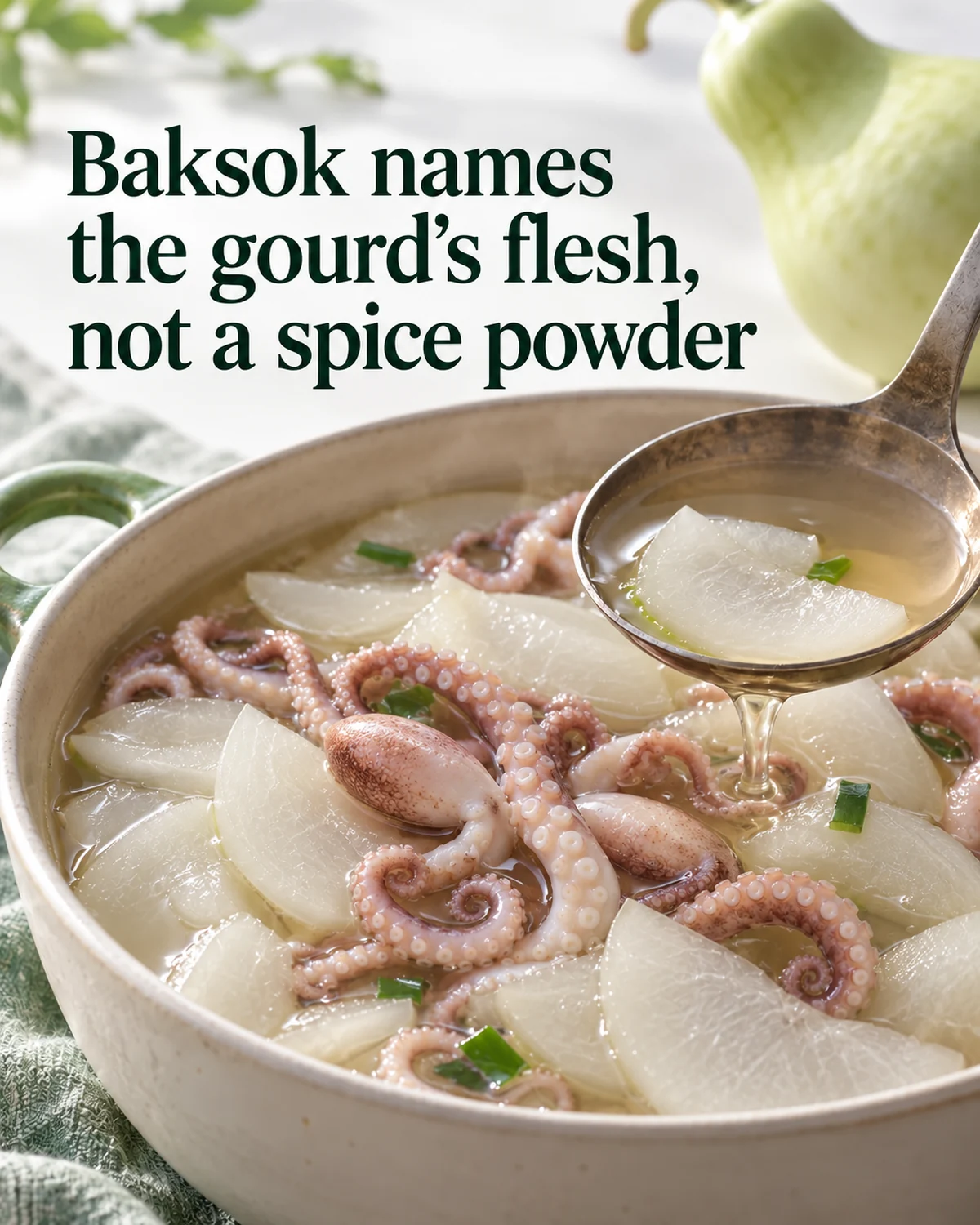
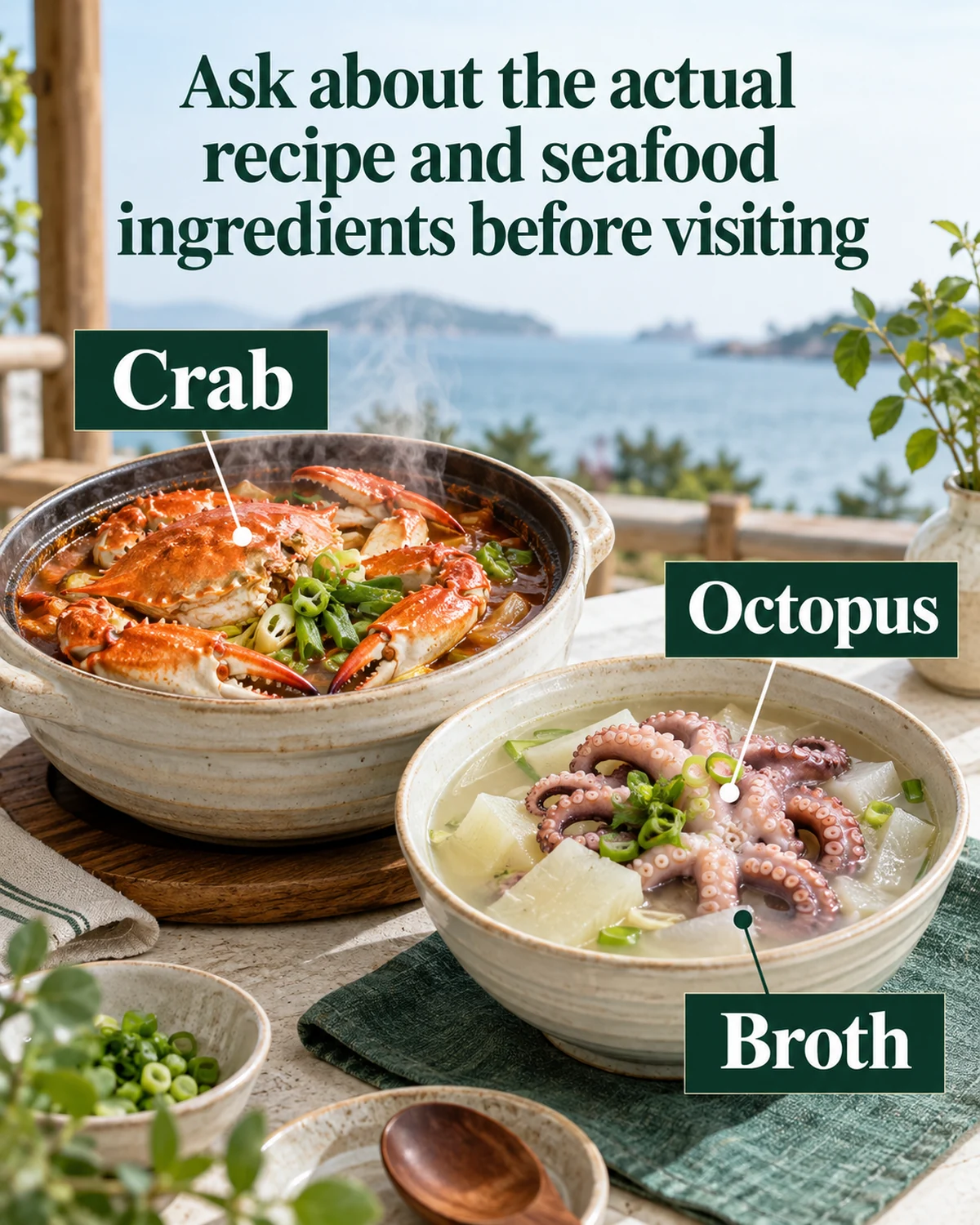
A coast does not have one flavor. In Taean, gaegukji points toward vegetables, seafood seasoning and a history of preservation, while baksok nakji-tang makes a different meal around octopus, bottle-gourd flesh and broth.
Looking only for the largest crab or the most dramatic octopus photograph misses the ingredients that explain the names. These dishes are more interesting when allowed to remain different.
The two dishes draw on a coastal pantry but have different histories
Gaegukji starts with a preservation story
Modern restaurant photos often show a bubbling pot with large pieces of blue crab, red broth and kimchi. That version is real as contemporary regional restaurant food, but it can obscure the older logic behind the name.
Reporting based on Chungcheongnam-do material describes gaegukji as a Seosan–Taean local food made by cooking crab with fresh or lightly seasoned kimchi. Other regional descriptions preserve a more frugal household story: liquid left from gejang or other strongly flavored seafood brine could be used with cabbage, radish, radish greens and other vegetables, then fermented or later simmered. The important historical idea is not “put a whole crab into kimchi stew” but “do not waste a salty, flavorful marine liquid.”
That distinction helps explain why older household versions and modern restaurant versions may look quite different without one automatically being “fake.” Regional foods change when they move from the home kitchen to a tourism menu. A dish built from leftovers, vegetable trimmings and preserved liquid is difficult to sell as a visually generous restaurant centerpiece, so restaurants may foreground whole crab and a richer stew presentation.
Regional explanations connect the name to ge-guk or get-guk, a crab- or sea-derived liquid used to season vegetables. The exact folk etymology is described somewhat differently across local accounts, so it is safer not to force one spelling story into absolute certainty. What remains consistent is the role of a salty seafood liquid as the flavor base.
This matters because it changes how the dish is read. If “gaegukji” is interpreted only through the modern restaurant pot, the crab becomes the main object and the kimchi looks like a secondary ingredient. In the preservation logic, the relationship is reversed: vegetables and kimchi are the vehicle, while the concentrated sea flavor seasons and preserves them.
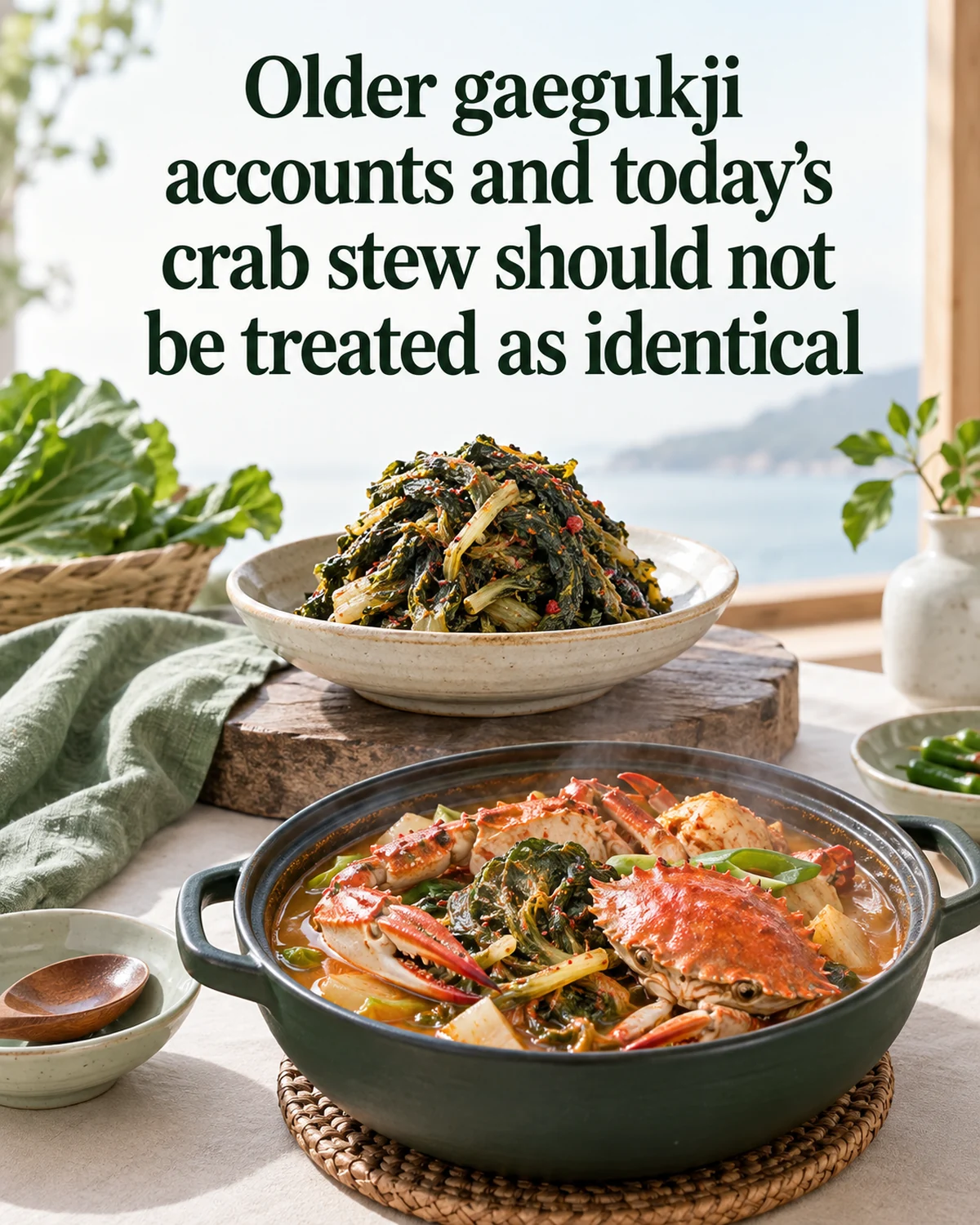
Older gaegukji accounts and today’s crab stew should not be treated as identical
The result sits at the border between kimchi history and seafood cooking. That border is exactly why gaegukji is difficult to translate with a single English label. “Crab kimchi stew” is convenient, but it does not fully capture the older process.
Travel food writing often praises seafood by saying “the fresher, the better.” Gaegukji complicates that idea. Its traditional appeal depends partly on transformation over time. Vegetables soften, lactic fermentation produces acidity, salt penetrates the plant tissue and seafood-derived compounds build a deeper savory profile.
That does not mean age is automatically good. Fermentation must happen under appropriate salinity, temperature and handling conditions. The point is cultural: a coastal household did not need every marine flavor to be eaten immediately after catch. Salt and fermentation allowed intense flavors to move into a different season and a different meal.
When the fermented vegetables are later simmered, heat softens them further and the liquid becomes a broth. A contemporary whole crab may add sweetness and body, but the fermented vegetable base still gives the pot a character that is different from ordinary fresh blue-crab soup.
Baksok nakji-tang starts with a clear broth
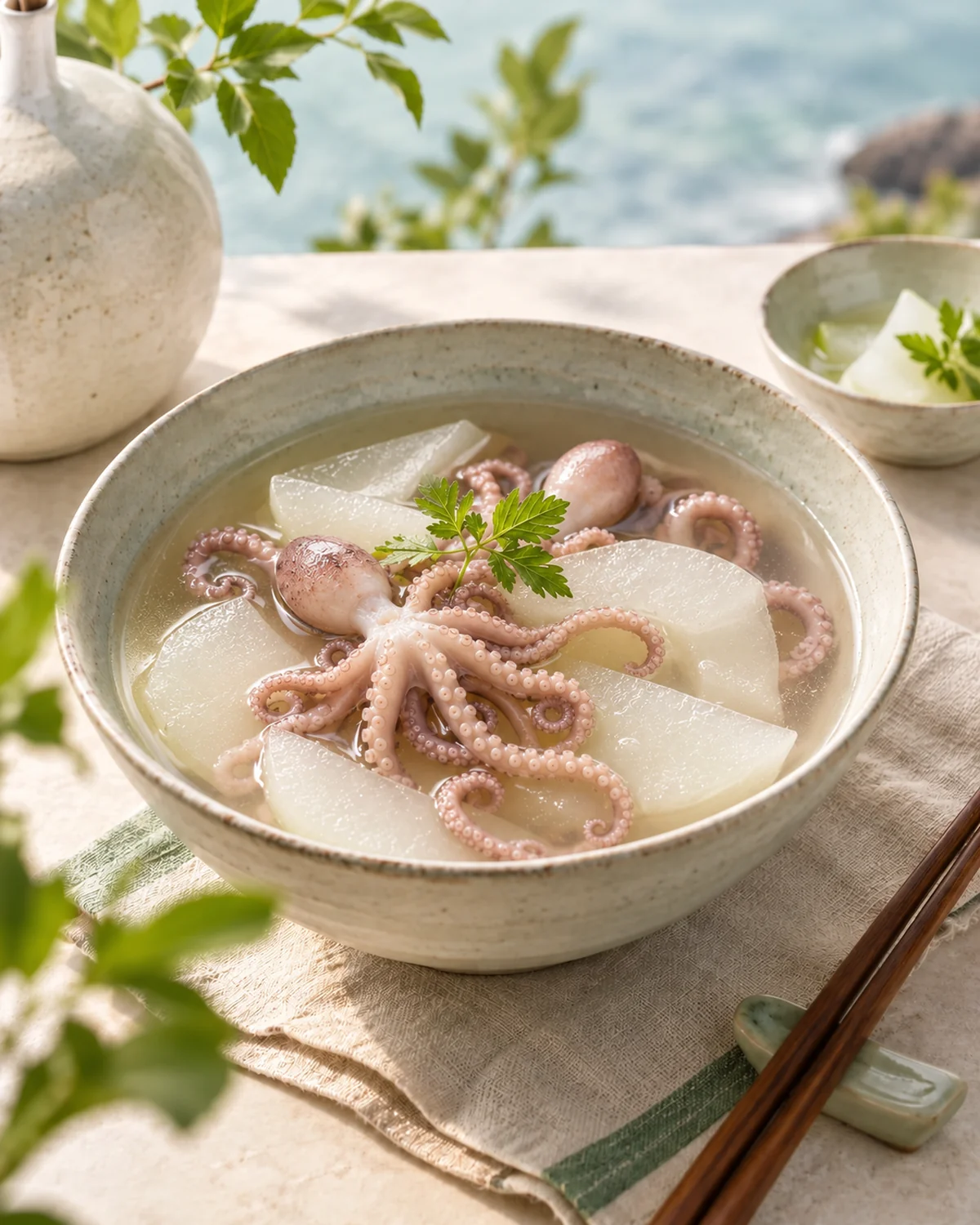
Baksok nakji-tang does not need fermented kimchi to create identity. Its core contrast is between tender small octopus and the soft white interior of a bottle gourd. The broth is usually described as clear and clean-tasting rather than thick and red.
The name is unusually literal once it is broken apart. Bak is bottle gourd; sok means the inside or flesh; nakji is the small octopus commonly eaten in Korea; and tang is soup or broth. A related name, baksok-milguk-nakji-tang, also points to wheat dough or noodles added to the pot.
Baksok nakji-tang foregrounds a lighter broth and gourd
A Nongmin Shinmun regional-food feature describes the dish as a Taean specialty in which slices of the white inner gourd are boiled and whole cleaned octopus is added, with wheat noodles or hand-torn dough often used to finish the meal. That gives the pot a completely different rhythm from gaegukji: cook the gourd, briefly cook the octopus so it stays tender, eat the seafood, then use the broth for starch.
Bottle gourd has a mild flavor and high water content. When simmered, it softens and releases liquid without dominating the broth. That makes it a useful partner for octopus, whose flavor can be sweet, saline and delicate when it is not overcooked.
The gourd therefore acts less like a strongly flavored vegetable and more like a broth-building ingredient. Its soft texture also contrasts with the springy muscle of the octopus. The combination is subtle: one ingredient gives up water and softness; the other requires careful timing to avoid toughness.
That timing is central. Octopus muscle tightens with heat. In a restaurant pot, the goal is generally to cook it long enough to be safe and tender but not leave it boiling unnecessarily while every other ingredient finishes. Diners may be told when to remove and eat the octopus before noodles or dough are added later.
The tidal flat and the seasonal pantry
The Seosan–Taean coast is strongly shaped by broad intertidal zones. At low tide, areas of mud and sand that were underwater become accessible. These environments support shellfish, crustaceans and other organisms used in local foodways. Ports and fisheries add another layer of marine supply.
It is tempting to write “the tidal flats created gaegukji” or “the mudflat invented baksok nakji-tang.” That wording is too deterministic. Similar marine ingredients exist across Korea’s west and south coasts, yet the recipes are not identical everywhere.
A better causal chain is environment → ingredient availability → household preservation/cooking choices → repeated local practice → regional identity. The environment makes certain foods likely; culture decides how those foods become dishes.
The dish depends on two ingredients that have their own seasonal and supply patterns: bottle gourd and small octopus. Traditional food descriptions often connect the pairing to periods when the gourd was available and octopus was especially valued locally. Restaurant supply chains can extend availability, but that does not erase the seasonal logic of the older dish.
Visitors should therefore be cautious with absolute statements such as “this is always the best month” unless checking current local supply. Weather, fishing conditions, seafood prices and farming all change year to year. An evergreen article can explain the seasonal tradition without freezing one month into a permanent rule.
How a household preparation became a restaurant name
A household preservation food and a destination restaurant dish have different incentives. At home, using leftover brine and vegetable parts can be economically rational even if the result is visually plain. A restaurant serving travelers needs a menu item that can be portioned, repeated and recognized in photographs.
That shift can produce a more standardized red stew with visible crab. Recent travel reporting on Seosan and Taean notes that the modern restaurant version often looks more generous than older home forms and that locals themselves sometimes recognize a gap between the two.
Rather than treating this as corruption of an “authentic” recipe, it is more useful to document both layers. The older layer explains why the dish existed. The restaurant layer explains why visitors can order it today and why it became a regional tourism symbol.
Two soups, two ways to organize a meal
Gaegukji is salty, fermented, vegetable-centered and often robust. Baksok nakji-tang is usually clearer, lighter and built around the immediate texture of seafood. Both can be described as west-coast food, yet their techniques point in opposite directions.
That is useful for understanding regional cuisine. Geography does not mechanically dictate “spicy seafood.” The same coast can produce fermented vegetables, clear soups, raw seafood, salted seafood, grilled fish and noodle dishes. The ecological pantry provides ingredients; households and restaurants decide what cooking problem to solve with them.
In Seosan and Taean, tidal flats matter because they support a culture in which small marine animals, crabs, shellfish and coastal vegetables are familiar ingredients. But the food history is made by what people do with those ingredients after they come home.
Baksok nakji-tang is often eaten in stages. The octopus is the premium texture, so it may be eaten soon after it reaches the proper doneness. The gourd and broth continue cooking. After the seafood is mostly gone, wheat noodles or hand-torn dough can turn the remaining liquid into a more filling final course.
Baksok names the gourd’s flesh, not a spice powder
This sequence is efficient. The most delicate ingredient is not sacrificed to the cooking time of the starch. At the same time, the broth becomes more valuable after it has absorbed octopus flavor. The finish uses that accumulated broth rather than starting a second dish from zero.
That structure has a distant parallel with pan foods such as dakgalbi, where fried rice uses the remaining sauce, but the sensory result is entirely different. Korean shared-pot dining often makes the final starch a form of flavor recovery.
What to ask before ordering either soup
Gaegukji is unsuitable for people with crab or crustacean allergy when crab or crab-derived liquid is used, even if no large crab piece is visible. Fermented or leftover brine can hide the allergen from someone judging only by appearance.
Baksok nakji-tang contains molluscan seafood. Some diners who react to crustaceans can tolerate mollusks and others cannot, so a serious allergy requires individual medical guidance and clear restaurant communication. Added noodles introduce wheat, and dipping sauces can introduce soy or other ingredients.
Neither dish should be assumed vegetarian or vegan. Even vegetable-heavy gaegukji is defined by seafood-derived seasoning in its traditional logic.
For a first-time visitor, appearance can be confusing because modern gaegukji may contain a whole crab and resemble spicy crab stew. The best clue is the fermented vegetable base. Ask whether the dish uses gaegukji-style kimchi or crab-brine-seasoned vegetables rather than simply fresh vegetables in a seafood broth.
Choose between two flavor structures rather than ordering by the region alone
There is no need to police restaurants with one rigid definition; regional food changes. But the question helps recover the dish’s historical identity. A pot that contains crab and kimchi can be delicious without necessarily representing the older preservation logic in the same way.
Seosan and Taean cover a wide area, and restaurants specialize differently. Some are primarily crab restaurants, some are octopus specialists and some offer a broad seafood menu. Current prices, fishing supply, closing days and whether a particular dish is available can change.
If gaegukji is the priority, check that it is a regular menu item and ask what style the restaurant serves. If baksok nakji-tang is the priority, confirm current octopus availability and whether the meal includes the noodle or dough finish you expect. Avoid using an old travel article’s hard-coded hours as if they were permanent.
For regional context, official Seosan and Taean government sites are useful starting points, while restaurant-specific details should be rechecked near the visit date.
Let the octopus stay tender
If the octopus is added at the table, follow the restaurant’s guidance for timing. When it is ready, eating it before the final noodle stage can protect its texture. Leaving a delicate octopus boiling throughout a long conversation can make it progressively firmer.
The gourd can stay in the broth longer. Its job is to soften. Once the octopus is eaten, noodles or dough can be added if offered. That order makes the meal easier to understand: broth and gourd first, octopus at its best texture, starch last.
Comfort food is not a medical promise
Octopus dishes are frequently described in Korean food culture with words associated with stamina, strength or recovery. Seafood soups are also often framed as restorative. Those descriptions are culturally meaningful because they tell us when and why people value a dish.
They should not be rewritten as clinical claims. Eating baksok nakji-tang does not have a proven medical effect merely because tourism copy calls octopus nourishing. The same rule applies to fermented foods: gaegukji can be discussed as a fermentation tradition without promising gut-health or disease-prevention outcomes.
Food history is stronger when it explains belief and practice without turning culinary reputation into medicine.
Gaegukji’s flavor is built partly from salted and fermented components, so sodium can be substantial depending on recipe and serving size. Baksok nakji-tang may look visually light, but broth seasoning also varies. “Clear” does not automatically mean low-sodium, just as “fermented” does not automatically mean healthy for every diner.
For someone managing sodium intake, the practical questions are portion size, how much broth is consumed, and how salty the restaurant prepares the dish. Those are more useful than broad health labels.
For gaegukji, ask what vegetables and seafood seasoning distinguish the house version from an ordinary crab stew. Modern restaurant presentations can foreground fresh crab, while the older preservation logic explains another layer of the dish. A large crustacean in the photograph is therefore not a complete definition.
For baksok nakji-tang, ask about the bottle gourd and the sequence in which octopus, broth and any noodle finish are eaten. Baksok refers to the gourd’s flesh, not a particular octopus size. Follow the restaurant’s guidance rather than leaving tender pieces to simmer indefinitely while waiting for the final starch.
Ask about the actual recipe and seafood ingredients before visiting
The two bowls also need different ingredient questions. A clear-looking broth does not prove it lacks strong seasoning or animal ingredients, and “restorative” describes a cultural expectation rather than a guaranteed health effect. Choose the meal whose texture, seasoning and quantity suit the table. Combining both into a single category of healthy seafood soup hides the very distinctions that make a regional food trip worthwhile.
Compare another coast, an inland river and a different use of coastal ingredients.
A slice of sundae and a spoonful of sundae-gukbap can contain related ingredients but offer quite different experiences. On the plate, the casing and filling stay in focus. In soup, broth, rice and condiments reshape the whole meal.
Byeongcheon’s reputation is rooted in a recognizable food-street cluster. That regional identity is more useful than treating one recipe, one restaurant or one personal ranking as a rule for everyone.
The filling and casing tell you what you ordered
Sundae (순대) is Korea’s family of stuffed sausages. The familiar modern street-food version often uses a pork casing filled with sweet-potato glass noodles, blood and seasonings, but the category is much broader than one recipe. Fillings can include rice, vegetables, perilla, noodles, blood and other ingredients in different proportions. Casings also vary, as do steaming methods and the way the sausage is held after cooking.
Byeongcheon-style sundae is generally associated with a fuller, softer filling and a strong restaurant culture built around pork sausage and soup. Older guides sometimes reduce the distinction to a rigid formula—small intestine, no noodles, one exact list of vegetables—but that overstates uniformity. The street is a cluster of independent businesses, not one standardized factory recipe.
For a first-time diner, the most useful comparison is not “authentic versus ordinary.” It is plate versus bowl. Sliced sundae lets you focus on casing, filling and seasoning. Sundae-gukbap places the same sausage inside a pork-based broth with rice and often other cuts of meat or offal, turning texture into only one part of a larger soup system.
The same sausage can be ordered as a plate or as part of soup
The first sensation of sundae is often the casing before the filling. Pork intestine has its own collagen-rich structure, and cleaning, thickness and cooking time all affect whether the bite feels delicate, elastic or tough.
Once steamed, the casing should be cooked through but still hold the filling. Too firm and it dominates the bite; too fragile and the slices collapse. Shops can differ because they use different intestine sections, stuffing densities and steaming times. This is one reason it is risky to claim that every Byeongcheon sausage uses one exact casing specification.
The casing and filling distinguish this sundae experience
The filling then determines the second texture. Rice gives density and softness; glass noodles add spring; chopped vegetables add moisture; ground seeds can change aroma and graininess. Blood contributes color, flavor and binding but does not have to dominate every recipe equally.
A market town becomes a sundae destination
Cheonan’s municipal data distinguishes Byeongcheon Market from Byeongcheon Sundae Street. The market is listed as a traditional market, while the sundae street is separately identified as a specialized commercial street around Aunae Sundae-gil. That distinction is useful because it shows how a general market environment can generate a narrower food district.
On the city page last updated on January 26, 2026, Byeongcheon Sundae Street is listed with 18 businesses. Restaurant counts can change, so that number should be treated as a current municipal snapshot rather than an eternal fact. What is stable is the density: enough sundae specialists operate in a compact area that visitors can reasonably think of the town itself as a destination for the food.
Restaurant concentration explains the town’s food identity without proving a single inventor
This kind of cluster has economic advantages. Several restaurants selling related dishes create comparison and competition, but they also reinforce the destination. A traveler who would not drive for one unknown shop may travel for a whole street where another option is nearby if the first shop is full. Individual businesses compete for the same customer while collectively strengthening the place name.
Korea Tourism Organization lists Cheonghwajip (청화집) on Byeongcheon Sundae Street and says the restaurant is regarded as the street’s oldest, having opened in 1968. Its menu is notably focused: sundae-gukbap and modeum sundae, or assorted sliced sundae and pork parts.
This gives the local story a useful documentary anchor. A restaurant operating from 1968 is evidence that a recognizable commercial sundae tradition existed in Byeongcheon by that period. It does not automatically prove that all Byeongcheon sundae was invented in 1968, that no earlier market seller existed, or that one shop created every later recipe.
Market food has to solve practical problems. It should be satisfying, reasonably quick to portion, robust enough for repeated service and flexible enough to use ingredients efficiently. Sundae and gukbap fit that environment well.
A sausage can be made in batches, steamed, held and sliced to order. Pork bones and meat trimmings can contribute to a broth. Rice turns the soup into a complete bowl. Kimchi and kkakdugi add acidity, salt and crunch. Diners can adjust seasoning at the table rather than requiring the kitchen to make a separate broth for every preference.
That structure matters more than a romantic claim that the dish was “born because market workers needed energy.” Market workers, traders, residents and visitors all eat. The evidence-backed point is simpler: the format is highly compatible with a market restaurant because it transforms a prepared sausage into either a quick plate or a filling soup meal.
Sliced sundae, soup and Sokcho’s squid version
Order a plate of modeum sundae and the sausage is the center of attention. You can compare casing resistance, the grain or noodle content of the filling, blood flavor, vegetable aroma and how much moisture remains after steaming. Assorted plates may also include boiled pork offal, which adds liver, lung or other textures depending on the restaurant.
In sundae-gukbap, those distinctions are softened by broth. The casing absorbs hot liquid. Fat and seasoning from the soup coat the filling. Rice adds starch and changes the viscosity around each spoonful. Offal becomes part of a mixed bowl rather than a separate bite.
Broth and condiments change the rhythm of the meal
This is why a traveler interested in understanding the style benefits from trying both formats. One isolates the sausage. The other shows the restaurant’s broth, seasoning system and idea of a complete meal.
The word sundae refers to the stuffed-food idea more broadly than one pork sausage. That becomes clear when Byeongcheon is compared with Sokcho’s ojingeo sundae. In Sokcho, a cleaned squid body acts as the casing around a savory filling. In Byeongcheon, pork intestine and pork-based soup culture are central.
The comparison is useful because it prevents the English translation “blood sausage” from becoming too narrow. Many common pork sundae versions do contain blood, but Korean stuffed-food traditions include variations where the casing, filling and regional story change dramatically.
For travelers, this also changes expectation. Ojingeo sundae has a seafood casing and is often sliced as a side or specialty plate. Byeongcheon sundae is deeply integrated with pork gukbap culture.
The broth, salted shrimp and radish kimchi
Korea Tourism Organization describes Cheonghwajip’s sundae-gukbap as a milky soup. A pale or cloudy pork broth does not require dairy. As bones, meat and connective tissues cook, fat droplets, proteins and fine particles disperse into the liquid. Stronger boiling and agitation can keep more of that material suspended, making the broth look opaque.
Not every Byeongcheon shop produces exactly the same color or density. Some broths are heavier and pork-rich; others are cleaner or clearer. A cloudy bowl should therefore be understood as one common restaurant style rather than a rule that defines whether a soup is “real Byeongcheon sundae.”
The broth also arrives less complete than its color may suggest. Many gukbap restaurants expect diners to finish seasoning with salted shrimp, chili seasoning, chopped scallion or perilla powder. That table customization is part of the format.
Saeujeot (새우젓), salted fermented shrimp, is a common pork condiment in Korea. In a sundae-gukbap bowl it provides salinity in a very concentrated form, plus fermented seafood aroma. Because it is powerful, a small amount can shift an entire bowl.
Its role is practical. The base broth can remain relatively restrained, while each diner adjusts salt. Chili seasoning changes heat and color. Ground perilla adds nutty aroma and a slightly thicker mouthfeel. Chopped green onion brings freshness. The result is a soup whose final balance is partly transferred from kitchen to diner.
There is no need to invent a mandatory “local eating order.” Add seasonings gradually, taste after each change and stop when the broth is balanced for you.
Kkakdugi, cubed radish kimchi, is particularly effective with rich pork broth. The radish gives crisp texture against soft sausage and rice, while fermentation brings acidity and chile heat. Cabbage kimchi can play the same balancing role.
Fresh green chili, raw onion or garlic may also appear depending on the restaurant. These should be treated as optional condiments rather than compulsory proof of eating “like a local.” The strongest meal is the one in which the broth, sausage and side dishes remain distinct enough that you can notice each component.
Ordering when offal is unfamiliar
A practical first order for two diners is a sliced sundae plate plus one or two bowls of gukbap. Start with the sausage by itself. That tells you whether you like the casing and filling before the flavor is blended into soup.
If liver or other offal textures are unfamiliar, ask what comes in the assorted plate or soup. Some restaurants may be able to reduce certain pieces, but service policies vary. A clear request is better than assuming “sundae soup” contains only sliced sausage.
A mixed order may contain offal beyond the sausage itself
Once the soup arrives, taste the broth before adding salted shrimp or chili paste. The bowl may already be more seasoned than expected. Add condiments in small amounts because both salt and fermented shrimp are difficult to reverse.
Taste first; the bowl’s starting seasoning varies by restaurant
Aunae’s history is not a recipe origin date
Byeongcheon is also known by the older local name Aunae and is an important site in Korea’s March First independence-movement history. The 1919 Aunae demonstration associated with Yu Gwan-sun gives the market area national historical significance independent of food.
It is tempting to fuse the two stories too tightly—market history, independence history and sundae history—into one dramatic causal narrative. That should be avoided unless sources actually connect them. The market can be historically important for one reason and later become famous for food for another.
For a visitor, however, the proximity is meaningful at the itinerary level. A food trip can include both a market meal and local historical sites without implying that one caused the other.
Plan the visit and check the ingredients
Restaurant hours, weekly closure days and menu prices can change. The official KTO listing for an individual restaurant is useful close to a trip, but an evergreen history article should not promise that a shop will always open at the same hour years later.
The stable geography is Byeongcheon-myeon in eastern Cheonan, around Byeongcheon Market and Aunae Sundae-gil. Cheonan’s municipal page lists the market and specialty street separately, which makes them easy to identify in current map services. Use current transit and restaurant information on the travel date.
A market day can add atmosphere, but do not build a long-distance itinerary around an old schedule without verifying it. The food street itself operates independently of whether the traditional market is at peak activity that day.
Sundae and sundae-gukbap are pork-based foods and are unsuitable for people avoiding pork for religious, ethical or dietary reasons. Blood is commonly used in many pork sundae fillings, but recipes vary; diners who avoid blood should ask rather than infer from color.
Saeujeot contains shellfish. Broth can contain pork bones, meat, offal and seasonings not visible in the final bowl. People with allergies should ask about broth and condiments, not only the sausage.
These details matter because “sausage” is only one component of the meal. A modeum plate, broth, dipping condiment and kimchi can each introduce separate ingredients.
Taste before seasoning the bowl
Start with what is in the order: sausage alone, sausage with other pork cuts, or a soup containing a particular mixture. A dish name does not settle a diner’s comfort with offal, and a meat-free-looking section of filling is not a vegetarian guarantee. It is easier to make that choice before the bowl arrives than to try to sort out an unwanted ingredient afterwards.
Taste the broth before adding salted shrimp or other strong condiments. Saeujeot changes the salt and aroma; it also remains a shellfish ingredient. Radish kimchi creates another contrast through acidity and crunch. Those roles are worth noticing separately rather than tipping everything into the soup at once.
Two people sharing can compare a suitable platter with soup, but a solo diner does not need both to understand the specialty. In either format, take a bite that includes the casing and center. Comparing Byeongcheon sundae with Sokcho’s squid-filled version then becomes a question about structure and regional context, not a contest over which town owns the entire word sundae.
A squid casing and a bean-sprout soup show how much the words sundae and gukbap can contain.
One long silver fish can lead to three very different meals in Jeju. Galchi-jorim makes a shared dish around sauce and radish; galchi-gui puts the fish and its cooking surface forward; galchi-guk asks you to pay attention to a quieter broth.
Choosing among them is more useful than asking which preparation is the most authentic. They show what changes when the same ingredient meets a different cooking method.
One fish, three very different Jeju meals
Cutlassfish is caught and eaten in multiple Korean coastal regions. Jeju’s importance is not exclusivity. It is concentration: the fish appears in local markets, fisheries, specialist restaurants and tourism material, and cooks use it in several established Jeju preparations.
The official Jeju tourism guidebook lists galchi among the island’s specialty products and includes galchi-guk among representative Jeju foods. Current Visit Jeju restaurant listings also show galchi-guk, galchi-jorim, galchi-gui and galchi-hoe appearing on the same local menus. That is useful evidence of culinary range rather than a marketing slogan about one signature dish.
A visitor can therefore use galchi as a small tasting project: try the fish braised, grilled and in soup, then notice which parts of the flavor come from the fish and which come from the cooking system around it.
Galchi is the fish; the cooking word tells you what meal arrives
Fresh cutlassfish has an intensely reflective silver surface. Unlike a thick, heavily scaled fish, its appearance is delicate and easily affected by handling. Abrasion during capture, sorting and transport can dull or damage that mirror-like exterior.
This helps explain market language around eun-galchi (은갈치, “silver galchi”). A Korean Ministry of Oceans and Fisheries distribution study notes that fresh galchi landed in Jeju is commonly caught through hook-and-line and offshore longline fisheries; because those fishing methods tend to cause less physical damage during capture, the fish is commonly referred to in the market as eun-galchi. The same report contrasts this with galchi from some other fisheries where gear can produce more surface damage and where the market term meok-galchi is also used.
That does not mean every Jeju galchi is caught by one method, nor does the word “silver” automatically certify one universal quality grade. Catch method, fish size, freshness, handling, storage and the seller’s terminology all matter. The useful takeaway is narrower: the condition of the silver skin is partly a handling story, and Jeju’s hook-and-line fisheries help explain why bright intact fish are prized.
Galchi-jorim: radish, sauce and a shared pot
Galchi-jorim (갈치조림) is the version that dominates travel photographs. Thick cross-cut sections of fish are braised with a red seasoning that may include gochugaru, gochujang, soy sauce, garlic and sweetness. Radish is common; potato also appears in many restaurant versions.
In galchi-jorim the radish and sauce are part of the meal
The technique works because the fish flesh is soft and relatively delicate. Instead of aggressive stirring, the pieces are usually left in place while hot seasoned liquid cooks around them. The sauce penetrates the surface while the interior remains moist. Radish or potato absorbs the seasoned cooking liquid, so the vegetables are not filler—they become one of the strongest carriers of the braising sauce.
Recipes vary enough that no article should prescribe one mandatory sauce formula. Some kitchens lean sweeter, some saltier, some hotter. The stable idea is fish sections braised in a concentrated seasoned liquid with vegetables.
Galchi has many bones, including fine bones that can surprise diners accustomed to boneless fillets. Cross-cutting the long fish into sections is practical for cooking, but it also means the diner encounters the fish’s skeletal structure in each piece.
The red sauce can make bones harder to see than in a plainly grilled fish. Eat slowly, separate flesh with chopsticks, and avoid treating a section as if it were a boneless steak. Adults who grew up eating galchi often remove flesh efficiently because the anatomy is familiar; that skill should not be mistaken for the fish being easy to debone automatically.
For children or anyone with swallowing difficulties, extra caution is appropriate. A restaurant may prepare the fish carefully, but the species itself has not become boneless.
Radish is more than a traditional accompaniment. Its high water content and porous cooked texture make it an effective absorber of seasoned braising liquid. As it softens, the radish takes on fish juices, chile seasoning and soy while releasing some of its own sweetness into the pot.
The result is a useful division of labor. The fish provides protein, fat and marine flavor; the radish becomes a reservoir for sauce. Diners often alternate fish, rice and radish because each carries the seasoning differently.
Potato performs a related role but brings more starch and a denser texture. Restaurants may use one, the other or both. Neither ingredient defines galchi-jorim alone.
Galchi-gui: the fish without the sauce
Galchi-gui (갈치구이) is generally salted and grilled or pan-cooked. Without a heavy braising sauce, the fish’s own fat, moisture, skin condition and cooking precision become easier to notice.
Galchi-gui foregrounds the fish rather than a braising sauce
Heat browns the outer surface while the white flesh inside stays soft. Because cutlassfish is thin relative to many round fish, overcooking can dry it quickly. A well-cooked piece should separate in moist flakes rather than crumble into dry fibers.
Grilled galchi is also a useful baseline before trying the braise. If you want to understand the ingredient rather than only the sauce, taste the grilled fish first. The comparison makes it easier to recognize what jorim adds: chile, fermented seasoning, sweetness and vegetable absorption.
Jeju restaurants sometimes serve very long sections—or visually dramatic whole-fish presentations—because the ribbon shape is part of galchi’s appeal. Visit Jeju describes restaurants specializing in large whole grilled cutlassfish.
The spectacle should not be confused with a historical rule that Jeju families always served enormous whole fish at home. Restaurant presentation responds to tourism as well as tradition. What the long presentation does genuinely reveal is the fish’s unusual anatomy: a narrow, blade-like body that looks completely different from mackerel, sea bream or pollock.
Size can affect price and eating experience, but bigger is not automatically “more authentic.” A smaller fresh fish cooked well can be more satisfying than a large fish handled poorly.
Galchi-guk: the quieter island specialty
Galchi-guk (갈치국) is a Jeju fish soup that appears in the island’s official tourism guidebook and current restaurant listings. Compared with red jorim, it can look visually modest: pale broth, fish pieces and vegetables rather than a glossy red pan.
Galchi-guk is a third cooking form, not a pale version of the braise
That quiet appearance is exactly why it is useful. A lightly seasoned soup leaves much less room to hide stale fish or muddy flavors. The broth depends on the fish’s freshness and the balance of vegetables and seasoning.
Recipes vary. Jeju versions may use cabbage, squash or pumpkin, green chile and simple seasoning. It is safer to describe those as common patterns rather than declare one fixed island-wide recipe. The shared idea is a soup in which the fish remains the central flavor rather than a vehicle for a heavy red sauce.
In galchi-jorim, gochugaru, garlic, soy and sweetness create a powerful flavor matrix. In galchi-guk, those masking effects are reduced. The cook has to manage fish aroma, salt and vegetable sweetness more carefully.
That makes soup a good second or third galchi dish for a visitor. If you try only the braise, you may leave thinking galchi tastes primarily like spicy sauce. The soup demonstrates that the flesh itself can produce a light, savory broth and pair with vegetables in a much gentler register.
This is also a broader lesson about regional food tourism: the most photographed dish is not always the one that tells you the most about everyday cooking.
Reading eun-galchi and the catch information
Because “silver galchi” sounds premium, it is easy for the term to become a shortcut for “best.” The Ministry of Oceans and Fisheries provides a better framework. In Korean distribution practice, Jeju fish from gear that tends to preserve the surface are commonly marketed as eun-galchi, and fish from gear that causes more abrasion may be marketed differently.
But a label cannot tell you everything that happened after capture. A beautifully landed fish can still be stored badly, and a less visually perfect fish can still be handled well and taste excellent. The label is therefore useful information about market category and handling history—not a substitute for freshness, size, temperature control and cooking.
An evergreen guide should also avoid saying “all Jeju galchi is line-caught.” Official fisheries data itself describes more than one fishing method in Jeju landings.
Fish begins changing immediately after capture. Rapid chilling and proper freezing can preserve quality, while poorly handled “fresh” fish can deteriorate. For a long, delicate fish like galchi, temperature control and physical handling matter.
Some preparations also tolerate frozen fish better than others. A strongly seasoned braise can be forgiving; a clear soup or simple grill exposes texture and aroma more directly. This does not mean frozen fish is inherently inferior. It means the cooking method changes which quality differences are most noticeable.
Ask about sourcing only if it matters to you; do not assume a high restaurant price automatically proves same-day local catch.
Choose by sauce, serving size and appetite
For a rice-centered meal with a bold shared dish, ask about jorim. For a closer look at skin, flesh and grilling, consider gui. For the relationship between fish, vegetables and broth, consider guk. This is a decision framework, not a national ranking or a guarantee that every restaurant seasons its version the same way.
Long whole-fish presentations can make portion size difficult to judge from a photograph. Confirm whether the order is priced by fish, by serving or as a set, and what else arrives with it. Two people need not order all three methods to learn the differences; one preparation now and another on a later meal may be more comfortable.
Choose by serving unit and appetite, not the photograph’s apparent length
Names such as eun-galchi are useful clues to marketing and handling, but they do not disclose every fact about origin, storage and freshness. Ask direct questions when those details matter. Across all three methods, take time with the fish’s fine bones. A rich sauce or a large presentation does not remove the work of eating carefully.
Silver appearance is not a complete freshness or sourcing test
Before visiting a galchi restaurant
Visit Jeju lists multiple restaurants serving galchi-guk, galchi-jorim, grilled galchi and related seafood. Named restaurants, opening hours, days off and menu prices can change, so those details should be checked close to the visit rather than embedded as permanent facts in a food-history article.
If the goal is comparison, search current Visit Jeju listings for a restaurant offering at least two of the three preparations. If the goal is a dramatic whole grill, current tourism listings can identify specialists. Either way, verify the live menu before traveling across the island specifically for one dish.
Galchi is fish, so it is unsuitable for people with fish allergies and is not vegetarian or vegan. Jorim sauces can contain soy and other allergens; restaurant recipes vary. Grilled fish can also be salted heavily, and braised versions may be high in sodium depending on the sauce.
There is no need to market galchi as a medical or “anti-aging” food. It is a culturally important seafood with nutritional value like many fish, but health effects depend on total diet, serving size and individual circumstances.
The most important practical safety issue for many first-time diners is simpler: fine bones. Eat slowly and use chopsticks to separate the flesh.
An inland fish soup or a tidal-flat pot offers a useful contrast to Jeju’s three galchi forms.
In Gangneung, tofu has a neighborhood. Chodang Dubu Village (초당두부마을), near the East Sea, is known for Chodang sundubu (초당순두부): a distinctive Korean soft tofu whose regional identity is tied to marine mineral coagulants—seawater, bittern or related seawater-derived materials—rather than to one universal industrial formula. The village also carries a famous Joseon-era origin story. The two parts of the story should be kept separate: the legend explains cultural memory, while the modern rise of the tofu village is much easier to document.
That separation makes Chodang sundubu more interesting, not less. The dish sits at the intersection of food science, local geography and regional branding. Soybeans provide the protein. A coagulant changes the behavior of that protein so curds form. Gangneung’s coastal setting supplies the marine association that distinguishes Chodang tofu. Then restaurants turn the same soft tofu into two very different experiences: a quiet, nearly plain bowl and a spicy jjamppong-style reinterpretation.
Plain Chodang sundubu is deliberately gentle: soft tofu, light seasoning and simple sides keep the soybean flavor visible.
What Is Chodang Sundubu? Korean Soft Tofu From Gangneung
Sundubu is soft tofu that is eaten before the curds are pressed into a firm block. Its texture can range from loose and spoonable to softly set, but it is much more delicate than tofu meant for slicing and pan-frying. Chodang sundubu belongs to that soft-tofu family, with the regional distinction coming from the way Gangneung producers have traditionally linked coagulation to seawater or marine mineral coagulants.
Plain Chodang sundubu is often served with very little built-in seasoning. That makes sense if the tofu itself is the point. A light bowl lets diners notice soybean aroma, the gentle salinity associated with the coagulant, and the contrast between soft curds and any accompanying rice or banchan. Sauce can be added, but it does not have to dominate the first spoonful.
This is different from the red, bubbling sundubu-jjigae many visitors know from Korean restaurants abroad. Both use soft tofu, but Chodang’s regional specialty often treats the tofu as the main subject rather than as one ingredient inside a heavily seasoned stew.
Chodang’s tofu identity is inseparable from Gangneung’s coastal setting and the local use of marine-mineral coagulants.
Why a coagulant is necessary to make tofu
Tofu begins with soybeans that are soaked, ground with water, heated and filtered to produce soy milk. Soy milk contains proteins dispersed in water. Those proteins do not spontaneously become a tofu block just because the liquid cools. The maker needs conditions that encourage protein molecules to aggregate into a network, trapping water and forming curds.
Mineral salts can do that work. Magnesium and calcium ions reduce the electrostatic repulsion that keeps heat-denatured soy proteins dispersed, allowing the proteins to aggregate into a gel network that traps water. Food-science studies of magnesium-chloride and calcium-chloride tofu show that coagulant concentration, heating, protein concentration and coagulation temperature all affect the final gel state. Bittern—traditionally the mineral-rich liquid left after salt crystallizes—is one familiar source of those ions. Seawater or controlled seawater-derived mineral solutions can supply related salts, but the chemistry should not be confused with simply “salting” finished tofu.
The amount and handling matter. Too little coagulation can leave the soy milk weakly set; stronger or faster coagulation can change firmness, water retention and curd structure. Heating history, soy concentration, mixing and resting conditions also matter. That is why “seawater tofu” is best understood as a controlled protein-setting process with a regional marine-mineral identity, not as one fixed recipe followed identically by every producer.
Soy milk needs a coagulant. Magnesium- and calcium-rich marine materials can help proteins form the delicate curds associated with Chodang sundubu.
Does every Chodang shop literally carry buckets of seawater from the shore?
No broad claim like that should be made for every modern producer. Official tourism material strongly connects Chodang tofu with East Sea water, bittern and deep-sea-water-based production, but exact contemporary methods can differ by shop or manufacturer. Some producers may use filtered or processed seawater; others may use bittern or a controlled mineral coagulant derived from seawater.
The safe regional point is that marine mineral coagulation is central to Chodang’s identity. The exact production method belongs to each producer. A historical method should not be mistaken for proof that every restaurant follows the same procedure unchanged.
The Heo Yeop story is local tradition, not settled documentary history
Chodang tofu is closely associated with Heo Yeop (허엽), a Joseon scholar-official whose pen name was Chodang. He is also remembered as the father of poet Heo Nanseolheon and writer Heo Gyun. Local tradition says that Heo Yeop used good local water to make soy milk and mineral-rich East Sea water or bittern to set the curds. The tofu became associated with his pen name, which in turn became attached to the neighborhood.
The story is culturally important because it connects a food, a place name and one of Gangneung’s best-known literary families. But VISITKOREA adds an important caution: it is uncertain whether Heo Yeop’s original recipe was continuously transmitted through the generations. That sentence changes how the legend should be written.
It is reasonable to say that Gangneung tradition credits Heo Yeop with the method. It is not reasonable to claim that every bowl served today is an unchanged direct descendant of one sixteenth-century recipe. Legend can explain why a community remembers a food without functioning as a complete chain of documentary proof.
How Chodang Dubu Village Grew in Gangneung
VISITKOREA provides a clearer account of the twentieth-century development of Chodang Dubu Village. It says the village’s tofu became especially well known in the 1970s and 1980s, when residents sold homemade tofu in downtown Gangneung and word of the product spread. Visitors increasingly came to the neighborhood itself, helping a cluster of tofu restaurants and shops develop.
This modern history is enough to explain the village as a food destination. A household production tradition becomes a commercial specialty; multiple shops concentrate in one area; visitors can compare different interpretations; and the neighborhood name becomes inseparable from the product.
That trajectory is common in regional food culture. A place does not need a perfectly documented ancient origin to have a genuine tradition. Repeated local production, specialist knowledge, family businesses and decades of customer recognition can create a powerful regional identity in their own right.
The Heo Yeop story is an important local legend; the village’s restaurant expansion in the late twentieth century is easier to document.
Plain Chodang sundubu puts the tofu itself first
If the goal is to understand Chodang tofu itself, the plain version is the clearest starting point. The curds are soft enough to break with a spoon, and the flavor is intentionally restrained. Instead of asking whether the bowl is “bland,” ask what becomes noticeable when chile, seafood and heavy seasoning are absent.
The soybean aroma is easier to detect. The mineral coagulant can contribute a subtle saline impression. The curd structure feels more delicate than firm block tofu. A soy-based dipping sauce, scallions or banchan can add intensity afterward, but the first taste establishes the baseline.
This baseline is useful because Chodang’s most famous modern reinterpretation goes in the opposite direction.
Taste the tofu first, then season lightly. Rice, kimchi and a small amount of sauce add contrast without burying the tofu.
Jjamppong sundubu turns a quiet ingredient into a loud modern dish
Jjamppong sundubu (짬뽕순두부) combines soft Chodang-style tofu with a spicy broth influenced by Korean-Chinese jjamppong. The result is not simply “traditional sundubu with more chile.” The seafood-forward, smoky, spicy soup changes the role of the tofu. Instead of carrying the meal through subtle soybean flavor, the tofu becomes a soft, cooling contrast to an intense broth.
A current VISITKOREA local-food feature identifies Donghwa Garden as the first restaurant in Chodang Tofu Village to serve jjamppong sundubu. That is useful documentary evidence for a modern restaurant innovation. It also demonstrates an important point about regional tradition: a food culture can remain recognizable while developing new dishes.
The tofu village therefore offers two ends of one spectrum. Plain sundubu foregrounds the ingredient and coagulation tradition. Jjamppong sundubu shows how the same ingredient can absorb contemporary restaurant trends and become famous through a much more assertive flavor profile.
Why side-by-side tasting teaches more than choosing one “best” bowl
A plain bowl and a jjamppong-style bowl answer different questions. The plain bowl makes texture, soybean aroma and the restraint of the seasoning easy to notice. The spicy version shows how the same soft curd behaves inside a seafood-forward broth with much stronger aromatics and chile heat.
The useful comparison is not which one is “more authentic.” It is how much of Chodang identity sits in the tofu itself and how much comes from the dish built around it. That distinction is the bridge between regional ingredient tradition and modern restaurant invention.
Chodang Sundubu vs Sundubu Jjigae: What’s the Difference?
Outside Korea, “sundubu” often means spicy sundubu-jjigae by default. In Korean, however, the word can refer to the soft tofu itself. Chodang sundubu makes that distinction especially clear because the tofu may be served plainly enough that there is little confusion about what the central ingredient is.
Sundubu-jjigae is a stew category. It commonly includes chile seasoning and may contain seafood, meat, egg or other additions. Chodang sundubu is a regional tofu identity, and it can appear in a plain serving, in a set meal, in jjamppong-inspired soup or in other restaurant variations.
So the relationship is ingredient versus dish structure. Soft tofu can be the product being tasted, or it can be one component inside a stew.
Plain Chodang sundubu, spicy sundubu-jjigae and firm tofu share soybeans, but their texture, seasoning and serving logic are different.
What do marine minerals change — and what do they not change?
The strongest difference is not that the tofu tastes like a mouthful of ocean water. Well-made Chodang sundubu is usually described as mild, nutty and gently saline rather than aggressively salty. The mineral coagulant’s primary technical job is to set the soy proteins; flavor is a secondary consequence of the minerals and process.
That distinction matters because “made with seawater” can sound as if the tofu is simply soaked in brine. It is more accurate to think of the marine material as part of the chemistry that creates the curd. Salt concentration and mineral balance help determine how the proteins aggregate, while the producer controls texture through technique.
The texture is a production choice, not just a synonym for “silken”
English descriptions sometimes call all very soft tofu “silken tofu.” That is convenient but can flatten meaningful production differences. Chodang sundubu is fresh, softly coagulated soybean curd with a regional method and serving culture. Commercial silken tofu sold in sealed packages may use a different production process and different coagulants.
For diners, the practical distinction is texture and freshness rather than an attempt to map every Korean tofu term to one supermarket label. Chodang sundubu is meant to be spooned, not neatly cubed. Its fragility is part of the experience.
Is plain Chodang sundubu vegetarian or vegan?
The tofu itself is made from soybeans, water and a coagulant, so the core product can be plant-based. But a restaurant meal should not automatically be labeled vegan. Dipping sauces, kimchi and other banchan may contain fish sauce, salted seafood or animal-derived seasonings. Rice dishes or soups served alongside the tofu can also contain broth made from meat or seafood.
Jjamppong sundubu is an even clearer boundary case because the style is commonly built around a seafood- or meat-influenced spicy broth. Diners avoiding animal products should ask about the full set meal rather than assuming that “tofu” guarantees a vegetarian preparation.
Is Chodang sundubu a health food?
Tofu is a soy food and contributes protein, but that fact does not justify medical promises. Chodang sundubu should not be presented as a cure, detox food, digestive treatment or guaranteed low-calorie meal. Nutritional content changes with serving size and with the broth, sauces, rice and side dishes served around it.
The more interesting value is culinary: a simple protein food shows how one change in coagulation method can become the basis of a regional identity.
Visiting Chodang Dubu Village: What to Check Before You Go
Chodang Dubu Village remains a cluster rather than a single restaurant. That makes it possible to choose between traditional plain tofu, spicy adaptations and tofu-based desserts or snacks. But opening hours, closure days, menus and prices can change, especially at small independent shops.
Use current tourism listings or the restaurant’s own current information close to the day of travel instead of relying on an old price table. VISITKOREA itself warns in older Chodang Village material that shop hours vary and details can change. Treat the cultural background as stable and the restaurant logistics as current information to verify.
Gangneung’s broader coastal attractions make the area easy to combine with other stops, but exact train times, bus routes and transfer durations should also be checked when traveling rather than treated as permanent facts.
Search: “Chodang sundubu,” “Chodang Dubu Village,” or “Gangneung soft tofu.”
Order: start with plain sundubu if you want to taste the tofu itself; choose jjamppong sundubu if you want the spicy local variation.
Check before going: the restaurant’s current opening day, last order, menu and whether a queue system is in use.
For dietary needs: ask about broth, sauces, kimchi and banchan as well as the tofu itself.
Quick answers
Is Chodang sundubu made with seawater?
Its regional identity is strongly tied to seawater, bittern or other seawater-derived mineral coagulants. Exact modern methods vary by producer, so it is safer not to claim that every shop uses untreated seawater in exactly the same way.
Did Heo Yeop invent Chodang tofu?
Local tradition credits the Joseon scholar-official Heo Yeop, whose pen name was Chodang. VISITKOREA presents the story as a local legend and notes that continuous transmission of the original recipe cannot be confirmed.
When did Chodang Dubu Village become widely known?
Official tourism material says the village’s tofu reputation expanded strongly in the 1970s and 1980s as residents sold homemade tofu in downtown Gangneung and more visitors began seeking out the neighborhood.
What is jjamppong sundubu?
It is a modern spicy dish that pairs soft tofu with a jjamppong-inspired broth. VISITKOREA identifies Donghwa Garden as the first restaurant in Chodang Tofu Village to serve the style.
Does the tofu taste very salty?
Usually the marine identity is subtler than the word “seawater” suggests. The coagulant’s main job is to form curds, and well-made Chodang sundubu is generally associated with mild soybean flavor and gentle salinity rather than strong brine.
Is it the same as red sundubu-jjigae?
No. Sundubu is the soft tofu itself, while sundubu-jjigae is a stew made with soft tofu. Chodang’s specialty can be served plain, in a set meal or in newer spicy preparations.
Why Chodang is a useful way to understand regional Korean food
Chodang sundubu shows how a regional specialty can have several layers of truth at the same time. The Heo Yeop story is meaningful cultural memory but not an unbroken recipe certificate. The modern village’s growth in the 1970s and 1980s is better documented. The seawater connection is not merely folklore because mineral coagulants genuinely change soy protein into curds. And jjamppong sundubu proves that regional identity can continue evolving rather than remaining frozen in a historical pose.
Put those layers together and the dish becomes more than “soft tofu by the beach.” It is a story about coagulation chemistry, local legend, twentieth-century food clustering and modern restaurant innovation. The plain bowl and the spicy bowl are not rivals; together they show how one ingredient can carry both continuity and change.
Evidence note: official tourism material is used for Chodang-specific history, place and restaurant-development claims; peer-reviewed food-science sources are used for coagulation mechanics.