Why Koreans Eat That

Author: JWOO2016 Ch.

  • Korean Cold Noodles (Naengmyeon): Why Korea’s Icy Summer Dish Was Once a Winter Food

    Korean Cold Noodles (Naengmyeon): Why Korea’s Icy Summer Dish Was Once a Winter Food

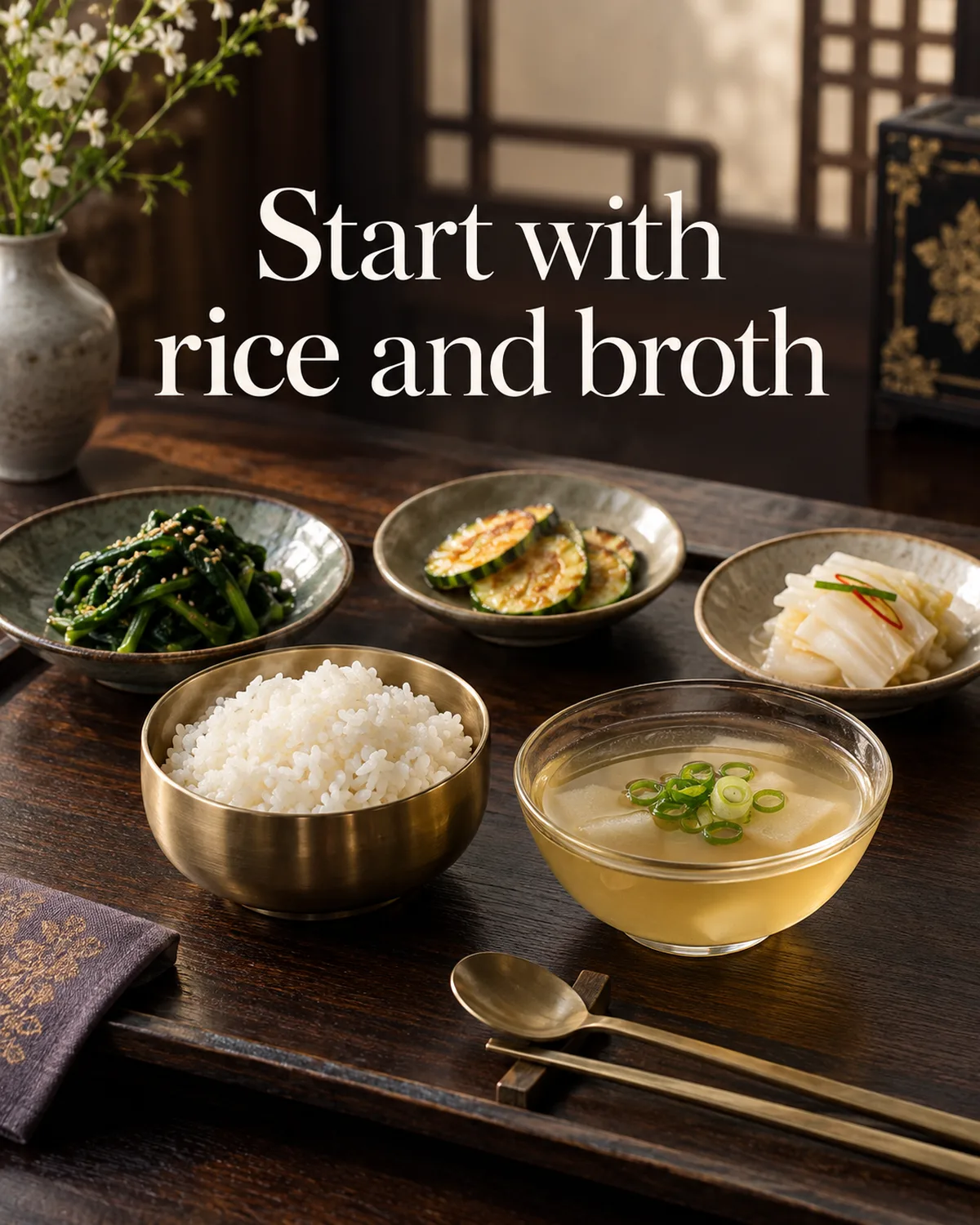
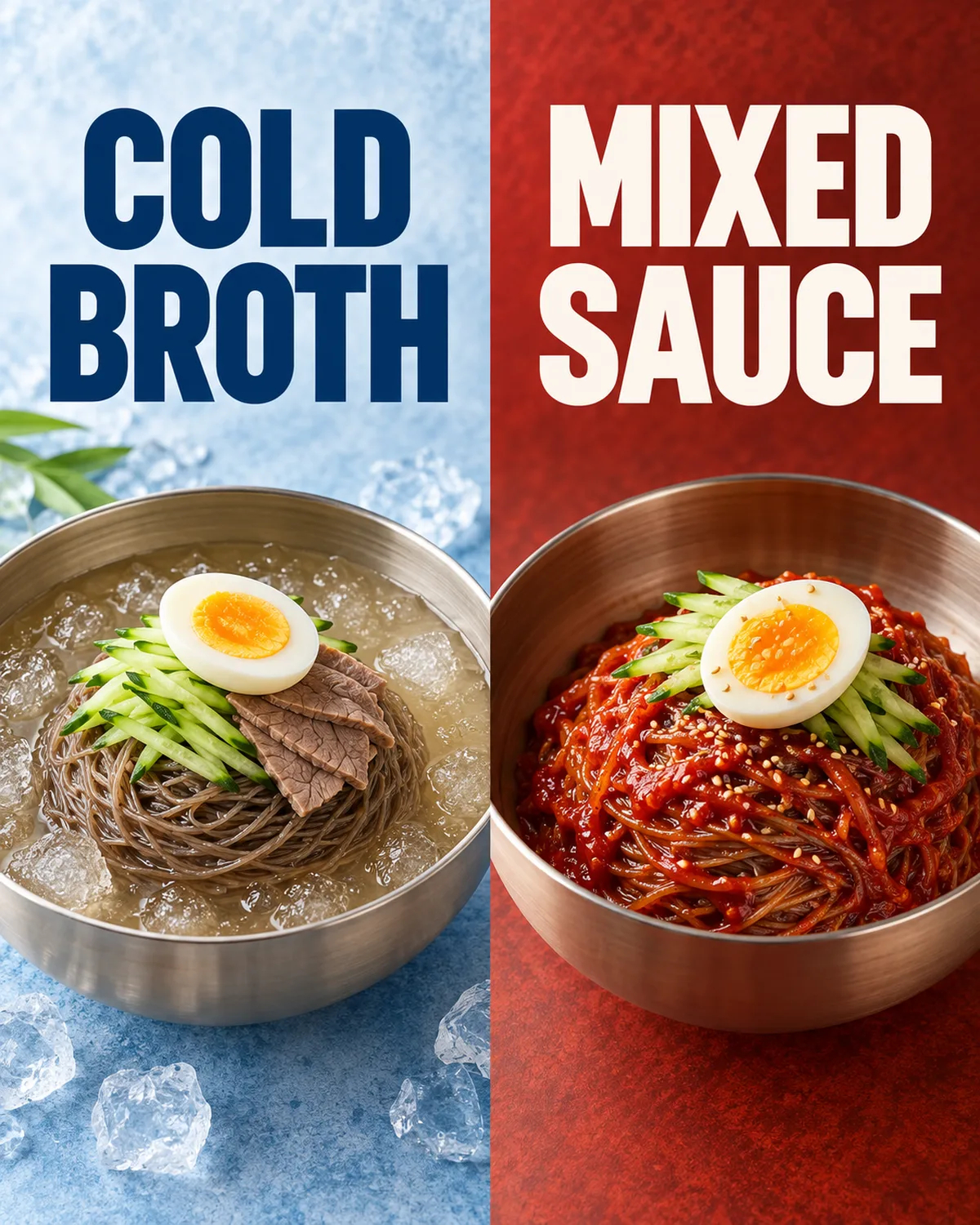
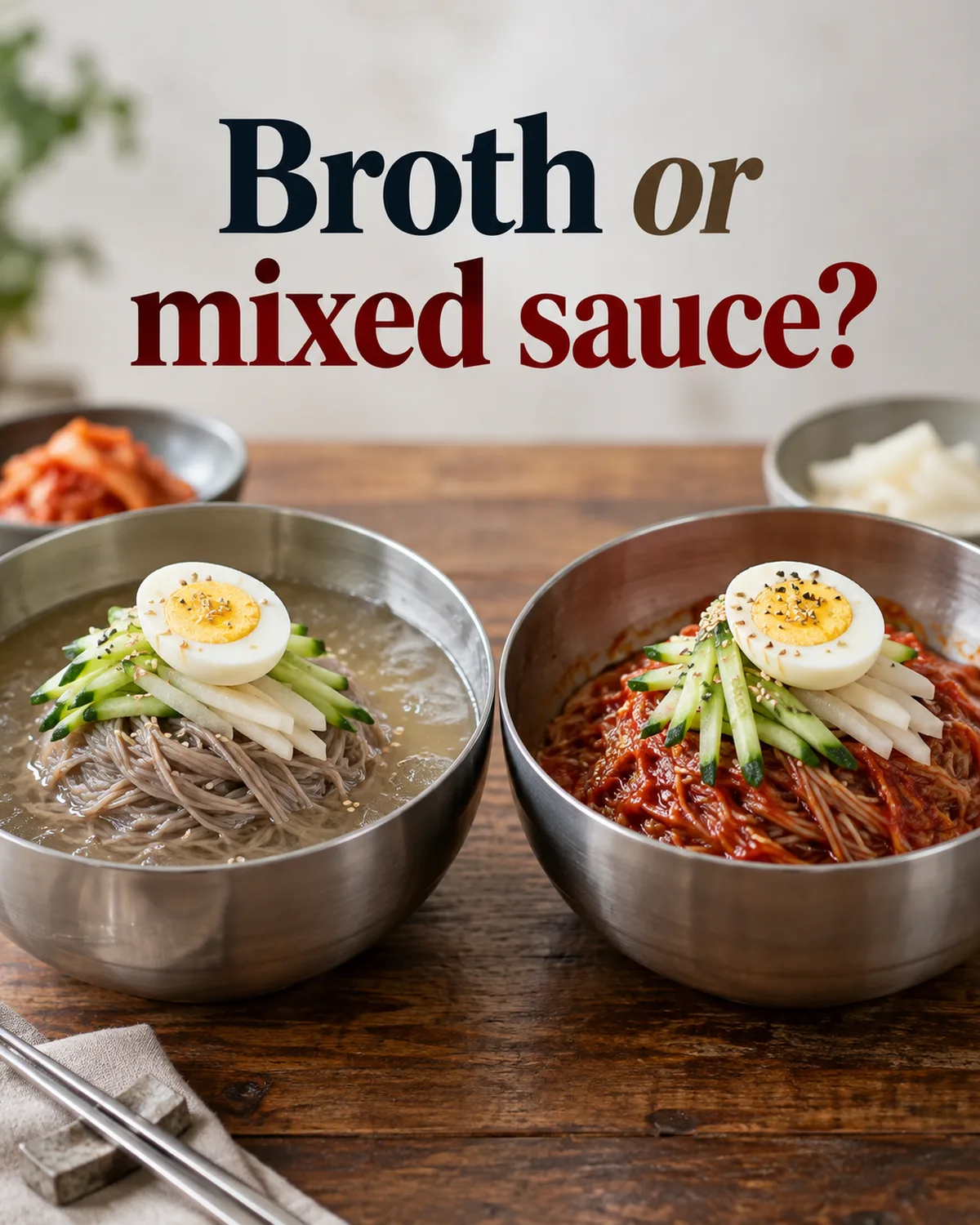
    Choose the liquid before choosing the regional label. A bowl of cold broth makes temperature and the first spoonful central; spicy mixed noodles put sauce directly around the strands. Both are naengmyeon, but they ask you to taste different things.

    The winter history makes the chilled bowl more interesting. Radish brine and northern noodle traditions belong to the story, while the modern ordering decision is still practical: broth or mixed sauce, a gentler bite or a springier chew, a main meal or a smaller finish after barbecue.
    Mul and bibim describe different serving formats.
    Mul and bibim describe different serving formats.

    A winter history behind a cold bowl

    The Academy of Korean Studies describes naengmyeon as noodles in chilled liquid and discusses Pyongyang, Hamhung and Jinju regional forms. Its entry records buckwheat-and-starch noodles, several meat or kimchi-based broth options and garnishes that can include meat, vegetables and egg.[1]

    Mul naengmyeon means the broth format; bibim naengmyeon means the mixed-sauce format. Pyongyang and Hamhung refer to regional associations. These are two different ways to describe a bowl: a menu offering mul and bibim does not automatically promise two exact historical city recipes.

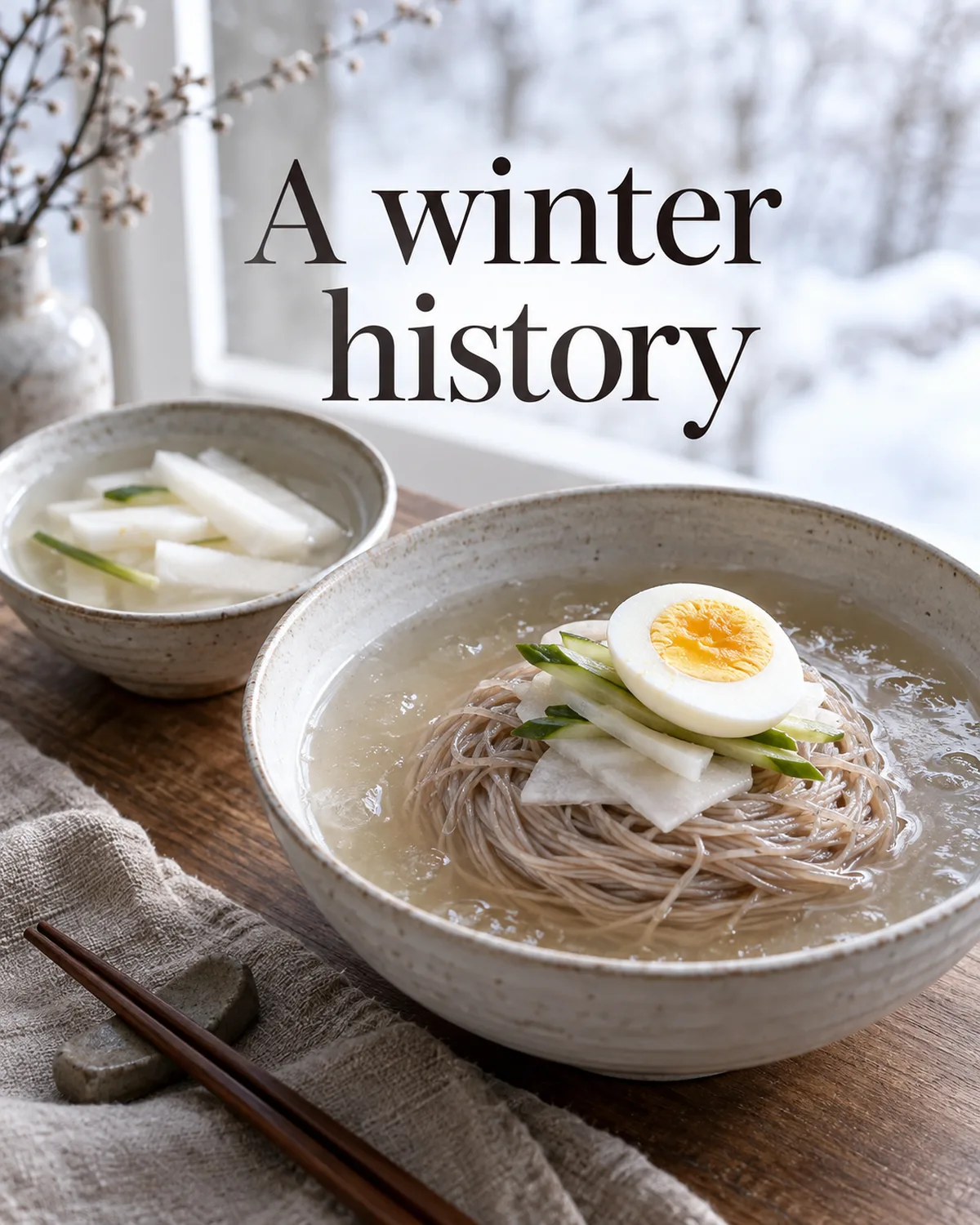
    The same encyclopedia identifies naengmyeon as a historical winter specialty and cites Dongguk Sesigi among the records. Korea.net’s 2017 recipe feature connects the winter custom with dongchimi radish brine and the winter-solstice period. These accounts support winter associations, not an exact date when cold noodles were invented.[1], [3]
    Winter radish brine belongs to the documented story.
    Winter radish brine belongs to the documented story.

    The encyclopedia’s Pyongyang entry describes a relatively mild food tradition, buckwheat noodles mixed with starch, and a broth blending meat stock and dongchimi. It mentions older pheasant stock and later beef and bone stock. Its recipe is one documented preparation, not a universal ratio every restaurant must use.[2]

    Taste a spoonful before reaching for condiments. A restrained broth lets you compare grain aroma, the savory stock and the radish-brine note. If you expect every cold bowl to be sharply sweet and sour, that quieter starting point may be the most useful discovery.

    Notice the stock and radish-brine note before adding condiments.
    Notice the stock and radish-brine note before adding condiments.

    Ask about the noodle as well as the city

    Noodle composition changes the bite. Ask how the shop describes its buckwheat and starch mixture rather than guessing from the city name. A softer strand and a very elastic strand can require different amounts of chewing and different handling with chopsticks.

    There is no single buckwheat percentage for this guide to prescribe. If grain flavor matters to you, ask about the noodles; if ease of eating matters, ask about their texture and whether scissors are available.

    The encyclopedia associates Hamhung noodles with potato starch, pronounced chew, spicy mixing and a fish garnish such as flatfish or skate. That is a useful regional description; a particular South Korean restaurant may offer different toppings or both broth and mixed versions.[1]

    Read the fish topping separately from the sauce choice. A red bowl may contain fish, beef, egg or another garnish, and its color cannot tell you whether the fish is raw, seasoned or otherwise prepared. Ask the restaurant about the actual order rather than assuming every bibim bowl contains the same thing.

    The menu should explain the actual topping.
    The menu should explain the actual topping.

    Migration and a changing season

    The Pyongyang encyclopedia entry says people moving south after the Korean War helped spread the dish nationwide. Migration belongs to the history of where these noodles were served; it does not require every later restaurant to have the same stock, noodle ratio or garnish.[2]

    Winter history and summer appetite can coexist. The cold serving temperature is appealing in warm weather, but the bowl’s ingredients and regional memories have a longer story. You do not need an invented year when a winter food officially became a summer food.

    Mul and bibim are useful first decisions

    • Noodles: ask about buckwheat and starch, rather than assuming a fixed ratio.
    • Texture: compare a softer bite with a more elastic chew.
    • Liquid: check meat stock, kimchi brine and seasoning.
    • Topping: read the actual garnish and its preparation.

    Treat these comparisons as starting questions. Ask whether the noodles are buckwheat-forward or starch-forward, whether the broth is meat-based or mixed with kimchi brine, and what garnish the menu includes. A regional label alone does not answer all three.

    • Cold broth: start with mul naengmyeon.
    • Sauce around the strands: choose bibim naengmyeon.
    • Grain aroma: ask about buckwheat-forward noodles.
    • After barbecue: check finishing portions and whether to share.

    A restaurant may use the same noodles for its mul and bibim orders, or different recipes. The broth-versus-sauce decision is the quickest first choice; noodle composition is the next question when you want to compare texture.

    Ask about grain and starch as well as the serving style.
    Ask about grain and starch as well as the serving style.

    After barbecue, cold noodles create a distinct change from the hot grilled meat. Decide whether you want a shared contrast or another full meal. Check whether the restaurant offers a smaller finishing portion instead of assuming every bowl is designed to be eaten after a meat order.

    At a specialist noodle restaurant, the bowl can be the main event. In that setting, give the broth and strands your attention before adding other food or condiments. The same dish can play a different role in another restaurant.

    Choose a portion that fits the meal.
    Choose a portion that fits the meal.

    Broth, vinegar, mustard and scissors

    Try a spoonful of broth, then a manageable portion of noodles. Add a small amount of vinegar or mustard if you want it, and taste again. This keeps the house’s starting flavor available for comparison while leaving the final seasoning to your preference.

    For bibim noodles, mix the sauce through the strands as the restaurant recommends. Taste before adding more condiments: the bowl may already have a strong balance of sweetness, acidity and heat. A little extra seasoning can change that balance quickly.

    If the long strands are difficult to manage, ask for scissors or help cutting them. Take a short portion with the chopsticks instead of lifting a large tangle. The goal is to enjoy the noodle texture comfortably.
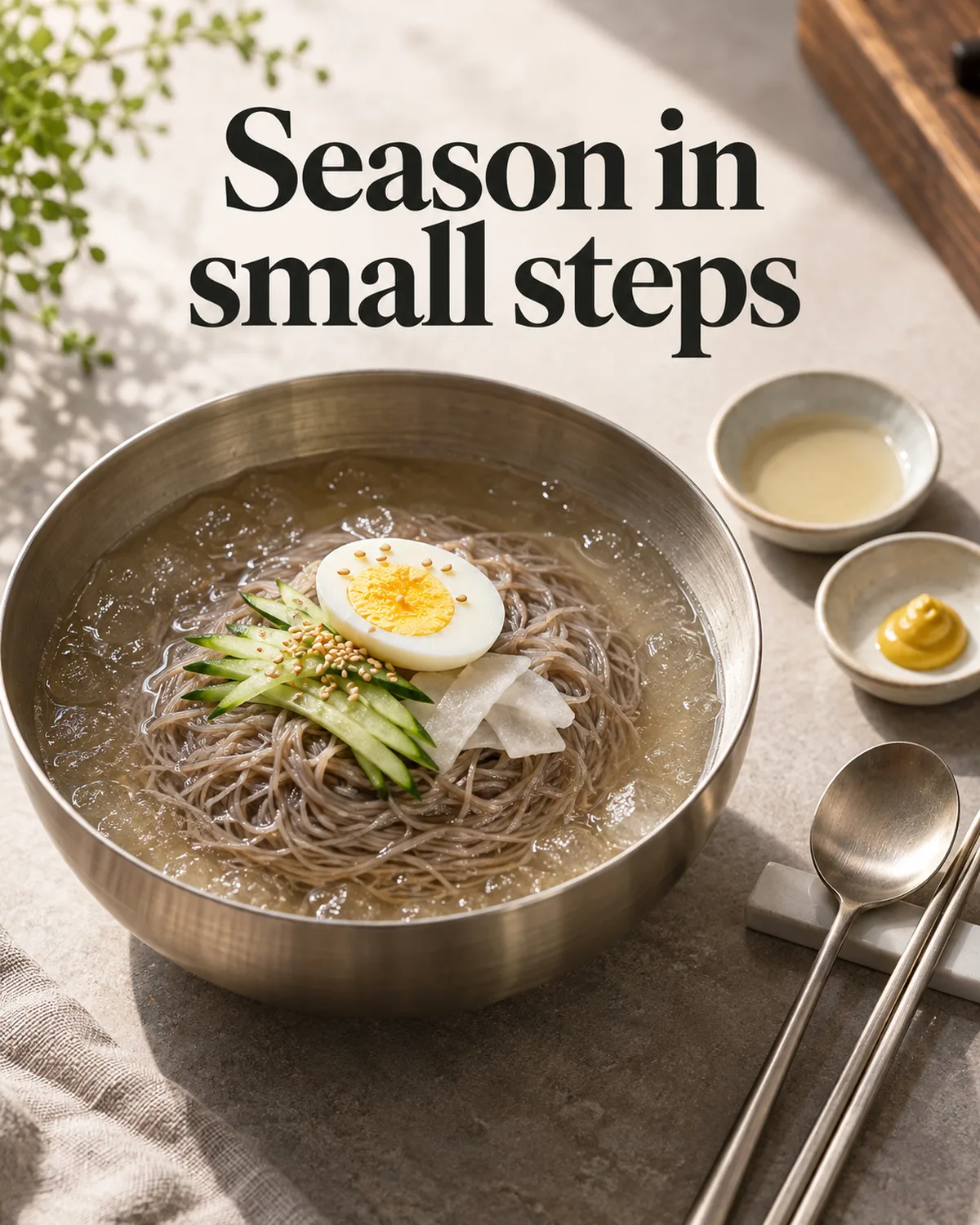
    Taste first, then adjust vinegar or mustard if you want it.
    Taste first, then adjust vinegar or mustard if you want it.

    If warm broth arrives separately, ask how the house serves it. It may be intended for sipping alongside the meal. Do not pour it into the cold bowl without checking, especially if you want to preserve the original broth concentration and temperature.

    Check the actual noodle, broth, sauce and toppings when ingredients matter. A bowl with vegetables on top can still contain meat stock, seafood seasoning, egg, buckwheat or wheat. The menu name and the clear appearance of the broth are not a full ingredient list.

    Check ingredients, then choose a portion

    For a vegetarian order or a particular allergy requirement, ask about the liquid as carefully as the noodles. Request the restaurant’s ingredient information and explain the requirement before ordering; removing a visible meat garnish does not change what is already in the broth or sauce.

    For the first tasting, choose mul if you want to notice the cold broth, and bibim if you want a sauce-coated bowl. Within either format, ask about the noodles and topping. That gives you a clearer comparison than choosing a city label without knowing the serving style.

    Winter associations, migration and modern summer demand all help explain naengmyeon. In the bowl, the enduring choices are more immediate: grain aroma, chew, broth, sauce and the way you season the next bite.

    Start with the house’s serving, taste before adjusting it and choose a portion that fits the meal. The cold bowl becomes easier to understand once the noodles and liquid have each had a chance to speak.

    Compare broth, sauce, noodle texture and portion.
    Compare broth, sauce, noodle texture and portion.

    Sources and reading

    1. Academy of Korean Studies — Naengmyeon
    2. Academy of Korean Studies — Pyongyang Naengmyeon
    3. Korea.net — Naengmyeon recipe and winter history (2017)
  • Makgeolli: Fermentation, Regional Styles and How to Choose a Bottle

    Makgeolli: Fermentation, Regional Styles and How to Choose a Bottle

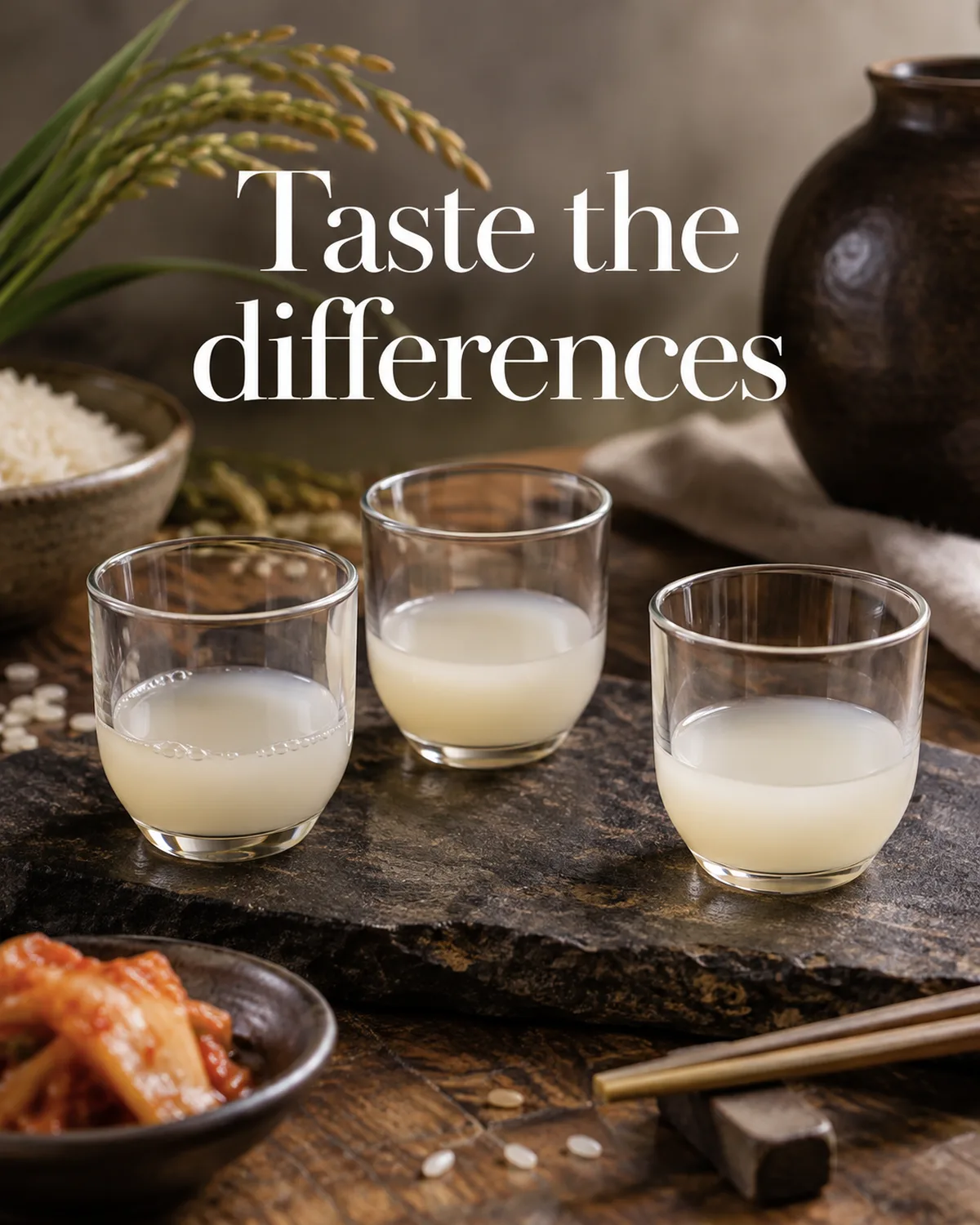
    Choose makgeolli by the bottle you will drink, not just by its milky appearance. Sweetness, tartness, body, bubbles and alcohol strength are separate qualities. Two cloudy pours can offer very different experiences alongside the same food.

    The revival has a history: Korea.net reported international attention in 2022, and KTO’s 2025 guide describes regional breweries and new styles. Those dated accounts explain renewed interest; “hottest” is not a verified ranking of the current market.[2], [3]

    Makgeolli varies by product and producer.
    Makgeolli varies by product and producer.

    Cloudiness belongs to the brewing process

    The Cultural Heritage Administration’s 2021 designation notice describes a conventional process: cooked rice, water and nuruk ferment together, then the mash passes through a sieve. It identifies nuruk as a fermentation starter containing enzymes and natural yeast.[1]

    Rough filtration helps explain the cloudy character and the sediment you may see in a bottle. That visible separation is a useful reason to read the handling instructions. It does not by itself tell you how sweet, strong or fresh the product is.

    KTO’s regional guide describes rice or wheat in the drink’s grain base and explains that ingredients and brewing choices can change flavor. The name identifies a category with variation, rather than one national recipe.[2]

    When ordering, ask what the producer highlights: the grain, the starter, a regional tradition or a particular flavor. Choose the information that helps you compare the drink, instead of treating an old-looking package as proof of one unchanged ancient method.

    The conventional method connects cooked grain and a fermentation starter.
    The conventional method connects cooked grain and a fermentation starter.

    Read the label before opening

    Find the alcohol strength, ingredients, storage instruction and date information. Ask how sweet and sparkling the drink is expected to be. A category name cannot answer those questions for a particular bottle.

    KTO explains that draft makgeolli retains brewing microorganisms, which can contribute to its flavor but complicate transport and long storage. Follow the particular producer’s refrigeration and handling guidance.[2]

    Keep a bottle that requires refrigeration cold, and follow its instructions for opening and redistributing sediment. Avoid vigorous shaking when the drink is carbonated. Open carefully over a surface that can catch foam; ask the seller if the package’s instructions are unclear.

    Pasteurization is useful information about processing, not a taste verdict. Compare the actual product rather than deciding that every pasteurized bottle is inferior or every draft bottle must taste the same.

    Read the listed strength instead of assuming a fixed percentage. KTO’s guide includes both conventional styles and stronger products. The amount poured matters as well as the number on the label.[2]

    Check the actual strength and storage instructions.
    Check the actual strength and storage instructions.

    Compare sweetness, acidity and texture separately

    For a small first pour, notice the aroma before taking a sip. Then ask three different questions: how sweet is it, how tart is it, and how much body does it have? A creamy texture can coexist with acidity, while a light texture does not guarantee a low alcohol strength.

    Notice the bubbles separately too. A sparkling sensation can make a drink feel different from a nearly still pour even when both are cloudy. Describe that sensation without assuming one is automatically fresher or more traditional.

    If you are comparing two products, use similar small portions and follow each bottle’s serving directions. Taste them before introducing a strongly flavored food, then return to a sip after a bite. That keeps the drink and the pairing from becoming one undifferentiated judgment.

    A useful tasting note is specific: “more tart,” “thicker,” “less sweet” or “more sparkling.” It gives you something to ask for next time. A label such as premium tells you much less about whether the flavor fits your preference.

    Compare sweetness, acidity, body and bubbles separately.
    Compare sweetness, acidity, body and bubbles separately.

    Making and sharing is the recognized heritage

    On June 15, 2021, the Cultural Heritage Administration designated Makgeolli Making and Sharing as national intangible cultural heritage. Its notice emphasizes historical documentation, regional character and continued practice by breweries, research groups and families; it does not designate one exclusive holder.[1]

    The notice also describes a twentieth-century shift toward commercial brewing and notes that home production for personal consumption was legalized in 1995. This is a historical account of changing practice, not instructions for current licensing or commercial production.[1]

    The shared practice is a better way to understand the heritage than hunting for a single original flavor. A region, a family and a brewery can have different knowledge and methods. Ask whose version you are tasting and how the maker explains it.

    A distributed practice carries regional histories.
    A distributed practice carries regional histories.

    Korea.net’s 2022 report on international coverage presents the revival as a renewed interest in traditional brewing. That particular report belongs to its date. It does not establish today’s sales growth or prove that every new bottle revives a lost household recipe.[3]

    Jeon is a familiar pairing, not a requirement

    Korea.net’s 2022 feature describes the familiar pairing of jeon and makgeolli, including its rainy-day association. The custom provides a starting point for a meal; it is not a rule that a rainy afternoon calls for alcohol.[3]

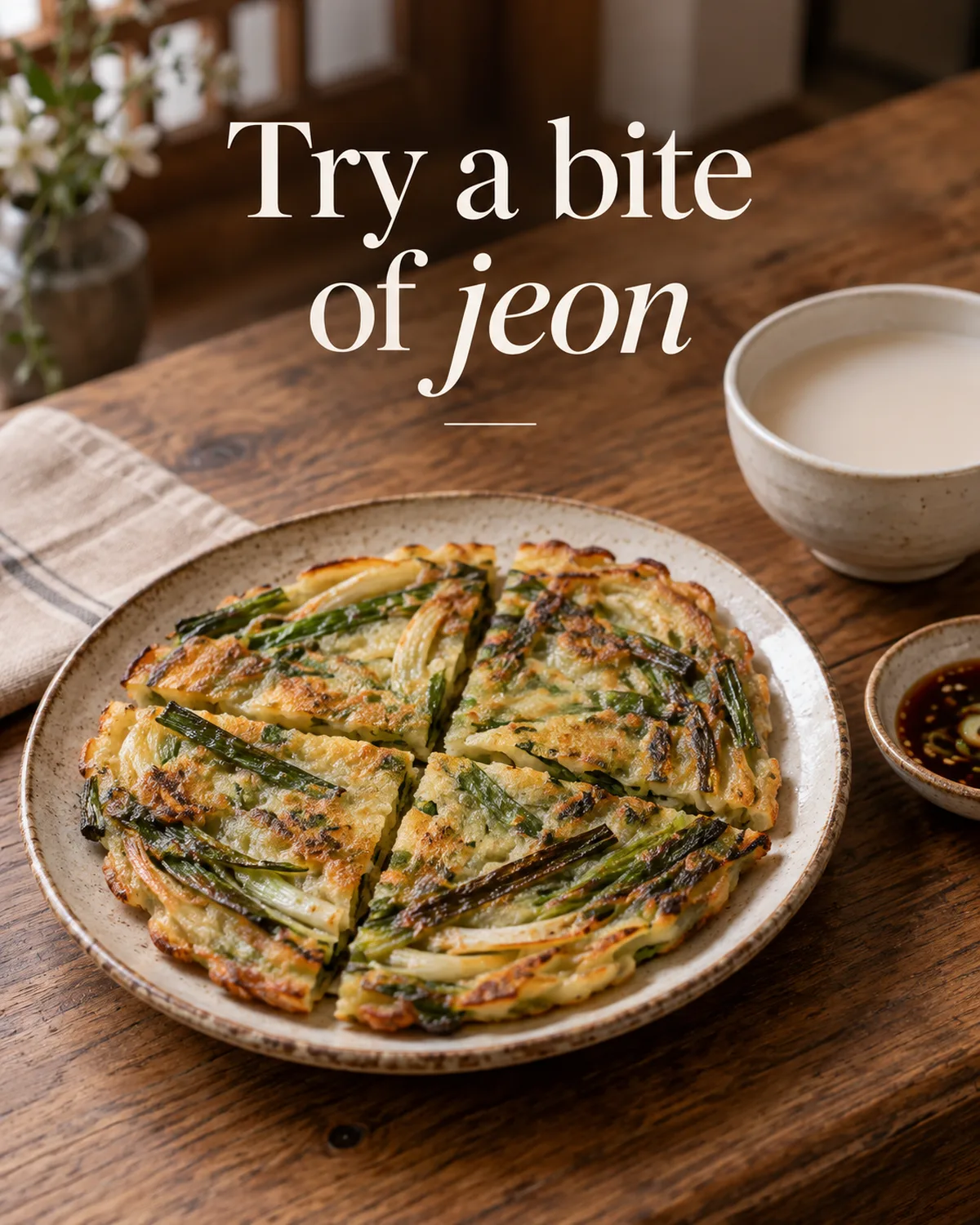
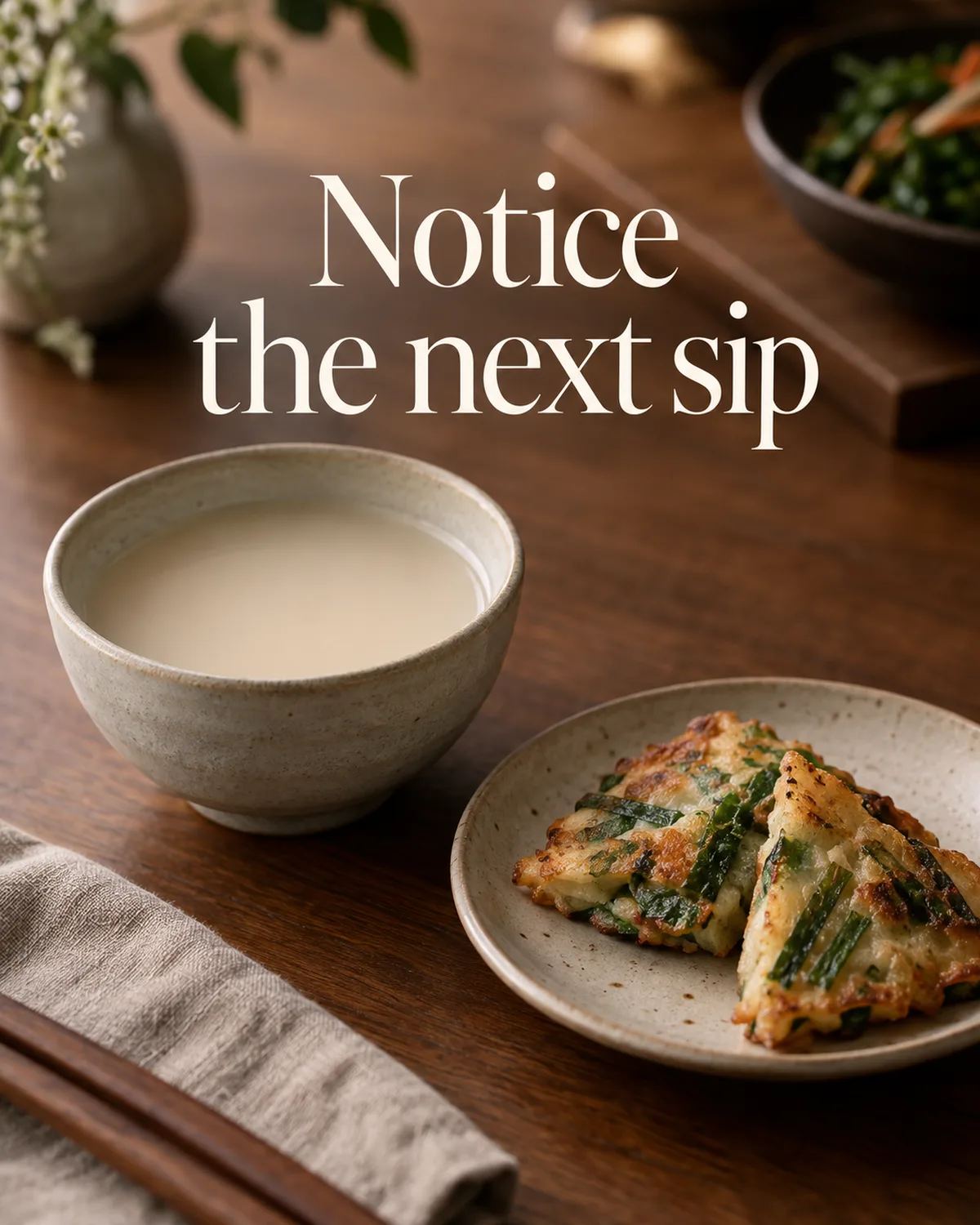
    If you choose a pancake pairing, try a bite of the crisp edge and then a little of the soft center. Compare the next sip with each texture. Keep dipping sauce modest at first so its salt and acidity do not dominate everything you taste.

    Compare the crisp edge and softer center with the next sip.
    Compare the crisp edge and softer center with the next sip.

    A shared pancake can make more sense than several large dishes when the aim is a small tasting. Ask about the pancake’s ingredients and portion as carefully as the drink’s. Seafood, wheat and egg can matter independently of the bottle you selected.

    You can also ask the producer or restaurant which foods they serve with that particular style. A suggested pairing is more informative when it explains the drink’s sweetness, acidity or texture, rather than claiming one food fits every makgeolli.

    Plan storage as carefully as the tasting

    For a purchase to take away, check how the bottle must travel and how soon it should be consumed. If you cannot maintain its required storage conditions, choose a product suitable for your plans or leave the purchase for another visit. Brewery programs and opening hours need a current check before travel.

    Follow the producer’s instructions for the specific bottle.
    Follow the producer’s instructions for the specific bottle.

    Makgeolli remains an alcoholic drink. WHO describes health risks from alcohol consumption; a fermentation story does not turn it into a health supplement. Its culinary interest is in grain, brewing, flavor and shared food, and that history can be explored without drinking.[4]
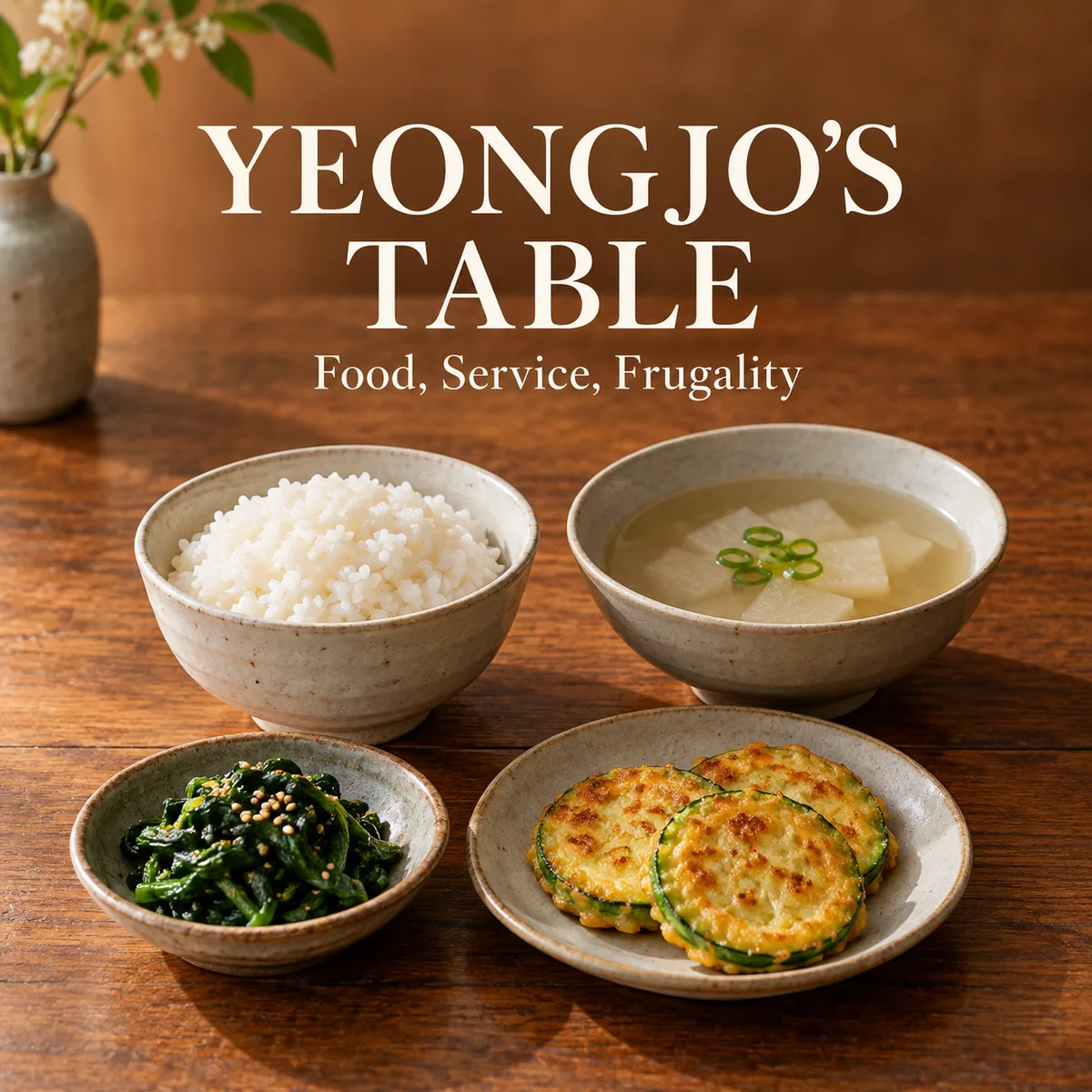
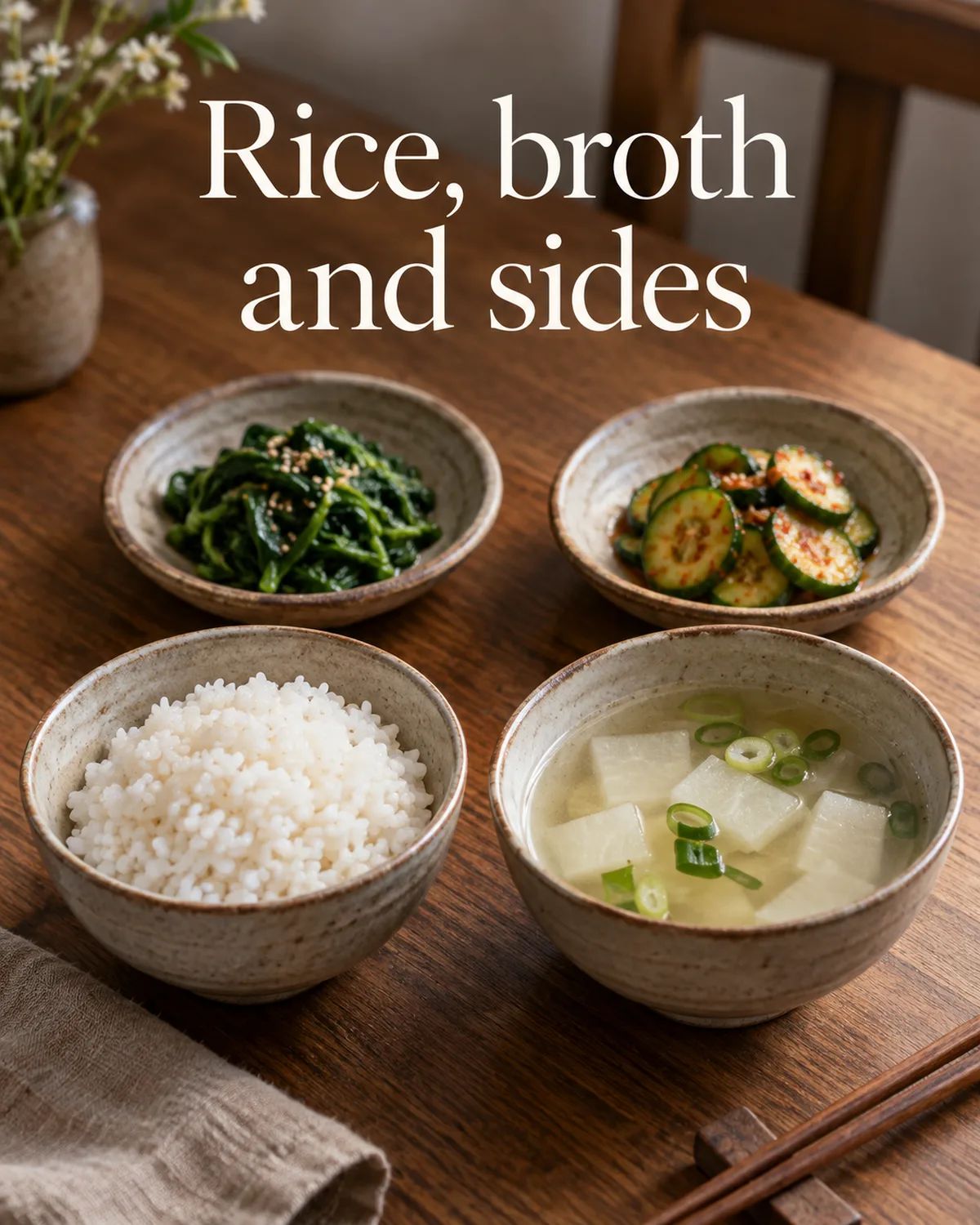
    For a first tasting, start with the actual label and a small pour. Notice sweetness, tartness, body and bubbles, then compare them with the food. Those details make a regional drink easier to understand than a national popularity slogan.

    The particular bottle matters more than a popularity slogan.
    The particular bottle matters more than a popularity slogan.

    Sources and reading

    1. Cultural Heritage Administration — Makgeolli Making and Sharing designation, June 15, 2021
    2. Korea Tourism Organization — Regional Makgeolli guide (2025)
    3. Korea.net — International coverage of the revival (2022)
    4. World Health Organization — Alcohol
  • Korean Royal Court Cuisine: What Joseon Kings Ate — and the Real ‘Dae Jang Geum’

    Korean Royal Court Cuisine: What Joseon Kings Ate — and the Real ‘Dae Jang Geum’

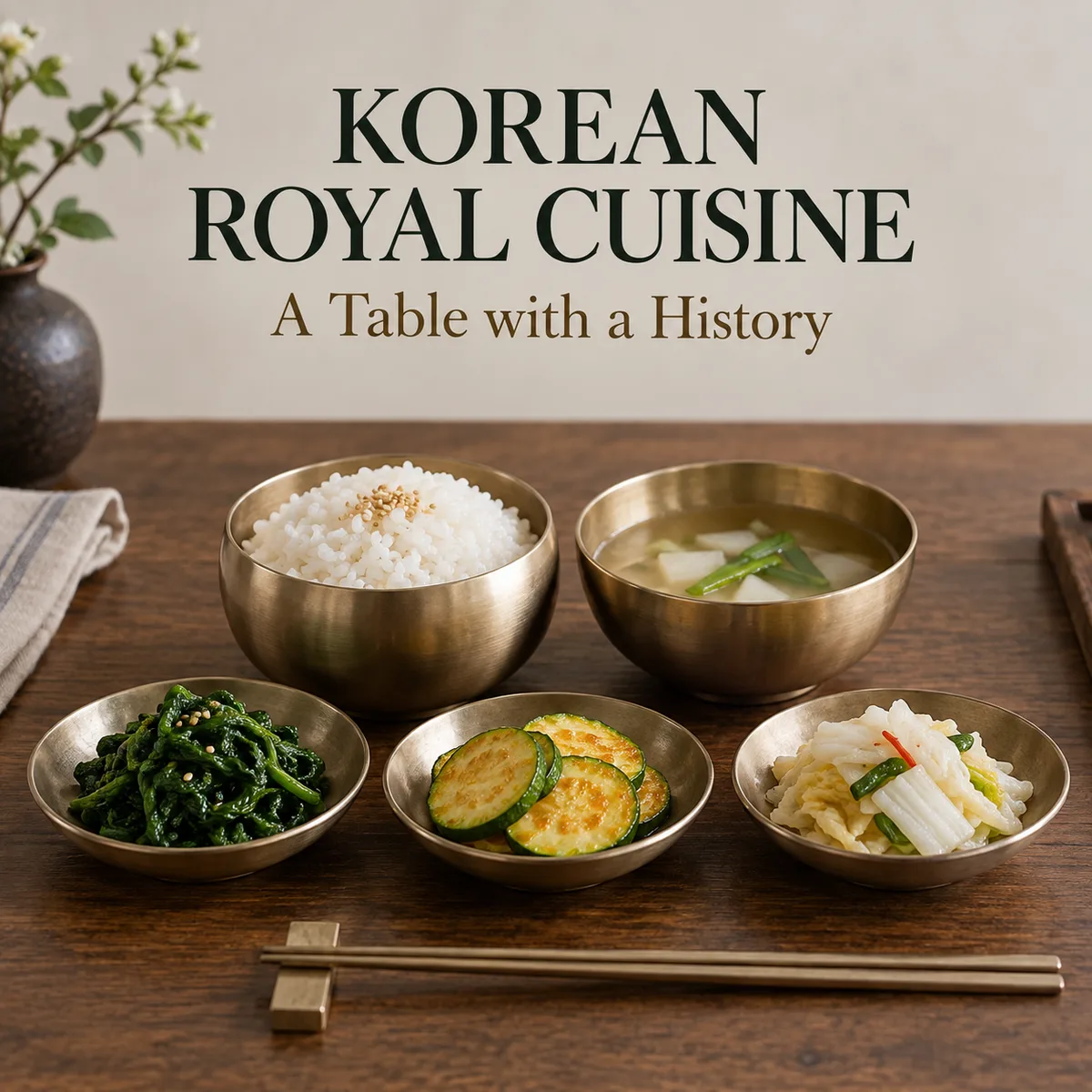
    Start a royal-style meal by finding the rice, soup and dishes you will actually eat. The pleasure is in the contrasts: a warm broth beside a vegetable preparation, a delicate wrapper beside a savory filling, a small portion of something richly seasoned.

    A palace banquet, a daily royal table and a modern tasting menu each organize food differently. Knowing which one you are being shown makes the meal easier to enjoy—and gives the story of Joseon court cuisine more substance than a count of polished bowls.

    Taste the meal through its contrasts.
    Taste the meal through its contrasts.

    Read the meal before counting the dishes

    Sura names the king’s meal; surasang is the royal meal table. The Korea Tourism Organization’s guide presents royal cuisine through seasonal ingredients, trained cooks and living transmission. Its examples include the wrapped fillings of gujeolpan, the heated broth of sinseollo and the soft mung-bean jelly of tangpyeongchae.[2]

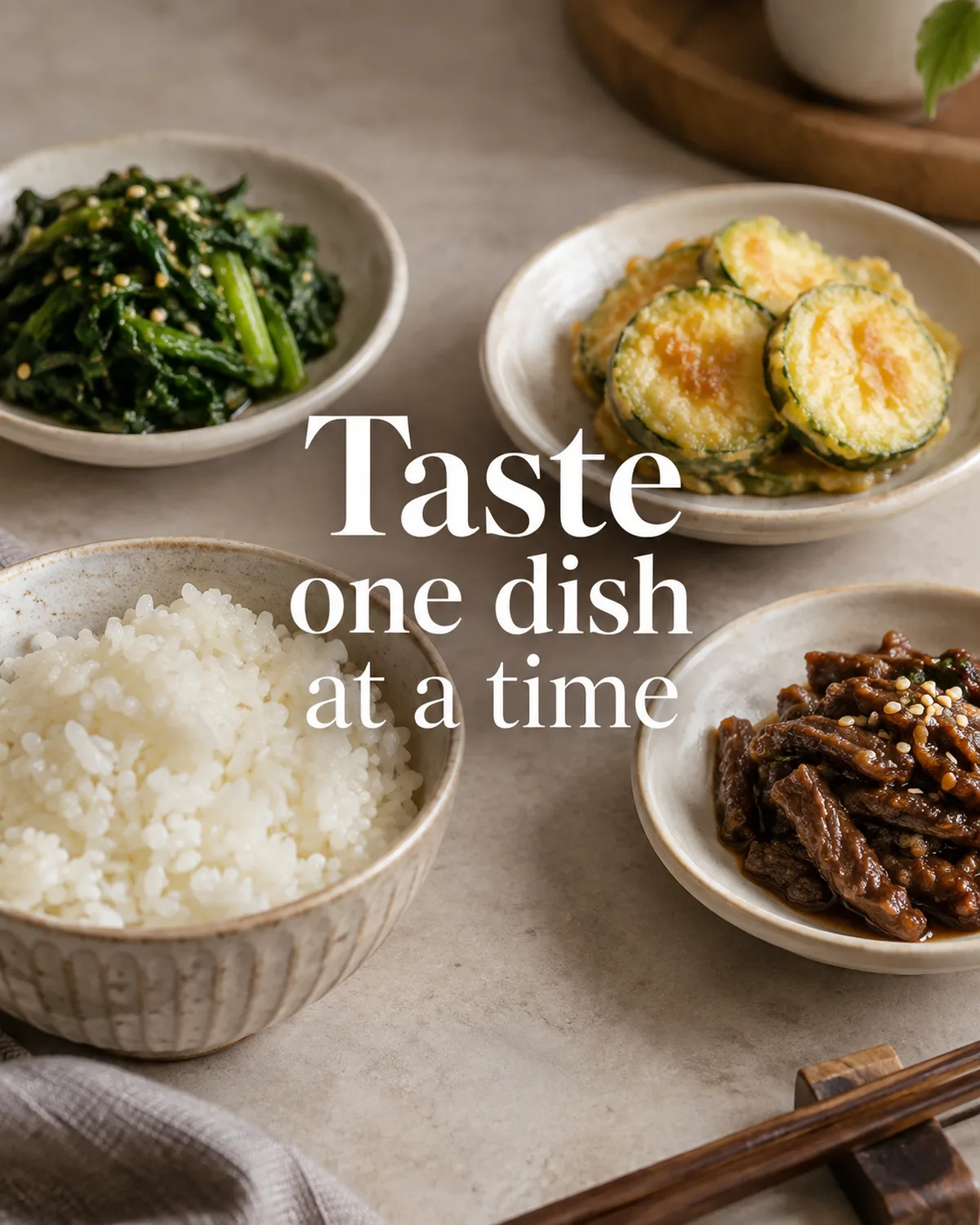
    Begin with a spoonful of soup and a bite of rice. Then try one small side dish on its own before combining it with the staple. This lets you notice whether the dish is lightly seasoned, braised, grilled or pan-fried, instead of turning the whole spread into one mixed flavor.

    Ask which dishes are individual servings and which are shared. A small vessel can contain a strong seasoning rather than a portion to finish at once. Let the host explain sauces and service order, especially when a hot pot or a course of wrapped fillings arrives.

    Compare each preparation before combining it with rice.
    Compare each preparation before combining it with rice.

    A wrapper and a hot pot show two different techniques

    Gujeolpan places eight fillings around thin wheat crepes in the center of a divided tray. KTO describes eating the fillings wrapped in those crepes. The tray separates the components until you assemble a bite.[2]

    For a first wrap, use modest amounts of just a few fillings so the crepe can close comfortably. Taste that combination before adding sauce or building a fuller wrap. The neat arrangement becomes a practical way to compare textures, rather than decoration you are afraid to disturb.

    Gujeolpan separates fillings until you assemble a bite.
    Gujeolpan separates fillings until you assemble a bite.

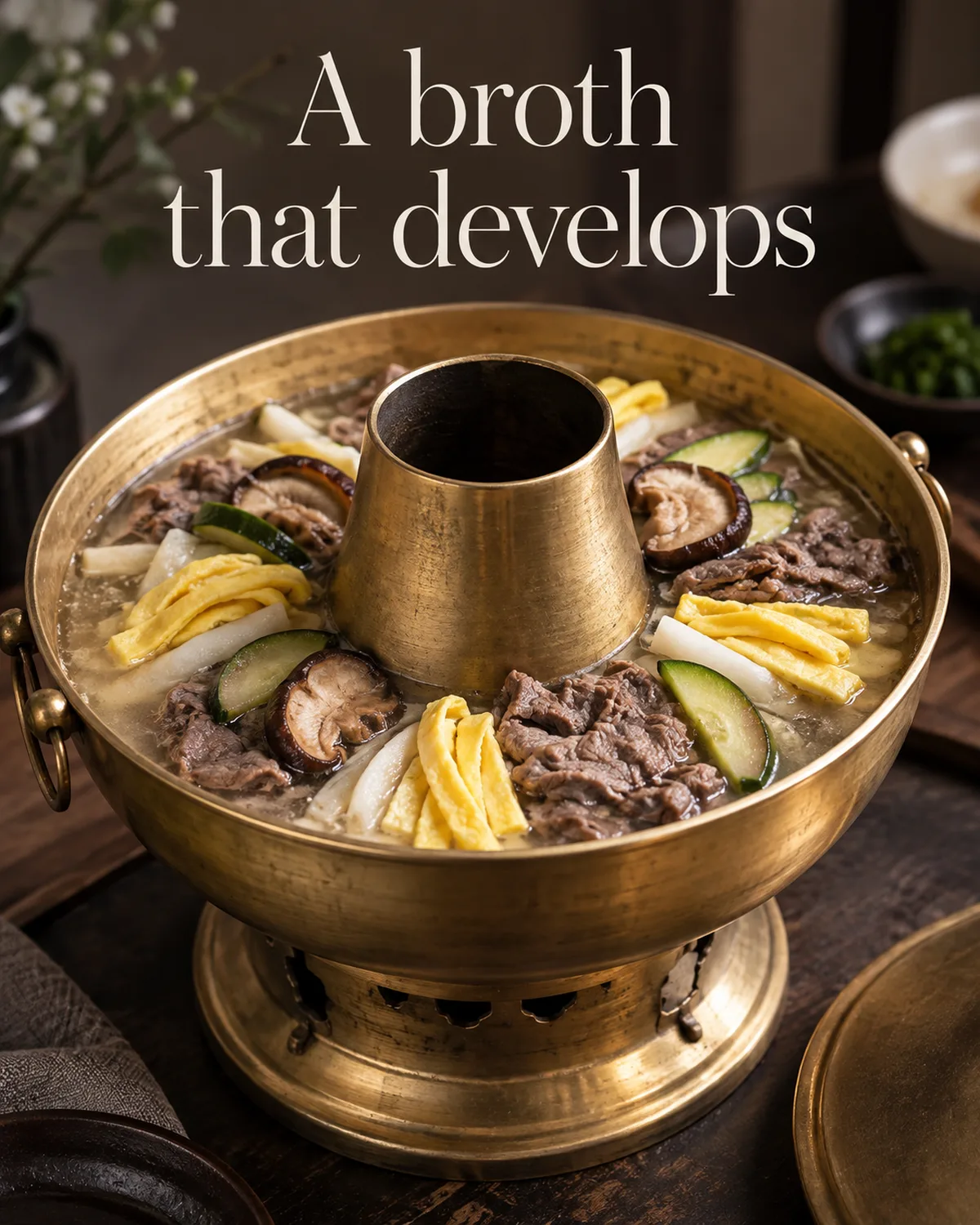
    Sinseollo uses a distinctive pot with heat through its central opening. KTO’s dish guide describes meat, fish, vegetables and other possible ingredients cooking in broth around it; the broth develops as those ingredients contribute their flavors.[3]

    Treat the hot pot as an evolving course. Ask the server how the particular meal is served and which components are ready to eat. Taste a little broth, then one ingredient, and compare the next spoonful rather than assuming every sinseollo contains the same selection.

    Sinseollo is a heated broth course.
    Sinseollo is a heated broth course.

    A modern menu can combine these foods in many ways. Check the actual fillings, stock and dipping sauce when ingredients matter. An elegant vegetable arrangement can still include beef, egg or seafood, and a wheat crepe needs to be considered separately from the filling.

    The transmitted royal table is not every king’s daily menu

    The National Palace Museum’s 2024–2025 exhibition explains that the familiar twelve-cheop model comes from testimony of court women serving the last Gojong and Sunjong courts. It notes that earlier royal meals often had seven side dishes. Dish counts and daily service varied.[1]

    This makes the date and occasion useful parts of the food story. A later transmitted table can preserve a serious culinary tradition without being the exact meal of every Joseon ruler. Ask which period or teaching tradition a reconstruction follows.

    The museum describes an average of five eating occasions, with two main meals and lighter services. It also stresses variation with taste, health and circumstances. Five occasions should not be pictured as five identical elaborate feasts.[1]

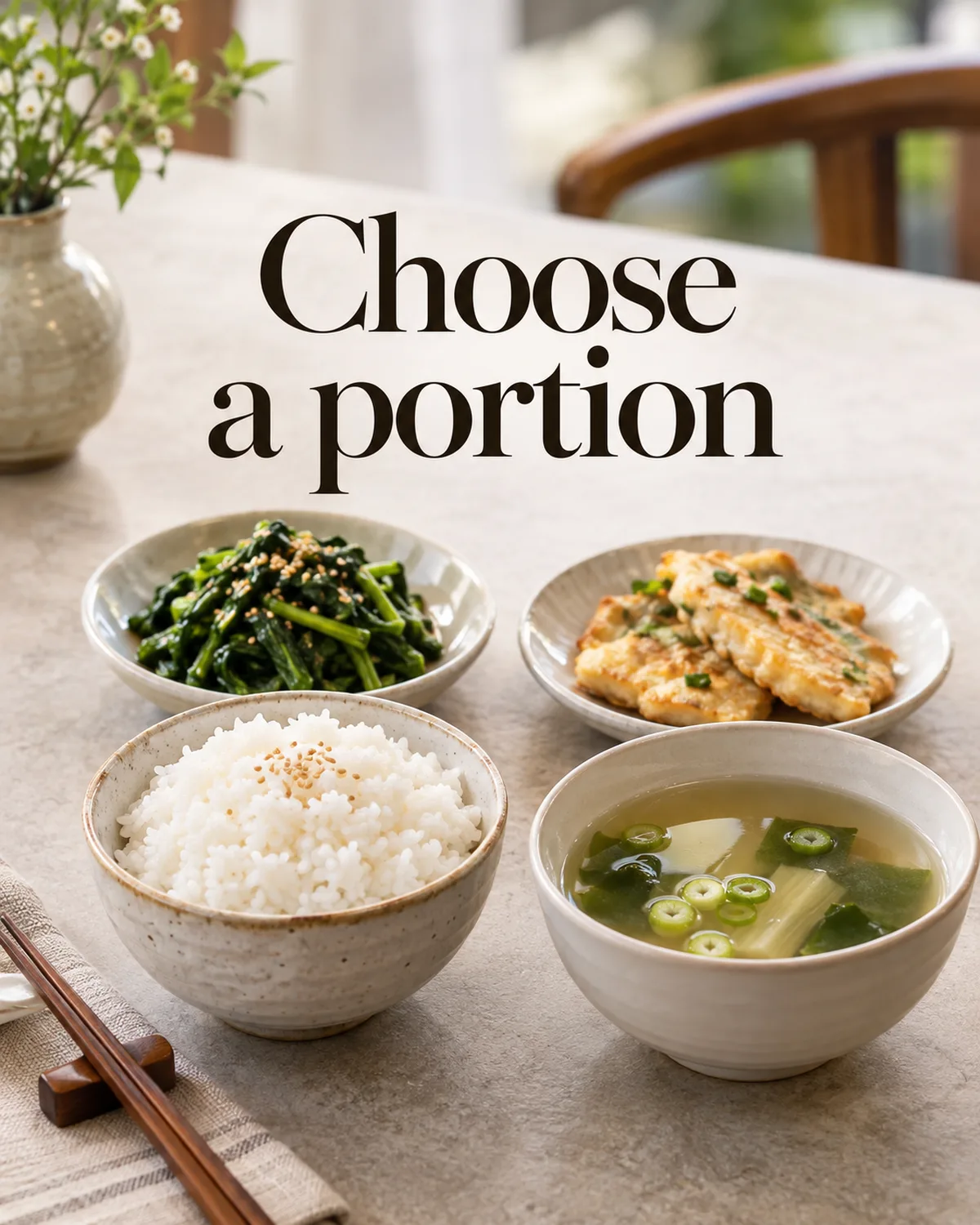
    At a restaurant, decide what amount of food suits your visit. A full course and a smaller tasting of one court-associated dish provide different experiences. Ask about course size and sharing before ordering; a photograph of many bowls is a poor guide to how much one person will eat.

    A full course and a smaller tasting offer different experiences.
    A full course and a smaller tasting offer different experiences.

    A banquet record captures a particular journey

    The museum identifies Wonhaeng Eulmyo Jeongni Uigwe as a protocol published in 1796 recording the 1795 royal journey. Korea.net’s 2026 museum feature describes its banquet and daily-meal records for Jeongjo, his mother and the entourage during the eight-day visit.[1], [4]

    That record is valuable because it places food inside an occasion: a journey, a birthday celebration and service for many participants. It is a stronger basis for discussing that event than for declaring one unchanged daily menu across five centuries.

    Ceremonial presentation also had its own purpose. The palace museum distinguishes tall food displays from foods served for eating and explains that banquet food was shared with participants beyond the royal family. Display and consumption belonged to a larger system of hospitality.[1]

    Modern presentation does not recreate every historical banquet.
    Modern presentation does not recreate every historical banquet.

    The palace kitchen relied on many kinds of work

    The museum describes Saongwon’s specialist male cooks, including teams preparing rice, grilled foods, tofu and rice cakes. Court women also handled plating and some cooking; medical staff and eunuchs had roles in royal food service.[1]

    KTO likewise identifies both court ladies and professional male cooks in the tradition, and records the designation of Royal Culinary Art of the Joseon Dynasty as national intangible heritage in 1971. The skill survives through practitioners and teaching.[2]

    Look for that labor in the meal: evenly cut fillings, a thin crepe, carefully cooked components and a broth served at the right moment. Those details tell you more about culinary refinement than assuming expensive ingredients alone make a dish royal.

    Fine cuts and careful cooking are part of the pleasure.
    Fine cuts and careful cooking are part of the pleasure.

    The real Jang-geum appears in medical records

    The Annals identify Jang-geum as a medical woman in an entry dated to 1515, lunar third month, day 22, discussing criticism after royal childbirth. In 1544, lunar second month, day 9, a reward order names Dae Jang-geum among medical personnel and grants her rice and beans.[5], [6]

    A further entry from 1544, lunar tenth month, day 25, records Jang-geum reporting the king’s sleep and bodily symptoms. These are specific surviving references to royal medical service.[7]

    Those entries support a real woman named Jang-geum at court. They do not document the television storyline in which she learns palace cooking through competitions before becoming a physician. Enjoy the drama’s food scenes while keeping its invented biography separate from the records.

    A court’s concern with a ruler’s health belongs to history. It does not show that a modern royal-style dish treats disease. For this meal, concentrate on flavor, preparation and the ingredients actually served.

    Choose a royal-style meal you can understand and enjoy

    Ask whether the menu follows a transmitted surasang model, draws on a particular banquet record or offers a modern interpretation. Then ask about its signature dishes: a broth course, wrapped fillings, a jelly salad or another preparation. A clear explanation helps you choose what interests you.

    Taste the work in each course and give unfamiliar dishes a small first bite. Rice, broth, seasoning and texture make the spread intelligible. The history becomes richer when you can connect it to the food in front of you, while leaving each king’s table in its own time.

    Connect the history to the food in front of you.
    Connect the history to the food in front of you.

    Sources and reading

    1. National Palace Museum of Korea — Royal Cuisine exhibition record (2024–2025)
    2. Korea Tourism Organization — Royal Cuisine
    3. Korea Tourism Organization — Sinseollo
    4. Korea.net — Royal journey meals and the 1795 protocol (2026)
    5. Joseon Annals — Jang-geum, 1515 lunar third month, day 22
    6. Joseon Annals — Dae Jang-geum reward, 1544 lunar second month, day 9
    7. Joseon Annals — Jang-geum and the king’s condition, 1544 lunar tenth month, day 25
  • Korean Coffee Culture: Gojong’s Cup, Coffee Mix and the Modern Café

    Korean Coffee Culture: Gojong’s Cup, Coffee Mix and the Modern Café

    Start with two cups: a small, sweet coffee mix and a black iced americano. One dissolves instant coffee with sugar and powdered creamer; the other combines espresso, water and ice. The contrast makes Korea’s coffee culture tangible before a royal anecdote or a cafe count enters the story.

    Choose the drink and the setting separately. A quick takeaway, a bean-focused tasting and an afternoon in a bakery cafe can all involve coffee while offering different tastes, portions and ways to spend time.

    Coffee mix and an iced americano arrange sweetness and temperature differently.
    Coffee mix and an iced americano arrange sweetness and temperature differently.

    Gojong’s cup and a later coffeehouse

    Korea.net’s 2015 account associates Gojong’s coffee drinking with his refuge at the Russian legation in 1896–1897 and describes his continued enjoyment after returning to the palace. This is an early royal episode, rather than proof that one person created every later Korean coffee habit.[1]

    The court episode, the commercial coffeehouse, the instant packet and the modern espresso bar are different developments. A royal cup helps explain an early encounter with the drink; it cannot by itself explain a later national cafe market.

    A court episode does not explain every later coffee habit.
    A court episode does not explain every later coffee habit.

    A room as well as a drink

    Seoul Metropolitan Government’s 2016 account links Antoinette Sontag with Gojong’s coffee enthusiasm and identifies her 1902 hotel restaurant and cafe as a landmark in the city’s coffee history. Its description of a first cafe concerns a commercial venue, not a claim that nobody had previously tasted coffee.[2]

    The useful distinction is between serving a drink privately and building a place where people buy the drink and spend time. The latter makes the room part of the experience, a question visitors still face when choosing between a small counter and a spacious cafe.

    Dabang and different reasons to visit

    Korea.net describes early twentieth-century dabang coffeehouses and the later spread of instant coffee associated with U.S. military rations. These are separate stages of access and preparation, not one unchanged recipe passed from the palace to a paper cup.[1]

    A dabang, an espresso counter and a roastery should not be ranked as if they were successive steps from bad coffee to good coffee. Ask what each place emphasizes: a familiar sweet drink, a meeting room, quick service or the flavor of particular beans.

    A meeting place, a quick counter and a roastery offer different visits.
    A meeting place, a quick counter and a roastery offer different visits.

    What coffee mix puts in the cup

    The practical shift with instant coffee is preparation. A hot-water supply and a packet can produce a repeatable drink without an espresso machine or a filter setup. That makes the format easy to serve wherever the equipment and ingredients are available.

    Korea.net describes coffee mix as instant coffee with sugar and powdered creamer. Expect a sweet, creamy cup rather than the flavor profile of unsweetened black coffee. Check the actual packet for its ingredients and water instructions; products do not all have the same composition.[1]

    Compare coffee mix with black coffee on its own terms. The dissolved ingredients make sweetness and creaminess part of every sip. An americano leaves those additions optional, and its strength changes with the espresso-to-water ratio and melting ice.

    Coffee mix combines instant coffee, sugar and powdered creamer.
    Coffee mix combines instant coffee, sugar and powdered creamer.

    Black coffee, filter coffee and the cafe setting

    An iced americano gives you a straightforward comparison with coffee mix: black coffee, cold water and ice, without the packet’s built-in sugar and creamer. Ask about size and the number of espresso shots when deciding what to order; the same menu name does not guarantee the same concentration.

    Taste the drink before adding syrup. Cold temperature, the beans and the cafe’s recipe can make one americano seem brighter, more bitter or more diluted than another. If you want milk, order a milk-based drink rather than expecting an americano to contain it.

    Ask about the drink size and espresso shots.
    Ask about the drink size and espresso shots.

    The “17,000 cafes” in the headline should not be read as a verified current national total. Cafe counts depend on date, geography and business category. This guide makes no present-day nationwide count claim; its useful comparison is between coffee formats and the settings that serve them.

    For a bean-focused visit, ask which coffee is available as filter coffee and how the shop describes its roast or flavor. For a longer conversation, look at seating and the house’s policies first. A beautiful room and a carefully prepared drink are two things to assess separately.

    Filter coffee foregrounds the shop’s beans and brewing style.
    Filter coffee foregrounds the shop’s beans and brewing style.

    A tiny takeaway counter, a roastery with a short menu and a bakery with many tables may all be called cafes. Their layout tells you something useful: whether the visit is organized around speed, tasting, food or spending time in the room.

    Seoul’s 2016 cafe-culture account describes renovated homes in Yeonnam-dong, cafes in remodeled hanok near Gyeongbokgung and book cafes in Samcheong-dong. These are dated examples of different cafe settings, not a verified current list of shops or operating hours.[3]

    Use that variety to decide what you want from a visit. A courtyard can make the surroundings part of the afternoon; a compact roastery can put the cup first; a bakery counter can make food the reason to stay. Check the current menu and access details for the specific business.

    Check the particular cafe’s seating and house policies.
    Check the particular cafe’s seating and house policies.

    Korea.net’s 2015 article describes after-meal coffee as part of the social routine for many people. A cafe can therefore be a second stop after lunch or dinner, rather than a replacement for the meal. Choose a drink and portion that suit what you have already eaten.[1]

    Read the drink description

    A coffee menu may also borrow a familiar food name. Do not assume that a drink named after a candy contains that candy: read the description or ask the staff. The actual dalgona sugar candy has its own ingredients, brittle texture and story, covered in the separate candy guide below.

    Choose your first cup

    • Sweet and creamy: check the coffee-mix ingredients and preparation.
    • Black and cold: choose an iced americano; check size and shots.
    • Bean-focused: ask about the filter-coffee selection.
    • Food and surroundings: compare the bakery menu, seating and house policies.

    Choose the format before comparing prices. A small sweet mix, an espresso-based cup and a filter coffee can differ in ingredients, preparation and serving size. The menu is more useful than an undated claim about the country’s average coffee price.

    Check one-order-per-person requirements, laptop restrictions, seating limits and outside-food rules at the actual cafe. These are house policies. Ask before taking a table for a long stay, particularly when seats are scarce.

    If pastries are the reason for visiting, check whether coffee and food are ordered at the same counter and whether the seating area has a minimum purchase. Return trays where requested and keep calls at a volume that suits the room.

    A small coffee mix and an iced americano offer an easy first comparison: sweetness, creaminess, temperature and dilution are arranged differently. A filter coffee adds another question—what the beans and brewing style contribute when the drink is served without built-in sweeteners.

    For a dessert pairing, taste a sip before and after the food. A buttery bread or syrup-soaked yakgwa changes the sweetness and richness surrounding the coffee. That simple comparison tells you more about your preference than a rule that every Korean cafe drink must be paired the same way.

    A bread or syrup-soaked sweet changes the coffee pairing.
    A bread or syrup-soaked sweet changes the coffee pairing.

    Begin with the cup you want, then choose the room and food around it. Gojong’s early coffee episode remains an interesting historical stop; the everyday pleasure is discovering which drink, portion and setting make your own visit work.

    Sources and reading

    1. Korea.net — Coffee cups across Korea (2015)
    2. Seoul — Little Pieces of Europe (2016)
    3. Seoul — Cafe Culture (2016)
  • A Korean King Died After Eating This — Ganjang Gejang, the Soy-Marinated Raw Crab ‘Rice Thief’ With a 300-Year Mystery

    A Korean King Died After Eating This — Ganjang Gejang, the Soy-Marinated Raw Crab ‘Rice Thief’ With a 300-Year Mystery

    Ganjang gejang begins with an important distinction: soy marination is not cooking. The crab’s flesh, the seasoned liquid and the rice beside it create the meal, while the well-known story about King Gyeongjong belongs to a separate question about historical evidence.

    Both subjects are worth exploring, but a record of food eaten before an illness cannot by itself prove poisoning, and a dramatic royal story cannot certify a modern raw-seafood dish as safe.

    The crab is marinated, not cooked

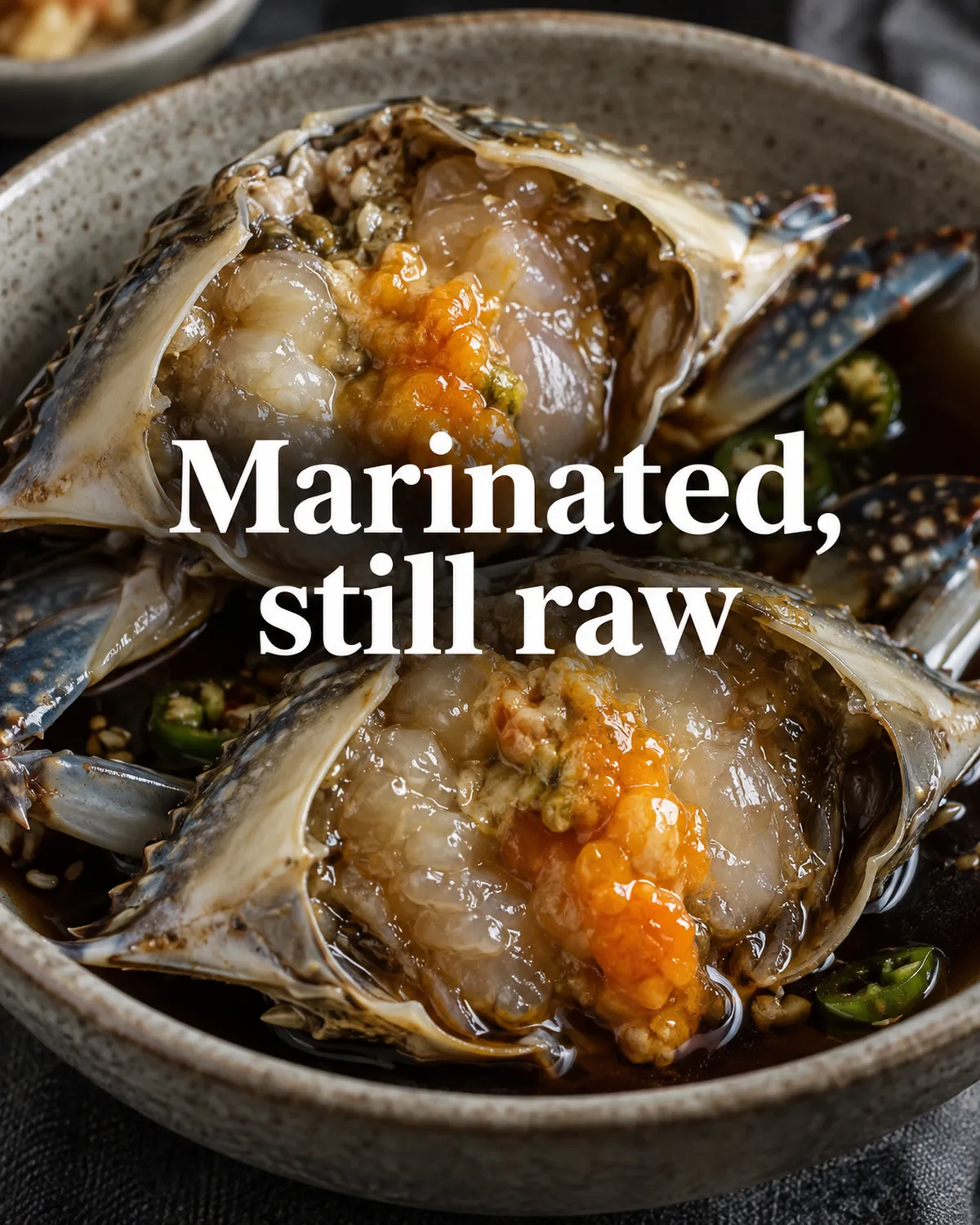
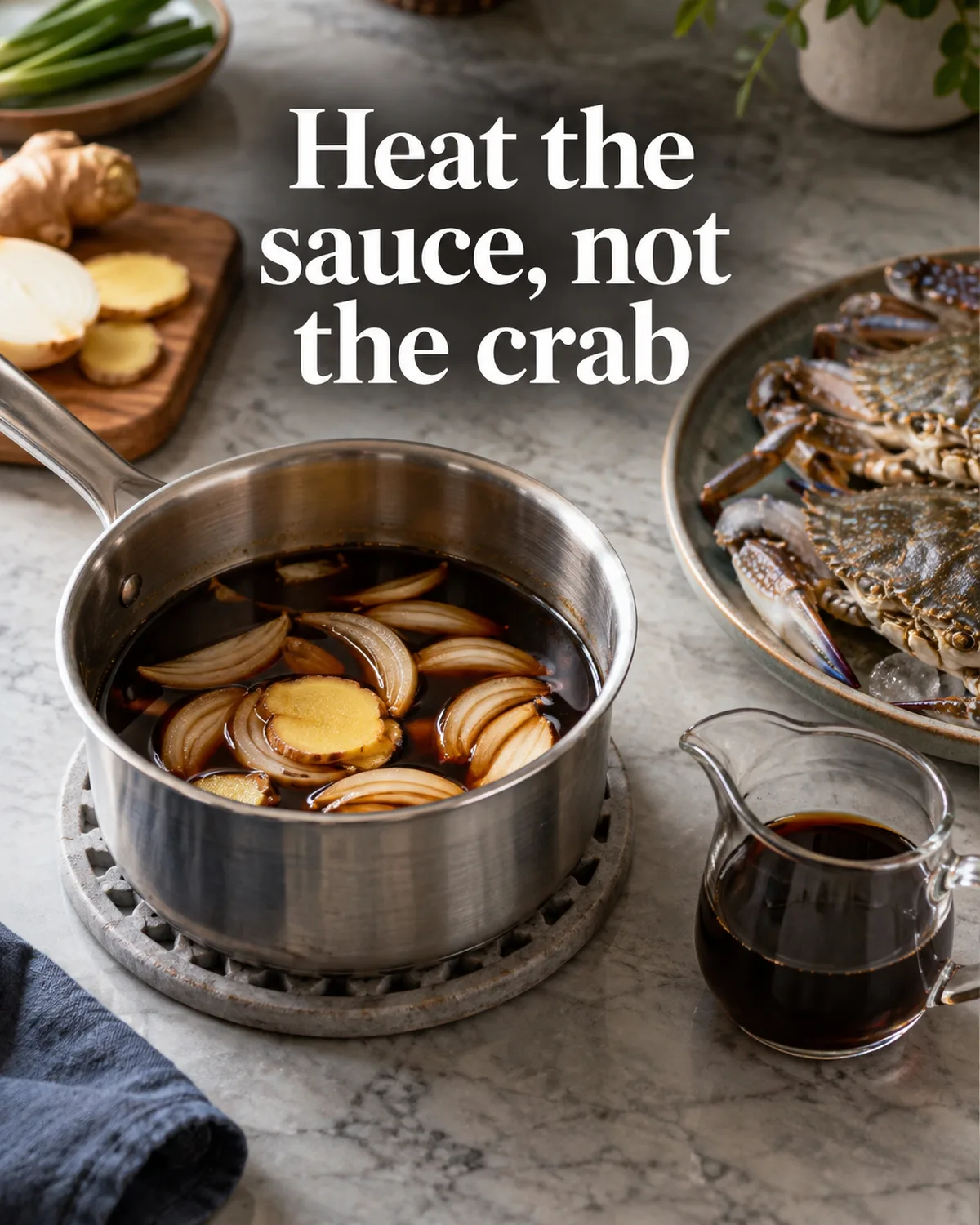
    Ganjang gejang is raw crab seasoned in a soy-sauce-based marinade. VISITKOREA describes an aromatic soy liquid that is heated separately, cooled, and then used for the crab. Heating the sauce does not mean the crab itself is cooked. That distinction explains both the soft flesh and the need for a separate food-safety decision.[3]

    Soy marination seasons the crab; it does not cook the flesh.
    Soy marination seasons the crab; it does not cook the flesh.

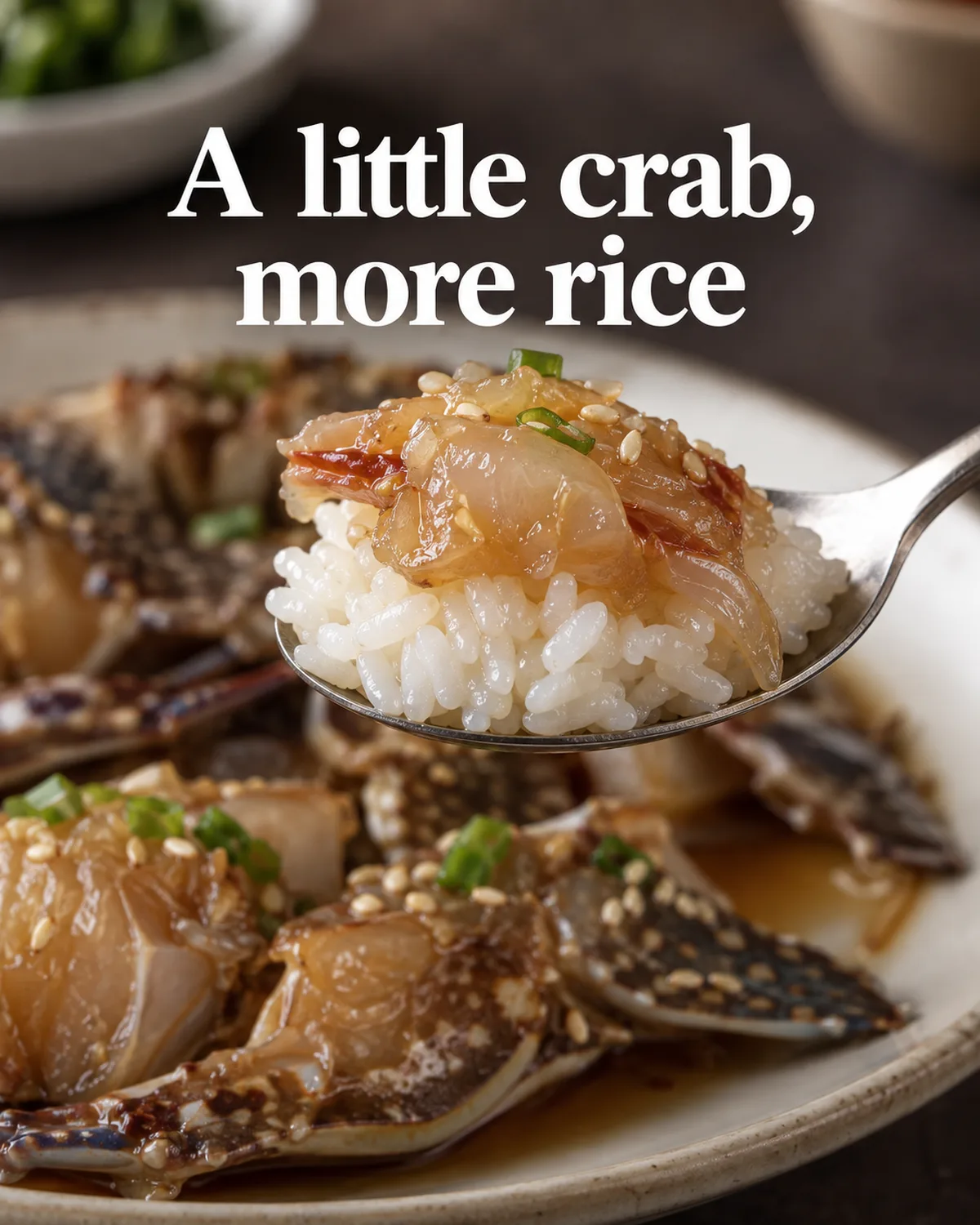
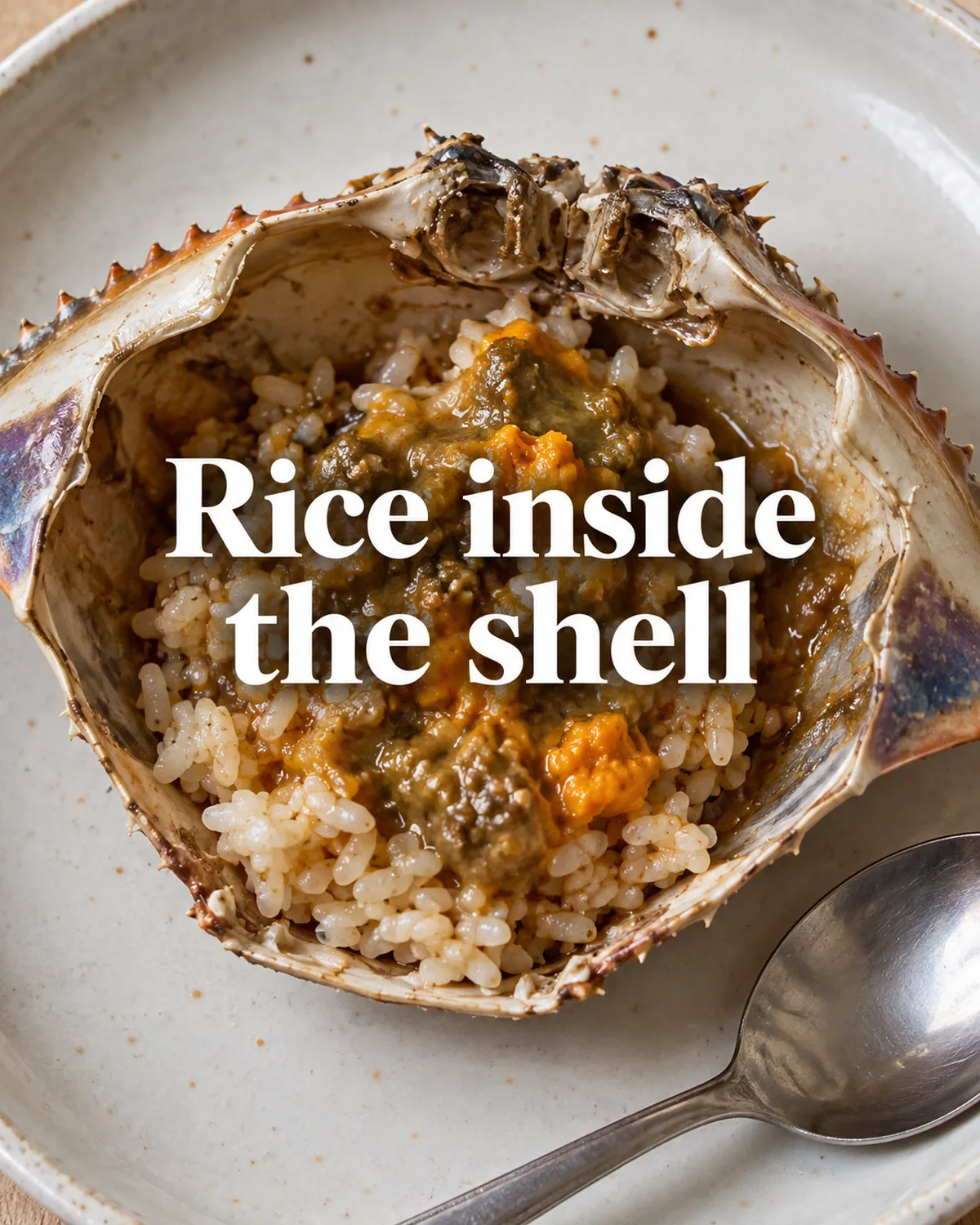
    The attraction is in a small bite: soft crab flesh, the savory soy seasoning and a spoonful of plain rice. The shell also holds rich internal contents. Rice mixed there picks up a different concentration of flavor from rice eaten beside a piece of body meat. These are two ways to explore the same plate rather than two separate courses.

    The nickname bapdoduk, or “rice thief,” describes how well the strongly seasoned crab partners with rice. It is a playful dining expression, not a medical claim about appetite. Start with a little crab on rice and notice how much seasoning that small amount carries.[3]

    Concentrated seasoning meets a mild spoonful of rice.
    Concentrated seasoning meets a mild spoonful of rice.

    VISITKOREA cites Hong Man-seon’s late-Joseon household work Sallim Gyeongje for soy and salt methods of preparing gejang. This is a useful route into the dish’s history: documented crab seasoning existed apart from the later palace-death story. It does not prove that every modern restaurant follows the same old recipe.[3]

    A meal inside the record of Gyeongjong’s final illness

    An Annals entry dated the 21st day of the eighth lunar month in Gyeongjong’s fourth reign year, 1724, reports that the king had been served gejang followed by raw persimmon the previous day. Court physicians said this was a combination their medical practice avoided and requested two remedies, Dusitang and Gwakhyang Jeonggi-san. The entry records a meal and the physicians’ response.[1]

    Read that passage with two questions in mind. What did the court report serving? What did the physicians believe? It answers those questions, but it does not identify poisoned crab or demonstrate a lethal chemical reaction between the two foods. The historical concern can be documented without accepting a modern claim of a solved murder.

    A different entry records the king’s death on the 25th day of the same lunar month. This explains why the meal is discussed alongside his final illness. Both dates belong to the Annals’ reign-year and lunar calendar; they should not be presented as Gregorian August dates.[2]

    The two Annals entries establish chronology, not a proven cause of death.
    The two Annals entries establish chronology, not a proven cause of death.

    The defensible story is specific: gejang and persimmon appear in a court medical entry shortly before a recorded royal death. The two passages establish that sequence. They do not settle the cause of death. A diner can be interested in the palace history without treating the legend as either a safety warning about persimmons or a safety guarantee about raw crab.

    The sauce and rice explain the “rice thief” name

    For the dining comparison, focus on where the heat goes. In the soy preparation described by VISITKOREA, aromatics flavor the heated sauce and the liquid cools before marinating the crab. A cooked crab dish applies heat to the crab itself. Sauce preparation and seafood cooking are different steps, even when the bowl looks richly seasoned.[3]

    The aromatic sauce is prepared separately from the raw crab.
    The aromatic sauce is prepared separately from the raw crab.

    The process changes flavor, water movement and texture, but it should not be described as if soy sauce “cooks” or sterilizes the crab. The defining ingredient remains raw seafood. That is why food-safety guidance for raw seafood is still relevant even when a restaurant has a long-established marinade method.

    Ganjang gejang can taste aggressively salty if judged by the spoonful. It is designed to be eaten as part of a rice-centered meal rather than as a large standalone portion of sauce.

    Try comparing two modest bites. First, eat rice with a little meat and its clinging seasoning. Next, try rice mixed into the open carapace if it is part of your serving. Notice the change in richness and texture, then return to plain rice. There is no need to consume the bowl’s remaining liquid to understand the meal.

    Soy marinade and the red-seasoned alternative

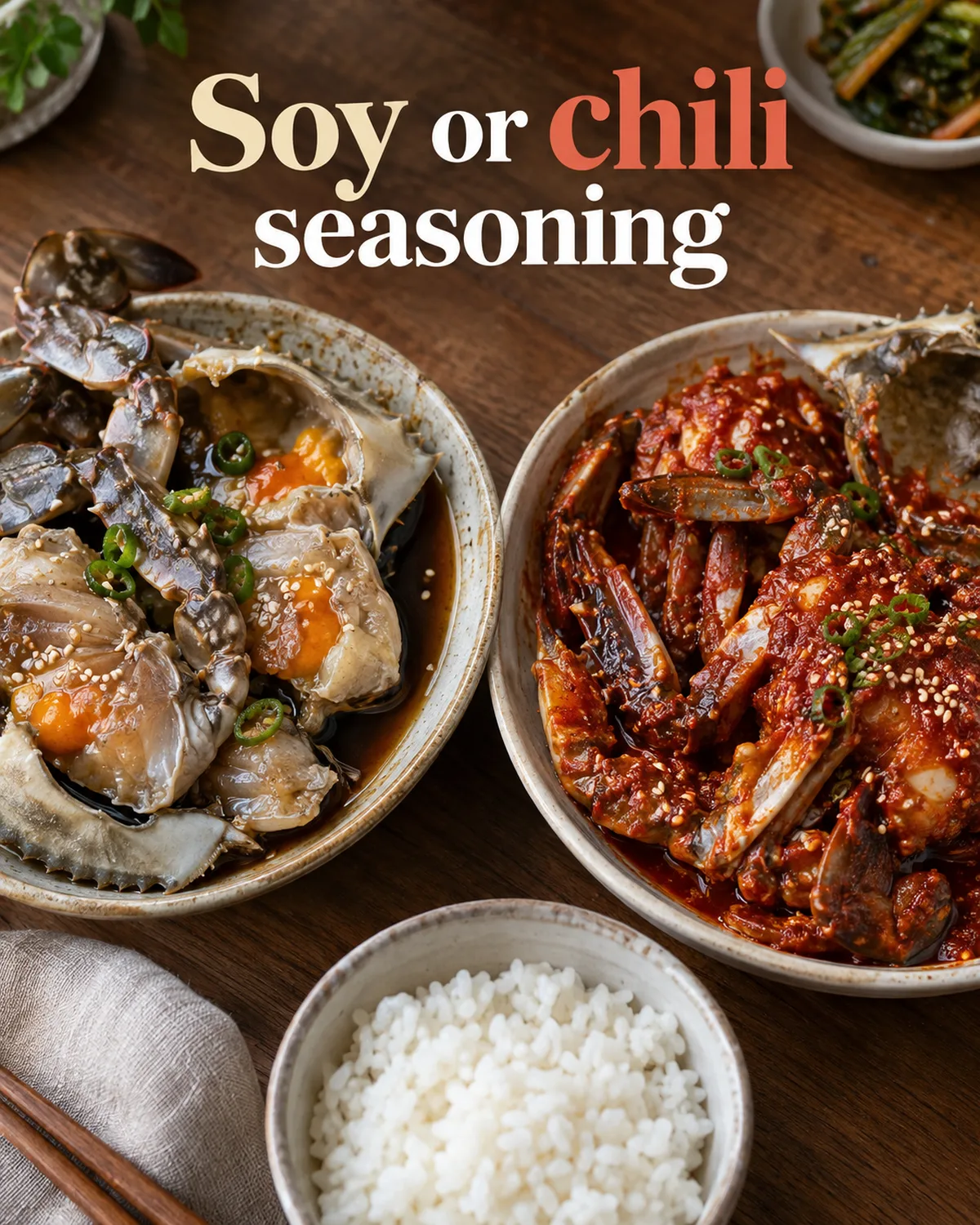
    Visitors often see two crab dishes side by side. Ganjang gejang uses a soy-sauce-based marinade. Yangnyeom gejang coats raw crab in a red chili seasoning mixture that usually emphasizes chili, sweetness, garlic and other aromatics.

    The soy and red-seasoned versions offer different flavor directions: one makes soy seasoning prominent, while the other brings a chili mixture to the foreground. The red coating can make it harder to see the flesh underneath, but it does not establish that the crab has been cooked. Ask about preparation rather than deciding from sauce color.

    Sauce color does not establish that the crab has been cooked.
    Sauce color does not establish that the crab has been cooked.

    For a first order, diners who want to understand the historical soy-preservation logic may find ganjang gejang the clearer reference point. Diners who prefer chili heat may enjoy yangnyeom gejang more. The decision is about flavor, not prestige.

    Ask what kind of crab the restaurant is serving and whether the order is a whole crab, selected sections or part of a set meal. Size, cutting and the presence of roe change what you receive. A photograph of a generous female crab is not a promise that every portion will look the same.

    For a first order, the practical questions are portion, seasoning and what comes with it. Confirm whether rice is included and whether the plate is intended for sharing. Current menu details are more useful than an old online price or a claim that one season guarantees the best crab everywhere.

    Working through the shell and the rice

    The easiest method is to treat the crab as several small eating zones rather than trying to attack the entire animal at once.

    The open carapace can hold rice mixed with the remaining rich contents.
    The open carapace can hold rice mixed with the remaining rich contents.
    1. Start with a body section. Hold the shell and squeeze or pull the meat toward the opening. Some restaurants provide scissors, gloves or shell tools.
    2. Use rice to regulate intensity. Alternate crab with rice rather than eating large spoonfuls of marinade alone.
    3. Save the carapace. If roe and sauce remain inside, mix in a small amount of rice and scrape the shell carefully with a spoon.
    4. Watch small shell fragments. Raw crab shells can be sharp. Eat slowly, especially around leg joints.
    5. Taste before adding extra sauce. The dish is already highly seasoned, and additional soy sauce is rarely necessary.

    There is no single ceremonial sequence every Korean follows. Restaurants prepare and cut the crab differently, and diners develop their own method. The useful rule is simply to let the rice and crab balance each other.

    At the table, ask what crab and preparation the restaurant serves, what is included in the order and how the house suggests handling the shell. Begin with a modest amount of the seasoned crab and rice. The sauce is a strongly flavored component, not a requirement to consume every drop.

    Raw seafood needs a separate safety decision

    Raw seafood carries a foodborne-illness risk. CDC guidance recommends cooking seafood and avoiding raw or undercooked seafood to prevent Vibrio infection. It stresses this particularly for people with underlying conditions, especially liver disease. The marinade does not provide a substitute for that advice.[4]

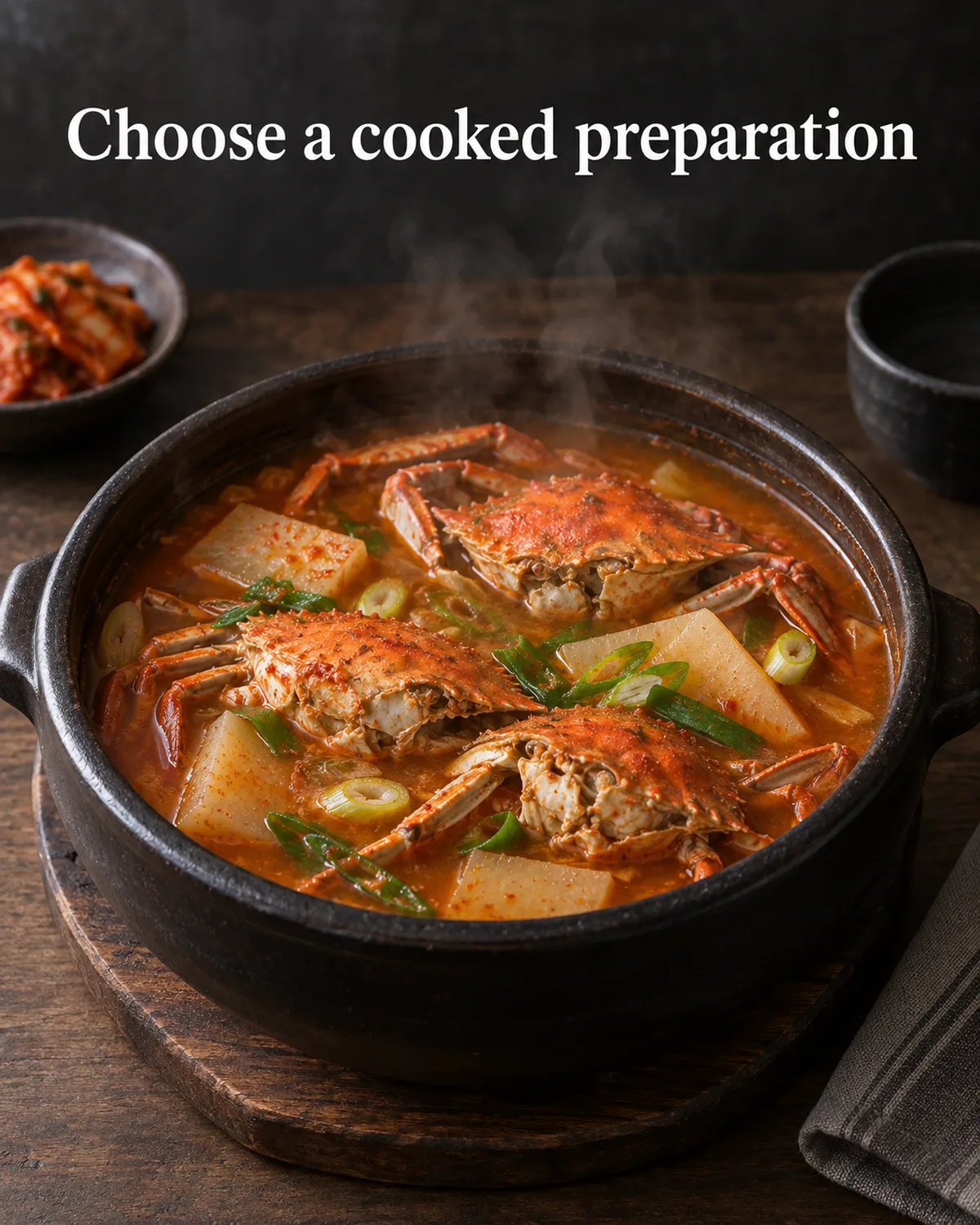
    If you want a cooked option, ask for a dish in which the crab itself is fully cooked, such as an appropriate crab soup or steamed-crab preparation. Its firmer flesh and different eating experience are part of that choice. Do not assume that a darker sauce, longer marinade or famous restaurant makes raw crab equivalent to cooked crab.

    A fully cooked crab dish offers a different texture and raw-seafood choice.
    A fully cooked crab dish offers a different texture and raw-seafood choice.

    CDC also identifies pregnant people, children under five, adults 65 and older, and people with weakened immune systems as groups needing extra precautions against food poisoning. Its safer-food table places cooked seafood above raw or undercooked seafood. Follow that guidance when deciding whether this raw dish suits you.[5]

    Check allergies against the actual ingredients: crab is crustacean shellfish, and soy seasoning may also contain wheat or additional seafood ingredients. Tell the restaurant what you need to avoid and ask about the marinade and cross-contact. A short menu label cannot provide the complete ingredient information for a house recipe.

    Ask about crab, soy, wheat-containing seasoning and other ingredients.
    Ask about crab, soy, wheat-containing seasoning and other ingredients.

    Rice makes the taste of a salty bite milder by sharing the mouthful; it does not remove sodium from the sauce already consumed. Taste a small amount before adding more marinade. This is a useful way to judge flavor rather than assuming a full bowl of sauce is part of the required serving.

    The memorable part of ganjang gejang is the meeting of soft crab, assertive seasoning and rice, with the shell becoming part of the eating experience. Learn how that serving works, make the raw-seafood decision explicitly, and leave the royal story within what the surviving records actually tell us.

    Sources and reading

    1. Annals — Gyeongjong4, lunar month8, day21 (1724)
    2. Annals — Gyeongjong4, lunar month8, day25 (1724)
    3. VISITKOREA — Ganjanggejang: Korea’s Ultimate Rice Thief
    4. CDC — Preventing Vibrio Infection
    5. CDC — Safer Food Choices
  • King Yeongjo’s Meals: Palace Restraint and the Limits of a Longevity Story

    King Yeongjo’s Meals: Palace Restraint and the Limits of a Longevity Story

    A bowl of rice, a spoonful of broth and several small dishes can make a Korean meal feel generous without turning it into a banquet. The interesting question is how those components are served and eaten—not whether they reproduce a king’s secret formula.

    Yeongjo’s food story offers an unusually clear example of restraint inside an abundant institution. His reported reduction in eating occasions concerns palace service and frugality. Those records do not establish that a particular diet kept him alive.[2]

    Read the meal through its components.
    Read the meal through its components.

    Begin with the structure of the meal

    For a meal built around rice and side dishes, identify the staple, the broth and the preparations around them. A seasoned vegetable, a fermented condiment and a cooked protein contribute different tastes and textures. Their presence does not reveal one compulsory national proportion.

    Try a side dish on its own, then with a little rice. Notice whether it is mild enough to eat as a vegetable portion or strongly seasoned enough to accompany several bites of the staple. The size of a serving bowl is not always the amount intended for one diner.

    Ask what is shared and what is individual. If the meal arrives in courses, find out whether more rice, soup or a hot dish is coming before treating the opening arrangement as the entire meal.

    A contemporary table can illustrate ways of organizing food. It cannot prove that Yeongjo ate those same ingredients, in those quantities, every day. Enjoy the meal as the cook presents it while keeping the historical claim separate.

    Seasoning and portion are separate questions.
    Seasoning and portion are separate questions.

    The recorded change concerns eating occasions

    The National Institute of Korean History describes five customary services: early light food, morning and evening meals, midday food and late food. They were not five equally elaborate banquets.[2]

    Its commentary says the frugal Yeongjo omitted midday and late-night services, eating three times daily. It specifies occasions rather than a complete menu or measured portions.[2]

    The distinction changes how the story is pictured. The documented comparison is between a customary service schedule and a ruler’s reported reduction. A photograph of a small rice bowl cannot fill in the missing quantities.

    Nor does three occasions tell us everything about the food. Frequency, amount and composition are different questions. The account supports a change in frequency without turning it into a calorie calculation or a modern fasting program.

    Meal frequency does not measure the amount eaten.
    Meal frequency does not measure the amount eaten.

    Royal restraint also had a public meaning

    The account describes gamseon, reducing royal food during disasters, mourning and other serious circumstances; tribute could stop during drought or flood. Restoring service was bokseon.[2]

    This places a king’s table inside government, ritual and provisioning. Reducing dishes could express concern for suffering subjects; the meal was more than a private choice between a rich lunch and a light lunch.

    Yeongjo’s customary reduction and emergency-related gamseon are distinct statements. The latter supplies context, without explaining every omitted service.

    For a visitor, this makes the explanation accompanying a royal-style meal worth hearing. Ask whether the presentation concerns daily service, a ceremonial occasion or a modern interpretation. Those are different routes into the food’s history.

    Daily meals and ceremonial service have different occasions.
    Daily meals and ceremonial service have different occasions.

    What the long life establishes

    The Academy of Korean Studies identifies Yeongjo as Joseon’s twenty-first king, born in 1694 and dead in 1776, reigning from 1724 to 1776. Its biography records his death at eighty-three and describes the dynasty’s longest reign.[1]

    The historical age count and modern elapsed-year counting differ. Keeping the birth and death years visible avoids turning a traditional age number into an imagined modern equivalent such as “over a hundred today.”

    An advanced age is an outcome in one life. A reported meal schedule is a behavior. Reading the two together does not isolate what caused the outcome, and the biography is not a nutrition experiment.

    A favorite ingredient mentioned in another record would require its own evidence. Barley, millet, greens, tiny meat portions or ginseng should not be assembled into a lifelong menu simply because the resulting plate looks plausible.

    A modern meal cannot document a king’s lifelong menu.
    A modern meal cannot document a king’s lifelong menu.

    A modern meal does not need a royal promise

    Choose a rice-and-side-dish meal for its actual cooking. Look for contrasts you enjoy: tender greens beside a firmer vegetable, a warm broth beside something cool, a lightly seasoned component beside a concentrated sauce.

    If you want to compare grains, taste a plain rice bowl and a mixed-grain preparation as two recipes. Their chew, aroma and cooking texture are tangible differences. Calling either bowl Yeongjo’s daily preference would require a source that documents that preference.

    Taste different preparations as actual recipes.
    Taste different preparations as actual recipes.

    Do the same with fermented foods. A little kimchi or soybean seasoning can change a bite through acidity, salt and savory depth. Those culinary qualities are useful to notice without making the dish a promise about lifespan.

    A smaller selection can be easier to understand than a maximal spread. Ask which dishes best show the kitchen’s work and how much is suitable for your party. Sharing and course size matter more than recreating an unsupported royal calorie target.

    Acidity, salt and savory depth change a bite.
    Acidity, salt and savory depth change a bite.

    Keep the strongest part of the story

    Yeongjo’s reported frugality challenges the assumption that a royal food day always meant consuming the fullest possible display.

    Let that history change what you ask about the table—its occasion, service and preparation. Then judge the meal you actually receive by its taste and craftsmanship. There is plenty to discover without treating one king’s biography as a diet prescription.

    Choose the meal for its taste and craftsmanship.
    Choose the meal for its taste and craftsmanship.

    Explore the table through other food stories

    Sources and reading

    1. Academy of Korean Studies — Yeongjo
    2. National Institute of Korean History — Royal Cuisine
  • Yakgwa: Fried Dough, Syrup and the History of Korean Oil-and-Honey Sweets

    Yakgwa: Fried Dough, Syrup and the History of Korean Oil-and-Honey Sweets

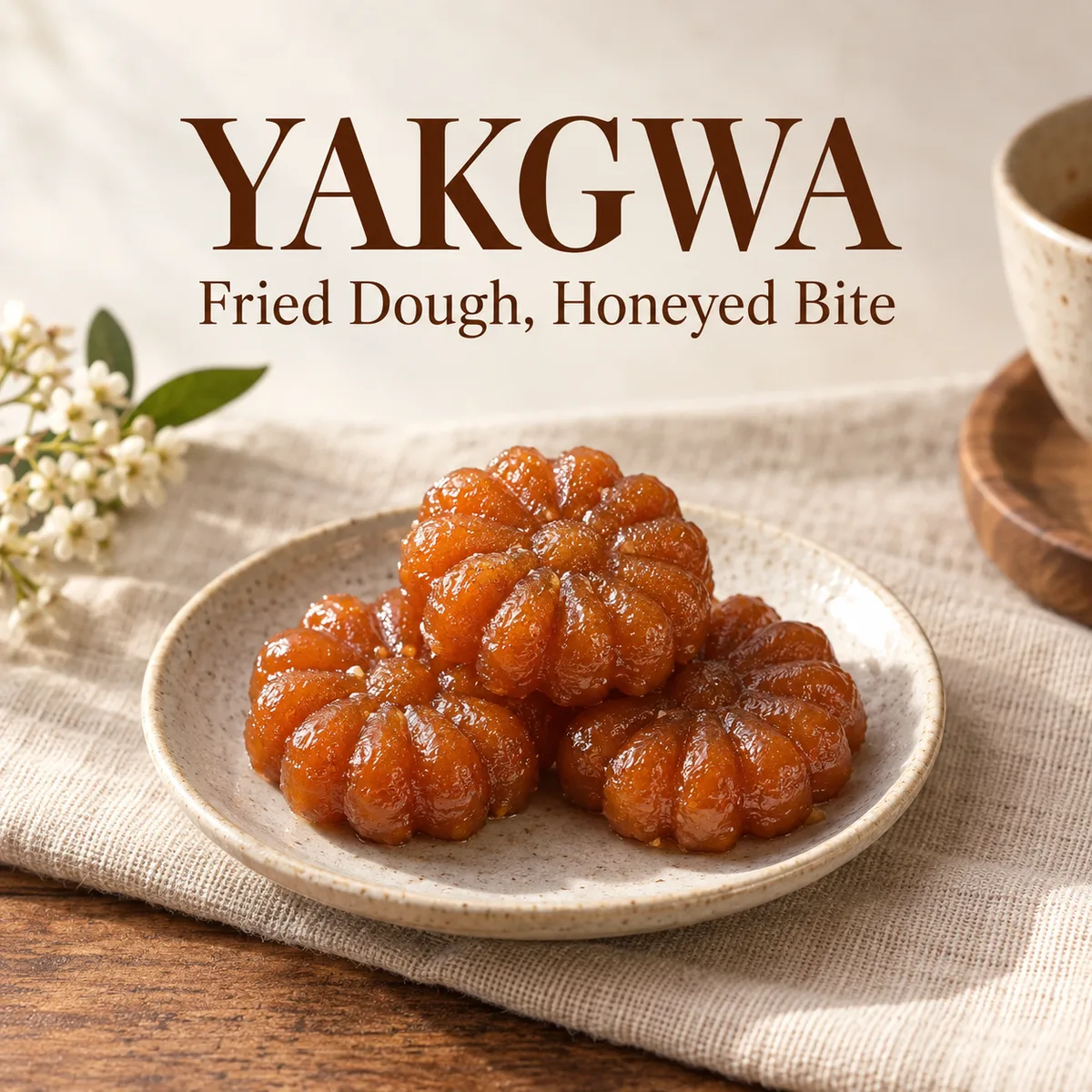
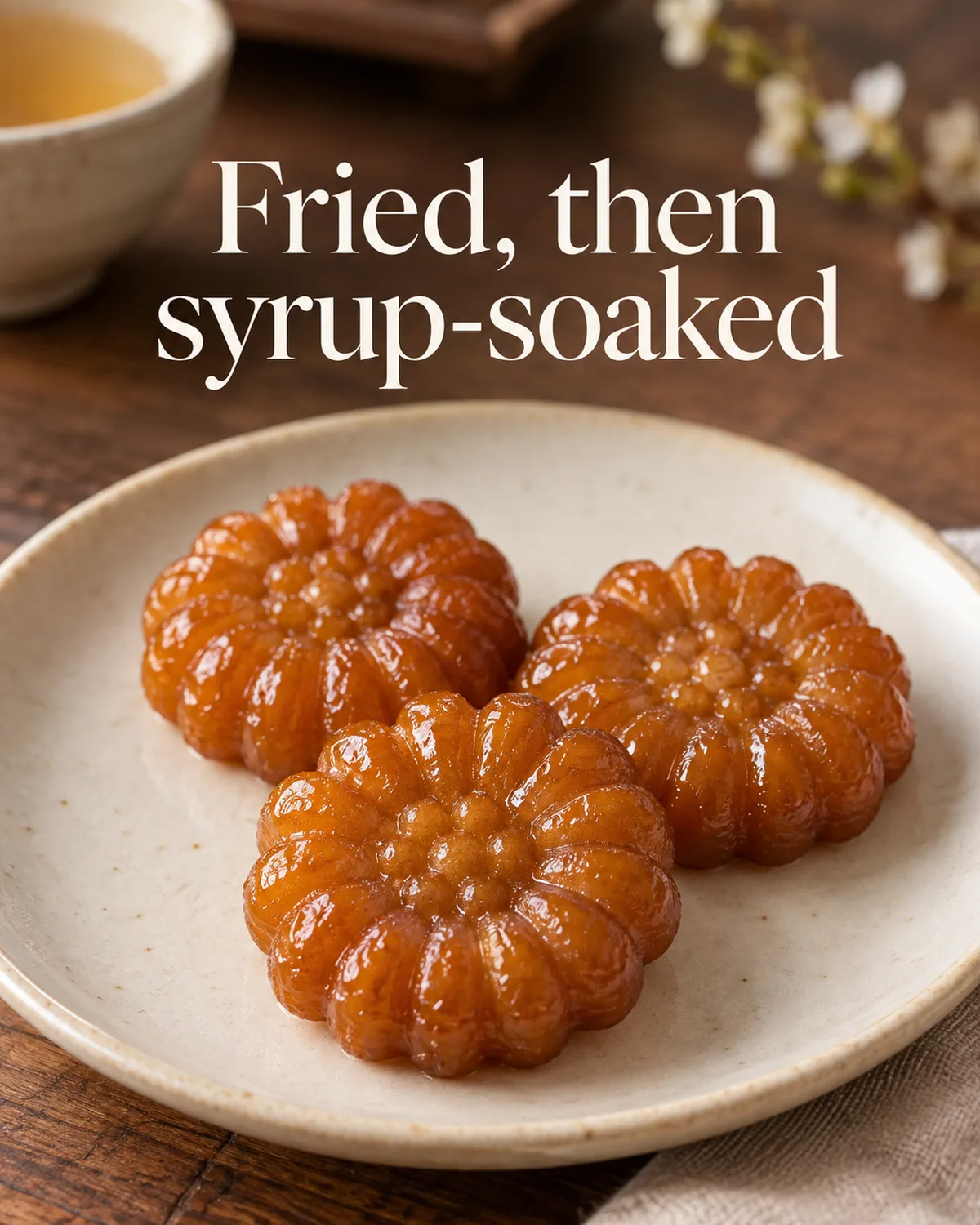
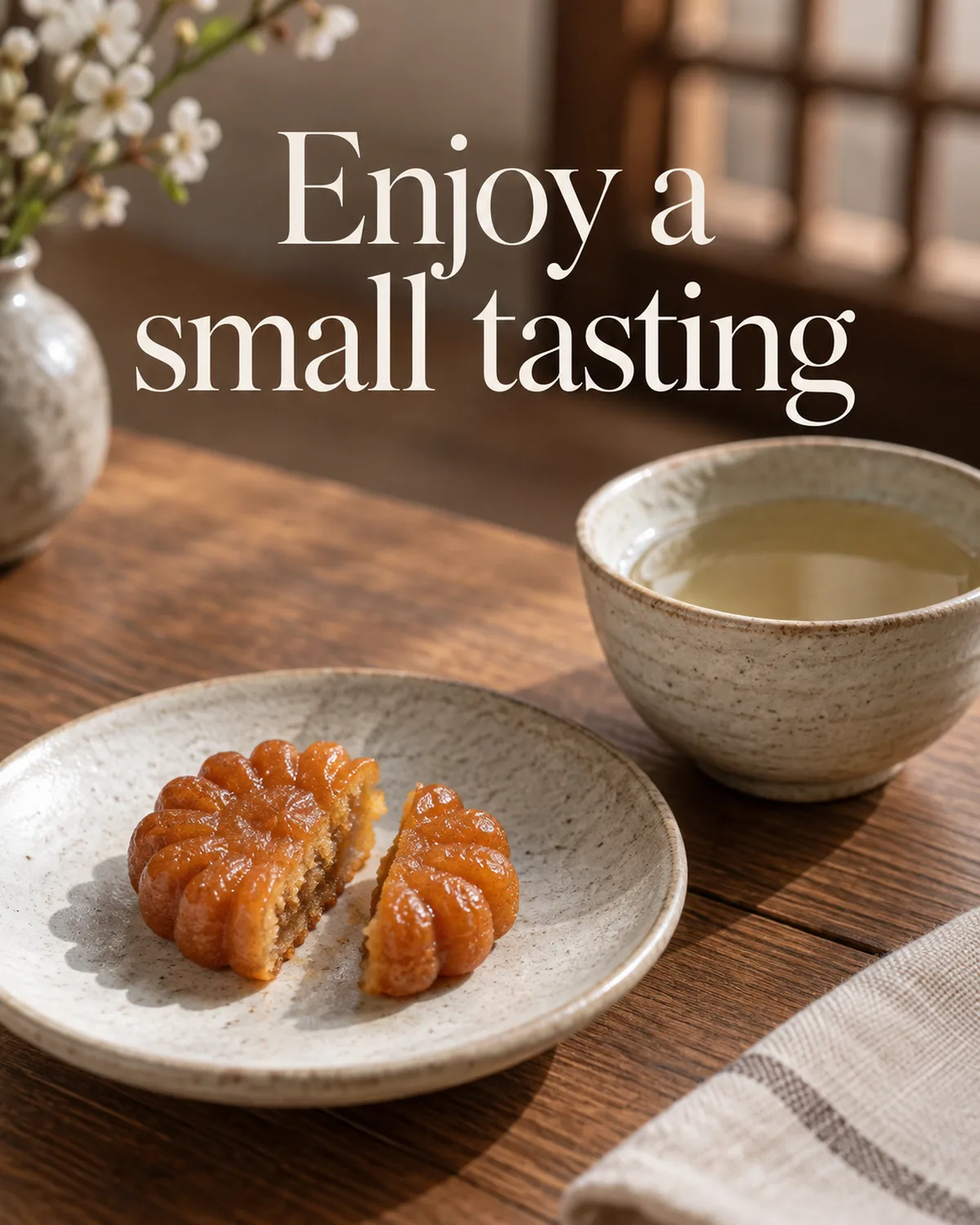
    A small flower-shaped yakgwa can look like a molded biscuit until you pick it up. Its glossy surface and substantial bite belong to a different kind of sweet: dough is fried, then soaked in syrup. Start with a small piece and notice how the edge and center behave.

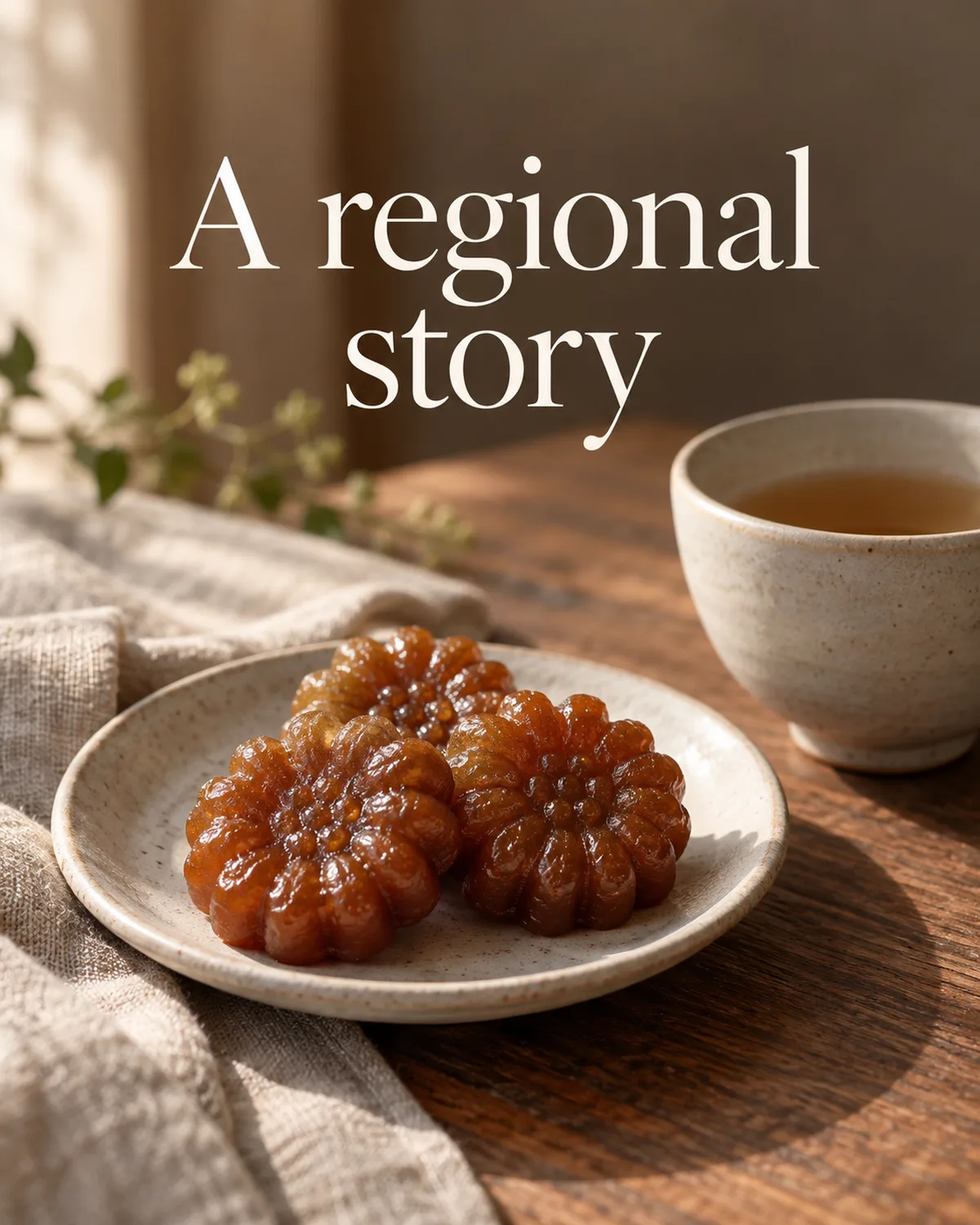
    Its older history is best understood through yumilgwa, the wider family of oil-and-honey confections. A royal association and a long tradition do not mean that every modern flower-shaped cookie follows one unchanged, thousand-year-old recipe.[2]

    Two stages shape the sweet.
    Two stages shape the sweet.

    Frying and syrup create the distinctive bite

    The Academy of Korean Studies defines yakgwa as wheat-flour dough made with honey and sesame oil, pressed into a mold and cooked in vegetable oil. It then goes into honey or grain syrup.[1]

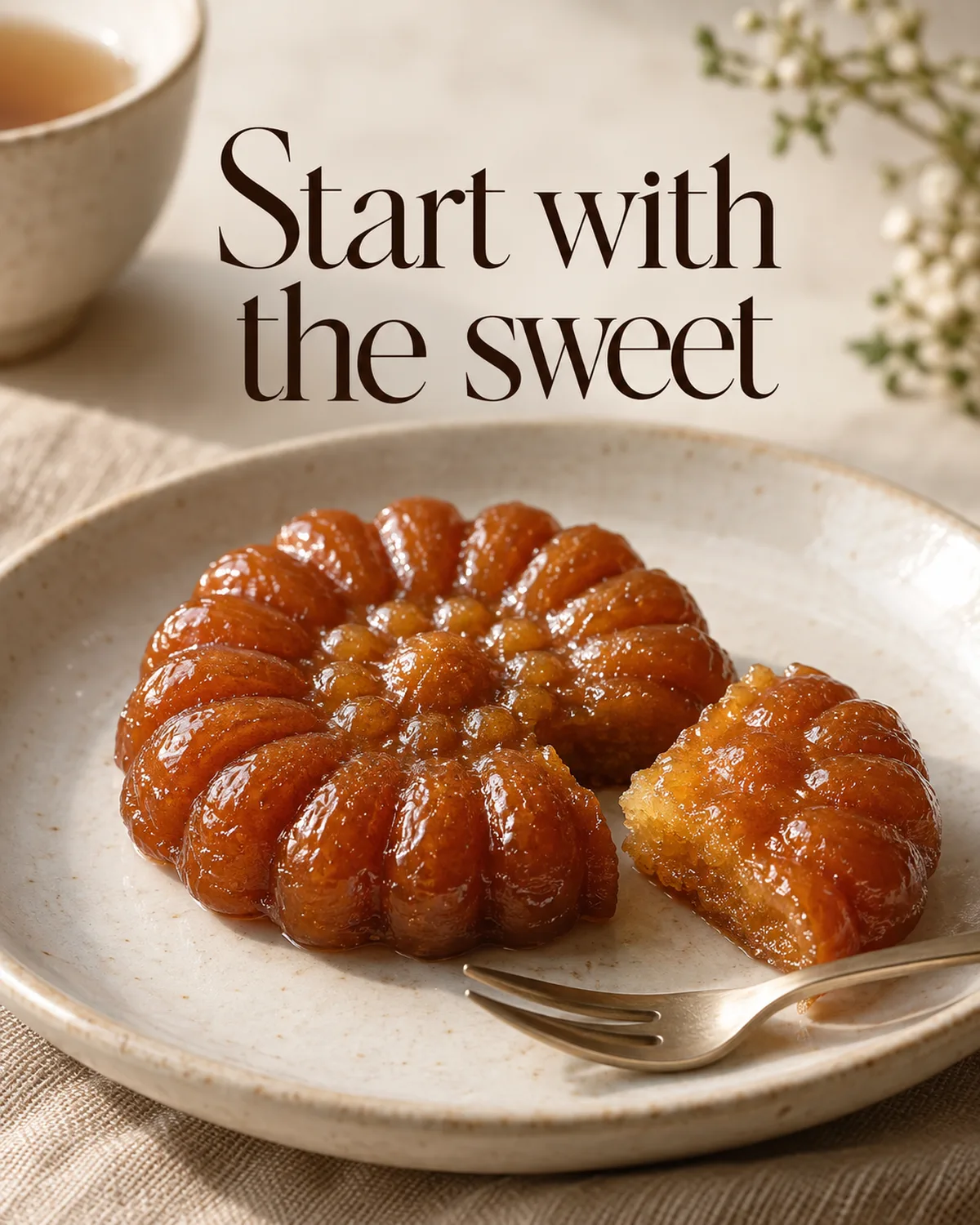
    That sequence helps explain why the word “cookie” only gets you part of the way. Look at a cut or broken piece: the inside is a cooked dough structure carrying sweetness, rather than a crisp biscuit with a thin icing on top.

    Taste an edge first, then a piece from the center. Compare resistance, softness and the way syrup coats the mouth. Different makers can deliver a firmer, more crumbly piece or a softer, denser one; a flower outline alone cannot predict the result.

    The encyclopedia’s recipe includes ginger juice and clear rice wine in the dough, with cinnamon in the soaking syrup. Those details describe a documented preparation, not an ingredient guarantee for every packaged or handmade product.[1]

    Look beyond the glossy surface.
    Look beyond the glossy surface.

    Choose the product, not just the photograph

    A molded flower is the familiar image, but shape and size vary. The same reference distinguishes small and large yakgwa and a large angular form called moyakgwa.[1]

    Ask the seller what the piece is like before buying a large box. Is the center soft, is the surface particularly sticky, and is the portion intended as one serving or for sharing? A small sample tells you more about your preference than a glossy display.

    Read the actual ingredients when they matter to you. Wheat flour, sesame oil, honey, syrup, spices and toppings need checking on the product you choose. A traditional description cannot settle substitutions, shared equipment or the composition of a cream-filled adaptation.

    For taking it home, follow the maker’s packaging and storage directions. Plain yakgwa and a dessert assembled with cream or ice cream are different products. Keep the box supported and do not assume one universal shelf life from the name.

    Ask about texture and ingredients.
    Ask about texture and ingredients.

    An old confection family, not a precise invention date

    The encyclopedia’s yumilgwa entry explicitly says its beginning is unknown. It describes the family as flourishing in Goryeo, used at rites, banquets and weddings. Its 1296 account concerns confections brought to a royal wedding in Yuan territory.[2]

    It also records restrictions in 1192 and 1353, linking extensive use to demand for grain, honey and oil. The history concerns costly ingredients and public resources as well as ceremonial prestige.[2]

    These dates establish medieval documentation of the broader family. They do not identify the first baker of today’s flower-shaped yakgwa or certify that a modern shop reproduces a medieval formula.

    The wider family includes molded, angular and dumpling-shaped forms with different names and uses. Reading yakgwa within that family leaves room for changes in shape, occasion and preparation.[2]

    Shapes and occasions have varied.
    Shapes and occasions have varied.

    Suwon adds a local story to the royal connection

    The Academy’s Suwon entry describes yakgwa as made across Joseon, with Suwon especially renowned. It discusses Yongjusa’s confections being supplied for rites at Hyeollyungwon, the tomb associated with Crown Prince Sado.[3]

    The entry also retells an account from Jeong Yak-yong’s Mokminsimseo in which King Injo requests Suwon yakgwa. That is an attributed historical anecdote in a later text, rather than a surviving order that proves one original royal recipe.[3]

    The royal connection is therefore richer than a label saying “food only kings could eat.” Local reputation, temple provisioning and ceremonial use offer more specific questions to ask about a regional sweet.

    When a shop advertises a regional style, ask what distinguishes its actual preparation. A place name can guide curiosity, but it does not replace tasting the product or checking the maker’s explanation.

    Ask what distinguishes the preparation.
    Ask what distinguishes the preparation.

    The modern revival has a date

    A Korea Tourism Organization article published on February 2, 2024 described young consumers queuing for yakgwa and competing to secure sought-after products, using the term “yaketing.” It also described yakgwa cookies, financiers and ice cream.[4]

    That dated account helps explain the sweet’s modern visibility. It is evidence of a reported revival, not a live ranking of Korea’s most popular dessert or a promise that a particular shop still has the same queues.

    Notice what the dessert adds.
    Notice what the dessert adds.

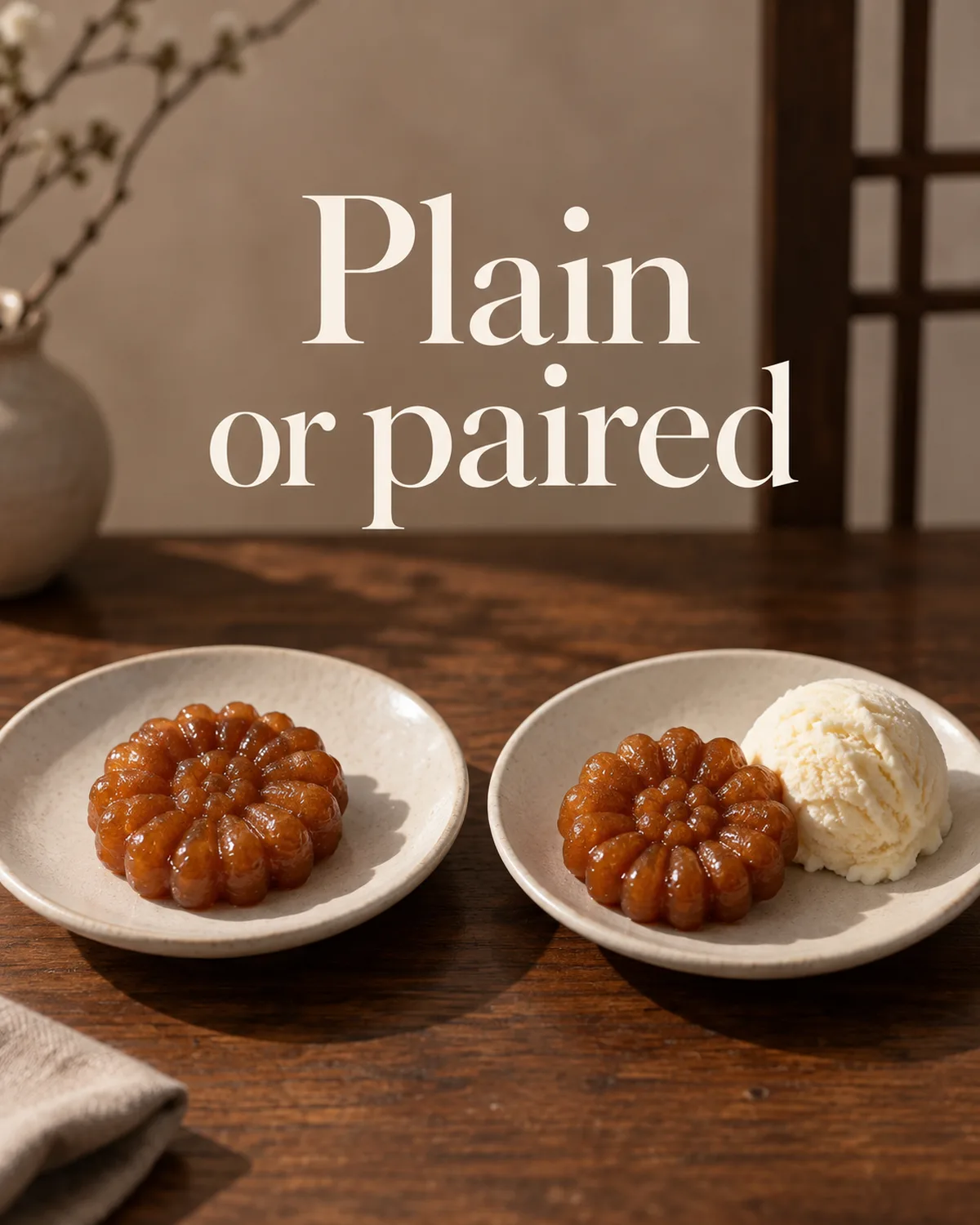
    A plain piece lets you concentrate on the fried dough and syrup. In a composed dessert, ask whether yakgwa is an intact topping, broken pieces or part of the filling; cream and frozen elements change the balance and the eating method.

    If comparing versions, begin with a small plain piece before a richer adaptation. You can then distinguish the sweet itself from the dessert built around it, rather than judging both by the same expectation.

    Compare a small plain bite first.
    Compare a small plain bite first.

    A small tasting is enough to start

    Set one piece on a plate and divide it if the portion feels substantial. Try a bite by itself, then take a sip of an unsweetened drink you enjoy. Notice whether the pairing changes how strongly you perceive the syrup, spice or toasted notes.

    The name’s connection with honey belongs to its food history; it is not a reason to treat the confection as medicine. Enjoy yakgwa as a sweet whose technique, regional stories and modern variations reward attention.[1]

    Texture, aroma and a drink you like.
    Texture, aroma and a drink you like.

    Explore other Korean sweets

    Sources and reading

    1. 한국민족문화대백과사전 — 약과 (Yakgwa)
    2. 한국민족문화대백과사전 — 유밀과 (Yumilgwa)
    3. 한국민족문화대백과사전 — 수원약과 (Suwon Yakgwa)
    4. Korea Tourism Organization — Gen Z’s Choice of Traditional Desserts, February 2, 2024
  • Korean BBQ Guide: Why Koreans Are Obsessed With K-BBQ — and the King Who Couldn’t Stop Eating Meat

    Korean BBQ Guide: Why Koreans Are Obsessed With K-BBQ — and the King Who Couldn’t Stop Eating Meat

    Korean barbecue becomes less intimidating when the first decision is the meat rather than the wrap. An unmarinated fatty cut and a sweetly marinated portion ask different things of the grill and leave different room for the accompaniments.

    The tabletop arrangement matters just as much. Heat, shared plates, sauces and leaves let a meal develop through small decisions instead of arriving as one finished personal plate.

    The table, not just the grill

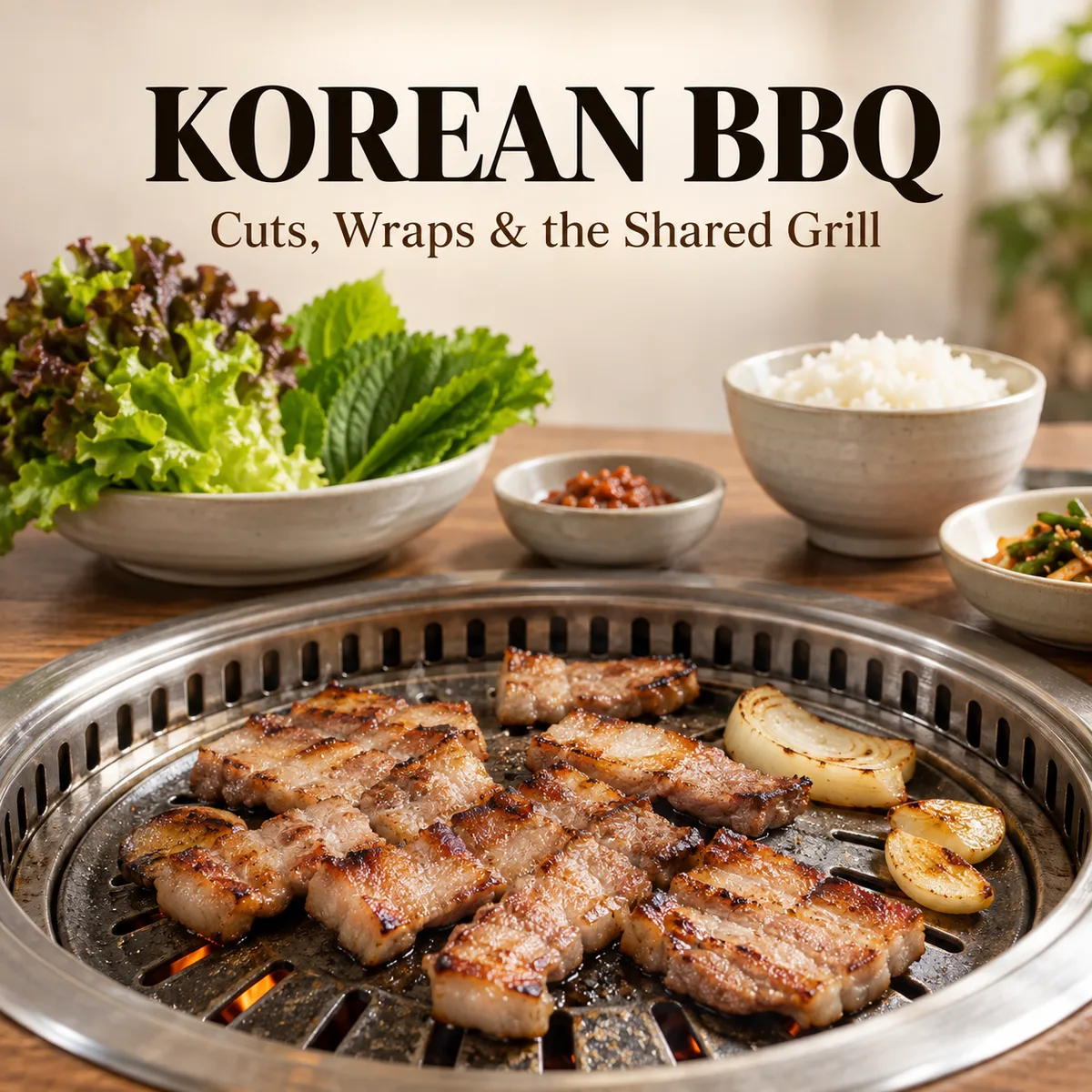
    At a Korean barbecue table, the meat order establishes the meal’s direction. Pork belly emphasizes rendered fat and browned edges. Thin marinated beef brings sweet-soy seasoning. Rib meat has another shape and chew. Leaves, sauces and side dishes let each diner adjust a cooked bite rather than committing to one finished sauce over the whole plate.

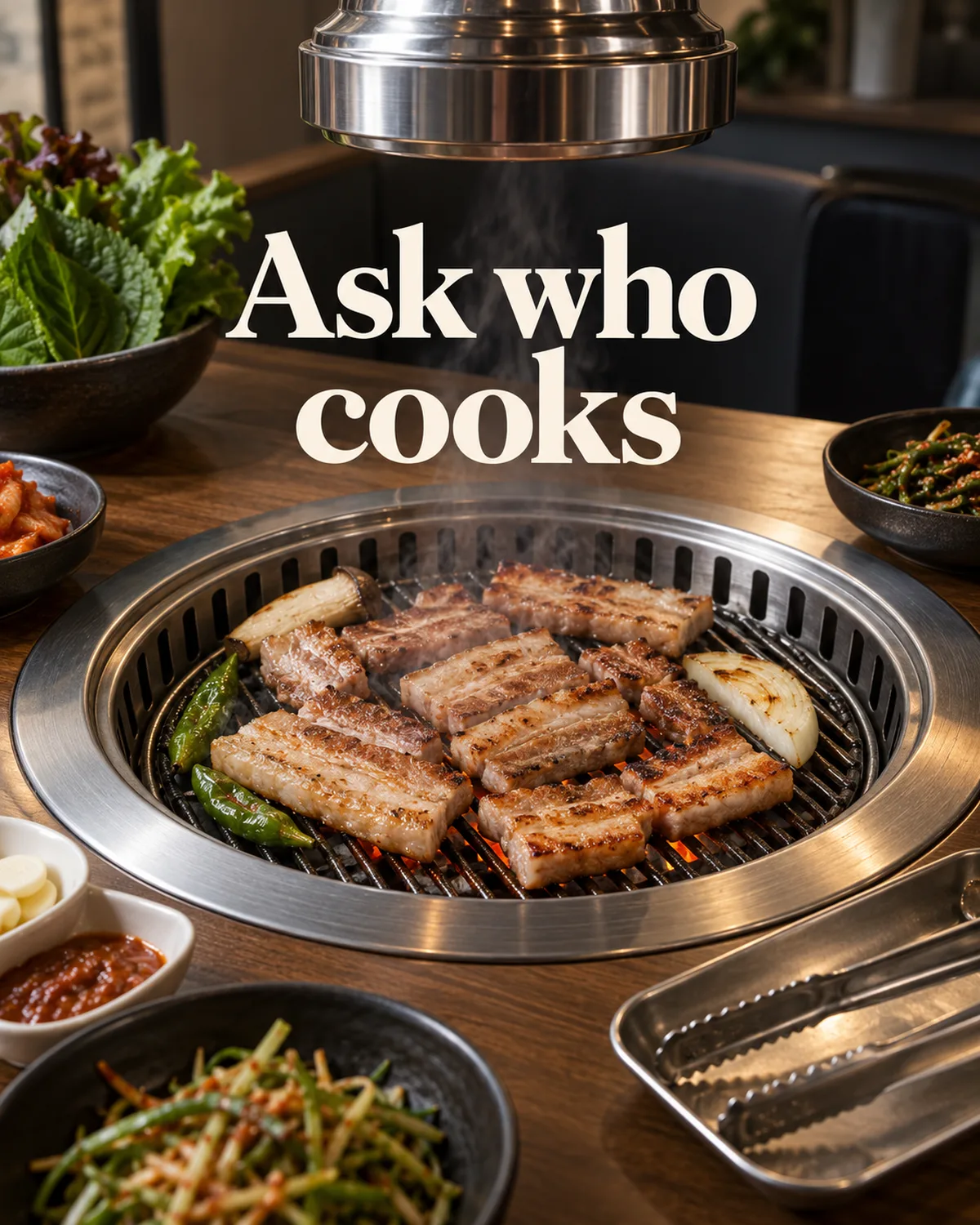
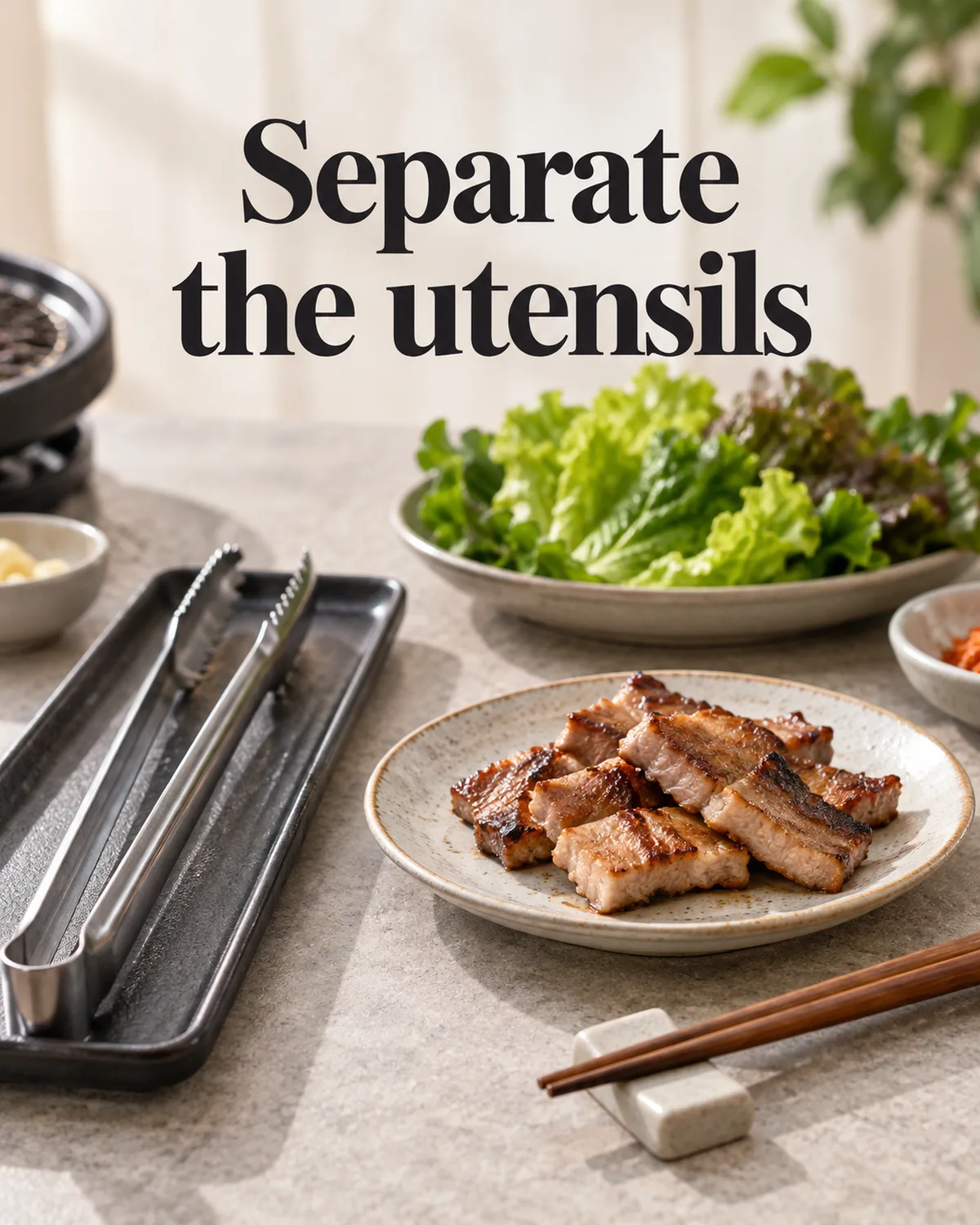
    Before touching the tongs, ask who cooks. Staff may handle every round, help with the first order or leave the grill to customers. Confirm where cooked pieces should go and which utensils are for raw meat. Knowing the restaurant’s service style makes the shared table easier to use.

    Internationally, “Korean BBQ” often sounds like the name of one cuisine item. In Korea, the same restaurant format can serve very different cuts and seasoning systems.

    • Samgyeopsal: pork belly, commonly ordered without marinade; fat, browned edges and accompaniments lead the experience.
    • Bulgogi: thin marinated beef; ask whether it is grilled or cooked in a pan with liquid.
    • Galbi: rib meat; check the animal, cut and whether the order is marinated.
    • Fresh beef: an unmarinated cut lets the meat’s own flavor lead.

    The table can look similar while the culinary logic changes. A fatty pork belly meal is about rendering and contrast. Bulgogi is about marinade penetration and thin slicing. Fresh beef puts more pressure on ingredient quality and heat control. Treating all of them as one “K-BBQ flavor” erases the reason diners choose one format over another.

    Pork belly, marinated beef and ribs create different meals.
    Pork belly, marinated beef and ribs create different meals.

    Bulgogi: an older name and different modern cooking styles

    The Academy of Korean Studies defines bulgogi as thin, broad beef slices marinated and grilled. It says neobiani was an earlier name used in the court and Seoul yangban households. The same entry presents a proposed connection with maekjeok, skewered meat grilled over direct heat. That longer ancestry is a theory rather than a surviving chain of identical recipes.[1]

    Bulgogi today also varies by cooking vessel. VISITKOREA describes a pan-cooked version with broth or water and a separate grilled version cooked directly over fire. Ask which style the menu offers: a juicy pan preparation and smoky grilled beef can share a name while creating quite different meals.[2], [3]

    Bulgogi can be grilled or cooked with liquid in a pan.
    Bulgogi can be grilled or cooked with liquid in a pan.

    Sejong’s meat story was a debate about mourning

    An Annals entry dated the 21st day of the ninth lunar month in Sejong’s fourth reign year, 1422, records officials urging him to resume meat during mourning. They said he ordinarily found meals without meat difficult and feared for his health. Sejong refused: he said he was not ill and asked why he alone should be unable to eat vegetable food when monks did so. The record preserves his restraint as well as the officials’ description of his usual preference.[6]

    That exchange explains the royal anecdote more carefully than saying a king could never stop eating meat. It does not identify a modern barbecue order, its marinade or a restaurant ritual. Sejong’s mourning debate and today’s shared grill are different contexts; the former is an interesting record, not an origin certificate for the latter.

    Sejong declined meat during the recorded mourning debate.
    Sejong declined meat during the recorded mourning debate.

    Unmarinated pork, bulgogi and galbi need different attention

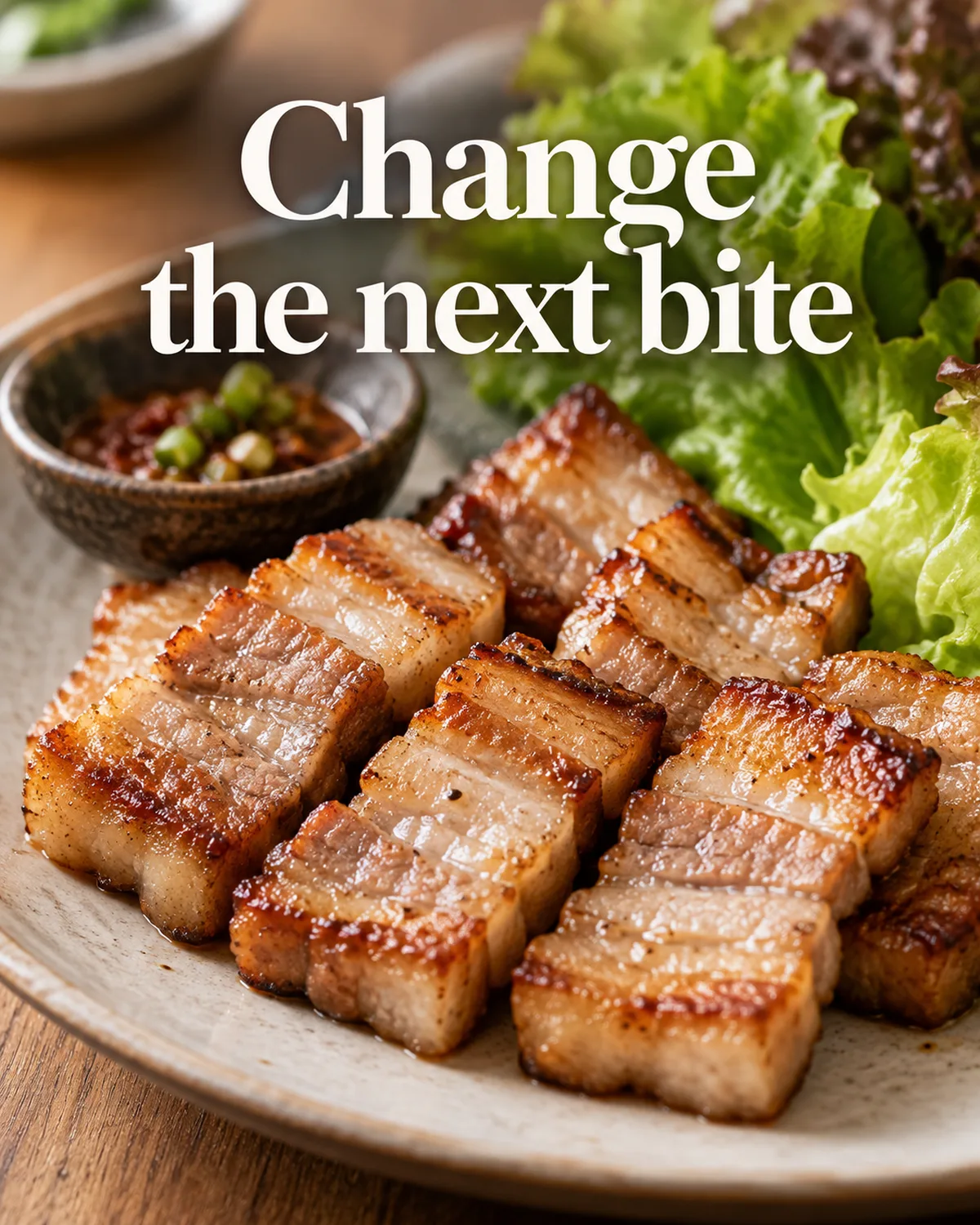
    Samgyeopsal means pork belly. VISITKOREA describes grilling it on a hot plate and pairing the cooked meat with chili-and-soybean seasoning or sesame oil and salt, with lettuce or garlic as accompaniments. For a relatively plain pork-belly order, those additions provide several ways to change the next bite.[4]

    Because the pork starts relatively plain, diners can change each bite. One piece may go into lettuce with ssamjang. Another may be dipped in salt and sesame oil. Another may be eaten with kimchi. This modularity is one reason samgyeopsal suits a shared table so well.

    A cooked pork-belly piece can be tasted plain or with accompaniments.
    A cooked pork-belly piece can be tasted plain or with accompaniments.

    With sweet-soy marinated meat, watch the grill surface as well as the piece of meat. Sticky seasoning can darken or burn as cooking continues. Ask staff about changing the grate or adjusting heat when sauce residue accumulates; a fixed cooking time cannot account for every cut, thickness and grill.

    Galbi has a different geometry. Rib meat may be cut across or around the bone, sometimes unfolded into thinner strips. A marinated galbi order therefore combines the flavor of the seasoning with connective tissue, fat and the tactile experience of meat near bone.

    There is no universal order, but there is a sensory reason to begin with subtler meat. Strong sweet-soy marinades leave sugar, garlic and sauce on the palate and often on the grill. If a table plans to compare fresh beef with marinated galbi, the fresh cut first makes differences easier to taste.

    Pork and beef order can also depend on the grill plate and staff sequence. Some restaurants change grills between categories to prevent burnt sauce and carryover flavors. Asking the staff what should go first is often more useful than following an internet rule.

    Follow the restaurant’s grill and service sequence.
    Follow the restaurant’s grill and service sequence.

    Build a wrap that lets you taste the meat

    A manageable ssam begins with one leaf, a cooked meat piece and a small amount of condiment. Add rice, garlic or a side dish if you want them. Keep the filling modest enough that the leaf can fold around it without sauce dripping across the table.

    Try the first properly cooked piece with minimal seasoning, then compare another with ssamjang or a wrap. The leaf adds texture; the condiment supplies concentrated seasoning. This small comparison helps you decide how much sauce suits the cut instead of masking every order with the same large dollop.

    A modest leaf wrap leaves the meat and condiment easy to taste.
    A modest leaf wrap leaves the meat and condiment easy to taste.

    USDA FSIS advises using a food thermometer to establish safe cooking and keeping clean plates and utensils for cooked food. Meat can brown quickly on the outside before it is safely cooked. At a restaurant, follow staff’s cooking instructions and ask for help with doneness; do not move cooked meat onto the plate that held the raw order.[5]

    Read the minimum order before deciding the group’s mix. Ask whether it applies per person, per meat type or to the table, and whether rice, stew or noodles are extra. The menu’s grams per portion and included items are more useful than a price remembered from an old travel article.

    Side dishes and scissors have practical jobs

    Korean barbecue tables often arrive with kimchi, pickles, seasoned vegetables or other side dishes before the meat is cooked. These dishes are not random decoration. They create acidity, crunch, freshness and fermented flavor around rich meat.

    For side-dish refills, ask what the house includes. The policy for basic vegetables can differ from an added special salad or premium side. Confirm before ordering more rather than assuming that the phrase Korean BBQ promises one unlimited package.

    Scissors portion long meat strips directly at the grill. Let the staff demonstrate if the handling is unfamiliar, and keep the cutting tools and tongs in the restaurant’s designated places. A separate eating utensil makes it easier to keep raw-meat handling away from your rice and leaves.

    Changing utensils matters after raw meat has been handled. USDA FSIS guidance says not to reuse raw-food plates or tools for cooked food unless they have been washed. The same separation applies to ready-to-eat leaves and side dishes, even while several people share the grill.[5]

    Keep raw-meat handling tools away from cooked food and ready-to-eat sides.
    Keep raw-meat handling tools away from cooked food and ready-to-eat sides.

    Who cooks the meat, and how the restaurant handles smoke

    Some places cook premium cuts for the table, while others expect self-grilling. Staff assistance can keep the cooking consistent and does not make the meal less Korean. Watch the service style and ask before taking over the tongs.

    You will often see an exhaust tube above the grill or another ventilation system near the table. Keep bags, sleeves and loose belongings away from the hot cooking area. If coat storage is available, use it before grilling begins; clothes may still retain some food or smoke odor.

    Choose your first barbecue order by cut and portion

    • For pork-belly texture: start with samgyeopsal and compare plain, lightly seasoned and wrapped bites.
    • For sweet-soy beef: choose bulgogi and confirm the cooking vessel.
    • For ribs: choose galbi and check the cut and marinade.
    • For minimal seasoning: ask about an available fresh-beef cut and its portion.

    For a first visit, choose the cut and seasoning you want, confirm the portion and who cooks, and leave room for rice or a finishing dish. Start with a modest wrap and build the next bite differently. Those decisions make the meal more enjoyable than trying to follow a supposedly universal sequence.

    Check meat portions, rice and finishing dishes before ordering.
    Check meat portions, rice and finishing dishes before ordering.

    Sources and reading

    1. Academy of Korean Studies — Bulgogi
    2. VISITKOREA — Bulgogi
    3. VISITKOREA — Grilled Bulgogi
    4. VISITKOREA — Grilled Pork Belly
    5. USDA FSIS — Barbecue and Food Safety
    6. Annals — Sejong4, lunar month9, day21 (1422)
  • Boknal Foods: Samgyetang, Cold Noodles and Korea’s Summer Meal Choices

    Boknal Foods: Samgyetang, Cold Noodles and Korea’s Summer Meal Choices

    A whole small chicken in hot broth and a bowl of chilled noodles can both make sense on a Korean summer menu. The choice begins with the kind of meal you want: chicken and rice in one bowl, a pot to share, or noodles whose temperature and chew lead the experience.

    Boknal names three traditional summer observances: chobok, jungbok and malbok. The Academy of Korean Studies explains their calculation through the seasonal calendar. They mark the hot season; they are not selected afterward by finding the three highest readings on a thermometer.[1]

    The BTS framing in the headline is an invitation to learn about the foods, rather than a verified menu for the members. The food sources here describe the seasonal custom and dishes. They do not establish a current member-by-member boknal routine, so those private eating claims should not guide your order.

    For a concrete date reference, the tourism organization’s July 2026 guide lists July 15, July 25 and August 14 as that year’s three sambok dates. Those dates are now past. The dishes still provide useful choices beyond a single calendar occasion.[3]

    Chobok, jungbok and malbok belong to the seasonal calendar.
    Chobok, jungbok and malbok belong to the seasonal calendar.

    Open the chicken to find the rice

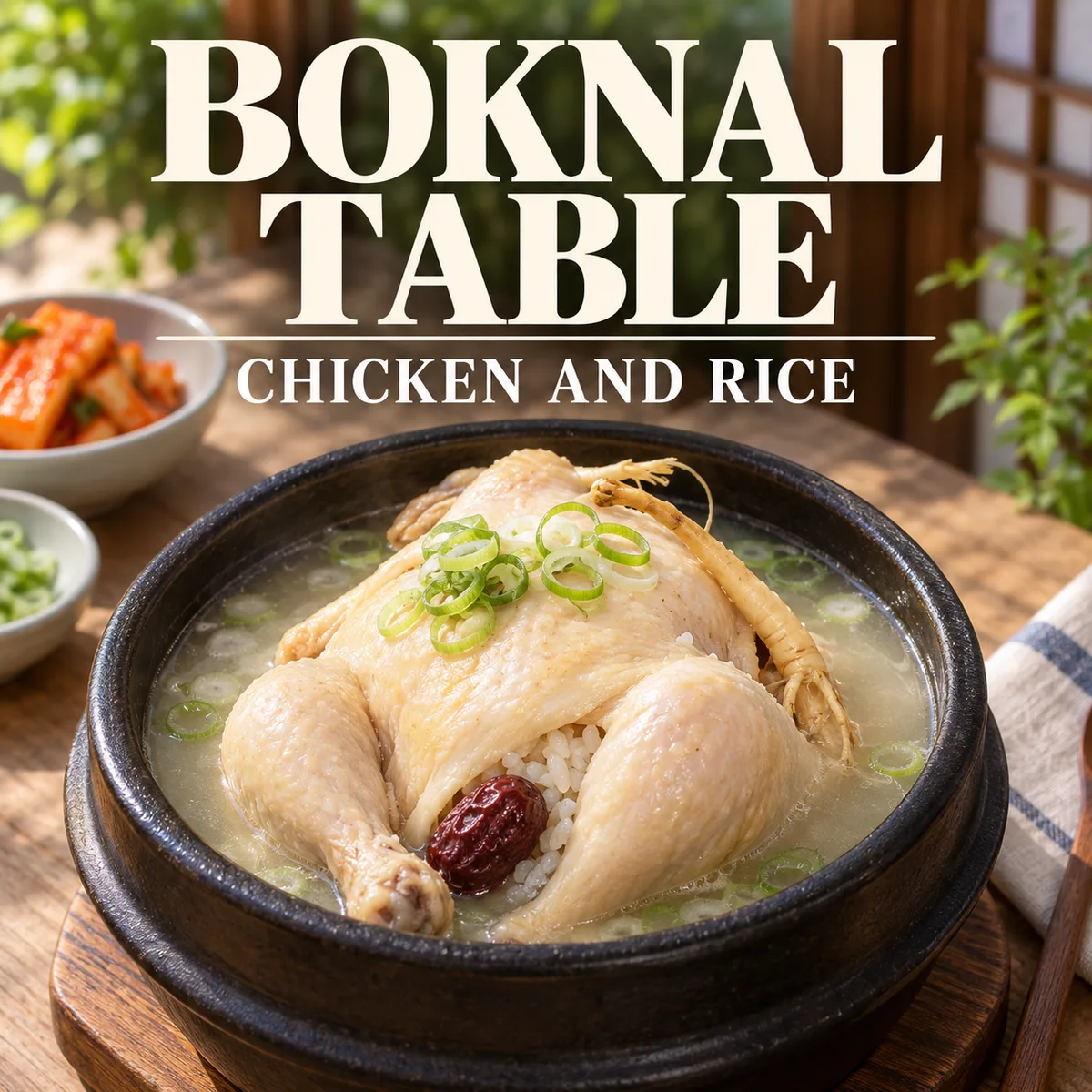
    VISITKOREA describes samgyetang as a young chicken stuffed with sweet rice, garlic, jujube and ginseng, then simmered. This gives the bowl more structure than a plain cup of broth: a bird sits in the liquid, and part of the meal is inside it.[2]

    Before you pull the chicken apart, notice where the cavity opens. Separating a little meat makes the rice easier to see. Move a manageable portion toward the edge of your bowl instead of trying to lift the entire bird at once.

    Try broth, meat and filling separately for the first few bites. The rice is softer than a separate bowl of steamed rice, and a piece of chicken brings a different texture. Keeping them distinct briefly helps you understand what the bowl contains.

    Table salt or other condiments may be offered for adjustment. Begin by tasting what is served, then add a little if you want it. The presence of a condiment dish does not mean the whole amount belongs in the soup.

    Opening the small chicken reveals the rice filling.
    Opening the small chicken reveals the rice filling.

    A shared chicken pot changes the occasion

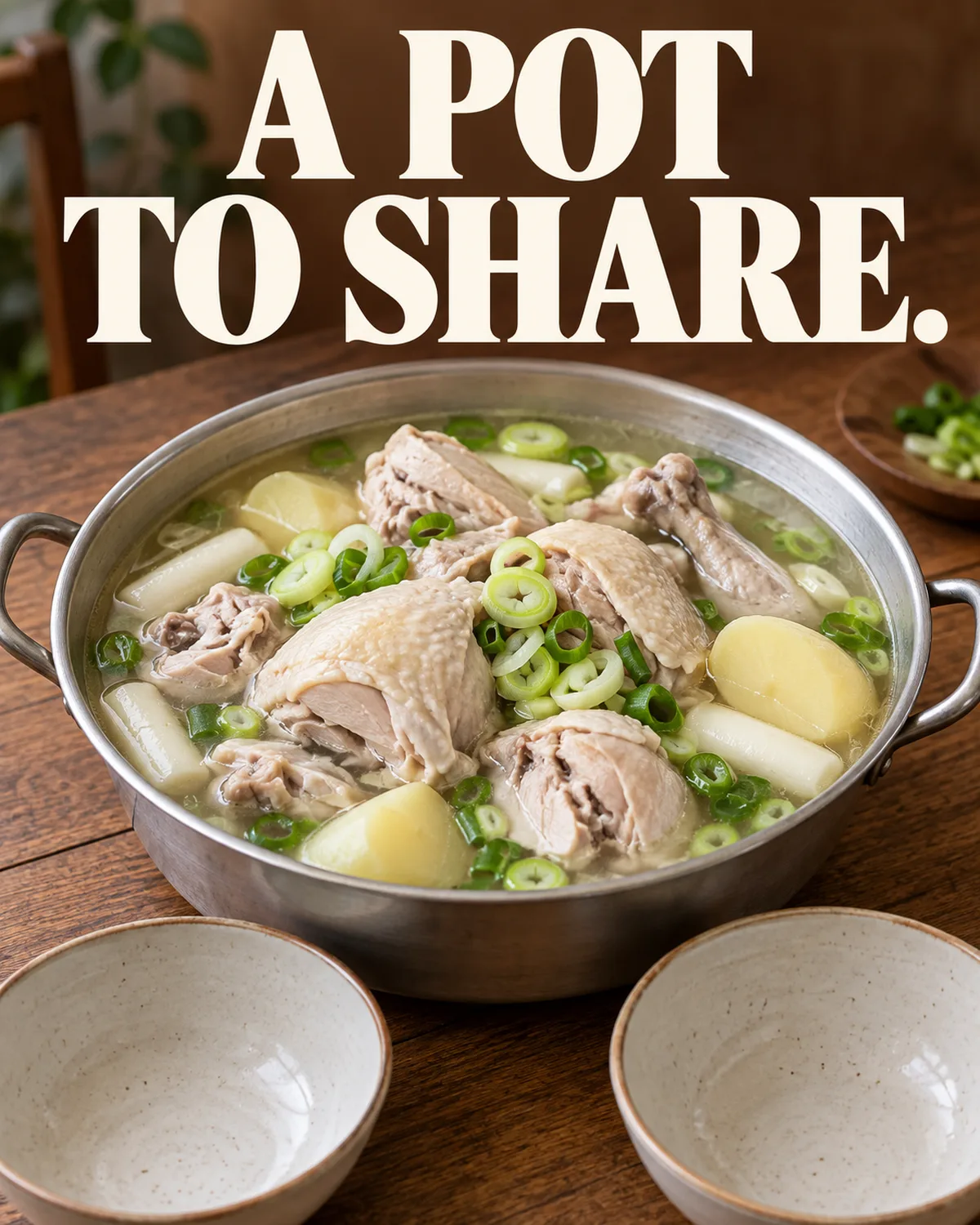
    The tourism guide describes dakhanmari as a whole-chicken hot pot with ingredients such as green onion, potato and rice cakes. Its dipping sauce and later noodle or rice additions create a different format from an individual stuffed-chicken bowl.[3]

    Start the order by asking how many people the listed pot serves. A whole bird can appear in both preparations, but the size, accompaniments and way the restaurant serves it matter. The name alone cannot settle the portion for your table.

    With a shared pot, take pieces into a personal bowl and use the serving utensils provided. This gives everyone access to the broth and chicken without each diner working on the same piece. Ask the staff about the sequence if the pot arrives in stages.

    Discuss additions before the liquid has nearly disappeared. If the restaurant offers a later finish, ask when it should be ordered and what it includes. A noodle or rice stage is part of a particular menu, rather than an automatic entitlement everywhere.

    A shared chicken pot creates a different meal format from an individual bowl.
    A shared chicken pot creates a different meal format from an individual bowl.

    Cold noodles offer a different texture

    Naengmyeon is another summer choice in the tourism guide, with broth-based and spicy-sauce styles. The useful distinction is between a chilled liquid surrounding the noodles and a sauce mixed through them. Read which version the menu actually offers.[3]

    For a broth bowl, taste the liquid before adding anything from the table. Lift a small portion of noodles and notice how the chew contrasts with the cold broth. A bowl can be chilled without all of its ingredients tasting mild.

    For a sauce version, mix enough to coat the noodles evenly before deciding whether you want more seasoning. The top of an unmixed mound is a poor sample of the whole bowl. Garnishes can offer a separate bite before they are folded through.

    Choose manageable mouthfuls. If you want the noodles cut, ask the restaurant for help or the utensils it uses. Enjoying the texture does not require struggling with an oversized tangle.

    Cold broth and mixed sauce lead to different naengmyeon mouthfuls.
    Cold broth and mixed sauce lead to different naengmyeon mouthfuls.

    The seasonal story holds more than one dish

    The Academy’s account includes chicken preparations, red-bean porridge and seasonal fruit in the wider custom. That variety matters: boknal is a seasonal occasion with a history, rather than a rule that every Korean eats an identical modern restaurant bowl.[1]

    The expression iyeol-chiyeol, often rendered as fighting heat with heat, belongs to the cultural explanation of hot summer food. Treat it as a food custom, not as evidence that a bowl has a measurable stamina score or guarantees recovery.

    Temperature is one part of preference. Some diners want a substantial hot soup; others want the chill and chew of noodles. A group can share the occasion without every person choosing the same food.

    The food can also be the reason to visit on a quieter day. You do not have to reproduce a particular calendar date or a performer’s presumed routine to understand a chicken bowl. The meal’s ingredients and serving format remain available to notice.

    Hot chicken soup and chilled noodles can suit different appetites.
    Hot chicken soup and chilled noodles can suit different appetites.

    Choose a meal that fits the table

    For one person, an individual chicken-and-rice bowl makes the portion easy to discuss. For friends who want to linger, a shared pot may make more sense. For someone seeking chilled noodles, the broth or sauce choice becomes the first question.

    Ask what comes with the main order before adding another starch. Rice inside a chicken, noodles after a shared pot and dumplings beside cold noodles produce different amounts of food. Count the people and their appetites instead of ordering by the photograph alone.

    Check the actual broth, noodle ingredients and garnishes when restrictions matter. A cold bowl can contain meat stock, and a chicken preparation can include additions beyond the familiar short description. The kitchen’s information is more useful than removing one visible topping.

    Choose the restaurant for the format you want, then check its current menu and ordering arrangements. Once the food arrives, start with a small taste, find the rice or separate the noodles, and let the bowl explain the season through its temperature, texture and portion.

    An individual bowl and a shared pot call for different ordering decisions.
    An individual bowl and a shared pot call for different ordering decisions.

    Explore the seasonal dishes

    Sources and reading

    1. 한국민족문화대백과사전 — 복날 (Boknal), Academy of Korean Studies
    2. VISITKOREA — Ginseng Chicken Soup, October 19, 2023
    3. VISITKOREA — Seven Korean summer foods, July 15, 2026
  • Lisa’s Gamjatang Memory: Pork-Bone Stew and the Dates Behind Her 2026 Projects

    Lisa’s Gamjatang Memory: Pork-Bone Stew and the Dates Behind Her 2026 Projects

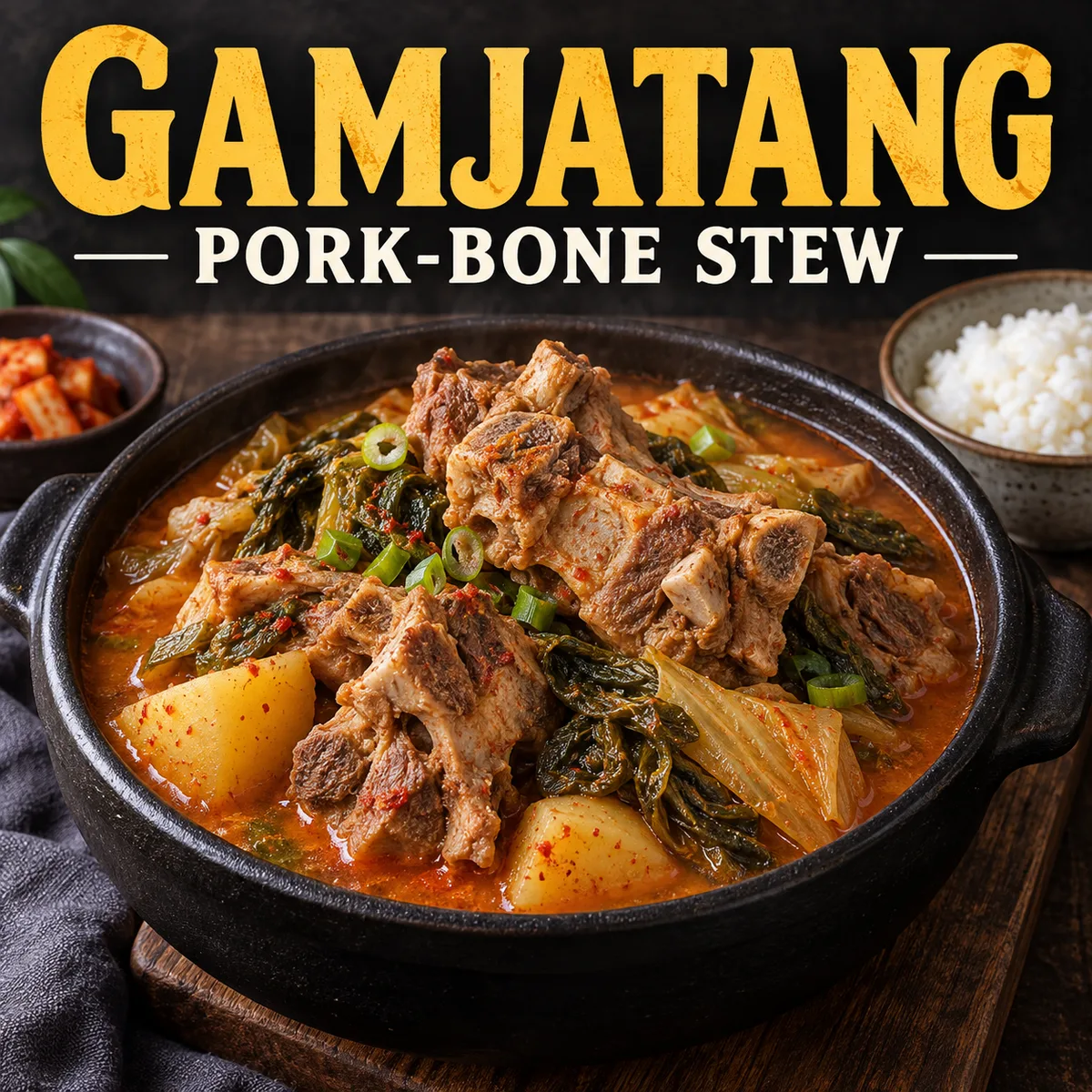
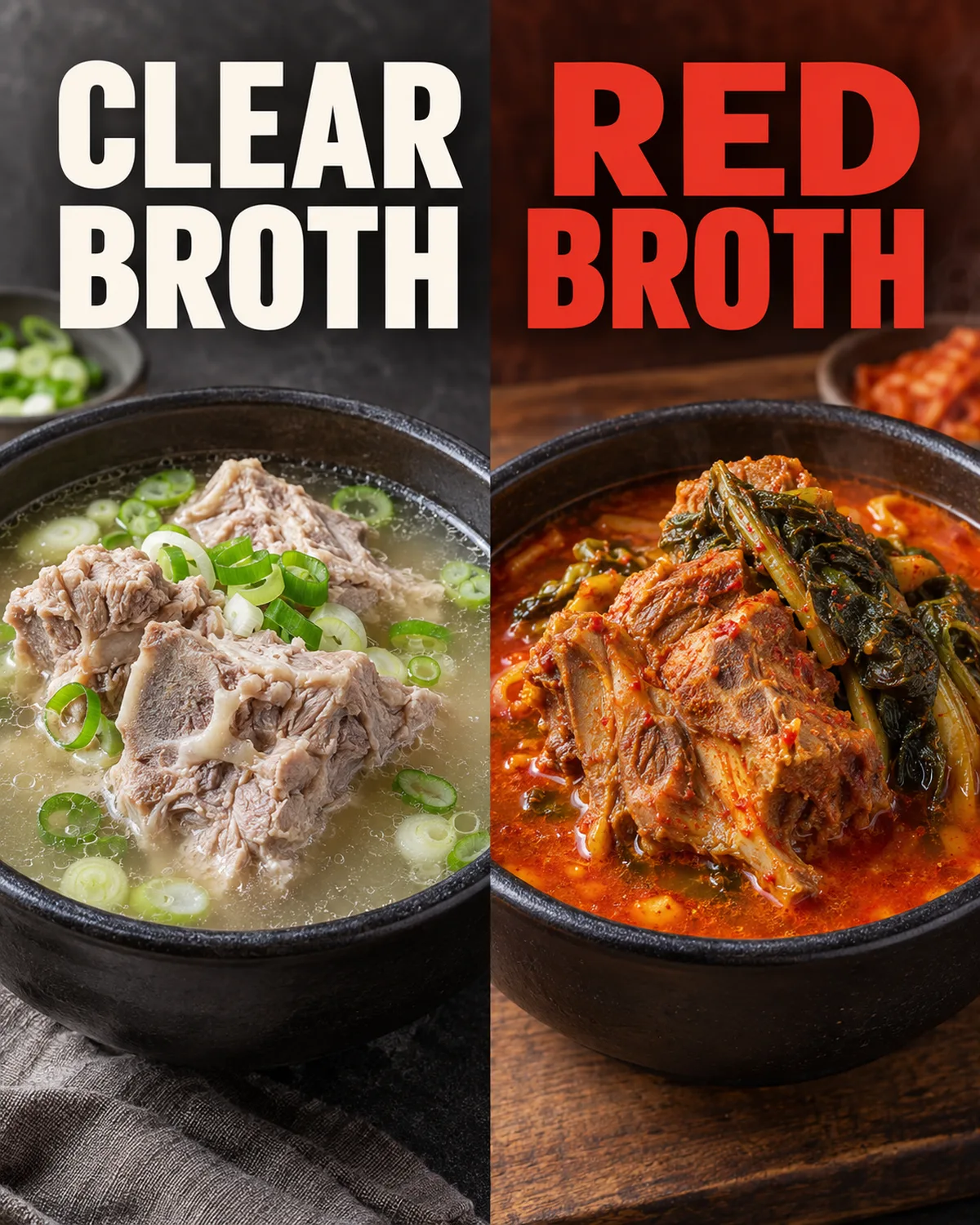
    A gamjatang pot can look crowded before anyone takes a bite: irregular pork bones rise above the broth, while vegetables settle between them. The useful question is how much tender meat sits around those bones. A tall pile and a generous edible portion are different things.

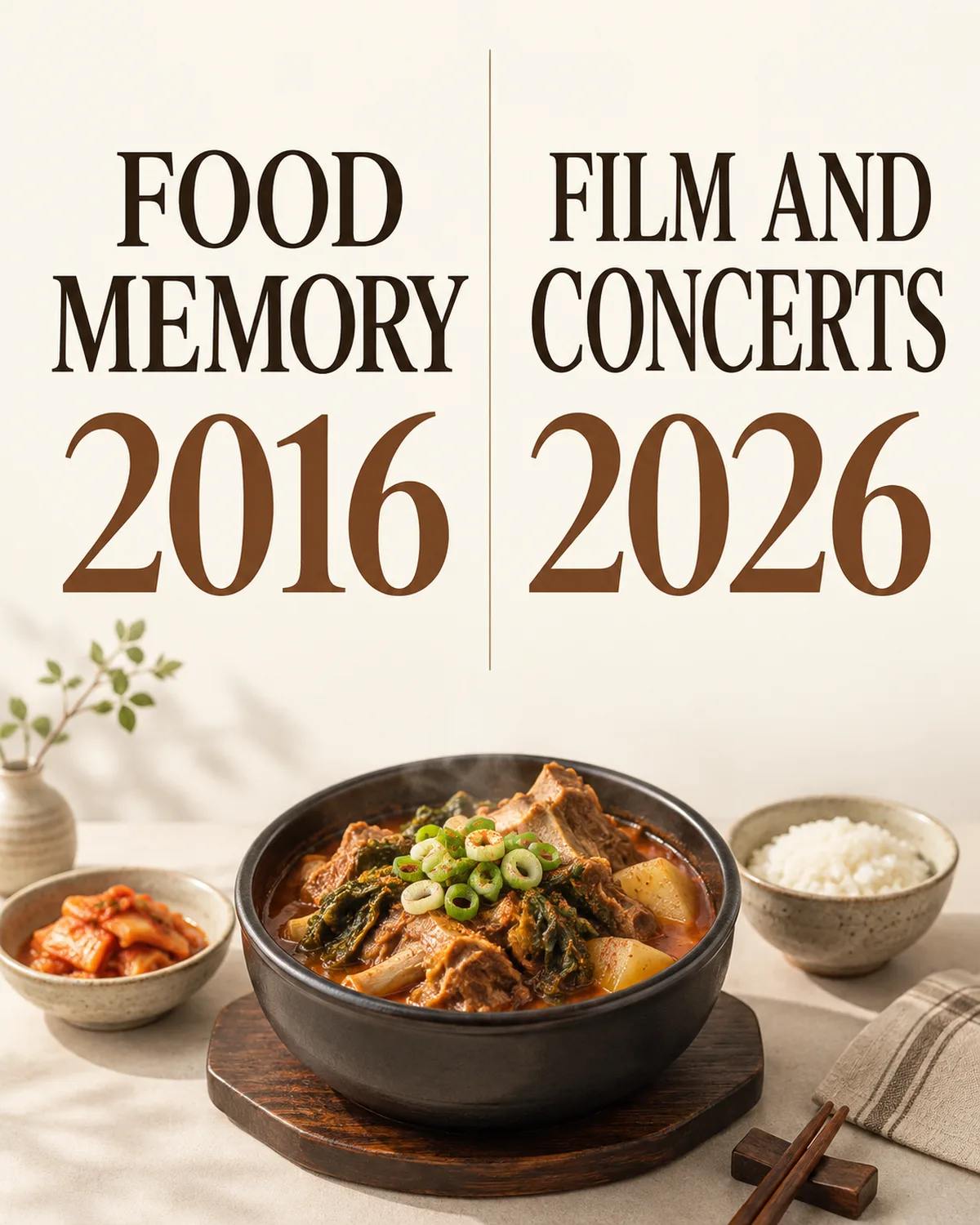
    Lisa’s connection is a dated food memory. In a November 3, 2016 YG LIFE interview, she recalled trying gamjatang after coming to Korea and enjoying it. That record introduces the dish without claiming to know her current meals or private routine.[1]

    The entertainment dates in the headline also need their current context. Sony’s September 2, 2026 announcement schedules Sue Kim’s Always, LALISA for a limited IMAX and cinema release on October 12, followed by YouTube Premium later in 2026. That announcement gives October 12, 2026 as the theatrical start date and supplies no exact streaming date. Check current cinema listings and streaming availability before making plans.[2]

    Caesars’ September 29 announcement lists six VIVA LA LISA performances at the Colosseum: November 12, 13, 14, 27, 28 and 29, 2026. These are announced future dates, rather than a report of performances already seen. The 2016 food recollection remains separate from the documentary and residency news.[3]

    The food recollection dates to 2016; the film and concerts belong to the 2026 calendar.
    The food recollection dates to 2016; the film and concerts belong to the 2026 calendar.

    Look for meat around the bones

    Maangchi’s gamjatang uses pork neck or spine bones, vegetables and potatoes. The meat sits in gaps around the irregular bones, so the dish takes a different kind of attention from a bowl filled with boneless slices. Her serving suggestions include individual bowls and a shared pot.[4]

    Set a manageable piece in your own bowl before working around it. Use the chopsticks to separate meat where it yields, and the spoon to collect broth. A small dish for emptied bones keeps the eating space clearer as the meal goes on.

    Do not treat an impressive bone as a single mouthful. Turn it to inspect the other side and leave the hard structure behind. The edible meat, vegetables and broth together explain the portion better than the outline of the bone alone.

    For a shared order, ask how many people the pot is intended to serve. A photograph cannot tell you the amount of meat or the restaurant’s portion convention. The listed size, number of diners and other food on the table make a more useful comparison.

    Edible meat sits around the irregular pork bones.
    Edible meat sits around the irregular pork bones.

    The broth and vegetables complete the bite

    In Maangchi’s version, red pepper seasonings accompany cabbage, potatoes and perilla ingredients. That is one documented preparation, rather than a fixed recipe for every restaurant. Notice which of those elements are present in the bowl you receive.[4]

    Taste a little broth separately before combining it with meat. It lets you notice the liquid’s intensity without a large vegetable piece changing the mouthful. Then try a bite of meat with broth to see how the two work together.

    Leafy vegetables bring a different texture from the meat. A folded leaf may hold more broth than its size suggests, while a potato piece offers a softer, denser bite. Alternating them gives the meal more contrast than picking only at the bones.

    Rice belongs beside the stew rather than inside every first spoonful. Take some with a broth or meat bite, and keep another bite plain if you want to compare. There is no need to turn the whole bowl into one uniform mixture at once.

    Broth, greens and potato offer different textures alongside the meat.
    Broth, greens and potato offer different textures alongside the meat.

    A clear broth is another useful reference

    Visit Seoul describes Seobu Gamjaguk as serving carefully trimmed pork backbone meat with a comparatively mild, clear broth. That example shows why a red appearance cannot define the entire pork-bone soup category.[5]

    If you prefer a particular style, ask about the broth before ordering. Clear, red and heavily seasoned appearances give different first impressions, but a picture alone does not measure the actual heat or saltiness. The kitchen can explain its own preparation.

    The name gamjatang contains gamja, the everyday Korean word for potato, yet the bones remain central to the dish described here. Maangchi notes competing explanations of the name. Treat the etymology as unsettled rather than inventing a single origin story.[4]

    The practical distinction is easier than the naming debate: order a pork-bone stew expecting bones, then look at what accompanies them. A potato, greens and a large bone have different jobs in the meal, even when they share the same broth.

    A clear pork-bone soup provides a different reference from a red broth.
    A clear pork-bone soup provides a different reference from a red broth.

    Understand the format before adding extras

    A shared pot and an individual bowl create different rhythms. With a pot, move a serving into your own bowl so that you can see the meat and vegetables clearly. With an individual portion, there is already a defined space in which to work around the bones.

    Ask which additions the restaurant offers and when they are normally put in. Noodles, rice or other extras may change the remaining liquid and the size of the meal. A familiar photograph is not a promise that every menu includes the same finish.

    It helps to decide whether the first order is enough before adding more. Count the people eating and consider the other dishes on the table. A shared stew can be substantial without every diner ordering an identical extra.

    For ingredient restrictions, ask about the actual broth, seasonings and garnishes. Taking a visible ingredient off the surface cannot identify what has already cooked into the liquid. The restaurant serving the bowl is the relevant source for those details.

    A shared pot and an individual bowl shape how the meal is served.
    A shared pot and an individual bowl shape how the meal is served.

    Keep a food memory in proportion

    A performer’s interview can give a reader a reason to notice an unfamiliar food. It cannot supply the experience of eating the stew, identify an undocumented favorite restaurant or establish what appears in a separate documentary. Those are separate questions requiring separate evidence.

    The announced film and concerts belong to the 2026 calendar. The food memory belongs to a 2016 interview. Keeping the dates visible makes the connection interesting without presenting a decade-old recollection as a fresh endorsement.

    For a first gamjatang meal, focus on three observations: the meat that comes away from a bone, the broth taken on its own and the vegetables eaten alongside rice. Those details give the dish a character beyond the celebrity name that led you to it.

    Begin with the portion and broth style offered by the actual restaurant. Make room for the bones, take manageable servings and notice the food around them. That turns a crowded-looking pot into a meal you can understand one bite at a time.

    Meat, broth and vegetables explain the meal better than bone size alone.
    Meat, broth and vegetables explain the meal better than bone size alone.

    Other Korean bowls and shared meals

    Sources and reading

    1. YG LIFE — Lisa’s food recollection, November 3, 2016
    2. Sony Music — Always, LALISA release announcement, September 2, 2026
    3. Caesars Entertainment — six November dates, September 29, 2026
    4. Maangchi — pork bone soup, updated April 8, 2023
    5. Visit Seoul — Seobu Gamjaguk, updated July 22, 2026