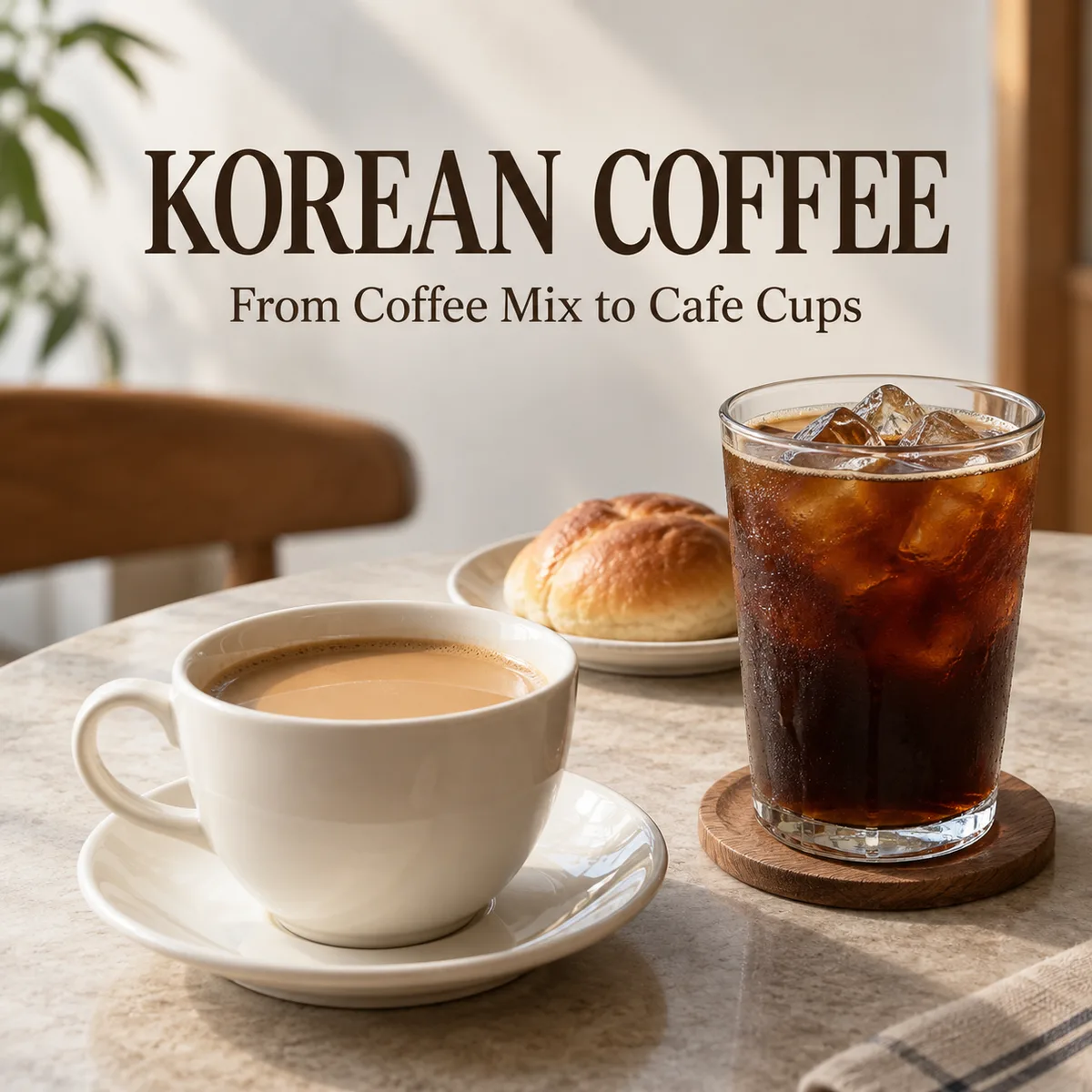
Start with two cups: a small, sweet coffee mix and a black iced americano. One dissolves instant coffee with sugar and powdered creamer; the other combines espresso, water and ice. The contrast makes Korea’s coffee culture tangible before a royal anecdote or a cafe count enters the story.
Choose the drink and the setting separately. A quick takeaway, a bean-focused tasting and an afternoon in a bakery cafe can all involve coffee while offering different tastes, portions and ways to spend time.
Coffee mix and an iced americano arrange sweetness and temperature differently.
Gojong’s cup and a later coffeehouse
Korea.net’s 2015 account associates Gojong’s coffee drinking with his refuge at the Russian legation in 1896–1897 and describes his continued enjoyment after returning to the palace. This is an early royal episode, rather than proof that one person created every later Korean coffee habit.[1]
The court episode, the commercial coffeehouse, the instant packet and the modern espresso bar are different developments. A royal cup helps explain an early encounter with the drink; it cannot by itself explain a later national cafe market.
A court episode does not explain every later coffee habit.
A room as well as a drink
Seoul Metropolitan Government’s 2016 account links Antoinette Sontag with Gojong’s coffee enthusiasm and identifies her 1902 hotel restaurant and cafe as a landmark in the city’s coffee history. Its description of a first cafe concerns a commercial venue, not a claim that nobody had previously tasted coffee.[2]
The useful distinction is between serving a drink privately and building a place where people buy the drink and spend time. The latter makes the room part of the experience, a question visitors still face when choosing between a small counter and a spacious cafe.
Dabang and different reasons to visit
Korea.net describes early twentieth-century dabang coffeehouses and the later spread of instant coffee associated with U.S. military rations. These are separate stages of access and preparation, not one unchanged recipe passed from the palace to a paper cup.[1]
A dabang, an espresso counter and a roastery should not be ranked as if they were successive steps from bad coffee to good coffee. Ask what each place emphasizes: a familiar sweet drink, a meeting room, quick service or the flavor of particular beans.
A meeting place, a quick counter and a roastery offer different visits.
What coffee mix puts in the cup
The practical shift with instant coffee is preparation. A hot-water supply and a packet can produce a repeatable drink without an espresso machine or a filter setup. That makes the format easy to serve wherever the equipment and ingredients are available.
Korea.net describes coffee mix as instant coffee with sugar and powdered creamer. Expect a sweet, creamy cup rather than the flavor profile of unsweetened black coffee. Check the actual packet for its ingredients and water instructions; products do not all have the same composition.[1]
Compare coffee mix with black coffee on its own terms. The dissolved ingredients make sweetness and creaminess part of every sip. An americano leaves those additions optional, and its strength changes with the espresso-to-water ratio and melting ice.
Coffee mix combines instant coffee, sugar and powdered creamer.
Black coffee, filter coffee and the cafe setting
An iced americano gives you a straightforward comparison with coffee mix: black coffee, cold water and ice, without the packet’s built-in sugar and creamer. Ask about size and the number of espresso shots when deciding what to order; the same menu name does not guarantee the same concentration.
Taste the drink before adding syrup. Cold temperature, the beans and the cafe’s recipe can make one americano seem brighter, more bitter or more diluted than another. If you want milk, order a milk-based drink rather than expecting an americano to contain it.
Ask about the drink size and espresso shots.
The “17,000 cafes” in the headline should not be read as a verified current national total. Cafe counts depend on date, geography and business category. This guide makes no present-day nationwide count claim; its useful comparison is between coffee formats and the settings that serve them.
For a bean-focused visit, ask which coffee is available as filter coffee and how the shop describes its roast or flavor. For a longer conversation, look at seating and the house’s policies first. A beautiful room and a carefully prepared drink are two things to assess separately.
Filter coffee foregrounds the shop’s beans and brewing style.
A tiny takeaway counter, a roastery with a short menu and a bakery with many tables may all be called cafes. Their layout tells you something useful: whether the visit is organized around speed, tasting, food or spending time in the room.
Seoul’s 2016 cafe-culture account describes renovated homes in Yeonnam-dong, cafes in remodeled hanok near Gyeongbokgung and book cafes in Samcheong-dong. These are dated examples of different cafe settings, not a verified current list of shops or operating hours.[3]
Use that variety to decide what you want from a visit. A courtyard can make the surroundings part of the afternoon; a compact roastery can put the cup first; a bakery counter can make food the reason to stay. Check the current menu and access details for the specific business.
Check the particular cafe’s seating and house policies.
Korea.net’s 2015 article describes after-meal coffee as part of the social routine for many people. A cafe can therefore be a second stop after lunch or dinner, rather than a replacement for the meal. Choose a drink and portion that suit what you have already eaten.[1]
Read the drink description
A coffee menu may also borrow a familiar food name. Do not assume that a drink named after a candy contains that candy: read the description or ask the staff. The actual dalgona sugar candy has its own ingredients, brittle texture and story, covered in the separate candy guide below.
Choose your first cup
Sweet and creamy: check the coffee-mix ingredients and preparation.
Black and cold: choose an iced americano; check size and shots.
Bean-focused: ask about the filter-coffee selection.
Food and surroundings: compare the bakery menu, seating and house policies.
Choose the format before comparing prices. A small sweet mix, an espresso-based cup and a filter coffee can differ in ingredients, preparation and serving size. The menu is more useful than an undated claim about the country’s average coffee price.
Check one-order-per-person requirements, laptop restrictions, seating limits and outside-food rules at the actual cafe. These are house policies. Ask before taking a table for a long stay, particularly when seats are scarce.
If pastries are the reason for visiting, check whether coffee and food are ordered at the same counter and whether the seating area has a minimum purchase. Return trays where requested and keep calls at a volume that suits the room.
A small coffee mix and an iced americano offer an easy first comparison: sweetness, creaminess, temperature and dilution are arranged differently. A filter coffee adds another question—what the beans and brewing style contribute when the drink is served without built-in sweeteners.
For a dessert pairing, taste a sip before and after the food. A buttery bread or syrup-soaked yakgwa changes the sweetness and richness surrounding the coffee. That simple comparison tells you more about your preference than a rule that every Korean cafe drink must be paired the same way.
A bread or syrup-soaked sweet changes the coffee pairing.
Begin with the cup you want, then choose the room and food around it. Gojong’s early coffee episode remains an interesting historical stop; the everyday pleasure is discovering which drink, portion and setting make your own visit work.
Ganjang gejang begins with an important distinction: soy marination is not cooking. The crab’s flesh, the seasoned liquid and the rice beside it create the meal, while the well-known story about King Gyeongjong belongs to a separate question about historical evidence.
Both subjects are worth exploring, but a record of food eaten before an illness cannot by itself prove poisoning, and a dramatic royal story cannot certify a modern raw-seafood dish as safe.
The crab is marinated, not cooked
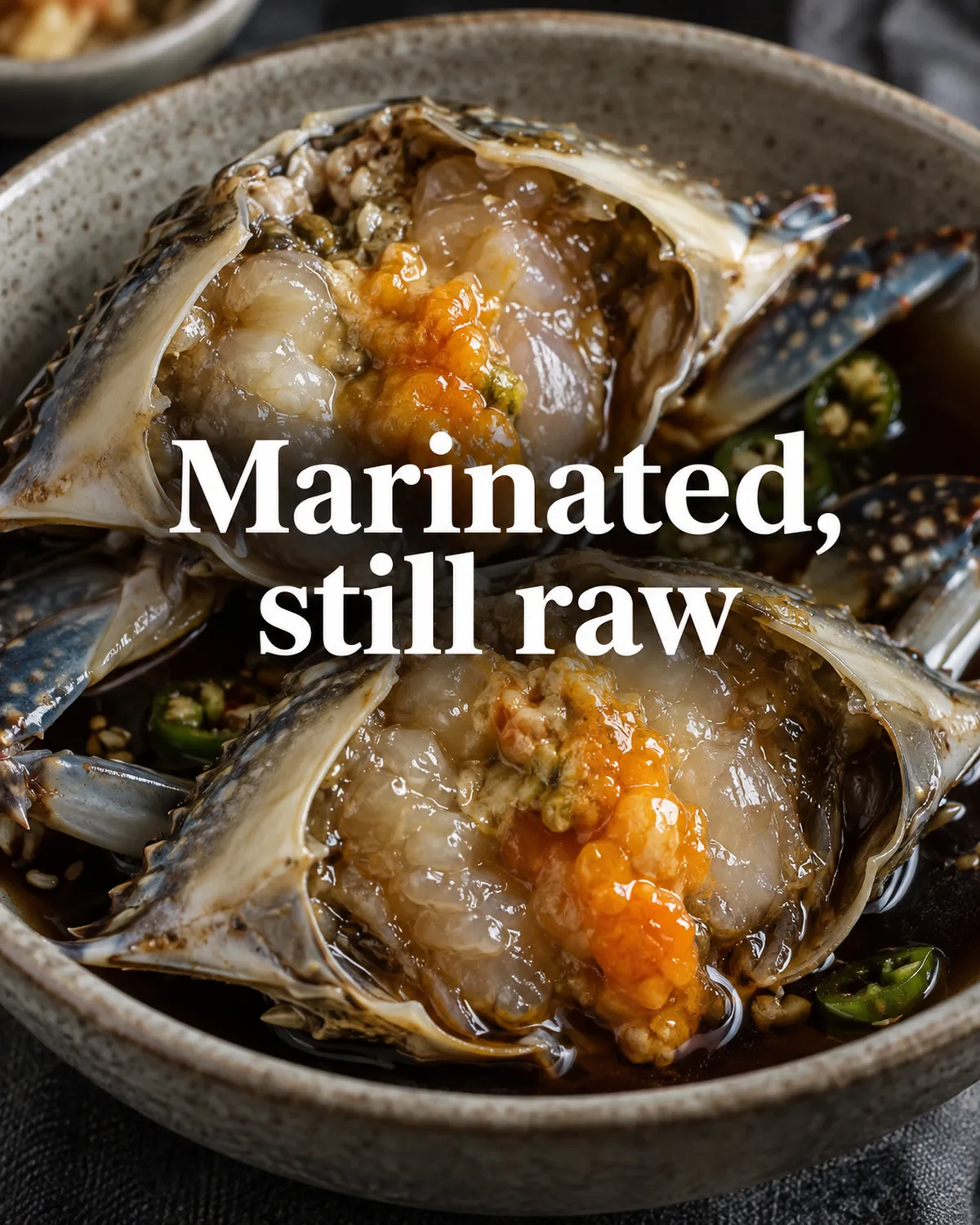
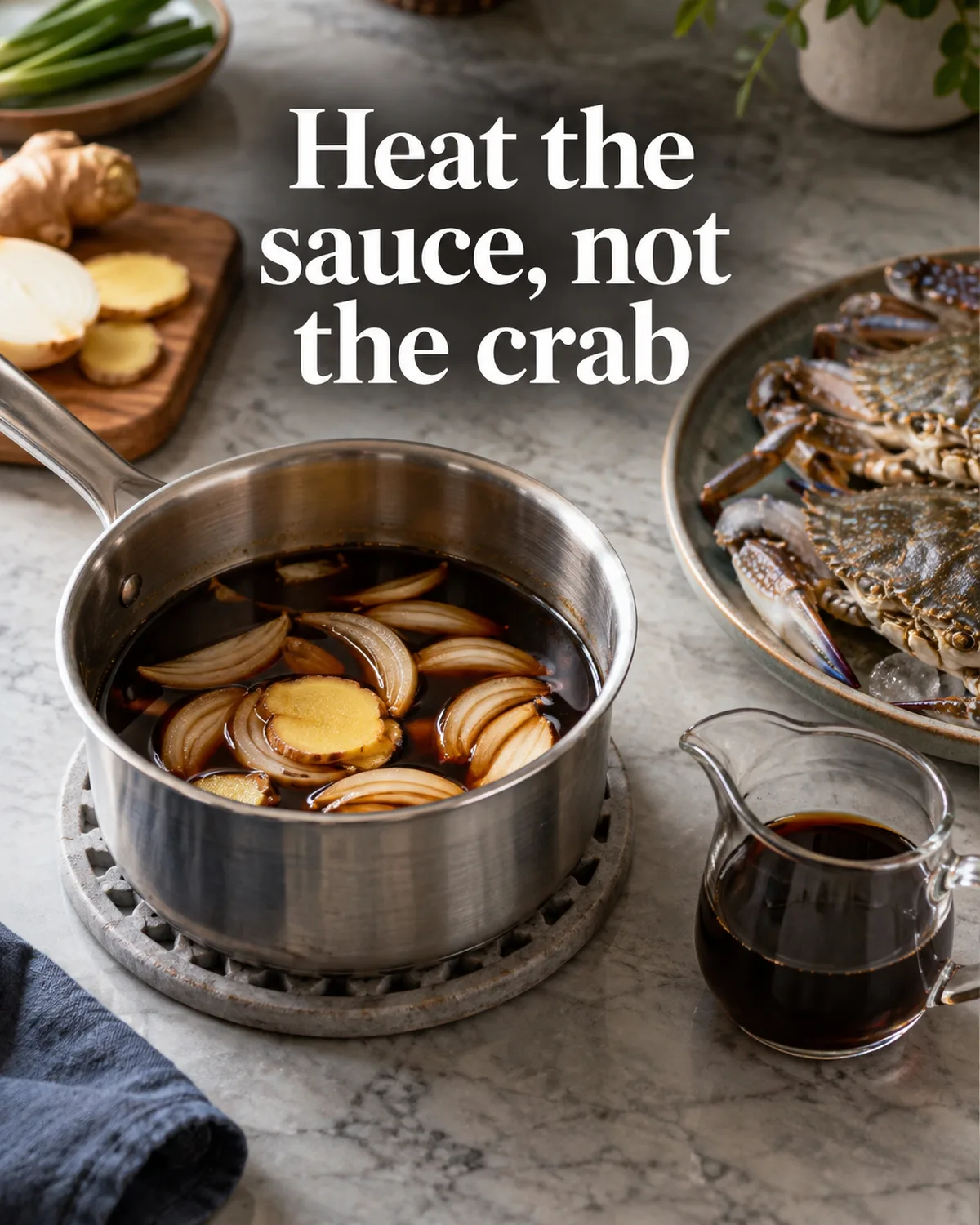
Ganjang gejang is raw crab seasoned in a soy-sauce-based marinade. VISITKOREA describes an aromatic soy liquid that is heated separately, cooled, and then used for the crab. Heating the sauce does not mean the crab itself is cooked. That distinction explains both the soft flesh and the need for a separate food-safety decision.[3]
Soy marination seasons the crab; it does not cook the flesh.
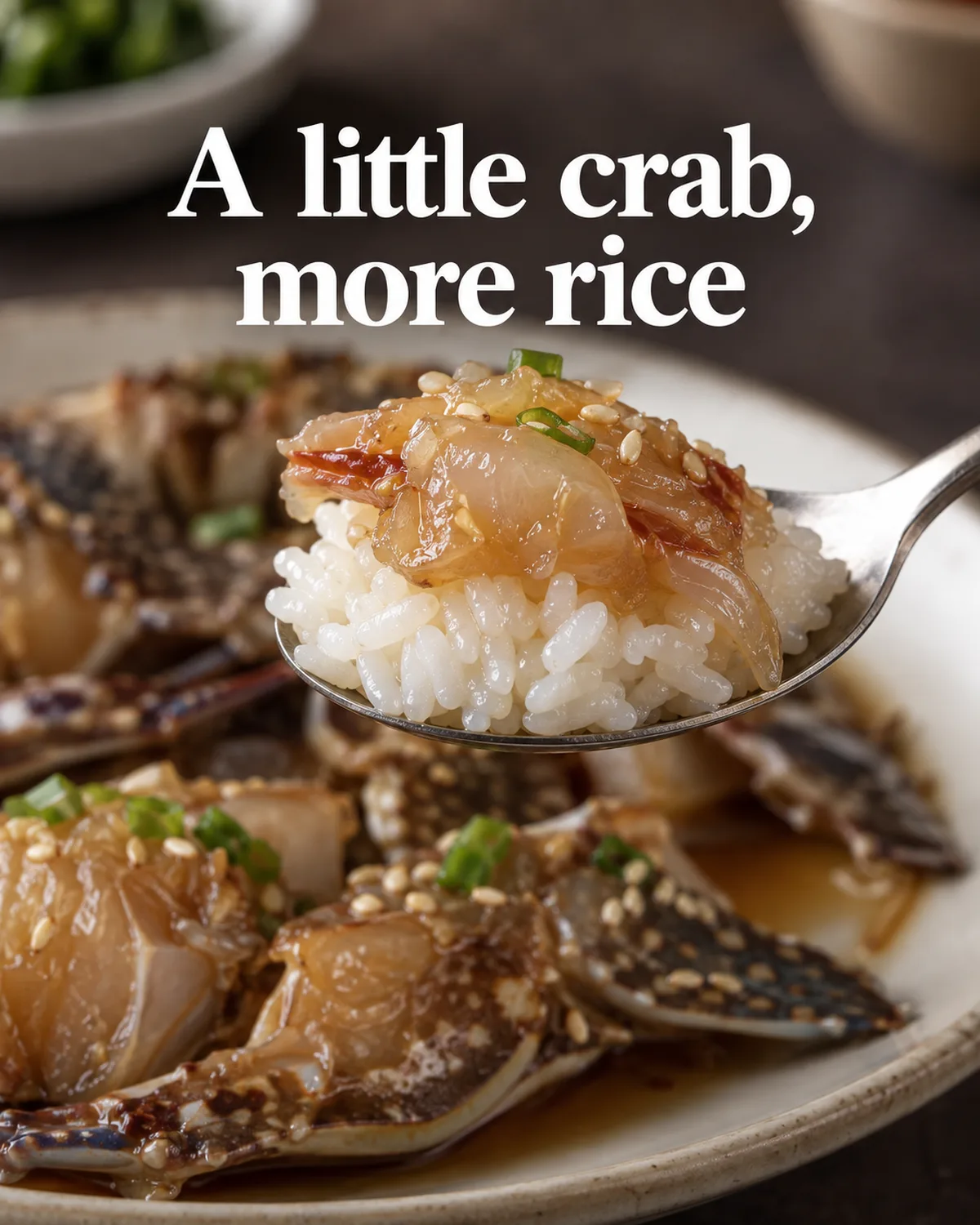
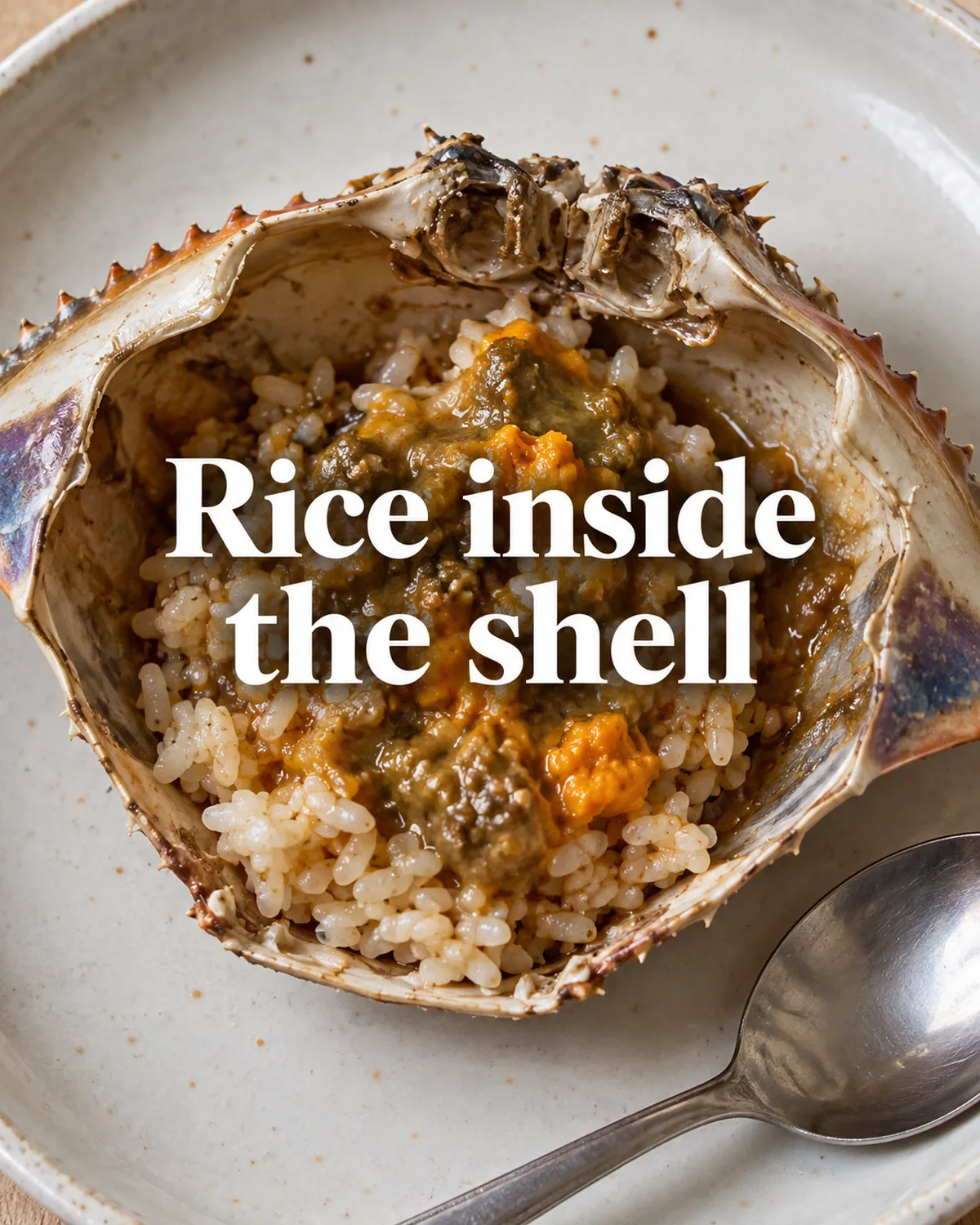
The attraction is in a small bite: soft crab flesh, the savory soy seasoning and a spoonful of plain rice. The shell also holds rich internal contents. Rice mixed there picks up a different concentration of flavor from rice eaten beside a piece of body meat. These are two ways to explore the same plate rather than two separate courses.
The nickname bapdoduk, or “rice thief,” describes how well the strongly seasoned crab partners with rice. It is a playful dining expression, not a medical claim about appetite. Start with a little crab on rice and notice how much seasoning that small amount carries.[3]
Concentrated seasoning meets a mild spoonful of rice.
VISITKOREA cites Hong Man-seon’s late-Joseon household work Sallim Gyeongje for soy and salt methods of preparing gejang. This is a useful route into the dish’s history: documented crab seasoning existed apart from the later palace-death story. It does not prove that every modern restaurant follows the same old recipe.[3]
A meal inside the record of Gyeongjong’s final illness
An Annals entry dated the 21st day of the eighth lunar month in Gyeongjong’s fourth reign year, 1724, reports that the king had been served gejang followed by raw persimmon the previous day. Court physicians said this was a combination their medical practice avoided and requested two remedies, Dusitang and Gwakhyang Jeonggi-san. The entry records a meal and the physicians’ response.[1]
Read that passage with two questions in mind. What did the court report serving? What did the physicians believe? It answers those questions, but it does not identify poisoned crab or demonstrate a lethal chemical reaction between the two foods. The historical concern can be documented without accepting a modern claim of a solved murder.
A different entry records the king’s death on the 25th day of the same lunar month. This explains why the meal is discussed alongside his final illness. Both dates belong to the Annals’ reign-year and lunar calendar; they should not be presented as Gregorian August dates.[2]
The two Annals entries establish chronology, not a proven cause of death.
The defensible story is specific: gejang and persimmon appear in a court medical entry shortly before a recorded royal death. The two passages establish that sequence. They do not settle the cause of death. A diner can be interested in the palace history without treating the legend as either a safety warning about persimmons or a safety guarantee about raw crab.
The sauce and rice explain the “rice thief” name
For the dining comparison, focus on where the heat goes. In the soy preparation described by VISITKOREA, aromatics flavor the heated sauce and the liquid cools before marinating the crab. A cooked crab dish applies heat to the crab itself. Sauce preparation and seafood cooking are different steps, even when the bowl looks richly seasoned.[3]
The aromatic sauce is prepared separately from the raw crab.
The process changes flavor, water movement and texture, but it should not be described as if soy sauce “cooks” or sterilizes the crab. The defining ingredient remains raw seafood. That is why food-safety guidance for raw seafood is still relevant even when a restaurant has a long-established marinade method.
Ganjang gejang can taste aggressively salty if judged by the spoonful. It is designed to be eaten as part of a rice-centered meal rather than as a large standalone portion of sauce.
Try comparing two modest bites. First, eat rice with a little meat and its clinging seasoning. Next, try rice mixed into the open carapace if it is part of your serving. Notice the change in richness and texture, then return to plain rice. There is no need to consume the bowl’s remaining liquid to understand the meal.
Soy marinade and the red-seasoned alternative
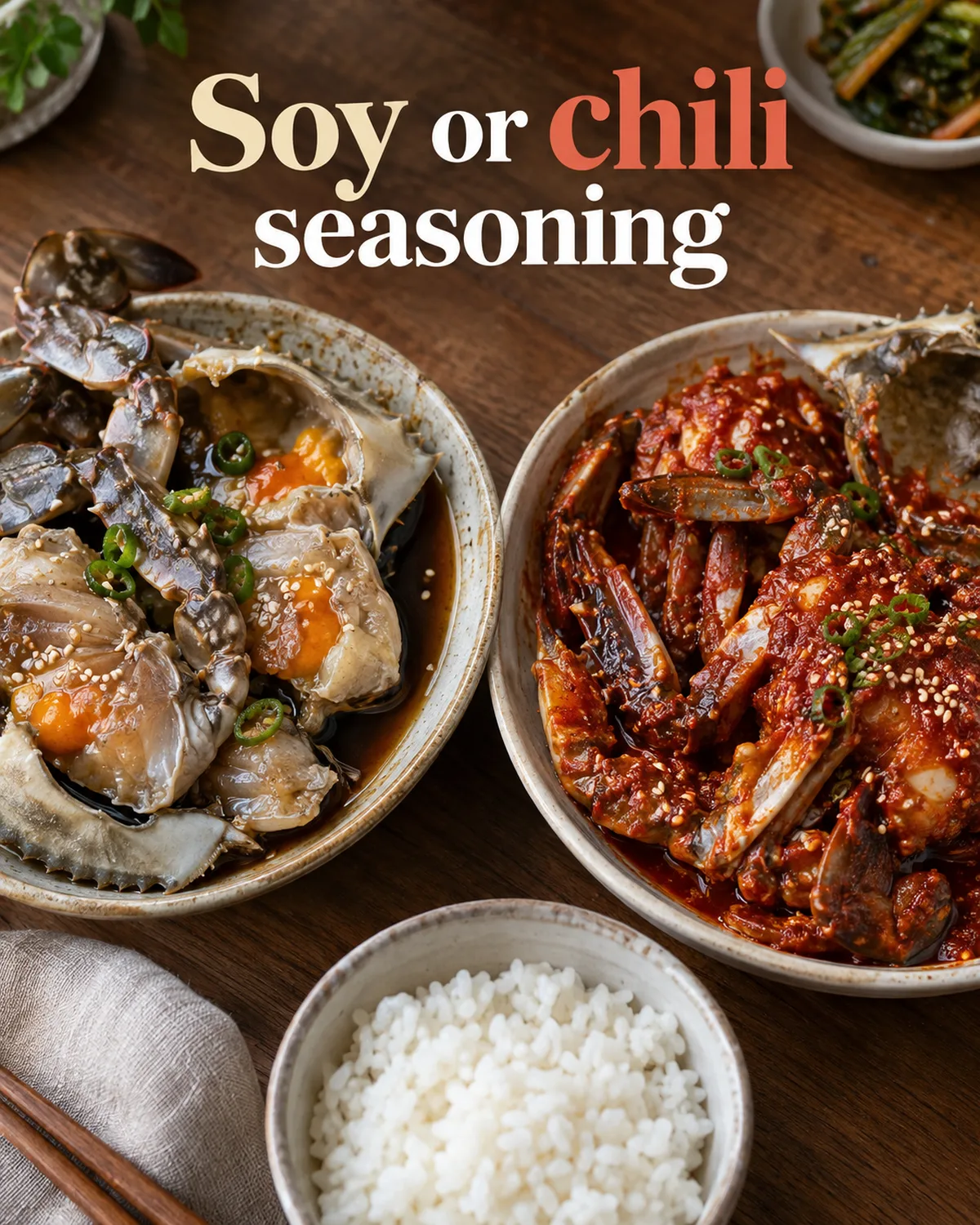
Visitors often see two crab dishes side by side. Ganjang gejang uses a soy-sauce-based marinade. Yangnyeom gejang coats raw crab in a red chili seasoning mixture that usually emphasizes chili, sweetness, garlic and other aromatics.
The soy and red-seasoned versions offer different flavor directions: one makes soy seasoning prominent, while the other brings a chili mixture to the foreground. The red coating can make it harder to see the flesh underneath, but it does not establish that the crab has been cooked. Ask about preparation rather than deciding from sauce color.
Sauce color does not establish that the crab has been cooked.
For a first order, diners who want to understand the historical soy-preservation logic may find ganjang gejang the clearer reference point. Diners who prefer chili heat may enjoy yangnyeom gejang more. The decision is about flavor, not prestige.
Ask what kind of crab the restaurant is serving and whether the order is a whole crab, selected sections or part of a set meal. Size, cutting and the presence of roe change what you receive. A photograph of a generous female crab is not a promise that every portion will look the same.
For a first order, the practical questions are portion, seasoning and what comes with it. Confirm whether rice is included and whether the plate is intended for sharing. Current menu details are more useful than an old online price or a claim that one season guarantees the best crab everywhere.
Working through the shell and the rice
The easiest method is to treat the crab as several small eating zones rather than trying to attack the entire animal at once.
The open carapace can hold rice mixed with the remaining rich contents.
Start with a body section. Hold the shell and squeeze or pull the meat toward the opening. Some restaurants provide scissors, gloves or shell tools.
Use rice to regulate intensity. Alternate crab with rice rather than eating large spoonfuls of marinade alone.
Save the carapace. If roe and sauce remain inside, mix in a small amount of rice and scrape the shell carefully with a spoon.
Watch small shell fragments. Raw crab shells can be sharp. Eat slowly, especially around leg joints.
Taste before adding extra sauce. The dish is already highly seasoned, and additional soy sauce is rarely necessary.
There is no single ceremonial sequence every Korean follows. Restaurants prepare and cut the crab differently, and diners develop their own method. The useful rule is simply to let the rice and crab balance each other.
At the table, ask what crab and preparation the restaurant serves, what is included in the order and how the house suggests handling the shell. Begin with a modest amount of the seasoned crab and rice. The sauce is a strongly flavored component, not a requirement to consume every drop.
Raw seafood needs a separate safety decision
Raw seafood carries a foodborne-illness risk. CDC guidance recommends cooking seafood and avoiding raw or undercooked seafood to prevent Vibrio infection. It stresses this particularly for people with underlying conditions, especially liver disease. The marinade does not provide a substitute for that advice.[4]
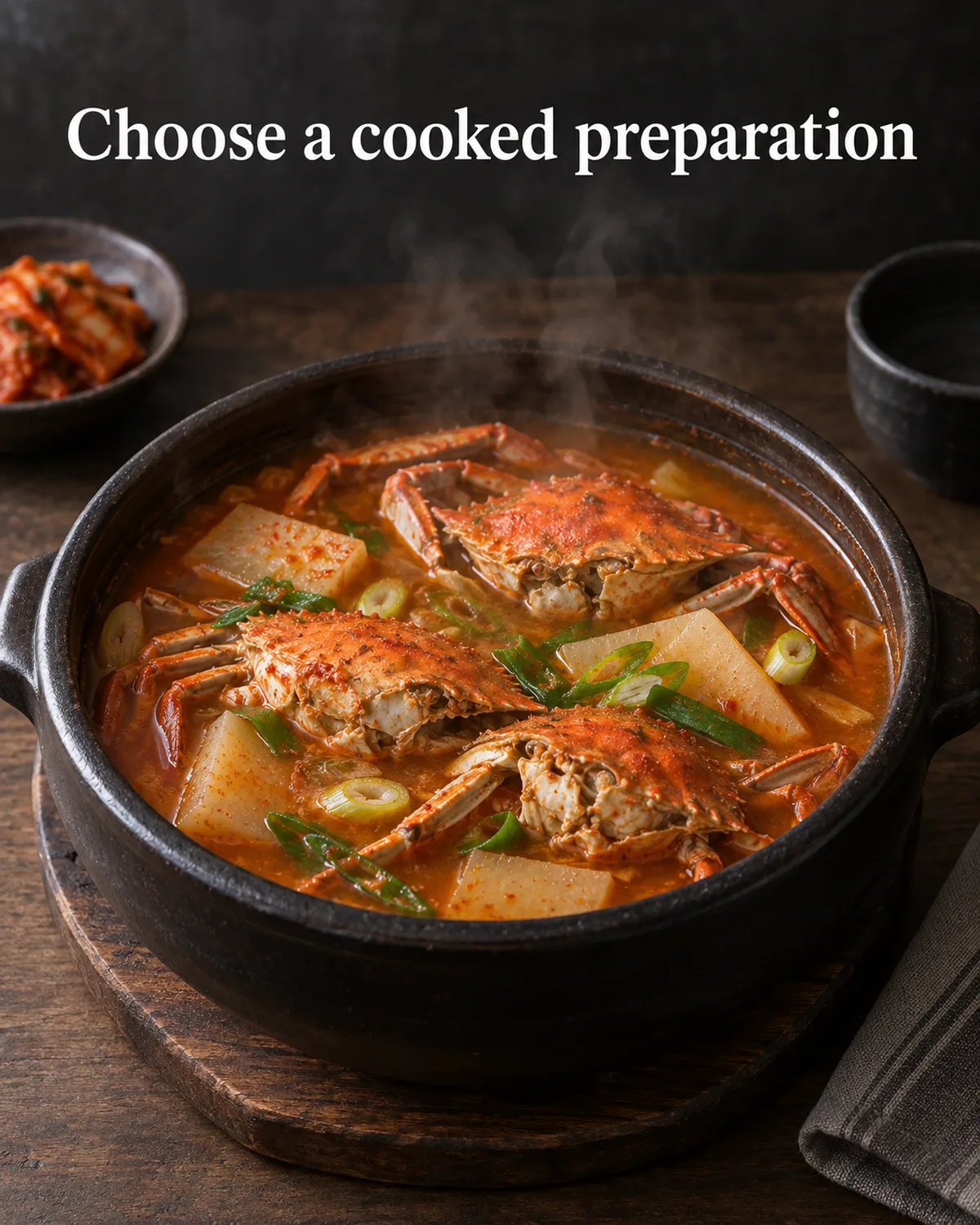
If you want a cooked option, ask for a dish in which the crab itself is fully cooked, such as an appropriate crab soup or steamed-crab preparation. Its firmer flesh and different eating experience are part of that choice. Do not assume that a darker sauce, longer marinade or famous restaurant makes raw crab equivalent to cooked crab.
A fully cooked crab dish offers a different texture and raw-seafood choice.
CDC also identifies pregnant people, children under five, adults 65 and older, and people with weakened immune systems as groups needing extra precautions against food poisoning. Its safer-food table places cooked seafood above raw or undercooked seafood. Follow that guidance when deciding whether this raw dish suits you.[5]
Check allergies against the actual ingredients: crab is crustacean shellfish, and soy seasoning may also contain wheat or additional seafood ingredients. Tell the restaurant what you need to avoid and ask about the marinade and cross-contact. A short menu label cannot provide the complete ingredient information for a house recipe.
Ask about crab, soy, wheat-containing seasoning and other ingredients.
Rice makes the taste of a salty bite milder by sharing the mouthful; it does not remove sodium from the sauce already consumed. Taste a small amount before adding more marinade. This is a useful way to judge flavor rather than assuming a full bowl of sauce is part of the required serving.
The memorable part of ganjang gejang is the meeting of soft crab, assertive seasoning and rice, with the shell becoming part of the eating experience. Learn how that serving works, make the raw-seafood decision explicitly, and leave the royal story within what the surviving records actually tell us.
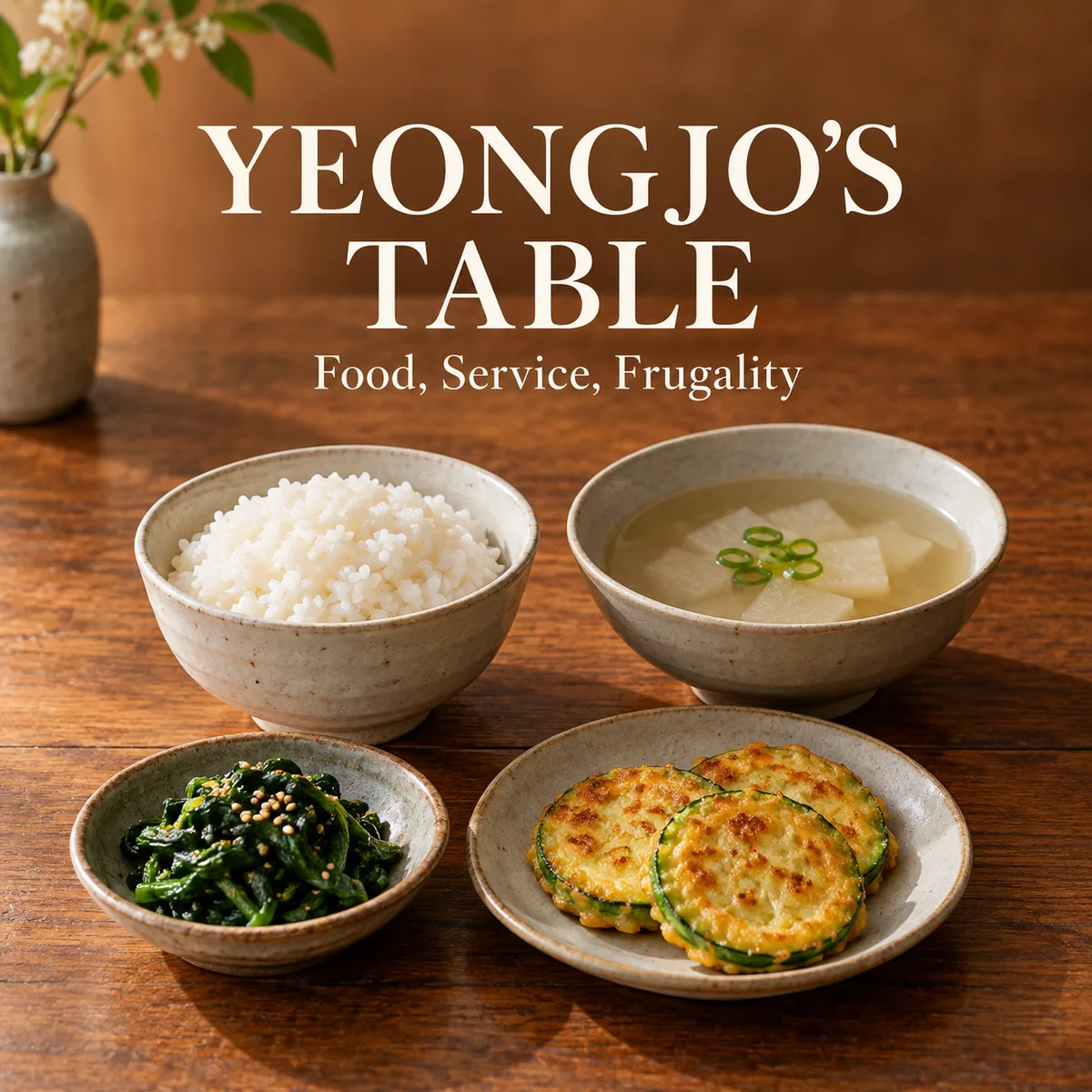
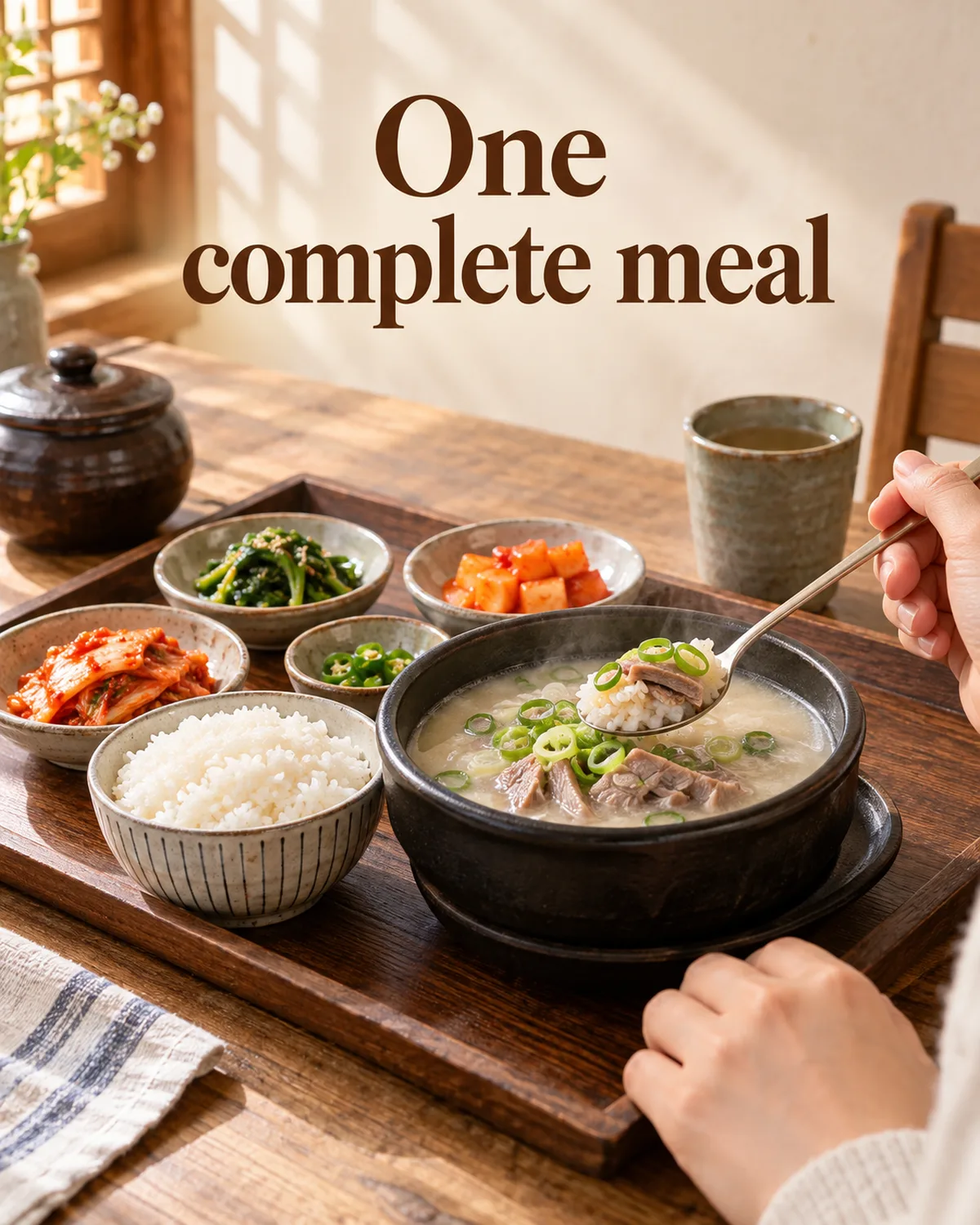
A bowl of rice, a spoonful of broth and several small dishes can make a Korean meal feel generous without turning it into a banquet. The interesting question is how those components are served and eaten—not whether they reproduce a king’s secret formula.
Yeongjo’s food story offers an unusually clear example of restraint inside an abundant institution. His reported reduction in eating occasions concerns palace service and frugality. Those records do not establish that a particular diet kept him alive.[2]
Read the meal through its components.
Begin with the structure of the meal
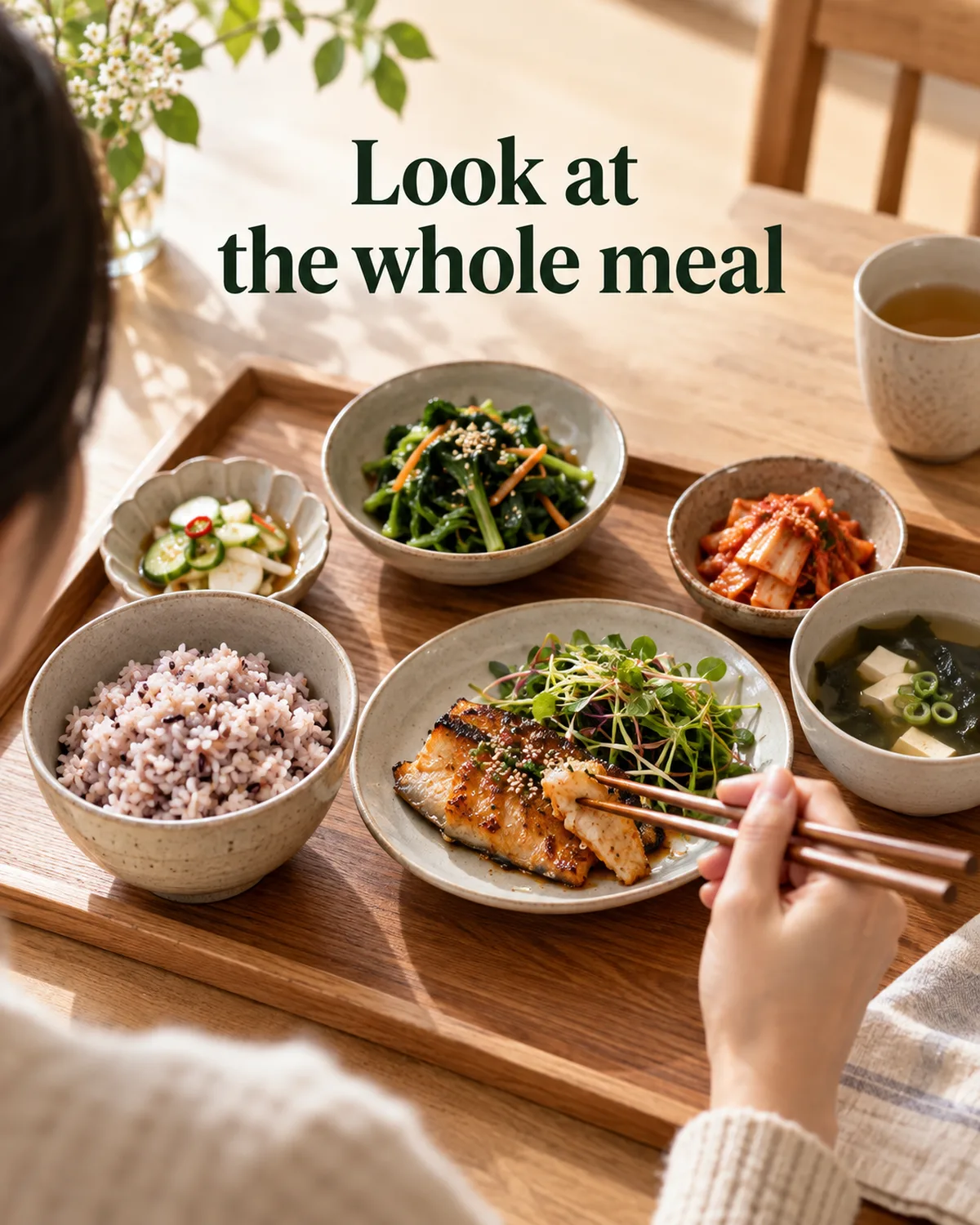
For a meal built around rice and side dishes, identify the staple, the broth and the preparations around them. A seasoned vegetable, a fermented condiment and a cooked protein contribute different tastes and textures. Their presence does not reveal one compulsory national proportion.
Try a side dish on its own, then with a little rice. Notice whether it is mild enough to eat as a vegetable portion or strongly seasoned enough to accompany several bites of the staple. The size of a serving bowl is not always the amount intended for one diner.
Ask what is shared and what is individual. If the meal arrives in courses, find out whether more rice, soup or a hot dish is coming before treating the opening arrangement as the entire meal.
A contemporary table can illustrate ways of organizing food. It cannot prove that Yeongjo ate those same ingredients, in those quantities, every day. Enjoy the meal as the cook presents it while keeping the historical claim separate.
Seasoning and portion are separate questions.
The recorded change concerns eating occasions
The National Institute of Korean History describes five customary services: early light food, morning and evening meals, midday food and late food. They were not five equally elaborate banquets.[2]
Its commentary says the frugal Yeongjo omitted midday and late-night services, eating three times daily. It specifies occasions rather than a complete menu or measured portions.[2]
The distinction changes how the story is pictured. The documented comparison is between a customary service schedule and a ruler’s reported reduction. A photograph of a small rice bowl cannot fill in the missing quantities.
Nor does three occasions tell us everything about the food. Frequency, amount and composition are different questions. The account supports a change in frequency without turning it into a calorie calculation or a modern fasting program.
Meal frequency does not measure the amount eaten.
Royal restraint also had a public meaning
The account describes gamseon, reducing royal food during disasters, mourning and other serious circumstances; tribute could stop during drought or flood. Restoring service was bokseon.[2]
This places a king’s table inside government, ritual and provisioning. Reducing dishes could express concern for suffering subjects; the meal was more than a private choice between a rich lunch and a light lunch.
Yeongjo’s customary reduction and emergency-related gamseon are distinct statements. The latter supplies context, without explaining every omitted service.
For a visitor, this makes the explanation accompanying a royal-style meal worth hearing. Ask whether the presentation concerns daily service, a ceremonial occasion or a modern interpretation. Those are different routes into the food’s history.
Daily meals and ceremonial service have different occasions.
What the long life establishes
The Academy of Korean Studies identifies Yeongjo as Joseon’s twenty-first king, born in 1694 and dead in 1776, reigning from 1724 to 1776. Its biography records his death at eighty-three and describes the dynasty’s longest reign.[1]
The historical age count and modern elapsed-year counting differ. Keeping the birth and death years visible avoids turning a traditional age number into an imagined modern equivalent such as “over a hundred today.”
An advanced age is an outcome in one life. A reported meal schedule is a behavior. Reading the two together does not isolate what caused the outcome, and the biography is not a nutrition experiment.
A favorite ingredient mentioned in another record would require its own evidence. Barley, millet, greens, tiny meat portions or ginseng should not be assembled into a lifelong menu simply because the resulting plate looks plausible.
A modern meal cannot document a king’s lifelong menu.
A modern meal does not need a royal promise
Choose a rice-and-side-dish meal for its actual cooking. Look for contrasts you enjoy: tender greens beside a firmer vegetable, a warm broth beside something cool, a lightly seasoned component beside a concentrated sauce.
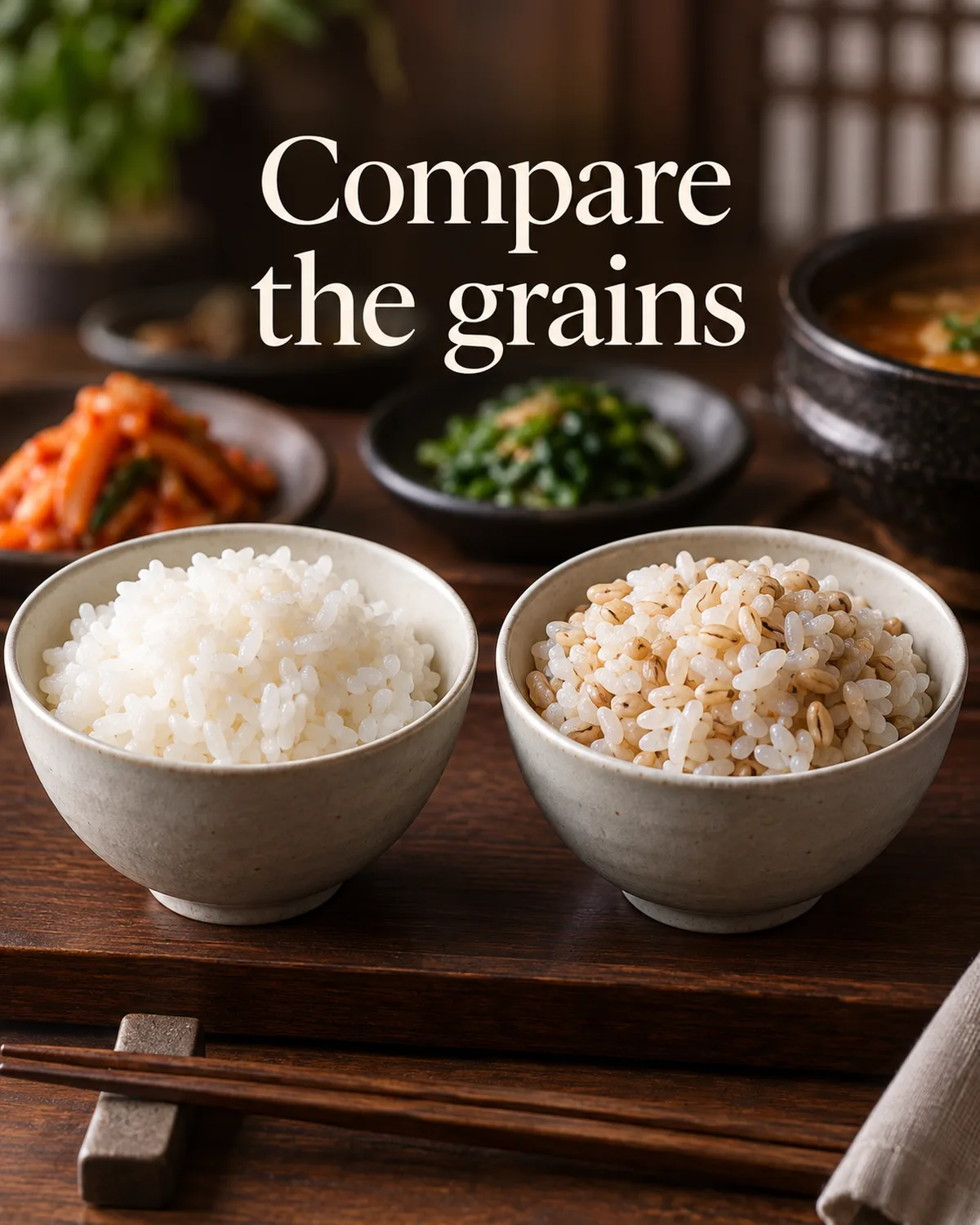
If you want to compare grains, taste a plain rice bowl and a mixed-grain preparation as two recipes. Their chew, aroma and cooking texture are tangible differences. Calling either bowl Yeongjo’s daily preference would require a source that documents that preference.
Taste different preparations as actual recipes.
Do the same with fermented foods. A little kimchi or soybean seasoning can change a bite through acidity, salt and savory depth. Those culinary qualities are useful to notice without making the dish a promise about lifespan.
A smaller selection can be easier to understand than a maximal spread. Ask which dishes best show the kitchen’s work and how much is suitable for your party. Sharing and course size matter more than recreating an unsupported royal calorie target.
Acidity, salt and savory depth change a bite.
Keep the strongest part of the story
Yeongjo’s reported frugality challenges the assumption that a royal food day always meant consuming the fullest possible display.
Let that history change what you ask about the table—its occasion, service and preparation. Then judge the meal you actually receive by its taste and craftsmanship. There is plenty to discover without treating one king’s biography as a diet prescription.
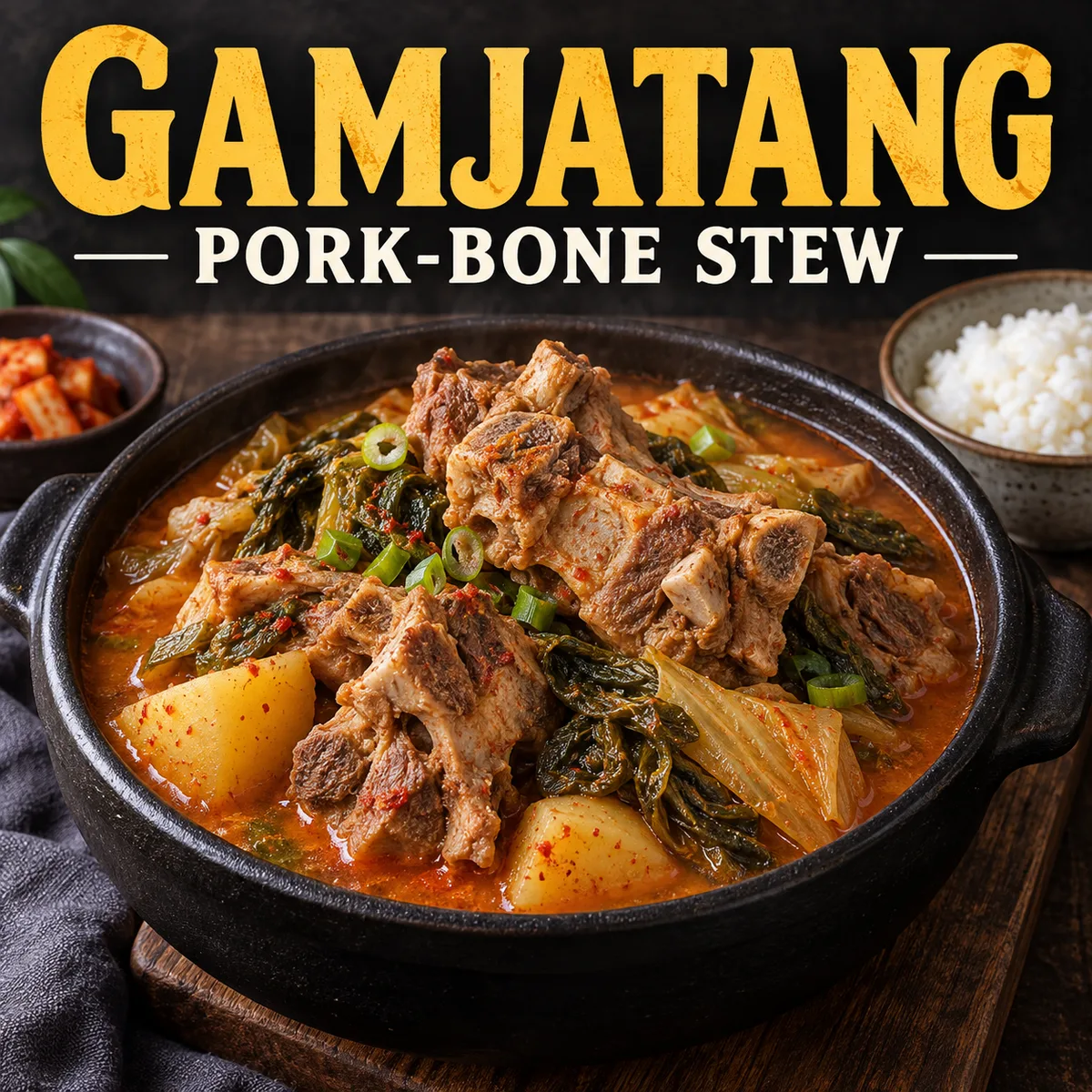
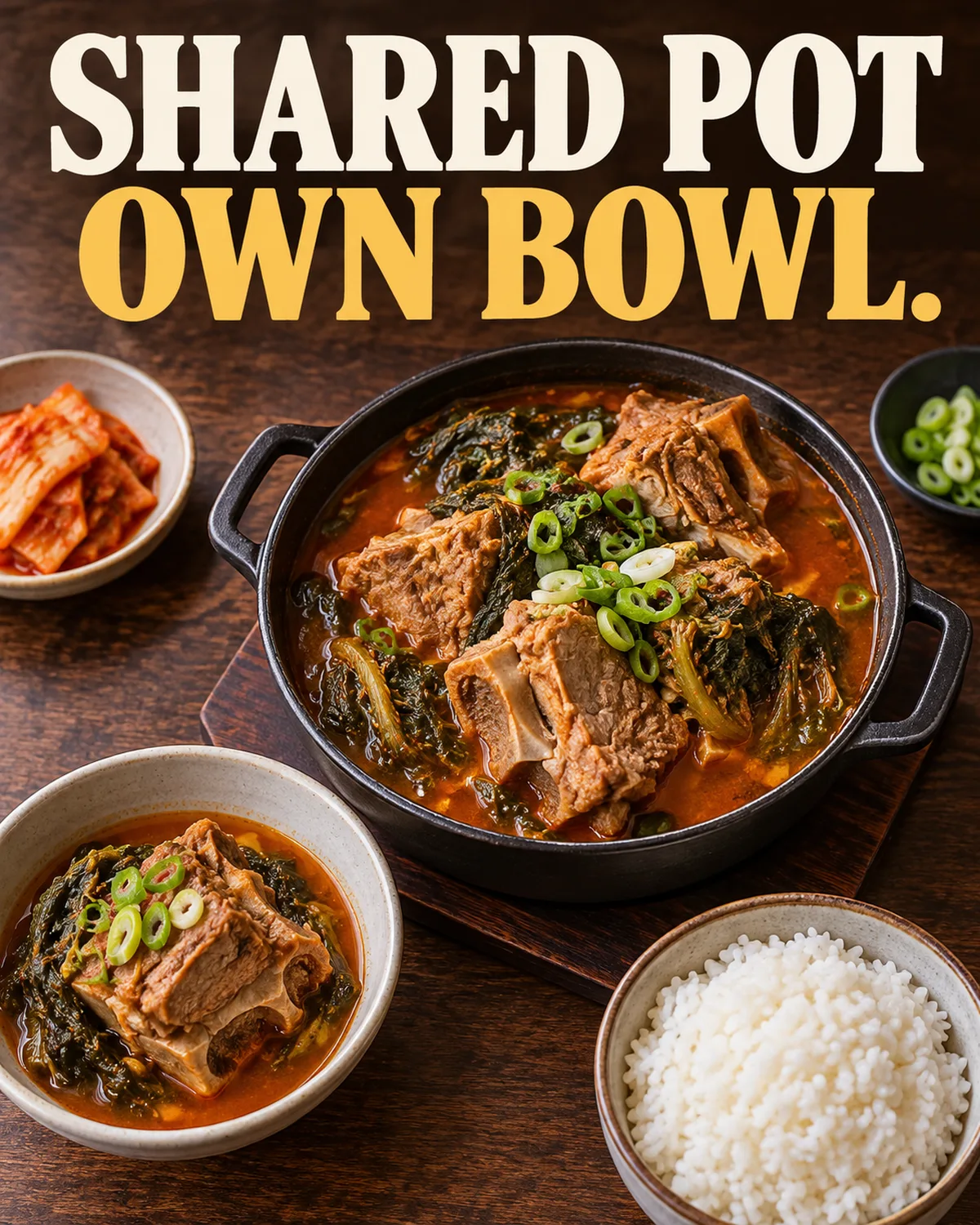
A gamjatang pot can look crowded before anyone takes a bite: irregular pork bones rise above the broth, while vegetables settle between them. The useful question is how much tender meat sits around those bones. A tall pile and a generous edible portion are different things.
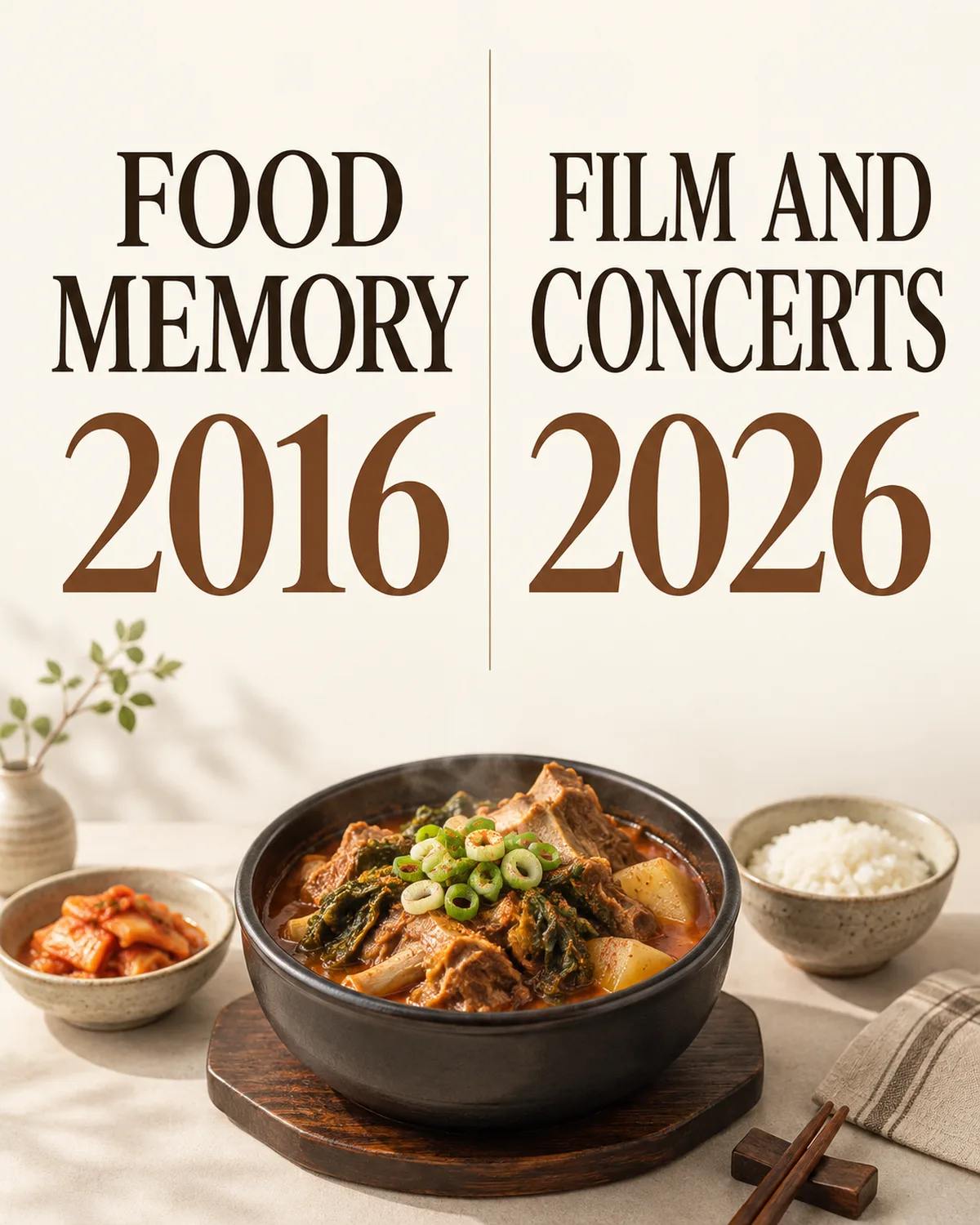
Lisa’s connection is a dated food memory. In a November 3, 2016 YG LIFE interview, she recalled trying gamjatang after coming to Korea and enjoying it. That record introduces the dish without claiming to know her current meals or private routine.[1]
The entertainment dates in the headline also need their current context. Sony’s September 2, 2026 announcement schedules Sue Kim’s Always, LALISA for a limited IMAX and cinema release on October 12, followed by YouTube Premium later in 2026. That announcement gives October 12, 2026 as the theatrical start date and supplies no exact streaming date. Check current cinema listings and streaming availability before making plans.[2]
Caesars’ September 29 announcement lists six VIVA LA LISA performances at the Colosseum: November 12, 13, 14, 27, 28 and 29, 2026. These are announced future dates, rather than a report of performances already seen. The 2016 food recollection remains separate from the documentary and residency news.[3]
The food recollection dates to 2016; the film and concerts belong to the 2026 calendar.
Look for meat around the bones
Maangchi’s gamjatang uses pork neck or spine bones, vegetables and potatoes. The meat sits in gaps around the irregular bones, so the dish takes a different kind of attention from a bowl filled with boneless slices. Her serving suggestions include individual bowls and a shared pot.[4]
Set a manageable piece in your own bowl before working around it. Use the chopsticks to separate meat where it yields, and the spoon to collect broth. A small dish for emptied bones keeps the eating space clearer as the meal goes on.
Do not treat an impressive bone as a single mouthful. Turn it to inspect the other side and leave the hard structure behind. The edible meat, vegetables and broth together explain the portion better than the outline of the bone alone.
For a shared order, ask how many people the pot is intended to serve. A photograph cannot tell you the amount of meat or the restaurant’s portion convention. The listed size, number of diners and other food on the table make a more useful comparison.
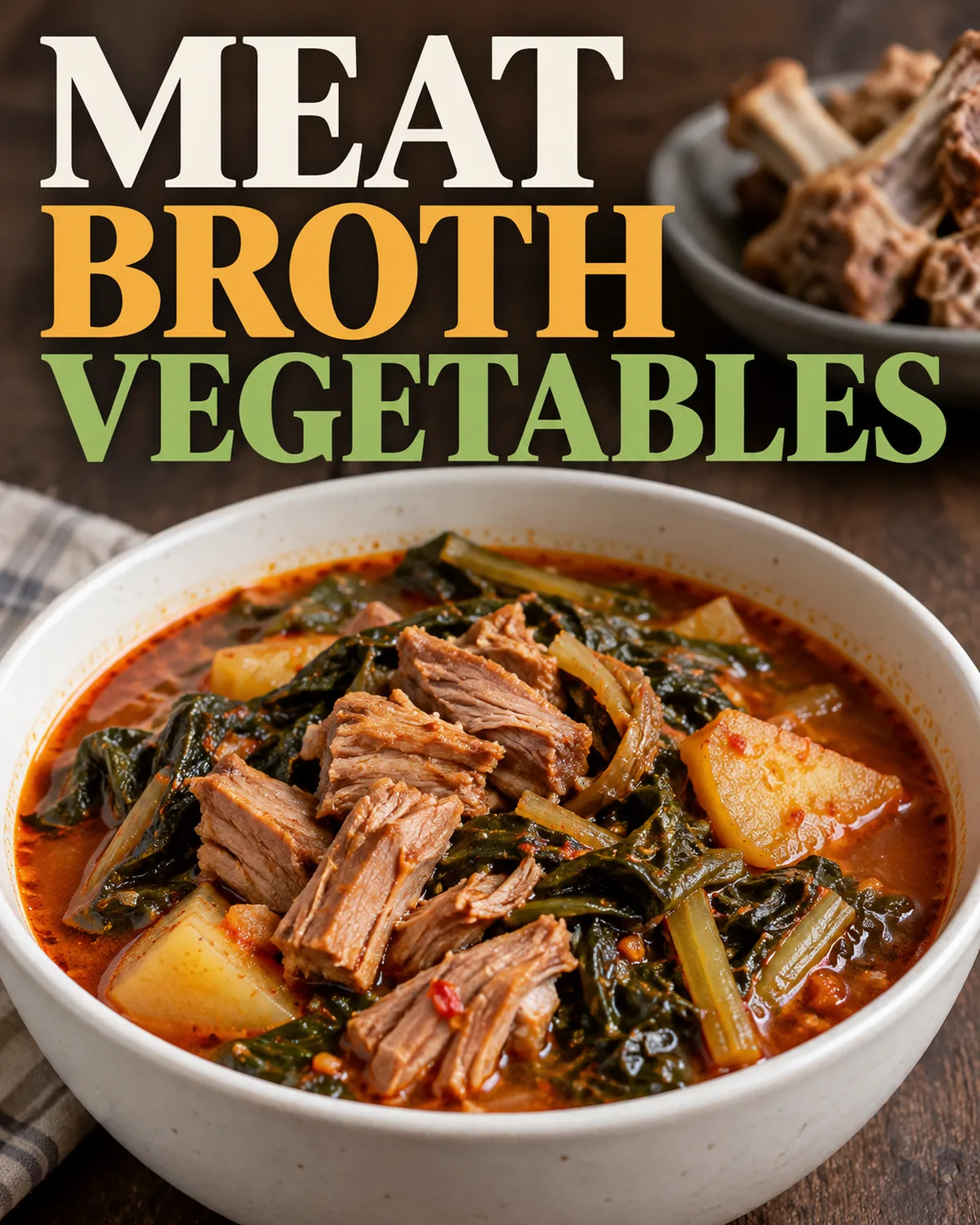
Edible meat sits around the irregular pork bones.
The broth and vegetables complete the bite
In Maangchi’s version, red pepper seasonings accompany cabbage, potatoes and perilla ingredients. That is one documented preparation, rather than a fixed recipe for every restaurant. Notice which of those elements are present in the bowl you receive.[4]
Taste a little broth separately before combining it with meat. It lets you notice the liquid’s intensity without a large vegetable piece changing the mouthful. Then try a bite of meat with broth to see how the two work together.
Leafy vegetables bring a different texture from the meat. A folded leaf may hold more broth than its size suggests, while a potato piece offers a softer, denser bite. Alternating them gives the meal more contrast than picking only at the bones.
Rice belongs beside the stew rather than inside every first spoonful. Take some with a broth or meat bite, and keep another bite plain if you want to compare. There is no need to turn the whole bowl into one uniform mixture at once.
Broth, greens and potato offer different textures alongside the meat.
A clear broth is another useful reference
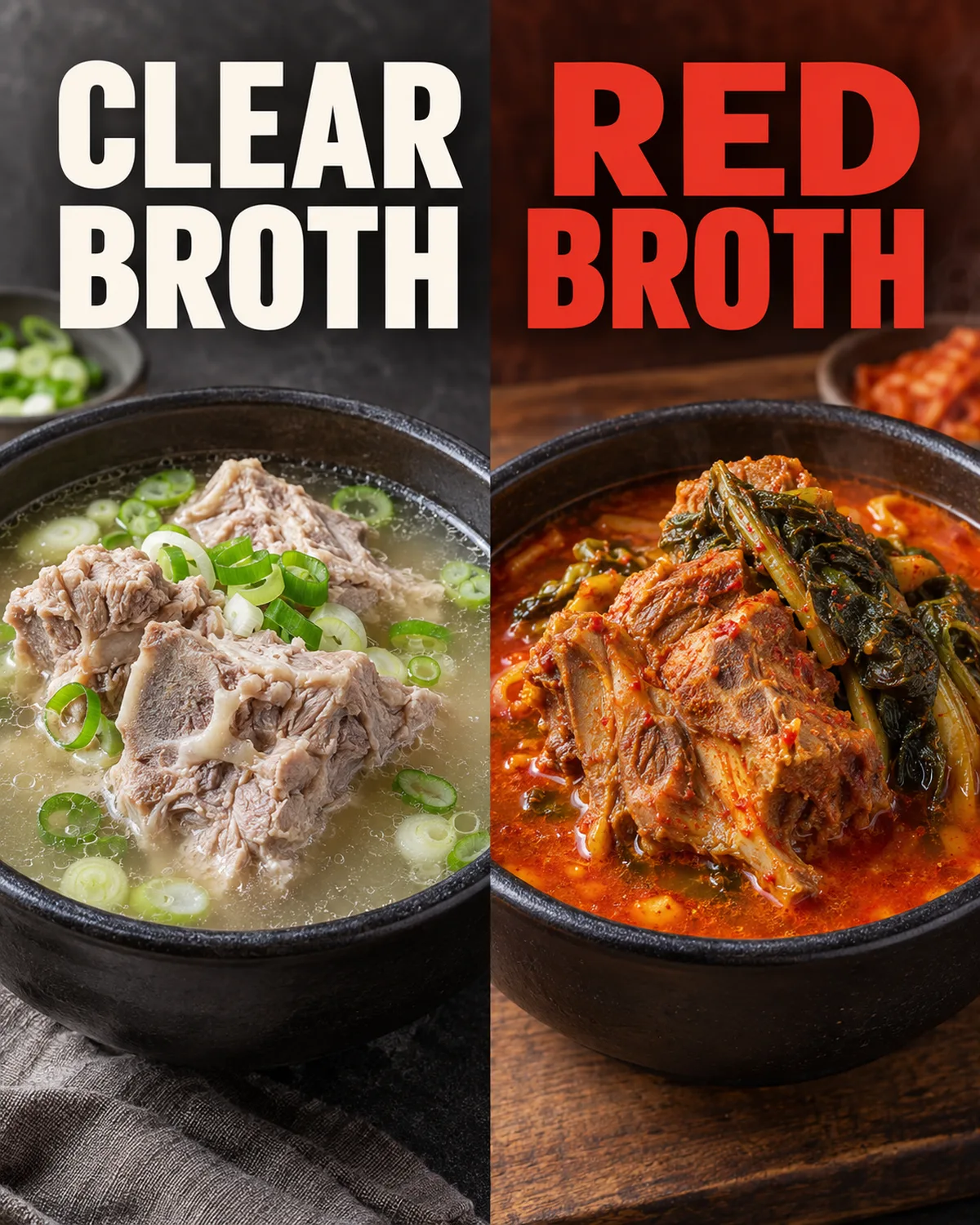
Visit Seoul describes Seobu Gamjaguk as serving carefully trimmed pork backbone meat with a comparatively mild, clear broth. That example shows why a red appearance cannot define the entire pork-bone soup category.[5]
If you prefer a particular style, ask about the broth before ordering. Clear, red and heavily seasoned appearances give different first impressions, but a picture alone does not measure the actual heat or saltiness. The kitchen can explain its own preparation.
The name gamjatang contains gamja, the everyday Korean word for potato, yet the bones remain central to the dish described here. Maangchi notes competing explanations of the name. Treat the etymology as unsettled rather than inventing a single origin story.[4]
The practical distinction is easier than the naming debate: order a pork-bone stew expecting bones, then look at what accompanies them. A potato, greens and a large bone have different jobs in the meal, even when they share the same broth.
A clear pork-bone soup provides a different reference from a red broth.
Understand the format before adding extras
A shared pot and an individual bowl create different rhythms. With a pot, move a serving into your own bowl so that you can see the meat and vegetables clearly. With an individual portion, there is already a defined space in which to work around the bones.
Ask which additions the restaurant offers and when they are normally put in. Noodles, rice or other extras may change the remaining liquid and the size of the meal. A familiar photograph is not a promise that every menu includes the same finish.
It helps to decide whether the first order is enough before adding more. Count the people eating and consider the other dishes on the table. A shared stew can be substantial without every diner ordering an identical extra.
For ingredient restrictions, ask about the actual broth, seasonings and garnishes. Taking a visible ingredient off the surface cannot identify what has already cooked into the liquid. The restaurant serving the bowl is the relevant source for those details.
A shared pot and an individual bowl shape how the meal is served.
Keep a food memory in proportion
A performer’s interview can give a reader a reason to notice an unfamiliar food. It cannot supply the experience of eating the stew, identify an undocumented favorite restaurant or establish what appears in a separate documentary. Those are separate questions requiring separate evidence.
The announced film and concerts belong to the 2026 calendar. The food memory belongs to a 2016 interview. Keeping the dates visible makes the connection interesting without presenting a decade-old recollection as a fresh endorsement.
For a first gamjatang meal, focus on three observations: the meat that comes away from a bone, the broth taken on its own and the vegetables eaten alongside rice. Those details give the dish a character beyond the celebrity name that led you to it.
Begin with the portion and broth style offered by the actual restaurant. Make room for the bones, take manageable servings and notice the food around them. That turns a crowded-looking pot into a meal you can understand one bite at a time.
Meat, broth and vegetables explain the meal better than bone size alone.
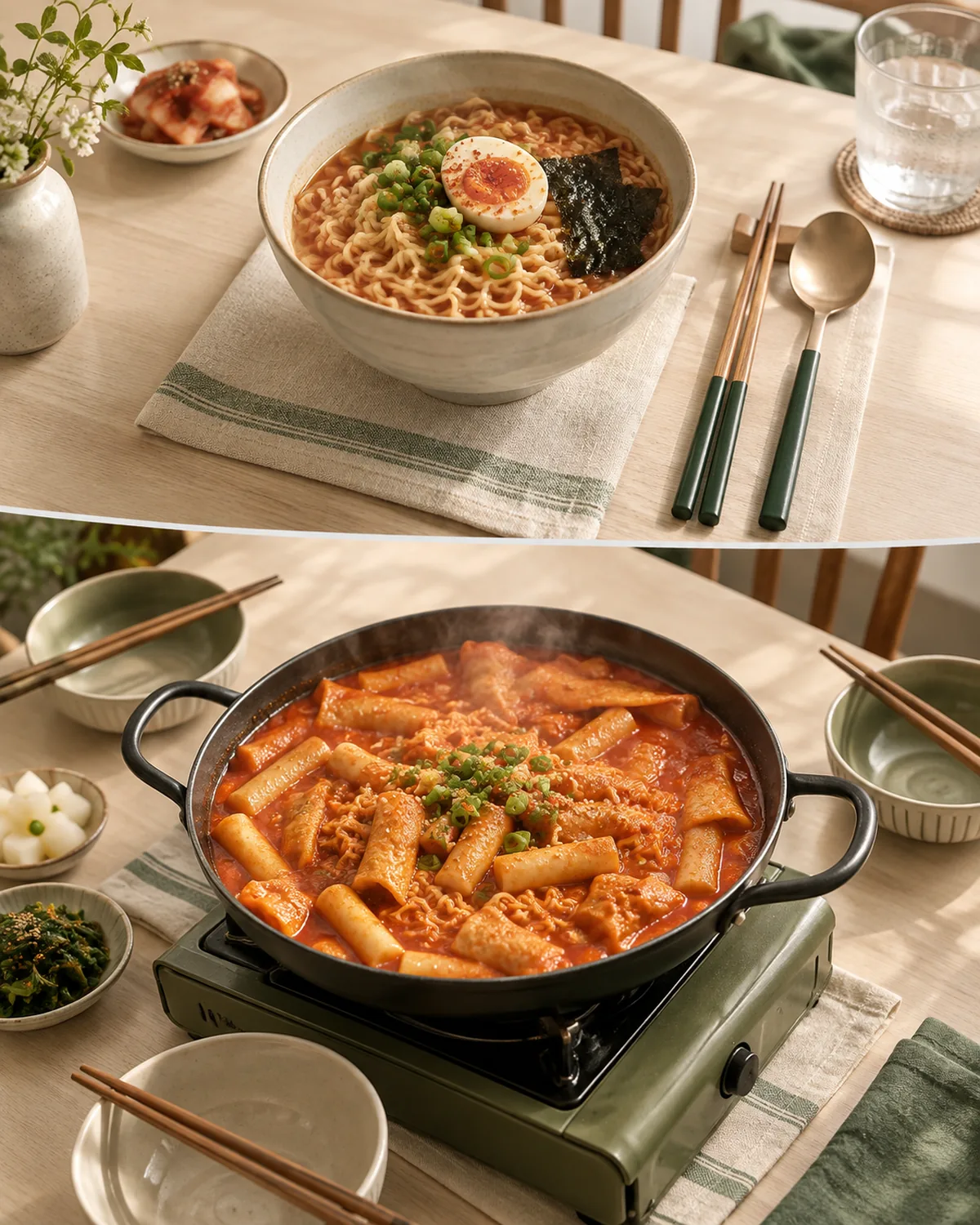
Jung Kook’s Bulgeuri starts with instant noodles, but the important move happens in the pan: two seasoning systems meet, liquid reduces, and the noodles pick up a stronger coating. His perilla-oil noodle posts take another route, using a mixed dressing and cooled buckwheat noodles. These are specific dishes you can learn about, rather than a guessed list of seven permanent favorites.
The original Weverse posts and official recipe-program pages offer useful starting points for a BTS-inspired Korean meal. This guide follows what the foods taste like, how their methods differ and which preparation might suit your appetite. A published recipe documents that version; it does not establish what every member always orders.
Bulgeuri: look at the pan, not just the packet
On March 16, 2023, Jung Kook posted a Bulgeuri recipe on Weverse. It combines Buldak liquid sauce with Neoguri seasoning and noodle components. The visible instructions specify using a frying pan, reducing the liquid while watching the noodles, and adding water if the result is too salty.[1]
This makes the dish different from simply preparing two separate bowls of ramyeon. As liquid leaves the pan, seasoning remains with the noodles. A loose broth and a clinging sauce can begin with similar ingredients but deliver quite different mouthfuls. That is the useful cooking idea behind the mix.
Watch the finished consistency rather than treating a brand combination as a guarantee. If a reduction goes too far, the noodles can sit in an overly concentrated coating; if it stops much earlier, the bowl will be soupier. Noodle firmness and the amount of liquid are linked decisions because they change while the same pan is heating.
Pan reduction changes how seasoning coats the noodles.
For a first taste, notice the spring of the noodles, then the heat and saltiness of the coating. Make a small serving before committing to a large batch. Adding more spicy sauce is not the only way to change the bowl: the original post explicitly allows water as a correction.
Perilla-oil noodles use a different kind of balance
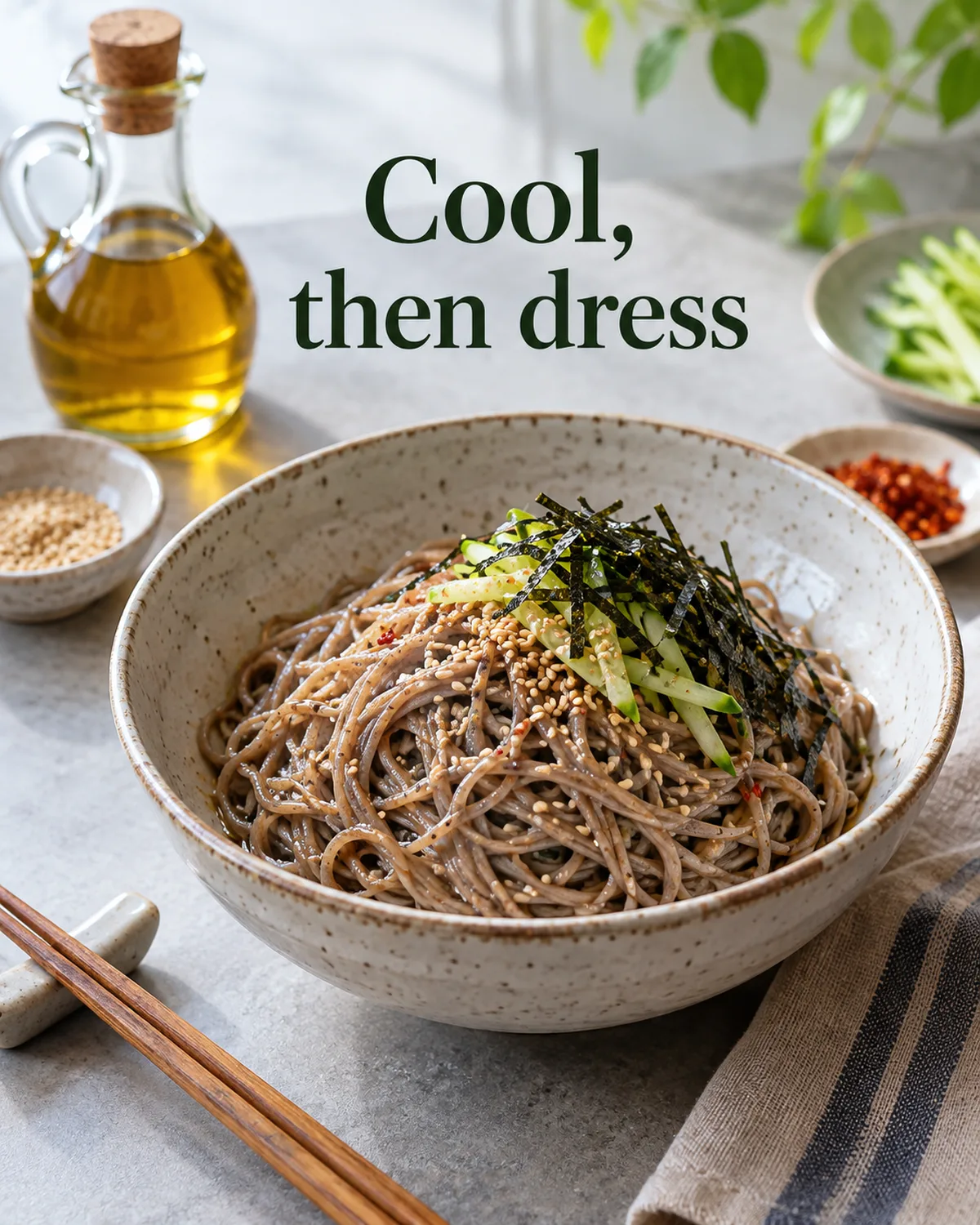
The April 25, 2023 post is titled around perilla-oil makguksu. Its visible text lists perilla oil, Cham sauce, Buldak sauce, Buldak mayonnaise and egg yolk, then describes cooking buckwheat noodles and rinsing them with cold water. This is a dressed noodle preparation rather than the reduced hot pan used for Bulgeuri.[2]
Perilla-oil makguksu follows a different method from hot reduced noodles.
Perilla oil contributes a distinctive nutty aroma. The other sauces bring their own salt, sweetness, heat and richness. Their roles overlap, so adding several of them does not automatically make the dish balanced. The noodles must carry the dressing without disappearing beneath it.
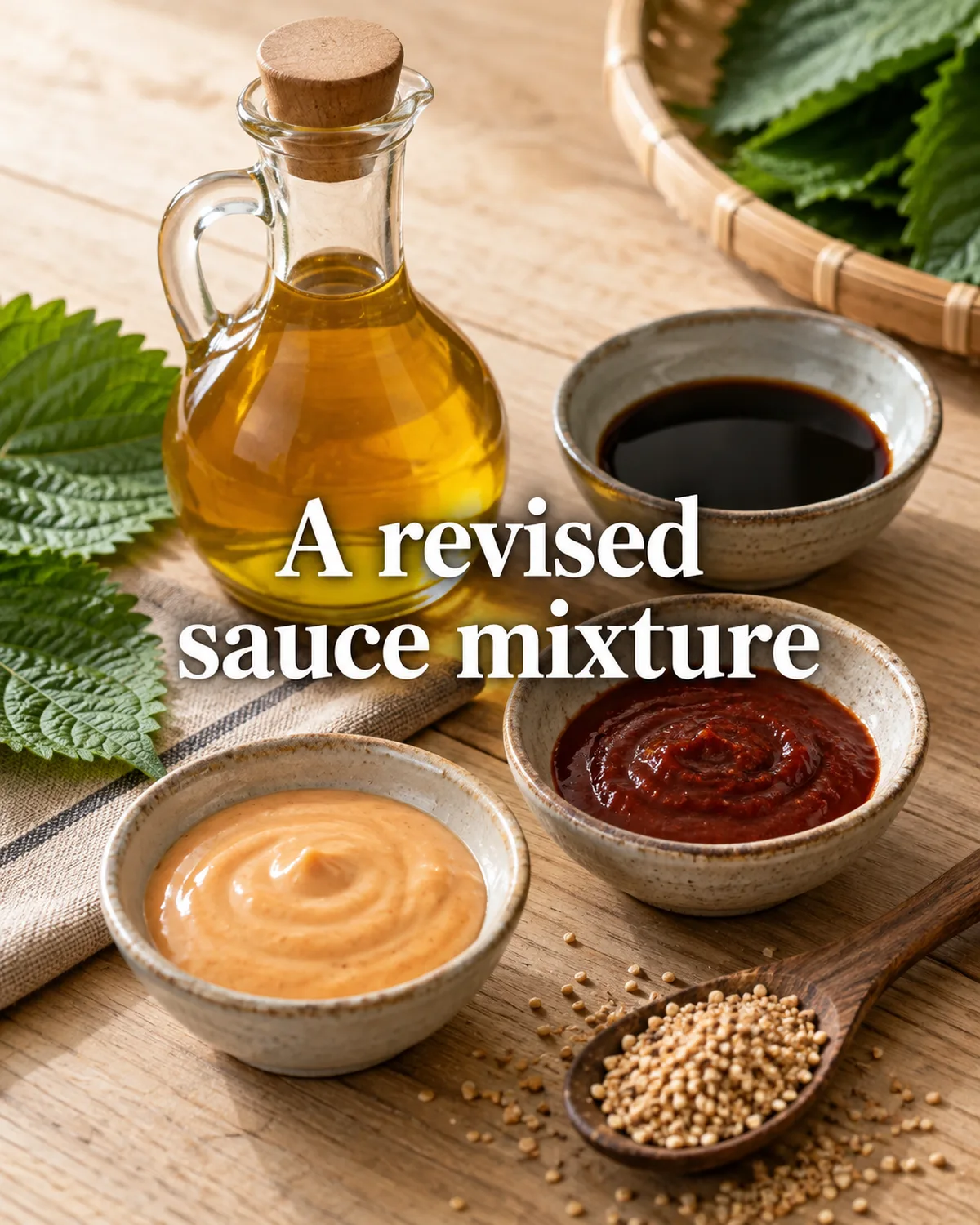
Jung Kook returned to the mixture on July 31, 2023. That post adds soy sauce, pepper and crushed roasted sesame to a revised ingredient list and identifies a 200-gram, two-person basis. It also explains his concern that people were making the dish too salty. The revision matters: the April and July versions should not be blended into one supposedly unchanged recipe.[3]
The dated recipe versions use different ingredient lists.
When comparing these noodles with Bulgeuri, look for what happens after cooking. One method keeps heating to concentrate the liquid. The other cools the noodles and coats them with a prepared mixture. You can understand that contrast without turning either dish into an all-time favorite claim.
Choose the original recipe or make a clearly named adaptation
If recreating a specific post, keep its date and link with your notes. If changing the noodle type, leaving out egg or choosing another sauce, call the result your adaptation. That makes the bowl easier to discuss: a difference in texture might come from your ingredients rather than from the original method.
Check the actual packets available where you live. A familiar product name does not guarantee identical ingredients across markets. Noodles and sauces can contain wheat, soy, seafood ingredients, egg, dairy or sesame, depending on the product. Read every component rather than treating the combined dish as a new ingredient label.
The uncooked yolk in a dressing needs a separate decision. USDA FSIS guidance advises against uncooked ordinary eggs and identifies in-shell pasteurized eggs as suitable for use without cooking. Ordinary raw yolk does not become safe merely because it is mixed with sauce. If you omit it, expect the texture to change; that is an adaptation.[9]
A sensible first comparison is modest: prepare one version, notice its coating and aroma, and adjust a later batch deliberately. Changing the water, oil, sauce and noodle type all at once makes it hard to know which choice improved the result.
Kimchi fried rice gives the same pantry another job
The official The BTS Recipe in KOREAN catalog includes a kimchi-bokkeumbap program page. That confirms a dish featured in the series. The catalog title alone is not a full ingredient list or proof that every member prefers that exact serving.[4]
The food itself is a useful contrast to the noodle bowls. Kimchi fried rice brings cooked rice into contact with chopped kimchi and pan heat. The rice takes on seasoning, while the cabbage supplies small pieces to bite through. A spoonful can contain soft grains and firmer cabbage instead of a continuous strand of noodle.
Kimchi can also be served beside rice as banchan. Putting it into the pan changes its role: the seasoning is distributed through the rice rather than selected separately with each bite. If you are choosing a meal, decide whether you want that integrated flavor or the freedom of a rice-and-side-dish table.
Pan cooking distributes kimchi through the rice.
Egg, meat, cheese and other additions depend on the recipe or restaurant. A photograph of one attractive bowl does not tell you which extras are included in the menu item you are ordering. Ask about the actual preparation, particularly if a topping or ingredient matters to you.
Gimbap, tteokguk and suyuk invite different meals
Official program pages also identify gimbap, tteokguk and suyuk. They are distinct food formats, rather than interchangeable items on a celebrity checklist. Their catalog presence is the connection used here; the following descriptions explain the dishes themselves.[5][7][6]
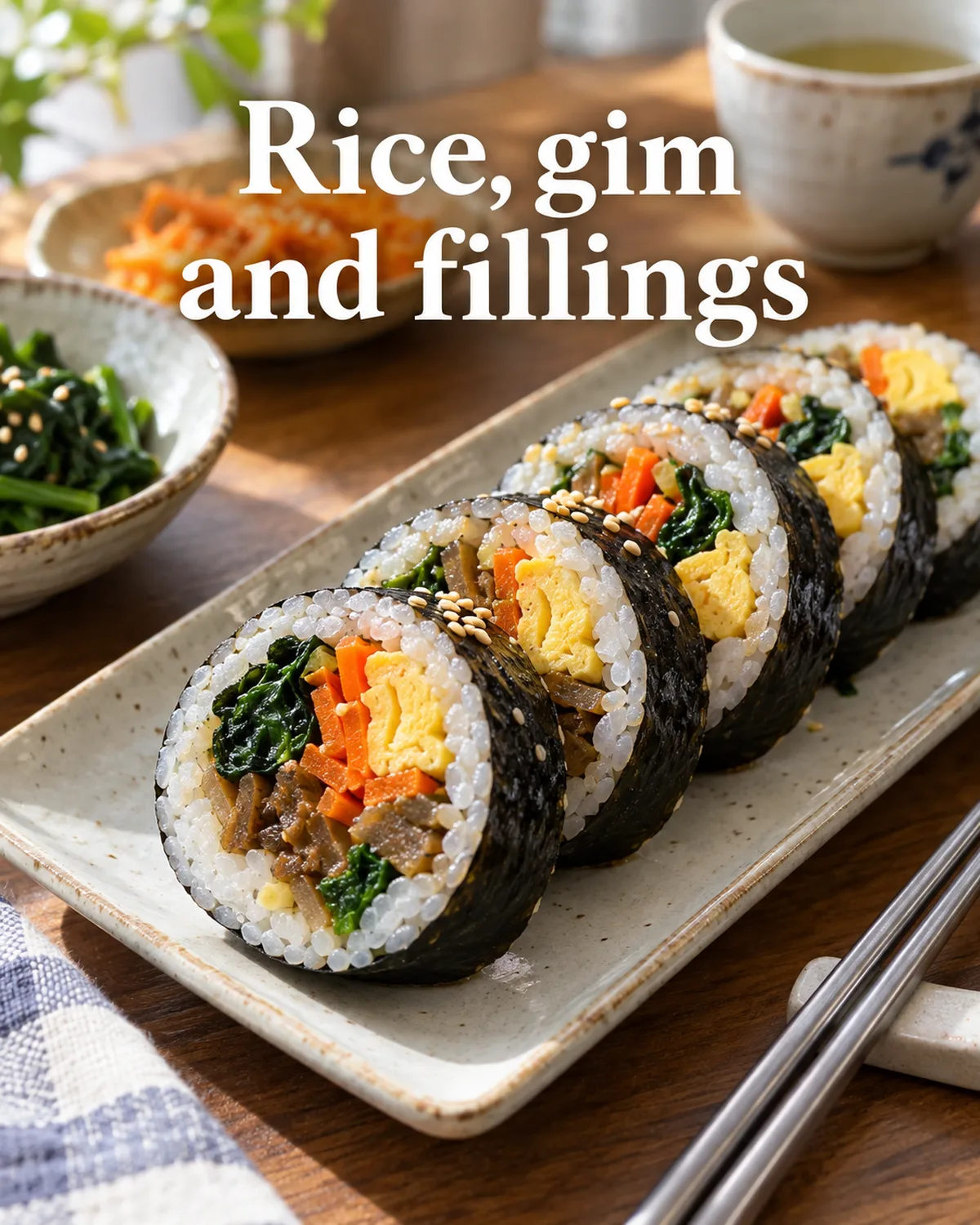
Gimbap wraps rice and fillings inside gim, then is sliced into rounds. Its appeal lies in the combination inside each slice: rice, seaweed and the textures of the chosen fillings arrive together. Check the filling list; a vegetable-looking roll may still contain egg or a meat-based component. It is a practical choice when you want portions that are easy to divide.
Gimbap combines several textures in each slice.
Tteokguk is a rice-cake soup. The sliced rice cakes offer a chewy bite in broth, making the meal quite different from dry dressed noodles or a rice roll. Broth and garnishes vary, so check them rather than assuming that a white-looking soup is vegetarian. Choose it when a warm spoon-and-bowl meal sounds more appealing.
Tteokguk offers chewy rice cakes in broth.
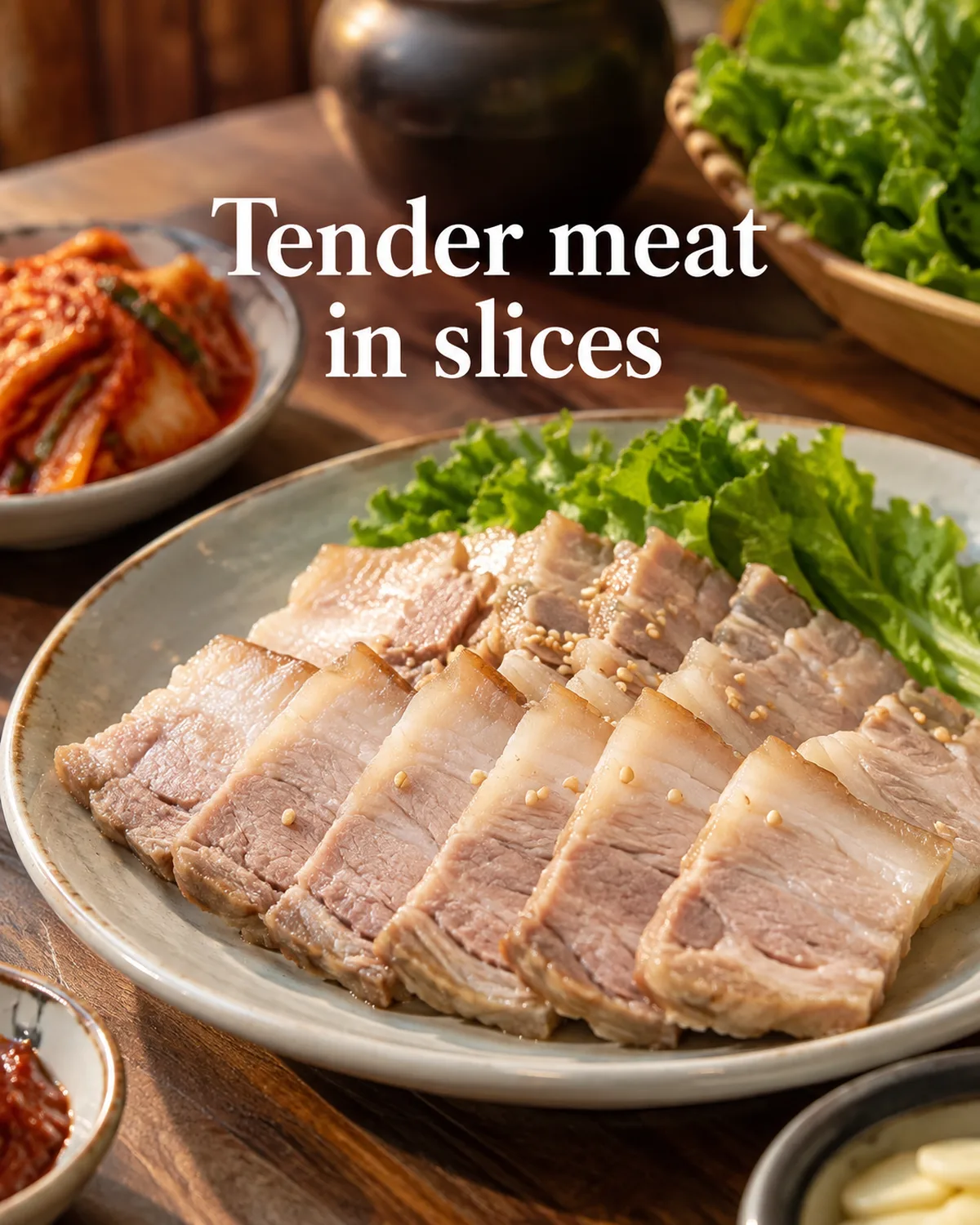
Suyuk is boiled meat served in slices. It can be eaten with accompaniments, but the cut, serving size and sides belong to the particular menu. Its tender sliced format differs from cooking raw meat at a tabletop grill. Ask how much a serving contains before deciding whether it suits one diner or a group.
Suyuk is boiled meat served as a sliced dish.
Dalgona offers a snack instead of another full meal
The official recipe series has a dalgona program page too. Its presence connects the catalog to a sugar candy whose interest includes making, stamping and handling, not simply another bowl to finish.[8]
A cooled dalgona disc breaks with a thin, porous crunch. A stamped outline can turn it into a shape-removal challenge, but playing is optional. For a snack after a meal, a small edge piece lets you notice the caramel-like sweetness without attempting the whole game.
A cooled dalgona piece can be eaten without playing the game.
This is where food choice becomes more useful than collecting every reference. A noodle bowl, gimbap, soup, sliced meat and a sweet do not need to be eaten in one outing. Choose a meal that fits your hunger, then a snack if you still want one. The catalog can introduce variety without prescribing a full day’s intake.
Plan around the dish and the actual menu
Start with the kind of eating you want: a hot noodle bowl, cooled dressed noodles, a rice dish, a warm soup or shared meat. Then look for a place serving that preparation. The dish remains useful even if a restaurant mentioned in an old food clip has closed or changed its menu.
Before a planned visit, check the restaurant’s current menu, opening information and ordering conditions. A past artist visit documents a past visit; it does not establish today’s hours or a continuing personal recommendation. The same applies to a limited food promotion whose dates have ended.
When the food arrives, compare something concrete. Does the noodle sauce cling or pool? Can you distinguish kimchi pieces from the rice? Does a gimbap filling add crunch? Those observations make the meal your own, while the original recipe or official program remains the starting point.
Explore the dishes and the separate food collaborations
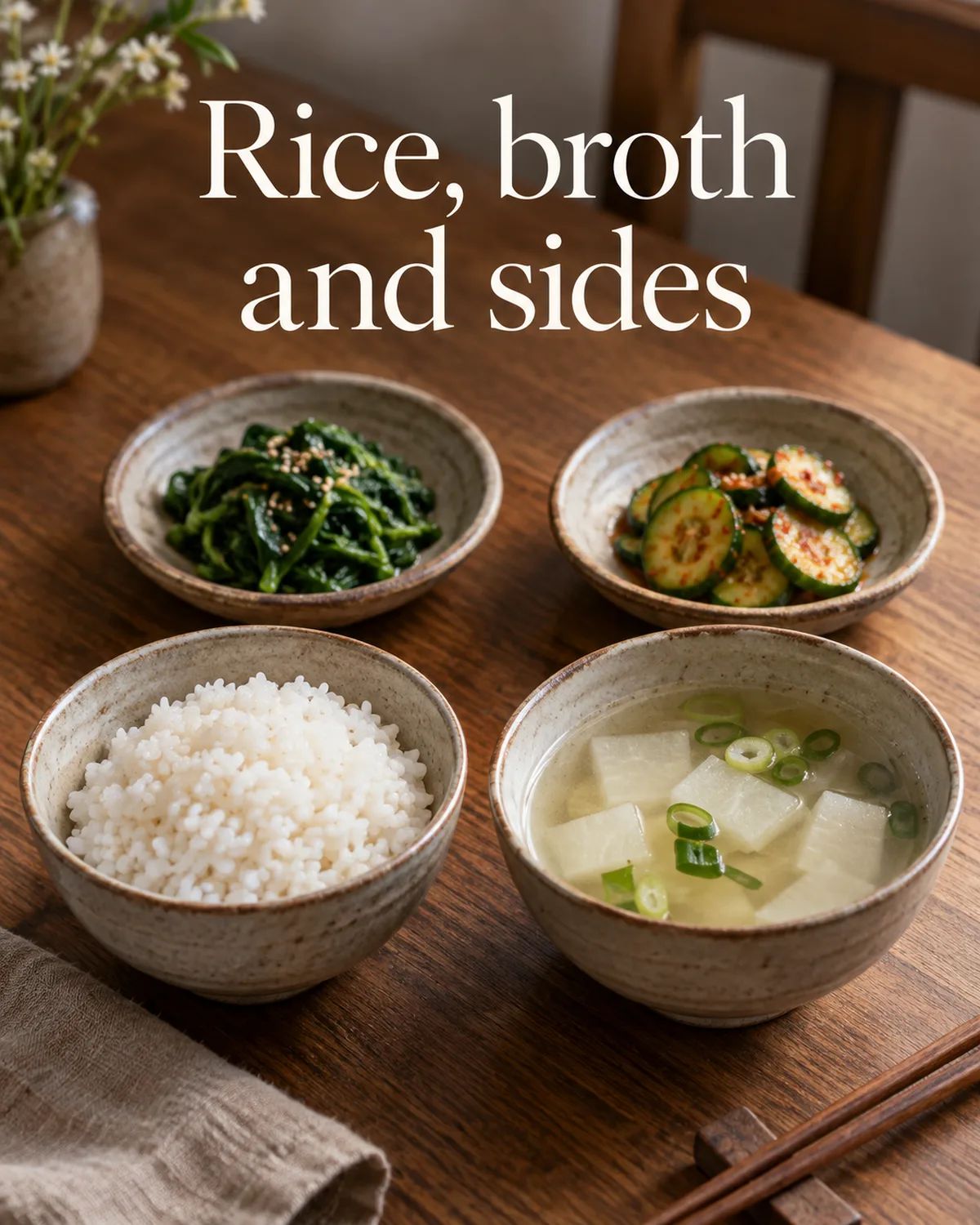
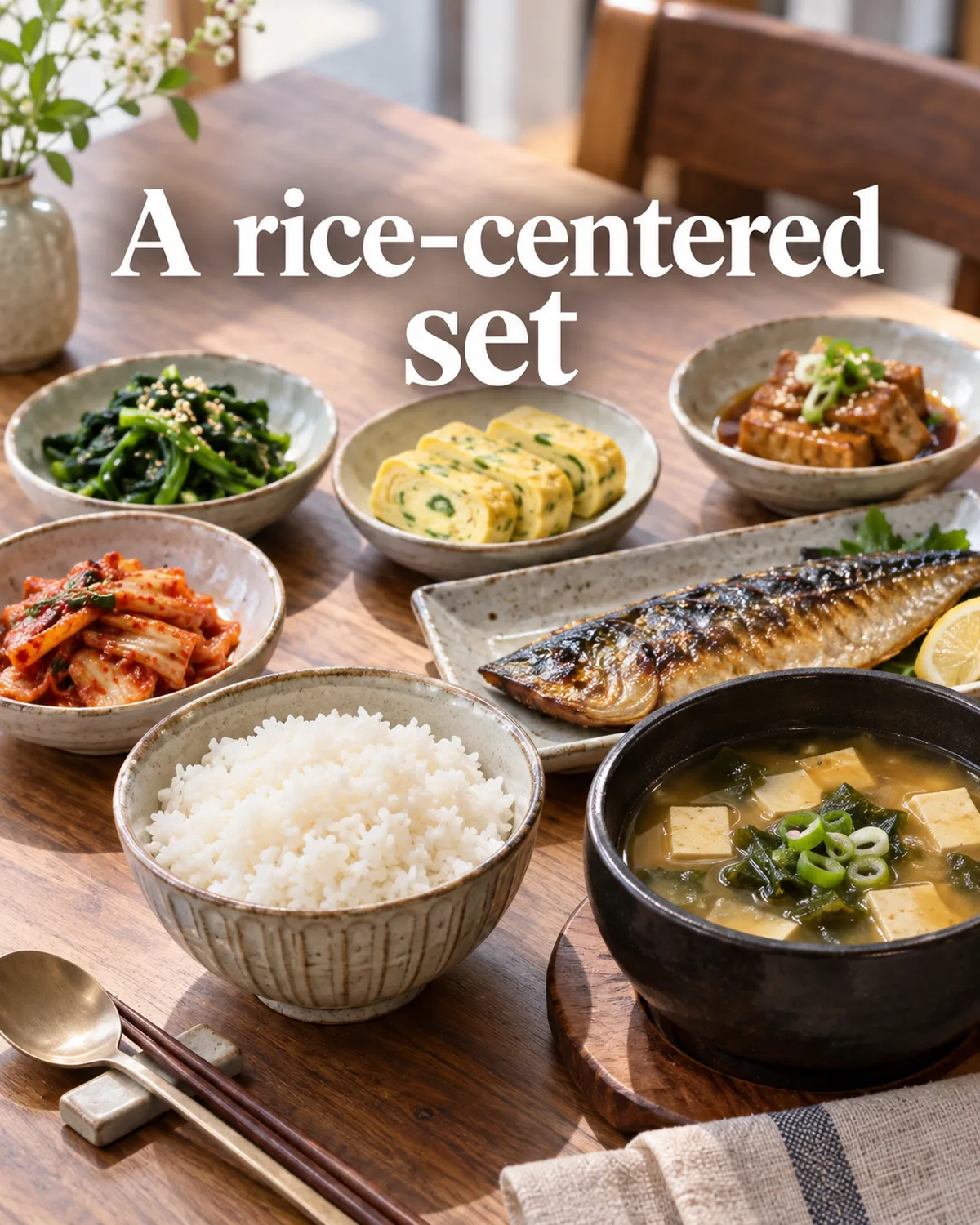
The little dishes are not merely extras surrounding the main attraction. At a Korean table, they can supply contrasts that the rice, soup or main dish does not provide on its own: crunch against softness, acidity against richness, or a strongly seasoned bite beside plain rice.
Banchan makes more sense as a meal system than as a promise of free food. The number of plates is only the most visible part of that system.
Begin with rice, soup and the bansang structure
The Academy of Korean Studies defines bansang (반상) as an everyday table setting composed of rice and accompanying dishes. Rice functions as the staple, while the foods around it are chosen to be eaten with that rice. Soup or stew can join the setting, and the side dishes can include raw or cooked vegetables, grilled foods, braises, pancakes, raw preparations, salted seafood and dried foods.1
That definition changes the visual hierarchy. An English menu can make the “main” item look like the center and everything else secondary. A traditional Korean rice table is organized differently. The staple is stable; the accompanying dishes create variation from bite to bite.
This is why even a small amount of several foods can be more useful than one large side dish. A spoonful of rice can be paired first with kimchi, then with a mild vegetable, then with fish, then with a braise. The meal is designed to move rather than repeat.
Formal descriptions use cheop (첩) for counted accompanying dishes. The Academy of Korean Studies’ bansang entry describes settings from three to twelve cheop.1
The number can be misunderstood if every visible bowl is counted. In formal descriptions, rice, soup, kimchi and condiments are basic components alongside the numbered dishes. A three-cheop meal can therefore contain more than three vessels on the table.2
The formal system also cared about composition, not just quantity. The Academy’s bansang entry explains that dishes were selected so the same cooking method and the same ingredient were not simply repeated. A three-cheop table could combine a raw seasoned vegetable, a cooked vegetable and a grilled or braised item; larger settings expanded the range.
Rice, soup, kimchi and condiments sit alongside the counted side dishes.
This is an important correction to the modern obsession with plate count. The historical ideal was not “more bowls equals better food.” Variety had a structure.
For ordinary diners, calling kimchi a banchan is completely natural. It is eaten alongside the meal and performs exactly the kind of supporting role people associate with side dishes.
Formal cheop classification is more technical. The Academy’s bansang description places kimchi as a basic component while the numbered cheop are selected from additional categories. That is why someone trying to count a historical three-cheop table from a photograph can become confused: the table may visibly contain rice, soup, kimchi, sauces and three counted side dishes.
Everyday vocabulary and formal culinary classification do not always draw boundaries in the same place. Both can be correct within their context.
A table of contrasts, changed by the season
One reason a Korean table can feel abundant is that each small dish does a different job. A useful way to read the table is by contrasts rather than recipes:
Fermented versus fresh: kimchi or a fermented paste can sit beside fresh or lightly seasoned vegetables.
Soft versus crisp: braised tofu can contrast with radish, cucumber or fresh greens.
Mild versus pungent: a restrained vegetable dish can reset the palate after garlic, chili or fermented seasoning.
Wet versus dry: a saucy braise can alternate with roasted seaweed or a dry stir-fry.
Plant versus animal protein: beans, tofu, egg, fish or meat can appear in small amounts rather than as one huge center-of-plate serving.
The Academy of Korean Studies explicitly notes diversity of ingredients, tastes, colors and textures as a strength of bansang. This is the deeper logic behind a table that can look visually busy but still feel coherent.
Banchan are not a fixed national checklist. The same household can change them with the season, region, budget and what needs to be used in the refrigerator. A seasonal vegetable can take the place of another while still providing a fresh or lightly cooked contrast to rice.
VISITKOREA’s Korean-food guide highlights namul—seasoned vegetable dishes—as indispensable side dishes across home cooking, restaurants, temple food and baekban restaurants. The point is not that every Korean meal must contain the same namul. It is that Korean cooking has many methods for turning vegetables, mushrooms and seasonal plants into small prepared dishes that work with rice.4
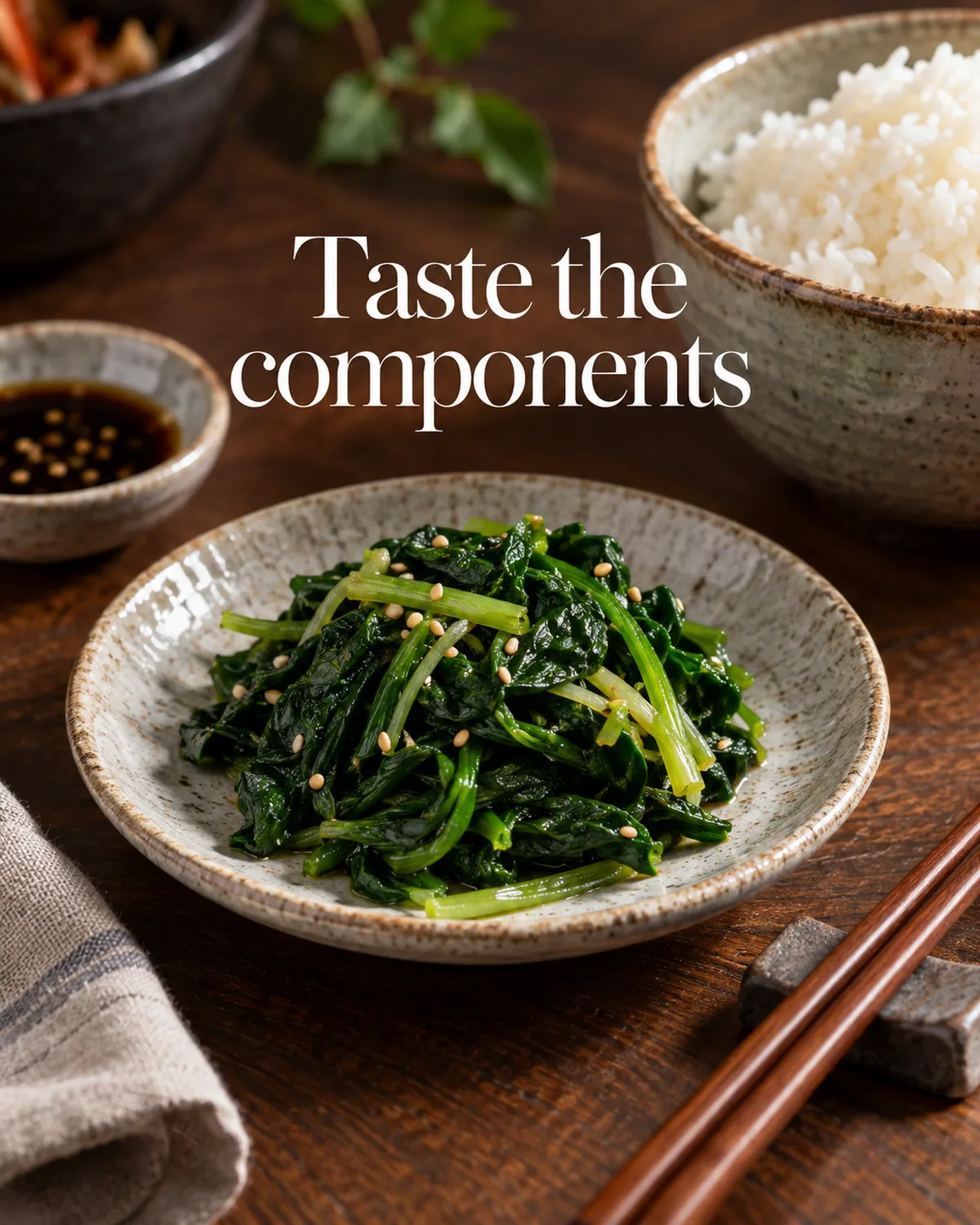
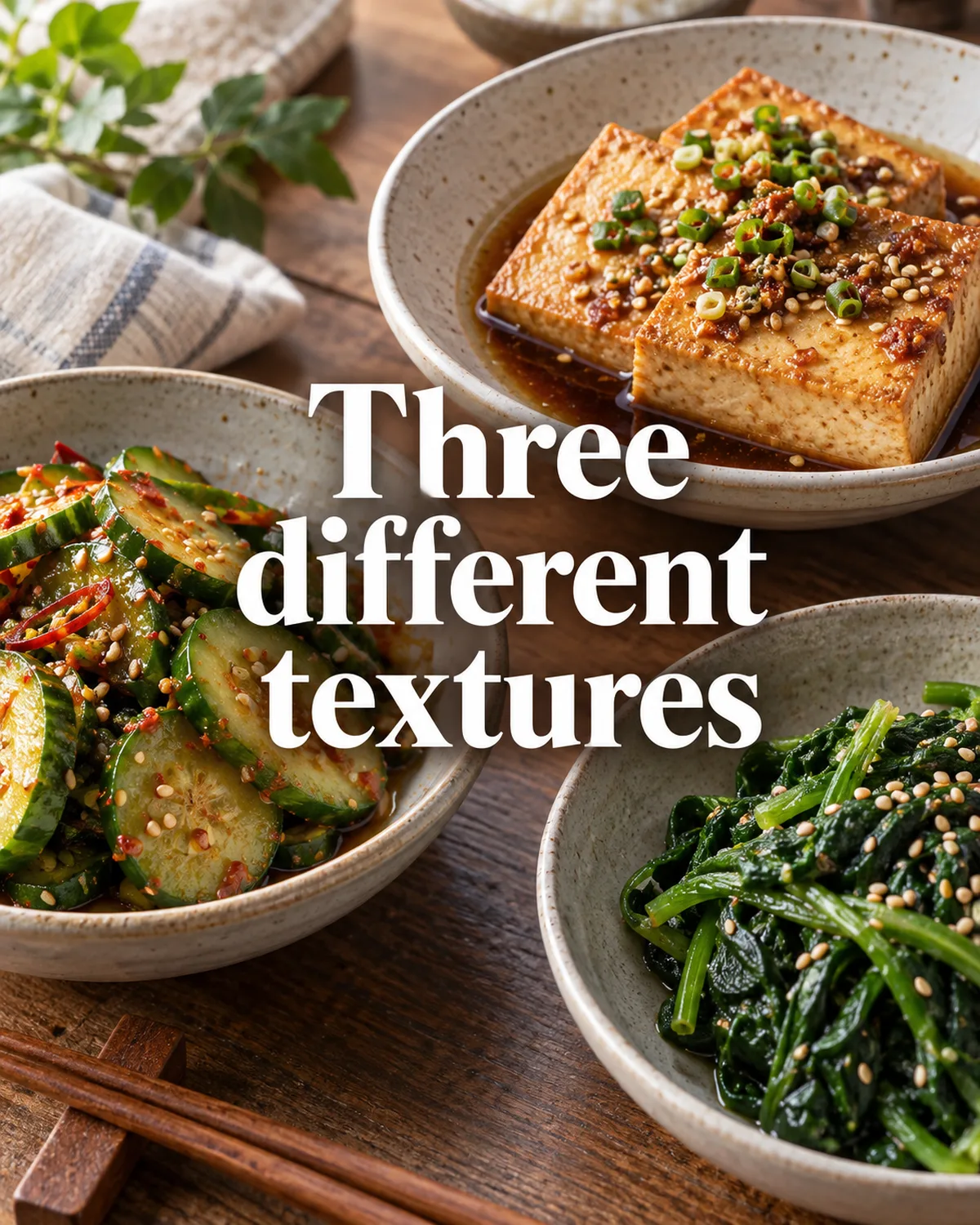
Consider a simple combination: spinach namul is tender and lightly seasoned; cucumber muchim can be juicy and crisp; tofu jorim carries a seasoned braising sauce. These examples show different textures and methods, not a compulsory three-dish menu. Cucumber muchim itself changes with the cook’s seasoning and cut.
Crisp cucumber, tender spinach and saucy tofu provide different bites beside rice.
There is no single origin story for every banchan
The twelve-cheop surasang is associated with Joseon royal dining. Korea Heritage Agency’s Gyeongbokgung Starlight Tour page describes its meal as a modern interpretation of that royal setting, rather than a surviving historical meal.3
That historical association is sometimes inflated into a dramatic internet rule: ordinary people were supposedly forbidden by law from eating twelve side dishes because the number belonged to the king. The surviving table hierarchy shows status and formality, but that does not by itself prove a universal criminal prohibition on every non-royal household that happened to serve many foods.
The stronger story is social rather than sensational. Ingredients, labor, servants, vessels, time and court protocol made an elaborate royal table a display of resources and hierarchy. A twelve-cheop setting signaled a different social world. There is no need to invent a food-police story to make that distinction meaningful.
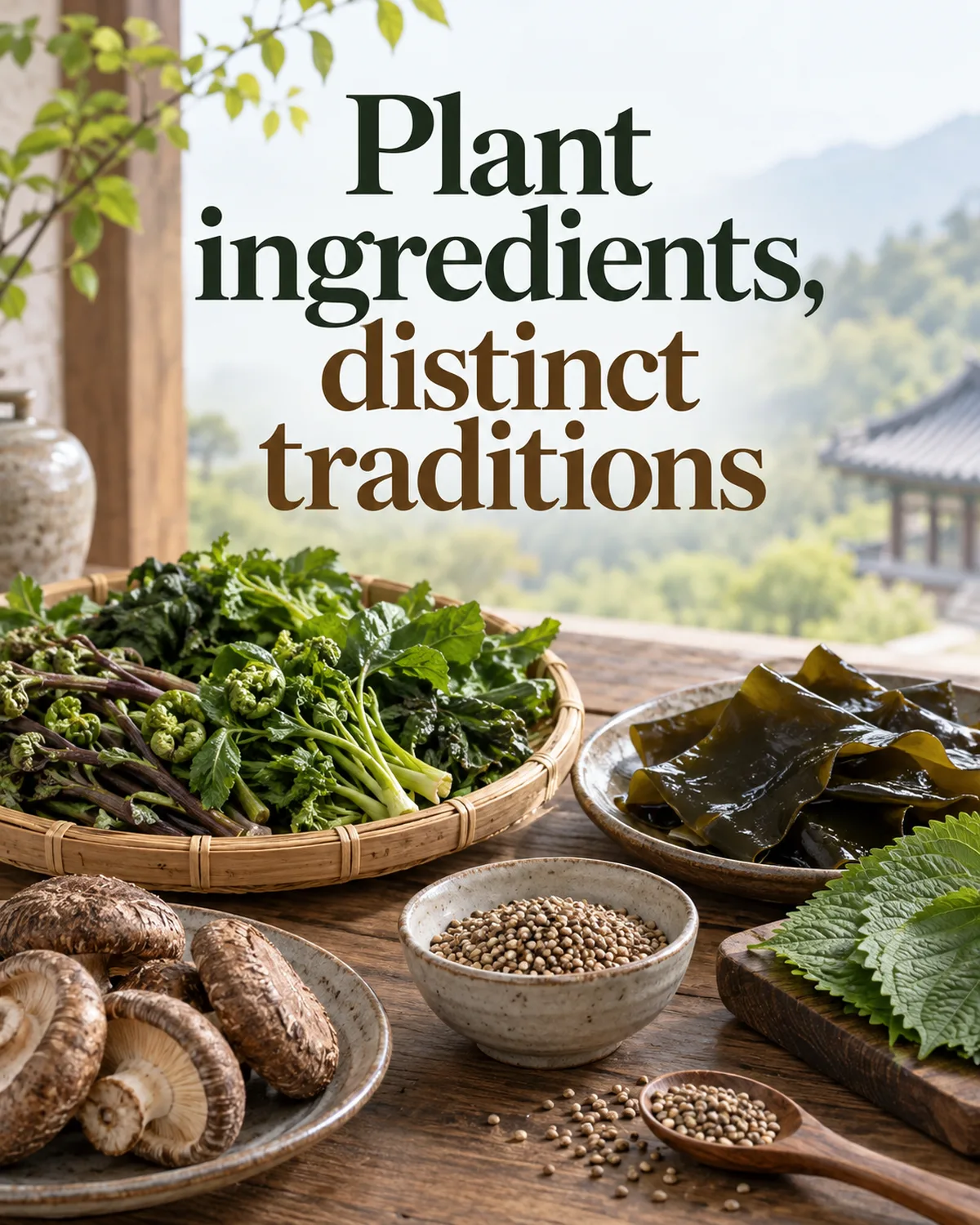
Buddhist temple food offers a distinct approach to plant ingredients and seasoning. The Cultural Corps of Korean Buddhism describes vegetables, mountain herbs and natural seasonings such as mushrooms, kelp and perilla seeds, alongside religious restrictions on meat and five pungent vegetables. This documents one tradition; it does not establish a single religious origin for all banchan.5
Temple cooking has its own plant ingredients, seasonings and religious restrictions.
Banchan reflect overlapping forces: grain-centered meals, agriculture, preservation, seasonality, household economy, regional ingredients, court conventions and religious food traditions. A broad meal architecture that developed over long periods is unlikely to have one inventor or one decisive moment.
The safer historical habit is to distinguish influence from origin. Temple cuisine helps explain an important branch of Korean vegetable cooking. It should not be used as a shortcut that erases every other branch.
Included does not mean unlimited
Many Korean restaurants bring basic banchan without a separate line-item charge, and common dishes may be replenished on request. From the diner’s perspective, that feels free. Economically, the ingredients, prep labor, dishwashing, refrigeration and food waste still cost money.
The sensible way to describe the system is that basic banchan are included in the restaurant’s service format and priced into the business as a whole. Different restaurants make different decisions about which dishes can be refilled, how much is served initially and whether higher-cost items are limited.
This is more accurate than claiming there is one ancient rule, one postwar origin story or a legal requirement that all side dishes must be endlessly replenished. Restaurant practice is a convention, not an unlimited entitlement.
Online explanations sometimes start with the modern refill custom and then search backward for a single event that supposedly created it: postwar rice prices, government policy, a restaurant competition or an ethic of hospitality. Those stories can be appealing because they turn a mundane service norm into a clean origin tale.
The evidence is stronger for the older meal structure than for one precise beginning of free refills. Rice-centered tables with multiple accompanying dishes long predate modern restaurant economics. Contemporary restaurants then adapted that familiar structure into a commercial service model.
For a diner, the useful distinction is between the familiar rice-and-side-dish structure and the restaurant’s own refill policy. The first does not establish the second.
Point to the particular plate you want replenished. Kimchi or seasoned bean sprouts may be part of the refillable basics; a grilled fish or special meat dish may belong to the priced set. Neither its small plate nor its position beside the rice settles the question. Ask before assuming a second serving is included.
The practical rule is to ask rather than infer. If an empty bowl is something you want more of, a simple “jogeum deo juseyo” (조금 더 주세요, “a little more, please”) works in many settings. A kiosk, call button or self-service bar may replace that interaction.
Do not turn a useful phrase into a promise that every restaurant will refill every dish. The current menu and staff are more authoritative than an evergreen travel article.
Request more of the particular dish; the restaurant decides what is included.
Shared dishes change the rhythm of eating
Banchan are commonly placed in the middle of the table. Diners keep their own rice and often soup, but repeatedly reach toward shared dishes. That creates a meal with two scales at once: individual staple bowls and communal flavor resources.
The arrangement changes behavior. No one needs a full serving of every side dish. A diner can take one bite of spinach, two pieces of kimchi, a piece of tofu and later return to the dish that best matches the next spoonful of rice.
This sharing system also means etiquette is mostly about proportionality. Take a reasonable amount, use serving utensils if they are provided, avoid moving food around unnecessarily, and do not request repeated refills that will be abandoned. Exact house customs vary, but waste is a more durable concern than performing a rigid “correct” sequence.
Baekban restaurants are useful for understanding banchan because the point is not one spectacular specialty. A typical set centers rice and soup with a selection of prepared side dishes, letting the meal’s balance become the attraction.
A baekban meal offers a rice-centered setting with prepared sides. The menu may identify a particular soup or protein, but the number and identity of accompanying dishes remain specific to the restaurant.4
A baekban setting brings prepared sides around rice and soup.
At a baekban table, compare the bowls across a few mouthfuls: does the crunchy radish change a soft spoonful of rice, and does a mild vegetable temper a strongly seasoned braise? This reveals what the sides contribute without requiring a large plate count.
Home kitchens, preservation and meals for one
At home, banchan can be a time-management system. Several dishes are cooked in advance, refrigerated and brought out across multiple meals. A fresh dish can join older staples, so dinner does not require cooking six foods from zero every night.
In a restaurant, the same visual form solves a different problem. Side dishes help define house identity, prepare diners for the main food, balance salty or fatty dishes and create a feeling of completeness while the kitchen standardizes prep in bulk.
That distinction explains why “Koreans eat ten freshly cooked side dishes at every home meal” is just as misleading as “banchan are restaurant freebies.” The bowls may look similar, but household and commercial workflows differ.
Some banchan are prepared for immediate eating; others use fermentation, drying or braising. That does not give all of them the same storage life. A freshly seasoned cucumber, cooked tofu and fermented kimchi still require handling appropriate to their ingredients. Treat a restaurant table as food for the current meal, rather than storage advice for leftovers.
This creates a layered refrigerator. A long-lasting dish can remain while one fresh namul is added today and a protein dish tomorrow. The table gains variety without requiring every item to be cooked at once.
Separate containers let a household bring out different prepared sides.
Preservation therefore helps explain abundance, but it is not the sole origin of banchan. It is one mechanism that makes a multi-dish system practical.
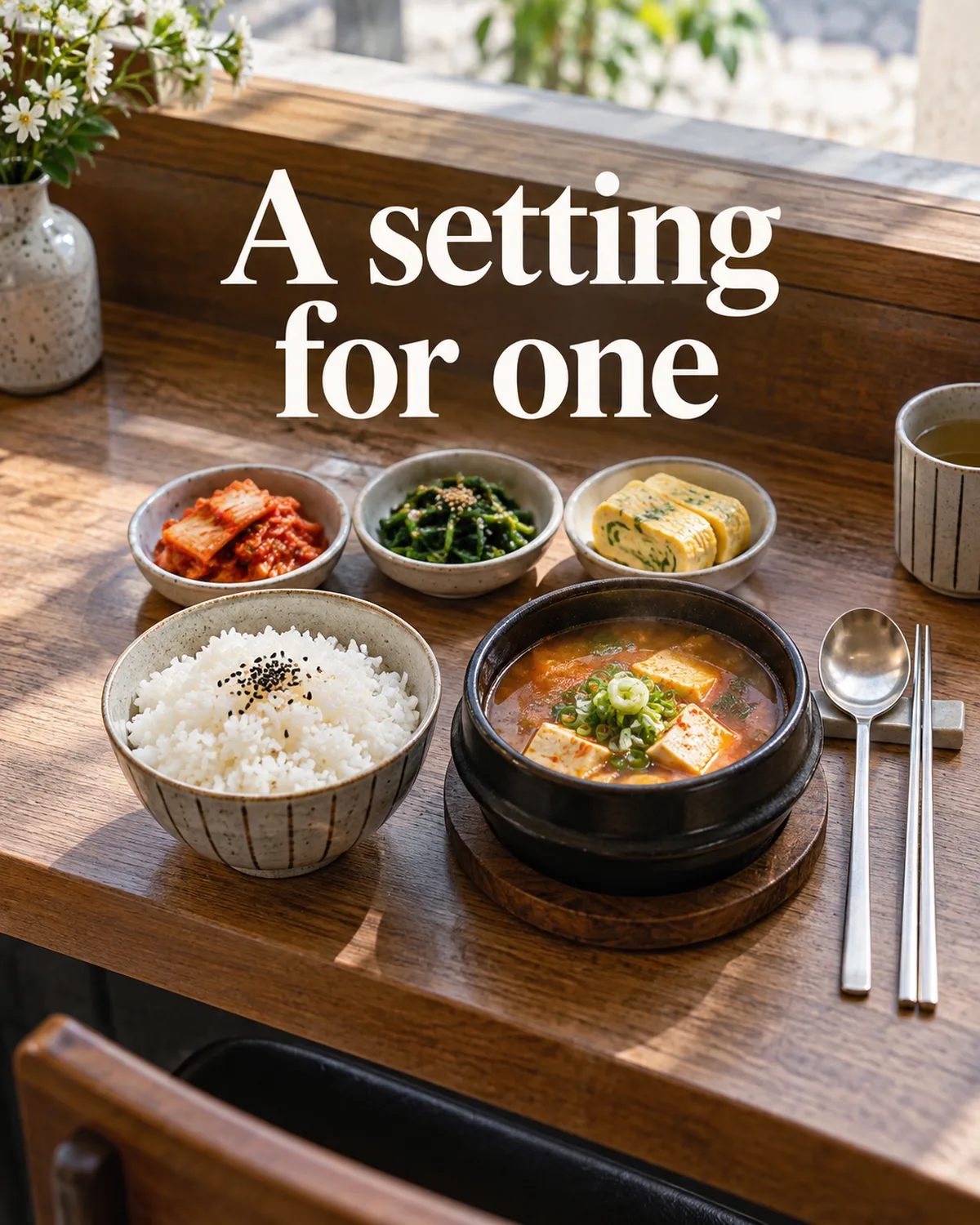
Banchan need not be communal: the Academy’s formal bansang description treats an individual table as the usual arrangement and describes adjustments for two diners. At today’s shared restaurant table, however, portions set out for a group may be too large for one person. Solo dining calls for a suitable serving size, rather than a different definition of the food.1
Small portions can provide several contrasts for one diner.
Restaurants and retailers respond in several ways. Some offer a smaller fixed set. Some use self-service bars. Convenience stores package several tiny components into one tray. One-person restaurants may use individual side-dish compartments rather than communal bowls.
The idea survives because the core function survives: give a rice-centered meal variety and contrast. The container changes before the cultural logic does.
Read the table by function before learning every name
Try one side with a small bite of rice, then compare it with another. A juicy radish kimchi, a tender vegetable and a dry sheet of gim change the same rice in different ways. The goal is to notice the food’s texture and seasoning, rather than to identify every bowl at once.
If one dish is strongly seasoned, use a smaller bite beside the rice. If another is mild, try it separately as well. There is no required circuit around the table; you can return to a favorite without combining every flavor into one mouthful.
Recognizing a few categories is more useful than memorizing a hundred recipes. Namul tells you to expect seasoned vegetables or plant foods. Jorim often indicates braising in seasoned liquid. Jeon points toward pan-fried battered or egg-coated foods. Muchim signals a seasoned mixed preparation. Kimchi is a fermented category with enormous regional and ingredient variation.
Namul, jorim, jeon and muchim describe different preparations.
Some vegetable-looking banchan contain fish sauce, salted seafood, egg, soy, wheat, sesame or nuts. Check ingredients before tasting if you have an allergy or dietary restriction; ask about shared preparation utensils too. A small taste is not an allergy test. If the ingredients or preparation cannot be confirmed, choose another dish.6
Once the ingredients suit your needs, alternate a little rice with one side at a time. Request more of the particular dish you enjoy, rather than refilling every bowl.
Ingredients still matter on a colorful table
A bansang can create ingredient diversity, and the Academy of Korean Studies notes balance as an advantage of formal composition. That should not be converted into the claim that any Korean table with many bowls is automatically healthy.
Some banchan are vegetable-rich and lightly seasoned. Others are salty, sweet, fried or preserved. A table can contain many foods while still delivering a high sodium load, especially if salty side dishes are combined with soup, stew, sauces and processed foods.
Small dishes can make several ingredients easy to include, but their colors and number do not establish a nutritional verdict. The recipe, portion and rest of the meal remain relevant.
A roll, a grill and a meal for one show how the small plates adapt to different tables.
Replacing some white rice with grains or beans can change a meal without making it unrecognizable. Soup, kimchi and side dishes may remain around the same bowl. That compatibility helps explain the appeal of Korea’s jeosok-nohwa, or slow-aging, food discussion.
The label still cannot prove that one bowl, one ratio or one commercial product slows aging. The useful task is to look at what changes in the meal and what the research actually measured.
What jeosok-nohwa means in this food trend
Physician Jung Hee-won helped popularize jeosok-nohwa in Korea while working in geriatric medicine at Seoul Asan Medical Center. A March 2024 Korean health report described the growing discussion and his proposed mixed-grain recipe. That dated account documents the trend; it does not establish the recipe’s medical effects.6
The framework draws on ideas already familiar in nutrition research rather than claiming a newly discovered Korean nutrient. Jung has discussed the MIND dietary pattern, a hybrid of Mediterranean and DASH approaches that emphasizes plant foods and limits foods high in saturated fat and added sugar. In Korean everyday cooking, one obvious place to translate that principle is the rice bowl.
This is why the trend should be described as adaptation, not rediscovery. Korea has long eaten barley, beans, millet, mixed grains, tofu and vegetables. But historical existence is not the same as a single continuous “slow-aging diet.” Today’s movement selects some older ingredients and meal habits, combines them with modern nutrition language, and packages them as a contemporary behavior-change system.
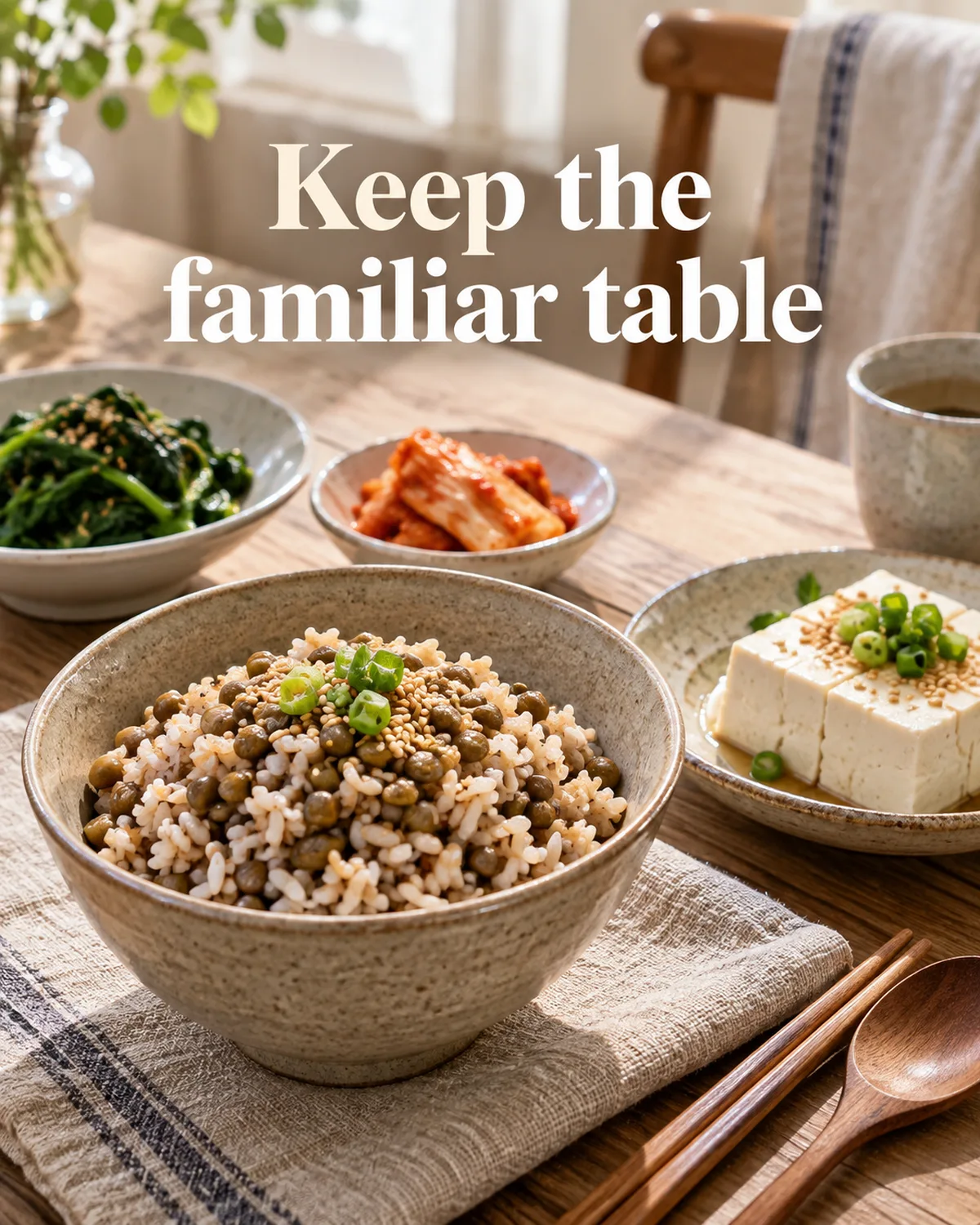
A Western diet plan often asks a Korean eater to redesign the entire plate. The slow-aging approach can be much less disruptive. Rice remains in the center, soup can remain beside it, kimchi and namul can stay on the table, and familiar proteins can still appear. The most visible change is that polished white rice no longer has to be the only grain.
That is culturally important. A staple is not just a nutrient source; it is the organizing center of a meal. Change the staple and you alter texture, satiety, cooking time, side-dish balance and the amount of refined carbohydrate in every spoonful without asking the eater to abandon the architecture of a Korean meal built around rice and banchan.
A mixed-grain rice bowl keeps familiar tofu, vegetable and kimchi sides around it.
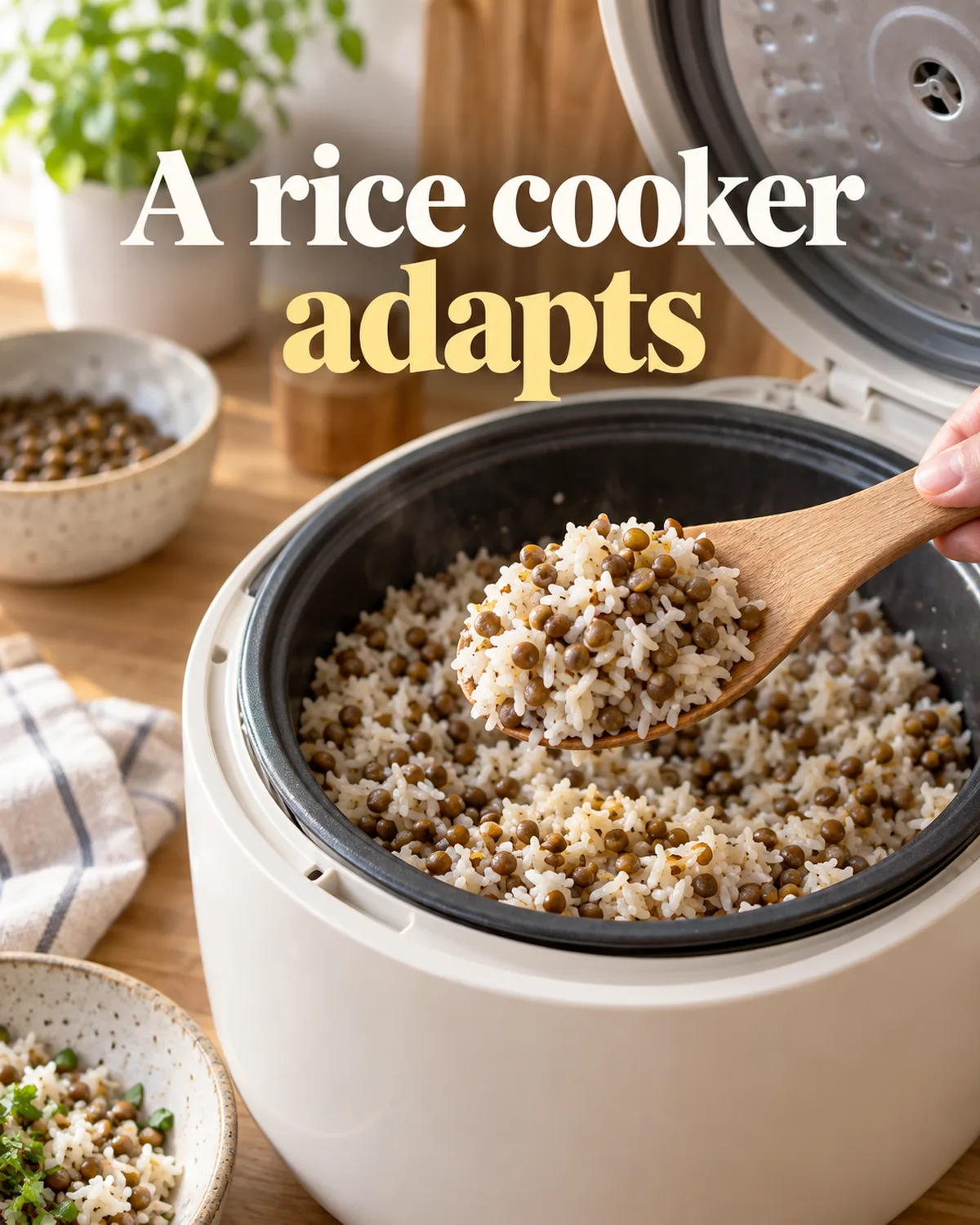
The same principle helps explain why the trend traveled beyond specialist clinics. It is easier to repeat a framework that can be cooked in a normal rice cooker than one that requires a separate health-food cuisine. The innovation is partly nutritional and partly logistical.
A mixed-grain bowl is not one compulsory formula
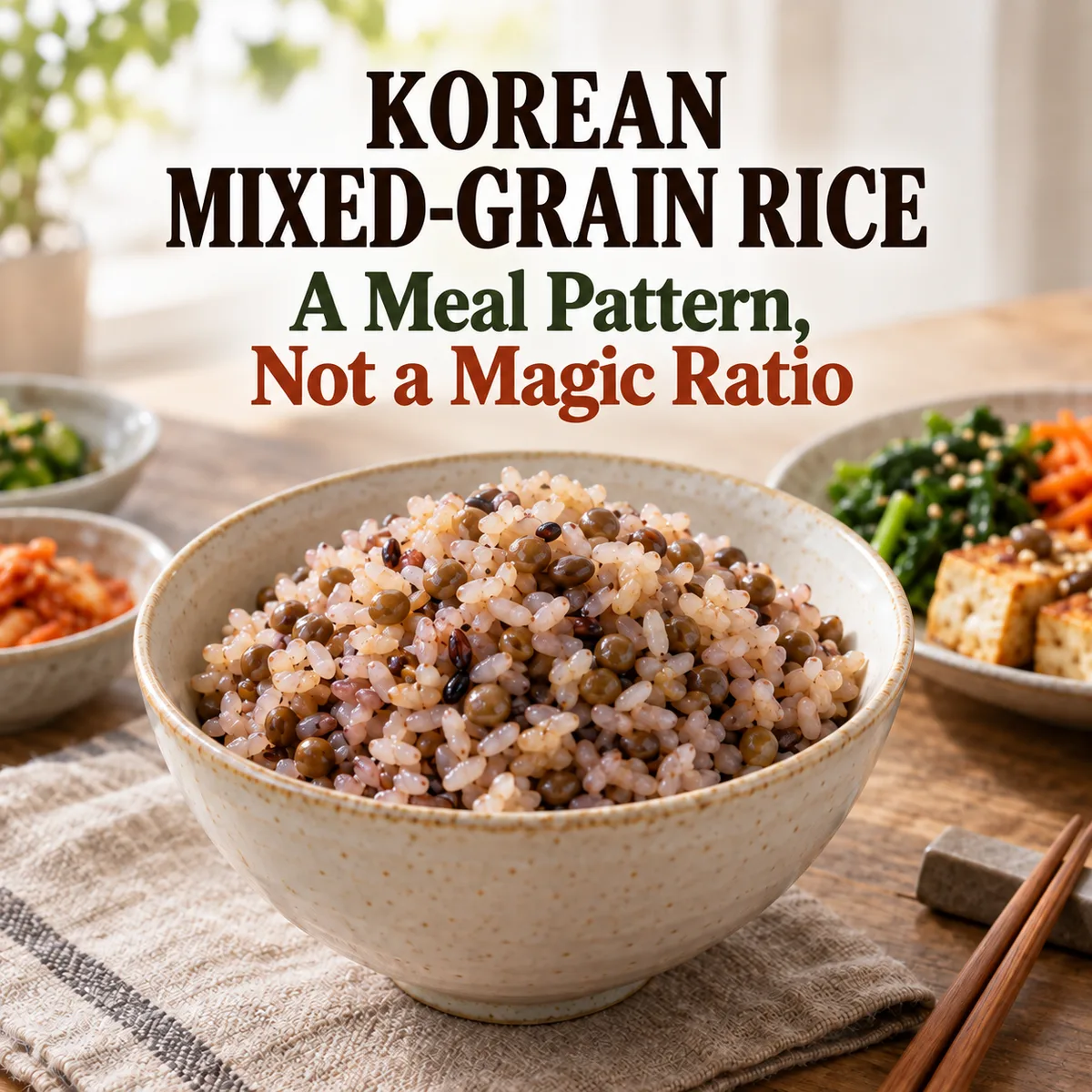
The March 2024 report described a lentil, oat, brown-rice and white-rice mix of 4:2:2:2, equivalent to 2:1:1:1. That ratio may be useful when it is attributed to a particular recipe or author. It should not be described as the one formula “Koreans actually cook.”
There are several reasons. First, household rice mixtures vary by taste, digestion, price and what is available. Second, grains absorb water differently. Third, the rest of the meal matters: a bowl with more whole grain does not automatically compensate for an otherwise unbalanced diet. Fourth, health conditions can make a generic high-fiber or high-potassium pattern inappropriate for some people.1
The durable principle is simpler:
Replace part of refined grain with less-refined grains or legumes.
Increase plant variety rather than worship one “superfood.”
Keep protein adequate and spread through the day.
Reduce dependence on highly processed foods, sugary drinks and sweets.
Build a pattern that can be repeated, not a recipe that is endured for a week.
A lentil-heavy bowl, a barley-and-brown-rice mix, or another whole-grain combination can all fit the same logic. The exact ratio is a recipe decision. The dietary pattern is the bigger idea.
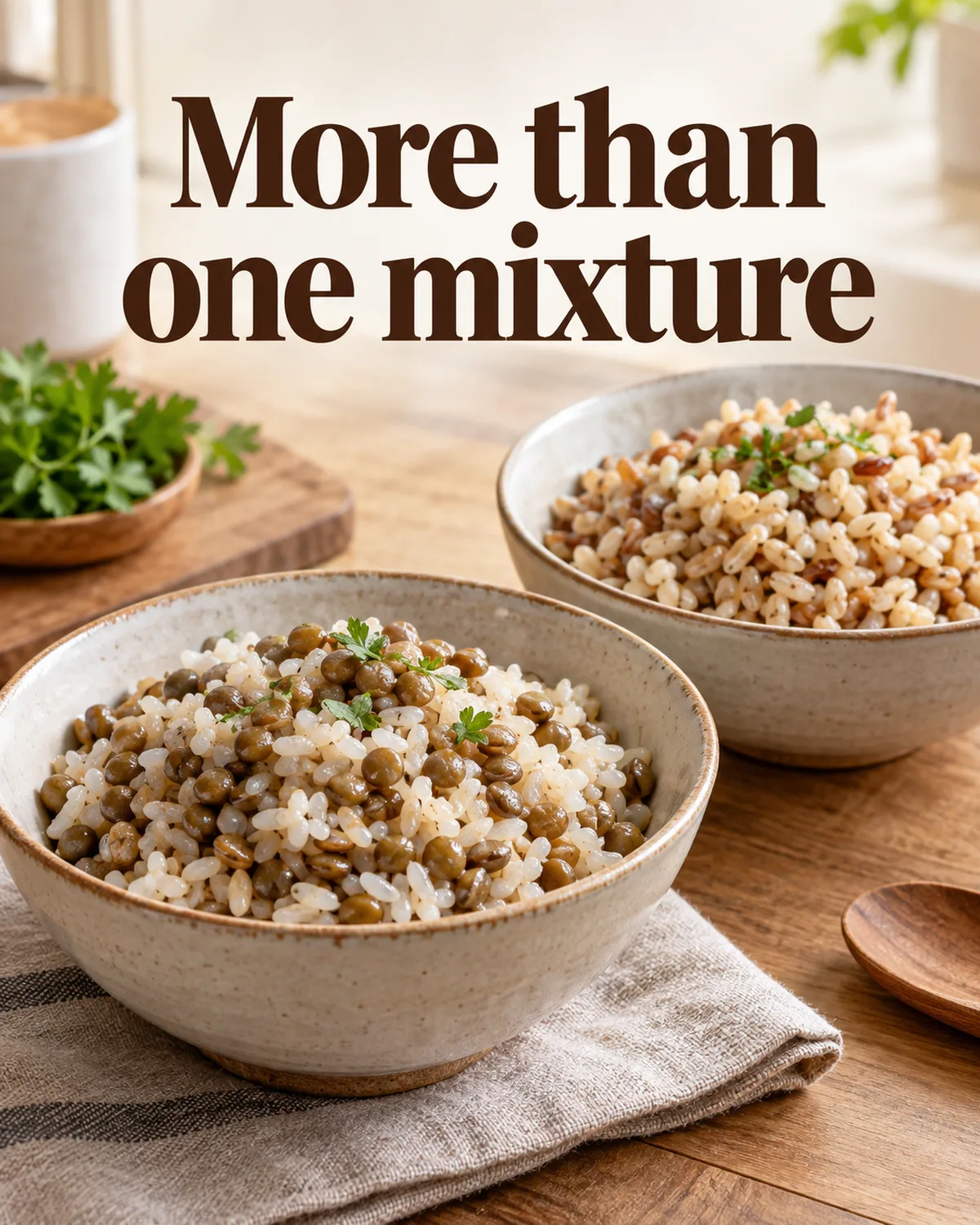
Lentil-rice and barley-brown-rice mixtures can look and feel different.
The difference is not mystical. Refining grain removes much of the bran and germ. Less-refined grains therefore retain more fiber and a broader mix of micronutrients. Legumes add fiber and plant protein, and their starch is packaged inside a different cellular structure from polished white rice.
Those differences affect cooking as much as nutrition. Brown rice usually needs more time and water than polished rice because the bran layer slows hydration. Oats soften quickly and can change the mixture’s creaminess. Lentils vary by type: split red lentils break down readily, while brown or green lentils tend to hold their shape longer. A rice-cooker mixture that works for one combination can become dry, mushy or uneven if the ingredients are swapped without changing water and soaking time.
Whole green lentils hold their shape more readily; split red lentils soften and break down.
This is one place where practical food science is more useful than a viral ratio. Start with a moderate proportion of unfamiliar grains, use the rice cooker’s mixed-grain setting if available, and adjust water after observing the texture. If a particular legume causes digestive discomfort, increasing the amount gradually can be easier than forcing the full social-media recipe from day one.
A dietary pattern is different from an anti-aging claim
MIND stands for Mediterranean–DASH Intervention for Neurodegenerative Delay. It combines features of the Mediterranean and DASH dietary patterns while emphasizing foods that observational studies had associated with brain health. The name made it a natural reference point for a Korean doctor trying to explain long-term diet quality in an aging society.
But a crucial piece of evidence keeps the discussion honest. In a three-year randomized controlled trial published in the New England Journal of Medicine in 2023, 604 older adults without cognitive impairment but with a family history of dementia were assigned either a MIND diet with mild calorie restriction or a control diet with the same mild calorie restriction. Both groups improved on cognitive scores, and the difference between them was not statistically significant. Brain MRI outcomes also did not differ significantly.2
That trial does not prove that healthy dietary patterns are useless. It shows why “this diet prevents cognitive aging” is too strong. Observational evidence, cardiovascular evidence, metabolic effects and long-term eating quality can all be relevant while a specific anti-aging claim remains unproven.
This distinction is the most important part of the article: a diet can be sensible without being a medical time machine.
Large prospective-study meta-analyses have associated higher whole-grain intake with lower risks of cardiovascular disease and all-cause mortality. Similar bodies of evidence support eating more vegetables, fruit, nuts and other minimally processed plant foods as part of a healthy dietary pattern.4
Brown rice retains outer layers that polished white rice largely loses.
Association is not the same as a guarantee for an individual person. People who eat more whole grains may also differ in exercise, smoking, income, healthcare access and other behaviors. High-quality studies adjust for many of these factors, but no single observational association can prove that one food directly extends life.
The scientifically safer formulation is therefore: replacing some refined grains with whole grains and legumes can align a Korean meal with well-supported healthy-eating principles. Whether a specific “slow-aging” recipe measurably changes biological age, dementia risk or lifespan in an individual is a different question requiring direct evidence.
Whole grains and legumes change a bowl’s fiber, protein and texture. But those ingredient differences do not make every mixed-grain meal equivalent, nor do they establish an anti-aging effect.
Total carbohydrate amount, portion size, cooking time, ingredient form and what else is eaten in the meal all matter. A very large bowl of mixed grains is still a large bowl. Grinding grains, cooking them very soft, or pairing them with sugary foods changes the metabolic context. Likewise, a zero-sugar label on one condiment does not make the whole meal nutritionally superior.
Mixed grains still have a serving size; the name does not make a large portion disappear.
The slow-aging idea works best when the grain substitution is one part of a broader pattern rather than a permission slip to ignore the rest of the table.
A Korean table can be adjusted without being replaced
One attractive story says Korea merely rediscovered how grandparents ate: grains, beans, vegetables, fermented foods and little meat. There is some historical truth inside that image, but it becomes misleading when poverty, seasonality and regional variation disappear.
Past Korean households ate differently by class, location, season and food availability. Refined white rice could be prestigious precisely because it was not always accessible. Meat intake changed with income and supply. Preservation created extraordinary fermented foods but also meant salt was structurally important. A traditional table can contain vegetables and beans while also containing salty broth, refined starch, sweetened condiments or fried foods.
No national cuisine has one health profile. “Traditional” is a historical category, not a nutrition score. The modern slow-aging movement is better understood as selective editing: keep useful meal structures, increase whole plant foods, reduce refined or highly processed foods, and pay attention to portions and protein.
Lentils are not historically central to Korean cuisine. Their success in this trend is interesting precisely because they were inserted into a strongly Korean meal system without requiring the meal to stop feeling Korean.
The rice cooker acts as a cultural adapter. Cooked together with rice and grains, lentils become part of the staple rather than a separate foreign side dish. Kimchi, tofu, fish, egg, seaweed, soup and seasoned vegetables can still surround the bowl. The diner experiences continuity even though the ingredient mix has changed.
Cooked lentils can join rice in an ordinary meal without replacing all the side dishes.
This mechanism appears repeatedly in Korean food history. New ingredients survive when they find a place inside an established eating structure. The question is not simply whether Koreans accept a foreign ingredient; it is whether the ingredient can be made to behave like part of a familiar meal.
Instead of memorizing a celebrity recipe, use a decision framework that survives ingredient changes:
What is the staple? Is all of it highly refined, or can part be replaced with whole grain or legumes?
Where is the protein? Tofu, beans, fish, eggs, poultry, dairy or meat can all fit; the point is adequacy and balance rather than one mandatory source.
How many plant foods are actually present? A decorative lettuce leaf is not the same as a meal structured around vegetables, mushrooms, seaweed and legumes.
Where is the hidden excess? Sweet drinks, highly processed snacks, salty broth, large sauces and frequent processed meat can change the meal’s overall profile.
This four-question method is more transferable than a single 2:1:1:1 formula. It works in a Korean home, a cafeteria, a convenience store or a restaurant.
The staple, protein, vegetables and seasoning each contribute to the meal.
The same questions work outside the home
The slow-aging trend is often shown as an ideal home table, but a large share of Korean meals are eaten alone or purchased ready-made. That makes the connection to honbap, Korea’s modern solo-dining culture important.
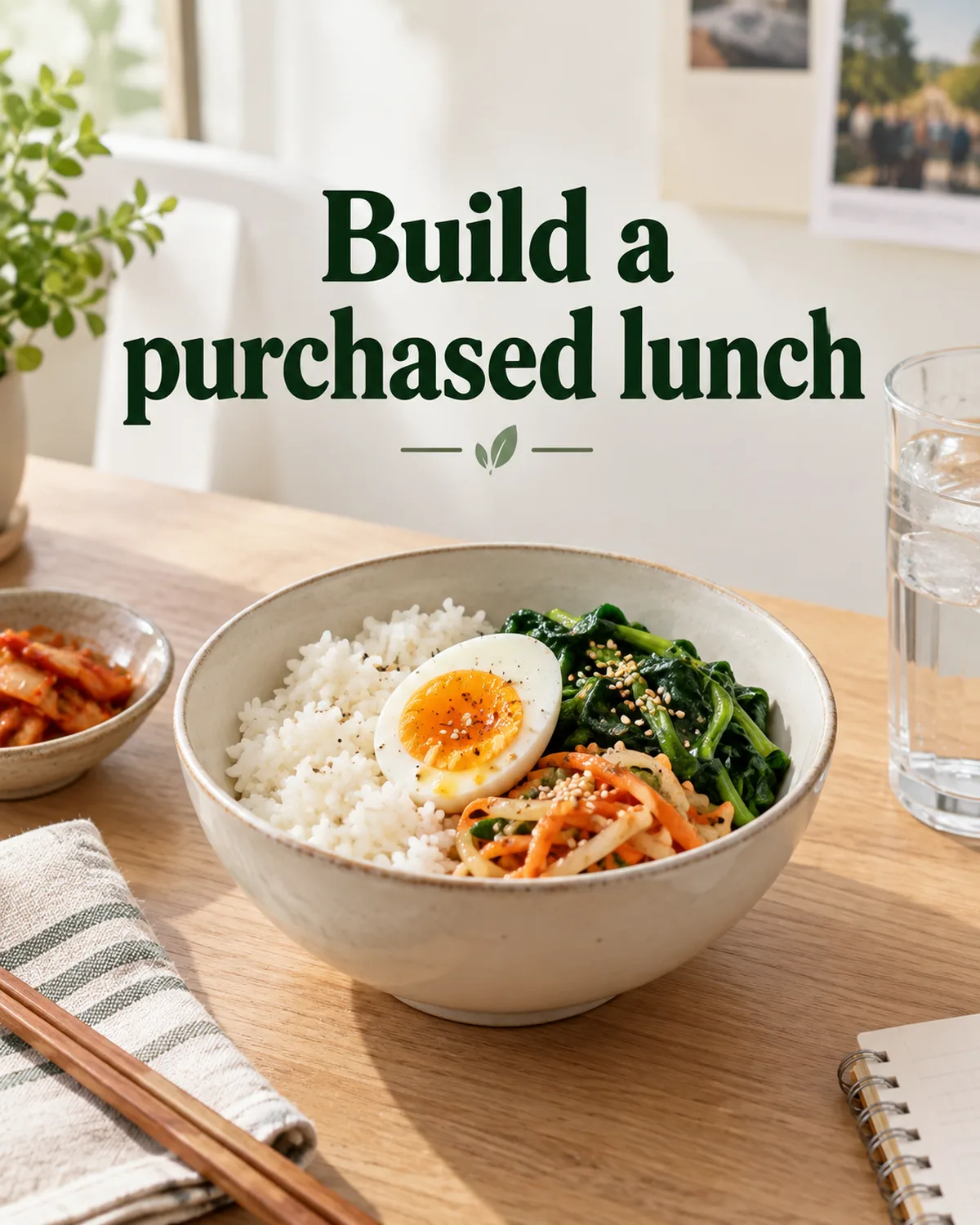
A convenience-store meal can be improved without pretending it becomes clinical nutrition. Pair a grain-based item with eggs, tofu, unsweetened dairy or another protein; add a vegetable side or fruit; choose water or an unsweetened drink; and watch whether the meal duplicates processed meat, salty soup and refined starch all at once.
A purchased lunch can be considered by its food components rather than a trend label.
The decision is architectural. You are not searching for a magical product labeled “slow aging.” You are assembling a meal whose components collectively resemble the intended pattern.
When eating out, exact grain ratios and sodium levels are often unknown. It is more useful to choose formats that let you control the table. A rice bowl with multiple vegetables, a tofu-based meal, grilled fish with side dishes, or a soup-and-rice meal can all be adjusted by how much broth, rice, sauce and processed side dish you consume.
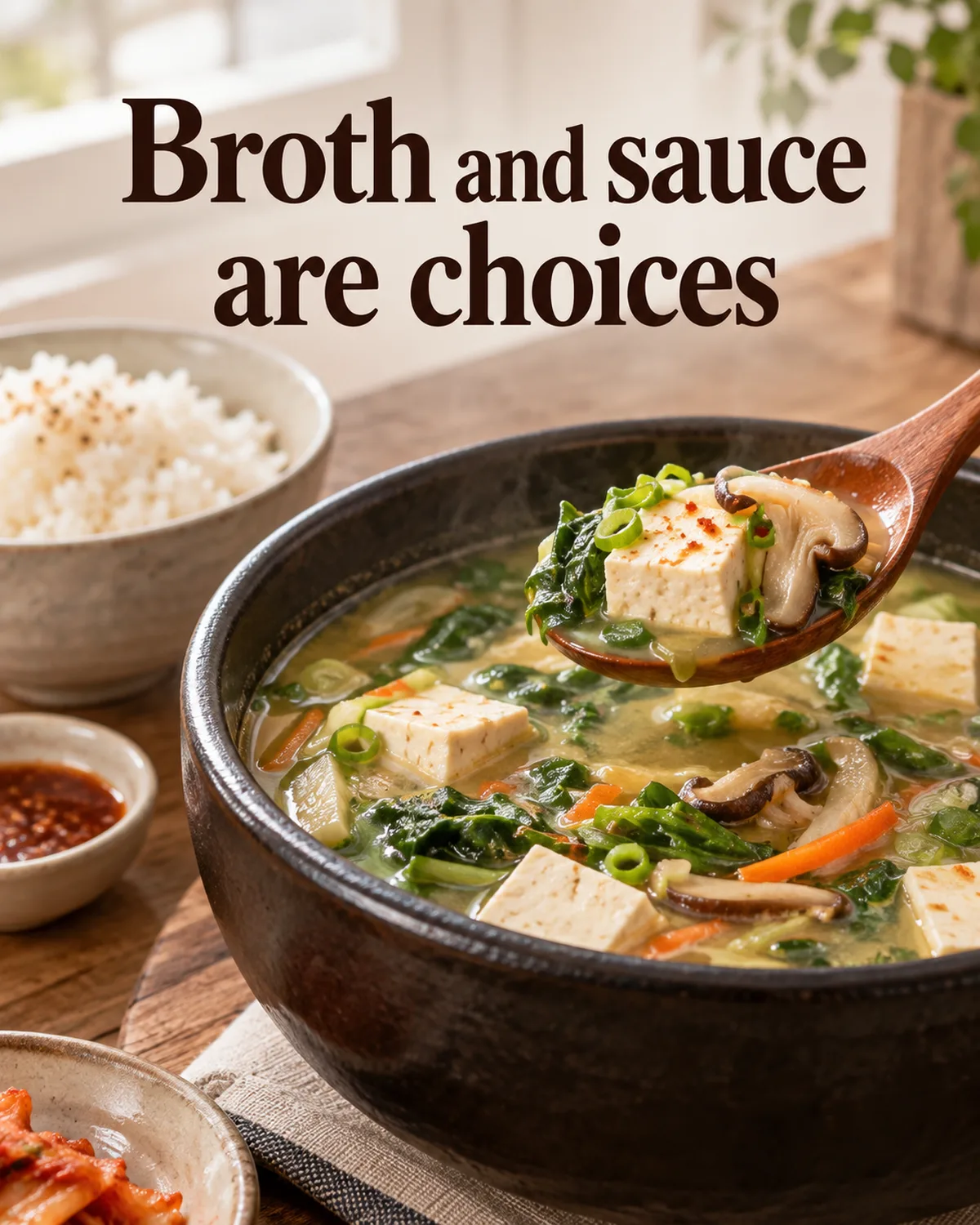
Do not assume that a dish is automatically “slow aging” because it is Korean, vegetarian-looking or traditional. Bibimbap can be vegetable-rich, but sauce quantity and rice portion vary. Soup can contain excellent ingredients while delivering a large sodium load if all the broth is consumed. Tofu can be minimally processed or arrive fried and heavily sauced.
Soup ingredients and the amount of broth or sauce consumed are separate choices.
The framework is therefore about choices inside a meal, not labels attached to dishes.
Try a manageable change rather than a perfect plate
One possible misreading of a plant-forward diet is to remove protein foods indiscriminately. A meal pattern dominated by grains and vegetables but consistently short on the eater’s nutritional needs is not automatically an improvement.
This is why legumes are useful: they contribute both carbohydrate and protein. Tofu, fish, eggs and other protein foods can also sit naturally in a Korean table. The goal is not to eliminate animal foods at any cost. It is to build a pattern that emphasizes minimally processed foods while still meeting the eater’s nutritional needs.
People with kidney disease, diabetes requiring medication adjustment, digestive disease, swallowing problems or other medical conditions may need individualized advice. A generic article cannot safely turn a trend into a prescription.
For a household used to plain white rice, replacing everything at once can create a texture problem and a compliance problem. A practical approach is to change one variable at a time.
A small ingredient change is easier to evaluate than replacing the whole mixture at once.
Begin by mixing a smaller amount of brown rice, barley, oats or lentils into white rice.
Adjust soaking and water based on the specific grain rather than following one universal instruction.
Keep two or three familiar side dishes so the meal still feels normal.
Add a clear protein source.
Increase the proportion of vegetables gradually if the current diet is low in fiber.
Use flavor strategically: sesame, vinegar, garlic, scallion, doenjang or a modest amount of kimchi can make whole grains easier to repeat without relying on sugar-heavy sauces.
The measure of success is not whether the bowl resembles a social-media photo. It is whether the pattern can survive busy weekdays, travel, eating out and family preferences.
Ask about the grain component, the protein source, vegetables, and seasoning or portion size. Those questions translate an appealing label into food that can be identified. They can also be used with a purchased lunch or restaurant meal without pretending the diner controls every gram.
Look at familiar rice and tofu dishes as adjustable meals rather than health labels.
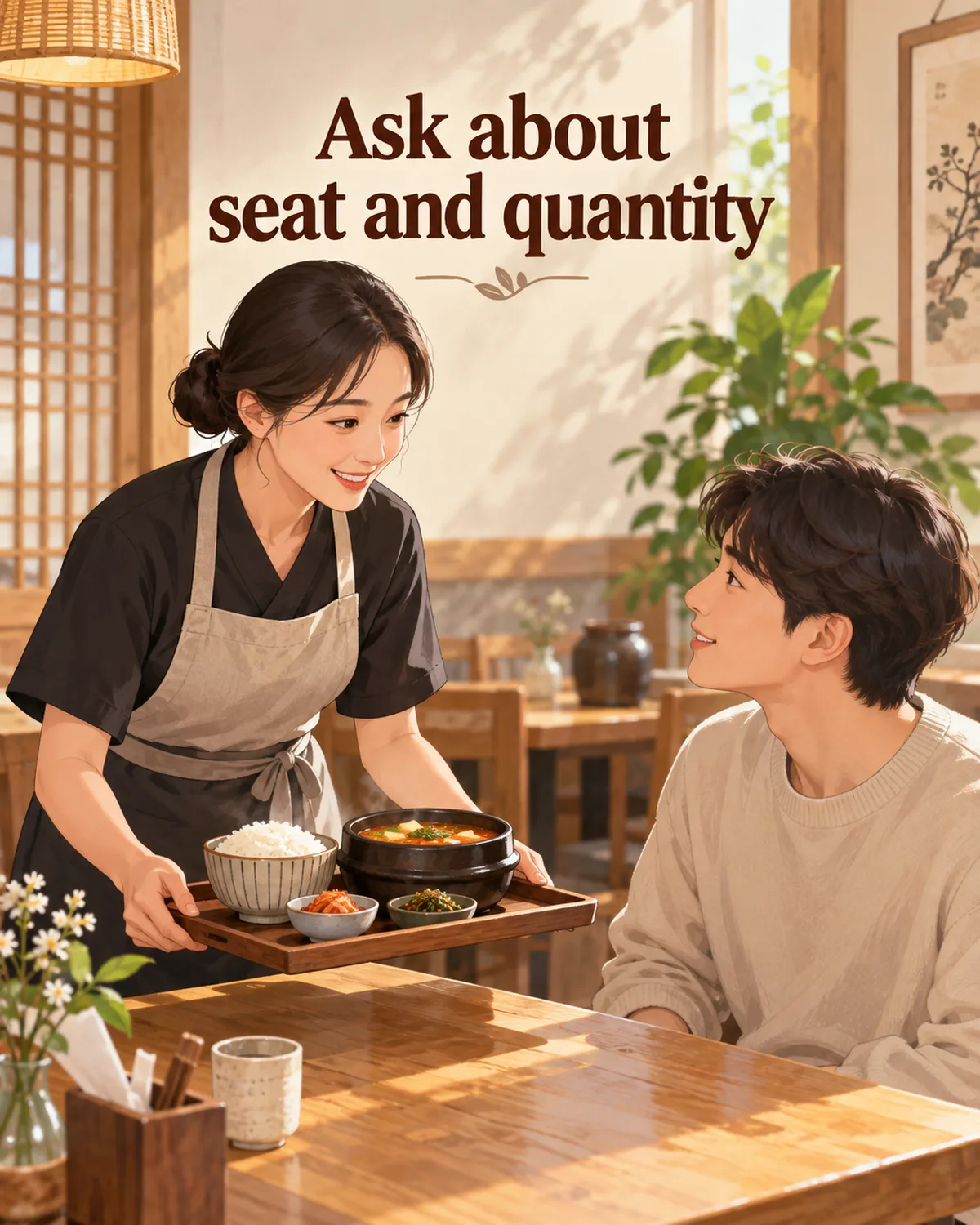
The most useful question for a solo meal in Korea is often not “Will eating alone look strange?” It is “Can this dish be ordered as a complete portion for one?” A bowl of soup and rice and a large shared grill have different operating requirements.
Honbap becomes easier to understand when the household, the individual meal and the restaurant’s service format are separated. None can stand in for the other two.
Living alone and eating alone are different things
A one-person household and a solo diner are related categories, not synonyms. Someone who lives alone can eat with coworkers every day. Someone who lives with family can eat lunch alone because schedules do not match. A student can choose a quiet meal between classes; an office worker can eat alone because colleagues are in meetings; an older adult can live alone but regularly share meals with friends.
This distinction prevents two common exaggerations. The first is that Korea suddenly became “individualistic” because more people eat alone. The second is that demographic growth automatically proves every solo meal is voluntary or enjoyable. Honbap is better understood as infrastructure catching up with more varied household and schedule patterns.
The Statistics Korea figures also show why age stereotypes fail. In 2024, one-person households were not only a young-adult phenomenon: people aged 29 or younger, people in their 30s, and people in their 60s each formed substantial shares. The single-person economy therefore serves students, workers, divorced adults, widowed seniors and many other groups with different food needs.
Older Korean meal culture placed enormous value on eating together. Family meals, school meals, company lunches, hoesik work dinners, barbecue grills and communal stews all reinforced the idea that eating is social. Korean table settings also combine individual rice and soup with shared side dishes, so the meal physically expresses both the individual and the group.
But saying “Koreans never ate alone until the 2010s” turns a strong social norm into a false historical absolute. Travelers, workers, market vendors, students and people living apart from family obviously ate alone at times. Many traditional commercial foods—noodle bowls, rice soups, bibimbap—were already structurally possible for one diner.
What changed was visibility, language and commercial accommodation. A behavior that could once feel like an exception gained a name, media attention, dedicated seating formats and menus designed around one person. The transition was from possible but sometimes conspicuous to ordinary in many contexts.
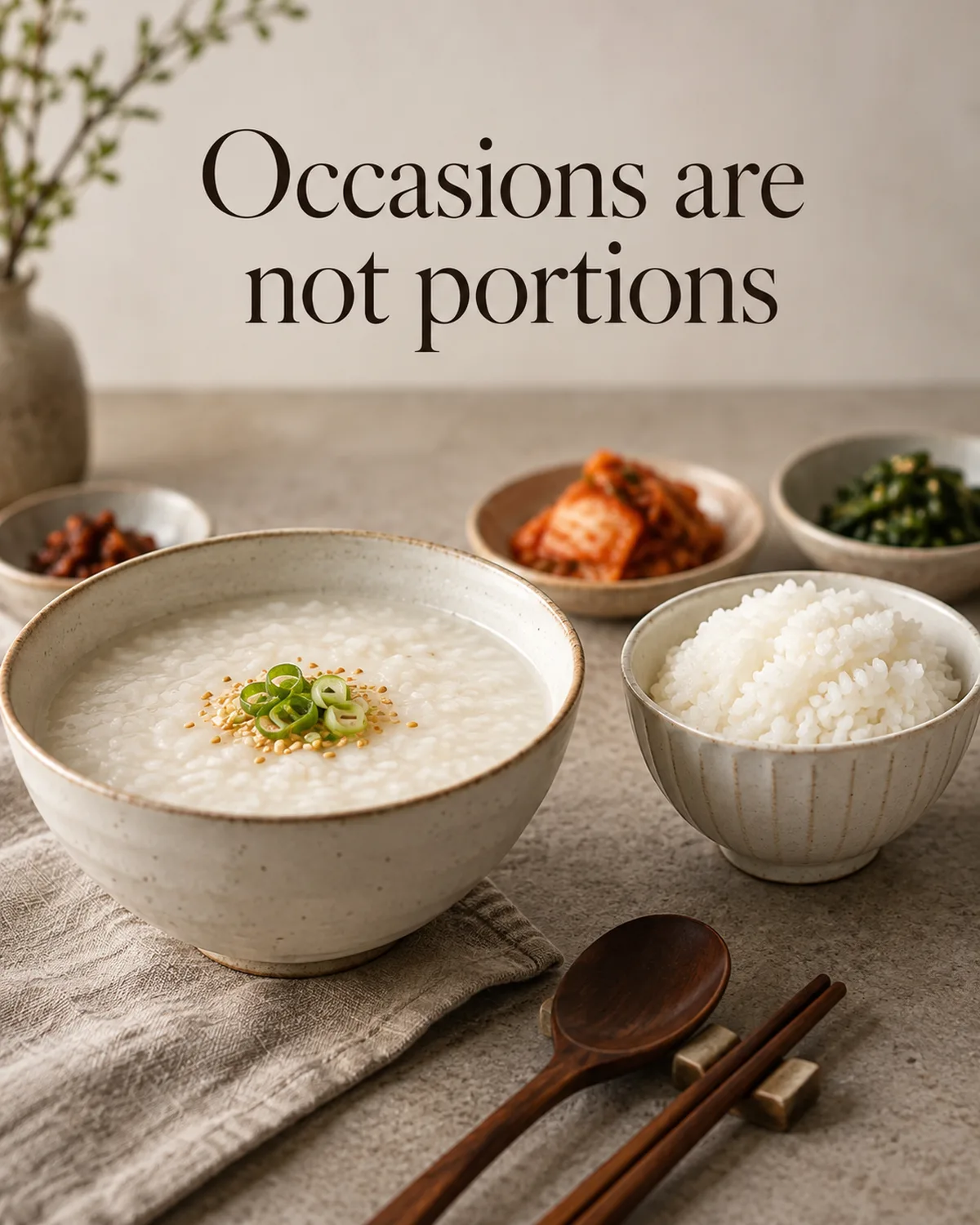
An individual soup-and-rice setting can include a main ingredient and vegetable side dishes.
By the middle of the 2010s, Korean and international reporting was treating honbap as a recognizable social trend. Restaurants experimented with counter seats, partitions and smaller portions. Media discussed honbap, honsul (drinking alone) and the broader language of doing leisure activities alone.
A 2015 study compared university students in Korea and Japan using data collected in 2011–2013. The Korean students in that convenience sample associated solo eating more strongly with negative feelings than the Japanese comparison group. It records a particular cohort and period, rather than today’s national attitude.4
A 2018 study used Korean health-survey data from 2013–2015 to examine patterns of eating alone. Associations differed by meal pattern and sex, and the design did not establish that eating alone caused a health outcome. Company at the table and the composition of a meal remain separate questions.
Menus made room for one person
Think of solo dining as a transaction-cost problem. A group-oriented restaurant can impose several costs on one diner: a two-serving minimum, a large grill table, a pot designed for sharing, slow ordering for one portion, or the social discomfort of occupying a four-person table during a busy period.
Honbap-friendly formats reduce those costs. Counter seating uses less floor space. Individual burners allow one-person hot pots. Kiosks make ordering less dependent on conversation. Convenience stores package complete meals in one-person units. Delivery platforms allow a single household to assemble dinner without coordinating with anyone else.
The cultural shift and the business shift reinforce each other. More solo customers make single-person formats profitable; more single-person formats make solo dining feel routine.
Individual heating equipment and counter seating can make a one-person portion easier to serve.
Gukbap literally combines soup and rice, but its great advantage for solo diners is not the name. It is the service unit. A bowl or earthenware pot can be cooked and priced for one person without changing the kitchen’s fundamental workflow.
A grill restaurant has to decide how to handle one customer ordering meat normally sold in multiple portions. A large hot pot may have a minimum size. Gukbap simply arrives as one bowl with rice, broth, protein or sprouts, and side dishes.
Jeonju kongnamul-gukbap is a clear example. Its market history, hot broth, rice and soybean sprouts make sense as an individual meal even before anyone labels the act “honbap.” The dish did not adapt to solo culture; solo culture discovered that the format was already compatible.
Travelers do not need a list of “approved honbap foods.” They need to read the menu architecture. Foods that naturally arrive in one person’s vessel are usually simplest:
Gukbap and soup bowls: rice soup, seolleongtang, galbitang and similar individual servings.
Noodles: kalguksu, naengmyeon, ramyeon and many noodle soups are ordered one bowl at a time.
Bibimbap and rice bowls: the serving unit is one bowl even when side dishes are shared in a group.
Gimbap and bunsik: small dishes can be combined without a group minimum.
Individual jjigae: many casual restaurants serve one-person earthenware stews, although house rules vary.
The common feature is not cuisine type but portion independence. One person can order without forcing the restaurant to redesign the dish.
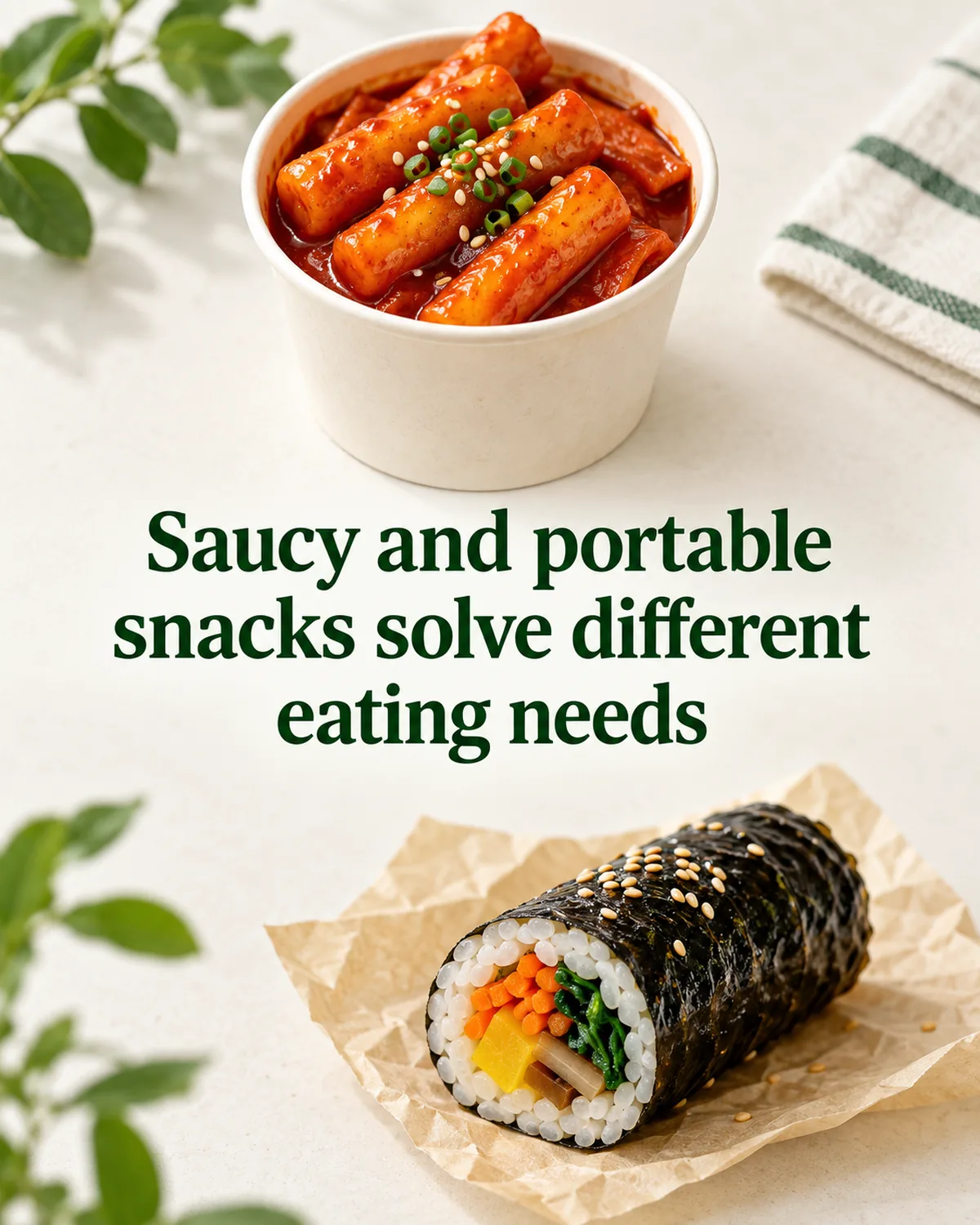
A noodle bowl and a gimbap roll illustrate separate portion choices, rather than a required combined set.
A shared grill is a portion question, not a social verdict
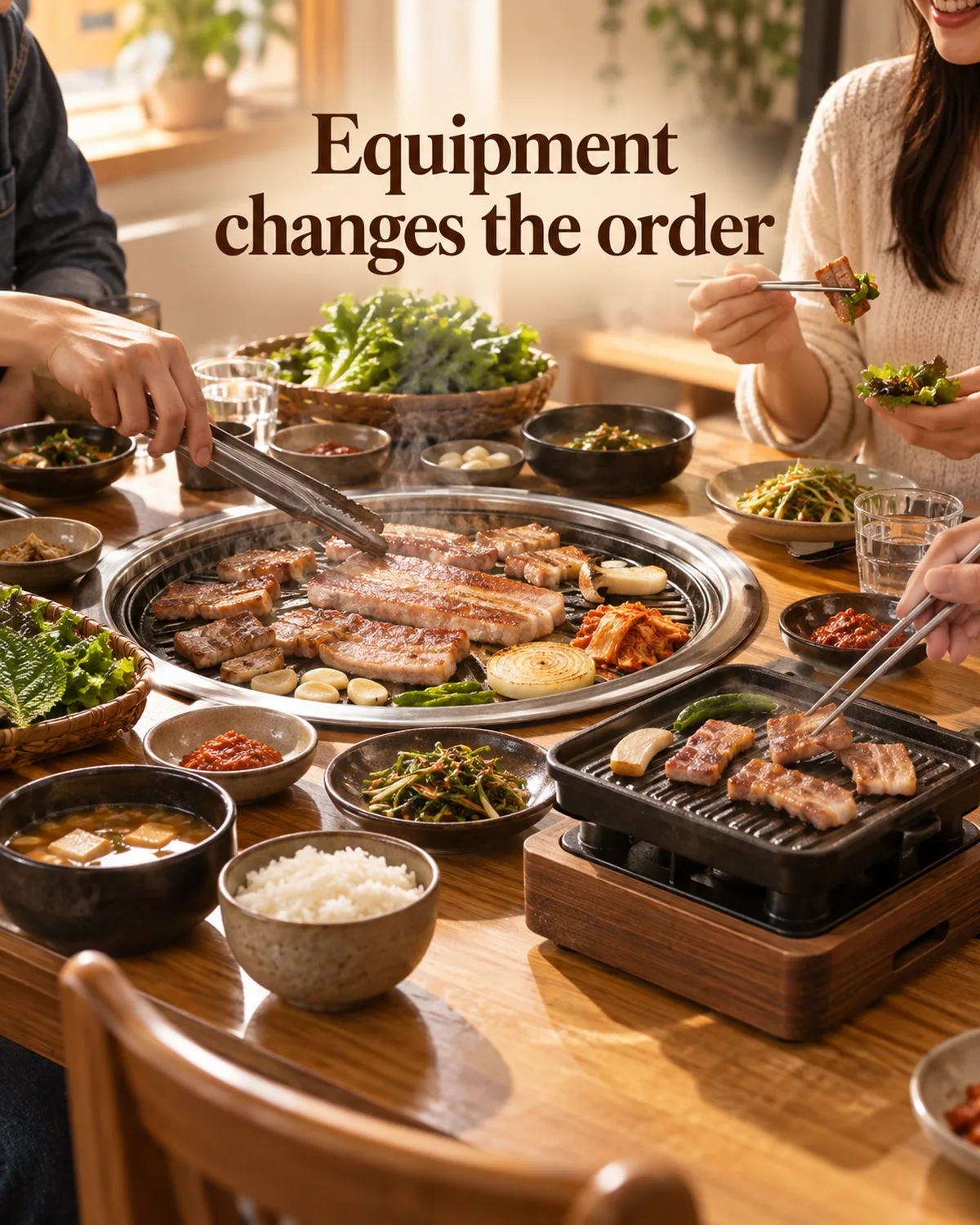
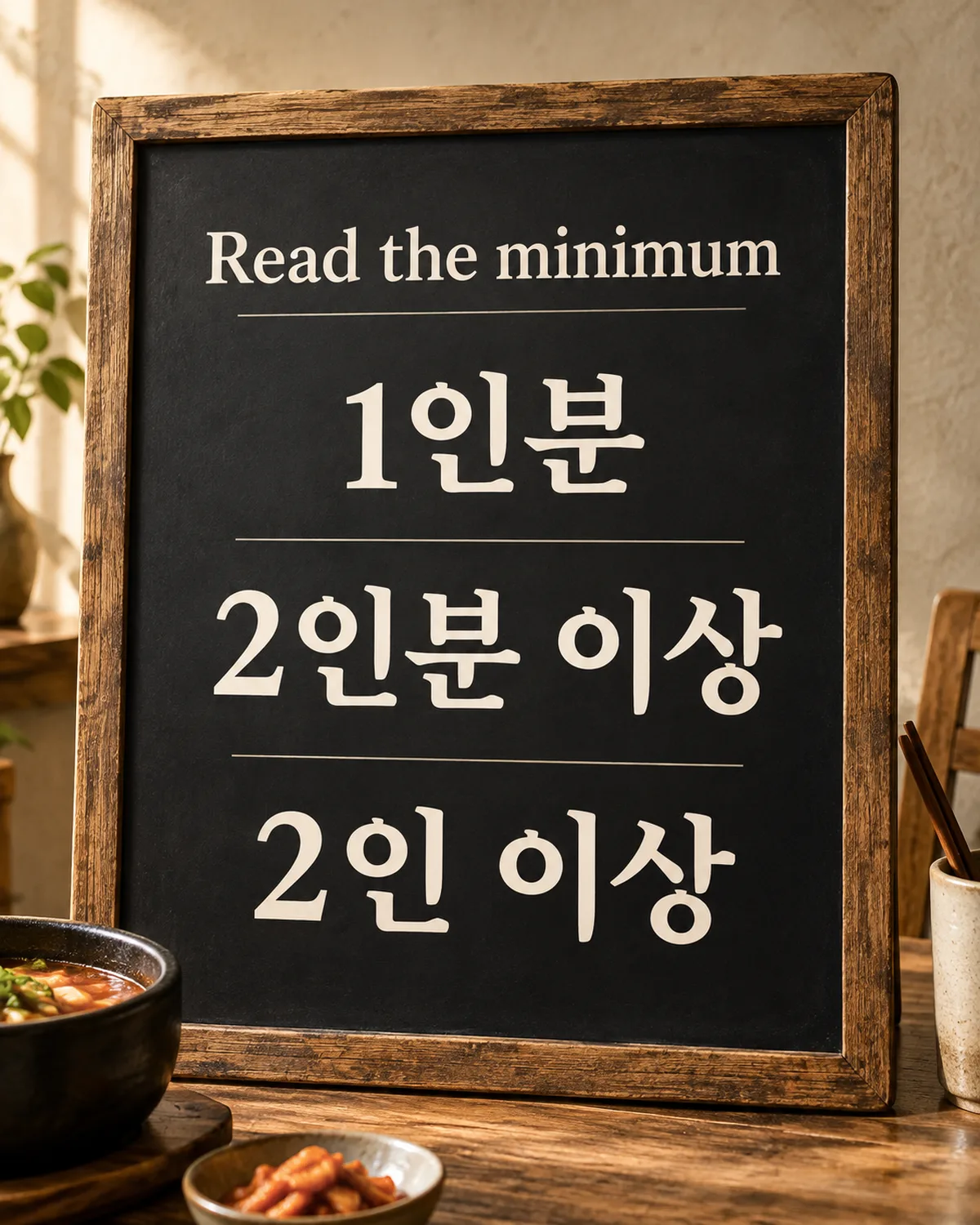
Korean barbecue is the classic example. Meat may be sold by multiple portions, the grill consumes a full table, side dishes must be set for one customer, and staff may spend similar labor on a lower total bill. A restaurant can welcome solo diners yet still require a two-portion minimum.
Large hot pots and shared platters create the same issue. This is why “Is it rude to eat alone in Korea?” is the wrong question. The more useful question is “Can this restaurant economically serve this menu to one person?”
That distinction prevents needless anxiety. A minimum order is not necessarily a judgment on loneliness. It can simply be a portion and equipment rule. Conversely, a restaurant with single grills or half-size portions may actively court solo customers.
Traditional Korean barbecue creates a difficult one-person cost structure: a shared grill, several banchan dishes, ventilation capacity and meat portions often designed for groups. Solo-barbecue concepts solve the problem by changing physical design rather than asking the diner to change.
Individual grills, counter layouts, smaller meat sets and partitioned seating let a restaurant allocate equipment to one customer efficiently. The food may be familiar; the innovation is the table.
That makes solo barbecue a particularly clear example of demography becoming architecture. One-person households do not merely buy different quantities. They can change how restaurants use square meters, heat sources and labor.
Shared and individual grills illustrate how equipment can affect order size.
Three menu signals to read before sitting down
For practical travel, three signals predict solo-friendliness better than any cultural stereotype.
Portion notation: Does the menu say “2 servings minimum,” list a pot by size, or price a dish per person?
Equipment: Does each seat have an individual burner or grill, or is the cooking setup built around a group table?
Seat geometry: Counters, two-tops and bar seating usually absorb one diner more easily than restaurants dominated by large grill tables.
If those signals are unclear, asking whether an item can be ordered for one person is normal. Restaurant rules change, so a current menu or staff answer is more reliable than a years-old blog that labels an entire cuisine “solo-friendly” or “not solo-friendly.”
These generic menu phrases distinguish a portion from minimum portions and minimum diners; they do not state any restaurant’s policy.
The convenience store is another eating format
One-person households do not only reshape restaurants. They change retail food. Convenience stores and supermarkets sell smaller rice portions, lunch boxes, ready meals, cut fruit, single desserts, frozen foods and microwaveable soups. A person can assemble a meal without buying family-size ingredients or creating leftovers for several days.
This matters because the biggest challenge for a one-person household is often not cooking skill but scale. Perishable vegetables, large meat packs and multi-serving sauces create waste when only one person is eating. Convenience food solves that problem by charging more per unit but lowering the risk of spoilage and reducing preparation time.
Small takeaway and grocery portions illustrate another way to assemble a meal for one.
The trade-off is not “home cooking good, convenience store bad.” It is cost, nutrition, waste and time. Different one-person households optimize those variables differently.
A study published in 2025 examined 2022 food-consumption survey data from 949 one-person households, grouped into ages 20–39, 40–59 and 60–74. The younger two groups spent more on eating out than the oldest group in that dataset. This is a dated comparison of food spending, not a description of every solo diner.
A 25-year-old living near a university, a 45-year-old divorced office worker and a 72-year-old widow may all be counted as one-person households, but their mobility, income, cooking habits, health priorities and preferred restaurants can be completely different. Good food culture writing should preserve that diversity.
Company, choice and the communal table
Solo meals serve different purposes. Someone may value control over time, menu and pace, or may eat alone because schedules and circumstances leave no alternative. Satisfaction cannot be read from the number of chairs at the table.
This is why romanticizing honbap as pure liberation is as simplistic as describing it as sad. The same behavior can mean efficient lunch, restorative solitude, work pressure or social isolation depending on the person and day.
A comfortable counter seat shows ordinary solo dining, without implying loneliness.
The food-history angle is narrower and more useful: Korean commercial eating has become flexible enough that many more of those situations can now be served without friction.
Normalization of honbap did not erase Korean group dining. Barbecue, shared stews, fried-chicken gatherings, family meals and work dinners remain important. Banchan are still placed in the center of many tables. Celebrations still use food to build relationships.
What changed is that the group meal lost its monopoly over what counts as a socially acceptable meal. A person can enjoy barbecue with friends on Friday and eat kalguksu alone on Saturday without treating the two acts as competing identities.
That coexistence is the real cultural shift. Korea did not move from “collectivist eating” to “individualist eating.” It added more valid table configurations.
Individual lunch and shared dinner settings can coexist, rather than marking a single national progression.
Ordering a solo meal without a special “honbap” label
Gukbap restaurants are often straightforward, but practices vary. Check the menu for the type of soup, portion size and add-ons. Sit where staff direct you. The rice may arrive inside the soup or separately. Salt, pepper, chopped scallion or salted shrimp may be available for adjustment depending on the regional style.
If the broth is served very hot in a ttukbaegi, the vessel can remain dangerously hot after the bubbling stops. Handle the bowl through the table, not by grabbing the sides.
A first-time visitor can waste time searching for restaurants explicitly branded for solo dining. In most urban neighborhoods, the easier strategy is to choose naturally single-serving food. Noodle shops, gukbap houses, gimbap restaurants, food courts and many casual rice-bowl shops already solve the problem.
Then treat group-format food as a separate category requiring a menu check. This is more durable than maintaining a list of “solo-friendly” businesses whose seating policies, hours and ownership can change.
Read the minimum as carefully as the price. 1인분 is one serving; 1인 세트 is a set for one person. 2인분 이상 requires at least two servings, while 2인 이상 refers to at least two people. Those are different conditions. Ask both whether one diner can be seated and whether the required quantity suits your appetite.
Ask about seating and serving quantity before ordering.
Convenience stores, take-away packaging and individual meal sets expand the available formats, but they do not tell us why any particular person is eating alone. A chosen quiet lunch and unwanted isolation can look identical from another table. Choose the meal that suits the occasion rather than turning solitude into a test of independence, loneliness or health.
A meal for one still has several components
Studies of eating alone sometimes report associations with diet quality or health outcomes, but those relationships are entangled with age, income, living arrangement, meal frequency and social conditions. One bowl eaten alone does not cause a health outcome.
The practical issue is repetition. If honbap means instant noodles every night because they are convenient, the nutritional pattern matters. If it means a balanced rice-soup meal with vegetables and adequate protein, the pattern is different. The social setting cannot substitute for what is actually on the plate.
For a regular solo meal, look beyond the number of seats: what is the main starch, what supplies protein, and are vegetables part of the meal or only a small garnish? Repeating a narrow convenience-food pattern is a different question from whether you happened to eat it alone.
Look at rice, protein and vegetables together when assessing what this meal contains.
A noodle bowl or bean-sprout soup offers a different way to put the solo-dining idea into practice.
What should you eat in Seoul when the day only has room for a few meals? A market, a noodle institution, barbecue, tteokbokki and a bakery can all be appealing. Put them on one itinerary without looking at portion size, and five stops become five meals.
Group meals around the area already in your day
Choose the meal you most want to experience, then use its neighborhood to shape the day. A working market lets you sample; a tabletop pan asks you to sit and share; a cafe can be a later pause. These differences make the map useful without turning every district into another compulsory stop.
Jongno and Myeong-dong: market counters and noodle bowls
Jongno is useful as a first food district because it contains several layers of Seoul at once: palace-era street geography, long commercial corridors, markets and restaurants with unusually deep local histories.
Gwangjang Market is the most obvious entry point. The official Seoul travel guide lists foods such as bindaetteok, assorted jeon, small gimbap rolls, sundae and yukhoe among the market’s familiar foods. The point is not that every stall is ancient. The point is that a dense traditional market lets you see multiple cooking systems within one block: grinding mung beans, frying pancakes, rolling rice, slicing raw beef and serving noodles at counters.
This makes Gwangjang best used as a sampling stop, not as a place where every person orders a full portion from the first vendor. A small group can share one pancake, one plate of mini gimbap and another dish, then move on. The market becomes more informative when you compare methods rather than simply pursue one viral stall.
Jongno also preserves older eating geographies beyond the market. Pimatgol, for example, is remembered as a network of alleys beside the main road that developed pubs and gukbap shops for commoners moving through central Seoul. Much of the old alley fabric has changed, but the story helps explain why inexpensive soups and drinking food belong so naturally in the old downtown.
For a focused market route, use the Gwangjang Market guide. For an older soup institution, the seolleongtang history adds another layer to central Seoul eating.
A soup meal fits a different occasion from an evening shared platter
Myeong-dong is internationally associated with shopping and fast-changing street snacks, but one of the district’s most durable food stories is a bowl of noodles.
The Michelin Guide’s current profile of Myeongdong Kyoja states that the family-run restaurant has operated since 1966 and specializes in dumplings and noodle soup. That date matters because it prevents an easy mistake: presenting the restaurant’s kalguksu as an ancient Seoul origin story. What it represents is modern urban restaurant continuity.
The restaurant is known for its noodle soup, dumplings and assertive garlic kimchi. The Michelin profile describes a narrow menu and food made in-house. Its significance is the continuity of a recognizable restaurant meal in a changing commercial district, rather than a claim that every Seoul noodle bowl follows the same recipe.
That is a different kind of heritage from palace cuisine or a centuries-old market. Seoul food history is full of 20th-century institutions that became “classic” because generations of customers kept returning. Myeong-dong kalguksu belongs in that category.
The dedicated Myeong-dong kalguksu guide explains the noodle mechanics and restaurant context in more detail.
Sindang and Jangchung: two meals designed for company
Sindang-dong is one of Seoul’s most important centers for modern spicy tteokbokki culture. The district is often reduced to a single invention legend about Ma Bok-rim, but the more useful story is how a style, a restaurant cluster and a youth culture formed around the dish.
Seoul Metropolitan Government material retells the Ma Bok-rim story and links the neighborhood’s growth to the spread of spicy tteokbokki and later transport access. The anecdote is part of the district’s cultural memory, but it should not be used to claim that all tteokbokki began there. Rice-cake dishes existed before the modern red version, including soy-seasoned forms.
What makes Sindang different today is the jeukseok format: a larger pan can arrive at the table with rice cakes, fish cake, noodles and additions that cook together while diners eat. The starch thickens the sauce as the meal progresses. That is a fundamentally different experience from buying a small ready-cooked portion at a street stall.
The neighborhood also developed an entertainment identity around tteokbokki restaurants. Korea Tourism Organization describes theaters, students and the remembered DJs of the late 1970s and 1980s: a cheap meal became part of an afternoon of music and meeting friends. That helps explain why a shared pan carries a different social memory from a quick street-stall portion. The Sindang-dong tteokbokki guide separates the documented neighborhood story from the popular invention legend.
Jangchung-dong’s jokbal story is a lesson in urban foot traffic. The official Visit Seoul page, edited in 2026, connects the growth of Jokbal Alley with crowds attending events at nearby Jangchung Arena. Spectators leaving sports events and concerts created demand, nearby jokbal restaurants benefited, and the cluster became a destination in its own right.
That is more precise than saying Jangchung-dong “invented jokbal.” Braised pig’s feet are not owned by one Seoul alley. The neighborhood’s significance lies in the restaurant concentration and the way a large public venue helped produce a recognizable after-event food district.
Jokbal itself is suited to group dining. The meat is braised, sliced and served in a large shared portion, often with greens, garlic, fermented shrimp condiment and other accompaniments. The texture comes from both meat and collagen-rich skin, so good preparation balances tenderness with enough chew to remain satisfying.
For a deeper treatment of the dish and the alley’s development, see the Jangchung-dong jokbal guide.
Market tasting and a seated group dinner require different plans
Mapo and Euljiro: read the cut and the occasion
“Where is Seoul’s best Korean BBQ?” is usually the wrong first question. Seoul has too many grill traditions and restaurant clusters for one neighborhood to represent the whole category.
Start with the cut and the dining style. Samgyeopsal gives you fatty pork belly and a casual, high-heat table-grill experience. Dwaeji galbi brings sweet-savory marinated pork ribs. Sogalbi moves toward beef ribs and a different price point. Some restaurants specialize in aged pork, some in charcoal, some in specific cattle breeds, and some in large group dining.
Mapo has long been associated with meat restaurants and after-work dining, but a useful plan is not “go to Mapo because all good barbecue is there.” It is “decide whether you want pork belly, marinated ribs, beef, charcoal or a late-night social meal, then choose a district and restaurant that specializes in that format.”
A celebrated beef-rib restaurant may be the wrong choice for someone looking for pork belly. Choose the cut and serving style first, then check which restaurant actually specializes in them.
Serving format matters as much as neighborhood reputation
Seoul dining often extends beyond a single restaurant. A group can eat dinner, move for drinks and snacks, then finish somewhere else. Central districts such as Euljiro are useful for understanding this layered evening rather than one iconic dish.
Foods such as golbaengi-muchim, dried fish, grilled meats, pancakes or simple noodle dishes can function as anju—food eaten with alcohol. The meal logic is different from a Western appetizer-main-dessert sequence. Dishes arrive for sharing, the group controls the pace, and the “second round” may be as socially important as dinner.
This is where translation such as “bar food” is useful but incomplete. Anju is not one recipe category; it is a relationship between food and drinking occasion.
Seongsu: leave room for a bakery stop
Seongsu is valuable for almost the opposite reason from Jangchung or Myeong-dong. Seoul Metropolitan Government material describes how former factory and warehouse spaces were transformed into cafes, galleries and cultural venues, creating one of the city’s strongest contemporary trend districts.
The neighborhood is therefore ideal for observing format innovation: industrial spaces converted into cafes, bakeries using social-media-friendly display systems, pop-up collaborations, branded desserts and fast-moving bread trends. Salt bread is one example of a product that moved through this ecosystem, but it would be a mistake to freeze Seongsu into one permanent “salt bread street.”
In a trend district, the durable object is the neighborhood’s role as a testing ground. Individual shops, queues and signature items are the unstable layer. Check current opening status and reservation systems close to the visit rather than relying on a months-old viral list.
If you want the specific salt-bread story, see the Seongsu salt bread guide.
A food district is not a fixed restaurant ranking
A traditional market rewards broad sampling. The physical concentration of many vendors makes it efficient to compare pancake, noodles, rice rolls, meat and sweets. A trend district rewards selective research because individual cafes can have long queues, timed entry, limited releases or rapid menu changes.
That means the planning logic is almost reversed:
Market: verify the market’s current operating pattern, arrive hungry, then decide stall by stall.
Historic food alley: choose the dish first, then compare a few established businesses.
Long-running institution: verify the current restaurant status and accept that the menu may be intentionally narrow.
Trend district: check current shops shortly before the visit and keep a backup because pop-ups, sell-outs and queues are normal.
Seoul offers almost every major Korean food, but availability is not the same as origin or regional identity. Bibimbap is everywhere in Seoul, yet Jeonju has a stronger regional claim to a particular bibimbap tradition. Dakgalbi can be excellent in the capital, but Chuncheon is central to its modern regional story. Chodang sundubu points toward Gangneung. Idong galbi points toward Pocheon.
This distinction helps when a trip extends beyond Seoul. Eat foods in the capital when they fit the day, but save some dishes for the region where landscape, local industry or neighborhood history adds another layer.
The companion Korea food guide by region is designed for that decision.
A queue can tell you that demand is high. It cannot tell you whether the food will match your taste, whether the line is inflated by social media, or whether a nearby specialist is worse.
For old institutions, a queue may reflect limited seating and a narrow menu. For trend cafes, it may reflect a product launch or photo-friendly space. For market stalls, it may simply be that one vendor was featured in a show.
Set a personal waiting threshold before the day starts. If a food is central to the trip, a long wait may be rational. If it is one of six planned snacks, spending an hour in line destroys the rest of the route.
Build a day around one anchor meal
The biggest failure in food itineraries is not choosing the wrong restaurant. It is scheduling too many heavy dishes too close together.
A practical Seoul food day works better when each stop has a different weight. For example:
Morning: a light soup, simple rice meal or bakery stop.
Lunch: a focused restaurant institution such as kalguksu.
Afternoon: shared market snacks rather than another full meal.
Dinner: the group meal—jokbal, barbecue, jeukseok tteokbokki or another dish that benefits from sharing.
Late evening: only if appetite remains, a smaller anju or dessert stop.
The exact neighborhoods can change, but the principle is stable: alternate meal weight, cooking style and setting. Three bowls of noodles in three districts may be historically interesting and physically miserable.
Late morning — Jongno: begin with old-downtown context rather than immediately chasing a viral cafe. If you choose Gwangjang, sample rather than feast.
Lunch — Myeong-dong: use a long-running noodle institution or another established downtown restaurant to contrast with the market format.
Afternoon — walk, museum or coffee: leave a real gap before another substantial meal. A food itinerary can include time when you are looking at the city rather than ordering something else.
Leave practical space between sightseeing, dining and a cafe stop
Dinner — Sindang or Jangchung: choose one. Sindang is stronger if the interest is table-cooked tteokbokki and youth-food history; Jangchung is stronger for a meat-centered group meal and the arena-linked alley story.
Alternative evening — Seongsu: if historical food is not the priority, use Seongsu for current cafe and bakery culture instead. This sacrifices some historical continuity in exchange for seeing what is changing now.
For a more snack-focused version of the day, the Korean street food guide organizes foods by market, stall and seasonal eating format.
Choose the meal that matters most and organize the surrounding stops around its quantity and timing. A shared barbecue or tabletop tteokbokki meal needs a different appetite from a brief bakery visit. A nearby snack is not necessarily a small portion: walking distance and meal size are separate decisions.
Use a neighborhood’s food identity as orientation rather than a promise that every business serves one thing. In Jongno, food stalls sit within broader market commerce. In Seongsu, a cafe’s current queue, menu and ordering system are live information, not permanent features of the district. Confirm the specific shop rather than building a day around an old screenshot.
The most informative comparison may be between two food systems instead of two rankings: a finished jokbal platter and a tteokbokki pan still changing at the table, for example. Leave room to take that comparison seriously. Seoul can introduce foods associated with other regions, but serving them in the capital does not relocate their entire history.
Reservations, portions and current opening information
Do not assume every restaurant uses the same system. Some modern restaurants take reservations through Korean booking platforms, some manage bookings directly, some use remote waitlists, and some long-running casual restaurants operate primarily with walk-in queues. Traditional market stalls may have no booking concept at all.
This is why “Do I need reservations in Seoul?” has no citywide answer. The correct question is “What reservation or queue system does this specific business use now?” Check close to the visit, especially for tasting menus, famous barbecue restaurants, small trend cafes and peak weekend periods.
Menus, ingredient costs, rent, labor and tourism demand change. So do opening hours, branch arrangements and holiday closures. A useful evergreen guide should preserve the reason to go while treating prices and business hours as dynamic.
For named restaurants, verify the business’s current official or major-platform listing before leaving. For markets, check the market-level hours but remember that individual vendors can differ. For trend districts, verify the exact shop because closures and relocations are part of the environment.
Search the dish and verify the exact branch, not just a familiar district name
This is more reliable than memorizing a price copied from a blog several years ago.
Follow the meal that best fits the next part of your day.
You have room for a snack, not three lunches. So what should your first stop be: a skewer, a crisp pancake or a small rice roll? All three can be called Korean street food, but they ask different things of your appetite—and of the place where you eat them.
Start with the texture you want, then choose a portion and a place to pause. Following sauce, broth, crispness and filling gives the outing a shape. It also leaves room to understand why a dish that looks portable may belong at a counter or around a shared pot.
Four eating settings hidden inside “street food”
Visitors often imagine a continuous row of outdoor carts. Korea certainly has carts and temporary stalls, but many foods associated with “street food” are sold in permanent markets, tiny snack shops or seated alleys. The category is broader than the English phrase suggests.
Traditional markets are the best place to see cooking as part of the attraction. Large griddles, steaming pots, chopped ingredients and shared counters are visible to the customer. Gwangjang Market in Seoul is a classic example: Seoul Tourism Organization’s market guide highlights mung-bean pancakes, small gimbap rolls and other ready-to-eat foods.
Bunsik shops are inexpensive snack or light-meal businesses. Tteokbokki, eomuk, twigim, gimbap, sundae and ramyeon often overlap on the same menu. These shops may be fully indoors, so calling every bowl “street food” describes the food culture more than the architecture.
Carts and kiosks specialize in speed and portability. Bungeoppang, hotteok, skewered eomuk and some fried foods work because they can be cooked or held in small spaces and eaten immediately. Their exact locations are less stable than a market building, which is why a fixed “best cart” list ages quickly.
Start with a texture you want, not a list of compulsory foods
Pojangmacha literally evokes the covered wagon or tent-stall format. Modern versions range from simple outdoor drinking stalls to permanent businesses using the aesthetic. They are closer to an informal bar-and-food setting than to a pastry cart. The menu can include fish cakes, noodles, stir-fries, seafood and alcohol, and the experience is usually about staying rather than walking away with one snack.
A hot, savory first round
Modern spicy tteokbokki is one of the clearest visual symbols of Korean snack food: cylindrical rice cakes simmered in a red sauce commonly built around gochujang, with fish cake, scallion, cabbage or boiled egg depending on the vendor. The sauce thickens as starch from the rice cakes and other ingredients enters the pan, which is why a busy stall can look glossy and almost lacquered by the end of service.
The history needs more care than the familiar “one person invented tteokbokki” story. Rice-cake dishes called tteokbokki existed before the modern red street-food form. Earlier versions could be soy-seasoned and closer to a stir-fry. Sindang-dong later became a major center for the spicy, table-cooked form that now defines the neighborhood.
A stall snack and a shared restaurant pan carry different memories. Korea Tourism Organization’s account of Sindang-dong attributes early rice-cake sales to Ma Bok-rim’s restaurant-owner history, including customers visiting the nearby theater; the neighborhood later became associated with student outings. These are accounts of local trade and eating habits, not proof that one person invented every form of tteokbokki. Today, the distinction remains practical: a ready-served portion can fit a short stop, while a pan cooked at the table asks you to sit, wait and share.
There is also a format difference worth noticing. At many snack counters, tteokbokki is already cooked and served by portion. In Sindang-dong’s better-known restaurant style, a larger pan may arrive at the table with rice cakes, fish cake and additions that continue cooking together. One is optimized for speed; the other turns the sauce and starch development into part of a shared meal.
Saucy and portable snacks solve different eating needs
Eomuk is ground fish formed into cakes, sheets, bars or other shapes. On the street, the familiar version is folded onto a skewer and kept hot in broth. The skewer is not decorative: it makes a soft, slippery food easy to handle while standing, and the broth keeps the product hot through cold weather.
Busan has a particularly strong association with fish cakes. Korea Tourism Organization’s Busan guide places eomuk alongside the snacks found in the coastal city’s markets. That regional link is useful because it shows why “Korean street food” cannot be reduced to Seoul alone.
The broth deserves attention too. It is often treated as a free extra in simplified travel descriptions, but serving rules differ by business. More important is its function: hot broth adds warmth, moisture and a mild savory counterpoint to the denser fish cake. In a winter market, the skewer-and-broth combination is almost a complete piece of food design—portable, fast, easy to portion and suited to cold hands.
Read the food and the broth separately when checking ingredients
For travelers with fish or shellfish allergies, eomuk requires caution. The exact seafood mixture and broth ingredients vary by product and vendor, and the same cooking area may handle multiple seafood items. The word eomuk tells you the category, not the complete ingredient list.
Bindaetteok is a mung-bean pancake, and Gwangjang Market is one of the places most strongly associated with it. Seoul Tourism Organization lists bindaetteok among the market’s representative foods. The pancake offers a crisp contrast to softer rice rolls and broth-held skewers.
This is not a food that becomes better merely because you walk with it. The batter is cooked on a large hot surface until the outside browns and crisps while the interior stays softer. Freshness matters because crispness declines as steam is trapped during holding or transport.
The market setting also turns cooking into a visible performance. Grinding, ladling batter, turning pancakes and cutting portions happen in front of customers. That creates a different relationship between cook and eater from a packaged snack.
For a deeper market route, see the Gwangjang Market guide. It is more useful to understand one market’s food ecology—what is cooked, what is shared, what is seasonal—than to treat every traditional market as interchangeable.
A roll can be a meal, not just a snack
Gimbap works differently from a sweet snack or fried skewer. Rice and fillings are rolled in seaweed, sliced and carried easily, so the food can function as breakfast, lunch, picnic food, convenience-store meal or market snack depending on portion and filling.
The small rolls sold at Gwangjang Market show how the format changes when portability is pushed further. The small rolls are widely known as kkoma gimbap or nicknamed mayak gimbap; Seoul Tourism Organization includes mayak gimbap among the market’s familiar foods. A dipping sauce may accompany them, so check the serving rather than assuming every roll is prepared alike. “Mayak” literally means a narcotic drug in Korean, but in food naming it is informal hyperbole for something considered hard to stop eating; it is not an ingredient claim.
This is a useful reminder about translation. Korean food names often carry jokes, marketing language or cultural shorthand that sounds more literal in English than it is in context. A guide should explain the phrase rather than repeat it as exotic spectacle.
Full-size gimbap and mini rolls also solve different hunger levels. A large roll can replace a meal. Mini rolls make it easier to sample several foods in one market visit without becoming full after the first stop.
Two sweets that ask you to slow down
Hotteok is a filled pancake cooked on a griddle, usually until the exterior is browned and the interior filling melts. The classic sweet version commonly uses brown sugar with cinnamon and nuts or seeds, although regional and modern fillings can be savory or much more elaborate.
A sweet snack can still require care with its hot filling
Korean Air’s Morning Calm food feature links hotteok’s spread to Chinese people who settled in Korea from the late nineteenth century. The useful point for today’s eater is adaptation rather than one frozen “original” filling: dough, sweetness, seeds, frying style and fillings can change as a food becomes part of local markets.
The dangerous pleasure is thermal rather than spicy. Sugar liquefies inside a sealed or partly sealed dough pocket, so the center can remain much hotter than the surface feels. A hotteok that is comfortable to hold can still contain near-molten syrup. Waiting briefly before the first deep bite is practical advice, not etiquette.
Korea Tourism Organization’s recent winter-snack material still treats hotteok as a cold-weather market food and points to regional examples, including Busan’s seed-filled versions. Seasonality is part of the experience: some permanent shops sell hotteok all year, while temporary carts may appear or disappear with the weather.
Bungeoppang is the fish-shaped pastry that confuses first-time visitors for exactly one second. The shape resembles a carp, but the standard pastry contains no fish. A batter shell is cooked in a fish-shaped mold around a filling, classically sweet red bean paste and increasingly custard, chocolate, cheese or other variations.
Bungeoppang has a close relationship with Japanese taiyaki. In a Korea JoongAng Daily account, food and culture critic Yun Deok-no traces the Korean pastry to that Japanese form. The Korean name, fillings and winter-cart memories help explain why travelers encounter it as its own familiar snack today.
Texture changes quickly. Fresh from the mold, the shell can be crisp at the edges while the filling is soft and hot. As steam migrates through the pastry, the shell softens. That explains why bungeoppang is a “buy it when you see it, eat it now” food more than a souvenir for later.
Recent VISITKOREA winter-food coverage shows how much the category has diversified, including the familiar red-bean-versus-custard preference debate and newer fillings. It also reinforces a practical point: famous winter stalls can draw lines or sell out, while other vendors appear throughout ordinary neighborhoods. A traveler does not need to cross the city for a single fish-shaped pastry unless the stall itself is the destination.
Fried sides and the modern cheese pull
Street-food eating rarely means ordering one isolated signature item. Tteokbokki stalls often sit beside or sell twigim, a broad category of battered and fried items such as vegetables, squid, dumplings or seaweed rolls. Diners may dip fried pieces into tteokbokki sauce, turning two menu categories into one combined experience.
Sundae is Korean blood sausage, generally made by stuffing intestine with a mixture that can include noodles, grain and blood, with regional versions differing substantially. It can be sliced as snack food or served in soup as a full meal. Travelers who only know the market-plate version miss how strongly sundae changes by region; the Byeongcheon sundae guide is one example of that regional depth.
Korean-style corn dogs occupy a more recent global-pop-culture position. The modern category includes sausage, cheese or mixed fillings inside a thick coating, sometimes with potato pieces or sweet dusting on the outside. The useful distinction is not “traditional versus fake.” Street food constantly absorbs new formats. A food can be recent and still become a real part of contemporary Korean snack culture.
Build the route around how you want to eat
If the goal is variety in one stop, a traditional market is efficient. You can move from pancake to mini gimbap to noodles or sweets without traveling across the city. Gwangjang is the obvious first reference in Seoul, but it is not a template for every market in Korea.
If the goal is one dish with a neighborhood story, Sindang-dong makes more sense for tteokbokki because the district itself is part of the subject. If the goal is winter snacks, look for active shopping streets, market entrances, transport hubs and neighborhood commercial areas rather than assuming one fixed street operates every night.
If the goal is contemporary novelty, tourist shopping districts such as Myeong-dong can show newer skewers, sweets and visually dramatic snacks. The trade-off is that novelty changes quickly. A trending menu item can disappear long before a travel article is updated.
For a broader neighborhood plan, use the Seoul food guide to decide whether street food should be the meal, the snack between meals or one stop inside a larger day.
Instead of chasing ten famous names, build the first outing around four contrasts. Start with tteokbokki to understand sauce, starch and bunsik culture. Add eomuk to see how a skewer-and-broth format works in cold weather. Choose either hotteok or bungeoppang for a seasonal sweet snack. Then eat one market-specific food such as Gwangjang bindaetteok or mini gimbap.
That sequence covers four different design problems: sauced snack, broth-held skewer, hand-held sweet and market griddle food. It also leaves room for a fifth item that belongs to the actual neighborhood rather than to an internet checklist.
If several people are eating together, order one portion at a time and share. Street-food sampling becomes much easier when each person does not commit to a full serving at every stop. This is also how the market becomes legible: you can compare textures, cooking methods and service styles instead of simply counting dishes.
Order by portion, not by the length of the queue
Payment practices vary by vendor. Permanent market restaurants and snack shops may accept cards, while some small temporary stalls may prefer cash or a local transfer method. Foreign mobile-wallet compatibility is another separate question.
Where a snack is sold does not make every place a sit-down restaurant
The practical approach is redundancy: carry a physical payment card that works internationally and a modest amount of Korean won rather than relying on one phone app or assuming every stall is cash-only. Look for posted payment signs before ordering when language is a concern.
For a group, one person can pay while another tracks the shared total, but avoid mixing several tiny transactions if the stall is busy. Market service is designed for fast turnover, so having the payment method ready is more useful than memorizing a fixed national rule that does not exist.
Many street-food transactions are visual. You can point to the item, show the desired quantity with fingers, or use a translation app for ingredient questions. Basic food names help: tteokbokki for spicy rice cakes, eomuk for fish cake, twigim for fried items, gimbap for seaweed rice rolls and mandu for dumplings.
For allergies or dietary restrictions, pointing is not enough. Sauces, broth, fillings and shared frying oil can contain ingredients that are not visible. Ask specifically about the ingredient that matters rather than asking whether a dish is simply “safe.” Vegetarian-looking tteokbokki can contain fish cake or seafood-based broth; gimbap can contain egg, ham or processed fish; fried foods can share oil with meat or seafood.
Spiciness also cannot be read from color alone. Red sauce often signals chili, but sweetness and heat level vary. Conversely, non-red foods such as mustard-dressed mini gimbap can have a sharp bite. If spice tolerance is low, start with a small portion instead of assuming one national heat level.
Choose one warm savory item, then pause before buying the next. If that first portion already feels like lunch, let it be lunch. A dense pancake, a rice roll and a fried filled snack do not become light merely because they are sold on the street.
Look at how the food is being prepared and served, while remembering that popularity does not certify food safety. Ask about ingredients that are not visible in the final shape: fish-based broth, egg in a filling, or meat in a seemingly vegetable-centered item. A fish-shaped bungeoppang tells you about the mold, not that the filling is fish.
Timing matters to taste and comfort. A hotteok’s molten filling can remain much hotter than its outer surface; a crisp pancake changes as steam softens it. Keep the items you want to enjoy immediately separate from food you plan to carry away, and use the vendor’s storage guidance. Leaving space for a second round is not missing out. It lets the first tastes inform a better next choice.
Check preparation and today’s stall information
Street-food prices vary by neighborhood, portion, ingredient cost and tourist demand. Temporary vendors may not operate every day. Even permanent markets contain businesses with different closing days and hours. That makes exact price-and-hour lists unusually fragile.
A better planning method is to set a food budget range for the whole outing rather than expecting every skewer or pancake to match an old blog price. For timing, verify the market or district itself, then treat individual stalls as variable unless the vendor publishes a current schedule.
Order in manageable stages and respect the stall’s seating arrangement
This is especially important at famous markets. KTO pages can provide useful market-level context, but individual businesses inside the market may open later, close earlier, sell out or take a day off. “The market is open” does not guarantee that one specific food stall is serving.
A long line can indicate turnover, but it is not a scientific guarantee of food safety. A quieter stall is not automatically unsafe either. What a traveler can observe is process: whether hot foods are kept hot, whether cooked and raw ingredients are handled separately, whether the cooking surface is active, whether serving utensils are used consistently and whether the food appears to be turning over rather than sitting for long periods.
A guide cannot inspect a vendor’s whole kitchen from the queue. CDC’s travel guidance advises avoiding street vendors; for travelers who choose street food, it emphasizes food cooked and served steaming hot and avoiding raw items. A busy counter is not a substitute for those precautions or for checking ingredients that matter to you.
For most travelers, the best strategy is the same one that works in any food environment: choose food that is prepared and handled sensibly, ask questions when an ingredient matters, and skip a vendor if the handling makes you uncomfortable.
Choose the next story by the kind of food or eating setting that caught your attention.